Water Flow Scheme in the Danau Sentarum
Catchment Areas
S. SERIANG
S. TANGIT
S. SENUNUK S. SUMPAK
S. EMPANANG
S. LABIAN
LEBOYAN
S. BELITUNG
S. TAWANG
Collaborative Actions in Managing
the Danau Sentarum Catchment Area
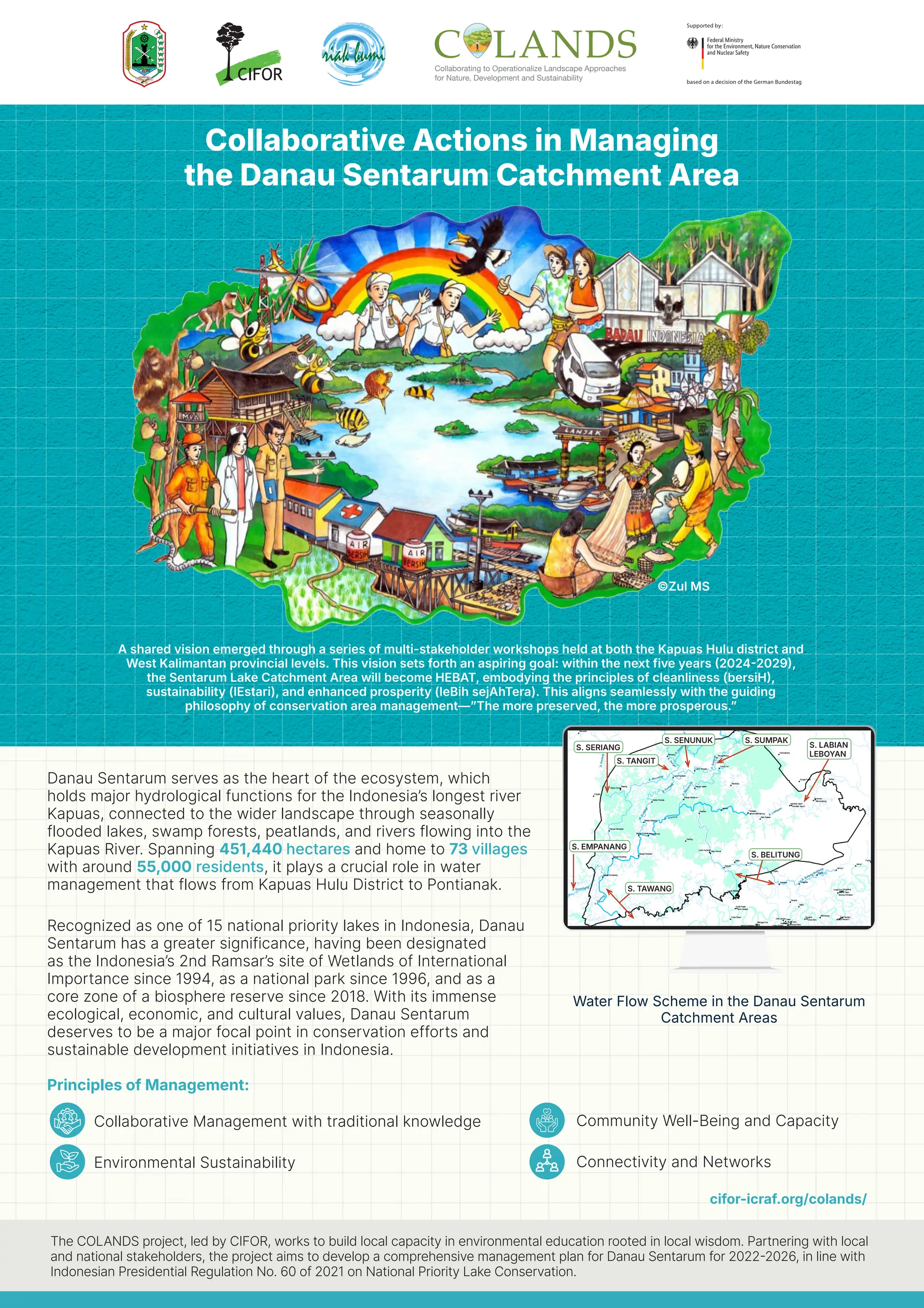
A shared vision emerged through a series of multi-stakeholder workshops held at both the Kapuas Hulu district and
West Kalimantan provincial levels. This vision sets forth an aspiring goal: within the next five years (2024-2029),
the Sentarum Lake Catchment Area will become HEBAT, embodying the principles of cleanliness (bersiH),
sustainability (lEstari), and enhanced prosperity (leBih sejAhTera). This aligns seamlessly with the guiding
philosophy of conservation area management—”The more preserved, the more prosperous.”
©Zul MS
Collaborating to Operationalize Landscape Approaches
for Nature, Development and Sustainability
The COLANDS project, led by CIFOR, works to build local capacity in environmental education rooted in local wisdom. Partnering with local
and national stakeholders, the project aims to develop a comprehensive management plan for Danau Sentarum for 2022-2026, in line with
Indonesian Presidential Regulation No. 60 of 2021 on National Priority Lake Conservation.
Danau Sentarum serves as the heart of the ecosystem, which
holds major hydrological functions for the Indonesia’s longest river
Kapuas, connected to the wider landscape through seasonally
flooded lakes, swamp forests, peatlands, and rivers flowing into the
Kapuas River. Spanning 451,440 hectares and home to 73 villages
with around 55,000 residents, it plays a crucial role in water
management that flows from Kapuas Hulu District to Pontianak.
Recognized as one of 15 national priority lakes in Indonesia, Danau
Sentarum has a greater significance, having been designated
as the Indonesia’s 2nd Ramsar’s site of Wetlands of International
Importance since 1994, as a national park since 1996, and as a
core zone of a biosphere reserve since 2018. With its immense
ecological, economic, and cultural values, Danau Sentarum
deserves to be a major focal point in conservation efforts and
sustainable development initiatives in Indonesia.
Principles of Management:
Collaborative Management with traditional knowledge
Environmental Sustainability
Community Well-Being and Capacity
Connectivity and Networks
cifor-icraf.org/colands/
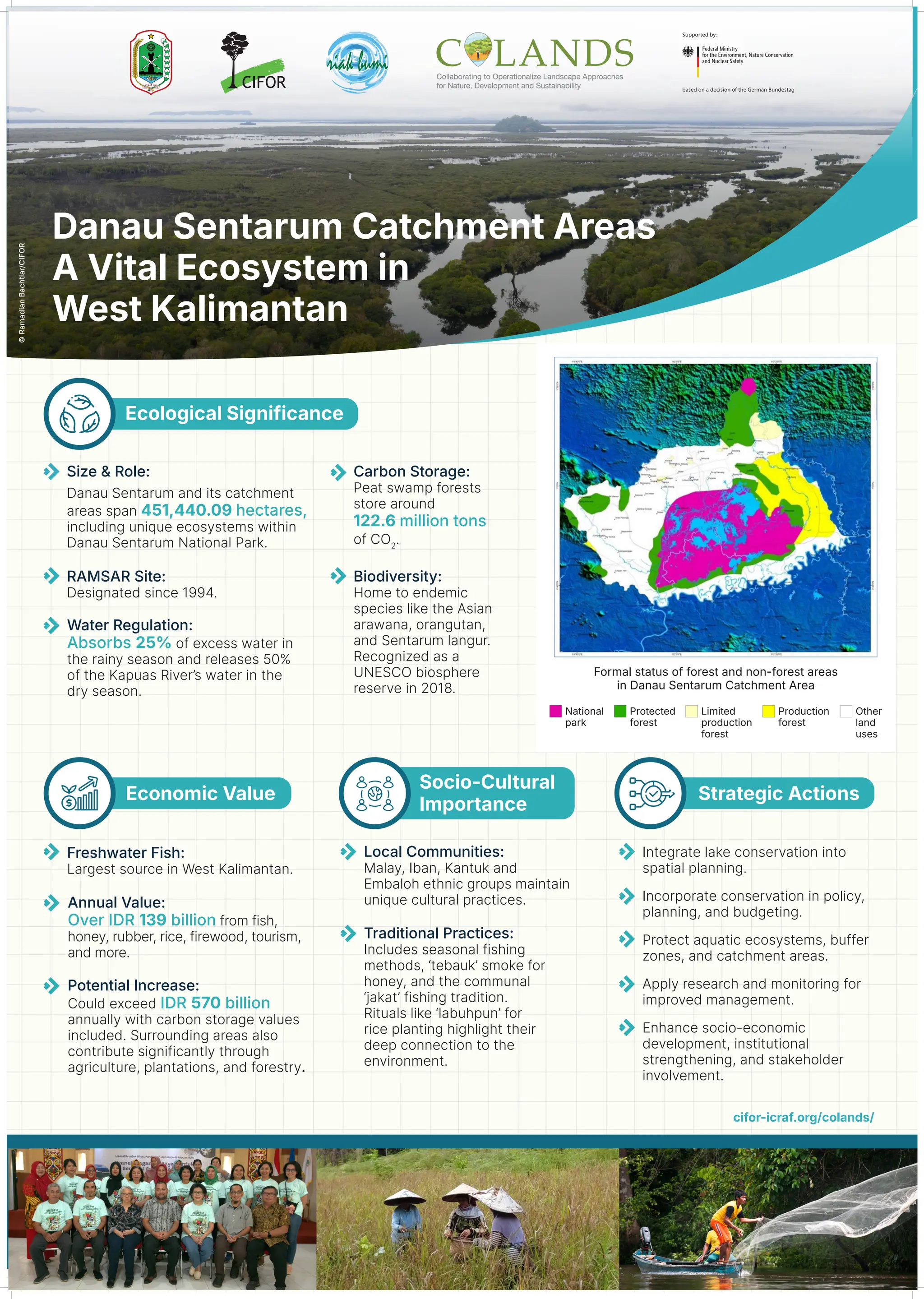
Danau Sentarum Catchment Areas
A Vital Ecosystem in
West Kalimantan
©
Ramadian
Bachtiar/CIFOR
Ecological Significance
Size & Role:
Economic Value
Freshwater Fish:
Largest source in West Kalimantan.
Strategic Actions
Integrate lake conservation into
spatial planning.
Incorporate conservation in policy,
planning, and budgeting.
Protect aquatic ecosystems, buffer
zones, and catchment areas.
Apply research and monitoring for
improved management.
Enhance socio-economic
development, institutional
strengthening, and stakeholder
involvement.
Socio-Cultural
Importance
Local Communities:
Malay, Iban, Kantuk and
Embaloh ethnic groups maintain
unique cultural practices.
Carbon Storage:
Peat swamp forests
store around
122.6 million tons
of CO2
.
Danau Sentarum and its catchment
areas span 451,440.09 hectares,
including unique ecosystems within
Danau Sentarum National Park.
Potential Increase:
Could exceed IDR 570 billion
annually with carbon storage values
included. Surrounding areas also
contribute significantly through
agriculture, plantations, and forestry.
Annual Value:
Over IDR 139 billion from fish,
honey, rubber, rice, firewood, tourism,
and more.
RAMSAR Site:
Designated since 1994.
Water Regulation:
Absorbs 25% of excess water in
the rainy season and releases 50%
of the Kapuas River’s water in the
dry season.
Biodiversity:
Home to endemic
species like the Asian
arawana, orangutan,
and Sentarum langur.
Recognized as a
UNESCO biosphere
reserve in 2018.
Traditional Practices:
Includes seasonal fishing
methods, ‘tebauk’ smoke for
honey, and the communal
‘jakat’ fishing tradition.
Rituals like ‘labuhpun’ for
rice planting highlight their
deep connection to the
environment.
cifor-icraf.org/colands/
Collaborating to Operationalize Landscape Approaches
for Nature, Development and Sustainability
Formal status of forest and non-forest areas
in Danau Sentarum Catchment Area
National
park
Protected
forest
Limited
production
forest
Production
forest
Other
land
uses

Collaborative actions in managing the Danau Sentarum catchment area

  • 1.
    Water Flow Schemein the Danau Sentarum Catchment Areas S. SERIANG S. TANGIT S. SENUNUK S. SUMPAK S. EMPANANG S. LABIAN LEBOYAN S. BELITUNG S. TAWANG Collaborative Actions in Managing the Danau Sentarum Catchment Area A shared vision emerged through a series of multi-stakeholder workshops held at both the Kapuas Hulu district and West Kalimantan provincial levels. This vision sets forth an aspiring goal: within the next five years (2024-2029), the Sentarum Lake Catchment Area will become HEBAT, embodying the principles of cleanliness (bersiH), sustainability (lEstari), and enhanced prosperity (leBih sejAhTera). This aligns seamlessly with the guiding philosophy of conservation area management—”The more preserved, the more prosperous.” ©Zul MS Collaborating to Operationalize Landscape Approaches for Nature, Development and Sustainability The COLANDS project, led by CIFOR, works to build local capacity in environmental education rooted in local wisdom. Partnering with local and national stakeholders, the project aims to develop a comprehensive management plan for Danau Sentarum for 2022-2026, in line with Indonesian Presidential Regulation No. 60 of 2021 on National Priority Lake Conservation. Danau Sentarum serves as the heart of the ecosystem, which holds major hydrological functions for the Indonesia’s longest river Kapuas, connected to the wider landscape through seasonally flooded lakes, swamp forests, peatlands, and rivers flowing into the Kapuas River. Spanning 451,440 hectares and home to 73 villages with around 55,000 residents, it plays a crucial role in water management that flows from Kapuas Hulu District to Pontianak. Recognized as one of 15 national priority lakes in Indonesia, Danau Sentarum has a greater significance, having been designated as the Indonesia’s 2nd Ramsar’s site of Wetlands of International Importance since 1994, as a national park since 1996, and as a core zone of a biosphere reserve since 2018. With its immense ecological, economic, and cultural values, Danau Sentarum deserves to be a major focal point in conservation efforts and sustainable development initiatives in Indonesia. Principles of Management: Collaborative Management with traditional knowledge Environmental Sustainability Community Well-Being and Capacity Connectivity and Networks cifor-icraf.org/colands/
  • 2.
    Danau Sentarum CatchmentAreas A Vital Ecosystem in West Kalimantan © Ramadian Bachtiar/CIFOR Ecological Significance Size & Role: Economic Value Freshwater Fish: Largest source in West Kalimantan. Strategic Actions Integrate lake conservation into spatial planning. Incorporate conservation in policy, planning, and budgeting. Protect aquatic ecosystems, buffer zones, and catchment areas. Apply research and monitoring for improved management. Enhance socio-economic development, institutional strengthening, and stakeholder involvement. Socio-Cultural Importance Local Communities: Malay, Iban, Kantuk and Embaloh ethnic groups maintain unique cultural practices. Carbon Storage: Peat swamp forests store around 122.6 million tons of CO2 . Danau Sentarum and its catchment areas span 451,440.09 hectares, including unique ecosystems within Danau Sentarum National Park. Potential Increase: Could exceed IDR 570 billion annually with carbon storage values included. Surrounding areas also contribute significantly through agriculture, plantations, and forestry. Annual Value: Over IDR 139 billion from fish, honey, rubber, rice, firewood, tourism, and more. RAMSAR Site: Designated since 1994. Water Regulation: Absorbs 25% of excess water in the rainy season and releases 50% of the Kapuas River’s water in the dry season. Biodiversity: Home to endemic species like the Asian arawana, orangutan, and Sentarum langur. Recognized as a UNESCO biosphere reserve in 2018. Traditional Practices: Includes seasonal fishing methods, ‘tebauk’ smoke for honey, and the communal ‘jakat’ fishing tradition. Rituals like ‘labuhpun’ for rice planting highlight their deep connection to the environment. cifor-icraf.org/colands/ Collaborating to Operationalize Landscape Approaches for Nature, Development and Sustainability Formal status of forest and non-forest areas in Danau Sentarum Catchment Area National park Protected forest Limited production forest Production forest Other land uses