COLDPLAY
H Y M N F O R T H E W E E K E N D
THE MUSIC VIDEO: A BRIEF HISTORY
At 12:01am on August 1, 1981, history was made when MTV, the first
24-hour video music channel, launched onto our television sets and
literally changed our lives with the birth of the music video. The first
video ever played on the network was quite ironic — “Video Killed The
Radio Star” by The Buggles. With this new outlet that possessed
exciting opportunities for not just the singers but in technology and
communications too, the music video reputation soared, playing a
central role in popular music marketing. Many important acts of this
period, most notably Adam and the Ants, Duran Duran and Madonna,
owed a great deal of their success to the skilful construction and
seductive appeal of their videos.
Since then, though the popularity of the music video has somewhat
diminished, artists from all around the video often stream live videos
primarily made and used as a marketing device intended to promote
the sale of music recordings. Often, music videos these days also use a
wide range of styles of contemporary video making techniques,
including animation, live action filming, documentaries, and non-
narrative approaches such as abstract film.
GOODWIN’S THEORY
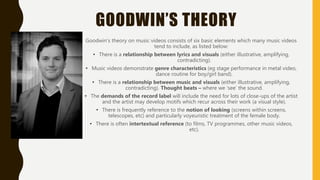
Goodwin's theory on music videos consists of six basic elements which many music videos
tend to include, as listed below:
• There is a relationship between lyrics and visuals (either illustrative, amplifying,
contradicting).
• Music videos demonstrate genre characteristics (eg stage performance in metal video,
dance routine for boy/girl band).
• There is a relationship between music and visuals (either illustrative, amplifying,
contradicting). Thought beats – where we ‘see’ the sound.
• The demands of the record label will include the need for lots of close-ups of the artist
and the artist may develop motifs which recur across their work (a visual style).
• There is frequently reference to the notion of looking (screens within screens,
telescopes, etc) and particularly voyeuristic treatment of the female body.
• There is often intertextual reference (to films, TV programmes, other music videos,
etc).
COLDPLAY – HYMN FOR THE WEEKEND
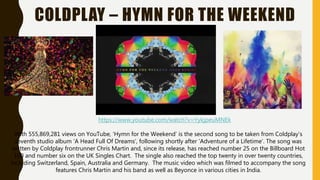
With 555,869,281 views on YouTube, ‘Hymn for the Weekend’ is the second song to be taken from Coldplay’s
seventh studio album ‘A Head Full Of Dreams’, following shortly after ‘Adventure of a Lifetime’. The song was
written by Coldplay frontrunner Chris Martin and, since its release, has reached number 25 on the Billboard Hot
100 and number six on the UK Singles Chart. The single also reached the top twenty in over twenty countries,
including Switzerland, Spain, Australia and Germany. The music video which was filmed to accompany the song
features Chris Martin and his band as well as Beyonce in various cities in India.
https://www.youtube.com/watch?v=YykjpeuMNEk
1. GENRE CHARACTERISTICS
As a band defined by the genres of alternative rock, pop
rock and piano rock, there are certain genre characteristics
which would be expected to be found in other videos
conforming to the same category. In this case, there are
several shots of the band playing their instruments,
including an establishing shot and several close ups of the
individual band members with their instruments too. By
doing this, the band demonstrate an entire attention upon
their music, as well as their audience as they enjoy seeing
them having a good time, something which is regularly
found in several other of their music videos and other
music videos of bands with similar genres.
2. THE RELATIONSHIP BETWEEN
LYRICS AND VISUALS
When applying this segment of Goodwin’s theory to Coldplay’s music video, it can be argued that the visuals both
contradict and yet amplify the lyrics.
Upon the lyrics ‘Put your wings on me/Wings on me/When I was so heavy’, a high angle shot reveals a flock of
birds taking flight and soaring into the air. In this part, both the lyrics and the visuals slot together and both give
the impression of being able to fly away again and soar because some kind of heavy burden has been lifted.
A further meaning between the lyrics and the visuals can also be found upon the lyrics ‘Let me shoot across the
sky’ which sees a young Indian woman opening her hands to release some colourful confetti. The camera then
follows and tracks this confetti flying away, which once more implies the meaning of soaring across the sky as the
lyrics suggest.
That said, however, a lot of other shots which precede and follow contradict the lyrics so that no overall
relationship or meaning between the two can evidently be distinguished, what with the mise-en-scene that sets
the video in a remote town in India and the strange, vibrant paint which stains the band members and the people
dancing around them. One could say, nonetheless, that this is done with good reason. Because the song itself has
no particular meaning or moral, the music video itself doesn’t have to either. Instead, the directors perhaps wish
for the audience to focus more upon the relationship between the music and the visuals instead as well as the
song’s catchy beat and tune.
3. THE RELATIONSHIP BETWEEN
MUSIC AND VISUALS
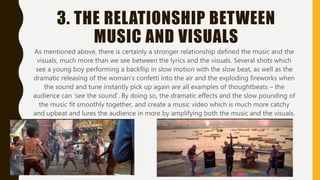
As mentioned above, there is certainly a stronger relationship defined the music and the
visuals, much more than we see between the lyrics and the visuals. Several shots which
see a young boy performing a backflip in slow motion with the slow beat, as well as the
dramatic releasing of the woman’s confetti into the air and the exploding fireworks when
the sound and tune instantly pick up again are all examples of thoughtbeats – the
audience can ‘see the sound’. By doing so, the dramatic effects and the slow pounding of
the music fit smoothly together, and create a music video which is much more catchy
and upbeat and lures the audience in more by amplifying both the music and the visuals.
4. INTERTEXTUAL REFERENCES
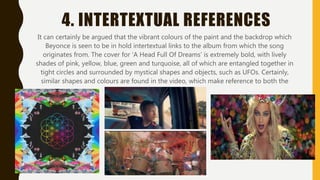
It can certainly be argued that the vibrant colours of the paint and the backdrop which
Beyonce is seen to be in hold intertextual links to the album from which the song
originates from. The cover for ‘A Head Full Of Dreams’ is extremely bold, with lively
shades of pink, yellow, blue, green and turquoise, all of which are entangled together in
tight circles and surrounded by mystical shapes and objects, such as UFOs. Certainly,
similar shapes and colours are found in the video, which make reference to both the
song and the album.
5. THE DEMANDS OF THE RECORD
LABEL + MOTIFS
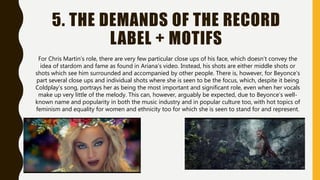
For Chris Martin’s role, there are very few particular close ups of his face, which doesn’t convey the
idea of stardom and fame as found in Ariana’s video. Instead, his shots are either middle shots or
shots which see him surrounded and accompanied by other people. There is, however, for Beyonce’s
part several close ups and individual shots where she is seen to be the focus, which, despite it being
Coldplay’s song, portrays her as being the most important and significant role, even when her vocals
make up very little of the melody. This can, however, arguably be expected, due to Beyonce’s well-
known name and popularity in both the music industry and in popular culture too, with hot topics of
feminism and equality for women and ethnicity too for which she is seen to stand for and represent.
6. THE NOTION OF LOOKING +
VOYEURISTIC TREATMENT OF THE FEMALE
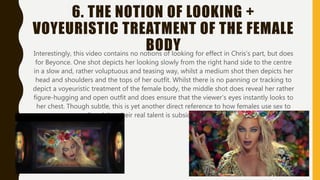
BODYInterestingly, this video contains no notions of looking for effect in Chris’s part, but does
for Beyonce. One shot depicts her looking slowly from the right hand side to the centre
in a slow and, rather voluptuous and teasing way, whilst a medium shot then depicts her
head and shoulders and the tops of her outfit. Whilst there is no panning or tracking to
depict a voyeuristic treatment of the female body, the middle shot does reveal her rather
figure-hugging and open outfit and does ensure that the viewer’s eyes instantly looks to
her chest. Though subtle, this is yet another direct reference to how females use sex to
sell and that their real talent is subsided because of this.

Coldplay - Hymn For The Weekend (Improved Version)

  • 1.
    COLDPLAY H Y MN F O R T H E W E E K E N D
  • 2.
    THE MUSIC VIDEO:A BRIEF HISTORY At 12:01am on August 1, 1981, history was made when MTV, the first 24-hour video music channel, launched onto our television sets and literally changed our lives with the birth of the music video. The first video ever played on the network was quite ironic — “Video Killed The Radio Star” by The Buggles. With this new outlet that possessed exciting opportunities for not just the singers but in technology and communications too, the music video reputation soared, playing a central role in popular music marketing. Many important acts of this period, most notably Adam and the Ants, Duran Duran and Madonna, owed a great deal of their success to the skilful construction and seductive appeal of their videos. Since then, though the popularity of the music video has somewhat diminished, artists from all around the video often stream live videos primarily made and used as a marketing device intended to promote the sale of music recordings. Often, music videos these days also use a wide range of styles of contemporary video making techniques, including animation, live action filming, documentaries, and non- narrative approaches such as abstract film.
  • 3.
    GOODWIN’S THEORY Goodwin's theoryon music videos consists of six basic elements which many music videos tend to include, as listed below: • There is a relationship between lyrics and visuals (either illustrative, amplifying, contradicting). • Music videos demonstrate genre characteristics (eg stage performance in metal video, dance routine for boy/girl band). • There is a relationship between music and visuals (either illustrative, amplifying, contradicting). Thought beats – where we ‘see’ the sound. • The demands of the record label will include the need for lots of close-ups of the artist and the artist may develop motifs which recur across their work (a visual style). • There is frequently reference to the notion of looking (screens within screens, telescopes, etc) and particularly voyeuristic treatment of the female body. • There is often intertextual reference (to films, TV programmes, other music videos, etc).
  • 4.
    COLDPLAY – HYMNFOR THE WEEKEND With 555,869,281 views on YouTube, ‘Hymn for the Weekend’ is the second song to be taken from Coldplay’s seventh studio album ‘A Head Full Of Dreams’, following shortly after ‘Adventure of a Lifetime’. The song was written by Coldplay frontrunner Chris Martin and, since its release, has reached number 25 on the Billboard Hot 100 and number six on the UK Singles Chart. The single also reached the top twenty in over twenty countries, including Switzerland, Spain, Australia and Germany. The music video which was filmed to accompany the song features Chris Martin and his band as well as Beyonce in various cities in India. https://www.youtube.com/watch?v=YykjpeuMNEk
  • 5.
    1. GENRE CHARACTERISTICS Asa band defined by the genres of alternative rock, pop rock and piano rock, there are certain genre characteristics which would be expected to be found in other videos conforming to the same category. In this case, there are several shots of the band playing their instruments, including an establishing shot and several close ups of the individual band members with their instruments too. By doing this, the band demonstrate an entire attention upon their music, as well as their audience as they enjoy seeing them having a good time, something which is regularly found in several other of their music videos and other music videos of bands with similar genres.
  • 6.
    2. THE RELATIONSHIPBETWEEN LYRICS AND VISUALS When applying this segment of Goodwin’s theory to Coldplay’s music video, it can be argued that the visuals both contradict and yet amplify the lyrics. Upon the lyrics ‘Put your wings on me/Wings on me/When I was so heavy’, a high angle shot reveals a flock of birds taking flight and soaring into the air. In this part, both the lyrics and the visuals slot together and both give the impression of being able to fly away again and soar because some kind of heavy burden has been lifted. A further meaning between the lyrics and the visuals can also be found upon the lyrics ‘Let me shoot across the sky’ which sees a young Indian woman opening her hands to release some colourful confetti. The camera then follows and tracks this confetti flying away, which once more implies the meaning of soaring across the sky as the lyrics suggest. That said, however, a lot of other shots which precede and follow contradict the lyrics so that no overall relationship or meaning between the two can evidently be distinguished, what with the mise-en-scene that sets the video in a remote town in India and the strange, vibrant paint which stains the band members and the people dancing around them. One could say, nonetheless, that this is done with good reason. Because the song itself has no particular meaning or moral, the music video itself doesn’t have to either. Instead, the directors perhaps wish for the audience to focus more upon the relationship between the music and the visuals instead as well as the song’s catchy beat and tune.
  • 8.
    3. THE RELATIONSHIPBETWEEN MUSIC AND VISUALS As mentioned above, there is certainly a stronger relationship defined the music and the visuals, much more than we see between the lyrics and the visuals. Several shots which see a young boy performing a backflip in slow motion with the slow beat, as well as the dramatic releasing of the woman’s confetti into the air and the exploding fireworks when the sound and tune instantly pick up again are all examples of thoughtbeats – the audience can ‘see the sound’. By doing so, the dramatic effects and the slow pounding of the music fit smoothly together, and create a music video which is much more catchy and upbeat and lures the audience in more by amplifying both the music and the visuals.
  • 9.
    4. INTERTEXTUAL REFERENCES Itcan certainly be argued that the vibrant colours of the paint and the backdrop which Beyonce is seen to be in hold intertextual links to the album from which the song originates from. The cover for ‘A Head Full Of Dreams’ is extremely bold, with lively shades of pink, yellow, blue, green and turquoise, all of which are entangled together in tight circles and surrounded by mystical shapes and objects, such as UFOs. Certainly, similar shapes and colours are found in the video, which make reference to both the song and the album.
  • 10.
    5. THE DEMANDSOF THE RECORD LABEL + MOTIFS For Chris Martin’s role, there are very few particular close ups of his face, which doesn’t convey the idea of stardom and fame as found in Ariana’s video. Instead, his shots are either middle shots or shots which see him surrounded and accompanied by other people. There is, however, for Beyonce’s part several close ups and individual shots where she is seen to be the focus, which, despite it being Coldplay’s song, portrays her as being the most important and significant role, even when her vocals make up very little of the melody. This can, however, arguably be expected, due to Beyonce’s well- known name and popularity in both the music industry and in popular culture too, with hot topics of feminism and equality for women and ethnicity too for which she is seen to stand for and represent.
  • 11.
    6. THE NOTIONOF LOOKING + VOYEURISTIC TREATMENT OF THE FEMALE BODYInterestingly, this video contains no notions of looking for effect in Chris’s part, but does for Beyonce. One shot depicts her looking slowly from the right hand side to the centre in a slow and, rather voluptuous and teasing way, whilst a medium shot then depicts her head and shoulders and the tops of her outfit. Whilst there is no panning or tracking to depict a voyeuristic treatment of the female body, the middle shot does reveal her rather figure-hugging and open outfit and does ensure that the viewer’s eyes instantly looks to her chest. Though subtle, this is yet another direct reference to how females use sex to sell and that their real talent is subsided because of this.