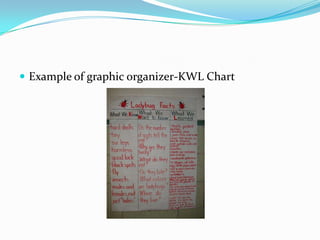
Cognitive learning theory proposes that students learn by actively engaging their senses and prior knowledge to process new information. Learners build on their existing mental frameworks ("schemas") and store new information in their brain like filing cabinets, creating new files for each new topic. Theorists like Vygotsky and Bruner emphasized that learning is an active process of discovery where students construct understanding within their zone of proximal development. Effective teaching strategies based on cognitive learning theory include student-centered learning, critical thinking, problem solving, using graphic organizers like KWL charts, and applying Bloom's taxonomy.