SOFTWARE ENGINEERING (II) PROJECT
PRESENTATION
PROPOSED PROJECT NAME:
ABU CONGREGATION ELECTION E-VOTING APPLICATION
SDG GOAL: 9
TEAM NAME:
GROUP A
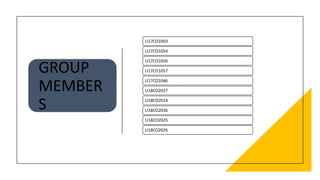
GROUP
MEMBER
S
U17CO1003
U17CO1054
U17CO1056
U17CO1057
U17CO1046
U18CO2027
U18CO2014
U18CO2036
U18CO2025
U18CO2026
Content
Introduction
Problem statement
Aim and objectives
Literature review
Software Development Life Cycle
Software Design
The User Interfaces
Conclusion and Live Demonstration
INTRODUCTION
In our world, elections are a fundamental process for selecting leaders and decision-makers in any organization or society.
Ahmadu Bello University (ABU) in Zaria is one of Nigeria’s oldest and largest universities.
Currently, ABU relies on paper ballots for its congregation elections, which are often criticized for being slow, insecure, and
inefficient.
In the digital era, e-voting enhances elections by improving efficiency, transparency, accessibility, and participation.
The application of technology boost voter turnout and confidence in the election process by guaranteeing security and
accessibility.
The development of this system is intended to address existing challenges and create a more streamlined and effective
electoral process at ABU.
Problem
Statement
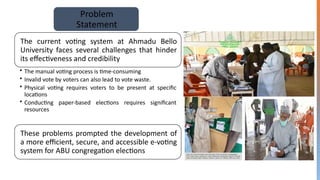
The current voting system at Ahmadu Bello
University faces several challenges that hinder
its effectiveness and credibility
• The manual voting process is time-consuming
• Invalid vote by voters can also lead to vote waste.
• Physical voting requires voters to be present at specific
locations
• Conducting paper-based elections requires significant
resources
These problems prompted the development of
a more efficient, secure, and accessible e-voting
system for ABU congregation elections
AIM AND OBJECTIVES
The aim of this project work is to create easy to use, reliable and secure e-
voting application that will meet the electoral demand of Ahmadu Bello
University Congregation election. The objectives in achieving the aims
are:
• To create a user-friendly e-voting application that facilitates Congregation elections within
the university.
• To develop application that will be used to accommodate all voters, including those with
disabilities and those off-campus.
• To conduct a usability testing with a diverse group of voters to collect feedback and
improve the application's functionality.
LITERATURE REVIEW
Kalaiyarasi et al. (2020) developed a smartphone-based e-voting system using Android Studio, XML,
Java, MySQL, and Firebase, reducing voting time and fraud but missing discussion on security
vulnerabilities and accessibility, aligning with SDG 16.
Sherine et al. (2022) created a secure e-voting app for students with captcha, OTP, and fingerprint
authentication, preventing phishing and enabling remote voting, though improvements are needed
in real-time result display and notifications, aligning with SDG 16 and SDG 9.
Yanti et al. (2023) developed an Android-based e-voting application for village head elections using
the Waterfall model, promoting transparency and efficiency but lacking detailed cybersecurity
measures and accessibility considerations, aligning with SDG 16 and SDG 9.
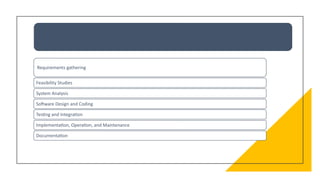
SOFTWARE DEVELOPMENT LIFE CYCLE
Requirements gathering
Feasibility Studies
System Analysis
Software Design and Coding
Testing and Integration
Implementation, Operation, and Maintenance
Documentation
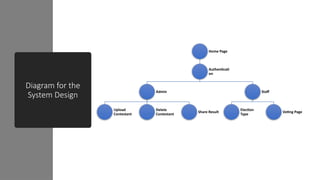
Diagram for the
System Design
Home Page
Authenticati
on
Admin
Upload
Contestant
Delete
Contestant
Share Result
Staff
Election
Type
Voting Page
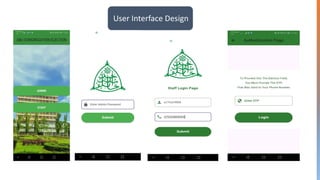
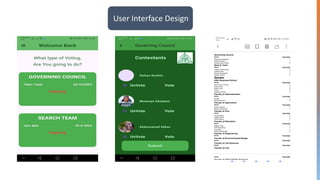
User Interface Design
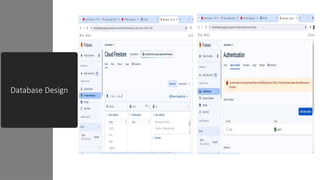
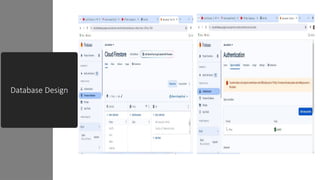
Database Design
Database Design
Conclusion
The main objective of the E-Voting Mobile Application
development process was to create a safe, effective, and easy-
to-use platform for electronic voting. Using a thorough
Software Development Life Cycle (SDLC) process, the
application was created, put into use, and tested to ensure that
it satisfied the requirements of both election officials and
voters.
THANK YOU FOR LISTENING.....

COEN_502_PRESENTATION_ABUZARIA_GROUP_.pptx

  • 1.
    SOFTWARE ENGINEERING (II)PROJECT PRESENTATION PROPOSED PROJECT NAME: ABU CONGREGATION ELECTION E-VOTING APPLICATION SDG GOAL: 9 TEAM NAME: GROUP A
  • 2.
  • 3.
    Content Introduction Problem statement Aim andobjectives Literature review Software Development Life Cycle Software Design The User Interfaces Conclusion and Live Demonstration
  • 4.
    INTRODUCTION In our world,elections are a fundamental process for selecting leaders and decision-makers in any organization or society. Ahmadu Bello University (ABU) in Zaria is one of Nigeria’s oldest and largest universities. Currently, ABU relies on paper ballots for its congregation elections, which are often criticized for being slow, insecure, and inefficient. In the digital era, e-voting enhances elections by improving efficiency, transparency, accessibility, and participation. The application of technology boost voter turnout and confidence in the election process by guaranteeing security and accessibility. The development of this system is intended to address existing challenges and create a more streamlined and effective electoral process at ABU.
  • 5.
    Problem Statement The current votingsystem at Ahmadu Bello University faces several challenges that hinder its effectiveness and credibility • The manual voting process is time-consuming • Invalid vote by voters can also lead to vote waste. • Physical voting requires voters to be present at specific locations • Conducting paper-based elections requires significant resources These problems prompted the development of a more efficient, secure, and accessible e-voting system for ABU congregation elections
  • 6.
    AIM AND OBJECTIVES Theaim of this project work is to create easy to use, reliable and secure e- voting application that will meet the electoral demand of Ahmadu Bello University Congregation election. The objectives in achieving the aims are: • To create a user-friendly e-voting application that facilitates Congregation elections within the university. • To develop application that will be used to accommodate all voters, including those with disabilities and those off-campus. • To conduct a usability testing with a diverse group of voters to collect feedback and improve the application's functionality.
  • 7.
    LITERATURE REVIEW Kalaiyarasi etal. (2020) developed a smartphone-based e-voting system using Android Studio, XML, Java, MySQL, and Firebase, reducing voting time and fraud but missing discussion on security vulnerabilities and accessibility, aligning with SDG 16. Sherine et al. (2022) created a secure e-voting app for students with captcha, OTP, and fingerprint authentication, preventing phishing and enabling remote voting, though improvements are needed in real-time result display and notifications, aligning with SDG 16 and SDG 9. Yanti et al. (2023) developed an Android-based e-voting application for village head elections using the Waterfall model, promoting transparency and efficiency but lacking detailed cybersecurity measures and accessibility considerations, aligning with SDG 16 and SDG 9.
  • 8.
    SOFTWARE DEVELOPMENT LIFECYCLE Requirements gathering Feasibility Studies System Analysis Software Design and Coding Testing and Integration Implementation, Operation, and Maintenance Documentation
  • 9.
    Diagram for the SystemDesign Home Page Authenticati on Admin Upload Contestant Delete Contestant Share Result Staff Election Type Voting Page
  • 10.
  • 11.
  • 12.
  • 13.
  • 14.
    Conclusion The main objectiveof the E-Voting Mobile Application development process was to create a safe, effective, and easy- to-use platform for electronic voting. Using a thorough Software Development Life Cycle (SDLC) process, the application was created, put into use, and tested to ensure that it satisfied the requirements of both election officials and voters.
  • 15.
    THANK YOU FORLISTENING.....