1
/Code that
gets you
pwn(s|'d)/
L o u i s N y f f e n e g g e r 

L o u i s @ p e n t e s t e r l a b . c o m
@ s n y f f / @ P e n t e s t e r L a b
2
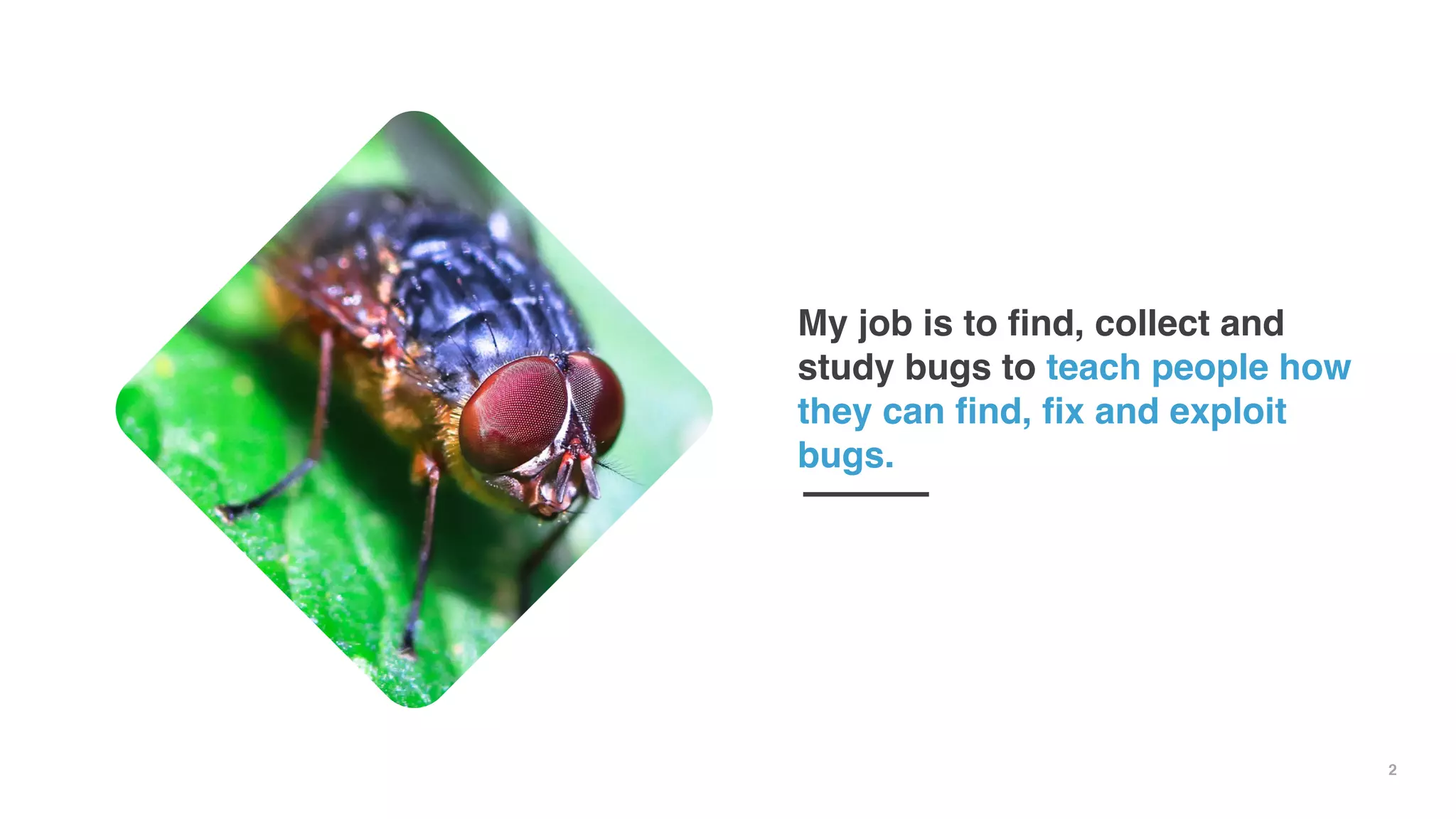
My job is to find, collect and
study bugs to teach people how
they can find, fix and exploit
bugs.
3
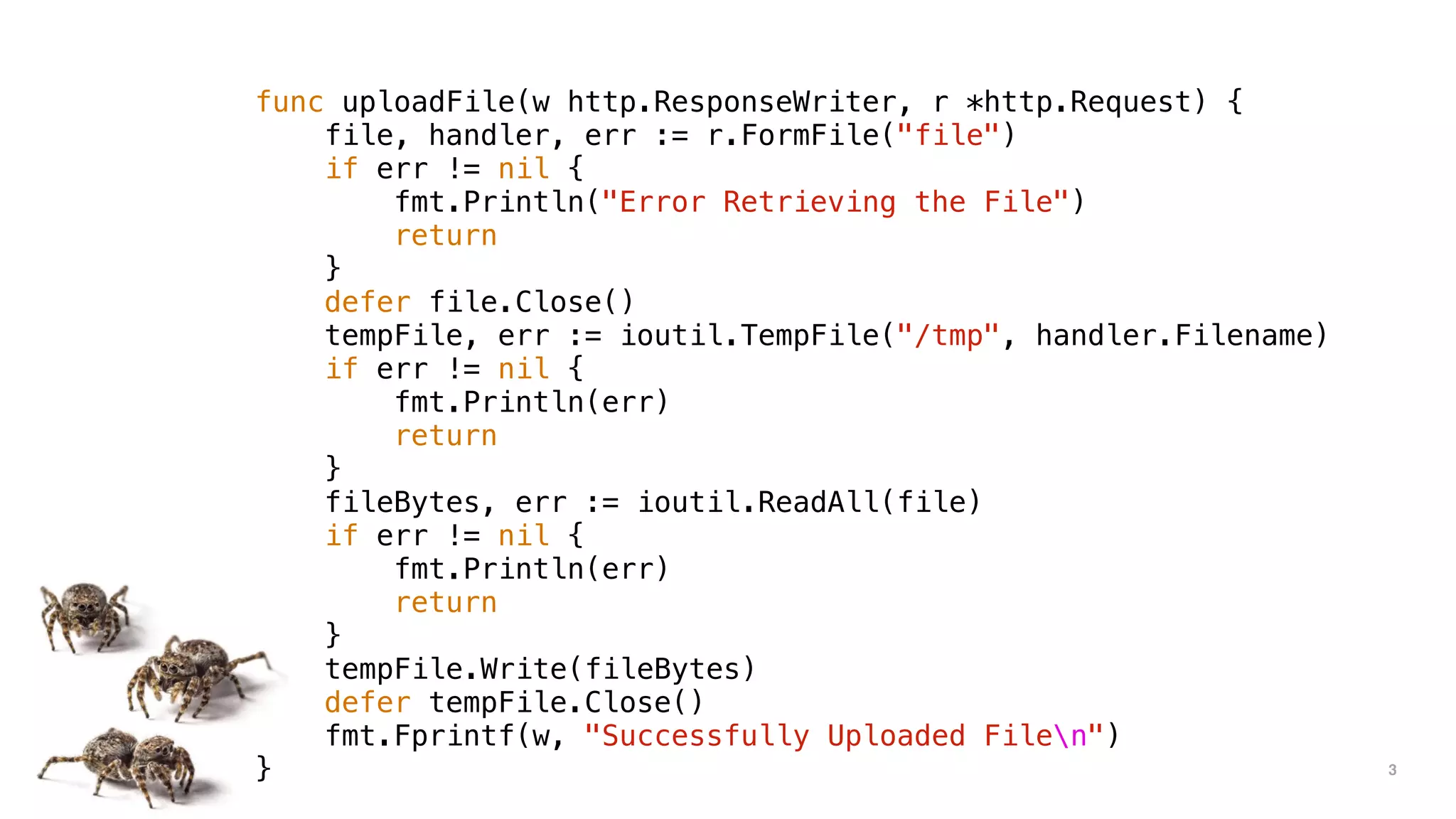
func uploadFile(w http.ResponseWriter, r *http.Request) {
file, handler, err := r.FormFile("file")
if err != nil {
fmt.Println("Error Retrieving the File")
return
}
defer file.Close()
tempFile, err := ioutil.TempFile("/tmp", handler.Filename)
if err != nil {
fmt.Println(err)
return
}
fileBytes, err := ioutil.ReadAll(file)
if err != nil {
fmt.Println(err)
return
}
tempFile.Write(fileBytes)
defer tempFile.Close()
fmt.Fprintf(w, "Successfully Uploaded Filen")
}
4
5
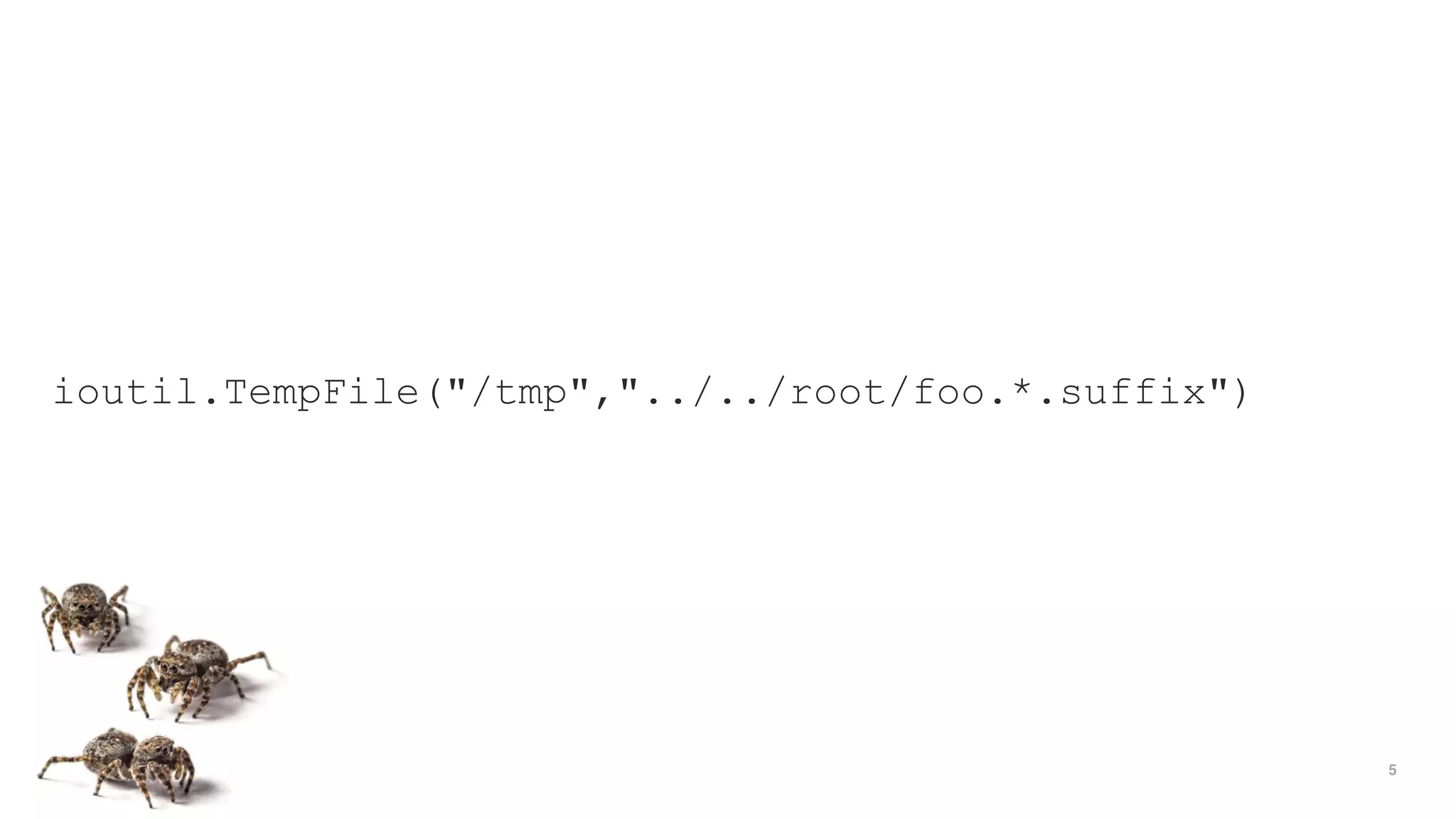
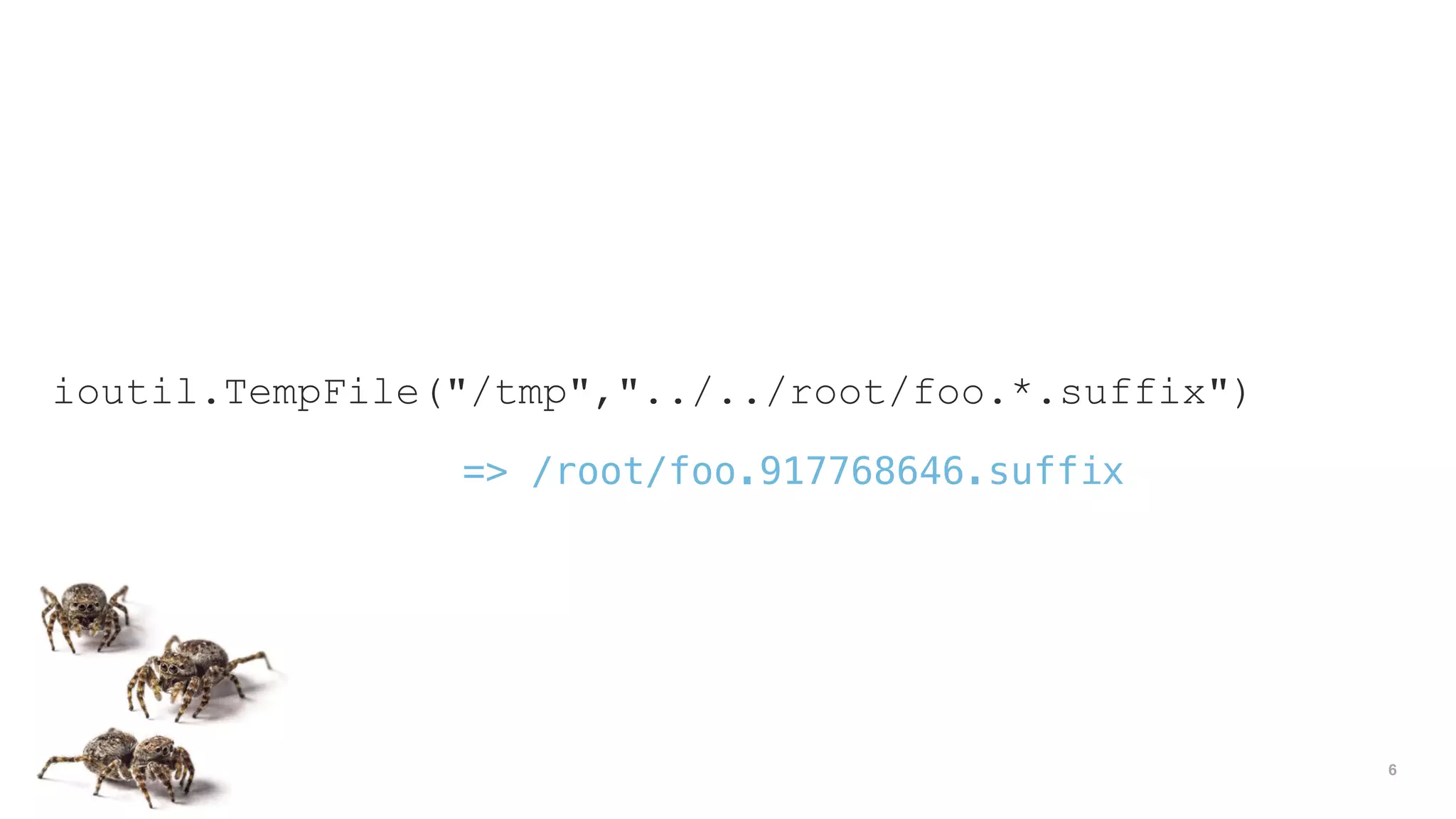
ioutil.TempFile("/tmp","../../root/foo.*.suffix")
6
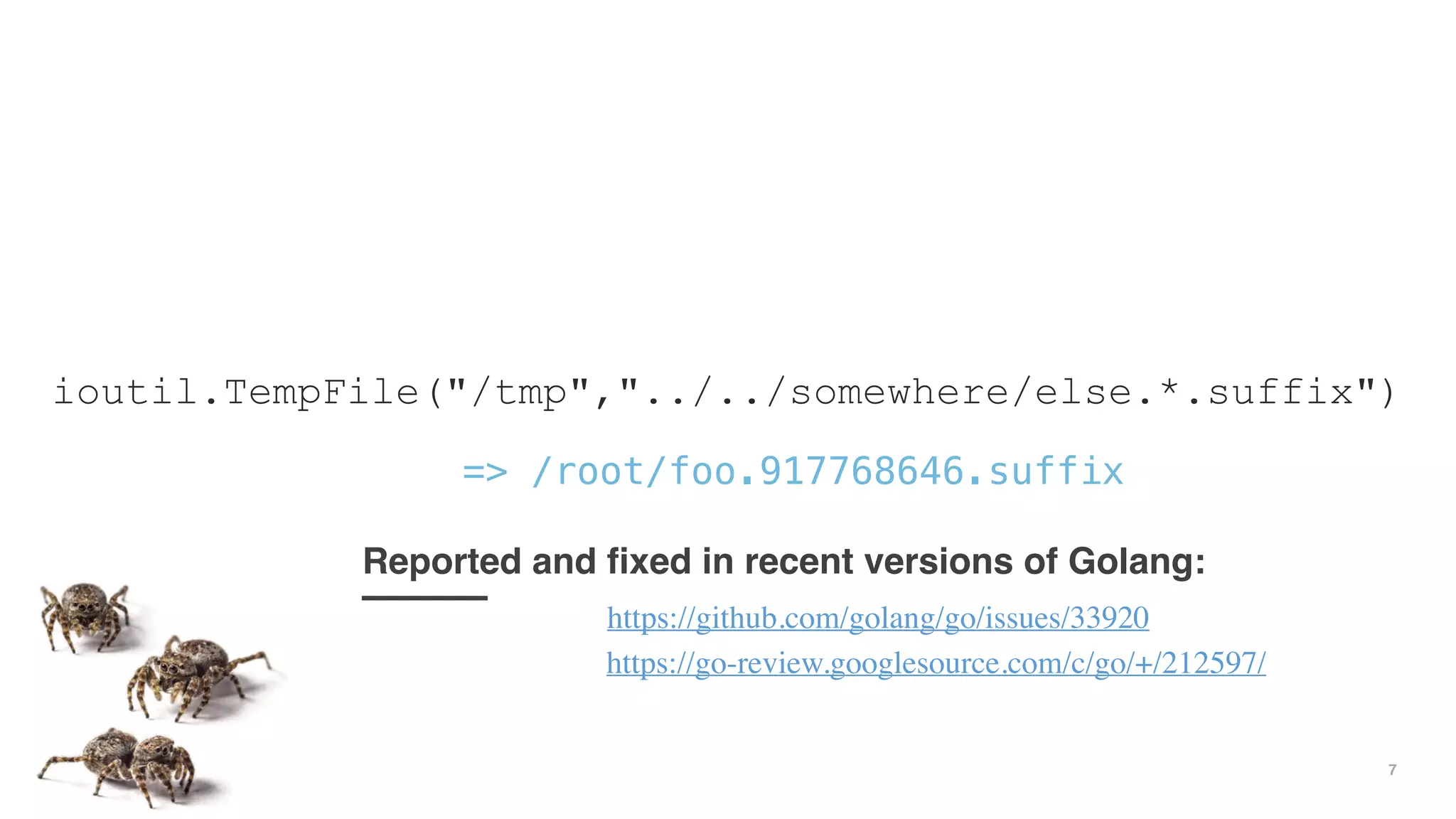
ioutil.TempFile("/tmp","../../root/foo.*.suffix")
=> /root/foo.917768646.suffix
7
ioutil.TempFile("/tmp","../../somewhere/else.*.suffix")
https://github.com/golang/go/issues/33920
Reported and fixed in recent versions of Golang:
https://go-review.googlesource.com/c/go/+/212597/
=> /root/foo.917768646.suffix
8
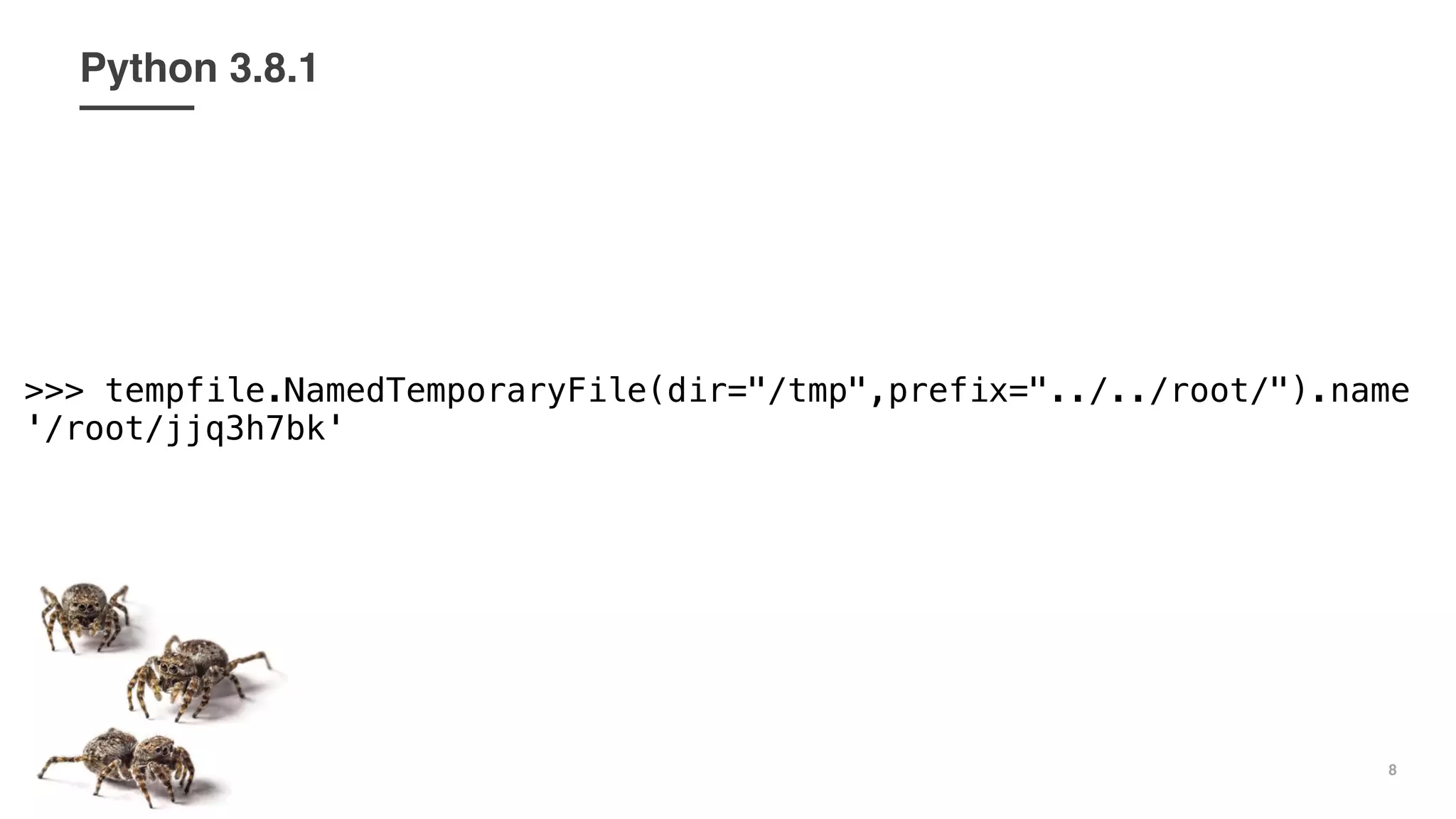
>>> tempfile.NamedTemporaryFile(dir="/tmp",prefix="../../root/").name
'/root/jjq3h7bk'
Python 3.8.1
9
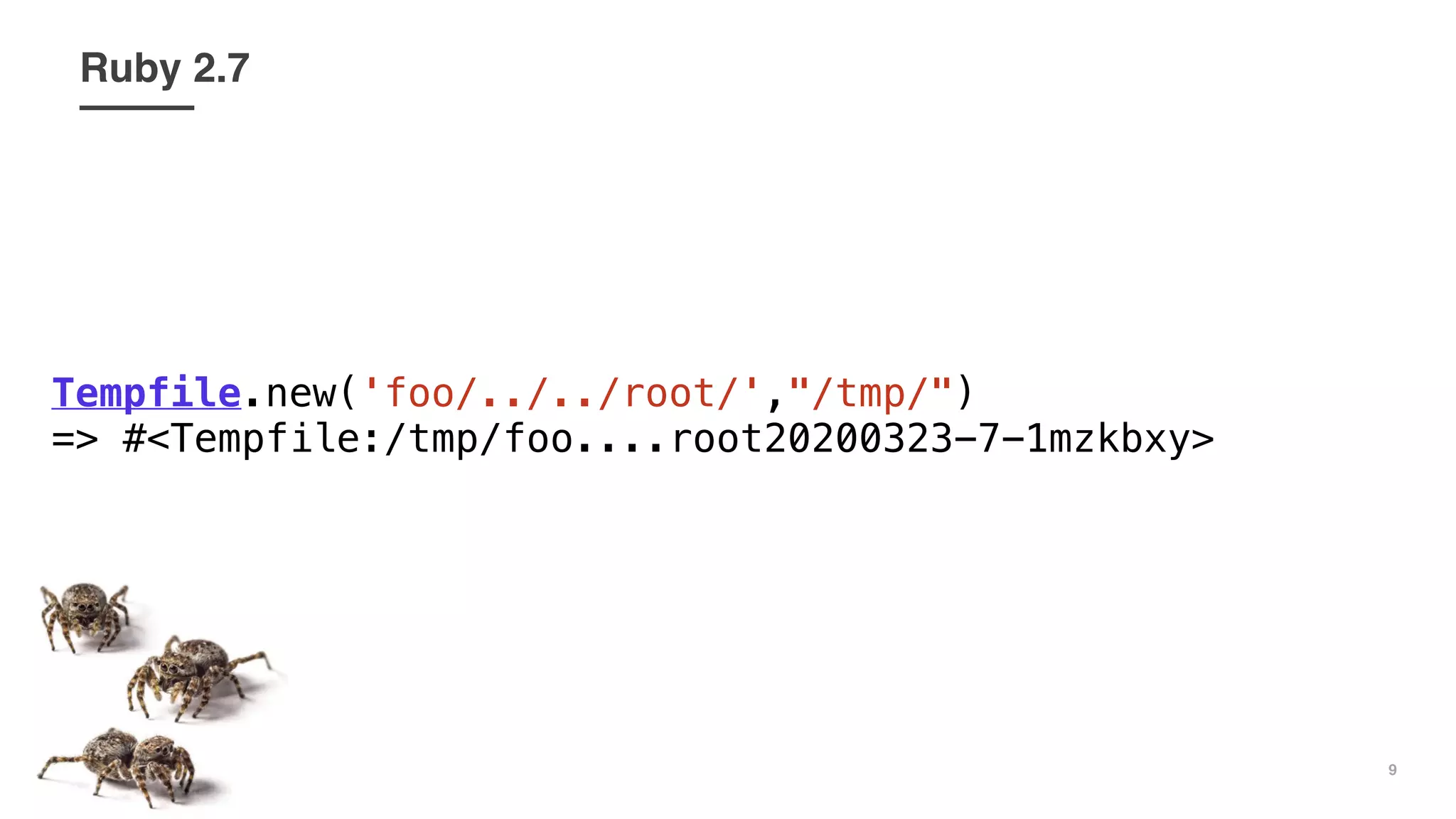
Tempfile.new('foo/../../root/',"/tmp/")
=> #<Tempfile:/tmp/foo....root20200323-7-1mzkbxy>
Ruby 2.7
10
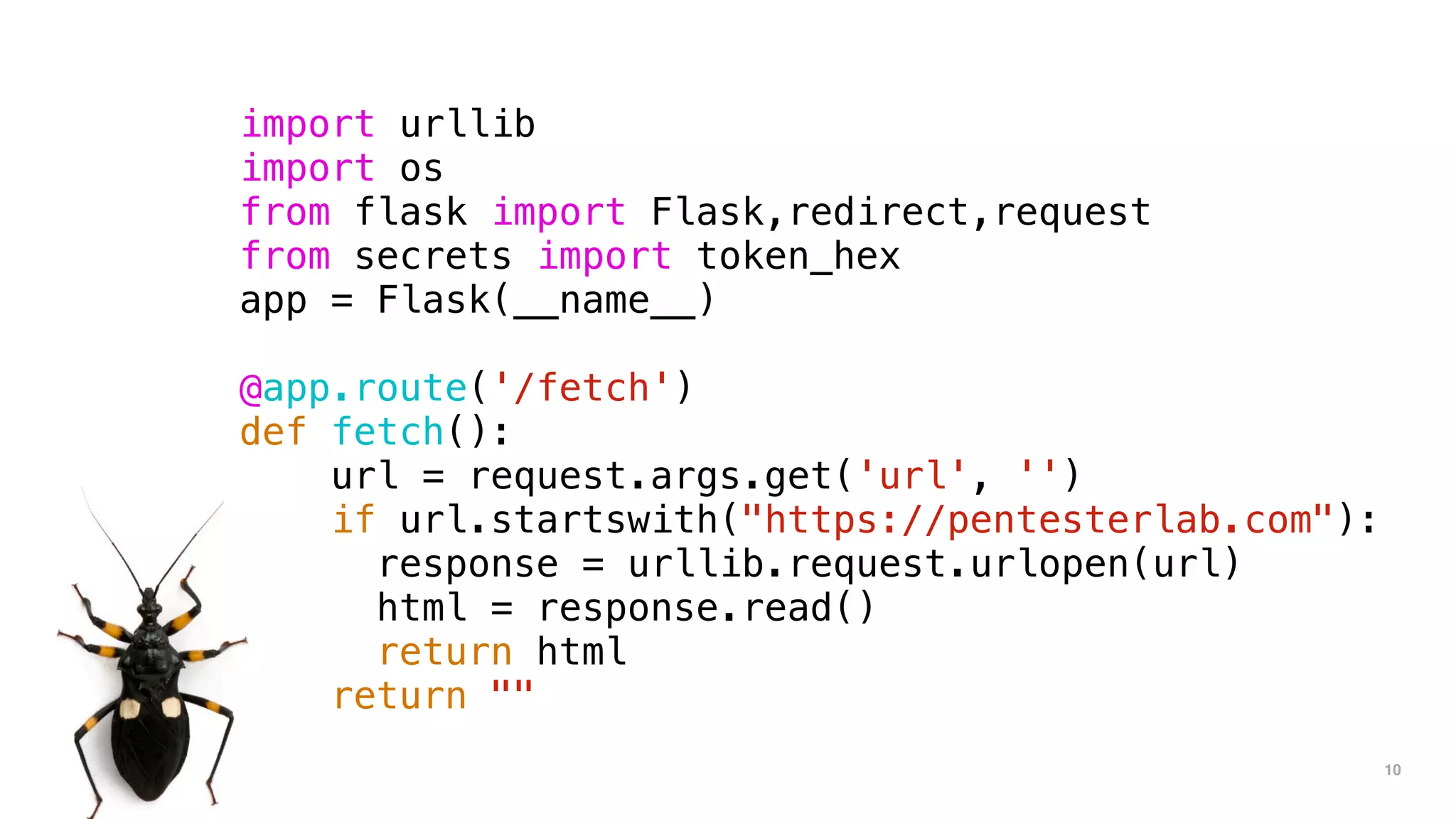
import urllib
import os
from flask import Flask,redirect,request
from secrets import token_hex
app = Flask(__name__)
@app.route('/fetch')
def fetch():
url = request.args.get('url', '')
if url.startswith("https://pentesterlab.com"):
response = urllib.request.urlopen(url)
html = response.read()
return html
return ""
11
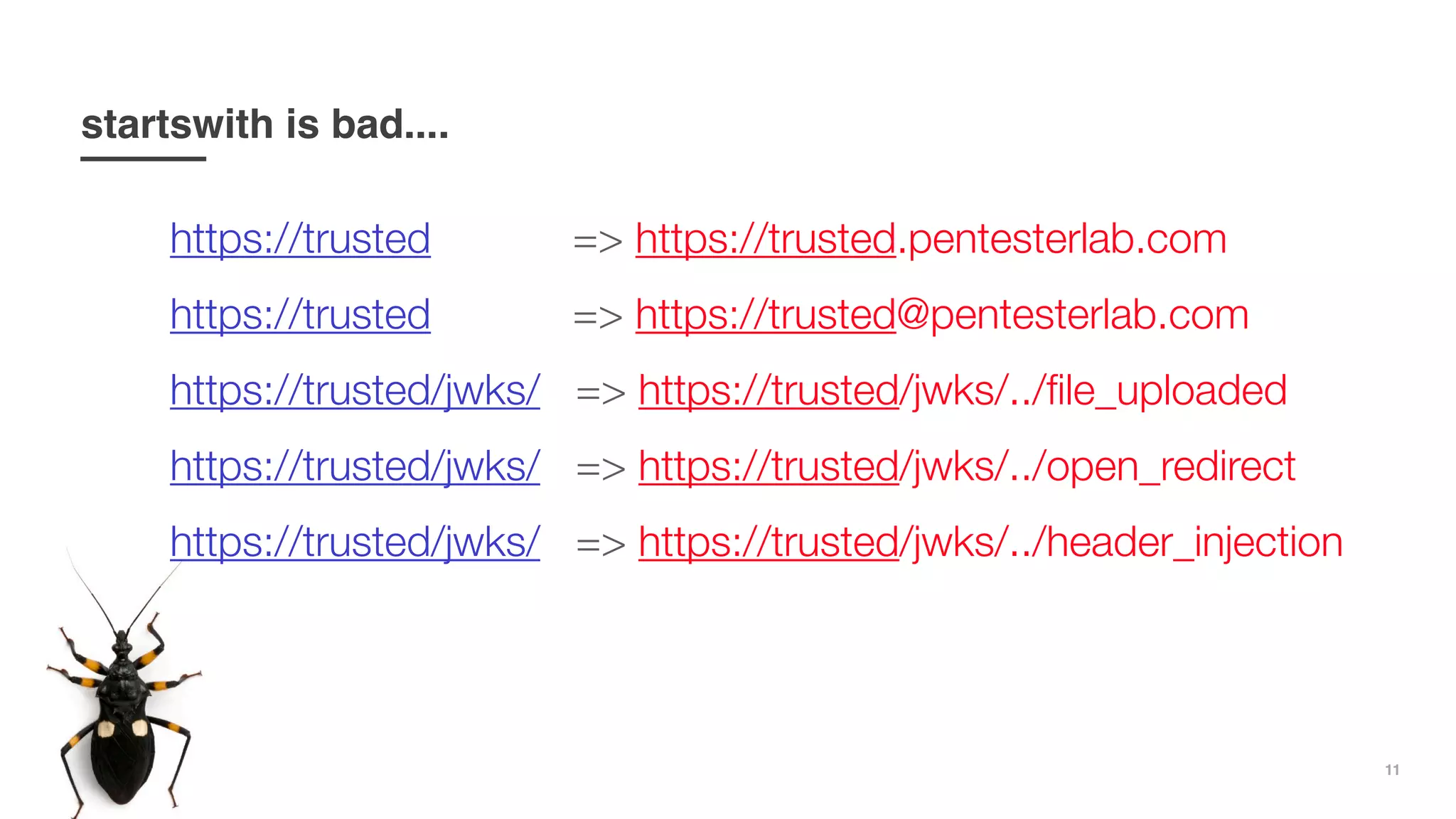
https://trusted => https://trusted.pentesterlab.com
https://trusted => https://trusted@pentesterlab.com
https://trusted/jwks/ => https://trusted/jwks/../file_uploaded
https://trusted/jwks/ => https://trusted/jwks/../open_redirect
https://trusted/jwks/ => https://trusted/jwks/../header_injection
startswith is bad....
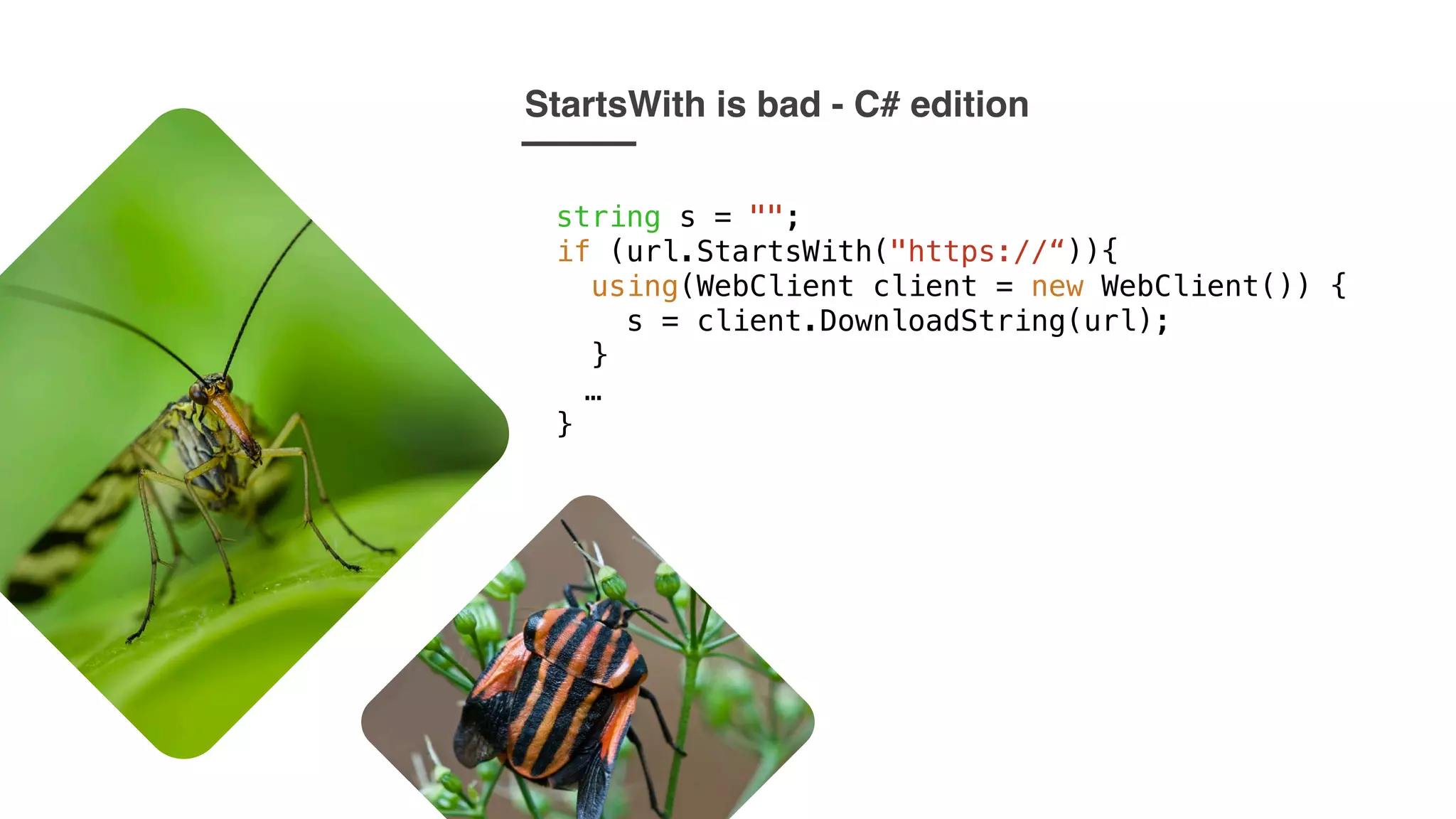
StartsWith is bad - C# edition
string s = "";
if (url.StartsWith("https://“)){
using(WebClient client = new WebClient()) {
s = client.DownloadString(url);
}
…
}
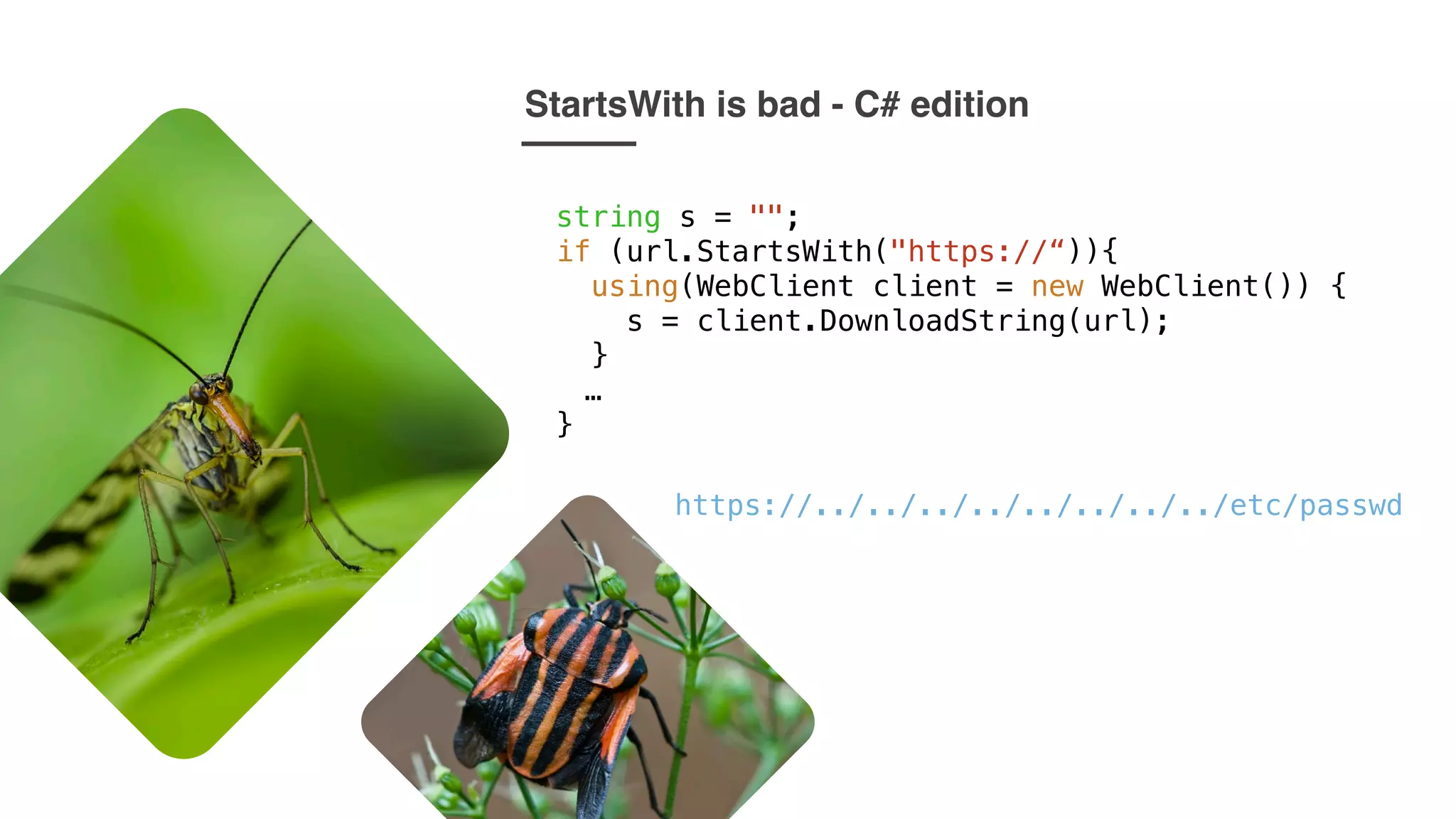
StartsWith is bad - C# edition
string s = "";
if (url.StartsWith("https://“)){
using(WebClient client = new WebClient()) {
s = client.DownloadString(url);
}
…
}
https://../../../../../../../../etc/passwd
14
func handler(w http.ResponseWriter, r *http.Request) {
filename := path.Clean(r.URL.Query()["filename"][0])
fd, err := os.Open(filename)
defer fd.Close()
if err != nil {
http.Error(w, "File not found.", 404)
return
}
io.Copy(w, fd)
}
func main() {
http.HandleFunc("/", handler)
log.Fatal(http.ListenAndServe(":8080", nil))
}
15
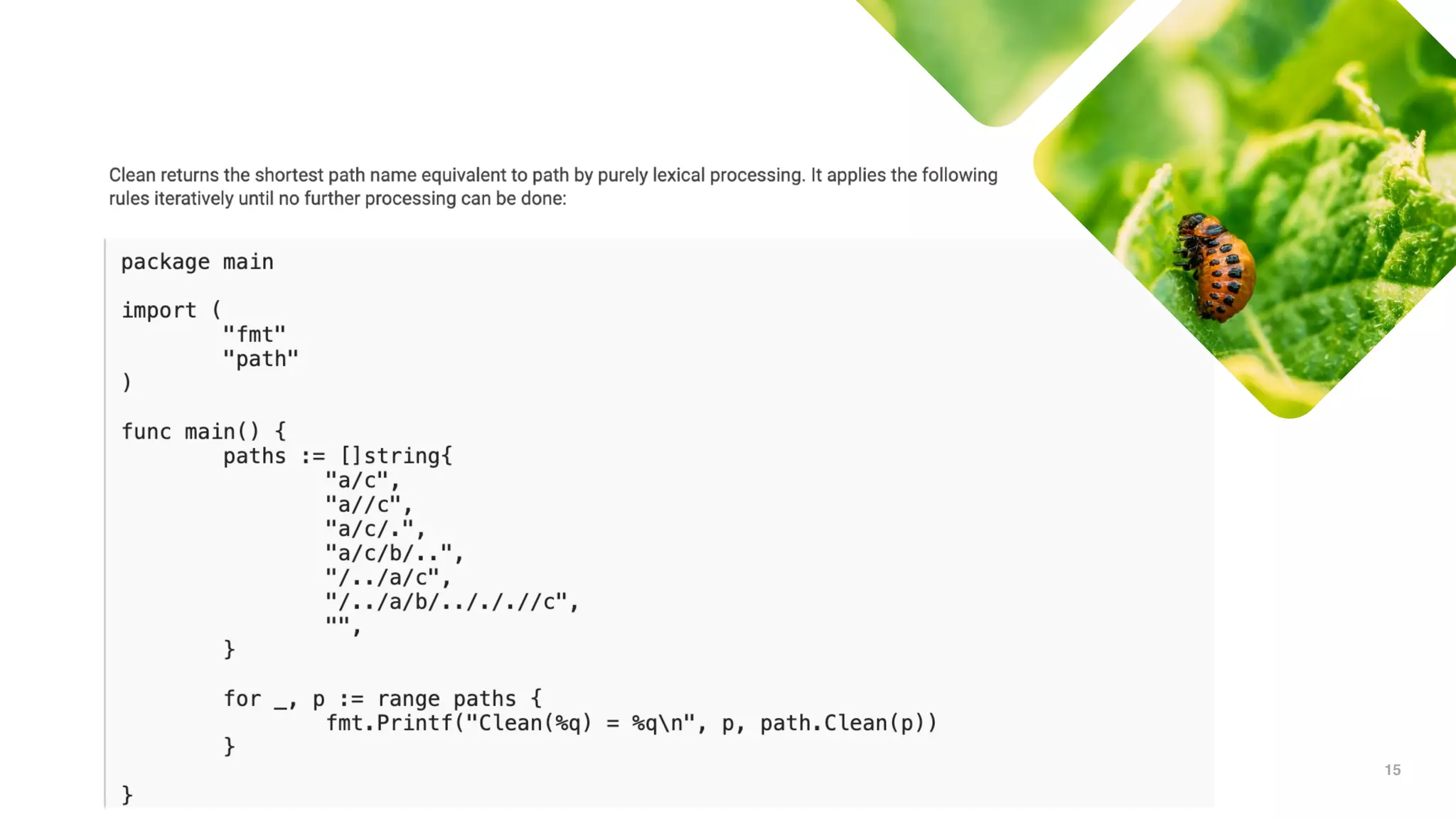
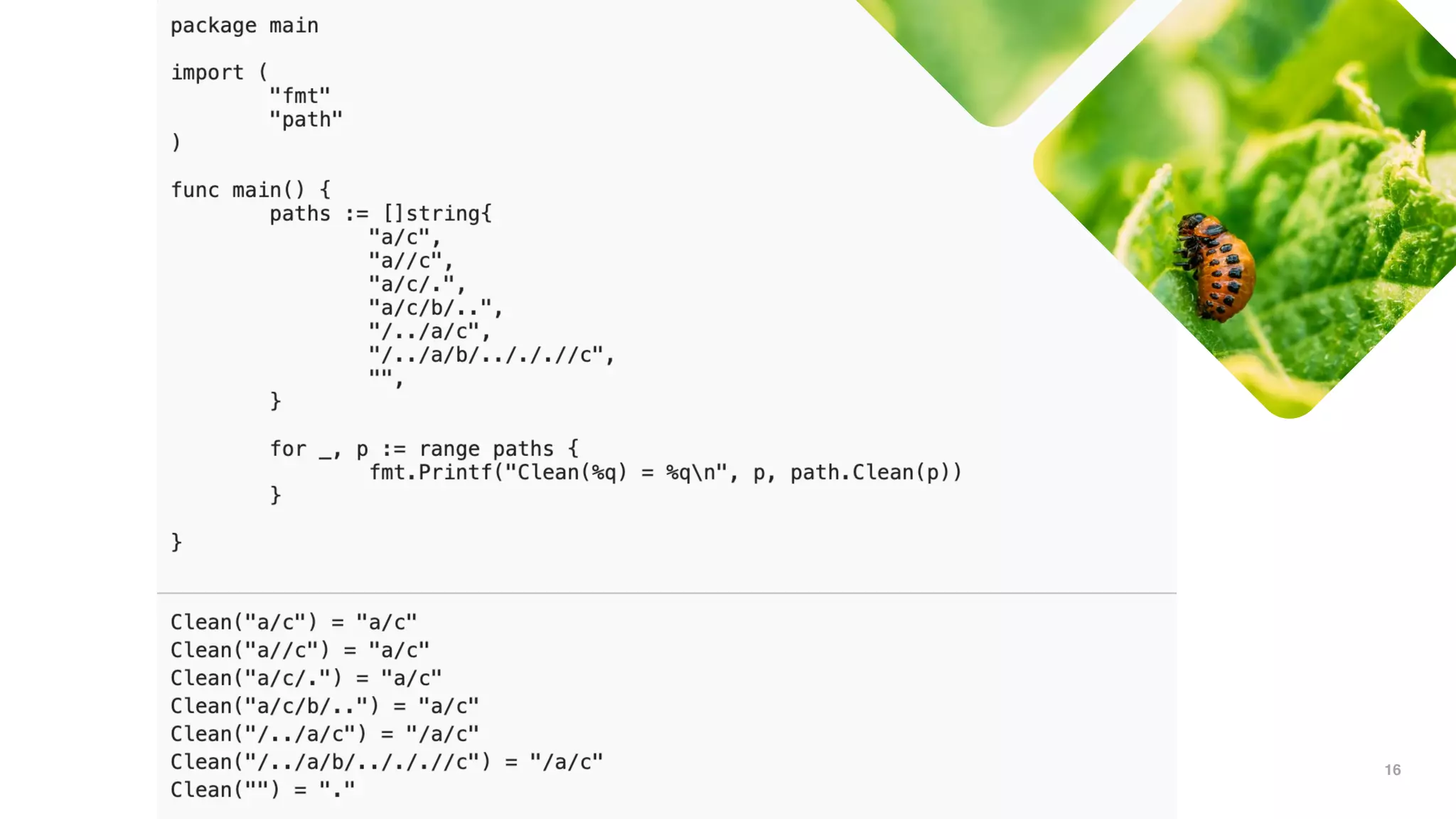
16
17
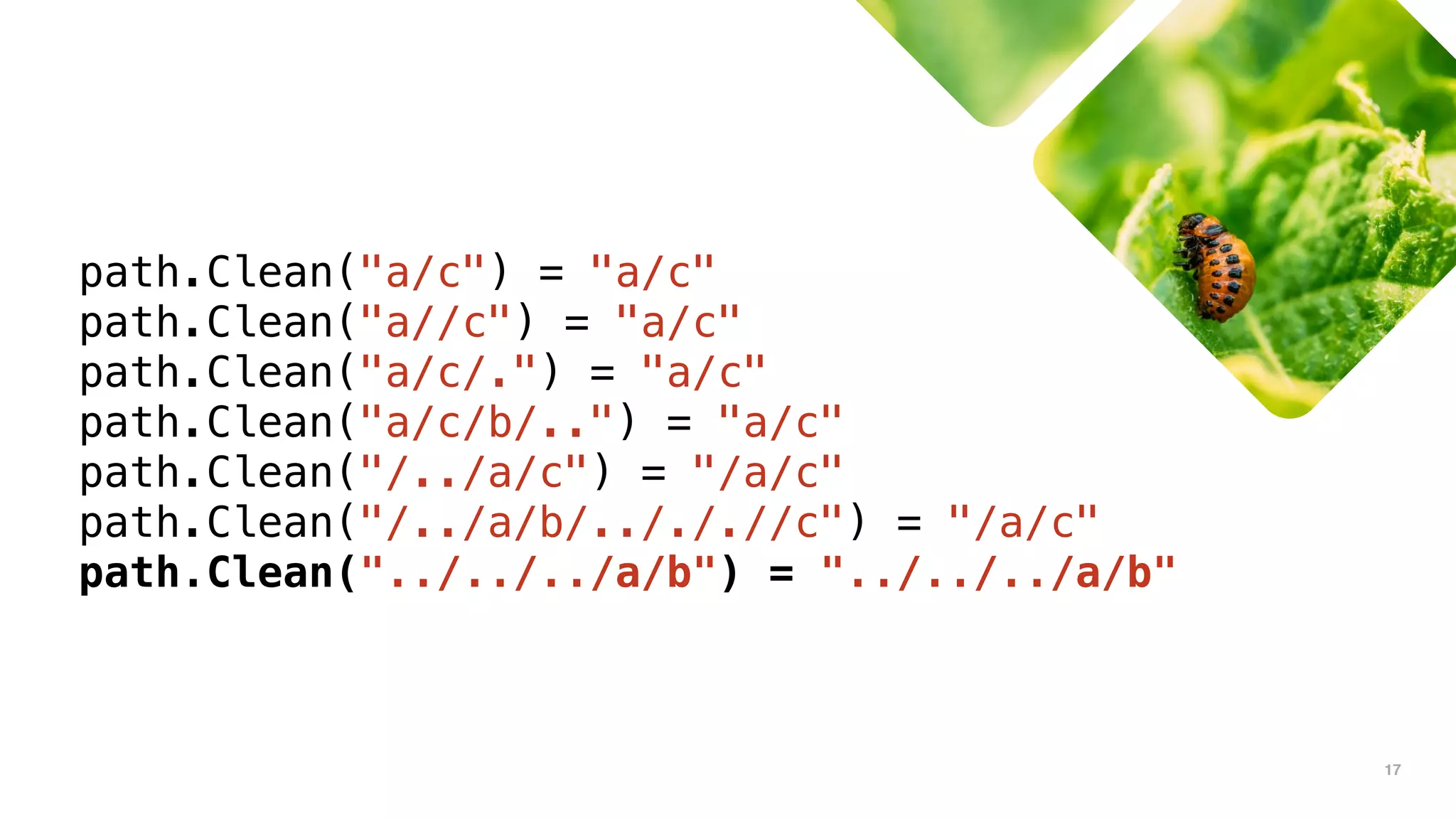
path.Clean("a/c") = "a/c"
path.Clean("a//c") = "a/c"
path.Clean("a/c/.") = "a/c"
path.Clean("a/c/b/..") = "a/c"
path.Clean("/../a/c") = "/a/c"
path.Clean("/../a/b/../././/c") = "/a/c"
path.Clean("../../../a/b") = "../../../a/b"
18
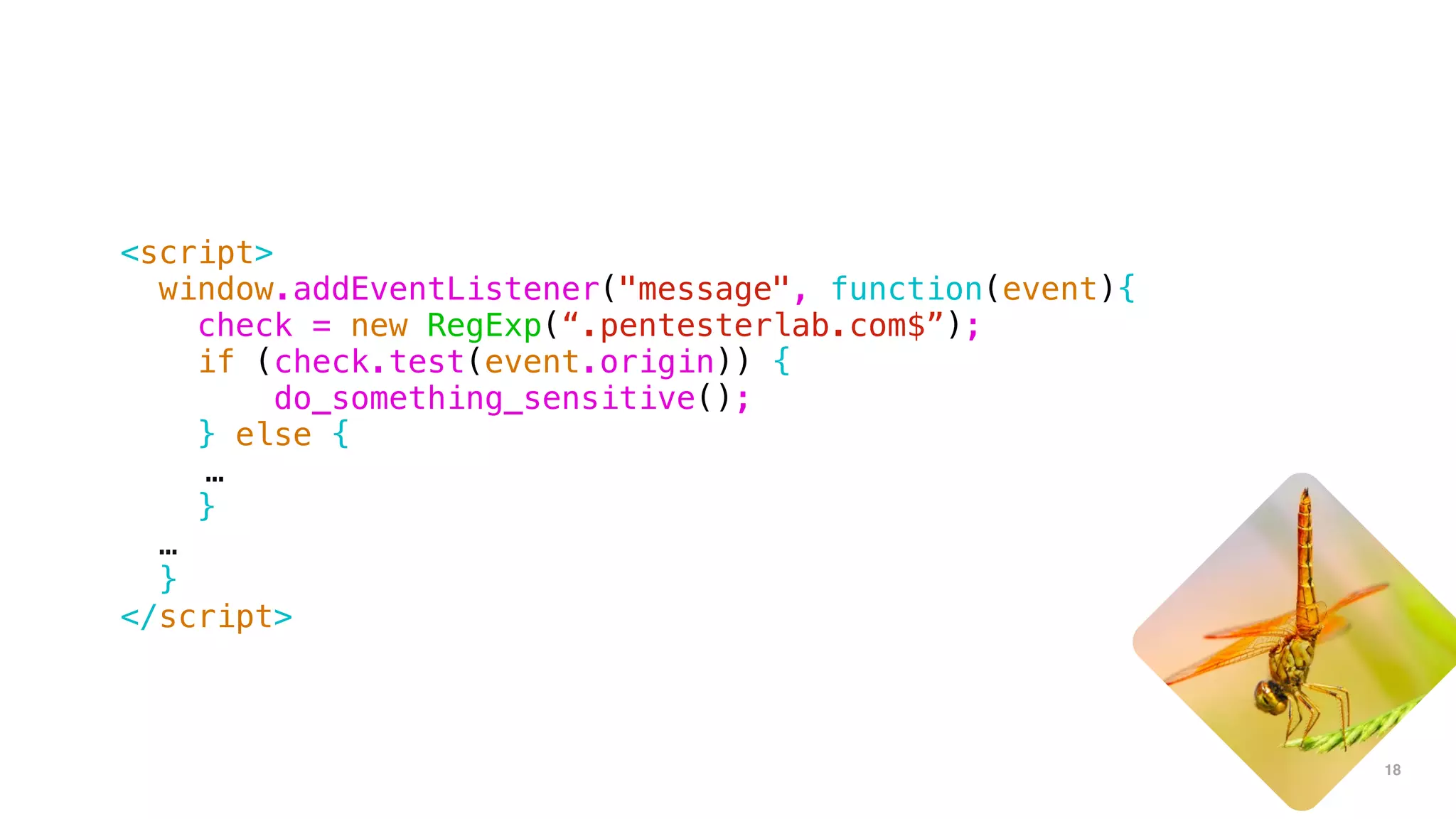
<script>
window.addEventListener("message", function(event){
check = new RegExp(“.pentesterlab.com$”);
if (check.test(event.origin)) {
do_something_sensitive();
} else {
…
}
…
}
</script>
19
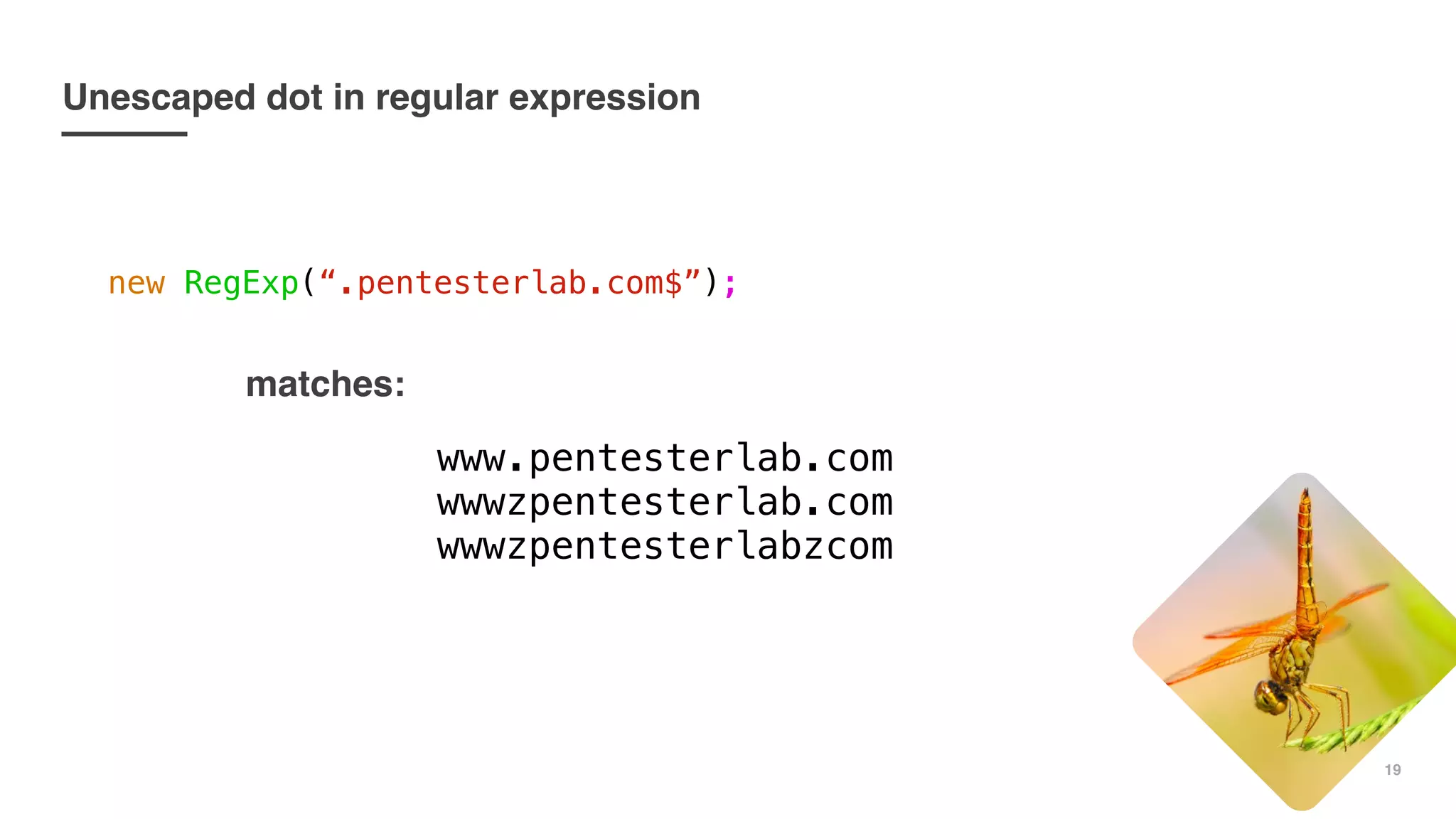
Unescaped dot in regular expression
new RegExp(“.pentesterlab.com$”);
matches:
www.pentesterlab.com
wwwzpentesterlab.com
wwwzpentesterlabzcom
20
const express = require('express')
const app = express()
var allowedDomains = ['EXAMPLE.ORG', 'GMAIL.COM',
'GOOGLE.COM'];
function fetchContent(domain) {
…
}
app.get('/fetch', (req, res) => {
if (allowedDomains.includes(req.query.domain.toUpperCase())) {
return res.send(fetchContent(req.query.domain))
} else {
res.status(403)
return res.send("ACCESS DENIED")
}
});
21
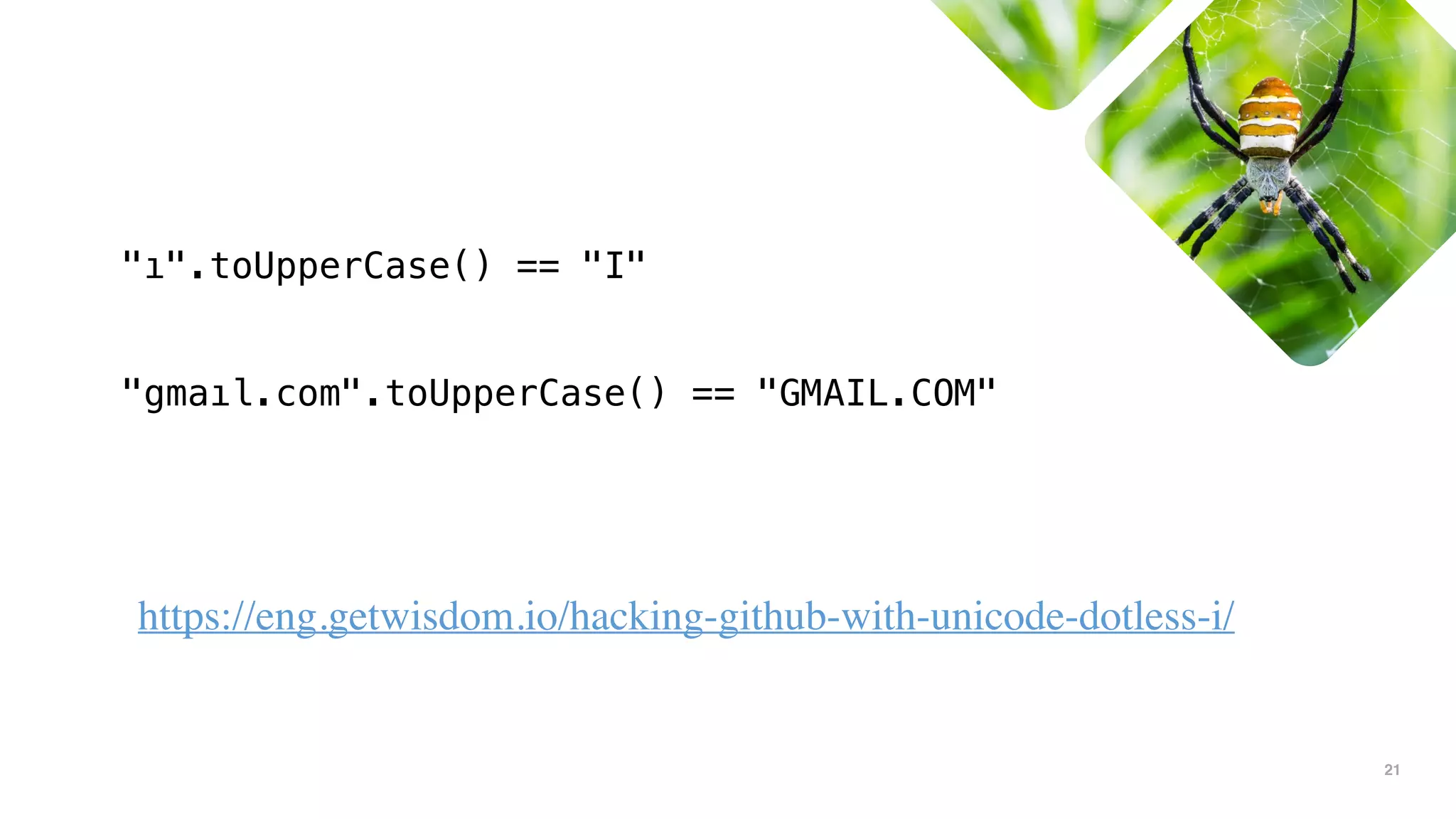
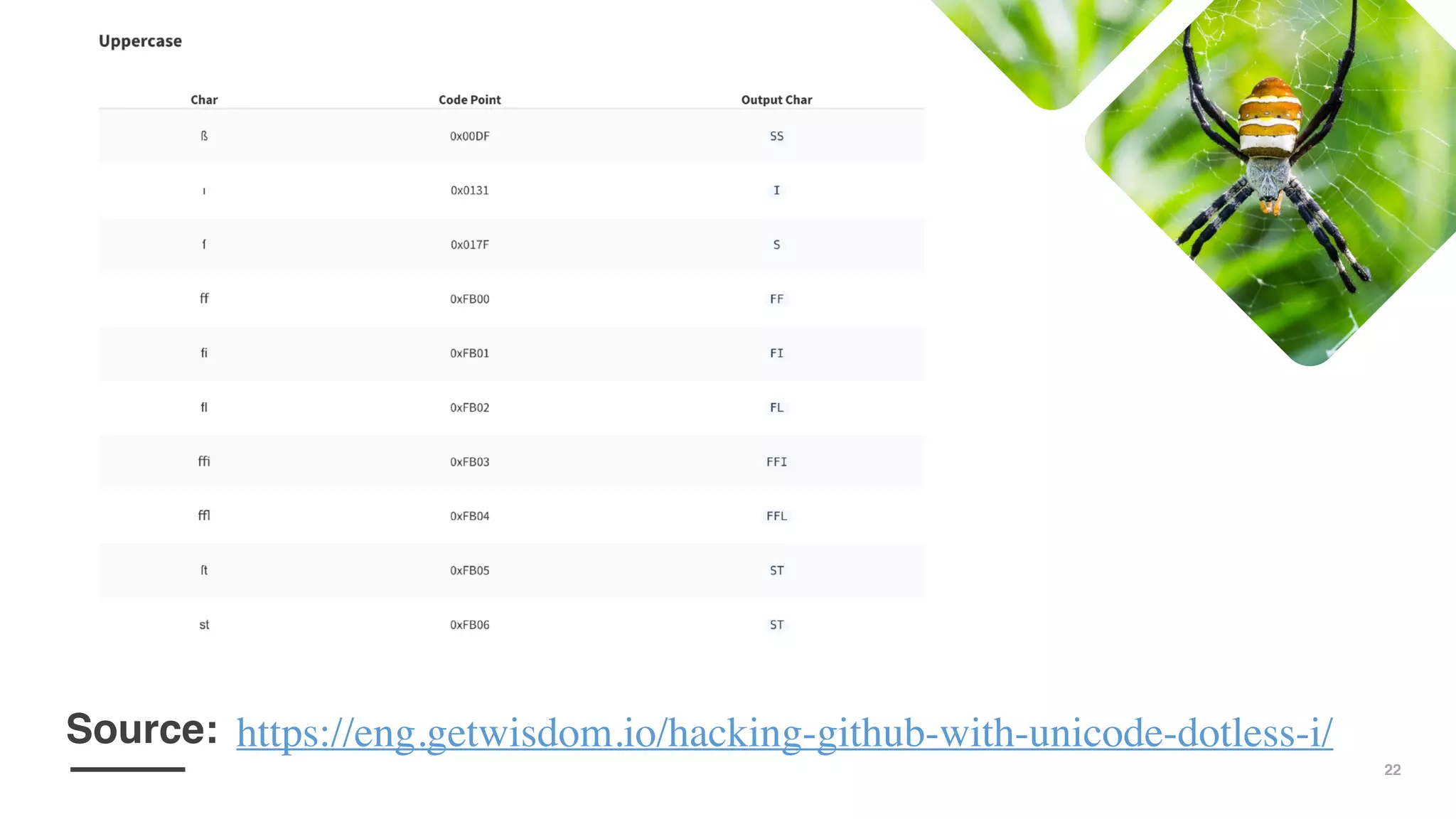
https://eng.getwisdom.io/hacking-github-with-unicode-dotless-i/
"ı".toUpperCase() == "I"
"gmaıl.com".toUpperCase() == "GMAIL.COM"
22
https://eng.getwisdom.io/hacking-github-with-unicode-dotless-i/Source:
23
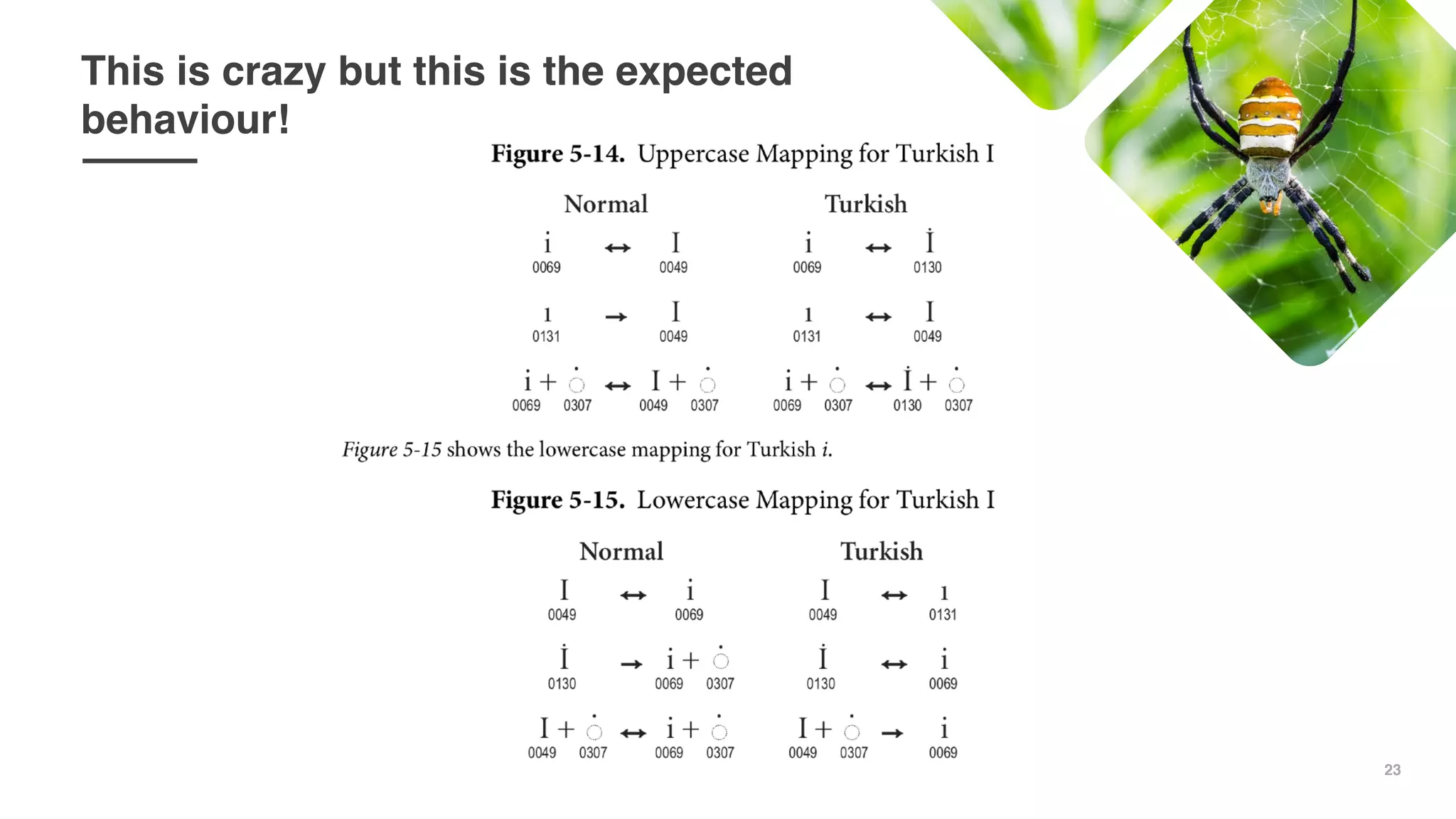
This is crazy but this is the expected
behaviour!
24
http://capturethefl.ag:1234/
http://capturethefl.ag:5678/
For those wanting to play @~
25
SO WE TALKED ABOUT REGEXP,
WE TALKED ABOUT UNICODE...
WHAT IF WE MIX THE TWO?
26
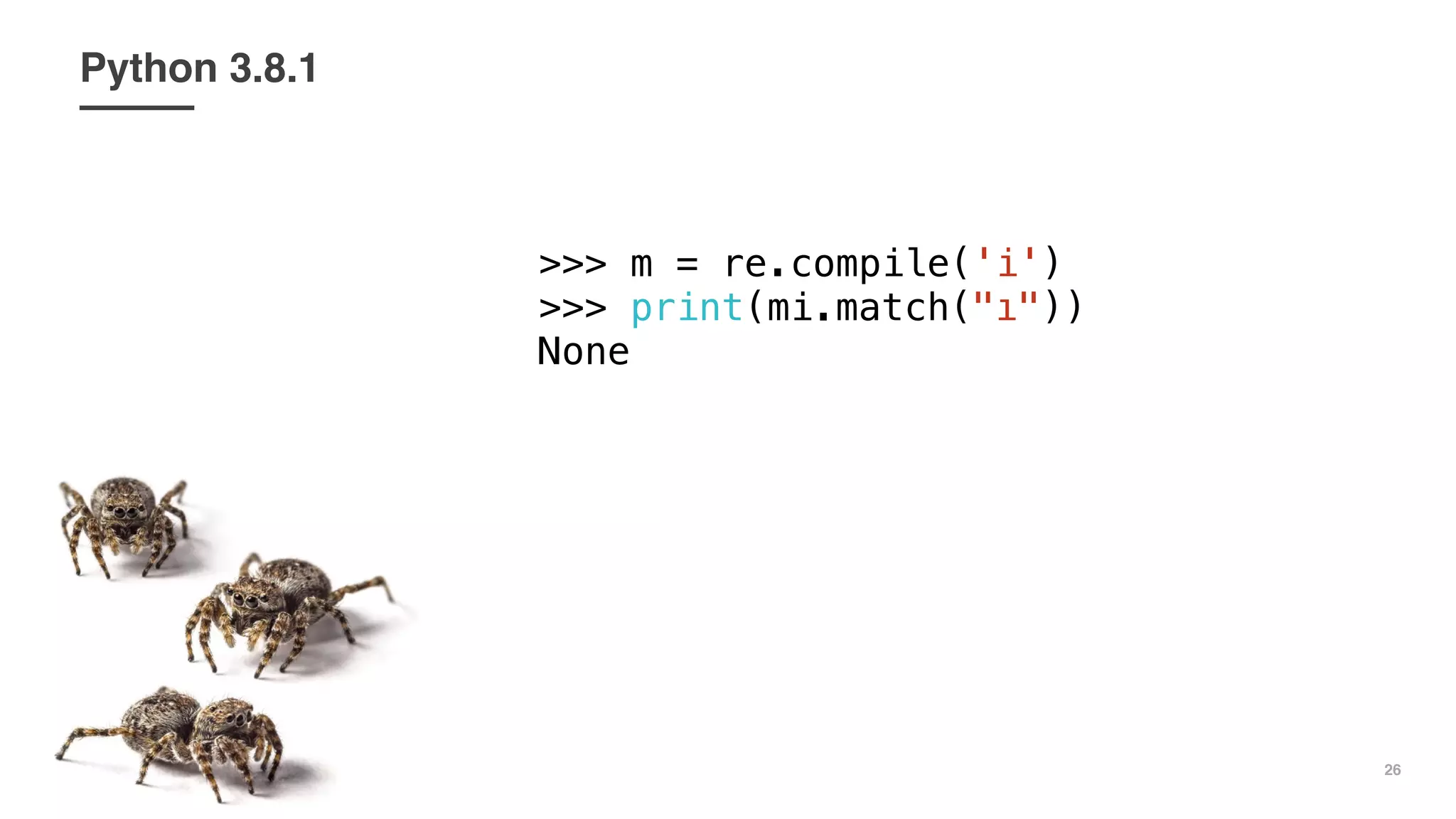
Python 3.8.1
>>> m = re.compile('i')
>>> print(mi.match("ı"))
None
27
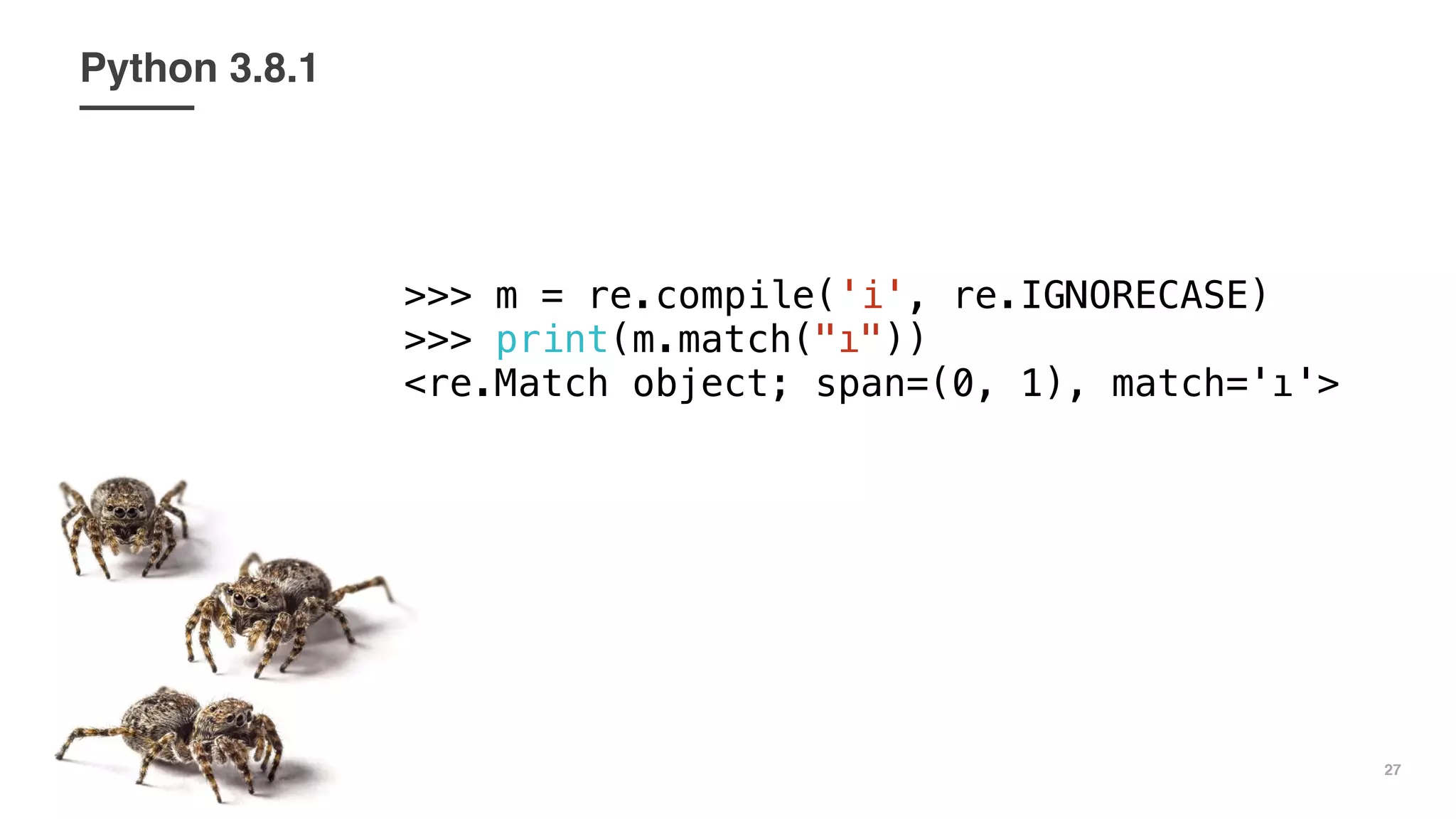
Python 3.8.1
>>> m = re.compile('i', re.IGNORECASE)
>>> print(m.match("ı"))
<re.Match object; span=(0, 1), match='ı'>
28
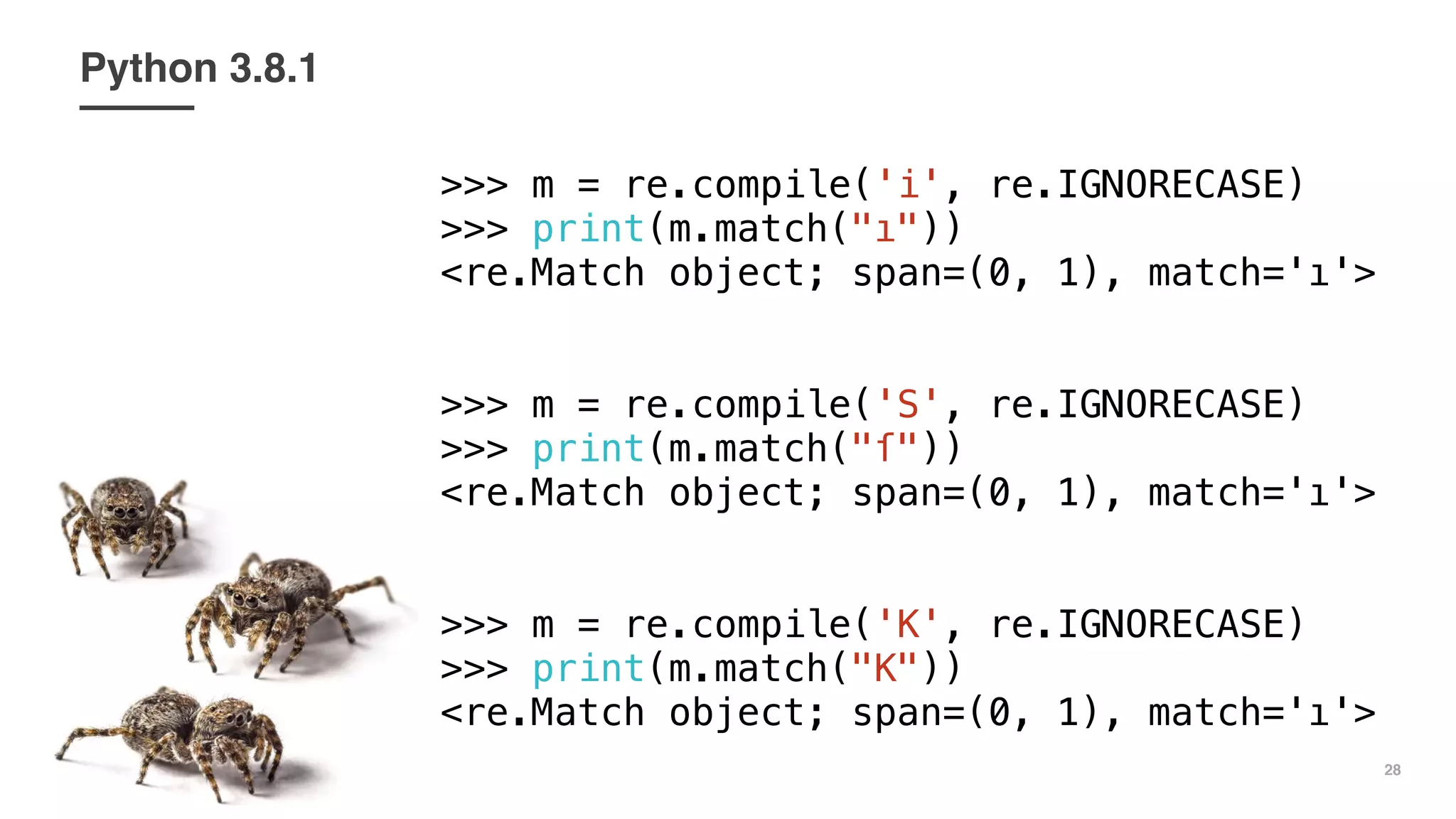
Python 3.8.1
>>> m = re.compile('i', re.IGNORECASE)
>>> print(m.match("ı"))
<re.Match object; span=(0, 1), match='ı'>
>>> m = re.compile('S', re.IGNORECASE)
>>> print(m.match("ſ"))
<re.Match object; span=(0, 1), match='ı'>
>>> m = re.compile('K', re.IGNORECASE)
>>> print(m.match("K"))
<re.Match object; span=(0, 1), match='ı'>
29
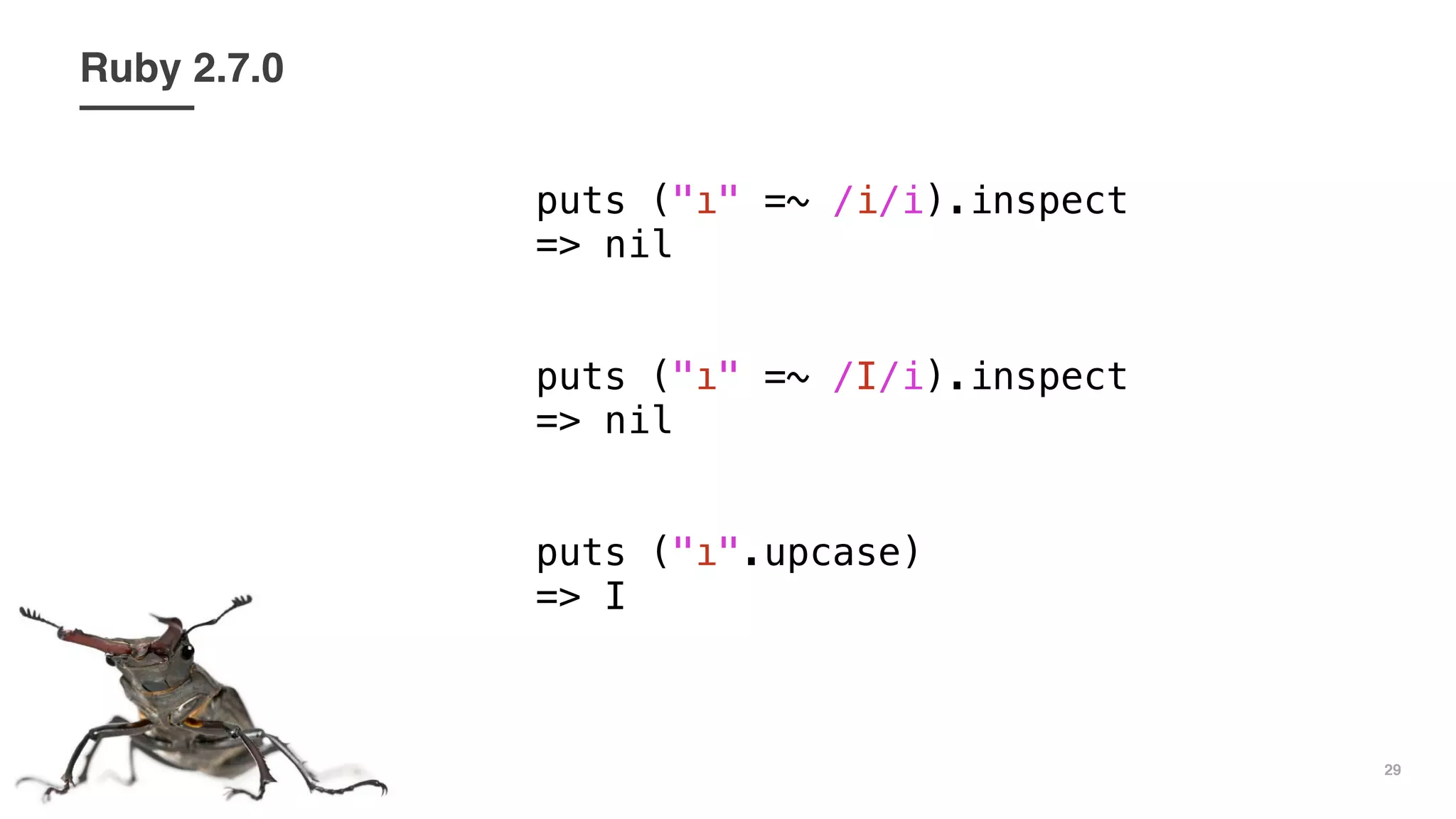
Ruby 2.7.0
puts ("ı" =~ /i/i).inspect
=> nil
puts ("ı" =~ /I/i).inspect
=> nil
puts ("ı".upcase)
=> I
30
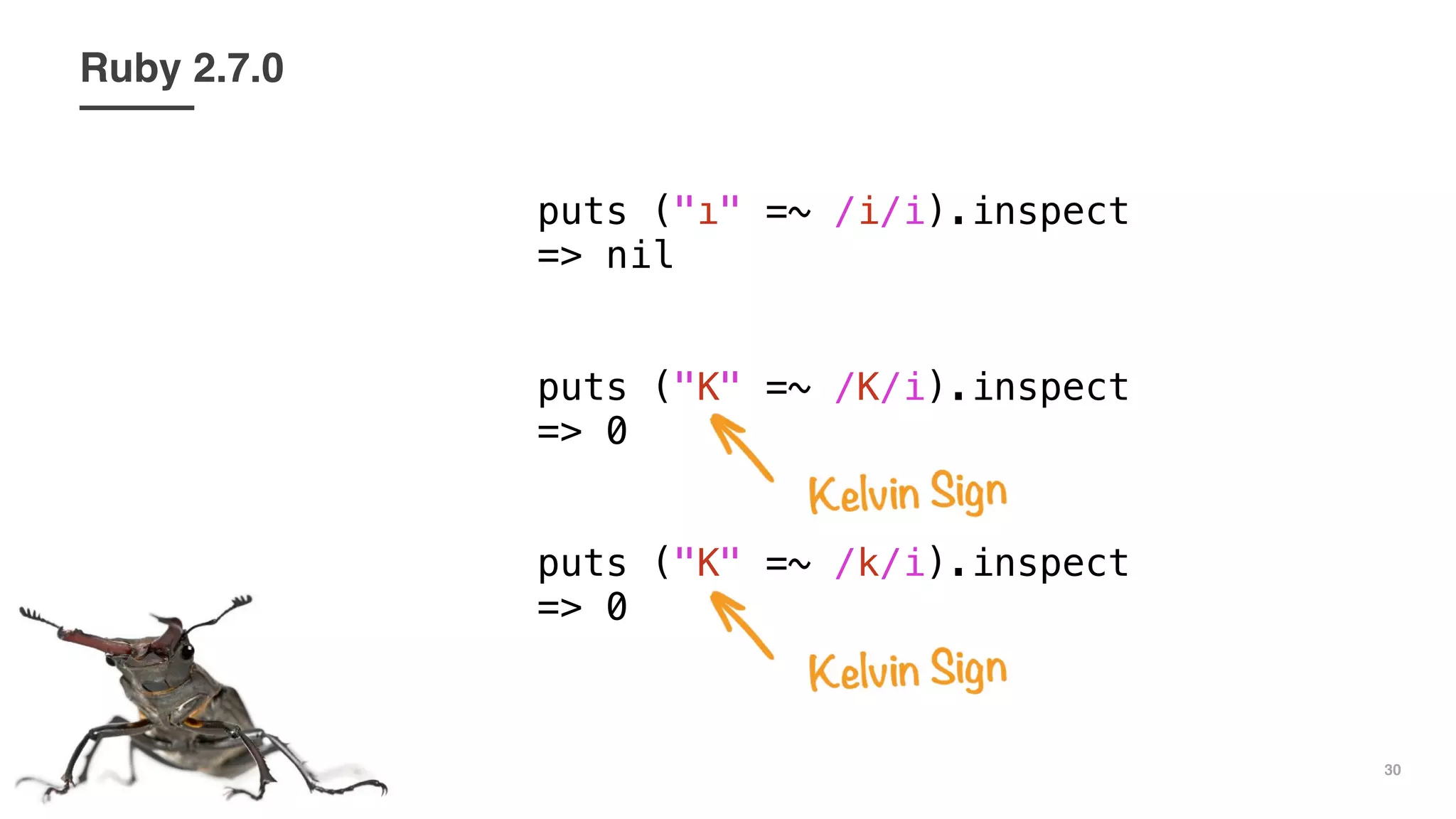
Ruby 2.7.0
puts ("ı" =~ /i/i).inspect
=> nil
puts ("K" =~ /K/i).inspect
=> 0
puts ("K" =~ /k/i).inspect
=> 0
31
Ruby 2.7.0
puts ("ı" =~ /i/i).inspect
=> nil
puts ("ſ" =~ /S/i).inspect
=> 0
puts ("ſ" =~ /s/i).inspect
=> 0
32
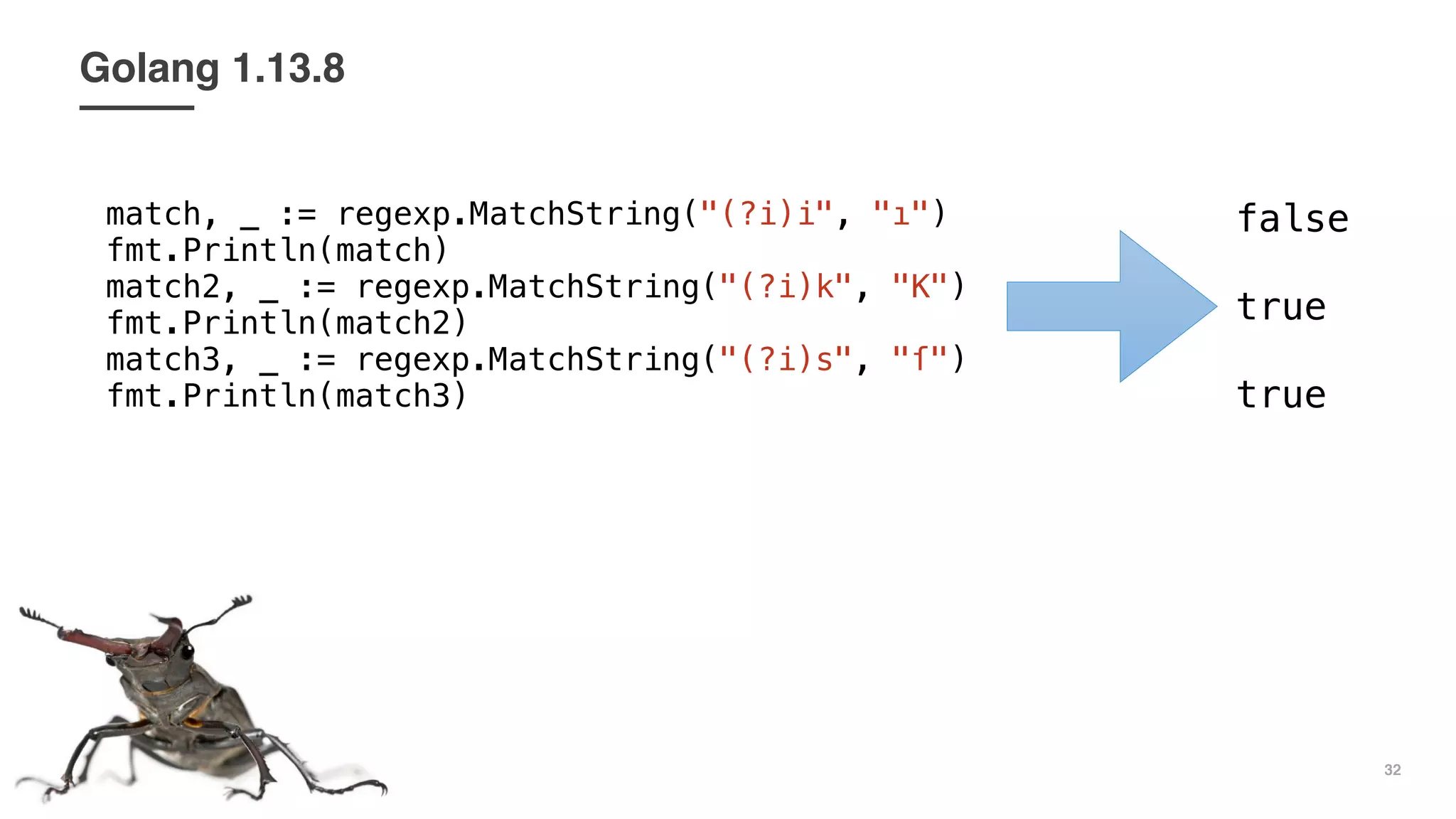
Golang 1.13.8
match, _ := regexp.MatchString("(?i)i", "ı")
fmt.Println(match)
match2, _ := regexp.MatchString("(?i)k", "K")
fmt.Println(match2)
match3, _ := regexp.MatchString("(?i)s", "ſ")
fmt.Println(match3)
false
true
true
33
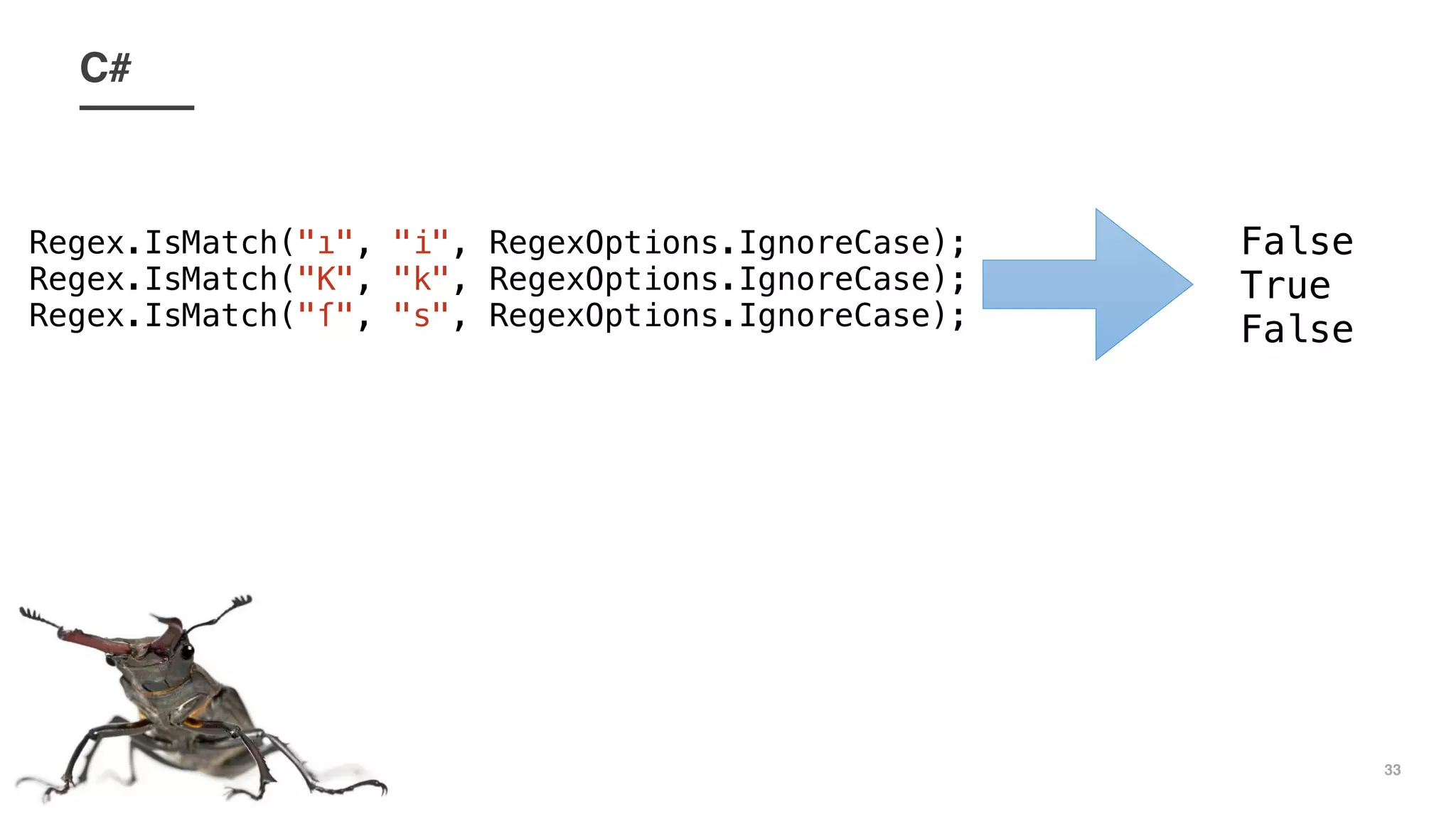
C#
Regex.IsMatch("ı", "i", RegexOptions.IgnoreCase);
Regex.IsMatch("K", "k", RegexOptions.IgnoreCase);
Regex.IsMatch("ſ", "s", RegexOptions.IgnoreCase);
False
True
False
34
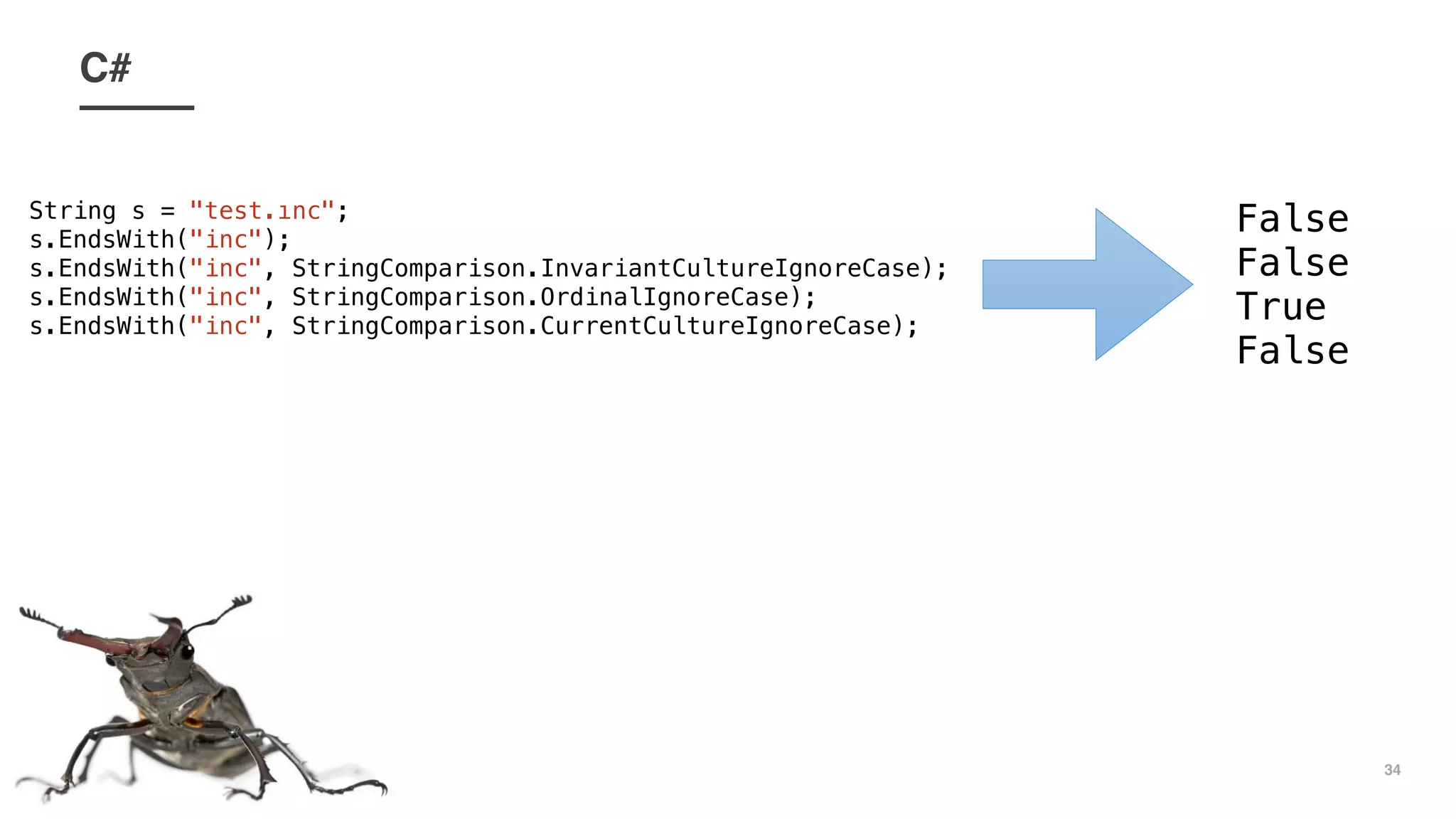
C#
String s = "test.ınc";
s.EndsWith("inc");
s.EndsWith("inc", StringComparison.InvariantCultureIgnoreCase);
s.EndsWith("inc", StringComparison.OrdinalIgnoreCase);
s.EndsWith("inc", StringComparison.CurrentCultureIgnoreCase);
False
False
True
False
35
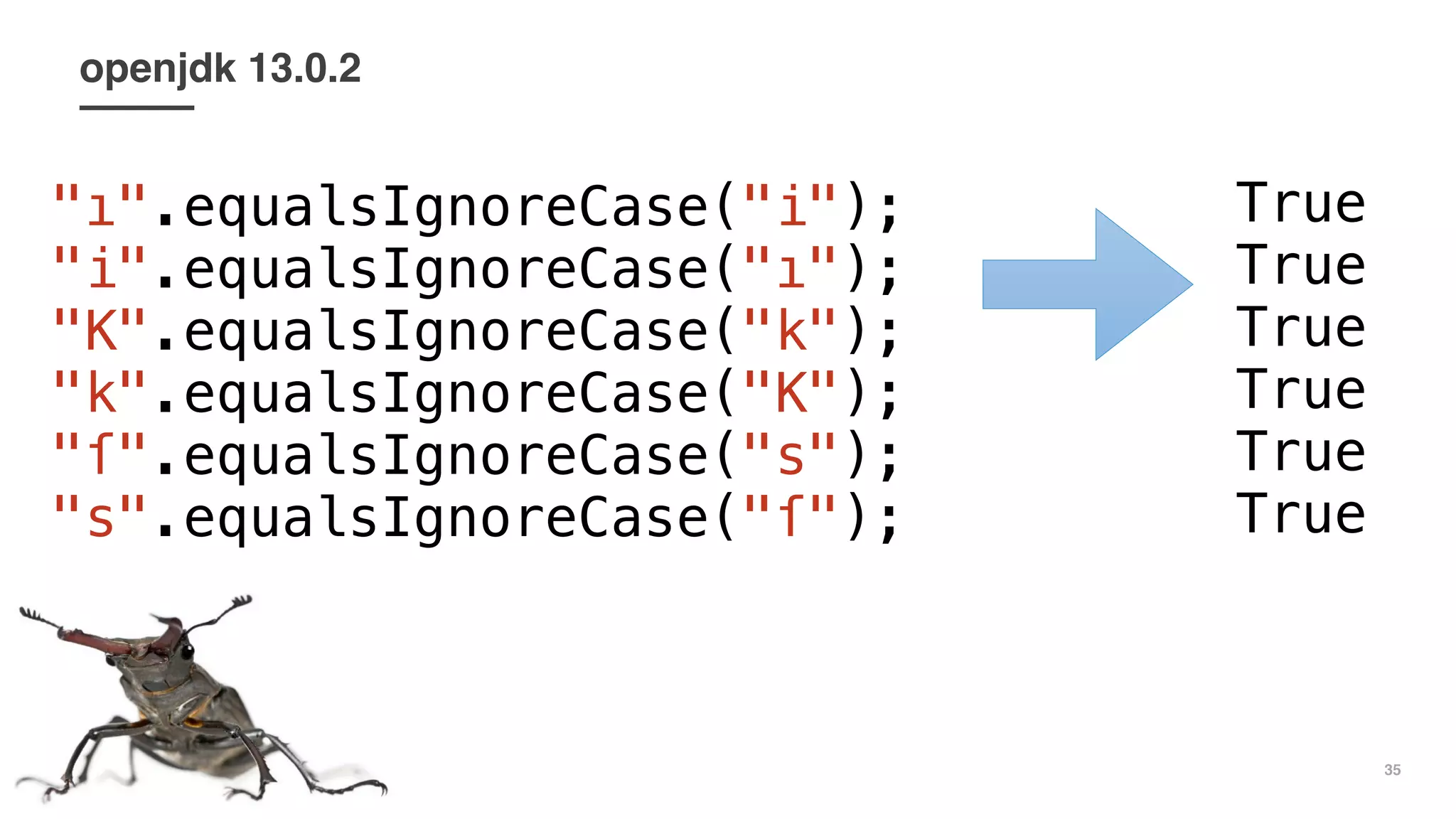
openjdk 13.0.2
"ı".equalsIgnoreCase("i");
"i".equalsIgnoreCase("ı");
"K".equalsIgnoreCase("k");
"k".equalsIgnoreCase("K");
"ſ".equalsIgnoreCase("s");
"s".equalsIgnoreCase("ſ");
True
True
True
True
True
True
36
openjdk 13.0.2
Pattern p = Pattern.compile("i", Pattern.CASE_INSENSITIVE);
System.out.println(p.matcher("ı").find());
Pattern ps = Pattern.compile("s", Pattern.CASE_INSENSITIVE);
System.out.println(ps.matcher("ſ").find());
Pattern pk = Pattern.compile("k", Pattern.CASE_INSENSITIVE);
System.out.println(pk.matcher("K").find());
False
False
False
37
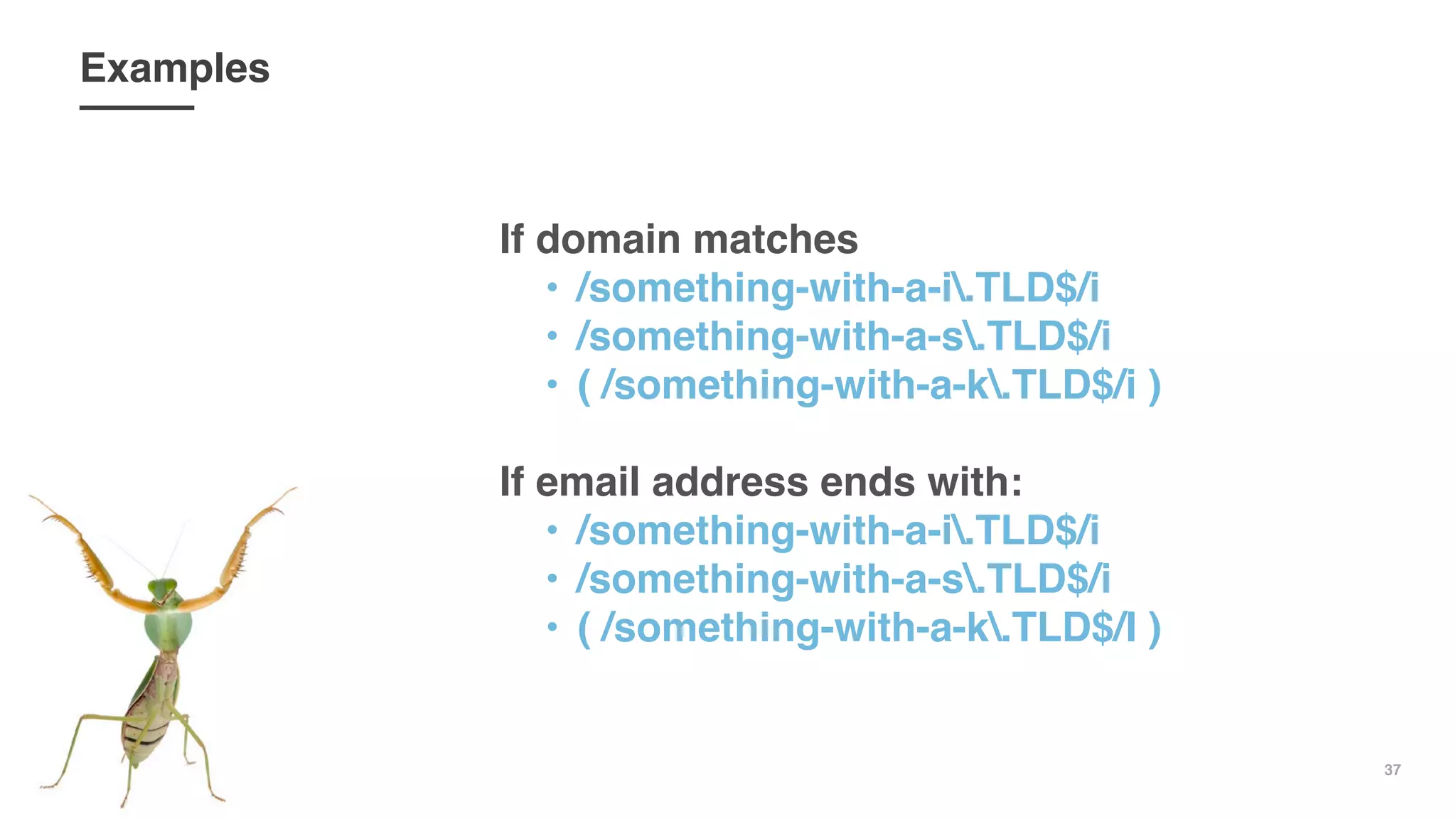
Examples
If domain matches
• /something-with-a-i.TLD$/i
• /something-with-a-s.TLD$/i
• ( /something-with-a-k.TLD$/i )
If email address ends with:
• /something-with-a-i.TLD$/i
• /something-with-a-s.TLD$/i
• ( /something-with-a-k.TLD$/I )
38
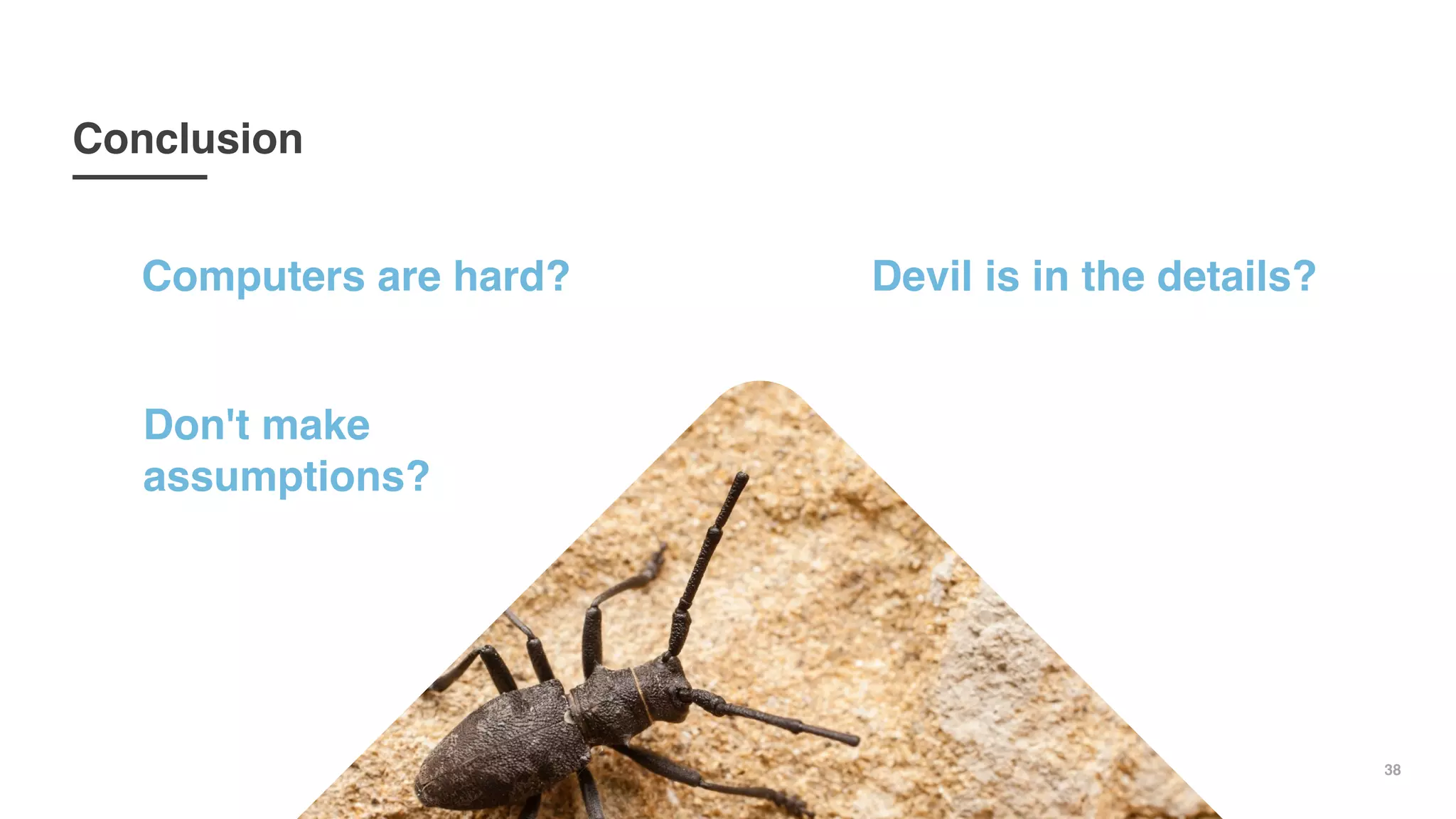
Conclusion
Computers are hard? Devil is in the details?
Don't make
assumptions?
39
Thanks for your time!
Any questions?
@snyff
@PentesterLab

Code that gets you pwn(s|'d)