Code Readability in R
Kim Man Lui, PhD
Code readability is actually for more
yourself than others.
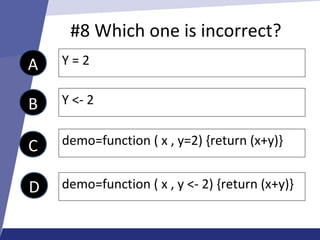
Note: R guys generally use “<-” in R;
however, many developers have used “=“ in
programming for decades.
Does this really matter? (see #8)
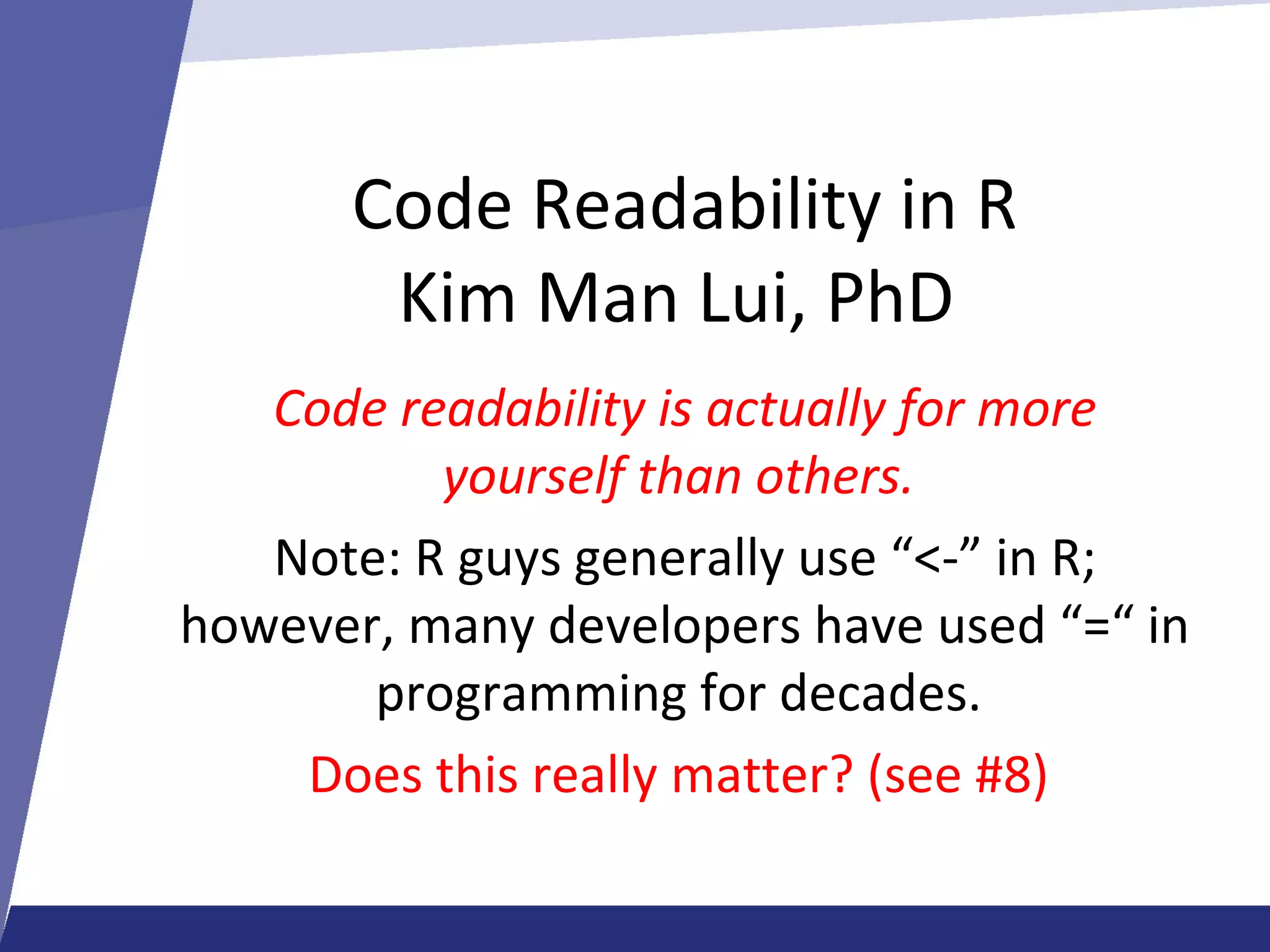
#1 Which one is precise?
if (0==colCon) {
pv=0
} else {
pv=(colCon * 4.5 - 10 )/100
}
pv = if (0==colCon) 0 else (colCon * 4.5 - 10 )/100
A
B
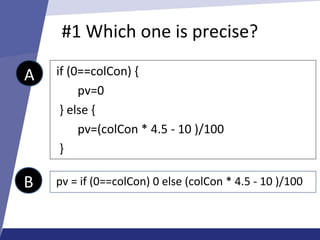
#2 Which is easier to understand?
pointVal = if (0==colConDex) 3 else 6
bheadtmp = bhead + pointVal
bheadtmp = bhead +
if (0==colConDex) 3 else 6
A
B
#3 When B is better than A?
coeff[[1]][[1]]= coeff[[1]][[2]]=rep(0,20)
coeff[[1]][[1]][4]=1
coeff[[1]][[1]][6]=1
… … …
coeff[[1]][[1]]=c(0,0,0,1,0, 1,0,0,0,0, 0,0,0,0,0, 0,0,0,0,0)
coeff[[1]][[2]]=c(0,0,0,0,0, 0,0,1,0,0, 0,0,0,0,0, 0,0,0,0,0)
A
B
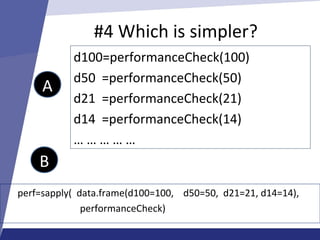
#4 Which is simpler?
d100=performanceCheck(100)
d50 =performanceCheck(50)
d21 =performanceCheck(21)
d14 =performanceCheck(14)
… … … … …
perf=sapply( data.frame(d100=100, d50=50, d21=21, d14=14),
performanceCheck)
A
B
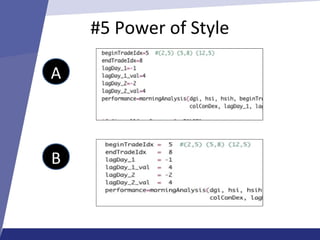
#5 Power of Style
A
B
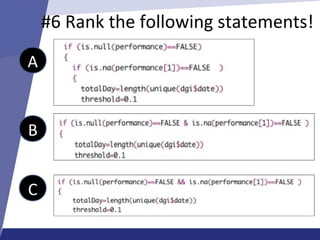
#6 Rank the following statements!
A
B
C
A
B
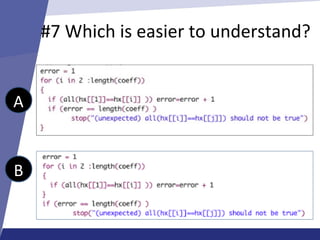
#7 Which is easier to understand?
#8 Which one is incorrect?
demo=function ( x , y=2) {return (x+y)}
demo=function ( x , y <- 2) {return (x+y)}
Y <- 2
Y = 2A
B
C
D
#9 Which one is intuitive?
s=subset(s, (as.Date(today)-30) <=
time(s) & time(s)<=today & 0<s[,5])
s=subset(s, time(s)>=(as.Date(today)-30)
& time(s)<=today & s[,5]>0)
A
B
General Principle :
when assigning a number to a variable, write as var=1
when doing logical operations, try to write as 1==var
This way helps our eyes to judge assignment or comparison quickly
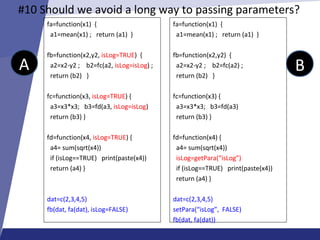
#10 Should we avoid a long way to passing parameters?
fa=function(x1) {
a1=mean(x1) ; return (a1) }
fb=function(x2,y2, isLog=TRUE) {
a2=x2-y2 ; b2=fc(a2, isLog=isLog) ;
return (b2) }
fc=function(x3, isLog=TRUE) {
a3=x3*x3; b3=fd(a3, isLog=isLog)
return (b3) }
fd=function(x4, isLog=TRUE) {
a4= sum(sqrt(x4))
if (isLog==TRUE) print(paste(x4))
return (a4) }
dat=c(2,3,4,5)
fb(dat, fa(dat), isLog=FALSE)
A B
fa=function(x1) {
a1=mean(x1) ; return (a1) }
fb=function(x2,y2) {
a2=x2-y2 ; b2=fc(a2) ;
return (b2) }
fc=function(x3) {
a3=x3*x3; b3=fd(a3)
return (b3) }
fd=function(x4) {
a4= sum(sqrt(x4))
isLog=getPara(“isLog”)
if (isLog==TRUE) print(paste(x4))
return (a4) }
dat=c(2,3,4,5)
setPara(“isLog”, FALSE)
fb(dat, fa(dat))

Code readability in r

  • 1.
    Code Readability inR Kim Man Lui, PhD Code readability is actually for more yourself than others. Note: R guys generally use “<-” in R; however, many developers have used “=“ in programming for decades. Does this really matter? (see #8)
  • 2.
    #1 Which oneis precise? if (0==colCon) { pv=0 } else { pv=(colCon * 4.5 - 10 )/100 } pv = if (0==colCon) 0 else (colCon * 4.5 - 10 )/100 A B
  • 3.
    #2 Which iseasier to understand? pointVal = if (0==colConDex) 3 else 6 bheadtmp = bhead + pointVal bheadtmp = bhead + if (0==colConDex) 3 else 6 A B
  • 4.
    #3 When Bis better than A? coeff[[1]][[1]]= coeff[[1]][[2]]=rep(0,20) coeff[[1]][[1]][4]=1 coeff[[1]][[1]][6]=1 … … … coeff[[1]][[1]]=c(0,0,0,1,0, 1,0,0,0,0, 0,0,0,0,0, 0,0,0,0,0) coeff[[1]][[2]]=c(0,0,0,0,0, 0,0,1,0,0, 0,0,0,0,0, 0,0,0,0,0) A B
  • 5.
    #4 Which issimpler? d100=performanceCheck(100) d50 =performanceCheck(50) d21 =performanceCheck(21) d14 =performanceCheck(14) … … … … … perf=sapply( data.frame(d100=100, d50=50, d21=21, d14=14), performanceCheck) A B
  • 6.
    #5 Power ofStyle A B
  • 7.
    #6 Rank thefollowing statements! A B C
  • 8.
    A B #7 Which iseasier to understand?
  • 9.
    #8 Which oneis incorrect? demo=function ( x , y=2) {return (x+y)} demo=function ( x , y <- 2) {return (x+y)} Y <- 2 Y = 2A B C D
  • 10.
    #9 Which oneis intuitive? s=subset(s, (as.Date(today)-30) <= time(s) & time(s)<=today & 0<s[,5]) s=subset(s, time(s)>=(as.Date(today)-30) & time(s)<=today & s[,5]>0) A B General Principle : when assigning a number to a variable, write as var=1 when doing logical operations, try to write as 1==var This way helps our eyes to judge assignment or comparison quickly
  • 11.
    #10 Should weavoid a long way to passing parameters? fa=function(x1) { a1=mean(x1) ; return (a1) } fb=function(x2,y2, isLog=TRUE) { a2=x2-y2 ; b2=fc(a2, isLog=isLog) ; return (b2) } fc=function(x3, isLog=TRUE) { a3=x3*x3; b3=fd(a3, isLog=isLog) return (b3) } fd=function(x4, isLog=TRUE) { a4= sum(sqrt(x4)) if (isLog==TRUE) print(paste(x4)) return (a4) } dat=c(2,3,4,5) fb(dat, fa(dat), isLog=FALSE) A B fa=function(x1) { a1=mean(x1) ; return (a1) } fb=function(x2,y2) { a2=x2-y2 ; b2=fc(a2) ; return (b2) } fc=function(x3) { a3=x3*x3; b3=fd(a3) return (b3) } fd=function(x4) { a4= sum(sqrt(x4)) isLog=getPara(“isLog”) if (isLog==TRUE) print(paste(x4)) return (a4) } dat=c(2,3,4,5) setPara(“isLog”, FALSE) fb(dat, fa(dat))