PURPOSE
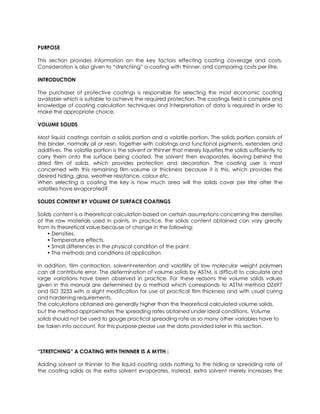
This section provides information on the key factors effecting coating coverage and costs.
Consideration is also given to “stretching” a coating with thinner, and comparing costs per litre.
INTRODUCTION
The purchaser of protective coatings is responsible for selecting the most economic coating
available which is suitable to achieve the required protection. The coatings field is complex and
knowledge of coating calculation techniques and interpretation of data is required in order to
make the appropriate choice.
VOLUME SOLIDS
Most liquid coatings contain a solids portion and a volatile portion. The solids portion consists of
the binder, normally oil or resin, together with colorings and functional pigments, extenders and
additives. The volatile portion is the solvent or thinner that merely liquefies the solids sufficiently to
carry them onto the surface being coated. The solvent then evaporates, leaving behind the
dried film of solids, which provides protection and decoration. The coating user is most
concerned with this remaining film volume or thickness because it is this, which provides the
desired hiding, gloss, weather resistance, colour etc.
When selecting a coating the key is how much area will the solids cover per litre after the
volatiles have evaporated?
SOLIDS CONTENT BY VOLUME OF SURFACE COATINGS
Solids content is a theoretical calculation based on certain assumptions concerning the densities
of the raw materials used in paints. In practice, the solids content obtained can vary greatly
from its theoretical value because of change in the following:
• Densities.
• Temperature effects.
• Small differences in the physical condition of the paint.
• The methods and conditions of application.
In addition, film contraction, solvent-retention and volatility of low molecular weight polymers
can all contribute error. The determination of volume solids by ASTM, is difficult to calculate and
large variations have been observed in practice. For these reasons the volume solids values
given in this manual are determined by a method which corresponds to ASTM method DZ697
and ISO 3233 with a slight modification for use at practical film thickness and with usual curing
and hardening requirements.
The calculations obtained are generally higher than the theoretical calculated volume solids,
but the method approximates the spreading rates obtained under ideal conditions. Volume
solids should not be used to gauge practical spreading rate as so many other variables have to
be taken into account. For this purpose please use the data provided later in this section.
“STRETCHING” A COATING WITH THINNER IS A MYTH :
Adding solvent or thinner to the liquid coating adds nothing to the hiding or spreading rate of
the coating solids as the extra solvent evaporates. Instead, extra solvent merely increases the
coating cost by the price of the thinner and increases application costs by the additional labor
time required to mix the thinner into the coating. In the case of baking systems, the cost is
increased by the greater amount of oven heating required to remove the thinner. Adequate
volume solids, not thinners, are the key to proper coverage by a coating.
COMPARING LITRE COSTS :
Often buyers tend to select a coating strictly on a cost per liter basis without considering the
volume solids of the paint. The user of a coating should be interested in the cost of finishing a
given unit area and not the price per liter.
In the long run the coating user receives value only from that portion of the liter that remains as
dried coating film after the volatile solvent or thinner has been released. Volume solids are the
key factor in determining coating economies and not weight solids.
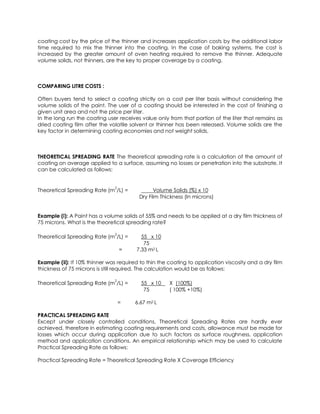
THEORETICAL SPREADING RATE The theoretical spreading rate is a calculation of the amount of
coating on average applied to a surface, assuming no losses or penetration into the substrate. It
can be calculated as follows:
Theoretical Spreading Rate (m
2
/L) = Volume Solids (%) x 10
Dry Film Thickness (In microns)
Example (i): A Paint has a volume solids of 55% and needs to be applied at a dry film thickness of
75 microns. What is the theoretical spreading rate?
Theoretical Spreading Rate (m
2
/L) = 55 x 10
75
= 7.33 m2 L
Example (ii): If 10% thinner was required to thin the coating to application viscosity and a dry film
thickness of 75 microns is still required. The calculation would be as follows:
Theoretical Spreading Rate (m
2
/L) = 55 x 10 X (100%)
75 ( 100% +10%)
= 6.67 m2 L
PRACTICAL SPREADING RATE
Except under closely controlled conditions, Theoretical Spreading Rates are hardly ever
achieved, therefore in estimating coating requirements and costs, allowance must be made for
losses which occur during application due to such factors as surface roughness, application
method and application conditions. An empirical relationship which may be used to calculate
Practical Spreading Rate as follows:
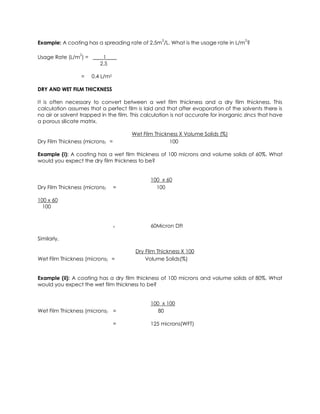
Practical Spreading Rate = Theoretical Spreading Rate X Coverage Efficiency
The BELOW (table) below shows the approximate coverage efficiencies expected for various
surfaces and application conditions.
Application Method
Surface Coating Efficiency
Brush/Roller
Airless
Spray/Interior
Airless
Spray/Exterior
Airless Spray/Windy
Conditions
New Smooth Steel 0.87 0.78 0.68 0.49
Blast Cleaned Steel 0.83 0.74 0.65 0.46
Power Tool Cleaned
Steel
0.79 0.70 0.61 0.44
Blasted Steel – lightly
pitted
0.79 0.70 0.61 0.44
Blasted Steel –
heavily pitted
0.74 0.70 0.58 0.41
Rough Concrete or
Masonry
0.61 0.66 0.47 0.34
Example (i) :
An application had a coating with a theoretical spreading rate pf 4.0m
2
/L and intended to
airless spray lightly pitted steel, with only light winds. Calculate the practical spreading rate:
Practical Spreading Rate(m
2
/L) = 4.0 X 0.61
= 2.44 m2 /L
CONVERSION OF SPREADING RATES TO USAGE RATES
It is sometime necessary to convert from spreading rates expressed in m
2
/L to a usage rate in
L/m
2
. This is gives the amount of paint required to coat a square meter of surface:
Usage Rate (L/m
2
) = ______1__________
Spreading Rate (m2/L)
Example: A coating has a spreading rate of 2.5m
2
/L. What is the usage rate in L/m
2
?
Usage Rate (L/m
2
) = ____1____
2.5
= 0.4 L/m2
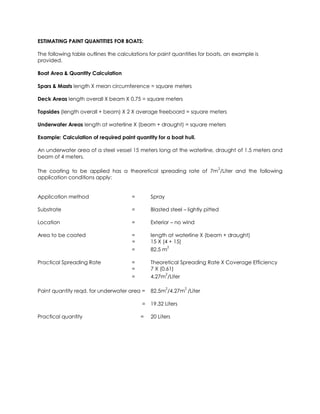
DRY AND WET FILM THICKNESS
It is often necessary to convert between a wet film thickness and a dry film thickness. This
calculation assumes that a perfect film is laid and that after evaporation of the solvents there is
no air or solvent trapped in the film. This calculation is not accurate for inorganic zincs that have
a porous silicate matrix.
Wet Film Thickness X Volume Solids (%)
Dry Film Thickness (microns) = 100
Example (i): A coating has a wet film thickness of 100 microns and volume solids of 60%. What
would you expect the dry film thickness to be?
100 x 60
Dry Film Thickness (microns) = 100
100 x 60
100
= 60Micron Dft
Similarly,
Dry Film Thickness X 100
Wet Film Thickness (microns) = Volume Solids(%)
Example (ii): A coating has a dry film thickness of 100 microns and volume solids of 80%. What
would you expect the wet film thickness to be?
100 x 100
Wet Film Thickness (microns) = 80
= 125 microns(WFT)
ESTIMATING PAINT QUANTITIES FOR BOATS:
The following table outlines the calculations for paint quantities for boats, an example is
provided.
Boat Area & Quantity Calculation
Spars & Masts length X mean circumference = square meters
Deck Areas length overall X beam X 0.75 = square meters
Topsides (length overall + beam) X 2 X average freeboard = square meters
Underwater Areas length at waterline X (beam + draught) = square meters
Example: Calculation of required paint quantity for a boat hull.
An underwater area of a steel vessel 15 meters long at the waterline, draught of 1.5 meters and
beam of 4 meters.
The coating to be applied has a theoretical spreading rate of 7m
2
/Liter and the following
application conditions apply:
Application method = Spray
Substrate = Blasted steel – lightly pitted
Location = Exterior – no wind
Area to be coated = length at waterline X (beam + draught)
= 15 X (4 + 15)
= 82.5 m
2
Practical Spreading Rate = Theoretical Spreading Rate X Coverage Efficiency
= 7 X (0.61)
= 4.27m
2
/Liter
Paint quantity reqd. for underwater area = 82.5m
2
/4.27m
2
/Liter
= 19.32 Liters
Practical quantity = 20 Liters

Coating coverage brochure

  • 1.
    PURPOSE This section providesinformation on the key factors effecting coating coverage and costs. Consideration is also given to “stretching” a coating with thinner, and comparing costs per litre. INTRODUCTION The purchaser of protective coatings is responsible for selecting the most economic coating available which is suitable to achieve the required protection. The coatings field is complex and knowledge of coating calculation techniques and interpretation of data is required in order to make the appropriate choice. VOLUME SOLIDS Most liquid coatings contain a solids portion and a volatile portion. The solids portion consists of the binder, normally oil or resin, together with colorings and functional pigments, extenders and additives. The volatile portion is the solvent or thinner that merely liquefies the solids sufficiently to carry them onto the surface being coated. The solvent then evaporates, leaving behind the dried film of solids, which provides protection and decoration. The coating user is most concerned with this remaining film volume or thickness because it is this, which provides the desired hiding, gloss, weather resistance, colour etc. When selecting a coating the key is how much area will the solids cover per litre after the volatiles have evaporated? SOLIDS CONTENT BY VOLUME OF SURFACE COATINGS Solids content is a theoretical calculation based on certain assumptions concerning the densities of the raw materials used in paints. In practice, the solids content obtained can vary greatly from its theoretical value because of change in the following: • Densities. • Temperature effects. • Small differences in the physical condition of the paint. • The methods and conditions of application. In addition, film contraction, solvent-retention and volatility of low molecular weight polymers can all contribute error. The determination of volume solids by ASTM, is difficult to calculate and large variations have been observed in practice. For these reasons the volume solids values given in this manual are determined by a method which corresponds to ASTM method DZ697 and ISO 3233 with a slight modification for use at practical film thickness and with usual curing and hardening requirements. The calculations obtained are generally higher than the theoretical calculated volume solids, but the method approximates the spreading rates obtained under ideal conditions. Volume solids should not be used to gauge practical spreading rate as so many other variables have to be taken into account. For this purpose please use the data provided later in this section. “STRETCHING” A COATING WITH THINNER IS A MYTH : Adding solvent or thinner to the liquid coating adds nothing to the hiding or spreading rate of the coating solids as the extra solvent evaporates. Instead, extra solvent merely increases the
  • 2.
    coating cost bythe price of the thinner and increases application costs by the additional labor time required to mix the thinner into the coating. In the case of baking systems, the cost is increased by the greater amount of oven heating required to remove the thinner. Adequate volume solids, not thinners, are the key to proper coverage by a coating. COMPARING LITRE COSTS : Often buyers tend to select a coating strictly on a cost per liter basis without considering the volume solids of the paint. The user of a coating should be interested in the cost of finishing a given unit area and not the price per liter. In the long run the coating user receives value only from that portion of the liter that remains as dried coating film after the volatile solvent or thinner has been released. Volume solids are the key factor in determining coating economies and not weight solids. THEORETICAL SPREADING RATE The theoretical spreading rate is a calculation of the amount of coating on average applied to a surface, assuming no losses or penetration into the substrate. It can be calculated as follows: Theoretical Spreading Rate (m 2 /L) = Volume Solids (%) x 10 Dry Film Thickness (In microns) Example (i): A Paint has a volume solids of 55% and needs to be applied at a dry film thickness of 75 microns. What is the theoretical spreading rate? Theoretical Spreading Rate (m 2 /L) = 55 x 10 75 = 7.33 m2 L Example (ii): If 10% thinner was required to thin the coating to application viscosity and a dry film thickness of 75 microns is still required. The calculation would be as follows: Theoretical Spreading Rate (m 2 /L) = 55 x 10 X (100%) 75 ( 100% +10%) = 6.67 m2 L PRACTICAL SPREADING RATE Except under closely controlled conditions, Theoretical Spreading Rates are hardly ever achieved, therefore in estimating coating requirements and costs, allowance must be made for losses which occur during application due to such factors as surface roughness, application method and application conditions. An empirical relationship which may be used to calculate Practical Spreading Rate as follows: Practical Spreading Rate = Theoretical Spreading Rate X Coverage Efficiency
  • 3.
    The BELOW (table)below shows the approximate coverage efficiencies expected for various surfaces and application conditions. Application Method Surface Coating Efficiency Brush/Roller Airless Spray/Interior Airless Spray/Exterior Airless Spray/Windy Conditions New Smooth Steel 0.87 0.78 0.68 0.49 Blast Cleaned Steel 0.83 0.74 0.65 0.46 Power Tool Cleaned Steel 0.79 0.70 0.61 0.44 Blasted Steel – lightly pitted 0.79 0.70 0.61 0.44 Blasted Steel – heavily pitted 0.74 0.70 0.58 0.41 Rough Concrete or Masonry 0.61 0.66 0.47 0.34 Example (i) : An application had a coating with a theoretical spreading rate pf 4.0m 2 /L and intended to airless spray lightly pitted steel, with only light winds. Calculate the practical spreading rate: Practical Spreading Rate(m 2 /L) = 4.0 X 0.61 = 2.44 m2 /L CONVERSION OF SPREADING RATES TO USAGE RATES It is sometime necessary to convert from spreading rates expressed in m 2 /L to a usage rate in L/m 2 . This is gives the amount of paint required to coat a square meter of surface: Usage Rate (L/m 2 ) = ______1__________ Spreading Rate (m2/L)
  • 4.
    Example: A coatinghas a spreading rate of 2.5m 2 /L. What is the usage rate in L/m 2 ? Usage Rate (L/m 2 ) = ____1____ 2.5 = 0.4 L/m2 DRY AND WET FILM THICKNESS It is often necessary to convert between a wet film thickness and a dry film thickness. This calculation assumes that a perfect film is laid and that after evaporation of the solvents there is no air or solvent trapped in the film. This calculation is not accurate for inorganic zincs that have a porous silicate matrix. Wet Film Thickness X Volume Solids (%) Dry Film Thickness (microns) = 100 Example (i): A coating has a wet film thickness of 100 microns and volume solids of 60%. What would you expect the dry film thickness to be? 100 x 60 Dry Film Thickness (microns) = 100 100 x 60 100 = 60Micron Dft Similarly, Dry Film Thickness X 100 Wet Film Thickness (microns) = Volume Solids(%) Example (ii): A coating has a dry film thickness of 100 microns and volume solids of 80%. What would you expect the wet film thickness to be? 100 x 100 Wet Film Thickness (microns) = 80 = 125 microns(WFT)
  • 5.
    ESTIMATING PAINT QUANTITIESFOR BOATS: The following table outlines the calculations for paint quantities for boats, an example is provided. Boat Area & Quantity Calculation Spars & Masts length X mean circumference = square meters Deck Areas length overall X beam X 0.75 = square meters Topsides (length overall + beam) X 2 X average freeboard = square meters Underwater Areas length at waterline X (beam + draught) = square meters Example: Calculation of required paint quantity for a boat hull. An underwater area of a steel vessel 15 meters long at the waterline, draught of 1.5 meters and beam of 4 meters. The coating to be applied has a theoretical spreading rate of 7m 2 /Liter and the following application conditions apply: Application method = Spray Substrate = Blasted steel – lightly pitted Location = Exterior – no wind Area to be coated = length at waterline X (beam + draught) = 15 X (4 + 15) = 82.5 m 2 Practical Spreading Rate = Theoretical Spreading Rate X Coverage Efficiency = 7 X (0.61) = 4.27m 2 /Liter Paint quantity reqd. for underwater area = 82.5m 2 /4.27m 2 /Liter = 19.32 Liters Practical quantity = 20 Liters