Understanding ResNet (Residual
Networks)
• A Deep Dive into One of the Most Influential
Architectures in Deep Learning
What are CNNs?
• Convolutional Neural Networks are the
cornerstone of deep learning in computer
vision.
• Use convolutional layers to extract features.
• Pooling layers to reduce dimensions.
• Fully connected layers for classification.
Why Deep Networks?
• Deeper networks can learn more complex
patterns but come with challenges.
• Can model intricate features of data.
• However, prone to issues like vanishing
gradients.
Challenges in Deep Learning
• Deep neural networks often face issues like
vanishing and exploding gradients.
• Degraded performance as depth increases.
• Higher computational costs.
Understanding Vanishing Gradients
• Gradients become too small, causing slow or
stalled training.
• Occurs mainly in networks with Sigmoid
activation.
• Gradients shrink as they backpropagate.
ResNet to the Rescue!
• Residual Networks (ResNet) are designed to
mitigate vanishing gradients.
• Introduces shortcut connections.
• Allows for training of very deep networks.
Key Idea: Skip Connections
• Skip connections bypass one or more layers,
allowing gradients to flow uninterrupted.
• Simplifies learning when the optimal function
is identity.
• Improves gradient flow.
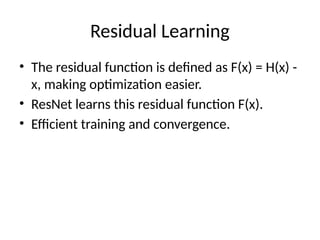
Residual Learning
• The residual function is defined as F(x) = H(x) -
x, making optimization easier.
• ResNet learns this residual function F(x).
• Efficient training and convergence.
The Residual Block
• A typical residual block consists of two layers
with a skip connection.
• Each layer includes convolution, batch
normalization, and ReLU.
• Skip connection adds the input directly to the
output.
Mathematical Perspective
• The block learns F(x) and outputs H(x) = F(x) +
x.
• This stabilizes training in deep networks.
• Reduces vanishing gradient problem.
Why It Works
• Skip connections prevent vanishing gradients
by enabling easier gradient flow.
• Improves convergence in deep networks.
• Simplifies learning identity mappings.
Core Components of ResNet
• ResNet architecture includes convolution,
batch normalization, and ReLU layers.
• Convolutional layers for feature extraction.
• Batch normalization for faster training.
• ReLU activation for non-linearity.
Batch Normalization
• Normalization helps improve stability and
accelerates convergence.
• Keeps activations in a consistent range.
• Reduces internal covariate shift.
ReLU Activation
• Rectified Linear Unit (ReLU) introduces non-
linearity, aiding in training deep networks.
• Activates neurons selectively, avoiding
vanishing gradients.
• Simple and effective for deep architectures.
The Shortcut Connection
• Adds the input of a block directly to its output,
facilitating efficient gradient flow.
• Backbone of ResNet’s architecture.
• Enables easier training of deeper networks.
ResNet Variants Overview
• ResNet architectures include 18, 34, 50, 101,
and 152 layers.
• Shallower networks (ResNet18) use basic
blocks.
• Deeper networks like ResNet50 use bottleneck
blocks.
Bottleneck Blocks in Deeper
ResNets
• Bottleneck blocks improve efficiency in deep
architectures.
• Consist of 1x1, 3x3, and 1x1 convolutions.
• Reduce computational complexity while
increasing depth.
ResNet50 Architecture
• ResNet50 is a deeper version with 50 layers,
offering better performance on complex tasks.
• Uses bottleneck layers to increase depth.
• Effective on datasets like ImageNet.
Performance Metrics
• ResNet achieved state-of-the-art results on
benchmarks like ImageNet.
• Improves accuracy and reduces error rates.
• Performs well compared to other deep
architectures.
Applications of ResNet
• Used widely in computer vision tasks such as
image classification, object detection, and
facial recognition.
• Medical imaging and autonomous vehicles.
• Research and commercial applications.
Real-World Impact
• ResNet powers modern AI applications,
impacting fields like medical diagnosis and
self-driving cars.
• Enhanced image analysis and diagnosis.
• Advancements in autonomous vehicle
technology.
Implementing ResNet in PyTorch
• Steps to build ResNet models in PyTorch.
• Define residual block class.
• Stack blocks to build deeper networks.
• Use pretrained models for prototyping.
Sample PyTorch Code
• Example code for implementing ResNet with
BasicBlock and network definition.
• Explanation of BasicBlock.
• Details of network structure.
Training and Fine-Tuning
• Best practices for training ResNet models.
• Use data augmentation for better
generalization.
• Leverage transfer learning.
Advanced Topics: ResNeXt and
Beyond
• Extensions like ResNeXt build on ResNet's
principles with grouped convolutions.
• Flexible and scalable architectures.
• Improved efficiency.
Future of Residual Learning
• Research is exploring better skip connection
designs and attention mechanisms.
• Enhancing residual networks with
transformers.
• Optimizing for speed and efficiency.
Limitations of ResNet
• While powerful, ResNet models can be
computationally expensive and require careful
tuning.
• High computational requirements for deep
models.
• Challenges in hyperparameter optimization.
Conclusion
• ResNet transformed deep learning by making
ultra-deep networks feasible, impacting
various fields.
• Revolutionized image classification.
• Inspiration for new architectures.
Q&A
• Thank you for your attention! Feel free to ask
questions on any part of the presentation.

CNN, Deep Learning ResNet_30_Slide_Presentation.pptx

  • 1.
    Understanding ResNet (Residual Networks) •A Deep Dive into One of the Most Influential Architectures in Deep Learning
  • 2.
    What are CNNs? •Convolutional Neural Networks are the cornerstone of deep learning in computer vision. • Use convolutional layers to extract features. • Pooling layers to reduce dimensions. • Fully connected layers for classification.
  • 3.
    Why Deep Networks? •Deeper networks can learn more complex patterns but come with challenges. • Can model intricate features of data. • However, prone to issues like vanishing gradients.
  • 4.
    Challenges in DeepLearning • Deep neural networks often face issues like vanishing and exploding gradients. • Degraded performance as depth increases. • Higher computational costs.
  • 5.
    Understanding Vanishing Gradients •Gradients become too small, causing slow or stalled training. • Occurs mainly in networks with Sigmoid activation. • Gradients shrink as they backpropagate.
  • 6.
    ResNet to theRescue! • Residual Networks (ResNet) are designed to mitigate vanishing gradients. • Introduces shortcut connections. • Allows for training of very deep networks.
  • 7.
    Key Idea: SkipConnections • Skip connections bypass one or more layers, allowing gradients to flow uninterrupted. • Simplifies learning when the optimal function is identity. • Improves gradient flow.
  • 8.
    Residual Learning • Theresidual function is defined as F(x) = H(x) - x, making optimization easier. • ResNet learns this residual function F(x). • Efficient training and convergence.
  • 9.
    The Residual Block •A typical residual block consists of two layers with a skip connection. • Each layer includes convolution, batch normalization, and ReLU. • Skip connection adds the input directly to the output.
  • 10.
    Mathematical Perspective • Theblock learns F(x) and outputs H(x) = F(x) + x. • This stabilizes training in deep networks. • Reduces vanishing gradient problem.
  • 11.
    Why It Works •Skip connections prevent vanishing gradients by enabling easier gradient flow. • Improves convergence in deep networks. • Simplifies learning identity mappings.
  • 12.
    Core Components ofResNet • ResNet architecture includes convolution, batch normalization, and ReLU layers. • Convolutional layers for feature extraction. • Batch normalization for faster training. • ReLU activation for non-linearity.
  • 13.
    Batch Normalization • Normalizationhelps improve stability and accelerates convergence. • Keeps activations in a consistent range. • Reduces internal covariate shift.
  • 14.
    ReLU Activation • RectifiedLinear Unit (ReLU) introduces non- linearity, aiding in training deep networks. • Activates neurons selectively, avoiding vanishing gradients. • Simple and effective for deep architectures.
  • 15.
    The Shortcut Connection •Adds the input of a block directly to its output, facilitating efficient gradient flow. • Backbone of ResNet’s architecture. • Enables easier training of deeper networks.
  • 16.
    ResNet Variants Overview •ResNet architectures include 18, 34, 50, 101, and 152 layers. • Shallower networks (ResNet18) use basic blocks. • Deeper networks like ResNet50 use bottleneck blocks.
  • 17.
    Bottleneck Blocks inDeeper ResNets • Bottleneck blocks improve efficiency in deep architectures. • Consist of 1x1, 3x3, and 1x1 convolutions. • Reduce computational complexity while increasing depth.
  • 18.
    ResNet50 Architecture • ResNet50is a deeper version with 50 layers, offering better performance on complex tasks. • Uses bottleneck layers to increase depth. • Effective on datasets like ImageNet.
  • 19.
    Performance Metrics • ResNetachieved state-of-the-art results on benchmarks like ImageNet. • Improves accuracy and reduces error rates. • Performs well compared to other deep architectures.
  • 20.
    Applications of ResNet •Used widely in computer vision tasks such as image classification, object detection, and facial recognition. • Medical imaging and autonomous vehicles. • Research and commercial applications.
  • 21.
    Real-World Impact • ResNetpowers modern AI applications, impacting fields like medical diagnosis and self-driving cars. • Enhanced image analysis and diagnosis. • Advancements in autonomous vehicle technology.
  • 22.
    Implementing ResNet inPyTorch • Steps to build ResNet models in PyTorch. • Define residual block class. • Stack blocks to build deeper networks. • Use pretrained models for prototyping.
  • 23.
    Sample PyTorch Code •Example code for implementing ResNet with BasicBlock and network definition. • Explanation of BasicBlock. • Details of network structure.
  • 24.
    Training and Fine-Tuning •Best practices for training ResNet models. • Use data augmentation for better generalization. • Leverage transfer learning.
  • 25.
    Advanced Topics: ResNeXtand Beyond • Extensions like ResNeXt build on ResNet's principles with grouped convolutions. • Flexible and scalable architectures. • Improved efficiency.
  • 26.
    Future of ResidualLearning • Research is exploring better skip connection designs and attention mechanisms. • Enhancing residual networks with transformers. • Optimizing for speed and efficiency.
  • 27.
    Limitations of ResNet •While powerful, ResNet models can be computationally expensive and require careful tuning. • High computational requirements for deep models. • Challenges in hyperparameter optimization.
  • 28.
    Conclusion • ResNet transformeddeep learning by making ultra-deep networks feasible, impacting various fields. • Revolutionized image classification. • Inspiration for new architectures.
  • 29.
    Q&A • Thank youfor your attention! Feel free to ask questions on any part of the presentation.