Module 1 - Lesson 3
PLOT
ELEMENTS OF
CREATIVE NONFICTION:
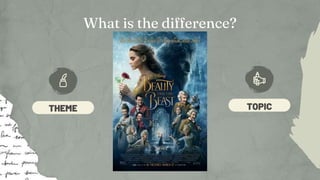
TOPIC
What is the difference?
THEME
What is a plot?
01
Plot is the order of events
in a story.
Elements
of
Creative
Nonfiction
Plots must present an event, action, or turning point that
creates conflict or raises a dramatic question, leading to
subsequent events that are connected to each other as a means
of “answering” the dramatic question and conflict.
The arc of a story’s plot features a causal relationship between a
beginning, middle, and end in which the conflict is built to a
climax and resolved in conclusion.
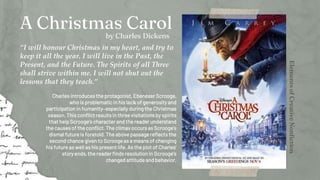
A Christmas Carol
“I will honour Christmas in my heart, and try to
keep it all the year. I will live in the Past, the
Present, and the Future. The Spirits of all Three
shall strive within me. I will not shut out the
lessons that they teach.”
by Charles Dickens
Charles introduces the protagonist, Ebenezer Scrooge,
who is problematic in his lack of generosity and
participation in humanity–especially during the Christmas
season. This conflict resultsin three visitations by spirits
that help Scrooge’s character and the reader understand
the causes of the conflict. The climax occursas Scrooge’s
dismal future is foretold. The above passage reflects the
second chance given to Scrooge as a means of changing
his future as well as his present life. As the plot of Charles’
storyends, the reader finds resolution in Scrooge’s
changed attitude and behavior.
Some elements that influence plot are genre, setting,
characters, dramatic situation, theme, etc.,
but there are two general types of plot:
1 . LINEAR (beginning-middle-end)
2. NON-LINEAR (start with the climax or the ending)
“in medias res”
- stories that begin with the
climax
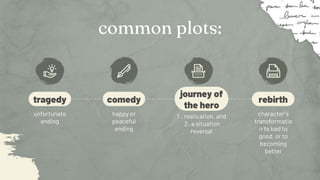
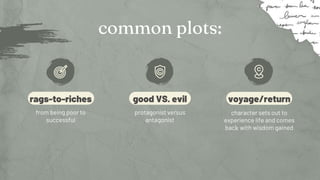
common plots:
tragedy
unfortunate
ending
comedy
happy or
peaceful
ending
journey of
the hero
1 . realization, and
2. a situation
reversal
rebirth
character's
transformatio
n to bad to
good, or to
becoming
better
rags-to-riches
from being poor to
successful
good VS. evil
protagonist versus
antagonist
common plots:
voyage/return
character sets out to
experience life and comes
back with wisdom gained
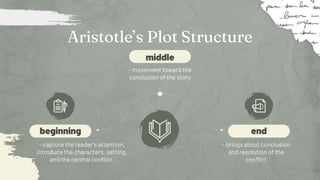
Aristotle’s Plot Structure
beginning
- capture the reader’s attention,
introduce the characters, setting,
and the central conflict.
middle
- movement toward the
conclusion of the story
end
- brings about conclusion
and resolution of the
conflict
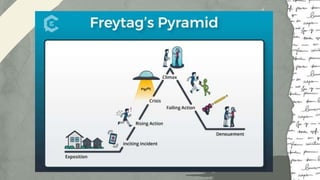
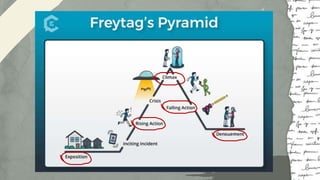
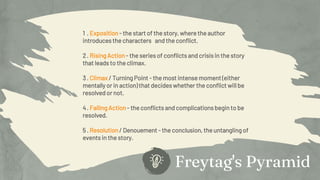
1 . Exposition- the start of the story, where the author
introduces the characters and the conflict.
2. Rising Action- the series of conflicts and crisis in the story
that leads to the climax.
3. Climax / Turning Point - the most intense moment (either
mentally or in action) that decides whether the conflict will be
resolved or not.
4. Falling Action- the conflicts and complications begin to be
resolved.
5. Resolution/ Denouement - the conclusion, the untangling of
events in the story.
Freytag's Pyramid
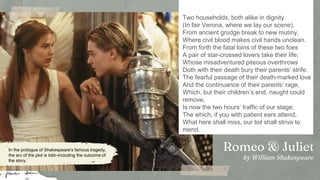
Two households, both alike in dignity
(In fair Verona, where we lay our scene),
From ancient grudge break to new mutiny,
Where civil blood makes civil hands unclean.
From forth the fatal loins of these two foes
A pair of star-crossed lovers take their life;
Whose misadventured piteous overthrows
Doth with their death bury their parents’ strife.
The fearful passage of their death-marked love
And the continuance of their parents’ rage,
Which, but their children’s end, naught could
remove,
Is now the two hours’ traffic of our stage;
The which, if you with patient ears attend,
What here shall miss, our toil shall strive to
mend.
Romeo & Juliet
by William Shakespeare
In the prologue of Shakespeare’s famous tragedy,
the arc of the plot is told–including the outcome of
the story.
Venus
V enus has a beautiful name and
is the second planet from the
Sun. It’s terribly hot there
Jupiter
It’s the biggest planet in the Solar
System. It’s also the fourth-
brightest object in the sky
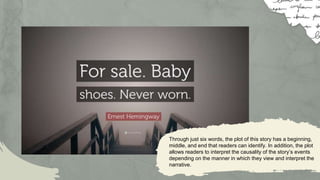
Through just six words, the plot of this story has a beginning,
middle, and end that readers can identify. In addition, the plot
allows readers to interpret the causality of the story’s events
depending on the manner in which they view and interpret the
narrative.
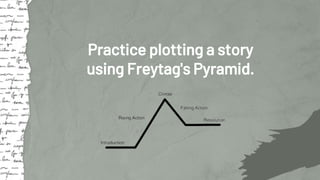
Practice plotting a story
using Freytag's Pyramid.
Big numbers catch your audience’s attention
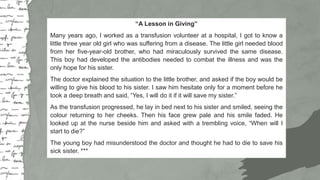
“A Lesson in Giving”
Many years ago, I worked as a transfusion volunteer at a hospital, I got to know a
little three year old girl who was suffering from a disease. The little girl needed blood
from her five-year-old brother, who had miraculously survived the same disease.
This boy had developed the antibodies needed to combat the illness and was the
only hope for his sister.
The doctor explained the situation to the little brother, and asked if the boy would be
willing to give his blood to his sister. I saw him hesitate only for a moment before he
took a deep breath and said, “Yes, I will do it if it will save my sister.”
As the transfusion progressed, he lay in bed next to his sister and smiled, seeing the
colour returning to her cheeks. Then his face grew pale and his smile faded. He
looked up at the nurse beside him and asked with a trembling voice, “When will I
start to die?”
The young boy had misunderstood the doctor and thought he had to die to save his
sick sister. ***
CREDITS: This presentation template was
created by Slidesgo, including icons by Flaticon,
and infographics & images by Freepik
Do you have any questions?
Thanks!
CNF LESSON 4.1.pdfseewweeeeeeeeeeeeeeeee

  • 1.
    Module 1 -Lesson 3 PLOT ELEMENTS OF CREATIVE NONFICTION:
  • 2.
    TOPIC What is thedifference? THEME
  • 3.
    What is aplot? 01 Plot is the order of events in a story. Elements of Creative Nonfiction
  • 4.
    Plots must presentan event, action, or turning point that creates conflict or raises a dramatic question, leading to subsequent events that are connected to each other as a means of “answering” the dramatic question and conflict. The arc of a story’s plot features a causal relationship between a beginning, middle, and end in which the conflict is built to a climax and resolved in conclusion.
  • 5.
    A Christmas Carol “Iwill honour Christmas in my heart, and try to keep it all the year. I will live in the Past, the Present, and the Future. The Spirits of all Three shall strive within me. I will not shut out the lessons that they teach.” by Charles Dickens Charles introduces the protagonist, Ebenezer Scrooge, who is problematic in his lack of generosity and participation in humanity–especially during the Christmas season. This conflict resultsin three visitations by spirits that help Scrooge’s character and the reader understand the causes of the conflict. The climax occursas Scrooge’s dismal future is foretold. The above passage reflects the second chance given to Scrooge as a means of changing his future as well as his present life. As the plot of Charles’ storyends, the reader finds resolution in Scrooge’s changed attitude and behavior.
  • 6.
    Some elements thatinfluence plot are genre, setting, characters, dramatic situation, theme, etc., but there are two general types of plot: 1 . LINEAR (beginning-middle-end) 2. NON-LINEAR (start with the climax or the ending) “in medias res” - stories that begin with the climax
  • 7.
    common plots: tragedy unfortunate ending comedy happy or peaceful ending journeyof the hero 1 . realization, and 2. a situation reversal rebirth character's transformatio n to bad to good, or to becoming better
  • 8.
    rags-to-riches from being poorto successful good VS. evil protagonist versus antagonist common plots: voyage/return character sets out to experience life and comes back with wisdom gained
  • 9.
    Aristotle’s Plot Structure beginning -capture the reader’s attention, introduce the characters, setting, and the central conflict. middle - movement toward the conclusion of the story end - brings about conclusion and resolution of the conflict
  • 12.
    1 . Exposition-the start of the story, where the author introduces the characters and the conflict. 2. Rising Action- the series of conflicts and crisis in the story that leads to the climax. 3. Climax / Turning Point - the most intense moment (either mentally or in action) that decides whether the conflict will be resolved or not. 4. Falling Action- the conflicts and complications begin to be resolved. 5. Resolution/ Denouement - the conclusion, the untangling of events in the story. Freytag's Pyramid
  • 13.
    Two households, bothalike in dignity (In fair Verona, where we lay our scene), From ancient grudge break to new mutiny, Where civil blood makes civil hands unclean. From forth the fatal loins of these two foes A pair of star-crossed lovers take their life; Whose misadventured piteous overthrows Doth with their death bury their parents’ strife. The fearful passage of their death-marked love And the continuance of their parents’ rage, Which, but their children’s end, naught could remove, Is now the two hours’ traffic of our stage; The which, if you with patient ears attend, What here shall miss, our toil shall strive to mend. Romeo & Juliet by William Shakespeare In the prologue of Shakespeare’s famous tragedy, the arc of the plot is told–including the outcome of the story.
  • 14.
    Venus V enus hasa beautiful name and is the second planet from the Sun. It’s terribly hot there Jupiter It’s the biggest planet in the Solar System. It’s also the fourth- brightest object in the sky Through just six words, the plot of this story has a beginning, middle, and end that readers can identify. In addition, the plot allows readers to interpret the causality of the story’s events depending on the manner in which they view and interpret the narrative.
  • 15.
    Practice plotting astory using Freytag's Pyramid.
  • 16.
    Big numbers catchyour audience’s attention “A Lesson in Giving” Many years ago, I worked as a transfusion volunteer at a hospital, I got to know a little three year old girl who was suffering from a disease. The little girl needed blood from her five-year-old brother, who had miraculously survived the same disease. This boy had developed the antibodies needed to combat the illness and was the only hope for his sister. The doctor explained the situation to the little brother, and asked if the boy would be willing to give his blood to his sister. I saw him hesitate only for a moment before he took a deep breath and said, “Yes, I will do it if it will save my sister.” As the transfusion progressed, he lay in bed next to his sister and smiled, seeing the colour returning to her cheeks. Then his face grew pale and his smile faded. He looked up at the nurse beside him and asked with a trembling voice, “When will I start to die?” The young boy had misunderstood the doctor and thought he had to die to save his sick sister. ***
  • 17.
    CREDITS: This presentationtemplate was created by Slidesgo, including icons by Flaticon, and infographics & images by Freepik Do you have any questions? Thanks!