Cloud Native CI/CD with
“GitOps”
DevOpsDays Copenhagen 2019
Kasper Nissen, Cloud Architect/SRE @lunarway
kni@lunarway.com @phennex
$ whoami
Kasper Nissen (@phennex)
● Cloud Architect / Site Reliability Engineer @lunarway
● Organizer and Co-Founder at Cloud Native Aarhus
● Founder of Cloud Native Nordics Slack Community
● Blogger at kubecloud.io
@phennex
What is Lunar Way?
Our vision is to rethink the interaction with
money.
Live in Sweden, Norway, and Denmark
3 Kubernetes clusters in AWS
80+ microservices in production
@phennex
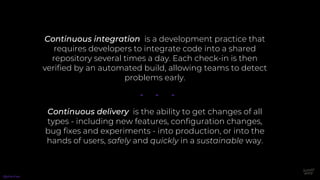
Continuous integration is a development practice that
requires developers to integrate code into a shared
repository several times a day. Each check-in is then
verified by an automated build, allowing teams to detect
problems early.
- - -
Continuous delivery is the ability to get changes of all
types - including new features, configuration changes,
bug fixes and experiments - into production, or into the
hands of users, safely and quickly in a sustainable way.
@phennex
This sounds like two
different concerns?
… aren’t we all about decomposing, into smaller
components with single responsibility?
@phennex
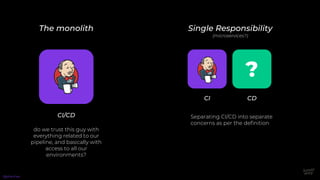
?
CI/CD
do we trust this guy with
everything related to our
pipeline, and basically with
access to all our
environments?
CI CD
Separating CI/CD into separate
concerns as per the definition
The monolith Single Responsibility
(microservices?)
@phennex
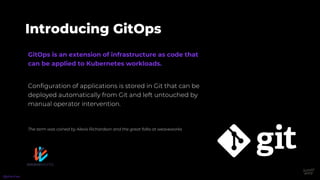
GitOps is an extension of infrastructure as code that
can be applied to Kubernetes workloads.
Configuration of applications is stored in Git that can be
deployed automatically from Git and left untouched by
manual operator intervention.
The term was coined by Alexis Richardson and the great folks at weaveworks
Introducing GitOps
@phennex
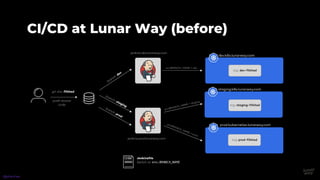
CI/CD at Lunar Way (before)
@phennex
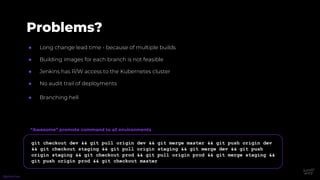
Problems?
● Long change lead time - because of multiple builds
● Building images for each branch is not feasible
● Jenkins has R/W access to the Kubernetes cluster
● No audit trail of deployments
● Branching hell
git checkout dev && git pull origin dev && git merge master && git push origin dev
&& git checkout staging && git pull origin staging && git merge dev && git push
origin staging && git checkout prod && git pull origin prod && git merge staging &&
git push origin prod && git checkout master
“Awesome” promote command to all environments
@phennex
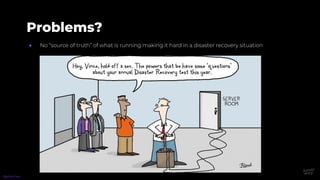
Problems?
● No “source of truth” of what is running making it hard in a disaster recovery situation
@phennex
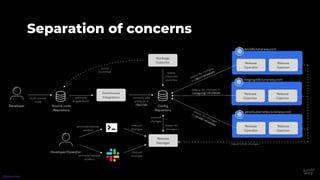
Separation of concerns
@phennex
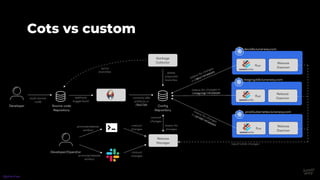
Cots vs custom
@phennex
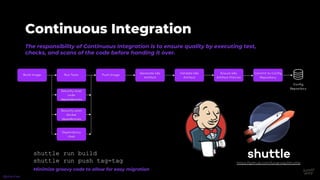
The responsibility of Continuous Integration is to ensure quality by executing test,
checks, and scans of the code before handing it over.
Continuous Integration
shuttle run build
shuttle run push tag=tag https://github.com/lunarway/shuttle
Minimize groovy code to allow for easy migration
@phennex
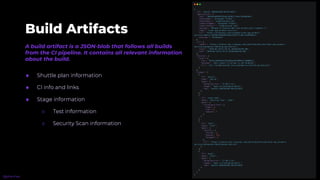
A build artifact is a JSON-blob that follows all builds
from the CI pipeline. It contains all relevant information
about the build.
Build Artifacts
● Shuttle plan information
● CI info and links
● Stage information
○ Test information
○ Security Scan information
@phennex
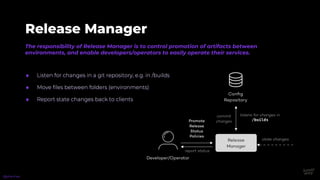
The responsibility of Release Manager is to control promotion of artifacts between
environments, and enable developers/operators to easily operate their services.
Release Manager
● Listen for changes in a git repository, e.g. in /builds
● Move files between folders (environments)
● Report state changes back to clients
@phennex
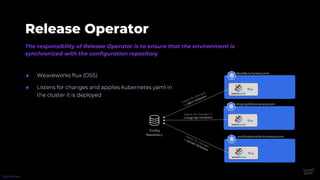
The responsibility of Release Operator is to ensure that the environment is
synchronized with the configuration repository
Release Operator
● Weaveworks flux (OSS)
● Listens for changes and applies kubernetes yaml in
the cluster it is deployed
@phennex
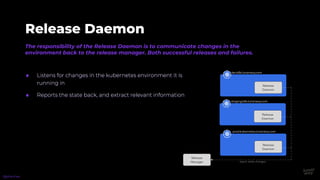
The responsibility of the Release Daemon is to communicate changes in the
environment back to the release manager. Both successful releases and failures.
Release Daemon
● Listens for changes in the kubernetes environment it is
running in
● Reports the state back, and extract relevant information
@phennex
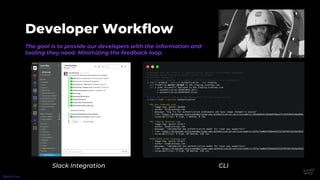
The goal is to provide our developers with the information and
tooling they need. Minimizing the feedback loop.
Developer Workflow
Slack Integration CLI
@phennex
Adopting a modified GitOps pattern has improved a lot of the previous pain points
Wrapping up, what did we get?
● Faster lead time to production
● Promotion of artifacts instead of code (reproducible builds)
● Current state of the cluster is always stored in git and can easily be
recreated
@phennex
Continued
Wrapping up, what did we get?
● Minimizing the need for developer access to the environments (minimize
the risk of exposing credentials and human errors)
● CI no longer have access to the cluster, minimizing the surface of attack
● Audit trail of changes
@phennex
Thank You!we are hiring https://jobs.lunarway.com/

Cloud Native CI/CD with GitOps

  • 1.
    Cloud Native CI/CDwith “GitOps” DevOpsDays Copenhagen 2019 Kasper Nissen, Cloud Architect/SRE @lunarway kni@lunarway.com @phennex
  • 2.
    $ whoami Kasper Nissen(@phennex) ● Cloud Architect / Site Reliability Engineer @lunarway ● Organizer and Co-Founder at Cloud Native Aarhus ● Founder of Cloud Native Nordics Slack Community ● Blogger at kubecloud.io @phennex
  • 3.
    What is LunarWay? Our vision is to rethink the interaction with money. Live in Sweden, Norway, and Denmark 3 Kubernetes clusters in AWS 80+ microservices in production @phennex
  • 4.
    Continuous integration isa development practice that requires developers to integrate code into a shared repository several times a day. Each check-in is then verified by an automated build, allowing teams to detect problems early. - - - Continuous delivery is the ability to get changes of all types - including new features, configuration changes, bug fixes and experiments - into production, or into the hands of users, safely and quickly in a sustainable way. @phennex
  • 5.
    This sounds liketwo different concerns? … aren’t we all about decomposing, into smaller components with single responsibility? @phennex
  • 6.
    ? CI/CD do we trustthis guy with everything related to our pipeline, and basically with access to all our environments? CI CD Separating CI/CD into separate concerns as per the definition The monolith Single Responsibility (microservices?) @phennex
  • 7.
    GitOps is anextension of infrastructure as code that can be applied to Kubernetes workloads. Configuration of applications is stored in Git that can be deployed automatically from Git and left untouched by manual operator intervention. The term was coined by Alexis Richardson and the great folks at weaveworks Introducing GitOps @phennex
  • 8.
    CI/CD at LunarWay (before) @phennex
  • 9.
    Problems? ● Long changelead time - because of multiple builds ● Building images for each branch is not feasible ● Jenkins has R/W access to the Kubernetes cluster ● No audit trail of deployments ● Branching hell git checkout dev && git pull origin dev && git merge master && git push origin dev && git checkout staging && git pull origin staging && git merge dev && git push origin staging && git checkout prod && git pull origin prod && git merge staging && git push origin prod && git checkout master “Awesome” promote command to all environments @phennex
  • 10.
    Problems? ● No “sourceof truth” of what is running making it hard in a disaster recovery situation @phennex
  • 11.
  • 12.
  • 13.
    The responsibility ofContinuous Integration is to ensure quality by executing test, checks, and scans of the code before handing it over. Continuous Integration shuttle run build shuttle run push tag=tag https://github.com/lunarway/shuttle Minimize groovy code to allow for easy migration @phennex
  • 14.
    A build artifactis a JSON-blob that follows all builds from the CI pipeline. It contains all relevant information about the build. Build Artifacts ● Shuttle plan information ● CI info and links ● Stage information ○ Test information ○ Security Scan information @phennex
  • 15.
    The responsibility ofRelease Manager is to control promotion of artifacts between environments, and enable developers/operators to easily operate their services. Release Manager ● Listen for changes in a git repository, e.g. in /builds ● Move files between folders (environments) ● Report state changes back to clients @phennex
  • 16.
    The responsibility ofRelease Operator is to ensure that the environment is synchronized with the configuration repository Release Operator ● Weaveworks flux (OSS) ● Listens for changes and applies kubernetes yaml in the cluster it is deployed @phennex
  • 17.
    The responsibility ofthe Release Daemon is to communicate changes in the environment back to the release manager. Both successful releases and failures. Release Daemon ● Listens for changes in the kubernetes environment it is running in ● Reports the state back, and extract relevant information @phennex
  • 18.
    The goal isto provide our developers with the information and tooling they need. Minimizing the feedback loop. Developer Workflow Slack Integration CLI @phennex
  • 19.
    Adopting a modifiedGitOps pattern has improved a lot of the previous pain points Wrapping up, what did we get? ● Faster lead time to production ● Promotion of artifacts instead of code (reproducible builds) ● Current state of the cluster is always stored in git and can easily be recreated @phennex
  • 20.
    Continued Wrapping up, whatdid we get? ● Minimizing the need for developer access to the environments (minimize the risk of exposing credentials and human errors) ● CI no longer have access to the cluster, minimizing the surface of attack ● Audit trail of changes @phennex Thank You!we are hiring https://jobs.lunarway.com/