2021 | intellias.com
is the best modern practice for CD with Kubernetes
GitOps approach
by Volodymyr Shynkar
Senior Lead DevOps Engineer
#!/BIN/ABOUT_ME
Volodymyr Shynkar
Senior Lead DevOps Engineer at Intellias
6+ years of commercial DevOps experience. Overall 8+ years of Engineering
Successfully migrated, rolled out, consulted over 15 projects in the healthcare,
gambling, automotive, e-commerce industries
Member of the Center of Excellence
Lead of the CCI team in the automotive segment
Certified SAFe Agile Software Engineer
Addicted to IoT and Smart Home
Cyclist, promoter of a healthy lifestyle
Contents
01
Introducing to GitOps
02
The Principles of GitOps
03
Secure your pipeline
04
CD - Why? How?
01
Introducing to GitOps
GitOps is
An evolution of infrastructure as code, a framework
that can drastically improve deployment speed and
development efficiency.
GitOps is…
v An operations model for building Cloud Native apps
GitOps is…
v An operations model for building Cloud Native apps
v Based on years of operations experience
GitOps is…
v An operations model for building Cloud Native apps
v Based on years of operations experience
v A set of principles
GitOps is…
v An operations model for building Cloud Native apps
v Based on years of operations experience
v A set of principles
v A way to speed up your team
GitOps is…
v An operations model for building Cloud Native apps
v Based on years of operations experience
v A set of principles
v A way to speed up your team
v GitOps applies to everything
v Config is a code
v Code must be version controlled
v Config must be version controlled too!
02
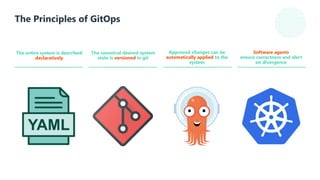
The Principles of GitOps
The entire system is described
declaratively
The canonical desired system
state is versioned in git
Approved changes can be
automatically applied to the
system
Software agents
ensure correctness and alert
on divergence
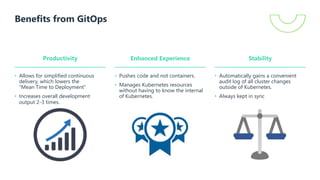
Benefits from GitOps
Productivity Enhanced Experience Stability
• Allows for simplified continuous
delivery, which lowers the
“Mean Time to Deployment”
• Increases overall development
output 2-3 times.
• Pushes code and not containers.
• Manages Kubernetes resources
without having to know the internal
of Kubernetes.
• Automatically gains a convenient
audit log of all cluster changes
outside of Kubernetes.
• Always kept in sync
Benefits from GitOps
Reliability Consistency Security / Audit
• In case of a problem, rollback is as easy as
revert commit in Git. Single source of
truth simplifies the process and reduces
delays
• One entry point for changes. Everything
is driven through commits in a Git
repository. Everything is described at one
place (Single pane of glass). PR - Review –
Merge – Apply
• Leveraging Git build-in security and
signature. Allows for easy tracking of
changes and their approvals
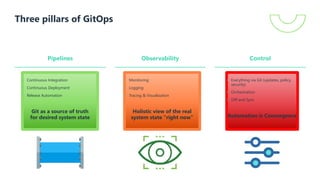
Three pillars of GitOps
Pipelines Observability
• Continuous Integration
• Continuous Deployment
• Release Automation
Git as a source of truth
for desired system state
• Monitoring
• Logging
• Tracing & Visualization
Holistic view of the real
system state “right now”
• Everything via Git (updates, policy,
security)
• Orchestration
• Diff and Sync
Automation is Convergence
Control
03
Secure your pipeline
Move the burden of security
Move from access to cluster to access to repository!
…So how to secure your repository?
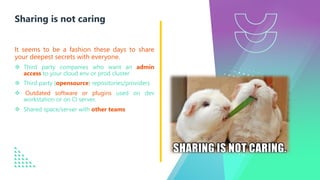
It seems to be a fashion these days to share
your deepest secrets with everyone.
v Third party companies who want an admin
access to your cloud env or prod cluster
v Third party (opensource) repositories/providers
v Outdated software or plugins used on dev
workstation or on CI server.
v Shared space/server with other teams
Sharing is not caring
What is solution for this?
v Move humans as far away from that final
production deployment as possible
v Statically analyse everything
v Run through multiple layers of checks
v Have individuals sign off the change, but not
modify the change that goes through
v All above are fundamentally based on using git
as the basis for everything
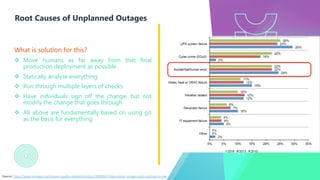
Root Causes of Unplanned Outages
Source: https://www.ecmweb.com/power-quality-reliability/article/20900947/data-center-outage-costs-continue-to-rise
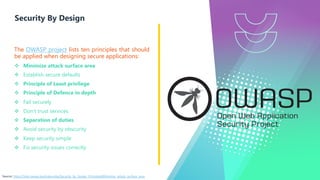
The OWASP project lists ten principles that should
be applied when designing secure applications:
v Minimize attack surface area
v Establish secure defaults
v Principle of Least privilege
v Principle of Defence in depth
v Fail securely
v Don’t trust services
v Separation of duties
v Avoid security by obscurity
v Keep security simple
v Fix security issues correctly
Security By Design
Source: https://wiki.owasp.org/index.php/Security_by_Design_Principles#Minimize_attack_surface_area
Threats:
v Git users can impersonate each other
• Mitigation: Enforce strong identity in VCS with GPG
Signed Commits
v Malicious user rewrites history
• Mitigation: Prevent force pushes to Master/Main branch
• Mitigation: Backup Git repositories
v Malicious user removes security features
• Mitigation: Configure Git provider with IaC
• Mitigation: Verify commits to Master/Main
Continuous Deployment and Continuous Security
Source: https://www.ecmweb.com/power-quality-reliability/article/20900947/data-center-outage-costs-continue-to-rise
v Everyone on the team can easily pull the deploy
secrets
v To pull the secrets out you just need to push changes
to a branch that print out the environment variables
during a job run, or POST them to an endpoint
v In the above scenario, compromising a single
engineer is enough to gain access to production
through the CI.
Free-for-all secrets
What is solution for this?
v Paper/USB/CDR two fireproof safes?
v Vault (or actually Consul)?
Where do I version control my secrets?
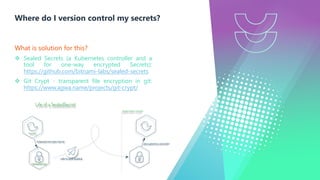
What is solution for this?
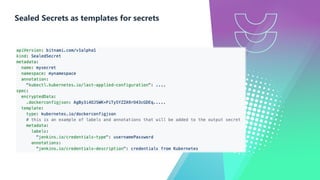
v Sealed Secrets (a Kubernetes controller and a
tool for one-way encrypted Secrets):
https://github.com/bitnami-labs/sealed-secrets
v Git Crypt - transparent file encryption in git:
https://www.agwa.name/projects/git-crypt/
Where do I version control my secrets?
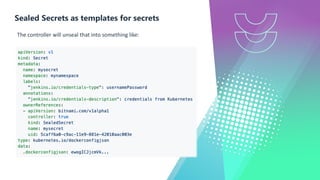
Sealed Secrets as templates for secrets
The controller will unseal that into something like:
04
CD - Why? How?
Two ways to GitOps
• There are two ways to implement the deployment
strategy for GitOps:
Push-based and Pull-based.
The push-based CD
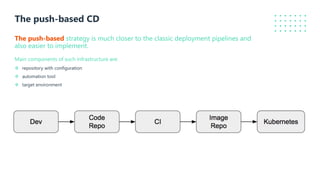
The push-based strategy is much closer to the classic deployment pipelines and
also easier to implement.
Main components of such infrastructure are:
v repository with configuration
v automation tool
v target environment
Questions to ask include:
• Does your CI environment have direct access to the
container image repository?
• Does your CI environment have direct access to the
production cluster?
The push-based CD
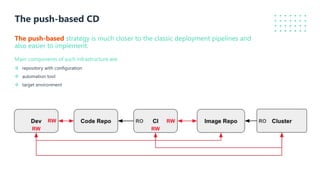
The push-based strategy is much closer to the classic deployment pipelines and
also easier to implement.
Main components of such infrastructure are:
v repository with configuration
v automation tool
v target environment
The pull-based CD
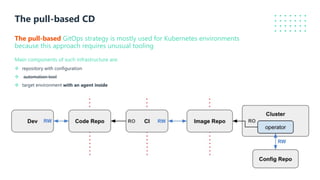
The pull-based GitOps strategy is mostly used for Kubernetes environments
because this approach requires unusual tooling
Main components of such infrastructure are:
v repository with configuration
v automation tool
v target environment with an agent inside
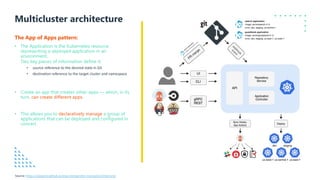
Multicluster architecture
The App of Apps pattern:
• The Application is the Kubernetes resource
representing a deployed application in an
environment.
Two key pieces of information define it:
• source reference to the desired state in Git
• destination reference to the target cluster and namespace
• Create an app that creates other apps — which, in its
turn, can create different apps.
• This allows you to declaratively manage a group of
applications that can be deployed and configured in
concert.
Source: https://argoproj.github.io/argo-cd/operator-manual/architecture/
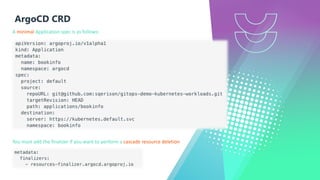
ArgoCD CRD
You must add the finalizer if you want to perform a cascade resource deletion
A minimal Application spec is as follows:
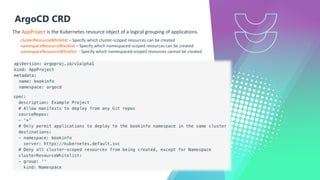
ArgoCD CRD
The AppProject is the Kubernetes resource object of a logical grouping of applications.
clusterResourceWhitelist – Specify which cluster-scoped resources can be created
namespaceResourceBlacklist – Specify which namespaced-scoped resources can be created
namespaceResourceWhitelist - Specify which namespaced-scoped resources cannot be created
Demo time
Questions?
2021 | intellias.com
Thank you!
by Volodymyr Shynkar
Senior Lead DevOps Engineer
https://www.linkedin.com/in/vshynkar/
https://github.com/sqerison

GitOps is the best modern practice for CD with Kubernetes

  • 1.
    2021 | intellias.com isthe best modern practice for CD with Kubernetes GitOps approach by Volodymyr Shynkar Senior Lead DevOps Engineer
  • 2.
    #!/BIN/ABOUT_ME Volodymyr Shynkar Senior LeadDevOps Engineer at Intellias 6+ years of commercial DevOps experience. Overall 8+ years of Engineering Successfully migrated, rolled out, consulted over 15 projects in the healthcare, gambling, automotive, e-commerce industries Member of the Center of Excellence Lead of the CCI team in the automotive segment Certified SAFe Agile Software Engineer Addicted to IoT and Smart Home Cyclist, promoter of a healthy lifestyle
  • 3.
    Contents 01 Introducing to GitOps 02 ThePrinciples of GitOps 03 Secure your pipeline 04 CD - Why? How?
  • 4.
  • 5.
    GitOps is An evolutionof infrastructure as code, a framework that can drastically improve deployment speed and development efficiency.
  • 6.
    GitOps is… v Anoperations model for building Cloud Native apps
  • 7.
    GitOps is… v Anoperations model for building Cloud Native apps v Based on years of operations experience
  • 8.
    GitOps is… v Anoperations model for building Cloud Native apps v Based on years of operations experience v A set of principles
  • 9.
    GitOps is… v Anoperations model for building Cloud Native apps v Based on years of operations experience v A set of principles v A way to speed up your team
  • 10.
    GitOps is… v Anoperations model for building Cloud Native apps v Based on years of operations experience v A set of principles v A way to speed up your team v GitOps applies to everything v Config is a code v Code must be version controlled v Config must be version controlled too!
  • 11.
  • 12.
    The Principles ofGitOps The entire system is described declaratively The canonical desired system state is versioned in git Approved changes can be automatically applied to the system Software agents ensure correctness and alert on divergence
  • 13.
    Benefits from GitOps ProductivityEnhanced Experience Stability • Allows for simplified continuous delivery, which lowers the “Mean Time to Deployment” • Increases overall development output 2-3 times. • Pushes code and not containers. • Manages Kubernetes resources without having to know the internal of Kubernetes. • Automatically gains a convenient audit log of all cluster changes outside of Kubernetes. • Always kept in sync
  • 14.
    Benefits from GitOps ReliabilityConsistency Security / Audit • In case of a problem, rollback is as easy as revert commit in Git. Single source of truth simplifies the process and reduces delays • One entry point for changes. Everything is driven through commits in a Git repository. Everything is described at one place (Single pane of glass). PR - Review – Merge – Apply • Leveraging Git build-in security and signature. Allows for easy tracking of changes and their approvals
  • 15.
    Three pillars ofGitOps Pipelines Observability • Continuous Integration • Continuous Deployment • Release Automation Git as a source of truth for desired system state • Monitoring • Logging • Tracing & Visualization Holistic view of the real system state “right now” • Everything via Git (updates, policy, security) • Orchestration • Diff and Sync Automation is Convergence Control
  • 16.
  • 17.
    Move the burdenof security Move from access to cluster to access to repository! …So how to secure your repository?
  • 18.
    It seems tobe a fashion these days to share your deepest secrets with everyone. v Third party companies who want an admin access to your cloud env or prod cluster v Third party (opensource) repositories/providers v Outdated software or plugins used on dev workstation or on CI server. v Shared space/server with other teams Sharing is not caring
  • 19.
    What is solutionfor this? v Move humans as far away from that final production deployment as possible v Statically analyse everything v Run through multiple layers of checks v Have individuals sign off the change, but not modify the change that goes through v All above are fundamentally based on using git as the basis for everything Root Causes of Unplanned Outages Source: https://www.ecmweb.com/power-quality-reliability/article/20900947/data-center-outage-costs-continue-to-rise
  • 20.
    The OWASP projectlists ten principles that should be applied when designing secure applications: v Minimize attack surface area v Establish secure defaults v Principle of Least privilege v Principle of Defence in depth v Fail securely v Don’t trust services v Separation of duties v Avoid security by obscurity v Keep security simple v Fix security issues correctly Security By Design Source: https://wiki.owasp.org/index.php/Security_by_Design_Principles#Minimize_attack_surface_area
  • 21.
    Threats: v Git userscan impersonate each other • Mitigation: Enforce strong identity in VCS with GPG Signed Commits v Malicious user rewrites history • Mitigation: Prevent force pushes to Master/Main branch • Mitigation: Backup Git repositories v Malicious user removes security features • Mitigation: Configure Git provider with IaC • Mitigation: Verify commits to Master/Main Continuous Deployment and Continuous Security Source: https://www.ecmweb.com/power-quality-reliability/article/20900947/data-center-outage-costs-continue-to-rise
  • 22.
    v Everyone onthe team can easily pull the deploy secrets v To pull the secrets out you just need to push changes to a branch that print out the environment variables during a job run, or POST them to an endpoint v In the above scenario, compromising a single engineer is enough to gain access to production through the CI. Free-for-all secrets
  • 23.
    What is solutionfor this? v Paper/USB/CDR two fireproof safes? v Vault (or actually Consul)? Where do I version control my secrets?
  • 24.
    What is solutionfor this? v Sealed Secrets (a Kubernetes controller and a tool for one-way encrypted Secrets): https://github.com/bitnami-labs/sealed-secrets v Git Crypt - transparent file encryption in git: https://www.agwa.name/projects/git-crypt/ Where do I version control my secrets?
  • 25.
    Sealed Secrets astemplates for secrets
  • 26.
    Sealed Secrets astemplates for secrets The controller will unseal that into something like:
  • 27.
  • 28.
    Two ways toGitOps • There are two ways to implement the deployment strategy for GitOps: Push-based and Pull-based.
  • 29.
    The push-based CD Thepush-based strategy is much closer to the classic deployment pipelines and also easier to implement. Main components of such infrastructure are: v repository with configuration v automation tool v target environment
  • 30.
    Questions to askinclude: • Does your CI environment have direct access to the container image repository? • Does your CI environment have direct access to the production cluster?
  • 31.
    The push-based CD Thepush-based strategy is much closer to the classic deployment pipelines and also easier to implement. Main components of such infrastructure are: v repository with configuration v automation tool v target environment
  • 32.
    The pull-based CD Thepull-based GitOps strategy is mostly used for Kubernetes environments because this approach requires unusual tooling Main components of such infrastructure are: v repository with configuration v automation tool v target environment with an agent inside
  • 33.
    Multicluster architecture The Appof Apps pattern: • The Application is the Kubernetes resource representing a deployed application in an environment. Two key pieces of information define it: • source reference to the desired state in Git • destination reference to the target cluster and namespace • Create an app that creates other apps — which, in its turn, can create different apps. • This allows you to declaratively manage a group of applications that can be deployed and configured in concert. Source: https://argoproj.github.io/argo-cd/operator-manual/architecture/
  • 34.
    ArgoCD CRD You mustadd the finalizer if you want to perform a cascade resource deletion A minimal Application spec is as follows:
  • 35.
    ArgoCD CRD The AppProjectis the Kubernetes resource object of a logical grouping of applications. clusterResourceWhitelist – Specify which cluster-scoped resources can be created namespaceResourceBlacklist – Specify which namespaced-scoped resources can be created namespaceResourceWhitelist - Specify which namespaced-scoped resources cannot be created
  • 36.
  • 37.
  • 38.
    2021 | intellias.com Thankyou! by Volodymyr Shynkar Senior Lead DevOps Engineer https://www.linkedin.com/in/vshynkar/ https://github.com/sqerison