Cloud Foundry
The Building of the Open PaaS


         Derek Collison
         July 27, 2011
What is
Cloud Foundry?
The Open
Platform as a Service
What is
PaaS?
Or more
specifically, an
   aPaaS?
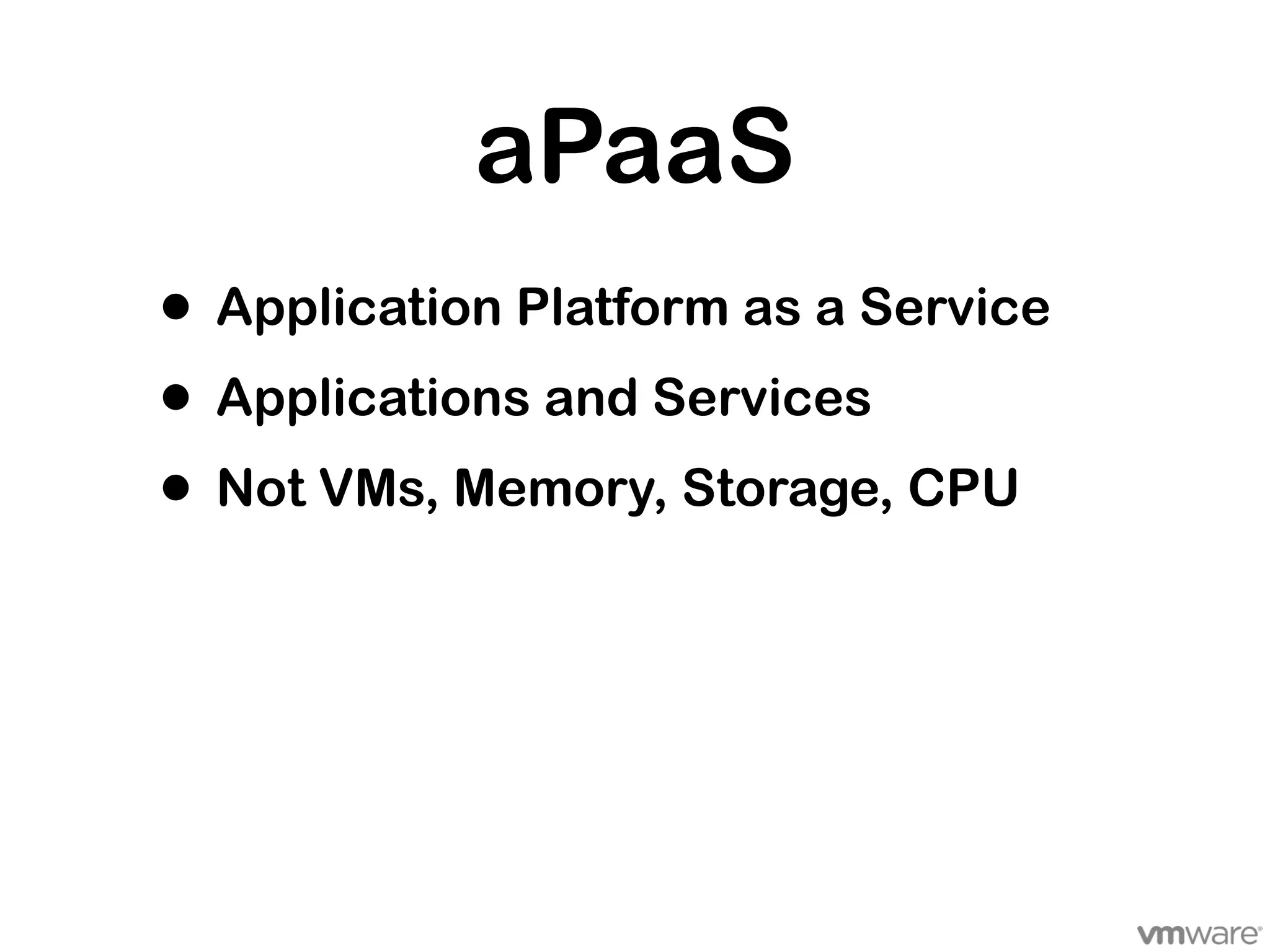
aPaaS
• Application Platform as a Service
• Applications and Services
• Not VMs, Memory, Storage, CPU
What is
OpenPaaS?
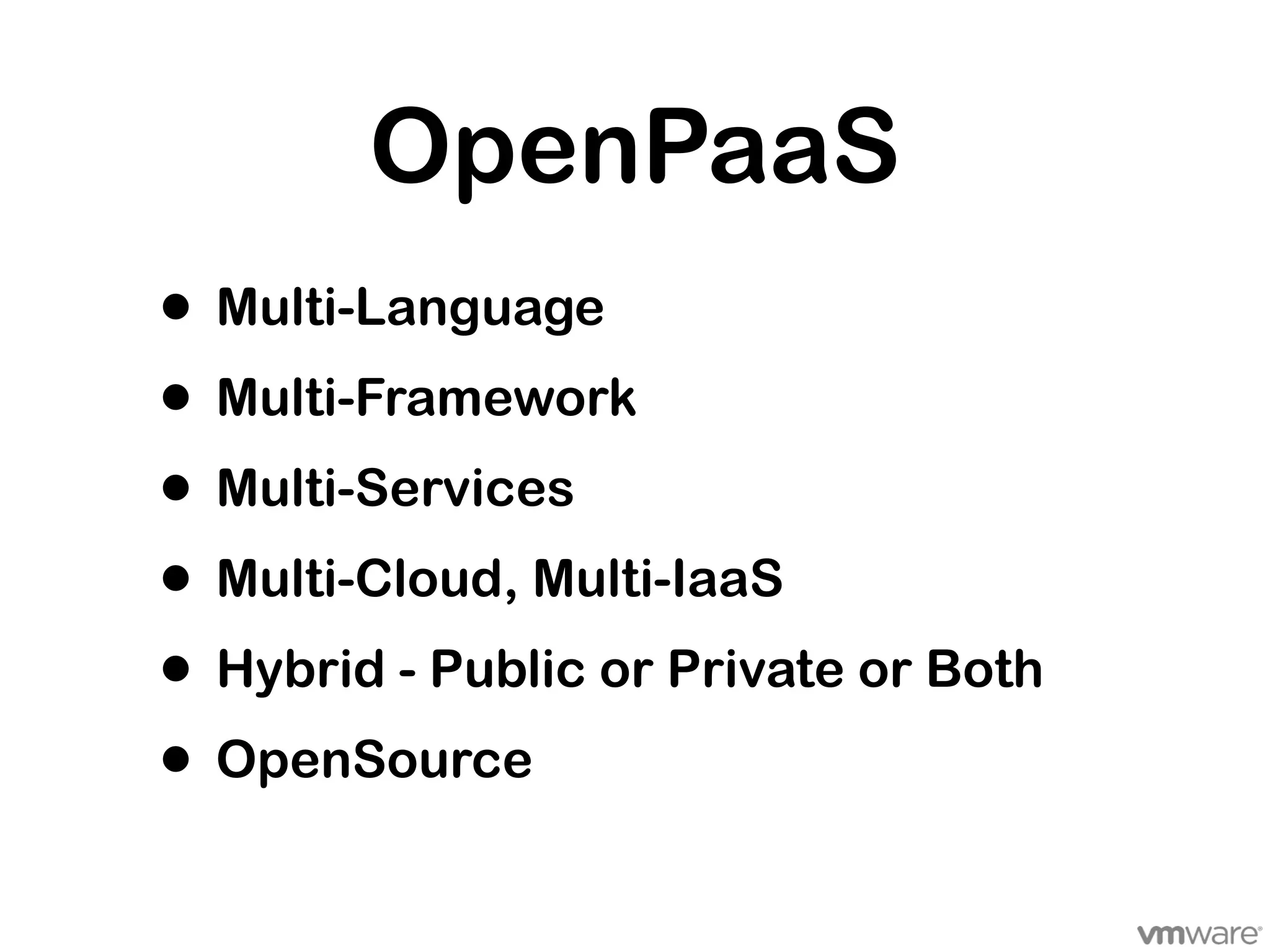
OpenPaaS
• Multi-Language
• Multi-Framework
• Multi-Services
• Multi-Cloud, Multi-IaaS
• Hybrid - Public or Private or Both
• OpenSource
OpenPaaS
•   Multi-Language
    •   Java, Scala, Ruby, Node, Erlang, PHP..

•   Multi-Framework
    •   Spring, Grails, Express, Rails, Lift, MochiWeb

•   Multi-Services
    •   MySQL, Postgres, MongoDB, Redis, RabbitMQ

•   Multi-Cloud, Multi-IaaS
    •   vSphere, OpenStack, AWS, Eucalyptus
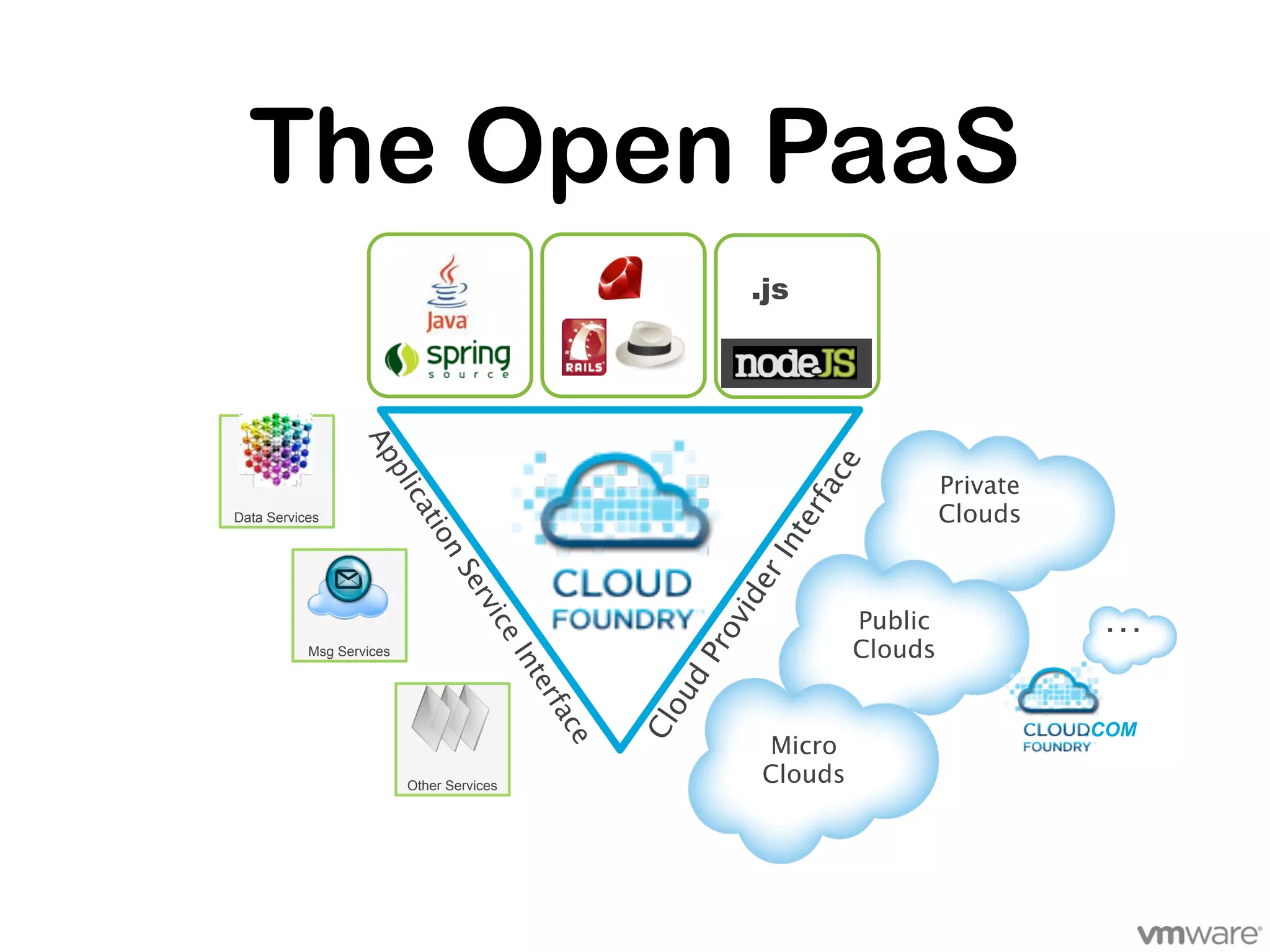
The Open PaaS
                                                                  .js

                  Ap


                                                                         ce
                     p


                                                                                       Private
                          lic


                                                                        rfa
                                                                                       Clouds
                           at


Data Services


                                                                    te
                             io


                                                                  In
                                n
                                 Se


                                                              er
                                    r


                                                             vid
                                                                                                  …
                                     vic


                                                                              Public


                                                              o
                                         e


                                                                              Clouds

                                                           Pr
           Msg Services
                                            In
                                              te


                                                      ud
                                              rfa


                                                       o
                                                    Cl

                                                                                                 .COM
                                               ce


                                                                  Micro
                           Other Services
                                                                  Clouds
What was our Goal?
• Raise the unit of currency to the be
  the application and its associated
  services, not the infrastructure

• Best of breed delivery platform for all
  modern applications and frameworks
• Favor Choice and Openness
• Simplicity and Speed
How was it Built?
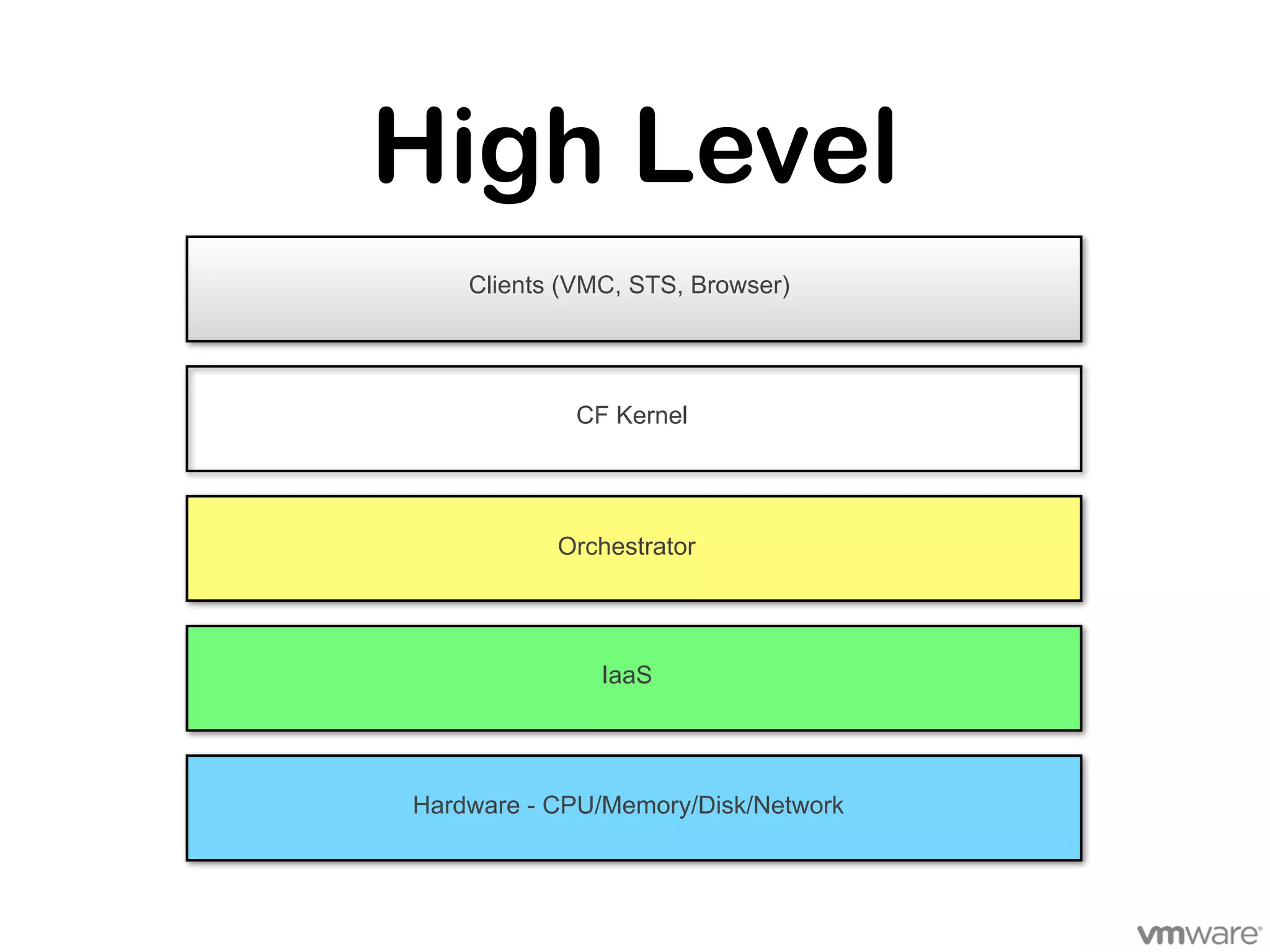
• Kernel and Orchestrator Shells
 •   Layered on top of IaaS

• Kernel
 •   Core PaaS System

• Orchestrator
 •   Creation, management and
     orchestration of the infrastructure
High Level
    Clients (VMC, STS, Browser)


             CF Kernel


           Orchestrator


               IaaS


Hardware - CPU/Memory/Disk/Network
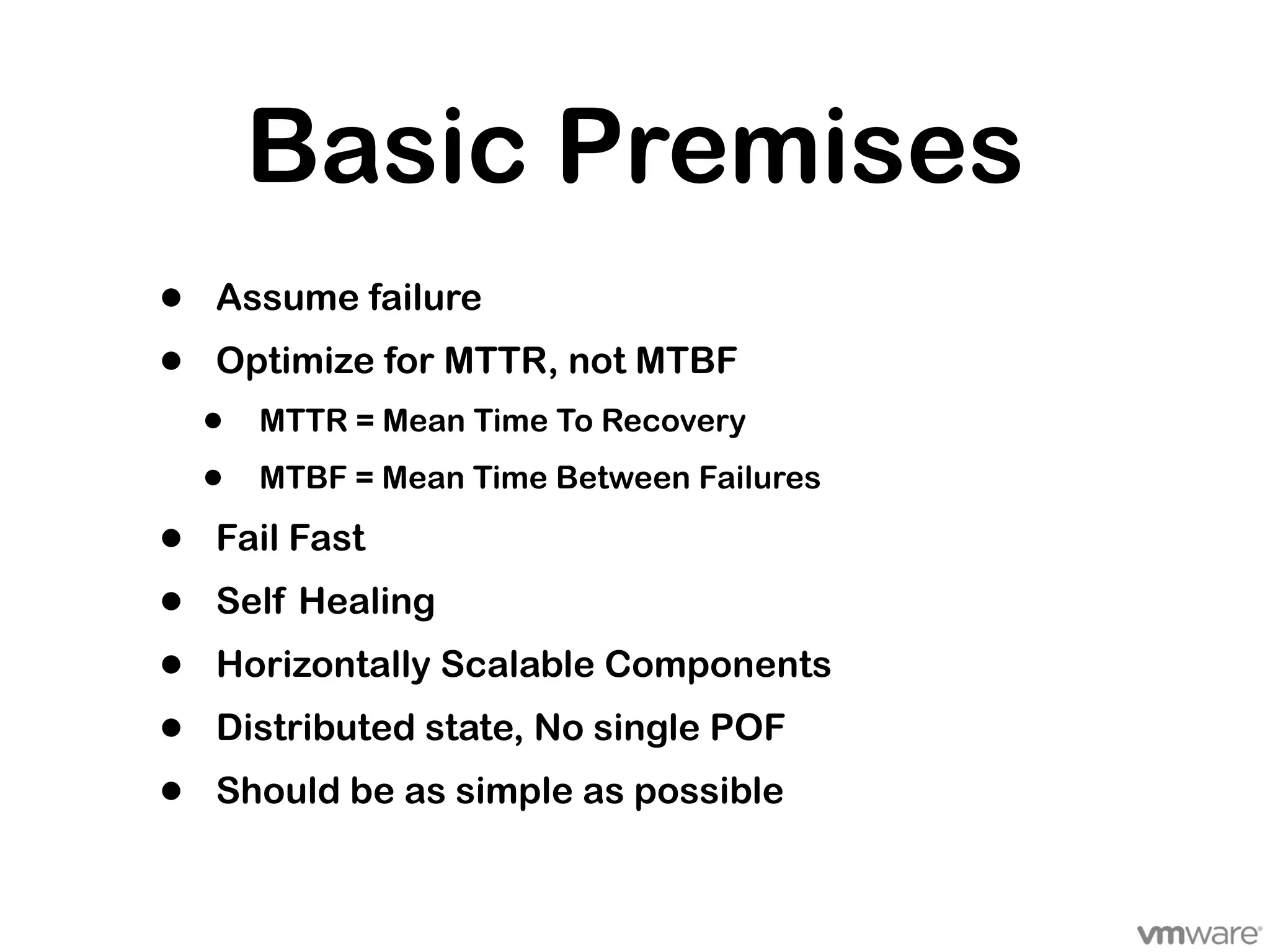
Basic Premises
•   Assume failure
•   Optimize for MTTR, not MTBF
    •   MTTR = Mean Time To Recovery

    •   MTBF = Mean Time Between Failures

•   Fail Fast
•   Self Healing
•   Horizontally Scalable Components
•   Distributed state, No single POF
•   Should be as simple as possible
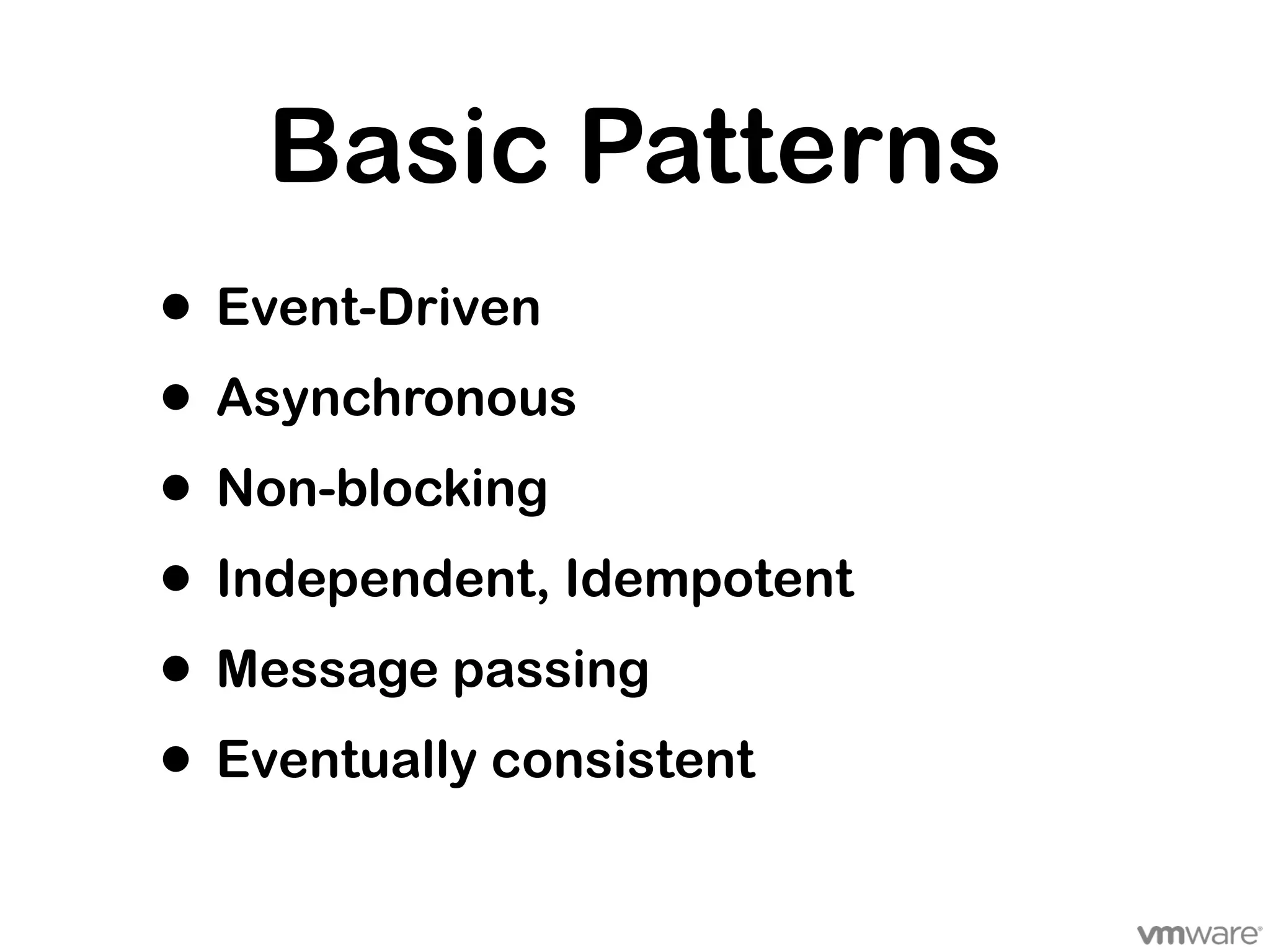
Basic Patterns
• Event-Driven
• Asynchronous
• Non-blocking
• Independent, Idempotent
• Message passing
• Eventually consistent
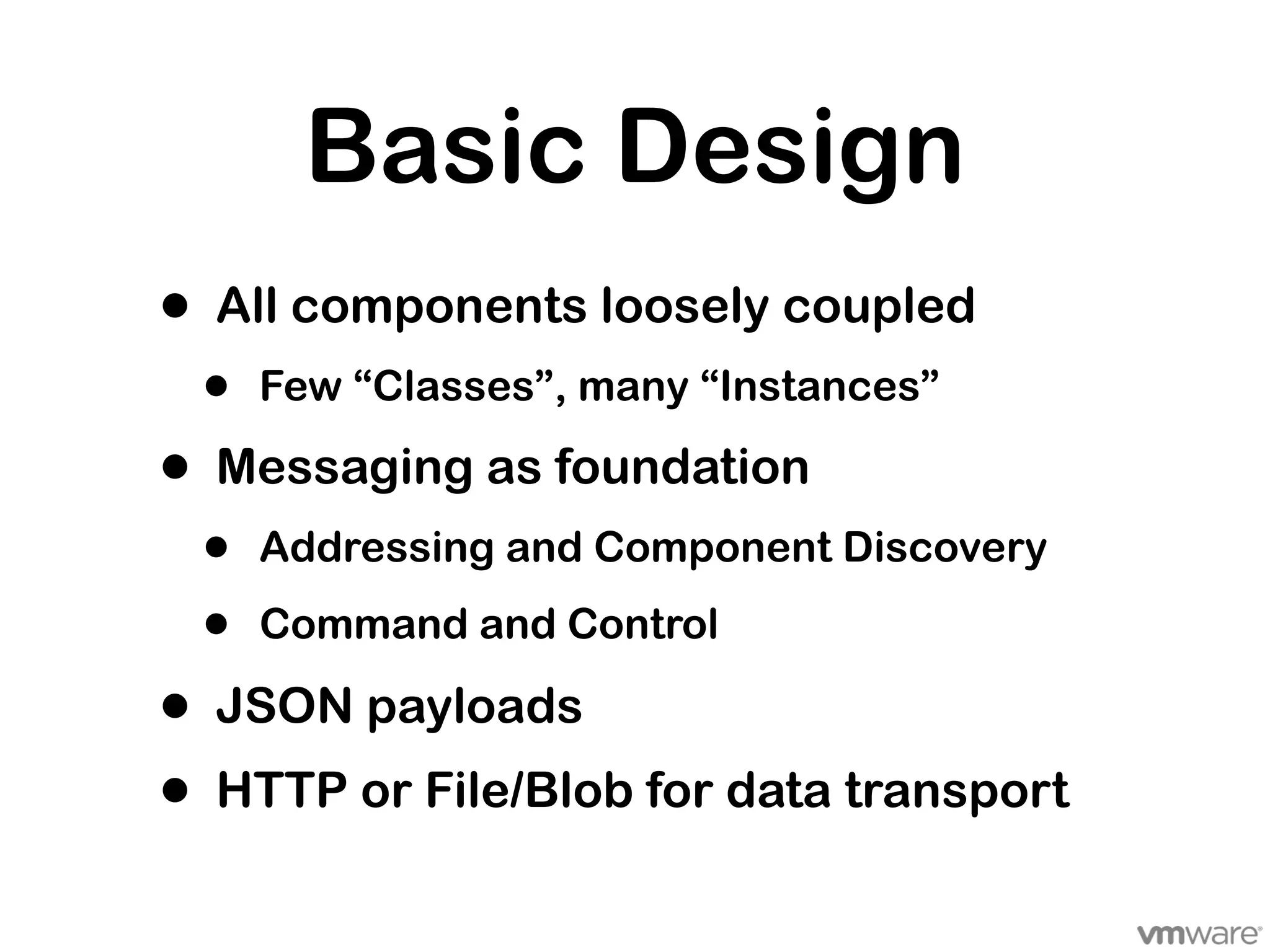
Basic Design
•   All components loosely coupled
    •   Few “Classes”, many “Instances”

•   Messaging as foundation
    •   Addressing and Component Discovery

    •   Command and Control

•   JSON payloads
•   HTTP or File/Blob for data transport
Kernel Components
• All dynamically discoverable
• Launch and scale in any order
• Can come and go as needed
• Monitor via HTTP and JSON
• Location independent
Kernel Components
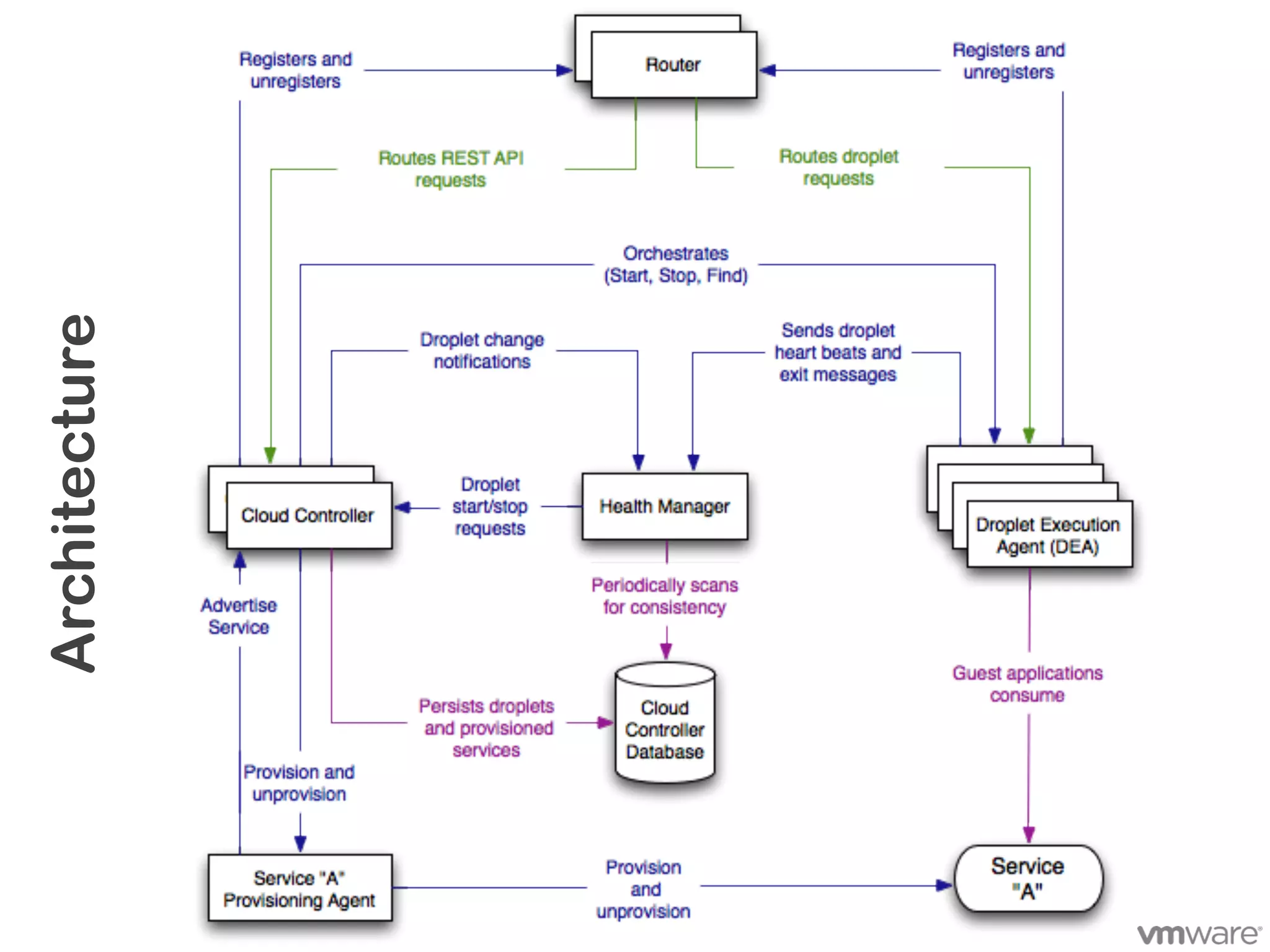
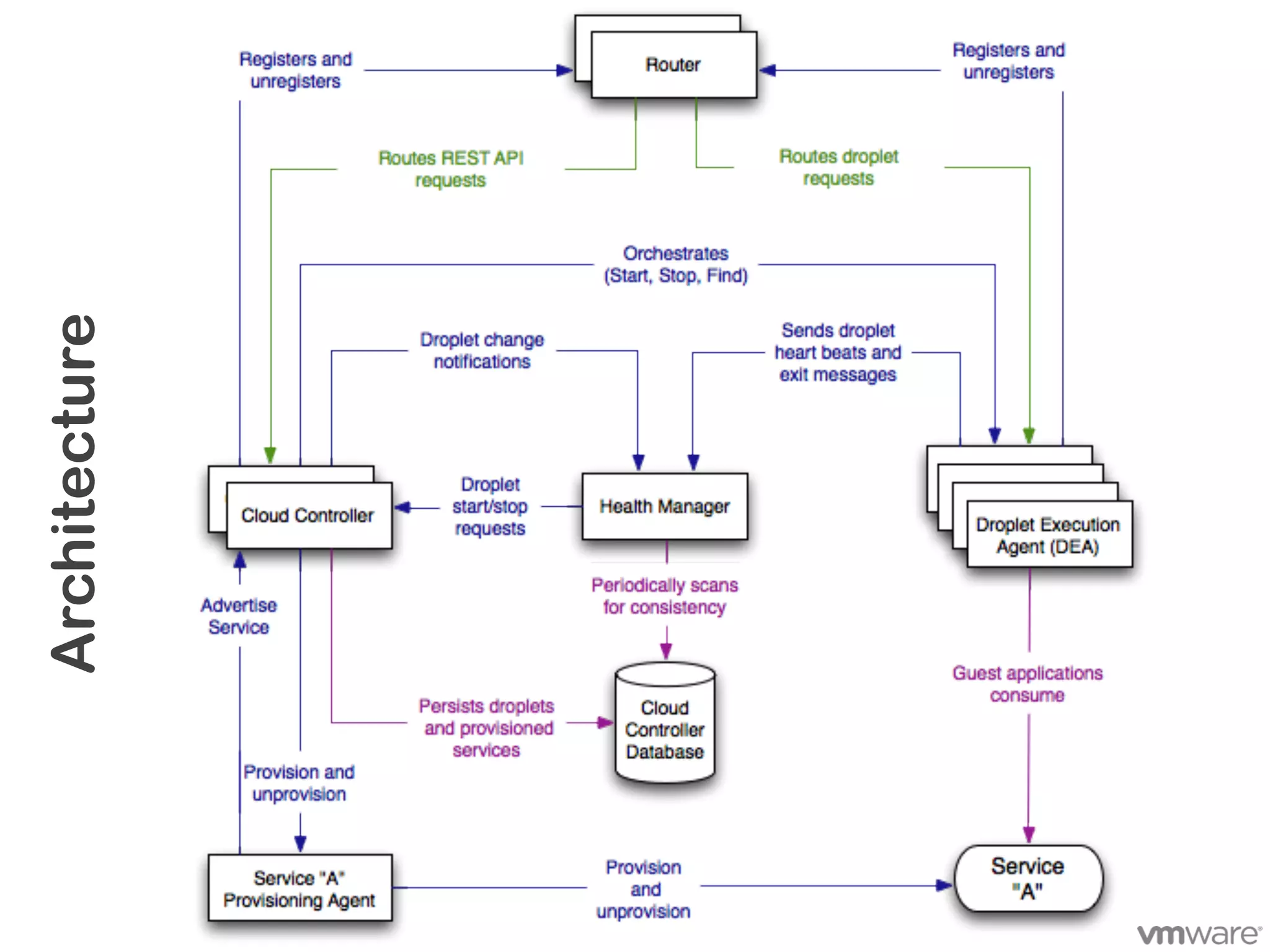
• Router
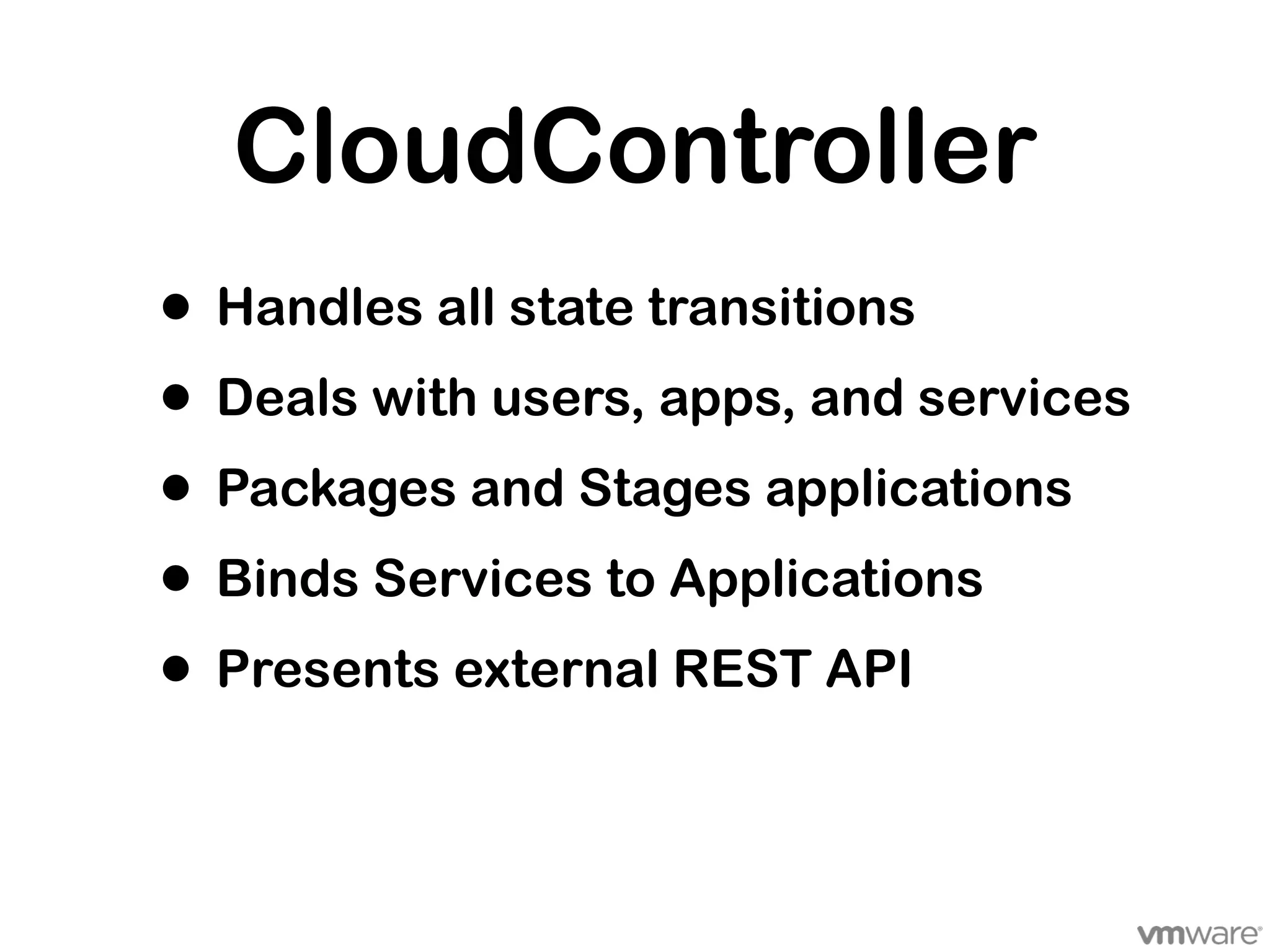
• CloudController
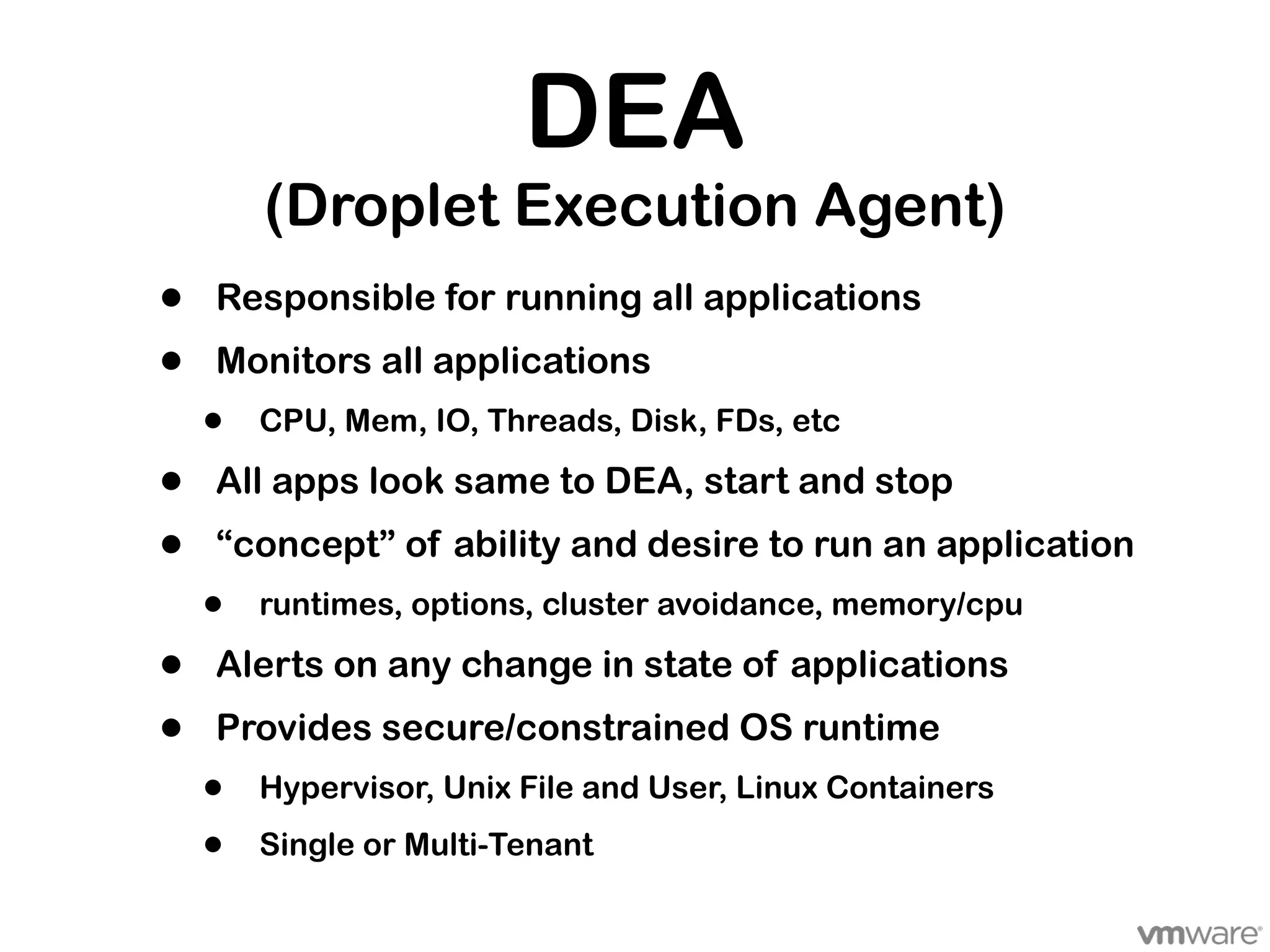
• DEA
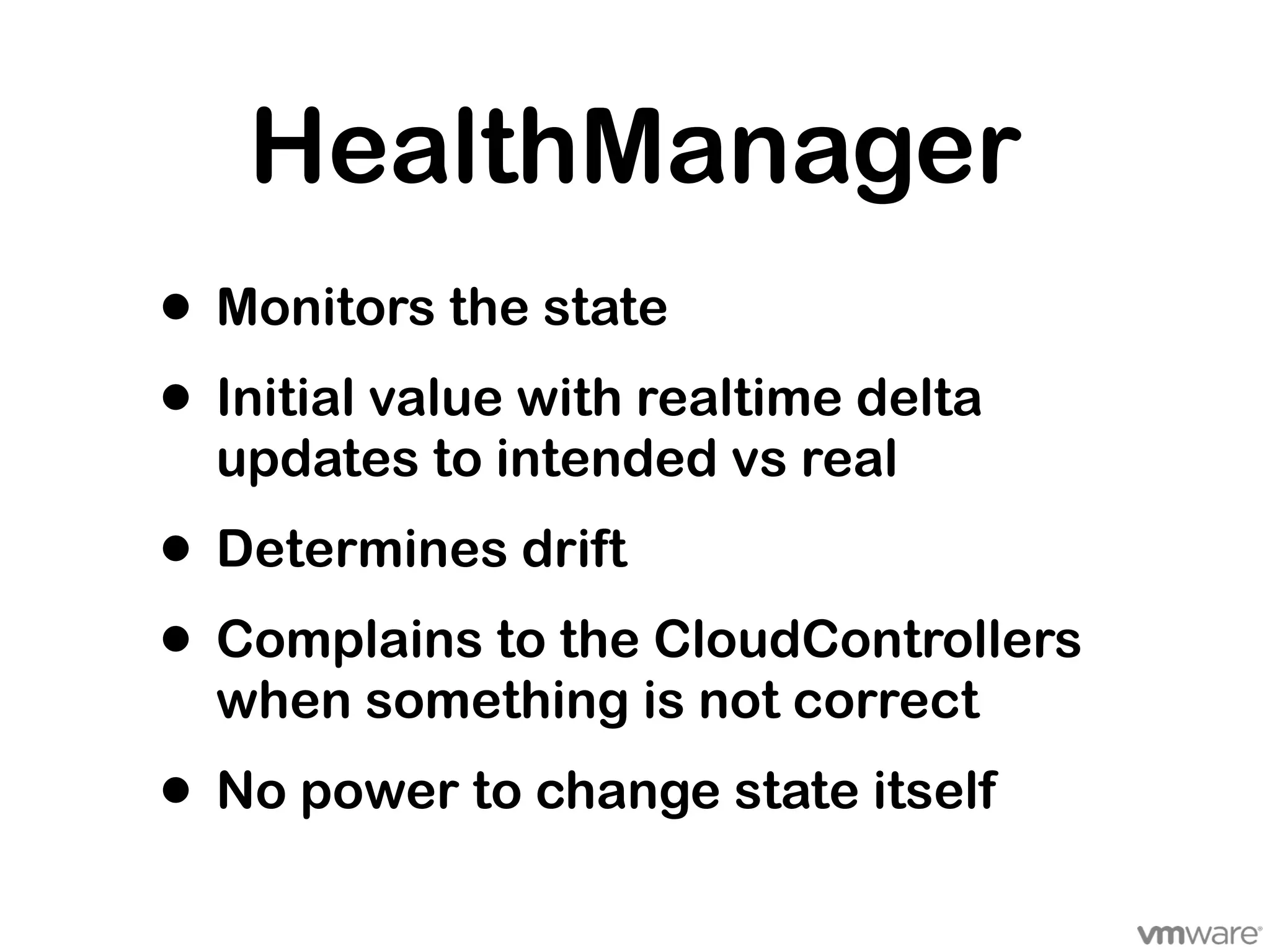
• HealthManager
• Messaging System
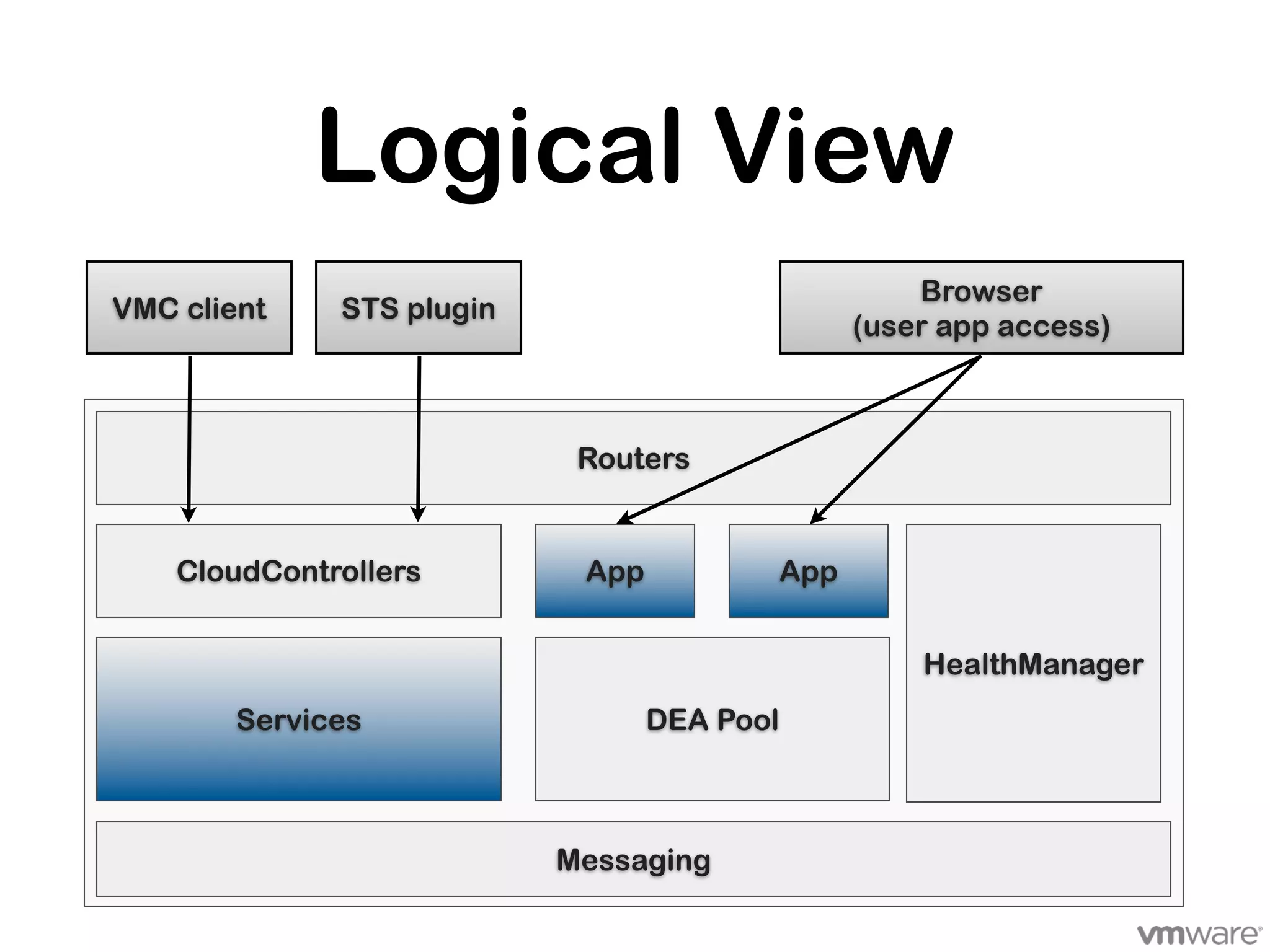
Logical View
                                                       Browser
VMC client    STS plugin
                                                   (user app access)


                            Routers


    CloudControllers        App              App


                                                       HealthManager
        Services                  DEA Pool


                           Messaging
Messaging
•   Addressing and Discovery
    •   No static IPs or DNS lookups req’d

    •   Just Layer 4

•   Command and Control
•   Central communication system
•   Dial tone, fire and forget
•   Protects *itself* at all costs
•   Idempotent semantics
Router
• Handles all HTTP traffic
• Maintains distributed routing state
• Routes URLs to applications
• Distributes load among instances
• Realtime distributed updates to
  routing tables from DEAs
CloudController
• Handles all state transitions
• Deals with users, apps, and services
• Packages and Stages applications
• Binds Services to Applications
• Presents external REST API
HealthManager
• Monitors the state
• Initial value with realtime delta
  updates to intended vs real
• Determines drift
• Complains to the CloudControllers
  when something is not correct
• No power to change state itself
DEA
        (Droplet Execution Agent)
•   Responsible for running all applications
•   Monitors all applications
    •   CPU, Mem, IO, Threads, Disk, FDs, etc

•   All apps look same to DEA, start and stop
•   “concept” of ability and desire to run an application
    •   runtimes, options, cluster avoidance, memory/cpu

•   Alerts on any change in state of applications
•   Provides secure/constrained OS runtime
    •   Hypervisor, Unix File and User, Linux Containers

    •   Single or Multi-Tenant
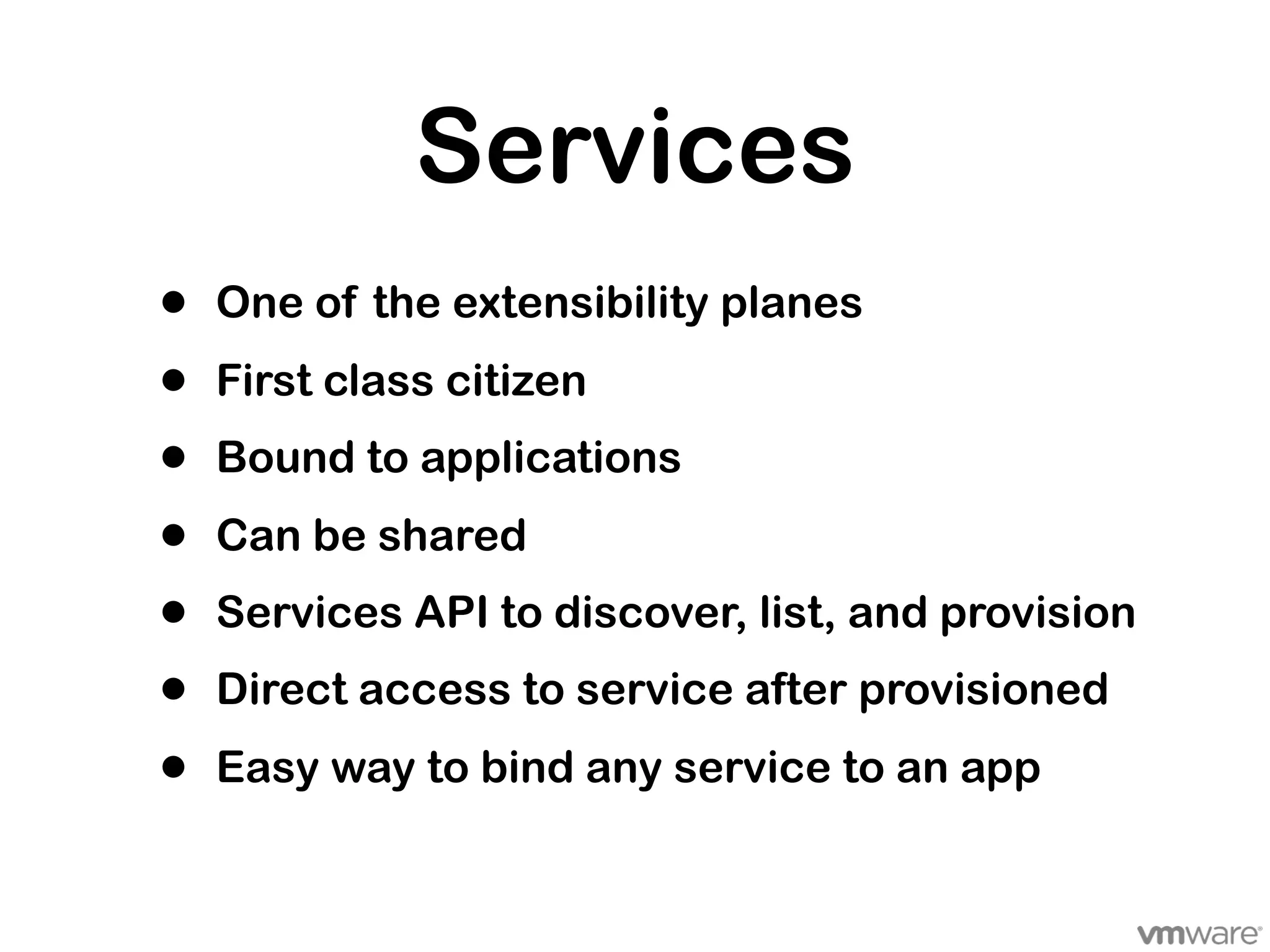
Services
•   One of the extensibility planes

•   First class citizen
•   Bound to applications

•   Can be shared
•   Services API to discover, list, and provision
•   Direct access to service after provisioned

•   Easy way to bind any service to an app
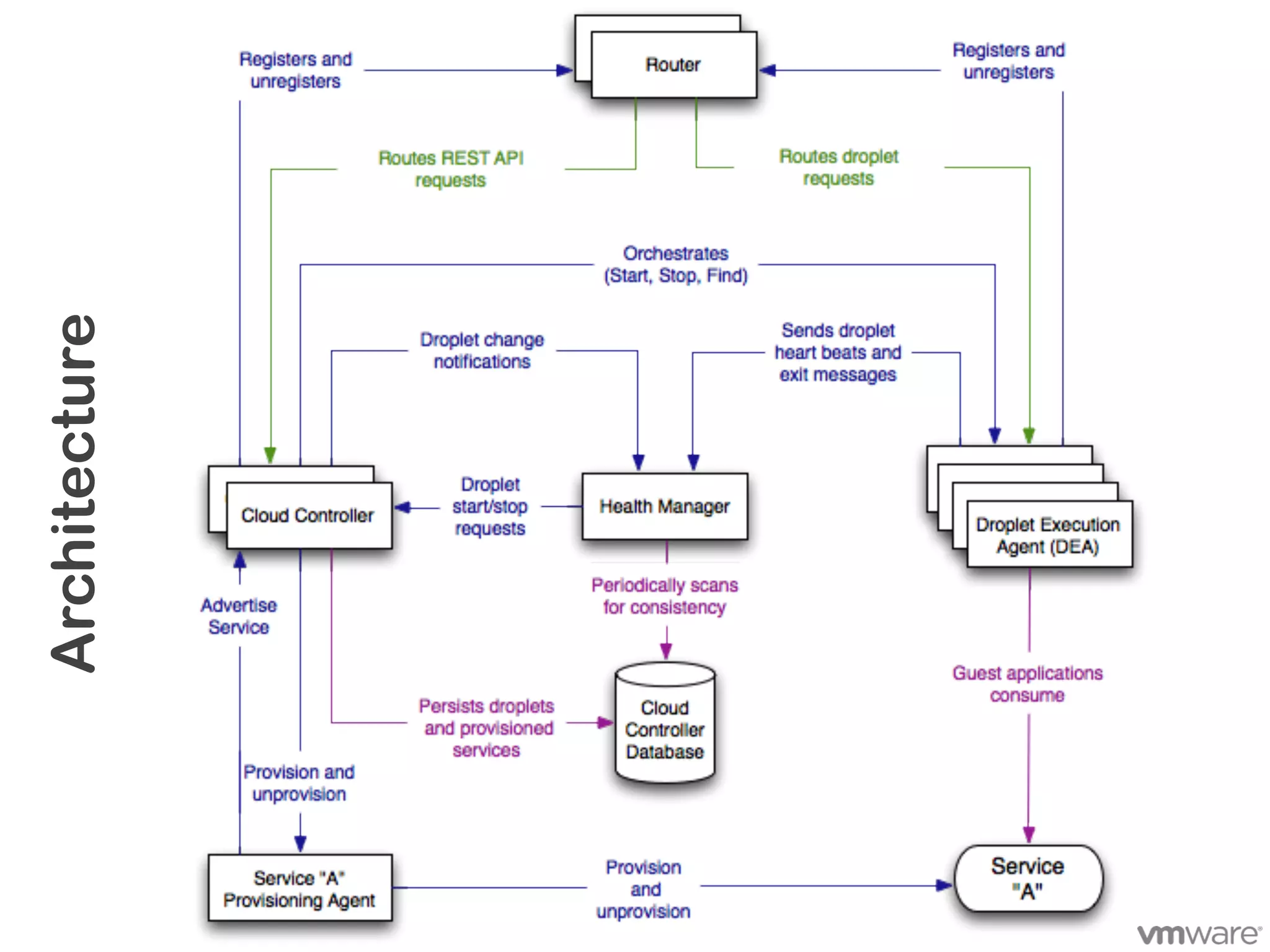
Architecture
How does it all
   work?
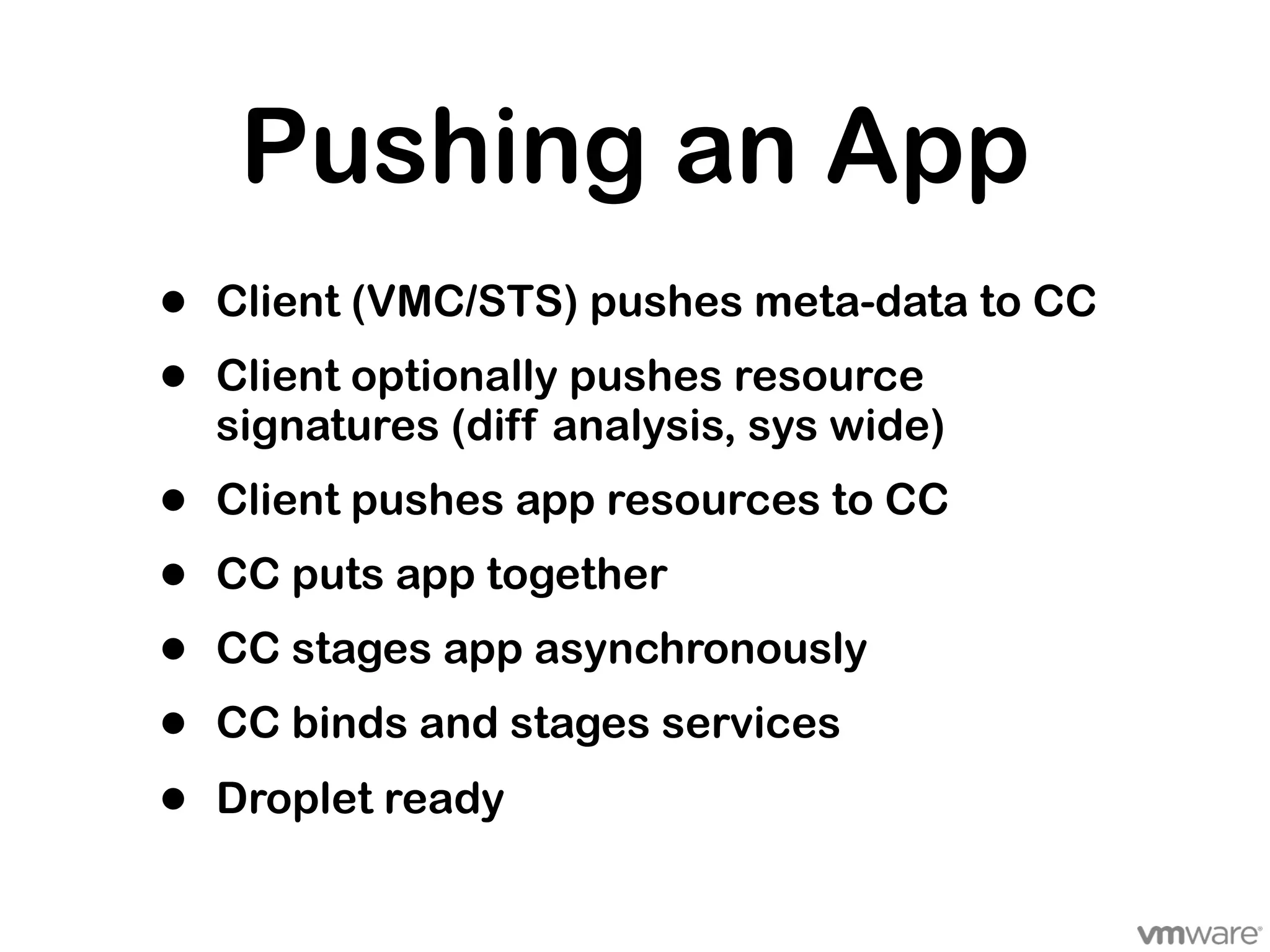
Pushing an App
•   Client (VMC/STS) pushes meta-data to CC
•   Client optionally pushes resource
    signatures (diff analysis, sys wide)
•   Client pushes app resources to CC
•   CC puts app together
•   CC stages app asynchronously
•   CC binds and stages services

•   Droplet ready
Architecture
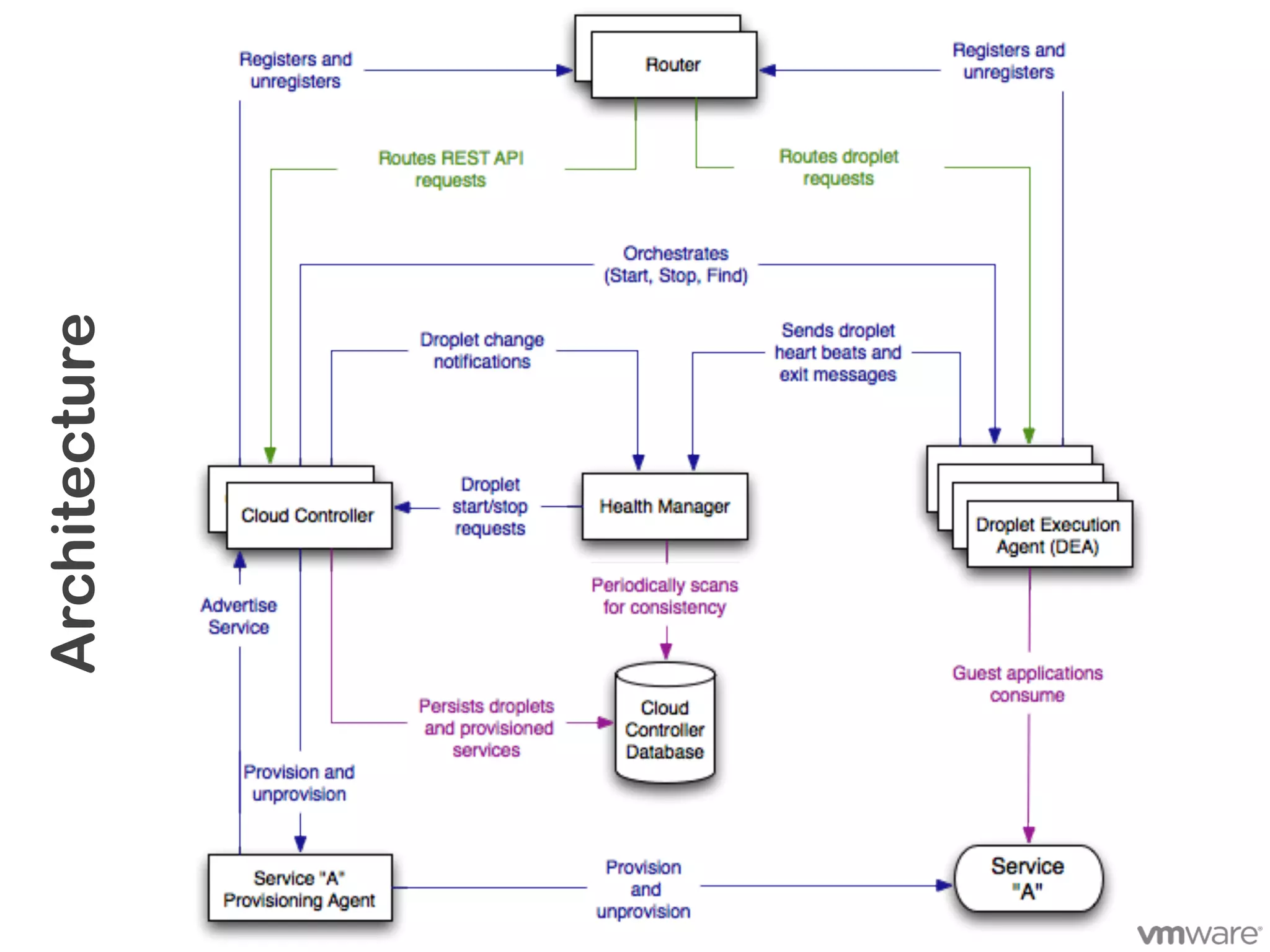
Running an App
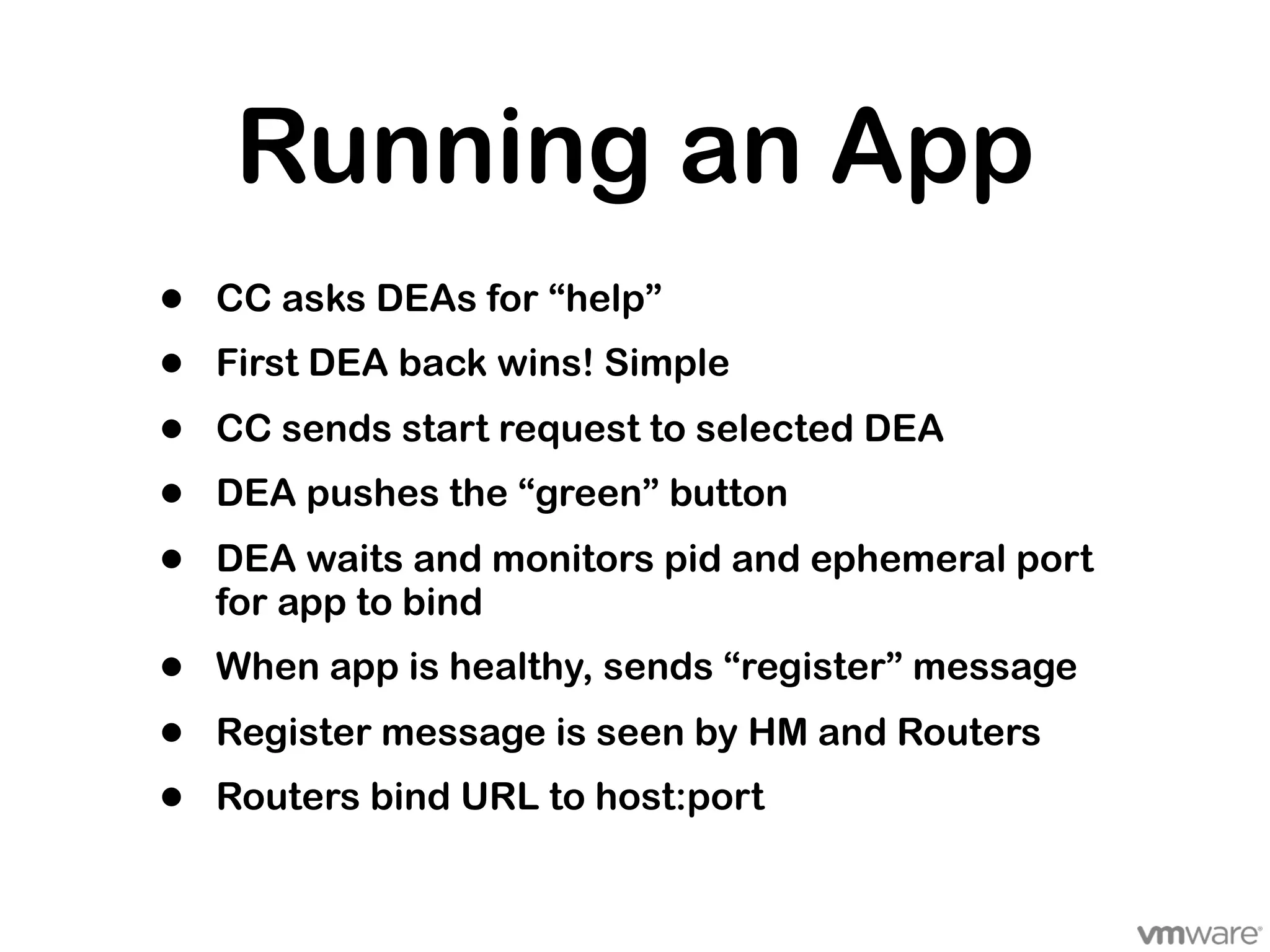
•   CC asks DEAs for “help”
•   First DEA back wins! Simple

•   CC sends start request to selected DEA
•   DEA pushes the “green” button

•   DEA waits and monitors pid and ephemeral port
    for app to bind
•   When app is healthy, sends “register” message

•   Register message is seen by HM and Routers
•   Routers bind URL to host:port
Architecture
DEAs answer?
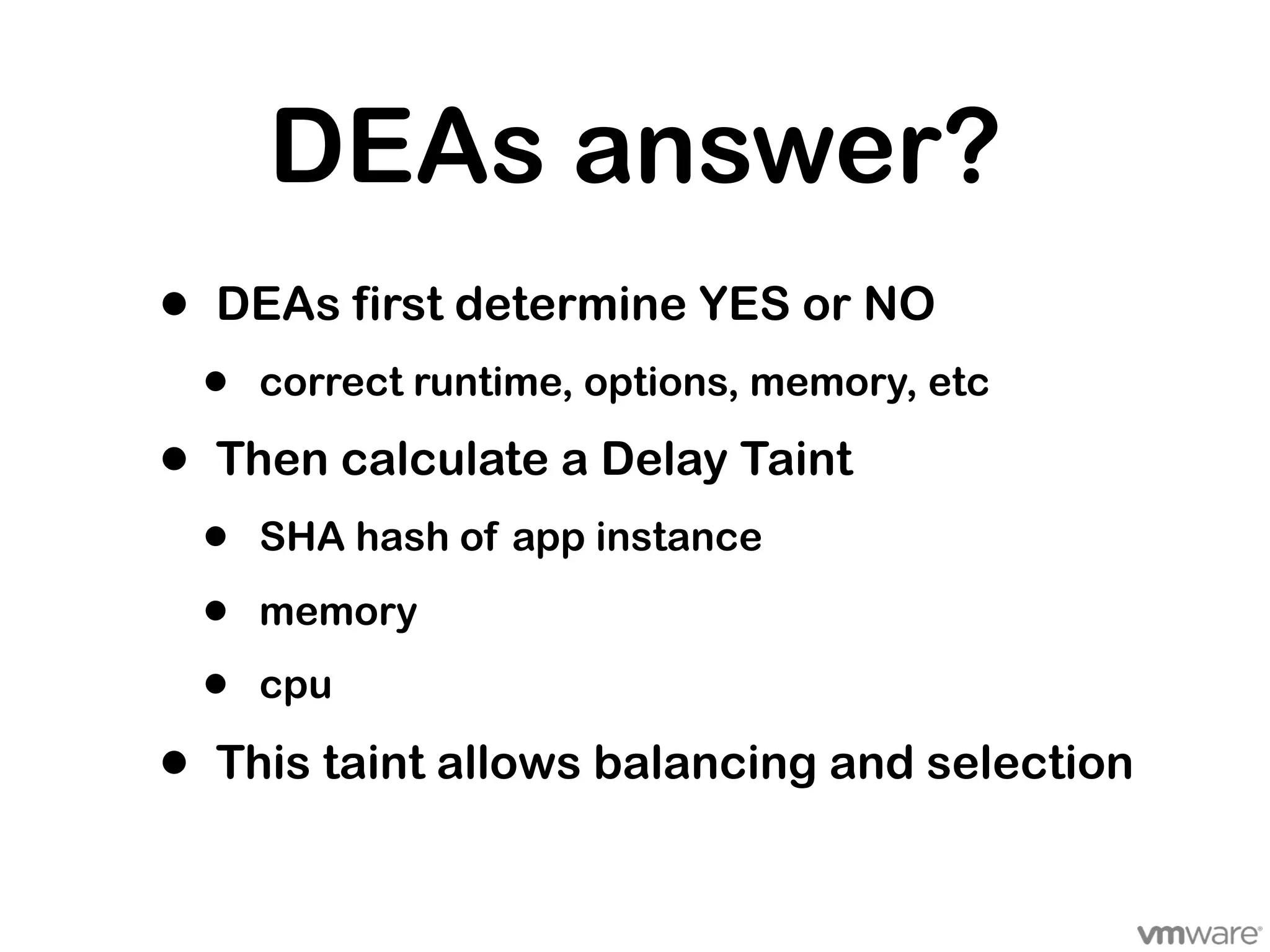
•   DEAs first determine YES or NO
    •   correct runtime, options, memory, etc

•   Then calculate a Delay Taint
    •   SHA hash of app instance

    •   memory

    •   cpu

•   This taint allows balancing and selection
Scale up & down?
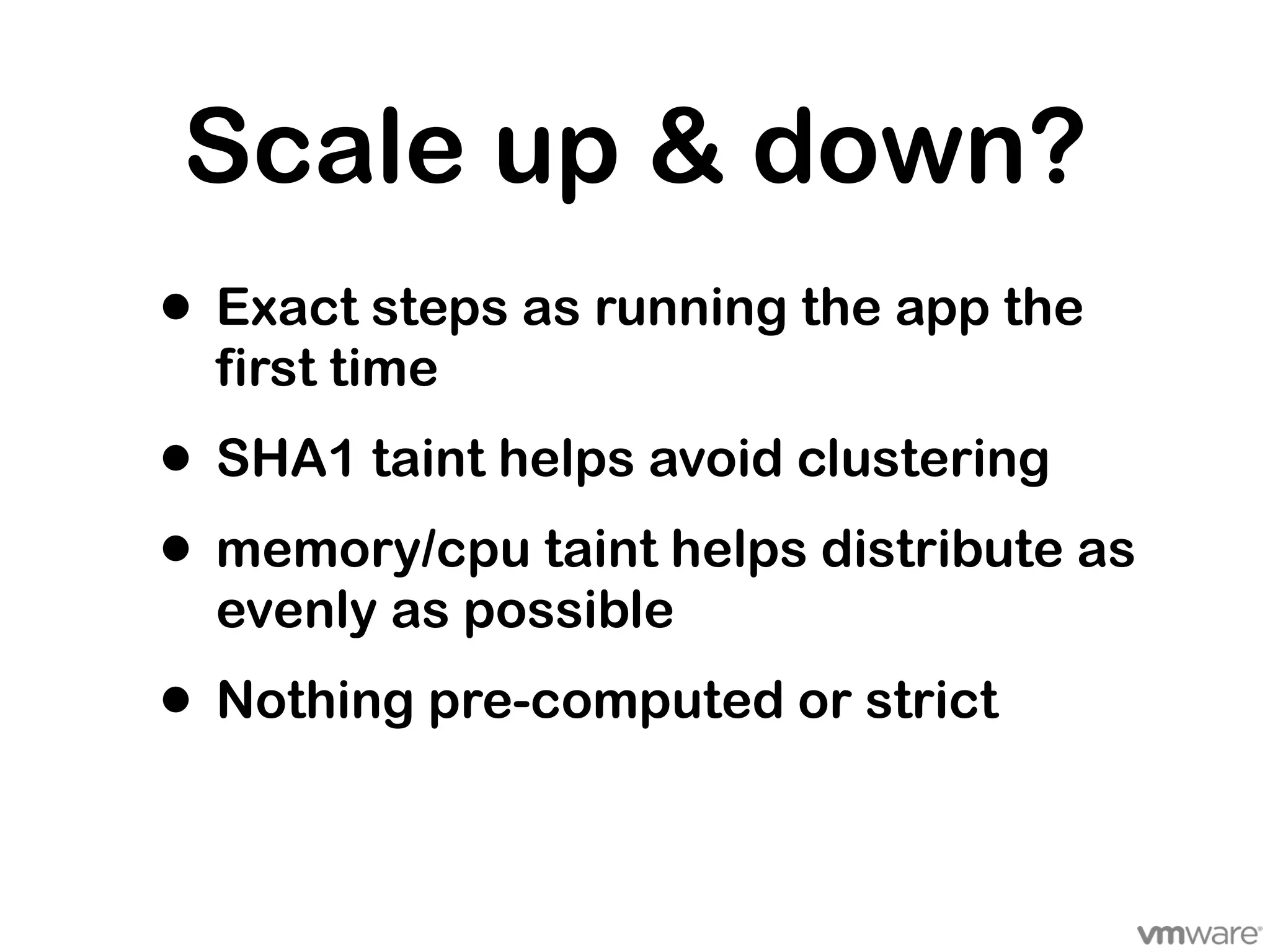
• Exact steps as running the app the
  first time
• SHA1 taint helps avoid clustering
• memory/cpu taint helps distribute as
  evenly as possible
• Nothing pre-computed or strict
Crashes?
•   If your app stops and we did not tell it
    to, that is a crash
•   Crashed apps are immediately detected
    by DEA and message sent
•   Routers disconnect route
•   HM will signal a CC that something is
    wrong
•   CC will issue run sequence again
Architecture
Access to my App?
•   All routers understand where all
    instances of your application are running
•   Will randomly pick backend, not
    semantically aware.
•   Will remove routes that are stale or
    unhealthy
•   Session stickiness and replication
    available, but best to avoid if possible
Thank You
Questions?
dcollison@vmware.com
derek.collison@gmail.com
@derekcollison

Cloud foundry - the building of the open paas presentation

  • 1.
    Cloud Foundry The Buildingof the Open PaaS Derek Collison July 27, 2011
  • 2.
  • 3.
  • 4.
  • 5.
  • 6.
    aPaaS • Application Platformas a Service • Applications and Services • Not VMs, Memory, Storage, CPU
  • 7.
  • 8.
    OpenPaaS • Multi-Language • Multi-Framework •Multi-Services • Multi-Cloud, Multi-IaaS • Hybrid - Public or Private or Both • OpenSource
  • 9.
    OpenPaaS • Multi-Language • Java, Scala, Ruby, Node, Erlang, PHP.. • Multi-Framework • Spring, Grails, Express, Rails, Lift, MochiWeb • Multi-Services • MySQL, Postgres, MongoDB, Redis, RabbitMQ • Multi-Cloud, Multi-IaaS • vSphere, OpenStack, AWS, Eucalyptus
  • 10.
    The Open PaaS .js Ap ce p Private lic rfa Clouds at Data Services te io In n Se er r vid … vic Public o e Clouds Pr Msg Services In te ud rfa o Cl .COM ce Micro Other Services Clouds
  • 11.
    What was ourGoal? • Raise the unit of currency to the be the application and its associated services, not the infrastructure • Best of breed delivery platform for all modern applications and frameworks • Favor Choice and Openness • Simplicity and Speed
  • 12.
    How was itBuilt? • Kernel and Orchestrator Shells • Layered on top of IaaS • Kernel • Core PaaS System • Orchestrator • Creation, management and orchestration of the infrastructure
  • 13.
    High Level Clients (VMC, STS, Browser) CF Kernel Orchestrator IaaS Hardware - CPU/Memory/Disk/Network
  • 14.
    Basic Premises • Assume failure • Optimize for MTTR, not MTBF • MTTR = Mean Time To Recovery • MTBF = Mean Time Between Failures • Fail Fast • Self Healing • Horizontally Scalable Components • Distributed state, No single POF • Should be as simple as possible
  • 15.
    Basic Patterns • Event-Driven •Asynchronous • Non-blocking • Independent, Idempotent • Message passing • Eventually consistent
  • 16.
    Basic Design • All components loosely coupled • Few “Classes”, many “Instances” • Messaging as foundation • Addressing and Component Discovery • Command and Control • JSON payloads • HTTP or File/Blob for data transport
  • 17.
    Kernel Components • Alldynamically discoverable • Launch and scale in any order • Can come and go as needed • Monitor via HTTP and JSON • Location independent
  • 18.
    Kernel Components • Router •CloudController • DEA • HealthManager • Messaging System
  • 19.
    Logical View Browser VMC client STS plugin (user app access) Routers CloudControllers App App HealthManager Services DEA Pool Messaging
  • 20.
    Messaging • Addressing and Discovery • No static IPs or DNS lookups req’d • Just Layer 4 • Command and Control • Central communication system • Dial tone, fire and forget • Protects *itself* at all costs • Idempotent semantics
  • 21.
    Router • Handles allHTTP traffic • Maintains distributed routing state • Routes URLs to applications • Distributes load among instances • Realtime distributed updates to routing tables from DEAs
  • 22.
    CloudController • Handles allstate transitions • Deals with users, apps, and services • Packages and Stages applications • Binds Services to Applications • Presents external REST API
  • 23.
    HealthManager • Monitors thestate • Initial value with realtime delta updates to intended vs real • Determines drift • Complains to the CloudControllers when something is not correct • No power to change state itself
  • 24.
    DEA (Droplet Execution Agent) • Responsible for running all applications • Monitors all applications • CPU, Mem, IO, Threads, Disk, FDs, etc • All apps look same to DEA, start and stop • “concept” of ability and desire to run an application • runtimes, options, cluster avoidance, memory/cpu • Alerts on any change in state of applications • Provides secure/constrained OS runtime • Hypervisor, Unix File and User, Linux Containers • Single or Multi-Tenant
  • 25.
    Services • One of the extensibility planes • First class citizen • Bound to applications • Can be shared • Services API to discover, list, and provision • Direct access to service after provisioned • Easy way to bind any service to an app
  • 26.
  • 27.
    How does itall work?
  • 28.
    Pushing an App • Client (VMC/STS) pushes meta-data to CC • Client optionally pushes resource signatures (diff analysis, sys wide) • Client pushes app resources to CC • CC puts app together • CC stages app asynchronously • CC binds and stages services • Droplet ready
  • 29.
  • 30.
    Running an App • CC asks DEAs for “help” • First DEA back wins! Simple • CC sends start request to selected DEA • DEA pushes the “green” button • DEA waits and monitors pid and ephemeral port for app to bind • When app is healthy, sends “register” message • Register message is seen by HM and Routers • Routers bind URL to host:port
  • 31.
  • 32.
    DEAs answer? • DEAs first determine YES or NO • correct runtime, options, memory, etc • Then calculate a Delay Taint • SHA hash of app instance • memory • cpu • This taint allows balancing and selection
  • 33.
    Scale up &down? • Exact steps as running the app the first time • SHA1 taint helps avoid clustering • memory/cpu taint helps distribute as evenly as possible • Nothing pre-computed or strict
  • 34.
    Crashes? • If your app stops and we did not tell it to, that is a crash • Crashed apps are immediately detected by DEA and message sent • Routers disconnect route • HM will signal a CC that something is wrong • CC will issue run sequence again
  • 35.
  • 36.
    Access to myApp? • All routers understand where all instances of your application are running • Will randomly pick backend, not semantically aware. • Will remove routes that are stale or unhealthy • Session stickiness and replication available, but best to avoid if possible
  • 37.
  • 38.