Cloud Federation
Why Cloud Federation?
• Capacity Management
• Load Balancing
• Efficient use of Surplus Resources
• Prevention from Power Outages & Failures
• Prevention from Vendor Lock-ins
• Scaling Data to Other CSPs(Cloud Service
Provider)
Why Cloud Federation?
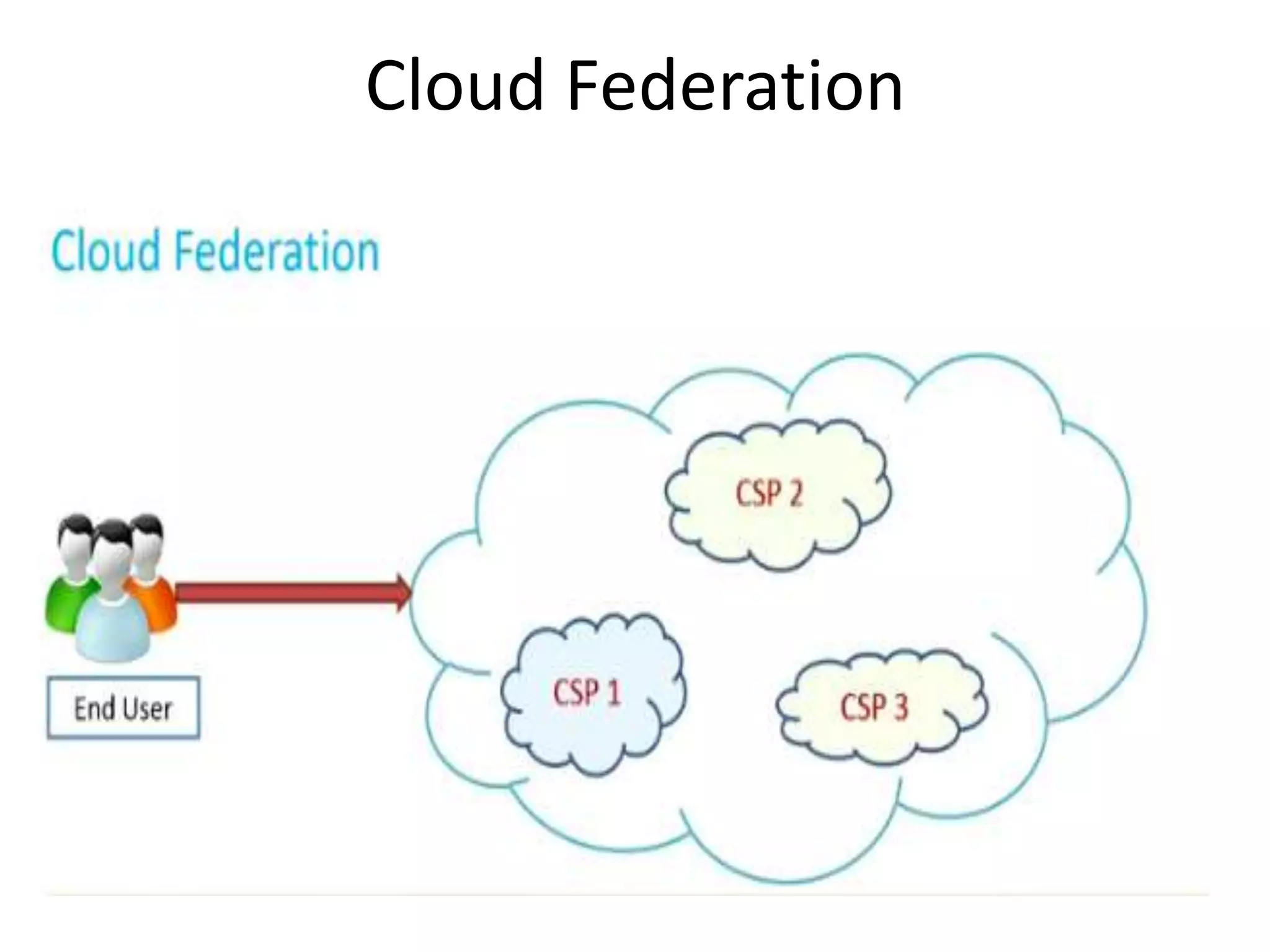
Cloud Federation
Cloud federation
Cloud federation manages consistency and
access controls when two or more
independent geographically distinct Clouds
share either authentication, files, computing
resources, command and control or access to
storage resources.
Federated Cloud
• Federated cloud is also called as cloud Federation.
• Federation means the union of small parts that do
common work.
• It is the concept of brining different services offered by
various providers under a single platform.
• It is a multi-national cloud system that integrates
community , private , public clouds into scalable
computing platform.
• It is the deployment and management of multiple
external and internal cloud computing services to
match business needs.
Cloud federation
• It is the practice of interconnecting the cloud
computing environments of two or more service
providers for the purpose of load balancing traffic
and accommodating spikes in demand.
• It requires one provider to wholesale or rent
computing resources to another cloud provider.
• Those resources become a temporary or
permanent extension of the buyer’s cloud
computing environment, depending on the
specific federation agreement between providers.
Federation in the Cloud
• One challenge in creating and managing a
globally centralized cloud computing
environment is maintaining consistent
connectivity between untrusted components
while remaining fault-tolerant.
• A key opportunity for the emerging cloud
industry will be in defining a federated cloud
ecosystem by connecting multiple cloud
providers using a common standard
Federation in the Cloud
• A notable research project being conducted by
Microsoft, called the Geneva Framework, focuses
on issues involved in cloud federation.
• Many believe that those barriers can be
overcome by eXtensible Messaging and Presence
Protocol(XMPP), also called Jabber, as the
protocol that will fuel the Software – as – a –
Service(SaaS) models of tomorrow.
• Google, Apple, AOL,IBM,Livejournal, and Jive
have all incorporated this protocol into their
cloud-based solutions in the last few years.
• XMPP’s advantage:
– It is decentralized, meaning anyone may set up an
XMPP server.
– It is based on open standards
– It is mature – multiple implementations of client
and servers exist
– Robust security is supported via Simple
Authentication and Security Layer(SASL) and
Transport Layer Security(TLS)
– It is flexible and designed to be extended.
Federation in the Cloud
• XMPP is good fit for cloud computing because
– It allows for easy two way communication
– It eliminates the need for polling
– It has rich publish subscribe(pub-sub) functionality
built in
– It is XML-based and easily extensible, perfect for both
new IM features and custom cloud services.
– It is efficient and has been proven to scale to millions
of concurrent users on a single service(such as
Google’s Gtalk)
– It also has a built-in world wide federation model
Cloud Federation Stack
Four levels of Federation
• Permissive federation
• Verified federation
• Encrypted federation
• Trusted federation
Permissive federation
• Permissive federation occurs when server accepts a
connection from a peer network server without verifying its
identity using DNS lookups or certificate checking.
• The lack of verification or authentication may lead to
domain spoofing( the unauthorized use of a third-party
domain name in an email message in order to pretend to
be someone else), which opens the door to widespread
spam and other abuses.
• With the release of the open source jabbered 1.2 server in
October 2000, which included support for the Server
Dialback protocol( fully supported in Jabber XCP),
permissive federation met its demise on the XMPP
network.
Verified federation
• This type of federation occurs when a server accepts a
connection from a peer after the identity of the peer has
been verified.
• It uses information obtained via DNS and by means of
domain-specific keys exchanged beforehand
• The connection is not encrypted, and the use of identity
verification effectively prevents domain spoofing
• To make this work, federation requires proper DNS setup,
and that is still subject to DNS poisoning attacks
• Verified federation has been the default service policy on
the open XMPP since the release of the open-source
jabbered 1.2 server.
Encrypted Federation
• In this mode, a server accepts a connection from peer
if and only if the peer supports Transport Layer
Security(TLS) as defined for XMPP in Request for
Comments(RFC) 3920
• The peer must present a digital certificate
• The certificate may be self-signed , but this prevents
using mutual authentication
• If this is the case, both parties proceed to weakly verify
identity using Server Dialback
• XEP-0220 defines the Server Dialback protocol, which is
used between XMPP servers to provide identity
verfication.
Encrypted federation
• Server Dialback uses the DNS as the basis for verifying
identity; the basic approach is that when a receiving server
receives a server to server connection request from an
originating server, it does not accept the request until it has
verified a key with an authoritative server for the domain
asserted by the originating server.
• Although Server Dialback does not provide strong
authentication or trusted federation, and although it is
subject to DNS poisoning attacks, it has effectively
prevented most instances of address spoofing on the XMPP
network since its release in 2000
• This results in an encryp ted connection with weak identity
verification
Trusted federation
• Here, a server accepts a connection from peer only under the
stipulation that the peer supports TLS and the peer can present a
digital certificate issued by a root certification authority(CA) that is
trusted by the authenticating server.
• The list of trusted root CA s may be determined by one or more
factors, such as the operating system, XMPP server software, or
local service policy.
• In trusted federation, the use of digital certificates results not only
in a channel encryption but also in strong authentication
• The use of trusted domain certtificates effectively prevents DNS
poisoning attacks but makes federation more difficult, since such
certificates have traditionally not been easy to obtain.
Cloud federation.pptx

Cloud federation.pptx

  • 1.
  • 2.
    Why Cloud Federation? •Capacity Management • Load Balancing • Efficient use of Surplus Resources • Prevention from Power Outages & Failures • Prevention from Vendor Lock-ins • Scaling Data to Other CSPs(Cloud Service Provider)
  • 3.
  • 4.
  • 5.
    Cloud federation Cloud federationmanages consistency and access controls when two or more independent geographically distinct Clouds share either authentication, files, computing resources, command and control or access to storage resources.
  • 6.
    Federated Cloud • Federatedcloud is also called as cloud Federation. • Federation means the union of small parts that do common work. • It is the concept of brining different services offered by various providers under a single platform. • It is a multi-national cloud system that integrates community , private , public clouds into scalable computing platform. • It is the deployment and management of multiple external and internal cloud computing services to match business needs.
  • 7.
    Cloud federation • Itis the practice of interconnecting the cloud computing environments of two or more service providers for the purpose of load balancing traffic and accommodating spikes in demand. • It requires one provider to wholesale or rent computing resources to another cloud provider. • Those resources become a temporary or permanent extension of the buyer’s cloud computing environment, depending on the specific federation agreement between providers.
  • 8.
    Federation in theCloud • One challenge in creating and managing a globally centralized cloud computing environment is maintaining consistent connectivity between untrusted components while remaining fault-tolerant. • A key opportunity for the emerging cloud industry will be in defining a federated cloud ecosystem by connecting multiple cloud providers using a common standard
  • 9.
    Federation in theCloud • A notable research project being conducted by Microsoft, called the Geneva Framework, focuses on issues involved in cloud federation. • Many believe that those barriers can be overcome by eXtensible Messaging and Presence Protocol(XMPP), also called Jabber, as the protocol that will fuel the Software – as – a – Service(SaaS) models of tomorrow. • Google, Apple, AOL,IBM,Livejournal, and Jive have all incorporated this protocol into their cloud-based solutions in the last few years.
  • 10.
    • XMPP’s advantage: –It is decentralized, meaning anyone may set up an XMPP server. – It is based on open standards – It is mature – multiple implementations of client and servers exist – Robust security is supported via Simple Authentication and Security Layer(SASL) and Transport Layer Security(TLS) – It is flexible and designed to be extended.
  • 11.
    Federation in theCloud • XMPP is good fit for cloud computing because – It allows for easy two way communication – It eliminates the need for polling – It has rich publish subscribe(pub-sub) functionality built in – It is XML-based and easily extensible, perfect for both new IM features and custom cloud services. – It is efficient and has been proven to scale to millions of concurrent users on a single service(such as Google’s Gtalk) – It also has a built-in world wide federation model
  • 12.
  • 13.
    Four levels ofFederation • Permissive federation • Verified federation • Encrypted federation • Trusted federation
  • 14.
    Permissive federation • Permissivefederation occurs when server accepts a connection from a peer network server without verifying its identity using DNS lookups or certificate checking. • The lack of verification or authentication may lead to domain spoofing( the unauthorized use of a third-party domain name in an email message in order to pretend to be someone else), which opens the door to widespread spam and other abuses. • With the release of the open source jabbered 1.2 server in October 2000, which included support for the Server Dialback protocol( fully supported in Jabber XCP), permissive federation met its demise on the XMPP network.
  • 15.
    Verified federation • Thistype of federation occurs when a server accepts a connection from a peer after the identity of the peer has been verified. • It uses information obtained via DNS and by means of domain-specific keys exchanged beforehand • The connection is not encrypted, and the use of identity verification effectively prevents domain spoofing • To make this work, federation requires proper DNS setup, and that is still subject to DNS poisoning attacks • Verified federation has been the default service policy on the open XMPP since the release of the open-source jabbered 1.2 server.
  • 16.
    Encrypted Federation • Inthis mode, a server accepts a connection from peer if and only if the peer supports Transport Layer Security(TLS) as defined for XMPP in Request for Comments(RFC) 3920 • The peer must present a digital certificate • The certificate may be self-signed , but this prevents using mutual authentication • If this is the case, both parties proceed to weakly verify identity using Server Dialback • XEP-0220 defines the Server Dialback protocol, which is used between XMPP servers to provide identity verfication.
  • 17.
    Encrypted federation • ServerDialback uses the DNS as the basis for verifying identity; the basic approach is that when a receiving server receives a server to server connection request from an originating server, it does not accept the request until it has verified a key with an authoritative server for the domain asserted by the originating server. • Although Server Dialback does not provide strong authentication or trusted federation, and although it is subject to DNS poisoning attacks, it has effectively prevented most instances of address spoofing on the XMPP network since its release in 2000 • This results in an encryp ted connection with weak identity verification
  • 18.
    Trusted federation • Here,a server accepts a connection from peer only under the stipulation that the peer supports TLS and the peer can present a digital certificate issued by a root certification authority(CA) that is trusted by the authenticating server. • The list of trusted root CA s may be determined by one or more factors, such as the operating system, XMPP server software, or local service policy. • In trusted federation, the use of digital certificates results not only in a channel encryption but also in strong authentication • The use of trusted domain certtificates effectively prevents DNS poisoning attacks but makes federation more difficult, since such certificates have traditionally not been easy to obtain.