Introduction to Middleware I
•

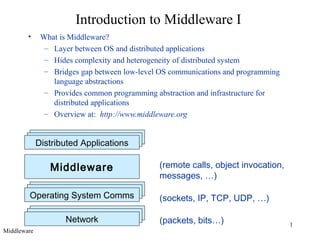
What is Middleware?
– Layer between OS and distributed applications
– Hides complexity and heterogeneity of distributed system
– Bridges gap between low-level OS communications and programming
language abstractions
– Provides common programming abstraction and infrastructure for
distributed applications
– Overview at: http://www.middleware.org

Distributed Applications

Middleware
Operating System Comms
Network
Network
Network
Middleware

(remote calls, object invocation,
messages, …)
(sockets, IP, TCP, UDP, …)
(packets, bits…)

1
Introduction to Middleware II
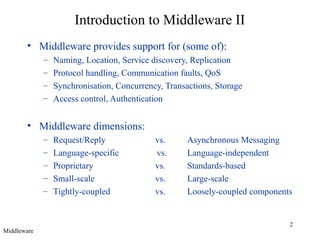
• Middleware provides support for (some of):
–
–
–
–

Naming, Location, Service discovery, Replication
Protocol handling, Communication faults, QoS
Synchronisation, Concurrency, Transactions, Storage
Access control, Authentication

• Middleware dimensions:
–
–
–
–
–

Middleware

Request/Reply
Language-specific
Proprietary
Small-scale
Tightly-coupled

vs.
vs.
vs.
vs.
vs.

Asynchronous Messaging
Language-independent
Standards-based
Large-scale
Loosely-coupled components

2
Outline
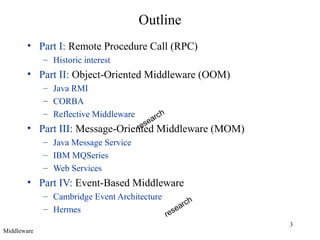
• Part I: Remote Procedure Call (RPC)
– Historic interest

• Part II: Object-Oriented Middleware (OOM)
– Java RMI
– CORBA
– Reflective Middleware

• Part III:

h
arc
e
es Middleware
r
Message-Oriented

(MOM)

– Java Message Service
– IBM MQSeries
– Web Services

• Part IV: Event-Based Middleware
– Cambridge Event Architecture
h
arc
e
– Hermes
es
r
Middleware

3
Part I: Remote Procedure Call (RPC)
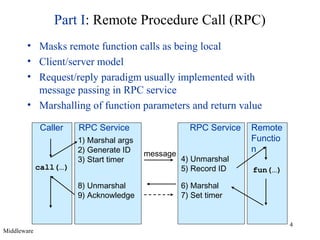
• Masks remote function calls as being local
• Client/server model
• Request/reply paradigm usually implemented with
message passing in RPC service
• Marshalling of function parameters and return value
Caller

call(…)

RPC Service
1) Marshal args
2) Generate ID
3) Start timer
8) Unmarshal
9) Acknowledge

Middleware

RPC Service
message

4) Unmarshal
5) Record ID

Remote
Functio
n
fun(…)

6) Marshal
7) Set timer

4
Properties of RPC
Language-level pattern of function call
•

easy to understand for programmer

Synchronous request/reply interaction
•
•
•

natural from a programming language point-of-view
matches replies to requests
built in synchronisation of requests and replies

Distribution transparency (in the no-failure case)
•

hides the complexity of a distributed system

Various reliability guarantees
•
Middleware

deals with some distributed systems aspects of failure
5
Failure Modes of RPC
•

•

Invocation semantics supported by RPC in the light of:
network and/or server congestion,
client, network and/or server failure
note DS independent failure modes
RPC systems differ, many examples, local was Mayflower

Maybe or at most once (RPC system tries
once)
• Error return – programmer may retry
Exactly once (RPC system retries a few times)
• Hard error return – some failure most likely
note that “exactly once” cannot be guaranteed
Middleware

6
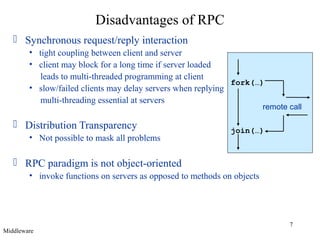
Disadvantages of RPC
 Synchronous request/reply interaction
• tight coupling between client and server
• client may block for a long time if server loaded
leads to multi-threaded programming at client
fork(…)
• slow/failed clients may delay servers when replying
multi-threading essential at servers

remote call

 Distribution Transparency
• Not possible to mask all problems

join(…)

 RPC paradigm is not object-oriented
• invoke functions on servers as opposed to methods on objects

Middleware

7
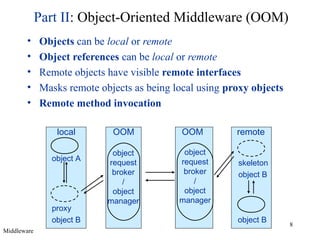
Part II: Object-Oriented Middleware (OOM)
•
•
•
•
•

Objects can be local or remote
Object references can be local or remote
Remote objects have visible remote interfaces
Masks remote objects as being local using proxy objects
Remote method invocation
local
object A

proxy
object B
Middleware

OOM
object
request
broker
/
object
manager

OOM
object
request
broker
/
object
manager

remote
skeleton
object B

object B

8
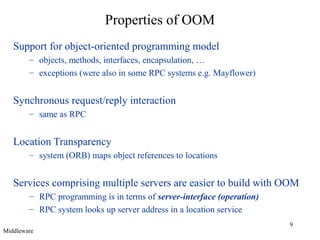
Properties of OOM
Support for object-oriented programming model
– objects, methods, interfaces, encapsulation, …
– exceptions (were also in some RPC systems e.g. Mayflower)

Synchronous request/reply interaction
– same as RPC

Location Transparency
– system (ORB) maps object references to locations

Services comprising multiple servers are easier to build with OOM
– RPC programming is in terms of server-interface (operation)
– RPC system looks up server address in a location service
Middleware

9
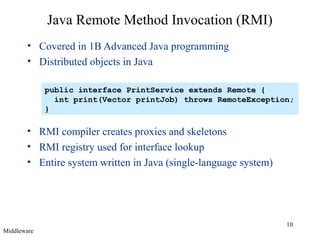
Java Remote Method Invocation (RMI)
• Covered in 1B Advanced Java programming
• Distributed objects in Java
public interface PrintService extends Remote {
int print(Vector printJob) throws RemoteException;
}

• RMI compiler creates proxies and skeletons
• RMI registry used for interface lookup
• Entire system written in Java (single-language system)

Middleware

10
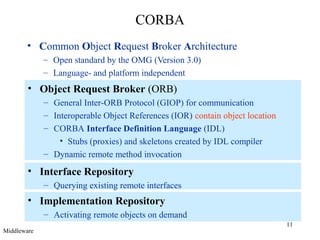
CORBA
• Common Object Request Broker Architecture
– Open standard by the OMG (Version 3.0)
– Language- and platform independent

• Object Request Broker (ORB)
– General Inter-ORB Protocol (GIOP) for communication
– Interoperable Object References (IOR) contain object location
– CORBA Interface Definition Language (IDL)
• Stubs (proxies) and skeletons created by IDL compiler
– Dynamic remote method invocation

• Interface Repository
– Querying existing remote interfaces

• Implementation Repository
– Activating remote objects on demand
Middleware

11
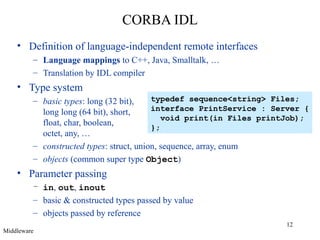
CORBA IDL
• Definition of language-independent remote interfaces
– Language mappings to C++, Java, Smalltalk, …
– Translation by IDL compiler

• Type system
typedef sequence<string> Files;
– basic types: long (32 bit),
interface PrintService : Server {
long long (64 bit), short,
void print(in Files printJob);
float, char, boolean,
};
octet, any, …
– constructed types: struct, union, sequence, array, enum
– objects (common super type Object)

• Parameter passing
– in, out, inout
– basic & constructed types passed by value
– objects passed by reference
Middleware

12
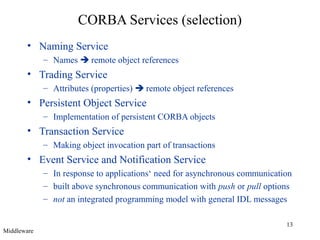
CORBA Services (selection)
• Naming Service
– Names  remote object references

• Trading Service
– Attributes (properties)  remote object references

• Persistent Object Service
– Implementation of persistent CORBA objects

• Transaction Service
– Making object invocation part of transactions

• Event Service and Notification Service
– In response to applications‘ need for asynchronous communication
– built above synchronous communication with push or pull options
– not an integrated programming model with general IDL messages

Middleware

13
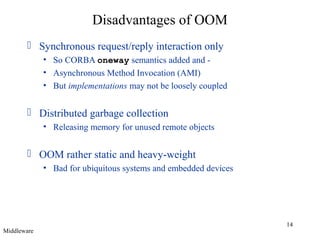
Disadvantages of OOM
 Synchronous request/reply interaction only
• So CORBA oneway semantics added and • Asynchronous Method Invocation (AMI)
• But implementations may not be loosely coupled

 Distributed garbage collection
• Releasing memory for unused remote objects

 OOM rather static and heavy-weight
• Bad for ubiquitous systems and embedded devices

Middleware

14
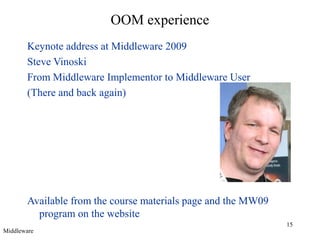
OOM experience
Keynote address at Middleware 2009
Steve Vinoski
From Middleware Implementor to Middleware User
(There and back again)

Available from the course materials page and the MW09
program on the website
Middleware

15
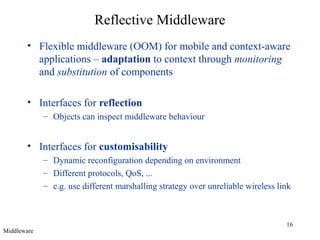
Reflective Middleware
• Flexible middleware (OOM) for mobile and context-aware
applications – adaptation to context through monitoring
and substitution of components
• Interfaces for reflection
– Objects can inspect middleware behaviour

• Interfaces for customisability
– Dynamic reconfiguration depending on environment
– Different protocols, QoS, ...
– e.g. use different marshalling strategy over unreliable wireless link

Middleware

16
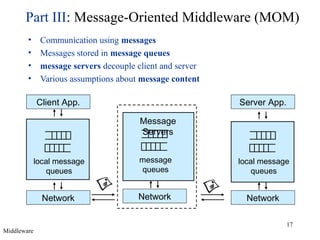
Part III: Message-Oriented Middleware (MOM)
•
•
•
•

Communication using messages
Messages stored in message queues
message servers decouple client and server
Various assumptions about message content
Client App.

Server App.
Message
Servers

local message
queues

local message
queues

Network

Middleware

message
queues

Network

Network
17
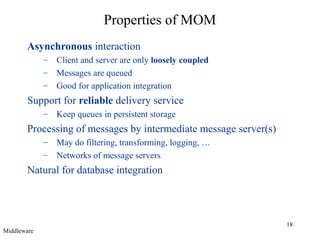
Properties of MOM
Asynchronous interaction
–
–
–

Client and server are only loosely coupled
Messages are queued
Good for application integration

Support for reliable delivery service
–

Keep queues in persistent storage

Processing of messages by intermediate message server(s)
–
–

May do filtering, transforming, logging, …
Networks of message servers

Natural for database integration

Middleware

18
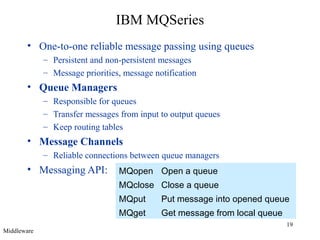
IBM MQSeries
• One-to-one reliable message passing using queues
– Persistent and non-persistent messages
– Message priorities, message notification

• Queue Managers
– Responsible for queues
– Transfer messages from input to output queues
– Keep routing tables

• Message Channels
– Reliable connections between queue managers

• Messaging API:

MQopen Open a queue
MQclose Close a queue
MQput
MQget

Middleware

Put message into opened queue
Get message from local queue
19
Java Message Service (JMS)
• API specification to access MOM implementations
• Two modes of operation *specified*:
– Point-to-point
• one-to-one communication using queues
– Publish/Subscribe
• cf. Event-Based Middleware

•
•
•
•
•
Middleware

JMS Server implements JMS API
JMS Clients connect to JMS servers
Java objects can be serialised to JMS messages
A JMS interface has been provided for MQ
pub/sub (one-to-many) - just a specification?
20
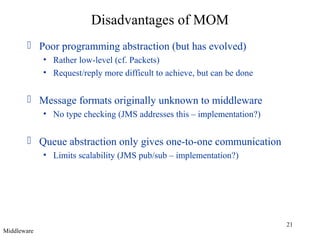
Disadvantages of MOM
 Poor programming abstraction (but has evolved)
• Rather low-level (cf. Packets)
• Request/reply more difficult to achieve, but can be done

 Message formats originally unknown to middleware
• No type checking (JMS addresses this – implementation?)

 Queue abstraction only gives one-to-one communication
• Limits scalability (JMS pub/sub – implementation?)

Middleware

21
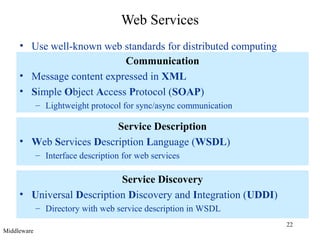
Web Services
• Use well-known web standards for distributed computing
Communication
• Message content expressed in XML
• Simple Object Access Protocol (SOAP)
– Lightweight protocol for sync/async communication

Service Description
• Web Services Description Language (WSDL)
– Interface description for web services

Service Discovery
• Universal Description Discovery and Integration (UDDI)
– Directory with web service description in WSDL
Middleware

22
Properties of Web Services
Language-independent and open standard
SOAP offers OOM and MOM-style communication:
•
•
•
•

Synchronous request/reply like OOM
Asynchronous messaging like MOM
Supports internet transports (http, smtp, ...)
Uses XML Schema for marshalling types to/from programming
language types

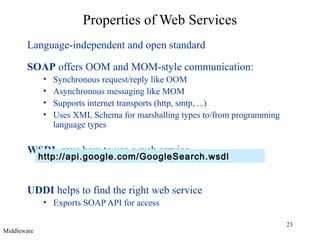
WSDL says how to use a web service

http://api.google.com/GoogleSearch.wsdl

UDDI helps to find the right web service
• Exports SOAP API for access
Middleware

23
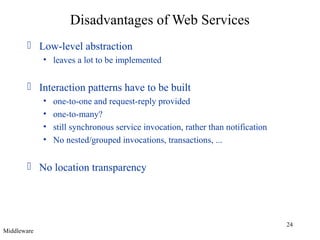
Disadvantages of Web Services
 Low-level abstraction
• leaves a lot to be implemented

 Interaction patterns have to be built
•
•
•
•

one-to-one and request-reply provided
one-to-many?
still synchronous service invocation, rather than notification
No nested/grouped invocations, transactions, ...

 No location transparency

Middleware

24
What we lack, so far
 General interaction patterns
•
•
•
•

we have one-to-one and request-reply
one-to-many? many to many?
notification?
dynamic joining and leaving?

 Location transparency
• anonymity of communicating entities

 Support for pervasive computing
• data values from sensors
• lightweight software

Middleware

25
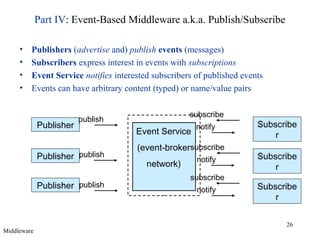
Part IV: Event-Based Middleware a.k.a. Publish/Subscribe
•
•
•
•

Publishers (advertise and) publish events (messages)
Subscribers express interest in events with subscriptions
Event Service notifies interested subscribers of published events
Events can have arbitrary content (typed) or name/value pairs

Publisher

Publisher publish
Publisher publish

Middleware

subscribe

publish

Event Service

notify

(event-brokersubscribe
network)

notify
subscribe
notify

Subscribe
r
Subscribe
r
Subscribe
r
26
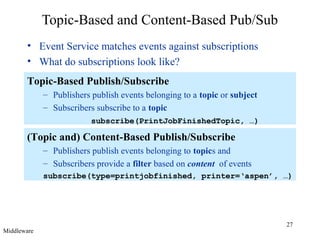
Topic-Based and Content-Based Pub/Sub
• Event Service matches events against subscriptions
• What do subscriptions look like?
Topic-Based Publish/Subscribe
– Publishers publish events belonging to a topic or subject
– Subscribers subscribe to a topic
subscribe(PrintJobFinishedTopic, …)

(Topic and) Content-Based Publish/Subscribe
– Publishers publish events belonging to topics and
– Subscribers provide a filter based on content of events
subscribe(type=printjobfinished, printer=‘aspen’, …)

Middleware

27
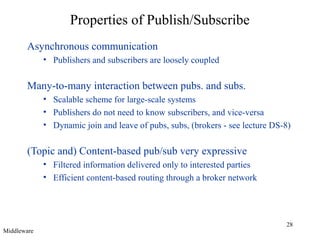
Properties of Publish/Subscribe
Asynchronous communication
• Publishers and subscribers are loosely coupled

Many-to-many interaction between pubs. and subs.
• Scalable scheme for large-scale systems
• Publishers do not need to know subscribers, and vice-versa
• Dynamic join and leave of pubs, subs, (brokers - see lecture DS-8)

(Topic and) Content-based pub/sub very expressive
• Filtered information delivered only to interested parties
• Efficient content-based routing through a broker network

Middleware

28
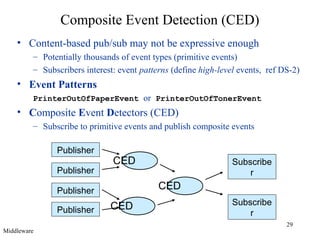
Composite Event Detection (CED)
• Content-based pub/sub may not be expressive enough
– Potentially thousands of event types (primitive events)
– Subscribers interest: event patterns (define high-level events, ref DS-2)

• Event Patterns
PrinterOutOfPaperEvent or PrinterOutOfTonerEvent

• Composite Event Detectors (CED)
– Subscribe to primitive events and publish composite events
Publisher
Publisher

CED
CED

Publisher
Publisher
Middleware

Subscribe
r

CED

Subscribe
r
29
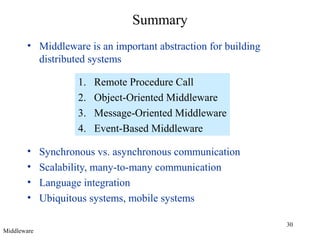
Summary
• Middleware is an important abstraction for building
distributed systems
1.
2.
3.
4.
•
•
•
•
Middleware

Remote Procedure Call
Object-Oriented Middleware
Message-Oriented Middleware
Event-Based Middleware

Synchronous vs. asynchronous communication
Scalability, many-to-many communication
Language integration
Ubiquitous systems, mobile systems
30

Middleware

  • 1.
    Introduction to MiddlewareI • What is Middleware? – Layer between OS and distributed applications – Hides complexity and heterogeneity of distributed system – Bridges gap between low-level OS communications and programming language abstractions – Provides common programming abstraction and infrastructure for distributed applications – Overview at: http://www.middleware.org Distributed Applications Distributed Applications Distributed Applications Middleware Operating System Comms Operating System Comms Operating System Comms Network Network Network Middleware (remote calls, object invocation, messages, …) (sockets, IP, TCP, UDP, …) (packets, bits…) 1
  • 2.
    Introduction to MiddlewareII • Middleware provides support for (some of): – – – – Naming, Location, Service discovery, Replication Protocol handling, Communication faults, QoS Synchronisation, Concurrency, Transactions, Storage Access control, Authentication • Middleware dimensions: – – – – – Middleware Request/Reply Language-specific Proprietary Small-scale Tightly-coupled vs. vs. vs. vs. vs. Asynchronous Messaging Language-independent Standards-based Large-scale Loosely-coupled components 2
  • 3.
    Outline • Part I:Remote Procedure Call (RPC) – Historic interest • Part II: Object-Oriented Middleware (OOM) – Java RMI – CORBA – Reflective Middleware • Part III: h arc e es Middleware r Message-Oriented (MOM) – Java Message Service – IBM MQSeries – Web Services • Part IV: Event-Based Middleware – Cambridge Event Architecture h arc e – Hermes es r Middleware 3
  • 4.
    Part I: RemoteProcedure Call (RPC) • Masks remote function calls as being local • Client/server model • Request/reply paradigm usually implemented with message passing in RPC service • Marshalling of function parameters and return value Caller call(…) RPC Service 1) Marshal args 2) Generate ID 3) Start timer 8) Unmarshal 9) Acknowledge Middleware RPC Service message 4) Unmarshal 5) Record ID Remote Functio n fun(…) 6) Marshal 7) Set timer 4
  • 5.
    Properties of RPC Language-levelpattern of function call • easy to understand for programmer Synchronous request/reply interaction • • • natural from a programming language point-of-view matches replies to requests built in synchronisation of requests and replies Distribution transparency (in the no-failure case) • hides the complexity of a distributed system Various reliability guarantees • Middleware deals with some distributed systems aspects of failure 5
  • 6.
    Failure Modes ofRPC • • Invocation semantics supported by RPC in the light of: network and/or server congestion, client, network and/or server failure note DS independent failure modes RPC systems differ, many examples, local was Mayflower Maybe or at most once (RPC system tries once) • Error return – programmer may retry Exactly once (RPC system retries a few times) • Hard error return – some failure most likely note that “exactly once” cannot be guaranteed Middleware 6
  • 7.
    Disadvantages of RPC Synchronous request/reply interaction • tight coupling between client and server • client may block for a long time if server loaded leads to multi-threaded programming at client fork(…) • slow/failed clients may delay servers when replying multi-threading essential at servers remote call  Distribution Transparency • Not possible to mask all problems join(…)  RPC paradigm is not object-oriented • invoke functions on servers as opposed to methods on objects Middleware 7
  • 8.
    Part II: Object-OrientedMiddleware (OOM) • • • • • Objects can be local or remote Object references can be local or remote Remote objects have visible remote interfaces Masks remote objects as being local using proxy objects Remote method invocation local object A proxy object B Middleware OOM object request broker / object manager OOM object request broker / object manager remote skeleton object B object B 8
  • 9.
    Properties of OOM Supportfor object-oriented programming model – objects, methods, interfaces, encapsulation, … – exceptions (were also in some RPC systems e.g. Mayflower) Synchronous request/reply interaction – same as RPC Location Transparency – system (ORB) maps object references to locations Services comprising multiple servers are easier to build with OOM – RPC programming is in terms of server-interface (operation) – RPC system looks up server address in a location service Middleware 9
  • 10.
    Java Remote MethodInvocation (RMI) • Covered in 1B Advanced Java programming • Distributed objects in Java public interface PrintService extends Remote { int print(Vector printJob) throws RemoteException; } • RMI compiler creates proxies and skeletons • RMI registry used for interface lookup • Entire system written in Java (single-language system) Middleware 10
  • 11.
    CORBA • Common ObjectRequest Broker Architecture – Open standard by the OMG (Version 3.0) – Language- and platform independent • Object Request Broker (ORB) – General Inter-ORB Protocol (GIOP) for communication – Interoperable Object References (IOR) contain object location – CORBA Interface Definition Language (IDL) • Stubs (proxies) and skeletons created by IDL compiler – Dynamic remote method invocation • Interface Repository – Querying existing remote interfaces • Implementation Repository – Activating remote objects on demand Middleware 11
  • 12.
    CORBA IDL • Definitionof language-independent remote interfaces – Language mappings to C++, Java, Smalltalk, … – Translation by IDL compiler • Type system typedef sequence<string> Files; – basic types: long (32 bit), interface PrintService : Server { long long (64 bit), short, void print(in Files printJob); float, char, boolean, }; octet, any, … – constructed types: struct, union, sequence, array, enum – objects (common super type Object) • Parameter passing – in, out, inout – basic & constructed types passed by value – objects passed by reference Middleware 12
  • 13.
    CORBA Services (selection) •Naming Service – Names  remote object references • Trading Service – Attributes (properties)  remote object references • Persistent Object Service – Implementation of persistent CORBA objects • Transaction Service – Making object invocation part of transactions • Event Service and Notification Service – In response to applications‘ need for asynchronous communication – built above synchronous communication with push or pull options – not an integrated programming model with general IDL messages Middleware 13
  • 14.
    Disadvantages of OOM Synchronous request/reply interaction only • So CORBA oneway semantics added and • Asynchronous Method Invocation (AMI) • But implementations may not be loosely coupled  Distributed garbage collection • Releasing memory for unused remote objects  OOM rather static and heavy-weight • Bad for ubiquitous systems and embedded devices Middleware 14
  • 15.
    OOM experience Keynote addressat Middleware 2009 Steve Vinoski From Middleware Implementor to Middleware User (There and back again) Available from the course materials page and the MW09 program on the website Middleware 15
  • 16.
    Reflective Middleware • Flexiblemiddleware (OOM) for mobile and context-aware applications – adaptation to context through monitoring and substitution of components • Interfaces for reflection – Objects can inspect middleware behaviour • Interfaces for customisability – Dynamic reconfiguration depending on environment – Different protocols, QoS, ... – e.g. use different marshalling strategy over unreliable wireless link Middleware 16
  • 17.
    Part III: Message-OrientedMiddleware (MOM) • • • • Communication using messages Messages stored in message queues message servers decouple client and server Various assumptions about message content Client App. Server App. Message Servers local message queues local message queues Network Middleware message queues Network Network 17
  • 18.
    Properties of MOM Asynchronousinteraction – – – Client and server are only loosely coupled Messages are queued Good for application integration Support for reliable delivery service – Keep queues in persistent storage Processing of messages by intermediate message server(s) – – May do filtering, transforming, logging, … Networks of message servers Natural for database integration Middleware 18
  • 19.
    IBM MQSeries • One-to-onereliable message passing using queues – Persistent and non-persistent messages – Message priorities, message notification • Queue Managers – Responsible for queues – Transfer messages from input to output queues – Keep routing tables • Message Channels – Reliable connections between queue managers • Messaging API: MQopen Open a queue MQclose Close a queue MQput MQget Middleware Put message into opened queue Get message from local queue 19
  • 20.
    Java Message Service(JMS) • API specification to access MOM implementations • Two modes of operation *specified*: – Point-to-point • one-to-one communication using queues – Publish/Subscribe • cf. Event-Based Middleware • • • • • Middleware JMS Server implements JMS API JMS Clients connect to JMS servers Java objects can be serialised to JMS messages A JMS interface has been provided for MQ pub/sub (one-to-many) - just a specification? 20
  • 21.
    Disadvantages of MOM Poor programming abstraction (but has evolved) • Rather low-level (cf. Packets) • Request/reply more difficult to achieve, but can be done  Message formats originally unknown to middleware • No type checking (JMS addresses this – implementation?)  Queue abstraction only gives one-to-one communication • Limits scalability (JMS pub/sub – implementation?) Middleware 21
  • 22.
    Web Services • Usewell-known web standards for distributed computing Communication • Message content expressed in XML • Simple Object Access Protocol (SOAP) – Lightweight protocol for sync/async communication Service Description • Web Services Description Language (WSDL) – Interface description for web services Service Discovery • Universal Description Discovery and Integration (UDDI) – Directory with web service description in WSDL Middleware 22
  • 23.
    Properties of WebServices Language-independent and open standard SOAP offers OOM and MOM-style communication: • • • • Synchronous request/reply like OOM Asynchronous messaging like MOM Supports internet transports (http, smtp, ...) Uses XML Schema for marshalling types to/from programming language types WSDL says how to use a web service http://api.google.com/GoogleSearch.wsdl UDDI helps to find the right web service • Exports SOAP API for access Middleware 23
  • 24.
    Disadvantages of WebServices  Low-level abstraction • leaves a lot to be implemented  Interaction patterns have to be built • • • • one-to-one and request-reply provided one-to-many? still synchronous service invocation, rather than notification No nested/grouped invocations, transactions, ...  No location transparency Middleware 24
  • 25.
    What we lack,so far  General interaction patterns • • • • we have one-to-one and request-reply one-to-many? many to many? notification? dynamic joining and leaving?  Location transparency • anonymity of communicating entities  Support for pervasive computing • data values from sensors • lightweight software Middleware 25
  • 26.
    Part IV: Event-BasedMiddleware a.k.a. Publish/Subscribe • • • • Publishers (advertise and) publish events (messages) Subscribers express interest in events with subscriptions Event Service notifies interested subscribers of published events Events can have arbitrary content (typed) or name/value pairs Publisher Publisher publish Publisher publish Middleware subscribe publish Event Service notify (event-brokersubscribe network) notify subscribe notify Subscribe r Subscribe r Subscribe r 26
  • 27.
    Topic-Based and Content-BasedPub/Sub • Event Service matches events against subscriptions • What do subscriptions look like? Topic-Based Publish/Subscribe – Publishers publish events belonging to a topic or subject – Subscribers subscribe to a topic subscribe(PrintJobFinishedTopic, …) (Topic and) Content-Based Publish/Subscribe – Publishers publish events belonging to topics and – Subscribers provide a filter based on content of events subscribe(type=printjobfinished, printer=‘aspen’, …) Middleware 27
  • 28.
    Properties of Publish/Subscribe Asynchronouscommunication • Publishers and subscribers are loosely coupled Many-to-many interaction between pubs. and subs. • Scalable scheme for large-scale systems • Publishers do not need to know subscribers, and vice-versa • Dynamic join and leave of pubs, subs, (brokers - see lecture DS-8) (Topic and) Content-based pub/sub very expressive • Filtered information delivered only to interested parties • Efficient content-based routing through a broker network Middleware 28
  • 29.
    Composite Event Detection(CED) • Content-based pub/sub may not be expressive enough – Potentially thousands of event types (primitive events) – Subscribers interest: event patterns (define high-level events, ref DS-2) • Event Patterns PrinterOutOfPaperEvent or PrinterOutOfTonerEvent • Composite Event Detectors (CED) – Subscribe to primitive events and publish composite events Publisher Publisher CED CED Publisher Publisher Middleware Subscribe r CED Subscribe r 29
  • 30.
    Summary • Middleware isan important abstraction for building distributed systems 1. 2. 3. 4. • • • • Middleware Remote Procedure Call Object-Oriented Middleware Message-Oriented Middleware Event-Based Middleware Synchronous vs. asynchronous communication Scalability, many-to-many communication Language integration Ubiquitous systems, mobile systems 30