Design, Innovation and Sustainability
December 2020
INTRODUCTION
 Problem
definition
 Current data
 Scale of the issue
OVERVIEW
 Developments
carried out by
notable brands
(case studies)
 Findings from
case studies
PROPOSED SOLUTION
 Description
 Lifecycle analysis of
the proposed
solution
INTRODUCTION
Dana
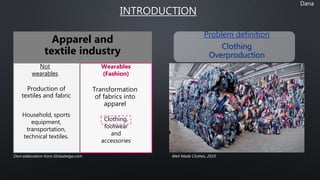
Problem definition
Clothing
Overproduction
Apparel and
textile industry
Production of
textiles and fabric
Transformation
of fabrics into
apparel
Household, sports
equipment,
transportation,
technical textiles.
Not
wearables
Wearables
(Fashion)
Clothing,
footwear
and
accessories
Own elaboration from Globaledge.com Well Made Clothes, 2019
Dana
Kleinhueckelkotten, 2019
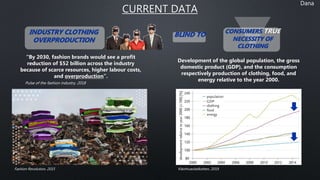
CURRENT DATA
Development of the global population, the gross
domestic product (GDP), and the consumption
respectively production of clothing, food, and
energy relative to the year 2000.
Fashion Revolution, 2015
“By 2030, fashion brands would see a profit
reduction of $52 billion across the industry
because of scarce resources, higher labour costs,
and overproduction”.
INDUSTRY CLOTHING
OVERPRODUCTION
BLIND TO CONSUMERS TRUE
NECESSITY OF
CLOTHING
Pulse of the fashion industry, 2018
Dana
“But even with such a big demand for new
clothes, there is still a forecasting error, a risk
every business seems to accept. If a company
underestimates the demand, it may lose profit.
Given how cheap production is, especially in Asia,
a lot of apparel brands prefer to overestimate
future sales”.
Share Cloth, 2018
CLOTHING OVERPRODUCTION
IN A GLOBAL SCALE
SCALE OF THE ISSUE
Pulse of the fashion industry, 2018
Customized
clothing
Instead of
Mass production
Reducing the need
of
end of use
efforts
150 billion garments
30% of those garments is never sold
Over 50%
of fast fashion is disposed in a
year
20%
is kept by consumers (but until
when?)
Share Cloth, 2018
Reducing the
production and
use of raw
materials
OVERVIEW
Developments carried out by notable brands
Suitkits by SE
Thrushna
Founder – Sierra Elizabeth (lawyer by profession and an athlete)(October 2018)
Aim –Women custom suits designed to fit your body, your style, your job
Idea –Expect more from your suits that is not only to wear but also to make a lasting impact on how it
feels.
How does it work?
 SuitKits is a website were our own made-to-measure suits are design that separates from the comfort of
home or office.
What is made to measure custom suit?
 Combination of ready-to-wear suit and a bespoke suit.
 Manufacturers alter pre-existing patterns (2, 4, 6, 8, etc) before the cutting process to match more closely to
your unique measurements.
 Bespoke uses patterns that are designed from scratch.
Availability –New York, Chicago, Washington D.C., Atlanta, Boston and Los Angeles.
Delivery time – Approx. 8 weeks
Thrushna
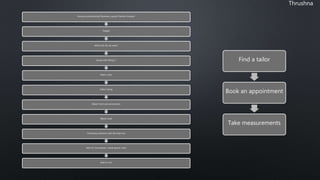
Business professional/ Business casual/ Fashion forward
Height
What size do we wear?
Issues with fitting ?
Fabric color
Fabric lining
Blazer front and accessories
Blazer back
Choosing a bottom with the heel size
Add on (monogram, sweat guard, vest)
Add to cart
Find a tailor
Book an appointment
Take measurements
Thrushna
OVERVIEW
Developments carried out by notable brands
Red thread
Founder – Meghan Litchfield(June 2017)
Aim –Smash The Sizerarchy
Idea – Eliminate sizes and create made-to-measure essentials that women feel great wearing.
How It Works?
Delivery time – One week
Capsule collection – Basic t-shirts, jackets, essential black dress.
CHOOSE YOUR STYLE
TAKE A FIT QUIZ
SNAP A PHOTO
Red thread
Thrushna
RED THREAD
SUITKITS
PROPOSED SOLUTION
Customized Capsule Wardrobe
Shubham
Controlled production in the shape of a business model
named: “Customized Capsule Wardrobe”
• Customized clothing
made to order and
returnable to be
recycled.
• Target market
• Country: UK
• Ages: 18 – 55 years old
• Gender: women, men and
children.
Model Components
• Attract new customers by
delivering superior value
• Product selection
• Market segmentation
• Period- Event based
• Offer customized product
• Test consumer demands
• Fulfill consumers
expectation
Value proposition
Target market Strategy
PROPOSED SOLUTION
Shubham
Application process:
1. Enter body measurements.
2. Upload face picture.
3. Software will produce a 3D avatar of the customer.
4. Select the from two options: capsule wardrobe or single
clothing.
5. Select the type of customization: fabric , shape, color, print.
6. View the capsule wardrobe or single clothing in 3D with a 360°
effect or on the avatar.
7. If apply, software will suggest other types of customization more
flattering to the body shape and facial features.
8. Avatar will model the clothing, moving with them in order to
show different angles of them.
9. Software saves automatically the customized clothing created,
and storage the creations indefinitely.
10. Customer can share the designs with their contacts
PROPOSED SOLUTION
Shubham
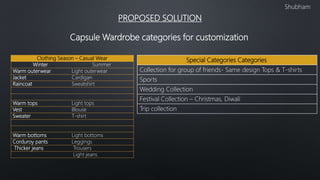
Capsule Wardrobe categories for customization
Clothing Season – Casual Wear
Winter Summer
Warm outerwear Light outerwear
Jacket Cardigan
Raincoat Sweatshirt
Warm tops Light tops
Vest Blouse
Sweater T-shirt
Warm bottoms Light bottoms
Corduroy pants Leggings
Thicker jeans Trousers
Light jeans
Special Categories Categories
Collection for group of friends- Same design Tops & T-shirts
Sports
Wedding Collection
Festival Collection – Christmas, Diwali
Trip collection
PROPOSED SOLUTION
Lifecycle analysis of the proposed solution
Shubham
1. Supply of fabric and materials for customized
production
2. Make your own apparel
3. Production
4. Shipping
5. Use by customer
6. Return
7. Recycling
Customized capsule wardrobe presents seven stages of production. The main impacts on the
environment that were identified in our process, were: energy overconsumption, human power
exploitation, cloth waste and CO2 emissions due transportation.
• Global Edge, 2020, https://globaledge.msu.edu/industries/apparel-and-textiles/background [Accessed
25/11/2020]
• Well Made Clothes, 2019, https://wellmadeclothes.com/articles/HM43BillionWorthOfUnsoldClothes/
[Accessed 26/11/2020]
• Share Cloth, 2018, https://sharecloth.com/blog/reports/apparel-overproduction [Accessed 28/11/2020]
• 3D Insider, 2020, https://3dinsider.optitex.com/fashion-quantity-outweighs-quality/ [Accessed 05/12/2020]
• Kleinhueckelkotten, S. & Neitzke, H. 2019, "Increasing sustainability in clothing production and consumption
- opportunities and constraints", Gaia (Heidelberg, Germany), vol. 28, no. 1, pp. 240-248.
• Linkedin, 2016, https://www.linkedin.com/pulse/overproduction-taboo-fashion-hasmik-matevosyan/
[Accessed 30/11/2020]
• van der Velden, Natascha M & Vogtländer, J.G. 2017, "Monetisation of external socio-economic costs of
industrial production: A social-LCA-based case of clothing production", Journal of cleaner production, vol.
153, pp. 320-330.
• Norum, P
.S. 2018, "Clothing Production and Consumption: A View Through the Lens of
Sustainability", Journal of family and consumer sciences, vol. 110, no. 1, pp. 13-18.
• Ellen Macarthur Foundation, 2017,
https://www.ellenmacarthurfoundation.org/assets/downloads/publications/A-New-Textiles-Economy_Full-
Report_Updated_1-12-17.pdf [Accessed 08/12/2020]
• Pulse of the Fashion Industry, 2017,
https://static1.squarespace.com/static/5810348d59cc68e529b7d9ba/t/596454f715d5db35061ea63e/1499747
644232/Pulse-of-the-Fashion-Industry_2017.pdf [Accessed 03/12/2020]
• Suitkits, 2018, https://suitkits.com/ [Accessed 11/12/2020]
• Red Thread collection, 2017, https://redthreadcollection.com/ [Accessed 14/12/2020]
• Forbes, https://www.forbes.com/sites/blakemorgan/2018/11/19/creating-personalized-retail-customer-
experiences-with-redthread/?sh=56d4f2154d29 [Accessed 16/12/2020]
•
• TRI-MIRROR 3D SOWTWAREHTTPS://WWW.TRIMIRROR.COM/
• LIFE CYCLE OF CLOTHES AVAILABLE FROM : TRI-MIRROR 3D
SOWTWAREHTTPS://WWW.TRIMIRROR.COM/
• ALICE PAYNE(2011), THE LIFE-CYCLE OF THE FASHION GARMENT AND THE ROLE OF
AUSTRALIAN MASS MARKET DESIGNERS, AVAILABLE FROM :
HTTPS://WWW.RESEARCHGATE.NET/PUBLICATION/267205505_THE_LIFE-
CYCLE_OF_THE_FASHION_GARMENT_AND_THE_ROLE_OF_AUSTRALIAN_MASS_MARKET
_DESIGNERS

Clothing overproduction - Customization

  • 1.
    Design, Innovation andSustainability December 2020
  • 2.
    INTRODUCTION  Problem definition  Currentdata  Scale of the issue OVERVIEW  Developments carried out by notable brands (case studies)  Findings from case studies PROPOSED SOLUTION  Description  Lifecycle analysis of the proposed solution
  • 3.
    INTRODUCTION Dana Problem definition Clothing Overproduction Apparel and textileindustry Production of textiles and fabric Transformation of fabrics into apparel Household, sports equipment, transportation, technical textiles. Not wearables Wearables (Fashion) Clothing, footwear and accessories Own elaboration from Globaledge.com Well Made Clothes, 2019
  • 4.
    Dana Kleinhueckelkotten, 2019 CURRENT DATA Developmentof the global population, the gross domestic product (GDP), and the consumption respectively production of clothing, food, and energy relative to the year 2000. Fashion Revolution, 2015 “By 2030, fashion brands would see a profit reduction of $52 billion across the industry because of scarce resources, higher labour costs, and overproduction”. INDUSTRY CLOTHING OVERPRODUCTION BLIND TO CONSUMERS TRUE NECESSITY OF CLOTHING Pulse of the fashion industry, 2018
  • 5.
    Dana “But even withsuch a big demand for new clothes, there is still a forecasting error, a risk every business seems to accept. If a company underestimates the demand, it may lose profit. Given how cheap production is, especially in Asia, a lot of apparel brands prefer to overestimate future sales”. Share Cloth, 2018 CLOTHING OVERPRODUCTION IN A GLOBAL SCALE SCALE OF THE ISSUE Pulse of the fashion industry, 2018 Customized clothing Instead of Mass production Reducing the need of end of use efforts 150 billion garments 30% of those garments is never sold Over 50% of fast fashion is disposed in a year 20% is kept by consumers (but until when?) Share Cloth, 2018 Reducing the production and use of raw materials
  • 6.
    OVERVIEW Developments carried outby notable brands Suitkits by SE Thrushna Founder – Sierra Elizabeth (lawyer by profession and an athlete)(October 2018) Aim –Women custom suits designed to fit your body, your style, your job Idea –Expect more from your suits that is not only to wear but also to make a lasting impact on how it feels. How does it work?  SuitKits is a website were our own made-to-measure suits are design that separates from the comfort of home or office. What is made to measure custom suit?  Combination of ready-to-wear suit and a bespoke suit.  Manufacturers alter pre-existing patterns (2, 4, 6, 8, etc) before the cutting process to match more closely to your unique measurements.  Bespoke uses patterns that are designed from scratch. Availability –New York, Chicago, Washington D.C., Atlanta, Boston and Los Angeles. Delivery time – Approx. 8 weeks
  • 7.
    Thrushna Business professional/ Businesscasual/ Fashion forward Height What size do we wear? Issues with fitting ? Fabric color Fabric lining Blazer front and accessories Blazer back Choosing a bottom with the heel size Add on (monogram, sweat guard, vest) Add to cart Find a tailor Book an appointment Take measurements
  • 8.
    Thrushna OVERVIEW Developments carried outby notable brands Red thread Founder – Meghan Litchfield(June 2017) Aim –Smash The Sizerarchy Idea – Eliminate sizes and create made-to-measure essentials that women feel great wearing. How It Works? Delivery time – One week Capsule collection – Basic t-shirts, jackets, essential black dress. CHOOSE YOUR STYLE TAKE A FIT QUIZ SNAP A PHOTO Red thread
  • 9.
  • 10.
    PROPOSED SOLUTION Customized CapsuleWardrobe Shubham Controlled production in the shape of a business model named: “Customized Capsule Wardrobe” • Customized clothing made to order and returnable to be recycled. • Target market • Country: UK • Ages: 18 – 55 years old • Gender: women, men and children. Model Components • Attract new customers by delivering superior value • Product selection • Market segmentation • Period- Event based • Offer customized product • Test consumer demands • Fulfill consumers expectation Value proposition Target market Strategy
  • 11.
    PROPOSED SOLUTION Shubham Application process: 1.Enter body measurements. 2. Upload face picture. 3. Software will produce a 3D avatar of the customer. 4. Select the from two options: capsule wardrobe or single clothing. 5. Select the type of customization: fabric , shape, color, print. 6. View the capsule wardrobe or single clothing in 3D with a 360° effect or on the avatar. 7. If apply, software will suggest other types of customization more flattering to the body shape and facial features. 8. Avatar will model the clothing, moving with them in order to show different angles of them. 9. Software saves automatically the customized clothing created, and storage the creations indefinitely. 10. Customer can share the designs with their contacts
  • 12.
    PROPOSED SOLUTION Shubham Capsule Wardrobecategories for customization Clothing Season – Casual Wear Winter Summer Warm outerwear Light outerwear Jacket Cardigan Raincoat Sweatshirt Warm tops Light tops Vest Blouse Sweater T-shirt Warm bottoms Light bottoms Corduroy pants Leggings Thicker jeans Trousers Light jeans Special Categories Categories Collection for group of friends- Same design Tops & T-shirts Sports Wedding Collection Festival Collection – Christmas, Diwali Trip collection
  • 13.
    PROPOSED SOLUTION Lifecycle analysisof the proposed solution Shubham 1. Supply of fabric and materials for customized production 2. Make your own apparel 3. Production 4. Shipping 5. Use by customer 6. Return 7. Recycling Customized capsule wardrobe presents seven stages of production. The main impacts on the environment that were identified in our process, were: energy overconsumption, human power exploitation, cloth waste and CO2 emissions due transportation.
  • 14.
    • Global Edge,2020, https://globaledge.msu.edu/industries/apparel-and-textiles/background [Accessed 25/11/2020] • Well Made Clothes, 2019, https://wellmadeclothes.com/articles/HM43BillionWorthOfUnsoldClothes/ [Accessed 26/11/2020] • Share Cloth, 2018, https://sharecloth.com/blog/reports/apparel-overproduction [Accessed 28/11/2020] • 3D Insider, 2020, https://3dinsider.optitex.com/fashion-quantity-outweighs-quality/ [Accessed 05/12/2020] • Kleinhueckelkotten, S. & Neitzke, H. 2019, "Increasing sustainability in clothing production and consumption - opportunities and constraints", Gaia (Heidelberg, Germany), vol. 28, no. 1, pp. 240-248. • Linkedin, 2016, https://www.linkedin.com/pulse/overproduction-taboo-fashion-hasmik-matevosyan/ [Accessed 30/11/2020] • van der Velden, Natascha M & Vogtländer, J.G. 2017, "Monetisation of external socio-economic costs of industrial production: A social-LCA-based case of clothing production", Journal of cleaner production, vol. 153, pp. 320-330. • Norum, P .S. 2018, "Clothing Production and Consumption: A View Through the Lens of Sustainability", Journal of family and consumer sciences, vol. 110, no. 1, pp. 13-18.
  • 15.
    • Ellen MacarthurFoundation, 2017, https://www.ellenmacarthurfoundation.org/assets/downloads/publications/A-New-Textiles-Economy_Full- Report_Updated_1-12-17.pdf [Accessed 08/12/2020] • Pulse of the Fashion Industry, 2017, https://static1.squarespace.com/static/5810348d59cc68e529b7d9ba/t/596454f715d5db35061ea63e/1499747 644232/Pulse-of-the-Fashion-Industry_2017.pdf [Accessed 03/12/2020] • Suitkits, 2018, https://suitkits.com/ [Accessed 11/12/2020] • Red Thread collection, 2017, https://redthreadcollection.com/ [Accessed 14/12/2020] • Forbes, https://www.forbes.com/sites/blakemorgan/2018/11/19/creating-personalized-retail-customer- experiences-with-redthread/?sh=56d4f2154d29 [Accessed 16/12/2020] •
  • 16.
    • TRI-MIRROR 3DSOWTWAREHTTPS://WWW.TRIMIRROR.COM/ • LIFE CYCLE OF CLOTHES AVAILABLE FROM : TRI-MIRROR 3D SOWTWAREHTTPS://WWW.TRIMIRROR.COM/ • ALICE PAYNE(2011), THE LIFE-CYCLE OF THE FASHION GARMENT AND THE ROLE OF AUSTRALIAN MASS MARKET DESIGNERS, AVAILABLE FROM : HTTPS://WWW.RESEARCHGATE.NET/PUBLICATION/267205505_THE_LIFE- CYCLE_OF_THE_FASHION_GARMENT_AND_THE_ROLE_OF_AUSTRALIAN_MASS_MARKET _DESIGNERS