Clinical Trial FeasibilityChecklist:
Protocol Assessment & Site Selection
Criteria
Discover how the Clinical Trial Feasibility Checklist ensures study success by assessing
protocol practicality and site readiness.
What if a clinical trial fails not because of a bad drug — but because it started at the wrong
site?
What if months of planning collapse due to low patient enrollment or missing lab
equipment?
These are exactly the risks that a well-structured Clinical Trial Feasibility Checklist aims
to prevent.
The Clinical Trial Feasibility Checklist is a strategic tool used to evaluate whether a study
can be conducted safely, ethically, and efficiently within real-world conditions. It helps
sponsors and CROs assess protocol practicality, site capabilities, patient availability,
regulatory readiness, andresource requirements—ensuring each trial is scientifically sound,
operationally feasible, and set up for success before initiation.
A well-structured feasibility process examines the trial from two critical angles:
• Protocol Assessment — Is the study design realistic and executable?
• Site Selection Criteria — Do the chosen sites have the right experience, facilities,
and patient population?
LEVELS OF FEASIBILITY IN CLINICAL TRIALS
Feasibility in clinical research operates at multiple levels, each designed to ensure that a
study is both scientifically valid and operationally achievable. Together, these levels form
the backbone of effective trial planning:
2.
PROGRAM LEVEL FEASIBILITY:
Conductedearly in the drug development phase to evaluate the overall potential of a
therapeutic program. It looks at how common the disease is, where patients can be found,
and whether the trial would make sense in different regions before starting multiple studies.
STUDY LEVEL FEASIBILITY:
This looks at one specific clinical trial plan to see if it’s practical and can actually work. It
checks whether the study design, goals, and timelines make sense and if the procedures
can be carried out smoothly in different locations and among real patients.
SITE LEVEL FEASIBILITY:
This focuses on each hospital or research center where the trial will happen. It checks if the
site has the right equipment, experienced doctors, trained staff, and enough suitable
patients to run the study properly and follow all rules.
PURPOSE OF CLINICAL TRIAL FEASIBILITY:
Clinical trial feasibility ensures that a study can work effectively in real-world settings before
it begins. It checks if the design, sites, and patient availability are practical and achievable.
This process helps identify potential risks or challenges early on. Ultimately, it ensures the
trial runs safely, efficiently, and successfully.
HOW THERE WILL BE A PROTOCOL ASSESSMENT
3.
Before starting aclinical trial, the protocol must be carefully reviewed to see if it’s practical
for real-world conditions.
PROCEEDURAL BURDEN:
Imagine a diabetes study that requires patients to visit the clinic every two days for blood
glucose tests and undergo multiple labs scans each month. Many participants may dropout
because of travel costs or time off work, and site staff may struggle to keep up with the
workload. Simplifying visits (say, once a week) can make the trial more realistic and patient
friendly.
The complexity of the protocol directly impacts site performance and patient participation.
It evaluates the number of site visits, sample collections, and invasive procedures required
throughout the study. A protocol with excessive or complicated procedures can increase
staff workload, patient discomfort, and dropout rates. Simplifying visit schedules and
reducing unnecessary tests can improve compliance and study efficiency.
4.
INCLUSION / EXCLUSIONCRITERIA FEASIBILITY
Evaluate how strict the eligibility rules are (age, lab ranges, comorbidities) and the likely
“screen failure rate.” Overly restrictive criteria may result in very few eligible patients,
making recruitment difficult. Feasibility means balancing scientific rigor with practical
recruitability.
COMPETING TRIALS OVERLAP
Check whether other studies in the same therapeutic area or near the same sites. If so,
patient pools could be diluted, leading to lower enrollment per trial. Understanding the local
trial landscape helps avoid conflicts and ensures adequate recruitment.
TIMELINES & ENROLLMENT TARGETS
Examine whether the proposed schedule (site activation, patient enrollment, and last
patient visit) is realistic. Aggressive targets may push sites to overextend, compromising
data quality or timelines. A buffer and phased enrollment plan can reduce the risk of delay.
BUDGET
Estimate cost per patient, reimbursements, training, lab costs, equipment needed, and
logistics. If the budget is too tight, sites may cut corners or be unable to deliver what is
required. Adequate financial planning supports site operations, staffing, and study
demands.
ETHICAL CONSIDERATIONS
Determine what special approvals are required (e.g. for genetic testing, device trials, multi-
center international trials). Multi-center or cross-border studies may face varied regulatory
or ethics committee requirements. Early identification of these demands avoids delays in
approval and site activation.
5.
PRIOR TRIALS
Review howsimilar protocols fared in past studies (enrollment rates, challenges,
deviations). If prior versions had issues (slow recruitment, protocol deviations), these raise
red flags. Learning from past data helps refine design and set realistic expectations.
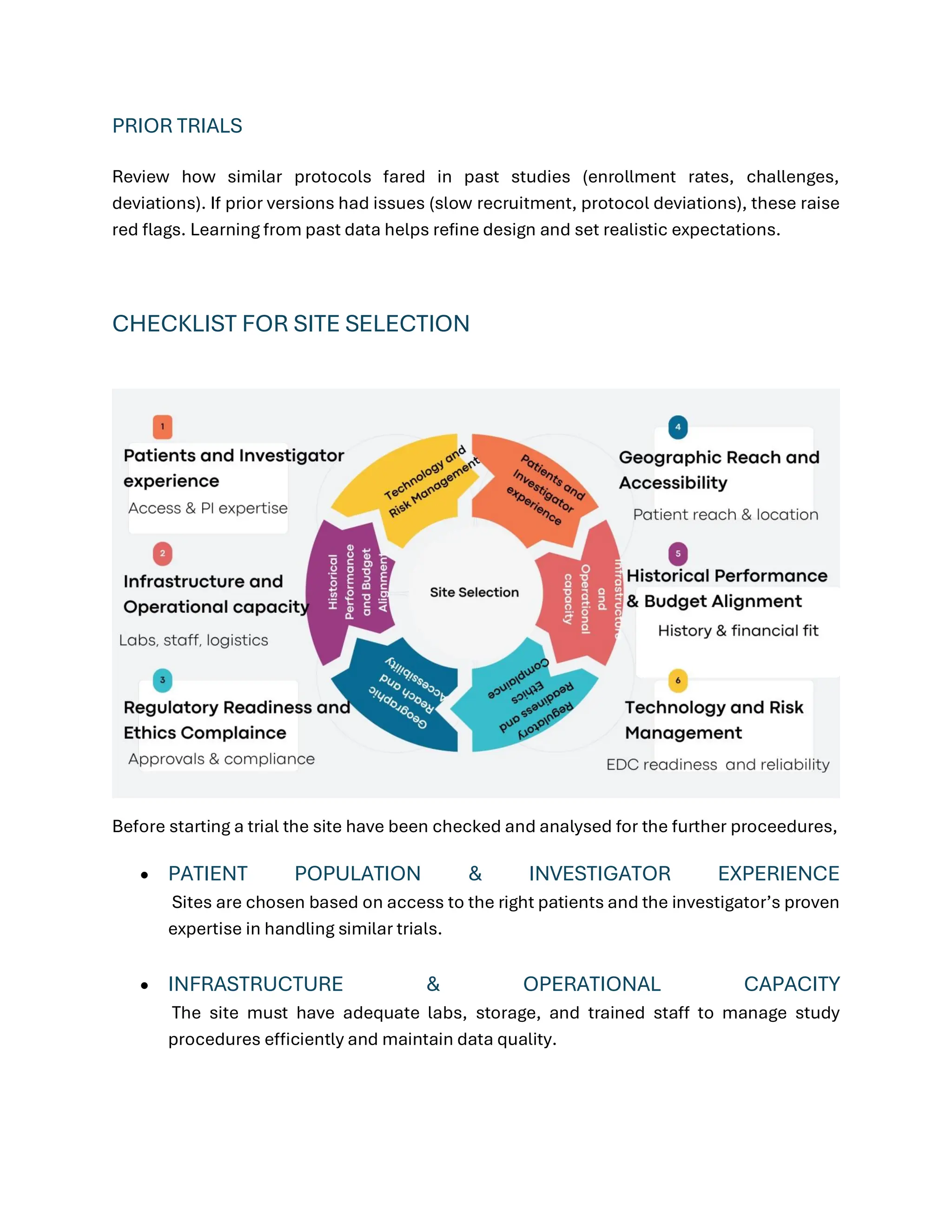
CHECKLIST FOR SITE SELECTION
Before starting a trial the site have been checked and analysed for the further proceedures,
• PATIENT POPULATION & INVESTIGATOR EXPERIENCE
Sites are chosen based on access to the right patients and the investigator’s proven
expertise in handling similar trials.
• INFRASTRUCTURE & OPERATIONAL CAPACITY
The site must have adequate labs, storage, and trained staff to manage study
procedures efficiently and maintain data quality.
6.
• REGULATORY READINESS& ETHICS COMPLIANCE
Sites with prior ethics approvals, ICH-GCP awareness, and a history of regulatory
compliance ensure smoother trial startup.
• GEOGRAPHIC REACH & ACCESSIBILITY
Easily reachable sites encourage patient participation and reduce dropout rates,
supporting better recruitment outcomes.
• HISTORICAL PERFORMANCE & BUDGET ALIGNMENT
Past trial delivery, accurate data handling, and realistic cost planning indicate a
site’s reliability and sustainability.
• TECHNOLOGY & RISK MANAGEMENT
Strong data systems, EDC readiness, and early identification of risks like staff
turnover or competing trials ensure trial continuity.
EVALUATION OF FEASIBILITY
Site Feasibility Questionnaires / Site response Questionnaires (SFQs / SRQs)
These are structured, detailed forms that sponsors or CROs send to clinical trial sites. They
ask about
• The site’s patient population (how many eligible patients they see per month)
• Previous experience with trials, staff qualifications
• Available facilities, equipment, lab capacity, and data systems
• Operational capabilities, regulatory compliance history
Decision Trees & Weighted Scoring Systems
Decision Tree:
7.
• A visual“yes/no” logic flow that helps decide whether a site qualifies based on key
checkpoints (for example: does the site have lab capabilities? → yes, proceed; no →
disqualify).
RATING SCALE
• Each criterion (e.g. recruitment potential, infrastructure, regulatory experience) is
assigned a weight. Sites are scored on each criterion, and the total score helps rank
them.
MRCT Decision Tree
The MRCT (Multi-Regional Clinical Trials) Decision Tree is a framework developed to
support multi-center, multi-country trials. It guides sponsors through critical checkpoints
like capacity to enroll in diverse populations, site infrastructure, ethical and regulatory
readiness, and recruitment potential.
CHALLENGES IN THE CLINICAL FEASIBILITY CHECKLIST
Protocol-Related Challenges
Complex study designs, excessive visits, or invasive procedures make protocols hard to
execute. Overly strict eligibility criteria reduce patient recruitment. Unrealistic timelines and
budgets strain site resources. Poor adaptation from prior trials leads to repeated issues.
Site-Related Challenges
Sites may overestimate patient availability or lack trained staff. Limited infrastructure or
competing studies slow enrollment. Regulatory delays and ethics approvals cause startup
bottlenecks. Inconsistent performance or data quality affects trial reliability.
8.
Operational & LogisticalChallenges
Inadequate funding, delayed payments, or poor coordination hinder site motivation. Weak
data systems and communication gaps disrupt trial flow. Geographic inaccessibility
reduces patient retention. High staff turnover increases error rates and monitoring needs.
Ethical & Regulatory Challenges
Sites may struggle with GCP compliance or evolving local regulations. Multi-country studies
face varied IRB/EC processes and documentation demands. Delays in approvals impact
study timelines. Failure to maintain ethical standards can risk patient safety and study
credibility.
CONCLUSION
In simple terms, clinical trial feasibility is all about checking whether a study can actually
work in the real world before it begins. It helps researchers find out if the plan, sites, and
resources are practical, and if enough patients can safely take part. By identifying problems
early—like complicated study designs, tight budgets, or limited staff—teams can save time,
money, and effort later.
A well-planned feasibility process makes sure trials run smoothly, ethically, and efficiently.
It builds confidence among sponsors, researchers, and patients that the study is realistic
and valuable. In short, good feasibility means fewer surprises, faster progress, and more
reliable results that help bring new treatments to people who need them most. To explore
this topic in depth and gain hands-on knowledge of how real clinical trials are planned and
managed enroll in PG Diploma in Clinical Research: Advance Your Career.
Know more: contact@clinilaunchresearch.in
Ph: 8040395600, 8904269998




![R&D Directions Webcast June Final[1]](https://cdn.slidesharecdn.com/ss_thumbnails/rddirectionswebcastjunefinal1-13111957862724-phpapp02-110720160427-phpapp02-thumbnail.jpg?width=640&height=640&fit=bounds)
![R&D Directions Webcast June Final[1]](https://cdn.slidesharecdn.com/ss_thumbnails/rddirectionswebcastjunefinal1-13111948790252-phpapp01-110720160137-phpapp01-thumbnail.jpg?width=640&height=640&fit=bounds)


