Interview Preparation Questions
CLINICAL RESEARCH
PART-4
www.clinosol.com | 9121151622| @clinosolresearch
1
2
3
4
5
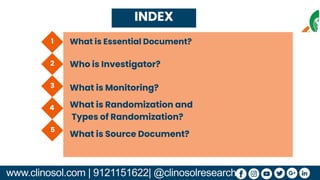
What is Essential Document?
Who is Investigator?
What is Monitoring?
What is Randomization and
Types of Randomization?
INDEX
www.clinosol.com | 9121151622| @clinosolresearch
What is Source Document?
www.clinosol.com | 9121151622| @clinosolresearch
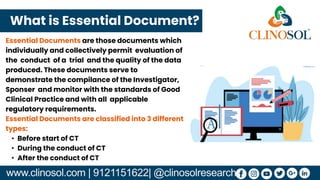
Essential Documents are those documents which
individually and collectively permit evaluation of
the conduct of a trial and the quality of the data
produced. These documents serve to
demonstrate the compilance of the Investigator,
Sponser and monitor with the standards of Good
Clinical Practice and with all applicable
regulatory requirements.
Essential Documents are classified into 3 different
types:
• Before start of CT
• During the conduct of CT
• After the conduct of CT
What is Essential Document?
www.clinosol.com | 9121151622| @clinosolresearch
Who is Investigator?
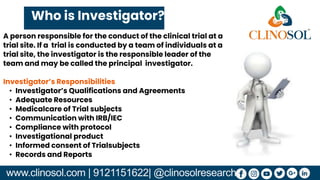
A person responsible for the conduct of the clinical trial at a
trial site. If a trial is conducted by a team of individuals at a
trial site, the investigator is the responsible leader of the
team and may be called the principal investigator.
Investigator’s Responsibilities
• Investigator’s Qualifications and Agreements
• Adequate Resources
• Medicalcare of Trial subjects
• Communication with IRB/IEC
• Compliance with protocol
• Investigational product
• Informed consent of Trialsubjects
• Records and Reports
www.clinosol.com | 9121151622| @clinosolresearch
•The act of overseeing the progress of a clinical trial,
and of ensuring that it is conducted, recorded, and
reported in accordance with the protocol,Standard
Operating Procedures (SOPs), Good Clinical Practice
(GCP), and the applicable regulatory requirements.
•Monitor acts as main line of communication between
sponsor and investigator.
At least 3 Monitoring visits:
• Before start of the trial
• Duringthetrial
• Afterthetrial
What is Monitoring?
www.clinosol.com | 9121151622| @clinosolresearch
What is Randomization?
• Randomly assigning subjects to the treatment group based
on element of chance is called Randomization.
• Randomization is done to avoid bias.
Types of randomization
• Simple randomization: In simple randomization, the subjects
are randomly allocated to experiment/intervention groups
based on a constant probability. The advantage is that it
eliminates selection bias.
• Block randomization: In block randomization, the subjects of
similar characteristics are classified into blocks.The aim of
block randomization is to balance the number of subjecs
allocated to each experiment/intervention group.
• Stratified randomization: In stratified randomization,the
subjects are defined based on certain strata,which are
covariates.
The advantage of this methodology is that it enables
comparability between experiment/interventiongroupsandthus
makes result analysis more efficient.
www.clinosol.com | 9121151622| @clinosolresearch
Original records or documents which shows the evidence
about methods and evaluation of results. (e.g., hospital
records, clinical and office charts, laboratory notes,
memoranda, subjects diaries or evaluation checklists,
pharmacy dispensing records, recorded data from automated
instruments, copies or transcriptions certified after verification
as being accurate copies, microfiches, photographic negatives,
microfilm or magnetic media, x-rays, subject files, and records
keptat thepharmacy,atthelaboratories andat medico-
technicaldepartmentsinvolved in the clinicaltrial).
What is Source Document?
www.clinosol.com | 9121151622| @clinosolresearch
Acheivements-
2023
www.clinosol.com | 9121151622| @clinosolresearch

Clinical Research Interview Question Part 4

  • 1.
    Interview Preparation Questions CLINICALRESEARCH PART-4 www.clinosol.com | 9121151622| @clinosolresearch
  • 2.
    1 2 3 4 5 What is EssentialDocument? Who is Investigator? What is Monitoring? What is Randomization and Types of Randomization? INDEX www.clinosol.com | 9121151622| @clinosolresearch What is Source Document?
  • 3.
    www.clinosol.com | 9121151622|@clinosolresearch Essential Documents are those documents which individually and collectively permit evaluation of the conduct of a trial and the quality of the data produced. These documents serve to demonstrate the compilance of the Investigator, Sponser and monitor with the standards of Good Clinical Practice and with all applicable regulatory requirements. Essential Documents are classified into 3 different types: • Before start of CT • During the conduct of CT • After the conduct of CT What is Essential Document?
  • 4.
    www.clinosol.com | 9121151622|@clinosolresearch Who is Investigator? A person responsible for the conduct of the clinical trial at a trial site. If a trial is conducted by a team of individuals at a trial site, the investigator is the responsible leader of the team and may be called the principal investigator. Investigator’s Responsibilities • Investigator’s Qualifications and Agreements • Adequate Resources • Medicalcare of Trial subjects • Communication with IRB/IEC • Compliance with protocol • Investigational product • Informed consent of Trialsubjects • Records and Reports
  • 5.
    www.clinosol.com | 9121151622|@clinosolresearch •The act of overseeing the progress of a clinical trial, and of ensuring that it is conducted, recorded, and reported in accordance with the protocol,Standard Operating Procedures (SOPs), Good Clinical Practice (GCP), and the applicable regulatory requirements. •Monitor acts as main line of communication between sponsor and investigator. At least 3 Monitoring visits: • Before start of the trial • Duringthetrial • Afterthetrial What is Monitoring?
  • 6.
    www.clinosol.com | 9121151622|@clinosolresearch What is Randomization? • Randomly assigning subjects to the treatment group based on element of chance is called Randomization. • Randomization is done to avoid bias. Types of randomization • Simple randomization: In simple randomization, the subjects are randomly allocated to experiment/intervention groups based on a constant probability. The advantage is that it eliminates selection bias. • Block randomization: In block randomization, the subjects of similar characteristics are classified into blocks.The aim of block randomization is to balance the number of subjecs allocated to each experiment/intervention group. • Stratified randomization: In stratified randomization,the subjects are defined based on certain strata,which are covariates. The advantage of this methodology is that it enables comparability between experiment/interventiongroupsandthus makes result analysis more efficient.
  • 7.
    www.clinosol.com | 9121151622|@clinosolresearch Original records or documents which shows the evidence about methods and evaluation of results. (e.g., hospital records, clinical and office charts, laboratory notes, memoranda, subjects diaries or evaluation checklists, pharmacy dispensing records, recorded data from automated instruments, copies or transcriptions certified after verification as being accurate copies, microfiches, photographic negatives, microfilm or magnetic media, x-rays, subject files, and records keptat thepharmacy,atthelaboratories andat medico- technicaldepartmentsinvolved in the clinicaltrial). What is Source Document?
  • 8.
  • 9.
  • 10.
  • 11.