T
T
ACISA
WNEONT
Who was Isaac
Newton?
SIR ISAAC NEWTON was an English
mathematician, physicist, astronomer,
theologian and author who is widely
recognized as one of the most influential
scientists of all time.
He was the one who formulated the
famous three laws of motion
and universal gravitation that formed the
dominant scientific viewpoint until it was
superseded by the theory of relativity.
Newton’sFirst Law of Motion
Bodies at rest will remain
at rest and bodies in motion will
continue moving unless acted
upon by an outside(external)
force.
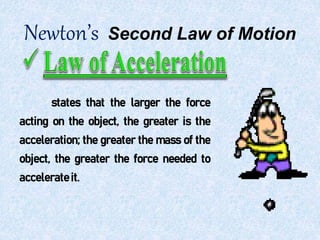
states that the larger the force
acting on the object, the greater is the
acceleration; the greater the mass of the
object, the greater the force needed to
accelerateit.
Newton’s Second Law of Motion
f = m•a
force = mass • acceleration
f = net force (newtons)
m = mass (Kilograms)
a = acceleration (meters/second2)
Newton’s Third Law of Motion
for every action,
there is always an
equal and opposite
reaction.
For every action, there is
an equal and opposite reaction.

Discuss the following questions briefly on a
sheetof paper,preferably½ crosswise.
1. Why do objectstendto resistchangesin its
current state?
2. How doesforce lead to motion?
3. Why do forces come in pairs?
Classroom Observation PPT.pptx

Classroom Observation PPT.pptx

  • 1.
  • 2.
  • 4.
  • 6.
    Who was Isaac Newton? SIRISAAC NEWTON was an English mathematician, physicist, astronomer, theologian and author who is widely recognized as one of the most influential scientists of all time. He was the one who formulated the famous three laws of motion and universal gravitation that formed the dominant scientific viewpoint until it was superseded by the theory of relativity.
  • 7.
    Newton’sFirst Law ofMotion Bodies at rest will remain at rest and bodies in motion will continue moving unless acted upon by an outside(external) force.
  • 8.
    states that thelarger the force acting on the object, the greater is the acceleration; the greater the mass of the object, the greater the force needed to accelerateit. Newton’s Second Law of Motion
  • 9.
    f = m•a force= mass • acceleration f = net force (newtons) m = mass (Kilograms) a = acceleration (meters/second2)
  • 10.
    Newton’s Third Lawof Motion for every action, there is always an equal and opposite reaction.
  • 11.
    For every action,there is an equal and opposite reaction.
  • 13.
    Discuss the followingquestions briefly on a sheetof paper,preferably½ crosswise. 1. Why do objectstendto resistchangesin its current state? 2. How doesforce lead to motion? 3. Why do forces come in pairs?