Create an organismand
describe how it meets
each of the MRS GREN
characteristics.
BE CREATIVE - design
and hand in at the end of
the lesson. It can not be
an organism that already
exists.
3.
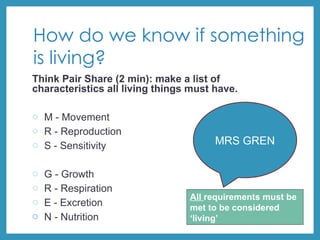
How do weknow if something
is living?
Think Pair Share (2 min): make a list of
characteristics all living things must have.
o M - Movement
o R - Reproduction
o S - Sensitivity
o G - Growth
o R - Respiration
o E - Excretion
o N - Nutrition
MRS GREN
All requirements must be
met to be considered
‘living’
4.
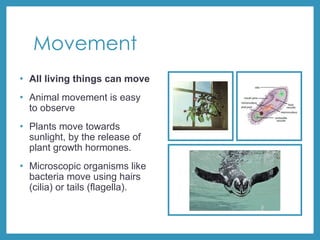
Movement
• All livingthings can move
• Animal movement is easy
to observe
• Plants move towards
sunlight, by the release of
plant growth hormones.
• Microscopic organisms like
bacteria move using hairs
(cilia) or tails (flagella).
5.
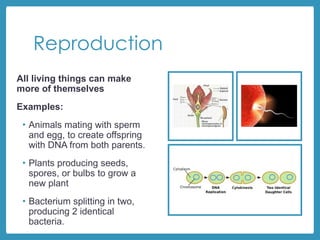
Reproduction
All living thingscan make
more of themselves
Examples:
• Animals mating with sperm
and egg, to create offspring
with DNA from both parents.
• Plants producing seeds,
spores, or bulbs to grow a
new plant
• Bacterium splitting in two,
producing 2 identical
bacteria.
6.
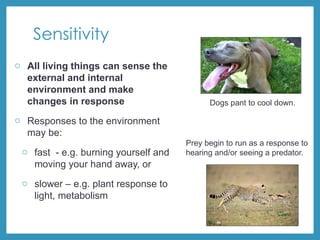
Sensitivity
o All livingthings can sense the
external and internal
environment and make
changes in response
o Responses to the environment
may be:
o fast - e.g. burning yourself and
moving your hand away, or
o slower – e.g. plant response to
light, metabolism
Dogs pant to cool down.
Prey begin to run as a response to
hearing and/or seeing a predator.
7.
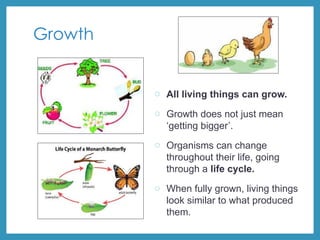
Growth
o All livingthings can grow.
o Growth does not just mean
‘getting bigger’.
o Organisms can change
throughout their life, going
through a life cycle.
o When fully grown, living things
look similar to what produced
them.
8.
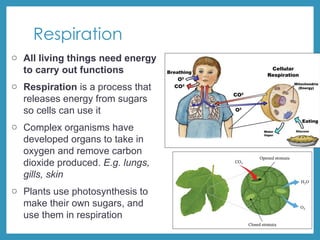
Respiration
o All livingthings need energy
to carry out functions
o Respiration is a process that
releases energy from sugars
so cells can use it
o Complex organisms have
developed organs to take in
oxygen and remove carbon
dioxide produced. E.g. lungs,
gills, skin
o Plants use photosynthesis to
make their own sugars, and
use them in respiration
9.
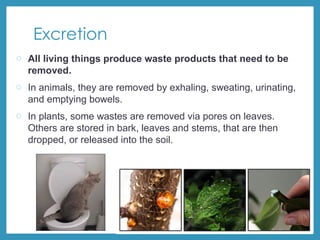
Excretion
o All livingthings produce waste products that need to be
removed.
o In animals, they are removed by exhaling, sweating, urinating,
and emptying bowels.
o In plants, some wastes are removed via pores on leaves.
Others are stored in bark, leaves and stems, that are then
dropped, or released into the soil.
10.
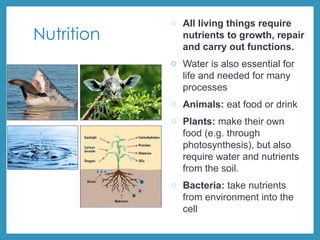
Nutrition
o All livingthings require
nutrients to growth, repair
and carry out functions.
o Water is also essential for
life and needed for many
processes
o Animals: eat food or drink
o Plants: make their own
food (e.g. through
photosynthesis), but also
require water and nutrients
from the soil.
o Bacteria: take nutrients
from environment into the
cell
11.
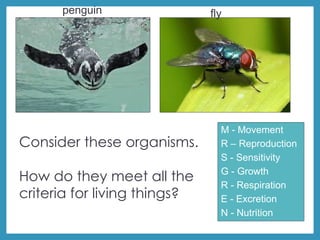
Consider these organisms.
Howdo they meet all the
criteria for living things?
M - Movement
R – Reproduction
S - Sensitivity
G - Growth
R - Respiration
E - Excretion
N - Nutrition
penguin fly
12.
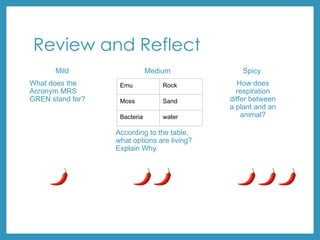
Review and Reflect
Mild
Whatdoes the
Acronym MRS
GREN stand for?
Medium
According to the table,
what options are living?
Explain Why.
Spicy
How does
respiration
differ between
a plant and an
animal?
Emu Rock
Moss Sand
Bacteria water
13.
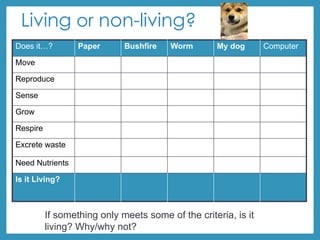
Living or non-living?
Doesit…? Paper Bushfire Worm My dog Computer
Move
Reproduce
Sense
Grow
Respire
Excrete waste
Need Nutrients
Is it Living?
If something only meets some of the criteria, is it
living? Why/why not?
14.
What is thedifference between non-living
and dead?
o Something dead was once living and
had all required characteristics – e.g.
wood used to be a living tree.
o Something non-living has never been
alive – e.g. water, rocks, paper
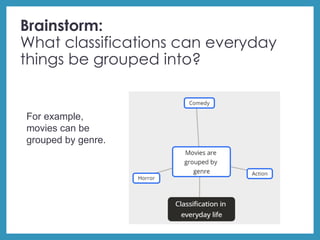
Classification
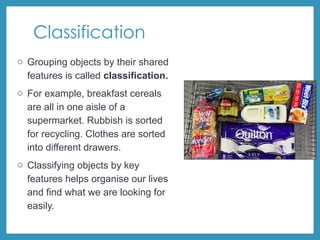
o Grouping objectsby their shared
features is called classification.
o For example, breakfast cereals
are all in one aisle of a
supermarket. Rubbish is sorted
for recycling. Clothes are sorted
into different drawers.
o Classifying objects by key
features helps organise our lives
and find what we are looking for
easily.
17.
Why is classificationof living
things important?
o Taxonomy: the science of classifying living things
o Having a universal system of classifying living things
has many benefits:
o Makes studying different kinds of organisms and
sharing scientific knowledge much easier.
o Tells us about the similarities between species and
allows for easier identification
o Help conservation efforts – can identify native vs
introduced species
18.
Who am I?
PART1.
o Describe the appearance of an animal to your partner (verbally, without
using the animal’s name).
o Your partner should try to draw the animal.
PART 2.
o This time, draw an animal. Your partner should try to guess what it is.
DISCUSS:
o How effective was describing vs. drawing when communicating about the
animal?
o What problems were there? How could these problems be overcome with
technology?
19.
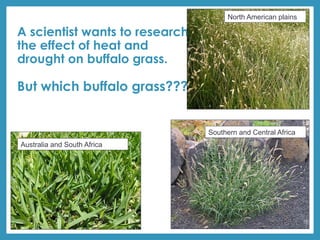
A scientist wantsto research
the effect of heat and
drought on buffalo grass.
But which buffalo grass???
Southern and Central Africa
Australia and South Africa
North American plains
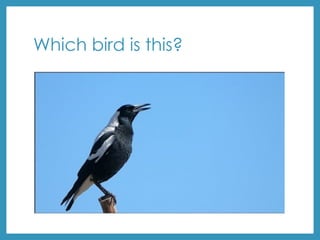
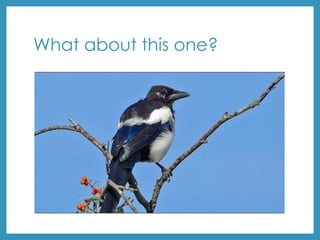
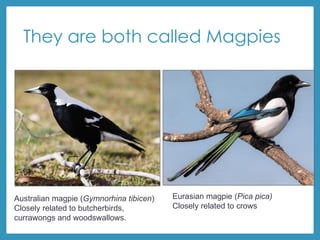
They are bothcalled Magpies
Eurasian magpie (Pica pica)
Closely related to crows
Australian magpie (Gymnorhina tibicen)
Closely related to butcherbirds,
currawongs and woodswallows.
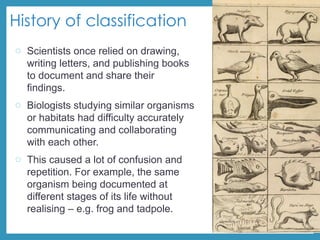
History of classification
oScientists once relied on drawing,
writing letters, and publishing books
to document and share their
findings.
o Biologists studying similar organisms
or habitats had difficulty accurately
communicating and collaborating
with each other.
o This caused a lot of confusion and
repetition. For example, the same
organism being documented at
different stages of its life without
realising – e.g. frog and tadpole.
25.
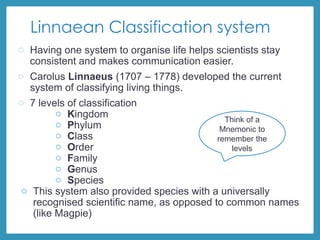
Linnaean Classification system
oHaving one system to organise life helps scientists stay
consistent and makes communication easier.
o Carolus Linnaeus (1707 – 1778) developed the current
system of classifying living things.
o 7 levels of classification
o Kingdom
o Phylum
o Class
o Order
o Family
o Genus
o Species
o This system also provided species with a universally
recognised scientific name, as opposed to common names
(like Magpie)
Think of a
Mnemonic to
remember the
levels
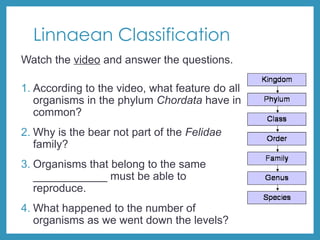
Linnaean Classification
Watch thevideo and answer the questions.
1. According to the video, what feature do all
organisms in the phylum Chordata have in
common?
2. Why is the bear not part of the Felidae
family?
3. Organisms that belong to the same
____________ must be able to
reproduce.
4. What happened to the number of
organisms as we went down the levels?
28.
Binomial System
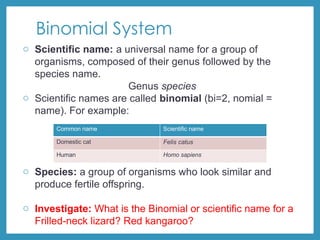
o Scientificname: a universal name for a group of
organisms, composed of their genus followed by the
species name.
Genus species
o Scientific names are called binomial (bi=2, nomial =
name). For example:
o Species: a group of organisms who look similar and
produce fertile offspring.
o Investigate: What is the Binomial or scientific name for a
Frilled-neck lizard? Red kangaroo?
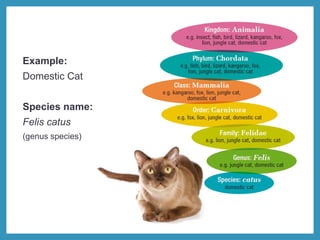
Common name Scientific name
Domestic cat Felis catus
Human Homo sapiens
29.
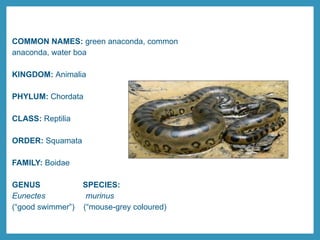
COMMON NAMES: greenanaconda, common
anaconda, water boa
KINGDOM: Animalia
PHYLUM: Chordata
CLASS: Reptilia
ORDER: Squamata
FAMILY: Boidae
GENUS SPECIES:
Eunectes murinus
(“good swimmer”) (“mouse-grey coloured)
30.
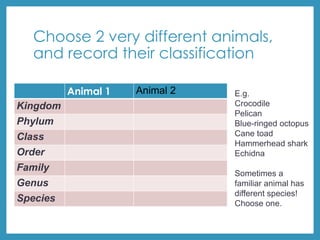
Choose 2 verydifferent animals,
and record their classification
Animal 1 Animal 2
Kingdom
Phylum
Class
Order
Family
Genus
Species
E.g.
Crocodile
Pelican
Blue-ringed octopus
Cane toad
Hammerhead shark
Echidna
Sometimes a
familiar animal has
different species!
Choose one.
31.
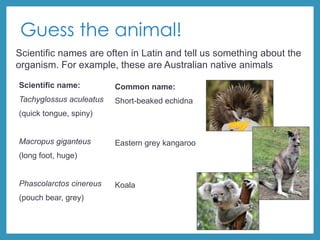
Guess the animal!
Scientificname:
Tachyglossus aculeatus
(quick tongue, spiny)
Macropus giganteus
(long foot, huge)
Phascolarctos cinereus
(pouch bear, grey)
Common name:
Short-beaked echidna
Eastern grey kangaroo
Koala
Scientific names are often in Latin and tell us something about the
organism. For example, these are Australian native animals
32.
Review and Reflect
Mild
Listthe order of
Linnaean
classification.
Medium
Explain which
classification levels have
the most organisms and
which classification level
has the least.
Spicy
Sharks and dolphins
both have streamlined
bodies and live in the
water. Which
classification levels do
they share? Why would
they differ after those
levels?
33.
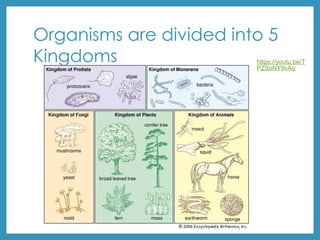
Organisms are dividedinto 5
Kingdoms https://youtu.be/T
PZSoNY9vAo
Overview of each
kingdom
34.
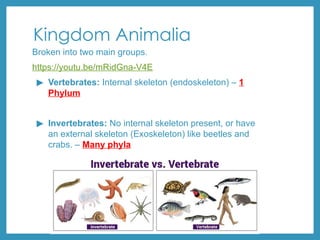
Kingdom Animalia
Broken intotwo main groups.
https://youtu.be/mRidGna-V4E
▶ Vertebrates: Internal skeleton (endoskeleton) – 1
Phylum
▶ Invertebrates: No internal skeleton present, or have
an external skeleton (Exoskeleton) like beetles and
crabs. – Many phyla
35.
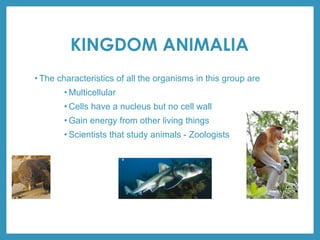
KINGDOM ANIMALIA
• Thecharacteristics of all the organisms in this group are
• Multicellular
• Cells have a nucleus but no cell wall
• Gain energy from other living things
• Scientists that study animals - Zoologists
36.
SKELETON
In the KingdomAnimalia, the first question scientists ask is
“Does this animal have an internal or external skeleton?”
Internal Skeleton – Endoskeleton
Make the group Vertebrates
External Skeleton – Exoskeleton
Make the group Invertebrates
37.
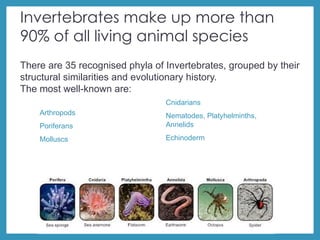
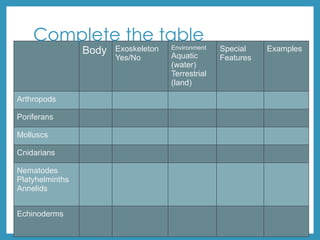
Invertebrates make upmore than
90% of all living animal species
Arthropods
Poriferans
Molluscs
Cnidarians
Nematodes, Platyhelminths,
Annelids
Echinoderm
There are 35 recognised phyla of Invertebrates, grouped by their
structural similarities and evolutionary history.
The most well-known are:
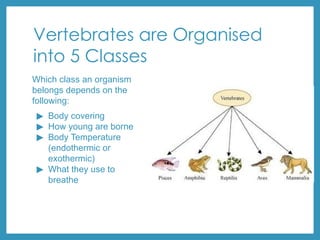
Vertebrates are Organised
into5 Classes
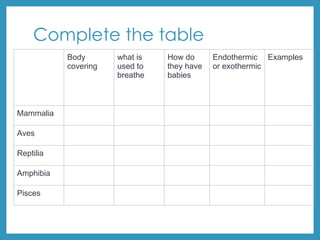
Which class an organism
belongs depends on the
following:
▶ Body covering
▶ How young are borne
▶ Body Temperature
(endothermic or
exothermic)
▶ What they use to
breathe
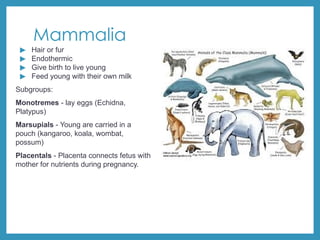
Mammalia
▶ Hair orfur
▶ Endothermic
▶ Give birth to live young
▶ Feed young with their own milk
Subgroups:
Monotremes - lay eggs (Echidna,
Platypus)
Marsupials - Young are carried in a
pouch (kangaroo, koala, wombat,
possum)
Placentals - Placenta connects fetus with
mother for nutrients during pregnancy.
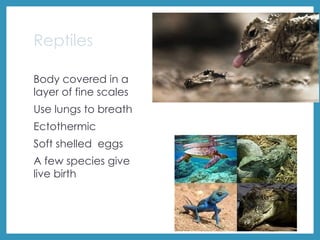
Reptiles
Body covered ina
layer of fine scales
Use lungs to breath
Ectothermic
Soft shelled eggs
A few species give
live birth
44.
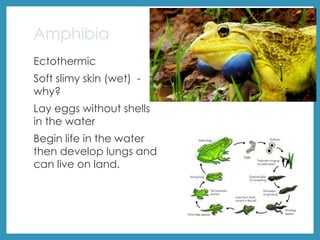
Amphibia
Ectothermic
Soft slimy skin(wet) -
why?
Lay eggs without shells
in the water
Begin life in the water
then develop lungs and
can live on land.
45.
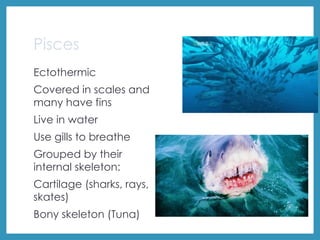
Pisces
Ectothermic
Covered in scalesand
many have fins
Live in water
Use gills to breathe
Grouped by their
internal skeleton:
Cartilage (sharks, rays,
skates)
Bony skeleton (Tuna)
46.
Review and Reflect
Mild
Givean example for
each class of
vertebrate and
invertebrate.
Medium
What is the difference
between an ectothermic,
endothermic and
exothermic.
Spicy
Do all invertebrates have
an exoskeleton? Explain.
Dichotomous Keys
❏Scientists liketo sort organisms
with similar characteristics into
groups. This is also known as
classification.
❏Dichotomous Key - Visual tool
used to classify organisms.
❏Branched key (Di = two) always
splitting in two.
49.
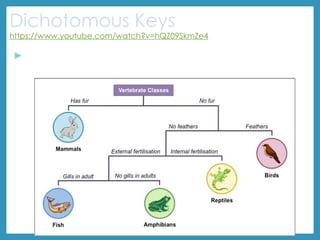
Dichotomous key
❏Simple yesor no decisions
❏What characteristics might you
use to decide if an organism is a
bird, Reptile, fish, mammal,
amphibian?
Creating a Dichotomous
Key
USEFUL
Yes/ no choices should be
based on characteristics
which are visible.
E.g Feathers covering the
body or no feathers
covering the body.
NOT USEFUL
Questions based on what
the organism is doing, or a
feature that can change.
E.g Sleeping or not
sleeping.
E.g Scratching fur or not
scratching fur.
Why?
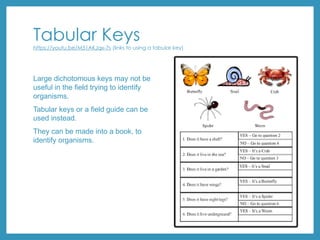
Tabular Keys
https://youtu.be/M51AKJqx-7s (linksto using a tabular key)
Large dichotomous keys may not be
useful in the field trying to identify
organisms.
Tabular keys or a field guide can be
used instead.
They can be made into a book, to
identify organisms.
54.
Review and Reflect
Mild
Adog dreams about
cats, would this be part
of a Dichotomous Key?
Medium
Why is it important to
use observable
characteristics in a
dichotomous key?
Spicy
Why might two people
using the same
dichotomous key come to
a different conclusion?
55.
Glossary terms
write adefinition and include
a diagram where possible
Taxonomy
Multicellular
Unicellular
Nucleus
Cell wall
Plankton
Amoeba
Endoskeleton
Vertebrate
Exoskeleton
Invertebrate
Endotherm
Ectotherm
Autotroph
Heterotroph
#5 Plant reproduction: https://www.youtube.com/watch?v=W9OiGA5_mVs - stop at 2 mins
Binary fission: https://www.youtube.com/watch?v=ReX0r2vm2U8
#7 Bean germination time lapse - https://www.youtube.com/watch?v=w77zPAtVTuI
Cell division and specialisation time lapse of a salamander - https://www.youtube.com/watch?v=SEejivHRIbE
#8 Leaf animation showing stomata - https://www.youtube.com/watch?v=pwymX2LxnQs – can stop at 1min
#10 Heterotrophs and Autotrophs - https://www.youtube.com/watch?v=PzzCOEDtiMM
#13 the fire and the computer are not considered living, even though they meet many of the requirements. ALL requirements must be met for something to be considered living, including reproduction of CELLS.
#15 Starter for looking at biological classification
#19 Foxtail buffalo grass: Cenchrus ciliaris
St. Augustine grass (Stenotaphrum secundatum), also known as buffalo turf in Australia and buffalo grass in South Africa,
North American native buffalo grass: Buchloë dactyloides
#22 Same common name – Magpie
But different scientific names.
#24 Question: Write down two examples of plants or animals that look very different as they move through their life cycle.
Image by: Étienne de Flacourt (1607-1660) Flaucourt’s illustrations of animals include the small Madagascar hippopotamus (top row, second from right)
#25 The levels decrease in the amount of living things included at each level.
Keep Ponds Clean or Frogs Get Sick
Kids Prefer Cheese Over Fried Green Spinach
King Phillip Crawled Over Four Gooey Snails
#26 The levels decrease in the amount of living things included at each level.
#31 Scientists use the Latin words for scientific names because, centuries ago, Latin was a common language amongst scientists in different countries.
The latin name usually mean something.
#38 There is an alternative task to this which uses a dichotomous key to help students identify features of each Phyla.
#39 complete Vertebrates cut and paste activity or have students complete the table on following slide
#47 Please let Nga know at least 48hr before doing the dissection.
#50 Teacher notes:
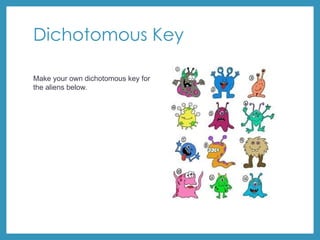
There is a tub of different pictures students can use to create their own dichotomous key in the prep room.
#52 page 207 of textbook has a dichotomous key activity using objects or packets of chips.
#53 Ask students to describe how the key works:
2 choices at each stage and when a decision is made they are led to the next choice or identification of the organism.


![Classification-Chapter-1 2 [Auto-saved].pptx](https://cdn.slidesharecdn.com/ss_thumbnails/classification-chapter-12auto-saved-231217153019-5f57951f-thumbnail.jpg?width=640&height=640&fit=bounds)


