Forest Society and
Colonialism: A Historical
Perspective
NAME- Aditya Dwivedi
CLASS- 'L'
CONTENTS
. Introduction . Causes of Deforestation
. Scientific Forestry and Forest Laws . Impact on Local Communities
. Forest Management in Java,
Indonesia
. Forests and Wars
. Modern Changes and Conservation
Introduction
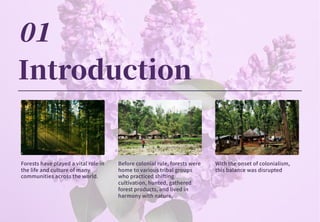
Forests have played a vital role in
the life and culture of many
communities across the world.
Before colonial rule, forests were
home to various tribal groups
who practiced shifting
cultivation, hunted, gathered
forest products, and lived in
harmony with nature.
With the onset of colonialism,
this balance was disrupted
Introduction
Forests have played a vital role in the life and culture of many communities across the world.
Before colonial rule, forests were home to various tribal groups who practiced shifting cultivation, hunted,
gathered forest products, and lived in harmony with nature.
With the onset of colonialism, this balance was disrupted
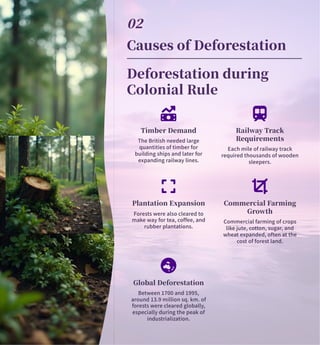
Causes of Deforestation
Deforestation during
Colonial Rule
Timber Demand
The British needed large
quantities of timber for
building ships and later for
expanding railway lines.
Railway Track
Requirements
Each mile of railway track
required thousands of wooden
sleepers.
Plantation Expansion
Forests were also cleared to
make way for tea, coffee, and
rubber plantations.
Commercial Farming
Growth
Commercial farming of crops
like jute, cotton, sugar, and
wheat expanded, often at the
cost of forest land.
Global Deforestation
Between and ,
around . million sq. km. of
forests were cleared globally,
especially during the peak of
industrialization.
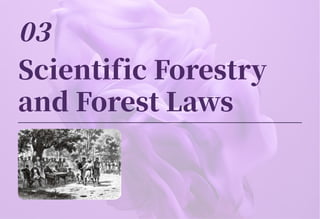
Scientific Forestry
and Forest Laws
Introduction of Scientific Forestry
Scientific Forestry
The British introduced a system called "scientific
forestry."
Forest Replacement
This method involved the cutting of natural forests
and replacing them with single-species plantations
such as teak or sal.
Forest Classification
The Indian Forest Act of , later amended in
and , classified forests into reserved,
protected, and village forests.
Impact on Local Communities
Forest Regulation
In reserved forests, local people
were banned from collecting
wood, hunting, or grazing
animals.
Community Impact
These changes had devastating
effects on forest communities.
Their everyday activities
became illegal.
Bribery Issues
They had to bribe forest guards
or face punishment.
Impact on Women
Women, who collected firewood and forest
produce, suffered the most.
Cultivation Ban
Shifting cultivation was banned as the British
believed it harmed the forests, displacing
communities and pushing them into poverty.
Impact on Local
Communities
Impact on Local Communities
Community Reactions
· People reacted to the forest policies in various
ways.
· Some adapted by joining forest-based industries
and trading forest products.
· Many resisted the changes through protests and
rebellions.
Case Study: The Bastar Rebellion
· In Bastar (present-day Chhattisgarh), people rose
in revolt in when the British tried to reserve
two-thirds of the forest.
· Led by leaders like Gunda Dhur, villagers looted
bazaars and government offices.
· Although the rebellion was suppressed, it forced
the British to reduce the area under reservation.
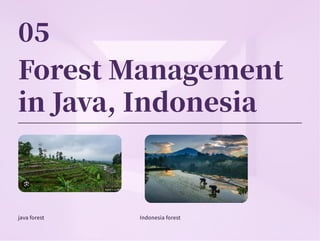
Forest Management
in Java, Indonesia
java forest Indonesia forest
Forest Management in Java, Indonesia
Java Events
Similar events took place in Java, Indonesia, under
Dutch colonial rule.
Forest Laws
The Dutch implemented forest laws and restricted
the local people’s access to forests.
Labor Systems
They introduced systems like blandongdiensten,
where forest villagers had to provide free labor in
return for being allowed to cultivate forest land.
Community Resistance
Communities like the Kalangs resisted these
changes, and leaders like Surontiko Samin
protested state control over natural resources.
Forests and Wars
Forests and Wars
Deforestation Impact
World Wars I and II also caused widespread
deforestation.
Timber Demand
During wars, the demand for timber increased
rapidly.
Management Rules
Forest management rules were relaxed, and vast
areas were cleared.
Sawmill Destruction
In Java, Dutch forces destroyed sawmills and
timber to prevent Japanese capture.
Exploitation of Forests
The Japanese, in turn, exploited the forests even
more ruthlessly.
Modern Changes and
Conservation
Modern Changes and Conservation
Conservation
Awareness
In recent decades,
governments and communities
have realized that excluding
people from forests does not
help in conserving them.
Joint Management
New forest policies promote
joint forest management,
where villagers help protect
and manage forests.
Biodiversity
Preservation
Sacred groves and traditional
forest conservation methods
are being recognized as
effective ways to preserve
biodiversity.
This project highlights how colonial forest policies affected the environment and local communities. It also
shows the importance of involving indigenous people in forest conservation efforts.
Class9 Forest Society and Colonialis project.pdf

Class9 Forest Society and Colonialis project.pdf

  • 1.
    Forest Society and Colonialism:A Historical Perspective NAME- Aditya Dwivedi CLASS- 'L'
  • 2.
    CONTENTS . Introduction .Causes of Deforestation . Scientific Forestry and Forest Laws . Impact on Local Communities . Forest Management in Java, Indonesia . Forests and Wars . Modern Changes and Conservation
  • 3.
    Introduction Forests have playeda vital role in the life and culture of many communities across the world. Before colonial rule, forests were home to various tribal groups who practiced shifting cultivation, hunted, gathered forest products, and lived in harmony with nature. With the onset of colonialism, this balance was disrupted
  • 4.
    Introduction Forests have playeda vital role in the life and culture of many communities across the world. Before colonial rule, forests were home to various tribal groups who practiced shifting cultivation, hunted, gathered forest products, and lived in harmony with nature. With the onset of colonialism, this balance was disrupted
  • 5.
    Causes of Deforestation Deforestationduring Colonial Rule Timber Demand The British needed large quantities of timber for building ships and later for expanding railway lines. Railway Track Requirements Each mile of railway track required thousands of wooden sleepers. Plantation Expansion Forests were also cleared to make way for tea, coffee, and rubber plantations. Commercial Farming Growth Commercial farming of crops like jute, cotton, sugar, and wheat expanded, often at the cost of forest land. Global Deforestation Between and , around . million sq. km. of forests were cleared globally, especially during the peak of industrialization.
  • 6.
  • 7.
    Introduction of ScientificForestry Scientific Forestry The British introduced a system called "scientific forestry." Forest Replacement This method involved the cutting of natural forests and replacing them with single-species plantations such as teak or sal. Forest Classification The Indian Forest Act of , later amended in and , classified forests into reserved, protected, and village forests.
  • 8.
    Impact on LocalCommunities Forest Regulation In reserved forests, local people were banned from collecting wood, hunting, or grazing animals. Community Impact These changes had devastating effects on forest communities. Their everyday activities became illegal. Bribery Issues They had to bribe forest guards or face punishment. Impact on Women Women, who collected firewood and forest produce, suffered the most. Cultivation Ban Shifting cultivation was banned as the British believed it harmed the forests, displacing communities and pushing them into poverty.
  • 9.
  • 10.
    Impact on LocalCommunities Community Reactions · People reacted to the forest policies in various ways. · Some adapted by joining forest-based industries and trading forest products. · Many resisted the changes through protests and rebellions. Case Study: The Bastar Rebellion · In Bastar (present-day Chhattisgarh), people rose in revolt in when the British tried to reserve two-thirds of the forest. · Led by leaders like Gunda Dhur, villagers looted bazaars and government offices. · Although the rebellion was suppressed, it forced the British to reduce the area under reservation.
  • 11.
    Forest Management in Java,Indonesia java forest Indonesia forest
  • 12.
    Forest Management inJava, Indonesia Java Events Similar events took place in Java, Indonesia, under Dutch colonial rule. Forest Laws The Dutch implemented forest laws and restricted the local people’s access to forests. Labor Systems They introduced systems like blandongdiensten, where forest villagers had to provide free labor in return for being allowed to cultivate forest land. Community Resistance Communities like the Kalangs resisted these changes, and leaders like Surontiko Samin protested state control over natural resources.
  • 13.
  • 14.
    Forests and Wars DeforestationImpact World Wars I and II also caused widespread deforestation. Timber Demand During wars, the demand for timber increased rapidly. Management Rules Forest management rules were relaxed, and vast areas were cleared. Sawmill Destruction In Java, Dutch forces destroyed sawmills and timber to prevent Japanese capture. Exploitation of Forests The Japanese, in turn, exploited the forests even more ruthlessly.
  • 15.
  • 16.
    Modern Changes andConservation Conservation Awareness In recent decades, governments and communities have realized that excluding people from forests does not help in conserving them. Joint Management New forest policies promote joint forest management, where villagers help protect and manage forests. Biodiversity Preservation Sacred groves and traditional forest conservation methods are being recognized as effective ways to preserve biodiversity. This project highlights how colonial forest policies affected the environment and local communities. It also shows the importance of involving indigenous people in forest conservation efforts.