Homicide
Homicide Schemes
Intentional Killings: Willful, Deliberate and Premeditated Murder
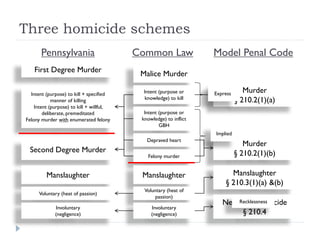
Three homicide schemes
Pennsylvania

Common Law

First Degree Murder

Malice Murder

Intent (purpose) to kill + specified
manner of killing
Intent (purpose) to kill + willful,
deliberate, premeditated
Felony murder with enumerated felony

Intent (purpose or
knowledge) to kill

Model Penal Code

Express

Murder
§ 210.2(1)(a)

Intent (purpose or
knowledge) to inflict
GBH
Implied
Depraved heart

Second Degree Murder

Felony murder

Manslaughter

Manslaughter

Voluntary (heat of passion)

Voluntary (heat of
passion)

Involuntary
(negligence)

Involuntary
(negligence)

Murder
§ 210.2(1)(b)
Manslaughter
§ 210.3(1)(a) &(b)
Recklessness
Negligent Homicide
§ 210.4
State v. Guthrie (W. Va. 1995)
“Murder by poison, lying
“[A]ny interval of time in
What verdict?
wait, imprisonment,
between the forming of the
starving, kill and the
intent toor by any willful,
A = First-degree murder
deliberate and
execution of that intent,
B = Second-degree murder
premeditated killing, duration
which is of sufficient or in
C = Manslaughter
the commission of, or
for the accused to be fully
attempt to commit [specific
conscious of what he
felonies] is sufficient the
intended,is murder in to
first degree. All other
support a conviction for first
murder is murder
degree murder” in the
second degree”
Discussion
Schrader definition of “deliberate and premeditated”
 Deliberate and premeditated = “[W]hat is really
meant by the language ‘willful, deliberate and
premeditated’… is that the killing be intentional
[purposeful]”
 Morrin definition of “deliberate and premeditated”
Second degree murder = purpose or knowledge
 Deliberate = “[T]o deliberate is to measure and
“Unstructured discretion”
Firstevaluate murder = willful, deliberate and problem”
degree the major facets of a choice or premeditated
 Premeditated = “[T]o premeditate is to think about
beforehand”
purpose

Discussion

Which definition ─ Shrader or Morrin ─ is better?
A = Schrader
B = Morrin
Midgett v. State (Ark. 1987)


What verdict under Morrin?
A = First-degree murder
B = Second-degree murder
C = Voluntary manslaughter
D = Not guilty



What verdict under Schrader?
Forrest v. State (N.C. 1987)


What verdict under Morrin?
A = First-degree murder
B = Second-degree murder
C = Voluntary manslaughter
D = Not guilty



What verdict under Schrader?
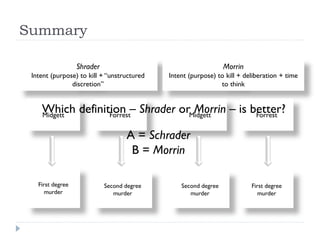
Summary
Shrader

Morrin

Intent (purpose) to kill + “unstructured
discretion”

Intent (purpose) to kill + deliberation + time
to think

Which definition – Shrader orMidgett – is better?
Morrin
Midgett
Forrest
Forrest
A = Schrader
B = Morrin
First degree
murder

Second degree
murder

Second degree
murder

First degree
murder
Discussion – Ariz. Rev. Stat. Ann. § 13-751
 of [i]ntending or of
The trier of fact shall impose a sentence Mitigating circumstances fact finds one
Aggravating circumstances
A person commits first degree murder if:death if the trierknowing that



or more aggravating circumstances andThe defendant’s capacity there are no
the person’s has been or cause death,thenperson causes the death of
the determines that to appreciate

The defendant conduct willwas
the wrongfulness
mitigating circumstances sufficiently premeditationcallhis conduct or to
another person, with substantial to of for leniency
previously convicted of a serious
conform his conduct to the
requirements of law was significantly
impaired, but not so impaired as to
constitute a defense;

offense;






The defendant knowingly created a
grave risk of death to another
person in addition to the person
murdered;
The defendant committed the
offense in an especially heinous,
cruel or depraved manner;
The offense was committed in a
cold, calculated manner without
pretense of moral or legal
justification



The defendant was under unusual and
substantial duress, although not such as
to constitute a defense;



Any factors proffered by the defendant
that are relevant to determining whether
to impose a sentence less than death,
including any aspect of the defendant’s
character, propensities or record and any
of the circumstances of the offense

Class.17.posted

  • 1.
    Homicide Homicide Schemes Intentional Killings:Willful, Deliberate and Premeditated Murder
  • 2.
    Three homicide schemes Pennsylvania CommonLaw First Degree Murder Malice Murder Intent (purpose) to kill + specified manner of killing Intent (purpose) to kill + willful, deliberate, premeditated Felony murder with enumerated felony Intent (purpose or knowledge) to kill Model Penal Code Express Murder § 210.2(1)(a) Intent (purpose or knowledge) to inflict GBH Implied Depraved heart Second Degree Murder Felony murder Manslaughter Manslaughter Voluntary (heat of passion) Voluntary (heat of passion) Involuntary (negligence) Involuntary (negligence) Murder § 210.2(1)(b) Manslaughter § 210.3(1)(a) &(b) Recklessness Negligent Homicide § 210.4
  • 3.
    State v. Guthrie(W. Va. 1995) “Murder by poison, lying “[A]ny interval of time in What verdict? wait, imprisonment, between the forming of the starving, kill and the intent toor by any willful, A = First-degree murder deliberate and execution of that intent, B = Second-degree murder premeditated killing, duration which is of sufficient or in C = Manslaughter the commission of, or for the accused to be fully attempt to commit [specific conscious of what he felonies] is sufficient the intended,is murder in to first degree. All other support a conviction for first murder is murder degree murder” in the second degree”
  • 4.
    Discussion Schrader definition of“deliberate and premeditated”  Deliberate and premeditated = “[W]hat is really meant by the language ‘willful, deliberate and premeditated’… is that the killing be intentional [purposeful]”  Morrin definition of “deliberate and premeditated” Second degree murder = purpose or knowledge  Deliberate = “[T]o deliberate is to measure and “Unstructured discretion” Firstevaluate murder = willful, deliberate and problem” degree the major facets of a choice or premeditated  Premeditated = “[T]o premeditate is to think about beforehand” purpose 
  • 5.
    Discussion Which definition ─Shrader or Morrin ─ is better? A = Schrader B = Morrin
  • 6.
    Midgett v. State(Ark. 1987)  What verdict under Morrin? A = First-degree murder B = Second-degree murder C = Voluntary manslaughter D = Not guilty  What verdict under Schrader?
  • 7.
    Forrest v. State(N.C. 1987)  What verdict under Morrin? A = First-degree murder B = Second-degree murder C = Voluntary manslaughter D = Not guilty  What verdict under Schrader?
  • 8.
    Summary Shrader Morrin Intent (purpose) tokill + “unstructured discretion” Intent (purpose) to kill + deliberation + time to think Which definition – Shrader orMidgett – is better? Morrin Midgett Forrest Forrest A = Schrader B = Morrin First degree murder Second degree murder Second degree murder First degree murder
  • 9.
    Discussion – Ariz.Rev. Stat. Ann. § 13-751  of [i]ntending or of The trier of fact shall impose a sentence Mitigating circumstances fact finds one Aggravating circumstances A person commits first degree murder if:death if the trierknowing that  or more aggravating circumstances andThe defendant’s capacity there are no the person’s has been or cause death,thenperson causes the death of the determines that to appreciate  The defendant conduct willwas the wrongfulness mitigating circumstances sufficiently premeditationcallhis conduct or to another person, with substantial to of for leniency previously convicted of a serious conform his conduct to the requirements of law was significantly impaired, but not so impaired as to constitute a defense; offense;    The defendant knowingly created a grave risk of death to another person in addition to the person murdered; The defendant committed the offense in an especially heinous, cruel or depraved manner; The offense was committed in a cold, calculated manner without pretense of moral or legal justification  The defendant was under unusual and substantial duress, although not such as to constitute a defense;  Any factors proffered by the defendant that are relevant to determining whether to impose a sentence less than death, including any aspect of the defendant’s character, propensities or record and any of the circumstances of the offense