1
B+ Trees
2
Tree-Structured Indices
 Tree-structured indexing techniques support
both range searches and equality searches.
 ISAM: static structure; B+ tree: dynamic,
adjusts gracefully under inserts and deletes.
3
ISAM
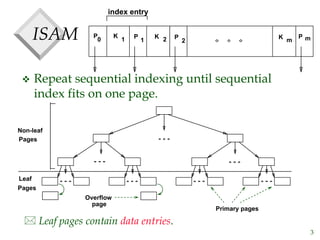
 Repeat sequential indexing until sequential
index fits on one page.
 Leaf pages contain data entries.
P
0
K
1 P
1
K 2 P
2
K m
P m
index entry
Non-leaf
Pages
Pages
Overflow
page
Primary pages
Leaf
4
Example ISAM Tree
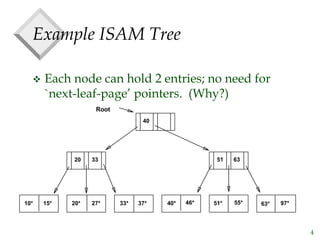
 Each node can hold 2 entries; no need for
`next-leaf-page’ pointers. (Why?)
10* 15* 20* 27* 33* 37* 40* 46* 51* 55* 63* 97*
20 33 51 63
40
Root
5
Comments on ISAM
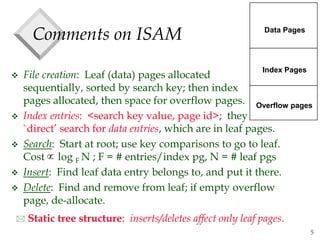
 File creation: Leaf (data) pages allocated
sequentially, sorted by search key; then index
pages allocated, then space for overflow pages.
 Index entries: <search key value, page id>; they
`direct’ search for data entries, which are in leaf pages.
 Search: Start at root; use key comparisons to go to leaf.
Cost log F N ; F = # entries/index pg, N = # leaf pgs
 Insert: Find leaf data entry belongs to, and put it there.
 Delete: Find and remove from leaf; if empty overflow
page, de-allocate.
 Static tree structure: inserts/deletes affect only leaf pages.

Data Pages
Index Pages
Overflow pages
6
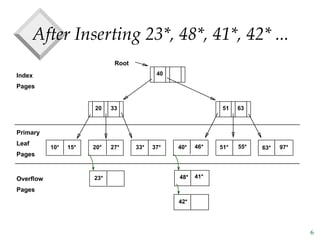
After Inserting 23*, 48*, 41*, 42* ...
10* 15* 20* 27* 33* 37* 40* 46* 51* 55* 63* 97*
20 33 51 63
40
Root
23* 48* 41*
42*
Overflow
Pages
Leaf
Index
Pages
Pages
Primary
7
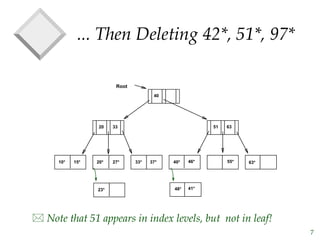
... Then Deleting 42*, 51*, 97*
 Note that 51 appears in index levels, but not in leaf!
10* 15* 20* 27* 33* 37* 40* 46* 55* 63*
20 33 51 63
40
Root
23* 48* 41*
8
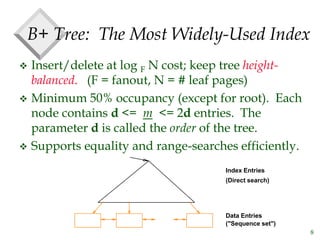
B+ Tree: The Most Widely-Used Index
 Insert/delete at log F N cost; keep tree height-
balanced. (F = fanout, N = # leaf pages)
 Minimum 50% occupancy (except for root). Each
node contains d <= m <= 2d entries. The
parameter d is called the order of the tree.
 Supports equality and range-searches efficiently.
Index Entries
Data Entries
("Sequence set")
(Direct search)
9
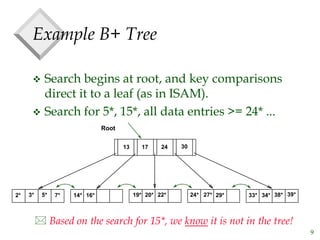
Example B+ Tree
 Search begins at root, and key comparisons
direct it to a leaf (as in ISAM).
 Search for 5*, 15*, all data entries >= 24* ...
 Based on the search for 15*, we know it is not in the tree!
Root
17 24 30
2* 3* 5* 7* 14* 16* 19* 20* 22* 24* 27* 29* 33* 34* 38* 39*
13
10
B+ Trees in Practice
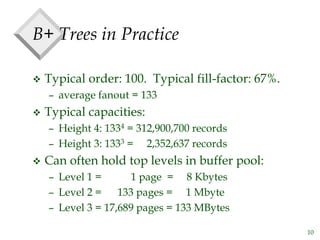
 Typical order: 100. Typical fill-factor: 67%.
– average fanout = 133
 Typical capacities:
– Height 4: 1334 = 312,900,700 records
– Height 3: 1333 = 2,352,637 records
 Can often hold top levels in buffer pool:
– Level 1 = 1 page = 8 Kbytes
– Level 2 = 133 pages = 1 Mbyte
– Level 3 = 17,689 pages = 133 MBytes
11
Inserting a Data Entry into a B+ Tree
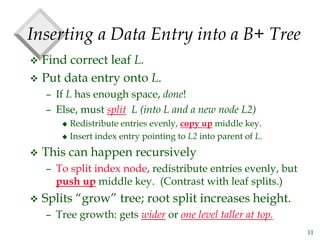
 Find correct leaf L.
 Put data entry onto L.
– If L has enough space, done!
– Else, must split L (into L and a new node L2)
 Redistribute entries evenly, copy up middle key.
 Insert index entry pointing to L2 into parent of L.
 This can happen recursively
– To split index node, redistribute entries evenly, but
push up middle key. (Contrast with leaf splits.)
 Splits “grow” tree; root split increases height.
– Tree growth: gets wider or one level taller at top.
12
Inserting 8* into Example B+ Tree
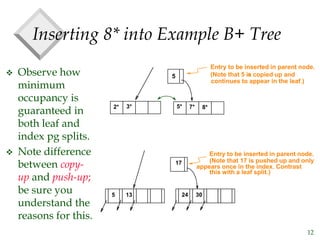
 Observe how
minimum
occupancy is
guaranteed in
both leaf and
index pg splits.
 Note difference
between copy-
up and push-up;
be sure you
understand the
reasons for this.
2* 3* 5* 7* 8*
5
Entry to be inserted in parent node.
(Note that 5 is
continues to appear in the leaf.)
s copied up and
appears once in the index. Contrast
5 24 30
17
13
Entry to be inserted in parent node.
(Note that 17 is pushed up and only
this with a leaf split.)
13
Example B+ Tree After Inserting 8*
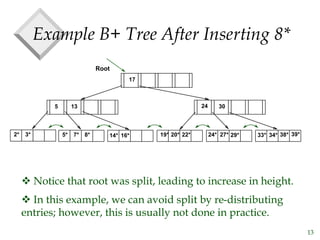
 Notice that root was split, leading to increase in height.
 In this example, we can avoid split by re-distributing
entries; however, this is usually not done in practice.
2* 3*
Root
17
24 30
14* 16* 19* 20* 22* 24* 27* 29* 33* 34* 38* 39*
13
5
7*
5* 8*
14
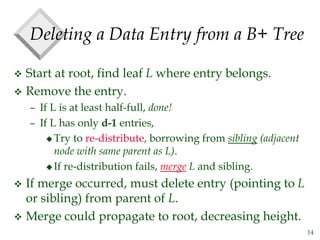
Deleting a Data Entry from a B+ Tree
 Start at root, find leaf L where entry belongs.
 Remove the entry.
– If L is at least half-full, done!
– If L has only d-1 entries,
 Try to re-distribute, borrowing from sibling (adjacent
node with same parent as L).
 If re-distribution fails, merge L and sibling.
 If merge occurred, must delete entry (pointing to L
or sibling) from parent of L.
 Merge could propagate to root, decreasing height.
15
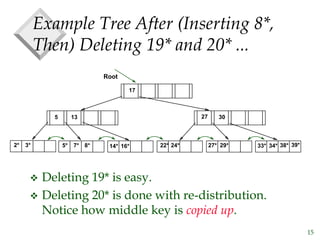
Example Tree After (Inserting 8*,
Then) Deleting 19* and 20* ...
 Deleting 19* is easy.
 Deleting 20* is done with re-distribution.
Notice how middle key is copied up.
2* 3*
Root
17
30
14* 16* 33* 34* 38* 39*
13
5
7*
5* 8* 22* 24*
27
27* 29*
16
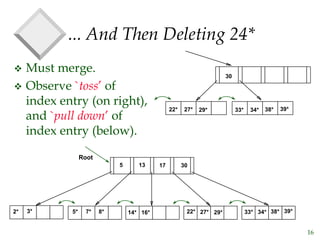
... And Then Deleting 24*
 Must merge.
 Observe `toss’ of
index entry (on right),
and `pull down’ of
index entry (below).
30
22* 27* 29* 33* 34* 38* 39*
2* 3* 7* 14* 16* 22* 27* 29* 33* 34* 38* 39*
5* 8*
Root
30
13
5 17
17
Summary
 Tree-structured indexes are ideal for range-
searches, also good for equality searches.
 ISAM is a static structure.
– Performance can degrade over time.
 B+ tree is a dynamic structure.
– Inserts/deletes leave tree height-balanced; log F N cost.
– High fanout (F) means depth rarely more than 3 or 4.
– Almost always better than maintaining a sorted file.
18
Summary (Contd.)
– Typically, 67% occupancy on average.
– Usually preferable to ISAM, modulo locking
considerations; adjusts to growth gracefully.
 Most widely used index in database management
systems because of its versatility. One of the most
optimized components of a DBMS.

class15.ppt,,,,,,,,,,,,,,,,,,,,,,,,,,,,,,,,,,,,,,,,,,,,,,,,,,

  • 1.
  • 2.
    2 Tree-Structured Indices  Tree-structuredindexing techniques support both range searches and equality searches.  ISAM: static structure; B+ tree: dynamic, adjusts gracefully under inserts and deletes.
  • 3.
    3 ISAM  Repeat sequentialindexing until sequential index fits on one page.  Leaf pages contain data entries. P 0 K 1 P 1 K 2 P 2 K m P m index entry Non-leaf Pages Pages Overflow page Primary pages Leaf
  • 4.
    4 Example ISAM Tree Each node can hold 2 entries; no need for `next-leaf-page’ pointers. (Why?) 10* 15* 20* 27* 33* 37* 40* 46* 51* 55* 63* 97* 20 33 51 63 40 Root
  • 5.
    5 Comments on ISAM File creation: Leaf (data) pages allocated sequentially, sorted by search key; then index pages allocated, then space for overflow pages.  Index entries: <search key value, page id>; they `direct’ search for data entries, which are in leaf pages.  Search: Start at root; use key comparisons to go to leaf. Cost log F N ; F = # entries/index pg, N = # leaf pgs  Insert: Find leaf data entry belongs to, and put it there.  Delete: Find and remove from leaf; if empty overflow page, de-allocate.  Static tree structure: inserts/deletes affect only leaf pages.  Data Pages Index Pages Overflow pages
  • 6.
    6 After Inserting 23*,48*, 41*, 42* ... 10* 15* 20* 27* 33* 37* 40* 46* 51* 55* 63* 97* 20 33 51 63 40 Root 23* 48* 41* 42* Overflow Pages Leaf Index Pages Pages Primary
  • 7.
    7 ... Then Deleting42*, 51*, 97*  Note that 51 appears in index levels, but not in leaf! 10* 15* 20* 27* 33* 37* 40* 46* 55* 63* 20 33 51 63 40 Root 23* 48* 41*
  • 8.
    8 B+ Tree: TheMost Widely-Used Index  Insert/delete at log F N cost; keep tree height- balanced. (F = fanout, N = # leaf pages)  Minimum 50% occupancy (except for root). Each node contains d <= m <= 2d entries. The parameter d is called the order of the tree.  Supports equality and range-searches efficiently. Index Entries Data Entries ("Sequence set") (Direct search)
  • 9.
    9 Example B+ Tree Search begins at root, and key comparisons direct it to a leaf (as in ISAM).  Search for 5*, 15*, all data entries >= 24* ...  Based on the search for 15*, we know it is not in the tree! Root 17 24 30 2* 3* 5* 7* 14* 16* 19* 20* 22* 24* 27* 29* 33* 34* 38* 39* 13
  • 10.
    10 B+ Trees inPractice  Typical order: 100. Typical fill-factor: 67%. – average fanout = 133  Typical capacities: – Height 4: 1334 = 312,900,700 records – Height 3: 1333 = 2,352,637 records  Can often hold top levels in buffer pool: – Level 1 = 1 page = 8 Kbytes – Level 2 = 133 pages = 1 Mbyte – Level 3 = 17,689 pages = 133 MBytes
  • 11.
    11 Inserting a DataEntry into a B+ Tree  Find correct leaf L.  Put data entry onto L. – If L has enough space, done! – Else, must split L (into L and a new node L2)  Redistribute entries evenly, copy up middle key.  Insert index entry pointing to L2 into parent of L.  This can happen recursively – To split index node, redistribute entries evenly, but push up middle key. (Contrast with leaf splits.)  Splits “grow” tree; root split increases height. – Tree growth: gets wider or one level taller at top.
  • 12.
    12 Inserting 8* intoExample B+ Tree  Observe how minimum occupancy is guaranteed in both leaf and index pg splits.  Note difference between copy- up and push-up; be sure you understand the reasons for this. 2* 3* 5* 7* 8* 5 Entry to be inserted in parent node. (Note that 5 is continues to appear in the leaf.) s copied up and appears once in the index. Contrast 5 24 30 17 13 Entry to be inserted in parent node. (Note that 17 is pushed up and only this with a leaf split.)
  • 13.
    13 Example B+ TreeAfter Inserting 8*  Notice that root was split, leading to increase in height.  In this example, we can avoid split by re-distributing entries; however, this is usually not done in practice. 2* 3* Root 17 24 30 14* 16* 19* 20* 22* 24* 27* 29* 33* 34* 38* 39* 13 5 7* 5* 8*
  • 14.
    14 Deleting a DataEntry from a B+ Tree  Start at root, find leaf L where entry belongs.  Remove the entry. – If L is at least half-full, done! – If L has only d-1 entries,  Try to re-distribute, borrowing from sibling (adjacent node with same parent as L).  If re-distribution fails, merge L and sibling.  If merge occurred, must delete entry (pointing to L or sibling) from parent of L.  Merge could propagate to root, decreasing height.
  • 15.
    15 Example Tree After(Inserting 8*, Then) Deleting 19* and 20* ...  Deleting 19* is easy.  Deleting 20* is done with re-distribution. Notice how middle key is copied up. 2* 3* Root 17 30 14* 16* 33* 34* 38* 39* 13 5 7* 5* 8* 22* 24* 27 27* 29*
  • 16.
    16 ... And ThenDeleting 24*  Must merge.  Observe `toss’ of index entry (on right), and `pull down’ of index entry (below). 30 22* 27* 29* 33* 34* 38* 39* 2* 3* 7* 14* 16* 22* 27* 29* 33* 34* 38* 39* 5* 8* Root 30 13 5 17
  • 17.
    17 Summary  Tree-structured indexesare ideal for range- searches, also good for equality searches.  ISAM is a static structure. – Performance can degrade over time.  B+ tree is a dynamic structure. – Inserts/deletes leave tree height-balanced; log F N cost. – High fanout (F) means depth rarely more than 3 or 4. – Almost always better than maintaining a sorted file.
  • 18.
    18 Summary (Contd.) – Typically,67% occupancy on average. – Usually preferable to ISAM, modulo locking considerations; adjusts to growth gracefully.  Most widely used index in database management systems because of its versatility. One of the most optimized components of a DBMS.