RESOURCE
S
• Everything available in our
environment which can be used
to satisfy our needs
What all in
this
presentation
.
Types of Resources-
natural and man made
Classification of resources
in, on the basis of origin,
stock, distribution,
development
Conserving Resources&
Sustainable development.
Classificatio
n of
Resources
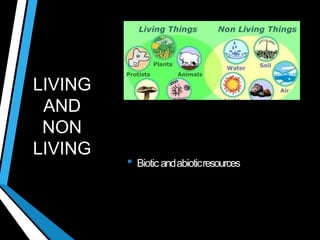
OnthebasisofOrigin:BioticandAbiotic
On the basis of Exhaustibility:
Renewable and Non-Renewable
On the basis of Distribution :
Localised and Ubiquitous
On the basis of Status of
Development: Potential, Developed,
Stock and Reserves
On the basic of
origin -biotic
and abiotic
resources
LIVING
AND
NON
LIVING
• Biotic andabioticresources
RENEWABLE
AND
NONRENEWAB
LE
RESOURCES.
OWNE
R
SHIP
Individual Resources: These are also owned privately by
individuals. Many farmers own land which is allotted to them
by government against the payment of revenue. In villages
there are people with land ownership but there are many who
are landless. Urban people own plots, houses and other
property
Community Owned Resources: There are resources which
are accessible to all the members of the community. Village
commons (grazing grounds, burial grounds, village ponds,
etc.) public parks, picnic spots
National Resources: Technically, all the resources belong
to the nation. The country has legal powers to acquire
even private property for public good.
International Resources: There are international institutions
which regulate some resources. The oceanic resources
beyond 200 km of the Exclusive Economic Zone belong to
open ocean and no individual country can utilise these
without the concurrence of international institutions.
On the
basis
of their
distribution
resources
can
be
ubiquitous
or
localised.
• . Resources that are found everywhere
like the air we breathe, are ubiquitous.
But those which are found only in
certain places are localised, like copper
and iron ore
Human
Resourc
es
•Peoplecanmakethebestuseofnaturetocreate
moreresourceswhentheyhavetheknowledge,
skillandthetechnologytodoso.
•That is why human beings are a special
resource.
•People are human resources.
•Education and health help in making people a
valuable resource. Improving the quality of
people’s skills so that they are able to create
more resources is known as human resource
development
Conserving
resources:
Howtoconserveresources?
By
doing
followin
g
practice
s
Sustainabledevelopment
Resourceplanning
Creatingawareness
By using 4 R: Reuse,
Reduce, Recycle,
Refuse.
Following the principles
of Sustainable
Development.
Resourc
e
Plannin
g
• Planning is widely accepted strategy for judicious
use of resources.
WHY DO WE NEED RESOURCE PLANNING?
• IMPORTANCE OF RESOURCE PLAINNING-
• It has importance in a country like India , which
has enormous diversity in the availability of
resources.
• There are some regions which can be considered
self sufficient in terms of the availability of
resources and there are some regions which
have acute shortage of some resources. For
example Jharkhand ,Chhattisgarh rich in coal,
Rajasthan rich in solar energy.
• We have to save for future generation and to
avoid wastage of resources.
• To reduce regional and personal disparity.
• To control global ecological crises- global
warming, depletion of ozone layer.
HOW RESOURCE
PLANNING IS DONE
IN INDIA.
Resource planning is a complex
process which involves :
(i)identification and inventory of
resources across the regions of the
country. This involves surveying,
mapping and qualitative and
quantitative estimation and
measurement of the resources.
(ii)Evolving a planning structure
endowed with appropriate technology,
skill and institutional set up for
implementing resource development
plans
. (iii) Matching the resource
development plans with overall
national development plans.

Class VIII - Geog.ppt resources and development

  • 2.
    RESOURCE S • Everything availablein our environment which can be used to satisfy our needs
  • 3.
    What all in this presentation . Typesof Resources- natural and man made Classification of resources in, on the basis of origin, stock, distribution, development Conserving Resources& Sustainable development.
  • 5.
    Classificatio n of Resources OnthebasisofOrigin:BioticandAbiotic On thebasis of Exhaustibility: Renewable and Non-Renewable On the basis of Distribution : Localised and Ubiquitous On the basis of Status of Development: Potential, Developed, Stock and Reserves
  • 6.
    On the basicof origin -biotic and abiotic resources
  • 7.
  • 8.
  • 9.
    OWNE R SHIP Individual Resources: Theseare also owned privately by individuals. Many farmers own land which is allotted to them by government against the payment of revenue. In villages there are people with land ownership but there are many who are landless. Urban people own plots, houses and other property Community Owned Resources: There are resources which are accessible to all the members of the community. Village commons (grazing grounds, burial grounds, village ponds, etc.) public parks, picnic spots National Resources: Technically, all the resources belong to the nation. The country has legal powers to acquire even private property for public good. International Resources: There are international institutions which regulate some resources. The oceanic resources beyond 200 km of the Exclusive Economic Zone belong to open ocean and no individual country can utilise these without the concurrence of international institutions.
  • 12.
    On the basis of their distribution resources can be ubiquitous or localised. •. Resources that are found everywhere like the air we breathe, are ubiquitous. But those which are found only in certain places are localised, like copper and iron ore
  • 13.
    Human Resourc es •Peoplecanmakethebestuseofnaturetocreate moreresourceswhentheyhavetheknowledge, skillandthetechnologytodoso. •That is whyhuman beings are a special resource. •People are human resources. •Education and health help in making people a valuable resource. Improving the quality of people’s skills so that they are able to create more resources is known as human resource development
  • 14.
  • 15.
    By doing followin g practice s Sustainabledevelopment Resourceplanning Creatingawareness By using 4R: Reuse, Reduce, Recycle, Refuse. Following the principles of Sustainable Development.
  • 16.
    Resourc e Plannin g • Planning iswidely accepted strategy for judicious use of resources. WHY DO WE NEED RESOURCE PLANNING? • IMPORTANCE OF RESOURCE PLAINNING- • It has importance in a country like India , which has enormous diversity in the availability of resources. • There are some regions which can be considered self sufficient in terms of the availability of resources and there are some regions which have acute shortage of some resources. For example Jharkhand ,Chhattisgarh rich in coal, Rajasthan rich in solar energy. • We have to save for future generation and to avoid wastage of resources. • To reduce regional and personal disparity. • To control global ecological crises- global warming, depletion of ozone layer.
  • 17.
    HOW RESOURCE PLANNING ISDONE IN INDIA. Resource planning is a complex process which involves : (i)identification and inventory of resources across the regions of the country. This involves surveying, mapping and qualitative and quantitative estimation and measurement of the resources. (ii)Evolving a planning structure endowed with appropriate technology, skill and institutional set up for implementing resource development plans . (iii) Matching the resource development plans with overall national development plans.