By:Asst. Prof.Manoj Kumar Behera
ASTHA School of Managenment,
Bhubaneswar
Module I
Corporate Strategy
What is Strategy?
 Strategy:It is the determination of the long term
goals and objectives of an enterprise and the
adoption of the course of action and the allocation
of resources necessary for carrying out these
goals.
 Strategy isn’t the mission-it is the plan that allows
the company to accomplish the mission.
 Strategy is management’s game plan for
strengthening the organization's position pleasing
customize and achieving performance target.
 Strategic Management:-It is defined as the art
and science of formulation, implementing and
evaluating decision the enable the organisation to
achieve its objectives.
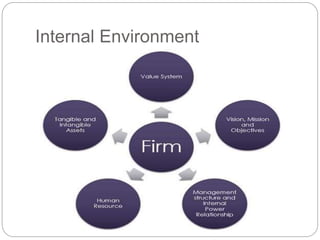
Internal Environment
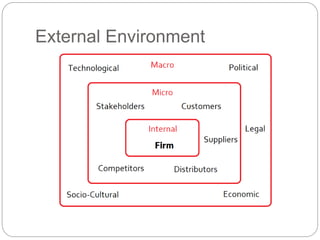
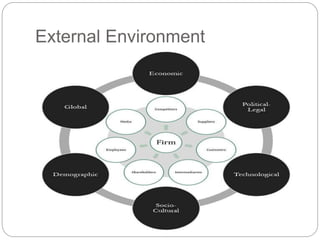
External Environment
 Internal Environment pinpoints in-house factors of
the firm, which are often constitutional in nature.
 On the flip side, External environment is
composed of those factors which are exterior to
the firm.
 Business refers to the collective effort of the firm
in making money by buying and selling
merchandise. We all are aware of the fact that
every business operates in an environment called
Business Environment.
Comparison Between Internal
Environment vs External
Environment
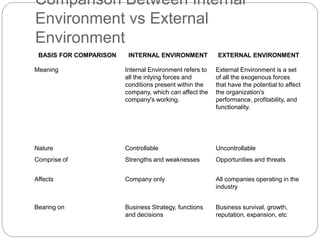
BASIS FOR COMPARISON INTERNAL ENVIRONMENT EXTERNAL ENVIRONMENT
Meaning Internal Environment refers to
all the inlying forces and
conditions present within the
company, which can affect the
company's working.
External Environment is a set
of all the exogenous forces
that have the potential to affect
the organization's
performance, profitability, and
functionality.
Nature Controllable Uncontrollable
Comprise of Strengths and weaknesses Opportunities and threats
Affects Company only All companies operating in the
industry
Bearing on Business Strategy, functions
and decisions
Business survival, growth,
reputation, expansion, etc
Strategic Advantage Profile
(SAP)
 Every firm has strategic advantages and disadvantages.
For example, large firms have financial strength but they
tend to move slowly, compared to smaller firms, and
often cannot react to changes quickly. No firm is equally
strong in all its functions. In other words, every firm has
strengths as well as weaknesses.
 Strategists must be aware of the strategic advantages or
strengths of the firm to be able to choose the best
opportunity for the firm. On the other hand they must
regularly analyse their strategic disadvantages or
weaknesses in order to face environmental threats
effectively.
 Examples:
 The Strategist should look to see if the firm is
stronger in these factors than its competitors.
When a firm is strong in the market, it has a
strategic advantage in launching new products or
services and increasing market share of present
products and services.
Environmental Threat and
Opportunity Profile (ЕТОР)
 What is ETOP analysis?
 ETOP analysis (environmental threat and
opportunity profile) is the process by which
organizations monitor their relevant environment
to identify opportunities and threats affecting their
business for the purpose of taking strategic
decisions.
Why ETOP is needed?
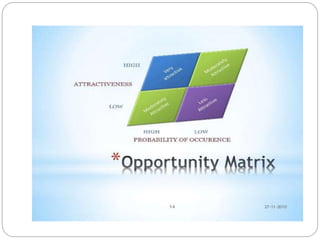
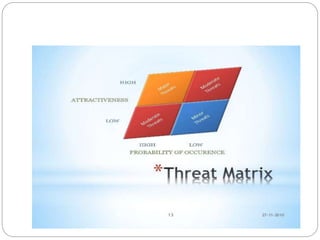
 Helps organization to identify opportunities and
threats .
 To consolidate and strengthen organizations
position.
 Provides the strategists of which sectors have a
favorable impact on the organization.
 Help organization know where it stands with
respect to its environment.
 Helps in formulating appropriate strategy.
 Helps in formulating SWOT analysis. (Strategic
weakness, opportunities and threats)
How to prepare an ETOP?
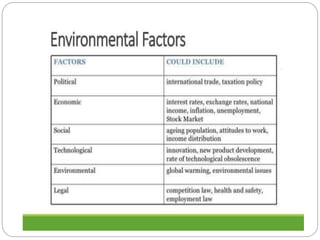
 Dividing the environment into different sectors
such as economical, market, social, international,
legal, technological, political, ecological, etc.
 Analyzing the impact of each sector on the
organization. Sub-dividing each environmental
sector into sub factors .
 Impact of each sub-sector on organization in form
of a statement.
What is SWOC Analysis?
 SWOC analysis is a strategic planning method
used to research external and internal factors
which affect company success and growth. Firms
use SWOC analysis to determine the strengths,
weaknesses, opportunities, and challenges of
their firm, products, and competition.
 SWOC analysis is relevant to SWOT analysis.
SWOT examines strengths, weaknesses, and
opportunities. But it focuses on threats rather
than challenges.
 The two are similar but they do have their
differences, which is why firms may choose to
use SWOC or SWOT.
Conceptual framework for strategic
management
 The strategic management framework provides a
detailed overview of the strategy process adopted
by many organizations.
 This framework separates the strategy process
into three high level activities: defining vision and
mission, formulating strategy and implementing
strategy.
 Stage 1: Vision and Purpose (or Mission)
 The first activity that needs to be completed when
following the Strategic Management Framework
is the creation of an organizational vision and
mission.
 The organization’s vision and mission then go on
to be a constant point of reference throughout the
remainder of the organization’s strategy process.
 Stage 2: Strategy Formulation
 The second stage of this framework takes an
organization through the process of formulating a
strategy. This is done in several sub-stages.
 Analysis
 The first part of strategy formulation is analysis of
the current state. It’s impossible to decide on and
create a strategy if you don’t understand the lay
of the land, so analyzing a wide range of factors
is the first stage of the strategic process.
 Strategy Formation
 Once an organization understands the current
state and has a detailed analysis of their
environment, their industry and themselves, they
can start to look forward and consider the
opportunities and threats that they may face.
 Goal Setting
 The last part of the strategy formulation stage of
the Strategic Management Framework is to
create goals and targets relating to the
organizations defined strategy. It’s great to know
what you’re going to do at a high level, but for
your strategy to be useful it needs to include
specific detail to manage towards.
 Stage 3: Implementing your strategy
 The third stage of this framework focuses on the
implementation of strategy.
 Thank You

Class 1, 2, 3 Module I Corporate Strategy.pptx

  • 1.
    By:Asst. Prof.Manoj KumarBehera ASTHA School of Managenment, Bhubaneswar Module I Corporate Strategy
  • 2.
  • 3.
     Strategy:It isthe determination of the long term goals and objectives of an enterprise and the adoption of the course of action and the allocation of resources necessary for carrying out these goals.  Strategy isn’t the mission-it is the plan that allows the company to accomplish the mission.
  • 4.
     Strategy ismanagement’s game plan for strengthening the organization's position pleasing customize and achieving performance target.
  • 5.
     Strategic Management:-Itis defined as the art and science of formulation, implementing and evaluating decision the enable the organisation to achieve its objectives.
  • 6.
  • 7.
  • 8.
  • 9.
     Internal Environmentpinpoints in-house factors of the firm, which are often constitutional in nature.  On the flip side, External environment is composed of those factors which are exterior to the firm.  Business refers to the collective effort of the firm in making money by buying and selling merchandise. We all are aware of the fact that every business operates in an environment called Business Environment.
  • 10.
    Comparison Between Internal Environmentvs External Environment BASIS FOR COMPARISON INTERNAL ENVIRONMENT EXTERNAL ENVIRONMENT Meaning Internal Environment refers to all the inlying forces and conditions present within the company, which can affect the company's working. External Environment is a set of all the exogenous forces that have the potential to affect the organization's performance, profitability, and functionality. Nature Controllable Uncontrollable Comprise of Strengths and weaknesses Opportunities and threats Affects Company only All companies operating in the industry Bearing on Business Strategy, functions and decisions Business survival, growth, reputation, expansion, etc
  • 11.
    Strategic Advantage Profile (SAP) Every firm has strategic advantages and disadvantages. For example, large firms have financial strength but they tend to move slowly, compared to smaller firms, and often cannot react to changes quickly. No firm is equally strong in all its functions. In other words, every firm has strengths as well as weaknesses.  Strategists must be aware of the strategic advantages or strengths of the firm to be able to choose the best opportunity for the firm. On the other hand they must regularly analyse their strategic disadvantages or weaknesses in order to face environmental threats effectively.
  • 12.
     Examples:  TheStrategist should look to see if the firm is stronger in these factors than its competitors. When a firm is strong in the market, it has a strategic advantage in launching new products or services and increasing market share of present products and services.
  • 17.
    Environmental Threat and OpportunityProfile (ЕТОР)  What is ETOP analysis?  ETOP analysis (environmental threat and opportunity profile) is the process by which organizations monitor their relevant environment to identify opportunities and threats affecting their business for the purpose of taking strategic decisions.
  • 18.
    Why ETOP isneeded?  Helps organization to identify opportunities and threats .  To consolidate and strengthen organizations position.  Provides the strategists of which sectors have a favorable impact on the organization.  Help organization know where it stands with respect to its environment.  Helps in formulating appropriate strategy.  Helps in formulating SWOT analysis. (Strategic weakness, opportunities and threats)
  • 19.
    How to preparean ETOP?  Dividing the environment into different sectors such as economical, market, social, international, legal, technological, political, ecological, etc.  Analyzing the impact of each sector on the organization. Sub-dividing each environmental sector into sub factors .  Impact of each sub-sector on organization in form of a statement.
  • 23.
    What is SWOCAnalysis?  SWOC analysis is a strategic planning method used to research external and internal factors which affect company success and growth. Firms use SWOC analysis to determine the strengths, weaknesses, opportunities, and challenges of their firm, products, and competition.
  • 24.
     SWOC analysisis relevant to SWOT analysis. SWOT examines strengths, weaknesses, and opportunities. But it focuses on threats rather than challenges.  The two are similar but they do have their differences, which is why firms may choose to use SWOC or SWOT.
  • 25.
    Conceptual framework forstrategic management  The strategic management framework provides a detailed overview of the strategy process adopted by many organizations.  This framework separates the strategy process into three high level activities: defining vision and mission, formulating strategy and implementing strategy.
  • 26.
     Stage 1:Vision and Purpose (or Mission)  The first activity that needs to be completed when following the Strategic Management Framework is the creation of an organizational vision and mission.  The organization’s vision and mission then go on to be a constant point of reference throughout the remainder of the organization’s strategy process.
  • 27.
     Stage 2:Strategy Formulation  The second stage of this framework takes an organization through the process of formulating a strategy. This is done in several sub-stages.
  • 28.
     Analysis  Thefirst part of strategy formulation is analysis of the current state. It’s impossible to decide on and create a strategy if you don’t understand the lay of the land, so analyzing a wide range of factors is the first stage of the strategic process.
  • 29.
     Strategy Formation Once an organization understands the current state and has a detailed analysis of their environment, their industry and themselves, they can start to look forward and consider the opportunities and threats that they may face.
  • 30.
     Goal Setting The last part of the strategy formulation stage of the Strategic Management Framework is to create goals and targets relating to the organizations defined strategy. It’s great to know what you’re going to do at a high level, but for your strategy to be useful it needs to include specific detail to manage towards.
  • 31.
     Stage 3:Implementing your strategy  The third stage of this framework focuses on the implementation of strategy.
  • 32.