1
Clarinet
Introduction

2
Clarinet
How to use
it

3
Clarinet
Decoration

4
Clarinet
History

5
Clarinet
Ancient
Clarinet

6
Clarinet
Modern
Clarinet
CLARINET
By: Steve
Table of Contents
i.
ii.
iii.
iv.
v.
vi.

Clarinet – Introduction
Clarinet – How to use it
Clarinet - Decorations
Clarinet – History
Modern Clarinet
Ancient Clarinet
Clarinet - Introduction
•Clarinet is a wood wind instrument, which
has a single-reed mouthpiece. Clarinet was
invented by Johann Gottfried Walther in
1732 from Germany. He said that “The
reason for the name was that it sounded
from far off not unlike a trumpet.” So, he
name the instrument „Clarinet‟ because
trumpet is clarino in Italian and clarinette in
French.
Exit
Clarinet – How to use it.
•Clarinet is a woodwind instrument. Reed is an
essential part in Clarinet because it generates
Clarinet‟s clear and deep sound. The
instrument can play 40 different notes in
standard range with 21 different metal keys and
rings that can be pressed down. For many
notes on the clarinet, you need to cover several
holes at the same time, unlikely piano or guitar.
Exit
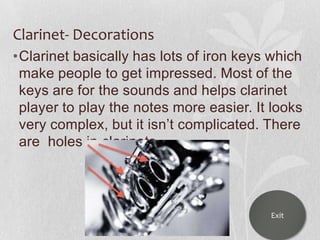
Clarinet- Decorations
•Clarinet basically has lots of iron keys which
make people to get impressed. Most of the
keys are for the sounds and helps clarinet
player to play the notes more easier. It looks
very complex, but it isn‟t complicated. There
are holes in clarinets

Exit
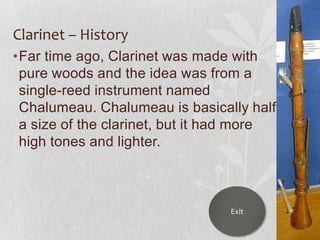
Clarinet – History
•Far time ago, Clarinet was made with
pure woods and the idea was from a
single-reed instrument named
Chalumeau. Chalumeau is basically half
a size of the clarinet, but it had more
high tones and lighter.

Exit
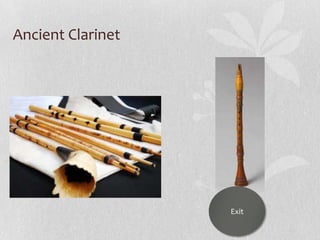
Ancient Clarinet

Exit
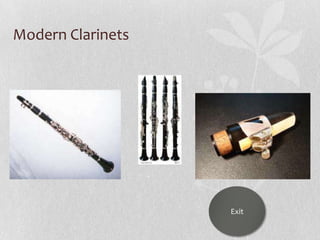
Modern Clarinets

Exit
Bibilography
• Works Cited
• Clarinet. Wikipedia, 20 Jan. 2014. Web. 20 Jan. 2014.
<http://en.wikipedia.org/wiki/Clarinet>.
• Lomin, Thomas. "What did Ancient Music Sound Like?" The
Getty iris. Thomas Lomin, 18 July 2012. Web. 27 Jan. 2014.
<http://blogs.getty.edu/iris/what-did-ancient-music-sound-like/>.
• Wherley, Tegan. "Clarinet." Treble Clef. Tegan Wherley, n.d.
Web. 27 Jan. 2014. <http://trebletee.weebly.com/clarinet.html>.
• "Clarinet in D [Germany]" (2010.185) In Heilbrunn Timeline of
Art History . New York: The Metropolitan Museum of Art, 2000–.
http://www.metmuseum.org/toah/works-of-art/2010.185.
(February 2011)
Exit

Clarinet

  • 1.
  • 2.
  • 3.
    Table of Contents i. ii. iii. iv. v. vi. Clarinet– Introduction Clarinet – How to use it Clarinet - Decorations Clarinet – History Modern Clarinet Ancient Clarinet
  • 4.
    Clarinet - Introduction •Clarinetis a wood wind instrument, which has a single-reed mouthpiece. Clarinet was invented by Johann Gottfried Walther in 1732 from Germany. He said that “The reason for the name was that it sounded from far off not unlike a trumpet.” So, he name the instrument „Clarinet‟ because trumpet is clarino in Italian and clarinette in French. Exit
  • 5.
    Clarinet – Howto use it. •Clarinet is a woodwind instrument. Reed is an essential part in Clarinet because it generates Clarinet‟s clear and deep sound. The instrument can play 40 different notes in standard range with 21 different metal keys and rings that can be pressed down. For many notes on the clarinet, you need to cover several holes at the same time, unlikely piano or guitar. Exit
  • 6.
    Clarinet- Decorations •Clarinet basicallyhas lots of iron keys which make people to get impressed. Most of the keys are for the sounds and helps clarinet player to play the notes more easier. It looks very complex, but it isn‟t complicated. There are holes in clarinets Exit
  • 7.
    Clarinet – History •Fartime ago, Clarinet was made with pure woods and the idea was from a single-reed instrument named Chalumeau. Chalumeau is basically half a size of the clarinet, but it had more high tones and lighter. Exit
  • 8.
  • 9.
  • 10.
    Bibilography • Works Cited •Clarinet. Wikipedia, 20 Jan. 2014. Web. 20 Jan. 2014. <http://en.wikipedia.org/wiki/Clarinet>. • Lomin, Thomas. "What did Ancient Music Sound Like?" The Getty iris. Thomas Lomin, 18 July 2012. Web. 27 Jan. 2014. <http://blogs.getty.edu/iris/what-did-ancient-music-sound-like/>. • Wherley, Tegan. "Clarinet." Treble Clef. Tegan Wherley, n.d. Web. 27 Jan. 2014. <http://trebletee.weebly.com/clarinet.html>. • "Clarinet in D [Germany]" (2010.185) In Heilbrunn Timeline of Art History . New York: The Metropolitan Museum of Art, 2000–. http://www.metmuseum.org/toah/works-of-art/2010.185. (February 2011) Exit