DEFINITION :-
1) CKD :- Chronic kidney disease is progressive loss in
kidney function over a period of months or year.
2)MALARIA:- an intermittent and remittent fever
caused by a protozoan parasite which invades the red
blood cells and is transmitted by mosquitoes in many
tropic and subtropics regions.
3)ACUTE GE :- is the sudden onset of diarrhoea and/or
vomiting.
Patient Demographic Data:-
 Name:-XYZ I.P. NO.:- 51160
 Age:-50 years DOA :- 30/11/2017
 Sex:-Male
 Ward name:- MMW Unit D
SUBJECTIVE :-
Chief complaints:-
 A 50 years old male patient was admitted to the male
medicine unit D with
 C/O of swelling of B/L lower limbs since 15 days
C/O of fever with chills and rigor since 6 days
C/O of GBA since 6 days
H/O Vomiting 6 episode since 2 days
H/O diarrhoea 4 episode since 2 days
PAST MEDICAL HISTORY:-
K/C/O CKD since 9 months
PAST MEDICATION HISTORY:-
 Not taking medicine before 4 months
PERSONAL HISTORY :-
 Mixed diet.
 Appetite decreased
 Sleep normal
 B/B regular
FAMILY HISTORY :-
• Nothing significant
OBJECTIVE :-
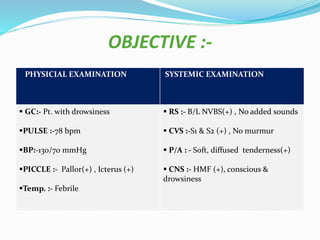
PHYSICIAL EXAMINATION SYSTEMIC EXAMINATION
 GC:- Pt. with drowsiness
PULSE :-78 bpm
BP:-130/70 mmHg
PICCLE :- Pallor(+) , Icterus (+)
Temp. :- Febrile
 RS :- B/L NVBS(+) , No added sounds
 CVS :-S1 & S2 (+) , No murmur
 P/A : - Soft, diffused tenderness(+)
 CNS :- HMF (+), conscious &
drowsiness
ADVICE
 CH
 RBS
 RFT
 LFT
 Serum electrolytes
 PS for MP
 HIV test
LABORATORY INVESTIGATIONS
PARAMETER RESULT REFERENCE RANGE
30/11/2017
RBS 88mg/dl 80-140 mg/dl
HB % 8 gm% 13 – 17gm %
RBC 3.4millions/cumm 4.5-5.5 millions/cumm
TC 14000 cells/cumm 4000 – 1100 cells/cumm
Neutrophil 80% 50-70 %
ESR 45 mm in 1st hour 0-20mm in 1st hour
Urea 70 mg/dl 15-45 mg/dl
S. Creatinine 3.2 mg/dl 0.9 – 1.2 mg/dl
Total bilirubin 2.5 mg/dl 0-1mg/dl
Unconjugated bilirubin 1.7 mg/dl 0.1-0.8 mg/dl
Sodium 132 mmol/l 135-145mmol/l
Other Electrolyte count normal, HIV(-ve), PS for MP (+)
ASSESSMENT :-
 Final diagnosis: Based on subjective and objective evidences the
patient is diagnosed as :-
Treatment at Admission day :-
S.N DRUG ( Generic) DOSE FREQUENCY
1) IVF 2 pint NS @ 75 ml/ hr
2) Inj Ceftriaxone 1 gm 1-1-1
3) Tab . Paracetamol (DOLO 650) 650mg 1-1-1-1
4) Inj. Ranitidine 50 mg 1-0-1
5) Inj. Furosemide 40 mg 1-1-1
6) Tab . Ferrous fumarate 375 mg 1-0-1
7) Tab . Folic acid 5 mg 0-1-1
8) Tab. Sodium bicarbonate 250mg 1-1-1
9) Tab. Metronidazole 500mg 1-1-1
10) Tab. Artesunste 200mg 1-0-1
11) Syp. Lactulose 15 ml 1-0-1
12) Inj. Ondansetron 4mg 1-0-1
 To reduce current signs & symptoms of patients
 To control the Disease & Avoiding patient suffering
 Preventing further complications
 Use of proper drug therapy
 Patient’s understanding regarding drug & disease
along with life style modification.
DAY 2
Physical examination Chief complaints
 BP:110/70mmHg -Headache & Fever
 PR: 82 bpm -2 episode of vomiting
 RS:- No added sounds -3 episode of loose stool
 CVS:- S1 & S2 sound(+),no murmur
 P/A:- Soft, diffused tenderness(+)
Laboratory reports Advice
 RBS :- 86 mg/dl -USG abdomen
 Hb :- 8.2 gm% -CH
 RBC:- 3.6 million/cumm -LFT
 Nutrophile :- 70% -RFT
 ESR:- 44 mm in 1st hrs
 Sodium :- 134mmol/l
 Urea :- 60mg/dl
 S. Cr. :- 3mg/dl
Treatment plan:- APC as 1st day + Tab. Albendazole 500 mg at night
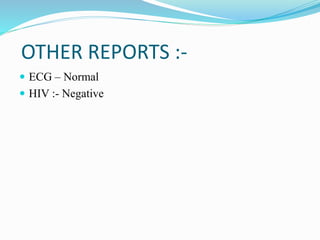
OTHER REPORTS :-
 ECG – Normal
 HIV :- Negative
DAY 3
Physical examination Chief complaints
 BP:120/70mmHg -No new fresh complaints
 PR: 80 bpm
 RS:- No added sounds
 CVS:- S1 & S2 sound(+),no murmur
 P/A:- Soft, non tenderness
 CNS :- Pt. Conscious & oriented
Laboratory reports
 RBS :- 84 mg/dl
 Hb :- 9 gm%
 RBC:- 3.6 million/cumm
 Nutrophile :- 70%
 ESR:- 40 mm/hrs
 Sodium :- 136mmol/l
 Urea :- 40 mg/dl
 S. Cr. :- 2.2 mg/dl
 USG Abdomen:- Mild hepatospleenomegaly & abdominal wall thin
Treatment plan:- APC as 2st day
DAY 4
Physical examination Chief complaints
 BP:110/70mmHg -Fever at evening
 PR: 79 bpm
 RS:- No added sounds
 CVS:- S1 & S2 sound(+),no murmur
 P/A:- Soft, non tenderness
 CNS :- conscious & oriented
Treatment plan:- APC as 3st day ADVICE
-CH
- LFT
-Urine routine
DAY 5
Physical examination Chief complaints
 BP:110/80mmHg -No new fresh complaints
 PR: 88 bpm -Pallor (-) & Icterus (+)
 RS:- No added sounds
 CVS:- S1 & S2 sound(+),no murmur
 P/A:- Soft, non tenderness
Laboratory reports
 Hb :- 10 gm%
 Urea :- 34 mg/dl
 S. Cr. :- 2.0 mg/dl
 Total bilirubin:- 1.4 mg/dl
 Unconjugated:- o.8mg/dl
Treatment plan:- APC as 4st day
DISCHARGE MEDICATIONS
 Tab. Paracetamol 500 mg sos
 Tab. Cefotaxim x 200mg/po x 1-0-1 for 5 days
 Tab. Calcium carbonate x 500 mg/po x 1-0-1
continue
 Tab. Folvite x 5 mg/po x 1-0-0 continue
 Tab. Livogen x 375 mg x 1-0-1 continue
 Tab. Ranitidine x 150 mg x 1-0-1 continue
 Tab. Larinate 200kit x 1-0-0 for 7 days
(Artesunate 200mg + Sulfadoxine 500mg + Pyrimethamine 25mg)
 Syp. Lactulose 1-1-1
About medications
 NS used to prevent dehydration
 Ceftrixone, a 3rd generation antibiotic used to prevent from infection
 Paracetamol used as analgesic and antipyretic
 Ranitidine used to suppress GI acid
 Furosemide used as loop diuretic to treat oedema
 Ferrous fumarate used for iron supplements
 Folvite used as folic acid supplement
 Metronidazol used as anti-protozoal to control diarrhoea
 Lactulose used as hepato-protective
 Artesunate used as anti-malarial
 Ondensetron used as anti-emetic to prevent vomiting
 Cefotaxim used to prevent from infection
INTERVENTIONS
DRUG-DRUG INTERACTIONS :-
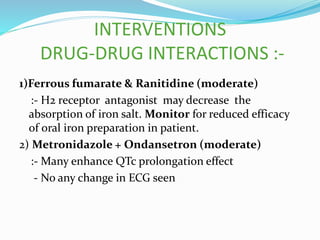
1)Ferrous fumarate & Ranitidine (moderate)
:- H2 receptor antagonist may decrease the
absorption of iron salt. Monitor for reduced efficacy
of oral iron preparation in patient.
2) Metronidazole + Ondansetron (moderate)
:- Many enhance QTc prolongation effect
- No any change in ECG seen
MONITORING PARAMETERS
1. Ceftriaxone:- CBC, LFT, RFT
2. Paractamol :- serum paracetamol high level
1. Ceftriaxone should give only upto 2 gm *max dose
in CKD patient
2. Furosemide should not prescribe at night time
3. Dose of paracetamol should maintain to avoid
hepato-toxicity
4. Prescribing calcium carbonate tablet may be useful
5. Folic acid should use only once a day or change
frequency morning and night
PATIENT COUNSELLING
Non –Pharmacological therapy
COUNSELLING ABOUT DISEASE
1) CKD :- Chronic kidney disease is slow progressive
kidney damage. Which can be controlled by drug
therapy , diet maintain & life style modification.
2) Malaria:- Malaria is caused by mosquito, which can
be treated by using medicine and by preventing
from mosquito biting.
3) Acute GE :- This is acute condition of gastritis.
Which can be curable by using drugs and
maintaining hygiene.
PATIENT COUNSELLING
Non –Pharmacological therapy
About Diet :-
I ) CKD
 Limit protein intake ranging from 0.6 to 0.75 gm/kg body weight /Day
 Avoid low potassium containing food and take low phosphorus
containing food.
 Avoid junks, spicy, preserved and processed food to avoid cholesterol &
fat.
II) Malaria
 Food containing high level of iron like Spinach, beet root
III) Acute GE
 Avoid spicy & oily food and eat nicely boiled food and fresh fruits
PATIENT COUNSELLING
COUNSELLING ABOUT LIFE STYLE MODIFICATION
1)MALARIYA
-Avoid mosquito bite by keeping mosquito net, applying Odom's, cleaning water
drainage and avoid water accumulation to surroundings.
- Try to avoid biting of mosquito at day time .
2) CKD
-Maintain hygiene
-Enough rest and light exercise
- Psychosocial support
ABOUT MEDICATION
- Take medicine in right dose and right time
-If dose missed, don’t take a double dose
CKD WITH MALARIA & ACUTE GE

CKD WITH MALARIA & ACUTE GE

  • 2.
    DEFINITION :- 1) CKD:- Chronic kidney disease is progressive loss in kidney function over a period of months or year. 2)MALARIA:- an intermittent and remittent fever caused by a protozoan parasite which invades the red blood cells and is transmitted by mosquitoes in many tropic and subtropics regions. 3)ACUTE GE :- is the sudden onset of diarrhoea and/or vomiting.
  • 3.
    Patient Demographic Data:- Name:-XYZ I.P. NO.:- 51160  Age:-50 years DOA :- 30/11/2017  Sex:-Male  Ward name:- MMW Unit D
  • 4.
    SUBJECTIVE :- Chief complaints:- A 50 years old male patient was admitted to the male medicine unit D with  C/O of swelling of B/L lower limbs since 15 days C/O of fever with chills and rigor since 6 days C/O of GBA since 6 days H/O Vomiting 6 episode since 2 days H/O diarrhoea 4 episode since 2 days
  • 5.
    PAST MEDICAL HISTORY:- K/C/OCKD since 9 months PAST MEDICATION HISTORY:-  Not taking medicine before 4 months
  • 6.
    PERSONAL HISTORY :- Mixed diet.  Appetite decreased  Sleep normal  B/B regular FAMILY HISTORY :- • Nothing significant
  • 7.
    OBJECTIVE :- PHYSICIAL EXAMINATIONSYSTEMIC EXAMINATION  GC:- Pt. with drowsiness PULSE :-78 bpm BP:-130/70 mmHg PICCLE :- Pallor(+) , Icterus (+) Temp. :- Febrile  RS :- B/L NVBS(+) , No added sounds  CVS :-S1 & S2 (+) , No murmur  P/A : - Soft, diffused tenderness(+)  CNS :- HMF (+), conscious & drowsiness
  • 8.
    ADVICE  CH  RBS RFT  LFT  Serum electrolytes  PS for MP  HIV test
  • 9.
    LABORATORY INVESTIGATIONS PARAMETER RESULTREFERENCE RANGE 30/11/2017 RBS 88mg/dl 80-140 mg/dl HB % 8 gm% 13 – 17gm % RBC 3.4millions/cumm 4.5-5.5 millions/cumm TC 14000 cells/cumm 4000 – 1100 cells/cumm Neutrophil 80% 50-70 % ESR 45 mm in 1st hour 0-20mm in 1st hour Urea 70 mg/dl 15-45 mg/dl S. Creatinine 3.2 mg/dl 0.9 – 1.2 mg/dl Total bilirubin 2.5 mg/dl 0-1mg/dl Unconjugated bilirubin 1.7 mg/dl 0.1-0.8 mg/dl Sodium 132 mmol/l 135-145mmol/l Other Electrolyte count normal, HIV(-ve), PS for MP (+)
  • 10.
    ASSESSMENT :-  Finaldiagnosis: Based on subjective and objective evidences the patient is diagnosed as :-
  • 11.
    Treatment at Admissionday :- S.N DRUG ( Generic) DOSE FREQUENCY 1) IVF 2 pint NS @ 75 ml/ hr 2) Inj Ceftriaxone 1 gm 1-1-1 3) Tab . Paracetamol (DOLO 650) 650mg 1-1-1-1 4) Inj. Ranitidine 50 mg 1-0-1 5) Inj. Furosemide 40 mg 1-1-1 6) Tab . Ferrous fumarate 375 mg 1-0-1 7) Tab . Folic acid 5 mg 0-1-1 8) Tab. Sodium bicarbonate 250mg 1-1-1 9) Tab. Metronidazole 500mg 1-1-1 10) Tab. Artesunste 200mg 1-0-1 11) Syp. Lactulose 15 ml 1-0-1 12) Inj. Ondansetron 4mg 1-0-1
  • 12.
     To reducecurrent signs & symptoms of patients  To control the Disease & Avoiding patient suffering  Preventing further complications  Use of proper drug therapy  Patient’s understanding regarding drug & disease along with life style modification.
  • 13.
    DAY 2 Physical examinationChief complaints  BP:110/70mmHg -Headache & Fever  PR: 82 bpm -2 episode of vomiting  RS:- No added sounds -3 episode of loose stool  CVS:- S1 & S2 sound(+),no murmur  P/A:- Soft, diffused tenderness(+) Laboratory reports Advice  RBS :- 86 mg/dl -USG abdomen  Hb :- 8.2 gm% -CH  RBC:- 3.6 million/cumm -LFT  Nutrophile :- 70% -RFT  ESR:- 44 mm in 1st hrs  Sodium :- 134mmol/l  Urea :- 60mg/dl  S. Cr. :- 3mg/dl Treatment plan:- APC as 1st day + Tab. Albendazole 500 mg at night
  • 14.
    OTHER REPORTS :- ECG – Normal  HIV :- Negative
  • 15.
    DAY 3 Physical examinationChief complaints  BP:120/70mmHg -No new fresh complaints  PR: 80 bpm  RS:- No added sounds  CVS:- S1 & S2 sound(+),no murmur  P/A:- Soft, non tenderness  CNS :- Pt. Conscious & oriented Laboratory reports  RBS :- 84 mg/dl  Hb :- 9 gm%  RBC:- 3.6 million/cumm  Nutrophile :- 70%  ESR:- 40 mm/hrs  Sodium :- 136mmol/l  Urea :- 40 mg/dl  S. Cr. :- 2.2 mg/dl  USG Abdomen:- Mild hepatospleenomegaly & abdominal wall thin Treatment plan:- APC as 2st day
  • 16.
    DAY 4 Physical examinationChief complaints  BP:110/70mmHg -Fever at evening  PR: 79 bpm  RS:- No added sounds  CVS:- S1 & S2 sound(+),no murmur  P/A:- Soft, non tenderness  CNS :- conscious & oriented Treatment plan:- APC as 3st day ADVICE -CH - LFT -Urine routine
  • 17.
    DAY 5 Physical examinationChief complaints  BP:110/80mmHg -No new fresh complaints  PR: 88 bpm -Pallor (-) & Icterus (+)  RS:- No added sounds  CVS:- S1 & S2 sound(+),no murmur  P/A:- Soft, non tenderness Laboratory reports  Hb :- 10 gm%  Urea :- 34 mg/dl  S. Cr. :- 2.0 mg/dl  Total bilirubin:- 1.4 mg/dl  Unconjugated:- o.8mg/dl Treatment plan:- APC as 4st day
  • 18.
    DISCHARGE MEDICATIONS  Tab.Paracetamol 500 mg sos  Tab. Cefotaxim x 200mg/po x 1-0-1 for 5 days  Tab. Calcium carbonate x 500 mg/po x 1-0-1 continue  Tab. Folvite x 5 mg/po x 1-0-0 continue  Tab. Livogen x 375 mg x 1-0-1 continue  Tab. Ranitidine x 150 mg x 1-0-1 continue  Tab. Larinate 200kit x 1-0-0 for 7 days (Artesunate 200mg + Sulfadoxine 500mg + Pyrimethamine 25mg)  Syp. Lactulose 1-1-1
  • 19.
    About medications  NSused to prevent dehydration  Ceftrixone, a 3rd generation antibiotic used to prevent from infection  Paracetamol used as analgesic and antipyretic  Ranitidine used to suppress GI acid  Furosemide used as loop diuretic to treat oedema  Ferrous fumarate used for iron supplements  Folvite used as folic acid supplement  Metronidazol used as anti-protozoal to control diarrhoea  Lactulose used as hepato-protective  Artesunate used as anti-malarial  Ondensetron used as anti-emetic to prevent vomiting  Cefotaxim used to prevent from infection
  • 20.
    INTERVENTIONS DRUG-DRUG INTERACTIONS :- 1)Ferrousfumarate & Ranitidine (moderate) :- H2 receptor antagonist may decrease the absorption of iron salt. Monitor for reduced efficacy of oral iron preparation in patient. 2) Metronidazole + Ondansetron (moderate) :- Many enhance QTc prolongation effect - No any change in ECG seen
  • 21.
    MONITORING PARAMETERS 1. Ceftriaxone:-CBC, LFT, RFT 2. Paractamol :- serum paracetamol high level
  • 22.
    1. Ceftriaxone shouldgive only upto 2 gm *max dose in CKD patient 2. Furosemide should not prescribe at night time 3. Dose of paracetamol should maintain to avoid hepato-toxicity 4. Prescribing calcium carbonate tablet may be useful 5. Folic acid should use only once a day or change frequency morning and night
  • 23.
    PATIENT COUNSELLING Non –Pharmacologicaltherapy COUNSELLING ABOUT DISEASE 1) CKD :- Chronic kidney disease is slow progressive kidney damage. Which can be controlled by drug therapy , diet maintain & life style modification. 2) Malaria:- Malaria is caused by mosquito, which can be treated by using medicine and by preventing from mosquito biting. 3) Acute GE :- This is acute condition of gastritis. Which can be curable by using drugs and maintaining hygiene.
  • 24.
    PATIENT COUNSELLING Non –Pharmacologicaltherapy About Diet :- I ) CKD  Limit protein intake ranging from 0.6 to 0.75 gm/kg body weight /Day  Avoid low potassium containing food and take low phosphorus containing food.  Avoid junks, spicy, preserved and processed food to avoid cholesterol & fat. II) Malaria  Food containing high level of iron like Spinach, beet root III) Acute GE  Avoid spicy & oily food and eat nicely boiled food and fresh fruits
  • 25.
    PATIENT COUNSELLING COUNSELLING ABOUTLIFE STYLE MODIFICATION 1)MALARIYA -Avoid mosquito bite by keeping mosquito net, applying Odom's, cleaning water drainage and avoid water accumulation to surroundings. - Try to avoid biting of mosquito at day time . 2) CKD -Maintain hygiene -Enough rest and light exercise - Psychosocial support ABOUT MEDICATION - Take medicine in right dose and right time -If dose missed, don’t take a double dose