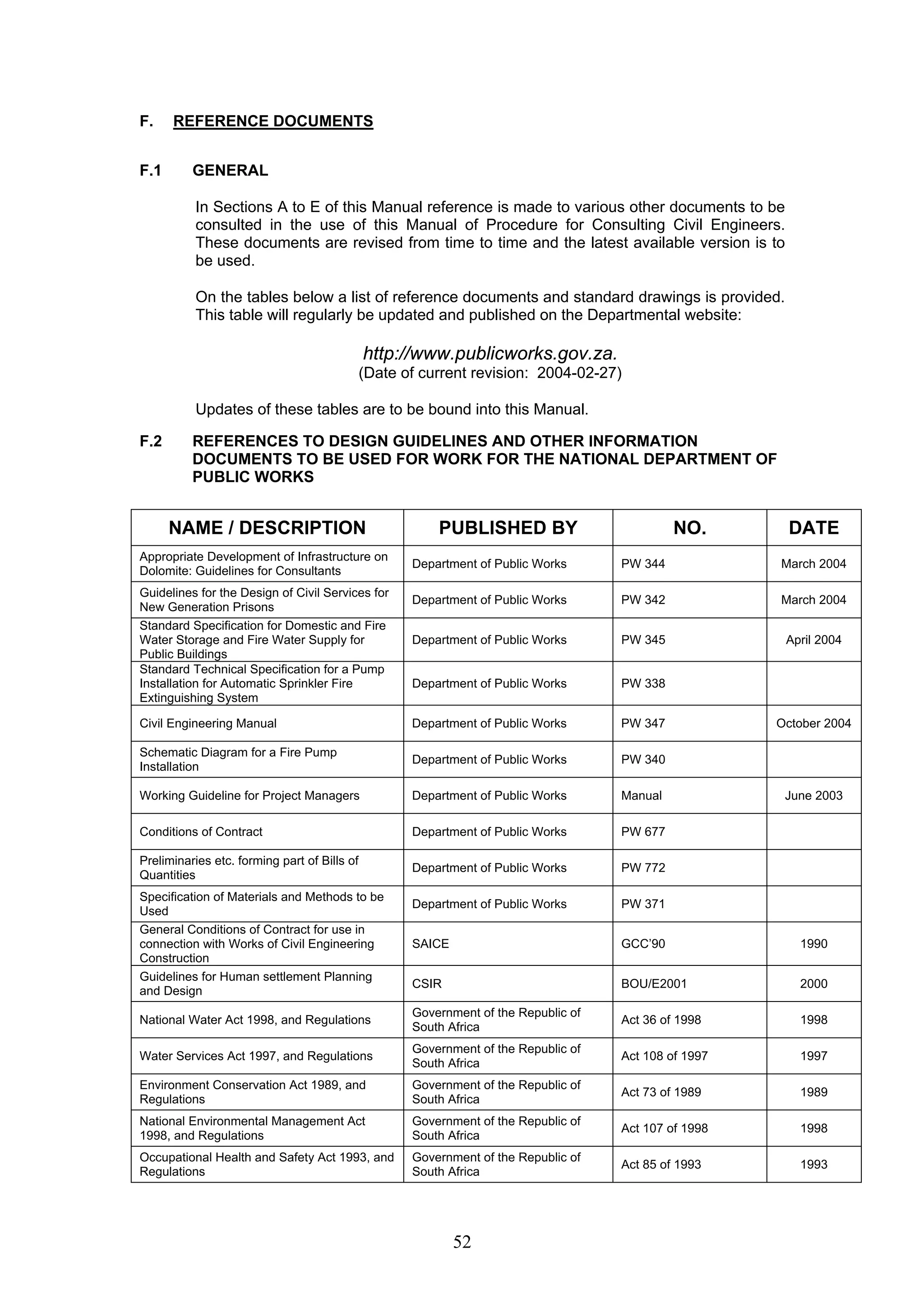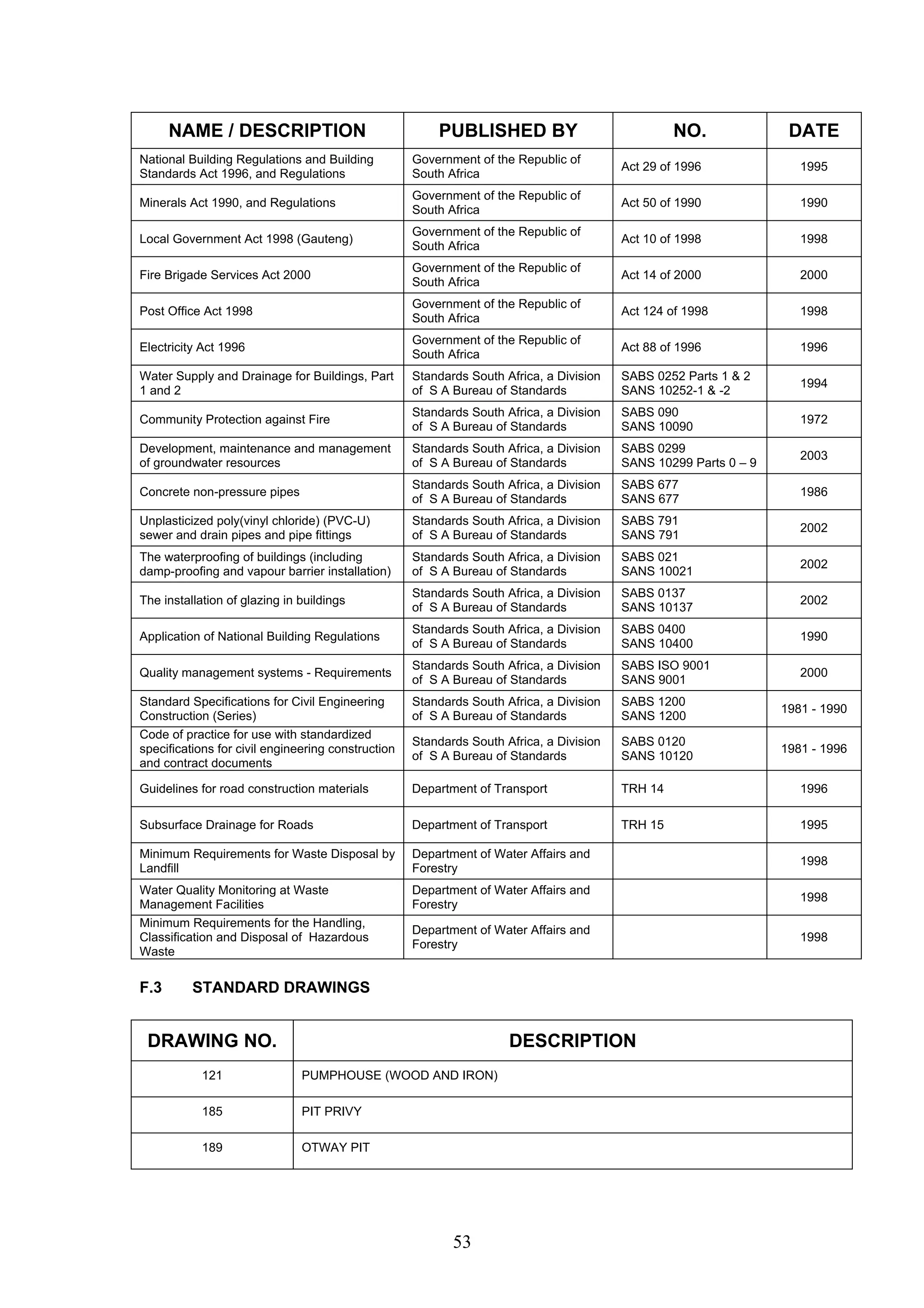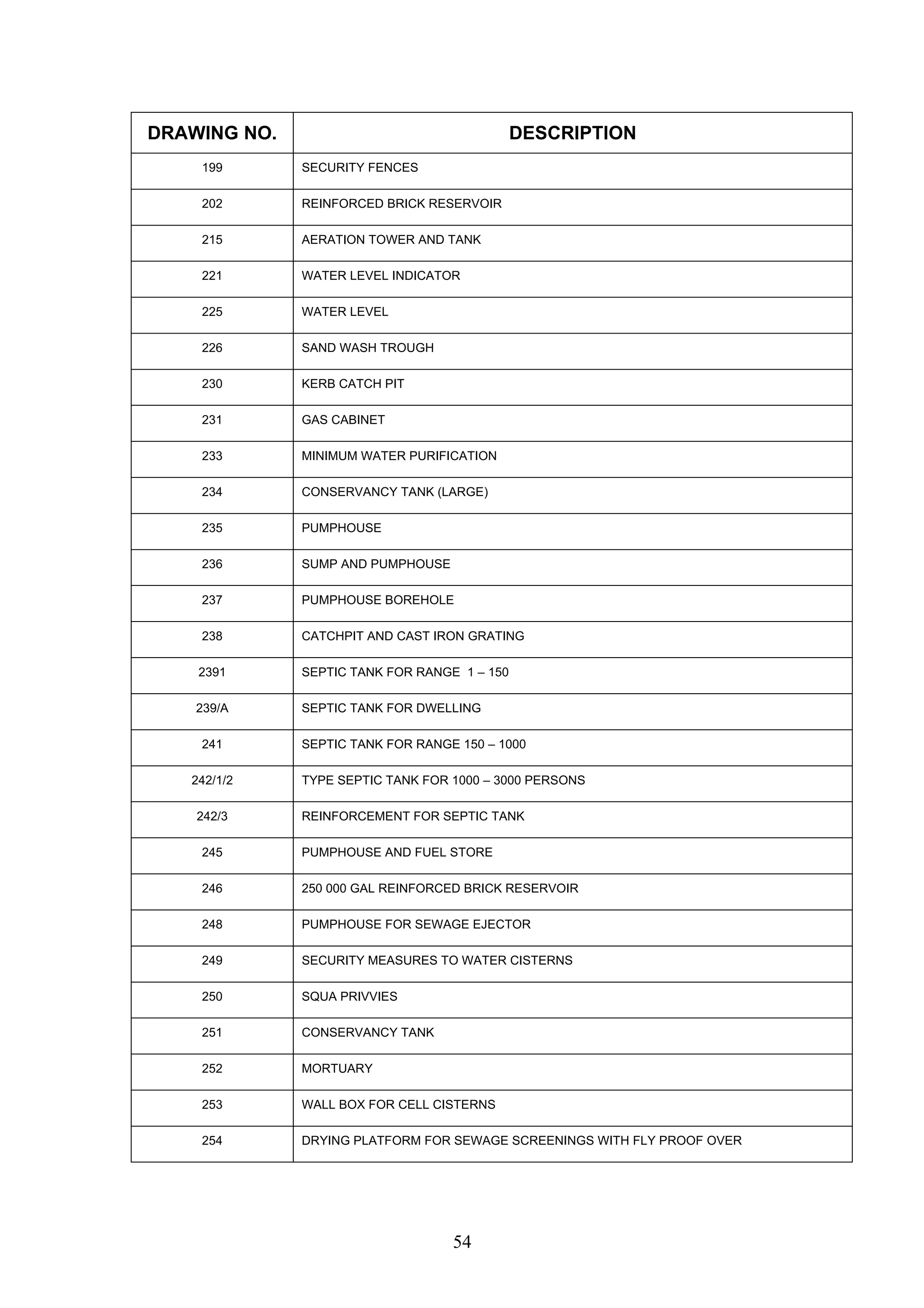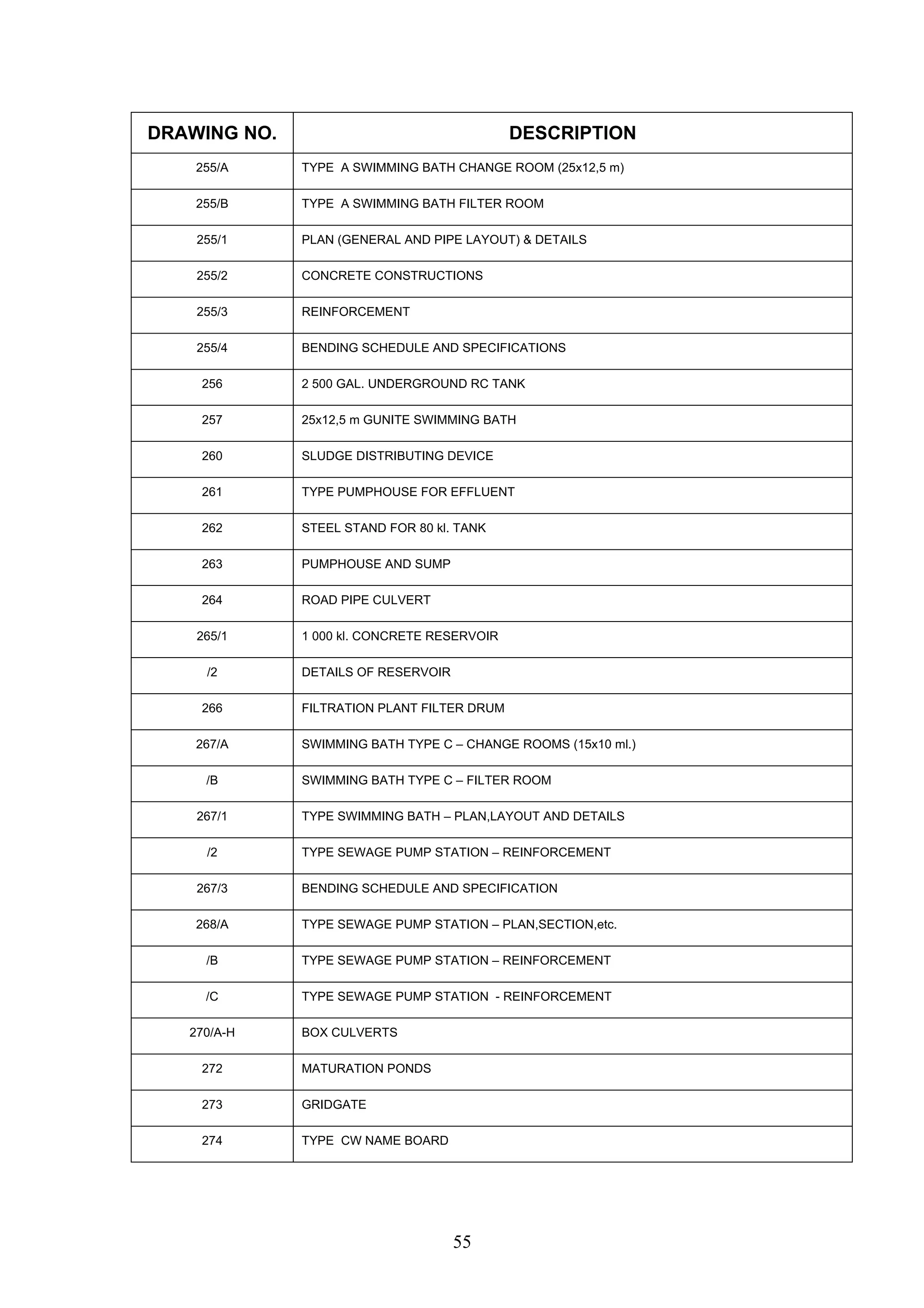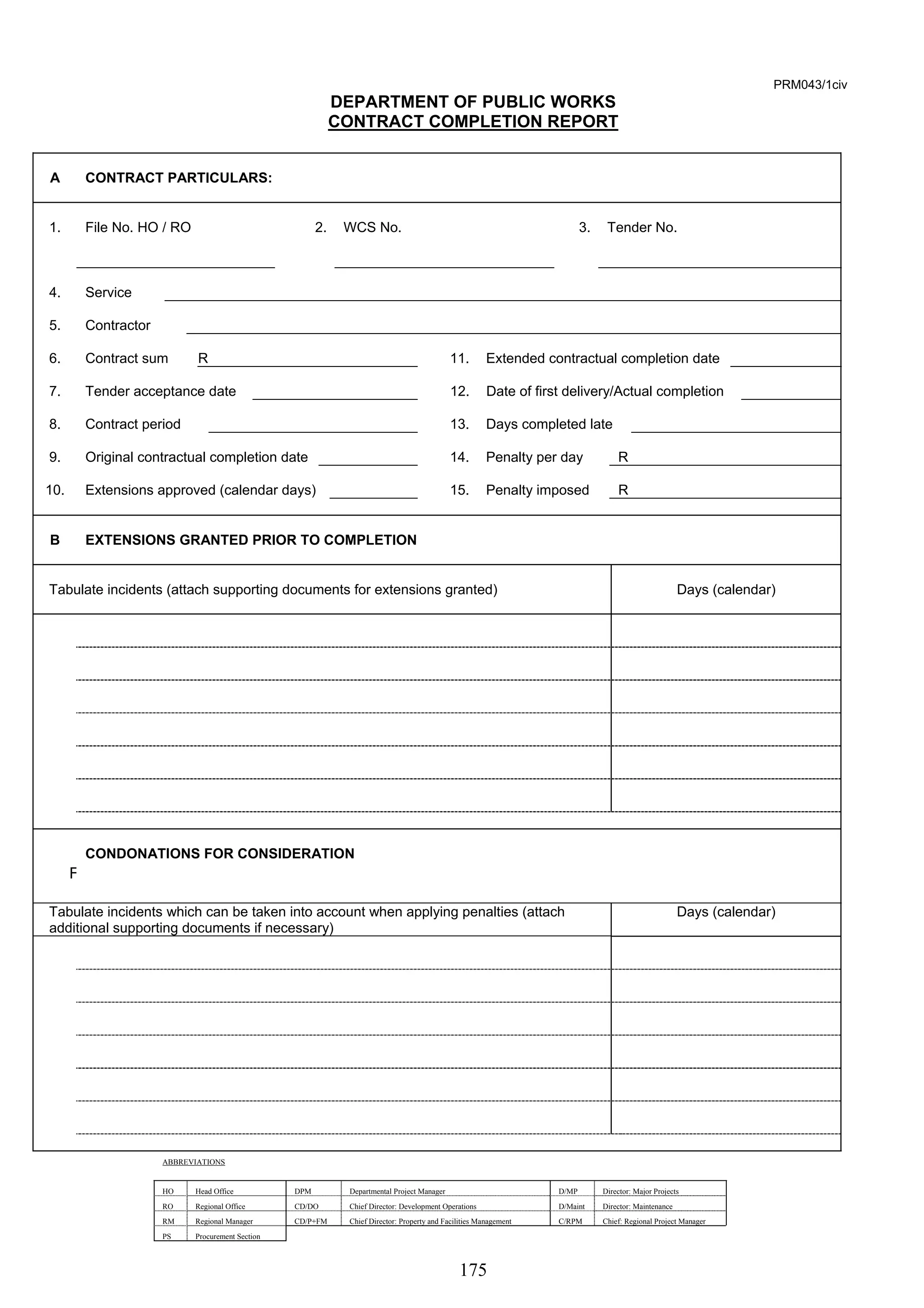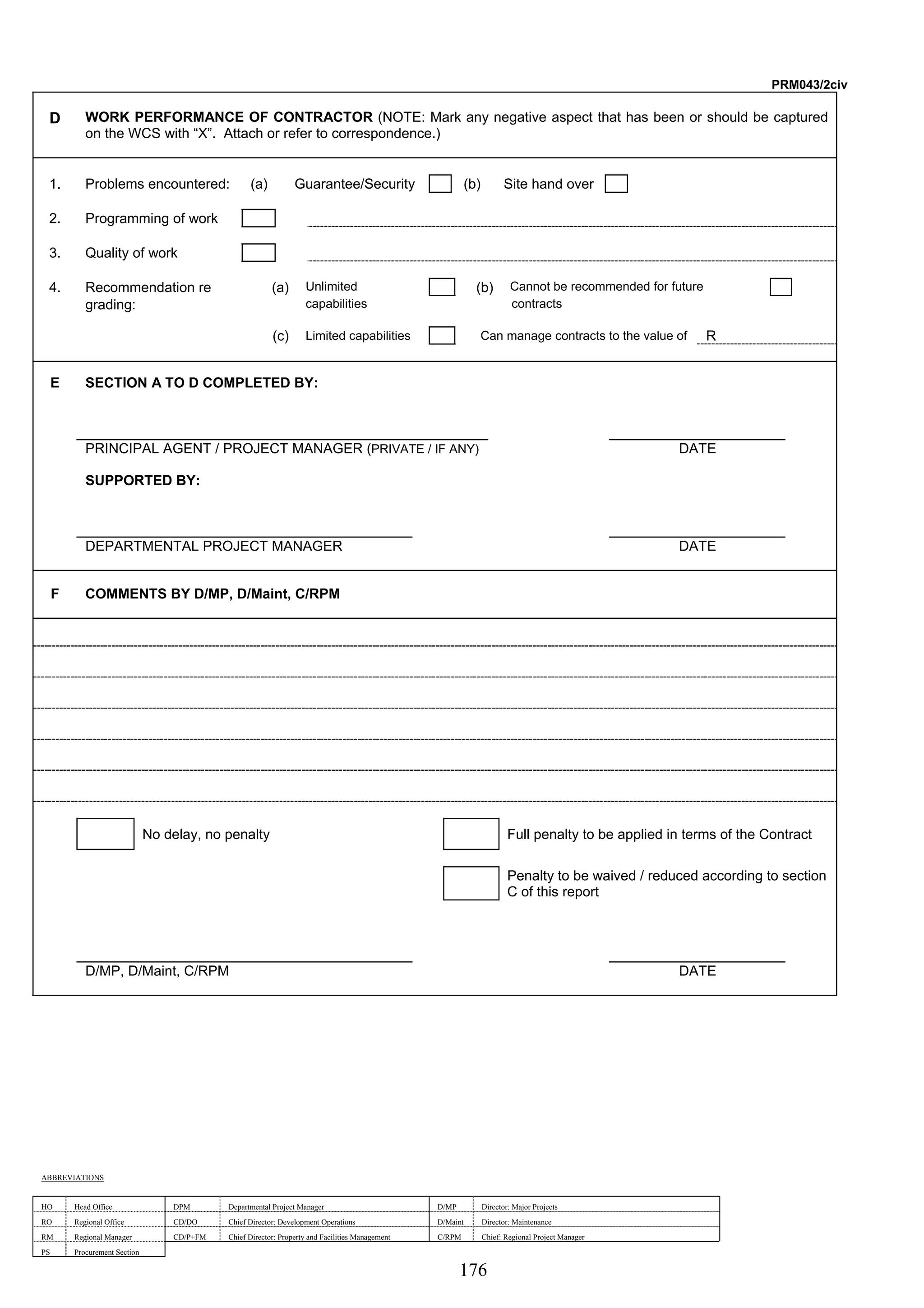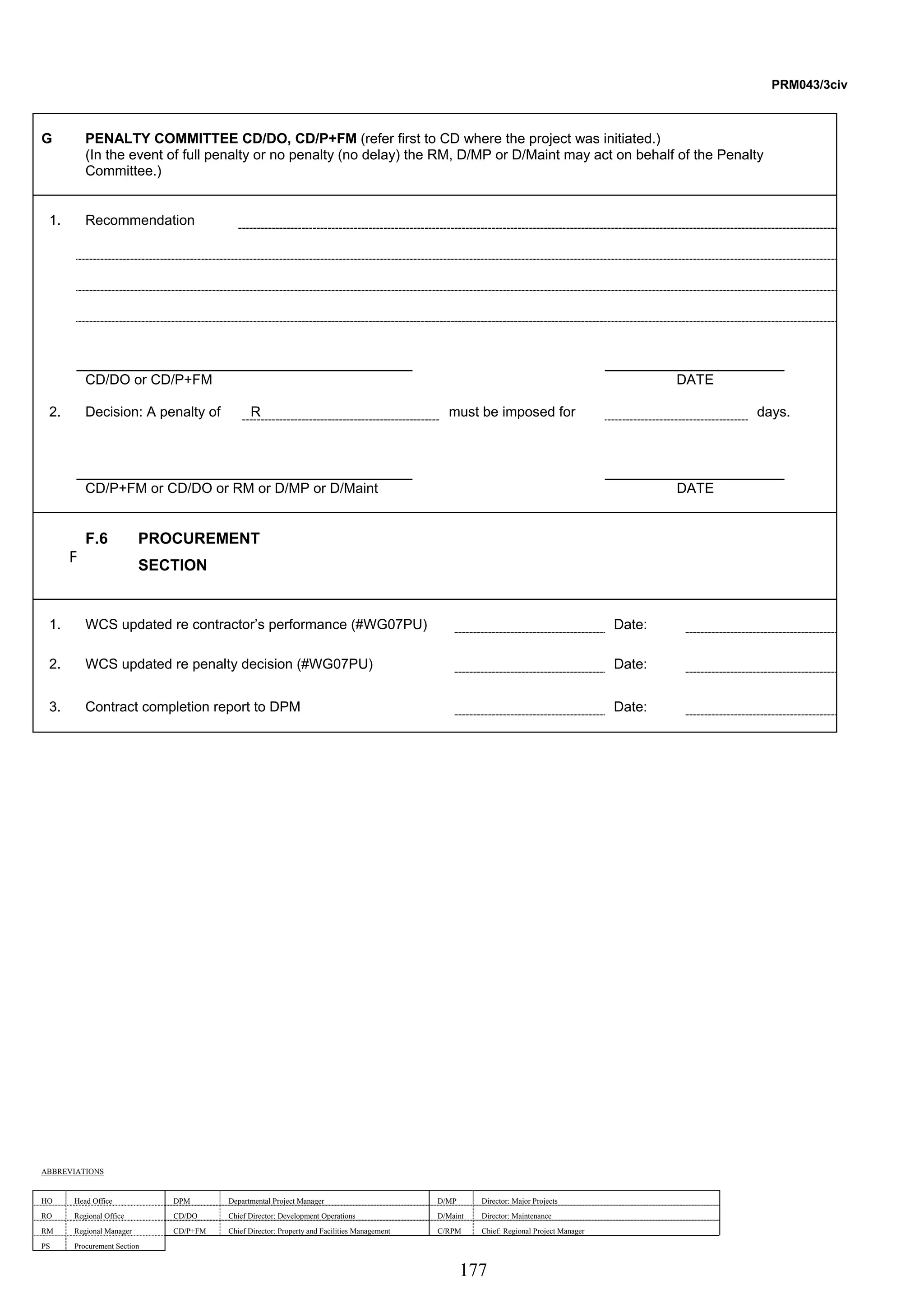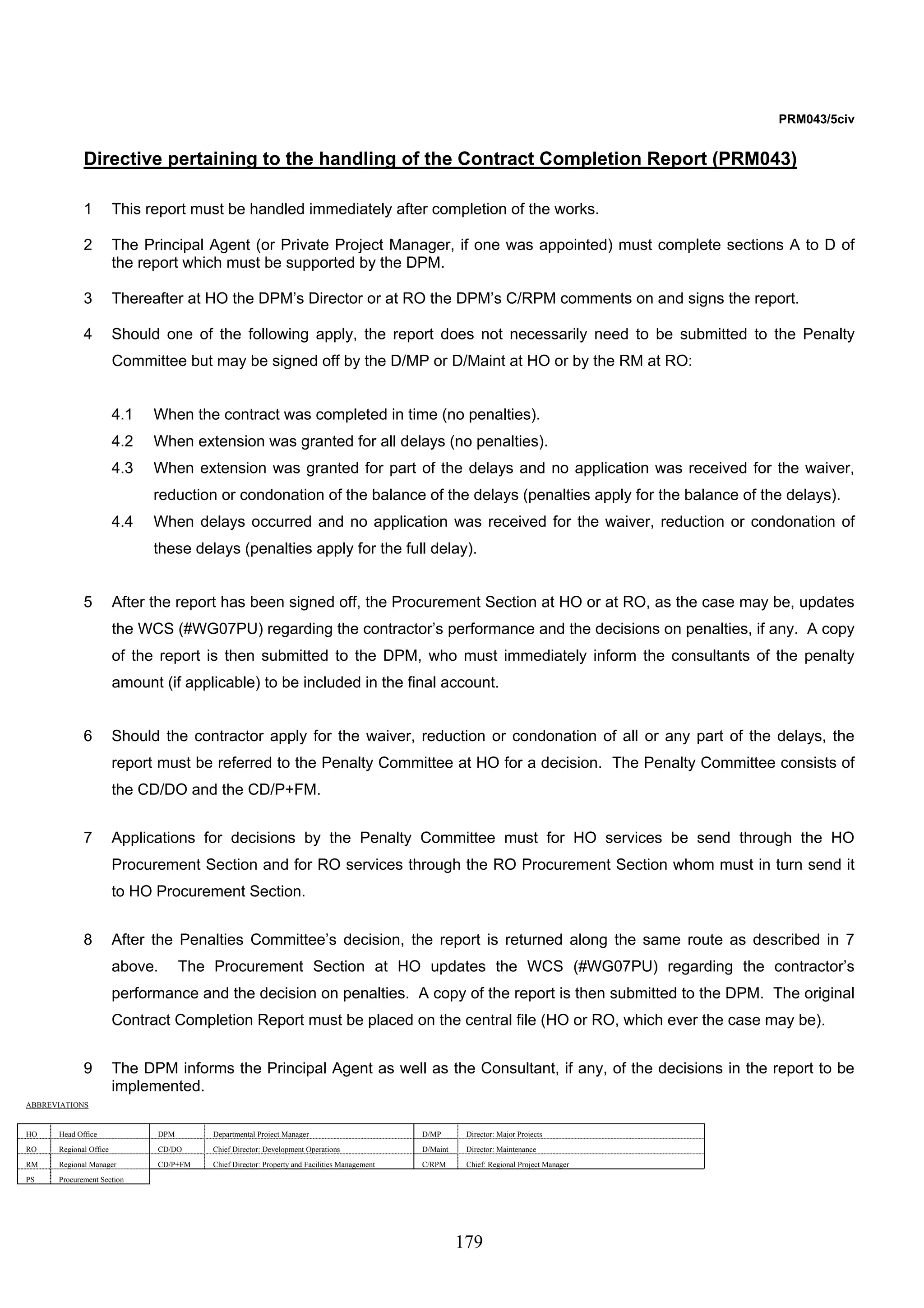
DEPARTMENT OF PUBLIC WORKS 
CIVIL ENGINEERING MANUAL 
OCTOBER 2004 
PW 347
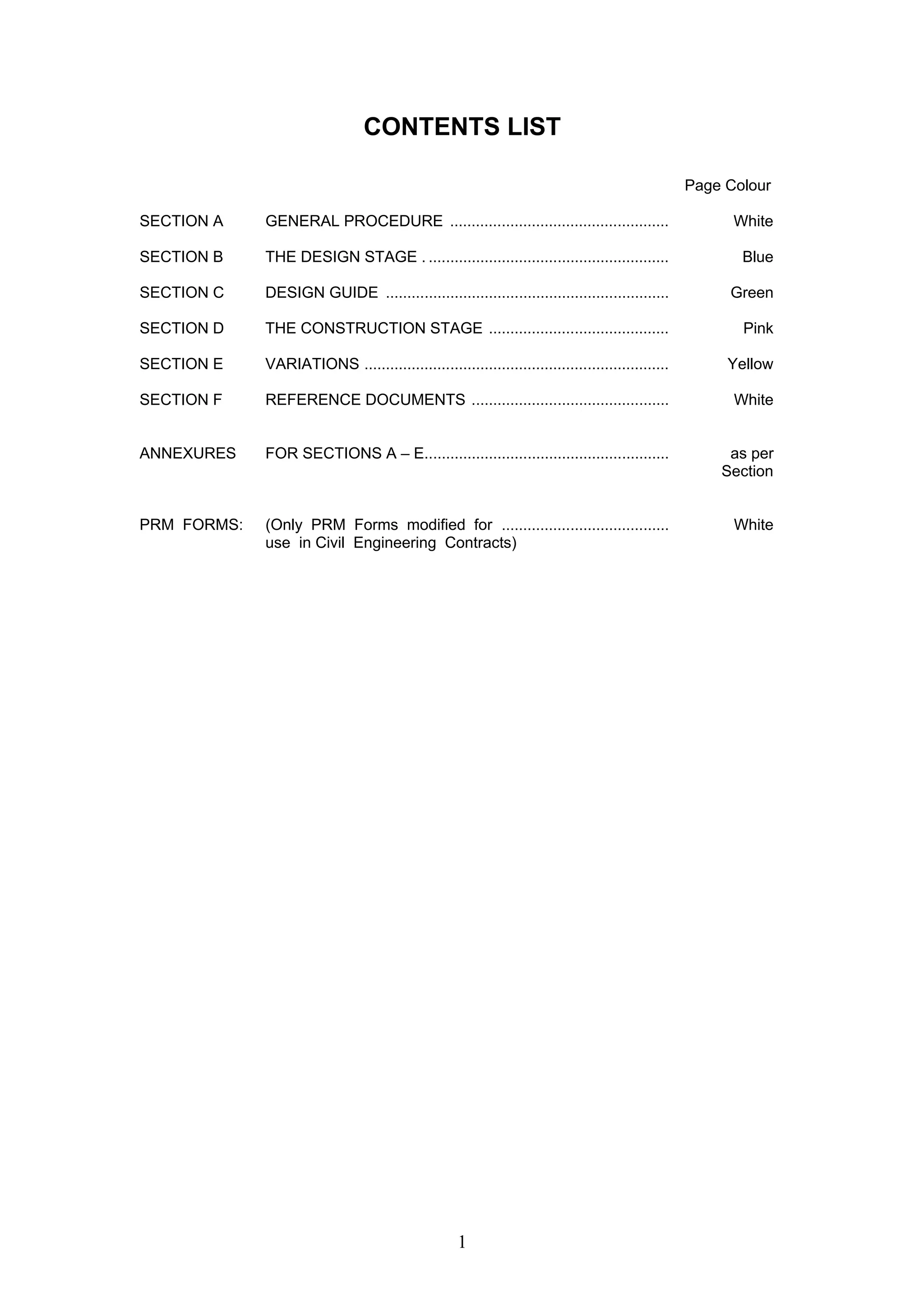
CONTENTS LIST 
1 
Page Colour 
SECTION A GENERAL PROCEDURE ................................................... White 
SECTION B THE DESIGN STAGE . ........................................................ Blue 
SECTION C DESIGN GUIDE .................................................................. Green 
SECTION D THE CONSTRUCTION STAGE .......................................... Pink 
SECTION E VARIATIONS ....................................................................... Yellow 
SECTION F REFERENCE DOCUMENTS .............................................. White 
ANNEXURES FOR SECTIONS A – E......................................................... as per 
Section 
PRM FORMS: (Only PRM Forms modified for ....................................... White 
use in Civil Engineering Contracts)
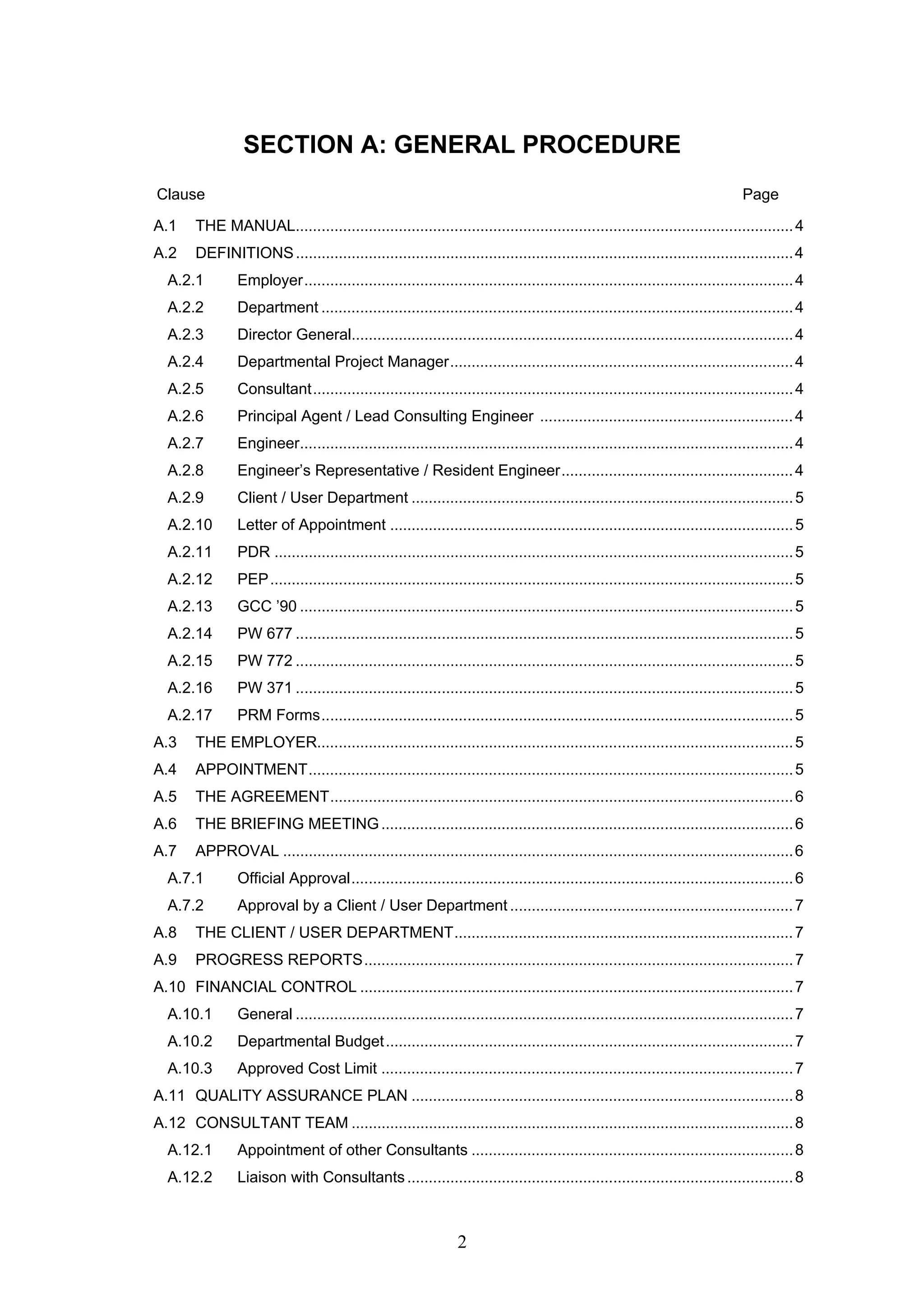
SECTION A: GENERAL PROCEDURE 
Clause Page 
A.1 THE MANUAL....................................................................................................................4 
A.2 DEFINITIONS....................................................................................................................4 
A.2.1 Employer..................................................................................................................4 
A.2.2 Department ..............................................................................................................4 
A.2.3 Director General.......................................................................................................4 
A.2.4 Departmental Project Manager................................................................................4 
A.2.5 Consultant................................................................................................................4 
A.2.6 Principal Agent / Lead Consulting Engineer ...........................................................4 
A.2.7 Engineer...................................................................................................................4 
A.2.8 Engineer’s Representative / Resident Engineer......................................................4 
A.2.9 Client / User Department .........................................................................................5 
A.2.10 Letter of Appointment ..............................................................................................5 
A.2.11 PDR .........................................................................................................................5 
A.2.12 PEP..........................................................................................................................5 
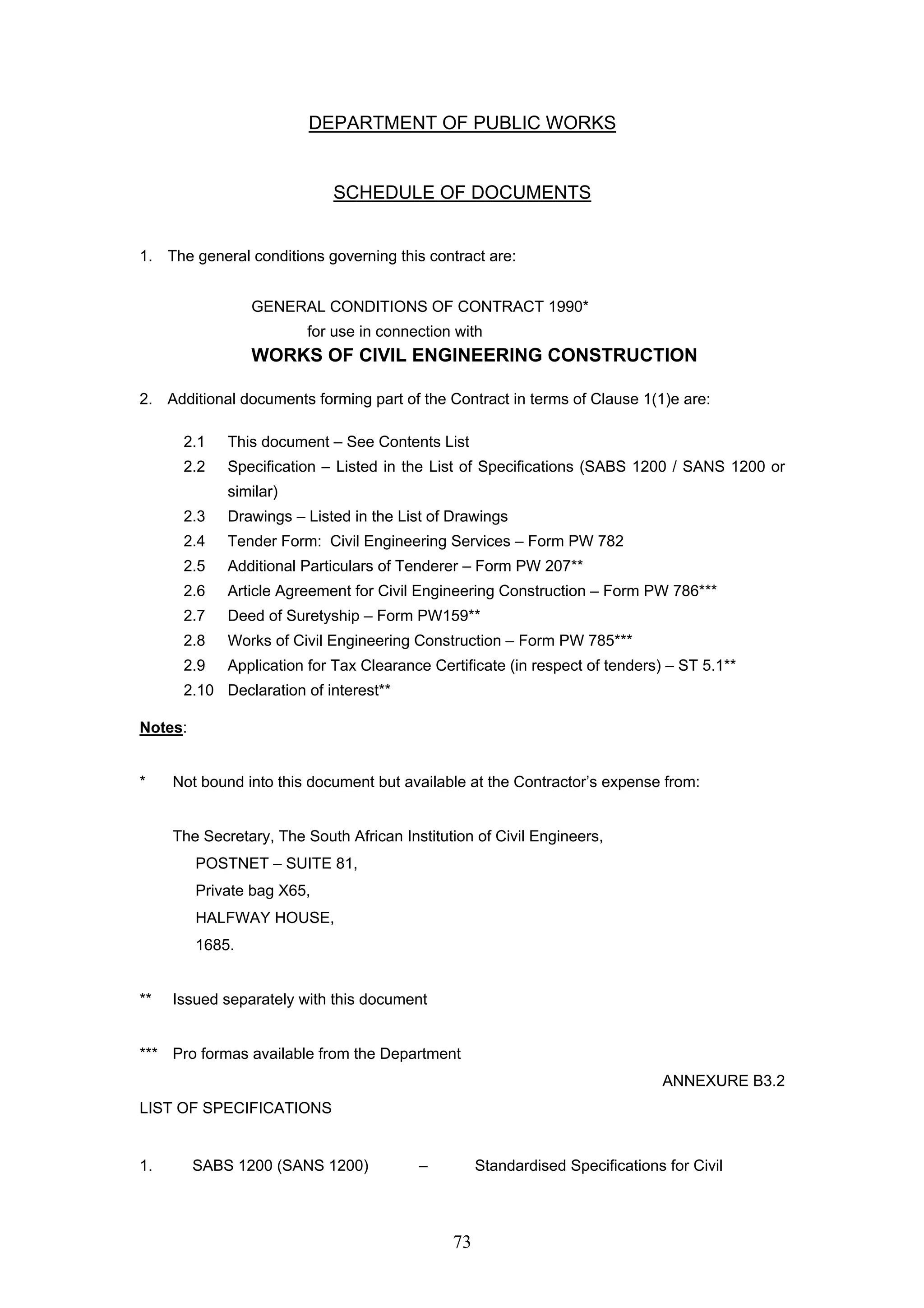
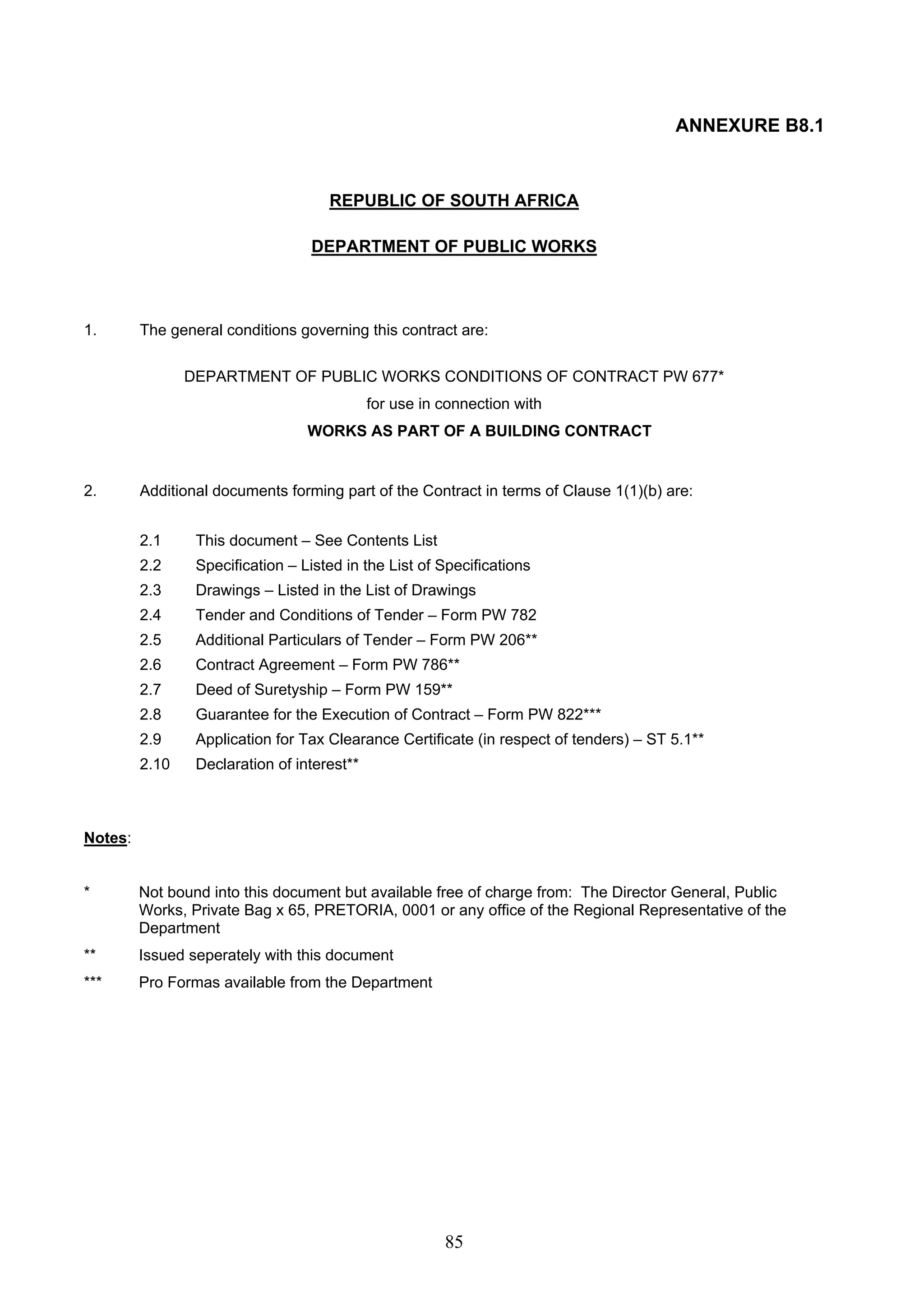
A.2.13 GCC ’90 ...................................................................................................................5 
A.2.14 PW 677 ....................................................................................................................5 
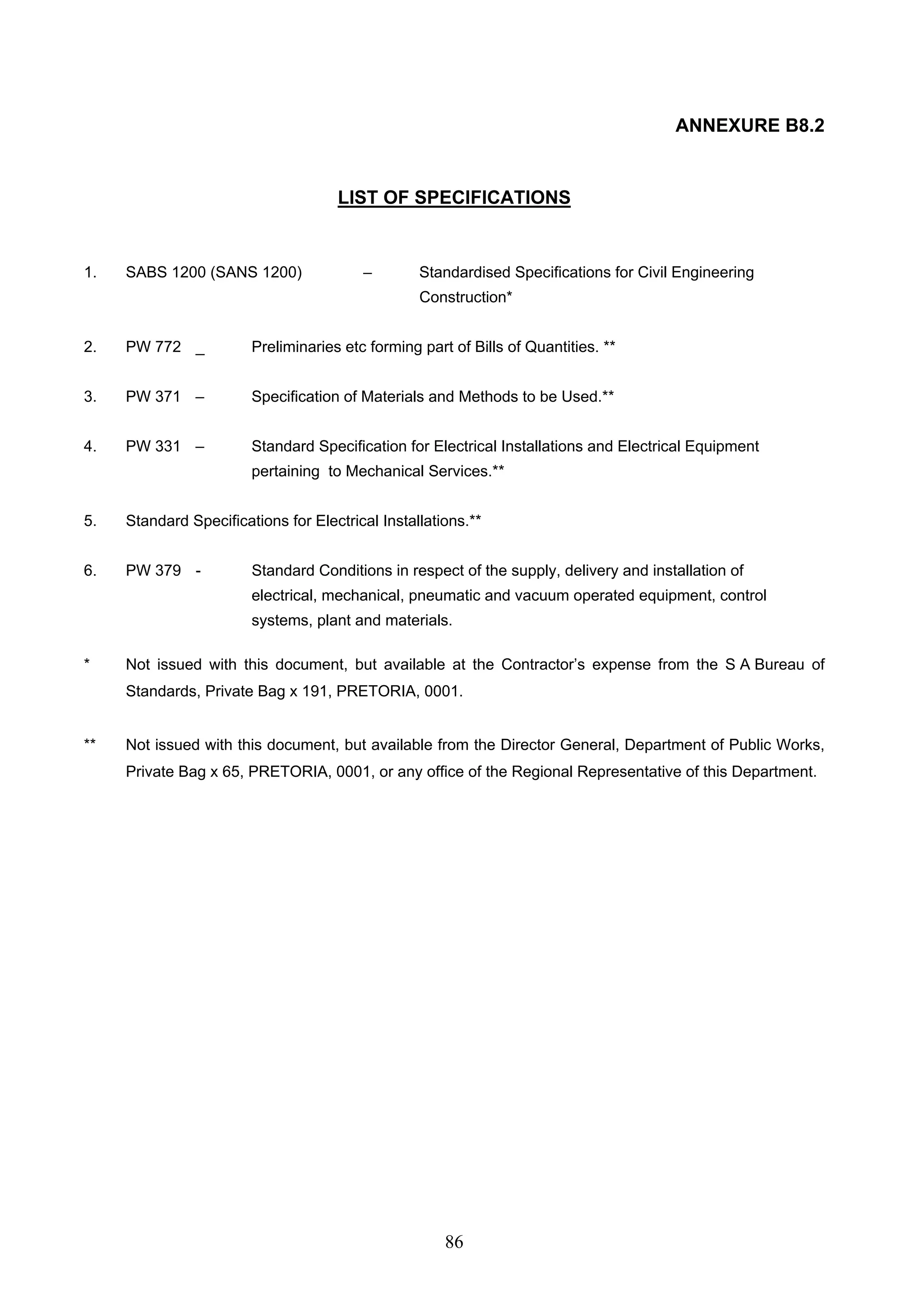
A.2.15 PW 772 ....................................................................................................................5 
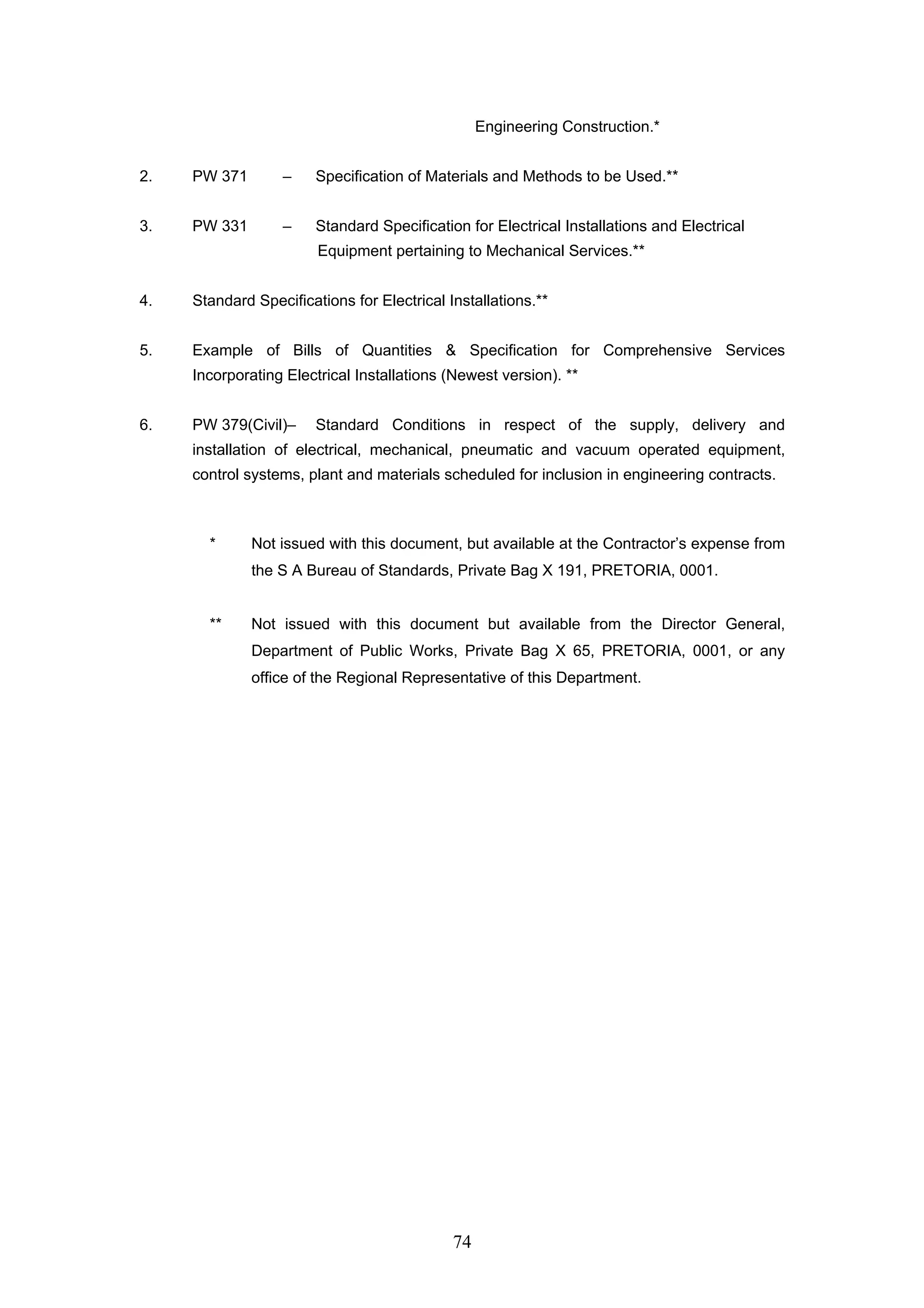
A.2.16 PW 371 ....................................................................................................................5 
A.2.17 PRM Forms..............................................................................................................5 
A.3 THE EMPLOYER...............................................................................................................5 
A.4 APPOINTMENT.................................................................................................................5 
A.5 THE AGREEMENT............................................................................................................6 
A.6 THE BRIEFING MEETING................................................................................................6 
A.7 APPROVAL .......................................................................................................................6 
A.7.1 Official Approval.......................................................................................................6 
A.7.2 Approval by a Client / User Department ..................................................................7 
A.8 THE CLIENT / USER DEPARTMENT...............................................................................7 
A.9 PROGRESS REPORTS....................................................................................................7 
A.10 FINANCIAL CONTROL .....................................................................................................7 
A.10.1 General ....................................................................................................................7 
A.10.2 Departmental Budget...............................................................................................7 
A.10.3 Approved Cost Limit ................................................................................................7 
A.11 QUALITY ASSURANCE PLAN .........................................................................................8 
A.12 CONSULTANT TEAM .......................................................................................................8 
A.12.1 Appointment of other Consultants ...........................................................................8 
A.12.2 Liaison with Consultants ..........................................................................................8 
2
A.12.3 Responsibility of Civil and Structural Engineers ......................................................9 
A.13 USE OF SPECIALISTS .....................................................................................................9 
A.13.1 Geotechnical investigations .....................................................................................9 
A.13.2 Traffic impact studies...............................................................................................9 
A.13.3 Site surveys .............................................................................................................9 
A.13.4 Hydrological studies, etc..........................................................................................9 
A.14 FORMS OF CONTRACT...................................................................................................9 
A.14.1 Civil Engineering Contract (GCC ’90)......................................................................9 
A.14.2 Nominated Sub-contract to Building Contract .......................................................10 
A.14.3 Civil Work Included in Building Contract (PW 677) ...............................................10 
A.14.4 Separate Mechanical and / or Electrical Contract .................................................10 
A.15 CONSTRUCTION MONITORING...................................................................................10 
A.16 DRAWINGS.....................................................................................................................10 
A.17 TRAVELLING PROCEDURES AND COSTS..................................................................10 
A.17.1 General ..................................................................................................................10 
A.17.2 Authority to Travel..................................................................................................11 
A.18 SUBMISSION OF ACCOUNTS.......................................................................................11 
A.18.1 Form of Submission...............................................................................................11 
A.18.2 Claims for Subsistence and Travelling ..................................................................11 
A.18.3 Claims for Other Disbursements............................................................................11 
A.18.4 Fees on Contract Price Adjustments .....................................................................11 
3
4 
A. GENERAL PROCEDURE 
A.1 THE MANUAL 
The purpose of this manual is to serve as a guide to the functions, duties and 
responsibilities of consulting civil engineers in the design, documentation and 
administration of projects for the Department of Public Works. 
A.2 DEFINITIONS 
The following words, expressions and abbreviations shall have the meanings 
assigned to them except where the context requires otherwise: 
A.2.1 Employer 
“Employer” means the Government of the Republic of South Africa as represented by 
the Director General: Department of Public Works and includes any person acting in 
and duly authorised to act in that capacity as well as any officer to whom any powers 
vested in the Director General have been delegated. 
A.2.2 Department 
The National Department of Public Works. 
A.2.3 Director General 
The person appointed as Head of Department, of the Department of Public Works. 
A.2.4 Departmental Project Manager 
(see Section A.4) 
A.2.5 Consultant 
The Consultant is the Private Consulting Civil Engineer or Consulting Civil 
Engineering Firm appointed by the Department in terms of the “Letter of 
Appointment”, to execute the work for which this Manual of Procedure is intended. 
A.2.6 Principal Agent / Lead Consulting Engineer 
A Consultant (not necessarily a civil engineer) appointed by the Department to act as 
co-ordinator and team leader of a group of consultants working on the same project. 
A.2.7 Engineer 
The “Engineer” means the natural or juristic person or partnership named as the 
Engineer in the Special Conditions of Contract (see Annexure B.2) for the supervision 
and management of the Engineering Works undertaken by the Contractor. 
A.2.8 Engineer’s Representative / Resident Engineer 
A person appointed from time to time by the Engineer to represent the Engineer on 
the Construction Site.
5 
A.2.9 Client / User Department 
(see Section A.8) 
A.2.10 Letter of Appointment 
(see Sections A.5 and A.6) 
A.2.11 PDR 
Preliminary Design Report, as described further in Section B of this Manual. 
A.2.12 PEP 
Project Execution Plan 
A.2.13 GCC ’90 
The General Conditions of Contract for use in connection with Works of Civil 
Engineering Construction (6th Edition, 1990); issued by the South African Institution of 
Civil Engineers. 
A.2.14 PW 677 
The departmental Conditions of Contract as published by the Department of Public 
Works, mainly applicable to Building Contracts. 
A.2.15 PW 772 
The Department’s “Preliminaries etc. forming part of Bills of Quantities”. 
A.2.16 PW 371 
The Department’s “Specification of Materials and Methods to be Used”. 
A.2.17 PRM Forms 
A system of pro-forma documents used by the Department for Project Management. 
A.3 THE EMPLOYER 
The Employer for the work is the Director General: National Department of Public 
Works or his authorised representative. The Consulting Engineer will deal with the 
Employer through the Departmental Project Manager as set out in this manual. 
A.4 APPOINTMENT 
The letter of invitation to perform professional services (generally referred to as “the 
letter of appointment”) together with the associated annexures, forms a binding 
contract between the Department and the Consulting Engineering Firm the moment 
the Consultant accepts the invitation to perform professional services in writing.
The Consultant and the Departmental Project Manager will initial each page at the 
bottom right hand corner as well as all changes / amendments, if applicable, made to 
the original contract documentation. 
6 
A.5 THE AGREEMENT 
Where the Department’s standard letter of appointment forms the basis of the 
commission, the Consultant is required to execute the work in accordance with this 
manual and with such supplementary instructions as the Department may issue from 
time to time. In cases where a special agreement is entered into, this will state any 
variations in procedure, which may be required. 
The standard appointment letter consists of the following: 
The appointment letter itself 
Section A: General Conditions and Information 
Section B: Reimbursement tariffs for typing, printing, duplicating work and 
forwarding 
Section C: Travelling and subsistence arrangements and tariffs on Charges 
Section D: Indemnification of the Department by firms with limited liability 
Section E: Conditions applicable to the appointment of firms in association 
Section X1: Extent of civil engineering appointment 
Section X2: Professional fees in respect of civil engineers appointment 
Appendix “N”: Briefing document, if applicable 
After appointment, the Consultant shall draw up a Project Execution Plan (PEP) 
indicating cashflows as well as work program. This document, once approved, will 
form part of the agreement. 
Remuneration tables referred to in the appointment letter are available on the 
Departmental website, i.e. http://www.publicworks.gov.za . 
A.6 THE BRIEFING MEETING 
After acceptance of the appointment the Consultant is required to arrange a 
consultation / briefing meeting with the Departmental Project Manager. At this stage 
the Consultant shall advise the Department which partner/director will be responsible 
for controlling the service. Minutes of this meeting must be kept and forwarded to the 
Departmental Project Manager. 
A.7 APPROVAL 
A.7.1 Official Approval 
The Consulting Engineer may not proceed from one stage to another without the 
written approval of the Departmental Project Manager. He must obtain prior approval 
before undertaking any survey, soil testing, travelling, etc. See also Section A.13. in 
this regard.
A.7.2 Approval by a Client / User Department 
Approval of any proposals either verbally or in writing by a Client / User Department is 
not binding on the Director General and does not relieve the Consultant in any way of 
the responsibility for obtaining written approval of any proposals from the 
Departmental Project Manager. 
7 
A.8 THE CLIENT / USER DEPARTMENT 
The designated occupant(s)/user(s) of a facility is/are the Client or User 
Department(s). Any discussions between the Consultant and the Client / User 
Department, must be arranged through the Departmental Project Manager. Any 
requests from Client / User Departments for amendments to the approved design 
must be referred by the Client / User Department to the Departmental Project 
Manager and his written authority obtained before such additions / alterations can be 
incorporated in the design proposals. 
A.9 PROGRESS REPORTS 
To control the strict adherence to the time schedule required for compliance with the 
documentation programme laid down in terms of the letter of appointment or as 
provided at the briefing the Consultant is required throughout the design and 
documentation stages to render to the Department progress reports to the last 
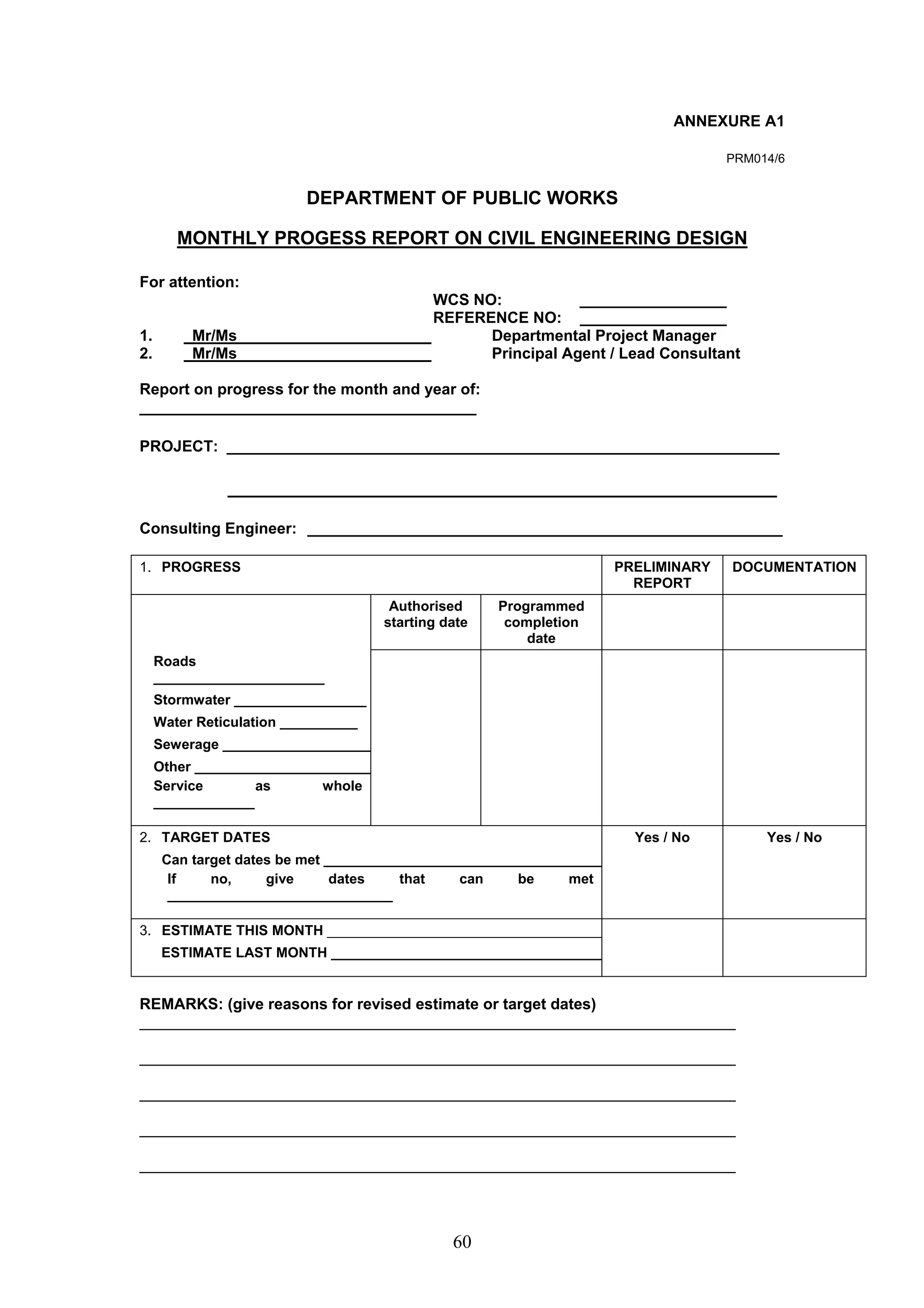
working day of each month on the form Annexure A1 (PRM014/6). 
In completing the form special attention must be drawn to any delays or changes in 
the estimated cost of the service and the cause thereof. 
A.10 FINANCIAL CONTROL 
A.10.1 General 
Financial control is done on a dual basis, i.e. construction (execution) costs and 
professional fees, which include travelling cost, supervision etc. 
A.10.2 Departmental Budget 
The Department makes a cost provision for each of its projects for budgeting 
purposes. The Consultant is required to design the project as economically as 
possible. 
A.10.3 Approved Cost Limit 
When the various stages of the project are approved an estimate of cost will 
concurrently be approved and the Consultant is required to adhere strictly to this cost 
limit, subject to escalation in costs or such deviation as approved by the Departmental 
Project Manager. Such estimates shall include preliminary and general costs and an 
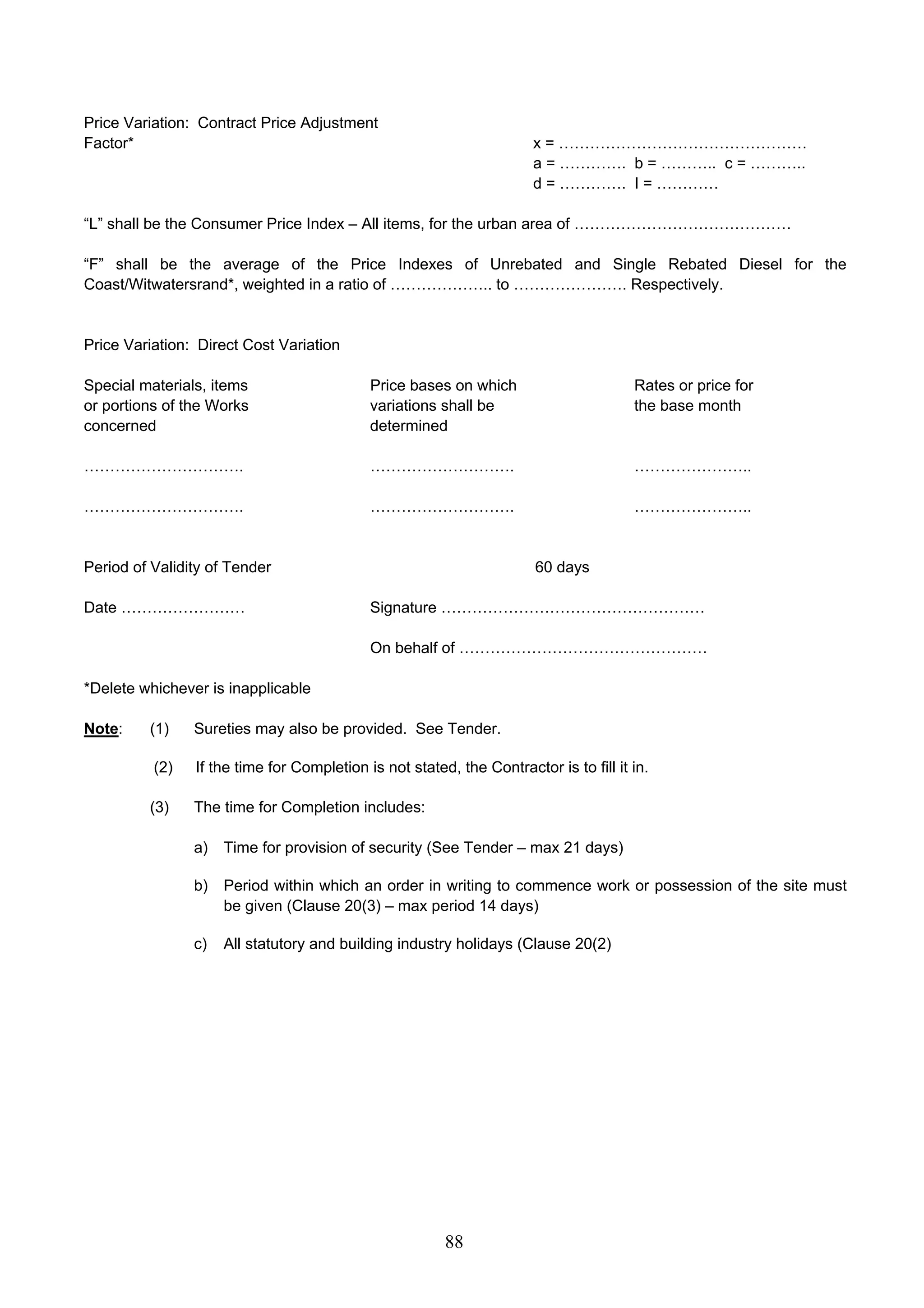
estimate of Contract Price Adjustment based on the formula below, but exclude any 
amounts for professional fees, travelling, supervision etc. for which the Department 
will make its own allowance. 
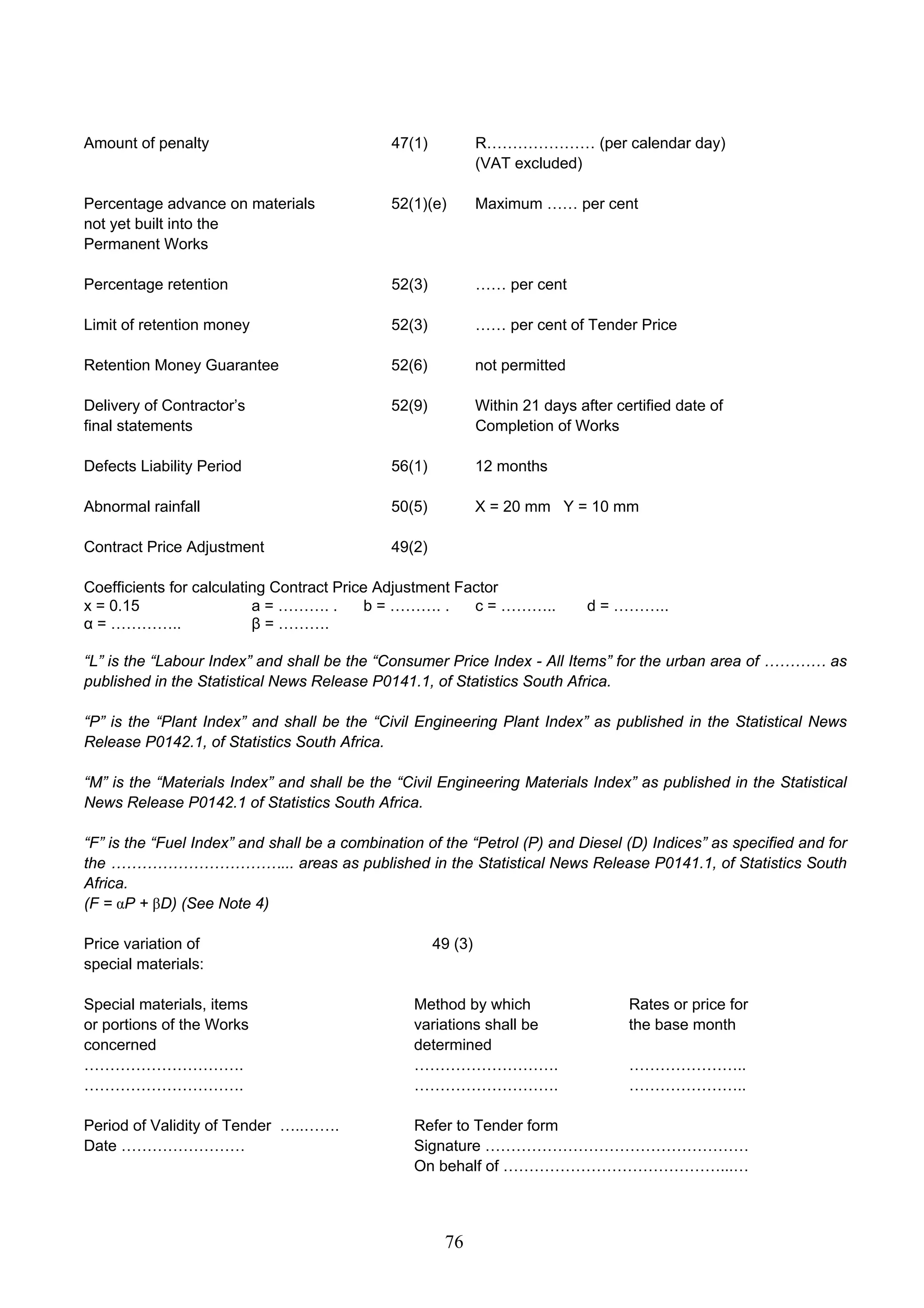
CPA = 85% x i x TP x [(T/2) + 3]
Where: i = Estimated rate of inflation 
TP = Tender Price (estimate) 
T = Time for completion (months) 
The Consultant must ensure that the design is comprehensive, as no allowance shall 
be made for any contingencies. 
8 
A.11 QUALITY ASSURANCE PLAN 
Consultants appointed by the Department shall confirm in writing with the 
Departmental Project Manager that they have a Quality Assurance Plan, to ensure 
that the designs carried out are to an acceptable standard. Their Quality Assurance 
Plan shall be compliant with the stipulations of the latest edition of SABS ISO 9001 
(SANS 9001) specifications. 
Special preference shall be given to firms who have SABS ISO 9001 (SANS 9001) 
accreditation or SABS ISO 9001 (SANS 9001) compliant quality control systems. 
It is the intention of the Department to make accreditation in terms of SABS ISO 9001 
(SANS 9001) a prerequisite for Consultants to be admitted to the Consultants Roster 
by the year 2008. 
A.12 CONSULTANT TEAM 
A.12.1 Appointment of other Consultants 
The architects, quantity surveyors, other engineering disciplines and any other 
specialists involved in the project are separately appointed by the relevant 
Departmental Project Managers and are briefed by them in respect of their scope of 
work, terms of agreement, departmental standards and technical aspects of their 
work. 
A.12.2 Liaison with Consultants 
In terms of their several agreements, all consultants are required to liaise closely with 
one another during all stages of the project and to keep each other fully informed of 
all relevant developments. This liaison will be done via the Departmental Project 
Manager. Direct liaison between consultants will only take place as determined by 
the Departmental Project Manager. In cases where a Lead Consultant / Principal 
Agent is appointed, the Departmental Project Manager can delegate certain liaison 
and co-ordination functions to the Lead Consultant / Principal Agent. Designs must 
be co-ordinated with that of the other members of the design team (where applicable) 
before submission of proposals. The Consultant shall not accept instructions from 
other consultants with regard to design standards, the extent of his brief and changes 
to approved proposals without the prior approval of the Departmental Project 
Manager. 
Co-ordination between consultants must be such that work is not duplicated, as the 
Department will not remunerate twice for the same work.
A.12.3 Responsibility of Civil and Structural Engineers 
The Department expects that the issue of responsibility / liability between the Civil-and 
Structural Engineer(s) be without ambiguity before a construction contract is 
awarded. 
At the first briefing meeting the Departmental Project Manager will spell out the 
different responsibilities of the civil and structural engineer. 
To clarify the above, the Department would hold the structural engineer responsible 
for the design performance of building/(s), even if earthworks were carried out under 
the “footprint” of the structure. Therefore, it is the prerogative of the structural 
engineer to verify / accept work done under the earthworks phase of the contract. 
The Civil Engineer will be responsible for the balancing of earthwork quantities and 
the Structural Engineer will be responsible for the bearing capacity and related 
specifications of earthworks under the footprint of a structure. 
Although the above depends to a large extent on a well co-ordinated design, 
specification(s), drawings and supervision, the Department does not accept split 
responsibility in this regard. Should the building for instance crack in due time, the 
structural engineer would be held responsible. 
9 
A.13 USE OF SPECIALISTS 
If the service of a specialist consultant is required, three (3) quotations for these 
services must be obtained and submitted to the Departmental Project Manager for 
approval. This is applicable for: 
A.13.1 Geotechnical investigations 
A.13.2 Traffic impact studies 
A.13.3 Site surveys 
A.13.4 Hydrological studies, etc. 
A.14 FORMS OF CONTRACT 
The service for which the Consultant is appointed will be executed by contract in one 
or more of the ways indicated below. 
The Department will decide in due course what form of contract will be employed. 
The Consultant’s recommendations in this regard should be included in the 
Preliminary Design Report and will be taken into consideration. 
A.14.1 Civil Engineering Contract (GCC ’90) 
Tender documents including drawings, specifications and schedules of quantities as 
well as an estimate of the cost are prepared by the Consultant, and submitted to the 
Project Manager in draft form. After approval the Department will arrange for the 
invitation of tenders, submit these to the Consultant for recommendation, and through 
the Department’s tender procedures accept a tender.
A.14.2 Nominated Sub-contract to Building Contract 
Procedure as for A.14.1 except that after acceptance by the Department’s tender 
procedures, the successful tenderer becomes a nominated sub-contractor to the main 
contractor. 
A.14.3 Civil Work Included in Building Contract (PW 677) 
Civil engineering services are included in the building contract. Contract drawings 
and technical specifications are prepared by the Civil Engineer and submitted to the 
Principal Agent / Project Leader, who after approval will arrange to have these 
included in the main building documentation. Although the defects liability period 
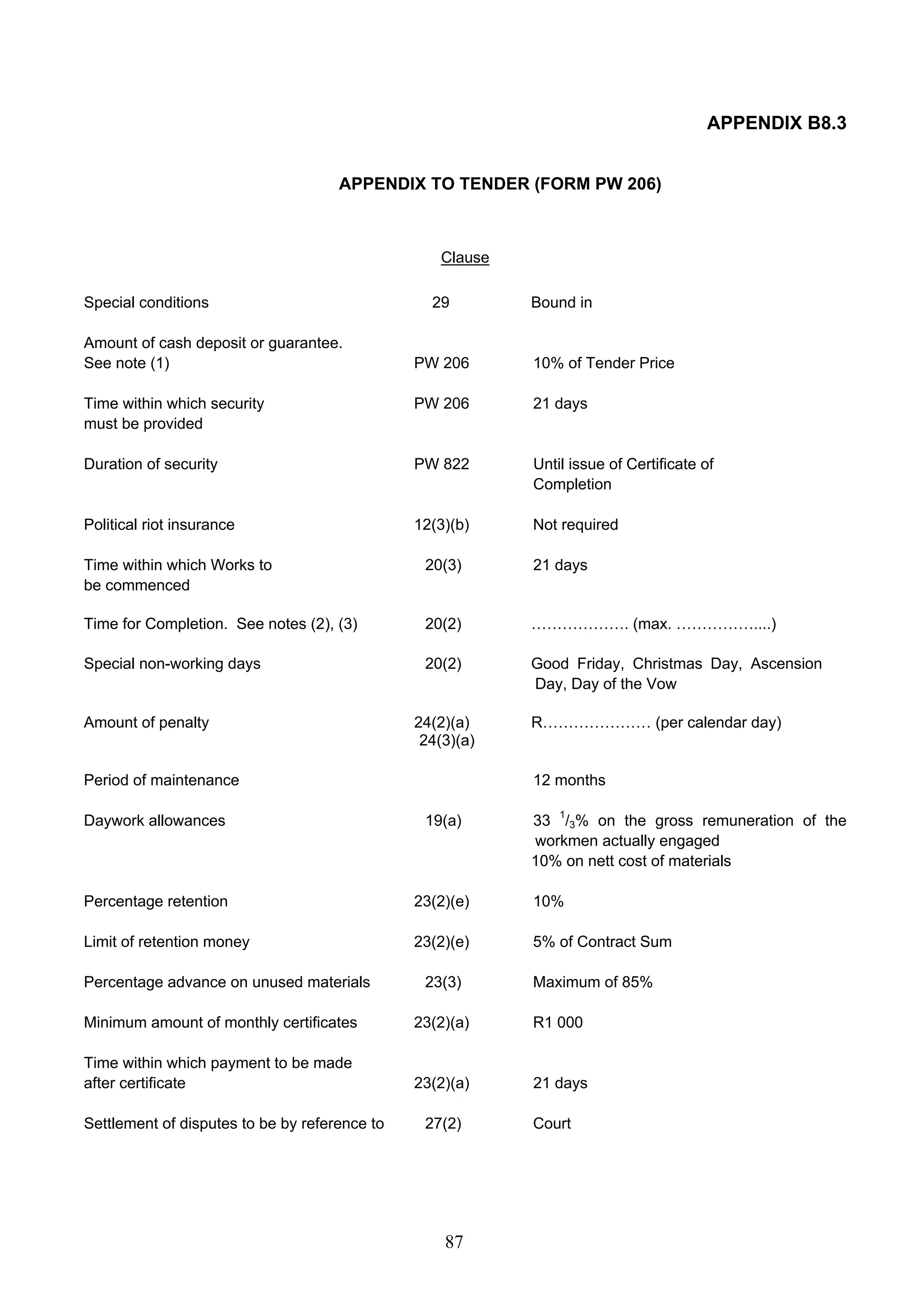
(maintenance period) on a building contract is normally 3 months, the civil portion will 
be subject to a defects liability period of 12 months. 
A.14.4 Separate Mechanical and / or Electrical Contract 
In certain circumstances (for example pump station installations), it may be expedient 
to have a separate mechanical / electrical subcontract. Tender documents including 
drawings, specifications and schedules of quantities as well as an estimate of the 
cost are prepared by the Mechanical / Electrical Consultant, and submitted to the 
Principal Agent in draft form. The Principal Agent will thereafter be responsible for 
the compilation of the Tender Document. After approval the Department will arrange 
for the invitation of tenders, submit these to the Consultant for recommendation, and 
through the Department’s tender procedures accept a tender. 
10 
A.15 CONSTRUCTION MONITORING 
The Consultant will be required to supervise the construction of the works for which 
the Consultant has been appointed and which have been included in the 
documentation as approved by the Departmental Project Manager (see Section D). 
The Consultant will also ensure that the Contractors comply with all the relevant acts 
and statutory regulations, e.g. National Water Act (Act 36/1998), Occupational Health 
and Safety Act (Act 85/1993), etc. 
A.16 DRAWINGS 
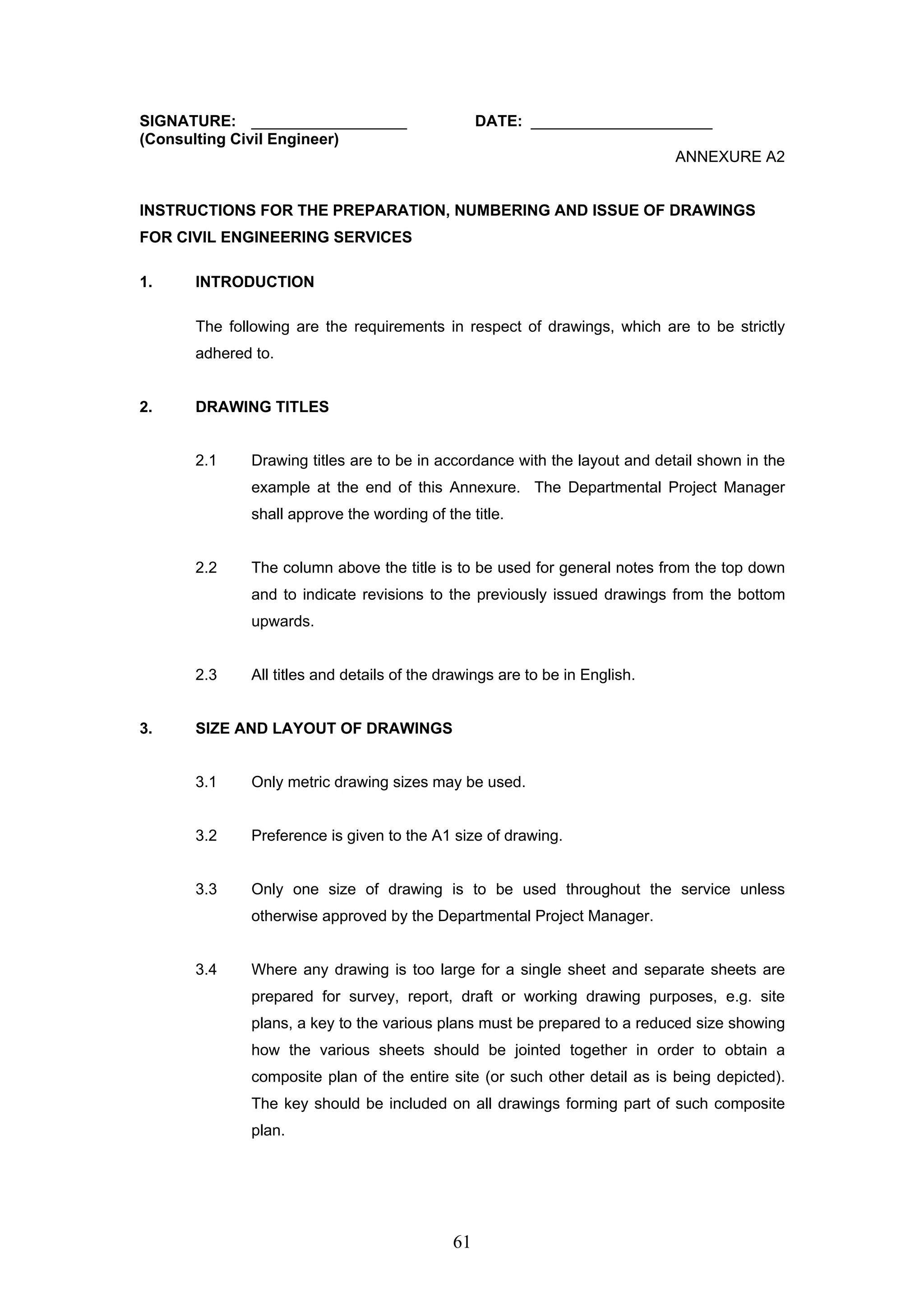
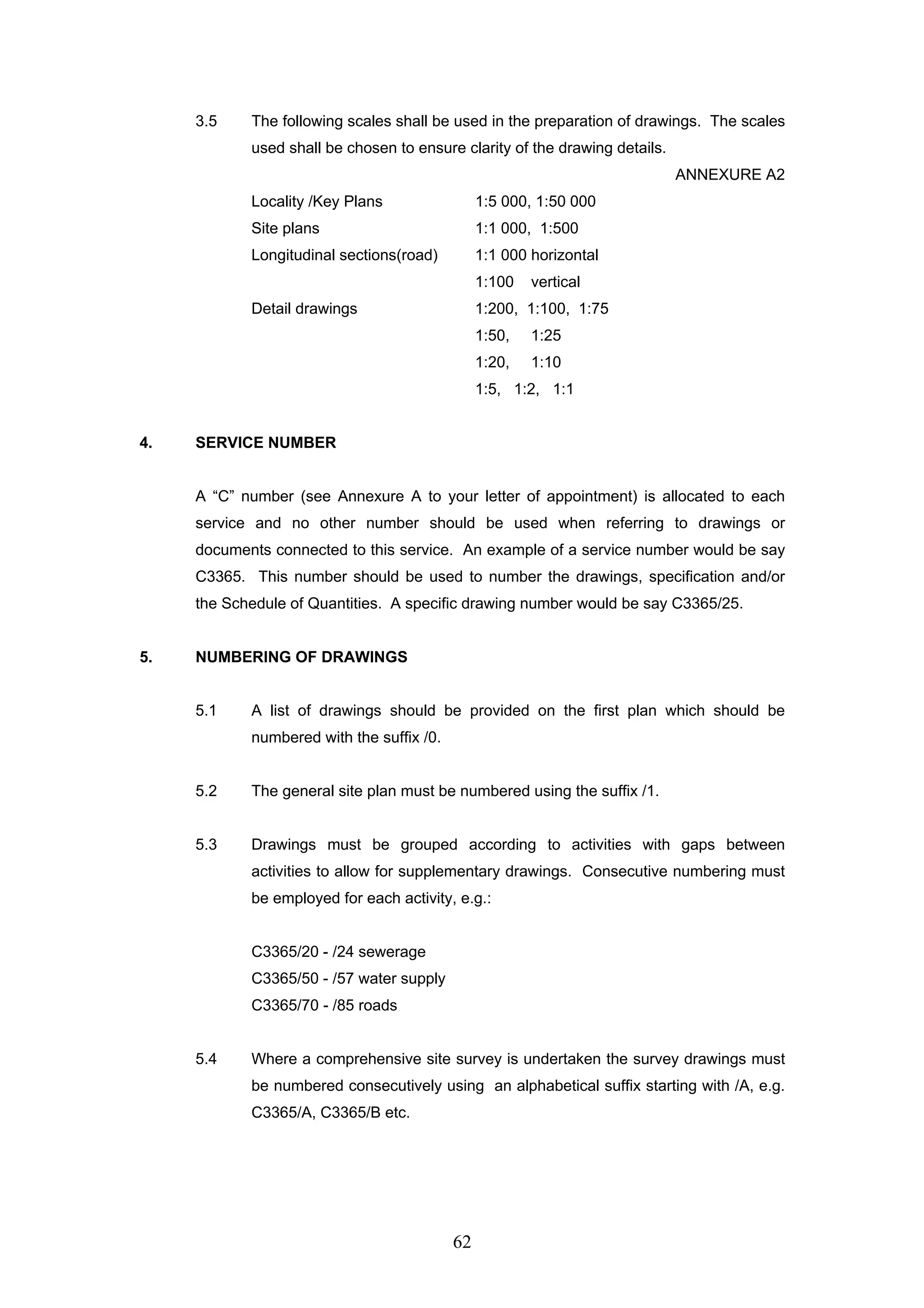
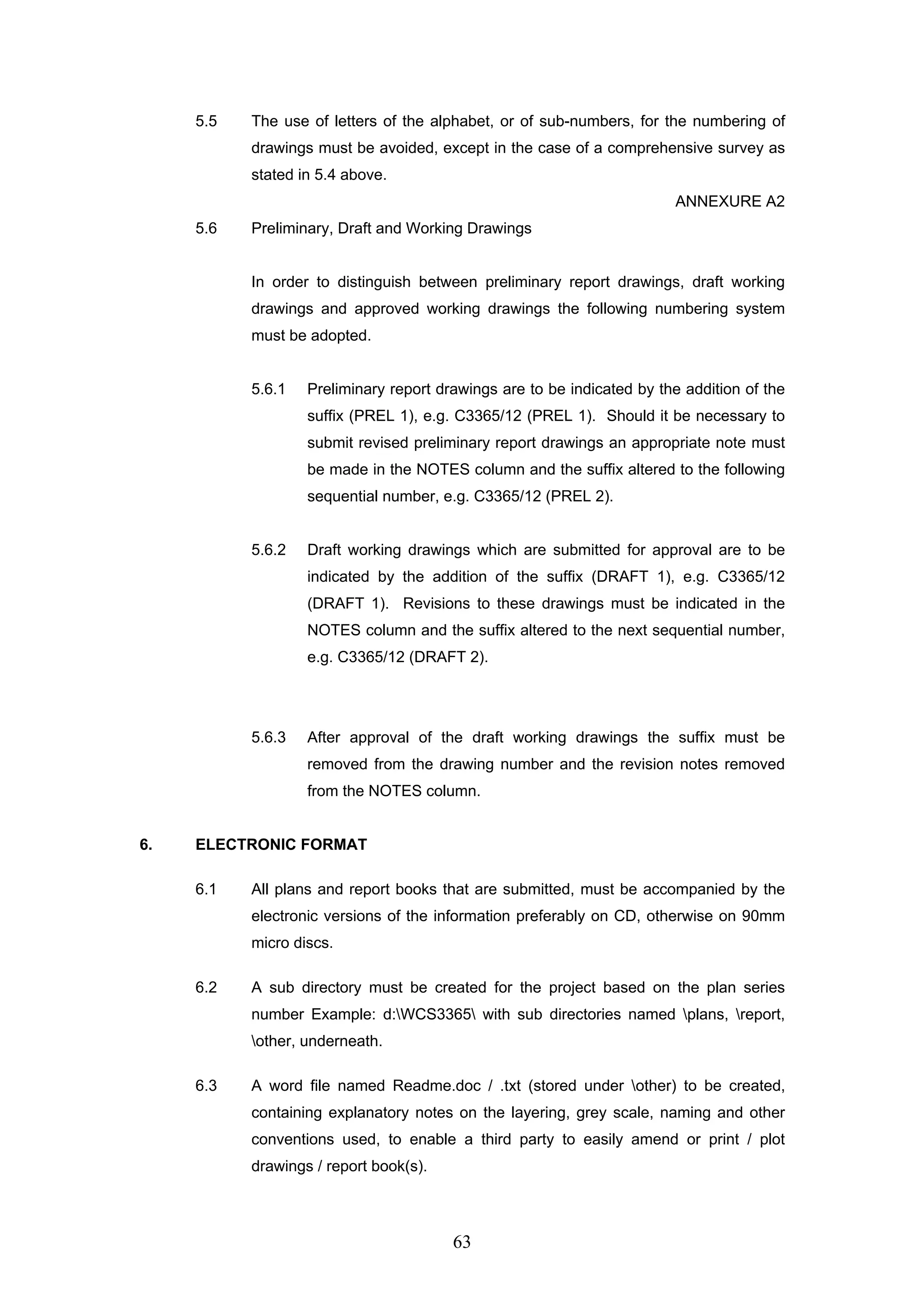
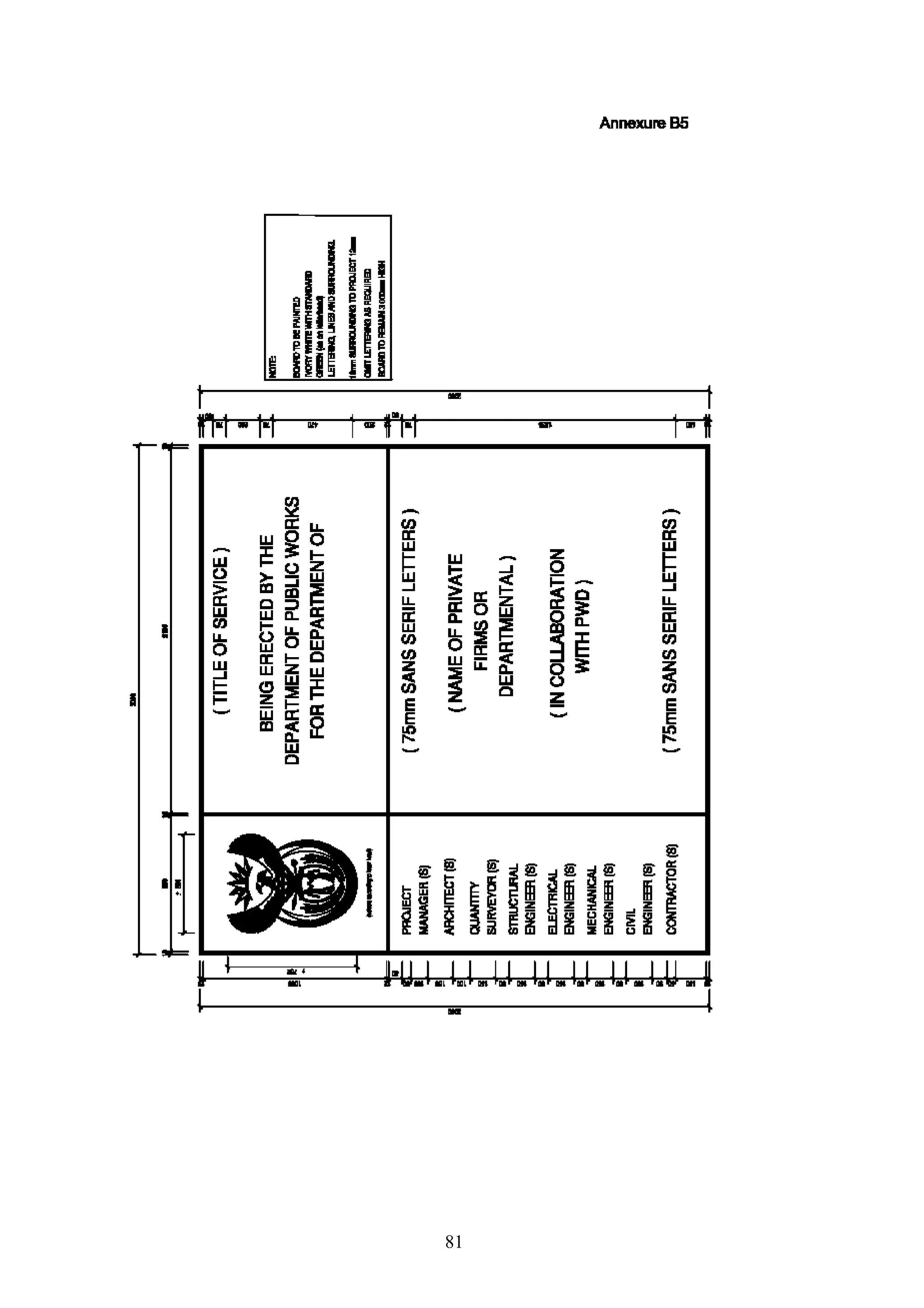
Please refer to Annexure A2 of this manual in this regard. 
A.17 TRAVELLING PROCEDURES AND COSTS 
A.17.1 General 
All trips are undertaken entirely at the Consultants own risk and only essential trips 
are to be undertaken. 
Travelling and subsistence costs and allowances will be reimbursed in accordance 
with Annexure C of the Letter of Appointment. 
In cases where air or rail travel is authorised, the Consultant is required to make own 
travel arrangements and pay the costs, which will be reimbursed. The ticket must be 
attached to the application for a reimbursement.
11 
A.17.2 Authority to Travel 
All applications for authority to travel by whatever means must be made through the 
Departmental Project Manager. Refer to Annexure C of the Letter of Appointment. 
A.18 SUBMISSION OF ACCOUNTS 
A.18.1 Form of Submission 
All accounts must be submitted on the forms provided by the Project Manager. They 
must be accompanied by invoices where relevant. Only the appropriate portions of 
the forms must be filled in. 
A.18.2 Claims for Subsistence and Travelling 
Such claims must be submitted as soon as possible after the journey has been made 
and in no circumstances later than three months after the date thereof. 
A.18.3 Claims for Other Disbursements 
Such claims must be submitted as soon as possible after the event or as soon as 
receipt of invoices, but not more than monthly. 
A.18.4 Fees on Contract Price Adjustments 
Fees are to be determined on the final value of the works, calculated according to the 
stipulations in the letter of appointment, if applicable.
SECTION B: THE DESIGN STAGE 
Clause Page 
B.1 STAGE 1: REPORT AND PRELIMINARY DESIGN PROPOSALS................................13 
B.2 STAGE 2: DESIGN and TENDER STAGE .....................................................................14 
B.2.1 Separate Civil Contract Vide Clause A.14.1..........................................................14 
B.2.2 Nominated Sub-contract to Building Contract Vide Clause A.14.2 .......................16 
B.2.3 Civil Work included in the Building Contract Vide Clause A.14.3..........................16 
B.2.4 VAT and Contingencies ........................................................................................17 
B.2.5 Penalties ................................................................................................................17 
B.2.6 Securities ...............................................................................................................17 
B.2.7 Limit of Retention...................................................................................................17 
B.2.8 Design Calculations ...............................................................................................18 
12
13 
B. THE DESIGN STAGE 
B.1 STAGE 1: REPORT AND PRELIMINARY DESIGN PROPOSALS 
B.1.1 This stage encompasses the Report and Preliminary Design stages as described in 
the Letter of Appointment. 
B.1.2 Unless otherwise instructed these two stages will be treated as one. If it becomes 
apparent that these two stages should be separated the prior approval of the 
Departmental Project Manager must be obtained. 
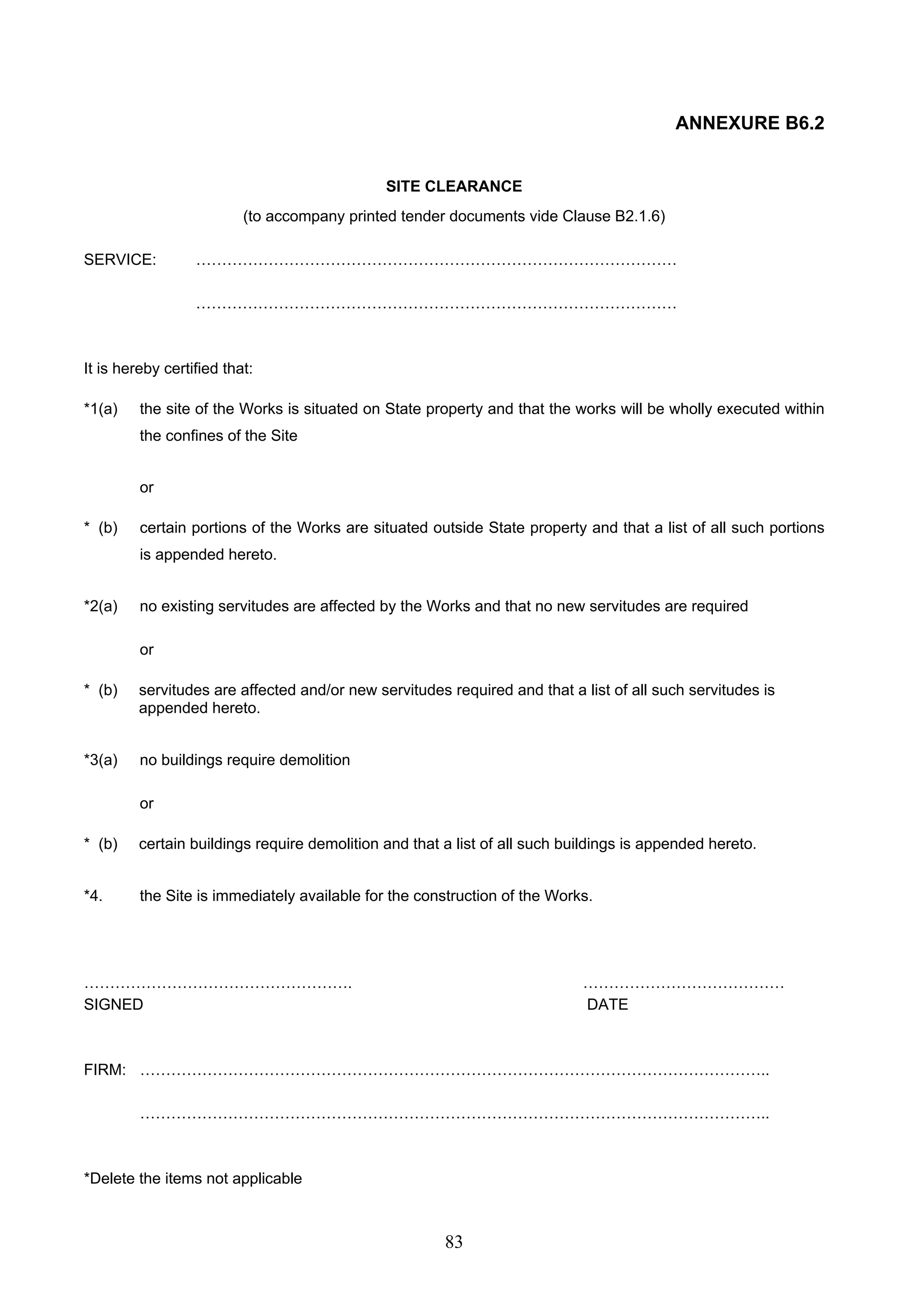
B.1.3 Three copies of the Preliminary Design Report (PDR) and Site Clearance 
(Annexure B6.2) are required. Although of a general nature, the report must 
contain sufficient information on the proposals and recommendations to enable 
worthwhile comment to be made by the Client / User Department and this 
Department. Refer to SECTION C – “Design Guide”, which sets out relevant 
design requirements. 
Particular attention should be paid to the suitability of the site, availability of 
construction materials, bulk and existing services and the presence of 
servitudes, or the necessity of acquiring servitudes or extra land as well as 
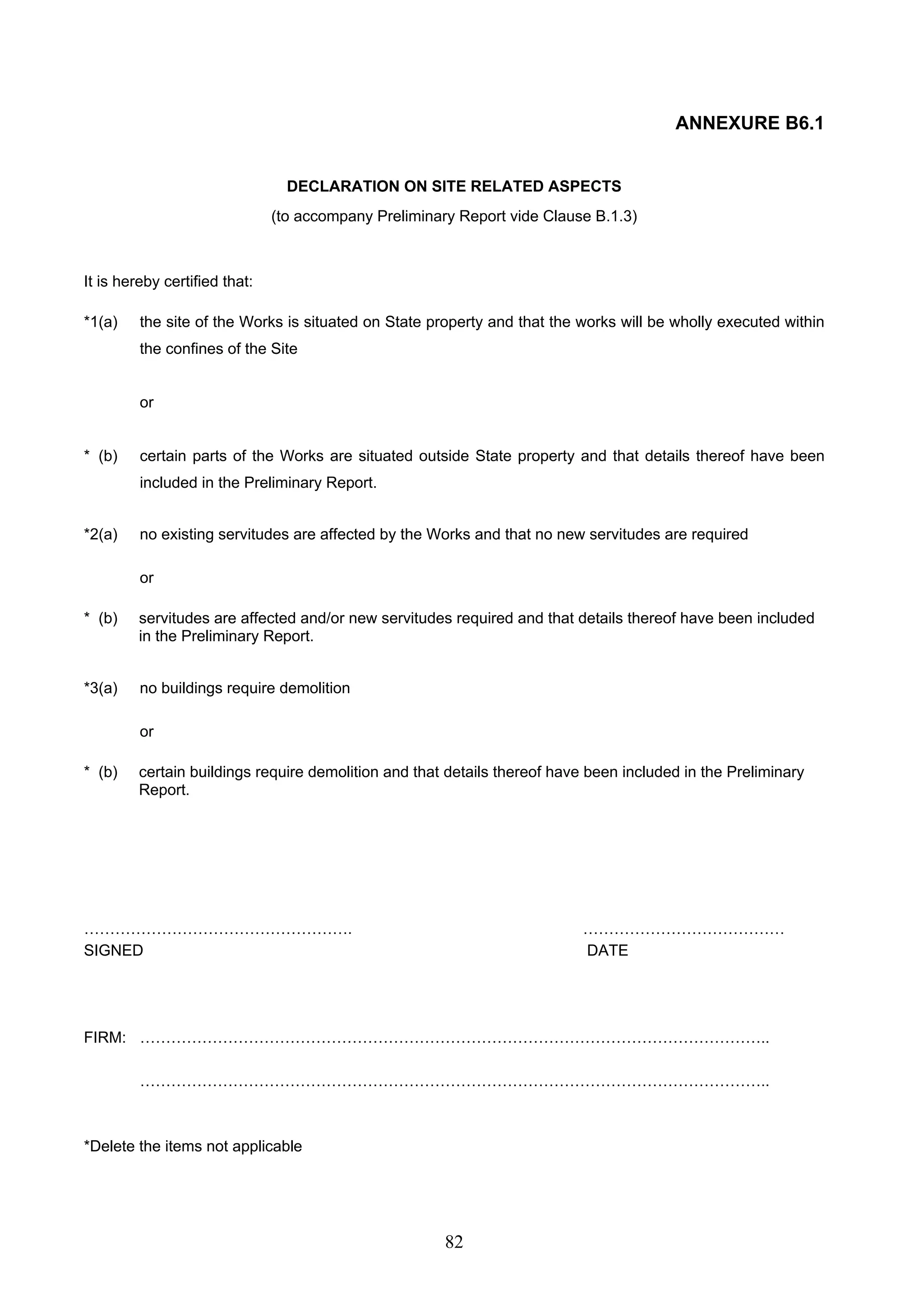
problems that may arise from adjoining sites (see Annexure B6.1). This report 
should also contain recommendations as to the best method of executing the 
scheme, such as phasing, number of contracts etc. as well as estimates for the 
various proposals vide clauses A.10 and A.14. Special attention must be given 
to any electrical power requirements for mechanical installations required by 
civil engineering project elements. 
B.1.4 The Preliminary Design Report will consist of an Executive Summary, followed by 
the report which shall include at least the following sections: 
Executive Summary 
Section 1: Introduction 
Appointment, 
Project Name and WCS No., 
Project location, 
Available information 
Scope of work – a discussion of the full extent of the project, i.e. limits 
of design, other designs affected, etc. 
Purpose of project, 
Section 2: Description of project 
A detail description of the project, including discussion and motivation 
of design proposals. 
Section 3: Land use 
A discussion of the existing land uses and anticipated future land use 
Section 4: Impact on environment and water related matters 
A summary of the environmental scan / EIA done (see Section C.13.)
Section 5: Geotechnical / Geological Discussion 
A discussion of geotechnical / geological factors influencing the 
project, with special attention to dolomitic areas. The Compliance 
Certificate for Dolomitic Areas must be bound into the PDR. 
Section 6: Traffic Impact Studies (if necessary) 
The effect of traffic on the proposals must be discussed. If necessary, 
a specialist must do a Traffic Impact Study, and the findings must be 
incorporated into the PDR. (see Section C.5.4) 
14 
Section 7: Design Standards 
A discussion of the relevant design standards used and motivation for 
deviation of norms. 
Section 8: Possible problems that may arise as a result of the project 
A discussion of possible problems regarding shifting of services, 
properties affected, drainage, pavement design, availability of 
construction materials, topography, flood lines, climate, geology, 
accessibility, traffic etc. 
Section 9: Liaison with parties concerned 
Section 10: Comparison of alternatives 
Section 11: Cost estimate 
Section 12: Summary and recommendations 
Section 13: List of drawings (actual drawings can be bound in separate 
volume) 
B.1.5 Monthly progress reports, in duplicate, as per Annexure A1(PRM014/6) of this 
manual are to be submitted not later than the 7th day of each month to the 
Departmental Project Manager. 
B.2 STAGE 2: DESIGN AND TENDER STAGE 
The Consultant may not proceed with Stage 2 without written approval of the 
Departmental Project Manager, after consultation with the Directorate: Civil 
Engineering of the Department. Refer to the letter of appointment to ascertain which of 
the following sections (B.2.1, B.2.2 or B.2.3) are applicable. 
B.2.1 Separate Civil Contract Vide Clause A.14.1 
B.2.1.1 The Consultant shall prepare a Final Design Report presenting and 
justifying the designs developed in the Detail Design Stage. This 
report should contain the following minimum information: 
Locality plan and list of plans 
Project definition 
Brief project overview and description 
Site and miscellaneous dictates
Environmental assessment (copy of the Record of Decisions 
must be included – see section C.13.5) 
Design standards used for all infrastructure services, i.e. water, 
sewer, storm water, roads, etc. 
Unique project issues 
Transportation issues , access routes, etc. 
Geological and geotechnical issues 
Reference to Preliminary Design report, highlighting changes 
Cost analysis of alternatives 
Motivation for chosen alternative 
Estimated contract value (including a confidential priced 
schedule of quantities using current construction rates) and 
period 
Special conditions of contract 
Material acquisition 
Wet and other services 
Expropriation issues if any 
Brief discussion on construction method etc. 
List of documents submitted 
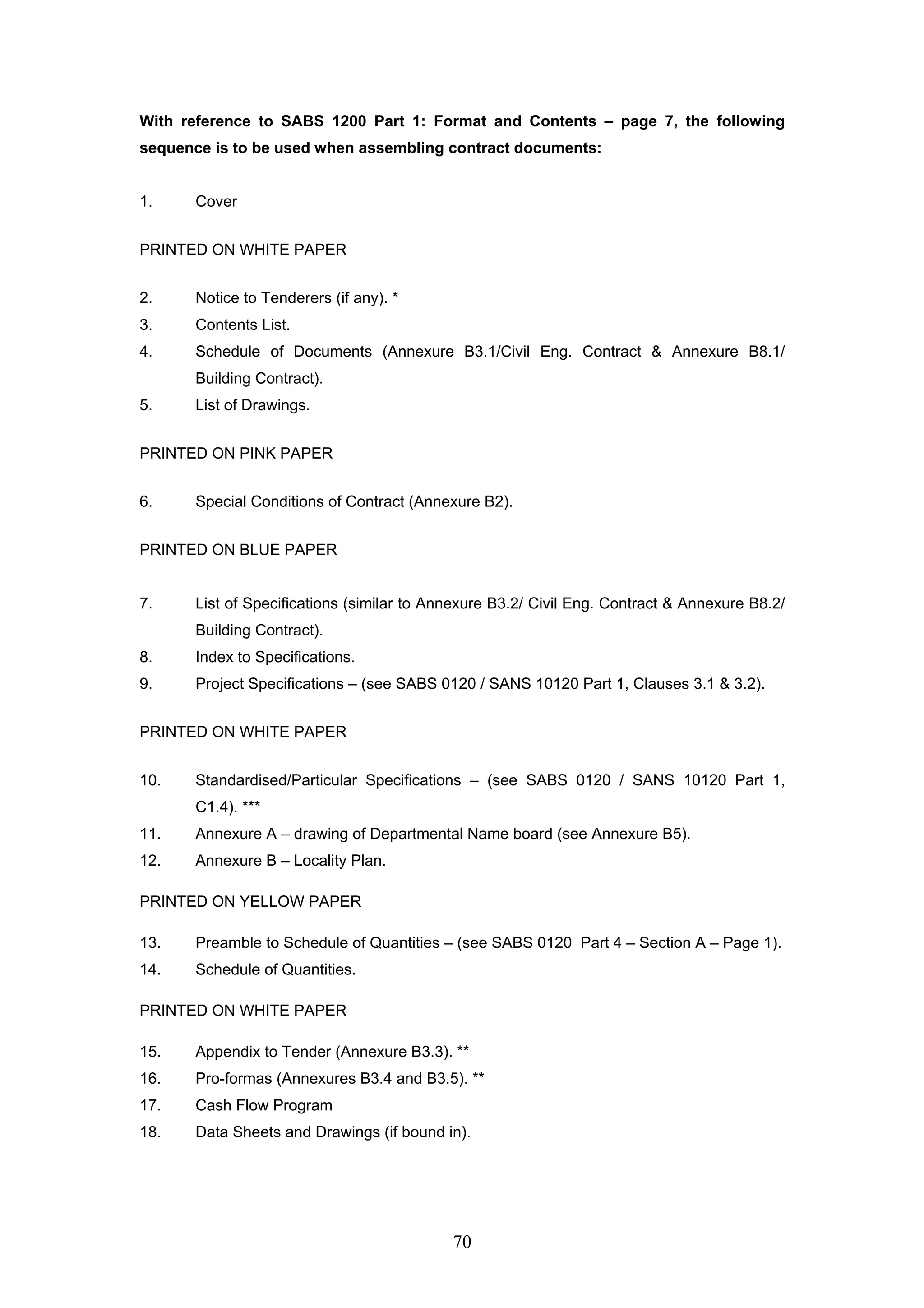
B.2.1.2 The Contract Document shall be compiled in accordance with 
Annexure B1 “Sequence of Contract Document”. 
B.2.1.3 Documentation shall be based on the General Conditions of Contract 
1990 issued by the SAICE, SABS 1200 (SANS 1200), the 
Departmental Special Conditions of Contract (Annexure B2 – Latest 
version) and the documents contained in Annexure B3.1. Except for 
the “List of Specifications” in Annexure B3.2, the documents 
contained in Annexure B3.1 and the Special Conditions of Contract 
may in no circumstances be amended. 
B.2.1.4 The Department’s latest policy regarding Targeted Procurement and 
the relevant forms shall be incorporated into the document. 
B.2.1.5 The clauses forming Annexure B4 must be considered in compiling 
the Project Specification (SABS 0120 – Part 2 – Section 0, Clauses 4 
& 5) (SANS 10120) and the Preamble to the Schedule of Quantities. 
B.2.1.6 Calling for and the acceptance of tenders is a function of the 
Department. To enable the Department to advertise the Contract for 
tender, a Pre-Tender Estimate and Site Clearance (Annexure B6.2) 
must be submitted with the printed tender documents. 
When instructed to do so, the Consultant must print the following 
number of tender documents:- 
Contract Documents - 25 copies or as 
15 
otherwise directed 
Reduced drawings (A2) - 25 Sets or as 
otherwise directed 
The above must be sent to the office of the Departmental Project 
Manager referred to in Annexure A of the Letter of Appointment, for 
tender purposes. Three Contract documents and one set of 
drawings may be retained by the Consultant for contract 
administration.
B.2.1.7 The Consultant will be expected to conduct a tender site inspection 
and to report and make recommendations on the acceptance of 
tenders. Notices to Tenderers (Addendums) must be avoided as far 
as possible. If it should be essential to issue a Notice to Tenderers 
arising from the site inspection, it must be approved by the 
Departmental Project Manager and issued to the tenderes by the 
Consultant not later than 14 days before the closing date of the 
tender. 
An agenda must be issued for, and minutes kept of the tender site 
inspection. Both these documents will be used for future reference 
only, and are not contractually binding. 
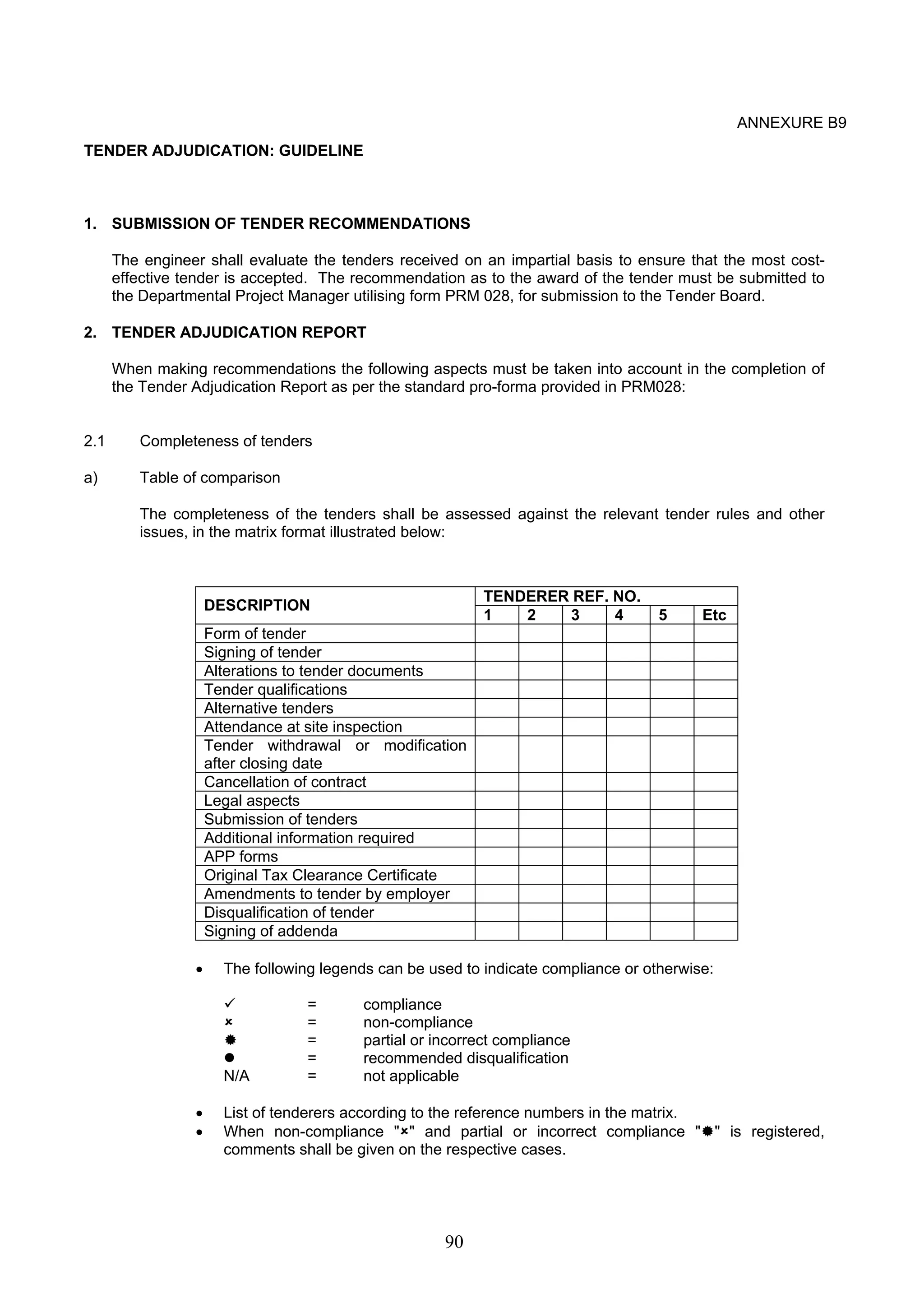
B.2.1.8 The engineer shall evaluate the tenders received on an impartial 
basis to ensure that the most cost-effective tender is accepted. In 
the recommendations for the award of the contract, due cognizance 
shall be taken of the issues enumerated in Annexure B9 to achieve 
the successful completion of the works within the specified 
parameters and with minimal risk accruing to the Department. 
B.2.2 Nominated Sub-contract to Building Contract Vide Clause A.14.2 
B.2.2.1 The document shall generally be compiled in accordance with the 
sequence described in Annexure B1 with deviations where required 
and agreed with the Project Manager. 
B.2.2.2 Documentation should be based on the Department’s General 
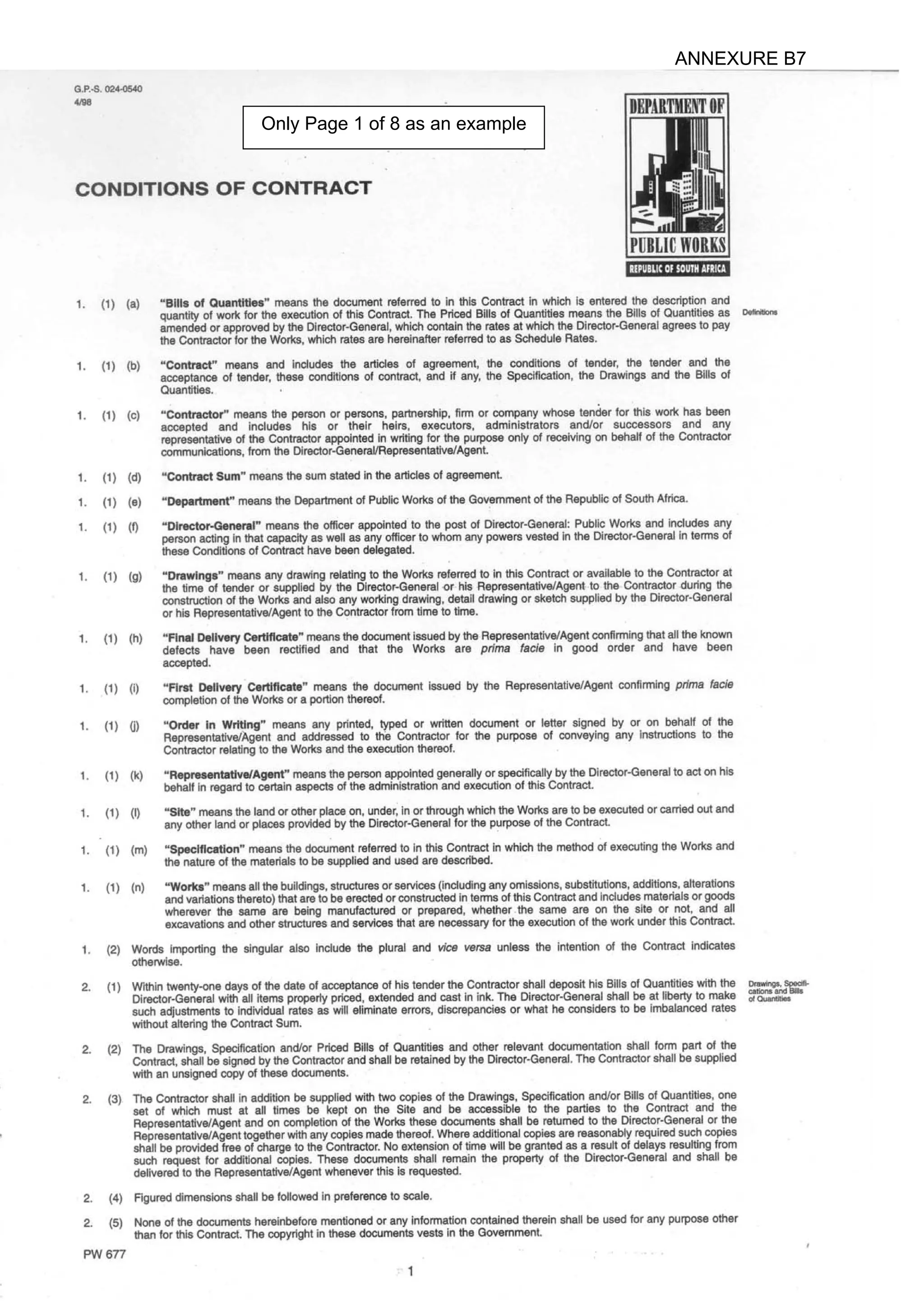
Conditions of Contract (PW 677, Annexure B7), the Department’s 
“Preliminaries etc. forming part of Bills of Quantities” (PW 772), the 
Department’s “Specification of Materials and Methods to be Used” 
(PW 371) and/or SABS 1200 (SANS 1200) as applicable, those 
documents contained in Annexure B8 and the Building Contract, or 
any other conditions of contract as prescribed by the Department for 
the contract. 
B.2.2.3 Any applicable clauses contained in Annexure B4 should be 
considered in compiling the Project Specification. 
16 
B.2.2.4 As per B.2.1.5. 
B.2.2.5 As per B.2.1.6. 
B.2.2.6 As per B.2.1.7. 
B.2.2.7 As per B.2.1.8. 
B.2.3 Civil Work included in the Building Contract Vide Clause A.14.3 
B.2.3.1 The document will be compiled by the Quantity Surveyor appointed 
for the service. 
B.2.3.2 Documentation prepared by the Quantity Surveyor will be based on 
those documents listed in Clause B.2.2.2 except for SABS 1200 
(SANS 1200). The Civil Engineering Consultant will be required to 
prepare tender drawings and a Project Specification relating to the 
civil works only, based on the Department’s “Specification of 
Materials and Methods to be Used” (PW 371).
B.2.3.3 Should the planning require certain matters to be stated in the 
tender (e.g. procedure clauses) these should be included in the 
project specification. In particular it must be stated that the defects 
liability period on the civil portion of the works will be 12 months, 
which differs from the requirement for the Building Contract. 
B.2.3.4 Estimating, scheduling and tender arrangements are the function of 
the Department and the Quantity Surveyor. The Civil Engineer is 
requested to assist the Quantity Surveyor wherever possible in this 
regard. 
17 
B.2.4 VAT and Contingencies 
Contractors must be registered in terms of the Value - Added Tax Act, (Act No. 
89 of 1991). Tendered rates and lump sums should make provision for the 
payment and recovery of any taxes, obligatory levies on all items to which they 
apply, but exclude Value Added Tax (VAT). Value-added tax shall be added to 
the sum of the total of the Schedule of Quantities in order to determine the 
Tender Sum. Should the rate at which VAT is charged be increased or 
decreased by legislation in relation to the rate applicable at the tender closing 
date, the difference in payment of VAT shall be borne by the employer or shall 
be to his benefit. 
No provision must be made for a contingency allowance in the contract 
documents. 
B.2.5 Penalties 
The penalty for late completion of the contract shall be calculated as described 
in the “Addendum to Notes to Consultant Quantity Surveyors on the 
Preparation of Bills of Quantities (QS37E, latest version)” available from the 
Departmental website. 
In the case of Nominated Sub-contracts the penalty which applies to the main 
contract will apply to the Sub-contract. 
B.2.6 Securities 
The following percentages of the estimate will be required for security: 
Estimate Percentage 
0 to R 100 000 : 0.00% 
R 100 001 to R 1 000 000 : 2.50% 
R 1 000 001 to R 3 000 000 : 5.00% 
R 3 000 000 to R 5 000 000 : 5.00% to 10.00% 
according to risk 
more than R 5 000 000 : 10.00% 
B.2.7 Limit of Retention 
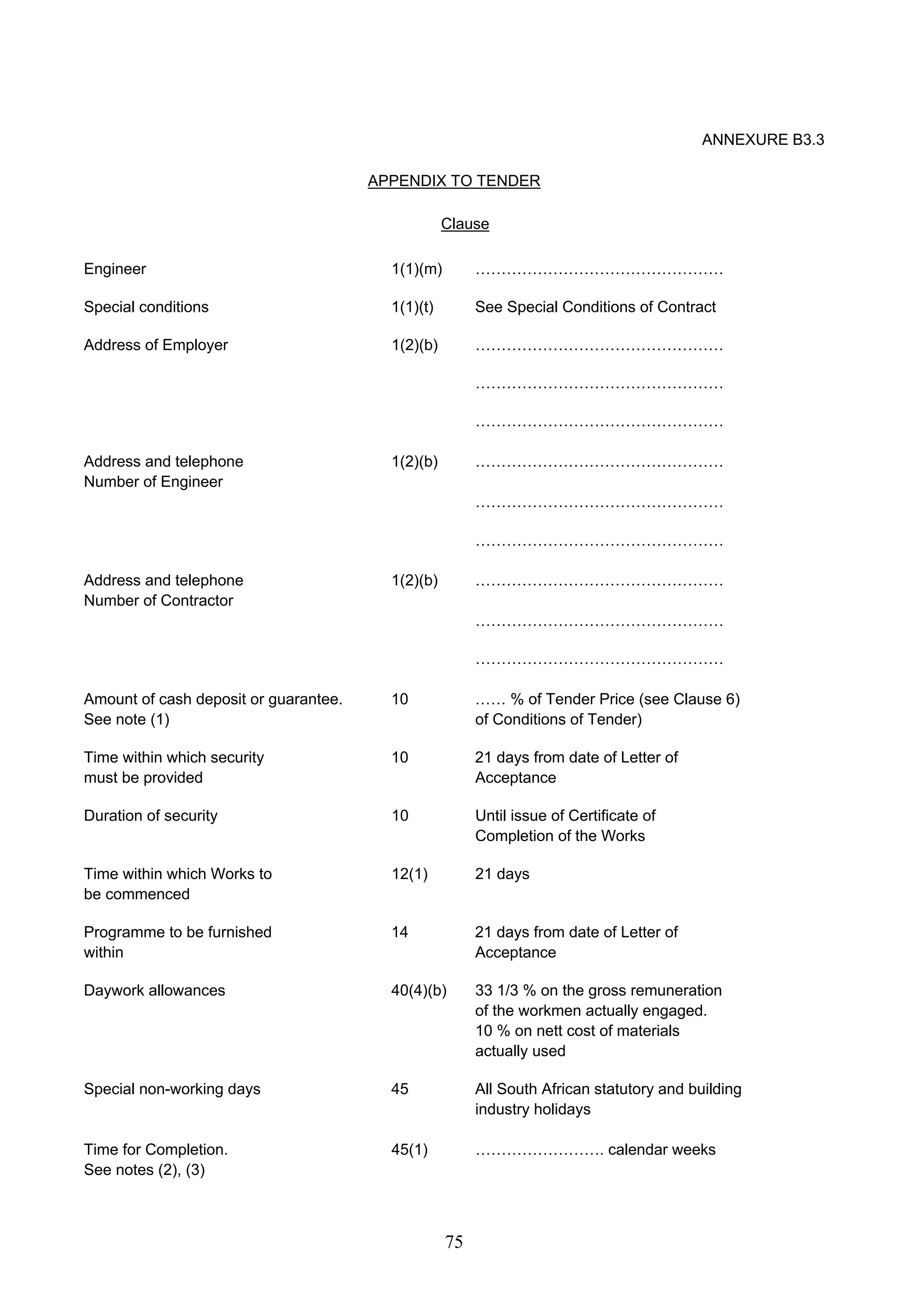
The Limit of Retention is usually taken as 10% of Tender Price, but may be 
reduced on large contracts in consultation with the Project Manager. 
Retention can be increased in lieu of security for contracts with an estimate of 
below R 2 million, as follows:
2,5% for projects more than R 100 000 to R 1 million 
5,0% for projects more than R 1 million to R 2 million 
18 
B.2.8 Design Calculations 
The Consultant shall exercise all reasonable skill, care and diligence in the 
execution of his work. He shall be responsible for breach of professional duty 
by reason of any error, omission or neglect by him in connection with the work 
performed by him or done under its auspices by Sub-designers and/or 
additional service providers. 
Design calculations must be done and kept in a systematic way. They shall be 
kept and safeguarded for at least 10 (ten) years. 
The Department reserves the right to request all calculations and to have any 
plans and calculations submitted by the Consultant checked and inspected with 
the knowledge of the Consultant, by another consulting firm or any other 
person or firm.
SECTION C: DESIGN GUIDE 
Clause Page 
C. DESIGN GUIDE............................................................................................................... 20 
C.1 PRECEDENCE OF DESIGN GUIDELINES....................................................................20 
C.2 DESIGN RESPONSIBILITY ............................................................................................20 
C.3 GENERAL GUIDELINES FOR SERVICES.....................................................................21 
C.4 SITE SURVEY.................................................................................................................22 
C.5 ROADS AND PARKING AREAS.....................................................................................22 
C.6 GEOTECHNICAL INVESTIGATION ...............................................................................24 
C.7 SOILS INVESTIGATION .................................................................................................25 
C.8 WATER SUPPLY.............................................................................................................25 
C.9 SANITATION ...................................................................................................................30 
C.10 STORM WATER..............................................................................................................34 
C.11 SUBSURFACE DRAINAGE ............................................................................................35 
C.12 EXISTING ELECTRICAL SERVICES .............................................................................36 
C.13 ENVIRONMENTAL ISSUES ...........................................................................................36 
C.14 SOLID WASTE DISPOSAL.............................................................................................37 
C.15 HAZARDOUS WASTE DISPOSAL .................................................................................38 
19
20 
C. DESIGN GUIDE 
C.1 PRECEDENCE OF DESIGN GUIDELINES 
Where applicable, services should generally be designed in accordance with the 
following documents, in the precedence shown: 
C.1.1 Applicable Laws and Acts of South Africa, especially with regard to 
environmental, water and effluent matters 
C.1.2 Departmental Directives, with special emphasis on directives regarding 
dolomitic areas. The following PRM forms are available from the 
Departmental Project Manager for work on dolomitic areas: PRM006, 
PRM007, PRM011, PRM012, PRM016, AND PRM018. 
C.1.3 SANS (previous SABS) Specifications. (All references to SABS documents 
are deemed to be references to the applicable SANS document as per 
Government Notice No. 1373 of 8 November 2002.) 
C.1.4 “Guidelines for Human Settlement Planning and Design” obtainable from the 
CSIR. 
C.1.5 Requirements of Local Authority where the relevant authority provides the fire 
services. In the case where the Local Authority’s requirements are more 
stringent than those described in this document, the Local Authority 
requirements shall prevail. 
In Section F is a table giving references to the newest Design Guidelines available. 
Section F will periodically be updated and published on the Departmental website, i.e. 
http://www.publicworks.gov.za. 
C.2 DESIGN RESPONSIBILITY 
Unless otherwise agreed to with the Departmental Project Manager in writing, and 
where applicable, the Consultant will inter alia be responsible for the design of the 
following: 
C.2.1 Bulk earthworks, excluding footprint areas of structures / buildings. 
C.2.2 All vehicle traffic areas, i.e. excluding pedestrian walkways except where 
these fall in the road verge. 
C.2.3 Aprons and drainage areas in dolomitic areas. 
C.2.4 Bulk water supply and main sewer pipelines, including pumping installations, 
if applicable. 
C.2.5 Water storage and purification, as well as sewage treatment if applicable. 
C.2.6 Main sewer pipelines, excluding plumbing. 
C.2.7 All external domestic water/fire mains and hydrants. Branch pipes to 
buildings are the responsibility of the Architect. 
C.2.8 Storm water drainage excluding rainwater disposal. 
C.2.9 External telecommunication and electrical ducting. 
C.2.10 Sports facilities (excluding buildings) to the extent agreed with the Project 
Manager. 
C.2.11 Solid Waste disposal
C.2.12 Railway sidings excluding electrification. 
C.3 GENERAL GUIDELINES FOR SERVICES 
C.3.1 On sites with existing installations the Consultant must contact the Regional 
Manager who will endeavor to point out the positions of existing water supply, 
sewers and electrical reticulations on site. 
C.3.2 Existing water and sewer information must also be gathered from the 
appropriate local authority and where applicable from the end user. This 
includes as-built information, local authority requirements and preferences on 
technical detail and operating data (e.g. water pressure, pipeline capacity, fire 
regulations, municipal bulk contributions, municipal connection fees, etc.), 
where applicable. Services to be relocated must be identified. 
C.3.3 Should the interface points between the internal system and the external 
system (Local Authority) be outside the boundaries of the property of the 
Client / User Department, the Local Authority should be approached to 
provide an interface point at the property boundary. If this cannot be done 
Treasury approval has to be obtained to work outside the said property. This 
aspect shall be thoroughly investigated and the financial implications thereof 
reported on at the report stage. 
C.3.4 The Consulting Engineer must perform a provisional site investigation to 
obtain site condition information with regard to: 
• soil type 
• existing services (or lack thereof) 
• general site surface conditions 
This does not include geotechnical and other detail investigations to be 
done by specialists 
C.3.5 The Consultant will be responsible to identify interface points of all wet 
services, and for the applications to the applicable local authority to connect 
into their existing services. 
C.3.6 In cases where no existing water services are available, the utilization of other 
sources such as bore holes or surface water must be investigated. In cases 
where no existing water or sewer services are available, a report 
recommending the preferred water and sanitation system to be used, must be 
forwarded to the Department for approval before detail design commences. 
C.3.7 The Consultant will only be responsible for the reticulation of bulk services on 
the inside of the departmental property from the property boundary. The 
Consultant however has to report on connection fees and bulk contributions 
of the local authority / bulk service provider. 
C.3.8 Special care must be taken for installation of services / ducting in dolomitic 
areas: The stipulations in the Departmental Guide re. Dolomite: 
• “Appropriate Development of Infrastructure on Dolomite: 
Guidelines for Consultants” 
21 
shall be adhered to.
22 
C.3.9 Ducting 
C.3.9.1 General 
The Civil Engineer is responsible for the co-ordination and detailing 
with respect to subsurface service ducting for other disciplines / 
consultants outside buildings. 
C.3.9.2 Electrical Ducting 
Attention is specifically drawn to the requirements of SABS 1200 LC 
(SANS 1200 LC) and the Departmental specifications for electrical 
work with respect to ducting for electrical services. 
C.3.9.3 Telecommunication Ducting 
Telecommunication ducting must be provided in accordance with the 
requirements of Telkom. The position of such ducting must be 
obtained from the Architect. 
C.3.9.4 Other Communication Ducting 
The position of ducting for any other communication services must be 
obtained from the Architect or Client / User Department where 
applicable (subject to approval of the Departmental Project 
Manager). Such ducting must be provided in accordance with the 
requirements of the supplier of the system. 
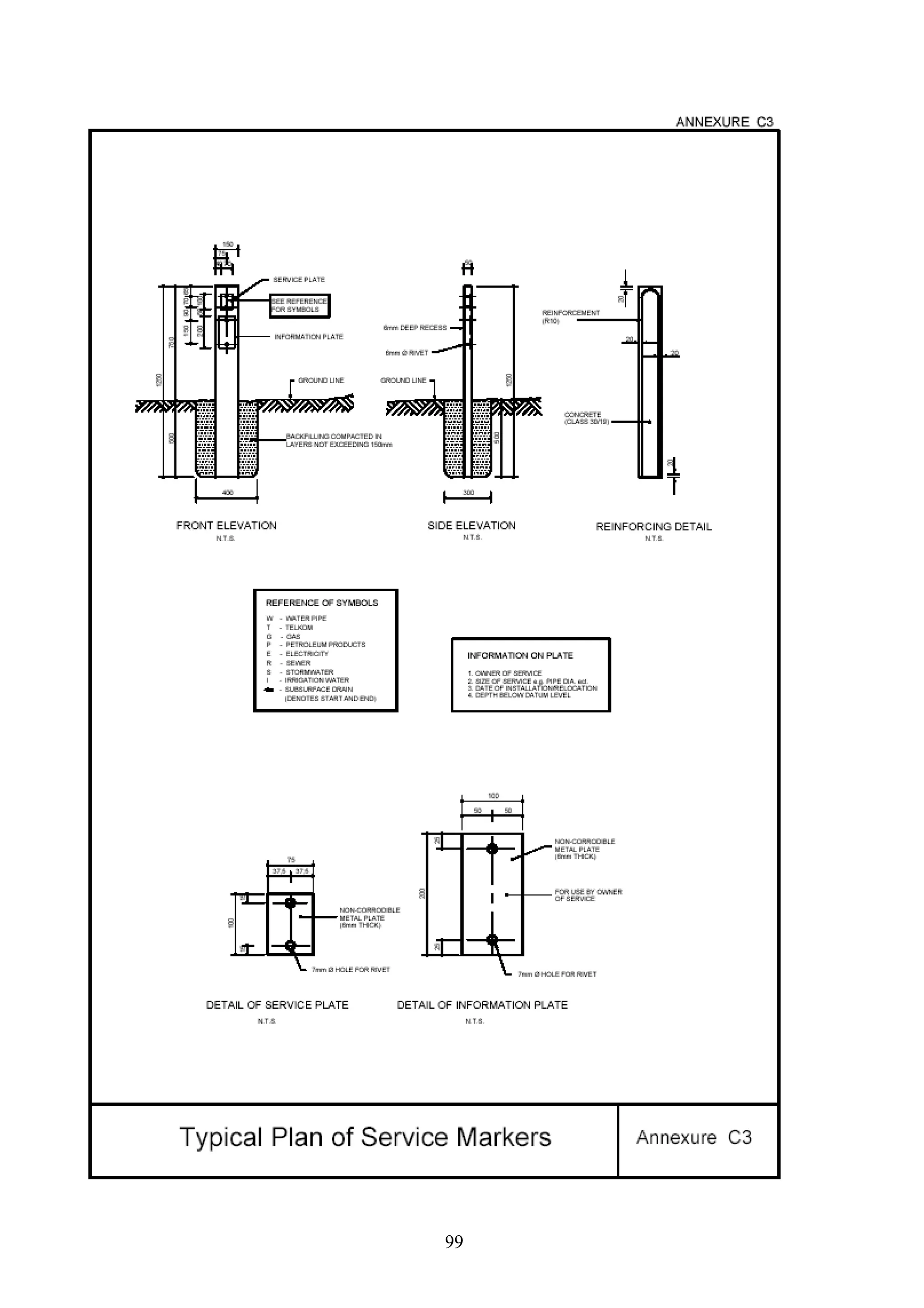
C.3.9.5 Service Markers 
Subsurface services and ducting must be marked with markers at 
turning points and at suitable intervals on straight sections. Details of 
service markers are given in Annexure C.3. 
C.4 SITE SURVEY 
C.4.1 Cognizance must be taken of section A.13 regarding the appointment of 
surveyors. 
C.4.2 The two primary objectives of the site survey are to provide: 
• A comprehensive plan of the site showing all the necessary detail 
and data required for the design and accurate siting of the 
proposed structure / project; 
• Permanently marked and accurately fixed (in plan and level) 
survey stations to be used for any future setting out, control of 
construction and subsequent monitoring. 
C.4.3 Detail to be surveyed 
The detail to be surveyed is described in Annexure C1 
C.5 ROADS AND PARKING AREAS 
C.5.1 Chapters 7 and 8 of “Guidelines for Human Settlement Planning and Design” 
should be used as basis for the design of roads, streets, accesses and 
parking areas. 
C.5.2 Appropriate values must be chosen for the following geometric design 
parameters, based on the proposed design speed for the road: 
• Horizontal curvature
• Gradients 
• Vertical curves 
• Sight distances 
• Design vehicle dimensions, determined by the type of facility 
being designed for. 
• Cross sectional element dimensions 
C.5.3 Special attention must be given to adequate surface drainage of parking 
areas. A minimum gradient of 0,5% must be used to avoid ponding of water. 
C.5.4 In areas / facilities with a high rate of pedestrians, care must be taken to 
avoid / minimize conflict points between vehicles and pedestrians. Sidewalks 
and or pedestrian walkways must be provided where required. 
C.5.5 When choosing a pavement design for a road or parking area, the following 
23 
must be taken into account: 
• The design lifetime of the facility. 
• The estimated E80 axle loading over the design lifetime. 
• Available construction materials 
• The macro-climatic region of South Africa in which the facility is to 
be constructed. 
• The prevention of water penetration through the pavement, 
especially in dolomitic areas. 
• The maintenance related to the type of pavement design. 
• Life – cycle cost of the pavement, taking into account both initial 
capital (construction cost) and maintenance costs over the lifetime 
of the pavement. 
C.5.6 Interlocking Blocks and Concrete Paving 
• Surfacing with interlocking blocks is generally preferred. 
• Surfacing with interlocking blocks should always be used where 
justified as result of traffic load, where oil and fuel leakage/spillage 
is likely to occur, e.g. parking areas, filling stations, where tight 
turning action by heavy vehicles would damage bituminous 
surfacing, etc. 
• Blocks with double interlock must be used for trafficked areas. 
• Cast in-situ concrete pavements should be considered for areas 
extensively used by heavy vehicles, and evaluated in terms of 
future maintenance. 
C.5.7 Bituminous surfacing 
• Bituminous surfacing should be considered for large areas to be 
surfaced, such as roads and streets in departmental complexes, 
due to a possible cost advantage. 
• A total lifecycle cost comparison is to be made to decide whether 
bituminous surfacing or interlocking blocks should be used. 
• Due consideration should be given to the lighter forms of 
surfacing such as single/double seals etc., where possible, for 
economic reasons.
24 
C.5.8 Traffic Engineering 
C.5.8.1 Traffic engineering is seen as a specialist competency. Cognizance 
must be taken of section A.13 regarding the appointment of 
specialists. A specialist traffic engineer must be appointed by the 
Consultant, with approval of the Departmental Project Manager, in 
cases where: 
• The location of the project has a marked impact on the traffic flow 
to and from the site, generally applicable in urban and industrial 
areas. 
• The internal traffic flow on the site is impacted markedly by the 
project. 
C.6 GEOTECHNICAL INVESTIGATION 
C.6.1 The purpose of a geotechnical investigation is to provide an accurate 
assessment of subsurface conditions. The investigation will assist the 
engineer in the selection of suitable foundation types, the preparation of 
adequate and economic foundation designs, the selection of appropriate 
embankment slopes and the preparation of reliable tender documents. It will 
also provide guidance to the Contractor in the preparation of his tender and 
the execution of the work. It is essential that the work be carried out in a 
competent manner, soil profiles are described using standard terminology, the 
results are reported in full and the validity of the information is not disclaimed. 
C.6.2 Depending on circumstances, investigations may extend from superficial 
visual inspections to sophisticated surface and subsurface testing. These will 
have to be agreed with the Departmental Project Manager at the appropriate 
stage of work. 
C.6.3 The Engineer shall submit for consideration a proposed investigation 
methodology with the Departmental Project Manager before commissioning 
any work on behalf of the Department. After agreement has been reached on 
the work to be undertaken and whether geophysical investigations are 
required, the engineer shall obtain at least three quotations for such 
geophysical investigations, and he shall submit a report including his 
recommendation to the Departmental Project Manager for a ruling. 
After the geophysical investigations have been completed the Engineer shall 
prepare draft tender documents for the detailed investigation which will 
include some or all the following: exploratory holes, in situ testing, laboratory 
testing, survey to set out and pick up positions and levels of exploratory 
holes, profiling holes, logging cores and photographing the cores. The draft 
documents shall be submitted to the Department for approval before tenders 
or quotations are obtained for the work. 
Tenders shall be invited for the work unless the estimated value of the work is 
considered by the Department to be too low to justify calling for tenders. In 
such cases, contractors selected with the approval of the Department shall be 
invited to quote for the work. See also Section A.13 in this regard. 
C.6.4 Geotechnical investigations should be carried out by geotechnical engineers 
(registered professional engineers) or engineering geologists (normally 
registered natural scientists) who are well experienced in the type of work 
envisaged. 
C.6.5 The investigation normally takes place in a number of phases. The phases 
include a desk study, site reconnaissance, preliminary fieldwork, detailed 
investigation and verification of conditions during construction. A guide to the
information, which may be obtained and reported on in the various phases, is 
given in Annexure C2: 
C.6.6 The following additional aspects have to be reported on in dolomitic areas: 
• The site shall be demarcated according to risk zones according to 
25 
current practice. 
• Describe and reference the methodology used in the risk 
characterisation of the site. 
• Outline the motivation for the risk characterisation of each zone. 
• Water boreholes, permanent or temporary natural water drainage 
features traversing the site. 
• Conditions of all wet services, canals, pipes and ducts which may 
convey water and water retaining structures with reference to 
water tightness (infiltration and exfiltration). 
C.6.7 Cognisance must be taken of the Departmental publication: “Appropriate 
Development of Infrastructure on Dolomite: Guidelines for Consultants”, in 
order to obtain a Clearance Certificate regarding dolomite. 
C.7 SOILS INVESTIGATION 
C.7.1 In-situ testing of soils for the construction of embankments, roads etc. is 
described in “TRH 14: Guidelines for road construction materials” 
C.7.2 Testing of soils for the construction of embankments, roads etc. in borrow pits 
is also described in “TRH 14: Guidelines for road construction materials” 
Borrow pits and/or quarries should be identified and investigated during the 
project design stage. The exploitation of materials is controlled by the 
Minerals Act No. 50 of 1990. It is a requirement that a Standard 
Environmental Management Programme be lodged with the relevant 
Regional Director of the Department of Minerals and Energy. 
C.8 WATER SUPPLY 
C.8.1 SABS 0252-1 (SANS 10252-1):1993 “Part 1: Water Supply Installations for 
Buildings” must be used in the choice and design of a specific water supply 
system. Cognisance should also be taken of Chapter 9 of “Guidelines for 
Human Settlement Planning and Design”. 
C.8.2 The potential sources of water, the sustainability thereof and the water quality 
must first be assessed when planning a water supply scheme for the project. 
Careful consideration should be taken of water pressure sensitivity of the 
water supply measured over at least a 24-hour normal workday cycle. 
C.8.3 The most general water sources are potable water from bulk supply pipelines 
and boreholes. The preferred water supply system shall be water of a 
suitable quality provided by the Local Authority. The method, which is 
however selected, shall be thoroughly investigated and the financial feasibility 
thereof motivated at the report stage. 
C.8.4 The following basic principles must be adhered to when developing a water 
supply scheme from boreholes: 
• The presence, quantity and depth of underground water cannot 
normally be predicted beforehand with a high degree of accuracy.
• A reputed specialist, prior to any final design criteria being 
established, should investigate existing boreholes and wells in the 
area. 
• If needed, the Consultant will appoint a specialist to determine the 
most likely sites, subject to the approval of the Department, as 
described in Section A.13. 
• When reverting to boreholes, a reputable driller registered with the 
Borehole Water Association of South Africa should be used. 
• Siting and drilling of boreholes should be executed in terms of the 
relevant sections of SABS 0299 (SANS 10299 Parts 0 to 9) and 
the Association’s publication “Minimum Code of Practice for 
Borehole Consumption and Pump Installation”. 
• In all cases, ground water should be analysed to determine its 
fitness for human consumption, manufacture of concrete as well 
as possible effects on pipe systems, etc. The publication “Quality 
of Domestic Water Supplies, Vol. 1: Assessment Guide (1998)” by 
the Water Research Commission is to be consulted in this regard. 
• The determination of borehole yield should be done in accordance 
with the Guidelines. 
• The supply of an Operation and Maintenance Manual is 
mandatory and shall be forwarded to the Department as a draft 
with the preliminary design report and drawings, and in final 
format one month before commissioning of the system. 
• A new set of boreholes has to be licensed by the Department of 
Water Affairs and Forestry for use by the Client / User 
Department. The Civil Engineer must facilitate the application 
procedure. 
C.8.5 Requirements regarding water storage on site must be in accordance with the 
Guidelines and be discussed with the Project Manager. The purpose of 
storing water is to meet pressure balancing requirements and to cater for 
emergencies e.g. fire fighting, planned shutdowns and forced containment of 
imprisoned people, etc. 
C.8.6 Cognisance must be taken of pressure requirements, annual average daily 
flow, peak flows and summer peak flows as described in the Guidelines, to 
design water supply systems. A realistic factor shall be applied to take into 
account the deterioration of flow due to the internal corrosion of the pipe work 
in the supply network. A factor after 50 years of usage should be adopted. 
26 
C.8.7 Pipe Materials 
The most commonly used pipes are galvanised mild steel pipes to SABS 62 
(SANS 62) for above ground applications. The other available materials are 
the plastics, which include polyvinyl chloride (PVC), unplasticised polyvinyl 
chloride (uPVC), high-density polyethylene (HDPE) and polypropylene (PP). 
Concrete pipes are not recommended in reticulation systems. 
Special attention shall be given during the design of water supply pipelines to 
the corrosive nature and other properties of the in-situ soil and their effect on 
pipeline materials proposed for the project. Soil tests shall be carried out to 
determine the effect of the soil properties on the pipe materials proposed. 
Galvanic action as a result of pipe / acidic soil or electrical interaction shall be 
investigated and appropriate measures to prevent this phenomenon shall be 
investigated and reported on. 
The materials to be used shall be agreed upon by the Department and the 
Local Authority at the report stage.
Depending on economy, water quality and site conditions, the use of uPVC 
pipes is preferred by the Department for pipes larger than 75mm diameter 
and HDPE for pipes equal to and smaller than 75mm diameter. 
In dolomitic areas only HDPE pipes may be used underground, unless 
specifically approved otherwise by the Department. 
Internal burrs of welded pipes shall be removed on completion of the welding 
or limited in height where approved by the Department. 
The use of resilient seal valves is preferred. Valves must be clockwise 
closing. The positions of air and scour valves shall be carefully determined 
during the detail design of the pipe system. 
All necessary tools to open valves and manhole covers shall be supplied as 
part of the Contract. A minimum of two tools for each application is required. 
C.8.8 Fire requirements and Hydrants 
Cognisance must be taken of the most recent Departmental publications 
regarding fire security, i.e. “Standard Technical Specification for a Pump 
Installation for Automatic Sprinkler Fire Extinguishing System”, “Schematic 
Diagram for a Fire Pump Installation”, as well as “Guidelines for Human 
Settlement Planning and Design, SABS 090 (SANS 10090) and SABS 0400 
(SANS 10400). 
The fire requirements as set out in the Guidelines, are usually the overriding 
criteria for the flow requirements in the design of a water distribution pipe 
network and SABS 0252 (SANS 10252-1) or SABS 0400 (SANS 10400) for 
hydrants and hose reels at buildings. Requirements depend on the risk 
category and standards have been set on the basis of a minimum flow for a 
given period (a) from a single hydrant and (b) from a group of hydrants within 
a given area. 
Table 1 in Part A, “Administration”, of SABS 0400 (SANS 10400) classifies 
buildings according to their occupancy and from the tables in Part T, “Fire 
Protection”, the risk category for each occupancy class can be deduced. Part 
W, “Fire Installation”, provides the guidelines regarding provision of water for 
fire fighting purposes. 
It is also important to obtain local fire regulations and requirements as well as 
to determine the ability (booster pumps, etc.) of the appropriate local authority 
to assist with fire activities. As far as possible, these parameters must be 
included and reported on in the fire design of the water distribution system. 
The capacity and ability of the Local Authority to assist in fire fighting 
activities must be ascertained and reported on. 
Where possible, hydrants should only be installed on pipes 75mm in diameter 
or larger. Hydrants must be constructed in accordance with the details 
provided in the Department’s standard drawings. 
The material used for water and fire mains must be specified to be at least 
class 9 uPVC according to SABS 966 (SANS 966) or class 10 HDPE to 
SABS ISO 4427 (SANS 4427). 
Internal burrs of welded pipes shall be removed on completion of the welding 
or limited in height where approved by the Department. 
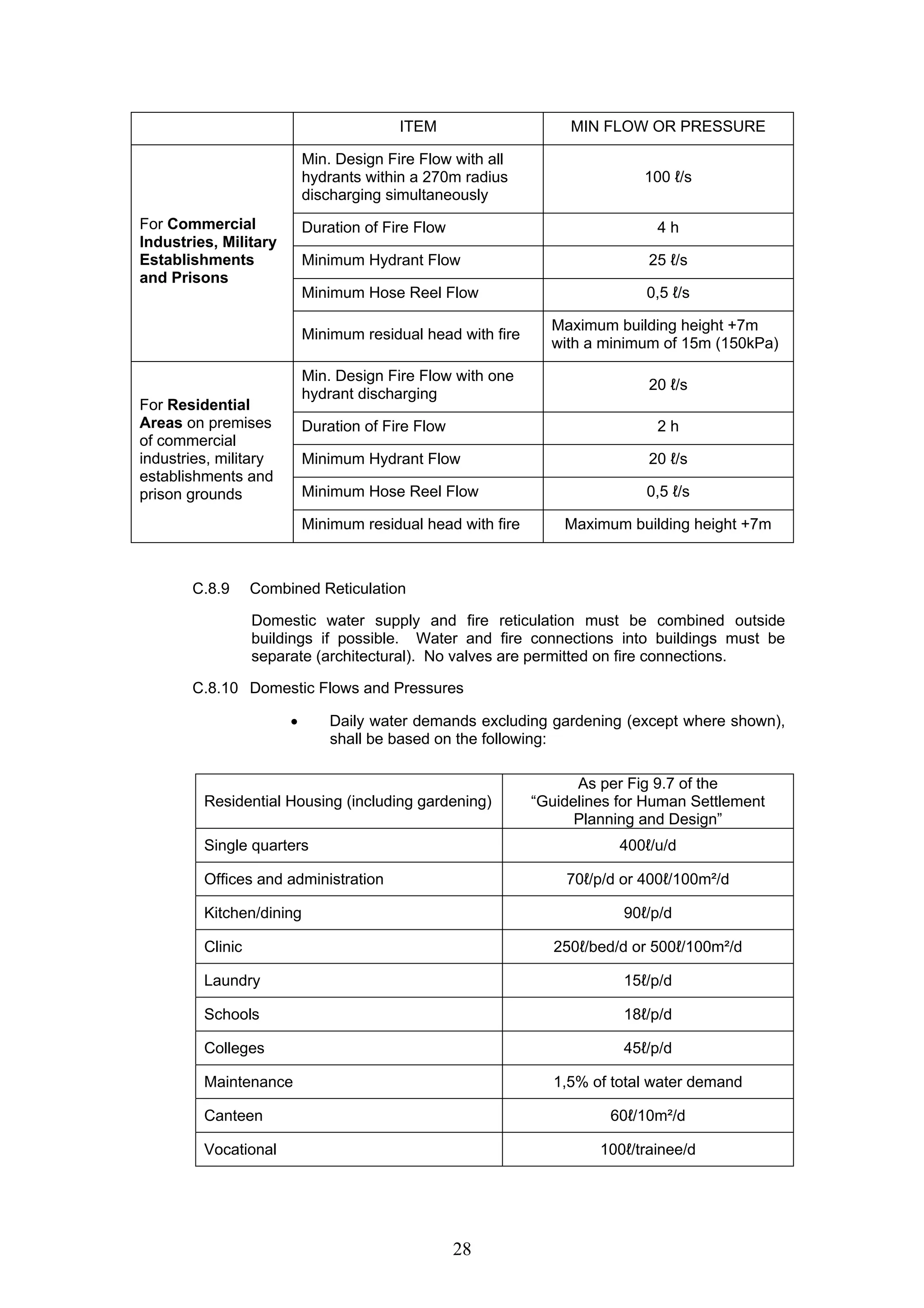
See following table for proposed fire water flows and pressures. 
27
ITEM MIN FLOW OR PRESSURE 
Min. Design Fire Flow with all 
hydrants within a 270m radius 
discharging simultaneously 
28 
100 ℓ/s 
Duration of Fire Flow 4 h 
Minimum Hydrant Flow 25 ℓ/s 
Minimum Hose Reel Flow 0,5 ℓ/s 
For Commercial 
Industries, Military 
Establishments 
and Prisons 
Minimum residual head with fire Maximum building height +7m 
with a minimum of 15m (150kPa) 
Min. Design Fire Flow with one 
hydrant discharging 20 ℓ/s 
Duration of Fire Flow 2 h 
Minimum Hydrant Flow 20 ℓ/s 
Minimum Hose Reel Flow 0,5 ℓ/s 
For Residential 
Areas on premises 
of commercial 
industries, military 
establishments and 
prison grounds 
Minimum residual head with fire Maximum building height +7m 
C.8.9 Combined Reticulation 
Domestic water supply and fire reticulation must be combined outside 
buildings if possible. Water and fire connections into buildings must be 
separate (architectural). No valves are permitted on fire connections. 
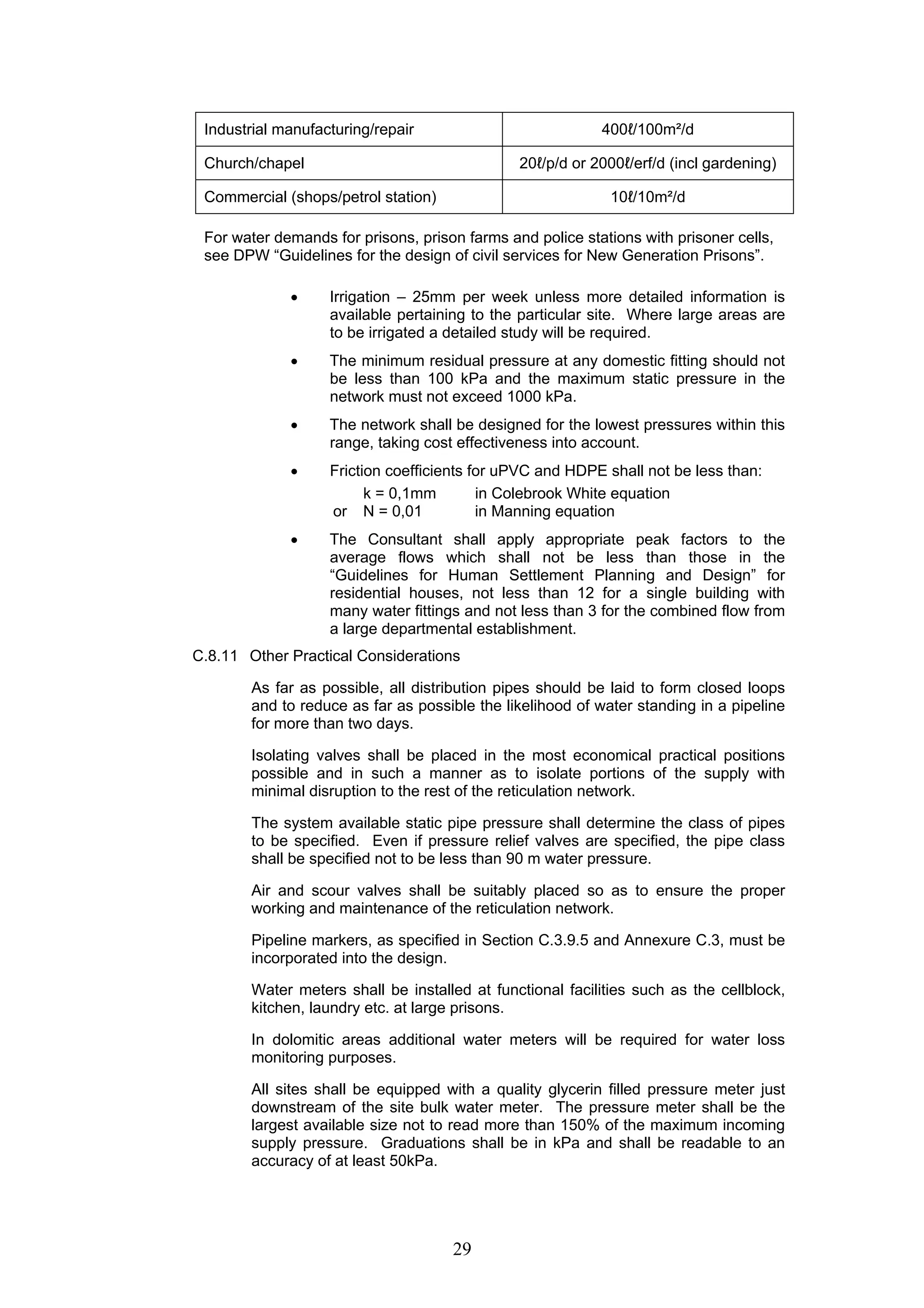
C.8.10 Domestic Flows and Pressures 
• Daily water demands excluding gardening (except where shown), 
shall be based on the following: 
Residential Housing (including gardening) 
As per Fig 9.7 of the 
“Guidelines for Human Settlement 
Planning and Design” 
Single quarters 400ℓ/u/d 
Offices and administration 70ℓ/p/d or 400ℓ/100m²/d 
Kitchen/dining 90ℓ/p/d 
Clinic 250ℓ/bed/d or 500ℓ/100m²/d 
Laundry 15ℓ/p/d 
Schools 18ℓ/p/d 
Colleges 45ℓ/p/d 
Maintenance 1,5% of total water demand 
Canteen 60ℓ/10m²/d 
Vocational 100ℓ/trainee/d
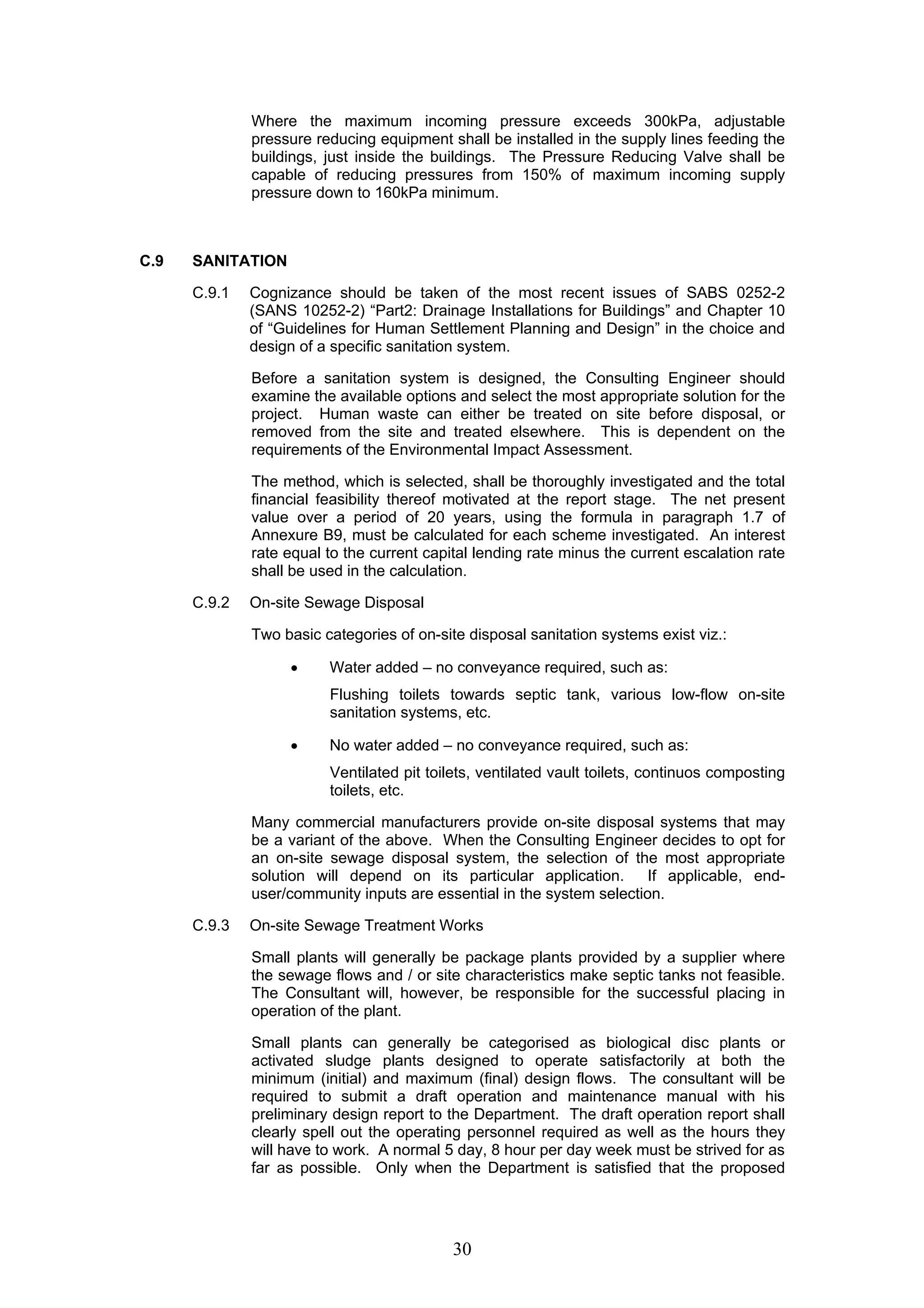
Industrial manufacturing/repair 400ℓ/100m²/d 
Church/chapel 20ℓ/p/d or 2000ℓ/erf/d (incl gardening) 
Commercial (shops/petrol station) 10ℓ/10m²/d 
For water demands for prisons, prison farms and police stations with prisoner cells, 
see DPW “Guidelines for the design of civil services for New Generation Prisons”. 
• Irrigation – 25mm per week unless more detailed information is 
available pertaining to the particular site. Where large areas are 
to be irrigated a detailed study will be required. 
• The minimum residual pressure at any domestic fitting should not 
be less than 100 kPa and the maximum static pressure in the 
network must not exceed 1000 kPa. 
• The network shall be designed for the lowest pressures within this 
range, taking cost effectiveness into account. 
• Friction coefficients for uPVC and HDPE shall not be less than: 
k = 0,1mm in Colebrook White equation 
or N = 0,01 in Manning equation 
• The Consultant shall apply appropriate peak factors to the 
average flows which shall not be less than those in the 
“Guidelines for Human Settlement Planning and Design” for 
residential houses, not less than 12 for a single building with 
many water fittings and not less than 3 for the combined flow from 
a large departmental establishment. 
C.8.11 Other Practical Considerations 
As far as possible, all distribution pipes should be laid to form closed loops 
and to reduce as far as possible the likelihood of water standing in a pipeline 
for more than two days. 
Isolating valves shall be placed in the most economical practical positions 
possible and in such a manner as to isolate portions of the supply with 
minimal disruption to the rest of the reticulation network. 
The system available static pipe pressure shall determine the class of pipes 
to be specified. Even if pressure relief valves are specified, the pipe class 
shall be specified not to be less than 90 m water pressure. 
Air and scour valves shall be suitably placed so as to ensure the proper 
working and maintenance of the reticulation network. 
Pipeline markers, as specified in Section C.3.9.5 and Annexure C.3, must be 
incorporated into the design. 
Water meters shall be installed at functional facilities such as the cellblock, 
kitchen, laundry etc. at large prisons. 
In dolomitic areas additional water meters will be required for water loss 
monitoring purposes. 
All sites shall be equipped with a quality glycerin filled pressure meter just 
downstream of the site bulk water meter. The pressure meter shall be the 
largest available size not to read more than 150% of the maximum incoming 
supply pressure. Graduations shall be in kPa and shall be readable to an 
accuracy of at least 50kPa. 
29
Where the maximum incoming pressure exceeds 300kPa, adjustable 
pressure reducing equipment shall be installed in the supply lines feeding the 
buildings, just inside the buildings. The Pressure Reducing Valve shall be 
capable of reducing pressures from 150% of maximum incoming supply 
pressure down to 160kPa minimum. 
30 
C.9 SANITATION 
C.9.1 Cognizance should be taken of the most recent issues of SABS 0252-2 
(SANS 10252-2) “Part2: Drainage Installations for Buildings” and Chapter 10 
of “Guidelines for Human Settlement Planning and Design” in the choice and 
design of a specific sanitation system. 
Before a sanitation system is designed, the Consulting Engineer should 
examine the available options and select the most appropriate solution for the 
project. Human waste can either be treated on site before disposal, or 
removed from the site and treated elsewhere. This is dependent on the 
requirements of the Environmental Impact Assessment. 
The method, which is selected, shall be thoroughly investigated and the total 
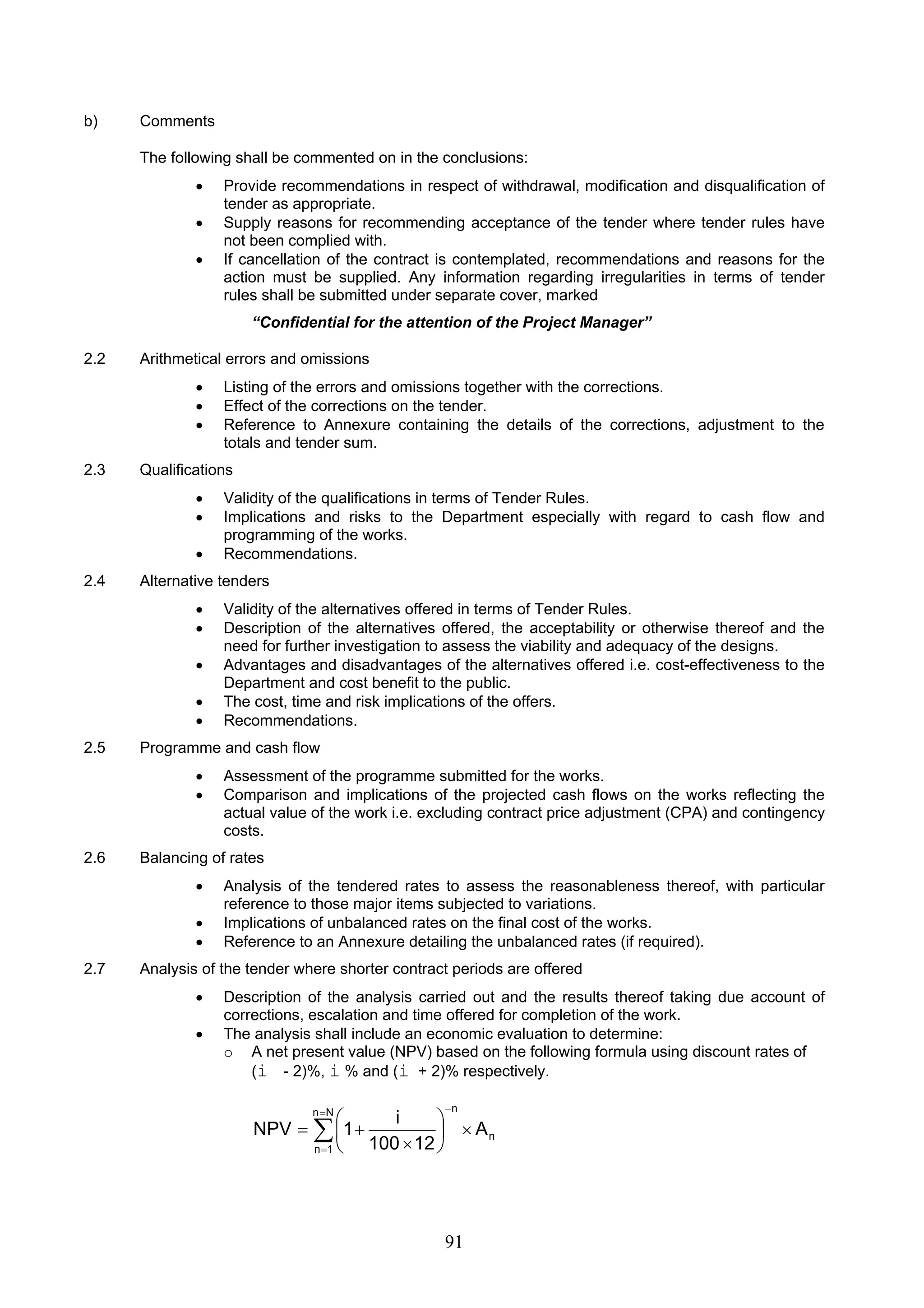
financial feasibility thereof motivated at the report stage. The net present 
value over a period of 20 years, using the formula in paragraph 1.7 of 
Annexure B9, must be calculated for each scheme investigated. An interest 
rate equal to the current capital lending rate minus the current escalation rate 
shall be used in the calculation. 
C.9.2 On-site Sewage Disposal 
Two basic categories of on-site disposal sanitation systems exist viz.: 
• Water added – no conveyance required, such as: 
Flushing toilets towards septic tank, various low-flow on-site 
sanitation systems, etc. 
• No water added – no conveyance required, such as: 
Ventilated pit toilets, ventilated vault toilets, continuos composting 
toilets, etc. 
Many commercial manufacturers provide on-site disposal systems that may 
be a variant of the above. When the Consulting Engineer decides to opt for 
an on-site sewage disposal system, the selection of the most appropriate 
solution will depend on its particular application. If applicable, end-user/ 
community inputs are essential in the system selection. 
C.9.3 On-site Sewage Treatment Works 
Small plants will generally be package plants provided by a supplier where 
the sewage flows and / or site characteristics make septic tanks not feasible. 
The Consultant will, however, be responsible for the successful placing in 
operation of the plant. 
Small plants can generally be categorised as biological disc plants or 
activated sludge plants designed to operate satisfactorily at both the 
minimum (initial) and maximum (final) design flows. The consultant will be 
required to submit a draft operation and maintenance manual with his 
preliminary design report to the Department. The draft operation report shall 
clearly spell out the operating personnel required as well as the hours they 
will have to work. A normal 5 day, 8 hour per day week must be strived for as 
far as possible. Only when the Department is satisfied that the proposed
process can be successfully operated with normal operators and assistants, 
will the Department authorise detail design. 
Should the Department conceive that the proposed process will create 
difficult, error prone or costly maintenance conditions, the Department will 
require the consultant to submit an alternative design. 
The capability of the plant to be successfully operated by a normal operating 
team as defined in the Water Act, remains the sole responsibility of the 
Consultant. 
The final and complete Operating and Maintenance Manual shall be supplied 
one week after the successful commissioning of the sewage treatment plant. 
C.9.4 Sewage Treatment at Central Municipal Works, i.e. Municipal Connection 
The design of a sewer system must be in accordance with the relevant 
sections of the most recent issues of SABS 1200 (SANS 1200) and SABS 
0252-2 (SANS 10252-2). 
The proposed sewer system shall be capable of conveying the proposed 
flows taking into account the average daily flows and peak flows that may 
occur. The existing system shall be checked for capability of maintaining the 
proposed additional flows added to it. 
The peak flow factor to be designed for should be 3.5 for populations smaller 
than 1 000, 2.5 for populations of 1 500; which can be reduced to 2.0 if a 
population of more than 3 000 is served. Intermediate values can be 
interpolated. 
The flows should be designed for a seepage factor of 15%. 
Where gravity flow or pumping of sewage to a central treatment plant is not 
feasible, on site septic tanks must be considered. Conservancy tanks with 
sufficient capacity can be considered as a last resort. The design of the 
conservancy tank must be done in consultation with the Local Authority, 
taking into account their capacity to empty the tanks. 
31 
C.9.5 Manholes 
The use of precast concrete manholes is preferred, but in-situ concrete and 
engineering brick manholes are also acceptable. A class I mortar must be 
specified for bricklaying. Manholes must not be plastered. 
Dolomite aggregates must be specified for use in concrete for manhole 
products. 
Waterproofing of joints in precast manholes is mandatory. Waterproofing 
tests on manholes must be done after construction. Special care must be 
taken to construct the benching of a manhole with smooth transitions and 
according to specification. 
Standards for precast manhole segments are covered in SABS 1294 (SANS 
1294). 
The special measures specified in the Departmental publication: PW 344, 
“Appropriate Development of Infrastructure on Dolomite: Guidelines for 
Consultants”, must be strictly adhered to in dolomitic areas. 
All the necessary tools to open manholes shall be supplied with the Contract. 
A minimum of two tools for each application is required.
32 
C.9.6 Pipe Materials 
There are a number of types of pipes used for the construction of sewers, 
such as vitrified clay, reinforced concrete (dolomitic aggregates) and rigid 
class 34 uPVC pipes (SABS 791 / SANS 791). It is the Department’s 
preference to specify vitrified clay pipes in sizes up to 300mm and where 
applicable, reinforced concrete (dolomitic aggregates) for larger diameters. 
Internal burrs of welded pipes shall be removed on completion of the welding 
or limited in height where approved by the Department. 
The special measures specified in the Departmental publication: “Appropriate 
Development of Infrastructure on Dolomite: Guidelines for Consultants”, must 
be strictly adhered to in dolomitic areas. 
C.9.7 Pumped Sewage Installations 
C.9.7.1 General 
Gravity flow is the preferred method of sewage conveyance. 
Pumping sewage should only be considered after all alternatives 
have been investigated to the fullest consequence. Only if the 
alternatives are not feasible or impossible, pump stations can be 
considered. 
The design and planning of a sewage pumping station involves the 
integration of various disciplines. The location of a pump station is 
important and a comprehensive study should be made to ensure that 
the area to be served can be adequately drained. Furthermore 
attention should also be given to the location of the station as it could 
very well determine the overall development of the area. 
The preparation of an Operating and Maintenance Manual is 
mandatory and must be forwarded to the Department simultaneous 
with the Design Report and Tender Drawings. This Preliminary 
Manual shall describe the operation of the pump station and need not 
include the manuals of equipment suppliers. The final and complete 
Operating and Maintenance Manual shall be supplied one week after 
the successful commissioning of the pump station. 
The departmental “Guidelines for Design and Construction of Pump 
Stations”, Annexure C4. must be used in the design of sewage pump 
stations. 
C.9.7.2 Pump stations 
There is a whole range of different types of pump stations varying 
from simple sumps to large elaborate complexes. Basically there are 
two types, namely the Wet Well Station and the Dry Well Station. A 
proper investigation should be carried out to determine the 
appropriate type of pump station to be provided. 
The Wet Well Station normally consists of a sump, which contains 
both the sewage discharged from the outfall sewer and the 
submersible pumps themselves. The Department is not in favour of 
submersible pumps and prefers suction pumps mounted at ground 
level. These stations are normally considered for smaller 
installations where the flow is not excessive. The sumps are not 
generally accompanied by above ground buildings when submersible 
pumps are used, with electrical switchgear housed in simple 
weatherproof kiosks.
In a Dry Well Station, the pumps are located in the dry well adjacent 
to the wet well. Dry Well Stations have generally been used where 
the volume of sewage to be pumped is large, where the pumping 
head is large or where the depth of the incoming sewer is substantial. 
The arrangement of the dry well to the wet well should preferably 
allow for the pumps to have a positive suction head at all times, but 
this is not absolutely necessary. 
The requirements for sewer manholes given elsewhere in these 
guidelines apply to the design of pump station wells. 
All the necessary tools and equipment to operate the pump station 
shall be supplied with the Contract, except for the tools to carry out 
repair work. 
33 
C.9.7.3 Pump selection 
The most important aspect of sewage pumping station design is that 
of the choice of the pumps themselves. Design information and 
product detail are readily available from specialist pump 
manufacturers. 
The pumps shall be chosen and designed in order to maintain the 
duty flow and head for any given situation, and adequate provision in 
the design shall be made for a back-up system when pump 
maintenance or breakdowns occur. 
Cognisance must be taken of the safeguards as specified in 
paragraph 4 of Annexure C4. 
C.9.7.4 Pipework 
The pipework in a sewage pumping station has to be carefully sized 
and laid out to prevent blockages. The number of bends should be 
limited and care must be taken to ensure that deposits that occur 
during off pumping periods do not prevent the subsequent pump 
operation. The preferred pipe material inside a pipe station is cast 
iron, ductile iron or corrosion protected steel pipes. Rising main 
pipes can be uPVC, corrosion protected steel pipes or preferably 
HDPE pipes. 
C.9.7.5 Safety and Cleanliness 
Stairways are preferable to ladders or step irons and stainless steel 
handrailings must be provided. Other safety features are non-slip 
treads and rubber mats in front of switchgear. 
When step irons are provided, they shall be of the fully plastic 
encapsulated type. 
Good pressure water supply for hosing down internal and external 
floors and walls should be encouraged, adequately dealing with such 
effluent to drain towards a suitable disposal point. 
C.9.8 Sewage Flows 
The average daily sewage design values to be utilised for prisons, prisoner 
holding cells and prison farms are set out in the departmental PW 342, 
“Guidelines for the Design of Civil Services for New Generation Prisons”.
The table below supplies average daily sewage design flows for other works 
of the Department: 
DESCRIPTION DESIGN VALUE 
Residential Housing 900 ℓ/h/d 
Single Quarters 360 ℓ/u/d 
Offices and Administration 67 ℓ/p/d 
Kitchen 81 ℓ/p/d 
Clinic 225 ℓ/bed/d 
Laundry 14,3 ℓ/pr/d 
Educational 43 ℓ/student/d 
Maintenance 1,35 % of total water intake/d 
Canteen 57 ℓ/10m² 
Vocational 70 ℓ/trainee/d 
Commercial including petrol stations 8,5 ℓ/10m²/d 
Chapel or church 19 ℓ/p/d 
Schools 37 ℓ/p/d 
Industrial / manufacturing / repair 140 ℓ/p/d 
Friction coefficients for uPVC and HDPE shall not be less than: 
k = 0,6mm in Colebrook White equation 
or N = 0,012 in Manning equation 
The consultant shall apply appropriate peak factors to the average sewage 
flows which shall not be less than 5 for a single house, not less than 10 for a 
single building with many water fittings and not less than 2,5 for the combined 
sewage flow from a large departmental establishment. 
34 
C.10 STORM WATER 
C.10.1 The requirements for storm water management are described in the 
“Guidelines for Human Settlement Planning and Design”, Chapter 6. It 
includes the requirements for the design flood frequencies for minor and 
major systems for the appropriate land use as well as relevant environmental 
issues. Tables 6.1 and 6.2 of the Guidelines, duplicated below, give the 
design flood recurrence intervals. 
Table 6.1: Design flood frequencies for major systems 
LAND USE DESIGN FLOOD RECURRENCE INTERVAL 
Residential 50 years 
Institutional (e.g. schools) 50 years 
General commercial and industrial 50 years 
High value central business districts 50 – 100 years 
Table 6.2: Design flood frequencies for minor systems 
LAND USE DESIGN FLOOD RECURRENCE INTERVAL 
Residential 1 – 5 years 
Institutional (e.g. schools) 2 – 5 years 
General commercial and industrial 5 years 
High value central business districts 5 – 10 years
A minimum recurrence interval of 2 years shall be used for minor systems 
except in high risk dolomite areas where the minimum recurrence interval 
shall be 5 years for minor systems. 
C.10.2 The National Water Act, Act 36 of 1998, must be read in conjunction with the 
above-mentioned document. According to section 144 of the Act, a 100-year 
recurrence interval flood line must be shown on residential / institutional 
development plans. 
C.10.3 The determination of flood lines is a specialist competency and the 
Consultant may appoint a specialist, with approval of the Department, if 
necessary. The stipulations in Section A.13 must be adhered to in this 
regard. 
C.10.4 The recommended minimum size of sediment carrying storm water pipes is 
450 mm diameter, and shall as far as possible be “self-cleansing”. The 
minimum acceptable class of pipe to be used has to withstand a 45,0 kN per 
metre length of pipe load for class D Proofloading as described in SABS 677 
(SANS 677), unless there is no possibility of vehicle loads occurring. In 
addition, if vehicle loads are expected, the strength of the pipe must be 
designed accordingly for traffic loads. 
Storm water pipes in dolomite areas shall be of HDPE except where 
otherwise approved by the Department. 
C.10.5 All the necessary tools to open manholes shall be supplied with the Contract. 
A minimum of two tools for each type is required. 
35 
C.11 SUBSURFACE DRAINAGE 
C.11.1 General Sub-Surface Drainage 
The Consultant shall review and report on the relevant and / or geotechnical 
information to assess the need to provide a subsoil drainage system. 
Subsurface drainage is an important element in the management of water. 
The handling of subsurface drainage is extensively covered in the TRH 15 
document “Subsurface Drainage for Roads” published by the CSIR. Although 
this document is specifically aimed at subsurface drainage for roads, the 
basic principles can be used for other applications. 
In dolomite areas subsurface drainage may not be allowed except if designed 
by a specialist in construction on dolomite areas. 
C.11.2 Sub-Surface Drainage Systems for Buildings 
Special attention shall be given to the waterproofing of basements and the 
removal of subsurface water in buildings. Particular attention shall be given 
to the provisions in SABS 021 (SANS 10021) “The waterproofing of buildings” 
The outside of basement walls shall be adequately waterproofed and a 
drainage system shall drain the subsurface water through the basement walls 
into collector drains inside the building. The water from these drains shall 
drain into a sump to be pumped into a suitable point of the storm water 
system around the building. 
Sumps shall generally be provided in the basement or at lift shafts and de-watering 
shall be accommodated by means of electric pumps. The pump 
shall be designed such that the maximum calculated design flow can be 
accommodated. The system should be designed with electronic controls and 
alarm systems so that adequate warning of flooding can be given if the
pumps fail to switch on in time. These pumps shall be wired to be powered 
off the electrical emergency supply system. 
The supply of an Operation and Maintenance Manual is mandatory and shall 
be forwarded to the Department in draft form together with the preliminary 
design report and drawings and in final format one month before 
commissioning of the system. 
36 
C.12 EXISTING ELECTRICAL SERVICES 
C.12.1 Existing Cables 
Any existing underground cables must be specified to be encased in suitable 
split pipes, before new roads are constructed over them, as part of the civil 
engineering contract. Permanent markers must also be provided, e.g. in the 
kerbing, to show where sleeves or cables cross under the roads. Service 
markers, as specified in Section C.3.9.5 and Annexure C3, must be 
incorporated into the design as an alternative to markers in the kerbing. 
Cables shall be installed at least 1m (one metre) below the road surface. 
C.12.2 Alterations to Existing Reticulation 
If instructed to do so by the Departmental Project Manager, and should any 
work be required on the existing electrical system such as re-routing or 
lowering of underground cables, moving of overhead lines, making safe 
against damage of existing electrical services and telephone cables etc., the 
Department must appoint an Electrical Consulting Engineer to do the 
planning and specifying of such work. Any such work, if involved, must form 
part of the civil engineering contract, and allowances must be made in the 
schedule of quantities and estimate for any such work. This electrical sub-document 
must be compiled by the Electrical Consulting Engineer. 
Ducting in dolomitic areas shall also be treated in accordance with Section 
C.3.8. 
C.12.3 Electrical Sub-contractor 
The contract documentation must make provision for the civil contractor to 
appoint an accredited electrical contractor to undertake any such electrical 
work. The Sub-contractor must be in a position to make an electrician 
available at all times to make good any damage caused to electrical services 
by the civil contractor. 
An accredited person in terms of the Occupational Health and Safety Act 
must certify all electrical work. 
C.13 ENVIRONMENTAL ISSUES 
C.13.1 Relevant Legislation 
The stipulations contained in the Environment Conservation Act No. 73 of 
1989, the National Environmental Management Act No. 107 of 1998 as well 
as the Regulations in terms of Act No. 73 of 1989, as published in the 
Government Gazette No. 5999 on 5 September 1997 (R1182, R1183 and 
R1184), have to be adhered to.
37 
C.13.2 Preliminary Design Stage 
A Pre-Environmental Impact Assessment (EIA) Checklist must be submitted 
to the Department of Environmental Affairs and Tourism (DEAT) if doubt 
exists whether the EIA process has to be followed. 
In the event that the EIA process has to be followed, a complete Scoping 
Report, based on a Plan of Study approved by DEAT, is needed. An EIA is 
only needed if requested by DEAT. 
C.13.3 Detail Design Stage 
If a Scoping Report and/or EIA was done during the preliminary design stage, 
only the relevant issues have to be amended and/or updated. An 
Environmental Management Plan (EMP) must be submitted if requested by 
DEAT. 
C.13.4 Construction Stage 
If a Scoping Report and/or EIA was done during either the preliminary or 
detail design stage, only the relevant issues have to be amended and/or 
updated before construction starts. An Environmental Management Plan 
(EMP) must be submitted if requested by DEAT. 
C.13.5 Record Of Decisions (ROD) 
No project should be embarked upon beyond the preliminary design stage 
unless the Record of Decision (ROD), emanating out of the above, has been 
filed with the consultant. If the civil engineering work is a sub-component of a 
larger project, the consultant shall insist that he be presented with proof that 
an ROD is on file, and ensure how it influences his design. The relevant 
stipulations in the ROD must be incorporated into the Contract Specifications. 
C.14 SOLID WASTE DISPOSAL 
C.14.1 Cognisance should be taken of Chapter 11 of “Guidelines for Human 
Settlement Planning and Design” and “Minimum Requirements for Waste 
Disposal by Landfill” produced by the Department of Water Affairs and 
Forestry, in the design of a solid waste disposal system. 
C.14.2 Preferably solid waste should be disposed of using the existing local authority 
infrastructure. The cost aspect of this must be addressed in the design 
report. 
C.14.3 All solid waste disposal systems must comply with the appropriate current 
South African legislation i.e. Environment Conservation Act 73 of 1989, 
National Water Act 36 of 1998 and the Health Act 63 of 1977. The 
Department of Water Affairs and Forestry also published reports (second 
edition 1998) with regards to “Minimum Requirements for Waste Disposal by 
Landfill” and “Water Quality Monitoring at Waste Management Facilities”, 
which is of major importance in solid waste management. 
C.14.4 For new landfill sites the Civil Engineer must obtain the necessary permits as 
described in the above documents. If necessary, the Civil Engineer must 
facilitate the appointment of a specialist consultant in this regard. Three (3) 
quotations for these services must be obtained and submitted to the 
Departmental Project Manager for approval. The processes to be followed, 
costs involved both for the permits and the Consultants time, must be 
addressed in the design report.
38 
C.15 HAZARDOUS WASTE DISPOSAL 
C.15.1 When dealing with hazardous and toxic waste, the current South African 
legislation and in particular the stipulations contained in the Occupational 
Health and Safety Act 85 of 1993 with particular reference to hazardous 
chemical substances, offences and penalties, have to be adhered to. The 
Department of Water Affairs and Forestry also published a report (Second 
Edition 1998) with regards to the “Minimum Requirements for the Handling, 
Classification and Disposal of Hazardous Waste”, which is of major 
importance when dealing with hazardous waste. 
C.15.2 If analyses confirm that a waste does contain hazardous substances (as 
listed in SABS 0228 / SANS 10228), the producer (originator / generator) 
must be registered as a Hazardous Waste Generator and determine the 
relevant Minimum Requirements. These could include pre-treatment, 
destruction, venting, or disposal according to the specific Act. 
C.15.3 Infectious waste includes medical waste, human tissue, waste from biological 
research facilities and water analysis laboratories. Infectious waste can be 
disposed of by incineration, pre-treatment by sterilization, direct irradiation or 
micro-waving before landfilling. 
C.15.4 The proper handling and disposal procedure of toxic and hazardous waste is 
complex. The Civil Engineer must appoint a specialist consultant, with 
approval of the Department, if necessary. See Section A.13 in this regard.
SECTION D: THE CONSTRUCTION STAGE 
Clause Page 
D.1 ADMINISTRATION AND CONSTRUCTION MONITORING OF A SEPARATE CIVIL 
CONTRACT.....................................................................................................................40 
D.1.1 Functions of the Consulting Engineer.................................................................... 40 
D.1.2 Functions in terms of the Agreement..................................................................... 40 
D.1.3 Contractual Claims................................................................................................. 40 
D.1.4 Handing Over of Site ............................................................................................. 40 
D.1.5 Construction Programme....................................................................................... 41 
D.1.6 Issue of Drawings .................................................................................................. 41 
D.1.7 Construction Monitoring......................................................................................... 41 
D.1.8 Decisions and Instructions on Site......................................................................... 41 
D.1.9 Functions of the Consultant which concern the Departmental Project Manager . 42 
D.1.10 Formal Site Meetings............................................................................................. 42 
D.1.11 Handing Over Procedures ..................................................................................... 43 
D.2 ADMINISTRATION AND CONSTRUCTION MONITORING OF CONTRACTS 
OTHER THAN SEPARATE CIVIL CONTRACTS ........................................................... 44 
D.2.1 General ..................................................................................................................44 
D.2.2 Payment Certificates.............................................................................................. 45 
D.3 PROVISION OF SITE STAFF ......................................................................................... 45 
D.3.1 General ..................................................................................................................45 
D.3.2 Consulting Firm’s Site Staff ................................................................................... 45 
D.3.3 Reimbursement of Technical Support Services during the Construction Phase... 46 
39
40 
D. THE CONSTRUCTION STAGE 
D.1 ADMINISTRATION AND CONSTRUCTION MONITORING OF A SEPARATE CIVIL 
CONTRACT 
D.1.1 Functions of the Consulting Engineer 
The Consultant Engineer is responsible for the interpretation to the 
Contractor of the intent of the design and documentation and for the 
monitoring of quality control of workmanship and materials. The Consulting 
Engineer’s attention is drawn to his obligations in terms of the most recent 
Regulations of the Occupational Health and Safety Act (Act 85 of 1993). The 
Departmental Project Manager of the Department is responsible for the 
overall administration and financial control on behalf of the Department and 
the Consultant Engineer shall assist him in this regard. All correspondence 
relating to contract administration must therefore be addressed to the 
Departmental Project Manager. 
D.1.2 Functions in terms of the Agreement 
The Consultant Engineer’s functions in respect of the administration of the 
contract and construction monitoring of the works are laid down in principle in 
part X1 of the Letter of Appointment. 
Certain of these functions are amplified in the following clauses. 
D.1.3 Contractual Claims 
Attention is drawn to the fact that certain functions are reserved for the 
Director General, such functions comprising: 
• Approval of Variation Orders 
• Extension of the Contract Period 
• Release of the Guarantee 
• Application of the Penalty (Delay Report), and 
• Termination of the Contract 
• Signing of the final account 
However, it is the Consultant’s duty to submit reports and recommendations 
in respect of these matters to the Departmental Project Manager for comment 
and forwarding to the Office of the Director General. 
D.1.4 Handing Over of Site 
The first function at the contract stage is the handing over of the site to the 
Contractor. It shall be the prerogative of the Departmental Project Manager, 
on behalf of the Director General, to conduct the handing over of the site 
meeting and he will be responsible for taking and issuing the minutes of this 
meeting only. The Departmental Project Manager will advise the Consultant 
of the time and date of the meeting and the Consultants attendance will be 
required. Thereafter the Consultant will be responsible for conducting site 
meetings and issuing minutes. At the handing over of the construction site 
the Departmental Project Manager will issue 3 sets of the contract documents 
and tender drawings to the Contractor (see section D.1.6).
41 
D.1.5 Construction Programme 
The Contractor must, immediately upon the site being handed over to him or 
as detailed in the contract documents, hand over to the Consultant a detailed 
construction- and cash flow programme taking into account all trades and 
aspects of the works and allowing for any procedural / contractual 
requirements. When the Consultant is satisfied that the programme is 
adequate a copy must be submitted to the Departmental Project Manager for 
his record. 
D.1.6 Issue of Drawings 
Apart from the tender drawings issued to the Contractor by the Departmental 
Project Manager at site handover the Consultant will be responsible for the 
issue of all working drawings to the Contractor in terms of Clause 16 of GCC 
’90. All drawings must be issued under cover of a site instruction and the 
Resident Engineer must maintain an updated drawing schedule on site at all 
times indicating date of issue and revision number of drawings issued. 
D.1.7 Construction Monitoring 
In addition to the standard requirements as set out in the Letter of 
Appointment the Consultant shall: 
D.1.7.1 Ensure that all site instructions are entered in the site instruction 
book provided by the Departmental Project Manager and furnish the 
Departmental Project Manager with copies of all site instructions. 
The Consultant and the Contractor must sign all site instructions. 
Site instructions may only be issued by the Consultant. Facts and 
circumstances referred to in Sub-clauses 51(3)(a) – 51(3)(f) of GCC 
’90 shall also be recorded in the official site instruction book. 
D.1.7.2 Furnish the Departmental Project Manager with draft variation orders 
on the Department’s prescribed VO form for approval by the 
Department (see Section E). 
D.1.7.3 Submit payment certificates prepared in accordance with Annexure 
D1 to the Departmental Project Manager before the 15th of each 
month. 
D.1.7.4 Submit the draft final account prepared in accordance with Annexure 
D2 (PRM044/civ) directly to the Departmental Project Manager, 
certified in accordance with Annexure D3 (PRM045/civ), for approval. 
The Departmental Project Manager will arrange for signature of the 
Final Account by the Contractor. 
D.1.7.5 Arrange for the handing over of the project, i.e. practical completion, 
completion and final approval, in accordance with Clause D.1.11. 
D.1.7.6 Ensure that a site diary is available on site and is kept up to date. 
The site diary shall have records of rain, which shall include the date, 
time, duration, and amount, as well as all other details that may be 
required when lodging a claim. It is encouraged that dated 
photographs of the site be kept. Both the Consultant and the 
Contractor may have separate site diaries. 
D.1.8 Decisions and Instructions on Site 
D.1.8.1 Decisions on matters arising on site 
The Consultant will deal with all minor matters arising on site. If any 
major points arise on site, which have significant financial and / or 
time implications or require decisions in principal, the Consultant
must apply in writing to the Departmental Project Manager for a 
ruling. 
D.1.8.2 Requests made by Client / User Departments 
Requests from representatives of a Client / User Department for 
changes to the design must be made officially in writing by the Head 
Office of that Department to the Director General and the Consultant 
may not implement any such changes without the written approval of 
the Departmental Project Manager. 
D.1.9 Functions of the Consultant which concern the Departmental Project Manager 
42 
D.1.9.1 Financial Control 
The Departmental Project Manager is the authorised local 
representative of the Director General and as such holds the funds 
for all contracts and is therefore responsible for overall administration 
and financial control. In order to execute financial control over the 
project and preclude unauthorised over expenditure it is imperative 
that a revised completion estimate be submitted to the Departmental 
Project Manager monthly together with the minutes of site meetings 
on Annexure D4. If unauthorised over expenditure occurs the 
Consultant may be held liable for such over expenditure. 
D.1.9.2 Site Meetings 
The Departmental Project Manager must be invited to attend all 
formal site meetings on behalf of the Department. 
D.1.9.3 Suggestions 
The Consultant must give due consideration to any suggestions in 
respect of the execution of the Contract, which may be made by the 
Departmental Project Manager. In the event that the Consultant 
does not agree with such suggestion, the Consultant must request 
that the matter be referred to the Departmental Project Manager’s 
superior for a decision. 
D.1.9.4 Payment Certificates 
The Departmental Project Manager will arrange for the payment of all 
certificates. Payment certificates must be submitted to the 
Departmental Project Manager on a date as agreed to by the 
Departmental Project Manager. 
In the event that a certificate cannot be submitted before the 15th of 
the month the Departmental Project Manager may, by special 
arrangement, reserve the necessary funds if he is informed 
telephonically of the amount of the certificate and the certificate is 
submitted before the 20th of the month. 
D.1.9.5 Delay Report 
On completion of the Contract the Departmental Project Manager 
must be furnished with written recommendations regarding the 
imposition of penalties on Annexure D6 (PRM043/1-5civ Contract 
Completion Report). 
D.1.10 Formal Site Meetings 
D.1.10.1 Arrangement of and Attendance at Site Meetings 
The Consultant will convene site meetings and act as Chairman. 
Those represented at site meetings beside the Consultant shall be
other professional consultants if applicable, the Contractor, the 
Departmental Project Manager as he may decide, as well as the User 
Department’s Representative together with any others concerned 
with the work at the discretion of the Chair or the Department. Due 
notice must be given to all who will attend. 
D.1.10.2 Frequency of Site Meetings 
Formal site meetings must be held at least once a month. Site 
meeting minutes should be distributed not later than one week after 
the meeting. 
43 
D.1.10.3 Format of Minutes 
Minutes must be prepared in accordance with Annexure D7. 
D.1.10.3.1 Every clause included in Annexure D7, with its relevant 
sub-heading, must be included in all minutes. Where 
matters have not been fully dealt with the relevant 
clauses must contain sufficient information to obviate the 
necessity of referring back to previous minutes. 
D.1.10.3.2 Where any item in the minutes calls for further action to 
be taken, e.g. queries to be dealt with, information to be 
furnished or work to be executed, the name of the 
person who is to deal with the matter must be recorded 
alongside the item concerned in an action column in the 
right hand margin of the minutes, together with the date 
of completing such action. 
D.1.10.3.3 A graph of actual and predicted cash flow must be 
attached to the site minutes using the “Californian 
Expenditure Curve”. (See Annexure D8). 
D.1.10.4 Information Required to Maintain Progress 
At each site meeting the Engineer must ascertain from the 
Contractor whether he requires any drawings, information or 
decisions to ensure the maintenance of progress of the Contract 
and to obviate delays. The Contractor’s reply and, where 
appropriate, the names of persons who are to take the requisite 
action must be recorded in the minutes. 
D.1.10.5 Late Completion 
If it seems likely that the Contractor is not going to complete the 
Contract on time he must be warned in terms of the relevant 
clauses of the Contract Document, and it must be recorded that 
penalties will be applied should he complete late. 
D.1.10.6 Distribution of Minutes 
A copy of the minutes must be forwarded to the Departmental 
Project Manager under cover of Annexure D4. The requirements of 
the Departmental Project Manager and the User Department must 
be determined at the first site meeting. 
D.1.11 Handing Over Procedures 
D.1.11.1 Certificate of Practical Completion (Clause 54.(1) of GCC ’90) 
As soon as the Works have reached a stage that allows their use for 
their intended purpose without danger or undue inconvenience, the 
Consultant must arrange with the Contractor and the Departmental
Project Manager for a joint inspection of the Works. The Consultant 
must issue a list to the Contractor, setting out the work to be 
completed to justify the issue of a Certificate of Practical 
Completion. As soon as the work on this list is completed a 
Certificate of Practical Completion must be issued. (Refer to form 
PRM041/1civ) 
D.1.11.2 Certificate of Completion (Clause 54. (4) of GCC’90) 
After the contractor has received the Certificate of Practical 
Completion a further list of work to be completed within a specified 
time frame, to justify the issue of a Certificate of Completion must 
be handed to the Contractor. The Consultant must arrange with the 
Contractor and the Departmental Project Manager for a joint 
inspection of the Works. If at the inspection it is concluded that the 
Works are essentially complete the Consultant shall advise the 
Departmental Project Manager in writing, including a list of defects 
and of work still to be completed in the defects liability period. The 
Certificate of Completion must then be issued. (Refer to form 
PRM041/2civ). The Departmental Project Manager will advise the 
Contractor and the Department’s Head Office accordingly and 
arrange for the release of Guarantees. The Consultant shall 
immediately proceed with the preparation of the draft final account 
in accordance with Clause D.1.7.4 and submit written 
recommendations on delays in accordance with Clause D.1.9.5 of 
this Manual. 
The submission of appropriation drawings and maintenance / 
operating manuals to the Departmental Project Manager must be 
facilitated by the Consultant at this stage. Refer to Clauses 7.6 and 
7.7 of Annexure A2, Clause 16(12) of the Special Conditions of 
Contract, and Section 8(15) of Board Notice 18 of 2003 or 
Regulation 2.1.1.4.14 of R1113, whichever is applicable to the 
specific appointment (see the specific Letter of Appointment in this 
regard). Three (3) copies of any maintenance/operating manual 
and a transparent set of appropriation drawings are required. 
The Consultant must submit as-Built drawings, as per Section 7 of 
Annexure A2. 
D.1.11.3 Final Approval Certificate (Clause 55.(1) of GCC ’90) 
The Consultant and the Departmental Project Manager shall take 
final delivery after a joint inspection at the end of the defects liability 
period, subject to all defects having been rectified. The Consultant 
must issue the Final Approval Certificate (refer to form 
PRM046/civ), and confirm this in writing to the Departmental Project 
Manager, who will inform the Contractor and the Department’s Head 
Office accordingly and arrange for the release of the final retention. 
D.2 ADMINISTRATION AND CONSTRUCTION MONITORING OF CONTRACTS 
OTHER THAN SEPARATE CIVIL CONTRACTS 
D.2.1 General 
Where the civil work is executed as a direct or nominated sub-contract to a 
building contract the Civil Engineer will assist the other members of the 
professional team in the above duties. 
44
45 
D.2.2 Payment Certificates 
D.2.2.1 Where the civil work is executed as a nominated sub-contract to a 
building contract the Civil Engineer will certify the certificates of the 
sub-contractor but these will be further processed by the Quantity 
Surveyor appointed for the main contract. 
D.2.2.2 In the case of comprehensive building contract(s) all measurements 
will be done by the Quantity Surveyor. The Civil Engineer will only be 
responsible for certifying the quality of the work, as and when 
appropriate / required. 
D.3 PROVISION OF SITE STAFF 
D.3.1 General 
D.3.1.1 Should the Department require the Consulting Firm to provide site 
staff for construction monitoring, the Consulting Firm shall appoint to 
the satisfaction of the Department such competent site staff as may 
be necessary for the efficient checking of setting out, verification of 
the construction to the design, testing of the construction for 
conformance with specifications, day-to-day inspection of the 
construction of the Works, measuring up of the Works on site, and 
agreeing to the quantities with the Contractor's representatives. 
D.3.1.2 The staff thus appointed can either be full-time or part-time. The 
category of staff needed by the Department must be clarified with the 
Departmental Project Manager. 
D.3.1.3 The Consultant shall submit a recommendation for the appointment 
of site staff on forms PRM033/1-4 in Annexure D5. In completing the 
application refer to the relevant Clauses of the letter of appointment. 
D.3.1.4 In projects extending over the salary increment date of site staff, the 
Consulting Engineer shall re-submit the complete application of such 
a member of staff for approval by the Department, i.e. form 
PPM033/1-4. 
D.3.1.5 The Engineer’s Representative, and his appointment to undertake 
the construction monitoring, shall be approved by the Department. 
His appointment will on no account relieve the Engineer of any of the 
obligations entrusted to him. 
D.3.1.6 The Consulting Firm shall submit applications for approval by the 
Department of the personnel structure and details of the staff on the 
prescribed forms together with a detailed breakdown of their 
remuneration packages, which are to be certified by an external 
auditor (forms PRM 033/1-4). 
D.3.2 Consulting Firm’s Site Staff 
The actual costs of site staff provided by the Consulting Firm will be 
reimbursable by the Department as per Section X2 of the Letter of 
Appointment. 
plus 
All other direct costs and expenses as mutually agreed between the 
Consulting Firm and the Department will be reimbursable by the Department 
as per Section C of the Letter of Appointment.
D.3.3 Reimbursement of Technical Support Services during the Construction Phase 
The Consulting Firm shall, if and when required by the Department to do so, 
provide the necessary equipment for a suitable site laboratory and survey 
office to provide acceptance control as mutually agreed beforehand between 
the Department and the Consultant. The costs of providing such services 
shall be agreed between the Departmental Project Manager and the 
Consultant. 
For the use of specialist services, three (3) quotations for these services must 
be obtained and submitted to the Departmental Project Manager for approval. 
The Contractor shall provide the laboratory buildings, survey office and the 
fixed facilities needed therewith, which are necessary for the construction 
monitoring of the Works, for the use of the Consultant at the cost of the 
Department. The type and extent of the buildings and facilities provided shall 
depend on the nature of the particular contract and agreed beforehand 
between the Departmental Project Manager and the Consultant. 
Geotechnical and drilling investigation costs are also reimbursable as 
specified above. The engineering interpretation shall however be deemed to 
be inclusive in the civil engineering fees, unless specifically otherwise 
approved by the Department. 
46
SECTION E: VARIATIONS 
Clause Page 
E.1 GENERAL........................................................................................................................ 48 
E.2 RESPONSIBILITY FOR ISSUING SITE INSTRUCTIONS / VARIATION ORDERS ...... 49 
E.3 FINANCIAL CONTROL ................................................................................................... 49 
E.4 FORMAT.......................................................................................................................... 49 
E.5 VARIATION ORDERS FOR EXTENSION OF TIME....................................................... 50 
47
48 
E. VARIATIONS 
E.1 GENERAL 
E.1.1 Site Instructions 
All variations to the Contract must be made in writing on the Site Instructions 
Form (Form PW 320, Annexure E3), and in the cases described below 
confirmed by variation orders. 
E.1.2 Variation Orders 
Only extensions of the contract completion date, provisional and prime cost 
sums and additional work that cannot be done at contract rates must be 
covered by a variation order. Whenever possible acceptable rates are to be 
negotiated with the Contractor and approved by the Department before the 
work is put in hand. A separate section shall be provided for measurement of 
this work. 
N.B.: 1. A Variation Order is not required for additional work, 
resulting from a variation in quantities, carried out at contract 
rates provided that any increase in the Contract Sum must be 
approved by the Departmental Project Manager before the work 
is put in hand. 
2. Variation orders must be obtained from the Department for 
all work that is outside the scope of Works as defined in the 
Contract, even if contract rates can be used for this work. 
3. A Variation Order must be applied for and approved by the 
Department for all Extension of Time claims related to additional 
work or variation orders outside the Scope of Work as defined in 
the contract. 
E.1.3 Day Works 
In general work must not be done as day works unless this is unavoidable 
and can be regarded as an emergency. Work paid against day works must 
be accompanied by day work sheets certified by both the Engineer’s 
Representative and the Project Manager. Work carried out on a day work 
basis must be covered by a variation order including the estimated cost of the 
work. See Annexure E1 (form PRM038 – VO Motivation) and Annexure E2 
(form PRM037 - VO). 
E.1.4 Contract Price Adjustment on Variation Orders 
When new rates are negotiated these must be based on scheduled rates 
and/or the prices and wages ruling at the time of tender. If such prices are 
unobtainable, rates must be based on the time of negotiation and de-escalated 
to the time of tender. Such adjusted rates will be accepted as rates 
that would have ruled at the time of tender. Negotiated rates must be 
certified by the Consulting Engineer as being fair and reasonable and 
recommended for acceptance.
E.1.5 Principal Agent / Lead Consultant 
In contracts where the Civil Engineering Consultant is not the Principal Agent 
/ Lead Consultant, the procedure laid down by the Principal Agent / Lead 
Consultant must be followed. 
E.2 RESPONSIBILITY FOR ISSUING SITE INSTRUCTIONS / VARIATION ORDERS 
49 
E.2.1 Separate Civil Contracts 
Refer to Clauses D.1.7.1 and D.1.7.2. 
E.2.2 Nominated Sub-contract to Building Contract 
Where civil work is carried out as a nominated sub-contract to the building 
contract the Civil Engineering Consultant shall submit a draft variation order 
(where necessary) for any changes to the civil work to the Principal Agent / 
Lead Consultant for further processing. 
E.2.3 Civil Work Included in a Building Contract 
In this case the Principal Agent / Lead Consultant will be responsible for the 
preparation of all variation orders. The Civil Engineering Consultant shall 
however assist him where civil engineering matters are concerned. 
E.3 FINANCIAL CONTROL 
Since the Department is required to plan and execute its construction programme 
within fixed yearly allocation of funds, strict control over expenditure in general and 
specifically on variations has to be exercised to ensure that: - 
a) the annual agreed cash flows allocated are not exceeded; 
b) the Department is on no account placed in the position of having to 
authorise ex post facto applications for additional funds for the 
completion of a contract; 
Consequently changes in the approved requirements, no matter how minor, which 
may be requested at any stage by officials of the Client / User Department or other 
members of the design team may only be implemented if they are approved by the 
Project Manager. 
NOTE: If the Civil Engineering Consultant makes unauthorised alterations on 
the instructions of other consultants or a Client / User Department or 
cause other consultants to make changes resulting in claims for 
additional or fruitless expenses, he will be held responsible for the 
payment of such claims. 
E.4 FORMAT 
E.4.1 Standard Form 
Draft variation orders must be submitted to the Departmental Project 
Manager or where civil work is included in the building contract, to the 
Principal Agent / Lead Consultant on the standard departmental variation 
order forms available from the Department. See Annexure E1 (form PRM038) 
and Annexure E2 (form PRM037).
50 
E.4.2 Motivation 
Each variation order must be prepared timeously and be accompanied by a 
full motivation for approval by the Department. Wherever practical such 
motivation must be submitted on a variation order form bearing the same 
number as the variation order. 
E.4.3 Essential Information 
E.4.3.1 Where applicable the following information must be contained in each 
variation order : 
• Negotiated rates with provisional quantities and the estimated 
total extra cost or saving. 
• An endorsement to the effect that rates have been de-escalated 
to the month prior to the closing of tenders. 
• Variation orders must be itemised if possible. 
E.4.3.2 Except in the case of an extension of time, motivations 
accompanying variation orders must contain the following: 
• A statement that rates are fair and reasonable. 
• A statement as to whether funds are available to meet the cost of 
the VO or not. 
• A statement as to whether fruitless expenditure is involved. 
E.5 VARIATION ORDERS FOR EXTENSION OF TIME 
E.5.1 No Contract Price Adjustment may be paid for an extended contract period, other 
than that provided for in Clause 3 of the Contract Price Adjustment Schedule 
in the GCC ‘90, until the Variation Order covering the extension of time has 
been approved by the Department . 
E.5.2 Variation order for an extension of time as a result of abnormal rainfall in terms of 
Clause 50(5) of the Special Conditions of Contract (where applicable) must 
only be submitted after practical completion has been certified, at which stage 
the algebraic extension of time can be calculated. 
E.5.3 An extension of time will only be considered where the Contractor has been 
delayed in terms of the Contract and has submitted a claim in writing in terms 
of the General Conditions of Contract (e.g. Clause 51 of GCC’90). Delays in 
the supply of materials or non-performance of sub-contractors will not be 
considered reason for granting an extension of time. However, such delays 
may be taken into consideration when the Department considers the 
imposition of penalties for late completion. 
N.B. The Consultant must process variation orders expeditiously and 
not allow them to accumulate for attention towards the end or at 
the end of the Contract.
SECTION F: REFERENCE DOCUMENTS 
Clause Page 
F.1 GENERAL........................................................................................................................52 
F.2 REFERENCES TO DESIGN GUIDELINES AND OTHER INFORMATION 
DOCUMENTS TO BE USED FOR WORK FOR THE NATIONAL DEPARTMENT OF 
PUBLIC WORKS.............................................................................................................52 
F.3 STANDARD DRAWINGS................................................................................................53 
51
52 
F. REFERENCE DOCUMENTS 
F.1 GENERAL 
In Sections A to E of this Manual reference is made to various other documents to be 
consulted in the use of this Manual of Procedure for Consulting Civil Engineers. 
These documents are revised from time to time and the latest available version is to 
be used. 
On the tables below a list of reference documents and standard drawings is provided. 
This table will regularly be updated and published on the Departmental website: 
http://www.publicworks.gov.za. 
(Date of current revision: 2004-02-27) 
Updates of these tables are to be bound into this Manual. 
F.2 REFERENCES TO DESIGN GUIDELINES AND OTHER INFORMATION 
DOCUMENTS TO BE USED FOR WORK FOR THE NATIONAL DEPARTMENT OF 
PUBLIC WORKS 
NAME / DESCRIPTION PUBLISHED BY NO. DATE 
Appropriate Development of Infrastructure on 
Dolomite: Guidelines for Consultants Department of Public Works PW 344 March 2004 
Guidelines for the Design of Civil Services for 
New Generation Prisons Department of Public Works PW 342 March 2004 
Standard Specification for Domestic and Fire 
Water Storage and Fire Water Supply for 
Department of Public Works PW 345 April 2004 
Public Buildings 
Standard Technical Specification for a Pump 
Installation for Automatic Sprinkler Fire 
Extinguishing System 
Department of Public Works PW 338 
Civil Engineering Manual Department of Public Works PW 347 October 2004 
Schematic Diagram for a Fire Pump 
Installation Department of Public Works PW 340 
Working Guideline for Project Managers Department of Public Works Manual June 2003 
Conditions of Contract Department of Public Works PW 677 
Preliminaries etc. forming part of Bills of 
Quantities Department of Public Works PW 772 
Specification of Materials and Methods to be 
Used Department of Public Works PW 371 
General Conditions of Contract for use in 
connection with Works of Civil Engineering 
Construction 
SAICE GCC’90 1990 
Guidelines for Human settlement Planning 
and Design CSIR BOU/E2001 2000 
National Water Act 1998, and Regulations Government of the Republic of 
South Africa Act 36 of 1998 1998 
Water Services Act 1997, and Regulations Government of the Republic of 
South Africa Act 108 of 1997 1997 
Environment Conservation Act 1989, and 
Regulations 
Government of the Republic of 
South Africa Act 73 of 1989 1989 
National Environmental Management Act 
1998, and Regulations 
Government of the Republic of 
South Africa Act 107 of 1998 1998 
Occupational Health and Safety Act 1993, and 
Regulations 
Government of the Republic of 
South Africa Act 85 of 1993 1993
NAME / DESCRIPTION PUBLISHED BY NO. DATE 
53 
National Building Regulations and Building 
Standards Act 1996, and Regulations 
Government of the Republic of 
South Africa Act 29 of 1996 1995 
Minerals Act 1990, and Regulations Government of the Republic of 
South Africa Act 50 of 1990 1990 
Local Government Act 1998 (Gauteng) Government of the Republic of 
South Africa Act 10 of 1998 1998 
Fire Brigade Services Act 2000 Government of the Republic of 
South Africa Act 14 of 2000 2000 
Post Office Act 1998 Government of the Republic of 
South Africa Act 124 of 1998 1998 
Electricity Act 1996 Government of the Republic of 
South Africa Act 88 of 1996 1996 
Water Supply and Drainage for Buildings, Part 
1 and 2 
Standards South Africa, a Division 
of S A Bureau of Standards 
SABS 0252 Parts 1 & 2 
SANS 10252-1 & -2 1994 
Community Protection against Fire Standards South Africa, a Division 
of S A Bureau of Standards 
SABS 090 
SANS 10090 1972 
Development, maintenance and management 
of groundwater resources 
Standards South Africa, a Division 
of S A Bureau of Standards 
SABS 0299 
SANS 10299 Parts 0 – 9 2003 
Concrete non-pressure pipes Standards South Africa, a Division 
of S A Bureau of Standards 
SABS 677 
SANS 677 1986 
Unplasticized poly(vinyl chloride) (PVC-U) 
sewer and drain pipes and pipe fittings 
Standards South Africa, a Division 
of S A Bureau of Standards 
SABS 791 
SANS 791 2002 
The waterproofing of buildings (including 
damp-proofing and vapour barrier installation) 
Standards South Africa, a Division 
of S A Bureau of Standards 
SABS 021 
SANS 10021 2002 
The installation of glazing in buildings Standards South Africa, a Division 
of S A Bureau of Standards 
SABS 0137 
SANS 10137 2002 
Application of National Building Regulations Standards South Africa, a Division 
of S A Bureau of Standards 
SABS 0400 
SANS 10400 1990 
Quality management systems - Requirements Standards South Africa, a Division 
of S A Bureau of Standards 
SABS ISO 9001 
SANS 9001 2000 
Standard Specifications for Civil Engineering 
Construction (Series) 
Standards South Africa, a Division 
of S A Bureau of Standards 
SABS 1200 
SANS 1200 1981 - 1990 
Code of practice for use with standardized 
specifications for civil engineering construction 
and contract documents 
Standards South Africa, a Division 
of S A Bureau of Standards 
SABS 0120 
SANS 10120 1981 - 1996 
Guidelines for road construction materials Department of Transport TRH 14 1996 
Subsurface Drainage for Roads Department of Transport TRH 15 1995 
Minimum Requirements for Waste Disposal by 
Landfill 
Department of Water Affairs and 
Forestry 1998 
Water Quality Monitoring at Waste 
Management Facilities 
Department of Water Affairs and 
Forestry 1998 
Minimum Requirements for the Handling, 
Classification and Disposal of Hazardous 
Waste 
Department of Water Affairs and 
Forestry 1998 
F.3 STANDARD DRAWINGS 
DRAWING NO. DESCRIPTION 
121 PUMPHOUSE (WOOD AND IRON) 
185 PIT PRIVY 
189 OTWAY PIT
DRAWING NO. DESCRIPTION 
54 
199 SECURITY FENCES 
202 REINFORCED BRICK RESERVOIR 
215 AERATION TOWER AND TANK 
221 WATER LEVEL INDICATOR 
225 WATER LEVEL 
226 SAND WASH TROUGH 
230 KERB CATCH PIT 
231 GAS CABINET 
233 MINIMUM WATER PURIFICATION 
234 CONSERVANCY TANK (LARGE) 
235 PUMPHOUSE 
236 SUMP AND PUMPHOUSE 
237 PUMPHOUSE BOREHOLE 
238 CATCHPIT AND CAST IRON GRATING 
2391 SEPTIC TANK FOR RANGE 1 – 150 
239/A SEPTIC TANK FOR DWELLING 
241 SEPTIC TANK FOR RANGE 150 – 1000 
242/1/2 TYPE SEPTIC TANK FOR 1000 – 3000 PERSONS 
242/3 REINFORCEMENT FOR SEPTIC TANK 
245 PUMPHOUSE AND FUEL STORE 
246 250 000 GAL REINFORCED BRICK RESERVOIR 
248 PUMPHOUSE FOR SEWAGE EJECTOR 
249 SECURITY MEASURES TO WATER CISTERNS 
250 SQUA PRIVVIES 
251 CONSERVANCY TANK 
252 MORTUARY 
253 WALL BOX FOR CELL CISTERNS 
254 DRYING PLATFORM FOR SEWAGE SCREENINGS WITH FLY PROOF OVER
DRAWING NO. DESCRIPTION 
255/A TYPE A SWIMMING BATH CHANGE ROOM (25x12,5 m) 
255/B TYPE A SWIMMING BATH FILTER ROOM 
255/1 PLAN (GENERAL AND PIPE LAYOUT) & DETAILS 
255/2 CONCRETE CONSTRUCTIONS 
55 
255/3 REINFORCEMENT 
255/4 BENDING SCHEDULE AND SPECIFICATIONS 
256 2 500 GAL. UNDERGROUND RC TANK 
257 25x12,5 m GUNITE SWIMMING BATH 
260 SLUDGE DISTRIBUTING DEVICE 
261 TYPE PUMPHOUSE FOR EFFLUENT 
262 STEEL STAND FOR 80 kl. TANK 
263 PUMPHOUSE AND SUMP 
264 ROAD PIPE CULVERT 
265/1 1 000 kl. CONCRETE RESERVOIR 
/2 DETAILS OF RESERVOIR 
266 FILTRATION PLANT FILTER DRUM 
267/A SWIMMING BATH TYPE C – CHANGE ROOMS (15x10 ml.) 
/B SWIMMING BATH TYPE C – FILTER ROOM 
267/1 TYPE SWIMMING BATH – PLAN,LAYOUT AND DETAILS 
/2 TYPE SEWAGE PUMP STATION – REINFORCEMENT 
267/3 BENDING SCHEDULE AND SPECIFICATION 
268/A TYPE SEWAGE PUMP STATION – PLAN,SECTION,etc. 
/B TYPE SEWAGE PUMP STATION – REINFORCEMENT 
/C TYPE SEWAGE PUMP STATION - REINFORCEMENT 
270/A-H BOX CULVERTS 
272 MATURATION PONDS 
273 GRIDGATE 
274 TYPE CW NAME BOARD
DRAWING NO. DESCRIPTION 
275 SUMP FOR CABLE VAULT 
276 SOCCER FIELD FOR HIGH SCHOOLS 
56 
277 TYPE TENNIS COURTS 
278 TYPE BASKETBALL COURT 
279 TYPE HOCKEY FIELD 
280 SQUASH COURTS 
281 TYPE RUGBY FIELD 
282 TYPE CRICKET COURT 
283 TYPE BADMINTON COURT 
284 TYPE 400 m ATHLETIC TRACK 
285 TYPE JUKSEI PITCH 
286 TYPE JAVELINE – THROWING TRACK 
287 TYPE HAMMER & DISCUS CAGE WITH RING FOR SHOTPUT 
288 HIGH AND LONG JUMP TRACK 
290 THRUST BLOCK DETAILS 
291 SUBMERSIBLE PUMP SUMP 
292 SEPTIC CONSERVANCY TANK COMBINATION 
293 FLOATING DRAW OFF CHEMICAL DOSER 
294 SEEPAGE TRENCH 
295 DE – AERATION CHAMBER 
296 TYPE D SWIMMING BATH 
297 SEDIMENTION TANK 
298 5kl. WATER TANK AND PUMP CHAMBER 
299 SOLAR HEATING 
300 5kl. WATER TANK AND PUMP CHAMBER 
301 TYPICAL LAYOUT OF PIT TOILETS 
301(cv) DETAIL DRAWING OF THRUST BLOCKS FOR FIRE HYDRANT AND VALVE CHAMBERS 
302(cv) FIRE HYDRANT
DRAWING NO. DESCRIPTION 
303(cv) DETAILS OF PREFABRICATED STEEL MANHOLE COVERS 
303 EVAPORATION TRANSPIRATION 
57 
303E FRENCH DRAIN 
304(cv) DETAILS OF SECURITY FENCES AND WALLS 
305(cv) DETAILS OF DEWATERING AND SUBMERSIBLE PUMPS 
305/A DOMITORY HOTWATER INSTALLATION 
305 DOMITORY ABLUTION BLOCKS 
306 HAY INTERSEPTING TRAP FOR STABLES etc. 
307 CATCHPIT,KERBS AND MANHOLE DETAILS 
310 TYPICAL LAYOUT OF PIT TOILET 
311 TYPE GUARD POST
ANNEXURES FOR SECTIONS A – E 
58
ANNEXURES FOR SECTION A 
59
60 
ANNEXURE A1 
PRM014/6 
DEPARTMENT OF PUBLIC WORKS 
MONTHLY PROGESS REPORT ON CIVIL ENGINEERING DESIGN 
For attention: 
WCS NO: _________________ 
REFERENCE NO: _________________ 
1. Mr/Ms Departmental Project Manager 
2. Mr/Ms Principal Agent / Lead Consultant 
Report on progress for the month and year of: 
_______________________________________ 
PROJECT: ________________________________________________________________ 
_____________________________________________________ 
Consulting Engineer: _______________________________________________________ 
1. PROGRESS PRELIMINARY 
REPORT 
DOCUMENTATION 
Authorised 
starting date 
Programmed 
completion 
date 
Roads 
______________________ 
Stormwater _________________ 
Water Reticulation __________ 
Sewerage ___________________ 
Other _______________________ 
Service as whole 
_____________ 
2. TARGET DATES 
Can target dates be met ____________________________________ 
If no, give dates that can be met 
_____________________________ 
Yes / No Yes / No 
3. ESTIMATE THIS MONTH ____________________________________ 
ESTIMATE LAST MONTH ___________________________________ 
REMARKS: (give reasons for revised estimate or target dates) 
_____________________________________________________________________ 
_____________________________________________________________________ 
_____________________________________________________________________ 
_____________________________________________________________________ 
_____________________________________________________________________
SIGNATURE: __________________ DATE: _____________________ 
(Consulting Civil Engineer) 
61 
ANNEXURE A2 
INSTRUCTIONS FOR THE PREPARATION, NUMBERING AND ISSUE OF DRAWINGS 
FOR CIVIL ENGINEERING SERVICES 
1. INTRODUCTION 
The following are the requirements in respect of drawings, which are to be strictly 
adhered to. 
2. DRAWING TITLES 
2.1 Drawing titles are to be in accordance with the layout and detail shown in the 
example at the end of this Annexure. The Departmental Project Manager 
shall approve the wording of the title. 
2.2 The column above the title is to be used for general notes from the top down 
and to indicate revisions to the previously issued drawings from the bottom 
upwards. 
2.3 All titles and details of the drawings are to be in English. 
3. SIZE AND LAYOUT OF DRAWINGS 
3.1 Only metric drawing sizes may be used. 
3.2 Preference is given to the A1 size of drawing. 
3.3 Only one size of drawing is to be used throughout the service unless 
otherwise approved by the Departmental Project Manager. 
3.4 Where any drawing is too large for a single sheet and separate sheets are 
prepared for survey, report, draft or working drawing purposes, e.g. site 
plans, a key to the various plans must be prepared to a reduced size showing 
how the various sheets should be jointed together in order to obtain a 
composite plan of the entire site (or such other detail as is being depicted). 
The key should be included on all drawings forming part of such composite 
plan.
3.5 The following scales shall be used in the preparation of drawings. The scales 
used shall be chosen to ensure clarity of the drawing details. 
62 
ANNEXURE A2 
Locality /Key Plans 1:5 000, 1:50 000 
Site plans 1:1 000, 1:500 
Longitudinal sections(road) 1:1 000 horizontal 
1:100 vertical 
Detail drawings 1:200, 1:100, 1:75 
1:50, 1:25 
1:20, 1:10 
1:5, 1:2, 1:1 
4. SERVICE NUMBER 
A “C” number (see Annexure A to your letter of appointment) is allocated to each 
service and no other number should be used when referring to drawings or 
documents connected to this service. An example of a service number would be say 
C3365. This number should be used to number the drawings, specification and/or 
the Schedule of Quantities. A specific drawing number would be say C3365/25. 
5. NUMBERING OF DRAWINGS 
5.1 A list of drawings should be provided on the first plan which should be 
numbered with the suffix /0. 
5.2 The general site plan must be numbered using the suffix /1. 
5.3 Drawings must be grouped according to activities with gaps between 
activities to allow for supplementary drawings. Consecutive numbering must 
be employed for each activity, e.g.: 
C3365/20 - /24 sewerage 
C3365/50 - /57 water supply 
C3365/70 - /85 roads 
5.4 Where a comprehensive site survey is undertaken the survey drawings must 
be numbered consecutively using an alphabetical suffix starting with /A, e.g. 
C3365/A, C3365/B etc.
5.5 The use of letters of the alphabet, or of sub-numbers, for the numbering of 
drawings must be avoided, except in the case of a comprehensive survey as 
stated in 5.4 above. 
63 
ANNEXURE A2 
5.6 Preliminary, Draft and Working Drawings 
In order to distinguish between preliminary report drawings, draft working 
drawings and approved working drawings the following numbering system 
must be adopted. 
5.6.1 Preliminary report drawings are to be indicated by the addition of the 
suffix (PREL 1), e.g. C3365/12 (PREL 1). Should it be necessary to 
submit revised preliminary report drawings an appropriate note must 
be made in the NOTES column and the suffix altered to the following 
sequential number, e.g. C3365/12 (PREL 2). 
5.6.2 Draft working drawings which are submitted for approval are to be 
indicated by the addition of the suffix (DRAFT 1), e.g. C3365/12 
(DRAFT 1). Revisions to these drawings must be indicated in the 
NOTES column and the suffix altered to the next sequential number, 
e.g. C3365/12 (DRAFT 2). 
5.6.3 After approval of the draft working drawings the suffix must be 
removed from the drawing number and the revision notes removed 
from the NOTES column. 
6. ELECTRONIC FORMAT 
6.1 All plans and report books that are submitted, must be accompanied by the 
electronic versions of the information preferably on CD, otherwise on 90mm 
micro discs. 
6.2 A sub directory must be created for the project based on the plan series 
number Example: d:WCS3365 with sub directories named plans, report, 
other, underneath. 
6.3 A word file named Readme.doc / .txt (stored under other) to be created, 
containing explanatory notes on the layering, grey scale, naming and other 
conventions used, to enable a third party to easily amend or print / plot 
drawings / report book(s).
6.4 Drawing data is to be submitted in CAD vector format only – not to be 
scanned and be submitted as images. See also section 7.7 for “as built” 
drawings. 
64 
ANNEXURE A2 
6.5 The following CAD formats are preferable: 
6.5.1 AutoCad (.dwg) 
6.5.2 Caddie for Windows (.drw) 
6.5.3 Allycad (.drg) 
6.5.4 Microstation 
6.5.5 Ultimate CAD 
6.5.6 Data exchange (.dxf) format will be accepted only if the Designer 
does not have the means to submit the plans in the above formats. 
6.6 Drawing data must be stored in the plans sub directory. 
6.7 Plotter pens with corresponding line widths should be as follows: 
Plotter pen Line width (mm) 
1 0,30 
2 0,35 
3 0,50 
4 0,70 
5 0,15 
6 1,00 
7 0,25 
8 0,10 
9 no plot 
6.8 Electronic Drawings should have meaningful file names related to the 
drawing number. 
6.9 If .tif or other images were used as background (i.e. survey plans, photo 
mosaics, etc.), the images must be given meaningful names, relating them to 
the drawing in which they are used. 
6.10 The use of grey scale CAD entities (e.g. lines, etc.) should be avoided – 
distinction between lines, etc. should be done using different pen widths. 
Images used as survey plan background should be printed in grey scale (only 
slightly lighter than the new CAD data).
6.11 All drawings shall be compiled in layers. Each layer shall consist of one 
category of drawing information. The colour code of each layer shall be as 
the default for each cad system. 
65 
ANNEXURE A2 
7. PRINTING AND ISSUE OF DRAWINGS 
7.1 Generally preliminary drawings are to be paper prints which are bound into 
the preliminary report. A full set of paper prints of the draft working drawings 
must be submitted to the Departmental Project Manager for approval. 
7.2 All drawings are to be signed in the appropriate place in the title block, as 
drawn, designed and checked by each member of your staff responsible for 
these activities. 
7.3 For separate civil contracts reduced drawings will generally be required for 
tender purposes. No drawing (or document) may be printed for tender 
purposes until so instructed by the Departmental Project Manager. In such 
cases construction drawings and documents must be issued in accordance 
with Clause 16 of GCC ‘90 (see Section D of this Manual). 
7.4 In the case where other consultants are involved plans must be supplied to 
the Principal Agent / Lead Consultant as required for co-ordinating purposes. 
The printing and issue of drawings is to be kept to the absolute minimum 
required for the proper and effective co-ordinating with the various members 
of the design team and administration of the Contract. 
7.5 No drawings may be submitted to local authorities or other bodies without the 
prior approval of the Project Manager. 
7.6 On completion of the Contract a full set of transparencies of appropriation 
drawings is to be signed and stamped “As Built” and submitted to the 
Departmental Project Manager. 
7.7 “As Built” drawings must also be submitted electronically using the same 
principles as described in section 6 above. The drawing must be submitted in 
CAD vector format (for use with further extensions of project) as well as a 
scanned / PDF format (for “as built” record purposes). A film copy of the 
drawing is also to be submitted at the cost of the consultant.
A legible name of the compiler and the date have to appear on the “as built” 
drawings. 
66
67 
ANNEXURE A2 
8. AMENDED DRAWINGS 
The procedure to be followed when amending working drawings during the contract 
period is as follows: 
7.8 Revised working drawings shall be numbered using the suffix Rev, e.g. 
C3365/20 Rev 1, C3365/20 Rev 2 etc. 
7.9 All amendments must be clearly dated and numbered so that the nature and 
time of alteration to previous versions of a drawing may be easily identified. 
A brief description of the amendment should be given. Alterations to drawings 
must be kept to a minimum and variations made by way of site instructions 
where possible. 
7.10 No amendment or supplementary working drawing may be issued for 
construction without the prior approval of the Departmental Project Manager 
if: - 
7.10.1 alterations to approved layouts or details are involved or if 
7.10.2 additional work is being indicated. 
7.11 Such approval of the Departmental Project Manager should, unless prior 
approval has been granted, be sought telephonically and confirmed in writing 
if required by the Departmental Project Manager. 
7.12 Copies of amended working drawings need not be forwarded to the 
Departmental Project Manager unless approval of the revision is required in 
terms of 7.3 above. 
9. EXAMPLE OF TITLE BLOCK 
(See the next page)
68 
No. Date Description By 
Cad File Name 
DEPARTMENT OF 
PUBLIC WORKS 
Private Bag X65 
Pretoria 
0001 
Tel (012) 337 2000 
Director-General 
T.M.J. Maseko 
Consultant / Departmental 
(Name and ContactInforma ti on 
Discipline 
CIVIL ENGINEERING 
Project Title 
WSC Number 
WCS 035076 
Drawing Title 
Ref.No 
Scale 
Date 
ofConsultant) 
Designed 
Drawn 
Checked 
SHEET LAYOUT 
DETAIL OF TITLE BLOCK 
No. Date Description By 
xyz.drg 
Consultant / Departmental 
(N ame and Contact Information 
of Consultant) 
Cad File Name 
DEPARTMENT OF 
PUBLIC WORKS 
Private Bag X65 
Pretoria 
0001 
Tel (012) 337 2000 
Director-General 
T.M.J. Maseko 
Discipline 
CIVIL ENGINEERING 
Project Title 
WSC Number 
WCS 035076 
Drawing Title 
Ref.No 
Scale 
Date 
Designed 
Drawn 
Checked 
Drawing Number 
C3365/25 (PREL 1) 
1 
xyz.drg 
Drawing Number 
C3365/25 (PREL 1) 
1 
Revision Number 
1 
Revisions 
Revisions 
Rev ision Number 
1
ANNEXURES FOR SECTION B 
69 
ANNEXURE B1 
B.1 SEQUENCE OF CONTRACT DOCUMENT
With reference to SABS 1200 Part 1: Format and Contents – page 7, the following 
sequence is to be used when assembling contract documents: 
70 
1. Cover 
PRINTED ON WHITE PAPER 
2. Notice to Tenderers (if any). * 
3. Contents List. 
4. Schedule of Documents (Annexure B3.1/Civil Eng. Contract & Annexure B8.1/ 
Building Contract). 
5. List of Drawings. 
PRINTED ON PINK PAPER 
6. Special Conditions of Contract (Annexure B2). 
PRINTED ON BLUE PAPER 
7. List of Specifications (similar to Annexure B3.2/ Civil Eng. Contract & Annexure B8.2/ 
Building Contract). 
8. Index to Specifications. 
9. Project Specifications – (see SABS 0120 / SANS 10120 Part 1, Clauses 3.1 & 3.2). 
PRINTED ON WHITE PAPER 
10. Standardised/Particular Specifications – (see SABS 0120 / SANS 10120 Part 1, 
C1.4). *** 
11. Annexure A – drawing of Departmental Name board (see Annexure B5). 
12. Annexure B – Locality Plan. 
PRINTED ON YELLOW PAPER 
13. Preamble to Schedule of Quantities – (see SABS 0120 Part 4 – Section A – Page 1). 
14. Schedule of Quantities. 
PRINTED ON WHITE PAPER 
15. Appendix to Tender (Annexure B3.3). ** 
16. Pro-formas (Annexures B3.4 and B3.5). ** 
17. Cash Flow Program 
18. Data Sheets and Drawings (if bound in).
71 
Notes: 
* Conditions of Tender are not required as they are covered to the satisfaction of the 
Department on the reverse of the Tender form. Advertisement of the tender will be 
arranged by the Department and will appear in the State Tender Bulletin. 
** Forms and documents referred to are for use when compiling a document for a 
separate civil contract vide Sub-clause B.2.1. Refer to Annexure B8 for the 
documents applicable to other forms of contract. 
*** SABS 1200 (SANS 1200) specifications should not be bound into the tender 
document (see also Annexure B3.2 in this regard). 
ANNEXURE B2 
Only Page 1 of 13 as an example
DEPARTMENT OF PUBLIC WORKS 
SPECIAL CONDITIONS OF CONTRACT 
forming the Annexure to the 
GENERAL CONDITIONS OF 
CONTRACT 
SIXTH EDITION (1990) 
for use in connection with 
WORKS OF CIVIL ENGINEERING 
CONSTRUCTION 
(Issued by the South African Institution of Civil Engineers) 
72 
(Newest version) 
ANNEXURE B3.1 
REPUBLIC OF SOUTH AFRICA
DEPARTMENT OF PUBLIC WORKS 
SCHEDULE OF DOCUMENTS 
1. The general conditions governing this contract are: 
GENERAL CONDITIONS OF CONTRACT 1990* 
for use in connection with 
WORKS OF CIVIL ENGINEERING CONSTRUCTION 
2. Additional documents forming part of the Contract in terms of Clause 1(1)e are: 
2.1 This document – See Contents List 
2.2 Specification – Listed in the List of Specifications (SABS 1200 / SANS 1200 or 
73 
similar) 
2.3 Drawings – Listed in the List of Drawings 
2.4 Tender Form: Civil Engineering Services – Form PW 782 
2.5 Additional Particulars of Tenderer – Form PW 207** 
2.6 Article Agreement for Civil Engineering Construction – Form PW 786*** 
2.7 Deed of Suretyship – Form PW159** 
2.8 Works of Civil Engineering Construction – Form PW 785*** 
2.9 Application for Tax Clearance Certificate (in respect of tenders) – ST 5.1** 
2.10 Declaration of interest** 
Notes: 
* Not bound into this document but available at the Contractor’s expense from: 
The Secretary, The South African Institution of Civil Engineers, 
POSTNET – SUITE 81, 
Private bag X65, 
HALFWAY HOUSE, 
1685. 
** Issued separately with this document 
*** Pro formas available from the Department 
ANNEXURE B3.2 
LIST OF SPECIFICATIONS 
1. SABS 1200 (SANS 1200) – Standardised Specifications for Civil
74 
Engineering Construction.* 
2. PW 371 – Specification of Materials and Methods to be Used.** 
3. PW 331 – Standard Specification for Electrical Installations and Electrical 
Equipment pertaining to Mechanical Services.** 
4. Standard Specifications for Electrical Installations.** 
5. Example of Bills of Quantities & Specification for Comprehensive Services 
Incorporating Electrical Installations (Newest version). ** 
6. PW 379(Civil)– Standard Conditions in respect of the supply, delivery and 
installation of electrical, mechanical, pneumatic and vacuum operated equipment, 
control systems, plant and materials scheduled for inclusion in engineering contracts. 
* Not issued with this document, but available at the Contractor’s expense from 
the S A Bureau of Standards, Private Bag X 191, PRETORIA, 0001. 
** Not issued with this document but available from the Director General, 
Department of Public Works, Private Bag X 65, PRETORIA, 0001, or any 
office of the Regional Representative of this Department.
75 
ANNEXURE B3.3 
APPENDIX TO TENDER 
Clause 
Engineer 1(1)(m) ………………………………………… 
Special conditions 1(1)(t) See Special Conditions of Contract 
Address of Employer 1(2)(b) ………………………………………… 
………………………………………… 
………………………………………… 
Address and telephone 1(2)(b) ………………………………………… 
Number of Engineer 
………………………………………… 
………………………………………… 
Address and telephone 1(2)(b) ………………………………………… 
Number of Contractor 
………………………………………… 
………………………………………… 
Amount of cash deposit or guarantee. 10 …… % of Tender Price (see Clause 6) 
See note (1) of Conditions of Tender) 
Time within which security 10 21 days from date of Letter of 
must be provided Acceptance 
Duration of security 10 Until issue of Certificate of 
Completion of the Works 
Time within which Works to 12(1) 21 days 
be commenced 
Programme to be furnished 14 21 days from date of Letter of 
within Acceptance 
Daywork allowances 40(4)(b) 33 1/3 % on the gross remuneration 
of the workmen actually engaged. 
10 % on nett cost of materials 
actually used 
Special non-working days 45 All South African statutory and building 
industry holidays 
Time for Completion. 45(1) ……………………. calendar weeks 
See notes (2), (3)
Amount of penalty 47(1) R………………… (per calendar day) 
76 
(VAT excluded) 
Percentage advance on materials 52(1)(e) Maximum …… per cent 
not yet built into the 
Permanent Works 
Percentage retention 52(3) …… per cent 
Limit of retention money 52(3) …… per cent of Tender Price 
Retention Money Guarantee 52(6) not permitted 
Delivery of Contractor’s 52(9) Within 21 days after certified date of 
final statements Completion of Works 
Defects Liability Period 56(1) 12 months 
Abnormal rainfall 50(5) X = 20 mm Y = 10 mm 
Contract Price Adjustment 49(2) 
Coefficients for calculating Contract Price Adjustment Factor 
x = 0.15 a = ………. . b = ………. . c = ……….. d = ……….. 
α = ………….. β = ………. 
“L” is the “Labour Index” and shall be the “Consumer Price Index - All Items” for the urban area of ………… as 
published in the Statistical News Release P0141.1, of Statistics South Africa. 
“P” is the “Plant Index” and shall be the “Civil Engineering Plant Index” as published in the Statistical News 
Release P0142.1, of Statistics South Africa. 
“M” is the “Materials Index” and shall be the “Civil Engineering Materials Index” as published in the Statistical 
News Release P0142.1 of Statistics South Africa. 
“F” is the “Fuel Index” and shall be a combination of the “Petrol (P) and Diesel (D) Indices” as specified and for 
the ……………………………... areas as published in the Statistical News Release P0141.1, of Statistics South 
Africa. 
(F = αP + βD) (See Note 4) 
Price variation of 49 (3) 
special materials: 
Special materials, items Method by which Rates or price for 
or portions of the Works variations shall be the base month 
concerned determined 
…………………………. ………………………. ………………….. 
…………………………. ………………………. ………………….. 
Period of Validity of Tender …..……. Refer to Tender form 
Date …………………… Signature …………………………………………… 
On behalf of ……………………………………...…
*Note : (1) Sureties may also be provided, See Conditions of Tender (PW 782) 
(2) If the Time for Completion is not stated, the Tenderer is to fill it in. 
(3) The time for Completion includes: 
(a) Time for the provision of security (See Conditions of Tender (PW 782) max 21 days). 
(b) Period within which an order in writing to commence work or possession of the site must 
be given (clause 12 (1) max. period 14 days). 
77 
(c) All special non-working days. 
(4) The total of α + β = 1
78 
ANNEXURE B4 
1. PROJECT SPECIFICATION CLAUSES 
The following clauses must be considered and used where applicable depending on the 
circumstances pertaining to the particular site. 
PS2 DESCRIPTION OF SITE AND ACCESS 
You must include an A4 size locality plan as Annexure A to the Project Specification. 
PS6.1 Source of Water Supply 
Water is available on site which the Contractor may use at his own discretion. The 
Contractor must make the temporary connection and install a meter at his own expense 
at a point approved by the Engineer. The connection shall be watertight. Water will not 
be charged for, but consumption will be monitored to prevent wastage. 
Where the site is located on dolomite, the Contractor shall take the necessary 
precautions to safeguard the use / abuse of water. If in the opinion of the Engineer the 
Contractor is negligent or is abusing the service, such that the continual use of the 
service compromises the integrity of the underlying dolomite, the service may be 
discontinued. In such cases the Contractor shall make own arrangement for water. 
The Department does not guarantee the sufficiency or continuity of the supply and no 
claims will be considered in this regard. 
The Contractor will be held responsible for any wastage of water due to negligence. 
PS6.2 Source of Power Supply 
Single/3 Phase power is available on site which the Contractor may use at his own 
discretion. The Contractor must make the temporary connection and install a meter at 
his own expense at a point approved by the Engineer. Power will be charged for at a 
tariff to be determined by the Regional Manager of the Department. 
The Department does not guarantee the sufficiency or continuity of the electrical supply 
and if the supply should fail or be insufficient the Contractor shall make his own 
arrangements. The Department will not be liable for any claims in this respect. 
PS8.n Security Check on Personnel 
Tenderers should note that it is a specific condition of the Contract that the Engineer 
may in certain areas require from the Contractor that his personnel or certain numbers 
of them be security classified. The Contractor shall comply with requirements that the
Commanding Offices may have in this regard and must take specific note of the fact 
that a reasonable amount of time will be required for security clearance. 
79 
PS8.n+1 Restricted Working Hours 
In terms of Clause 41 of GCC ’90, normal working hours will be those hours laid down 
by the Commanding Officer in conjunction with the Engineer. 
PS8.n+2 Prohibition on Taking of Photographs 
The Contractors attention is drawn to the Defence Act No. 44 of 1957 as amended and 
the Correctional Services Act No. 111 of 1998, which clearly state that the taking of 
photographs or making of sketches is prohibited and even the possession of a camera 
on site is an offence. 
PS9 Abnormal Rainfall 
The values of Nn and Rn for use in Sub-clause 12(8) of the Special Conditions of 
Contract shall be as follows: - 
Source of information: Weather Bureau, Department of Transport. 
Rainfall Station: ……………………………. 
Period: …………………… – ………………………… 
MONTH Nn Rn MONTH Nn Rn 
January July 
February August 
March September 
April October 
May November 
June December 
Average Annual 
Rainfall 
PSAn Time Related Items (Sub-clause 8.2.2) 
An approved extension of time (other than an extension of time granted in terms of 
Clause 12(8) of the Special Conditions of Contract) will entitle the Contractor to submit 
a claim for additional payment. Any such approved additional payment will be made for 
proven additional costs for each relevant time related item but will be limited to a 
maximum amount determined from the sum tendered for such item and from the 
designated operation, the period stated for the completion of the item or the tendered 
contract period, as applicable.
PSABn Name Board (Sub-clause 3.2.1) 
You must make provision for only one name board as per Annexure B5 which must be 
bound in as Annexure A to the Project Specification. 
80 
PSACn Sample / Trial Section 
Depending on the nature of the contract, a clause must be added requiring a sample / 
trial section to be provided / constructed and approved by the engineer before the 
actual work is executed. 
8. PREAMBLE CLAUSES 
The standard preamble to the Schedule of Quantities as laid down in SABS 0120 (SANS 10120) 
Section 4: Part A: General must be used with the following change(s). 
1.1.6 A price, rate or the work “NIL” is to be entered against each item of the schedule of 
quantities, whether the quantities are stated or not. If a rate is not entered against an item 
or a word other than “NIL” is entered the item will be considered to be covered by other 
prices in the schedule but the rate will nevertheless be taken as NIL and no claim will be 
considered if the quantity of such item increase or decrease.
81
82 
ANNEXURE B6.1 
DECLARATION ON SITE RELATED ASPECTS 
(to accompany Preliminary Report vide Clause B.1.3) 
It is hereby certified that: 
*1(a) the site of the Works is situated on State property and that the works will be wholly executed within 
the confines of the Site 
or 
* (b) certain parts of the Works are situated outside State property and that details thereof have been 
included in the Preliminary Report. 
*2(a) no existing servitudes are affected by the Works and that no new servitudes are required 
or 
* (b) servitudes are affected and/or new servitudes required and that details thereof have been included 
in the Preliminary Report. 
*3(a) no buildings require demolition 
or 
* (b) certain buildings require demolition and that details thereof have been included in the Preliminary 
Report. 
……………………………………………. ………………………………… 
SIGNED DATE 
FIRM: ………………………………………………………………………………………………………….. 
………………………………………………………………………………………………………….. 
*Delete the items not applicable
83 
ANNEXURE B6.2 
SITE CLEARANCE 
(to accompany printed tender documents vide Clause B2.1.6) 
SERVICE: ………………………………………………………………………………… 
………………………………………………………………………………… 
It is hereby certified that: 
*1(a) the site of the Works is situated on State property and that the works will be wholly executed within 
the confines of the Site 
or 
* (b) certain portions of the Works are situated outside State property and that a list of all such portions 
is appended hereto. 
*2(a) no existing servitudes are affected by the Works and that no new servitudes are required 
or 
* (b) servitudes are affected and/or new servitudes required and that a list of all such servitudes is 
appended hereto. 
*3(a) no buildings require demolition 
or 
* (b) certain buildings require demolition and that a list of all such buildings is appended hereto. 
*4. the Site is immediately available for the construction of the Works. 
……………………………………………. ………………………………… 
SIGNED DATE 
FIRM: ………………………………………………………………………………………………………….. 
………………………………………………………………………………………………………….. 
*Delete the items not applicable
Only Page 1 of 8 as an example 
84 
ANNEXURE B7
85 
ANNEXURE B8.1 
REPUBLIC OF SOUTH AFRICA 
DEPARTMENT OF PUBLIC WORKS 
1. The general conditions governing this contract are: 
DEPARTMENT OF PUBLIC WORKS CONDITIONS OF CONTRACT PW 677* 
for use in connection with 
WORKS AS PART OF A BUILDING CONTRACT 
2. Additional documents forming part of the Contract in terms of Clause 1(1)(b) are: 
2.1 This document – See Contents List 
2.2 Specification – Listed in the List of Specifications 
2.3 Drawings – Listed in the List of Drawings 
2.4 Tender and Conditions of Tender – Form PW 782 
2.5 Additional Particulars of Tender – Form PW 206** 
2.6 Contract Agreement – Form PW 786** 
2.7 Deed of Suretyship – Form PW 159** 
2.8 Guarantee for the Execution of Contract – Form PW 822*** 
2.9 Application for Tax Clearance Certificate (in respect of tenders) – ST 5.1** 
2.10 Declaration of interest** 
Notes: 
* Not bound into this document but available free of charge from: The Director General, Public 
Works, Private Bag x 65, PRETORIA, 0001 or any office of the Regional Representative of the 
Department 
** Issued seperately with this document 
*** Pro Formas available from the Department
86 
ANNEXURE B8.2 
LIST OF SPECIFICATIONS 
1. SABS 1200 (SANS 1200) – Standardised Specifications for Civil Engineering 
Construction* 
2. PW 772 _ Preliminaries etc forming part of Bills of Quantities. ** 
3. PW 371 – Specification of Materials and Methods to be Used.** 
4. PW 331 – Standard Specification for Electrical Installations and Electrical Equipment 
pertaining to Mechanical Services.** 
5. Standard Specifications for Electrical Installations.** 
6. PW 379 - Standard Conditions in respect of the supply, delivery and installation of 
electrical, mechanical, pneumatic and vacuum operated equipment, control 
systems, plant and materials. 
* Not issued with this document, but available at the Contractor’s expense from the S A Bureau of 
Standards, Private Bag x 191, PRETORIA, 0001. 
** Not issued with this document, but available from the Director General, Department of Public Works, 
Private Bag x 65, PRETORIA, 0001, or any office of the Regional Representative of this Department.
87 
APPENDIX B8.3 
APPENDIX TO TENDER (FORM PW 206) 
Clause 
Special conditions 29 Bound in 
Amount of cash deposit or guarantee. 
See note (1) PW 206 10% of Tender Price 
Time within which security PW 206 21 days 
must be provided 
Duration of security PW 822 Until issue of Certificate of 
Completion 
Political riot insurance 12(3)(b) Not required 
Time within which Works to 20(3) 21 days 
be commenced 
Time for Completion. See notes (2), (3) 20(2) ………………. (max. ……………....) 
Special non-working days 20(2) Good Friday, Christmas Day, Ascension 
Day, Day of the Vow 
Amount of penalty 24(2)(a) R………………… (per calendar day) 
24(3)(a) 
Period of maintenance 12 months 
Daywork allowances 19(a) 33 1/3% on the gross remuneration of the 
workmen actually engaged 
10% on nett cost of materials 
Percentage retention 23(2)(e) 10% 
Limit of retention money 23(2)(e) 5% of Contract Sum 
Percentage advance on unused materials 23(3) Maximum of 85% 
Minimum amount of monthly certificates 23(2)(a) R1 000 
Time within which payment to be made 
after certificate 23(2)(a) 21 days 
Settlement of disputes to be by reference to 27(2) Court
Price Variation: Contract Price Adjustment 
Factor* x = ………………………………………… 
88 
a = …………. b = ……….. c = ……….. 
d = …………. I = ………… 
“L” shall be the Consumer Price Index – All items, for the urban area of …………………………………… 
“F” shall be the average of the Price Indexes of Unrebated and Single Rebated Diesel for the 
Coast/Witwatersrand*, weighted in a ratio of ……………….. to …………………. Respectively. 
Price Variation: Direct Cost Variation 
Special materials, items Price bases on which Rates or price for 
or portions of the Works variations shall be the base month 
concerned determined 
…………………………. ………………………. ………………….. 
…………………………. ………………………. ………………….. 
Period of Validity of Tender 60 days 
Date …………………… Signature …………………………………………… 
On behalf of ………………………………………… 
*Delete whichever is inapplicable 
Note: (1) Sureties may also be provided. See Tender. 
(2) If the time for Completion is not stated, the Contractor is to fill it in. 
(3) The time for Completion includes: 
a) Time for provision of security (See Tender – max 21 days) 
b) Period within which an order in writing to commence work or possession of the site must 
be given (Clause 20(3) – max period 14 days) 
c) All statutory and building industry holidays (Clause 20(2)
89 
ANNEXURE B8.4 
PW 822 
The Director-General: Public Works 
c/o The Regional Representative 
Private Bag X ……………………………………….. 
………………………………………………………… 
………………………………………………………… 
Sir 
GUARANTEE FOR THE EXECUTION OF A CONTRACT IN TERMS OF THE CONDITIONS OF 
CONTRACT PW 677 
1. With reference to the contract between ____________________________________________ 
____________________________________________________________________________ 
and the Department of Public Works, Republic of South Africa, for the __________ 
____________________________________________________________________________ 
____________________________________________________________________________ 
for the sum of R_______________(_______________________________________________ 
_____________________________) I/we in my/our capacity as ________________________ 
and hereby representing _________________________________________ beg to advise that 
I/we hold at your disposal the sum of R__________________(__________________________ 
___________________________________________________________________________) 
being 10% of the contract amount, for the due fulfillment of the said contract. 
2. I/We hereby renounce the benefits of the exceptions non-numeratae pecuniae, non causa debiti, 
excussionis et divisionis, with the meaning and effect whereof I/we declare ourselves to be 
conversant, undertake to pay you the said amount of R______________________ on receipt of a 
written demand from you to do so and which demand may be made by you if (in your opinion and 
sole discretion) the said contractor fails or neglects to commence with the works on the dates 
prescribed in the contract, or if he fails or neglects to proceed therewith or if he for any reason fails or 
neglects to complete the service in accordance with the Conditions of Contract or if his estate is 
sequestrated or if he surrenders his estate in terms of the Insolvency Laws in force within the 
Republic of South Africa. Subject to the above, but without in any way detracting from your rights to 
adopt any of the procedures provided for you in Clause 24 of the Contract, the said demand can be 
made by you at any stage.
90 
ANNEXURE B9 
TENDER ADJUDICATION: GUIDELINE 
1. SUBMISSION OF TENDER RECOMMENDATIONS 
The engineer shall evaluate the tenders received on an impartial basis to ensure that the most cost-effective 
tender is accepted. The recommendation as to the award of the tender must be submitted to 
the Departmental Project Manager utilising form PRM 028, for submission to the Tender Board. 
2. TENDER ADJUDICATION REPORT 
When making recommendations the following aspects must be taken into account in the completion of 
the Tender Adjudication Report as per the standard pro-forma provided in PRM028: 
2.1 Completeness of tenders 
a) Table of comparison 
The completeness of the tenders shall be assessed against the relevant tender rules and other 
issues, in the matrix format illustrated below: 
DESCRIPTION TENDERER REF. NO. 1 2 3 4 5 Etc 
Form of tender 
Signing of tender 
Alterations to tender documents 
Tender qualifications 
Alternative tenders 
Attendance at site inspection 
Tender withdrawal or modification 
after closing date 
Cancellation of contract 
Legal aspects 
Submission of tenders 
Additional information required 
APP forms 
Original Tax Clearance Certificate 
Amendments to tender by employer 
Disqualification of tender 
Signing of addenda 
• The following legends can be used to indicate compliance or otherwise: 
9 = compliance 
8 = non-compliance 
“ = partial or incorrect compliance 
z = recommended disqualification 
N/A = not applicable 
• List of tenderers according to the reference numbers in the matrix. 
• When non-compliance "8" and partial or incorrect compliance "“" is registered, 
comments shall be given on the respective cases.
= − 
⎛ 
= Σ 
1 NPV × ⎟⎠ 
91 
b) Comments 
The following shall be commented on in the conclusions: 
• Provide recommendations in respect of withdrawal, modification and disqualification of 
tender as appropriate. 
• Supply reasons for recommending acceptance of the tender where tender rules have 
not been complied with. 
• If cancellation of the contract is contemplated, recommendations and reasons for the 
action must be supplied. Any information regarding irregularities in terms of tender 
rules shall be submitted under separate cover, marked 
“Confidential for the attention of the Project Manager” 
2.2 Arithmetical errors and omissions 
• Listing of the errors and omissions together with the corrections. 
• Effect of the corrections on the tender. 
• Reference to Annexure containing the details of the corrections, adjustment to the 
totals and tender sum. 
2.3 Qualifications 
• Validity of the qualifications in terms of Tender Rules. 
• Implications and risks to the Department especially with regard to cash flow and 
programming of the works. 
• Recommendations. 
2.4 Alternative tenders 
• Validity of the alternatives offered in terms of Tender Rules. 
• Description of the alternatives offered, the acceptability or otherwise thereof and the 
need for further investigation to assess the viability and adequacy of the designs. 
• Advantages and disadvantages of the alternatives offered i.e. cost-effectiveness to the 
Department and cost benefit to the public. 
• The cost, time and risk implications of the offers. 
• Recommendations. 
2.5 Programme and cash flow 
• Assessment of the programme submitted for the works. 
• Comparison and implications of the projected cash flows on the works reflecting the 
actual value of the work i.e. excluding contract price adjustment (CPA) and contingency 
costs. 
2.6 Balancing of rates 
• Analysis of the tendered rates to assess the reasonableness thereof, with particular 
reference to those major items subjected to variations. 
• Implications of unbalanced rates on the final cost of the works. 
• Reference to an Annexure detailing the unbalanced rates (if required). 
2.7 Analysis of the tender where shorter contract periods are offered 
• Description of the analysis carried out and the results thereof taking due account of 
corrections, escalation and time offered for completion of the work. 
• The analysis shall include an economic evaluation to determine: 
o A net present value (NPV) based on the following formula using discount rates of 
(i - 2)%, i % and (i + 2)% respectively. 
n 
n N n 
n 1 
A 
100 12 
⎞ 
⎜⎝ 
× 
= + 
i
92 
ANNEXURE B9 
Where: 
NPV = net present value 
An = estimated cash flow for month n 
n = month 1, month 2, etc. 
N = contract period in months 
i = discount rate per annum in % [current capital lending rate 
(i.e. minus) current escalation rate] 
o Above only to be done if cash flows are provided. 
o A sensitivity analysis for possible scenarios, focusing on the major items of work 
that are most likely to vary. 
• Reference to an Annexure showing the results of the respective analyses. 
Note: 
(1) No annotations, remarks or alterations whatsoever are to be made in the priced 
schedules, tender form or any other part of the tender. 
(2) All tender documents are to be returned by hand or registered post. 
(3) Your attention is drawn to paragraph 26 of ST36, “Conditions and Procedures in 
regard to Tender, Contract and Order” (available from the Chief Director: State 
Purchases) which states that although prices and names may be made known (on 
request) at the opening of tenders these may not be disclosed by telephone or other 
means subsequently.
ANNEXURES FOR SECTION C 
93
94 
ANNEXURE C1.1 
SITE SURVEY DETAIL 
The following detail has to be surveyed: 
• All natural and man made features that may have an impact on the siting of the project. 
• Contours to 0,25m vertical intervals on a scale of 1:500 and to 0,50m on a scale of 1:1 000 with 
supplementary spot heights wherever the contours are unable to portray ground shapes faithfully. 
Frequent spot heights shall be given on features such as roads, railways, bridges, etc. where 
elevations may be necessary for engineering design. Tachometric spot heights shall be taken on all 
changes of slope, on top of ridges and in the bottom of valleys. 
• Positions of survey stations, and details of survey beacons used for the survey. 
• Rivers, streams, springs, canals, dams, pans, marshes and areas subject to tidal flooding together 
with names and direction of flow, as appropriate. 
• Highest known flood levels of main streams, as near as can be determined from local evidence or 
information. 
• The source of such information and the specific point and date concerned must be indicated on the 
plan. 
• High tide marks, high water marks of rivers, streams and dams. 
• A description of the bed of a stream, e.g. sandy, boulders, solid rock, silted, etc. 
• Forest, bush, shrub, plantations, orchards, avenues, hedges, individual trees which are landmarks, or 
the preservation of which may be desirable for scenic purposes, etc. 
• Cultivated lands (differentiating between dry and irrigated), rock outcrops and hard or continuous rock, 
cliffs, sand dunes, etc. 
• Eroded areas and gullies. 
• Above ground and / or exposed water mains, sewers, storm water pipes, gas, petroleum and other 
services. 
• Power and telephone lines, showing individual poles or pylons in their surveyed positions. 
• Underground pipe lines, cables and other buried services the positions of which shall be determined 
from local authorities and surface indications, e.g. manholes, cable markers, etc., if such services will 
be affected by the planned construction. 
• Other underground services e.g. signal cables, telephone cables, sewers, storm water pipes, etc. 
• Manholes. 
• Spot heights. 
• Road levels. 
• Cuttings and banks (road and rail). 
• Fences and property beacons. 
• Culvert dimension shall be given. 
• Natural drainage and drainage improvements. 
• Structures affected by planning.
95 
ANNEXURE C1.2 
• Existing access to adjoining properties. 
• Position of foundation test holes with reduced ground levels if available. 
• North point. 
• Any special features. 
• Road and footpaths, differentiating between blacktop and other surfaces as well as between national, 
provincial and other roads. 
• Structures, with details regarding the openings, sizes, structure number and type of construction 
where such a structure has a bearing on the site. 
• Drainage and irrigation furrows. 
• All individual buildings, differentiating between types of construction, and stating the general use of 
the building or groups of buildings other than dwellings (e.g. store, school, etc.). 
• National monuments and buildings or structures of historical interest. Describe briefly. 
• Gates and fences, differentiating between ordinary, stock proof, jackal proof, security fences, etc. 
• Stone, brick or any other type of walls. 
• Wells, bore holes, windmills. 
• Quarries, tunnels, mine workings, etc. 
• Graves and cemeteries. 
• All cadastral and servitude information shall be shown in the surveyed area with names of owners and 
municipal boundaries, if applicable. Where it is difficult to supply cadastral information and where 
such data can be omitted without detrimental effect, approval shall be obtained from the Department.
96 
ANNEXURE C2.1 
GEOTECHNICAL INVESTIGATION 
The investigation normally takes place in a number of phases. The phases include a desk study, site 
reconnaissance, preliminary fieldwork, detailed investigation and verification of conditions during 
construction. In certain instances, the process may be iterative, with some phases being repeated prior to 
final site selection and commencement of detailed investigation. The following is a guide to the information 
which may be obtained in the various phases: 
A. Desk study : 
ƒ Topographical maps and aerial photographs should be consulted to gain information on the general 
topography and prominent features. 
ƒ Geological maps should be consulted to gain information on the basic geology. 
ƒ Local authorities and other organisations should be approached to establish whether they have 
knowledge of investigations conducted in the area or have records available. 
ƒ The government mining engineer should be approached for information on mining operations where 
such operations are known to have been undertaken. 
ƒ The study of overlapping aerial photographs through a stereoscope may be of value in identifying 
geological features such as faults, dykes, geological boundaries, etc., soil types and drainage patterns. 
These features are often not apparent in the field. 
B. Site reconnaissance 
ƒ A site reconnaissance should be undertaken to gain geotechnical information from visible features, 
establish the suitability of various geophysical testing methods and investigate accessibility for drilling 
equipment. 
C. Geophysical investigations 
ƒ Wherever practicable, a geophysical investigation shall be undertaken and shall comprise a seismic or 
resistivity or gravimetric or electromagnetic evaluation of the subsurface conditions of sufficient extent 
and depth in order to assist in the selection of the most economic detailed investigation as well as in the 
siting of foundations. 
ƒ It should be noted that a proper geophysical investigation could substantially reduce the number of bore 
holes required at any site. 
ƒ Only drilling will be required if the footprint of the structure is fixed. 
D. Detailed investigations – Exploratory holes 
ƒ The purpose of exploratory holes is to permit visual examination, testing of the in situ material and for 
the recovery of samples. 
ƒ Generally hand or machine (backactor) excavated test pits should be put down first, followed by large 
diameter auger holes and finally small diameter cored holes. Planning should be flexible so that the 
work can be varied as necessary in the light of fresh information. 
ƒ To obtain the greatest benefit from the investigation, it is essential that there be adequate direction and 
supervision of the work by competent personnel who have appropriate knowledge and experience and 
the authority to decide on variations to the investigation when required.
97 
ANNEXURE C2.2 
E. Logging and profiling 
ƒ This work shall be carried out in accordance with the following: 
ƒ “A guide to soil profiling for civil engineering purposes.” 
ƒ “A guide to core logging for civil engineering purposes.” 
ƒ “A guide to percussion bore hole loggin.” 
ƒ Produced by SAIEG, SAICE Geotechnical Division and AEG (1993), edited by ABA Brink and RM 
Bruin. 
The geotechnical report shall provide clear guidance to the engineer, enabling him to select the most 
appropriate solutions and foundation types. The report should quantify the parameters required for the 
design of the proposed foundation and embankments. 
The report, together with the inspection of the site, shall provide the contractor with sufficient information to 
reasonably anticipate any problems that may occur during the execution of the works. This will enable the 
contractor to tender a realistic price for the construction of the work and to select the most appropriate 
equipment and techniques therefore. 
The report shall be compiled under the following headings and shall include, but not be limited to, the 
following, as relevant: 
A. Introduction 
ƒ Terms of reference 
ƒ Description of the planning stage, and the purpose for which the investigation was conducted 
B. Description of the site(s) 
ƒ Location of the site(s) 
ƒ Accessibility of the site(s) 
ƒ Traffic ability of the site for construction equipment 
ƒ Listing of sources from which data is available or was obtained from 
ƒ Description of regional geology, vegetation, drainage and other general features of importance 
C. Investigations carried out 
ƒ Name(s) of firm(s) responsible for the field work (consultant, contractor) 
ƒ Name(s) of person(s) responsible for the interpretation of the geophysical work and for the profiling 
ƒ Dates on which the work was conducted 
ƒ Description of the types of field work undertaken and equipment used 
D. Investigation results 
ƒ Description of the soils encountered, identifying their stability or potential problems they may present 
e.g. tendency to heave, collapse, settle, etc.
98 
ANNEXURE C2.3 
ƒ Description of hard rock geology identifying the type, quality, degree of weathering, fracturing, etc. 
ƒ Potential for boulders and other obstructions to deep seated foundations 
ƒ Description of the problems experienced or to be expected 
ƒ Description of ground water and expected variations 
ƒ Field and laboratory testing carried out i.e. 
ƒ Types of tests conducted on the respective materials 
ƒ Results obtained and their reliability 
E. Recommendations 
ƒ Type of foundation best suited 
ƒ Expected bearing capacity and settlement for the respective materials on which founding could be 
considered 
ƒ Friction values and rock socket parameters for the design of piles 
ƒ Precautionary measures. 
ƒ Construction sequences 
F. References 
ƒ Listing of standards used for the classification of materials in respect of soil condition and rock 
hardness 
G. Annexures 
ƒ Locality plan to appropriate scale 
ƒ Results of geophysical investigations 
ƒ Bore hole, auger hole and test pit logs 
ƒ Photographs of bore hole cores recovered 
ƒ Laboratory test results 
ƒ Drawings to scale showing the location including levels of all positions investigated, physical features of 
the site and setting out points
99
100 
ANNEXURE C4 
GUIDELINES FOR DESIGN AND CONSTRUCTION OF PUMP STATIONS 
1. INTRODUCTION 
Pumping of sewage must under no circumstances lead to contamination of the environment. It is also 
illegal to allow any sewage to enter into the stormwater system or into the watercourses. It is therefore 
vitally important that the inclusion of any pump station in a sewer system be avoided as far as possible. 
2. LOCATION 
Should the provision of a pump station be unavoidable, the following aspects must be addressed when 
deciding on the location: 
• The inconvenience must be minimised 
• Should something go wrong, the impact must be minimised 
• It must be accessible by road 
• It must have a water connection 
• It must have an electricity connection 
• It must be above the 1:50 year flood line 
• The impact on the environment must be minimised 
3. PUMP STATION REQUIREMENTS 
Pump station designs must comply with the following: 
• The Occupational Health and Safety Act (Act 85 of 1993) 
• The Guidelines For the Provision Of Engineering Services And Amenities In Residential Township 
Development (Red Book) issued by The National Housing Board 
• The pump station must be fenced by a concrete palisade fence with a lockable pedestrian gate and 
a gate for vehicle access 
• The area around the pump station must have a 2m wide concrete apron draining into the wet sump 
• The pump station and surrounding area must be easily maintained 
• A washing slab draining into the wet sump must be provided 
• Lifting devices must be provided for lifting the pump onto a truck 
• Sufficient working space must be provided 
• Well-designed stairs must be provided 
• Cat ladders are not preferred 
• Dry wells must be equipped with sump pumps 
• Sufficient storage area must be provided for operational manuals, tools and lubricants 
• Wet sumps must be sized to allow for 8 stop/starts per hour. For submersible pumps it can be up 
to 15 stop/starts per hour 
• The pump station must be functional, but as simple as possible 
• All sumps must be well ventilated to prevent the building up of dangerous gasses 
For ease of maintenance it is preferable to have self-priming pump installations with the pump situated 
above ground level although wet well installations can be more cost effective for smaller pump stations. 
For protection of the pumps it is preferred to have a muncher installed in the inlet. As an alternative a 
screening device to remove large solids in the effluent from entering the pump
101 
ANNEXURE C4 
station shall be installed. Degritters can also be provided to remove grit before it enters the sump. For 
large pump stations these devices can be mechanically operated. 
Lifting facilities shall be provided to raise the muncher out of the inlet for maintenance purposes. 
4. SAFEGUARDS 
Preventative measures must be taken to avoid any possibility of spillage. Such preventative measures 
must include one or more of the following: 
• Provision of a standby pump which can be activated automatically should the duty pump become 
inoperative 
• Provision of standby generators to generate electricity during power failures 
• Provision of emergency storage capacity for the containment of any sewage spillage 
• Overflow of the system shall not be towards any storm water drainage system 
It is a requirement to have all pump stations equipped with at least 2 pumps of which one serves as the 
duty pump and the other as the standby. 
All pump stations shall be wired to a central emergency electrical generating system. 
5. PUMPS 
When selecting pumps the following aspects must be taken into account: 
• The pump must be able of doing the required duty at a rotational speed not exceeding 1 500 RPM 
• The suction inlet must be at least 100mm diameter 
• The impellers must be of a non-clog type and must be able to handle solids of up to 75mm in 
diameter 
• To prevent excessive wear on the impellers, volutes, liners, wear rings etc, these items must be 
protected with an approved abrasive resistant coating 
• All shaft seals must be double mechanical seals 
• The pumps must be selected to ensure that the duty specified falls well into the stable range of the 
head/quantity characteristic curve of the pump 
• The pump shall have a non-overloading power curve 
• Only electrical powered pumps may be installed 
• The electrical motors must be rated for continuous operation at an output of 10% in excess of the 
maximum power requirements of the pump when operating at the maximum duty 
• All wet wells must be able to be isolated from the incoming flow for a short while 
• As a general rule all pumps larger than 5kW must be installed on the surface or in a dry well 
For submersible pumps, the following additional measures must be taken: 
• All slide rails, locating plates, lifting eyes and lifting ropes must be of grade 304 stainless steel 
• Each pump must be fitted with a seal monitoring sensor 
• Each pump must be fitted with a temperature sensor in the motor stator 
Each pump station must have at least two pumps but at the same time care must be taken not to 
provide excessive standby capacity.
102 
ANNEXURE C4 
Where two pumps are installed, the pumps must be sized such that the ratio between the pump 
capacity (both pumps running), and the peak dry weather flow is 2:1. Where 3 pumps are installed the 
pumps should be sized such that the ratio between the pump capacity (with 2 pumps running), and the 
peak dry weather flow is 1,5:1. 
All standby pumps must be used in the normal operation of the pump station. 
6. PIPEWORK 
When designing the pipework, the following must be addressed: 
• Pipework must be properly designed and detailed 
• Only gate valves must be used 
• Only swing check valves must be used 
• Vortex formation at suction pipes must be prevented 
• Air must not be trapped in the suction pipe 
• Every suction pipe must be equipped with an isolating valve 
• A flexible coupling must be provided between the valve on the suction pipe and the pump 
• The maximum flow velocity in the suction pipes must not exceed 1,5m/s (Check NPSH) 
• On the delivery side a check valve must be provided followed by a gate valve 
• A flexible coupling must be provided between the pump and the check valve 
• The pipework must be properly supported to prevent the pipework from resting on the pump 
• The maximum flow velocity in the delivery pipes must not exceed 3,0m/s 
• The layout of the pipework must be such that the pump can be removed without dissembling the 
pipework 
• It must be possible to remove any pump without affecting any other pump 
• For submersible pumps the valves and check valves must be installed in a separate box outside the 
wet sump and access from the natural ground must be easy 
• All pumps must be fitted with pressure meters on the delivery side 
7. RISING MAINS 
Rising mains must be designed to take care of the following: 
• Rising mains must be of such a diameter that solids deposited while the pumps are stopped will be 
scoured out when the pumps are working. A velocity of 0,9m/s to 1,2m/s is commonly considered 
to be desirable 
• The minimum internal diameter is 75mm 
• Where possible the rising main must have a positive grade with no low points or high points 
• Scour valves and air valves must be avoided at all cost 
• The rising main must be analysed for water hammer 
• To prevent the release of H2S at the outlet, turbulence must be avoided 
• Unbalanced thrust must be balanced 
8. ELECTRICAL INSTALLATION 
Switchgear must always be installed above ground level. Where superstructures are provided, the 
switchgear must be inside the superstructure. For submersible pump stations a weatherproof panel 
manufactured of corrosion resistant material must be provided at least 2m from the pump station.
103 
ANNEXURE C4 
Panels must have at least the following functions: 
• It must comply with SABS 0142 
• It must have a padlock lockout system 
• All equipment must be numbered and labelled according to the panel drawings 
• Rotation of the duty and standby pumps 
• An Ampere-meter for every pump 
• A Voltmeter 
• An hour-meter for every pump 
• A kW-hour meter for the pump station 
• A welding socket 
• A 15 amp socket 
• For each motor indicating lights showing: Running (Green) 
Stop (Red) 
Fault (Yellow) 
The pumps must be controlled by ultrasonic level switches and must control the pumps such that the 
running time for all pumps is more or less the same for any day. At a given water level the first pump 
must be activated and should the water level rises even more, the other pumps are activated one by 
one. In cases where the water level rises extremely high the standby pump must also be activated. At 
a predetermined low water level all pumps must be switched off. 
A telemetric alarm system must be activated should: 
• A power failure occur at which the emergency scheme shall automatically take over 
• A pump trip 
• A pump or pumps do not start 
• The sump run empty and the pump or pumps do not shut down 
Sufficient site lightning must be provided as well as lighting for the pump station. 
9. GENERAL 
All equipment must have corrosion resistant metal tags attached to it giving the most important 
technical details. Three copies of the operating and maintenance manuals must be supplied giving the 
following information. 
• A flow diagram of the pump station showing all the components as well as the working pressures 
and flow rates 
• Operation of the pump station 
• Maintenance of the pump station 
• Complete list of emergency spares to be kept in store 
• A list of spares with specifications, names and addresses of suppliers of all components used in the 
pump station, pipework and rising main 
• A complete set of the as-built drawings 
• Electrical panel drawings
ANNEXURES FOR SECTION D 
104
105 
ANNEXURE D1.1/1 
MONTHLY PAYMENT CERTIFICATES 
1. Monthly payment certificates for civil engineering services must be based on an accurate 
assessment of the work completed up to the time of measurement. 
2. The quantities of work completed must be filled in on a blank schedule of quantities and valued at 
contract rates and prices. 
3. The schedule of quantities must show the quantity of work scheduled in the contract documents 
and the quantity of work measured to date as well as the percentage completion of each item. A 
separate schedule must be made for measurement of work executed against variation orders. The 
total for each section of the schedule of quantities must be carried to a summary sheet. 
4. Refer to Clause D.1.9.4. for time of submission of the Payment Certificate. The Departmental 
Project Manager will arrange for payment to be made within 21 days of submission of the certificate 
to his office, (refer to the Appendix to Tender – Annexure B3.3). 
5. The payment certificate must be submitted under cover of Form PW 156 (Annexure D1.2) which 
must be filled in as follows: 
Item 1 CONTRACT PARTICULARS 
Item 1.1 Contract Sum 
The original contract sum (Tender Price) must be filled in including any 
allowances for VAT, Contingencies, etc. 
This amount must be used for calculating the Limit of Retention (see Item 
3.6). 
Item 1.2 Variations: Nett additions/omissions 
This item must not be completed on civil contracts. Work done against 
variation orders must be included in Item 3.1 (see Clause 3 above).
106 
ANNEXURE D1.1/2 
Item 1.3 Estimated Contract Price Adjustment 
The estimated total value of Contract Price Adjustment on completion is to 
be indicated here. 
Item 1.5 Estimated Final Value 
Fill in the latest estimate of completion value for the Contract (Contract 
Price – Clause 1(1)g of GCC ’90). This amount should be that used in 
completing Annexure D4 but should also include estimated CPA as per 1.3 
above. It is required for Departmental financial control only and is not used 
elsewhere on the form. 
Item 3 PAYMENT DETAILS 
Item 3.1 Value of Work Done 
This total must be brought forward from the summary sheet referred to in 
Clause 3 above. 
Item 3.2 Materials on Site 
100% of materials on site, for which the necessary proof of ownership can 
be produced, must be paid for under this item. (See PRM035civ in this 
regard). For civil contracts a certain percentage, to conform to the 
specification in the “Appendix to tender” (Annexure B2), is again subtracted 
under item 3.7. 
Item 3.3 Materials Off Site 
Does not apply to civil contracts – see item 2.7. 
Item 3.4 Contract Price Adjustments 
In terms of GCC ’90 escalation must also be paid on value of materials on 
site.
107 
ANNEXURE D1.1/3 
Contract Price Adjustments in respect of nominated sub-contractors should 
not be taken into consideration here but should be included in the amount 
reflected under Item 3.5. 
Should the Contractor exceed his contract period, Clause 3.0 of the 
Contract Price Adjustment Schedule must be applied. 
Item 3.5 Nominated Sub-contractors 
The name of and amount due to all nominated sub-contractors (including 
Contract Price Adjustment and VAT where applicable but excluding 
materials on site) must be indicated here. 
Item 3.6 Retention Money 
Calculate the Limit of Retention from the percentage stated in the Appendix 
to the Tender and item 1.1 and enter in the space for maximum retention. 
Calculate normal retention at 10% of SUB-TOTAL A and enter the space 
for retention money. Carry the lesser of the two into the right hand 
(money) column. After the issuing of the Certificate of Completion, 50% of 
the above values must be used. Should the Contract be divided into 
separate portions (phases), the above calculations should be repeated 
separately for each individual phase of the work on a summary sheet and 
the total of the minimums carried to the right hand (money) column. 
Item 3.7 Materials on Site 
Payment for materials on site may only be made on receipt of proof of the 
Contractor’s ownership certified by the Supplier. 
Advances for materials on an extended site may only be authorised after 
approval by the Departmental Project Manager. 
The 85% advance (100% payment under item 3.2 minus 15% under 
item3.7) for materials on site is a maximum and due care must be 
exercised in making any advance.
108 
ANNEXURE D1.1/4 
Item 3.8 Value Added Tax 
Refer to Clause B.2.5 of this manual. 
Item 4. DEDUCTIONS 
Item 4.1 Previous Payments 
Item 4.2 Penalty for Late Completion 
Should the Contractor exceed his contract period, Clause 46(1) of GCC ’90 
(penalties) must be applied progressively. 
Item 4.3 Other (Specify) 
Item 4.4 
Any direct payments made by the Department on behalf of the Contractor 
must be filled in here. Such amounts must also be included in the value of 
work done (SUB-TOTAL A) or elsewhere in the certificate. 
This item may also be used to recover overpayments to the Contractor on 
other contracts as directed by the Project Manager. 
Item 7 AMOUNT PAYABLE 
Item 8 STAGE 
The progress of the least advanced phase of the Contract must be indicated.
PW1526 
(PRM034/2) PROGRESS PAYMENT 
109 
ANNEXURE D1.2 
Key Information 
Advice Number Payee's Code 
Category Code* Payment Number 
Distribution Contractor's Code 
WCS Number (If 4.4 is applicable) 
Contract Number (* screen print of #WE06PE to be attached) 
USE ONLY 
SERVICE: 
CONTRACTOR: PAYEE 
ADDRESS 
HO Ref: RO Ref: VAT NO: 
Contract Sum, 14% VAT included 
1 ESTIMATED FINAL COST: 
1.1 Contract Sum MINUS VAT 
1.2 Estimated variations Excluding VAT +/- 
1.3 Estimated Contract Price Adjustment + 
1.4 Estimated VAT (14%) + 
1.5 Total 
2 DATE OF VALUATION 
3 PAYMENT DETAILS: Payment No: Certificate No: 
3.1 Value of work done 
3.2 Material on Site + 
3.3 Material off Site + 
3.4 Contract Price Adjustments: Principal Contract + 
3.5 Nominated Sub-Contrators incl CPA + 
SUB TOTAL A 
3.6 MINUS Retention Money: Maximum Retention Money = - 
3.7 PLUS Material on Site (Civil Contract) of + 
3.8 Miscelaneous (Specify) PLUS: + 
MINUS: - 
SUB TOTAL B 
4 DEDUCTIONS: 
4.1 Previous Payments No: To: - 
4.2 Penalty for late completion - 
4.3 Penalty for non-compliance with APP - 
4.4 DIRECT PAYMENTS to Nominated Sub-Contractors/Suppliers - 
5 NET AMOUNT SUB TOTAL C 
6 PLUS VAT (14%) (Cumulative: ) This payment + 
7 AMOUNT PAYABLE 
8 STAGE **Code 4 ** 1=Progress payment 2=First Delivery 3=Final Delivery 4=Final Payment 
Expected date of First Delivery if Stage =1 
I hereby certify that in terms of this Contract the payee is entitled to the payment as calculated above 
CERTIFICATE DATE: 
D D M M Y Y Y Y 
Signed: Principal Agent/Representative 
Payment Indicator: CLAIM NUMBER: 
WARRANT VOUCHER NUMBER: 
Payment Authorised By Project Manager: Updated By Assisting Official: 
Print Name: Print Name: 
Signature: Signature: 
Rank: Date: Rank: Date: 
Verified By Finance Section: 
Print Name: Rank: 
Signature: Date: 
FOR DEPARTMENTAL USE ONLY 
1 1 
R0.00 
FOR DEPART-MENTAL
110 
ANNEXURE D2.1 
FINAL STATEMENT 
1. Appropriation of drawings must be done as work proceeds. Final measurements and quantities for 
completed sections of the Contract must be agreed with the Contractor as soon as possible after 
completion of such sections of the work. 
2. The final statement for the Contract must be in accordance with Annexure D2.2. 
3. The final account must be certified in accordance with Annexure D3 and forwarded to the 
Departmental Project Manager within three weeks after your receiving the official decision 
regarding imposition of penalties. The Department will forward the final account to the Contractor 
for signature. 
4. Where work has been done as daywork, the final account must be accompanied by an audited 
statement regarding the wages paid to the relevant employees as well as time sheets and invoices 
for all materials used, certified by the Engineer’s Representative. See also Section E – Clause 
E.1.3. 
5. Variation order work must be summarised in a separate schedule, such work must not be re-measured 
in the other schedule. See also Section E – Clause E.1.2.
111 
ANNEXURE D2.2 
PRM044/1civ 
DEPARTMENT OF PUBLIC WORKS 
FINALISATION OF FINAL ACCOUNT 
1. Prerequisites for Departmental approval of the final account 
1.1 “Certificate of Completion” (PRM041civ/2) issued. 
1.2 “Certificate of Compliance and Indemnity by Consultants” (part 1 only) (PRM045/1civ) signed. 
1.3 “Final Statement” (PRM044/2civ) signed by all consultants involved. 
1.4 “Contract Completion Report” (PRM043/1civ) finalized (not necessary if nil report). 
1.5 “Geographical Targeted Procurement Management System” (GTPMS) compliance evidence handed 
in (relevant DF form). 
1.6 Guarantees, certificates, maintenance contracts and manuals 
1.6.1 When applicable submit guarantees e.g. roof, waterproofing, etc. 
1.6.2 Control and confirm that electrical certificate of compliance has been issued. 
1.6.3 Control and confirm that maintenance contracts are in place where this is contractually 
required (Ceded to the Department if required from a nominated sub-contractor). 
1.6.4 Where applicable, submit operational and maintenance manuals and maintenance 
specifications. 
1.6.5 When applicable, submit as-built drawings for mechanical installations provided by the 
contractor. 
1.6.6 Control and confirm that the original site instruction book(s) and site visitor book have been 
submitted to the Department. 
2. Prerequisites for final payment to the contractor 
2.1 Accepting the final account after approval by the Department in signing of the “Final Statement” by all 
parties including the contractor (resolution of signature from contractor required). The exception is 
that the final account shall be deemed signed by the contractor after three months if the contractor 
fails to object and sign subject to Clause 52(10) of the General Conditions of Contract ‘90. 
Note: The Final Statement can only be presented to the contractor for acceptance subsequent to the 
acceptance thereof by the Departmental project manager and the Director-General of the Department 
of Public Works. 
2.2 “Final Approval Certificates” issued (PRM046/civ). 
3. Prerequisite for final payment to consultants 
3.1 Signing of the “Final Statement” by the concerned consultant(s). 
3.2 Signing of the “Certificate of Compliance and Indemnity by Consultants” (PRM045/1civ and 
PRM045/2civ) by the concerned consultant(s). 
3.3 Submission of “As Built” drawings on A size 0.08mm thickness polyester film marked “As Built” dated 
and signed by concerned consultant (principal). 
3.4 “Final Approval Certificates” (PRM046/2civ) issued. 
3.5 Compliance certified and reconciliation of the prescribed space and cost norms submitted when 
applicable, by the concerned consultant(s) (PRM019/1 and -/2).
112 
ANNEXURE D2.2 
PRM044/2civ 
DEPARTMENT OF PUBLIC WORKS 
FINAL STATEMENT 
WCS NO: 
REFERENCE NO: 
PROJECT: 
CONTRACTOR: 
NET AMOUNT OF CONTRACT (EXCLUDING VAT) R 
APPROVED VARIATIONS R - 
R + 
R 
PLUS: CONTRACT PRICE ADJUSTMENT R + 
LESS: CONTRACT PRICE ADJUSTMENT R - 
R 
(1) LESS: Penalty for Late Completion (PW156 4.2) R 
(2) LESS: Penalty for Non-Compliance with APP (PW156 4.3) R + R - 
R 
VALUE ADDED TAX R + 
- 
FINAL VALUE OF CONTRACT R 
* RETENTION RETAINED (INCLUDING VAT) R 
CONSULTING ENGINEER DEPT. PROJECT MANAGER 
DATE: DATE: 
PRINCIPAL AGENT / LEAD CONSULTANT pp DIRECTOR-GENERAL 
DEPARTMENT OF PUBLIC WORKS 
DATE: DATE: 
I, the undersigned, duly authorised, accept the above statement as correct. 
CONTRACTOR DATE 
* Applicable for engineering contracts where 12 months retention period is required and retention amount also included in final 
value of contract 
F.4 FOR DEPARTMENTAL USE 
Contract close out captured on WCS (WG10PU): Name: OPW: 
Date:
113 
ANNEXURE D3 
PRM045/1civ 
DEPARTMENT OF PUBLIC WORKS 
CERTIFICATE OF COMPLIANCE AND INDEMNITY BY CONSULTANTS 
WCS NO: 
REFERENCE NO: 
PROJECT: 
DEPT. PROJECT MANAGER: 
PRINCIPAL AGENT / LEAD CONSULTANT: 
NAME OF CONTRACTOR: 
1. I/We appointed (Engineers / Project Manager *) Consultants appointed to prepare the Final Account for this 
service, hereby certify that the final account has been prepared according to the following requirements: 
(a) That it has been prepared in accordance with the Department's example; 
(b) Where schedule rates are applicable these have been used and non-schedule rates, where possible, 
have been based on schedule rates; 
(c) Where it is not possible to use schedule rates, items have been priced by me/us in accordance with the 
appropriate clause of the Condition of Contract. Calculations of non-schedule rates have been included 
with the final account and invoices, quotations, etc., where applicable are also attached thereto; 
(d) Copies of all invoices, receipted accounts, etc. mentioned in the final account are attached and are cross 
referenced to the items in the final account; 
(e) Fluctuations in cost are in accordance with the contract price adjustment provisions laid clown in the 
schedule of quantities; 
(f) All "daywork" sheets duly approved have been checked and attached to the final account; 
(g) All items included in the final account (except provisional items) are covered by the necessary approved 
variation orders or written site instructions; 
(h) All provisional items have been remeasured. Where provisional items have been varied, a list of all such 
unvaried items has been included in the final account, stating that such items have not been executed 
as measured; 
(i) All fruitless expenditure has been identified in the final account and a list of these items with their 
respective values, is attached thereto. For the purpose of this subclause "fruitless expenditure" shall 
mean the value of the work carried out and subsequently altered as a result of negligence and/or 
defective planning, resulting in work already planned and executed in good faith being made undone; 
(j) All calculations and amounts have been checked; 
(k) No payments have been made to the contractor, which are not in terms of the Contract; 
(l) Unless otherwise instructed by the Department, penalties for late completion of the contract have been 
deducted from monies due to the contractor and the deduction shown on the final statement. 
* Delete which is not required
114 
ANNEXURE D3 
PRM045/2civ 
I/We indemnify the Department against any overpayment which was made in terms of the final 
account as a result of incorrect information provided by me/us unless I/we can prove to the 
reasonable satisfaction of the Department that there was no negligence on my/our part or on the part 
of anyone in my/our employ. The Department shall be obliged, against payment to it in terms of this 
indemnity, to give cession to me/us of such claims as it may have against the contractor or any other 
party as may be necessary to enable me/us to recover from the contractor or any other party the 
amount paid over in terms of this indemnity. This document shall not constitute any novation of 
my/our obligations towards the Department. 
SIGNATURE DATE 
FIRM / CONSORTIUM / FIRMS-IN-COLLABORATION
ORIGINAL TENDER DETAILS ESTIMATED FINAL DETAILS 
(date) (date) 
115 
ANNEXURE D4.1 
The Director General Your Ref: 
Public Works 
Private Bag X65 WCS No. 
PRETORIA 
0001 My Ref: 
Attention: Departmental Project Manager 
Service: 
Attached please find a copy of the minutes of site meeting no.____________. 
CONTRACT NO: 
CONSULTING ENGINEER: 
CONTRACTOR: 
Tender amount (Latest revision) Estimated final contract amount as on 
Approved by Department on: 
Schedule Items Schedule Items 
Re-measurements 
Approved Additional Work (VO's) 
Estimated CPA 
Sub-total Sub-total 
VAT VAT 
TOTAL TOTAL 
CONTRACTUAL DATES OVER-/UNDER EXPENDITURE 
Commencement date Amount 
Contract period Percentage 
Completion date Percentage time lapsed 
Percentage money spent 
(date) 
APPROVED COMPLETION DATE CONTRACTUAL DATES 
Approved extension of time Extra time acceptable for extention of time 
Estimated contract period 
Estimated completion date 
(months) 
(date) 
(date) 
(days) 
(months) 
(date) 
(days)
116 
ANNEXURE D4.2 
EXPENDITURE TO DATE ESTIMATED EXPENDUTURE (Including VAT) 
Payment certificate No Previous financial year: (20…./20….) 
Certificate date Present financial year: (20…./20….) 
Future financial years: 
(date) 
Value of Work (20…./20….) 
CPA (20…./20….) 
VAT 
TOTAL TOTAL 
% of Estimated Expenditure PREVIOUS ESTIMATED EXPENDITURE 
Estimated value of next two payment certificates 
(Including VAT) 
Reasons for change in Estimated Expenditure: 
Cert. No Date Amount 
Signature: Date:
The different forms, making up the complete submission, are spread over 5 forms, each as per tab at 
the bottom of worksheers 
Only type the required information in shaded cells - unshaded cells contain formulas etc, do 
not alter or remove theses! 
This format makes provision for five site staff members. If less are required, simply enter zeros in the 
remaining spaces where no names are entered and regard thses as "full time", in other words replace 
the "#" on PRM033-1 with a "1". If additional site staff personnel are required at a later stage, replace 
the zeros with actual data and the correct symbol against full or part time - this way the officials having 
to make decisions can always have the complete cost picture. Hide the portions not required if less 
than five members are applied for - when printing these will not show. 
State the reasons why site staff is/are required clearly, stating what the effect will be if not 
appointed, under which regulation the appointment is requested, what the duties of the site 
staff will be 
Costs for all disciplines can be entered - the value for "building" will automatically appear 
as the difference between the Total and the sum of the others (civil, stuctural, electrical, 
mechanical and electronic) 
One of two possibilities exist: site staff is either "full time" or "part time", depending on the entry on 
PRM033-1 
If all information was correctly entered on the previous tabs, there should be no need to type/enter 
anything in this sheet 
If all information was correctly entered on the previous tabs, there should be no need to type/enter 
anything in this sheet 
117 
ANNEXURE D5 
GUIDELINES 
Start by completing the forms by moving from the second tab to the next until PRM033-4 
Repeating information need not be typed in again as Excel does this for you 
Start to open tab marked "PRM033-1: 
Rows 7 and 9: delete the Post descriptions which are not aplicable 
Complete all shaded cells 
Follow the instructions emphasised by the red blocks and arrows. 
Be sure to follow the method description exactly 
Type the motivation for the site staff in the appropriate block: 
Open tab marked "PRM033-2: 
Type in the appropriate values in the shaded cells 
Open tab marked PRM033-3: 
Excel will indicate one as "not applicable" depending on what was entered on PRM033-1 
Complete the shaded cells in the scenarion that is not marked "not applicable" 
If no indication was entered on PRM033-1, both scenarios will be marked "not applicable" 
If both are marked "not applicable", go back to PRM033-1 and indicate the appropriate scenario 
Tab: PRM033-4: 
Tab: ROUTE FORM: 
Go to File / Print ; in the box entitled: Print What" 
Tick "Entire Workbook" 
Forward for approval cycle.
ROUTE FORM 
Project: 
118 
WCS: 0 
Application for the Appointment of Site Staff 
Confidential 
To: Signed : Date: 
Project Manager 
0 
D/Major Projects: ~ D/Maintenance: ~ Chief Regional Project Manager (delete which is not applicable) 
0 
Chief Director: Development Operations ~ Area Manager: … (delete which is not applicable) 
0 
D/Major Projects: ~ D/Maintenance: ~ Chief Regional Project Manager (delete which is not applicable) 
0 
Project Manager 
0 
0
Enter first letter of ONE Discipline only (no combination): "B" for Building, 
"S"for Structural, "C"for Civil, "E"for Electrical, "EL"for Electronical/Security, "M"for Mechanical. 
119 
PRM 033-1 
APPLICATION FOR THE APPOINTMENT OF SITE STAFF 
(CONFIDENTIAL) 
Application Addressed to: 
1. Principal Agent 
2. Project Manager 
3. D/Major Projects: ~ D/Maintenance: ~ Chief Regional Project Manager (delete which is not applicable) 
4. Chief Director: Development Operations ~ Area Manager: … (delete which is not applicable) 
1. PROJECT: WCS: 
Site Staff Nominated for Appointment: 
Qualifi-cation: 
Appointed 
Discipline 
12345 
NB: 
2. Contact Particulars: 
Address: Age: Phone: 
0000 
0000 
3. Anticipated Contract Period: 
From (date) to (date): 
Total 
Months: 
4. Anticipated Period(s) of appointment(s) 
No of Months on Site Full Time Part Time 
# # 
# # 
# # 
# # 
# # 
NB: 
If Full Time: Replace # with numeral "1" in applicable block above 
if Part Time: Replace # with numeral "1" in applicable block above 
5. Total Value of Contract: (Excluding VAT) 
B Value of Building Work 
C Value of Civil Work 
S Value of Structural Work 
E Value of Electrical Work 
EL Value of Electronical/Security Work 
M Value of Mechanical Work 
R0.00 
0 
0
120 
PRM 033-1 
APPLICATION FOR THE APPOINTMENT OF SITE STAFF 
(CONFIDENTIAL) 
Motivation: 
0 
0 
0 
0 
0
121 
PRM 033-1 
APPLICATION FOR THE APPOINTMENT OF SITE STAFF 
(CONFIDENTIAL) 
0 
NAME OF FIRM: 
DATE: 
SIGNED Standard Form Amendment Date: 6-Aug-02
122 
PRM 033-2 
APPLICATION FOR THE APPOINTMENT OF SITE STAFF 
(CONFIDENTIAL) 
PROJECT: WCS: 
0 
NAME: 
Per Month 
1 Fringe Benefits not included in Basic Salary which may include: 
a Normal Annual Bonus (expressed per month) 
b Group Life Insurance Premiums 
c Employers Contribution to Medical Aid 
d Pension/provident Fund Contribution 
e Other Costs as per Letter of Appointment 
Specify: 
TOTAL: R0.00 
2 Costs Payable Due to Statutory Requirements which may include: 
a Workman's Compensation Fund Contributions 
b Unemployment Insurance Fund Contributions 
c Regional Services Council Levies 
d Other: 
60 Specify: 
TOTAL: R0.00 
3 Site Associated Allowances: 
(Motivate in Full) 
TOTAL: R0.00 
NAME OF FIRM: 
0 
DATE: 0-Jan-00 
SIGNED Standard Form Amendment Date: 6-Aug-02 
0 
0
0 
Enter "15" or "17.5", depending on the level of Site Staff Member applying for, 
according to the Departmental category based time fee rates 
A m aximum of 50 hours m ay be applied for. T ime spent on site in excess 
hereof will be without further remuneration. 
Distances applied for here m ay not be exceeded without prior approval of the 
Departmental Project Manager. Remuneration of travelling will be calculated 
according to actual distances per month at the applicable rate of the time of 
Surcharge of 12% is only payable for site staff who are in ful time em ploy of 
the appointed firm and will have to attend to full time site supervision 
123 
PRM 033-3 
APPLICATION FOR THE APPOINTMENT OF SITE STAFF 
(CONFIDENTIAL) 
PROJECT: WCS: 
0 
NAME: 
This Application Is for: 
Full T ime Supervision # 
Part Time Supervision # 
1 Basic Annual Salary (expressed per m onth) 
2 Fringe Benefits not included in 1 (PRM033-2) R0.00 
3 Costs Payable Due to Statutory Requirements (PRM033-2) R0.00 
4 TOTAL COST OF EMPLOYMENT R0.00 
5 12% of 4 (see note D below ) Not Applicable 
6 Site Associated Allowances (if any) (PRM033-2) Not Applicable 
7 10% of Item 6 above Not Applicable 
8 FULL TIME SUPERVISION (Total 4 to 7) Not Applicabl 
9 PART T IME SUPERVISION 
9.1 Annual Cost of Employment (Item 4 above X 12months) Not Applicable 
9.2 Rate (according to note A below ) 
9.3 Hours to be Spent on Site (see note B below ) 
9.4 R/hour rate Not Applicable 
9.5 Part Time Remuneration: Not Aplicable 
#VALUE! 
10 TRAVELLING 
10.1 Distance to and from the Site (estimated) (km) 
10.2 Distance on Site (estimated) (km) 
10.3 Total distance (10.1+10.2) (see note C below ) (km) 0.00 
10.4 Rate for travelling (at the time of application) (R/km) 
10.5 Total Cost of T ravelling R0.00 
Notes: 
A 
B 
C 
D 
Return travel to and from the site in excess 
of 100km to be specifically motivated to the 
Project Manager 
NAME: FIRM: 0 
DATE: 0-Jan-00 
SIGNED Standard Form Amendment Date: 6-Aug-02 
0 
If R/hour rate is more than max. 
hourly rate: override the formula 
with the max amount
0 
I, a s Pro ject Manager, undestand that, s h o u ld any deviation, e xtension, a lterartion and/or am endm ent to th e term s o f this approval be 
required, I m ust seek p rior a p prova l there for b e fore iss u in g the necessary ins tructio n to the P ro fessiona l T eam . I confirm that the 
D/M ajor P rojects: ~ D /M aintenance: ~ C hief R eg 
124 
PRM 033-3 
APPLICATION FOR THE APPOINTMENT OF SITE STAFF 
(CONFIDENTIAL) 
PROJECT: WCS: 
0 
Name: 
Discipline 
Hours per 
Month 
Full/P art 
T ime: 
T ota l S alary: Cost o f T ravel: 
T otal C ost o f 
Site S taff: 
% of 
Contract 
% of Disci-pline 
0 0 
Part 
Tim e - #VALUE! R0.00 #VALUE! #VALUE! FALSE 
0 0 
Part 
Tim e - #VALUE! R0.00 #VALUE! #VALUE! FALSE 
0 0 
Part 
Tim e - #VALUE! R0.00 #VALUE! #VALUE! FALSE 
0 0 
Part 
Tim e - #VALUE! R0.00 #VALUE! #VALUE! FALSE 
0 0 
Part 
Tim e - #VALUE! R0.00 #VALUE! #VALUE! FALSE 
#VALUE! #VALUE! 
Recom m end e d / N ot R ecom m ended Supported / N ot S upported 
Pro ject M anager Date Date 
0 
Approve d / N ot Approved 
Chie f D irector: D ev elo pm ent O p erations ~ Area M anager: … (delete w hich is not applicable ) Date 
0 
0 
Standard F orm Amendme n t D ate: 6-Aug-02 
It is recom m ended that the follow in g S ite S taff: 
be appoin ted for Supervisio n o n the P ro ject: 0 
for the d iscip lines, p eriods and remuneration basis as s tated herein. Said appoin tmen t(s) a re to b e made in terms o f the relevant 
leg is la tion and R egulations and G overnment N otices p romulgated an d /o r p u b lished under said leg is la tion.
125 
ANNEXURE D6 
PRM043/1civ 
DEPARTMENT OF PUBLIC WORKS 
CONTRACT COMPLETION REPORT 
A CONTRACT PARTICULARS: 
1. File No. HO / RO 2. WCS No. 3. Tender No. 
4. Service 
5. Contractor 
6. Contract sum R 11. Extended contractual completion date 
7. Tender acceptance date 12. Date of first delivery/Actual completion 
8. Contract period 13. Days completed late 
9. Original contractual completion date 14. Penalty per day R 
10. Extensions approved (calendar days) 15. Penalty imposed R 
B EXTENSIONS GRANTED PRIOR TO COMPLETION 
Tabulate incidents (attach supporting documents for extensions granted) Days (calendar) 
C CONDONATIONS FOR CONSIDERATION 
Tabulate incidents which can be taken into account when applying penalties (attach 
additional supporting documents if necessary) 
Days (calendar) 
ABBREVIATIONS 
HO Head Office DPM Departmental Project Manager D/MP Director: Major Projects 
RO Regional Office CD/DO Chief Director: Development Operations D/Maint Director: Maintenance 
RM Regional Manager CD/P+FM Chief Director: Property and Facilities Management C/RPM Chief: Regional Project Manager
126 
ANNEXURE D6 
PRM043/2civ 
D WORK PERFORMANCE OF CONTRACTOR (NOTE: Mark any negative aspect that has been or should be captured 
on the WCS with “X”. Attach or refer to correspondence.) 
1. Problems encountered: (a) Guarantee/Security (b) Site hand over 
2. Programming of work 
3. Quality of work 
4. Recommendation re (a) Unlimited (b) Cannot be recommended for future 
grading: capabilities contracts 
(c) Limited capabilities Can manage contracts to the value of R 
E SECTION A TO D COMPLETED BY: 
PRINCIPAL AGENT / PROJECT MANAGER (PRIVATE / IF ANY) DATE 
SUPPORTED BY: 
DEPARTMENTAL PROJECT MANAGER DATE 
F COMMENTS BY D/MP, D/Maint, C/RPM 
No delay, no penalty Full penalty to be applied in terms of the Contract 
Penalty to be waived / reduced according to section 
C of this report 
D/MP, D/Maint, C/RPM DATE 
ABBREVIATIONS 
HO Head Office DPM Departmental Project Manager D/MP Director: Major Projects 
RO Regional Office CD/DO Chief Director: Development Operations D/Maint Director: Maintenance 
RM Regional Manager CD/P+FM Chief Director: Property and Facilities Management C/RPM Chief: Regional Project Manager
127 
ANNEXURE D6 
PRM043/3civ 
G PENALTY COMMITTEE CD/DO, CD/P+FM (refer first to CD where the project was initiated.) 
(In the event of full penalty or no penalty (no delay) the RM, D/MP or D/Maint may act on behalf of the Penalty 
Committee.) 
1. Recommendation 
CD/DO or CD/P+FM DATE 
2. Decision: A penalty of R must be imposed for days. 
CD/P+FM or CD/DO or RM or D/MP or D/Maint DATE 
H PROCUREMENT SECTION 
1. WCS updated re contractor’s performance (#WG07PU) Date: 
2. WCS updated re penalty decision (#WG07PU) Date: 
3. Contract completion report to DPM Date: 
ABBREVIATIONS 
HO Head Office DPM Departmental Project Manager D/MP Director: Major Projects 
RO Regional Office CD/DO Chief Director: Development Operations D/Maint Director: Maintenance 
RM Regional Manager CD/P+FM Chief Director: Property and Facilities Management C/RPM Chief: Regional Project Manager
128 
PRM043/4civ 
Organigram pertaining to the handling of the Contract Completion Report (PRM043) 
Completion [Clause 54(4), (5) & (6)] 
Principal Agent (or Private Project manager, if any) 
completes sections A to D on form PRM043 
DPM supports 
Comments by D/MP or D/Maint or C/RPM 
Application for waiver / reduction / 
condonation of penalties 
For RO: 
RO: PS 
registers and 
submit to HO 
PS 
No delay (no penalties) 
or 
Extension granted for full delay (no 
penalties) 
or 
Part delay, part extension (penalties for 
delay, no application for waiver / 
reduction / condonation) 
or 
Delay (full penalties, no application for 
waiver / reduction / condonation) 
For HO: 
HO: PS 
registers and 
submit to 
Penalty 
Committee 
RM or D/MP or D/Maint signs 
Completion Report off on behalf of 
Penalty Committee 
HO: PS 
registers and 
submit to 
Penalty 
Committee 
Decision of Penalty Committee 
(CD/DO and CD/P+FM) 
Procurement Section at HO or RO updates WCS 
and 
Submit report to DPM 
DPM informs relevant consultants 
Implement in final account 
ABBREVIATIONS 
HO Head Office DPM Departmental Project Manager D/MP Director: Major Projects 
RO Regional Office CD/DO Chief Director: Development Operations D/Maint Director: Maintenance 
RM Regional Manager CD/P+FM Chief Director: Property and Facilities Management C/RPM Chief: Regional Project Manager
129 
PRM043/5civ 
Directive pertaining to the handling of the Contract Completion Report (PRM043) 
1 This report must be handled immediately after completion of the works. 
2 The Principal Agent (or Private Project Manager, if one was appointed) must 
complete sections A to D of the report which must be supported by the DPM. 
3 Thereafter at HO the DPM’s Director or at RO the DPM’s C/RPM comments on and 
signs the report. 
4 Should one of the following apply, the report does not necessarily need to be 
submitted to the Penalty Committee but may be signed off by the D/MP or D/Maint at 
HO or by the RM at RO: 
4.1 When the contract was completed in time (no penalties). 
4.2 When extension was granted for all delays (no penalties). 
4.3 When extension was granted for part of the delays and no application was 
received for the waiver, reduction or condonation of the balance of the delays 
(penalties apply for the balance of the delays). 
4.4 When delays occurred and no application was received for the waiver, reduction 
or condonation of these delays (penalties apply for the full delay). 
5 After the report has been signed off, the Procurement Section at HO or at RO, as the 
case may be, updates the WCS (#WG07PU) regarding the contractor’s performance 
and the decisions on penalties, if any. A copy of the report is then submitted to the 
DPM, who must immediately inform the consultants of the penalty amount (if 
applicable) to be included in the final account. 
6 Should the contractor apply for the waiver, reduction or condonation of all or any part 
of the delays, the report must be referred to the Penalty Committee at HO for a 
decision. The Penalty Committee consists of the CD/DO and the CD/P+FM. 
7 Applications for decisions by the Penalty Committee must for HO services be send 
through the HO Procurement Section and for RO services through the RO 
Procurement Section whom must in turn send it to HO Procurement Section. 
8 After the Penalties Committee’s decision, the report is returned along the same route 
as described in 7 above. The Procurement Section at HO updates the WCS 
(#WG07PU) regarding the contractor’s performance and the decision on penalties. 
A copy of the report is then submitted to the DPM. The original Contract Completion 
Report must be placed on the central file (HO or RO, which ever the case may be). 
9 The DPM informs the Principal Agent as well as the Consultant, if any, of the 
decisions in the report to be implemented. 
ABBREVIATIONS 
HO Head Office DPM Departmental Project Manager D/MP Director: Major Projects 
RO Regional Office CD/DO Chief Director: Development Operations D/Maint Director: Maintenance 
RM Regional Manager CD/P+FM Chief Director: Property and Facilities Management C/RPM Chief: Regional Project Manager
130 
ANNEXURE D7 
Contract number: …………………………………. 
WCS No. …………………………………. 
Consultant Ref No. …………………………………. 
DEPARTMENT OF PUBLIC WORKS 
Date of writing minutes 
MINUTES OF SITE MEETING NO. ? HELD AT time ON day date AT THE SITE OFFICE OF 
contractor name AT location of offices FOR THE contract description. 
DEPARTMENT OF PUBLIC WORKS CONTRACT ………../…. 
CONSULTING ENGINEER 
CONTRACTOR 
TENDER SUM 
TIME FOR COMPLETION 
CONTRACT STARTING DATE 
CONTRACT COMPLETION DATE 
EXTENSION OF TIME GRANTED 
REVISED COMPLETION DATE 
1. ATTENDANCE 
1.1 DEPARTMENT OF PUBLIC WORKS 
1.2 (Client / User Department name) 
1.3 (Contractor name) 
• Head Office : 
• Site Office : 
1.4 (Principal Agent / Lead Consultant name)
131 
1.5 (Consultant name) : 
1.6 Other : 
1.7 
Apologies : 
2. REPRESENTATIVES 
2.1 Employer 
2.2 Client / User Department 
2.3 Contractor 
Head Office : 
Site Office : 
2.4 Principal Agent / Lead Consultant 
Head Office : 
Site Office : 
2.5 Consultant 
Head Office : 
Site Management : 
3. MINUTES OF PREVIOUS MEETING 
3.1 Approval 
3.2 Matters arising 
To be discussed together with new items on agenda
132 
ACTION 
4. PROGRAMME OF WORK 
4.1 Programme of works to be Constructed 
5. PROGRESS 
5.1 Progress of works under Construction 
. 
6. FRUSTRATIONS AND DELAYS 
6.1 
7. INFORMATION REQUIRED 
Urgent information requirements of all parties to the contract will be recorded 
under this item. 
At this stage the following information is required:- 
7.1 By the Contractor 
7.2 By the Principal Agent / Lead Consultant 
7.3 By The Employer 
7.4 By the Consultant 
7.5 General
133 
ACTION 
8. EXTENSION OF TIME 
8.1 Record of Extension of Time due to Rainfall 
A summary of the rainfall, standing time and temperatures as agreed to on site 
is as follows : 
Date Rainfall 
(mm) 
Min. 
Temp. 
(°C) 
Max. 
Temp. 
(°C) 
Standing 
time (days) 
Total Rw = 
Extension 
of time (V) 
Recorded 
(days) 
V = (Nw - Nn) + (Rw – Rn) 
X = 
8.2 Applied for and Approved Extension of Time 
Reason for Extension of time 
Date 
Applied 
For 
Date 
Approved 
9. SITE INSTRUCTIONS 
9.1 All site instructions issued during the contract period will be dealt with under 
this item. 
10. CONTRACT DRAWINGS 
10.1 New Drawings and Amended Drawings 
All new drawings issued during the contract period will be listed under this item 
and will be issued with a Site Instruction. 
10.2 Drawing Amendments 
11. MATERIAL DESIGNS, SUBMISSIONS AND 
APPROVALS 
11.1 Borrow pits and Gravels
134 
ACTION 
11.2 Surfacing and Similar 
11.3 Concrete Mix Designs 
12. SAFETY ON SITE AND 
ACCOMMODATION OF TRAFFIC 
12.1 Accidents 
Refer to Annexure VI 
13. VARIATION ORDERS 
13.1 Variation Orders 
Additional work shall only be ordered upon approval of the employer. Specific 
numbers will identify variation orders (e.g. VO1, VO2 etc.), in the monthly 
payment certificates: 
13.2 Daywork Orders 
Daywork shall only be undertaken upon the instruction of the engineer. 
14. MEASUREMENT AND PAYMENT 
14.1 Measurement of quantities and finalisation thereof must be undertaken on a 
continuous basis to avoid re-measurement at a later stage. 
14.2 Payment certificates handed in are as follows : 
Cert. No. Value Date submitted Date paid 
Total 
15. BUDGETING 
15.1 Estimation of the contract amount will be recorded against the original tender 
sum on a continuous basis to assist the employer in the project budgeting. Any 
items of work not shown on the drawings or in the schedule of quantities must 
be regarded as omitted from the schedules of quantities and classified as a 
possible over-expenditure. 
15.2 
16. BORROWPITS & SIMILAR 
(if applicable) 
16.1 Strict control is to be exercised at the borrowpits regarding excavations and 
final finishing of the areas.
135 
ACTION 
16.2 All dealings etc. shall be recorded here. 
17. LOCAL AUTHORITIES,COMMUNITY AND 
LANDOWNERS 
17.1 Any dealings or negotiations shall be recorded here. 
18. CLAIMS 
18.1 The contractor must familiarise himself with the procedure stated in the General 
Conditions of Contract should he consider submitting a contractual claim. 
18.2 The Employer expects the engineer’s representative and the site agent to work 
in close co-operation with one another in terms of the daily running of the 
contract and differences are to be lodged timeously with the Engineer in order 
to prevent claim situations from developing. 
19. ACCEPTANCE AND QUALITY 
CONTROL 
19.1 Acceptance Control 
The engineer is to define the system to be used and ensure monthly that it is 
operational and reported on. 
20. STANDARD OF WORK 
20.1 All parties to report on standard of work after site inspection. 
21. SUBCONTRACTORS 
21.1 Subcontractors approved will be listed here. 
21.2 Subcontractors including ABE’s are to be dealt with under this heading. 
22. COMPLIANCE WITH THE APP PROGRAMME AS PER THE 
CONTRACT DOCUMENT 
22.1 Labour Maximisation 
Contractual commitment and progress to be reported. 
22.2 ABE Utilisation 
Contractual commitment and progress to be reported. 
22.3 PDI Supervisory Staff 
Contractual commitment and progress to be reported. 
22.4 Bonus / Penalties
136 
ACTION 
23. GENERAL 
23.1 
24. APPROVAL OF MINUTES 
FOR contractor name 
FOR consultant name 
25. NEXT MEETING 
25.1 Dates reserved for future meetings :
137 
26. DISTRIBUTION OF MINUTES 
AUTHORITY ADDRESS NO OF 
COPIES 
Department of Public Works 
Tel : 
Fax : 
Cell : 
Mr.???? 
Postal Address 
Client / User Department 
Tel : 
Fax : 
Cell : 
Mr.???? 
Postal Address 
Principal Agent / Lead Consultant 
Tel : 
Fax : 
Cell : 
Head Office 
Mr. 
Postal Address 
Consultant name 
Tel : 
Fax : 
Cell : 
Head Office 
Mr. 
Postal Address 
Tel : 
Fax : 
Cell : 
Site Office 
Mr. 
Contractor name 
Tel : 
Fax : 
Head Office 
Mr. 
Postal Address 
Tel : 
Fax : 
Cell : 
Site Office 
Mr. 
Others as requested by Department 
TOTAL NUMBER
138 
27. ANNEXURES 
I SITE INSTRUCTIONS 
II AMENDED DRAWINGS ISSUED 
III VARIATION ORDERS 
IV PROGRESS 
(a) Cashflow diagram 
(b) Physical Progress 
V CLAIMS 
VI ACCIDENTS
ANNEXURES FOR SECTION E 
139
140
141
142 
ANNEXURE E3
DETAILS OF INSTRUCTION 
143 
G.P.-S. 024-0103 
ANNEXURE E3 
DEPARTMENT OF PUBLIC WORKS 
SITE INSTRUCTIONS 
File No. ………...…..…....………… Tender No. …………..….…....….……… WCS No. ……………...……...……... 
Name of Service………………………………………………………………………………………………………… 
Contractor……………………………………………………………………………………………………………….. 
……..…...…………………………………………………………………………………………………………… 
……..…...…………………………………………………………………………………………………………… 
……..…...…………………………………………………………………………………………………………… 
……..…...…………………………………………………………………………………………………………… 
……..…...…………………………………………………………………………………………………………… 
……..…...…………………………………………………………………………………………………………… 
……..…...…………………………………………………………………………………………………………… 
……..…...…………………………………………………………………………………………………………… 
……..…...…………………………………………………………………………………………………………… 
……..…...…………………………………………………………………………………………………………… 
……..…...…………………………………………………………………………………………………………… 
……..…...…………………………………………………………………………………………………………… 
……..…...…………………………………………………………………………………………………………… 
……..…...…………………………………………………………………………………………………………… 
……..…...…………………………………………………………………………………………………………… 
……..…...…………………………………………………………………………………………………………… 
……………………………………… ……………………….. 
Representative/Agent Date 
Instruction received by: 
……………………………………… ……………………….. 
Signature of Contractor/Forman Date 
NOTE: Site instructions having a financial implication must be supported by an approved V.O. before being executed 
PW 320 
1/2001
PRM FORMS: 
(only PRM Forms modified for use in Civil Engineering Contracts) 
144
145 
PRM031civ/1 
DEPARTMENT OF PUBLIC WORKS 
HANDING OVER OF SITE MEETING MINUTES * 
(Clauses 12 & 13 GCC’90) 
1. PROJECT: 
2. PROJECT MANAGER: 
3. PRINCIPAL AGENT: 
4. CONTRACTOR: 
5. SITE MEETING NUMBER: 1: 6. DPW TENDER NO: 
7. DATE OF MEETING: 8. WCS NUMBER: 
9. REFERENCE NUMBER: 
10. CONTRACT INFORMATION: 
10.1 Contract Award Amount: 
10.2 Guarantee received: 10.3 Guarantee approved: 
10.4 Contract Commencement Date: 10.5 Contract period: 
10.6 Completion Date: 
11. ATTENDANCE REGISTER 
NAME FIRM DISCIPLINE TEL NO. FAX NO. POSTAL ADDRESS 
12. RESIDENT ENGINEER (Clerk of Works) 
If a Resident Engineer (Clerk of Works) is required, a proper motivation must be submitted by 
the Principal Agent to the Project Manager for perusal (Duties defined in Clause 2 of GCC’90). 
13. CONTRACTOR 
Contractor must make the name(s) available of his representative(s) for all contractual matters 
relating to the site (Contractor’s Site Agent: Clause 25 of GCC’90), as well as the name of his 
foreman and a responsible person in accordance with the Occupational Health and Safety Act. 
14. PROPERTY OWNER(S), GENERAL PUBLIC, LOCAL COMMUNITY, LOCAL 
AUTHORITIES, MOVEMENT INTO AND ON SITE 
14.1 Role of / and relationship between local community (Project Steering Committee) and the 
contracting parties. 
14.2 Nobody will be allowed on site without the necessary approval/permission given by the 
Contractor and or the Client/Owner (Security areas, National Defence Force installations or 
any other required security arrangement). 
14.3 At SANDF installations the following must be taken in consideration: 
14.3.1 Access permits must be arranged. 
14.3.2 All permits for deliveries must be arranged two days in advance of delivery and to reflect at 
least the vehicle drivers particulars and the vehicle registration number and access approval 
for everyone on and in the vehicle. 
NOTE: * This pro-forma serves only as an example and the site meeting minutes of each project 
should be project dedicated 
* The site handover cannot take place without para.10.2 & 10.3 having been complied with in all respects
146 
PRM031civ/2 
14.3.3 All workers must be accompanied by driver/overseer. No loafing or idling of individuals in or 
around the gate of the site will be permitted. 
14.3.4 Any deviation from formal designated areas and access roads will not be permitted. Any 
employee of the Contractor roaming about outside the designated area will be prohibited from 
coming onto the base. 
14.3.5 The Contractor must at all times endeavour to prevent complaints from the SANDF due to his 
own or his employees’ action(s) out of context of the contract. 
14.3.6 The Contractor must immediately report in writing about any incident, occurrence or accident 
that may have contractual implications. 
14.3.7 The Contractor must take care that due to the building operations the site and surrounding 
areas will be kept neat and tidy. 
14.3.8 The establishing of borrow pits in security areas will not be permitted. 
15. SUB-CONTRACTORS: CLAUSES 8 AND 9 OF GCC 1990 
The names of all Sub-contractors to be employed by the Contractor during the contract period 
must be submitted to the Engineer / Principal Agent for approval. Suppliers are not ormalized 
as sub-contractors except where stipulated. 
16. THE PRINCIPAL AGENT / ENGINEER: CLAUSE 2 OF GCC 1990 
The Principal Agent / Engineer and / or his delegated representative(s) (consultants) where 
required will be in charge of the administration of the Contract for Supervision, quality control, 
financial control and norms and this includes all nominated or direct contracts. 
17. SITE AND / OR PROGRESS MEETINGS 
17.1 All representatives at the meeting(s) must be delegated to take binding decisions, although it 
may be sometimes necessary to refer some decisions to higher authority. 
17.2 Any decision taken at the meeting must be ormalized in writing through an instruction in the 
site book, a letter of instruction and / or an approved Variation Order if required. 
17.3 Any claim or intention to claim must be brought to the attention of the Meeting / Engineer / 
Principal Agent in writing and within 28 days of the cause of the delay or where contractually 
required any specific shorter period (clause 51 of GCC ’90). Not complying with this 
instruction/procedure will be regarded as relinquishment of the claim. 
17.4 All important matters must be brought to the attention of the meeting timeously and supported 
by a written notification. 
17.5 The contractor may submit new tariffs for additional work in writing to the meeting only if the 
contract value is exceeded by 15% (clause 40 of GCC ’90). 
17.6 Any matters of a routine nature must be settled by the Engineer / Principal Agent and the 
Contractor’s Representative before the meeting and only noted at the meeting if no agreement 
can be reached. 
17.7 Special attention must be given at the meeting to the following: 
17.7.1 Progress measured against approved programme 
17.7.2 Variation Orders: applied for – pending – approved 
17.7.3 Delays and disruptions 
17.7.4 Quality and workmanship 
17.7.5 Rain and weather condition records, authenticated by the Engineer’s Representative.
147 
PRM031civ/3 
17.8 Any item being discussed will be allocated a unique reference number, which will be published 
in the subsequent minutes until the problem has been solved. 
17.9 The minutes must have an action column in the right hand margin indicating which 
party/person needs to take the required action. The date by which such activity should be 
completed must be recorded. 
17.10 All consultants to report on progress at the meeting. 
18. CONTRACT DOCUMENTS AND DRAWINGS 
Drawings and documents used for the contract must be properly filed for reference purposes 
and kept in a good condition on site until completion the project. Drawings replaced must be 
submitted to the Engineer / Principal Agent to be destroyed, which must also be done with all 
drawings on completion of the project. 
19. DRAWINGS AND DOCUMENTS HANDED OVER TO THE CONTRACTOR 
19.1 1 x PW371 Standard Specification 
19.2 1 x PW320 Site instruction book pages numbered ………. to………….. 
19.3 1 x Visitors book 
19.4 2 x sets of drainage details 
19.5 2 x sets of Hardware sample list PW377 
19.6 2 x copies of name board drawing, 1 x copy for contractor and 1 x copy for Engineer / Principal 
Agent to prepare 
19.7 3 x sets of civil engineering drawings, 
19.8 3 x sets of structural engineering drawings, (if applicable) 
19.9 3 x sets of architectural drawings, (if applicable) 
19.10 3 x sets of electrical engineering drawings, (if applicable) 
19.11 3 x sets of mechanical engineering drawings, (if applicable) 
19.12 Contract Document, 1 x priced copy plus 1 x blank copy, supplied by Civil Engineer 
20. CONTRADICTIONS IN THE DOCUMENTATION 
Anything unclear or contradictory in the documents must be timeously brought to the attention 
of Engineer / Principal Agent and this also includes the non-availability of specified material. 
21. ESTABLISHING THE SITE 
21.1 Camp site 
Where the building site is within a SANDF base or within the confines of any other state owned 
property, and also not near an existing town or city, a camp site and the access to the site to 
be used by the contractor and his staff will be pointed out to the contractor. The campsite must 
be kept neat and tidy at all times. 
21.2 F.5 BUILDING SITE 
All building rubble must be removed from the site on a regular basis. Trees cannot be removed 
without approval by the Engineer / Principal Agent or the representative of the client 
department. After contract completion the stipulation of clause 22 of GCC’90 must be strictly 
adhered to. 
21.3 Housing and Accommodation 
The provision of housing or any accommodation for the contractor and / or his staff does not 
form part of this contract. 
21.4 Electricity and Water 
In most instances water and electricity is available, but if problems should arise the contractor 
must supply water and electricity. Under no circumstances will it be allowed to draw water 
from a fire hydrant. 
The necessary arrangements must be made with the local suppliers to be connected to 
available services
148 
PRM031civ/4 
21.4 Effluent and Garbage Disposal 
Where a campsite for staff living quarters has been established it must be kept hygienic with 
ablutions connected to existing systems. 
21.5 Working Hours 
No work shall be done on Sundays and statutory holidays, especially at military installations. 
Working hours must be cleared with the client representative. 
22. MEASURING AND PAYMENTS 
22.1 The Contractor shall be entitled to receive a monthly progress payment which shall be based on a 
progress payment certificate issued by the Engineer / Principle Agent (Clause 52 of GCC ’90). 
22.2 All fees for supervision by consultants must be based on certified payment certificates with copies 
attached to the account. 
22.3 Cost control of the contract is regarded as of vital importance and measurement of quantities, at 
completion of the contract, must be finalised in time. No work must be covered until measured by 
the Engineer / Principle Agent who has been given timeous notice of work completed. (Clauses 28, 
52 to 55 of GCC’90) 
22.4 The contractor must submit acceptable proof of ownership of material delivered on site before any 
payment in terms of Clause 52.(1)(e) of GCC’90 may be given, including proof that VAT has been 
paid. Ownership of materials on site shall revert to the Department of Public Works in terms of 
Clause 32 of GCC’90. The Contractor shall sign over the ownership to the Department by 
submission of form PRM035/1 
23. SITE INSTRUCTIONS AND VARIATION ORDERS 
23.1 The site instruction book may not be removed from the site until completion of work has been 
certified. 
23.2 Only the Engineer / Principle Agent may remove pages from the site instruction book, but the 
original copy may not be removed at all. 
23.3 Site instructions must be listed in the minutes of the next meeting following the site instruction date. 
23.4 Site instructions, being formal and binding, will only be issued by the Engineer / Principal Agent or 
his delegated representative (other consultants). 
23.5 Site instructions will be issued for the rectification of defective work with copies to the Contractor, 
Project Manager and all consultants. 
23.6 On any instruction or additional work or adjustments that may have cost implications a variation 
order shall be issued, but only after permission has been obtained from the Principal Agent and the 
Project Manager. 
23.7 The preparation of variation orders is fully described in the manuals and must be strictly adhered to 
and the following must also be taken in consideration: 
23.7.1 Be sure that the extra work required is really necessary. 
23.7.2 The Engineer / Principle Agent in issuing variation orders may not exceed the prescribed financial 
limits, i.e. contract value ±15%. (Cl. 53 of GCC’90) 
23.7.3 When issuing a variation order, the availability of funds required must first be established. If this is 
not adhered to, the Department of Public Works will hold the Engineer / Principle Agent liable for 
unauthorised expenditure. 
23.7.4 When issuing variation orders care must be taken not to exceed cost and area limits, all as directed 
by the Engineer / Principle Agent. 
23.7.5 The Engineer / Principle Agent will prepare, approve and issue variation orders with the required 
input from other consultants.
149 
PRM031civ/5 
23.7.6 The proposed variation order shall be listed in the site meeting minutes. 
23.7.7 All variation orders shall be listed in the financial report. 
23.7.8 Variation orders may not be used to rectify bad/incorrect design or workmanship. 
23.7.9 Copies of variation orders will be issued by the Engineer / Principle Agent to: 
• Other Consultants (if applicable) (with figures) 
• The Contractor (without figures) 
• The Project Manager (with figures) 
23.7.11 Engineer / Principle Agent to prepare variation order drawing with copy to other consultants (if 
applicable) and when variation is approved, three (3) copies to Contractor. 
23.7.12 The client / user cannot instruct Engineer / Principle Agent / Contractor directly and any variation 
order required by the client must be submitted to the Project Manager firstly to be measured against 
cost and area norms and budget. If acceptable, the Project Manager will instruct the Engineer / 
Principle Agent to issue acceptable variation orders. 
23.7.13 If a variation order is issued late and may cause an extension of the contract period or extended 
period, it will not be approved. 
24. FUNDS 
24.1 Savings on a contract are not owned by the contract but may facilitate requests for additional funds. 
24.2 Funds on specialist contracts are not to be utilised for cross funding. 
24.3 Pre-conditions (PRM039), when applying for additional funds, shall in the following cases be strictly 
adhered to: 
• Variation orders where scheduled tariffs are applicable to a maximum of 50% of Contract 
Amount 
• Variation orders where non-scheduled tariffs are applicable to a maximum of 5% of Contract 
Amount 
• Adjustments to Provisional Items and work measured provisionally 
• Adjustments to Provisional Sums (excluding profit and attendance) 
• Adjustments to Provisional Profit and Attendance on Provisional Sums 
25. EXTENSION OF CONTRACT PERIOD 
25.1 Claims or the intention to claim for extension of contract period must be submitted in writing within 
the required period and no late claims will be entertained (Clauses 45 and51 of GCC’90). 
25.2 All submissions for claims for extension of contract period will be recorded in the site minutes 
progressively with an indication whether pending, approved or not approved. 
25.3 Claims must be fully, and acceptably motivated by the contractor and adjudicated by the Engineer / 
Principle Agent before submission to the Project Manager for final adjudication. 
25.4 Where a claim is submitted due to bad weather the following must be considered: 
25.4.1 The weather must have been exceptionally detrimental. 
25.4.2 The weather influenced the overall progress. 
24.4.3 Any/all rain must be measured, recorded in writing and signed off by the Engineer’s Representative 
on site and the Contractor’s Site Agent. (Weather Bureau records may be considered). 
25.4.4 Delays must be real and proven and measured against the critical path of the contractor’s 
programme, or according to the rainfall formula given in the Special Conditions of Contract, 
whichever is applicable.
150 
PRM031civ/6 
26. FINANCIAL REPORTS 
26.1 Financial reports will be prepared by the Engineer / other Consultants and submitted to the Project 
Manager on a monthly basis or any other period through the Engineer / Principle Agent. 
26.2 Monthly reports must accurately reflect the financial standing of the project and must include 
detailed reports on payments and anything else that may influence the contract value. 
26.3 The contractor is to be warned in time and in writing of the implication of delays. 
27. SITE MEETINGS 
27.1 Site meetings shall take place at least monthly and should be supported by a technical meeting 
alternating fortnightly or any other regular arrangement if so requested. 
27.2 Refer to the instructions in the Manual of Procedure for Consulting Civil Engineers on the 
requirement for a site meeting e.g. extra documentation, attendance, distribution, etc. 
28. BEACONS AND REFERENCE POINTS 
Benchmarks pegs, cadastral pegs and / or any other formal reference points which indicate the 
borders of the site must be formally pointed out to the contractor and acknowledged by the 
contractor by signing PRM032: Acknowledgement of Handing Over of Site. 
29. INFORMATION, DRAWING AND / OR VARIATION ORDERS REQUIRED BY THE ENGINEER / 
PRINCIPAL AGENT OR THE CONTRACTOR 
This item appears in minutes of every site meeting and is utilised for general information, enquiries 
and referring to site instructions and Variation orders issued. 
30. DAMAGE TO EXISTING SERVICES 
30.1 The Contractor and / or his staff will be held responsible for any damage to identified and known 
existing services. 
30.2 Any damage to existing services must be reported to the Engineer / Principal Agent immediately 
and must be noted in the site instruction book. 
30.3 The arrangement to have the damage repaired must not be delayed at all. 
31. CONTRACTOR’S PROGRAMME 
31.1 The contractor must submit the programme to the Engineer / Principal Agent within two weeks of 
handing over of site. 
31.2 The programme must reflect where, when and what work will be done and what the proposed 
progress will be. 
31.3 The Engineer / Principal Agent shall upon submission of the proposed programme of works, review, 
comment, approve the contractors programme within two weeks. 
32. PROGRESS 
32.1 The progress report must indicate the compliance with the APP requirements as well as overall 
progress by utilising the payment certificate statistics. 
32.2 Report must also include a detail progress report on all elements of the contract. 
32.3 Progress reports must indicate whether the contract is on time or running late. When running late 
the contractor must be informed in writing and requested to submit his plan of action to rectify the 
situation. (Clause 43 of GCC’90)
151 
PRM031ciV/7 
32.4 All other consultants must also report to the Engineer / Principal Agent about progress of their 
respective disciplines. 
33. QUALITY 
33.1 This item will remain on the agenda for the run of the contract allowing recording of remarks / 
comments on workmanship. 
33.2 Site instructions will be issued when unacceptable work is produced and if the work is not rectified 
within a reasonable period, a formal written instruction to remove / re-executed the work within a 
specified time, will be issued. (Clause 29 of GCC’90) 
34. DISRUPTIONS 
This item remains on the agenda for the run of the contract and as soon as any disruption occurs it 
must be reported to the Engineer / Principal Agent. 
35. SCOPE OF THE CONTRACT 
The consultants will describe the scope of the contract and answer any questions specifically about 
the project and documents available. 
36. GENERAL 
The following items may also need to be addressed: 
• Trees to be removed 
• Night watchmen if required 
• Telephone communication to the site 
• The position for the erection of the notice board 
• Position of site office, equipment and material, stores, etc. 
• Trial mixes, sand, stone and other material samples to be provided. 
• Contractor to submit proof of insurance in terms of the Occupational, Health and Safety Act 
(1993) Act 83 of 1993 and any other proof of insurance required. 
• Workman’s Compensation 
• Blasting activities 
• Traffic accommodation 
• Underground water 
• etc. 
37. NEXT MEETING 
The address, place, date, time of the regular meetings must be established for the foreseeable 
future.
152 
PRM031civ/8 
38. APPROVAL OF MINUTES 
38.1 Minutes shall be signed by the Engineer / Principle Agent, the representative of the client / user 
Department, the Project Manager / representative of the Department of Public Works and the 
Contractor’s duly authorised representative / owner of the company. 
38.2 The Engineer / Principle Agent shall safeguard all signed sets of site meeting minutes. (off the 
site) 
PRINCIPAL AGENT CONTRACTOR 
DATE DATE 
REPRESENTATIVE OF USER / 
CLIENT DEPARTMENT 
REPRESENTATIVE OF DEPARTMENT OF 
PUBLIC WORKS / PROJECT MANAGER 
DATE DATE
153 
PRM034CIV 
DEPARTMENT OF PUBLIC WORKS 
PROGRESS PAYMENT 
FOR DEPARTMENTAL USE ONLY 
KEY INFORMATION 
Advice number 
FMS Distribution 
WCS number 
Contract number 
Payee’s code 
Contractor’s code (if 4.4 is applicable) 
Payment number 
Regional Office HO Ref. 
RM Ref. 
VAT No. 
SERVICE 
CONTRACTOR : PAYEE 
Address 
Contract amount (VAT incl.) 
R c 
1. ESTIMATED FINAL COST 
1.1 Contract sum MINUS VAT 
1.2 Estimated variations Excluding VAT 
1.3 Estimated contract price adjustment 
1.4 Estimated VAT 
1.5 Total 
2. DATE OF VALUATION / / 
3. PAYMENT DETAILS Payment no. Certificate no. 
3.1 Value of work done + 
3.2 Material on site + 
3.3 Material off site + 
3.4 Contract price adjustments Principal contract (+ or/ -) 
3.5 Nominated sub-contractors include. CPA + 
SUB-TOTAL A 
3.6 MINUS Retention money: Maximum reten. Money R……….. - 
3.7 MINUS Mat. On Site (Civil contr.) ….% of R……………. - 
3.8 Miscellaneous (Specify) PLUS e.g. VAT on Penalties + 
MINUS e.g. Guarantee amount - 
SUB-TOTAL B 
4. DEDUCTIONS 
4.1 Previous payments no. ………….. to …………….. - 
4.2 Penalty for late completion ………… days - 
4.3 Penalty for non-compliance with APP - 
4.4 Direct payments to Nominated sub-Contractors/Suppliers - 
5 NET AMOUNT SUB-TOTAL C 
6. PLUS VAT (Cumulative R ) This payment + 
7. AMOUNT PAYABLE 
8. STAGE **Code **1 = Progress payment 2 = Practical completion 3 = Completion 4 = Final account 
Expected date of Practical completion if STAGE = 1 / / 
I hereby certify in terms of this contract the payee is entitled to the payment as calculated above. 
CERTIFIED DATE / / SIGNED AGENT/REPRESENTATIVE 
FOR DEPARTMENTAL USE ONLY 
ALLOCATIONS 
Payment indicator Warrant voucher Date / / 
Responsibility Objective Item Allocation amount 
1 
2 
3 
Payment checked Official title 
Payment authorised Posted 
Designation Verified 
Date
154 
PRM035civ/1 
DEPARTMENT OF PUBLIC WORKS 
APPLICATION FOR PAYMENT OF MATERIALS ON SITE IN TERMS OF CLAUSE 52 (2) AND VESTING 
OF OWNERSHIP IN TERMS OF CLAUSE 32 OF THE GENERAL CONDITIONS OF CONTRACT 1990. 
WCS NO: 
REFERENCE NO: 
PROJECT: 
NAME OF CONTRACTOR: 
I/we hereby apply for ……. % payment in respect of the following materials which have been delivered on 
site and attach the relevant invoices and receipts:- 
MATERIALS: VALUATION: 
R 
R 
R 
R 
R 
R 
R 
R 
R 
R 
TOTAL VALUE R 
I/we certify that these materials were my/our bona fide property at the time of delivery on site, ownership of 
which had passed to me/us according to Law. The ownership is hereby transferred to the Department of 
Public Works. 
CONTRACTOR / AUTHORISED REPRESENTATIVE DATE 
CONSULTANT CIVIL ENGINEER DATE 
PRINCIPAL AGENT/REPRESENTATIVE DATE
155 
PRM036civ/1 
DEPARTMENT OF PUBLIC WORKS 
CONTRACT STATUS REPORT 
MONTH: 
WCS NO: 
REFERENCE NO: 
PROJECT: 
PROJECT MANAGER: 
PRINCIPAL AGENT: 
A PROGRESS AND COMPLETION: 
A1 Contract Commencement Date: (Date of letter of acceptance of tender) 
A2 Contractual Completion Date: (= month of contract) 
A3 Extended Completion Date: (as approved by client) 
A4 Extended Practical Completion Date: (as determined by agent) 
REASONS FOR VARIANCE BETWEEN A2, A3 AND A4: 
OTHER COMMENTS REGARDING DELAYS, PROGRESS, ETC.: 
B FINANCIAL DATA: 
B1 Tender Amount (including VAT): R 
B2 Anticipated Final Cost: R (From Financial report) 
B3 Subject to cost norms? Yes / No 
B4 If Yes, will contract be completed within cost norm limits? Yes / No 
B5 If No, furnish reasons for variation from tender norms reconciliation and corrective action to be taken: 
B6 Details of monetary and / or time claims received from Contractor: 
C NOMINATED / SELECTED DEADLINE FOR NOMINATION DATE OF TENDER 
SUB-CONTRACTORS TO AVOID DELAYS ACCEPTANCE 
CERTIFIED CORRECT: 
CONSULTING ENGINEER DATE 
NB 1 FINANCIAL REPORT TO BE ATTACHED TO THIS DOCUMENT 
2 FINAL ACCOUNT TO BE SUBMITTED TO THE DEPARTMENT WITHIN 3 MONTHS DELIVERY 
PRINCIPAL AGENT / PROJECT MANAGER DATE
156 
PRM03CIV/2 
DEPARTMENT OF PUBLIC WORKS 
FINANCIAL REPORT 
PROJECT: MONTH: 
PROJECT MANAGER: WCS NO: 
PRINCIPAL AGENT: REFERENCE NO: 
DESCRIPTION TENDER 
ANALYSIS 
A 
PREVIOUS 
REPORT 
B 
CURRENT 
REPORT 
C 
CURRENT 
REPORT 
(B - C) 
ACCUMULATIVE 
VARIATIONS 
(C - A) 
REFERENCE 
1 PRELIMINARIES 
2 BUILDING WORK 
3 PROVISIONAL ITEMS AND WORK MEASURED PROVISIONALLY PRM036/1/3 
4 PROVISIONAL SUMS (EXCLUDING PROFIT AND ATTENDANCE) PRM036/1/4 
5 PROFIT AND ATTENDANCE ON PROVISIONAL SUMS PRM036/1/5 
6 VARIATION ORDERS (APPROVED) PRM036/1/6 
7 VARIATION ORDERS, SITE INSTRUCTIONS AND OTHER NOT 
YET APPROVED 
PRM036/1/7 
SUB-TOTAL A: 
8 CPA (PROJECTED) 
SUB-TOTAL B: 
9 VAT 
SUB-TOTAL C: 
10 LESS CREDITS FOR OLD MATERIALS ETC. 
11 ANTICIPATED TOTAL COSTS:
157 
PRM036civ/3 
WCS NO: 
PROVISIONAL ITEMS AND WORK MEASURED PROVISIONALLY 
DESCRIPTION OMISSION ADDITION 
TOTAL 
NET ADJUSTMENT
158 
PRM036civ/4 
WCS NO: 
PROVISIONAL SUMS (EXCLUDING PROFIT AND ATTENDANCE) 
DESCRIPTION OMISSION ADDITION 
TOTAL 
NET ADJUSTMENT
159 
PRM036civ/5 
WCS NO: 
PROFIT AND ATTENDANCE ON PROVISIONAL SUMS 
DESCRIPTION OMISSION ADDITION 
TOTAL 
NET ADJUSTMENT
160 
PRM036civ/6 
WCS NO: 
VARIATION ORDERS (APPROVED) 
DESCRIPTION OMISSION ADDITION 
VARIATION ORDERS (SCHEDULED RATES) (not exceeding 50% of contract value 
excluding VAT) 
VARIATION ORDERS (NON-SCHEDULED RATES) (not exceeding 5% of contract value 
excluding VAT) 
TOTAL 
NET ADJUSTMENT
161 
PRM036civ/7 
WCS NO: 
VARIATION ORDERS, SITE INSTRUCTIONS AND OTHER INSTRUCTIONS NOT YET 
APPROVED 
DESCRIPTION OMISSION ADDITION 
TOTAL 
NET ADJUSTMENT
162 
PRM036civ/8 
WCS NO: 
PROFESSIONAL FEES (FEES ON CPA EXCLUDED) 
DESCRIPTION AMOUNT 
CIVIL ENGINEER 
OTHER(SPECIFY) 
TOTAL
163 
PRM036civ/9 
DEPARTMENT OF PUBLIC WORKS 
COST NORM REPORT 
MONTH: 
WCS NO: 
REFERENCE NO: 
PROJECT: 
PROJECT MANAGER: 
PRINCIPAL AGENT: 
DESCRIPTION NORMS 
RECONCILIATIO 
N 
PREVIOUS 
REPORT 
B 
CURRENT 
REPORT 
C 
REFERENC 
E 
ANTICIPATED FINAL COST 
ADD PROFESSIONAL 
FEES (EXCLUDING FEES 
PRM036/8 
SUB-TOTAL A: 
OMIT CPA (PROJECTED) 
SUB-TOTAL B: 
ADD RESERVE FUND 1 
ADD RESERVE FUND 2 
ADD RESERVE FUND 3 
TOTAL: 
RESERVE FUND ANALYSIS (TENDER PROVISION) 
RESERVE FUND 1 
RESERVE FUND 2 
RESERVE FUND 3 
TOTAL: 
ACCUMULATIVE VARIATIONS (+ OR -) (CPA EXCLUDED) 
SUB-TOTAL: 
*ADJUSTMENT FOR OTHER SAVINGS OR LOSSES 
BALANCE OF RESERVE FUND 
* DESCRIPTION:
164 
PRM036/10 
DEPARTMENT OF PUBLIC WORKS 
ANNUAL CASH FLOW FOR BUDGETING PURPOSES 
DATE OF REPORT: 
WCS NO: 
REFERENCE NO: 
PROJECT: 
PROJECT MANAGER: PRINCIPAL AGENT: 
DISCIPLINE YEAR 
TOTAL 
YEAR 0 
YEAR 
0+1 YEAR 0+2 YEAR 0+3 YEAR 0+4 YEAR 0+5 YEAR 0+6 YEAR 0+7 YEAR 0+8 YEAR 0+9 
AMOUNTS 
ALREADY 
PAID IN 
PREVIOUS 
FINANCIAL 
YEARS 
R X 1000 
AMOUNTS 
ALREADY 
PAID IN 
PRESENT 
FINANCIAL 
YEAR 
R X 1000 
ESTIMATED 
AMOUNT 
PAYABLE 
FOR REMAIN 
OF 
FINANCIAL 
YEAR 
R X 1000 
R X 1000 R X 1000 R X 1000 R X 1000 R X 1000 R X 1000 R X 1000 R X 1000 R X 1000 R X 1000 
A CONTRACTORS 
1 MAIN CONTRACTOR 
2 SUB CONTRACTOR 
3 SUB CONTRACTOR 
SUB-TOTAL A: 
B CONSULTANTS: 
1 CIVIL ENGINEER 
OTHER (SPECIFY) 
2 
3 
4 
5 
SUB-TOTAL B: 
TOTAL (A + B): 
NOTE: 1 THE FINANCIAL YEAR OF THE PUBLIC SECTOR RUNS FROM 01 APRIL TO 31 MARCH 
2 (YEAR O) REPRESENT THE PRESENT FINANCIAL YEAR, YEAR (0 +1) REPRESENT THE FOLLOWING FINANCIAL YEAR, ETC. 
(PLEASE INSERT THE APPROPRIATE YEARS AT TOP OF EACH COLUMN - E.G. IF THE PRESENT YEAR IS 93/94, (YEAR 0 + 1) IS 94/95, ETC.)
165 
PRM039/civ/1 
DEPARTMENT OF PUBLIC WORKS 
APPLICATION FOR ADDITIONAL FUNDS 
WCS: 
F.5.1 Extension to contract time 
REFERENCE: Approved calendar days 
ENQUIRIES: Expected calendar days 
Total calendar days 
PROJECT: 
1 Contract amount: R (Excluding VAT) 
1.1 Site Instructions, VO’s pending/approved 
Funds previously requested R (Excluding VAT) 
Additional funds required now R (Excluding VAT) 
1.2 Adjustment to Provisional Items and work measured 
provisionally: Funds previously requested R (Excluding VAT) 
Additional funds required now R (Excluding VAT) 
1.3 Adjustment to Provisional Sums (excluding profit 
and attendance): Funds previously requested R (Excluding VAT) 
Additional funds required now R (Excluding VAT) 
1.4 Adjustment to Profit and Attendance on Provisional 
sums: Funds previously requested R (Excluding VAT) 
Additional funds required now R (Excluding VAT) 
1.5 Additional preliminaries – value +/or time related if applicable: 
Funds previously requested R (Excluding VAT) 
Additional funds required now R (Excluding VAT) 
Total funds requested (excluding CPA) A R (Excluding VAT) 
1.6 CPA originally requested (if applicable) R (Excluding VAT) 
Additional CPA R (Excluding VAT) 
F.5.1.1 Total CPA 
B 
R (Excluding VAT) 
1.7 Total funds required: 
Total (A + B) R 
Plus 14% VAT R 
F.5.1.2 TOTAL R 
2. Additional funds (Total of previous and current requests excluding CPA and VAT): 
Non-scheduled tariffs (1.1) R (___% of contract amount) 
Scheduled tariffs R (___% of contract amount) 
Adjustment (1.2, 1.3, 1.4 and 1.5) R (___% of contract amount) 
Total additional funds requested (excluding CPA and VAT) R (___% of contract amount) 
3. Project is still within set cost norms Yes / No Approved cost norm, if 
4. Please find summary of Variation Orders attached Yes / No applicable 
5. Practical Completion Certificate has been issued Yes / No 
R 
Signed: Date: 
PRINCIPAL AGENT / CONSULTING ENGINEER 
Signed: Date: 
PROJECT MANAGER /OPERATIONAL MANAGER Τ1 
Additional Funds: Approved / Not Approved Additional funds: Recommended / Not Recommended 
Client Budget Administration Director: Major Projects Date 
* This form has to be signed by the Operational Manager for projects executed by a region
166 
PRM039/civ/2 
DEPARTMENT OF PUBLIC WORKS 
APPLICATION FOR APPROVAL TO EXCEED THE CONTRACT AMOUNT BY MORE THAN 5% FOR NON-SCHEDULED 
TARIFFS/50% FOR SCHEDULED TARIFFS *2 IN ORDER TO EXECUTE ADDITIONAL WORK BY 
MEANS OF VARIATION ORDER 
PROCEDURE TO BE FOLLOWED 
1. Rule number one: Avoid the situation by appropriate, complete, correct and up to date tender documentation. 
2. Monitor and control the financial situation on the project continuously. The minimum form of control is the 
monthly contract status report prepared by the consultant with the Principal Agent. Approved and Proposed 
Variation Orders must be valued and reflected in these reports monthly. The percentage increase/decrease 
on the Contract Amount must be calculated and shown on each report. 
3. The restriction not to exceed 5% based on non-scheduled and 50% based on scheduled tariffs of the original 
contract amount in real terms is a State Tender Board regulation and is enforced by them as such. This 
regulation is to enforce proper planning and control, financially and otherwise, and to prevent contracts, 
particularly “alterations and additions” contracts, from running on unabated and unrestricted forever. 
There is also a 15% limit which is a contractual condition to bind the Contractor to his rates for variations 
within the limit of 15% above or below the Contract Amount as set out in clause 53 of the General Conditions 
of Contract (1990) and which has nothing to do with the above issue. 
4. If it appears likely that proposed variation orders will exceed the 5% and/or the 50% limit then application 
must be made well in advance using the Standardised format attached. Approval must be obtained before 
instructions are given to the Contractor. Applications must be submitted to the Tender Committee via the 
Chief Director or Regional Manager. 
5. GUIDELINES FOR APPLICATION 
ITEM 1 AND 2 
The front page must contain all the basic information and calculation of percentages for every application. 
(Note: The extended completion date must only be shown if the extension has already been officially 
approved). 
ITEM 3 BACKGROUND 
Provide accurate and condensed background information. Refer to and attach supporting documentation if 
applicable and relevant (e.g. letter from Client Department). 
If the application is as result of a request for additional accommodation, services or changes please confirm 
that approval has been obtained from Client Services/Port Folio Management and that norms have been 
adjusted. 
Attach a copy of the latest contract status report (Summary page only). 
ITEM 4 MOTIVATION 
Give brief but convincing motivation. The motivation has to be very specific and should, inter alia, at least 
cover the following points: 
• Why this requirement could not have been foreseen at the time when the work had been planned and 
documented originally. 
• Why this intended work has to be done in this present contract and why it can not be done in a 
subsequent contract. 
Τ2 The original contract amount may under no circumstance be exceeded by more than 5% where non-scheduled tariffs 
and 50% where scheduled tariffs are applicable and funds having been authorised.
167 
PRM039/civ/3 
• It will have to be shown and proven beyond any reasonable doubt that the work will be done at 
the same rates as the original work tendered for. It is impossible to prove this on “lump sum” or 
“specification” contracts and therefore any additional costs will have to be dealt with as “non-scheduled 
tariffs”. The reasonability of such non-scheduled tariffs will have to be proven by 
some other means such as quotes from a sufficient number of other contractors. 
• It has to be borne in mind that a large number of variation orders on a contract is normally 
perceived as indicative of poor planning and poor management. In point of fact, on “lump sum” 
or “specification” contracts there are supposed to be no variation orders at all due to the 
difficulty in establishing a fair price for the variation. In the private sector this is normally done by 
negotiation, but a civil servant will have to prove that he negotiated the best deal for the state 
and this is normally easier said than done. Hence the necessity for bill rates, quotations from 
different contractors, etc. 
ITEM 5 ESTIMATED COST OF PROPOSED VARIATIONS 
Give a breakdown of the elements involved with estimates for each element and the total estimated 
cost. 
Confirm that the additional work will be done at existing rates in the Bills of Quantities if this is the case. 
If not, explain how the estimate has been established e.g. rates to be negotiated but based on existing 
rates, calling for quotations via the Contractor). 
If the estimate is based on quotation submitted by the Contractor confirmation is required by the 
quantity surveyor that the price is considered to be fair and reasonable for the work involved. 
ITEM 6 RECOMMENDATION 
See Standardised format. 
Note 1: Work carried out in excess of 5% based on non-scheduled and 50% based on scheduled tariffs 
without prior approval will be treated as unauthorised expenditure and will not be approved by the 
State Tender Board although such cases must be submitted to the Board. 
Such cases will be reported to the Auditor-General by the Board with serious consequences for the 
Director-General and the Department. 
Note 2: The Departmental Tender Committee meets every Tuesday at 08:00. 
Applications must reach the Tender Section (Mr R Lloyd-Jones) not later than Thursday preceding.
168 
PRM039/civ/4 
DEPARTMENT OF PUBLIC WORKS 
Private Bag X65, Pretoria, 0001, Tel (012) 337-2000 
Central Government Offices, Cnr Vermeulen and Bosman Street, Pretoria 
From: __________________ (PROJECT MANAGER) 
Tel: ________________ Fax: _______________ e-mail: _______@pwdmail.pwv.gov.za 
Enquiries: ________________ Ref: __________________ 
1) The Chairman 
Departmental Standing Tender Committee 
2) The Chief Director 
Office of the State Tender Board 
Department of National Treasury 
Private Bag X49 
PRETORIA 
0001 
Date 
Dear Sir/Madam 
PROJECT NAME *1: 
WCS NO.: 
TENDER NO.: 
*3APPLICATION FOR APPROVAL TO EXCEED THE CONTRACT AMOUNT BY MORE THAN 5% FOR NON-SCHEDULED 
TARIFFS/50% FOR SCHEDULED TARIFFS *2 IN ORDER TO EXECUTE ADDITIONAL WORK 
BY MEANS OF VARIATION ORDER 
1. CONTRACT PERIOD 
Contract Commencement Date: 
Contract Period: 
Original Contract Completion Date: 
Extended Contract Completion Date:
169 
PRM039/civ/5 
2. CONTRACT AMOUNT AND FINANCIAL IMPLICATIONS (VAT INCLUDED) 
a. Contract Amount R 
b.(1) Estimated Cost of Variation Orders based on non-scheduled tariffs 
issued to date: 
R 
Percentage increase over Contract Amount to date: B x 100 
A 
% 
b.(2) Estimated Cost of Variation Orders based on scheduled tariffs issued to 
date: 
R 
Percentage increase over Contract Amount to date: B x 100 
A 
% 
c.(1) Estimated Cost of Proposed Variations contained in This Application 
based on non-scheduled tariffs: 
R 
Percentage increase over Contract Amount if application is approved 
B + C x 100 
A 
% 
c.(2) Estimated Cost of Proposed Variations contained in This Application 
based on scheduled tariffs: 
R 
Percentage increase over Contract Amount if application is approved 
B + C x 100 
A 
% 
3. BACKGROUND 
4. MOTIVATION 
5. ESTIMATED COST OF PROPOSED VARIATIONS (DETAILS) 
6. RECOMMENDATION 
It is recommended that approval be requested from the State Tender board to exceed the Contract 
Amount by % Based on non-scheduled /scheduled tariffs or both*2 in order to execute 
Additional work by means of Variation Order. 
FOR DIRECTOR-GENERAL 
*1 Omit the words “Project Name” - only the name of the project must be printed in bold type. 
*2 The original contract amount may under no circumstance be exceeded by more than 5% where non-scheduled 
tariffs and 50% where scheduled tariffs are applicable and funds having been authorised. 
*3 Heading must only reflect the case for which approval is sought (i.e if the submission is for approval to 
exceed on non-scheduled tariffs, reference to scheduled tariffs need not be part of heading unless the 
combined effect of scheduled and non-scheduled tariffs exceed 50%). Same applies for the information in 
paragraph 2b, 2c and 6.
170 
PRM040civ/1 
DEPARTMENT OF PUBLIC WORKS 
APPLICATION FOR EXTENSION OF CONTRACT PERIOD 
CLAIM NO. WCS NO: 
REFERENCE NO: 
PROJECT: 
PRINCIPAL AGENT: 
CONTRACTOR: 
1. Contract amount: R 
2. Contract commencement date: 
3. Contract period: 
4. Submission date of acceptable guarantee: 
5. Date of site handover: 
6. Original contractual completion date: 
7. Extensions awarded prior to this application: 
8. Adjusted contractual completion date as result of 8.: 
9. Date on which cause of delay arose: 
10. Date of contractor’s letter in which extension is applied for: 
RECOMMENDATION: (See attached report for complete motivation including PRM040/2) 
Submitted by: 
PRINCIPAL AGENT/PROJECT MANAGER DATE 
Supported/Not 
Supported by PROJECT MANAGER DATE 
EXTENSION AUTHORISED / NOT AUTHORISED 
COMMENTS: 
D/MAJOR PROJECTS / D/E  D (……..) DATE
171 
PRM040civ/2 
DEPARTMENT OF PUBLIC WORKS 
EXTENSION OF TIME CLAIM 
PROJECT: 
CONTRACTOR: REFERENCE: 
WCS No.: 
PROJECT MANAGER: FILE No.: 
TENDER No.: 
NOTE: ALL CLAIMS HAVE BEEN MADE IN TERMS OF CLAUSE 50 AND/OR 51 OF GCC ’90 AND/OR CLAUSE 50(5) OF THE SPECIAL CONDITIONS OF CONTRACT (“Abnormal Rainfall”) 
Claim 
No 
Date of 
Event 
Date of 
Application in 
Writing 
Within 28 
Days 
Working Days 
claimed by 
Contractor 
Working Days 
Recommended 
by Civil 
Engineer 
Reason for Claim Work 
Activity 
Critical 
Path 
Working Days 
Recommended by 
Project Manager 
Reasons for 
Project Managers 
Decision
172 
PRM040civ/3 
DEPARTMENT OF PUBLIC WORKS 
SUBMISSION OF APPLICATION FOR EXTENSION OF TIME BY PRINCIPAL AGENT 
CLAIMS _____ TO _____ 
(THIS FORM PROPERLY COMPLETED MUST BE ATTACHED TO EACH CLAIM SUBMITTED) 
PROJECT: FILE NR. 
WCS NR. 
Claims for the extension of contract time must comply with the following requirements, information needed with regard to each case is marked 
with a X. 
The required proof shall be submitted on or before , failing which claims for extension cannot be granted. 
A new application, completed in the correct format with all necessary proof can be resubmitted for the same claim. 
X CLAIM NR. INFORMATION NEEDED 
Please note that applications for extension of the contract period must be processed in numerical sequence. 
Contractor must, according to clauses 50 and/or 51 of the General Conditions of Contract 1990, formally apply in writing for 
extension. Contractor’s application must be appended. 
Contractor must clearly indicate, in the claim, under which clause of the conditions of contract this application for the 
extension of time is made. 
Each submission, regardless of the number of events, must have a cover page (PRM040/1). The Principal Agent must 
make a recommendation with regard to each event separately on the standard departmental form and sign it. 
Different types of events must be handled as separate claims and must not be combined. 
Specific dates for each claim must be provided. (From ______ to ____) 
Each event (regardless of the period) must be submitted as a separate claim, not more than one event per form and all 
submissions must be summarized (PRM040/2). 
Letter of appointment of contractor must accompany the first application for extension of time. 
Completed contract completion report must only accompany application for extension after first delivery. 
Reasons motivating a claim must be attested where proof cannot be provided. 
CLAIMS AS RESULT OF VARIATION ORDER/SITE INSTRUCTION: Approved variation order/site instruction, with proof 
when contractor received the variation order/site instruction, is required. 
UNREST OR UNREST RELATED INCIDENTS: An original affidavit or attestation of the events by the SA Police must 
accompany the claim. 
INCLEMENT WEATHER: During which no work is possible (any rain). Weather Bureau statistics containing average 
rainfall figures per month for at least the previous 5 years as well as the average rainy days per month plus on site 
recorded rainfall figures must accompany each claim. Similar statistics to be presented for abnormal cold (climos) and 
wind (dust / wind-chill). Claims for consequential delays must, in addition, be fully motivated. 
LATE DELIVERY OF MATERIAL: Written declaration from the supplier, stating dates of order, original delivery and actual 
dates and reasons for late delivery. 
With each claim an updated construction program, indicating the effect of the delay on the project with the accordingly 
adjusted completion date, must be submitted also indicating if the event of the claim is on the critical path or not. 
Should the delay be caused by an outside party e.g. the client, a letter from the party must accompany that claim. 
PRM040/1: Application for extension of contract period 
PRM040/2: Summary form for claims 
PRM040/3: Information needed 
PRM043/1 TO -/3: Contract Completion Report at finalization of project 
Tel Fax 
Signed by (Principal) Agent 
Date 
NOTE: Form to be utilised by: 
1. Principal Agent to confirm that all necessary information has been submitted. 
2. Project Manager as a guideline to Principal Agents and Contractors on correct procedures or requesting outstanding 
information.
173 
PRM041civ/1 
DEPARTMENT OF PUBLIC WORKS 
CERTIFICATE OF PRACTICAL COMPLETION 
(Clause 54 (1), (2)  (3) of GCC 1990) 
WCS NO: 
REFERENCE NO: 
PROJECT: 
PROJECT MANAGER: 
PRINCIPAL AGENT: 
NAME OF CONTRACTOR: 
TENDER/ORDER NO.: 
Date of practical completion: 
The Works have reached a stage that allows their use for their intended purpose without 
danger or undue inconvenience. 
CONSULTANT: 
Representative Signature Date 
USER DEPARTMENT: 
Representative Signature Date 
CONTRACTOR: 
Representative Signature Date 
DEPARTMENT OF PUBLIC WORKS 
Project Manager Signature Date
174 
PRM041civ/2 
DEPARTMENT OF PUBLIC WORKS 
CERTIFICATE OF COMPLETION 
(Clause 54 (4), (5)  (6) of GCC 1990) 
WCS NO: 
REFERENCE NO: 
PROJECT: 
PROJECT MANAGER: 
PRINCIPAL AGENT: 
NAME OF CONTRACTOR: 
TENDER/ORDER NO.: 
Date of completion: 
The defects liability period of months in accordance with the conditions of contract, 
commences on the date of issue of certificate of completion. 
All other work specified, as well as all work issued per variation order, have been completed 
satisfactorily. 
CONSULTANT: 
Representative Signature Date 
USER DEPARTMENT: 
Representative Signature Date 
CONTRACTOR: 
Representative Signature Date 
DEPARTMENT OF PUBLIC WORKS 
Project Manager Signature Date
175 
PRM043/1civ 
DEPARTMENT OF PUBLIC WORKS 
CONTRACT COMPLETION REPORT 
A CONTRACT PARTICULARS: 
1. File No. HO / RO 2. WCS No. 3. Tender No. 
4. Service 
5. Contractor 
6. Contract sum R 11. Extended contractual completion date 
7. Tender acceptance date 12. Date of first delivery/Actual completion 
8. Contract period 13. Days completed late 
9. Original contractual completion date 14. Penalty per day R 
10. Extensions approved (calendar days) 15. Penalty imposed R 
B EXTENSIONS GRANTED PRIOR TO COMPLETION 
Tabulate incidents (attach supporting documents for extensions granted) Days (calendar) 
F 
CONDONATIONS FOR CONSIDERATION 
Tabulate incidents which can be taken into account when applying penalties (attach 
additional supporting documents if necessary) 
Days (calendar) 
ABBREVIATIONS 
HO Head Office DPM Departmental Project Manager D/MP Director: Major Projects 
RO Regional Office CD/DO Chief Director: Development Operations D/Maint Director: Maintenance 
RM Regional Manager CD/P+FM Chief Director: Property and Facilities Management C/RPM Chief: Regional Project Manager 
PS Procurement Section
176 
PRM043/2civ 
D WORK PERFORMANCE OF CONTRACTOR (NOTE: Mark any negative aspect that has been or should be captured 
on the WCS with “X”. Attach or refer to correspondence.) 
1. Problems encountered: (a) Guarantee/Security (b) Site hand over 
2. Programming of work 
3. Quality of work 
4. Recommendation re (a) Unlimited (b) Cannot be recommended for future 
grading: capabilities contracts 
(c) Limited capabilities Can manage contracts to the value of R 
E SECTION A TO D COMPLETED BY: 
PRINCIPAL AGENT / PROJECT MANAGER (PRIVATE / IF ANY) DATE 
SUPPORTED BY: 
DEPARTMENTAL PROJECT MANAGER DATE 
F COMMENTS BY D/MP, D/Maint, C/RPM 
No delay, no penalty Full penalty to be applied in terms of the Contract 
Penalty to be waived / reduced according to section 
C of this report 
D/MP, D/Maint, C/RPM DATE 
ABBREVIATIONS 
HO Head Office DPM Departmental Project Manager D/MP Director: Major Projects 
RO Regional Office CD/DO Chief Director: Development Operations D/Maint Director: Maintenance 
RM Regional Manager CD/P+FM Chief Director: Property and Facilities Management C/RPM Chief: Regional Project Manager 
PS Procurement Section
177 
PRM043/3civ 
G PENALTY COMMITTEE CD/DO, CD/P+FM (refer first to CD where the project was initiated.) 
(In the event of full penalty or no penalty (no delay) the RM, D/MP or D/Maint may act on behalf of the Penalty 
Committee.) 
1. Recommendation 
CD/DO or CD/P+FM DATE 
2. Decision: A penalty of R must be imposed for days. 
CD/P+FM or CD/DO or RM or D/MP or D/Maint DATE 
F 
F.6 PROCUREMENT 
SECTION 
1. WCS updated re contractor’s performance (#WG07PU) Date: 
2. WCS updated re penalty decision (#WG07PU) Date: 
3. Contract completion report to DPM Date: 
ABBREVIATIONS 
HO Head Office DPM Departmental Project Manager D/MP Director: Major Projects 
RO Regional Office CD/DO Chief Director: Development Operations D/Maint Director: Maintenance 
RM Regional Manager CD/P+FM Chief Director: Property and Facilities Management C/RPM Chief: Regional Project Manager 
PS Procurement Section
178 
PRM043/4civ 
Organigram pertaining to the handling of the Contract Completion Report (PRM043) 
Completion [Clause 54(4), (5)  (6)] 
Principal Agent (or Private Project manager, if any) 
completes sections A to D on form PRM043 
DPM supports 
F.6.1.1.1 Comments by D/MP or D/Maint or C/RPM 
Application for waiver / reduction / 
condonation of penalties 
For RO: 
RO: PS 
registers and 
submit to HO PS 
No delay (no penalties) 
or 
Extension granted for full delay (no 
penalties) 
or 
Part delay, part extension (penalties for 
delay, no application for waiver / reduction / 
condonation) 
or 
Delay (full penalties, no application for 
waiver / reduction / condonation) 
For HO: 
HO: PS registers 
and submit to 
Penalty 
Committee 
RM or D/MP or D/Maint signs Completion 
Report off on behalf of Penalty Committee 
HO: PS 
registers and 
submit to 
Penalty 
Committee 
Decision of Penalty Committee 
(CD/DO and CD/P+FM) 
Procurement Section at HO or RO updates WCS 
and 
F.6.1.1.2 Submit report to DPM 
DPM informs relevant consultants 
Implement in final account 
ABBREVIATIONS 
HO Head Office DPM Departmental Project Manager D/MP Director: Major Projects 
RO Regional Office CD/DO Chief Director: Development Operations D/Maint Director: Maintenance 
RM Regional Manager CD/P+FM Chief Director: Property and Facilities Management C/RPM Chief: Regional Project Manager 
PS Procurement Section
179 
PRM043/5civ 
Directive pertaining to the handling of the Contract Completion Report (PRM043) 
1 This report must be handled immediately after completion of the works. 
2 The Principal Agent (or Private Project Manager, if one was appointed) must complete sections A to D of 
the report which must be supported by the DPM. 
3 Thereafter at HO the DPM’s Director or at RO the DPM’s C/RPM comments on and signs the report. 
4 Should one of the following apply, the report does not necessarily need to be submitted to the Penalty 
Committee but may be signed off by the D/MP or D/Maint at HO or by the RM at RO: 
4.1 When the contract was completed in time (no penalties). 
4.2 When extension was granted for all delays (no penalties). 
4.3 When extension was granted for part of the delays and no application was received for the waiver, 
reduction or condonation of the balance of the delays (penalties apply for the balance of the delays). 
4.4 When delays occurred and no application was received for the waiver, reduction or condonation of 
these delays (penalties apply for the full delay). 
5 After the report has been signed off, the Procurement Section at HO or at RO, as the case may be, updates 
the WCS (#WG07PU) regarding the contractor’s performance and the decisions on penalties, if any. A copy 
of the report is then submitted to the DPM, who must immediately inform the consultants of the penalty 
amount (if applicable) to be included in the final account. 
6 Should the contractor apply for the waiver, reduction or condonation of all or any part of the delays, the 
report must be referred to the Penalty Committee at HO for a decision. The Penalty Committee consists of 
the CD/DO and the CD/P+FM. 
7 Applications for decisions by the Penalty Committee must for HO services be send through the HO 
Procurement Section and for RO services through the RO Procurement Section whom must in turn send it 
to HO Procurement Section. 
8 After the Penalties Committee’s decision, the report is returned along the same route as described in 7 
above. The Procurement Section at HO updates the WCS (#WG07PU) regarding the contractor’s 
performance and the decision on penalties. A copy of the report is then submitted to the DPM. The original 
Contract Completion Report must be placed on the central file (HO or RO, which ever the case may be). 
9 The DPM informs the Principal Agent as well as the Consultant, if any, of the decisions in the report to be 
implemented. 
ABBREVIATIONS 
HO Head Office DPM Departmental Project Manager D/MP Director: Major Projects 
RO Regional Office CD/DO Chief Director: Development Operations D/Maint Director: Maintenance 
RM Regional Manager CD/P+FM Chief Director: Property and Facilities Management C/RPM Chief: Regional Project Manager 
PS Procurement Section
180 
PRM044/1civ 
DEPARTMENT OF PUBLIC WORKS 
FINALISATION OF FINAL ACCOUNT 
1. Prerequisites for Departmental approval of the final account 
1.1 “Certificate of Completion” (PRM041/3civ) issued. 
1.2 “Certificate of Compliance and Indemnity by Consultants” (part 1 only) (PRM045civ) signed. 
1.3 “Final Statement” (PRM044/2civ) signed by all consultants involved. 
1.4 “Contract Completion Report” (PRM043civ) finalized (not necessary if nil report). 
1.5 “Geographical Targeted Procurement Management System” (GTPMS) compliance evidence handed 
in (relevant DF form). 
1.6 Guarantees, certificates, maintenance contracts and manuals 
1.6.1 When applicable submit guarantees e.g. roof, waterproofing, etc. 
1.6.2 Control and confirm that electrical certificate of compliance has been issued. 
1.6.3 Control and confirm that maintenance contracts are in place where this is contractually 
required (Ceded to the Department if required from a nominated sub-contractor). 
1.6.4 Where applicable, submit operational and maintenance manuals and maintenance 
specifications. 
1.6.5 When applicable, submit as-built drawings for mechanical installations provided by the 
contractor. 
1.6.6 Control and confirm that the original site instruction book(s) and site visitor book have been 
submitted to the Department. 
2 Prerequisites for final payment to the contractor 
2.1 Accepting the final account after approval by the Department in signing of the “Final Statement” by 
all parties including the contractor (resolution of signature from contractor required). The exception is 
that the final account shall be deemed signed by the contractor after three months if the contractor 
fails to object and sign subject to Clause 52(10) of the General Conditions of Contract ‘90. 
Note: The Final Statement can only be presented to the contractor for acceptance subsequent to the 
acceptance thereof by the Departmental project manager and the Director-General of the 
Department of Public Works. 
2.2 “Final Approval Certificates” issued (PRM046/2civ). 
3 Prerequisite for final payment to consultants 
3.1 Signing of the “Final Statement” by the concerned consultant(s). 
3.2 Signing of the “Certificate of Compliance and Indemnity by Consultants” (PRM045civ Part 1 and 2) 
by the concerned consultant(s). 
3.3 Submission of “As Built” drawings on A size 0.08mm thickness polyester film marked “As Built” dated 
and signed by concerned consultant (principal). 
3.4 “Final Approval Certificates” (PRM046/2civ) issued. 
3.5 Compliance certified and reconciliation of the prescribed space and cost norms submitted when 
applicable, by the concerned consultant(s) (PRM019/1 and -/2).
181 
PRM044/2civ 
DEPARTMENT OF PUBLIC WORKS 
FINAL STATEMENT 
WCS NO: 
REFERENCE NO: 
PROJECT: 
CONTRACTOR: 
NET AMOUNT OF CONTRACT (EXCLUDING VAT) R 
APPROVED VARIATIONS R - 
R + 
R 
PLUS: CONTRACT PRICE ADJUSTMENT R + 
LESS: CONTRACT PRICE ADJUSTMENT R - 
R 
(1) LESS: Penalty for Late Completion (PW156 4.2) R 
(2) LESS: Penalty for Non-Compliance with APP (PW156 4.3) R + R - 
R 
VALUE ADDED TAX R + 
- 
FINAL VALUE OF CONTRACT R 
* RETENTION RETAINED (INCLUDING VAT) R 
CONSULTING ENGINEER DEPT. PROJECT MANAGER 
DATE: DATE: 
PRINCIPAL AGENT / LEAD CONSULTANT pp DIRECTOR-GENERAL 
DEPARTMENT OF PUBLIC WORKS 
DATE: DATE: 
I, the undersigned, duly authorised, accept the above statement as correct. 
CONTRACTOR DATE 
* Applicable for engineering contracts where 12 months retention period is required and retention amount also included in final 
value of contract 
FOR DEPARTMENTAL USE 
Contract close out captured on WCS (WG10PU): Name: OPW: 
Date:
182 
PRM045/1civ 
DEPARTMENT OF PUBLIC WORKS 
CERTIFICATE OF COMPLIANCE AND INDEMNITY BY CONSULTANTS 
WCS NO: 
REFERENCE NO: 
PROJECT: 
DEPT. PROJECT MANAGER: 
PRINCIPAL AGENT / LEAD CONSULTANT: 
NAME OF CONTRACTOR: 
1. I/We appointed (Engineers / Project Manager *) Consultants appointed to prepare the Final Account for this service, 
hereby certify that the final account has been prepared according to the following requirements: 
(a) That it has been prepared in accordance with the Department's example; 
(b) Where schedule rates are applicable these have been used and non-schedule rates, where 
possible, have been based on schedule rates; 
(c) Where it is not possible to use schedule rates, items have been priced by me/us in accordance with 
the appropriate clause of the Condition of Contract. Calculations of non-schedule rates have been included 
with the final account and invoices, quotations, etc., where applicable are also attached thereto; 
(d) Copies of all invoices, receipted accounts, etc. mentioned in the final account are attached and are cross 
referenced to the items in the final account; 
(e) Fluctuations in cost are in accordance with the contract price adjustment provisions laid clown in the schedule 
of quantities; 
(f) All daywork sheets duly approved have been checked and attached to the final account; 
(g) All items included in the final account (except provisional items) are covered by the necessary approved 
variation orders or written site instructions; 
(h) All provisional items have been remeasured. Where provisional items have been varied, a list of all such 
unvaried items has been included in the final account, stating that such items have not been executed as 
measured; 
(i) All fruitless expenditure has been identified in the final account and a list of these items with their 
respective values, is attached thereto. For the purpose of this subclause fruitless expenditure 
shall mean the value of the work carried out and subsequently altered as a result of negligence 
and/or defective planning, resulting in work already planned and executed in good faith being 
made undone; 
(j) All calculations and amounts have been checked; 
(k) No payments have been made to the contractor, which are not in terms of the Contract; 
(l) Unless otherwise instructed by the Department, penalties for late completion of the contract have been 
deducted from monies due to the contractor and the deduction shown on the final statement. 
* Delete which is not required
183 
PRM045/2civ 
I/We indemnify the Department against any overpayment which was made in terms of the final account as a 
result of incorrect information provided by me/us unless I/we can prove to the reasonable satisfaction of the 
Department that there was no negligence on my/our part or on the part of anyone in my/our employ. The 
Department shall be obliged, against payment to it in terms of this indemnity, to give cession to me/us of such 
claims as it may have against the contractor or any other party as may be necessary to enable me/us to recover 
from the contractor or any other party the amount paid over in terms of this indemnity. This document shall not 
constitute any novation of my/our obligations towards the Department. 
SIGNATURE DATE 
FIRM / CONSORTIUM / FIRMS-IN-COLLABORATION
184 
PRM046/civ 
DEPARTMENT OF PUBLIC WORKS 
FINAL APPROVAL CERTIFICATE 
(Clause 55 of GCC 1990) 
WCS NO: 
REFERENCE NO: 
PROJECT: 
PROJECT MANAGER: 
PRINCIPAL AGENT: 
NAME OF CONTRACTOR: 
TENDER/ORDER NO.: 
This is to certify that the Final Approval Certificate of the above-mentioned service was 
issued on and that all defects have been rectified in accordance with 
clauses 30, 54  56 of GCC 1990. 
CONSULTANT: 
Representative Signature Date 
USER DEPARTMENT: 
Representative Signature Date 
CONTRACTOR: 
Representative Signature Date 
DEPARTMENT OF PUBLIC WORKS 
Project Manager Signature Date

Civil engineering manual

  • 1.
    DEPARTMENT OF PUBLICWORKS CIVIL ENGINEERING MANUAL OCTOBER 2004 PW 347
  • 2.
    CONTENTS LIST 1 Page Colour SECTION A GENERAL PROCEDURE ................................................... White SECTION B THE DESIGN STAGE . ........................................................ Blue SECTION C DESIGN GUIDE .................................................................. Green SECTION D THE CONSTRUCTION STAGE .......................................... Pink SECTION E VARIATIONS ....................................................................... Yellow SECTION F REFERENCE DOCUMENTS .............................................. White ANNEXURES FOR SECTIONS A – E......................................................... as per Section PRM FORMS: (Only PRM Forms modified for ....................................... White use in Civil Engineering Contracts)
  • 3.
    SECTION A: GENERALPROCEDURE Clause Page A.1 THE MANUAL....................................................................................................................4 A.2 DEFINITIONS....................................................................................................................4 A.2.1 Employer..................................................................................................................4 A.2.2 Department ..............................................................................................................4 A.2.3 Director General.......................................................................................................4 A.2.4 Departmental Project Manager................................................................................4 A.2.5 Consultant................................................................................................................4 A.2.6 Principal Agent / Lead Consulting Engineer ...........................................................4 A.2.7 Engineer...................................................................................................................4 A.2.8 Engineer’s Representative / Resident Engineer......................................................4 A.2.9 Client / User Department .........................................................................................5 A.2.10 Letter of Appointment ..............................................................................................5 A.2.11 PDR .........................................................................................................................5 A.2.12 PEP..........................................................................................................................5 A.2.13 GCC ’90 ...................................................................................................................5 A.2.14 PW 677 ....................................................................................................................5 A.2.15 PW 772 ....................................................................................................................5 A.2.16 PW 371 ....................................................................................................................5 A.2.17 PRM Forms..............................................................................................................5 A.3 THE EMPLOYER...............................................................................................................5 A.4 APPOINTMENT.................................................................................................................5 A.5 THE AGREEMENT............................................................................................................6 A.6 THE BRIEFING MEETING................................................................................................6 A.7 APPROVAL .......................................................................................................................6 A.7.1 Official Approval.......................................................................................................6 A.7.2 Approval by a Client / User Department ..................................................................7 A.8 THE CLIENT / USER DEPARTMENT...............................................................................7 A.9 PROGRESS REPORTS....................................................................................................7 A.10 FINANCIAL CONTROL .....................................................................................................7 A.10.1 General ....................................................................................................................7 A.10.2 Departmental Budget...............................................................................................7 A.10.3 Approved Cost Limit ................................................................................................7 A.11 QUALITY ASSURANCE PLAN .........................................................................................8 A.12 CONSULTANT TEAM .......................................................................................................8 A.12.1 Appointment of other Consultants ...........................................................................8 A.12.2 Liaison with Consultants ..........................................................................................8 2
  • 4.
    A.12.3 Responsibility ofCivil and Structural Engineers ......................................................9 A.13 USE OF SPECIALISTS .....................................................................................................9 A.13.1 Geotechnical investigations .....................................................................................9 A.13.2 Traffic impact studies...............................................................................................9 A.13.3 Site surveys .............................................................................................................9 A.13.4 Hydrological studies, etc..........................................................................................9 A.14 FORMS OF CONTRACT...................................................................................................9 A.14.1 Civil Engineering Contract (GCC ’90)......................................................................9 A.14.2 Nominated Sub-contract to Building Contract .......................................................10 A.14.3 Civil Work Included in Building Contract (PW 677) ...............................................10 A.14.4 Separate Mechanical and / or Electrical Contract .................................................10 A.15 CONSTRUCTION MONITORING...................................................................................10 A.16 DRAWINGS.....................................................................................................................10 A.17 TRAVELLING PROCEDURES AND COSTS..................................................................10 A.17.1 General ..................................................................................................................10 A.17.2 Authority to Travel..................................................................................................11 A.18 SUBMISSION OF ACCOUNTS.......................................................................................11 A.18.1 Form of Submission...............................................................................................11 A.18.2 Claims for Subsistence and Travelling ..................................................................11 A.18.3 Claims for Other Disbursements............................................................................11 A.18.4 Fees on Contract Price Adjustments .....................................................................11 3
  • 5.
    4 A. GENERALPROCEDURE A.1 THE MANUAL The purpose of this manual is to serve as a guide to the functions, duties and responsibilities of consulting civil engineers in the design, documentation and administration of projects for the Department of Public Works. A.2 DEFINITIONS The following words, expressions and abbreviations shall have the meanings assigned to them except where the context requires otherwise: A.2.1 Employer “Employer” means the Government of the Republic of South Africa as represented by the Director General: Department of Public Works and includes any person acting in and duly authorised to act in that capacity as well as any officer to whom any powers vested in the Director General have been delegated. A.2.2 Department The National Department of Public Works. A.2.3 Director General The person appointed as Head of Department, of the Department of Public Works. A.2.4 Departmental Project Manager (see Section A.4) A.2.5 Consultant The Consultant is the Private Consulting Civil Engineer or Consulting Civil Engineering Firm appointed by the Department in terms of the “Letter of Appointment”, to execute the work for which this Manual of Procedure is intended. A.2.6 Principal Agent / Lead Consulting Engineer A Consultant (not necessarily a civil engineer) appointed by the Department to act as co-ordinator and team leader of a group of consultants working on the same project. A.2.7 Engineer The “Engineer” means the natural or juristic person or partnership named as the Engineer in the Special Conditions of Contract (see Annexure B.2) for the supervision and management of the Engineering Works undertaken by the Contractor. A.2.8 Engineer’s Representative / Resident Engineer A person appointed from time to time by the Engineer to represent the Engineer on the Construction Site.
  • 6.
    5 A.2.9 Client/ User Department (see Section A.8) A.2.10 Letter of Appointment (see Sections A.5 and A.6) A.2.11 PDR Preliminary Design Report, as described further in Section B of this Manual. A.2.12 PEP Project Execution Plan A.2.13 GCC ’90 The General Conditions of Contract for use in connection with Works of Civil Engineering Construction (6th Edition, 1990); issued by the South African Institution of Civil Engineers. A.2.14 PW 677 The departmental Conditions of Contract as published by the Department of Public Works, mainly applicable to Building Contracts. A.2.15 PW 772 The Department’s “Preliminaries etc. forming part of Bills of Quantities”. A.2.16 PW 371 The Department’s “Specification of Materials and Methods to be Used”. A.2.17 PRM Forms A system of pro-forma documents used by the Department for Project Management. A.3 THE EMPLOYER The Employer for the work is the Director General: National Department of Public Works or his authorised representative. The Consulting Engineer will deal with the Employer through the Departmental Project Manager as set out in this manual. A.4 APPOINTMENT The letter of invitation to perform professional services (generally referred to as “the letter of appointment”) together with the associated annexures, forms a binding contract between the Department and the Consulting Engineering Firm the moment the Consultant accepts the invitation to perform professional services in writing.
  • 7.
    The Consultant andthe Departmental Project Manager will initial each page at the bottom right hand corner as well as all changes / amendments, if applicable, made to the original contract documentation. 6 A.5 THE AGREEMENT Where the Department’s standard letter of appointment forms the basis of the commission, the Consultant is required to execute the work in accordance with this manual and with such supplementary instructions as the Department may issue from time to time. In cases where a special agreement is entered into, this will state any variations in procedure, which may be required. The standard appointment letter consists of the following: The appointment letter itself Section A: General Conditions and Information Section B: Reimbursement tariffs for typing, printing, duplicating work and forwarding Section C: Travelling and subsistence arrangements and tariffs on Charges Section D: Indemnification of the Department by firms with limited liability Section E: Conditions applicable to the appointment of firms in association Section X1: Extent of civil engineering appointment Section X2: Professional fees in respect of civil engineers appointment Appendix “N”: Briefing document, if applicable After appointment, the Consultant shall draw up a Project Execution Plan (PEP) indicating cashflows as well as work program. This document, once approved, will form part of the agreement. Remuneration tables referred to in the appointment letter are available on the Departmental website, i.e. http://www.publicworks.gov.za . A.6 THE BRIEFING MEETING After acceptance of the appointment the Consultant is required to arrange a consultation / briefing meeting with the Departmental Project Manager. At this stage the Consultant shall advise the Department which partner/director will be responsible for controlling the service. Minutes of this meeting must be kept and forwarded to the Departmental Project Manager. A.7 APPROVAL A.7.1 Official Approval The Consulting Engineer may not proceed from one stage to another without the written approval of the Departmental Project Manager. He must obtain prior approval before undertaking any survey, soil testing, travelling, etc. See also Section A.13. in this regard.
  • 8.
    A.7.2 Approval bya Client / User Department Approval of any proposals either verbally or in writing by a Client / User Department is not binding on the Director General and does not relieve the Consultant in any way of the responsibility for obtaining written approval of any proposals from the Departmental Project Manager. 7 A.8 THE CLIENT / USER DEPARTMENT The designated occupant(s)/user(s) of a facility is/are the Client or User Department(s). Any discussions between the Consultant and the Client / User Department, must be arranged through the Departmental Project Manager. Any requests from Client / User Departments for amendments to the approved design must be referred by the Client / User Department to the Departmental Project Manager and his written authority obtained before such additions / alterations can be incorporated in the design proposals. A.9 PROGRESS REPORTS To control the strict adherence to the time schedule required for compliance with the documentation programme laid down in terms of the letter of appointment or as provided at the briefing the Consultant is required throughout the design and documentation stages to render to the Department progress reports to the last working day of each month on the form Annexure A1 (PRM014/6). In completing the form special attention must be drawn to any delays or changes in the estimated cost of the service and the cause thereof. A.10 FINANCIAL CONTROL A.10.1 General Financial control is done on a dual basis, i.e. construction (execution) costs and professional fees, which include travelling cost, supervision etc. A.10.2 Departmental Budget The Department makes a cost provision for each of its projects for budgeting purposes. The Consultant is required to design the project as economically as possible. A.10.3 Approved Cost Limit When the various stages of the project are approved an estimate of cost will concurrently be approved and the Consultant is required to adhere strictly to this cost limit, subject to escalation in costs or such deviation as approved by the Departmental Project Manager. Such estimates shall include preliminary and general costs and an estimate of Contract Price Adjustment based on the formula below, but exclude any amounts for professional fees, travelling, supervision etc. for which the Department will make its own allowance. CPA = 85% x i x TP x [(T/2) + 3]
  • 9.
    Where: i =Estimated rate of inflation TP = Tender Price (estimate) T = Time for completion (months) The Consultant must ensure that the design is comprehensive, as no allowance shall be made for any contingencies. 8 A.11 QUALITY ASSURANCE PLAN Consultants appointed by the Department shall confirm in writing with the Departmental Project Manager that they have a Quality Assurance Plan, to ensure that the designs carried out are to an acceptable standard. Their Quality Assurance Plan shall be compliant with the stipulations of the latest edition of SABS ISO 9001 (SANS 9001) specifications. Special preference shall be given to firms who have SABS ISO 9001 (SANS 9001) accreditation or SABS ISO 9001 (SANS 9001) compliant quality control systems. It is the intention of the Department to make accreditation in terms of SABS ISO 9001 (SANS 9001) a prerequisite for Consultants to be admitted to the Consultants Roster by the year 2008. A.12 CONSULTANT TEAM A.12.1 Appointment of other Consultants The architects, quantity surveyors, other engineering disciplines and any other specialists involved in the project are separately appointed by the relevant Departmental Project Managers and are briefed by them in respect of their scope of work, terms of agreement, departmental standards and technical aspects of their work. A.12.2 Liaison with Consultants In terms of their several agreements, all consultants are required to liaise closely with one another during all stages of the project and to keep each other fully informed of all relevant developments. This liaison will be done via the Departmental Project Manager. Direct liaison between consultants will only take place as determined by the Departmental Project Manager. In cases where a Lead Consultant / Principal Agent is appointed, the Departmental Project Manager can delegate certain liaison and co-ordination functions to the Lead Consultant / Principal Agent. Designs must be co-ordinated with that of the other members of the design team (where applicable) before submission of proposals. The Consultant shall not accept instructions from other consultants with regard to design standards, the extent of his brief and changes to approved proposals without the prior approval of the Departmental Project Manager. Co-ordination between consultants must be such that work is not duplicated, as the Department will not remunerate twice for the same work.
  • 10.
    A.12.3 Responsibility ofCivil and Structural Engineers The Department expects that the issue of responsibility / liability between the Civil-and Structural Engineer(s) be without ambiguity before a construction contract is awarded. At the first briefing meeting the Departmental Project Manager will spell out the different responsibilities of the civil and structural engineer. To clarify the above, the Department would hold the structural engineer responsible for the design performance of building/(s), even if earthworks were carried out under the “footprint” of the structure. Therefore, it is the prerogative of the structural engineer to verify / accept work done under the earthworks phase of the contract. The Civil Engineer will be responsible for the balancing of earthwork quantities and the Structural Engineer will be responsible for the bearing capacity and related specifications of earthworks under the footprint of a structure. Although the above depends to a large extent on a well co-ordinated design, specification(s), drawings and supervision, the Department does not accept split responsibility in this regard. Should the building for instance crack in due time, the structural engineer would be held responsible. 9 A.13 USE OF SPECIALISTS If the service of a specialist consultant is required, three (3) quotations for these services must be obtained and submitted to the Departmental Project Manager for approval. This is applicable for: A.13.1 Geotechnical investigations A.13.2 Traffic impact studies A.13.3 Site surveys A.13.4 Hydrological studies, etc. A.14 FORMS OF CONTRACT The service for which the Consultant is appointed will be executed by contract in one or more of the ways indicated below. The Department will decide in due course what form of contract will be employed. The Consultant’s recommendations in this regard should be included in the Preliminary Design Report and will be taken into consideration. A.14.1 Civil Engineering Contract (GCC ’90) Tender documents including drawings, specifications and schedules of quantities as well as an estimate of the cost are prepared by the Consultant, and submitted to the Project Manager in draft form. After approval the Department will arrange for the invitation of tenders, submit these to the Consultant for recommendation, and through the Department’s tender procedures accept a tender.
  • 11.
    A.14.2 Nominated Sub-contractto Building Contract Procedure as for A.14.1 except that after acceptance by the Department’s tender procedures, the successful tenderer becomes a nominated sub-contractor to the main contractor. A.14.3 Civil Work Included in Building Contract (PW 677) Civil engineering services are included in the building contract. Contract drawings and technical specifications are prepared by the Civil Engineer and submitted to the Principal Agent / Project Leader, who after approval will arrange to have these included in the main building documentation. Although the defects liability period (maintenance period) on a building contract is normally 3 months, the civil portion will be subject to a defects liability period of 12 months. A.14.4 Separate Mechanical and / or Electrical Contract In certain circumstances (for example pump station installations), it may be expedient to have a separate mechanical / electrical subcontract. Tender documents including drawings, specifications and schedules of quantities as well as an estimate of the cost are prepared by the Mechanical / Electrical Consultant, and submitted to the Principal Agent in draft form. The Principal Agent will thereafter be responsible for the compilation of the Tender Document. After approval the Department will arrange for the invitation of tenders, submit these to the Consultant for recommendation, and through the Department’s tender procedures accept a tender. 10 A.15 CONSTRUCTION MONITORING The Consultant will be required to supervise the construction of the works for which the Consultant has been appointed and which have been included in the documentation as approved by the Departmental Project Manager (see Section D). The Consultant will also ensure that the Contractors comply with all the relevant acts and statutory regulations, e.g. National Water Act (Act 36/1998), Occupational Health and Safety Act (Act 85/1993), etc. A.16 DRAWINGS Please refer to Annexure A2 of this manual in this regard. A.17 TRAVELLING PROCEDURES AND COSTS A.17.1 General All trips are undertaken entirely at the Consultants own risk and only essential trips are to be undertaken. Travelling and subsistence costs and allowances will be reimbursed in accordance with Annexure C of the Letter of Appointment. In cases where air or rail travel is authorised, the Consultant is required to make own travel arrangements and pay the costs, which will be reimbursed. The ticket must be attached to the application for a reimbursement.
  • 12.
    11 A.17.2 Authorityto Travel All applications for authority to travel by whatever means must be made through the Departmental Project Manager. Refer to Annexure C of the Letter of Appointment. A.18 SUBMISSION OF ACCOUNTS A.18.1 Form of Submission All accounts must be submitted on the forms provided by the Project Manager. They must be accompanied by invoices where relevant. Only the appropriate portions of the forms must be filled in. A.18.2 Claims for Subsistence and Travelling Such claims must be submitted as soon as possible after the journey has been made and in no circumstances later than three months after the date thereof. A.18.3 Claims for Other Disbursements Such claims must be submitted as soon as possible after the event or as soon as receipt of invoices, but not more than monthly. A.18.4 Fees on Contract Price Adjustments Fees are to be determined on the final value of the works, calculated according to the stipulations in the letter of appointment, if applicable.
  • 13.
    SECTION B: THEDESIGN STAGE Clause Page B.1 STAGE 1: REPORT AND PRELIMINARY DESIGN PROPOSALS................................13 B.2 STAGE 2: DESIGN and TENDER STAGE .....................................................................14 B.2.1 Separate Civil Contract Vide Clause A.14.1..........................................................14 B.2.2 Nominated Sub-contract to Building Contract Vide Clause A.14.2 .......................16 B.2.3 Civil Work included in the Building Contract Vide Clause A.14.3..........................16 B.2.4 VAT and Contingencies ........................................................................................17 B.2.5 Penalties ................................................................................................................17 B.2.6 Securities ...............................................................................................................17 B.2.7 Limit of Retention...................................................................................................17 B.2.8 Design Calculations ...............................................................................................18 12
  • 14.
    13 B. THEDESIGN STAGE B.1 STAGE 1: REPORT AND PRELIMINARY DESIGN PROPOSALS B.1.1 This stage encompasses the Report and Preliminary Design stages as described in the Letter of Appointment. B.1.2 Unless otherwise instructed these two stages will be treated as one. If it becomes apparent that these two stages should be separated the prior approval of the Departmental Project Manager must be obtained. B.1.3 Three copies of the Preliminary Design Report (PDR) and Site Clearance (Annexure B6.2) are required. Although of a general nature, the report must contain sufficient information on the proposals and recommendations to enable worthwhile comment to be made by the Client / User Department and this Department. Refer to SECTION C – “Design Guide”, which sets out relevant design requirements. Particular attention should be paid to the suitability of the site, availability of construction materials, bulk and existing services and the presence of servitudes, or the necessity of acquiring servitudes or extra land as well as problems that may arise from adjoining sites (see Annexure B6.1). This report should also contain recommendations as to the best method of executing the scheme, such as phasing, number of contracts etc. as well as estimates for the various proposals vide clauses A.10 and A.14. Special attention must be given to any electrical power requirements for mechanical installations required by civil engineering project elements. B.1.4 The Preliminary Design Report will consist of an Executive Summary, followed by the report which shall include at least the following sections: Executive Summary Section 1: Introduction Appointment, Project Name and WCS No., Project location, Available information Scope of work – a discussion of the full extent of the project, i.e. limits of design, other designs affected, etc. Purpose of project, Section 2: Description of project A detail description of the project, including discussion and motivation of design proposals. Section 3: Land use A discussion of the existing land uses and anticipated future land use Section 4: Impact on environment and water related matters A summary of the environmental scan / EIA done (see Section C.13.)
  • 15.
    Section 5: Geotechnical/ Geological Discussion A discussion of geotechnical / geological factors influencing the project, with special attention to dolomitic areas. The Compliance Certificate for Dolomitic Areas must be bound into the PDR. Section 6: Traffic Impact Studies (if necessary) The effect of traffic on the proposals must be discussed. If necessary, a specialist must do a Traffic Impact Study, and the findings must be incorporated into the PDR. (see Section C.5.4) 14 Section 7: Design Standards A discussion of the relevant design standards used and motivation for deviation of norms. Section 8: Possible problems that may arise as a result of the project A discussion of possible problems regarding shifting of services, properties affected, drainage, pavement design, availability of construction materials, topography, flood lines, climate, geology, accessibility, traffic etc. Section 9: Liaison with parties concerned Section 10: Comparison of alternatives Section 11: Cost estimate Section 12: Summary and recommendations Section 13: List of drawings (actual drawings can be bound in separate volume) B.1.5 Monthly progress reports, in duplicate, as per Annexure A1(PRM014/6) of this manual are to be submitted not later than the 7th day of each month to the Departmental Project Manager. B.2 STAGE 2: DESIGN AND TENDER STAGE The Consultant may not proceed with Stage 2 without written approval of the Departmental Project Manager, after consultation with the Directorate: Civil Engineering of the Department. Refer to the letter of appointment to ascertain which of the following sections (B.2.1, B.2.2 or B.2.3) are applicable. B.2.1 Separate Civil Contract Vide Clause A.14.1 B.2.1.1 The Consultant shall prepare a Final Design Report presenting and justifying the designs developed in the Detail Design Stage. This report should contain the following minimum information: Locality plan and list of plans Project definition Brief project overview and description Site and miscellaneous dictates
  • 16.
    Environmental assessment (copyof the Record of Decisions must be included – see section C.13.5) Design standards used for all infrastructure services, i.e. water, sewer, storm water, roads, etc. Unique project issues Transportation issues , access routes, etc. Geological and geotechnical issues Reference to Preliminary Design report, highlighting changes Cost analysis of alternatives Motivation for chosen alternative Estimated contract value (including a confidential priced schedule of quantities using current construction rates) and period Special conditions of contract Material acquisition Wet and other services Expropriation issues if any Brief discussion on construction method etc. List of documents submitted B.2.1.2 The Contract Document shall be compiled in accordance with Annexure B1 “Sequence of Contract Document”. B.2.1.3 Documentation shall be based on the General Conditions of Contract 1990 issued by the SAICE, SABS 1200 (SANS 1200), the Departmental Special Conditions of Contract (Annexure B2 – Latest version) and the documents contained in Annexure B3.1. Except for the “List of Specifications” in Annexure B3.2, the documents contained in Annexure B3.1 and the Special Conditions of Contract may in no circumstances be amended. B.2.1.4 The Department’s latest policy regarding Targeted Procurement and the relevant forms shall be incorporated into the document. B.2.1.5 The clauses forming Annexure B4 must be considered in compiling the Project Specification (SABS 0120 – Part 2 – Section 0, Clauses 4 & 5) (SANS 10120) and the Preamble to the Schedule of Quantities. B.2.1.6 Calling for and the acceptance of tenders is a function of the Department. To enable the Department to advertise the Contract for tender, a Pre-Tender Estimate and Site Clearance (Annexure B6.2) must be submitted with the printed tender documents. When instructed to do so, the Consultant must print the following number of tender documents:- Contract Documents - 25 copies or as 15 otherwise directed Reduced drawings (A2) - 25 Sets or as otherwise directed The above must be sent to the office of the Departmental Project Manager referred to in Annexure A of the Letter of Appointment, for tender purposes. Three Contract documents and one set of drawings may be retained by the Consultant for contract administration.
  • 17.
    B.2.1.7 The Consultantwill be expected to conduct a tender site inspection and to report and make recommendations on the acceptance of tenders. Notices to Tenderers (Addendums) must be avoided as far as possible. If it should be essential to issue a Notice to Tenderers arising from the site inspection, it must be approved by the Departmental Project Manager and issued to the tenderes by the Consultant not later than 14 days before the closing date of the tender. An agenda must be issued for, and minutes kept of the tender site inspection. Both these documents will be used for future reference only, and are not contractually binding. B.2.1.8 The engineer shall evaluate the tenders received on an impartial basis to ensure that the most cost-effective tender is accepted. In the recommendations for the award of the contract, due cognizance shall be taken of the issues enumerated in Annexure B9 to achieve the successful completion of the works within the specified parameters and with minimal risk accruing to the Department. B.2.2 Nominated Sub-contract to Building Contract Vide Clause A.14.2 B.2.2.1 The document shall generally be compiled in accordance with the sequence described in Annexure B1 with deviations where required and agreed with the Project Manager. B.2.2.2 Documentation should be based on the Department’s General Conditions of Contract (PW 677, Annexure B7), the Department’s “Preliminaries etc. forming part of Bills of Quantities” (PW 772), the Department’s “Specification of Materials and Methods to be Used” (PW 371) and/or SABS 1200 (SANS 1200) as applicable, those documents contained in Annexure B8 and the Building Contract, or any other conditions of contract as prescribed by the Department for the contract. B.2.2.3 Any applicable clauses contained in Annexure B4 should be considered in compiling the Project Specification. 16 B.2.2.4 As per B.2.1.5. B.2.2.5 As per B.2.1.6. B.2.2.6 As per B.2.1.7. B.2.2.7 As per B.2.1.8. B.2.3 Civil Work included in the Building Contract Vide Clause A.14.3 B.2.3.1 The document will be compiled by the Quantity Surveyor appointed for the service. B.2.3.2 Documentation prepared by the Quantity Surveyor will be based on those documents listed in Clause B.2.2.2 except for SABS 1200 (SANS 1200). The Civil Engineering Consultant will be required to prepare tender drawings and a Project Specification relating to the civil works only, based on the Department’s “Specification of Materials and Methods to be Used” (PW 371).
  • 18.
    B.2.3.3 Should theplanning require certain matters to be stated in the tender (e.g. procedure clauses) these should be included in the project specification. In particular it must be stated that the defects liability period on the civil portion of the works will be 12 months, which differs from the requirement for the Building Contract. B.2.3.4 Estimating, scheduling and tender arrangements are the function of the Department and the Quantity Surveyor. The Civil Engineer is requested to assist the Quantity Surveyor wherever possible in this regard. 17 B.2.4 VAT and Contingencies Contractors must be registered in terms of the Value - Added Tax Act, (Act No. 89 of 1991). Tendered rates and lump sums should make provision for the payment and recovery of any taxes, obligatory levies on all items to which they apply, but exclude Value Added Tax (VAT). Value-added tax shall be added to the sum of the total of the Schedule of Quantities in order to determine the Tender Sum. Should the rate at which VAT is charged be increased or decreased by legislation in relation to the rate applicable at the tender closing date, the difference in payment of VAT shall be borne by the employer or shall be to his benefit. No provision must be made for a contingency allowance in the contract documents. B.2.5 Penalties The penalty for late completion of the contract shall be calculated as described in the “Addendum to Notes to Consultant Quantity Surveyors on the Preparation of Bills of Quantities (QS37E, latest version)” available from the Departmental website. In the case of Nominated Sub-contracts the penalty which applies to the main contract will apply to the Sub-contract. B.2.6 Securities The following percentages of the estimate will be required for security: Estimate Percentage 0 to R 100 000 : 0.00% R 100 001 to R 1 000 000 : 2.50% R 1 000 001 to R 3 000 000 : 5.00% R 3 000 000 to R 5 000 000 : 5.00% to 10.00% according to risk more than R 5 000 000 : 10.00% B.2.7 Limit of Retention The Limit of Retention is usually taken as 10% of Tender Price, but may be reduced on large contracts in consultation with the Project Manager. Retention can be increased in lieu of security for contracts with an estimate of below R 2 million, as follows:
  • 19.
    2,5% for projectsmore than R 100 000 to R 1 million 5,0% for projects more than R 1 million to R 2 million 18 B.2.8 Design Calculations The Consultant shall exercise all reasonable skill, care and diligence in the execution of his work. He shall be responsible for breach of professional duty by reason of any error, omission or neglect by him in connection with the work performed by him or done under its auspices by Sub-designers and/or additional service providers. Design calculations must be done and kept in a systematic way. They shall be kept and safeguarded for at least 10 (ten) years. The Department reserves the right to request all calculations and to have any plans and calculations submitted by the Consultant checked and inspected with the knowledge of the Consultant, by another consulting firm or any other person or firm.
  • 20.
    SECTION C: DESIGNGUIDE Clause Page C. DESIGN GUIDE............................................................................................................... 20 C.1 PRECEDENCE OF DESIGN GUIDELINES....................................................................20 C.2 DESIGN RESPONSIBILITY ............................................................................................20 C.3 GENERAL GUIDELINES FOR SERVICES.....................................................................21 C.4 SITE SURVEY.................................................................................................................22 C.5 ROADS AND PARKING AREAS.....................................................................................22 C.6 GEOTECHNICAL INVESTIGATION ...............................................................................24 C.7 SOILS INVESTIGATION .................................................................................................25 C.8 WATER SUPPLY.............................................................................................................25 C.9 SANITATION ...................................................................................................................30 C.10 STORM WATER..............................................................................................................34 C.11 SUBSURFACE DRAINAGE ............................................................................................35 C.12 EXISTING ELECTRICAL SERVICES .............................................................................36 C.13 ENVIRONMENTAL ISSUES ...........................................................................................36 C.14 SOLID WASTE DISPOSAL.............................................................................................37 C.15 HAZARDOUS WASTE DISPOSAL .................................................................................38 19
  • 21.
    20 C. DESIGNGUIDE C.1 PRECEDENCE OF DESIGN GUIDELINES Where applicable, services should generally be designed in accordance with the following documents, in the precedence shown: C.1.1 Applicable Laws and Acts of South Africa, especially with regard to environmental, water and effluent matters C.1.2 Departmental Directives, with special emphasis on directives regarding dolomitic areas. The following PRM forms are available from the Departmental Project Manager for work on dolomitic areas: PRM006, PRM007, PRM011, PRM012, PRM016, AND PRM018. C.1.3 SANS (previous SABS) Specifications. (All references to SABS documents are deemed to be references to the applicable SANS document as per Government Notice No. 1373 of 8 November 2002.) C.1.4 “Guidelines for Human Settlement Planning and Design” obtainable from the CSIR. C.1.5 Requirements of Local Authority where the relevant authority provides the fire services. In the case where the Local Authority’s requirements are more stringent than those described in this document, the Local Authority requirements shall prevail. In Section F is a table giving references to the newest Design Guidelines available. Section F will periodically be updated and published on the Departmental website, i.e. http://www.publicworks.gov.za. C.2 DESIGN RESPONSIBILITY Unless otherwise agreed to with the Departmental Project Manager in writing, and where applicable, the Consultant will inter alia be responsible for the design of the following: C.2.1 Bulk earthworks, excluding footprint areas of structures / buildings. C.2.2 All vehicle traffic areas, i.e. excluding pedestrian walkways except where these fall in the road verge. C.2.3 Aprons and drainage areas in dolomitic areas. C.2.4 Bulk water supply and main sewer pipelines, including pumping installations, if applicable. C.2.5 Water storage and purification, as well as sewage treatment if applicable. C.2.6 Main sewer pipelines, excluding plumbing. C.2.7 All external domestic water/fire mains and hydrants. Branch pipes to buildings are the responsibility of the Architect. C.2.8 Storm water drainage excluding rainwater disposal. C.2.9 External telecommunication and electrical ducting. C.2.10 Sports facilities (excluding buildings) to the extent agreed with the Project Manager. C.2.11 Solid Waste disposal
  • 22.
    C.2.12 Railway sidingsexcluding electrification. C.3 GENERAL GUIDELINES FOR SERVICES C.3.1 On sites with existing installations the Consultant must contact the Regional Manager who will endeavor to point out the positions of existing water supply, sewers and electrical reticulations on site. C.3.2 Existing water and sewer information must also be gathered from the appropriate local authority and where applicable from the end user. This includes as-built information, local authority requirements and preferences on technical detail and operating data (e.g. water pressure, pipeline capacity, fire regulations, municipal bulk contributions, municipal connection fees, etc.), where applicable. Services to be relocated must be identified. C.3.3 Should the interface points between the internal system and the external system (Local Authority) be outside the boundaries of the property of the Client / User Department, the Local Authority should be approached to provide an interface point at the property boundary. If this cannot be done Treasury approval has to be obtained to work outside the said property. This aspect shall be thoroughly investigated and the financial implications thereof reported on at the report stage. C.3.4 The Consulting Engineer must perform a provisional site investigation to obtain site condition information with regard to: • soil type • existing services (or lack thereof) • general site surface conditions This does not include geotechnical and other detail investigations to be done by specialists C.3.5 The Consultant will be responsible to identify interface points of all wet services, and for the applications to the applicable local authority to connect into their existing services. C.3.6 In cases where no existing water services are available, the utilization of other sources such as bore holes or surface water must be investigated. In cases where no existing water or sewer services are available, a report recommending the preferred water and sanitation system to be used, must be forwarded to the Department for approval before detail design commences. C.3.7 The Consultant will only be responsible for the reticulation of bulk services on the inside of the departmental property from the property boundary. The Consultant however has to report on connection fees and bulk contributions of the local authority / bulk service provider. C.3.8 Special care must be taken for installation of services / ducting in dolomitic areas: The stipulations in the Departmental Guide re. Dolomite: • “Appropriate Development of Infrastructure on Dolomite: Guidelines for Consultants” 21 shall be adhered to.
  • 23.
    22 C.3.9 Ducting C.3.9.1 General The Civil Engineer is responsible for the co-ordination and detailing with respect to subsurface service ducting for other disciplines / consultants outside buildings. C.3.9.2 Electrical Ducting Attention is specifically drawn to the requirements of SABS 1200 LC (SANS 1200 LC) and the Departmental specifications for electrical work with respect to ducting for electrical services. C.3.9.3 Telecommunication Ducting Telecommunication ducting must be provided in accordance with the requirements of Telkom. The position of such ducting must be obtained from the Architect. C.3.9.4 Other Communication Ducting The position of ducting for any other communication services must be obtained from the Architect or Client / User Department where applicable (subject to approval of the Departmental Project Manager). Such ducting must be provided in accordance with the requirements of the supplier of the system. C.3.9.5 Service Markers Subsurface services and ducting must be marked with markers at turning points and at suitable intervals on straight sections. Details of service markers are given in Annexure C.3. C.4 SITE SURVEY C.4.1 Cognizance must be taken of section A.13 regarding the appointment of surveyors. C.4.2 The two primary objectives of the site survey are to provide: • A comprehensive plan of the site showing all the necessary detail and data required for the design and accurate siting of the proposed structure / project; • Permanently marked and accurately fixed (in plan and level) survey stations to be used for any future setting out, control of construction and subsequent monitoring. C.4.3 Detail to be surveyed The detail to be surveyed is described in Annexure C1 C.5 ROADS AND PARKING AREAS C.5.1 Chapters 7 and 8 of “Guidelines for Human Settlement Planning and Design” should be used as basis for the design of roads, streets, accesses and parking areas. C.5.2 Appropriate values must be chosen for the following geometric design parameters, based on the proposed design speed for the road: • Horizontal curvature
  • 24.
    • Gradients •Vertical curves • Sight distances • Design vehicle dimensions, determined by the type of facility being designed for. • Cross sectional element dimensions C.5.3 Special attention must be given to adequate surface drainage of parking areas. A minimum gradient of 0,5% must be used to avoid ponding of water. C.5.4 In areas / facilities with a high rate of pedestrians, care must be taken to avoid / minimize conflict points between vehicles and pedestrians. Sidewalks and or pedestrian walkways must be provided where required. C.5.5 When choosing a pavement design for a road or parking area, the following 23 must be taken into account: • The design lifetime of the facility. • The estimated E80 axle loading over the design lifetime. • Available construction materials • The macro-climatic region of South Africa in which the facility is to be constructed. • The prevention of water penetration through the pavement, especially in dolomitic areas. • The maintenance related to the type of pavement design. • Life – cycle cost of the pavement, taking into account both initial capital (construction cost) and maintenance costs over the lifetime of the pavement. C.5.6 Interlocking Blocks and Concrete Paving • Surfacing with interlocking blocks is generally preferred. • Surfacing with interlocking blocks should always be used where justified as result of traffic load, where oil and fuel leakage/spillage is likely to occur, e.g. parking areas, filling stations, where tight turning action by heavy vehicles would damage bituminous surfacing, etc. • Blocks with double interlock must be used for trafficked areas. • Cast in-situ concrete pavements should be considered for areas extensively used by heavy vehicles, and evaluated in terms of future maintenance. C.5.7 Bituminous surfacing • Bituminous surfacing should be considered for large areas to be surfaced, such as roads and streets in departmental complexes, due to a possible cost advantage. • A total lifecycle cost comparison is to be made to decide whether bituminous surfacing or interlocking blocks should be used. • Due consideration should be given to the lighter forms of surfacing such as single/double seals etc., where possible, for economic reasons.
  • 25.
    24 C.5.8 TrafficEngineering C.5.8.1 Traffic engineering is seen as a specialist competency. Cognizance must be taken of section A.13 regarding the appointment of specialists. A specialist traffic engineer must be appointed by the Consultant, with approval of the Departmental Project Manager, in cases where: • The location of the project has a marked impact on the traffic flow to and from the site, generally applicable in urban and industrial areas. • The internal traffic flow on the site is impacted markedly by the project. C.6 GEOTECHNICAL INVESTIGATION C.6.1 The purpose of a geotechnical investigation is to provide an accurate assessment of subsurface conditions. The investigation will assist the engineer in the selection of suitable foundation types, the preparation of adequate and economic foundation designs, the selection of appropriate embankment slopes and the preparation of reliable tender documents. It will also provide guidance to the Contractor in the preparation of his tender and the execution of the work. It is essential that the work be carried out in a competent manner, soil profiles are described using standard terminology, the results are reported in full and the validity of the information is not disclaimed. C.6.2 Depending on circumstances, investigations may extend from superficial visual inspections to sophisticated surface and subsurface testing. These will have to be agreed with the Departmental Project Manager at the appropriate stage of work. C.6.3 The Engineer shall submit for consideration a proposed investigation methodology with the Departmental Project Manager before commissioning any work on behalf of the Department. After agreement has been reached on the work to be undertaken and whether geophysical investigations are required, the engineer shall obtain at least three quotations for such geophysical investigations, and he shall submit a report including his recommendation to the Departmental Project Manager for a ruling. After the geophysical investigations have been completed the Engineer shall prepare draft tender documents for the detailed investigation which will include some or all the following: exploratory holes, in situ testing, laboratory testing, survey to set out and pick up positions and levels of exploratory holes, profiling holes, logging cores and photographing the cores. The draft documents shall be submitted to the Department for approval before tenders or quotations are obtained for the work. Tenders shall be invited for the work unless the estimated value of the work is considered by the Department to be too low to justify calling for tenders. In such cases, contractors selected with the approval of the Department shall be invited to quote for the work. See also Section A.13 in this regard. C.6.4 Geotechnical investigations should be carried out by geotechnical engineers (registered professional engineers) or engineering geologists (normally registered natural scientists) who are well experienced in the type of work envisaged. C.6.5 The investigation normally takes place in a number of phases. The phases include a desk study, site reconnaissance, preliminary fieldwork, detailed investigation and verification of conditions during construction. A guide to the
  • 26.
    information, which maybe obtained and reported on in the various phases, is given in Annexure C2: C.6.6 The following additional aspects have to be reported on in dolomitic areas: • The site shall be demarcated according to risk zones according to 25 current practice. • Describe and reference the methodology used in the risk characterisation of the site. • Outline the motivation for the risk characterisation of each zone. • Water boreholes, permanent or temporary natural water drainage features traversing the site. • Conditions of all wet services, canals, pipes and ducts which may convey water and water retaining structures with reference to water tightness (infiltration and exfiltration). C.6.7 Cognisance must be taken of the Departmental publication: “Appropriate Development of Infrastructure on Dolomite: Guidelines for Consultants”, in order to obtain a Clearance Certificate regarding dolomite. C.7 SOILS INVESTIGATION C.7.1 In-situ testing of soils for the construction of embankments, roads etc. is described in “TRH 14: Guidelines for road construction materials” C.7.2 Testing of soils for the construction of embankments, roads etc. in borrow pits is also described in “TRH 14: Guidelines for road construction materials” Borrow pits and/or quarries should be identified and investigated during the project design stage. The exploitation of materials is controlled by the Minerals Act No. 50 of 1990. It is a requirement that a Standard Environmental Management Programme be lodged with the relevant Regional Director of the Department of Minerals and Energy. C.8 WATER SUPPLY C.8.1 SABS 0252-1 (SANS 10252-1):1993 “Part 1: Water Supply Installations for Buildings” must be used in the choice and design of a specific water supply system. Cognisance should also be taken of Chapter 9 of “Guidelines for Human Settlement Planning and Design”. C.8.2 The potential sources of water, the sustainability thereof and the water quality must first be assessed when planning a water supply scheme for the project. Careful consideration should be taken of water pressure sensitivity of the water supply measured over at least a 24-hour normal workday cycle. C.8.3 The most general water sources are potable water from bulk supply pipelines and boreholes. The preferred water supply system shall be water of a suitable quality provided by the Local Authority. The method, which is however selected, shall be thoroughly investigated and the financial feasibility thereof motivated at the report stage. C.8.4 The following basic principles must be adhered to when developing a water supply scheme from boreholes: • The presence, quantity and depth of underground water cannot normally be predicted beforehand with a high degree of accuracy.
  • 27.
    • A reputedspecialist, prior to any final design criteria being established, should investigate existing boreholes and wells in the area. • If needed, the Consultant will appoint a specialist to determine the most likely sites, subject to the approval of the Department, as described in Section A.13. • When reverting to boreholes, a reputable driller registered with the Borehole Water Association of South Africa should be used. • Siting and drilling of boreholes should be executed in terms of the relevant sections of SABS 0299 (SANS 10299 Parts 0 to 9) and the Association’s publication “Minimum Code of Practice for Borehole Consumption and Pump Installation”. • In all cases, ground water should be analysed to determine its fitness for human consumption, manufacture of concrete as well as possible effects on pipe systems, etc. The publication “Quality of Domestic Water Supplies, Vol. 1: Assessment Guide (1998)” by the Water Research Commission is to be consulted in this regard. • The determination of borehole yield should be done in accordance with the Guidelines. • The supply of an Operation and Maintenance Manual is mandatory and shall be forwarded to the Department as a draft with the preliminary design report and drawings, and in final format one month before commissioning of the system. • A new set of boreholes has to be licensed by the Department of Water Affairs and Forestry for use by the Client / User Department. The Civil Engineer must facilitate the application procedure. C.8.5 Requirements regarding water storage on site must be in accordance with the Guidelines and be discussed with the Project Manager. The purpose of storing water is to meet pressure balancing requirements and to cater for emergencies e.g. fire fighting, planned shutdowns and forced containment of imprisoned people, etc. C.8.6 Cognisance must be taken of pressure requirements, annual average daily flow, peak flows and summer peak flows as described in the Guidelines, to design water supply systems. A realistic factor shall be applied to take into account the deterioration of flow due to the internal corrosion of the pipe work in the supply network. A factor after 50 years of usage should be adopted. 26 C.8.7 Pipe Materials The most commonly used pipes are galvanised mild steel pipes to SABS 62 (SANS 62) for above ground applications. The other available materials are the plastics, which include polyvinyl chloride (PVC), unplasticised polyvinyl chloride (uPVC), high-density polyethylene (HDPE) and polypropylene (PP). Concrete pipes are not recommended in reticulation systems. Special attention shall be given during the design of water supply pipelines to the corrosive nature and other properties of the in-situ soil and their effect on pipeline materials proposed for the project. Soil tests shall be carried out to determine the effect of the soil properties on the pipe materials proposed. Galvanic action as a result of pipe / acidic soil or electrical interaction shall be investigated and appropriate measures to prevent this phenomenon shall be investigated and reported on. The materials to be used shall be agreed upon by the Department and the Local Authority at the report stage.
  • 28.
    Depending on economy,water quality and site conditions, the use of uPVC pipes is preferred by the Department for pipes larger than 75mm diameter and HDPE for pipes equal to and smaller than 75mm diameter. In dolomitic areas only HDPE pipes may be used underground, unless specifically approved otherwise by the Department. Internal burrs of welded pipes shall be removed on completion of the welding or limited in height where approved by the Department. The use of resilient seal valves is preferred. Valves must be clockwise closing. The positions of air and scour valves shall be carefully determined during the detail design of the pipe system. All necessary tools to open valves and manhole covers shall be supplied as part of the Contract. A minimum of two tools for each application is required. C.8.8 Fire requirements and Hydrants Cognisance must be taken of the most recent Departmental publications regarding fire security, i.e. “Standard Technical Specification for a Pump Installation for Automatic Sprinkler Fire Extinguishing System”, “Schematic Diagram for a Fire Pump Installation”, as well as “Guidelines for Human Settlement Planning and Design, SABS 090 (SANS 10090) and SABS 0400 (SANS 10400). The fire requirements as set out in the Guidelines, are usually the overriding criteria for the flow requirements in the design of a water distribution pipe network and SABS 0252 (SANS 10252-1) or SABS 0400 (SANS 10400) for hydrants and hose reels at buildings. Requirements depend on the risk category and standards have been set on the basis of a minimum flow for a given period (a) from a single hydrant and (b) from a group of hydrants within a given area. Table 1 in Part A, “Administration”, of SABS 0400 (SANS 10400) classifies buildings according to their occupancy and from the tables in Part T, “Fire Protection”, the risk category for each occupancy class can be deduced. Part W, “Fire Installation”, provides the guidelines regarding provision of water for fire fighting purposes. It is also important to obtain local fire regulations and requirements as well as to determine the ability (booster pumps, etc.) of the appropriate local authority to assist with fire activities. As far as possible, these parameters must be included and reported on in the fire design of the water distribution system. The capacity and ability of the Local Authority to assist in fire fighting activities must be ascertained and reported on. Where possible, hydrants should only be installed on pipes 75mm in diameter or larger. Hydrants must be constructed in accordance with the details provided in the Department’s standard drawings. The material used for water and fire mains must be specified to be at least class 9 uPVC according to SABS 966 (SANS 966) or class 10 HDPE to SABS ISO 4427 (SANS 4427). Internal burrs of welded pipes shall be removed on completion of the welding or limited in height where approved by the Department. See following table for proposed fire water flows and pressures. 27
  • 29.
    ITEM MIN FLOWOR PRESSURE Min. Design Fire Flow with all hydrants within a 270m radius discharging simultaneously 28 100 ℓ/s Duration of Fire Flow 4 h Minimum Hydrant Flow 25 ℓ/s Minimum Hose Reel Flow 0,5 ℓ/s For Commercial Industries, Military Establishments and Prisons Minimum residual head with fire Maximum building height +7m with a minimum of 15m (150kPa) Min. Design Fire Flow with one hydrant discharging 20 ℓ/s Duration of Fire Flow 2 h Minimum Hydrant Flow 20 ℓ/s Minimum Hose Reel Flow 0,5 ℓ/s For Residential Areas on premises of commercial industries, military establishments and prison grounds Minimum residual head with fire Maximum building height +7m C.8.9 Combined Reticulation Domestic water supply and fire reticulation must be combined outside buildings if possible. Water and fire connections into buildings must be separate (architectural). No valves are permitted on fire connections. C.8.10 Domestic Flows and Pressures • Daily water demands excluding gardening (except where shown), shall be based on the following: Residential Housing (including gardening) As per Fig 9.7 of the “Guidelines for Human Settlement Planning and Design” Single quarters 400ℓ/u/d Offices and administration 70ℓ/p/d or 400ℓ/100m²/d Kitchen/dining 90ℓ/p/d Clinic 250ℓ/bed/d or 500ℓ/100m²/d Laundry 15ℓ/p/d Schools 18ℓ/p/d Colleges 45ℓ/p/d Maintenance 1,5% of total water demand Canteen 60ℓ/10m²/d Vocational 100ℓ/trainee/d
  • 30.
    Industrial manufacturing/repair 400ℓ/100m²/d Church/chapel 20ℓ/p/d or 2000ℓ/erf/d (incl gardening) Commercial (shops/petrol station) 10ℓ/10m²/d For water demands for prisons, prison farms and police stations with prisoner cells, see DPW “Guidelines for the design of civil services for New Generation Prisons”. • Irrigation – 25mm per week unless more detailed information is available pertaining to the particular site. Where large areas are to be irrigated a detailed study will be required. • The minimum residual pressure at any domestic fitting should not be less than 100 kPa and the maximum static pressure in the network must not exceed 1000 kPa. • The network shall be designed for the lowest pressures within this range, taking cost effectiveness into account. • Friction coefficients for uPVC and HDPE shall not be less than: k = 0,1mm in Colebrook White equation or N = 0,01 in Manning equation • The Consultant shall apply appropriate peak factors to the average flows which shall not be less than those in the “Guidelines for Human Settlement Planning and Design” for residential houses, not less than 12 for a single building with many water fittings and not less than 3 for the combined flow from a large departmental establishment. C.8.11 Other Practical Considerations As far as possible, all distribution pipes should be laid to form closed loops and to reduce as far as possible the likelihood of water standing in a pipeline for more than two days. Isolating valves shall be placed in the most economical practical positions possible and in such a manner as to isolate portions of the supply with minimal disruption to the rest of the reticulation network. The system available static pipe pressure shall determine the class of pipes to be specified. Even if pressure relief valves are specified, the pipe class shall be specified not to be less than 90 m water pressure. Air and scour valves shall be suitably placed so as to ensure the proper working and maintenance of the reticulation network. Pipeline markers, as specified in Section C.3.9.5 and Annexure C.3, must be incorporated into the design. Water meters shall be installed at functional facilities such as the cellblock, kitchen, laundry etc. at large prisons. In dolomitic areas additional water meters will be required for water loss monitoring purposes. All sites shall be equipped with a quality glycerin filled pressure meter just downstream of the site bulk water meter. The pressure meter shall be the largest available size not to read more than 150% of the maximum incoming supply pressure. Graduations shall be in kPa and shall be readable to an accuracy of at least 50kPa. 29
  • 31.
    Where the maximumincoming pressure exceeds 300kPa, adjustable pressure reducing equipment shall be installed in the supply lines feeding the buildings, just inside the buildings. The Pressure Reducing Valve shall be capable of reducing pressures from 150% of maximum incoming supply pressure down to 160kPa minimum. 30 C.9 SANITATION C.9.1 Cognizance should be taken of the most recent issues of SABS 0252-2 (SANS 10252-2) “Part2: Drainage Installations for Buildings” and Chapter 10 of “Guidelines for Human Settlement Planning and Design” in the choice and design of a specific sanitation system. Before a sanitation system is designed, the Consulting Engineer should examine the available options and select the most appropriate solution for the project. Human waste can either be treated on site before disposal, or removed from the site and treated elsewhere. This is dependent on the requirements of the Environmental Impact Assessment. The method, which is selected, shall be thoroughly investigated and the total financial feasibility thereof motivated at the report stage. The net present value over a period of 20 years, using the formula in paragraph 1.7 of Annexure B9, must be calculated for each scheme investigated. An interest rate equal to the current capital lending rate minus the current escalation rate shall be used in the calculation. C.9.2 On-site Sewage Disposal Two basic categories of on-site disposal sanitation systems exist viz.: • Water added – no conveyance required, such as: Flushing toilets towards septic tank, various low-flow on-site sanitation systems, etc. • No water added – no conveyance required, such as: Ventilated pit toilets, ventilated vault toilets, continuos composting toilets, etc. Many commercial manufacturers provide on-site disposal systems that may be a variant of the above. When the Consulting Engineer decides to opt for an on-site sewage disposal system, the selection of the most appropriate solution will depend on its particular application. If applicable, end-user/ community inputs are essential in the system selection. C.9.3 On-site Sewage Treatment Works Small plants will generally be package plants provided by a supplier where the sewage flows and / or site characteristics make septic tanks not feasible. The Consultant will, however, be responsible for the successful placing in operation of the plant. Small plants can generally be categorised as biological disc plants or activated sludge plants designed to operate satisfactorily at both the minimum (initial) and maximum (final) design flows. The consultant will be required to submit a draft operation and maintenance manual with his preliminary design report to the Department. The draft operation report shall clearly spell out the operating personnel required as well as the hours they will have to work. A normal 5 day, 8 hour per day week must be strived for as far as possible. Only when the Department is satisfied that the proposed
  • 32.
    process can besuccessfully operated with normal operators and assistants, will the Department authorise detail design. Should the Department conceive that the proposed process will create difficult, error prone or costly maintenance conditions, the Department will require the consultant to submit an alternative design. The capability of the plant to be successfully operated by a normal operating team as defined in the Water Act, remains the sole responsibility of the Consultant. The final and complete Operating and Maintenance Manual shall be supplied one week after the successful commissioning of the sewage treatment plant. C.9.4 Sewage Treatment at Central Municipal Works, i.e. Municipal Connection The design of a sewer system must be in accordance with the relevant sections of the most recent issues of SABS 1200 (SANS 1200) and SABS 0252-2 (SANS 10252-2). The proposed sewer system shall be capable of conveying the proposed flows taking into account the average daily flows and peak flows that may occur. The existing system shall be checked for capability of maintaining the proposed additional flows added to it. The peak flow factor to be designed for should be 3.5 for populations smaller than 1 000, 2.5 for populations of 1 500; which can be reduced to 2.0 if a population of more than 3 000 is served. Intermediate values can be interpolated. The flows should be designed for a seepage factor of 15%. Where gravity flow or pumping of sewage to a central treatment plant is not feasible, on site septic tanks must be considered. Conservancy tanks with sufficient capacity can be considered as a last resort. The design of the conservancy tank must be done in consultation with the Local Authority, taking into account their capacity to empty the tanks. 31 C.9.5 Manholes The use of precast concrete manholes is preferred, but in-situ concrete and engineering brick manholes are also acceptable. A class I mortar must be specified for bricklaying. Manholes must not be plastered. Dolomite aggregates must be specified for use in concrete for manhole products. Waterproofing of joints in precast manholes is mandatory. Waterproofing tests on manholes must be done after construction. Special care must be taken to construct the benching of a manhole with smooth transitions and according to specification. Standards for precast manhole segments are covered in SABS 1294 (SANS 1294). The special measures specified in the Departmental publication: PW 344, “Appropriate Development of Infrastructure on Dolomite: Guidelines for Consultants”, must be strictly adhered to in dolomitic areas. All the necessary tools to open manholes shall be supplied with the Contract. A minimum of two tools for each application is required.
  • 33.
    32 C.9.6 PipeMaterials There are a number of types of pipes used for the construction of sewers, such as vitrified clay, reinforced concrete (dolomitic aggregates) and rigid class 34 uPVC pipes (SABS 791 / SANS 791). It is the Department’s preference to specify vitrified clay pipes in sizes up to 300mm and where applicable, reinforced concrete (dolomitic aggregates) for larger diameters. Internal burrs of welded pipes shall be removed on completion of the welding or limited in height where approved by the Department. The special measures specified in the Departmental publication: “Appropriate Development of Infrastructure on Dolomite: Guidelines for Consultants”, must be strictly adhered to in dolomitic areas. C.9.7 Pumped Sewage Installations C.9.7.1 General Gravity flow is the preferred method of sewage conveyance. Pumping sewage should only be considered after all alternatives have been investigated to the fullest consequence. Only if the alternatives are not feasible or impossible, pump stations can be considered. The design and planning of a sewage pumping station involves the integration of various disciplines. The location of a pump station is important and a comprehensive study should be made to ensure that the area to be served can be adequately drained. Furthermore attention should also be given to the location of the station as it could very well determine the overall development of the area. The preparation of an Operating and Maintenance Manual is mandatory and must be forwarded to the Department simultaneous with the Design Report and Tender Drawings. This Preliminary Manual shall describe the operation of the pump station and need not include the manuals of equipment suppliers. The final and complete Operating and Maintenance Manual shall be supplied one week after the successful commissioning of the pump station. The departmental “Guidelines for Design and Construction of Pump Stations”, Annexure C4. must be used in the design of sewage pump stations. C.9.7.2 Pump stations There is a whole range of different types of pump stations varying from simple sumps to large elaborate complexes. Basically there are two types, namely the Wet Well Station and the Dry Well Station. A proper investigation should be carried out to determine the appropriate type of pump station to be provided. The Wet Well Station normally consists of a sump, which contains both the sewage discharged from the outfall sewer and the submersible pumps themselves. The Department is not in favour of submersible pumps and prefers suction pumps mounted at ground level. These stations are normally considered for smaller installations where the flow is not excessive. The sumps are not generally accompanied by above ground buildings when submersible pumps are used, with electrical switchgear housed in simple weatherproof kiosks.
  • 34.
    In a DryWell Station, the pumps are located in the dry well adjacent to the wet well. Dry Well Stations have generally been used where the volume of sewage to be pumped is large, where the pumping head is large or where the depth of the incoming sewer is substantial. The arrangement of the dry well to the wet well should preferably allow for the pumps to have a positive suction head at all times, but this is not absolutely necessary. The requirements for sewer manholes given elsewhere in these guidelines apply to the design of pump station wells. All the necessary tools and equipment to operate the pump station shall be supplied with the Contract, except for the tools to carry out repair work. 33 C.9.7.3 Pump selection The most important aspect of sewage pumping station design is that of the choice of the pumps themselves. Design information and product detail are readily available from specialist pump manufacturers. The pumps shall be chosen and designed in order to maintain the duty flow and head for any given situation, and adequate provision in the design shall be made for a back-up system when pump maintenance or breakdowns occur. Cognisance must be taken of the safeguards as specified in paragraph 4 of Annexure C4. C.9.7.4 Pipework The pipework in a sewage pumping station has to be carefully sized and laid out to prevent blockages. The number of bends should be limited and care must be taken to ensure that deposits that occur during off pumping periods do not prevent the subsequent pump operation. The preferred pipe material inside a pipe station is cast iron, ductile iron or corrosion protected steel pipes. Rising main pipes can be uPVC, corrosion protected steel pipes or preferably HDPE pipes. C.9.7.5 Safety and Cleanliness Stairways are preferable to ladders or step irons and stainless steel handrailings must be provided. Other safety features are non-slip treads and rubber mats in front of switchgear. When step irons are provided, they shall be of the fully plastic encapsulated type. Good pressure water supply for hosing down internal and external floors and walls should be encouraged, adequately dealing with such effluent to drain towards a suitable disposal point. C.9.8 Sewage Flows The average daily sewage design values to be utilised for prisons, prisoner holding cells and prison farms are set out in the departmental PW 342, “Guidelines for the Design of Civil Services for New Generation Prisons”.
  • 35.
    The table belowsupplies average daily sewage design flows for other works of the Department: DESCRIPTION DESIGN VALUE Residential Housing 900 ℓ/h/d Single Quarters 360 ℓ/u/d Offices and Administration 67 ℓ/p/d Kitchen 81 ℓ/p/d Clinic 225 ℓ/bed/d Laundry 14,3 ℓ/pr/d Educational 43 ℓ/student/d Maintenance 1,35 % of total water intake/d Canteen 57 ℓ/10m² Vocational 70 ℓ/trainee/d Commercial including petrol stations 8,5 ℓ/10m²/d Chapel or church 19 ℓ/p/d Schools 37 ℓ/p/d Industrial / manufacturing / repair 140 ℓ/p/d Friction coefficients for uPVC and HDPE shall not be less than: k = 0,6mm in Colebrook White equation or N = 0,012 in Manning equation The consultant shall apply appropriate peak factors to the average sewage flows which shall not be less than 5 for a single house, not less than 10 for a single building with many water fittings and not less than 2,5 for the combined sewage flow from a large departmental establishment. 34 C.10 STORM WATER C.10.1 The requirements for storm water management are described in the “Guidelines for Human Settlement Planning and Design”, Chapter 6. It includes the requirements for the design flood frequencies for minor and major systems for the appropriate land use as well as relevant environmental issues. Tables 6.1 and 6.2 of the Guidelines, duplicated below, give the design flood recurrence intervals. Table 6.1: Design flood frequencies for major systems LAND USE DESIGN FLOOD RECURRENCE INTERVAL Residential 50 years Institutional (e.g. schools) 50 years General commercial and industrial 50 years High value central business districts 50 – 100 years Table 6.2: Design flood frequencies for minor systems LAND USE DESIGN FLOOD RECURRENCE INTERVAL Residential 1 – 5 years Institutional (e.g. schools) 2 – 5 years General commercial and industrial 5 years High value central business districts 5 – 10 years
  • 36.
    A minimum recurrenceinterval of 2 years shall be used for minor systems except in high risk dolomite areas where the minimum recurrence interval shall be 5 years for minor systems. C.10.2 The National Water Act, Act 36 of 1998, must be read in conjunction with the above-mentioned document. According to section 144 of the Act, a 100-year recurrence interval flood line must be shown on residential / institutional development plans. C.10.3 The determination of flood lines is a specialist competency and the Consultant may appoint a specialist, with approval of the Department, if necessary. The stipulations in Section A.13 must be adhered to in this regard. C.10.4 The recommended minimum size of sediment carrying storm water pipes is 450 mm diameter, and shall as far as possible be “self-cleansing”. The minimum acceptable class of pipe to be used has to withstand a 45,0 kN per metre length of pipe load for class D Proofloading as described in SABS 677 (SANS 677), unless there is no possibility of vehicle loads occurring. In addition, if vehicle loads are expected, the strength of the pipe must be designed accordingly for traffic loads. Storm water pipes in dolomite areas shall be of HDPE except where otherwise approved by the Department. C.10.5 All the necessary tools to open manholes shall be supplied with the Contract. A minimum of two tools for each type is required. 35 C.11 SUBSURFACE DRAINAGE C.11.1 General Sub-Surface Drainage The Consultant shall review and report on the relevant and / or geotechnical information to assess the need to provide a subsoil drainage system. Subsurface drainage is an important element in the management of water. The handling of subsurface drainage is extensively covered in the TRH 15 document “Subsurface Drainage for Roads” published by the CSIR. Although this document is specifically aimed at subsurface drainage for roads, the basic principles can be used for other applications. In dolomite areas subsurface drainage may not be allowed except if designed by a specialist in construction on dolomite areas. C.11.2 Sub-Surface Drainage Systems for Buildings Special attention shall be given to the waterproofing of basements and the removal of subsurface water in buildings. Particular attention shall be given to the provisions in SABS 021 (SANS 10021) “The waterproofing of buildings” The outside of basement walls shall be adequately waterproofed and a drainage system shall drain the subsurface water through the basement walls into collector drains inside the building. The water from these drains shall drain into a sump to be pumped into a suitable point of the storm water system around the building. Sumps shall generally be provided in the basement or at lift shafts and de-watering shall be accommodated by means of electric pumps. The pump shall be designed such that the maximum calculated design flow can be accommodated. The system should be designed with electronic controls and alarm systems so that adequate warning of flooding can be given if the
  • 37.
    pumps fail toswitch on in time. These pumps shall be wired to be powered off the electrical emergency supply system. The supply of an Operation and Maintenance Manual is mandatory and shall be forwarded to the Department in draft form together with the preliminary design report and drawings and in final format one month before commissioning of the system. 36 C.12 EXISTING ELECTRICAL SERVICES C.12.1 Existing Cables Any existing underground cables must be specified to be encased in suitable split pipes, before new roads are constructed over them, as part of the civil engineering contract. Permanent markers must also be provided, e.g. in the kerbing, to show where sleeves or cables cross under the roads. Service markers, as specified in Section C.3.9.5 and Annexure C3, must be incorporated into the design as an alternative to markers in the kerbing. Cables shall be installed at least 1m (one metre) below the road surface. C.12.2 Alterations to Existing Reticulation If instructed to do so by the Departmental Project Manager, and should any work be required on the existing electrical system such as re-routing or lowering of underground cables, moving of overhead lines, making safe against damage of existing electrical services and telephone cables etc., the Department must appoint an Electrical Consulting Engineer to do the planning and specifying of such work. Any such work, if involved, must form part of the civil engineering contract, and allowances must be made in the schedule of quantities and estimate for any such work. This electrical sub-document must be compiled by the Electrical Consulting Engineer. Ducting in dolomitic areas shall also be treated in accordance with Section C.3.8. C.12.3 Electrical Sub-contractor The contract documentation must make provision for the civil contractor to appoint an accredited electrical contractor to undertake any such electrical work. The Sub-contractor must be in a position to make an electrician available at all times to make good any damage caused to electrical services by the civil contractor. An accredited person in terms of the Occupational Health and Safety Act must certify all electrical work. C.13 ENVIRONMENTAL ISSUES C.13.1 Relevant Legislation The stipulations contained in the Environment Conservation Act No. 73 of 1989, the National Environmental Management Act No. 107 of 1998 as well as the Regulations in terms of Act No. 73 of 1989, as published in the Government Gazette No. 5999 on 5 September 1997 (R1182, R1183 and R1184), have to be adhered to.
  • 38.
    37 C.13.2 PreliminaryDesign Stage A Pre-Environmental Impact Assessment (EIA) Checklist must be submitted to the Department of Environmental Affairs and Tourism (DEAT) if doubt exists whether the EIA process has to be followed. In the event that the EIA process has to be followed, a complete Scoping Report, based on a Plan of Study approved by DEAT, is needed. An EIA is only needed if requested by DEAT. C.13.3 Detail Design Stage If a Scoping Report and/or EIA was done during the preliminary design stage, only the relevant issues have to be amended and/or updated. An Environmental Management Plan (EMP) must be submitted if requested by DEAT. C.13.4 Construction Stage If a Scoping Report and/or EIA was done during either the preliminary or detail design stage, only the relevant issues have to be amended and/or updated before construction starts. An Environmental Management Plan (EMP) must be submitted if requested by DEAT. C.13.5 Record Of Decisions (ROD) No project should be embarked upon beyond the preliminary design stage unless the Record of Decision (ROD), emanating out of the above, has been filed with the consultant. If the civil engineering work is a sub-component of a larger project, the consultant shall insist that he be presented with proof that an ROD is on file, and ensure how it influences his design. The relevant stipulations in the ROD must be incorporated into the Contract Specifications. C.14 SOLID WASTE DISPOSAL C.14.1 Cognisance should be taken of Chapter 11 of “Guidelines for Human Settlement Planning and Design” and “Minimum Requirements for Waste Disposal by Landfill” produced by the Department of Water Affairs and Forestry, in the design of a solid waste disposal system. C.14.2 Preferably solid waste should be disposed of using the existing local authority infrastructure. The cost aspect of this must be addressed in the design report. C.14.3 All solid waste disposal systems must comply with the appropriate current South African legislation i.e. Environment Conservation Act 73 of 1989, National Water Act 36 of 1998 and the Health Act 63 of 1977. The Department of Water Affairs and Forestry also published reports (second edition 1998) with regards to “Minimum Requirements for Waste Disposal by Landfill” and “Water Quality Monitoring at Waste Management Facilities”, which is of major importance in solid waste management. C.14.4 For new landfill sites the Civil Engineer must obtain the necessary permits as described in the above documents. If necessary, the Civil Engineer must facilitate the appointment of a specialist consultant in this regard. Three (3) quotations for these services must be obtained and submitted to the Departmental Project Manager for approval. The processes to be followed, costs involved both for the permits and the Consultants time, must be addressed in the design report.
  • 39.
    38 C.15 HAZARDOUSWASTE DISPOSAL C.15.1 When dealing with hazardous and toxic waste, the current South African legislation and in particular the stipulations contained in the Occupational Health and Safety Act 85 of 1993 with particular reference to hazardous chemical substances, offences and penalties, have to be adhered to. The Department of Water Affairs and Forestry also published a report (Second Edition 1998) with regards to the “Minimum Requirements for the Handling, Classification and Disposal of Hazardous Waste”, which is of major importance when dealing with hazardous waste. C.15.2 If analyses confirm that a waste does contain hazardous substances (as listed in SABS 0228 / SANS 10228), the producer (originator / generator) must be registered as a Hazardous Waste Generator and determine the relevant Minimum Requirements. These could include pre-treatment, destruction, venting, or disposal according to the specific Act. C.15.3 Infectious waste includes medical waste, human tissue, waste from biological research facilities and water analysis laboratories. Infectious waste can be disposed of by incineration, pre-treatment by sterilization, direct irradiation or micro-waving before landfilling. C.15.4 The proper handling and disposal procedure of toxic and hazardous waste is complex. The Civil Engineer must appoint a specialist consultant, with approval of the Department, if necessary. See Section A.13 in this regard.
  • 40.
    SECTION D: THECONSTRUCTION STAGE Clause Page D.1 ADMINISTRATION AND CONSTRUCTION MONITORING OF A SEPARATE CIVIL CONTRACT.....................................................................................................................40 D.1.1 Functions of the Consulting Engineer.................................................................... 40 D.1.2 Functions in terms of the Agreement..................................................................... 40 D.1.3 Contractual Claims................................................................................................. 40 D.1.4 Handing Over of Site ............................................................................................. 40 D.1.5 Construction Programme....................................................................................... 41 D.1.6 Issue of Drawings .................................................................................................. 41 D.1.7 Construction Monitoring......................................................................................... 41 D.1.8 Decisions and Instructions on Site......................................................................... 41 D.1.9 Functions of the Consultant which concern the Departmental Project Manager . 42 D.1.10 Formal Site Meetings............................................................................................. 42 D.1.11 Handing Over Procedures ..................................................................................... 43 D.2 ADMINISTRATION AND CONSTRUCTION MONITORING OF CONTRACTS OTHER THAN SEPARATE CIVIL CONTRACTS ........................................................... 44 D.2.1 General ..................................................................................................................44 D.2.2 Payment Certificates.............................................................................................. 45 D.3 PROVISION OF SITE STAFF ......................................................................................... 45 D.3.1 General ..................................................................................................................45 D.3.2 Consulting Firm’s Site Staff ................................................................................... 45 D.3.3 Reimbursement of Technical Support Services during the Construction Phase... 46 39
  • 41.
    40 D. THECONSTRUCTION STAGE D.1 ADMINISTRATION AND CONSTRUCTION MONITORING OF A SEPARATE CIVIL CONTRACT D.1.1 Functions of the Consulting Engineer The Consultant Engineer is responsible for the interpretation to the Contractor of the intent of the design and documentation and for the monitoring of quality control of workmanship and materials. The Consulting Engineer’s attention is drawn to his obligations in terms of the most recent Regulations of the Occupational Health and Safety Act (Act 85 of 1993). The Departmental Project Manager of the Department is responsible for the overall administration and financial control on behalf of the Department and the Consultant Engineer shall assist him in this regard. All correspondence relating to contract administration must therefore be addressed to the Departmental Project Manager. D.1.2 Functions in terms of the Agreement The Consultant Engineer’s functions in respect of the administration of the contract and construction monitoring of the works are laid down in principle in part X1 of the Letter of Appointment. Certain of these functions are amplified in the following clauses. D.1.3 Contractual Claims Attention is drawn to the fact that certain functions are reserved for the Director General, such functions comprising: • Approval of Variation Orders • Extension of the Contract Period • Release of the Guarantee • Application of the Penalty (Delay Report), and • Termination of the Contract • Signing of the final account However, it is the Consultant’s duty to submit reports and recommendations in respect of these matters to the Departmental Project Manager for comment and forwarding to the Office of the Director General. D.1.4 Handing Over of Site The first function at the contract stage is the handing over of the site to the Contractor. It shall be the prerogative of the Departmental Project Manager, on behalf of the Director General, to conduct the handing over of the site meeting and he will be responsible for taking and issuing the minutes of this meeting only. The Departmental Project Manager will advise the Consultant of the time and date of the meeting and the Consultants attendance will be required. Thereafter the Consultant will be responsible for conducting site meetings and issuing minutes. At the handing over of the construction site the Departmental Project Manager will issue 3 sets of the contract documents and tender drawings to the Contractor (see section D.1.6).
  • 42.
    41 D.1.5 ConstructionProgramme The Contractor must, immediately upon the site being handed over to him or as detailed in the contract documents, hand over to the Consultant a detailed construction- and cash flow programme taking into account all trades and aspects of the works and allowing for any procedural / contractual requirements. When the Consultant is satisfied that the programme is adequate a copy must be submitted to the Departmental Project Manager for his record. D.1.6 Issue of Drawings Apart from the tender drawings issued to the Contractor by the Departmental Project Manager at site handover the Consultant will be responsible for the issue of all working drawings to the Contractor in terms of Clause 16 of GCC ’90. All drawings must be issued under cover of a site instruction and the Resident Engineer must maintain an updated drawing schedule on site at all times indicating date of issue and revision number of drawings issued. D.1.7 Construction Monitoring In addition to the standard requirements as set out in the Letter of Appointment the Consultant shall: D.1.7.1 Ensure that all site instructions are entered in the site instruction book provided by the Departmental Project Manager and furnish the Departmental Project Manager with copies of all site instructions. The Consultant and the Contractor must sign all site instructions. Site instructions may only be issued by the Consultant. Facts and circumstances referred to in Sub-clauses 51(3)(a) – 51(3)(f) of GCC ’90 shall also be recorded in the official site instruction book. D.1.7.2 Furnish the Departmental Project Manager with draft variation orders on the Department’s prescribed VO form for approval by the Department (see Section E). D.1.7.3 Submit payment certificates prepared in accordance with Annexure D1 to the Departmental Project Manager before the 15th of each month. D.1.7.4 Submit the draft final account prepared in accordance with Annexure D2 (PRM044/civ) directly to the Departmental Project Manager, certified in accordance with Annexure D3 (PRM045/civ), for approval. The Departmental Project Manager will arrange for signature of the Final Account by the Contractor. D.1.7.5 Arrange for the handing over of the project, i.e. practical completion, completion and final approval, in accordance with Clause D.1.11. D.1.7.6 Ensure that a site diary is available on site and is kept up to date. The site diary shall have records of rain, which shall include the date, time, duration, and amount, as well as all other details that may be required when lodging a claim. It is encouraged that dated photographs of the site be kept. Both the Consultant and the Contractor may have separate site diaries. D.1.8 Decisions and Instructions on Site D.1.8.1 Decisions on matters arising on site The Consultant will deal with all minor matters arising on site. If any major points arise on site, which have significant financial and / or time implications or require decisions in principal, the Consultant
  • 43.
    must apply inwriting to the Departmental Project Manager for a ruling. D.1.8.2 Requests made by Client / User Departments Requests from representatives of a Client / User Department for changes to the design must be made officially in writing by the Head Office of that Department to the Director General and the Consultant may not implement any such changes without the written approval of the Departmental Project Manager. D.1.9 Functions of the Consultant which concern the Departmental Project Manager 42 D.1.9.1 Financial Control The Departmental Project Manager is the authorised local representative of the Director General and as such holds the funds for all contracts and is therefore responsible for overall administration and financial control. In order to execute financial control over the project and preclude unauthorised over expenditure it is imperative that a revised completion estimate be submitted to the Departmental Project Manager monthly together with the minutes of site meetings on Annexure D4. If unauthorised over expenditure occurs the Consultant may be held liable for such over expenditure. D.1.9.2 Site Meetings The Departmental Project Manager must be invited to attend all formal site meetings on behalf of the Department. D.1.9.3 Suggestions The Consultant must give due consideration to any suggestions in respect of the execution of the Contract, which may be made by the Departmental Project Manager. In the event that the Consultant does not agree with such suggestion, the Consultant must request that the matter be referred to the Departmental Project Manager’s superior for a decision. D.1.9.4 Payment Certificates The Departmental Project Manager will arrange for the payment of all certificates. Payment certificates must be submitted to the Departmental Project Manager on a date as agreed to by the Departmental Project Manager. In the event that a certificate cannot be submitted before the 15th of the month the Departmental Project Manager may, by special arrangement, reserve the necessary funds if he is informed telephonically of the amount of the certificate and the certificate is submitted before the 20th of the month. D.1.9.5 Delay Report On completion of the Contract the Departmental Project Manager must be furnished with written recommendations regarding the imposition of penalties on Annexure D6 (PRM043/1-5civ Contract Completion Report). D.1.10 Formal Site Meetings D.1.10.1 Arrangement of and Attendance at Site Meetings The Consultant will convene site meetings and act as Chairman. Those represented at site meetings beside the Consultant shall be
  • 44.
    other professional consultantsif applicable, the Contractor, the Departmental Project Manager as he may decide, as well as the User Department’s Representative together with any others concerned with the work at the discretion of the Chair or the Department. Due notice must be given to all who will attend. D.1.10.2 Frequency of Site Meetings Formal site meetings must be held at least once a month. Site meeting minutes should be distributed not later than one week after the meeting. 43 D.1.10.3 Format of Minutes Minutes must be prepared in accordance with Annexure D7. D.1.10.3.1 Every clause included in Annexure D7, with its relevant sub-heading, must be included in all minutes. Where matters have not been fully dealt with the relevant clauses must contain sufficient information to obviate the necessity of referring back to previous minutes. D.1.10.3.2 Where any item in the minutes calls for further action to be taken, e.g. queries to be dealt with, information to be furnished or work to be executed, the name of the person who is to deal with the matter must be recorded alongside the item concerned in an action column in the right hand margin of the minutes, together with the date of completing such action. D.1.10.3.3 A graph of actual and predicted cash flow must be attached to the site minutes using the “Californian Expenditure Curve”. (See Annexure D8). D.1.10.4 Information Required to Maintain Progress At each site meeting the Engineer must ascertain from the Contractor whether he requires any drawings, information or decisions to ensure the maintenance of progress of the Contract and to obviate delays. The Contractor’s reply and, where appropriate, the names of persons who are to take the requisite action must be recorded in the minutes. D.1.10.5 Late Completion If it seems likely that the Contractor is not going to complete the Contract on time he must be warned in terms of the relevant clauses of the Contract Document, and it must be recorded that penalties will be applied should he complete late. D.1.10.6 Distribution of Minutes A copy of the minutes must be forwarded to the Departmental Project Manager under cover of Annexure D4. The requirements of the Departmental Project Manager and the User Department must be determined at the first site meeting. D.1.11 Handing Over Procedures D.1.11.1 Certificate of Practical Completion (Clause 54.(1) of GCC ’90) As soon as the Works have reached a stage that allows their use for their intended purpose without danger or undue inconvenience, the Consultant must arrange with the Contractor and the Departmental
  • 45.
    Project Manager fora joint inspection of the Works. The Consultant must issue a list to the Contractor, setting out the work to be completed to justify the issue of a Certificate of Practical Completion. As soon as the work on this list is completed a Certificate of Practical Completion must be issued. (Refer to form PRM041/1civ) D.1.11.2 Certificate of Completion (Clause 54. (4) of GCC’90) After the contractor has received the Certificate of Practical Completion a further list of work to be completed within a specified time frame, to justify the issue of a Certificate of Completion must be handed to the Contractor. The Consultant must arrange with the Contractor and the Departmental Project Manager for a joint inspection of the Works. If at the inspection it is concluded that the Works are essentially complete the Consultant shall advise the Departmental Project Manager in writing, including a list of defects and of work still to be completed in the defects liability period. The Certificate of Completion must then be issued. (Refer to form PRM041/2civ). The Departmental Project Manager will advise the Contractor and the Department’s Head Office accordingly and arrange for the release of Guarantees. The Consultant shall immediately proceed with the preparation of the draft final account in accordance with Clause D.1.7.4 and submit written recommendations on delays in accordance with Clause D.1.9.5 of this Manual. The submission of appropriation drawings and maintenance / operating manuals to the Departmental Project Manager must be facilitated by the Consultant at this stage. Refer to Clauses 7.6 and 7.7 of Annexure A2, Clause 16(12) of the Special Conditions of Contract, and Section 8(15) of Board Notice 18 of 2003 or Regulation 2.1.1.4.14 of R1113, whichever is applicable to the specific appointment (see the specific Letter of Appointment in this regard). Three (3) copies of any maintenance/operating manual and a transparent set of appropriation drawings are required. The Consultant must submit as-Built drawings, as per Section 7 of Annexure A2. D.1.11.3 Final Approval Certificate (Clause 55.(1) of GCC ’90) The Consultant and the Departmental Project Manager shall take final delivery after a joint inspection at the end of the defects liability period, subject to all defects having been rectified. The Consultant must issue the Final Approval Certificate (refer to form PRM046/civ), and confirm this in writing to the Departmental Project Manager, who will inform the Contractor and the Department’s Head Office accordingly and arrange for the release of the final retention. D.2 ADMINISTRATION AND CONSTRUCTION MONITORING OF CONTRACTS OTHER THAN SEPARATE CIVIL CONTRACTS D.2.1 General Where the civil work is executed as a direct or nominated sub-contract to a building contract the Civil Engineer will assist the other members of the professional team in the above duties. 44
  • 46.
    45 D.2.2 PaymentCertificates D.2.2.1 Where the civil work is executed as a nominated sub-contract to a building contract the Civil Engineer will certify the certificates of the sub-contractor but these will be further processed by the Quantity Surveyor appointed for the main contract. D.2.2.2 In the case of comprehensive building contract(s) all measurements will be done by the Quantity Surveyor. The Civil Engineer will only be responsible for certifying the quality of the work, as and when appropriate / required. D.3 PROVISION OF SITE STAFF D.3.1 General D.3.1.1 Should the Department require the Consulting Firm to provide site staff for construction monitoring, the Consulting Firm shall appoint to the satisfaction of the Department such competent site staff as may be necessary for the efficient checking of setting out, verification of the construction to the design, testing of the construction for conformance with specifications, day-to-day inspection of the construction of the Works, measuring up of the Works on site, and agreeing to the quantities with the Contractor's representatives. D.3.1.2 The staff thus appointed can either be full-time or part-time. The category of staff needed by the Department must be clarified with the Departmental Project Manager. D.3.1.3 The Consultant shall submit a recommendation for the appointment of site staff on forms PRM033/1-4 in Annexure D5. In completing the application refer to the relevant Clauses of the letter of appointment. D.3.1.4 In projects extending over the salary increment date of site staff, the Consulting Engineer shall re-submit the complete application of such a member of staff for approval by the Department, i.e. form PPM033/1-4. D.3.1.5 The Engineer’s Representative, and his appointment to undertake the construction monitoring, shall be approved by the Department. His appointment will on no account relieve the Engineer of any of the obligations entrusted to him. D.3.1.6 The Consulting Firm shall submit applications for approval by the Department of the personnel structure and details of the staff on the prescribed forms together with a detailed breakdown of their remuneration packages, which are to be certified by an external auditor (forms PRM 033/1-4). D.3.2 Consulting Firm’s Site Staff The actual costs of site staff provided by the Consulting Firm will be reimbursable by the Department as per Section X2 of the Letter of Appointment. plus All other direct costs and expenses as mutually agreed between the Consulting Firm and the Department will be reimbursable by the Department as per Section C of the Letter of Appointment.
  • 47.
    D.3.3 Reimbursement ofTechnical Support Services during the Construction Phase The Consulting Firm shall, if and when required by the Department to do so, provide the necessary equipment for a suitable site laboratory and survey office to provide acceptance control as mutually agreed beforehand between the Department and the Consultant. The costs of providing such services shall be agreed between the Departmental Project Manager and the Consultant. For the use of specialist services, three (3) quotations for these services must be obtained and submitted to the Departmental Project Manager for approval. The Contractor shall provide the laboratory buildings, survey office and the fixed facilities needed therewith, which are necessary for the construction monitoring of the Works, for the use of the Consultant at the cost of the Department. The type and extent of the buildings and facilities provided shall depend on the nature of the particular contract and agreed beforehand between the Departmental Project Manager and the Consultant. Geotechnical and drilling investigation costs are also reimbursable as specified above. The engineering interpretation shall however be deemed to be inclusive in the civil engineering fees, unless specifically otherwise approved by the Department. 46
  • 48.
    SECTION E: VARIATIONS Clause Page E.1 GENERAL........................................................................................................................ 48 E.2 RESPONSIBILITY FOR ISSUING SITE INSTRUCTIONS / VARIATION ORDERS ...... 49 E.3 FINANCIAL CONTROL ................................................................................................... 49 E.4 FORMAT.......................................................................................................................... 49 E.5 VARIATION ORDERS FOR EXTENSION OF TIME....................................................... 50 47
  • 49.
    48 E. VARIATIONS E.1 GENERAL E.1.1 Site Instructions All variations to the Contract must be made in writing on the Site Instructions Form (Form PW 320, Annexure E3), and in the cases described below confirmed by variation orders. E.1.2 Variation Orders Only extensions of the contract completion date, provisional and prime cost sums and additional work that cannot be done at contract rates must be covered by a variation order. Whenever possible acceptable rates are to be negotiated with the Contractor and approved by the Department before the work is put in hand. A separate section shall be provided for measurement of this work. N.B.: 1. A Variation Order is not required for additional work, resulting from a variation in quantities, carried out at contract rates provided that any increase in the Contract Sum must be approved by the Departmental Project Manager before the work is put in hand. 2. Variation orders must be obtained from the Department for all work that is outside the scope of Works as defined in the Contract, even if contract rates can be used for this work. 3. A Variation Order must be applied for and approved by the Department for all Extension of Time claims related to additional work or variation orders outside the Scope of Work as defined in the contract. E.1.3 Day Works In general work must not be done as day works unless this is unavoidable and can be regarded as an emergency. Work paid against day works must be accompanied by day work sheets certified by both the Engineer’s Representative and the Project Manager. Work carried out on a day work basis must be covered by a variation order including the estimated cost of the work. See Annexure E1 (form PRM038 – VO Motivation) and Annexure E2 (form PRM037 - VO). E.1.4 Contract Price Adjustment on Variation Orders When new rates are negotiated these must be based on scheduled rates and/or the prices and wages ruling at the time of tender. If such prices are unobtainable, rates must be based on the time of negotiation and de-escalated to the time of tender. Such adjusted rates will be accepted as rates that would have ruled at the time of tender. Negotiated rates must be certified by the Consulting Engineer as being fair and reasonable and recommended for acceptance.
  • 50.
    E.1.5 Principal Agent/ Lead Consultant In contracts where the Civil Engineering Consultant is not the Principal Agent / Lead Consultant, the procedure laid down by the Principal Agent / Lead Consultant must be followed. E.2 RESPONSIBILITY FOR ISSUING SITE INSTRUCTIONS / VARIATION ORDERS 49 E.2.1 Separate Civil Contracts Refer to Clauses D.1.7.1 and D.1.7.2. E.2.2 Nominated Sub-contract to Building Contract Where civil work is carried out as a nominated sub-contract to the building contract the Civil Engineering Consultant shall submit a draft variation order (where necessary) for any changes to the civil work to the Principal Agent / Lead Consultant for further processing. E.2.3 Civil Work Included in a Building Contract In this case the Principal Agent / Lead Consultant will be responsible for the preparation of all variation orders. The Civil Engineering Consultant shall however assist him where civil engineering matters are concerned. E.3 FINANCIAL CONTROL Since the Department is required to plan and execute its construction programme within fixed yearly allocation of funds, strict control over expenditure in general and specifically on variations has to be exercised to ensure that: - a) the annual agreed cash flows allocated are not exceeded; b) the Department is on no account placed in the position of having to authorise ex post facto applications for additional funds for the completion of a contract; Consequently changes in the approved requirements, no matter how minor, which may be requested at any stage by officials of the Client / User Department or other members of the design team may only be implemented if they are approved by the Project Manager. NOTE: If the Civil Engineering Consultant makes unauthorised alterations on the instructions of other consultants or a Client / User Department or cause other consultants to make changes resulting in claims for additional or fruitless expenses, he will be held responsible for the payment of such claims. E.4 FORMAT E.4.1 Standard Form Draft variation orders must be submitted to the Departmental Project Manager or where civil work is included in the building contract, to the Principal Agent / Lead Consultant on the standard departmental variation order forms available from the Department. See Annexure E1 (form PRM038) and Annexure E2 (form PRM037).
  • 51.
    50 E.4.2 Motivation Each variation order must be prepared timeously and be accompanied by a full motivation for approval by the Department. Wherever practical such motivation must be submitted on a variation order form bearing the same number as the variation order. E.4.3 Essential Information E.4.3.1 Where applicable the following information must be contained in each variation order : • Negotiated rates with provisional quantities and the estimated total extra cost or saving. • An endorsement to the effect that rates have been de-escalated to the month prior to the closing of tenders. • Variation orders must be itemised if possible. E.4.3.2 Except in the case of an extension of time, motivations accompanying variation orders must contain the following: • A statement that rates are fair and reasonable. • A statement as to whether funds are available to meet the cost of the VO or not. • A statement as to whether fruitless expenditure is involved. E.5 VARIATION ORDERS FOR EXTENSION OF TIME E.5.1 No Contract Price Adjustment may be paid for an extended contract period, other than that provided for in Clause 3 of the Contract Price Adjustment Schedule in the GCC ‘90, until the Variation Order covering the extension of time has been approved by the Department . E.5.2 Variation order for an extension of time as a result of abnormal rainfall in terms of Clause 50(5) of the Special Conditions of Contract (where applicable) must only be submitted after practical completion has been certified, at which stage the algebraic extension of time can be calculated. E.5.3 An extension of time will only be considered where the Contractor has been delayed in terms of the Contract and has submitted a claim in writing in terms of the General Conditions of Contract (e.g. Clause 51 of GCC’90). Delays in the supply of materials or non-performance of sub-contractors will not be considered reason for granting an extension of time. However, such delays may be taken into consideration when the Department considers the imposition of penalties for late completion. N.B. The Consultant must process variation orders expeditiously and not allow them to accumulate for attention towards the end or at the end of the Contract.
  • 52.
    SECTION F: REFERENCEDOCUMENTS Clause Page F.1 GENERAL........................................................................................................................52 F.2 REFERENCES TO DESIGN GUIDELINES AND OTHER INFORMATION DOCUMENTS TO BE USED FOR WORK FOR THE NATIONAL DEPARTMENT OF PUBLIC WORKS.............................................................................................................52 F.3 STANDARD DRAWINGS................................................................................................53 51
  • 53.
    52 F. REFERENCEDOCUMENTS F.1 GENERAL In Sections A to E of this Manual reference is made to various other documents to be consulted in the use of this Manual of Procedure for Consulting Civil Engineers. These documents are revised from time to time and the latest available version is to be used. On the tables below a list of reference documents and standard drawings is provided. This table will regularly be updated and published on the Departmental website: http://www.publicworks.gov.za. (Date of current revision: 2004-02-27) Updates of these tables are to be bound into this Manual. F.2 REFERENCES TO DESIGN GUIDELINES AND OTHER INFORMATION DOCUMENTS TO BE USED FOR WORK FOR THE NATIONAL DEPARTMENT OF PUBLIC WORKS NAME / DESCRIPTION PUBLISHED BY NO. DATE Appropriate Development of Infrastructure on Dolomite: Guidelines for Consultants Department of Public Works PW 344 March 2004 Guidelines for the Design of Civil Services for New Generation Prisons Department of Public Works PW 342 March 2004 Standard Specification for Domestic and Fire Water Storage and Fire Water Supply for Department of Public Works PW 345 April 2004 Public Buildings Standard Technical Specification for a Pump Installation for Automatic Sprinkler Fire Extinguishing System Department of Public Works PW 338 Civil Engineering Manual Department of Public Works PW 347 October 2004 Schematic Diagram for a Fire Pump Installation Department of Public Works PW 340 Working Guideline for Project Managers Department of Public Works Manual June 2003 Conditions of Contract Department of Public Works PW 677 Preliminaries etc. forming part of Bills of Quantities Department of Public Works PW 772 Specification of Materials and Methods to be Used Department of Public Works PW 371 General Conditions of Contract for use in connection with Works of Civil Engineering Construction SAICE GCC’90 1990 Guidelines for Human settlement Planning and Design CSIR BOU/E2001 2000 National Water Act 1998, and Regulations Government of the Republic of South Africa Act 36 of 1998 1998 Water Services Act 1997, and Regulations Government of the Republic of South Africa Act 108 of 1997 1997 Environment Conservation Act 1989, and Regulations Government of the Republic of South Africa Act 73 of 1989 1989 National Environmental Management Act 1998, and Regulations Government of the Republic of South Africa Act 107 of 1998 1998 Occupational Health and Safety Act 1993, and Regulations Government of the Republic of South Africa Act 85 of 1993 1993
  • 54.
    NAME / DESCRIPTIONPUBLISHED BY NO. DATE 53 National Building Regulations and Building Standards Act 1996, and Regulations Government of the Republic of South Africa Act 29 of 1996 1995 Minerals Act 1990, and Regulations Government of the Republic of South Africa Act 50 of 1990 1990 Local Government Act 1998 (Gauteng) Government of the Republic of South Africa Act 10 of 1998 1998 Fire Brigade Services Act 2000 Government of the Republic of South Africa Act 14 of 2000 2000 Post Office Act 1998 Government of the Republic of South Africa Act 124 of 1998 1998 Electricity Act 1996 Government of the Republic of South Africa Act 88 of 1996 1996 Water Supply and Drainage for Buildings, Part 1 and 2 Standards South Africa, a Division of S A Bureau of Standards SABS 0252 Parts 1 & 2 SANS 10252-1 & -2 1994 Community Protection against Fire Standards South Africa, a Division of S A Bureau of Standards SABS 090 SANS 10090 1972 Development, maintenance and management of groundwater resources Standards South Africa, a Division of S A Bureau of Standards SABS 0299 SANS 10299 Parts 0 – 9 2003 Concrete non-pressure pipes Standards South Africa, a Division of S A Bureau of Standards SABS 677 SANS 677 1986 Unplasticized poly(vinyl chloride) (PVC-U) sewer and drain pipes and pipe fittings Standards South Africa, a Division of S A Bureau of Standards SABS 791 SANS 791 2002 The waterproofing of buildings (including damp-proofing and vapour barrier installation) Standards South Africa, a Division of S A Bureau of Standards SABS 021 SANS 10021 2002 The installation of glazing in buildings Standards South Africa, a Division of S A Bureau of Standards SABS 0137 SANS 10137 2002 Application of National Building Regulations Standards South Africa, a Division of S A Bureau of Standards SABS 0400 SANS 10400 1990 Quality management systems - Requirements Standards South Africa, a Division of S A Bureau of Standards SABS ISO 9001 SANS 9001 2000 Standard Specifications for Civil Engineering Construction (Series) Standards South Africa, a Division of S A Bureau of Standards SABS 1200 SANS 1200 1981 - 1990 Code of practice for use with standardized specifications for civil engineering construction and contract documents Standards South Africa, a Division of S A Bureau of Standards SABS 0120 SANS 10120 1981 - 1996 Guidelines for road construction materials Department of Transport TRH 14 1996 Subsurface Drainage for Roads Department of Transport TRH 15 1995 Minimum Requirements for Waste Disposal by Landfill Department of Water Affairs and Forestry 1998 Water Quality Monitoring at Waste Management Facilities Department of Water Affairs and Forestry 1998 Minimum Requirements for the Handling, Classification and Disposal of Hazardous Waste Department of Water Affairs and Forestry 1998 F.3 STANDARD DRAWINGS DRAWING NO. DESCRIPTION 121 PUMPHOUSE (WOOD AND IRON) 185 PIT PRIVY 189 OTWAY PIT
  • 55.
    DRAWING NO. DESCRIPTION 54 199 SECURITY FENCES 202 REINFORCED BRICK RESERVOIR 215 AERATION TOWER AND TANK 221 WATER LEVEL INDICATOR 225 WATER LEVEL 226 SAND WASH TROUGH 230 KERB CATCH PIT 231 GAS CABINET 233 MINIMUM WATER PURIFICATION 234 CONSERVANCY TANK (LARGE) 235 PUMPHOUSE 236 SUMP AND PUMPHOUSE 237 PUMPHOUSE BOREHOLE 238 CATCHPIT AND CAST IRON GRATING 2391 SEPTIC TANK FOR RANGE 1 – 150 239/A SEPTIC TANK FOR DWELLING 241 SEPTIC TANK FOR RANGE 150 – 1000 242/1/2 TYPE SEPTIC TANK FOR 1000 – 3000 PERSONS 242/3 REINFORCEMENT FOR SEPTIC TANK 245 PUMPHOUSE AND FUEL STORE 246 250 000 GAL REINFORCED BRICK RESERVOIR 248 PUMPHOUSE FOR SEWAGE EJECTOR 249 SECURITY MEASURES TO WATER CISTERNS 250 SQUA PRIVVIES 251 CONSERVANCY TANK 252 MORTUARY 253 WALL BOX FOR CELL CISTERNS 254 DRYING PLATFORM FOR SEWAGE SCREENINGS WITH FLY PROOF OVER
  • 56.
    DRAWING NO. DESCRIPTION 255/A TYPE A SWIMMING BATH CHANGE ROOM (25x12,5 m) 255/B TYPE A SWIMMING BATH FILTER ROOM 255/1 PLAN (GENERAL AND PIPE LAYOUT) & DETAILS 255/2 CONCRETE CONSTRUCTIONS 55 255/3 REINFORCEMENT 255/4 BENDING SCHEDULE AND SPECIFICATIONS 256 2 500 GAL. UNDERGROUND RC TANK 257 25x12,5 m GUNITE SWIMMING BATH 260 SLUDGE DISTRIBUTING DEVICE 261 TYPE PUMPHOUSE FOR EFFLUENT 262 STEEL STAND FOR 80 kl. TANK 263 PUMPHOUSE AND SUMP 264 ROAD PIPE CULVERT 265/1 1 000 kl. CONCRETE RESERVOIR /2 DETAILS OF RESERVOIR 266 FILTRATION PLANT FILTER DRUM 267/A SWIMMING BATH TYPE C – CHANGE ROOMS (15x10 ml.) /B SWIMMING BATH TYPE C – FILTER ROOM 267/1 TYPE SWIMMING BATH – PLAN,LAYOUT AND DETAILS /2 TYPE SEWAGE PUMP STATION – REINFORCEMENT 267/3 BENDING SCHEDULE AND SPECIFICATION 268/A TYPE SEWAGE PUMP STATION – PLAN,SECTION,etc. /B TYPE SEWAGE PUMP STATION – REINFORCEMENT /C TYPE SEWAGE PUMP STATION - REINFORCEMENT 270/A-H BOX CULVERTS 272 MATURATION PONDS 273 GRIDGATE 274 TYPE CW NAME BOARD
  • 57.
    DRAWING NO. DESCRIPTION 275 SUMP FOR CABLE VAULT 276 SOCCER FIELD FOR HIGH SCHOOLS 56 277 TYPE TENNIS COURTS 278 TYPE BASKETBALL COURT 279 TYPE HOCKEY FIELD 280 SQUASH COURTS 281 TYPE RUGBY FIELD 282 TYPE CRICKET COURT 283 TYPE BADMINTON COURT 284 TYPE 400 m ATHLETIC TRACK 285 TYPE JUKSEI PITCH 286 TYPE JAVELINE – THROWING TRACK 287 TYPE HAMMER & DISCUS CAGE WITH RING FOR SHOTPUT 288 HIGH AND LONG JUMP TRACK 290 THRUST BLOCK DETAILS 291 SUBMERSIBLE PUMP SUMP 292 SEPTIC CONSERVANCY TANK COMBINATION 293 FLOATING DRAW OFF CHEMICAL DOSER 294 SEEPAGE TRENCH 295 DE – AERATION CHAMBER 296 TYPE D SWIMMING BATH 297 SEDIMENTION TANK 298 5kl. WATER TANK AND PUMP CHAMBER 299 SOLAR HEATING 300 5kl. WATER TANK AND PUMP CHAMBER 301 TYPICAL LAYOUT OF PIT TOILETS 301(cv) DETAIL DRAWING OF THRUST BLOCKS FOR FIRE HYDRANT AND VALVE CHAMBERS 302(cv) FIRE HYDRANT
  • 58.
    DRAWING NO. DESCRIPTION 303(cv) DETAILS OF PREFABRICATED STEEL MANHOLE COVERS 303 EVAPORATION TRANSPIRATION 57 303E FRENCH DRAIN 304(cv) DETAILS OF SECURITY FENCES AND WALLS 305(cv) DETAILS OF DEWATERING AND SUBMERSIBLE PUMPS 305/A DOMITORY HOTWATER INSTALLATION 305 DOMITORY ABLUTION BLOCKS 306 HAY INTERSEPTING TRAP FOR STABLES etc. 307 CATCHPIT,KERBS AND MANHOLE DETAILS 310 TYPICAL LAYOUT OF PIT TOILET 311 TYPE GUARD POST
  • 59.
  • 60.
  • 61.
    60 ANNEXURE A1 PRM014/6 DEPARTMENT OF PUBLIC WORKS MONTHLY PROGESS REPORT ON CIVIL ENGINEERING DESIGN For attention: WCS NO: _________________ REFERENCE NO: _________________ 1. Mr/Ms Departmental Project Manager 2. Mr/Ms Principal Agent / Lead Consultant Report on progress for the month and year of: _______________________________________ PROJECT: ________________________________________________________________ _____________________________________________________ Consulting Engineer: _______________________________________________________ 1. PROGRESS PRELIMINARY REPORT DOCUMENTATION Authorised starting date Programmed completion date Roads ______________________ Stormwater _________________ Water Reticulation __________ Sewerage ___________________ Other _______________________ Service as whole _____________ 2. TARGET DATES Can target dates be met ____________________________________ If no, give dates that can be met _____________________________ Yes / No Yes / No 3. ESTIMATE THIS MONTH ____________________________________ ESTIMATE LAST MONTH ___________________________________ REMARKS: (give reasons for revised estimate or target dates) _____________________________________________________________________ _____________________________________________________________________ _____________________________________________________________________ _____________________________________________________________________ _____________________________________________________________________
  • 62.
    SIGNATURE: __________________ DATE:_____________________ (Consulting Civil Engineer) 61 ANNEXURE A2 INSTRUCTIONS FOR THE PREPARATION, NUMBERING AND ISSUE OF DRAWINGS FOR CIVIL ENGINEERING SERVICES 1. INTRODUCTION The following are the requirements in respect of drawings, which are to be strictly adhered to. 2. DRAWING TITLES 2.1 Drawing titles are to be in accordance with the layout and detail shown in the example at the end of this Annexure. The Departmental Project Manager shall approve the wording of the title. 2.2 The column above the title is to be used for general notes from the top down and to indicate revisions to the previously issued drawings from the bottom upwards. 2.3 All titles and details of the drawings are to be in English. 3. SIZE AND LAYOUT OF DRAWINGS 3.1 Only metric drawing sizes may be used. 3.2 Preference is given to the A1 size of drawing. 3.3 Only one size of drawing is to be used throughout the service unless otherwise approved by the Departmental Project Manager. 3.4 Where any drawing is too large for a single sheet and separate sheets are prepared for survey, report, draft or working drawing purposes, e.g. site plans, a key to the various plans must be prepared to a reduced size showing how the various sheets should be jointed together in order to obtain a composite plan of the entire site (or such other detail as is being depicted). The key should be included on all drawings forming part of such composite plan.
  • 63.
    3.5 The followingscales shall be used in the preparation of drawings. The scales used shall be chosen to ensure clarity of the drawing details. 62 ANNEXURE A2 Locality /Key Plans 1:5 000, 1:50 000 Site plans 1:1 000, 1:500 Longitudinal sections(road) 1:1 000 horizontal 1:100 vertical Detail drawings 1:200, 1:100, 1:75 1:50, 1:25 1:20, 1:10 1:5, 1:2, 1:1 4. SERVICE NUMBER A “C” number (see Annexure A to your letter of appointment) is allocated to each service and no other number should be used when referring to drawings or documents connected to this service. An example of a service number would be say C3365. This number should be used to number the drawings, specification and/or the Schedule of Quantities. A specific drawing number would be say C3365/25. 5. NUMBERING OF DRAWINGS 5.1 A list of drawings should be provided on the first plan which should be numbered with the suffix /0. 5.2 The general site plan must be numbered using the suffix /1. 5.3 Drawings must be grouped according to activities with gaps between activities to allow for supplementary drawings. Consecutive numbering must be employed for each activity, e.g.: C3365/20 - /24 sewerage C3365/50 - /57 water supply C3365/70 - /85 roads 5.4 Where a comprehensive site survey is undertaken the survey drawings must be numbered consecutively using an alphabetical suffix starting with /A, e.g. C3365/A, C3365/B etc.
  • 64.
    5.5 The useof letters of the alphabet, or of sub-numbers, for the numbering of drawings must be avoided, except in the case of a comprehensive survey as stated in 5.4 above. 63 ANNEXURE A2 5.6 Preliminary, Draft and Working Drawings In order to distinguish between preliminary report drawings, draft working drawings and approved working drawings the following numbering system must be adopted. 5.6.1 Preliminary report drawings are to be indicated by the addition of the suffix (PREL 1), e.g. C3365/12 (PREL 1). Should it be necessary to submit revised preliminary report drawings an appropriate note must be made in the NOTES column and the suffix altered to the following sequential number, e.g. C3365/12 (PREL 2). 5.6.2 Draft working drawings which are submitted for approval are to be indicated by the addition of the suffix (DRAFT 1), e.g. C3365/12 (DRAFT 1). Revisions to these drawings must be indicated in the NOTES column and the suffix altered to the next sequential number, e.g. C3365/12 (DRAFT 2). 5.6.3 After approval of the draft working drawings the suffix must be removed from the drawing number and the revision notes removed from the NOTES column. 6. ELECTRONIC FORMAT 6.1 All plans and report books that are submitted, must be accompanied by the electronic versions of the information preferably on CD, otherwise on 90mm micro discs. 6.2 A sub directory must be created for the project based on the plan series number Example: d:WCS3365 with sub directories named plans, report, other, underneath. 6.3 A word file named Readme.doc / .txt (stored under other) to be created, containing explanatory notes on the layering, grey scale, naming and other conventions used, to enable a third party to easily amend or print / plot drawings / report book(s).
  • 65.
    6.4 Drawing datais to be submitted in CAD vector format only – not to be scanned and be submitted as images. See also section 7.7 for “as built” drawings. 64 ANNEXURE A2 6.5 The following CAD formats are preferable: 6.5.1 AutoCad (.dwg) 6.5.2 Caddie for Windows (.drw) 6.5.3 Allycad (.drg) 6.5.4 Microstation 6.5.5 Ultimate CAD 6.5.6 Data exchange (.dxf) format will be accepted only if the Designer does not have the means to submit the plans in the above formats. 6.6 Drawing data must be stored in the plans sub directory. 6.7 Plotter pens with corresponding line widths should be as follows: Plotter pen Line width (mm) 1 0,30 2 0,35 3 0,50 4 0,70 5 0,15 6 1,00 7 0,25 8 0,10 9 no plot 6.8 Electronic Drawings should have meaningful file names related to the drawing number. 6.9 If .tif or other images were used as background (i.e. survey plans, photo mosaics, etc.), the images must be given meaningful names, relating them to the drawing in which they are used. 6.10 The use of grey scale CAD entities (e.g. lines, etc.) should be avoided – distinction between lines, etc. should be done using different pen widths. Images used as survey plan background should be printed in grey scale (only slightly lighter than the new CAD data).
  • 66.
    6.11 All drawingsshall be compiled in layers. Each layer shall consist of one category of drawing information. The colour code of each layer shall be as the default for each cad system. 65 ANNEXURE A2 7. PRINTING AND ISSUE OF DRAWINGS 7.1 Generally preliminary drawings are to be paper prints which are bound into the preliminary report. A full set of paper prints of the draft working drawings must be submitted to the Departmental Project Manager for approval. 7.2 All drawings are to be signed in the appropriate place in the title block, as drawn, designed and checked by each member of your staff responsible for these activities. 7.3 For separate civil contracts reduced drawings will generally be required for tender purposes. No drawing (or document) may be printed for tender purposes until so instructed by the Departmental Project Manager. In such cases construction drawings and documents must be issued in accordance with Clause 16 of GCC ‘90 (see Section D of this Manual). 7.4 In the case where other consultants are involved plans must be supplied to the Principal Agent / Lead Consultant as required for co-ordinating purposes. The printing and issue of drawings is to be kept to the absolute minimum required for the proper and effective co-ordinating with the various members of the design team and administration of the Contract. 7.5 No drawings may be submitted to local authorities or other bodies without the prior approval of the Project Manager. 7.6 On completion of the Contract a full set of transparencies of appropriation drawings is to be signed and stamped “As Built” and submitted to the Departmental Project Manager. 7.7 “As Built” drawings must also be submitted electronically using the same principles as described in section 6 above. The drawing must be submitted in CAD vector format (for use with further extensions of project) as well as a scanned / PDF format (for “as built” record purposes). A film copy of the drawing is also to be submitted at the cost of the consultant.
  • 67.
    A legible nameof the compiler and the date have to appear on the “as built” drawings. 66
  • 68.
    67 ANNEXURE A2 8. AMENDED DRAWINGS The procedure to be followed when amending working drawings during the contract period is as follows: 7.8 Revised working drawings shall be numbered using the suffix Rev, e.g. C3365/20 Rev 1, C3365/20 Rev 2 etc. 7.9 All amendments must be clearly dated and numbered so that the nature and time of alteration to previous versions of a drawing may be easily identified. A brief description of the amendment should be given. Alterations to drawings must be kept to a minimum and variations made by way of site instructions where possible. 7.10 No amendment or supplementary working drawing may be issued for construction without the prior approval of the Departmental Project Manager if: - 7.10.1 alterations to approved layouts or details are involved or if 7.10.2 additional work is being indicated. 7.11 Such approval of the Departmental Project Manager should, unless prior approval has been granted, be sought telephonically and confirmed in writing if required by the Departmental Project Manager. 7.12 Copies of amended working drawings need not be forwarded to the Departmental Project Manager unless approval of the revision is required in terms of 7.3 above. 9. EXAMPLE OF TITLE BLOCK (See the next page)
  • 69.
    68 No. DateDescription By Cad File Name DEPARTMENT OF PUBLIC WORKS Private Bag X65 Pretoria 0001 Tel (012) 337 2000 Director-General T.M.J. Maseko Consultant / Departmental (Name and ContactInforma ti on Discipline CIVIL ENGINEERING Project Title WSC Number WCS 035076 Drawing Title Ref.No Scale Date ofConsultant) Designed Drawn Checked SHEET LAYOUT DETAIL OF TITLE BLOCK No. Date Description By xyz.drg Consultant / Departmental (N ame and Contact Information of Consultant) Cad File Name DEPARTMENT OF PUBLIC WORKS Private Bag X65 Pretoria 0001 Tel (012) 337 2000 Director-General T.M.J. Maseko Discipline CIVIL ENGINEERING Project Title WSC Number WCS 035076 Drawing Title Ref.No Scale Date Designed Drawn Checked Drawing Number C3365/25 (PREL 1) 1 xyz.drg Drawing Number C3365/25 (PREL 1) 1 Revision Number 1 Revisions Revisions Rev ision Number 1
  • 70.
    ANNEXURES FOR SECTIONB 69 ANNEXURE B1 B.1 SEQUENCE OF CONTRACT DOCUMENT
  • 71.
    With reference toSABS 1200 Part 1: Format and Contents – page 7, the following sequence is to be used when assembling contract documents: 70 1. Cover PRINTED ON WHITE PAPER 2. Notice to Tenderers (if any). * 3. Contents List. 4. Schedule of Documents (Annexure B3.1/Civil Eng. Contract & Annexure B8.1/ Building Contract). 5. List of Drawings. PRINTED ON PINK PAPER 6. Special Conditions of Contract (Annexure B2). PRINTED ON BLUE PAPER 7. List of Specifications (similar to Annexure B3.2/ Civil Eng. Contract & Annexure B8.2/ Building Contract). 8. Index to Specifications. 9. Project Specifications – (see SABS 0120 / SANS 10120 Part 1, Clauses 3.1 & 3.2). PRINTED ON WHITE PAPER 10. Standardised/Particular Specifications – (see SABS 0120 / SANS 10120 Part 1, C1.4). *** 11. Annexure A – drawing of Departmental Name board (see Annexure B5). 12. Annexure B – Locality Plan. PRINTED ON YELLOW PAPER 13. Preamble to Schedule of Quantities – (see SABS 0120 Part 4 – Section A – Page 1). 14. Schedule of Quantities. PRINTED ON WHITE PAPER 15. Appendix to Tender (Annexure B3.3). ** 16. Pro-formas (Annexures B3.4 and B3.5). ** 17. Cash Flow Program 18. Data Sheets and Drawings (if bound in).
  • 72.
    71 Notes: *Conditions of Tender are not required as they are covered to the satisfaction of the Department on the reverse of the Tender form. Advertisement of the tender will be arranged by the Department and will appear in the State Tender Bulletin. ** Forms and documents referred to are for use when compiling a document for a separate civil contract vide Sub-clause B.2.1. Refer to Annexure B8 for the documents applicable to other forms of contract. *** SABS 1200 (SANS 1200) specifications should not be bound into the tender document (see also Annexure B3.2 in this regard). ANNEXURE B2 Only Page 1 of 13 as an example
  • 73.
    DEPARTMENT OF PUBLICWORKS SPECIAL CONDITIONS OF CONTRACT forming the Annexure to the GENERAL CONDITIONS OF CONTRACT SIXTH EDITION (1990) for use in connection with WORKS OF CIVIL ENGINEERING CONSTRUCTION (Issued by the South African Institution of Civil Engineers) 72 (Newest version) ANNEXURE B3.1 REPUBLIC OF SOUTH AFRICA
  • 74.
    DEPARTMENT OF PUBLICWORKS SCHEDULE OF DOCUMENTS 1. The general conditions governing this contract are: GENERAL CONDITIONS OF CONTRACT 1990* for use in connection with WORKS OF CIVIL ENGINEERING CONSTRUCTION 2. Additional documents forming part of the Contract in terms of Clause 1(1)e are: 2.1 This document – See Contents List 2.2 Specification – Listed in the List of Specifications (SABS 1200 / SANS 1200 or 73 similar) 2.3 Drawings – Listed in the List of Drawings 2.4 Tender Form: Civil Engineering Services – Form PW 782 2.5 Additional Particulars of Tenderer – Form PW 207** 2.6 Article Agreement for Civil Engineering Construction – Form PW 786*** 2.7 Deed of Suretyship – Form PW159** 2.8 Works of Civil Engineering Construction – Form PW 785*** 2.9 Application for Tax Clearance Certificate (in respect of tenders) – ST 5.1** 2.10 Declaration of interest** Notes: * Not bound into this document but available at the Contractor’s expense from: The Secretary, The South African Institution of Civil Engineers, POSTNET – SUITE 81, Private bag X65, HALFWAY HOUSE, 1685. ** Issued separately with this document *** Pro formas available from the Department ANNEXURE B3.2 LIST OF SPECIFICATIONS 1. SABS 1200 (SANS 1200) – Standardised Specifications for Civil
  • 75.
    74 Engineering Construction.* 2. PW 371 – Specification of Materials and Methods to be Used.** 3. PW 331 – Standard Specification for Electrical Installations and Electrical Equipment pertaining to Mechanical Services.** 4. Standard Specifications for Electrical Installations.** 5. Example of Bills of Quantities & Specification for Comprehensive Services Incorporating Electrical Installations (Newest version). ** 6. PW 379(Civil)– Standard Conditions in respect of the supply, delivery and installation of electrical, mechanical, pneumatic and vacuum operated equipment, control systems, plant and materials scheduled for inclusion in engineering contracts. * Not issued with this document, but available at the Contractor’s expense from the S A Bureau of Standards, Private Bag X 191, PRETORIA, 0001. ** Not issued with this document but available from the Director General, Department of Public Works, Private Bag X 65, PRETORIA, 0001, or any office of the Regional Representative of this Department.
  • 76.
    75 ANNEXURE B3.3 APPENDIX TO TENDER Clause Engineer 1(1)(m) ………………………………………… Special conditions 1(1)(t) See Special Conditions of Contract Address of Employer 1(2)(b) ………………………………………… ………………………………………… ………………………………………… Address and telephone 1(2)(b) ………………………………………… Number of Engineer ………………………………………… ………………………………………… Address and telephone 1(2)(b) ………………………………………… Number of Contractor ………………………………………… ………………………………………… Amount of cash deposit or guarantee. 10 …… % of Tender Price (see Clause 6) See note (1) of Conditions of Tender) Time within which security 10 21 days from date of Letter of must be provided Acceptance Duration of security 10 Until issue of Certificate of Completion of the Works Time within which Works to 12(1) 21 days be commenced Programme to be furnished 14 21 days from date of Letter of within Acceptance Daywork allowances 40(4)(b) 33 1/3 % on the gross remuneration of the workmen actually engaged. 10 % on nett cost of materials actually used Special non-working days 45 All South African statutory and building industry holidays Time for Completion. 45(1) ……………………. calendar weeks See notes (2), (3)
  • 77.
    Amount of penalty47(1) R………………… (per calendar day) 76 (VAT excluded) Percentage advance on materials 52(1)(e) Maximum …… per cent not yet built into the Permanent Works Percentage retention 52(3) …… per cent Limit of retention money 52(3) …… per cent of Tender Price Retention Money Guarantee 52(6) not permitted Delivery of Contractor’s 52(9) Within 21 days after certified date of final statements Completion of Works Defects Liability Period 56(1) 12 months Abnormal rainfall 50(5) X = 20 mm Y = 10 mm Contract Price Adjustment 49(2) Coefficients for calculating Contract Price Adjustment Factor x = 0.15 a = ………. . b = ………. . c = ……….. d = ……….. α = ………….. β = ………. “L” is the “Labour Index” and shall be the “Consumer Price Index - All Items” for the urban area of ………… as published in the Statistical News Release P0141.1, of Statistics South Africa. “P” is the “Plant Index” and shall be the “Civil Engineering Plant Index” as published in the Statistical News Release P0142.1, of Statistics South Africa. “M” is the “Materials Index” and shall be the “Civil Engineering Materials Index” as published in the Statistical News Release P0142.1 of Statistics South Africa. “F” is the “Fuel Index” and shall be a combination of the “Petrol (P) and Diesel (D) Indices” as specified and for the ……………………………... areas as published in the Statistical News Release P0141.1, of Statistics South Africa. (F = αP + βD) (See Note 4) Price variation of 49 (3) special materials: Special materials, items Method by which Rates or price for or portions of the Works variations shall be the base month concerned determined …………………………. ………………………. ………………….. …………………………. ………………………. ………………….. Period of Validity of Tender …..……. Refer to Tender form Date …………………… Signature …………………………………………… On behalf of ……………………………………...…
  • 78.
    *Note : (1)Sureties may also be provided, See Conditions of Tender (PW 782) (2) If the Time for Completion is not stated, the Tenderer is to fill it in. (3) The time for Completion includes: (a) Time for the provision of security (See Conditions of Tender (PW 782) max 21 days). (b) Period within which an order in writing to commence work or possession of the site must be given (clause 12 (1) max. period 14 days). 77 (c) All special non-working days. (4) The total of α + β = 1
  • 79.
    78 ANNEXURE B4 1. PROJECT SPECIFICATION CLAUSES The following clauses must be considered and used where applicable depending on the circumstances pertaining to the particular site. PS2 DESCRIPTION OF SITE AND ACCESS You must include an A4 size locality plan as Annexure A to the Project Specification. PS6.1 Source of Water Supply Water is available on site which the Contractor may use at his own discretion. The Contractor must make the temporary connection and install a meter at his own expense at a point approved by the Engineer. The connection shall be watertight. Water will not be charged for, but consumption will be monitored to prevent wastage. Where the site is located on dolomite, the Contractor shall take the necessary precautions to safeguard the use / abuse of water. If in the opinion of the Engineer the Contractor is negligent or is abusing the service, such that the continual use of the service compromises the integrity of the underlying dolomite, the service may be discontinued. In such cases the Contractor shall make own arrangement for water. The Department does not guarantee the sufficiency or continuity of the supply and no claims will be considered in this regard. The Contractor will be held responsible for any wastage of water due to negligence. PS6.2 Source of Power Supply Single/3 Phase power is available on site which the Contractor may use at his own discretion. The Contractor must make the temporary connection and install a meter at his own expense at a point approved by the Engineer. Power will be charged for at a tariff to be determined by the Regional Manager of the Department. The Department does not guarantee the sufficiency or continuity of the electrical supply and if the supply should fail or be insufficient the Contractor shall make his own arrangements. The Department will not be liable for any claims in this respect. PS8.n Security Check on Personnel Tenderers should note that it is a specific condition of the Contract that the Engineer may in certain areas require from the Contractor that his personnel or certain numbers of them be security classified. The Contractor shall comply with requirements that the
  • 80.
    Commanding Offices mayhave in this regard and must take specific note of the fact that a reasonable amount of time will be required for security clearance. 79 PS8.n+1 Restricted Working Hours In terms of Clause 41 of GCC ’90, normal working hours will be those hours laid down by the Commanding Officer in conjunction with the Engineer. PS8.n+2 Prohibition on Taking of Photographs The Contractors attention is drawn to the Defence Act No. 44 of 1957 as amended and the Correctional Services Act No. 111 of 1998, which clearly state that the taking of photographs or making of sketches is prohibited and even the possession of a camera on site is an offence. PS9 Abnormal Rainfall The values of Nn and Rn for use in Sub-clause 12(8) of the Special Conditions of Contract shall be as follows: - Source of information: Weather Bureau, Department of Transport. Rainfall Station: ……………………………. Period: …………………… – ………………………… MONTH Nn Rn MONTH Nn Rn January July February August March September April October May November June December Average Annual Rainfall PSAn Time Related Items (Sub-clause 8.2.2) An approved extension of time (other than an extension of time granted in terms of Clause 12(8) of the Special Conditions of Contract) will entitle the Contractor to submit a claim for additional payment. Any such approved additional payment will be made for proven additional costs for each relevant time related item but will be limited to a maximum amount determined from the sum tendered for such item and from the designated operation, the period stated for the completion of the item or the tendered contract period, as applicable.
  • 81.
    PSABn Name Board(Sub-clause 3.2.1) You must make provision for only one name board as per Annexure B5 which must be bound in as Annexure A to the Project Specification. 80 PSACn Sample / Trial Section Depending on the nature of the contract, a clause must be added requiring a sample / trial section to be provided / constructed and approved by the engineer before the actual work is executed. 8. PREAMBLE CLAUSES The standard preamble to the Schedule of Quantities as laid down in SABS 0120 (SANS 10120) Section 4: Part A: General must be used with the following change(s). 1.1.6 A price, rate or the work “NIL” is to be entered against each item of the schedule of quantities, whether the quantities are stated or not. If a rate is not entered against an item or a word other than “NIL” is entered the item will be considered to be covered by other prices in the schedule but the rate will nevertheless be taken as NIL and no claim will be considered if the quantity of such item increase or decrease.
  • 82.
  • 83.
    82 ANNEXURE B6.1 DECLARATION ON SITE RELATED ASPECTS (to accompany Preliminary Report vide Clause B.1.3) It is hereby certified that: *1(a) the site of the Works is situated on State property and that the works will be wholly executed within the confines of the Site or * (b) certain parts of the Works are situated outside State property and that details thereof have been included in the Preliminary Report. *2(a) no existing servitudes are affected by the Works and that no new servitudes are required or * (b) servitudes are affected and/or new servitudes required and that details thereof have been included in the Preliminary Report. *3(a) no buildings require demolition or * (b) certain buildings require demolition and that details thereof have been included in the Preliminary Report. ……………………………………………. ………………………………… SIGNED DATE FIRM: ………………………………………………………………………………………………………….. ………………………………………………………………………………………………………….. *Delete the items not applicable
  • 84.
    83 ANNEXURE B6.2 SITE CLEARANCE (to accompany printed tender documents vide Clause B2.1.6) SERVICE: ………………………………………………………………………………… ………………………………………………………………………………… It is hereby certified that: *1(a) the site of the Works is situated on State property and that the works will be wholly executed within the confines of the Site or * (b) certain portions of the Works are situated outside State property and that a list of all such portions is appended hereto. *2(a) no existing servitudes are affected by the Works and that no new servitudes are required or * (b) servitudes are affected and/or new servitudes required and that a list of all such servitudes is appended hereto. *3(a) no buildings require demolition or * (b) certain buildings require demolition and that a list of all such buildings is appended hereto. *4. the Site is immediately available for the construction of the Works. ……………………………………………. ………………………………… SIGNED DATE FIRM: ………………………………………………………………………………………………………….. ………………………………………………………………………………………………………….. *Delete the items not applicable
  • 85.
    Only Page 1of 8 as an example 84 ANNEXURE B7
  • 86.
    85 ANNEXURE B8.1 REPUBLIC OF SOUTH AFRICA DEPARTMENT OF PUBLIC WORKS 1. The general conditions governing this contract are: DEPARTMENT OF PUBLIC WORKS CONDITIONS OF CONTRACT PW 677* for use in connection with WORKS AS PART OF A BUILDING CONTRACT 2. Additional documents forming part of the Contract in terms of Clause 1(1)(b) are: 2.1 This document – See Contents List 2.2 Specification – Listed in the List of Specifications 2.3 Drawings – Listed in the List of Drawings 2.4 Tender and Conditions of Tender – Form PW 782 2.5 Additional Particulars of Tender – Form PW 206** 2.6 Contract Agreement – Form PW 786** 2.7 Deed of Suretyship – Form PW 159** 2.8 Guarantee for the Execution of Contract – Form PW 822*** 2.9 Application for Tax Clearance Certificate (in respect of tenders) – ST 5.1** 2.10 Declaration of interest** Notes: * Not bound into this document but available free of charge from: The Director General, Public Works, Private Bag x 65, PRETORIA, 0001 or any office of the Regional Representative of the Department ** Issued seperately with this document *** Pro Formas available from the Department
  • 87.
    86 ANNEXURE B8.2 LIST OF SPECIFICATIONS 1. SABS 1200 (SANS 1200) – Standardised Specifications for Civil Engineering Construction* 2. PW 772 _ Preliminaries etc forming part of Bills of Quantities. ** 3. PW 371 – Specification of Materials and Methods to be Used.** 4. PW 331 – Standard Specification for Electrical Installations and Electrical Equipment pertaining to Mechanical Services.** 5. Standard Specifications for Electrical Installations.** 6. PW 379 - Standard Conditions in respect of the supply, delivery and installation of electrical, mechanical, pneumatic and vacuum operated equipment, control systems, plant and materials. * Not issued with this document, but available at the Contractor’s expense from the S A Bureau of Standards, Private Bag x 191, PRETORIA, 0001. ** Not issued with this document, but available from the Director General, Department of Public Works, Private Bag x 65, PRETORIA, 0001, or any office of the Regional Representative of this Department.
  • 88.
    87 APPENDIX B8.3 APPENDIX TO TENDER (FORM PW 206) Clause Special conditions 29 Bound in Amount of cash deposit or guarantee. See note (1) PW 206 10% of Tender Price Time within which security PW 206 21 days must be provided Duration of security PW 822 Until issue of Certificate of Completion Political riot insurance 12(3)(b) Not required Time within which Works to 20(3) 21 days be commenced Time for Completion. See notes (2), (3) 20(2) ………………. (max. ……………....) Special non-working days 20(2) Good Friday, Christmas Day, Ascension Day, Day of the Vow Amount of penalty 24(2)(a) R………………… (per calendar day) 24(3)(a) Period of maintenance 12 months Daywork allowances 19(a) 33 1/3% on the gross remuneration of the workmen actually engaged 10% on nett cost of materials Percentage retention 23(2)(e) 10% Limit of retention money 23(2)(e) 5% of Contract Sum Percentage advance on unused materials 23(3) Maximum of 85% Minimum amount of monthly certificates 23(2)(a) R1 000 Time within which payment to be made after certificate 23(2)(a) 21 days Settlement of disputes to be by reference to 27(2) Court
  • 89.
    Price Variation: ContractPrice Adjustment Factor* x = ………………………………………… 88 a = …………. b = ……….. c = ……….. d = …………. I = ………… “L” shall be the Consumer Price Index – All items, for the urban area of …………………………………… “F” shall be the average of the Price Indexes of Unrebated and Single Rebated Diesel for the Coast/Witwatersrand*, weighted in a ratio of ……………….. to …………………. Respectively. Price Variation: Direct Cost Variation Special materials, items Price bases on which Rates or price for or portions of the Works variations shall be the base month concerned determined …………………………. ………………………. ………………….. …………………………. ………………………. ………………….. Period of Validity of Tender 60 days Date …………………… Signature …………………………………………… On behalf of ………………………………………… *Delete whichever is inapplicable Note: (1) Sureties may also be provided. See Tender. (2) If the time for Completion is not stated, the Contractor is to fill it in. (3) The time for Completion includes: a) Time for provision of security (See Tender – max 21 days) b) Period within which an order in writing to commence work or possession of the site must be given (Clause 20(3) – max period 14 days) c) All statutory and building industry holidays (Clause 20(2)
  • 90.
    89 ANNEXURE B8.4 PW 822 The Director-General: Public Works c/o The Regional Representative Private Bag X ……………………………………….. ………………………………………………………… ………………………………………………………… Sir GUARANTEE FOR THE EXECUTION OF A CONTRACT IN TERMS OF THE CONDITIONS OF CONTRACT PW 677 1. With reference to the contract between ____________________________________________ ____________________________________________________________________________ and the Department of Public Works, Republic of South Africa, for the __________ ____________________________________________________________________________ ____________________________________________________________________________ for the sum of R_______________(_______________________________________________ _____________________________) I/we in my/our capacity as ________________________ and hereby representing _________________________________________ beg to advise that I/we hold at your disposal the sum of R__________________(__________________________ ___________________________________________________________________________) being 10% of the contract amount, for the due fulfillment of the said contract. 2. I/We hereby renounce the benefits of the exceptions non-numeratae pecuniae, non causa debiti, excussionis et divisionis, with the meaning and effect whereof I/we declare ourselves to be conversant, undertake to pay you the said amount of R______________________ on receipt of a written demand from you to do so and which demand may be made by you if (in your opinion and sole discretion) the said contractor fails or neglects to commence with the works on the dates prescribed in the contract, or if he fails or neglects to proceed therewith or if he for any reason fails or neglects to complete the service in accordance with the Conditions of Contract or if his estate is sequestrated or if he surrenders his estate in terms of the Insolvency Laws in force within the Republic of South Africa. Subject to the above, but without in any way detracting from your rights to adopt any of the procedures provided for you in Clause 24 of the Contract, the said demand can be made by you at any stage.
  • 91.
    90 ANNEXURE B9 TENDER ADJUDICATION: GUIDELINE 1. SUBMISSION OF TENDER RECOMMENDATIONS The engineer shall evaluate the tenders received on an impartial basis to ensure that the most cost-effective tender is accepted. The recommendation as to the award of the tender must be submitted to the Departmental Project Manager utilising form PRM 028, for submission to the Tender Board. 2. TENDER ADJUDICATION REPORT When making recommendations the following aspects must be taken into account in the completion of the Tender Adjudication Report as per the standard pro-forma provided in PRM028: 2.1 Completeness of tenders a) Table of comparison The completeness of the tenders shall be assessed against the relevant tender rules and other issues, in the matrix format illustrated below: DESCRIPTION TENDERER REF. NO. 1 2 3 4 5 Etc Form of tender Signing of tender Alterations to tender documents Tender qualifications Alternative tenders Attendance at site inspection Tender withdrawal or modification after closing date Cancellation of contract Legal aspects Submission of tenders Additional information required APP forms Original Tax Clearance Certificate Amendments to tender by employer Disqualification of tender Signing of addenda • The following legends can be used to indicate compliance or otherwise: 9 = compliance 8 = non-compliance “ = partial or incorrect compliance z = recommended disqualification N/A = not applicable • List of tenderers according to the reference numbers in the matrix. • When non-compliance "8" and partial or incorrect compliance "“" is registered, comments shall be given on the respective cases.
  • 92.
    = − ⎛ = Σ 1 NPV × ⎟⎠ 91 b) Comments The following shall be commented on in the conclusions: • Provide recommendations in respect of withdrawal, modification and disqualification of tender as appropriate. • Supply reasons for recommending acceptance of the tender where tender rules have not been complied with. • If cancellation of the contract is contemplated, recommendations and reasons for the action must be supplied. Any information regarding irregularities in terms of tender rules shall be submitted under separate cover, marked “Confidential for the attention of the Project Manager” 2.2 Arithmetical errors and omissions • Listing of the errors and omissions together with the corrections. • Effect of the corrections on the tender. • Reference to Annexure containing the details of the corrections, adjustment to the totals and tender sum. 2.3 Qualifications • Validity of the qualifications in terms of Tender Rules. • Implications and risks to the Department especially with regard to cash flow and programming of the works. • Recommendations. 2.4 Alternative tenders • Validity of the alternatives offered in terms of Tender Rules. • Description of the alternatives offered, the acceptability or otherwise thereof and the need for further investigation to assess the viability and adequacy of the designs. • Advantages and disadvantages of the alternatives offered i.e. cost-effectiveness to the Department and cost benefit to the public. • The cost, time and risk implications of the offers. • Recommendations. 2.5 Programme and cash flow • Assessment of the programme submitted for the works. • Comparison and implications of the projected cash flows on the works reflecting the actual value of the work i.e. excluding contract price adjustment (CPA) and contingency costs. 2.6 Balancing of rates • Analysis of the tendered rates to assess the reasonableness thereof, with particular reference to those major items subjected to variations. • Implications of unbalanced rates on the final cost of the works. • Reference to an Annexure detailing the unbalanced rates (if required). 2.7 Analysis of the tender where shorter contract periods are offered • Description of the analysis carried out and the results thereof taking due account of corrections, escalation and time offered for completion of the work. • The analysis shall include an economic evaluation to determine: o A net present value (NPV) based on the following formula using discount rates of (i - 2)%, i % and (i + 2)% respectively. n n N n n 1 A 100 12 ⎞ ⎜⎝ × = + i
  • 93.
    92 ANNEXURE B9 Where: NPV = net present value An = estimated cash flow for month n n = month 1, month 2, etc. N = contract period in months i = discount rate per annum in % [current capital lending rate (i.e. minus) current escalation rate] o Above only to be done if cash flows are provided. o A sensitivity analysis for possible scenarios, focusing on the major items of work that are most likely to vary. • Reference to an Annexure showing the results of the respective analyses. Note: (1) No annotations, remarks or alterations whatsoever are to be made in the priced schedules, tender form or any other part of the tender. (2) All tender documents are to be returned by hand or registered post. (3) Your attention is drawn to paragraph 26 of ST36, “Conditions and Procedures in regard to Tender, Contract and Order” (available from the Chief Director: State Purchases) which states that although prices and names may be made known (on request) at the opening of tenders these may not be disclosed by telephone or other means subsequently.
  • 94.
  • 95.
    94 ANNEXURE C1.1 SITE SURVEY DETAIL The following detail has to be surveyed: • All natural and man made features that may have an impact on the siting of the project. • Contours to 0,25m vertical intervals on a scale of 1:500 and to 0,50m on a scale of 1:1 000 with supplementary spot heights wherever the contours are unable to portray ground shapes faithfully. Frequent spot heights shall be given on features such as roads, railways, bridges, etc. where elevations may be necessary for engineering design. Tachometric spot heights shall be taken on all changes of slope, on top of ridges and in the bottom of valleys. • Positions of survey stations, and details of survey beacons used for the survey. • Rivers, streams, springs, canals, dams, pans, marshes and areas subject to tidal flooding together with names and direction of flow, as appropriate. • Highest known flood levels of main streams, as near as can be determined from local evidence or information. • The source of such information and the specific point and date concerned must be indicated on the plan. • High tide marks, high water marks of rivers, streams and dams. • A description of the bed of a stream, e.g. sandy, boulders, solid rock, silted, etc. • Forest, bush, shrub, plantations, orchards, avenues, hedges, individual trees which are landmarks, or the preservation of which may be desirable for scenic purposes, etc. • Cultivated lands (differentiating between dry and irrigated), rock outcrops and hard or continuous rock, cliffs, sand dunes, etc. • Eroded areas and gullies. • Above ground and / or exposed water mains, sewers, storm water pipes, gas, petroleum and other services. • Power and telephone lines, showing individual poles or pylons in their surveyed positions. • Underground pipe lines, cables and other buried services the positions of which shall be determined from local authorities and surface indications, e.g. manholes, cable markers, etc., if such services will be affected by the planned construction. • Other underground services e.g. signal cables, telephone cables, sewers, storm water pipes, etc. • Manholes. • Spot heights. • Road levels. • Cuttings and banks (road and rail). • Fences and property beacons. • Culvert dimension shall be given. • Natural drainage and drainage improvements. • Structures affected by planning.
  • 96.
    95 ANNEXURE C1.2 • Existing access to adjoining properties. • Position of foundation test holes with reduced ground levels if available. • North point. • Any special features. • Road and footpaths, differentiating between blacktop and other surfaces as well as between national, provincial and other roads. • Structures, with details regarding the openings, sizes, structure number and type of construction where such a structure has a bearing on the site. • Drainage and irrigation furrows. • All individual buildings, differentiating between types of construction, and stating the general use of the building or groups of buildings other than dwellings (e.g. store, school, etc.). • National monuments and buildings or structures of historical interest. Describe briefly. • Gates and fences, differentiating between ordinary, stock proof, jackal proof, security fences, etc. • Stone, brick or any other type of walls. • Wells, bore holes, windmills. • Quarries, tunnels, mine workings, etc. • Graves and cemeteries. • All cadastral and servitude information shall be shown in the surveyed area with names of owners and municipal boundaries, if applicable. Where it is difficult to supply cadastral information and where such data can be omitted without detrimental effect, approval shall be obtained from the Department.
  • 97.
    96 ANNEXURE C2.1 GEOTECHNICAL INVESTIGATION The investigation normally takes place in a number of phases. The phases include a desk study, site reconnaissance, preliminary fieldwork, detailed investigation and verification of conditions during construction. In certain instances, the process may be iterative, with some phases being repeated prior to final site selection and commencement of detailed investigation. The following is a guide to the information which may be obtained in the various phases: A. Desk study : ƒ Topographical maps and aerial photographs should be consulted to gain information on the general topography and prominent features. ƒ Geological maps should be consulted to gain information on the basic geology. ƒ Local authorities and other organisations should be approached to establish whether they have knowledge of investigations conducted in the area or have records available. ƒ The government mining engineer should be approached for information on mining operations where such operations are known to have been undertaken. ƒ The study of overlapping aerial photographs through a stereoscope may be of value in identifying geological features such as faults, dykes, geological boundaries, etc., soil types and drainage patterns. These features are often not apparent in the field. B. Site reconnaissance ƒ A site reconnaissance should be undertaken to gain geotechnical information from visible features, establish the suitability of various geophysical testing methods and investigate accessibility for drilling equipment. C. Geophysical investigations ƒ Wherever practicable, a geophysical investigation shall be undertaken and shall comprise a seismic or resistivity or gravimetric or electromagnetic evaluation of the subsurface conditions of sufficient extent and depth in order to assist in the selection of the most economic detailed investigation as well as in the siting of foundations. ƒ It should be noted that a proper geophysical investigation could substantially reduce the number of bore holes required at any site. ƒ Only drilling will be required if the footprint of the structure is fixed. D. Detailed investigations – Exploratory holes ƒ The purpose of exploratory holes is to permit visual examination, testing of the in situ material and for the recovery of samples. ƒ Generally hand or machine (backactor) excavated test pits should be put down first, followed by large diameter auger holes and finally small diameter cored holes. Planning should be flexible so that the work can be varied as necessary in the light of fresh information. ƒ To obtain the greatest benefit from the investigation, it is essential that there be adequate direction and supervision of the work by competent personnel who have appropriate knowledge and experience and the authority to decide on variations to the investigation when required.
  • 98.
    97 ANNEXURE C2.2 E. Logging and profiling ƒ This work shall be carried out in accordance with the following: ƒ “A guide to soil profiling for civil engineering purposes.” ƒ “A guide to core logging for civil engineering purposes.” ƒ “A guide to percussion bore hole loggin.” ƒ Produced by SAIEG, SAICE Geotechnical Division and AEG (1993), edited by ABA Brink and RM Bruin. The geotechnical report shall provide clear guidance to the engineer, enabling him to select the most appropriate solutions and foundation types. The report should quantify the parameters required for the design of the proposed foundation and embankments. The report, together with the inspection of the site, shall provide the contractor with sufficient information to reasonably anticipate any problems that may occur during the execution of the works. This will enable the contractor to tender a realistic price for the construction of the work and to select the most appropriate equipment and techniques therefore. The report shall be compiled under the following headings and shall include, but not be limited to, the following, as relevant: A. Introduction ƒ Terms of reference ƒ Description of the planning stage, and the purpose for which the investigation was conducted B. Description of the site(s) ƒ Location of the site(s) ƒ Accessibility of the site(s) ƒ Traffic ability of the site for construction equipment ƒ Listing of sources from which data is available or was obtained from ƒ Description of regional geology, vegetation, drainage and other general features of importance C. Investigations carried out ƒ Name(s) of firm(s) responsible for the field work (consultant, contractor) ƒ Name(s) of person(s) responsible for the interpretation of the geophysical work and for the profiling ƒ Dates on which the work was conducted ƒ Description of the types of field work undertaken and equipment used D. Investigation results ƒ Description of the soils encountered, identifying their stability or potential problems they may present e.g. tendency to heave, collapse, settle, etc.
  • 99.
    98 ANNEXURE C2.3 ƒ Description of hard rock geology identifying the type, quality, degree of weathering, fracturing, etc. ƒ Potential for boulders and other obstructions to deep seated foundations ƒ Description of the problems experienced or to be expected ƒ Description of ground water and expected variations ƒ Field and laboratory testing carried out i.e. ƒ Types of tests conducted on the respective materials ƒ Results obtained and their reliability E. Recommendations ƒ Type of foundation best suited ƒ Expected bearing capacity and settlement for the respective materials on which founding could be considered ƒ Friction values and rock socket parameters for the design of piles ƒ Precautionary measures. ƒ Construction sequences F. References ƒ Listing of standards used for the classification of materials in respect of soil condition and rock hardness G. Annexures ƒ Locality plan to appropriate scale ƒ Results of geophysical investigations ƒ Bore hole, auger hole and test pit logs ƒ Photographs of bore hole cores recovered ƒ Laboratory test results ƒ Drawings to scale showing the location including levels of all positions investigated, physical features of the site and setting out points
  • 100.
  • 101.
    100 ANNEXURE C4 GUIDELINES FOR DESIGN AND CONSTRUCTION OF PUMP STATIONS 1. INTRODUCTION Pumping of sewage must under no circumstances lead to contamination of the environment. It is also illegal to allow any sewage to enter into the stormwater system or into the watercourses. It is therefore vitally important that the inclusion of any pump station in a sewer system be avoided as far as possible. 2. LOCATION Should the provision of a pump station be unavoidable, the following aspects must be addressed when deciding on the location: • The inconvenience must be minimised • Should something go wrong, the impact must be minimised • It must be accessible by road • It must have a water connection • It must have an electricity connection • It must be above the 1:50 year flood line • The impact on the environment must be minimised 3. PUMP STATION REQUIREMENTS Pump station designs must comply with the following: • The Occupational Health and Safety Act (Act 85 of 1993) • The Guidelines For the Provision Of Engineering Services And Amenities In Residential Township Development (Red Book) issued by The National Housing Board • The pump station must be fenced by a concrete palisade fence with a lockable pedestrian gate and a gate for vehicle access • The area around the pump station must have a 2m wide concrete apron draining into the wet sump • The pump station and surrounding area must be easily maintained • A washing slab draining into the wet sump must be provided • Lifting devices must be provided for lifting the pump onto a truck • Sufficient working space must be provided • Well-designed stairs must be provided • Cat ladders are not preferred • Dry wells must be equipped with sump pumps • Sufficient storage area must be provided for operational manuals, tools and lubricants • Wet sumps must be sized to allow for 8 stop/starts per hour. For submersible pumps it can be up to 15 stop/starts per hour • The pump station must be functional, but as simple as possible • All sumps must be well ventilated to prevent the building up of dangerous gasses For ease of maintenance it is preferable to have self-priming pump installations with the pump situated above ground level although wet well installations can be more cost effective for smaller pump stations. For protection of the pumps it is preferred to have a muncher installed in the inlet. As an alternative a screening device to remove large solids in the effluent from entering the pump
  • 102.
    101 ANNEXURE C4 station shall be installed. Degritters can also be provided to remove grit before it enters the sump. For large pump stations these devices can be mechanically operated. Lifting facilities shall be provided to raise the muncher out of the inlet for maintenance purposes. 4. SAFEGUARDS Preventative measures must be taken to avoid any possibility of spillage. Such preventative measures must include one or more of the following: • Provision of a standby pump which can be activated automatically should the duty pump become inoperative • Provision of standby generators to generate electricity during power failures • Provision of emergency storage capacity for the containment of any sewage spillage • Overflow of the system shall not be towards any storm water drainage system It is a requirement to have all pump stations equipped with at least 2 pumps of which one serves as the duty pump and the other as the standby. All pump stations shall be wired to a central emergency electrical generating system. 5. PUMPS When selecting pumps the following aspects must be taken into account: • The pump must be able of doing the required duty at a rotational speed not exceeding 1 500 RPM • The suction inlet must be at least 100mm diameter • The impellers must be of a non-clog type and must be able to handle solids of up to 75mm in diameter • To prevent excessive wear on the impellers, volutes, liners, wear rings etc, these items must be protected with an approved abrasive resistant coating • All shaft seals must be double mechanical seals • The pumps must be selected to ensure that the duty specified falls well into the stable range of the head/quantity characteristic curve of the pump • The pump shall have a non-overloading power curve • Only electrical powered pumps may be installed • The electrical motors must be rated for continuous operation at an output of 10% in excess of the maximum power requirements of the pump when operating at the maximum duty • All wet wells must be able to be isolated from the incoming flow for a short while • As a general rule all pumps larger than 5kW must be installed on the surface or in a dry well For submersible pumps, the following additional measures must be taken: • All slide rails, locating plates, lifting eyes and lifting ropes must be of grade 304 stainless steel • Each pump must be fitted with a seal monitoring sensor • Each pump must be fitted with a temperature sensor in the motor stator Each pump station must have at least two pumps but at the same time care must be taken not to provide excessive standby capacity.
  • 103.
    102 ANNEXURE C4 Where two pumps are installed, the pumps must be sized such that the ratio between the pump capacity (both pumps running), and the peak dry weather flow is 2:1. Where 3 pumps are installed the pumps should be sized such that the ratio between the pump capacity (with 2 pumps running), and the peak dry weather flow is 1,5:1. All standby pumps must be used in the normal operation of the pump station. 6. PIPEWORK When designing the pipework, the following must be addressed: • Pipework must be properly designed and detailed • Only gate valves must be used • Only swing check valves must be used • Vortex formation at suction pipes must be prevented • Air must not be trapped in the suction pipe • Every suction pipe must be equipped with an isolating valve • A flexible coupling must be provided between the valve on the suction pipe and the pump • The maximum flow velocity in the suction pipes must not exceed 1,5m/s (Check NPSH) • On the delivery side a check valve must be provided followed by a gate valve • A flexible coupling must be provided between the pump and the check valve • The pipework must be properly supported to prevent the pipework from resting on the pump • The maximum flow velocity in the delivery pipes must not exceed 3,0m/s • The layout of the pipework must be such that the pump can be removed without dissembling the pipework • It must be possible to remove any pump without affecting any other pump • For submersible pumps the valves and check valves must be installed in a separate box outside the wet sump and access from the natural ground must be easy • All pumps must be fitted with pressure meters on the delivery side 7. RISING MAINS Rising mains must be designed to take care of the following: • Rising mains must be of such a diameter that solids deposited while the pumps are stopped will be scoured out when the pumps are working. A velocity of 0,9m/s to 1,2m/s is commonly considered to be desirable • The minimum internal diameter is 75mm • Where possible the rising main must have a positive grade with no low points or high points • Scour valves and air valves must be avoided at all cost • The rising main must be analysed for water hammer • To prevent the release of H2S at the outlet, turbulence must be avoided • Unbalanced thrust must be balanced 8. ELECTRICAL INSTALLATION Switchgear must always be installed above ground level. Where superstructures are provided, the switchgear must be inside the superstructure. For submersible pump stations a weatherproof panel manufactured of corrosion resistant material must be provided at least 2m from the pump station.
  • 104.
    103 ANNEXURE C4 Panels must have at least the following functions: • It must comply with SABS 0142 • It must have a padlock lockout system • All equipment must be numbered and labelled according to the panel drawings • Rotation of the duty and standby pumps • An Ampere-meter for every pump • A Voltmeter • An hour-meter for every pump • A kW-hour meter for the pump station • A welding socket • A 15 amp socket • For each motor indicating lights showing: Running (Green) Stop (Red) Fault (Yellow) The pumps must be controlled by ultrasonic level switches and must control the pumps such that the running time for all pumps is more or less the same for any day. At a given water level the first pump must be activated and should the water level rises even more, the other pumps are activated one by one. In cases where the water level rises extremely high the standby pump must also be activated. At a predetermined low water level all pumps must be switched off. A telemetric alarm system must be activated should: • A power failure occur at which the emergency scheme shall automatically take over • A pump trip • A pump or pumps do not start • The sump run empty and the pump or pumps do not shut down Sufficient site lightning must be provided as well as lighting for the pump station. 9. GENERAL All equipment must have corrosion resistant metal tags attached to it giving the most important technical details. Three copies of the operating and maintenance manuals must be supplied giving the following information. • A flow diagram of the pump station showing all the components as well as the working pressures and flow rates • Operation of the pump station • Maintenance of the pump station • Complete list of emergency spares to be kept in store • A list of spares with specifications, names and addresses of suppliers of all components used in the pump station, pipework and rising main • A complete set of the as-built drawings • Electrical panel drawings
  • 105.
  • 106.
    105 ANNEXURE D1.1/1 MONTHLY PAYMENT CERTIFICATES 1. Monthly payment certificates for civil engineering services must be based on an accurate assessment of the work completed up to the time of measurement. 2. The quantities of work completed must be filled in on a blank schedule of quantities and valued at contract rates and prices. 3. The schedule of quantities must show the quantity of work scheduled in the contract documents and the quantity of work measured to date as well as the percentage completion of each item. A separate schedule must be made for measurement of work executed against variation orders. The total for each section of the schedule of quantities must be carried to a summary sheet. 4. Refer to Clause D.1.9.4. for time of submission of the Payment Certificate. The Departmental Project Manager will arrange for payment to be made within 21 days of submission of the certificate to his office, (refer to the Appendix to Tender – Annexure B3.3). 5. The payment certificate must be submitted under cover of Form PW 156 (Annexure D1.2) which must be filled in as follows: Item 1 CONTRACT PARTICULARS Item 1.1 Contract Sum The original contract sum (Tender Price) must be filled in including any allowances for VAT, Contingencies, etc. This amount must be used for calculating the Limit of Retention (see Item 3.6). Item 1.2 Variations: Nett additions/omissions This item must not be completed on civil contracts. Work done against variation orders must be included in Item 3.1 (see Clause 3 above).
  • 107.
    106 ANNEXURE D1.1/2 Item 1.3 Estimated Contract Price Adjustment The estimated total value of Contract Price Adjustment on completion is to be indicated here. Item 1.5 Estimated Final Value Fill in the latest estimate of completion value for the Contract (Contract Price – Clause 1(1)g of GCC ’90). This amount should be that used in completing Annexure D4 but should also include estimated CPA as per 1.3 above. It is required for Departmental financial control only and is not used elsewhere on the form. Item 3 PAYMENT DETAILS Item 3.1 Value of Work Done This total must be brought forward from the summary sheet referred to in Clause 3 above. Item 3.2 Materials on Site 100% of materials on site, for which the necessary proof of ownership can be produced, must be paid for under this item. (See PRM035civ in this regard). For civil contracts a certain percentage, to conform to the specification in the “Appendix to tender” (Annexure B2), is again subtracted under item 3.7. Item 3.3 Materials Off Site Does not apply to civil contracts – see item 2.7. Item 3.4 Contract Price Adjustments In terms of GCC ’90 escalation must also be paid on value of materials on site.
  • 108.
    107 ANNEXURE D1.1/3 Contract Price Adjustments in respect of nominated sub-contractors should not be taken into consideration here but should be included in the amount reflected under Item 3.5. Should the Contractor exceed his contract period, Clause 3.0 of the Contract Price Adjustment Schedule must be applied. Item 3.5 Nominated Sub-contractors The name of and amount due to all nominated sub-contractors (including Contract Price Adjustment and VAT where applicable but excluding materials on site) must be indicated here. Item 3.6 Retention Money Calculate the Limit of Retention from the percentage stated in the Appendix to the Tender and item 1.1 and enter in the space for maximum retention. Calculate normal retention at 10% of SUB-TOTAL A and enter the space for retention money. Carry the lesser of the two into the right hand (money) column. After the issuing of the Certificate of Completion, 50% of the above values must be used. Should the Contract be divided into separate portions (phases), the above calculations should be repeated separately for each individual phase of the work on a summary sheet and the total of the minimums carried to the right hand (money) column. Item 3.7 Materials on Site Payment for materials on site may only be made on receipt of proof of the Contractor’s ownership certified by the Supplier. Advances for materials on an extended site may only be authorised after approval by the Departmental Project Manager. The 85% advance (100% payment under item 3.2 minus 15% under item3.7) for materials on site is a maximum and due care must be exercised in making any advance.
  • 109.
    108 ANNEXURE D1.1/4 Item 3.8 Value Added Tax Refer to Clause B.2.5 of this manual. Item 4. DEDUCTIONS Item 4.1 Previous Payments Item 4.2 Penalty for Late Completion Should the Contractor exceed his contract period, Clause 46(1) of GCC ’90 (penalties) must be applied progressively. Item 4.3 Other (Specify) Item 4.4 Any direct payments made by the Department on behalf of the Contractor must be filled in here. Such amounts must also be included in the value of work done (SUB-TOTAL A) or elsewhere in the certificate. This item may also be used to recover overpayments to the Contractor on other contracts as directed by the Project Manager. Item 7 AMOUNT PAYABLE Item 8 STAGE The progress of the least advanced phase of the Contract must be indicated.
  • 110.
    PW1526 (PRM034/2) PROGRESSPAYMENT 109 ANNEXURE D1.2 Key Information Advice Number Payee's Code Category Code* Payment Number Distribution Contractor's Code WCS Number (If 4.4 is applicable) Contract Number (* screen print of #WE06PE to be attached) USE ONLY SERVICE: CONTRACTOR: PAYEE ADDRESS HO Ref: RO Ref: VAT NO: Contract Sum, 14% VAT included 1 ESTIMATED FINAL COST: 1.1 Contract Sum MINUS VAT 1.2 Estimated variations Excluding VAT +/- 1.3 Estimated Contract Price Adjustment + 1.4 Estimated VAT (14%) + 1.5 Total 2 DATE OF VALUATION 3 PAYMENT DETAILS: Payment No: Certificate No: 3.1 Value of work done 3.2 Material on Site + 3.3 Material off Site + 3.4 Contract Price Adjustments: Principal Contract + 3.5 Nominated Sub-Contrators incl CPA + SUB TOTAL A 3.6 MINUS Retention Money: Maximum Retention Money = - 3.7 PLUS Material on Site (Civil Contract) of + 3.8 Miscelaneous (Specify) PLUS: + MINUS: - SUB TOTAL B 4 DEDUCTIONS: 4.1 Previous Payments No: To: - 4.2 Penalty for late completion - 4.3 Penalty for non-compliance with APP - 4.4 DIRECT PAYMENTS to Nominated Sub-Contractors/Suppliers - 5 NET AMOUNT SUB TOTAL C 6 PLUS VAT (14%) (Cumulative: ) This payment + 7 AMOUNT PAYABLE 8 STAGE **Code 4 ** 1=Progress payment 2=First Delivery 3=Final Delivery 4=Final Payment Expected date of First Delivery if Stage =1 I hereby certify that in terms of this Contract the payee is entitled to the payment as calculated above CERTIFICATE DATE: D D M M Y Y Y Y Signed: Principal Agent/Representative Payment Indicator: CLAIM NUMBER: WARRANT VOUCHER NUMBER: Payment Authorised By Project Manager: Updated By Assisting Official: Print Name: Print Name: Signature: Signature: Rank: Date: Rank: Date: Verified By Finance Section: Print Name: Rank: Signature: Date: FOR DEPARTMENTAL USE ONLY 1 1 R0.00 FOR DEPART-MENTAL
  • 111.
    110 ANNEXURE D2.1 FINAL STATEMENT 1. Appropriation of drawings must be done as work proceeds. Final measurements and quantities for completed sections of the Contract must be agreed with the Contractor as soon as possible after completion of such sections of the work. 2. The final statement for the Contract must be in accordance with Annexure D2.2. 3. The final account must be certified in accordance with Annexure D3 and forwarded to the Departmental Project Manager within three weeks after your receiving the official decision regarding imposition of penalties. The Department will forward the final account to the Contractor for signature. 4. Where work has been done as daywork, the final account must be accompanied by an audited statement regarding the wages paid to the relevant employees as well as time sheets and invoices for all materials used, certified by the Engineer’s Representative. See also Section E – Clause E.1.3. 5. Variation order work must be summarised in a separate schedule, such work must not be re-measured in the other schedule. See also Section E – Clause E.1.2.
  • 112.
    111 ANNEXURE D2.2 PRM044/1civ DEPARTMENT OF PUBLIC WORKS FINALISATION OF FINAL ACCOUNT 1. Prerequisites for Departmental approval of the final account 1.1 “Certificate of Completion” (PRM041civ/2) issued. 1.2 “Certificate of Compliance and Indemnity by Consultants” (part 1 only) (PRM045/1civ) signed. 1.3 “Final Statement” (PRM044/2civ) signed by all consultants involved. 1.4 “Contract Completion Report” (PRM043/1civ) finalized (not necessary if nil report). 1.5 “Geographical Targeted Procurement Management System” (GTPMS) compliance evidence handed in (relevant DF form). 1.6 Guarantees, certificates, maintenance contracts and manuals 1.6.1 When applicable submit guarantees e.g. roof, waterproofing, etc. 1.6.2 Control and confirm that electrical certificate of compliance has been issued. 1.6.3 Control and confirm that maintenance contracts are in place where this is contractually required (Ceded to the Department if required from a nominated sub-contractor). 1.6.4 Where applicable, submit operational and maintenance manuals and maintenance specifications. 1.6.5 When applicable, submit as-built drawings for mechanical installations provided by the contractor. 1.6.6 Control and confirm that the original site instruction book(s) and site visitor book have been submitted to the Department. 2. Prerequisites for final payment to the contractor 2.1 Accepting the final account after approval by the Department in signing of the “Final Statement” by all parties including the contractor (resolution of signature from contractor required). The exception is that the final account shall be deemed signed by the contractor after three months if the contractor fails to object and sign subject to Clause 52(10) of the General Conditions of Contract ‘90. Note: The Final Statement can only be presented to the contractor for acceptance subsequent to the acceptance thereof by the Departmental project manager and the Director-General of the Department of Public Works. 2.2 “Final Approval Certificates” issued (PRM046/civ). 3. Prerequisite for final payment to consultants 3.1 Signing of the “Final Statement” by the concerned consultant(s). 3.2 Signing of the “Certificate of Compliance and Indemnity by Consultants” (PRM045/1civ and PRM045/2civ) by the concerned consultant(s). 3.3 Submission of “As Built” drawings on A size 0.08mm thickness polyester film marked “As Built” dated and signed by concerned consultant (principal). 3.4 “Final Approval Certificates” (PRM046/2civ) issued. 3.5 Compliance certified and reconciliation of the prescribed space and cost norms submitted when applicable, by the concerned consultant(s) (PRM019/1 and -/2).
  • 113.
    112 ANNEXURE D2.2 PRM044/2civ DEPARTMENT OF PUBLIC WORKS FINAL STATEMENT WCS NO: REFERENCE NO: PROJECT: CONTRACTOR: NET AMOUNT OF CONTRACT (EXCLUDING VAT) R APPROVED VARIATIONS R - R + R PLUS: CONTRACT PRICE ADJUSTMENT R + LESS: CONTRACT PRICE ADJUSTMENT R - R (1) LESS: Penalty for Late Completion (PW156 4.2) R (2) LESS: Penalty for Non-Compliance with APP (PW156 4.3) R + R - R VALUE ADDED TAX R + - FINAL VALUE OF CONTRACT R * RETENTION RETAINED (INCLUDING VAT) R CONSULTING ENGINEER DEPT. PROJECT MANAGER DATE: DATE: PRINCIPAL AGENT / LEAD CONSULTANT pp DIRECTOR-GENERAL DEPARTMENT OF PUBLIC WORKS DATE: DATE: I, the undersigned, duly authorised, accept the above statement as correct. CONTRACTOR DATE * Applicable for engineering contracts where 12 months retention period is required and retention amount also included in final value of contract F.4 FOR DEPARTMENTAL USE Contract close out captured on WCS (WG10PU): Name: OPW: Date:
  • 114.
    113 ANNEXURE D3 PRM045/1civ DEPARTMENT OF PUBLIC WORKS CERTIFICATE OF COMPLIANCE AND INDEMNITY BY CONSULTANTS WCS NO: REFERENCE NO: PROJECT: DEPT. PROJECT MANAGER: PRINCIPAL AGENT / LEAD CONSULTANT: NAME OF CONTRACTOR: 1. I/We appointed (Engineers / Project Manager *) Consultants appointed to prepare the Final Account for this service, hereby certify that the final account has been prepared according to the following requirements: (a) That it has been prepared in accordance with the Department's example; (b) Where schedule rates are applicable these have been used and non-schedule rates, where possible, have been based on schedule rates; (c) Where it is not possible to use schedule rates, items have been priced by me/us in accordance with the appropriate clause of the Condition of Contract. Calculations of non-schedule rates have been included with the final account and invoices, quotations, etc., where applicable are also attached thereto; (d) Copies of all invoices, receipted accounts, etc. mentioned in the final account are attached and are cross referenced to the items in the final account; (e) Fluctuations in cost are in accordance with the contract price adjustment provisions laid clown in the schedule of quantities; (f) All "daywork" sheets duly approved have been checked and attached to the final account; (g) All items included in the final account (except provisional items) are covered by the necessary approved variation orders or written site instructions; (h) All provisional items have been remeasured. Where provisional items have been varied, a list of all such unvaried items has been included in the final account, stating that such items have not been executed as measured; (i) All fruitless expenditure has been identified in the final account and a list of these items with their respective values, is attached thereto. For the purpose of this subclause "fruitless expenditure" shall mean the value of the work carried out and subsequently altered as a result of negligence and/or defective planning, resulting in work already planned and executed in good faith being made undone; (j) All calculations and amounts have been checked; (k) No payments have been made to the contractor, which are not in terms of the Contract; (l) Unless otherwise instructed by the Department, penalties for late completion of the contract have been deducted from monies due to the contractor and the deduction shown on the final statement. * Delete which is not required
  • 115.
    114 ANNEXURE D3 PRM045/2civ I/We indemnify the Department against any overpayment which was made in terms of the final account as a result of incorrect information provided by me/us unless I/we can prove to the reasonable satisfaction of the Department that there was no negligence on my/our part or on the part of anyone in my/our employ. The Department shall be obliged, against payment to it in terms of this indemnity, to give cession to me/us of such claims as it may have against the contractor or any other party as may be necessary to enable me/us to recover from the contractor or any other party the amount paid over in terms of this indemnity. This document shall not constitute any novation of my/our obligations towards the Department. SIGNATURE DATE FIRM / CONSORTIUM / FIRMS-IN-COLLABORATION
  • 116.
    ORIGINAL TENDER DETAILSESTIMATED FINAL DETAILS (date) (date) 115 ANNEXURE D4.1 The Director General Your Ref: Public Works Private Bag X65 WCS No. PRETORIA 0001 My Ref: Attention: Departmental Project Manager Service: Attached please find a copy of the minutes of site meeting no.____________. CONTRACT NO: CONSULTING ENGINEER: CONTRACTOR: Tender amount (Latest revision) Estimated final contract amount as on Approved by Department on: Schedule Items Schedule Items Re-measurements Approved Additional Work (VO's) Estimated CPA Sub-total Sub-total VAT VAT TOTAL TOTAL CONTRACTUAL DATES OVER-/UNDER EXPENDITURE Commencement date Amount Contract period Percentage Completion date Percentage time lapsed Percentage money spent (date) APPROVED COMPLETION DATE CONTRACTUAL DATES Approved extension of time Extra time acceptable for extention of time Estimated contract period Estimated completion date (months) (date) (date) (days) (months) (date) (days)
  • 117.
    116 ANNEXURE D4.2 EXPENDITURE TO DATE ESTIMATED EXPENDUTURE (Including VAT) Payment certificate No Previous financial year: (20…./20….) Certificate date Present financial year: (20…./20….) Future financial years: (date) Value of Work (20…./20….) CPA (20…./20….) VAT TOTAL TOTAL % of Estimated Expenditure PREVIOUS ESTIMATED EXPENDITURE Estimated value of next two payment certificates (Including VAT) Reasons for change in Estimated Expenditure: Cert. No Date Amount Signature: Date:
  • 118.
    The different forms,making up the complete submission, are spread over 5 forms, each as per tab at the bottom of worksheers Only type the required information in shaded cells - unshaded cells contain formulas etc, do not alter or remove theses! This format makes provision for five site staff members. If less are required, simply enter zeros in the remaining spaces where no names are entered and regard thses as "full time", in other words replace the "#" on PRM033-1 with a "1". If additional site staff personnel are required at a later stage, replace the zeros with actual data and the correct symbol against full or part time - this way the officials having to make decisions can always have the complete cost picture. Hide the portions not required if less than five members are applied for - when printing these will not show. State the reasons why site staff is/are required clearly, stating what the effect will be if not appointed, under which regulation the appointment is requested, what the duties of the site staff will be Costs for all disciplines can be entered - the value for "building" will automatically appear as the difference between the Total and the sum of the others (civil, stuctural, electrical, mechanical and electronic) One of two possibilities exist: site staff is either "full time" or "part time", depending on the entry on PRM033-1 If all information was correctly entered on the previous tabs, there should be no need to type/enter anything in this sheet If all information was correctly entered on the previous tabs, there should be no need to type/enter anything in this sheet 117 ANNEXURE D5 GUIDELINES Start by completing the forms by moving from the second tab to the next until PRM033-4 Repeating information need not be typed in again as Excel does this for you Start to open tab marked "PRM033-1: Rows 7 and 9: delete the Post descriptions which are not aplicable Complete all shaded cells Follow the instructions emphasised by the red blocks and arrows. Be sure to follow the method description exactly Type the motivation for the site staff in the appropriate block: Open tab marked "PRM033-2: Type in the appropriate values in the shaded cells Open tab marked PRM033-3: Excel will indicate one as "not applicable" depending on what was entered on PRM033-1 Complete the shaded cells in the scenarion that is not marked "not applicable" If no indication was entered on PRM033-1, both scenarios will be marked "not applicable" If both are marked "not applicable", go back to PRM033-1 and indicate the appropriate scenario Tab: PRM033-4: Tab: ROUTE FORM: Go to File / Print ; in the box entitled: Print What" Tick "Entire Workbook" Forward for approval cycle.
  • 119.
    ROUTE FORM Project: 118 WCS: 0 Application for the Appointment of Site Staff Confidential To: Signed : Date: Project Manager 0 D/Major Projects: ~ D/Maintenance: ~ Chief Regional Project Manager (delete which is not applicable) 0 Chief Director: Development Operations ~ Area Manager: … (delete which is not applicable) 0 D/Major Projects: ~ D/Maintenance: ~ Chief Regional Project Manager (delete which is not applicable) 0 Project Manager 0 0
  • 120.
    Enter first letterof ONE Discipline only (no combination): "B" for Building, "S"for Structural, "C"for Civil, "E"for Electrical, "EL"for Electronical/Security, "M"for Mechanical. 119 PRM 033-1 APPLICATION FOR THE APPOINTMENT OF SITE STAFF (CONFIDENTIAL) Application Addressed to: 1. Principal Agent 2. Project Manager 3. D/Major Projects: ~ D/Maintenance: ~ Chief Regional Project Manager (delete which is not applicable) 4. Chief Director: Development Operations ~ Area Manager: … (delete which is not applicable) 1. PROJECT: WCS: Site Staff Nominated for Appointment: Qualifi-cation: Appointed Discipline 12345 NB: 2. Contact Particulars: Address: Age: Phone: 0000 0000 3. Anticipated Contract Period: From (date) to (date): Total Months: 4. Anticipated Period(s) of appointment(s) No of Months on Site Full Time Part Time # # # # # # # # # # NB: If Full Time: Replace # with numeral "1" in applicable block above if Part Time: Replace # with numeral "1" in applicable block above 5. Total Value of Contract: (Excluding VAT) B Value of Building Work C Value of Civil Work S Value of Structural Work E Value of Electrical Work EL Value of Electronical/Security Work M Value of Mechanical Work R0.00 0 0
  • 121.
    120 PRM 033-1 APPLICATION FOR THE APPOINTMENT OF SITE STAFF (CONFIDENTIAL) Motivation: 0 0 0 0 0
  • 122.
    121 PRM 033-1 APPLICATION FOR THE APPOINTMENT OF SITE STAFF (CONFIDENTIAL) 0 NAME OF FIRM: DATE: SIGNED Standard Form Amendment Date: 6-Aug-02
  • 123.
    122 PRM 033-2 APPLICATION FOR THE APPOINTMENT OF SITE STAFF (CONFIDENTIAL) PROJECT: WCS: 0 NAME: Per Month 1 Fringe Benefits not included in Basic Salary which may include: a Normal Annual Bonus (expressed per month) b Group Life Insurance Premiums c Employers Contribution to Medical Aid d Pension/provident Fund Contribution e Other Costs as per Letter of Appointment Specify: TOTAL: R0.00 2 Costs Payable Due to Statutory Requirements which may include: a Workman's Compensation Fund Contributions b Unemployment Insurance Fund Contributions c Regional Services Council Levies d Other: 60 Specify: TOTAL: R0.00 3 Site Associated Allowances: (Motivate in Full) TOTAL: R0.00 NAME OF FIRM: 0 DATE: 0-Jan-00 SIGNED Standard Form Amendment Date: 6-Aug-02 0 0
  • 124.
    0 Enter "15"or "17.5", depending on the level of Site Staff Member applying for, according to the Departmental category based time fee rates A m aximum of 50 hours m ay be applied for. T ime spent on site in excess hereof will be without further remuneration. Distances applied for here m ay not be exceeded without prior approval of the Departmental Project Manager. Remuneration of travelling will be calculated according to actual distances per month at the applicable rate of the time of Surcharge of 12% is only payable for site staff who are in ful time em ploy of the appointed firm and will have to attend to full time site supervision 123 PRM 033-3 APPLICATION FOR THE APPOINTMENT OF SITE STAFF (CONFIDENTIAL) PROJECT: WCS: 0 NAME: This Application Is for: Full T ime Supervision # Part Time Supervision # 1 Basic Annual Salary (expressed per m onth) 2 Fringe Benefits not included in 1 (PRM033-2) R0.00 3 Costs Payable Due to Statutory Requirements (PRM033-2) R0.00 4 TOTAL COST OF EMPLOYMENT R0.00 5 12% of 4 (see note D below ) Not Applicable 6 Site Associated Allowances (if any) (PRM033-2) Not Applicable 7 10% of Item 6 above Not Applicable 8 FULL TIME SUPERVISION (Total 4 to 7) Not Applicabl 9 PART T IME SUPERVISION 9.1 Annual Cost of Employment (Item 4 above X 12months) Not Applicable 9.2 Rate (according to note A below ) 9.3 Hours to be Spent on Site (see note B below ) 9.4 R/hour rate Not Applicable 9.5 Part Time Remuneration: Not Aplicable #VALUE! 10 TRAVELLING 10.1 Distance to and from the Site (estimated) (km) 10.2 Distance on Site (estimated) (km) 10.3 Total distance (10.1+10.2) (see note C below ) (km) 0.00 10.4 Rate for travelling (at the time of application) (R/km) 10.5 Total Cost of T ravelling R0.00 Notes: A B C D Return travel to and from the site in excess of 100km to be specifically motivated to the Project Manager NAME: FIRM: 0 DATE: 0-Jan-00 SIGNED Standard Form Amendment Date: 6-Aug-02 0 If R/hour rate is more than max. hourly rate: override the formula with the max amount
  • 125.
    0 I, as Pro ject Manager, undestand that, s h o u ld any deviation, e xtension, a lterartion and/or am endm ent to th e term s o f this approval be required, I m ust seek p rior a p prova l there for b e fore iss u in g the necessary ins tructio n to the P ro fessiona l T eam . I confirm that the D/M ajor P rojects: ~ D /M aintenance: ~ C hief R eg 124 PRM 033-3 APPLICATION FOR THE APPOINTMENT OF SITE STAFF (CONFIDENTIAL) PROJECT: WCS: 0 Name: Discipline Hours per Month Full/P art T ime: T ota l S alary: Cost o f T ravel: T otal C ost o f Site S taff: % of Contract % of Disci-pline 0 0 Part Tim e - #VALUE! R0.00 #VALUE! #VALUE! FALSE 0 0 Part Tim e - #VALUE! R0.00 #VALUE! #VALUE! FALSE 0 0 Part Tim e - #VALUE! R0.00 #VALUE! #VALUE! FALSE 0 0 Part Tim e - #VALUE! R0.00 #VALUE! #VALUE! FALSE 0 0 Part Tim e - #VALUE! R0.00 #VALUE! #VALUE! FALSE #VALUE! #VALUE! Recom m end e d / N ot R ecom m ended Supported / N ot S upported Pro ject M anager Date Date 0 Approve d / N ot Approved Chie f D irector: D ev elo pm ent O p erations ~ Area M anager: … (delete w hich is not applicable ) Date 0 0 Standard F orm Amendme n t D ate: 6-Aug-02 It is recom m ended that the follow in g S ite S taff: be appoin ted for Supervisio n o n the P ro ject: 0 for the d iscip lines, p eriods and remuneration basis as s tated herein. Said appoin tmen t(s) a re to b e made in terms o f the relevant leg is la tion and R egulations and G overnment N otices p romulgated an d /o r p u b lished under said leg is la tion.
  • 126.
    125 ANNEXURE D6 PRM043/1civ DEPARTMENT OF PUBLIC WORKS CONTRACT COMPLETION REPORT A CONTRACT PARTICULARS: 1. File No. HO / RO 2. WCS No. 3. Tender No. 4. Service 5. Contractor 6. Contract sum R 11. Extended contractual completion date 7. Tender acceptance date 12. Date of first delivery/Actual completion 8. Contract period 13. Days completed late 9. Original contractual completion date 14. Penalty per day R 10. Extensions approved (calendar days) 15. Penalty imposed R B EXTENSIONS GRANTED PRIOR TO COMPLETION Tabulate incidents (attach supporting documents for extensions granted) Days (calendar) C CONDONATIONS FOR CONSIDERATION Tabulate incidents which can be taken into account when applying penalties (attach additional supporting documents if necessary) Days (calendar) ABBREVIATIONS HO Head Office DPM Departmental Project Manager D/MP Director: Major Projects RO Regional Office CD/DO Chief Director: Development Operations D/Maint Director: Maintenance RM Regional Manager CD/P+FM Chief Director: Property and Facilities Management C/RPM Chief: Regional Project Manager
  • 127.
    126 ANNEXURE D6 PRM043/2civ D WORK PERFORMANCE OF CONTRACTOR (NOTE: Mark any negative aspect that has been or should be captured on the WCS with “X”. Attach or refer to correspondence.) 1. Problems encountered: (a) Guarantee/Security (b) Site hand over 2. Programming of work 3. Quality of work 4. Recommendation re (a) Unlimited (b) Cannot be recommended for future grading: capabilities contracts (c) Limited capabilities Can manage contracts to the value of R E SECTION A TO D COMPLETED BY: PRINCIPAL AGENT / PROJECT MANAGER (PRIVATE / IF ANY) DATE SUPPORTED BY: DEPARTMENTAL PROJECT MANAGER DATE F COMMENTS BY D/MP, D/Maint, C/RPM No delay, no penalty Full penalty to be applied in terms of the Contract Penalty to be waived / reduced according to section C of this report D/MP, D/Maint, C/RPM DATE ABBREVIATIONS HO Head Office DPM Departmental Project Manager D/MP Director: Major Projects RO Regional Office CD/DO Chief Director: Development Operations D/Maint Director: Maintenance RM Regional Manager CD/P+FM Chief Director: Property and Facilities Management C/RPM Chief: Regional Project Manager
  • 128.
    127 ANNEXURE D6 PRM043/3civ G PENALTY COMMITTEE CD/DO, CD/P+FM (refer first to CD where the project was initiated.) (In the event of full penalty or no penalty (no delay) the RM, D/MP or D/Maint may act on behalf of the Penalty Committee.) 1. Recommendation CD/DO or CD/P+FM DATE 2. Decision: A penalty of R must be imposed for days. CD/P+FM or CD/DO or RM or D/MP or D/Maint DATE H PROCUREMENT SECTION 1. WCS updated re contractor’s performance (#WG07PU) Date: 2. WCS updated re penalty decision (#WG07PU) Date: 3. Contract completion report to DPM Date: ABBREVIATIONS HO Head Office DPM Departmental Project Manager D/MP Director: Major Projects RO Regional Office CD/DO Chief Director: Development Operations D/Maint Director: Maintenance RM Regional Manager CD/P+FM Chief Director: Property and Facilities Management C/RPM Chief: Regional Project Manager
  • 129.
    128 PRM043/4civ Organigrampertaining to the handling of the Contract Completion Report (PRM043) Completion [Clause 54(4), (5) & (6)] Principal Agent (or Private Project manager, if any) completes sections A to D on form PRM043 DPM supports Comments by D/MP or D/Maint or C/RPM Application for waiver / reduction / condonation of penalties For RO: RO: PS registers and submit to HO PS No delay (no penalties) or Extension granted for full delay (no penalties) or Part delay, part extension (penalties for delay, no application for waiver / reduction / condonation) or Delay (full penalties, no application for waiver / reduction / condonation) For HO: HO: PS registers and submit to Penalty Committee RM or D/MP or D/Maint signs Completion Report off on behalf of Penalty Committee HO: PS registers and submit to Penalty Committee Decision of Penalty Committee (CD/DO and CD/P+FM) Procurement Section at HO or RO updates WCS and Submit report to DPM DPM informs relevant consultants Implement in final account ABBREVIATIONS HO Head Office DPM Departmental Project Manager D/MP Director: Major Projects RO Regional Office CD/DO Chief Director: Development Operations D/Maint Director: Maintenance RM Regional Manager CD/P+FM Chief Director: Property and Facilities Management C/RPM Chief: Regional Project Manager
  • 130.
    129 PRM043/5civ Directivepertaining to the handling of the Contract Completion Report (PRM043) 1 This report must be handled immediately after completion of the works. 2 The Principal Agent (or Private Project Manager, if one was appointed) must complete sections A to D of the report which must be supported by the DPM. 3 Thereafter at HO the DPM’s Director or at RO the DPM’s C/RPM comments on and signs the report. 4 Should one of the following apply, the report does not necessarily need to be submitted to the Penalty Committee but may be signed off by the D/MP or D/Maint at HO or by the RM at RO: 4.1 When the contract was completed in time (no penalties). 4.2 When extension was granted for all delays (no penalties). 4.3 When extension was granted for part of the delays and no application was received for the waiver, reduction or condonation of the balance of the delays (penalties apply for the balance of the delays). 4.4 When delays occurred and no application was received for the waiver, reduction or condonation of these delays (penalties apply for the full delay). 5 After the report has been signed off, the Procurement Section at HO or at RO, as the case may be, updates the WCS (#WG07PU) regarding the contractor’s performance and the decisions on penalties, if any. A copy of the report is then submitted to the DPM, who must immediately inform the consultants of the penalty amount (if applicable) to be included in the final account. 6 Should the contractor apply for the waiver, reduction or condonation of all or any part of the delays, the report must be referred to the Penalty Committee at HO for a decision. The Penalty Committee consists of the CD/DO and the CD/P+FM. 7 Applications for decisions by the Penalty Committee must for HO services be send through the HO Procurement Section and for RO services through the RO Procurement Section whom must in turn send it to HO Procurement Section. 8 After the Penalties Committee’s decision, the report is returned along the same route as described in 7 above. The Procurement Section at HO updates the WCS (#WG07PU) regarding the contractor’s performance and the decision on penalties. A copy of the report is then submitted to the DPM. The original Contract Completion Report must be placed on the central file (HO or RO, which ever the case may be). 9 The DPM informs the Principal Agent as well as the Consultant, if any, of the decisions in the report to be implemented. ABBREVIATIONS HO Head Office DPM Departmental Project Manager D/MP Director: Major Projects RO Regional Office CD/DO Chief Director: Development Operations D/Maint Director: Maintenance RM Regional Manager CD/P+FM Chief Director: Property and Facilities Management C/RPM Chief: Regional Project Manager
  • 131.
    130 ANNEXURE D7 Contract number: …………………………………. WCS No. …………………………………. Consultant Ref No. …………………………………. DEPARTMENT OF PUBLIC WORKS Date of writing minutes MINUTES OF SITE MEETING NO. ? HELD AT time ON day date AT THE SITE OFFICE OF contractor name AT location of offices FOR THE contract description. DEPARTMENT OF PUBLIC WORKS CONTRACT ………../…. CONSULTING ENGINEER CONTRACTOR TENDER SUM TIME FOR COMPLETION CONTRACT STARTING DATE CONTRACT COMPLETION DATE EXTENSION OF TIME GRANTED REVISED COMPLETION DATE 1. ATTENDANCE 1.1 DEPARTMENT OF PUBLIC WORKS 1.2 (Client / User Department name) 1.3 (Contractor name) • Head Office : • Site Office : 1.4 (Principal Agent / Lead Consultant name)
  • 132.
    131 1.5 (Consultantname) : 1.6 Other : 1.7 Apologies : 2. REPRESENTATIVES 2.1 Employer 2.2 Client / User Department 2.3 Contractor Head Office : Site Office : 2.4 Principal Agent / Lead Consultant Head Office : Site Office : 2.5 Consultant Head Office : Site Management : 3. MINUTES OF PREVIOUS MEETING 3.1 Approval 3.2 Matters arising To be discussed together with new items on agenda
  • 133.
    132 ACTION 4.PROGRAMME OF WORK 4.1 Programme of works to be Constructed 5. PROGRESS 5.1 Progress of works under Construction . 6. FRUSTRATIONS AND DELAYS 6.1 7. INFORMATION REQUIRED Urgent information requirements of all parties to the contract will be recorded under this item. At this stage the following information is required:- 7.1 By the Contractor 7.2 By the Principal Agent / Lead Consultant 7.3 By The Employer 7.4 By the Consultant 7.5 General
  • 134.
    133 ACTION 8.EXTENSION OF TIME 8.1 Record of Extension of Time due to Rainfall A summary of the rainfall, standing time and temperatures as agreed to on site is as follows : Date Rainfall (mm) Min. Temp. (°C) Max. Temp. (°C) Standing time (days) Total Rw = Extension of time (V) Recorded (days) V = (Nw - Nn) + (Rw – Rn) X = 8.2 Applied for and Approved Extension of Time Reason for Extension of time Date Applied For Date Approved 9. SITE INSTRUCTIONS 9.1 All site instructions issued during the contract period will be dealt with under this item. 10. CONTRACT DRAWINGS 10.1 New Drawings and Amended Drawings All new drawings issued during the contract period will be listed under this item and will be issued with a Site Instruction. 10.2 Drawing Amendments 11. MATERIAL DESIGNS, SUBMISSIONS AND APPROVALS 11.1 Borrow pits and Gravels
  • 135.
    134 ACTION 11.2Surfacing and Similar 11.3 Concrete Mix Designs 12. SAFETY ON SITE AND ACCOMMODATION OF TRAFFIC 12.1 Accidents Refer to Annexure VI 13. VARIATION ORDERS 13.1 Variation Orders Additional work shall only be ordered upon approval of the employer. Specific numbers will identify variation orders (e.g. VO1, VO2 etc.), in the monthly payment certificates: 13.2 Daywork Orders Daywork shall only be undertaken upon the instruction of the engineer. 14. MEASUREMENT AND PAYMENT 14.1 Measurement of quantities and finalisation thereof must be undertaken on a continuous basis to avoid re-measurement at a later stage. 14.2 Payment certificates handed in are as follows : Cert. No. Value Date submitted Date paid Total 15. BUDGETING 15.1 Estimation of the contract amount will be recorded against the original tender sum on a continuous basis to assist the employer in the project budgeting. Any items of work not shown on the drawings or in the schedule of quantities must be regarded as omitted from the schedules of quantities and classified as a possible over-expenditure. 15.2 16. BORROWPITS & SIMILAR (if applicable) 16.1 Strict control is to be exercised at the borrowpits regarding excavations and final finishing of the areas.
  • 136.
    135 ACTION 16.2All dealings etc. shall be recorded here. 17. LOCAL AUTHORITIES,COMMUNITY AND LANDOWNERS 17.1 Any dealings or negotiations shall be recorded here. 18. CLAIMS 18.1 The contractor must familiarise himself with the procedure stated in the General Conditions of Contract should he consider submitting a contractual claim. 18.2 The Employer expects the engineer’s representative and the site agent to work in close co-operation with one another in terms of the daily running of the contract and differences are to be lodged timeously with the Engineer in order to prevent claim situations from developing. 19. ACCEPTANCE AND QUALITY CONTROL 19.1 Acceptance Control The engineer is to define the system to be used and ensure monthly that it is operational and reported on. 20. STANDARD OF WORK 20.1 All parties to report on standard of work after site inspection. 21. SUBCONTRACTORS 21.1 Subcontractors approved will be listed here. 21.2 Subcontractors including ABE’s are to be dealt with under this heading. 22. COMPLIANCE WITH THE APP PROGRAMME AS PER THE CONTRACT DOCUMENT 22.1 Labour Maximisation Contractual commitment and progress to be reported. 22.2 ABE Utilisation Contractual commitment and progress to be reported. 22.3 PDI Supervisory Staff Contractual commitment and progress to be reported. 22.4 Bonus / Penalties
  • 137.
    136 ACTION 23.GENERAL 23.1 24. APPROVAL OF MINUTES FOR contractor name FOR consultant name 25. NEXT MEETING 25.1 Dates reserved for future meetings :
  • 138.
    137 26. DISTRIBUTIONOF MINUTES AUTHORITY ADDRESS NO OF COPIES Department of Public Works Tel : Fax : Cell : Mr.???? Postal Address Client / User Department Tel : Fax : Cell : Mr.???? Postal Address Principal Agent / Lead Consultant Tel : Fax : Cell : Head Office Mr. Postal Address Consultant name Tel : Fax : Cell : Head Office Mr. Postal Address Tel : Fax : Cell : Site Office Mr. Contractor name Tel : Fax : Head Office Mr. Postal Address Tel : Fax : Cell : Site Office Mr. Others as requested by Department TOTAL NUMBER
  • 139.
    138 27. ANNEXURES I SITE INSTRUCTIONS II AMENDED DRAWINGS ISSUED III VARIATION ORDERS IV PROGRESS (a) Cashflow diagram (b) Physical Progress V CLAIMS VI ACCIDENTS
  • 140.
  • 141.
  • 142.
  • 143.
  • 144.
    DETAILS OF INSTRUCTION 143 G.P.-S. 024-0103 ANNEXURE E3 DEPARTMENT OF PUBLIC WORKS SITE INSTRUCTIONS File No. ………...…..…....………… Tender No. …………..….…....….……… WCS No. ……………...……...……... Name of Service………………………………………………………………………………………………………… Contractor……………………………………………………………………………………………………………….. ……..…...…………………………………………………………………………………………………………… ……..…...…………………………………………………………………………………………………………… ……..…...…………………………………………………………………………………………………………… ……..…...…………………………………………………………………………………………………………… ……..…...…………………………………………………………………………………………………………… ……..…...…………………………………………………………………………………………………………… ……..…...…………………………………………………………………………………………………………… ……..…...…………………………………………………………………………………………………………… ……..…...…………………………………………………………………………………………………………… ……..…...…………………………………………………………………………………………………………… ……..…...…………………………………………………………………………………………………………… ……..…...…………………………………………………………………………………………………………… ……..…...…………………………………………………………………………………………………………… ……..…...…………………………………………………………………………………………………………… ……..…...…………………………………………………………………………………………………………… ……..…...…………………………………………………………………………………………………………… ……………………………………… ……………………….. Representative/Agent Date Instruction received by: ……………………………………… ……………………….. Signature of Contractor/Forman Date NOTE: Site instructions having a financial implication must be supported by an approved V.O. before being executed PW 320 1/2001
  • 145.
    PRM FORMS: (onlyPRM Forms modified for use in Civil Engineering Contracts) 144
  • 146.
    145 PRM031civ/1 DEPARTMENTOF PUBLIC WORKS HANDING OVER OF SITE MEETING MINUTES * (Clauses 12 & 13 GCC’90) 1. PROJECT: 2. PROJECT MANAGER: 3. PRINCIPAL AGENT: 4. CONTRACTOR: 5. SITE MEETING NUMBER: 1: 6. DPW TENDER NO: 7. DATE OF MEETING: 8. WCS NUMBER: 9. REFERENCE NUMBER: 10. CONTRACT INFORMATION: 10.1 Contract Award Amount: 10.2 Guarantee received: 10.3 Guarantee approved: 10.4 Contract Commencement Date: 10.5 Contract period: 10.6 Completion Date: 11. ATTENDANCE REGISTER NAME FIRM DISCIPLINE TEL NO. FAX NO. POSTAL ADDRESS 12. RESIDENT ENGINEER (Clerk of Works) If a Resident Engineer (Clerk of Works) is required, a proper motivation must be submitted by the Principal Agent to the Project Manager for perusal (Duties defined in Clause 2 of GCC’90). 13. CONTRACTOR Contractor must make the name(s) available of his representative(s) for all contractual matters relating to the site (Contractor’s Site Agent: Clause 25 of GCC’90), as well as the name of his foreman and a responsible person in accordance with the Occupational Health and Safety Act. 14. PROPERTY OWNER(S), GENERAL PUBLIC, LOCAL COMMUNITY, LOCAL AUTHORITIES, MOVEMENT INTO AND ON SITE 14.1 Role of / and relationship between local community (Project Steering Committee) and the contracting parties. 14.2 Nobody will be allowed on site without the necessary approval/permission given by the Contractor and or the Client/Owner (Security areas, National Defence Force installations or any other required security arrangement). 14.3 At SANDF installations the following must be taken in consideration: 14.3.1 Access permits must be arranged. 14.3.2 All permits for deliveries must be arranged two days in advance of delivery and to reflect at least the vehicle drivers particulars and the vehicle registration number and access approval for everyone on and in the vehicle. NOTE: * This pro-forma serves only as an example and the site meeting minutes of each project should be project dedicated * The site handover cannot take place without para.10.2 & 10.3 having been complied with in all respects
  • 147.
    146 PRM031civ/2 14.3.3All workers must be accompanied by driver/overseer. No loafing or idling of individuals in or around the gate of the site will be permitted. 14.3.4 Any deviation from formal designated areas and access roads will not be permitted. Any employee of the Contractor roaming about outside the designated area will be prohibited from coming onto the base. 14.3.5 The Contractor must at all times endeavour to prevent complaints from the SANDF due to his own or his employees’ action(s) out of context of the contract. 14.3.6 The Contractor must immediately report in writing about any incident, occurrence or accident that may have contractual implications. 14.3.7 The Contractor must take care that due to the building operations the site and surrounding areas will be kept neat and tidy. 14.3.8 The establishing of borrow pits in security areas will not be permitted. 15. SUB-CONTRACTORS: CLAUSES 8 AND 9 OF GCC 1990 The names of all Sub-contractors to be employed by the Contractor during the contract period must be submitted to the Engineer / Principal Agent for approval. Suppliers are not ormalized as sub-contractors except where stipulated. 16. THE PRINCIPAL AGENT / ENGINEER: CLAUSE 2 OF GCC 1990 The Principal Agent / Engineer and / or his delegated representative(s) (consultants) where required will be in charge of the administration of the Contract for Supervision, quality control, financial control and norms and this includes all nominated or direct contracts. 17. SITE AND / OR PROGRESS MEETINGS 17.1 All representatives at the meeting(s) must be delegated to take binding decisions, although it may be sometimes necessary to refer some decisions to higher authority. 17.2 Any decision taken at the meeting must be ormalized in writing through an instruction in the site book, a letter of instruction and / or an approved Variation Order if required. 17.3 Any claim or intention to claim must be brought to the attention of the Meeting / Engineer / Principal Agent in writing and within 28 days of the cause of the delay or where contractually required any specific shorter period (clause 51 of GCC ’90). Not complying with this instruction/procedure will be regarded as relinquishment of the claim. 17.4 All important matters must be brought to the attention of the meeting timeously and supported by a written notification. 17.5 The contractor may submit new tariffs for additional work in writing to the meeting only if the contract value is exceeded by 15% (clause 40 of GCC ’90). 17.6 Any matters of a routine nature must be settled by the Engineer / Principal Agent and the Contractor’s Representative before the meeting and only noted at the meeting if no agreement can be reached. 17.7 Special attention must be given at the meeting to the following: 17.7.1 Progress measured against approved programme 17.7.2 Variation Orders: applied for – pending – approved 17.7.3 Delays and disruptions 17.7.4 Quality and workmanship 17.7.5 Rain and weather condition records, authenticated by the Engineer’s Representative.
  • 148.
    147 PRM031civ/3 17.8Any item being discussed will be allocated a unique reference number, which will be published in the subsequent minutes until the problem has been solved. 17.9 The minutes must have an action column in the right hand margin indicating which party/person needs to take the required action. The date by which such activity should be completed must be recorded. 17.10 All consultants to report on progress at the meeting. 18. CONTRACT DOCUMENTS AND DRAWINGS Drawings and documents used for the contract must be properly filed for reference purposes and kept in a good condition on site until completion the project. Drawings replaced must be submitted to the Engineer / Principal Agent to be destroyed, which must also be done with all drawings on completion of the project. 19. DRAWINGS AND DOCUMENTS HANDED OVER TO THE CONTRACTOR 19.1 1 x PW371 Standard Specification 19.2 1 x PW320 Site instruction book pages numbered ………. to………….. 19.3 1 x Visitors book 19.4 2 x sets of drainage details 19.5 2 x sets of Hardware sample list PW377 19.6 2 x copies of name board drawing, 1 x copy for contractor and 1 x copy for Engineer / Principal Agent to prepare 19.7 3 x sets of civil engineering drawings, 19.8 3 x sets of structural engineering drawings, (if applicable) 19.9 3 x sets of architectural drawings, (if applicable) 19.10 3 x sets of electrical engineering drawings, (if applicable) 19.11 3 x sets of mechanical engineering drawings, (if applicable) 19.12 Contract Document, 1 x priced copy plus 1 x blank copy, supplied by Civil Engineer 20. CONTRADICTIONS IN THE DOCUMENTATION Anything unclear or contradictory in the documents must be timeously brought to the attention of Engineer / Principal Agent and this also includes the non-availability of specified material. 21. ESTABLISHING THE SITE 21.1 Camp site Where the building site is within a SANDF base or within the confines of any other state owned property, and also not near an existing town or city, a camp site and the access to the site to be used by the contractor and his staff will be pointed out to the contractor. The campsite must be kept neat and tidy at all times. 21.2 F.5 BUILDING SITE All building rubble must be removed from the site on a regular basis. Trees cannot be removed without approval by the Engineer / Principal Agent or the representative of the client department. After contract completion the stipulation of clause 22 of GCC’90 must be strictly adhered to. 21.3 Housing and Accommodation The provision of housing or any accommodation for the contractor and / or his staff does not form part of this contract. 21.4 Electricity and Water In most instances water and electricity is available, but if problems should arise the contractor must supply water and electricity. Under no circumstances will it be allowed to draw water from a fire hydrant. The necessary arrangements must be made with the local suppliers to be connected to available services
  • 149.
    148 PRM031civ/4 21.4Effluent and Garbage Disposal Where a campsite for staff living quarters has been established it must be kept hygienic with ablutions connected to existing systems. 21.5 Working Hours No work shall be done on Sundays and statutory holidays, especially at military installations. Working hours must be cleared with the client representative. 22. MEASURING AND PAYMENTS 22.1 The Contractor shall be entitled to receive a monthly progress payment which shall be based on a progress payment certificate issued by the Engineer / Principle Agent (Clause 52 of GCC ’90). 22.2 All fees for supervision by consultants must be based on certified payment certificates with copies attached to the account. 22.3 Cost control of the contract is regarded as of vital importance and measurement of quantities, at completion of the contract, must be finalised in time. No work must be covered until measured by the Engineer / Principle Agent who has been given timeous notice of work completed. (Clauses 28, 52 to 55 of GCC’90) 22.4 The contractor must submit acceptable proof of ownership of material delivered on site before any payment in terms of Clause 52.(1)(e) of GCC’90 may be given, including proof that VAT has been paid. Ownership of materials on site shall revert to the Department of Public Works in terms of Clause 32 of GCC’90. The Contractor shall sign over the ownership to the Department by submission of form PRM035/1 23. SITE INSTRUCTIONS AND VARIATION ORDERS 23.1 The site instruction book may not be removed from the site until completion of work has been certified. 23.2 Only the Engineer / Principle Agent may remove pages from the site instruction book, but the original copy may not be removed at all. 23.3 Site instructions must be listed in the minutes of the next meeting following the site instruction date. 23.4 Site instructions, being formal and binding, will only be issued by the Engineer / Principal Agent or his delegated representative (other consultants). 23.5 Site instructions will be issued for the rectification of defective work with copies to the Contractor, Project Manager and all consultants. 23.6 On any instruction or additional work or adjustments that may have cost implications a variation order shall be issued, but only after permission has been obtained from the Principal Agent and the Project Manager. 23.7 The preparation of variation orders is fully described in the manuals and must be strictly adhered to and the following must also be taken in consideration: 23.7.1 Be sure that the extra work required is really necessary. 23.7.2 The Engineer / Principle Agent in issuing variation orders may not exceed the prescribed financial limits, i.e. contract value ±15%. (Cl. 53 of GCC’90) 23.7.3 When issuing a variation order, the availability of funds required must first be established. If this is not adhered to, the Department of Public Works will hold the Engineer / Principle Agent liable for unauthorised expenditure. 23.7.4 When issuing variation orders care must be taken not to exceed cost and area limits, all as directed by the Engineer / Principle Agent. 23.7.5 The Engineer / Principle Agent will prepare, approve and issue variation orders with the required input from other consultants.
  • 150.
    149 PRM031civ/5 23.7.6The proposed variation order shall be listed in the site meeting minutes. 23.7.7 All variation orders shall be listed in the financial report. 23.7.8 Variation orders may not be used to rectify bad/incorrect design or workmanship. 23.7.9 Copies of variation orders will be issued by the Engineer / Principle Agent to: • Other Consultants (if applicable) (with figures) • The Contractor (without figures) • The Project Manager (with figures) 23.7.11 Engineer / Principle Agent to prepare variation order drawing with copy to other consultants (if applicable) and when variation is approved, three (3) copies to Contractor. 23.7.12 The client / user cannot instruct Engineer / Principle Agent / Contractor directly and any variation order required by the client must be submitted to the Project Manager firstly to be measured against cost and area norms and budget. If acceptable, the Project Manager will instruct the Engineer / Principle Agent to issue acceptable variation orders. 23.7.13 If a variation order is issued late and may cause an extension of the contract period or extended period, it will not be approved. 24. FUNDS 24.1 Savings on a contract are not owned by the contract but may facilitate requests for additional funds. 24.2 Funds on specialist contracts are not to be utilised for cross funding. 24.3 Pre-conditions (PRM039), when applying for additional funds, shall in the following cases be strictly adhered to: • Variation orders where scheduled tariffs are applicable to a maximum of 50% of Contract Amount • Variation orders where non-scheduled tariffs are applicable to a maximum of 5% of Contract Amount • Adjustments to Provisional Items and work measured provisionally • Adjustments to Provisional Sums (excluding profit and attendance) • Adjustments to Provisional Profit and Attendance on Provisional Sums 25. EXTENSION OF CONTRACT PERIOD 25.1 Claims or the intention to claim for extension of contract period must be submitted in writing within the required period and no late claims will be entertained (Clauses 45 and51 of GCC’90). 25.2 All submissions for claims for extension of contract period will be recorded in the site minutes progressively with an indication whether pending, approved or not approved. 25.3 Claims must be fully, and acceptably motivated by the contractor and adjudicated by the Engineer / Principle Agent before submission to the Project Manager for final adjudication. 25.4 Where a claim is submitted due to bad weather the following must be considered: 25.4.1 The weather must have been exceptionally detrimental. 25.4.2 The weather influenced the overall progress. 24.4.3 Any/all rain must be measured, recorded in writing and signed off by the Engineer’s Representative on site and the Contractor’s Site Agent. (Weather Bureau records may be considered). 25.4.4 Delays must be real and proven and measured against the critical path of the contractor’s programme, or according to the rainfall formula given in the Special Conditions of Contract, whichever is applicable.
  • 151.
    150 PRM031civ/6 26.FINANCIAL REPORTS 26.1 Financial reports will be prepared by the Engineer / other Consultants and submitted to the Project Manager on a monthly basis or any other period through the Engineer / Principle Agent. 26.2 Monthly reports must accurately reflect the financial standing of the project and must include detailed reports on payments and anything else that may influence the contract value. 26.3 The contractor is to be warned in time and in writing of the implication of delays. 27. SITE MEETINGS 27.1 Site meetings shall take place at least monthly and should be supported by a technical meeting alternating fortnightly or any other regular arrangement if so requested. 27.2 Refer to the instructions in the Manual of Procedure for Consulting Civil Engineers on the requirement for a site meeting e.g. extra documentation, attendance, distribution, etc. 28. BEACONS AND REFERENCE POINTS Benchmarks pegs, cadastral pegs and / or any other formal reference points which indicate the borders of the site must be formally pointed out to the contractor and acknowledged by the contractor by signing PRM032: Acknowledgement of Handing Over of Site. 29. INFORMATION, DRAWING AND / OR VARIATION ORDERS REQUIRED BY THE ENGINEER / PRINCIPAL AGENT OR THE CONTRACTOR This item appears in minutes of every site meeting and is utilised for general information, enquiries and referring to site instructions and Variation orders issued. 30. DAMAGE TO EXISTING SERVICES 30.1 The Contractor and / or his staff will be held responsible for any damage to identified and known existing services. 30.2 Any damage to existing services must be reported to the Engineer / Principal Agent immediately and must be noted in the site instruction book. 30.3 The arrangement to have the damage repaired must not be delayed at all. 31. CONTRACTOR’S PROGRAMME 31.1 The contractor must submit the programme to the Engineer / Principal Agent within two weeks of handing over of site. 31.2 The programme must reflect where, when and what work will be done and what the proposed progress will be. 31.3 The Engineer / Principal Agent shall upon submission of the proposed programme of works, review, comment, approve the contractors programme within two weeks. 32. PROGRESS 32.1 The progress report must indicate the compliance with the APP requirements as well as overall progress by utilising the payment certificate statistics. 32.2 Report must also include a detail progress report on all elements of the contract. 32.3 Progress reports must indicate whether the contract is on time or running late. When running late the contractor must be informed in writing and requested to submit his plan of action to rectify the situation. (Clause 43 of GCC’90)
  • 152.
    151 PRM031ciV/7 32.4All other consultants must also report to the Engineer / Principal Agent about progress of their respective disciplines. 33. QUALITY 33.1 This item will remain on the agenda for the run of the contract allowing recording of remarks / comments on workmanship. 33.2 Site instructions will be issued when unacceptable work is produced and if the work is not rectified within a reasonable period, a formal written instruction to remove / re-executed the work within a specified time, will be issued. (Clause 29 of GCC’90) 34. DISRUPTIONS This item remains on the agenda for the run of the contract and as soon as any disruption occurs it must be reported to the Engineer / Principal Agent. 35. SCOPE OF THE CONTRACT The consultants will describe the scope of the contract and answer any questions specifically about the project and documents available. 36. GENERAL The following items may also need to be addressed: • Trees to be removed • Night watchmen if required • Telephone communication to the site • The position for the erection of the notice board • Position of site office, equipment and material, stores, etc. • Trial mixes, sand, stone and other material samples to be provided. • Contractor to submit proof of insurance in terms of the Occupational, Health and Safety Act (1993) Act 83 of 1993 and any other proof of insurance required. • Workman’s Compensation • Blasting activities • Traffic accommodation • Underground water • etc. 37. NEXT MEETING The address, place, date, time of the regular meetings must be established for the foreseeable future.
  • 153.
    152 PRM031civ/8 38.APPROVAL OF MINUTES 38.1 Minutes shall be signed by the Engineer / Principle Agent, the representative of the client / user Department, the Project Manager / representative of the Department of Public Works and the Contractor’s duly authorised representative / owner of the company. 38.2 The Engineer / Principle Agent shall safeguard all signed sets of site meeting minutes. (off the site) PRINCIPAL AGENT CONTRACTOR DATE DATE REPRESENTATIVE OF USER / CLIENT DEPARTMENT REPRESENTATIVE OF DEPARTMENT OF PUBLIC WORKS / PROJECT MANAGER DATE DATE
  • 154.
    153 PRM034CIV DEPARTMENTOF PUBLIC WORKS PROGRESS PAYMENT FOR DEPARTMENTAL USE ONLY KEY INFORMATION Advice number FMS Distribution WCS number Contract number Payee’s code Contractor’s code (if 4.4 is applicable) Payment number Regional Office HO Ref. RM Ref. VAT No. SERVICE CONTRACTOR : PAYEE Address Contract amount (VAT incl.) R c 1. ESTIMATED FINAL COST 1.1 Contract sum MINUS VAT 1.2 Estimated variations Excluding VAT 1.3 Estimated contract price adjustment 1.4 Estimated VAT 1.5 Total 2. DATE OF VALUATION / / 3. PAYMENT DETAILS Payment no. Certificate no. 3.1 Value of work done + 3.2 Material on site + 3.3 Material off site + 3.4 Contract price adjustments Principal contract (+ or/ -) 3.5 Nominated sub-contractors include. CPA + SUB-TOTAL A 3.6 MINUS Retention money: Maximum reten. Money R……….. - 3.7 MINUS Mat. On Site (Civil contr.) ….% of R……………. - 3.8 Miscellaneous (Specify) PLUS e.g. VAT on Penalties + MINUS e.g. Guarantee amount - SUB-TOTAL B 4. DEDUCTIONS 4.1 Previous payments no. ………….. to …………….. - 4.2 Penalty for late completion ………… days - 4.3 Penalty for non-compliance with APP - 4.4 Direct payments to Nominated sub-Contractors/Suppliers - 5 NET AMOUNT SUB-TOTAL C 6. PLUS VAT (Cumulative R ) This payment + 7. AMOUNT PAYABLE 8. STAGE **Code **1 = Progress payment 2 = Practical completion 3 = Completion 4 = Final account Expected date of Practical completion if STAGE = 1 / / I hereby certify in terms of this contract the payee is entitled to the payment as calculated above. CERTIFIED DATE / / SIGNED AGENT/REPRESENTATIVE FOR DEPARTMENTAL USE ONLY ALLOCATIONS Payment indicator Warrant voucher Date / / Responsibility Objective Item Allocation amount 1 2 3 Payment checked Official title Payment authorised Posted Designation Verified Date
  • 155.
    154 PRM035civ/1 DEPARTMENTOF PUBLIC WORKS APPLICATION FOR PAYMENT OF MATERIALS ON SITE IN TERMS OF CLAUSE 52 (2) AND VESTING OF OWNERSHIP IN TERMS OF CLAUSE 32 OF THE GENERAL CONDITIONS OF CONTRACT 1990. WCS NO: REFERENCE NO: PROJECT: NAME OF CONTRACTOR: I/we hereby apply for ……. % payment in respect of the following materials which have been delivered on site and attach the relevant invoices and receipts:- MATERIALS: VALUATION: R R R R R R R R R R TOTAL VALUE R I/we certify that these materials were my/our bona fide property at the time of delivery on site, ownership of which had passed to me/us according to Law. The ownership is hereby transferred to the Department of Public Works. CONTRACTOR / AUTHORISED REPRESENTATIVE DATE CONSULTANT CIVIL ENGINEER DATE PRINCIPAL AGENT/REPRESENTATIVE DATE
  • 156.
    155 PRM036civ/1 DEPARTMENTOF PUBLIC WORKS CONTRACT STATUS REPORT MONTH: WCS NO: REFERENCE NO: PROJECT: PROJECT MANAGER: PRINCIPAL AGENT: A PROGRESS AND COMPLETION: A1 Contract Commencement Date: (Date of letter of acceptance of tender) A2 Contractual Completion Date: (= month of contract) A3 Extended Completion Date: (as approved by client) A4 Extended Practical Completion Date: (as determined by agent) REASONS FOR VARIANCE BETWEEN A2, A3 AND A4: OTHER COMMENTS REGARDING DELAYS, PROGRESS, ETC.: B FINANCIAL DATA: B1 Tender Amount (including VAT): R B2 Anticipated Final Cost: R (From Financial report) B3 Subject to cost norms? Yes / No B4 If Yes, will contract be completed within cost norm limits? Yes / No B5 If No, furnish reasons for variation from tender norms reconciliation and corrective action to be taken: B6 Details of monetary and / or time claims received from Contractor: C NOMINATED / SELECTED DEADLINE FOR NOMINATION DATE OF TENDER SUB-CONTRACTORS TO AVOID DELAYS ACCEPTANCE CERTIFIED CORRECT: CONSULTING ENGINEER DATE NB 1 FINANCIAL REPORT TO BE ATTACHED TO THIS DOCUMENT 2 FINAL ACCOUNT TO BE SUBMITTED TO THE DEPARTMENT WITHIN 3 MONTHS DELIVERY PRINCIPAL AGENT / PROJECT MANAGER DATE
  • 157.
    156 PRM03CIV/2 DEPARTMENTOF PUBLIC WORKS FINANCIAL REPORT PROJECT: MONTH: PROJECT MANAGER: WCS NO: PRINCIPAL AGENT: REFERENCE NO: DESCRIPTION TENDER ANALYSIS A PREVIOUS REPORT B CURRENT REPORT C CURRENT REPORT (B - C) ACCUMULATIVE VARIATIONS (C - A) REFERENCE 1 PRELIMINARIES 2 BUILDING WORK 3 PROVISIONAL ITEMS AND WORK MEASURED PROVISIONALLY PRM036/1/3 4 PROVISIONAL SUMS (EXCLUDING PROFIT AND ATTENDANCE) PRM036/1/4 5 PROFIT AND ATTENDANCE ON PROVISIONAL SUMS PRM036/1/5 6 VARIATION ORDERS (APPROVED) PRM036/1/6 7 VARIATION ORDERS, SITE INSTRUCTIONS AND OTHER NOT YET APPROVED PRM036/1/7 SUB-TOTAL A: 8 CPA (PROJECTED) SUB-TOTAL B: 9 VAT SUB-TOTAL C: 10 LESS CREDITS FOR OLD MATERIALS ETC. 11 ANTICIPATED TOTAL COSTS:
  • 158.
    157 PRM036civ/3 WCSNO: PROVISIONAL ITEMS AND WORK MEASURED PROVISIONALLY DESCRIPTION OMISSION ADDITION TOTAL NET ADJUSTMENT
  • 159.
    158 PRM036civ/4 WCSNO: PROVISIONAL SUMS (EXCLUDING PROFIT AND ATTENDANCE) DESCRIPTION OMISSION ADDITION TOTAL NET ADJUSTMENT
  • 160.
    159 PRM036civ/5 WCSNO: PROFIT AND ATTENDANCE ON PROVISIONAL SUMS DESCRIPTION OMISSION ADDITION TOTAL NET ADJUSTMENT
  • 161.
    160 PRM036civ/6 WCSNO: VARIATION ORDERS (APPROVED) DESCRIPTION OMISSION ADDITION VARIATION ORDERS (SCHEDULED RATES) (not exceeding 50% of contract value excluding VAT) VARIATION ORDERS (NON-SCHEDULED RATES) (not exceeding 5% of contract value excluding VAT) TOTAL NET ADJUSTMENT
  • 162.
    161 PRM036civ/7 WCSNO: VARIATION ORDERS, SITE INSTRUCTIONS AND OTHER INSTRUCTIONS NOT YET APPROVED DESCRIPTION OMISSION ADDITION TOTAL NET ADJUSTMENT
  • 163.
    162 PRM036civ/8 WCSNO: PROFESSIONAL FEES (FEES ON CPA EXCLUDED) DESCRIPTION AMOUNT CIVIL ENGINEER OTHER(SPECIFY) TOTAL
  • 164.
    163 PRM036civ/9 DEPARTMENTOF PUBLIC WORKS COST NORM REPORT MONTH: WCS NO: REFERENCE NO: PROJECT: PROJECT MANAGER: PRINCIPAL AGENT: DESCRIPTION NORMS RECONCILIATIO N PREVIOUS REPORT B CURRENT REPORT C REFERENC E ANTICIPATED FINAL COST ADD PROFESSIONAL FEES (EXCLUDING FEES PRM036/8 SUB-TOTAL A: OMIT CPA (PROJECTED) SUB-TOTAL B: ADD RESERVE FUND 1 ADD RESERVE FUND 2 ADD RESERVE FUND 3 TOTAL: RESERVE FUND ANALYSIS (TENDER PROVISION) RESERVE FUND 1 RESERVE FUND 2 RESERVE FUND 3 TOTAL: ACCUMULATIVE VARIATIONS (+ OR -) (CPA EXCLUDED) SUB-TOTAL: *ADJUSTMENT FOR OTHER SAVINGS OR LOSSES BALANCE OF RESERVE FUND * DESCRIPTION:
  • 165.
    164 PRM036/10 DEPARTMENTOF PUBLIC WORKS ANNUAL CASH FLOW FOR BUDGETING PURPOSES DATE OF REPORT: WCS NO: REFERENCE NO: PROJECT: PROJECT MANAGER: PRINCIPAL AGENT: DISCIPLINE YEAR TOTAL YEAR 0 YEAR 0+1 YEAR 0+2 YEAR 0+3 YEAR 0+4 YEAR 0+5 YEAR 0+6 YEAR 0+7 YEAR 0+8 YEAR 0+9 AMOUNTS ALREADY PAID IN PREVIOUS FINANCIAL YEARS R X 1000 AMOUNTS ALREADY PAID IN PRESENT FINANCIAL YEAR R X 1000 ESTIMATED AMOUNT PAYABLE FOR REMAIN OF FINANCIAL YEAR R X 1000 R X 1000 R X 1000 R X 1000 R X 1000 R X 1000 R X 1000 R X 1000 R X 1000 R X 1000 R X 1000 A CONTRACTORS 1 MAIN CONTRACTOR 2 SUB CONTRACTOR 3 SUB CONTRACTOR SUB-TOTAL A: B CONSULTANTS: 1 CIVIL ENGINEER OTHER (SPECIFY) 2 3 4 5 SUB-TOTAL B: TOTAL (A + B): NOTE: 1 THE FINANCIAL YEAR OF THE PUBLIC SECTOR RUNS FROM 01 APRIL TO 31 MARCH 2 (YEAR O) REPRESENT THE PRESENT FINANCIAL YEAR, YEAR (0 +1) REPRESENT THE FOLLOWING FINANCIAL YEAR, ETC. (PLEASE INSERT THE APPROPRIATE YEARS AT TOP OF EACH COLUMN - E.G. IF THE PRESENT YEAR IS 93/94, (YEAR 0 + 1) IS 94/95, ETC.)
  • 166.
    165 PRM039/civ/1 DEPARTMENTOF PUBLIC WORKS APPLICATION FOR ADDITIONAL FUNDS WCS: F.5.1 Extension to contract time REFERENCE: Approved calendar days ENQUIRIES: Expected calendar days Total calendar days PROJECT: 1 Contract amount: R (Excluding VAT) 1.1 Site Instructions, VO’s pending/approved Funds previously requested R (Excluding VAT) Additional funds required now R (Excluding VAT) 1.2 Adjustment to Provisional Items and work measured provisionally: Funds previously requested R (Excluding VAT) Additional funds required now R (Excluding VAT) 1.3 Adjustment to Provisional Sums (excluding profit and attendance): Funds previously requested R (Excluding VAT) Additional funds required now R (Excluding VAT) 1.4 Adjustment to Profit and Attendance on Provisional sums: Funds previously requested R (Excluding VAT) Additional funds required now R (Excluding VAT) 1.5 Additional preliminaries – value +/or time related if applicable: Funds previously requested R (Excluding VAT) Additional funds required now R (Excluding VAT) Total funds requested (excluding CPA) A R (Excluding VAT) 1.6 CPA originally requested (if applicable) R (Excluding VAT) Additional CPA R (Excluding VAT) F.5.1.1 Total CPA B R (Excluding VAT) 1.7 Total funds required: Total (A + B) R Plus 14% VAT R F.5.1.2 TOTAL R 2. Additional funds (Total of previous and current requests excluding CPA and VAT): Non-scheduled tariffs (1.1) R (___% of contract amount) Scheduled tariffs R (___% of contract amount) Adjustment (1.2, 1.3, 1.4 and 1.5) R (___% of contract amount) Total additional funds requested (excluding CPA and VAT) R (___% of contract amount) 3. Project is still within set cost norms Yes / No Approved cost norm, if 4. Please find summary of Variation Orders attached Yes / No applicable 5. Practical Completion Certificate has been issued Yes / No R Signed: Date: PRINCIPAL AGENT / CONSULTING ENGINEER Signed: Date: PROJECT MANAGER /OPERATIONAL MANAGER Τ1 Additional Funds: Approved / Not Approved Additional funds: Recommended / Not Recommended Client Budget Administration Director: Major Projects Date * This form has to be signed by the Operational Manager for projects executed by a region
  • 167.
    166 PRM039/civ/2 DEPARTMENTOF PUBLIC WORKS APPLICATION FOR APPROVAL TO EXCEED THE CONTRACT AMOUNT BY MORE THAN 5% FOR NON-SCHEDULED TARIFFS/50% FOR SCHEDULED TARIFFS *2 IN ORDER TO EXECUTE ADDITIONAL WORK BY MEANS OF VARIATION ORDER PROCEDURE TO BE FOLLOWED 1. Rule number one: Avoid the situation by appropriate, complete, correct and up to date tender documentation. 2. Monitor and control the financial situation on the project continuously. The minimum form of control is the monthly contract status report prepared by the consultant with the Principal Agent. Approved and Proposed Variation Orders must be valued and reflected in these reports monthly. The percentage increase/decrease on the Contract Amount must be calculated and shown on each report. 3. The restriction not to exceed 5% based on non-scheduled and 50% based on scheduled tariffs of the original contract amount in real terms is a State Tender Board regulation and is enforced by them as such. This regulation is to enforce proper planning and control, financially and otherwise, and to prevent contracts, particularly “alterations and additions” contracts, from running on unabated and unrestricted forever. There is also a 15% limit which is a contractual condition to bind the Contractor to his rates for variations within the limit of 15% above or below the Contract Amount as set out in clause 53 of the General Conditions of Contract (1990) and which has nothing to do with the above issue. 4. If it appears likely that proposed variation orders will exceed the 5% and/or the 50% limit then application must be made well in advance using the Standardised format attached. Approval must be obtained before instructions are given to the Contractor. Applications must be submitted to the Tender Committee via the Chief Director or Regional Manager. 5. GUIDELINES FOR APPLICATION ITEM 1 AND 2 The front page must contain all the basic information and calculation of percentages for every application. (Note: The extended completion date must only be shown if the extension has already been officially approved). ITEM 3 BACKGROUND Provide accurate and condensed background information. Refer to and attach supporting documentation if applicable and relevant (e.g. letter from Client Department). If the application is as result of a request for additional accommodation, services or changes please confirm that approval has been obtained from Client Services/Port Folio Management and that norms have been adjusted. Attach a copy of the latest contract status report (Summary page only). ITEM 4 MOTIVATION Give brief but convincing motivation. The motivation has to be very specific and should, inter alia, at least cover the following points: • Why this requirement could not have been foreseen at the time when the work had been planned and documented originally. • Why this intended work has to be done in this present contract and why it can not be done in a subsequent contract. Τ2 The original contract amount may under no circumstance be exceeded by more than 5% where non-scheduled tariffs and 50% where scheduled tariffs are applicable and funds having been authorised.
  • 168.
    167 PRM039/civ/3 •It will have to be shown and proven beyond any reasonable doubt that the work will be done at the same rates as the original work tendered for. It is impossible to prove this on “lump sum” or “specification” contracts and therefore any additional costs will have to be dealt with as “non-scheduled tariffs”. The reasonability of such non-scheduled tariffs will have to be proven by some other means such as quotes from a sufficient number of other contractors. • It has to be borne in mind that a large number of variation orders on a contract is normally perceived as indicative of poor planning and poor management. In point of fact, on “lump sum” or “specification” contracts there are supposed to be no variation orders at all due to the difficulty in establishing a fair price for the variation. In the private sector this is normally done by negotiation, but a civil servant will have to prove that he negotiated the best deal for the state and this is normally easier said than done. Hence the necessity for bill rates, quotations from different contractors, etc. ITEM 5 ESTIMATED COST OF PROPOSED VARIATIONS Give a breakdown of the elements involved with estimates for each element and the total estimated cost. Confirm that the additional work will be done at existing rates in the Bills of Quantities if this is the case. If not, explain how the estimate has been established e.g. rates to be negotiated but based on existing rates, calling for quotations via the Contractor). If the estimate is based on quotation submitted by the Contractor confirmation is required by the quantity surveyor that the price is considered to be fair and reasonable for the work involved. ITEM 6 RECOMMENDATION See Standardised format. Note 1: Work carried out in excess of 5% based on non-scheduled and 50% based on scheduled tariffs without prior approval will be treated as unauthorised expenditure and will not be approved by the State Tender Board although such cases must be submitted to the Board. Such cases will be reported to the Auditor-General by the Board with serious consequences for the Director-General and the Department. Note 2: The Departmental Tender Committee meets every Tuesday at 08:00. Applications must reach the Tender Section (Mr R Lloyd-Jones) not later than Thursday preceding.
  • 169.
    168 PRM039/civ/4 DEPARTMENTOF PUBLIC WORKS Private Bag X65, Pretoria, 0001, Tel (012) 337-2000 Central Government Offices, Cnr Vermeulen and Bosman Street, Pretoria From: __________________ (PROJECT MANAGER) Tel: ________________ Fax: _______________ e-mail: _______@pwdmail.pwv.gov.za Enquiries: ________________ Ref: __________________ 1) The Chairman Departmental Standing Tender Committee 2) The Chief Director Office of the State Tender Board Department of National Treasury Private Bag X49 PRETORIA 0001 Date Dear Sir/Madam PROJECT NAME *1: WCS NO.: TENDER NO.: *3APPLICATION FOR APPROVAL TO EXCEED THE CONTRACT AMOUNT BY MORE THAN 5% FOR NON-SCHEDULED TARIFFS/50% FOR SCHEDULED TARIFFS *2 IN ORDER TO EXECUTE ADDITIONAL WORK BY MEANS OF VARIATION ORDER 1. CONTRACT PERIOD Contract Commencement Date: Contract Period: Original Contract Completion Date: Extended Contract Completion Date:
  • 170.
    169 PRM039/civ/5 2.CONTRACT AMOUNT AND FINANCIAL IMPLICATIONS (VAT INCLUDED) a. Contract Amount R b.(1) Estimated Cost of Variation Orders based on non-scheduled tariffs issued to date: R Percentage increase over Contract Amount to date: B x 100 A % b.(2) Estimated Cost of Variation Orders based on scheduled tariffs issued to date: R Percentage increase over Contract Amount to date: B x 100 A % c.(1) Estimated Cost of Proposed Variations contained in This Application based on non-scheduled tariffs: R Percentage increase over Contract Amount if application is approved B + C x 100 A % c.(2) Estimated Cost of Proposed Variations contained in This Application based on scheduled tariffs: R Percentage increase over Contract Amount if application is approved B + C x 100 A % 3. BACKGROUND 4. MOTIVATION 5. ESTIMATED COST OF PROPOSED VARIATIONS (DETAILS) 6. RECOMMENDATION It is recommended that approval be requested from the State Tender board to exceed the Contract Amount by % Based on non-scheduled /scheduled tariffs or both*2 in order to execute Additional work by means of Variation Order. FOR DIRECTOR-GENERAL *1 Omit the words “Project Name” - only the name of the project must be printed in bold type. *2 The original contract amount may under no circumstance be exceeded by more than 5% where non-scheduled tariffs and 50% where scheduled tariffs are applicable and funds having been authorised. *3 Heading must only reflect the case for which approval is sought (i.e if the submission is for approval to exceed on non-scheduled tariffs, reference to scheduled tariffs need not be part of heading unless the combined effect of scheduled and non-scheduled tariffs exceed 50%). Same applies for the information in paragraph 2b, 2c and 6.
  • 171.
    170 PRM040civ/1 DEPARTMENTOF PUBLIC WORKS APPLICATION FOR EXTENSION OF CONTRACT PERIOD CLAIM NO. WCS NO: REFERENCE NO: PROJECT: PRINCIPAL AGENT: CONTRACTOR: 1. Contract amount: R 2. Contract commencement date: 3. Contract period: 4. Submission date of acceptable guarantee: 5. Date of site handover: 6. Original contractual completion date: 7. Extensions awarded prior to this application: 8. Adjusted contractual completion date as result of 8.: 9. Date on which cause of delay arose: 10. Date of contractor’s letter in which extension is applied for: RECOMMENDATION: (See attached report for complete motivation including PRM040/2) Submitted by: PRINCIPAL AGENT/PROJECT MANAGER DATE Supported/Not Supported by PROJECT MANAGER DATE EXTENSION AUTHORISED / NOT AUTHORISED COMMENTS: D/MAJOR PROJECTS / D/E D (……..) DATE
  • 172.
    171 PRM040civ/2 DEPARTMENTOF PUBLIC WORKS EXTENSION OF TIME CLAIM PROJECT: CONTRACTOR: REFERENCE: WCS No.: PROJECT MANAGER: FILE No.: TENDER No.: NOTE: ALL CLAIMS HAVE BEEN MADE IN TERMS OF CLAUSE 50 AND/OR 51 OF GCC ’90 AND/OR CLAUSE 50(5) OF THE SPECIAL CONDITIONS OF CONTRACT (“Abnormal Rainfall”) Claim No Date of Event Date of Application in Writing Within 28 Days Working Days claimed by Contractor Working Days Recommended by Civil Engineer Reason for Claim Work Activity Critical Path Working Days Recommended by Project Manager Reasons for Project Managers Decision
  • 173.
    172 PRM040civ/3 DEPARTMENTOF PUBLIC WORKS SUBMISSION OF APPLICATION FOR EXTENSION OF TIME BY PRINCIPAL AGENT CLAIMS _____ TO _____ (THIS FORM PROPERLY COMPLETED MUST BE ATTACHED TO EACH CLAIM SUBMITTED) PROJECT: FILE NR. WCS NR. Claims for the extension of contract time must comply with the following requirements, information needed with regard to each case is marked with a X. The required proof shall be submitted on or before , failing which claims for extension cannot be granted. A new application, completed in the correct format with all necessary proof can be resubmitted for the same claim. X CLAIM NR. INFORMATION NEEDED Please note that applications for extension of the contract period must be processed in numerical sequence. Contractor must, according to clauses 50 and/or 51 of the General Conditions of Contract 1990, formally apply in writing for extension. Contractor’s application must be appended. Contractor must clearly indicate, in the claim, under which clause of the conditions of contract this application for the extension of time is made. Each submission, regardless of the number of events, must have a cover page (PRM040/1). The Principal Agent must make a recommendation with regard to each event separately on the standard departmental form and sign it. Different types of events must be handled as separate claims and must not be combined. Specific dates for each claim must be provided. (From ______ to ____) Each event (regardless of the period) must be submitted as a separate claim, not more than one event per form and all submissions must be summarized (PRM040/2). Letter of appointment of contractor must accompany the first application for extension of time. Completed contract completion report must only accompany application for extension after first delivery. Reasons motivating a claim must be attested where proof cannot be provided. CLAIMS AS RESULT OF VARIATION ORDER/SITE INSTRUCTION: Approved variation order/site instruction, with proof when contractor received the variation order/site instruction, is required. UNREST OR UNREST RELATED INCIDENTS: An original affidavit or attestation of the events by the SA Police must accompany the claim. INCLEMENT WEATHER: During which no work is possible (any rain). Weather Bureau statistics containing average rainfall figures per month for at least the previous 5 years as well as the average rainy days per month plus on site recorded rainfall figures must accompany each claim. Similar statistics to be presented for abnormal cold (climos) and wind (dust / wind-chill). Claims for consequential delays must, in addition, be fully motivated. LATE DELIVERY OF MATERIAL: Written declaration from the supplier, stating dates of order, original delivery and actual dates and reasons for late delivery. With each claim an updated construction program, indicating the effect of the delay on the project with the accordingly adjusted completion date, must be submitted also indicating if the event of the claim is on the critical path or not. Should the delay be caused by an outside party e.g. the client, a letter from the party must accompany that claim. PRM040/1: Application for extension of contract period PRM040/2: Summary form for claims PRM040/3: Information needed PRM043/1 TO -/3: Contract Completion Report at finalization of project Tel Fax Signed by (Principal) Agent Date NOTE: Form to be utilised by: 1. Principal Agent to confirm that all necessary information has been submitted. 2. Project Manager as a guideline to Principal Agents and Contractors on correct procedures or requesting outstanding information.
  • 174.
    173 PRM041civ/1 DEPARTMENTOF PUBLIC WORKS CERTIFICATE OF PRACTICAL COMPLETION (Clause 54 (1), (2) (3) of GCC 1990) WCS NO: REFERENCE NO: PROJECT: PROJECT MANAGER: PRINCIPAL AGENT: NAME OF CONTRACTOR: TENDER/ORDER NO.: Date of practical completion: The Works have reached a stage that allows their use for their intended purpose without danger or undue inconvenience. CONSULTANT: Representative Signature Date USER DEPARTMENT: Representative Signature Date CONTRACTOR: Representative Signature Date DEPARTMENT OF PUBLIC WORKS Project Manager Signature Date
  • 175.
    174 PRM041civ/2 DEPARTMENTOF PUBLIC WORKS CERTIFICATE OF COMPLETION (Clause 54 (4), (5) (6) of GCC 1990) WCS NO: REFERENCE NO: PROJECT: PROJECT MANAGER: PRINCIPAL AGENT: NAME OF CONTRACTOR: TENDER/ORDER NO.: Date of completion: The defects liability period of months in accordance with the conditions of contract, commences on the date of issue of certificate of completion. All other work specified, as well as all work issued per variation order, have been completed satisfactorily. CONSULTANT: Representative Signature Date USER DEPARTMENT: Representative Signature Date CONTRACTOR: Representative Signature Date DEPARTMENT OF PUBLIC WORKS Project Manager Signature Date
  • 176.
    175 PRM043/1civ DEPARTMENTOF PUBLIC WORKS CONTRACT COMPLETION REPORT A CONTRACT PARTICULARS: 1. File No. HO / RO 2. WCS No. 3. Tender No. 4. Service 5. Contractor 6. Contract sum R 11. Extended contractual completion date 7. Tender acceptance date 12. Date of first delivery/Actual completion 8. Contract period 13. Days completed late 9. Original contractual completion date 14. Penalty per day R 10. Extensions approved (calendar days) 15. Penalty imposed R B EXTENSIONS GRANTED PRIOR TO COMPLETION Tabulate incidents (attach supporting documents for extensions granted) Days (calendar) F CONDONATIONS FOR CONSIDERATION Tabulate incidents which can be taken into account when applying penalties (attach additional supporting documents if necessary) Days (calendar) ABBREVIATIONS HO Head Office DPM Departmental Project Manager D/MP Director: Major Projects RO Regional Office CD/DO Chief Director: Development Operations D/Maint Director: Maintenance RM Regional Manager CD/P+FM Chief Director: Property and Facilities Management C/RPM Chief: Regional Project Manager PS Procurement Section
  • 177.
    176 PRM043/2civ DWORK PERFORMANCE OF CONTRACTOR (NOTE: Mark any negative aspect that has been or should be captured on the WCS with “X”. Attach or refer to correspondence.) 1. Problems encountered: (a) Guarantee/Security (b) Site hand over 2. Programming of work 3. Quality of work 4. Recommendation re (a) Unlimited (b) Cannot be recommended for future grading: capabilities contracts (c) Limited capabilities Can manage contracts to the value of R E SECTION A TO D COMPLETED BY: PRINCIPAL AGENT / PROJECT MANAGER (PRIVATE / IF ANY) DATE SUPPORTED BY: DEPARTMENTAL PROJECT MANAGER DATE F COMMENTS BY D/MP, D/Maint, C/RPM No delay, no penalty Full penalty to be applied in terms of the Contract Penalty to be waived / reduced according to section C of this report D/MP, D/Maint, C/RPM DATE ABBREVIATIONS HO Head Office DPM Departmental Project Manager D/MP Director: Major Projects RO Regional Office CD/DO Chief Director: Development Operations D/Maint Director: Maintenance RM Regional Manager CD/P+FM Chief Director: Property and Facilities Management C/RPM Chief: Regional Project Manager PS Procurement Section
  • 178.
    177 PRM043/3civ GPENALTY COMMITTEE CD/DO, CD/P+FM (refer first to CD where the project was initiated.) (In the event of full penalty or no penalty (no delay) the RM, D/MP or D/Maint may act on behalf of the Penalty Committee.) 1. Recommendation CD/DO or CD/P+FM DATE 2. Decision: A penalty of R must be imposed for days. CD/P+FM or CD/DO or RM or D/MP or D/Maint DATE F F.6 PROCUREMENT SECTION 1. WCS updated re contractor’s performance (#WG07PU) Date: 2. WCS updated re penalty decision (#WG07PU) Date: 3. Contract completion report to DPM Date: ABBREVIATIONS HO Head Office DPM Departmental Project Manager D/MP Director: Major Projects RO Regional Office CD/DO Chief Director: Development Operations D/Maint Director: Maintenance RM Regional Manager CD/P+FM Chief Director: Property and Facilities Management C/RPM Chief: Regional Project Manager PS Procurement Section
  • 179.
    178 PRM043/4civ Organigrampertaining to the handling of the Contract Completion Report (PRM043) Completion [Clause 54(4), (5) (6)] Principal Agent (or Private Project manager, if any) completes sections A to D on form PRM043 DPM supports F.6.1.1.1 Comments by D/MP or D/Maint or C/RPM Application for waiver / reduction / condonation of penalties For RO: RO: PS registers and submit to HO PS No delay (no penalties) or Extension granted for full delay (no penalties) or Part delay, part extension (penalties for delay, no application for waiver / reduction / condonation) or Delay (full penalties, no application for waiver / reduction / condonation) For HO: HO: PS registers and submit to Penalty Committee RM or D/MP or D/Maint signs Completion Report off on behalf of Penalty Committee HO: PS registers and submit to Penalty Committee Decision of Penalty Committee (CD/DO and CD/P+FM) Procurement Section at HO or RO updates WCS and F.6.1.1.2 Submit report to DPM DPM informs relevant consultants Implement in final account ABBREVIATIONS HO Head Office DPM Departmental Project Manager D/MP Director: Major Projects RO Regional Office CD/DO Chief Director: Development Operations D/Maint Director: Maintenance RM Regional Manager CD/P+FM Chief Director: Property and Facilities Management C/RPM Chief: Regional Project Manager PS Procurement Section
  • 180.
    179 PRM043/5civ Directivepertaining to the handling of the Contract Completion Report (PRM043) 1 This report must be handled immediately after completion of the works. 2 The Principal Agent (or Private Project Manager, if one was appointed) must complete sections A to D of the report which must be supported by the DPM. 3 Thereafter at HO the DPM’s Director or at RO the DPM’s C/RPM comments on and signs the report. 4 Should one of the following apply, the report does not necessarily need to be submitted to the Penalty Committee but may be signed off by the D/MP or D/Maint at HO or by the RM at RO: 4.1 When the contract was completed in time (no penalties). 4.2 When extension was granted for all delays (no penalties). 4.3 When extension was granted for part of the delays and no application was received for the waiver, reduction or condonation of the balance of the delays (penalties apply for the balance of the delays). 4.4 When delays occurred and no application was received for the waiver, reduction or condonation of these delays (penalties apply for the full delay). 5 After the report has been signed off, the Procurement Section at HO or at RO, as the case may be, updates the WCS (#WG07PU) regarding the contractor’s performance and the decisions on penalties, if any. A copy of the report is then submitted to the DPM, who must immediately inform the consultants of the penalty amount (if applicable) to be included in the final account. 6 Should the contractor apply for the waiver, reduction or condonation of all or any part of the delays, the report must be referred to the Penalty Committee at HO for a decision. The Penalty Committee consists of the CD/DO and the CD/P+FM. 7 Applications for decisions by the Penalty Committee must for HO services be send through the HO Procurement Section and for RO services through the RO Procurement Section whom must in turn send it to HO Procurement Section. 8 After the Penalties Committee’s decision, the report is returned along the same route as described in 7 above. The Procurement Section at HO updates the WCS (#WG07PU) regarding the contractor’s performance and the decision on penalties. A copy of the report is then submitted to the DPM. The original Contract Completion Report must be placed on the central file (HO or RO, which ever the case may be). 9 The DPM informs the Principal Agent as well as the Consultant, if any, of the decisions in the report to be implemented. ABBREVIATIONS HO Head Office DPM Departmental Project Manager D/MP Director: Major Projects RO Regional Office CD/DO Chief Director: Development Operations D/Maint Director: Maintenance RM Regional Manager CD/P+FM Chief Director: Property and Facilities Management C/RPM Chief: Regional Project Manager PS Procurement Section
  • 181.
    180 PRM044/1civ DEPARTMENTOF PUBLIC WORKS FINALISATION OF FINAL ACCOUNT 1. Prerequisites for Departmental approval of the final account 1.1 “Certificate of Completion” (PRM041/3civ) issued. 1.2 “Certificate of Compliance and Indemnity by Consultants” (part 1 only) (PRM045civ) signed. 1.3 “Final Statement” (PRM044/2civ) signed by all consultants involved. 1.4 “Contract Completion Report” (PRM043civ) finalized (not necessary if nil report). 1.5 “Geographical Targeted Procurement Management System” (GTPMS) compliance evidence handed in (relevant DF form). 1.6 Guarantees, certificates, maintenance contracts and manuals 1.6.1 When applicable submit guarantees e.g. roof, waterproofing, etc. 1.6.2 Control and confirm that electrical certificate of compliance has been issued. 1.6.3 Control and confirm that maintenance contracts are in place where this is contractually required (Ceded to the Department if required from a nominated sub-contractor). 1.6.4 Where applicable, submit operational and maintenance manuals and maintenance specifications. 1.6.5 When applicable, submit as-built drawings for mechanical installations provided by the contractor. 1.6.6 Control and confirm that the original site instruction book(s) and site visitor book have been submitted to the Department. 2 Prerequisites for final payment to the contractor 2.1 Accepting the final account after approval by the Department in signing of the “Final Statement” by all parties including the contractor (resolution of signature from contractor required). The exception is that the final account shall be deemed signed by the contractor after three months if the contractor fails to object and sign subject to Clause 52(10) of the General Conditions of Contract ‘90. Note: The Final Statement can only be presented to the contractor for acceptance subsequent to the acceptance thereof by the Departmental project manager and the Director-General of the Department of Public Works. 2.2 “Final Approval Certificates” issued (PRM046/2civ). 3 Prerequisite for final payment to consultants 3.1 Signing of the “Final Statement” by the concerned consultant(s). 3.2 Signing of the “Certificate of Compliance and Indemnity by Consultants” (PRM045civ Part 1 and 2) by the concerned consultant(s). 3.3 Submission of “As Built” drawings on A size 0.08mm thickness polyester film marked “As Built” dated and signed by concerned consultant (principal). 3.4 “Final Approval Certificates” (PRM046/2civ) issued. 3.5 Compliance certified and reconciliation of the prescribed space and cost norms submitted when applicable, by the concerned consultant(s) (PRM019/1 and -/2).
  • 182.
    181 PRM044/2civ DEPARTMENTOF PUBLIC WORKS FINAL STATEMENT WCS NO: REFERENCE NO: PROJECT: CONTRACTOR: NET AMOUNT OF CONTRACT (EXCLUDING VAT) R APPROVED VARIATIONS R - R + R PLUS: CONTRACT PRICE ADJUSTMENT R + LESS: CONTRACT PRICE ADJUSTMENT R - R (1) LESS: Penalty for Late Completion (PW156 4.2) R (2) LESS: Penalty for Non-Compliance with APP (PW156 4.3) R + R - R VALUE ADDED TAX R + - FINAL VALUE OF CONTRACT R * RETENTION RETAINED (INCLUDING VAT) R CONSULTING ENGINEER DEPT. PROJECT MANAGER DATE: DATE: PRINCIPAL AGENT / LEAD CONSULTANT pp DIRECTOR-GENERAL DEPARTMENT OF PUBLIC WORKS DATE: DATE: I, the undersigned, duly authorised, accept the above statement as correct. CONTRACTOR DATE * Applicable for engineering contracts where 12 months retention period is required and retention amount also included in final value of contract FOR DEPARTMENTAL USE Contract close out captured on WCS (WG10PU): Name: OPW: Date:
  • 183.
    182 PRM045/1civ DEPARTMENTOF PUBLIC WORKS CERTIFICATE OF COMPLIANCE AND INDEMNITY BY CONSULTANTS WCS NO: REFERENCE NO: PROJECT: DEPT. PROJECT MANAGER: PRINCIPAL AGENT / LEAD CONSULTANT: NAME OF CONTRACTOR: 1. I/We appointed (Engineers / Project Manager *) Consultants appointed to prepare the Final Account for this service, hereby certify that the final account has been prepared according to the following requirements: (a) That it has been prepared in accordance with the Department's example; (b) Where schedule rates are applicable these have been used and non-schedule rates, where possible, have been based on schedule rates; (c) Where it is not possible to use schedule rates, items have been priced by me/us in accordance with the appropriate clause of the Condition of Contract. Calculations of non-schedule rates have been included with the final account and invoices, quotations, etc., where applicable are also attached thereto; (d) Copies of all invoices, receipted accounts, etc. mentioned in the final account are attached and are cross referenced to the items in the final account; (e) Fluctuations in cost are in accordance with the contract price adjustment provisions laid clown in the schedule of quantities; (f) All daywork sheets duly approved have been checked and attached to the final account; (g) All items included in the final account (except provisional items) are covered by the necessary approved variation orders or written site instructions; (h) All provisional items have been remeasured. Where provisional items have been varied, a list of all such unvaried items has been included in the final account, stating that such items have not been executed as measured; (i) All fruitless expenditure has been identified in the final account and a list of these items with their respective values, is attached thereto. For the purpose of this subclause fruitless expenditure shall mean the value of the work carried out and subsequently altered as a result of negligence and/or defective planning, resulting in work already planned and executed in good faith being made undone; (j) All calculations and amounts have been checked; (k) No payments have been made to the contractor, which are not in terms of the Contract; (l) Unless otherwise instructed by the Department, penalties for late completion of the contract have been deducted from monies due to the contractor and the deduction shown on the final statement. * Delete which is not required
  • 184.
    183 PRM045/2civ I/Weindemnify the Department against any overpayment which was made in terms of the final account as a result of incorrect information provided by me/us unless I/we can prove to the reasonable satisfaction of the Department that there was no negligence on my/our part or on the part of anyone in my/our employ. The Department shall be obliged, against payment to it in terms of this indemnity, to give cession to me/us of such claims as it may have against the contractor or any other party as may be necessary to enable me/us to recover from the contractor or any other party the amount paid over in terms of this indemnity. This document shall not constitute any novation of my/our obligations towards the Department. SIGNATURE DATE FIRM / CONSORTIUM / FIRMS-IN-COLLABORATION
  • 185.
    184 PRM046/civ DEPARTMENTOF PUBLIC WORKS FINAL APPROVAL CERTIFICATE (Clause 55 of GCC 1990) WCS NO: REFERENCE NO: PROJECT: PROJECT MANAGER: PRINCIPAL AGENT: NAME OF CONTRACTOR: TENDER/ORDER NO.: This is to certify that the Final Approval Certificate of the above-mentioned service was issued on and that all defects have been rectified in accordance with clauses 30, 54 56 of GCC 1990. CONSULTANT: Representative Signature Date USER DEPARTMENT: Representative Signature Date CONTRACTOR: Representative Signature Date DEPARTMENT OF PUBLIC WORKS Project Manager Signature Date