Cisco 2901 router delivers highly secure data, voice, video, and application services 
for small offices. It offers embedded hardware encryption acceleration, voice-and 
video-capable digital signal processor (DSP) slots, optional firewall, intrusion 
prevention, call processing, voicemail, and application services. In addition, the 
platforms support the industries widest range of wired and wireless connectivity 
options such as T1/E1, xDSL, copper and fiber GE. 
Key features of Cisco 2901/k9 includes: 
a. 2 integrated 10/100/1000 Ethernet ports 
b. 4 enhanced high-speed WAN interface card slots 
c. 2 onboard digital signal processor (DSP) slots 
d. 1 onboard Internal Service Module for application services 
e. Fully integrated power distribution to modules supporting 802.3af Power over 
Ethernet (PoE) and Cisco Enhanced PoE 
f. Security: Embedded hardware-accelerated VPN encryption for secure collaborative 
VPN communications; Integrated threat control using Cisco IOS Firewall, Cisco IOS 
Zone-Based Firewall, Cisco IOS IPS, and Cisco IOS Content Filtering; Identity 
management that uses authentication, authorization, and accounting (AAA) and 
public key infrastructure 
g. Voice: High-density-packet voice DSP module, optimized for voice and video; 
Standards-certified VoiceXML browser services; Cisco Unified Border Element 
capabilities; Cisco Unity Express voicemail support; Support for Cisco Communications 
Manager Express and Survivable Remote Site Telephony 
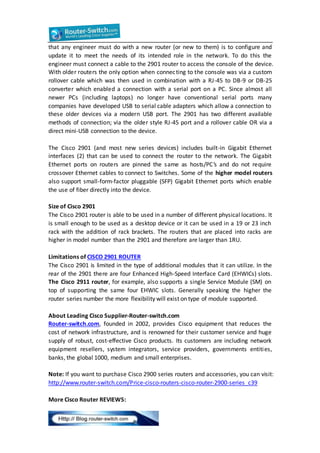
The 2901 router that will be used as an example in the following part is the successor 
to Cisco’s 2500, 2600 and 2800 series lines of routers. It is 1RU (Rack Unit) in size and 
is often referred to as a ‘pizza box’ router. 
Cisco 2901 Router-Front and Rear View 
Here we will focus on the hardware setup of a Cisco router. There are a number of 
different module options that are available for the Cisco 2901 router. The first thing
that any engineer must do with a new router (or new to them) is to configure and 
update it to meet the needs of its intended role in the network. To do this the 
engineer must connect a cable to the 2901 router to access the console of the device. 
With older routers the only option when connec ting to the console was via a custom 
rollover cable which was then used in combination with a RJ-45 to DB-9 or DB-25 
converter which enabled a connection with a serial port on a PC. Since almost all 
newer PCs (including laptops) no longer have conventional serial ports many 
companies have developed USB to serial cable adapters which allow a connection to 
these older devices via a modern USB port. The 2901 has two different available 
methods of connection; via the older style RJ-45 port and a rollover cable OR via a 
direct mini-USB connection to the device. 
The Cisco 2901 (and most new series devices) includes built-in Gigabit Ethernet 
interfaces (2) that can be used to connect the router to the network. The Gigabit 
Ethernet ports on routers are pinned the same as hosts/PC ’s and do not require 
crossover Ethernet cables to connect to Switches. Some of the higher model routers 
also support small-form-factor pluggable (SFP) Gigabit Ethernet ports which enable 
the use of fiber directly into the device. 
Size of Cisco 2901 
The Cisco 2901 router is able to be used in a number of different physical locations. It 
is small enough to be used as a desktop device or it can be used in a 19 or 23 inch 
rack with the addition of rack brackets. The routers that are placed into racks are 
higher in model number than the 2901 and therefore are larger than 1RU. 
Limitations of CISCO 2901 ROUTER 
The Cisco 2901 is limited in the type of additional modules that it can utilize. In the 
rear of the 2901 there are four Enhanced High-Speed Interface Card (EHWICs) slots. 
The Cisco 2911 router, for example, also supports a single Service Module (SM) on 
top of supporting the same four EHWIC slots. Generally speaking the higher the 
router series number the more flexibility will exist on type of module supported. 
About Leading Cisco Supplier-Router-switch.com 
Router-switch.com, founded in 2002, provides Cisco equipment that reduces the 
cost of network infrastructure, and is renowned for their customer service and huge 
supply of robust, cost-effective Cisco products. Its customers are including network 
equipment resellers, system integrators, service providers, governments entities, 
banks, the global 1000, medium and small enterprises. 
Note: If you want to purchase Cisco 2900 series routers and accessories, you can visit: 
http://www.router-switch.com/Price-cisco-routers-cisco-router-2900-series_c39 
More Cisco Router REVIEWS:
How to Recover Password on the Cisco 2900 Integrated Services Router? 
Cisco 1921 vs. Cisco 1941 vs. Cisco 1941W

Cisco 2901 router review

  • 1.
    Cisco 2901 routerdelivers highly secure data, voice, video, and application services for small offices. It offers embedded hardware encryption acceleration, voice-and video-capable digital signal processor (DSP) slots, optional firewall, intrusion prevention, call processing, voicemail, and application services. In addition, the platforms support the industries widest range of wired and wireless connectivity options such as T1/E1, xDSL, copper and fiber GE. Key features of Cisco 2901/k9 includes: a. 2 integrated 10/100/1000 Ethernet ports b. 4 enhanced high-speed WAN interface card slots c. 2 onboard digital signal processor (DSP) slots d. 1 onboard Internal Service Module for application services e. Fully integrated power distribution to modules supporting 802.3af Power over Ethernet (PoE) and Cisco Enhanced PoE f. Security: Embedded hardware-accelerated VPN encryption for secure collaborative VPN communications; Integrated threat control using Cisco IOS Firewall, Cisco IOS Zone-Based Firewall, Cisco IOS IPS, and Cisco IOS Content Filtering; Identity management that uses authentication, authorization, and accounting (AAA) and public key infrastructure g. Voice: High-density-packet voice DSP module, optimized for voice and video; Standards-certified VoiceXML browser services; Cisco Unified Border Element capabilities; Cisco Unity Express voicemail support; Support for Cisco Communications Manager Express and Survivable Remote Site Telephony The 2901 router that will be used as an example in the following part is the successor to Cisco’s 2500, 2600 and 2800 series lines of routers. It is 1RU (Rack Unit) in size and is often referred to as a ‘pizza box’ router. Cisco 2901 Router-Front and Rear View Here we will focus on the hardware setup of a Cisco router. There are a number of different module options that are available for the Cisco 2901 router. The first thing
  • 2.
    that any engineermust do with a new router (or new to them) is to configure and update it to meet the needs of its intended role in the network. To do this the engineer must connect a cable to the 2901 router to access the console of the device. With older routers the only option when connec ting to the console was via a custom rollover cable which was then used in combination with a RJ-45 to DB-9 or DB-25 converter which enabled a connection with a serial port on a PC. Since almost all newer PCs (including laptops) no longer have conventional serial ports many companies have developed USB to serial cable adapters which allow a connection to these older devices via a modern USB port. The 2901 has two different available methods of connection; via the older style RJ-45 port and a rollover cable OR via a direct mini-USB connection to the device. The Cisco 2901 (and most new series devices) includes built-in Gigabit Ethernet interfaces (2) that can be used to connect the router to the network. The Gigabit Ethernet ports on routers are pinned the same as hosts/PC ’s and do not require crossover Ethernet cables to connect to Switches. Some of the higher model routers also support small-form-factor pluggable (SFP) Gigabit Ethernet ports which enable the use of fiber directly into the device. Size of Cisco 2901 The Cisco 2901 router is able to be used in a number of different physical locations. It is small enough to be used as a desktop device or it can be used in a 19 or 23 inch rack with the addition of rack brackets. The routers that are placed into racks are higher in model number than the 2901 and therefore are larger than 1RU. Limitations of CISCO 2901 ROUTER The Cisco 2901 is limited in the type of additional modules that it can utilize. In the rear of the 2901 there are four Enhanced High-Speed Interface Card (EHWICs) slots. The Cisco 2911 router, for example, also supports a single Service Module (SM) on top of supporting the same four EHWIC slots. Generally speaking the higher the router series number the more flexibility will exist on type of module supported. About Leading Cisco Supplier-Router-switch.com Router-switch.com, founded in 2002, provides Cisco equipment that reduces the cost of network infrastructure, and is renowned for their customer service and huge supply of robust, cost-effective Cisco products. Its customers are including network equipment resellers, system integrators, service providers, governments entities, banks, the global 1000, medium and small enterprises. Note: If you want to purchase Cisco 2900 series routers and accessories, you can visit: http://www.router-switch.com/Price-cisco-routers-cisco-router-2900-series_c39 More Cisco Router REVIEWS:
  • 3.
    How to RecoverPassword on the Cisco 2900 Integrated Services Router? Cisco 1921 vs. Cisco 1941 vs. Cisco 1941W