Steven Stone
Deputy Director
Economy Division
Circularity and the SDGs:
Pathways to a future possible?
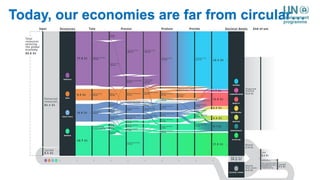
Today, our economies are far from circular…
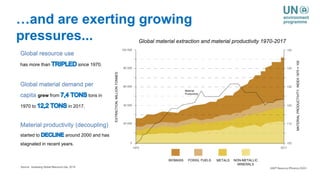
Global resource use
has more than since 1970.
Global material demand per
capita grew from tons in
1970 to in 2017.
Material productivity (decoupling)
started to around 2000 and has
stagnated in recent years.
Global material extraction and material productivity 1970-2017
METALS
BIOMASS FOSSIL FUELS NON-METALLIC
MINERALS
EXTRACTION,
MILLION
TONNES
MATERIAL
PRODUCTIVITY,
INDEX
1970
=
100
Source: Assessing Global Resource Use, 2018 UNEP Resource Efficiency 2020+
…and are exerting growing
pressures...
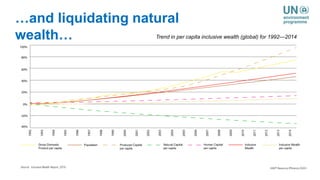
Source: Inclusive Wealth Report, 2019.
Trend in per capita inclusive wealth (global) for 1992—2014
+
UNEP Resource Efficiency 2020+
…and liquidating natural
wealth…
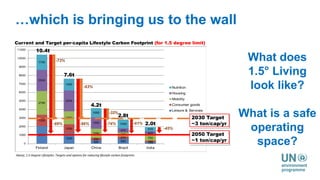
Akenji, 1.5-Degree Lifestyles: Targets and options for reducing lifestyle carbon footprints
-89% -86% -74% -61% 2.0t
-45%
Lifestyle Footprints
Current and Target per-capita Lifestyle Carbon Footprint (for 1.5 degree limit)
10.4t
-73%
7.6t
-63%
4.2t
-32%
2.8t 2030 Target
~3 ton/cap/yr
2050 Target
~1 ton/cap/yr
What does
1.5° Living
look like?
What is a safe
operating
space?
…which is bringing us to the wall
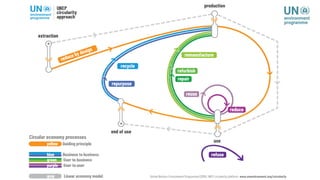
Source: UNEP Circularity Platform:
https://www.unenvironment.org/circularity
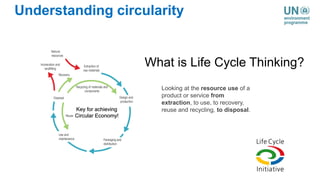
What is Life Cycle Thinking?
Key for achieving
Circular Economy!
Looking at the resource use of a
product or service from
extraction, to use, to recovery,
reuse and recycling, to disposal.
Understanding circularity
611
Programme
Partners
22
UN entities in the
10YFP Inter-Agency
Coordination Group
130
National
Focal Points
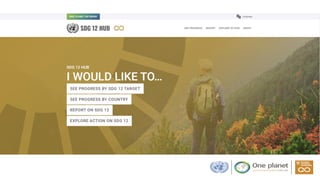
One Planet Network to support SDG 12
The challenge is collosal…
- Innovating away from scarcity – towards a pollution free planet,
circularity
- Resetting the relationship with nature – from endless frontier to
stable equilibria
- Reinventing economics – economics for a fragile planet?
Business ask 1: A frank appraisal of footprinting and high impact sectors that are key to the
transition. Partnering with actors along the value chain to identify circular opportunities –
and then bring this into consumer information.
Business ask 2: Raise the bar on industry performance. Redefining harmonised
metrics. Measuring progress with a holistic view. Publicly reporting with science-based data.
Business ask 3: Promote and join global commitments that align with SDGs. Join with
investors, consumers and industry associations to spur uptake.
Business ask 4: Commit to SDG-compliant procurement criteria. Purchase from vendors
with the best track record on green and sustainable performance.
Thank you
www.unep.org
steven.stone@un.org

Circularity and the SDGs: Pathways to a future possible?

  • 1.
    Steven Stone Deputy Director EconomyDivision Circularity and the SDGs: Pathways to a future possible?
  • 3.
    Today, our economiesare far from circular…
  • 4.
    Global resource use hasmore than since 1970. Global material demand per capita grew from tons in 1970 to in 2017. Material productivity (decoupling) started to around 2000 and has stagnated in recent years. Global material extraction and material productivity 1970-2017 METALS BIOMASS FOSSIL FUELS NON-METALLIC MINERALS EXTRACTION, MILLION TONNES MATERIAL PRODUCTIVITY, INDEX 1970 = 100 Source: Assessing Global Resource Use, 2018 UNEP Resource Efficiency 2020+ …and are exerting growing pressures...
  • 5.
    Source: Inclusive WealthReport, 2019. Trend in per capita inclusive wealth (global) for 1992—2014 + UNEP Resource Efficiency 2020+ …and liquidating natural wealth…
  • 9.
    Akenji, 1.5-Degree Lifestyles:Targets and options for reducing lifestyle carbon footprints -89% -86% -74% -61% 2.0t -45% Lifestyle Footprints Current and Target per-capita Lifestyle Carbon Footprint (for 1.5 degree limit) 10.4t -73% 7.6t -63% 4.2t -32% 2.8t 2030 Target ~3 ton/cap/yr 2050 Target ~1 ton/cap/yr What does 1.5° Living look like? What is a safe operating space? …which is bringing us to the wall
  • 11.
    Source: UNEP CircularityPlatform: https://www.unenvironment.org/circularity
  • 12.
    What is LifeCycle Thinking? Key for achieving Circular Economy! Looking at the resource use of a product or service from extraction, to use, to recovery, reuse and recycling, to disposal. Understanding circularity
  • 14.
    611 Programme Partners 22 UN entities inthe 10YFP Inter-Agency Coordination Group 130 National Focal Points One Planet Network to support SDG 12
  • 16.
    The challenge iscollosal… - Innovating away from scarcity – towards a pollution free planet, circularity - Resetting the relationship with nature – from endless frontier to stable equilibria - Reinventing economics – economics for a fragile planet?
  • 17.
    Business ask 1:A frank appraisal of footprinting and high impact sectors that are key to the transition. Partnering with actors along the value chain to identify circular opportunities – and then bring this into consumer information. Business ask 2: Raise the bar on industry performance. Redefining harmonised metrics. Measuring progress with a holistic view. Publicly reporting with science-based data. Business ask 3: Promote and join global commitments that align with SDGs. Join with investors, consumers and industry associations to spur uptake. Business ask 4: Commit to SDG-compliant procurement criteria. Purchase from vendors with the best track record on green and sustainable performance.
  • 18.