




Validating and Promoting HR Strategies 
with Data and Analytics 
Mark T Lawrence 
@MTLawrence 
25 November, 2014 
© 2014 International Business Machines Corporation
A History of Digging 
© 2014 International Business Machines Corporation
Objectives 
 To explain and evidence the value of HRBPs as a strategic business partner 
 To show how business objectives rely upon processes with tangible, measurable 
data 
 To challenge silos and collect advanced data for deeper, more insightful analyses 
 To outline some best-case examples of projects using analytics to increase HR 
impact 
© 2014 International Business Machines Corporation 
30 mins
The Importance Of Strategic HR Planning 
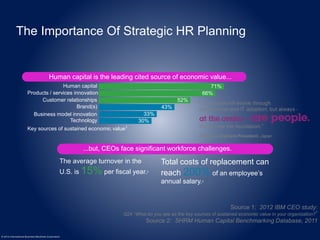
Human capital is the leading cited source of economic value... 
© 2014 International Business Machines Corporation 
Source 1: 2012 IBM CEO study: 
Q24 “What do you see as the key sources of sustained economic value in your organization?” 
Source 2: SHRM Human Capital Benchmarking Database, 2011 
Human capital 
Products / services innovation 
Customer relationships 
Brand(s) 
Business model innovation 
Technology 
71% 
66% 
52% 
43% 
33% 
30% 
...but, CEOs face significant workforce challenges. 
The average turnover in the 
U.S. is 15% per fiscal year.2 
Total costs of replacement can 
reach 200% of an employee’s 
annual salary.2 
Key sources of sustained economic value1
HR Must Now Be THE Strategic Priority! 
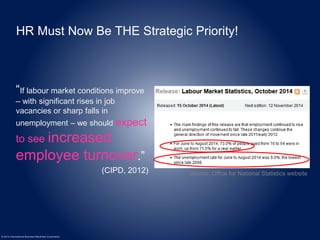
“If labour market conditions improve 
– with significant rises in job 
vacancies or sharp falls in 
unemployment – we should expect 
to see increased 
employee turnover.” 
© 2014 International Business Machines Corporation 
(CIPD, 2012) Source: Office for National Statistics website
Convinced? 
© 2014 International Business Machines Corporation
What Other Factors Need We Consider? 
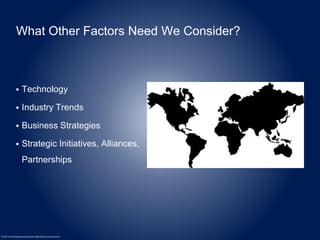
 Technology 
 Industry Trends 
 Business Strategies 
 Strategic Initiatives, Alliances, 
Partnerships 
© 2014 International Business Machines Corporation
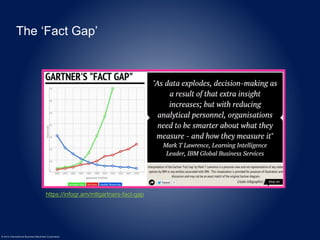
The ‘Fact Gap’ 
https://infogr.am/mtlgartners-fact-gap 
© 2014 International Business Machines Corporation
So, where do we start…? 
© 2014 International Business Machines Corporation
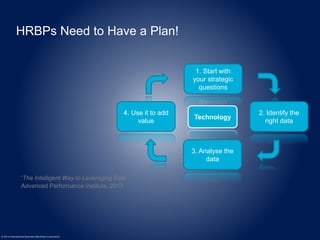
HRBPs Need to Have a Plan! 
‘The Intelligent Way to Leveraging Data’ 
Advanced Performance Institute, 2013 
© 2014 International Business Machines Corporation 
1. Start with 
your strategic 
questions 
2. Identify the 
right data 
3. Analyse the 
data 
4. Use it to add 
value 
Technology
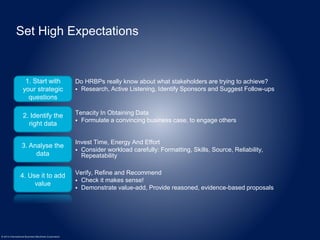
Set High Expectations 
© 2014 International Business Machines Corporation 
Do HRBPs really know about what stakeholders are trying to achieve? 
 Research, Active Listening, Identify Sponsors and Suggest Follow-ups 
Tenacity In Obtaining Data 
 Formulate a convincing business case, to engage others 
Invest Time, Energy And Effort 
 Consider workload carefully: Formatting, Skills, Source, Reliability, 
Repeatability 
Verify, Refine and Recommend 
 Check it makes sense! 
 Demonstrate value-add, Provide reasoned, evidence-based proposals 
1. Start with 
your strategic 
questions 
2. Identify the 
right data 
3. Analyse the 
data 
4. Use it to add 
value
© 2014 International Business Machines Corporation 
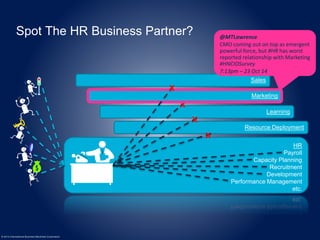
HR 
Sales 
Marketing 
Learning 
Payroll 
Capacity Planning 
Recruitment 
Development 
Performance Management 
etc. 
Spot The HR Business Partner? 
Resource Deployment 
X 
X 
X 
@MTLawrence 
CMO coming out on top as emergent 
powerful force, but #HR has worst 
reported relationship with Marketing 
#HNCIOSurvey 
7:13pm – 23 Oct 14 
X
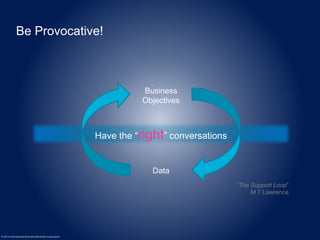
Be Provocative! 
© 2014 International Business Machines Corporation 
Business 
Objectives 
Have the “right” conversations 
Data 
“The Support Loop” 
M T Lawrence
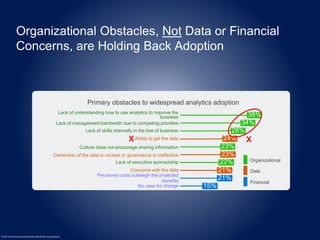
Organizational Obstacles, Not Data or Financial 
Concerns, are Holding Back Adoption 
Primary obstacles to widespread analytics adoption 
Lack of understanding how to use analytics to improve the 
business 
Lack of management bandwidth due to competing priorities 
© 2014 International Business Machines Corporation 
Lack of skills internally in the line of business 
X Ability to get the data 
X 
Culture does not encourage sharing information 
Ownership of the data is unclear or governance is ineffective 
Lack of executive sponsorship 
Concerns with the data 
Perceived costs outweigh the projected 
benefits 
No case for change 
38% 
34% 
28% 
24% 
23% 
23% 
22% 
21% 
21% 
15% 
Organizational 
Data 
Financial
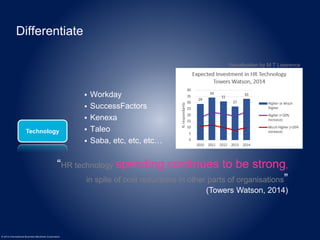
Differentiate 
© 2014 International Business Machines Corporation 
 Workday 
 SuccessFactors 
 Kenexa 
 Taleo 
 Saba, etc, etc, etc… 
Technology 
Visualisation by M T Lawrence 
“HR technology spending continues to be strong, 
in spite of cost reductions in other parts of organisations” 
(Towers Watson, 2014)
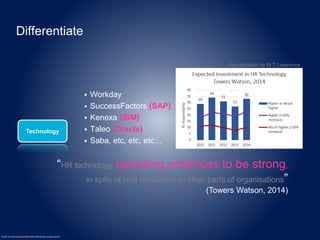
Differentiate 
© 2014 International Business Machines Corporation 
 Workday 
 SuccessFactors (SAP) 
 Kenexa (IBM) 
 Taleo (Oracle) 
 Saba, etc, etc, etc… 
Technology 
Visualisation by M T Lawrence 
“HR technology spending continues to be strong, 
in spite of cost reductions in other parts of organisations” 
(Towers Watson, 2014)
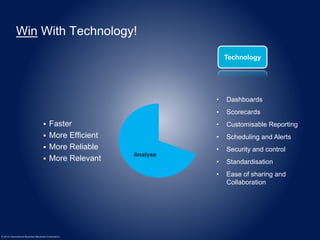
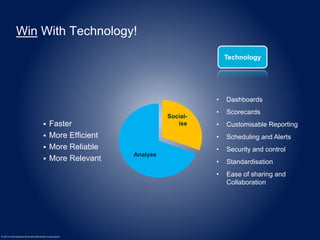
Win With Technology! 
 Faster 
 More Efficient 
 More Reliable 
 More Relevant 
© 2014 International Business Machines Corporation 
Technology 
Analyse 
• Dashboards 
• Scorecards 
• Customisable Reporting 
• Scheduling and Alerts 
• Security and control 
• Standardisation 
• Ease of sharing and 
Collaboration
© 2014 International Business Machines Corporation 
Social-ise 
Win With Technology! 
Analyse 
 Faster 
 More Efficient 
 More Reliable 
 More Relevant 
Technology 
• Dashboards 
• Scorecards 
• Customisable Reporting 
• Scheduling and Alerts 
• Security and control 
• Standardisation 
• Ease of sharing and 
Collaboration
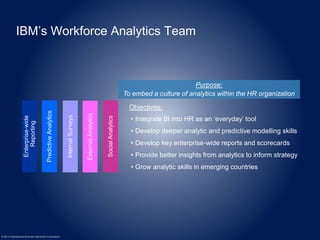
IBM’s Workforce Analytics Team 
Enterprise-wide 
Reporting 
Predictive Analytics 
© 2014 International Business Machines Corporation 
Internal Surveys 
External Analytics 
Purpose: 
To embed a culture of analytics within the HR organization 
Objectives: 
• Integrate BI into HR as an ‘everyday’ tool 
• Develop deeper analytic and predictive modelling skills 
• Develop key enterprise-wide reports and scorecards 
• Provide better insights from analytics to inform strategy 
• Grow analytic skills in emerging countries 
Social Analytics
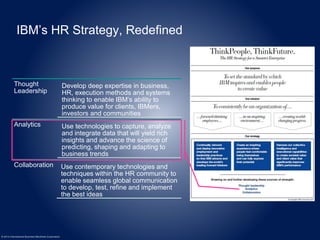
IBM’s HR Strategy, Redefined 
Thought 
Leadership 
© 2014 International Business Machines Corporation 
Develop deep expertise in business, 
HR, execution methods and systems 
thinking to enable IBM’s ability to 
produce value for clients, IBMers, 
investors and communities 
Analytics Use technologies to capture, analyze 
and integrate data that will yield rich 
insights and advance the science of 
predicting, shaping and adapting to 
business trends 
Collaboration Use contemporary technologies and 
techniques within the HR community to 
enable seamless global communication 
to develop, test, refine and implement 
the best ideas
© 2014 International Business Machines Corporation 
“There are three kinds of 
lies…”
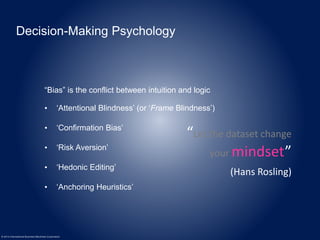
Decision-Making Psychology 
© 2014 International Business Machines Corporation 
“Let the dataset change 
your mindset” 
(Hans Rosling) 
“Bias” is the conflict between intuition and logic 
• ‘Attentional Blindness’ (or ‘Frame Blindness’) 
• ‘Confirmation Bias’ 
• ‘Risk Aversion’ 
• ‘Hedonic Editing’ 
• ‘Anchoring Heuristics’
Use Cases 
© 2014 International Business Machines Corporation
CASE STUDY 1) 
Smarter Learning Analytics 
CASE STUDY 2) 
Predicting Attrition 
CASE STUDY 3) 
Social Analytics 
© 2014 International Business Machines Corporation 
<Details removed>
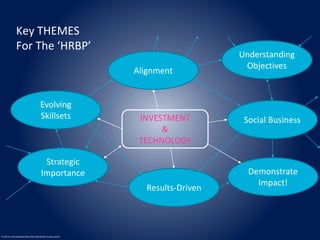
Key THEMES 
For The ‘HRBP’ 
© 2014 International Business Machines Corporation 
Understanding 
Objectives 
Social Business 
Evolving 
Skillsets 
Strategic 
Importance 
Alignment 
Results-Driven 
Demonstrate 
Impact! 
INVESTMENT 
& 
TECHNOLOGY
In Conclusion… 
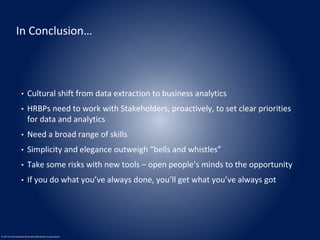
• Cultural shift from data extraction to business analytics 
• HRBPs need to work with Stakeholders, proactively, to set clear priorities 
for data and analytics 
• Need a broad range of skills 
• Simplicity and elegance outweigh “bells and whistles” 
• Take some risks with new tools – open people’s minds to the opportunity 
• If you do what you’ve always done, you’ll get what you’ve always got 
© 2014 International Business Machines Corporation
Thank you 
© 2014 International Business Machines Corporation
Further resources 
 Analytics: The New Path to Value” IBM 
(https://ibm.biz/newpathvalue) 
 MegaTrends | “Has Job Turnover Slowed Down?” CIPD 
(http://www.cipd.co.uk/binaries/megatrends_2013-job-turnover-slowed-down.pdf) 
 “2014 HR Service Delivery and Technology Survey Results” Towers Watson 
(http://www.towerswatson.com/en-GB/Insights/IC-Types/Survey-Research- 
Results/2014/06/2014-hr-service-delivery-and-technology-survey) 
 The Office for National Statistics (ONS): 
http://www.ons.gov.uk/ons/taxonomy/index.html?nscl=Labour+Market 
 The Advanced Performance Institute: 
http://www.ap-institute.com/ 
I would also like to acknowledge the contributions of Jonathan Sidhu, in preparing this 
content. @jmsidhu 
© 2014 International Business Machines Corporation
Continuing the discussion 
© 2014 International Business Machines Corporation 
On a range of topics, including: 
 Blog http://learningintelligence.blogspot.co.uk/ 
 Academic interest bn14mtl@leeds.ac.uk 
 Advice! 
Mark T Lawrence can be reached via: 
 Email mtlawre@gmail.com 
 Phone +44 (0)7917 270138 
 Twitter http://twitter.com/mtlawrence | @MTLawrence 
 Linked In https://www.linkedin.com/in/marktlawrence 
 About Me http://about.me/marktlawrence

Validating and Promoting HR Strategies with Data and Analytics

  • 1.
    Validating and PromotingHR Strategies with Data and Analytics Mark T Lawrence @MTLawrence 25 November, 2014 © 2014 International Business Machines Corporation
  • 2.
    A History ofDigging © 2014 International Business Machines Corporation
  • 3.
    Objectives  Toexplain and evidence the value of HRBPs as a strategic business partner  To show how business objectives rely upon processes with tangible, measurable data  To challenge silos and collect advanced data for deeper, more insightful analyses  To outline some best-case examples of projects using analytics to increase HR impact © 2014 International Business Machines Corporation 30 mins
  • 4.
    The Importance OfStrategic HR Planning Human capital is the leading cited source of economic value... © 2014 International Business Machines Corporation Source 1: 2012 IBM CEO study: Q24 “What do you see as the key sources of sustained economic value in your organization?” Source 2: SHRM Human Capital Benchmarking Database, 2011 Human capital Products / services innovation Customer relationships Brand(s) Business model innovation Technology 71% 66% 52% 43% 33% 30% ...but, CEOs face significant workforce challenges. The average turnover in the U.S. is 15% per fiscal year.2 Total costs of replacement can reach 200% of an employee’s annual salary.2 Key sources of sustained economic value1
  • 5.
    HR Must NowBe THE Strategic Priority! “If labour market conditions improve – with significant rises in job vacancies or sharp falls in unemployment – we should expect to see increased employee turnover.” © 2014 International Business Machines Corporation (CIPD, 2012) Source: Office for National Statistics website
  • 6.
    Convinced? © 2014International Business Machines Corporation
  • 7.
    What Other FactorsNeed We Consider?  Technology  Industry Trends  Business Strategies  Strategic Initiatives, Alliances, Partnerships © 2014 International Business Machines Corporation
  • 8.
    The ‘Fact Gap’ https://infogr.am/mtlgartners-fact-gap © 2014 International Business Machines Corporation
  • 9.
    So, where dowe start…? © 2014 International Business Machines Corporation
  • 10.
    HRBPs Need toHave a Plan! ‘The Intelligent Way to Leveraging Data’ Advanced Performance Institute, 2013 © 2014 International Business Machines Corporation 1. Start with your strategic questions 2. Identify the right data 3. Analyse the data 4. Use it to add value Technology
  • 11.
    Set High Expectations © 2014 International Business Machines Corporation Do HRBPs really know about what stakeholders are trying to achieve?  Research, Active Listening, Identify Sponsors and Suggest Follow-ups Tenacity In Obtaining Data  Formulate a convincing business case, to engage others Invest Time, Energy And Effort  Consider workload carefully: Formatting, Skills, Source, Reliability, Repeatability Verify, Refine and Recommend  Check it makes sense!  Demonstrate value-add, Provide reasoned, evidence-based proposals 1. Start with your strategic questions 2. Identify the right data 3. Analyse the data 4. Use it to add value
  • 12.
    © 2014 InternationalBusiness Machines Corporation HR Sales Marketing Learning Payroll Capacity Planning Recruitment Development Performance Management etc. Spot The HR Business Partner? Resource Deployment X X X @MTLawrence CMO coming out on top as emergent powerful force, but #HR has worst reported relationship with Marketing #HNCIOSurvey 7:13pm – 23 Oct 14 X
  • 13.
    Be Provocative! ©2014 International Business Machines Corporation Business Objectives Have the “right” conversations Data “The Support Loop” M T Lawrence
  • 14.
    Organizational Obstacles, NotData or Financial Concerns, are Holding Back Adoption Primary obstacles to widespread analytics adoption Lack of understanding how to use analytics to improve the business Lack of management bandwidth due to competing priorities © 2014 International Business Machines Corporation Lack of skills internally in the line of business X Ability to get the data X Culture does not encourage sharing information Ownership of the data is unclear or governance is ineffective Lack of executive sponsorship Concerns with the data Perceived costs outweigh the projected benefits No case for change 38% 34% 28% 24% 23% 23% 22% 21% 21% 15% Organizational Data Financial
  • 15.
    Differentiate © 2014International Business Machines Corporation  Workday  SuccessFactors  Kenexa  Taleo  Saba, etc, etc, etc… Technology Visualisation by M T Lawrence “HR technology spending continues to be strong, in spite of cost reductions in other parts of organisations” (Towers Watson, 2014)
  • 16.
    Differentiate © 2014International Business Machines Corporation  Workday  SuccessFactors (SAP)  Kenexa (IBM)  Taleo (Oracle)  Saba, etc, etc, etc… Technology Visualisation by M T Lawrence “HR technology spending continues to be strong, in spite of cost reductions in other parts of organisations” (Towers Watson, 2014)
  • 17.
    Win With Technology!  Faster  More Efficient  More Reliable  More Relevant © 2014 International Business Machines Corporation Technology Analyse • Dashboards • Scorecards • Customisable Reporting • Scheduling and Alerts • Security and control • Standardisation • Ease of sharing and Collaboration
  • 18.
    © 2014 InternationalBusiness Machines Corporation Social-ise Win With Technology! Analyse  Faster  More Efficient  More Reliable  More Relevant Technology • Dashboards • Scorecards • Customisable Reporting • Scheduling and Alerts • Security and control • Standardisation • Ease of sharing and Collaboration
  • 19.
    IBM’s Workforce AnalyticsTeam Enterprise-wide Reporting Predictive Analytics © 2014 International Business Machines Corporation Internal Surveys External Analytics Purpose: To embed a culture of analytics within the HR organization Objectives: • Integrate BI into HR as an ‘everyday’ tool • Develop deeper analytic and predictive modelling skills • Develop key enterprise-wide reports and scorecards • Provide better insights from analytics to inform strategy • Grow analytic skills in emerging countries Social Analytics
  • 20.
    IBM’s HR Strategy,Redefined Thought Leadership © 2014 International Business Machines Corporation Develop deep expertise in business, HR, execution methods and systems thinking to enable IBM’s ability to produce value for clients, IBMers, investors and communities Analytics Use technologies to capture, analyze and integrate data that will yield rich insights and advance the science of predicting, shaping and adapting to business trends Collaboration Use contemporary technologies and techniques within the HR community to enable seamless global communication to develop, test, refine and implement the best ideas
  • 21.
    © 2014 InternationalBusiness Machines Corporation “There are three kinds of lies…”
  • 22.
    Decision-Making Psychology ©2014 International Business Machines Corporation “Let the dataset change your mindset” (Hans Rosling) “Bias” is the conflict between intuition and logic • ‘Attentional Blindness’ (or ‘Frame Blindness’) • ‘Confirmation Bias’ • ‘Risk Aversion’ • ‘Hedonic Editing’ • ‘Anchoring Heuristics’
  • 23.
    Use Cases ©2014 International Business Machines Corporation
  • 24.
    CASE STUDY 1) Smarter Learning Analytics CASE STUDY 2) Predicting Attrition CASE STUDY 3) Social Analytics © 2014 International Business Machines Corporation <Details removed>
  • 25.
    Key THEMES ForThe ‘HRBP’ © 2014 International Business Machines Corporation Understanding Objectives Social Business Evolving Skillsets Strategic Importance Alignment Results-Driven Demonstrate Impact! INVESTMENT & TECHNOLOGY
  • 26.
    In Conclusion… •Cultural shift from data extraction to business analytics • HRBPs need to work with Stakeholders, proactively, to set clear priorities for data and analytics • Need a broad range of skills • Simplicity and elegance outweigh “bells and whistles” • Take some risks with new tools – open people’s minds to the opportunity • If you do what you’ve always done, you’ll get what you’ve always got © 2014 International Business Machines Corporation
  • 27.
    Thank you ©2014 International Business Machines Corporation
  • 28.
    Further resources Analytics: The New Path to Value” IBM (https://ibm.biz/newpathvalue)  MegaTrends | “Has Job Turnover Slowed Down?” CIPD (http://www.cipd.co.uk/binaries/megatrends_2013-job-turnover-slowed-down.pdf)  “2014 HR Service Delivery and Technology Survey Results” Towers Watson (http://www.towerswatson.com/en-GB/Insights/IC-Types/Survey-Research- Results/2014/06/2014-hr-service-delivery-and-technology-survey)  The Office for National Statistics (ONS): http://www.ons.gov.uk/ons/taxonomy/index.html?nscl=Labour+Market  The Advanced Performance Institute: http://www.ap-institute.com/ I would also like to acknowledge the contributions of Jonathan Sidhu, in preparing this content. @jmsidhu © 2014 International Business Machines Corporation
  • 29.
    Continuing the discussion © 2014 International Business Machines Corporation On a range of topics, including:  Blog http://learningintelligence.blogspot.co.uk/  Academic interest bn14mtl@leeds.ac.uk  Advice! Mark T Lawrence can be reached via:  Email mtlawre@gmail.com  Phone +44 (0)7917 270138  Twitter http://twitter.com/mtlawrence | @MTLawrence  Linked In https://www.linkedin.com/in/marktlawrence  About Me http://about.me/marktlawrence

Editor's Notes

  • #4 1. How the HRBP has arisen over the past 5 years, and why it will continue to grow in importance. Define “strategic”. 2. Business objectives and Metrics are symbiotic! 3. Define “advanced data” (or 2nd Tier data) 4. IBM examples, but they are intended to show how performance can be defined, and generate questions in your own minds [Time Check]
  • #5 In the UK, according to the CIPD (reference on following slide), median average turnover is approximately 12% in 2012 (down from peak of >18% in 2005 and 2001, resp.) Its worth remembering that the “turnover” metric is, in most cases, representative of joining and leaving a firm – not including, therefore, changes of role within the firm; so it could be argued to be as high as 3 times this number…!!!
  • #6 Quote from MegaTrends | “Has Job Turnover Slowed Down?” CIPD, page 17. (http://www.cipd.co.uk/binaries/megatrends_2013-job-turnover-slowed-down.pdf) Source of Labour Market Statistics commentary: ONS website, 19 October 2014. (http://www.ons.gov.uk/ons/taxonomy/index.html?nscl=Labour+Market)
  • #8 Technology – I’ll come back to this later Trends – what factors affect our organisation and can we anticipate or help to mitigate? Strategies – What do our stakeholders want to achieve? Initiatives – How might our culture be impacted? Motivation and Satisfaction? Can we measure this? What are the issues? The list goes on…
  • #9 The impact of these factors can be demonstrated in this simple chart, which has demonstrated real power and traction with my own stakeholders. This chart is not the original, by Gartner, but is a reproduction and is available at https://infogr.am/mtlgartners-fact-gap
  • #13 It’s a complicated world, full of time pressure and people with questions… Know what’s achievable.
  • #14 It’s not enough to be led… You need to provoke thoughts and encourage active thinking, to maintain your place at the table. All relationships should be equal and symbiotic… Be Disruptive! Be Fearless!!!
  • #15 Same source as previously cited - 2012 IBM CEO study
  • #16 Technology – This isn’t just the responsibility of the HRBP, but it’s important to understand what’s happening in this area, currently. During 2014, a third of businesses expect “higher”/“much higher” investment in HR technology! Quotation continues: “We believe this reflects an understanding that technology is a large and increasingly important driver of HR effectiveness and efficiency. These investments are directed mostly toward the implementation of new technology and new functionality, including HR portals, talent management solutions, mobile access services and leading software-as-a-service systems such as Workday.” http://www.towerswatson.com/en-GB/Insights/IC-Types/Survey-Research-Results/2014/06/2014-hr-service-delivery-and-technology-survey
  • #17 There is big money being attracted into this service area…
  • #18 Getting to grips with the technology available to you, will help you to create deeper, more meaningful business partnerships.
  • #19 Data isn’t just the subject, it might also inform the mechanism of communication…
  • #20 IBM Workforce Analytics - a clear purpose, which might help others to understand the kinds of capabilities HR organisations are requiring. With this growth of resource, it is even more important that HRBPs learn how to consult in this language!
  • #21 Setting an information agenda, to drive the business forward…
  • #22 Is anyone wiling to finish off the quotation (often attributed to Mark Twain)? Personally, I would argue that there’s much more than 3!
  • #23 What is a strategy? Michael Porter or Richard Rumelt would suggest Resources, Henry Mintzberg would focus on Capabilities. What is a decision? A commitment to a course of action. Consider the resources and capabilities aligned behind a decision…! It’s important to get your messages across correctly. Here are some of the Jedi Mind Tricks that can be employed – albeit, usually, not by design… For more on this, refer to Professor Danny Kahnemann (Prospect Theory). Thaler. Examples: Graph distortion, Option subjectivity, [Ethics!!! Another time, perhaps…]
  • #24 [Time check]
  • #28 In handouts, there is some more information (links to the studies cited, as well as my own contact details).