http://www.androidrobo.com/
1
CIMON-2 Robot
This Free-Flying Robot Head Is Like Alexa for Astronauts
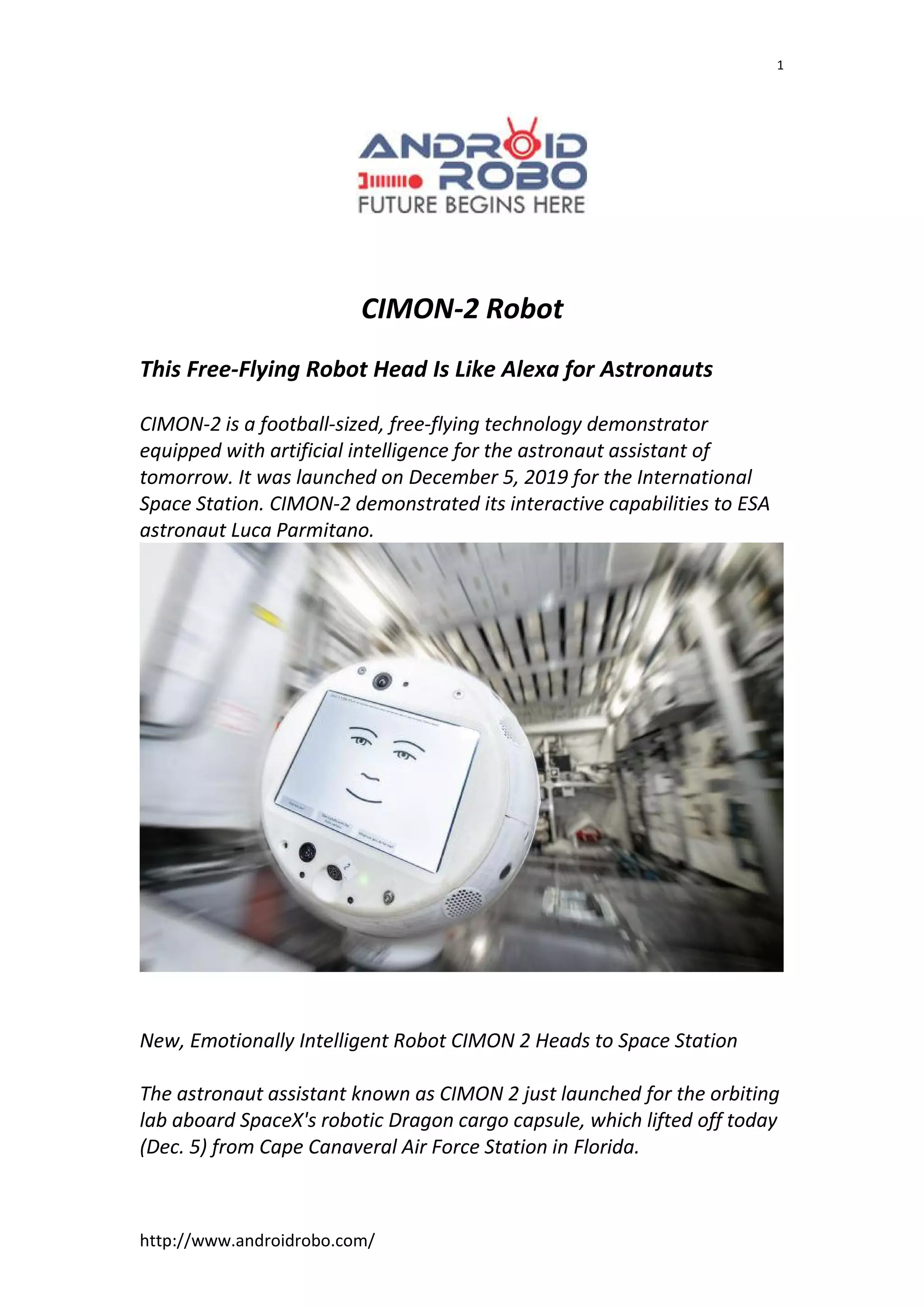
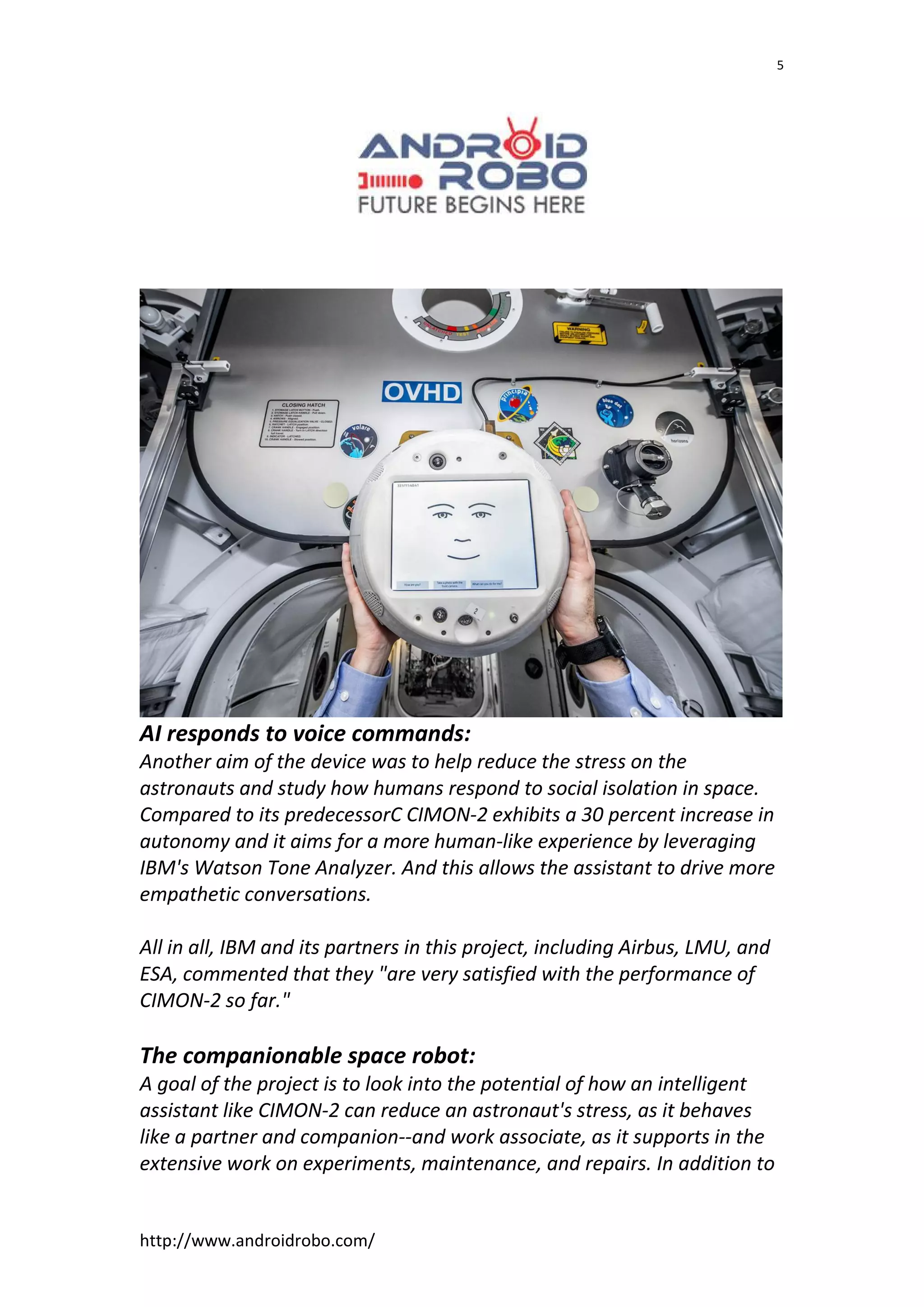
CIMON-2 is a football-sized, free-flying technology demonstrator
equipped with artificial intelligence for the astronaut assistant of
tomorrow. It was launched on December 5, 2019 for the International
Space Station. CIMON-2 demonstrated its interactive capabilities to ESA
astronaut Luca Parmitano.
New, Emotionally Intelligent Robot CIMON 2 Heads to Space Station
The astronaut assistant known as CIMON 2 just launched for the orbiting
lab aboard SpaceX's robotic Dragon cargo capsule, which lifted off today
(Dec. 5) from Cape Canaveral Air Force Station in Florida.
http://www.androidrobo.com/
2
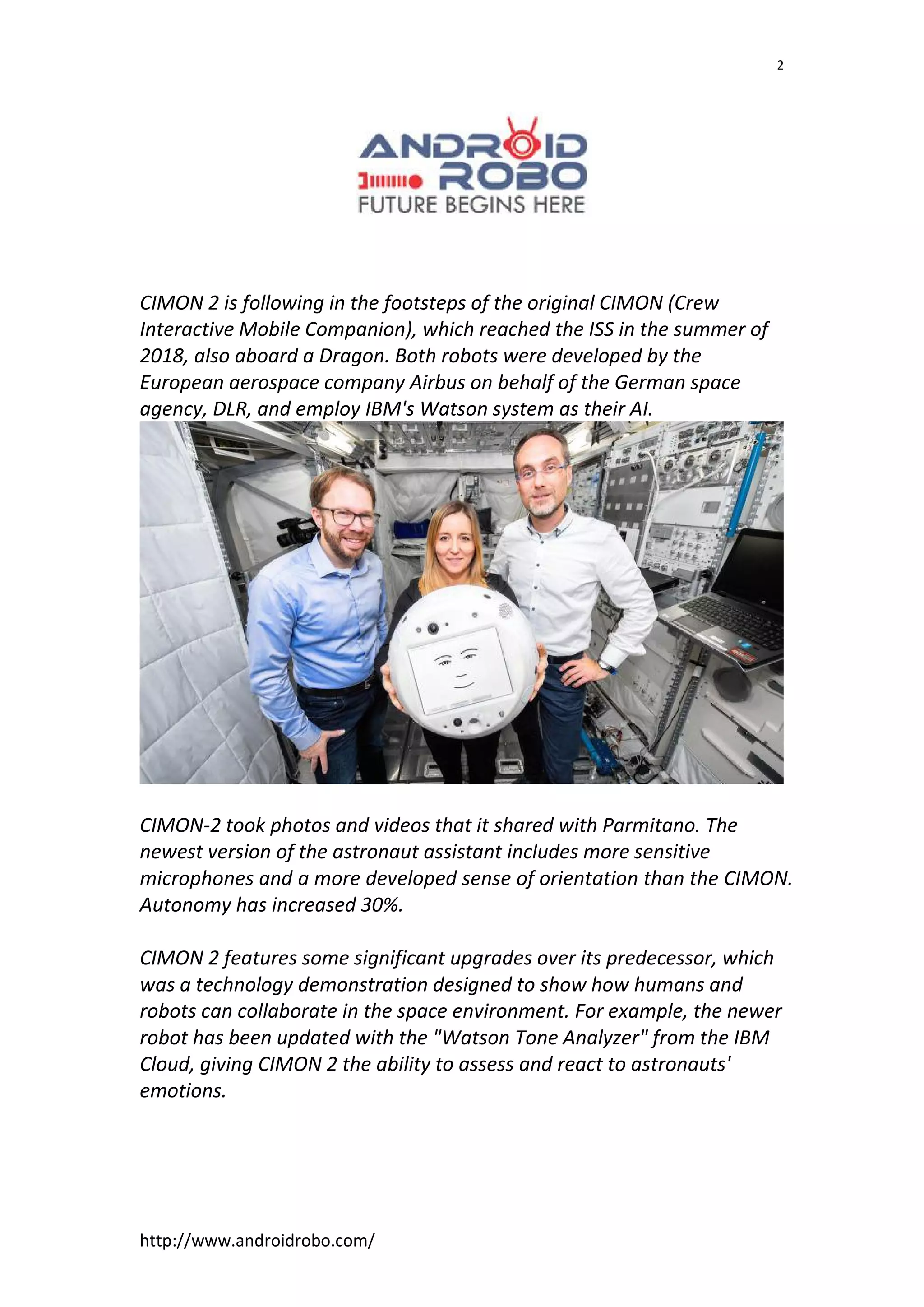
CIMON 2 is following in the footsteps of the original CIMON (Crew
Interactive Mobile Companion), which reached the ISS in the summer of
2018, also aboard a Dragon. Both robots were developed by the
European aerospace company Airbus on behalf of the German space
agency, DLR, and employ IBM's Watson system as their AI.
CIMON-2 took photos and videos that it shared with Parmitano. The
newest version of the astronaut assistant includes more sensitive
microphones and a more developed sense of orientation than the CIMON.
Autonomy has increased 30%.
CIMON 2 features some significant upgrades over its predecessor, which
was a technology demonstration designed to show how humans and
robots can collaborate in the space environment. For example, the newer
robot has been updated with the "Watson Tone Analyzer" from the IBM
Cloud, giving CIMON 2 the ability to assess and react to astronauts'
emotions.
http://www.androidrobo.com/
3
"With this update, CIMON has transformed from a scientific assistant to
an empathetic conversational partner," IBM representatives wrote in a
statement. "Specifically, CIMON 2 has more sensitive microphones and
an advanced sense of orientation. These AI capabilities and the stability
of the complex software applications have also been significantly
improved in the new CIMON 2."
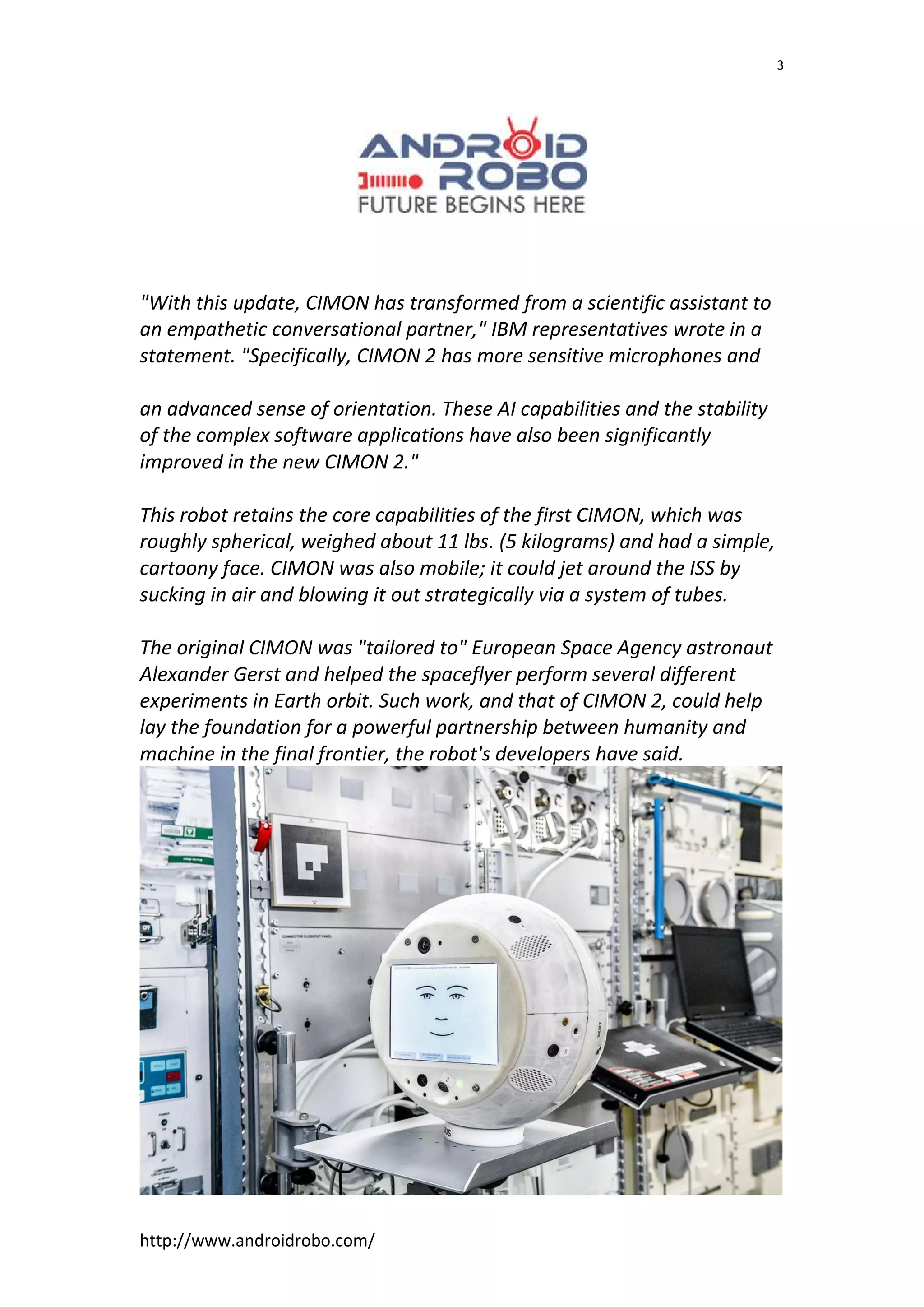
This robot retains the core capabilities of the first CIMON, which was
roughly spherical, weighed about 11 lbs. (5 kilograms) and had a simple,
cartoony face. CIMON was also mobile; it could jet around the ISS by
sucking in air and blowing it out strategically via a system of tubes.
The original CIMON was "tailored to" European Space Agency astronaut
Alexander Gerst and helped the spaceflyer perform several different
experiments in Earth orbit. Such work, and that of CIMON 2, could help
lay the foundation for a powerful partnership between humanity and
machine in the final frontier, the robot's developers have said.
http://www.androidrobo.com/
4
CIMON is an artificial intelligence-powered assistant to help astronauts
and increase the efficiency of work and repairs at the International Space
Station (ISS). Its latest version, which is currently on board the ISS, the
CIMON-2, has now successfully completed its initial testing phase.
The assistant made its journey to the ISS on December 5, last year. And it
is set to remain on the space station for a period of three years. For the
initial testing phase, CIMON-2's autonomous flight capabilities, voice
control of navigation and other tasks were put through the works.
Consequently, it was able to navigate to specific points within the
Columbus module, regardless of where it was located, with only verbal
commands.
Similarly, the assistant was also able to capture photos and videos for
the astronauts on command, which could prove to be a nifty convenience
when conducting scientific experiments.
CIMON-2 highlights:
1. It can detect emotions and language tones, and can react
empathetically to its conversational partners (and does so by using
Watson Tone Analyzer, AI provided by IBM).
2. It can reach a specific posit by verbal commands.
3. It can take and share photos and videos and show results to an
astronaut.
http://www.androidrobo.com/
5
AI responds to voice commands:
Another aim of the device was to help reduce the stress on the
astronauts and study how humans respond to social isolation in space.
Compared to its predecessorC CIMON-2 exhibits a 30 percent increase in
autonomy and it aims for a more human-like experience by leveraging
IBM's Watson Tone Analyzer. And this allows the assistant to drive more
empathetic conversations.
All in all, IBM and its partners in this project, including Airbus, LMU, and
ESA, commented that they "are very satisfied with the performance of
CIMON-2 so far."
The companionable space robot:
A goal of the project is to look into the potential of how an intelligent
assistant like CIMON-2 can reduce an astronaut's stress, as it behaves
like a partner and companion--and work associate, as it supports in the
extensive work on experiments, maintenance, and repairs. In addition to
http://www.androidrobo.com/
6
the stress of work duties, stress could potentially result from long-term
isolation or group-dynamics during long-term missions. This benefit could
be applied on Earth, too.

Cimon 2 robots

  • 1.
    http://www.androidrobo.com/ 1 CIMON-2 Robot This Free-FlyingRobot Head Is Like Alexa for Astronauts CIMON-2 is a football-sized, free-flying technology demonstrator equipped with artificial intelligence for the astronaut assistant of tomorrow. It was launched on December 5, 2019 for the International Space Station. CIMON-2 demonstrated its interactive capabilities to ESA astronaut Luca Parmitano. New, Emotionally Intelligent Robot CIMON 2 Heads to Space Station The astronaut assistant known as CIMON 2 just launched for the orbiting lab aboard SpaceX's robotic Dragon cargo capsule, which lifted off today (Dec. 5) from Cape Canaveral Air Force Station in Florida.
  • 2.
    http://www.androidrobo.com/ 2 CIMON 2 isfollowing in the footsteps of the original CIMON (Crew Interactive Mobile Companion), which reached the ISS in the summer of 2018, also aboard a Dragon. Both robots were developed by the European aerospace company Airbus on behalf of the German space agency, DLR, and employ IBM's Watson system as their AI. CIMON-2 took photos and videos that it shared with Parmitano. The newest version of the astronaut assistant includes more sensitive microphones and a more developed sense of orientation than the CIMON. Autonomy has increased 30%. CIMON 2 features some significant upgrades over its predecessor, which was a technology demonstration designed to show how humans and robots can collaborate in the space environment. For example, the newer robot has been updated with the "Watson Tone Analyzer" from the IBM Cloud, giving CIMON 2 the ability to assess and react to astronauts' emotions.
  • 3.
    http://www.androidrobo.com/ 3 "With this update,CIMON has transformed from a scientific assistant to an empathetic conversational partner," IBM representatives wrote in a statement. "Specifically, CIMON 2 has more sensitive microphones and an advanced sense of orientation. These AI capabilities and the stability of the complex software applications have also been significantly improved in the new CIMON 2." This robot retains the core capabilities of the first CIMON, which was roughly spherical, weighed about 11 lbs. (5 kilograms) and had a simple, cartoony face. CIMON was also mobile; it could jet around the ISS by sucking in air and blowing it out strategically via a system of tubes. The original CIMON was "tailored to" European Space Agency astronaut Alexander Gerst and helped the spaceflyer perform several different experiments in Earth orbit. Such work, and that of CIMON 2, could help lay the foundation for a powerful partnership between humanity and machine in the final frontier, the robot's developers have said.
  • 4.
    http://www.androidrobo.com/ 4 CIMON is anartificial intelligence-powered assistant to help astronauts and increase the efficiency of work and repairs at the International Space Station (ISS). Its latest version, which is currently on board the ISS, the CIMON-2, has now successfully completed its initial testing phase. The assistant made its journey to the ISS on December 5, last year. And it is set to remain on the space station for a period of three years. For the initial testing phase, CIMON-2's autonomous flight capabilities, voice control of navigation and other tasks were put through the works. Consequently, it was able to navigate to specific points within the Columbus module, regardless of where it was located, with only verbal commands. Similarly, the assistant was also able to capture photos and videos for the astronauts on command, which could prove to be a nifty convenience when conducting scientific experiments. CIMON-2 highlights: 1. It can detect emotions and language tones, and can react empathetically to its conversational partners (and does so by using Watson Tone Analyzer, AI provided by IBM). 2. It can reach a specific posit by verbal commands. 3. It can take and share photos and videos and show results to an astronaut.
  • 5.
    http://www.androidrobo.com/ 5 AI responds tovoice commands: Another aim of the device was to help reduce the stress on the astronauts and study how humans respond to social isolation in space. Compared to its predecessorC CIMON-2 exhibits a 30 percent increase in autonomy and it aims for a more human-like experience by leveraging IBM's Watson Tone Analyzer. And this allows the assistant to drive more empathetic conversations. All in all, IBM and its partners in this project, including Airbus, LMU, and ESA, commented that they "are very satisfied with the performance of CIMON-2 so far." The companionable space robot: A goal of the project is to look into the potential of how an intelligent assistant like CIMON-2 can reduce an astronaut's stress, as it behaves like a partner and companion--and work associate, as it supports in the extensive work on experiments, maintenance, and repairs. In addition to
  • 6.
    http://www.androidrobo.com/ 6 the stress ofwork duties, stress could potentially result from long-term isolation or group-dynamics during long-term missions. This benefit could be applied on Earth, too.