How Churches
Make Decisions

   Mark Ciampa

                 1
How Churches
Make Decisions


     Not
                 2
Not
 Not lecture
 Not free-for-all of what
  everyone thinks
 Is open study from
  Scriptures and
  discussion for WCC
                         3
Not
 Not bashing of what
  other groups think
 Not overlook incorrect
  interpretations
 Is examination of
  different views
                           4
Not
Not easy
Not all agree
Not setting to
 feel intimidated
                    5
Not
Not WCC official
 position
Not to create
 replacement checklist
Not matter
                    6
Outline
 Flawed method
 How decisions were made
  by NT churches
 Principles for WCC to
  consider
                        7
How Churches
Make Decisions


Flawed Method
                 8
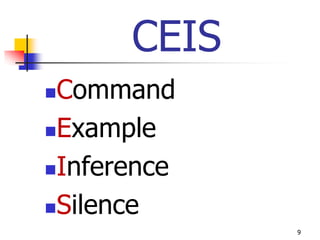
CEIS
Command
Example

Inference

Silence
             9
CEIS
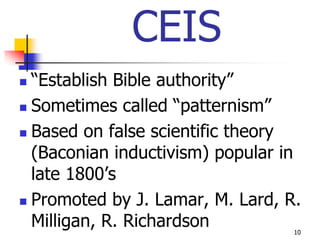
 “Establish Bible authority”
 Sometimes called “patternism”

 Based on false scientific theory

  (Baconian inductivism) popular in
  late 1800’s
 Promoted by J. Lamar, M. Lard, R.

  Milligan, R. Richardson         10
CEIS
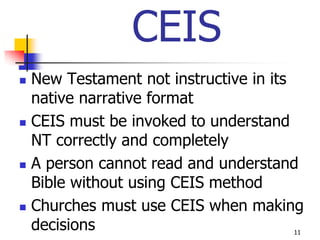
   New Testament not instructive in its
    native narrative format
   CEIS must be invoked to understand
    NT correctly and completely
   A person cannot read and understand
    Bible without using CEIS method
   Churches must use CEIS when making
    decisions                         11
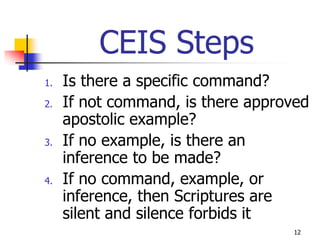
CEIS Steps
1.   Is there a specific command?
2.   If not command, is there approved
     apostolic example?
3.   If no example, is there an
     inference to be made?
4.   If no command, example, or
     inference, then Scriptures are
     silent and silence forbids it
                                   12
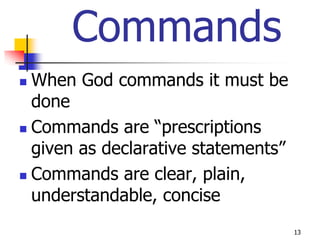
Commands
 When God commands it must be
  done
 Commands are “prescriptions

  given as declarative statements”
 Commands are clear, plain,

  understandable, concise
                                     13
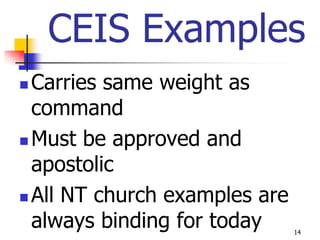
CEIS Examples
 Carries same weight as
  command
 Must be approved and

  apostolic
 All NT church examples are
  always binding for today     14
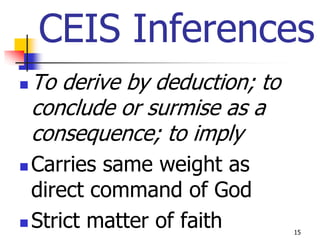
CEIS Inferences
   To derive by deduction; to
    conclude or surmise as a
    consequence; to imply
 Carries same weight as
  direct command of God
 Strict matter of faith
                                 15
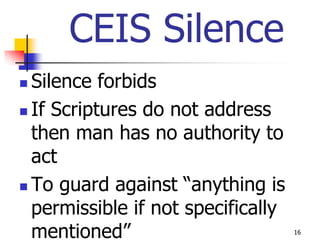
CEIS Silence
 Silence forbids
 If Scriptures do not address

  then man has no authority to
  act
 To guard against “anything is

  permissible if not specifically
  mentioned”                        16
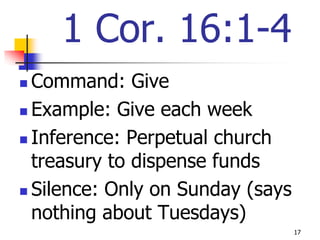
1 Cor. 16:1-4
 Command: Give
 Example: Give each week

 Inference: Perpetual church

  treasury to dispense funds
 Silence: Only on Sunday (says

  nothing about Tuesdays)
                                  17
How Churches
Make Decisions


Response to CEIS
                   18
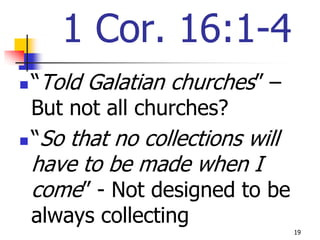
1 Cor. 16:1-4
 “Told Galatian churches” –
  But not all churches?
 “So that no collections will

    have to be made when I
    come” - Not designed to be
    always collecting
                                 19
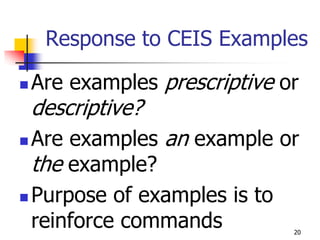
Response to CEIS Examples

   Are examples prescriptive or
    descriptive?
 Are examples an example or
  the example?
 Purpose of examples is to
  reinforce commands           20
Response to CEIS Examples

 John 13:12-17
 Jesus is providing an
  example that reinforces His
  instructions
 Not the exclusive example of
  the only way to serve others
                             21
Response to CEIS Inferences

 Inferences are elevated in
  status to a direct command
 Based on reasoning and

  conclusions of man
 Requires following checklist
  of human criteria              22
Response to CEIS Inferences

 Acts 20:7-11
 Inferred that this is only time
  to take Lord’s Supper
 Was Acts 2:46-47 Lord’s
  Supper?
                               23
Response to CEIS Silence

 Parent gives child $10 to buy
  gallon of milk but returns
  with milk and bread
 “I didn’t say to buy bread”

 “You didn’t say I could not”

                             24
Response to CEIS Silence
   Child remembered out of bread
   Child shows initiative, character,
    responsibility
   Has parent made child scared to act or
    given him freedom to enhance task?
   Does a parent really want a child who
    only follows specific commands?
                                        25
Response to CEIS Silence
 Matthew 25:14-30
 Matthew 12:1-8 – Silence of
  Law not prohibit activity
 God given us freedom to

  apply His principles to our
  everyday cultural situations
                             26
How Churches
Make Decisions


  Warnings &
Dangers of CEIS   27
Warnings to CEIS
 Matthew 15:1-9 – Binding
  precepts that originated
  from man
 2 Corinthians 3:4-6 – Law
  vs. Spirit
 1 Timothy 6:2-5 - Divisions
                                28
Assumptions of CEIS
 Assumes hidden and
  complete blueprint in NT
 Assumes justification based

  on how closely humans
  follow pattern created by
  CEIS
                                29
Dangers of CEIS
 Nothing stated or implied in
  NT about CEIS: if so critically
  important, why no mention?
 Makes rejection CEIS
  condition of fellowship
                               30
Dangers of CEIS
 Arbitrarily, capriciously, and
  inconsistently applied
 Rejects based on “culture”

 Forgets John 14:6

 Ignores Romans 8:1

                                   31
Dangers of CEIS
 Makes human reasoning
  primary focus
 Dethrones Jesus: CEIS

  becomes test of faith,
  purpose of church, focus of
  teaching
                                32
How Churches
Make Decisions

   Mark Ciampa

                 33

How Church’s Make Decisions [Part 1]

  • 1.
  • 2.
  • 3.
    Not  Not lecture Not free-for-all of what everyone thinks  Is open study from Scriptures and discussion for WCC 3
  • 4.
    Not  Not bashingof what other groups think  Not overlook incorrect interpretations  Is examination of different views 4
  • 5.
    Not Not easy Not allagree Not setting to feel intimidated 5
  • 6.
    Not Not WCC official position Not to create replacement checklist Not matter 6
  • 7.
    Outline  Flawed method How decisions were made by NT churches  Principles for WCC to consider 7
  • 8.
  • 9.
  • 10.
    CEIS  “Establish Bibleauthority”  Sometimes called “patternism”  Based on false scientific theory (Baconian inductivism) popular in late 1800’s  Promoted by J. Lamar, M. Lard, R. Milligan, R. Richardson 10
  • 11.
    CEIS  New Testament not instructive in its native narrative format  CEIS must be invoked to understand NT correctly and completely  A person cannot read and understand Bible without using CEIS method  Churches must use CEIS when making decisions 11
  • 12.
    CEIS Steps 1. Is there a specific command? 2. If not command, is there approved apostolic example? 3. If no example, is there an inference to be made? 4. If no command, example, or inference, then Scriptures are silent and silence forbids it 12
  • 13.
    Commands  When Godcommands it must be done  Commands are “prescriptions given as declarative statements”  Commands are clear, plain, understandable, concise 13
  • 14.
    CEIS Examples  Carriessame weight as command  Must be approved and apostolic  All NT church examples are always binding for today 14
  • 15.
    CEIS Inferences  To derive by deduction; to conclude or surmise as a consequence; to imply  Carries same weight as direct command of God  Strict matter of faith 15
  • 16.
    CEIS Silence  Silenceforbids  If Scriptures do not address then man has no authority to act  To guard against “anything is permissible if not specifically mentioned” 16
  • 17.
    1 Cor. 16:1-4 Command: Give  Example: Give each week  Inference: Perpetual church treasury to dispense funds  Silence: Only on Sunday (says nothing about Tuesdays) 17
  • 18.
  • 19.
    1 Cor. 16:1-4 “Told Galatian churches” – But not all churches?  “So that no collections will have to be made when I come” - Not designed to be always collecting 19
  • 20.
    Response to CEISExamples  Are examples prescriptive or descriptive?  Are examples an example or the example?  Purpose of examples is to reinforce commands 20
  • 21.
    Response to CEISExamples  John 13:12-17  Jesus is providing an example that reinforces His instructions  Not the exclusive example of the only way to serve others 21
  • 22.
    Response to CEISInferences  Inferences are elevated in status to a direct command  Based on reasoning and conclusions of man  Requires following checklist of human criteria 22
  • 23.
    Response to CEISInferences  Acts 20:7-11  Inferred that this is only time to take Lord’s Supper  Was Acts 2:46-47 Lord’s Supper? 23
  • 24.
    Response to CEISSilence  Parent gives child $10 to buy gallon of milk but returns with milk and bread  “I didn’t say to buy bread”  “You didn’t say I could not” 24
  • 25.
    Response to CEISSilence  Child remembered out of bread  Child shows initiative, character, responsibility  Has parent made child scared to act or given him freedom to enhance task?  Does a parent really want a child who only follows specific commands? 25
  • 26.
    Response to CEISSilence  Matthew 25:14-30  Matthew 12:1-8 – Silence of Law not prohibit activity  God given us freedom to apply His principles to our everyday cultural situations 26
  • 27.
    How Churches Make Decisions Warnings & Dangers of CEIS 27
  • 28.
    Warnings to CEIS Matthew 15:1-9 – Binding precepts that originated from man  2 Corinthians 3:4-6 – Law vs. Spirit  1 Timothy 6:2-5 - Divisions 28
  • 29.
    Assumptions of CEIS Assumes hidden and complete blueprint in NT  Assumes justification based on how closely humans follow pattern created by CEIS 29
  • 30.
    Dangers of CEIS Nothing stated or implied in NT about CEIS: if so critically important, why no mention?  Makes rejection CEIS condition of fellowship 30
  • 31.
    Dangers of CEIS Arbitrarily, capriciously, and inconsistently applied  Rejects based on “culture”  Forgets John 14:6  Ignores Romans 8:1 31
  • 32.
    Dangers of CEIS Makes human reasoning primary focus  Dethrones Jesus: CEIS becomes test of faith, purpose of church, focus of teaching 32
  • 33.