Chronic pain management
By Atalay Eshetie Demilie
Introduction
• Complex and many factors influence pain experience.
• Therefore, need multimodal interventions.
• Both physical and psychological, delivered in parallel.
• Pharmacotherapy plays an important role.
• Often refractory to conventional analgesic therapy.
• Non-analgesic drugs are frequently used.
2
Common classes of drugs chronic pain clinic
• Anti-depressants
• Anti-epileptics
• Opioids
• Local anesthetics and anti- arrhythmics
3
Anti-depressant drugs
• Almost 50% of patients with pain have depression.
• Use lower doses than used for treating depression.
• More effective in the absence of depression.
• Unknown mechanism.
• Likely inhibition of re-uptake of neurotransmitters in the CNS.
• Therefore; enhance descending inhibitory pathways.
4
• Additionally, act on other receptors.
E.g. alpha adrenergic, histaminergic and NMDA
Sodium and calcium channels blockade
Weak stimulatory action in µ-opioid receptors
• Most commonly used are the first generation tricyclic antidepressants
including amitriptyline, doxepin, clomipramine and dosulepin.
5
Side-effects (commonly limit their use) include
• Sedation and anticholinergic effects,
• Particularly dry mouth.
• Constipation and urinary retention are well documented.
• The drugs have a number of effects on the heart including
slowing of atrioventricular and intraventricular conduction.
6
• Mixed reuptake inhibitors such as amitriptyline are
more effective than selective agents.
• Emphasizing the importance of both serotonergic
and noradrenergic pathways in pain perception.
• Relieve other common symptoms in patients with
chronic pain, such as sleep disorder.
7
• Although anti-depressants have been used for over thirty years
to manage neuropathic pain, in the UK no antidepressant has a
product license for this indication.
8
Clinical and practical issues in using ADs
• Still one of first line drugs.
• In multiple large scale RCTs, antidepressants were found
beneficial. Mostly in patients with post-herpetic neuralgia,
painful diabetic neuropathy and central pain.
• Satisfactory NNT.
9
• Once daily. Night dose. >>> help in sleep disturbance.
• Morning sedation.
• If day time somnolence persist >>> take earlier.
• Titrate to efficacy and side effects
10
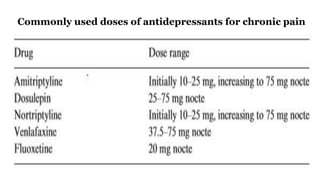
Commonly used doses of antidepressants for chronic pain
11
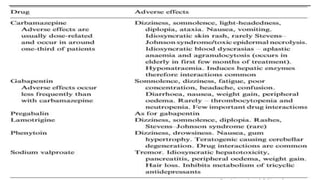
Anti-epileptic drugs
• Widely used in pain clinics to treat neuropathic pain.
• First phenytoin, then carbamazepine.
• Good for post-herpetic neuralgia, trigeminal neuralgia, painful
diabetic neuropathy, and post-stroke pain.
• Not robust for phantom limb pain and spinal cord injury.
• Multiple mechanisms of action.
12
• Older anti-epileptics reduce neuronal excitability by
frequency-dependent blockade of Na+ channels.
• Carbamazepine remains the treatment of choice in
trigeminal neuralgia.
• About 70% of patients get significant pain relief.
• Oxcarbazepin with less side effects.
13
• Lamotrigine acts at sodium channels and suppresses
release of glutamate.
• Sodium valproate elevates levels of GABA.
• Gabapentin and pregabeline have inhibitory action
in voltage-gated calcium channels.
• With gabapentin, at least 50% pain reduction.
14
Side effects of AEs:
• Acute toxicity.
• CNS, gastrointestinal and hematological systems
are commonly affected.
• Usually do not lead to discontinuation.
15
16
Opioids
• Strong opioids may be effective when other therapies fail.
• Preferably slow release preparations are used at a low dose
• Titrated against side effects and pain.
• Oxycodone, tramadol, fentanyl and morphine found effective.
• No robust evidence on superiority.
• Limitations?
17
• Common opioid-related adverse effects include:
Nausea and vomiting, constipation, sedation,
dizziness and respiratory depression.
• These effects generally decrease after long-term
treatment, except constipation.
• Long-term administration may be associated with
immunological changes, hypogonadism, hyperalgesia
and risk of addiction.
18
• Tramadol has properties of serotonin and
norepinephrine agonists.
• There is an increased risk of seizures in patients with
previous epilepsy or receiving drugs reducing the
seizure threshold such as TCAs.
19
Local anesthetics and anti-arrhythmics
• Suppress hyper-excitability by sodium channel blockade.
• Low-dose lidocaine may block glutamate-evoked activity
in the dorsal horn of the spinal cord.
• Primarily used to treat postoperative pain and more
recently for deafferentation pain, central pain and
diabetic neuropathy.
20
• The drug is not suitable for long-term use as it cannot
be given orally but continues to be used IV.
• Lidocaine 5% is available as a 10 X 14 cm patch.
• Shown to have efficacy and tolerability in the
management of post-herpetic neuralgia.
• Mexiletine is the oral analogue of lidocaine with
disappointing efficacy with bad side effect profile.
21
• Gastrointestinal side-effects of Mexiletine are very
common and frequently limit treatment.
• Other problems include worsening of existing arrhythmias
and neurological symptoms (particularly tremor).
• The use of other antiarrhythmic agents is now precluded
because of the incidence of severe adverse events.
22
Other pharmacological interventions
• Ketamine is an NMDA antagonist.
• Successfully used in sub-anesthetic doses for neuropathic pain.
• The side effects include psychomimetic effects: limit its usefulness.
• Generally used in limited response to standard treatments and
display features of central wind up phenomenon.
23
• Methadone is believed to have some action
at the NMDA receptor.
• It may well have a place in the management
of chronic pain.
• It is not easy to titrate but has advantage of a
long duration of action.
24
Non-pharmacologic therapies
• Simple measures such as massage, exercise and
physiotherapy can help in producing marked
functional improvements.
• Hypnosis, meditation, TENS and acupuncture.
25
Advanced interventions
• Neural blockade or ablation
• Spinal cord stimulations
• Surgical and chemical sympathectomy Surgery.
• e.g. Microvascular decompression for some
types of trigeminal neuralgia
26
Chronic post-surgical pain (CPSP)
• Multiple perioperative risks.
• Age was found inversely related with CPSP.
• Genetic susceptibility has central role.
• Malignancies
• Infections
• Pre-existing pain
27
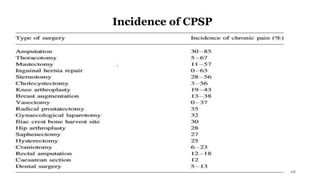
Incidence of CPSP
28
Preventive techniques
• Pre-emptive regional analgesia.
• Paravertebral block initiated before incision and
continued into the postoperative period in
thoracic and breast cancer.
• Epidural analgesia reduces the incidence of CPSP
in patients undergoing thoracotomy and
laparotomy.
29
• Perioperative IV ketamine infusion has been
used to prevent development of CPSP in
patients undergoing mastectomy,
thoracotomy, and rectal cancer surgery.
• Clonidine added in LA may reduce CPSP.
But limited data.
30
• Some patients develop neuropathic pain symptoms in
the immediate postoperative period.
• Anti-neuropathic medications such as gabapentin are
increasingly being used by the acute pain service.
• It is not known whether treating neuropathic pain in
the postoperative setting reduces the development of
chronic neuropathic pain after surgery.
31
Thank You!
32

Chronic pain management

  • 1.
    Chronic pain management ByAtalay Eshetie Demilie
  • 2.
    Introduction • Complex andmany factors influence pain experience. • Therefore, need multimodal interventions. • Both physical and psychological, delivered in parallel. • Pharmacotherapy plays an important role. • Often refractory to conventional analgesic therapy. • Non-analgesic drugs are frequently used. 2
  • 3.
    Common classes ofdrugs chronic pain clinic • Anti-depressants • Anti-epileptics • Opioids • Local anesthetics and anti- arrhythmics 3
  • 4.
    Anti-depressant drugs • Almost50% of patients with pain have depression. • Use lower doses than used for treating depression. • More effective in the absence of depression. • Unknown mechanism. • Likely inhibition of re-uptake of neurotransmitters in the CNS. • Therefore; enhance descending inhibitory pathways. 4
  • 5.
    • Additionally, acton other receptors. E.g. alpha adrenergic, histaminergic and NMDA Sodium and calcium channels blockade Weak stimulatory action in µ-opioid receptors • Most commonly used are the first generation tricyclic antidepressants including amitriptyline, doxepin, clomipramine and dosulepin. 5
  • 6.
    Side-effects (commonly limittheir use) include • Sedation and anticholinergic effects, • Particularly dry mouth. • Constipation and urinary retention are well documented. • The drugs have a number of effects on the heart including slowing of atrioventricular and intraventricular conduction. 6
  • 7.
    • Mixed reuptakeinhibitors such as amitriptyline are more effective than selective agents. • Emphasizing the importance of both serotonergic and noradrenergic pathways in pain perception. • Relieve other common symptoms in patients with chronic pain, such as sleep disorder. 7
  • 8.
    • Although anti-depressantshave been used for over thirty years to manage neuropathic pain, in the UK no antidepressant has a product license for this indication. 8
  • 9.
    Clinical and practicalissues in using ADs • Still one of first line drugs. • In multiple large scale RCTs, antidepressants were found beneficial. Mostly in patients with post-herpetic neuralgia, painful diabetic neuropathy and central pain. • Satisfactory NNT. 9
  • 10.
    • Once daily.Night dose. >>> help in sleep disturbance. • Morning sedation. • If day time somnolence persist >>> take earlier. • Titrate to efficacy and side effects 10
  • 11.
    Commonly used dosesof antidepressants for chronic pain 11
  • 12.
    Anti-epileptic drugs • Widelyused in pain clinics to treat neuropathic pain. • First phenytoin, then carbamazepine. • Good for post-herpetic neuralgia, trigeminal neuralgia, painful diabetic neuropathy, and post-stroke pain. • Not robust for phantom limb pain and spinal cord injury. • Multiple mechanisms of action. 12
  • 13.
    • Older anti-epilepticsreduce neuronal excitability by frequency-dependent blockade of Na+ channels. • Carbamazepine remains the treatment of choice in trigeminal neuralgia. • About 70% of patients get significant pain relief. • Oxcarbazepin with less side effects. 13
  • 14.
    • Lamotrigine actsat sodium channels and suppresses release of glutamate. • Sodium valproate elevates levels of GABA. • Gabapentin and pregabeline have inhibitory action in voltage-gated calcium channels. • With gabapentin, at least 50% pain reduction. 14
  • 15.
    Side effects ofAEs: • Acute toxicity. • CNS, gastrointestinal and hematological systems are commonly affected. • Usually do not lead to discontinuation. 15
  • 16.
  • 17.
    Opioids • Strong opioidsmay be effective when other therapies fail. • Preferably slow release preparations are used at a low dose • Titrated against side effects and pain. • Oxycodone, tramadol, fentanyl and morphine found effective. • No robust evidence on superiority. • Limitations? 17
  • 18.
    • Common opioid-relatedadverse effects include: Nausea and vomiting, constipation, sedation, dizziness and respiratory depression. • These effects generally decrease after long-term treatment, except constipation. • Long-term administration may be associated with immunological changes, hypogonadism, hyperalgesia and risk of addiction. 18
  • 19.
    • Tramadol hasproperties of serotonin and norepinephrine agonists. • There is an increased risk of seizures in patients with previous epilepsy or receiving drugs reducing the seizure threshold such as TCAs. 19
  • 20.
    Local anesthetics andanti-arrhythmics • Suppress hyper-excitability by sodium channel blockade. • Low-dose lidocaine may block glutamate-evoked activity in the dorsal horn of the spinal cord. • Primarily used to treat postoperative pain and more recently for deafferentation pain, central pain and diabetic neuropathy. 20
  • 21.
    • The drugis not suitable for long-term use as it cannot be given orally but continues to be used IV. • Lidocaine 5% is available as a 10 X 14 cm patch. • Shown to have efficacy and tolerability in the management of post-herpetic neuralgia. • Mexiletine is the oral analogue of lidocaine with disappointing efficacy with bad side effect profile. 21
  • 22.
    • Gastrointestinal side-effectsof Mexiletine are very common and frequently limit treatment. • Other problems include worsening of existing arrhythmias and neurological symptoms (particularly tremor). • The use of other antiarrhythmic agents is now precluded because of the incidence of severe adverse events. 22
  • 23.
    Other pharmacological interventions •Ketamine is an NMDA antagonist. • Successfully used in sub-anesthetic doses for neuropathic pain. • The side effects include psychomimetic effects: limit its usefulness. • Generally used in limited response to standard treatments and display features of central wind up phenomenon. 23
  • 24.
    • Methadone isbelieved to have some action at the NMDA receptor. • It may well have a place in the management of chronic pain. • It is not easy to titrate but has advantage of a long duration of action. 24
  • 25.
    Non-pharmacologic therapies • Simplemeasures such as massage, exercise and physiotherapy can help in producing marked functional improvements. • Hypnosis, meditation, TENS and acupuncture. 25
  • 26.
    Advanced interventions • Neuralblockade or ablation • Spinal cord stimulations • Surgical and chemical sympathectomy Surgery. • e.g. Microvascular decompression for some types of trigeminal neuralgia 26
  • 27.
    Chronic post-surgical pain(CPSP) • Multiple perioperative risks. • Age was found inversely related with CPSP. • Genetic susceptibility has central role. • Malignancies • Infections • Pre-existing pain 27
  • 28.
  • 29.
    Preventive techniques • Pre-emptiveregional analgesia. • Paravertebral block initiated before incision and continued into the postoperative period in thoracic and breast cancer. • Epidural analgesia reduces the incidence of CPSP in patients undergoing thoracotomy and laparotomy. 29
  • 30.
    • Perioperative IVketamine infusion has been used to prevent development of CPSP in patients undergoing mastectomy, thoracotomy, and rectal cancer surgery. • Clonidine added in LA may reduce CPSP. But limited data. 30
  • 31.
    • Some patientsdevelop neuropathic pain symptoms in the immediate postoperative period. • Anti-neuropathic medications such as gabapentin are increasingly being used by the acute pain service. • It is not known whether treating neuropathic pain in the postoperative setting reduces the development of chronic neuropathic pain after surgery. 31
  • 32.