


School & Academy
Governance
A policy overview
25 June 2013
Chris Caroe, Head of the School Governance Unit
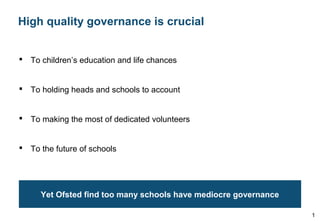
High quality governance is crucial
 To children’s education and life chances
 To holding heads and schools to account
 To making the most of dedicated volunteers
 To the future of schools
1
Yet Ofsted find too many schools have mediocre governance
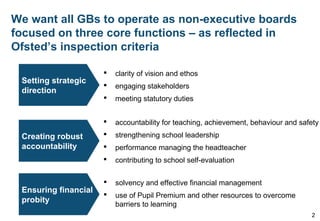
We want all GBs to operate as non-executive boards
focused on three core functions – as reflected in
Ofsted’s inspection criteria
2
 clarity of vision and ethos
 engaging stakeholders
 meeting statutory duties
Setting strategic
direction
Creating robust
accountability
Ensuring financial
probity
 accountability for teaching, achievement, behaviour and safety
 strengthening school leadership
 performance managing the headteacher
 contributing to school self-evaluation
 solvency and effective financial management
 use of Pupil Premium and other resources to overcome
barriers to learning
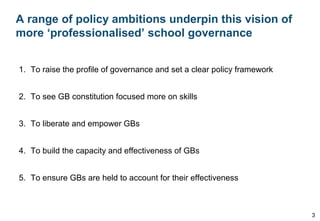
A range of policy ambitions underpin this vision of
more ‘professionalised’ school governance
3
1. To raise the profile of governance and set a clear policy framework
2. To see GB constitution focused more on skills
3. To liberate and empower GBs
4. To build the capacity and effectiveness of GBs
5. To ensure GBs are held to account for their effectiveness
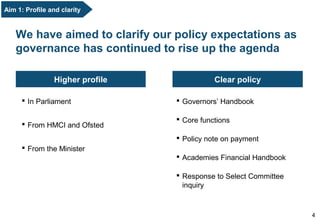
We have aimed to clarify our policy expectations as
governance has continued to rise up the agenda
4
Aim 1: Profile and clarity
Higher profile
 Governors’ Handbook
 Core functions
 Policy note on payment
 Academies Financial Handbook
 Response to Select Committee
inquiry
Clear policy
 In Parliament
 From HMCI and Ofsted
 From the Minister
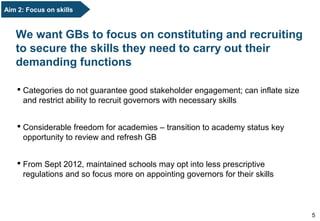
We want GBs to focus on constituting and recruiting
to secure the skills they need to carry out their
demanding functions
5
Aim 2: Focus on skills
 Categories do not guarantee good stakeholder engagement; can inflate size
and restrict ability to recruit governors with necessary skills
 Considerable freedom for academies – transition to academy status key
opportunity to review and refresh GB
 From Sept 2012, maintained schools may opt into less prescriptive
regulations and so focus more on appointing governors for their skills
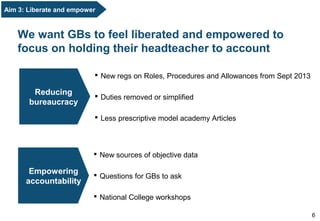
We want GBs to feel liberated and empowered to
focus on holding their headteacher to account
6
Aim 3: Liberate and empower
 New regs on Roles, Procedures and Allowances from Sept 2013
 Duties removed or simplified
 Less prescriptive model academy Articles
Reducing
bureaucracy
 New sources of objective data
 Questions for GBs to ask
 National College workshops
Empowering
accountability
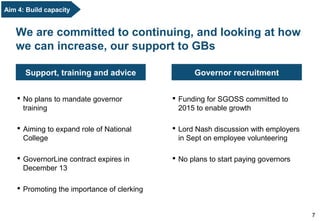
We are committed to continuing, and looking at how
we can increase, our support to GBs
7
Aim 4: Build capacity
Support, training and advice Governor recruitment
 No plans to mandate governor
training
 Aiming to expand role of National
College
 GovernorLine contract expires in
December 13
 Promoting the importance of clerking
 Funding for SGOSS committed to
2015 to enable growth
 Lord Nash discussion with employers
in Sept on employee volunteering
 No plans to start paying governors
8
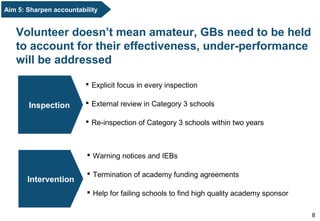
 Explicit focus in every inspection
 External review in Category 3 schools
 Re-inspection of Category 3 schools within two years
Inspection
 Warning notices and IEBs
 Termination of academy funding agreements
 Help for failing schools to find high quality academy sponsor
Intervention
Volunteer doesn’t mean amateur, GBs need to be held
to account for their effectiveness, under-performance
will be addressed
Aim 5: Sharpen accountability
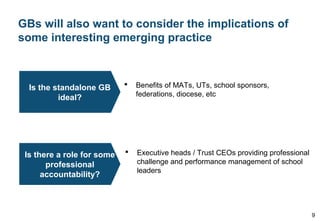
GBs will also want to consider the implications of
some interesting emerging practice
 Benefits of MATs, UTs, school sponsors,
federations, diocese, etc
9
Is the standalone GB
ideal?
 Executive heads / Trust CEOs providing professional
challenge and performance management of school
leaders
Is there a role for some
professional
accountability?
For more information please visit
www.education.gov.uk/governance
Questions or comments can be sent to
School.Governance@education.gsi.gov.uk

Chris caroe df e presentation governorlive 25062013

  • 1.
    School & Academy Governance Apolicy overview 25 June 2013 Chris Caroe, Head of the School Governance Unit
  • 2.
    High quality governanceis crucial  To children’s education and life chances  To holding heads and schools to account  To making the most of dedicated volunteers  To the future of schools 1 Yet Ofsted find too many schools have mediocre governance
  • 3.
    We want allGBs to operate as non-executive boards focused on three core functions – as reflected in Ofsted’s inspection criteria 2  clarity of vision and ethos  engaging stakeholders  meeting statutory duties Setting strategic direction Creating robust accountability Ensuring financial probity  accountability for teaching, achievement, behaviour and safety  strengthening school leadership  performance managing the headteacher  contributing to school self-evaluation  solvency and effective financial management  use of Pupil Premium and other resources to overcome barriers to learning
  • 4.
    A range ofpolicy ambitions underpin this vision of more ‘professionalised’ school governance 3 1. To raise the profile of governance and set a clear policy framework 2. To see GB constitution focused more on skills 3. To liberate and empower GBs 4. To build the capacity and effectiveness of GBs 5. To ensure GBs are held to account for their effectiveness
  • 5.
    We have aimedto clarify our policy expectations as governance has continued to rise up the agenda 4 Aim 1: Profile and clarity Higher profile  Governors’ Handbook  Core functions  Policy note on payment  Academies Financial Handbook  Response to Select Committee inquiry Clear policy  In Parliament  From HMCI and Ofsted  From the Minister
  • 6.
    We want GBsto focus on constituting and recruiting to secure the skills they need to carry out their demanding functions 5 Aim 2: Focus on skills  Categories do not guarantee good stakeholder engagement; can inflate size and restrict ability to recruit governors with necessary skills  Considerable freedom for academies – transition to academy status key opportunity to review and refresh GB  From Sept 2012, maintained schools may opt into less prescriptive regulations and so focus more on appointing governors for their skills
  • 7.
    We want GBsto feel liberated and empowered to focus on holding their headteacher to account 6 Aim 3: Liberate and empower  New regs on Roles, Procedures and Allowances from Sept 2013  Duties removed or simplified  Less prescriptive model academy Articles Reducing bureaucracy  New sources of objective data  Questions for GBs to ask  National College workshops Empowering accountability
  • 8.
    We are committedto continuing, and looking at how we can increase, our support to GBs 7 Aim 4: Build capacity Support, training and advice Governor recruitment  No plans to mandate governor training  Aiming to expand role of National College  GovernorLine contract expires in December 13  Promoting the importance of clerking  Funding for SGOSS committed to 2015 to enable growth  Lord Nash discussion with employers in Sept on employee volunteering  No plans to start paying governors
  • 9.
    8  Explicit focusin every inspection  External review in Category 3 schools  Re-inspection of Category 3 schools within two years Inspection  Warning notices and IEBs  Termination of academy funding agreements  Help for failing schools to find high quality academy sponsor Intervention Volunteer doesn’t mean amateur, GBs need to be held to account for their effectiveness, under-performance will be addressed Aim 5: Sharpen accountability
  • 10.
    GBs will alsowant to consider the implications of some interesting emerging practice  Benefits of MATs, UTs, school sponsors, federations, diocese, etc 9 Is the standalone GB ideal?  Executive heads / Trust CEOs providing professional challenge and performance management of school leaders Is there a role for some professional accountability?
  • 11.
    For more informationplease visit www.education.gov.uk/governance Questions or comments can be sent to School.Governance@education.gsi.gov.uk