Cholinergic
Transmission And
Cholinergic
Receptors
Submitted To :- Dr. Amit Kumar Verma
2
Medicinal Chemistry
S. No. Topic Name
1 Cholinergic Neurotransmitter
2 Cholinergic Neurochemistry
3 Cholinergic Transmission
4 Cholinergic Receptors
5 Biochemical Effects
6 Reference
Contents :-
3
Dale described the actions of esters and ethers of choline on isolated
organs and their relationship to Muscarinic Receptors, this helped in
understanding action of cholinergic nerve and its NT. Drugs can mimic
the action of ACh by either acting on ACh receptors or inhibiting AChE,
the enzyme that inactivates ACh. Cholinergic Nerves are found in PNS
and CNS, presence in CNS is under extensive research. Synaptic
terminals in the cerebral cortex, hippocampus and corpus striatum are
rich in ACh, however its function in CNS is not clear, implicated in
memory and behavioral activity.
Cholinergic Neurotransmitter
4
Cholinergic neurons synthesize ACh, AChE, ChAT. ChAT stands for
choline acetyltransferase and catalyze transfer of acetyl group(by
conversion of glucose to pyruvate in cytosol of neuron, formation of
acetyl CoA) from CoA to choline, this results in production of ACh. ACh
is present in cystosol & nerve endings, presynaptic nerve uptake the
choline part of ACh via Na+ since choline( by hydrolysis of ACh ) is a
limiting substrate for production of ACh. QAC can behave as a
competitive inhibitor of choline uptake, e.g. Hemicholinium (HC3), 2-
hydroxyethyltriethylammonium.
Cholinergic Neurochemistry
5
Serine gets metabolized by seine decarboxylase which gives
ethanolamine and S-adenosylmethionine act over it to produce
choline.
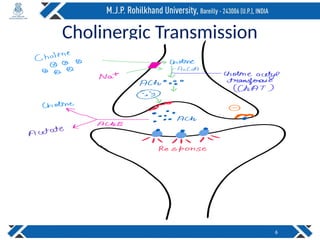
Depolarisation of the nerve terminal causes release of ACh & it
functions as a NT. Further this ACh is degraded by the action of
AChE (acetylcholinesterase) forming choline & acetate.
Cholinergic Neurochemistry
Cholinergic Transmission
6
Cholinergic Receptors
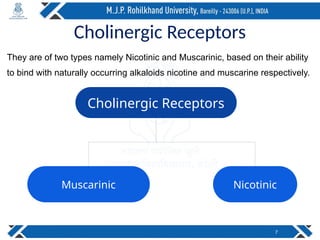
They are of two types namely Nicotinic and Muscarinic, based on their ability
to bind with naturally occurring alkaloids nicotine and muscarine respectively.
7
Cholinergic Receptors
Nicotinic
Muscarinic
8
Action of ACh on muscarinic receptors results in secretion from salivary &
sweat glands, contraction & secretion in gut and constriction of respiratory
tract. It also relaxes the smooth muscles and slows down contraction of heart
muscle. Guanosine triphosphate binding protein (G-protein) is responsible for
actions of muscarinic receptors. Muscarinic receptors consist of 7
transmembrane protein helices that create four intracellular and four
extracellular domains with the extracellular domain having ACh binding site
and intracellular domain attached to the G-protein. Muscarinic receptors
have subtypes namely M1, M2, M3, M4 and M5.
Muscarinic Receptors
9
M-1 Receptors
● These receptors have a high affinity for pirenzepine & low
affinity for AF-DX116. Also termed as neural as present in the
brain. They tend to stimulate the gastric secretions.
● Agonist :- McN-A343.
● Antagonist :- Pirenzepine Hydrochloride.
● Location :- CNS, Exocrine Glands, Autonomic Ganglia,
Parietal Cells(GIT), PNS & Submucosal Glands.
● Functions :- Rapid Eye Movement, Arousal Attention, Sleep,
Emotional Responses, Affective Disorders (stress,
depression), Memory & Learning.
Muscarinic Receptors
10
M-2 Receptors
● They show high affinity for methoctramine (polyamine) & low affinity for
pirenzepine. Since they are present in atria, also called cardiac muscarinic
receptors.
● Agonist :- Bethanechol
● Antagonist :- Atropine
● Location :- Lungs, Heart, Presynaptic terminals of postganglionic
cholinergic nerves & Visceral Smooth Muscles.
● Function:- Decrease strength & rate of heart rate, hyperpolarization of of
cardiac cells (bradycardia), lowers cAMP levels (Ca2+
also decrease) in
cardiac cells via Gi protein, Act as autoreceptor on presynaptic terminals of
postganglionic cholinergic nerves to inhibit ACh release.
Muscarinic Receptors
11
M-3 Receptors
● Also known as glandular muscarinic receptors & have
stimulatory effect on organs.
● Functions:- Glandular Secretion from Pancreatic, Bronchial,
Lacrimal, Salivary and Mucosal Cells, Contraction of Visceral
Smooth Muscle, Mediated via G Protein activation of PLC that
give DAG & IP3 (second messenger). Endothelium control tone of
Vascular Smooth Muscles by potent relaxant (EDRF) nitric oxide
& a vasoconstrictor Endothelium Derived Contracting Factor.
● Location:- Exocrine Glands, Smooth Muscles, Iris, & Vascular
Endothelium.
Muscarinic Receptors
12
M-4 & M-5 Receptors
M4 Receptors :-
Regulate K+
and Ca2+
ion channels like M2, present in
tracheal smooth muscle & inhibit ACH synthesis like M2
receptors.
Antagonist:- Tropicamide
M5 Receptors :-
M5 receptor mRNA found in substantia nigra & may
regulate dopamine release at terminals within the striatum.
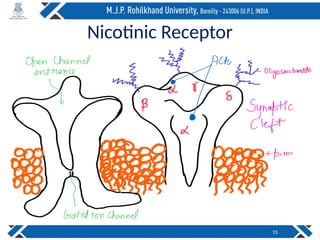
Nicotinic Receptors
They are coupled to ion channels, mediate very rapid response (0.1_10
milliseconds) and provide aqueous pathway to ions through plasma
membrane. Charge and size of ions affect selectivity of ion pore. water
around the ion determines the energy required to remove the hydration
shell. water surrounds ion as a tightly bound, highly ordered layer
immediately surrounding ion and a second less structured layer. First NT
isolated & purified in active form was nicotinic ACh receptor, a glycoprotein
embedded into polysynaptic membrane. It is a cylindrical protein of 250000
Da with five subunit polypeptide chains (α2β δ). These peptide chains are
ɣ
arranged in such a way that have a central opening and each chain
ɑ
contains a negatively charged binding site for QAG of ACh. Receptor exist
as a dimer of two five subunit polypeptide chain monomers linked via
disulfide bond b/w chains.
𝛿
13
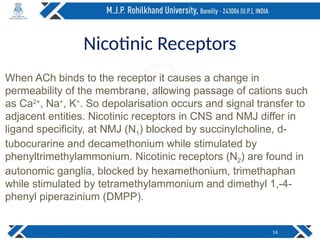
Nicotinic Receptors
When ACh binds to the receptor it causes a change in
permeability of the membrane, allowing passage of cations such
as Ca2+
, Na+
, K+
. So depolarisation occurs and signal transfer to
adjacent entities. Nicotinic receptors in CNS and NMJ differ in
ligand specificity, at NMJ (N1) blocked by succinylcholine, d-
tubocurarine and decamethonium while stimulated by
phenyltrimethylammonium. Nicotinic receptors (N2) are found in
autonomic ganglia, blocked by hexamethonium, trimethaphan
while stimulated by tetramethylammonium and dimethyl 1,-4-
phenyl piperazinium (DMPP).
14
Nicotinic Receptor
15
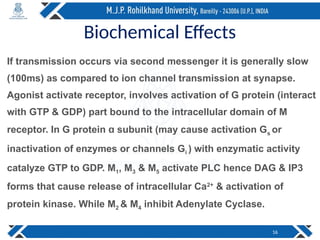
Biochemical Effects
If transmission occurs via second messenger it is generally slow
(100ms) as compared to ion channel transmission at synapse.
Agonist activate receptor, involves activation of G protein (interact
with GTP & GDP) part bound to the intracellular domain of M
receptor. In G protein subunit (may cause activation G
ɑ s or
inactivation of enzymes or channels Gi ) with enzymatic activity
catalyze GTP to GDP. M1, M3 & M5 activate PLC hence DAG & IP3
forms that cause release of intracellular Ca2+
& activation of
protein kinase. While M2 & M4 inhibit Adenylate Cyclase.
16
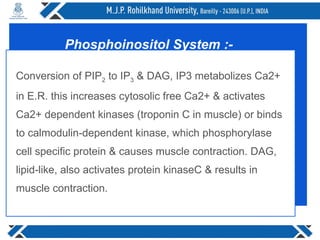
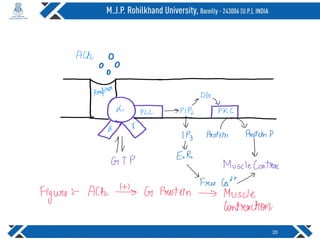
Conversion of PIP2 to IP3 & DAG, IP3 metabolizes Ca2+
in E.R. this increases cytosolic free Ca2+ & activates
Ca2+ dependent kinases (troponin C in muscle) or binds
to calmodulin-dependent kinase, which phosphorylase
cell specific protein & causes muscle contraction. DAG,
lipid-like, also activates protein kinaseC & results in
muscle contraction.
Phosphoinositol System :-
Another target for M receptors it metabolizes formation of
cAMP from ATP, this cAMP activates various protein
kinases which catalyzes phosphorylation of enzymes & ion
channels which alter ion(Ca2+) concentration hence
regulating muscle contraction. GTP protein (Gi) may cause
smooth muscle relaxation by reducing activity of Adenyl
Cyclase. M receptor stimulation causes cAMP level to fall,
cAMP protein dependent kinase activity decreases &
relaxation of muscle contraction.
Adenylate Cyclase
G proteins are present on the ion channel, Ca2+ channel
& activate them without need of a second messenger.
E.g. G protein in heart tissue activate K+ channel &
causes hyperpolarization ( heart rate decreases ).
Ion Channel
20
Reference
Wilson, C. O., Beale, J. M., & Block, J. H. (2011). Wilson
and Gisvold's textbook of organic medicinal and
pharmaceutical chemistry (12th ed.). Baltimore, MD:
Lippincott Williams & Wilkins.
THANKYOU
21

Cholinergic Transmission & Receptors....

  • 1.
  • 2.
    2 Medicinal Chemistry S. No.Topic Name 1 Cholinergic Neurotransmitter 2 Cholinergic Neurochemistry 3 Cholinergic Transmission 4 Cholinergic Receptors 5 Biochemical Effects 6 Reference Contents :-
  • 3.
    3 Dale described theactions of esters and ethers of choline on isolated organs and their relationship to Muscarinic Receptors, this helped in understanding action of cholinergic nerve and its NT. Drugs can mimic the action of ACh by either acting on ACh receptors or inhibiting AChE, the enzyme that inactivates ACh. Cholinergic Nerves are found in PNS and CNS, presence in CNS is under extensive research. Synaptic terminals in the cerebral cortex, hippocampus and corpus striatum are rich in ACh, however its function in CNS is not clear, implicated in memory and behavioral activity. Cholinergic Neurotransmitter
  • 4.
    4 Cholinergic neurons synthesizeACh, AChE, ChAT. ChAT stands for choline acetyltransferase and catalyze transfer of acetyl group(by conversion of glucose to pyruvate in cytosol of neuron, formation of acetyl CoA) from CoA to choline, this results in production of ACh. ACh is present in cystosol & nerve endings, presynaptic nerve uptake the choline part of ACh via Na+ since choline( by hydrolysis of ACh ) is a limiting substrate for production of ACh. QAC can behave as a competitive inhibitor of choline uptake, e.g. Hemicholinium (HC3), 2- hydroxyethyltriethylammonium. Cholinergic Neurochemistry
  • 5.
    5 Serine gets metabolizedby seine decarboxylase which gives ethanolamine and S-adenosylmethionine act over it to produce choline. Depolarisation of the nerve terminal causes release of ACh & it functions as a NT. Further this ACh is degraded by the action of AChE (acetylcholinesterase) forming choline & acetate. Cholinergic Neurochemistry
  • 6.
  • 7.
    Cholinergic Receptors They areof two types namely Nicotinic and Muscarinic, based on their ability to bind with naturally occurring alkaloids nicotine and muscarine respectively. 7 Cholinergic Receptors Nicotinic Muscarinic
  • 8.
    8 Action of AChon muscarinic receptors results in secretion from salivary & sweat glands, contraction & secretion in gut and constriction of respiratory tract. It also relaxes the smooth muscles and slows down contraction of heart muscle. Guanosine triphosphate binding protein (G-protein) is responsible for actions of muscarinic receptors. Muscarinic receptors consist of 7 transmembrane protein helices that create four intracellular and four extracellular domains with the extracellular domain having ACh binding site and intracellular domain attached to the G-protein. Muscarinic receptors have subtypes namely M1, M2, M3, M4 and M5. Muscarinic Receptors
  • 9.
    Muscarinic Receptors 9 M-1 Receptors ●These receptors have a high affinity for pirenzepine & low affinity for AF-DX116. Also termed as neural as present in the brain. They tend to stimulate the gastric secretions. ● Agonist :- McN-A343. ● Antagonist :- Pirenzepine Hydrochloride. ● Location :- CNS, Exocrine Glands, Autonomic Ganglia, Parietal Cells(GIT), PNS & Submucosal Glands. ● Functions :- Rapid Eye Movement, Arousal Attention, Sleep, Emotional Responses, Affective Disorders (stress, depression), Memory & Learning.
  • 10.
    Muscarinic Receptors 10 M-2 Receptors ●They show high affinity for methoctramine (polyamine) & low affinity for pirenzepine. Since they are present in atria, also called cardiac muscarinic receptors. ● Agonist :- Bethanechol ● Antagonist :- Atropine ● Location :- Lungs, Heart, Presynaptic terminals of postganglionic cholinergic nerves & Visceral Smooth Muscles. ● Function:- Decrease strength & rate of heart rate, hyperpolarization of of cardiac cells (bradycardia), lowers cAMP levels (Ca2+ also decrease) in cardiac cells via Gi protein, Act as autoreceptor on presynaptic terminals of postganglionic cholinergic nerves to inhibit ACh release.
  • 11.
    Muscarinic Receptors 11 M-3 Receptors ●Also known as glandular muscarinic receptors & have stimulatory effect on organs. ● Functions:- Glandular Secretion from Pancreatic, Bronchial, Lacrimal, Salivary and Mucosal Cells, Contraction of Visceral Smooth Muscle, Mediated via G Protein activation of PLC that give DAG & IP3 (second messenger). Endothelium control tone of Vascular Smooth Muscles by potent relaxant (EDRF) nitric oxide & a vasoconstrictor Endothelium Derived Contracting Factor. ● Location:- Exocrine Glands, Smooth Muscles, Iris, & Vascular Endothelium.
  • 12.
    Muscarinic Receptors 12 M-4 &M-5 Receptors M4 Receptors :- Regulate K+ and Ca2+ ion channels like M2, present in tracheal smooth muscle & inhibit ACH synthesis like M2 receptors. Antagonist:- Tropicamide M5 Receptors :- M5 receptor mRNA found in substantia nigra & may regulate dopamine release at terminals within the striatum.
  • 13.
    Nicotinic Receptors They arecoupled to ion channels, mediate very rapid response (0.1_10 milliseconds) and provide aqueous pathway to ions through plasma membrane. Charge and size of ions affect selectivity of ion pore. water around the ion determines the energy required to remove the hydration shell. water surrounds ion as a tightly bound, highly ordered layer immediately surrounding ion and a second less structured layer. First NT isolated & purified in active form was nicotinic ACh receptor, a glycoprotein embedded into polysynaptic membrane. It is a cylindrical protein of 250000 Da with five subunit polypeptide chains (α2β δ). These peptide chains are ɣ arranged in such a way that have a central opening and each chain ɑ contains a negatively charged binding site for QAG of ACh. Receptor exist as a dimer of two five subunit polypeptide chain monomers linked via disulfide bond b/w chains. 𝛿 13
  • 14.
    Nicotinic Receptors When AChbinds to the receptor it causes a change in permeability of the membrane, allowing passage of cations such as Ca2+ , Na+ , K+ . So depolarisation occurs and signal transfer to adjacent entities. Nicotinic receptors in CNS and NMJ differ in ligand specificity, at NMJ (N1) blocked by succinylcholine, d- tubocurarine and decamethonium while stimulated by phenyltrimethylammonium. Nicotinic receptors (N2) are found in autonomic ganglia, blocked by hexamethonium, trimethaphan while stimulated by tetramethylammonium and dimethyl 1,-4- phenyl piperazinium (DMPP). 14
  • 15.
  • 16.
    Biochemical Effects If transmissionoccurs via second messenger it is generally slow (100ms) as compared to ion channel transmission at synapse. Agonist activate receptor, involves activation of G protein (interact with GTP & GDP) part bound to the intracellular domain of M receptor. In G protein subunit (may cause activation G ɑ s or inactivation of enzymes or channels Gi ) with enzymatic activity catalyze GTP to GDP. M1, M3 & M5 activate PLC hence DAG & IP3 forms that cause release of intracellular Ca2+ & activation of protein kinase. While M2 & M4 inhibit Adenylate Cyclase. 16
  • 17.
    Conversion of PIP2to IP3 & DAG, IP3 metabolizes Ca2+ in E.R. this increases cytosolic free Ca2+ & activates Ca2+ dependent kinases (troponin C in muscle) or binds to calmodulin-dependent kinase, which phosphorylase cell specific protein & causes muscle contraction. DAG, lipid-like, also activates protein kinaseC & results in muscle contraction. Phosphoinositol System :-
  • 18.
    Another target forM receptors it metabolizes formation of cAMP from ATP, this cAMP activates various protein kinases which catalyzes phosphorylation of enzymes & ion channels which alter ion(Ca2+) concentration hence regulating muscle contraction. GTP protein (Gi) may cause smooth muscle relaxation by reducing activity of Adenyl Cyclase. M receptor stimulation causes cAMP level to fall, cAMP protein dependent kinase activity decreases & relaxation of muscle contraction. Adenylate Cyclase
  • 19.
    G proteins arepresent on the ion channel, Ca2+ channel & activate them without need of a second messenger. E.g. G protein in heart tissue activate K+ channel & causes hyperpolarization ( heart rate decreases ). Ion Channel
  • 20.
  • 21.
    Reference Wilson, C. O.,Beale, J. M., & Block, J. H. (2011). Wilson and Gisvold's textbook of organic medicinal and pharmaceutical chemistry (12th ed.). Baltimore, MD: Lippincott Williams & Wilkins. THANKYOU 21