CORVINUS UNIVERSITY OF BUDAPEST
Faculty of Business Administration
Department of Marketing
The China Effect:
Chinese Technology Firms Going Global
Andras Bodrog
Business Management
Business Communication Specialization
2010
Consultant: Tamas D. Szabo
2
Abstract
From personal and professional passion towards the economy of China, I based
my paper on the technology sector, on one of the most strategically important segments
of the nation’s economy. Trailing the technology sector in the Middle Kingdom, my
research aims to find supportive arguments for the way Chinese tech firms
internationalize and the role the government’s reforms play in creating the environment
for ‘going global’.
Using mainly secondary sources while drawing upon the resources of three
disciplines (marketing, international business and political science) I examined three
hypothesis. I defined the China effect as the way Chinese companies are shaping the
future global technology landscape and concluded that China is developing in a unique
fashion. According to the internationalization theories, Chinese tech firms’ global
expansion is best described by behavioral approaches, more closely the Uppsala/stages
model. Using marketing related concepts, I explained the branding strategies and digital
communication techniques involved in Chinese internationalization.
To show real world examples and apply the case method, I showcased two of the
leading Chinese electronics companies (Lenovo and TCL) and concluded that China’s
rise in technology is substantial and shows an increasing trend. However, it can also be
said that although these companies are well known and are globally present, they are not
yet as dominant as their Western competitors. The importance of the paper and findings
can be contributed to better understand the implications China’s rise in technology means
for the rest of the world.
I would like to thank my consultants, Tamas D. Szabo and Adam Meszaros for
their help and ideas in writing my thesis, Katalin Nadasi for her marketing related
materials and my friend and China source Jiayou Xi for his input.
“I …………………. hereby testify to my full responsibility, that all
text, figures and tables contained in this thesis work – not including the
referenced works that follow the given guidelines – are solely the product of
my own work and do not rely upon other contributors or materials.”
3
TABLE OF CONTENTS
1. Introduction.................................................................................................................... 4
2. Internationalization ....................................................................................................... 7
2. 1. Economic approaches ........................................................................................... 9
2. 2. Behavioral approaches........................................................................................ 12
3. Economic transition and international marketing ..................................................... 15
3. 1. China’s reform process....................................................................................... 17
3. 1.1. Chinese gradual reform........................................................................... 18
3. 2. Governmental programs in science and technology ........................................ 20
3. 2.1. The 11th
FYP (2006-2010)....................................................................... 25
3. 2.2. The High-tech Industry Development Program of the 11th Five-Year
Plan..................................................................................................................... 26
3. 2.3. Challenges in S&T development ............................................................ 27
3. 2.4. Chinese S&T advantages ........................................................................ 28
3. 3. The Going Global policy..................................................................................... 28
3. 4. Chinese outward direct investment ................................................................... 30
4. Chinese tech enterprises .............................................................................................. 34
4. 1. Centers for technology........................................................................................ 35
4. 2. China’s technology sector................................................................................... 36
4. 2.1. Intellectual property........................................................................................ 38
4. 2.2. High technology and original equipment manufacturers (OEMs) ................. 39
4. 3. Chinese internet and advertising ....................................................................... 39
4. 3.1. Digital globalization ....................................................................................... 41
4. 4. Case studies of Chinese high-tech companies................................................... 43
4. 4.1. Lenovo Group................................................................................................. 43
4. 4.2. TCL Group ..................................................................................................... 48
4. 5. Overview of firms.............................................................................................. 53
4. 6. Branding Strategies............................................................................................ 55
4. 7. Digital communications and online marketing:................................................. 56
4. 8. Presence and significance in Hungary:.............................................................. 59
5. Overview ....................................................................................................................... 60
6. Bibliography:................................................................................................................ 62
7. Appendix....................................................................................................................... 74
4
1. Introduction
“Let China sleep for when she awakes, she will shake the world" /Napoleon Bonaparte
The China effect1
is taking over the world. Since the opening of China’s economy
and reform began in 1978, the world has witnessed an unparalleled magnitude of growth.
The Middle Kingdom, which in the early middle ages been the main contributor to world
trade is under way to resemble some if its past. For centuries, this ancient country has
stood as the leading civilization, outpacing the rest of the world in the field of arts and
sciences. At the start of the last millennium, China was among the preeminent
international traders, having a primitive global trading system, the Chinese silk road that
connected the East with Rome and Europe (Cateora et al., 2009). Through setbacks
caused by the western imperial powers and 20th
century internal problems, China has
missed out on industrialization, until now when it is becoming a dominant force in
technological aspects. Technological advances are transforming almost all aspect of
economic, political and social affairs. The new industrial revolution after the Cold War is
based on the computer, the rise of information technology (IT) and the internet economy.
This is why consumer electronic manufacturers play an important role in shaping the
economy of China.
The role of science and technology plays a pivotal role in each countries’
development. Throughout history, China has been a hotbed of inventions, such as
gunpowder, compass, tea and kites just to name a few. Today’s China, which has been
called the “factory of the world” is growing its economy at an unprecedented speed.
China is the country with the most mobile phone and internet users. A country that is
fueled by growth and has abundant financial resources at its disposal to develop it’s key
industries. The technology sector is one of the most important areas politically and
economically in China, which will play an increasingly important role domestically and
internationally in the future. However, the technology that fuels this robust growth is in
large part foreign. In my research, I am showing the aspiration of China to lose the
‘factory of the world’ tag and become a high-technology innovator.
1
I use the term as the global impact of China’s economic rise and that of it’s companies.
5
China’s domestic companies’ global emergence is in the beginning stages. The
country’s foreign assets, fierce domestic competition and developing know-how will
contribute to Chinese tech firms gradually becoming more apt and important in global
business. Strategic sectors such as telecom, ICT and high-technology have strengthened
since the opening reforms with strategic government programs and will continue to
expand globally in the foreseeable future based on the “indigenous innovation” paradigm
of the CCP. However, understanding the ramifications and underlying characteristics of
Chinese firms’ internationalization is a niche research area to which not much has been
contributed. Works published by Sandra Bell (2008), Hong Liu (2009) and Yu Zhou
(2009) among others are major contributions to explaining the Chinese technology
sector’s globalization.
My paper is based on the assumption, that the Chinese leadership is promoting
it’s technology sector in order to maintain growth and innovation, make China more
competitive globally and increase the market share, presence and brand equity of
Chinese technology companies abroad. This study aims to bring forth and examine the
way the Chinese technology sector is creating “the China effect” by globalizing its firms
and spreading influence. The paper examines Chinese internationalization in the light of
global internationalization theories the impact of China’s going global policy in the
technology sector, painting a picture about the internationalization routes and current
trends of Chinese enterprises using Chinese characters and some Chinese references2
. It
includes short case studies on a small selection of China’s national champions in the
technology sector, Lenovo and TCL. I am basing my research on the following
hypotheses:
 Hypothesis 0: The Chinese government is supporting domestic S&T and tech firms
by policy programs, funding and indirect control to internationalize, in order to
increase China’s overall competitiveness in the global economy.
 Hypothesis 1: The western internationalization theories partially explain Chinese
technology firms’ internationalization. The most adequate theory is the stages model,
which follows not only a pattern with the Chinese government’s incremental reform
2
As a student at Corvinus University and Eotvos Lorand University studying Management and
Mandarin, I am passionate and interested about the Chinese business landscape. I use Chinese
characters to define some key terms in order add to my paper’s originality and factualness.
6
and opening approach, but is also in line with developing country’s latecomer tech
firms.
 Hypothesis 2: China needs to develop and foster indigenous innovation and its high-
technology sector in order to create a solid foundation for future domestic growth and
not rely on foreign technology. The most successful companies going global are in
many cases domestic market leaders, using corporate branding to market themselves.
In my paper, I will explain two approaches among the international theories, briefly
highlight the main elements of Chinese economic reform and Going Global policy and
show two company examples. The contribution of this paper is three fold:
1. The paper showcases and explains modes of internationalization and applies them
to the way Chinese technology companies go abroad.
2. I am analyzing the technology sector of China and the effect the Chinese
governmental reforms, opening up, five year plans and the going global policy
has on it.
3. Within the technology sector, the focus is on high-technology original equipment
manufacturers (OEMs)3
and some of their respective companies. The case studies
show the path Lenovo and TCL took to become global players and highlight
online marketing and brand management approaches taken by the firms.
3
OEM as defined by Mohr et al. (2005), is a type of contract manufacturing or outsourcing, where
a manufacturer produces products that are purchased by an other company
7
2. Internationalization
Although the post-Cold War world is mainly characterized by globalization, we
still live in a world where national policies and domestic economies are the principal
determinants of economic affairs. According to Robert Gilpin in Global Political
Economy (2001) “the Cold War provided the necessary political condition for the
creation of a truly global economy however it is economic, political and technological
developments that have been the driving force behind economic globalization.”
Technological changes alone have created easier transportation, computerized
telecommunications compression of time and allow firms to go global more easily.
Global trade and financial flows have increased dramatically in the last twenty years,
with multinational companies (MNCs) having a more dominant position in transforming
international economy.
There has been a lot of research conducted about the internationalization of the firm.
Internationalization, in the broadest sense means that domestic companies spread their
operations over borders and utilize resources abroad. Reaching over countries brings
certain advantages, such as economies of scale, foreign talent, low cost labor, tax
incentives…etc. If internationalization is defined as “the crossing of national boundaries
in the process of growth” (Buckley and Ghauri, 1999), then China is currently the most
active internationalizing economy among the developing countries (Child et al. 2005).
Mainland Chinese firms had established 7470 companies in over 160 countries or regions
by the beginning of 2004 (Chung, 2004). According to Child et al. (2005) China’s
outward economic expansion is taking place on three different levels:
1. Exporting – most significant in economic value
2. Original Equipment Manufacturers (OEM) or subcontracting for foreign firms –
mainly included in the figures of exporting. Chinese firms gain much
management know-how and technological competence through these JVs and
partnerships
3. Outward foreign direct investment (OFDI or ODI) – Chinese firms’ physical and
organizational expansion abroad, purchasing overseas assets or funding organic
outside investment from China
8
Most research that has been conducted about the internationalization topic states a
western point of view. Theories on developing countries may be more applicable to
Chinese firms, however the question remains if they suit China’s own capitalist
institutions and cultural aspects. In order to identify the most appropriate models for
Chinese tech firms’ internationalization, the following assumptions will help narrow
down the theories:
 China is a developing country (World Bank, 2008).
 As a nation state, ruled by the Chinese Communist Party, government
intervention and influence is significant. Compared to Western countries, such as
the US, Chinese tech firms are backed more by the government with long term
programs and directives.
 Chinese tech firms that internationalize are large in size and domestic market
share.
Thus, theories that incorporate or build upon these assumptions are the most
appropriate in defining Chinese tech firm’s going global. In addition, certain industries
behave differently in how their firms internationalize. According to Kutschker, Schmid
(2006) internationalization processes are different in different industries. They build on
the assumption that high-tech industry belongs to fast internationalizing industries, while
for example agriculture is slow to internationalize.
Looking at internationalization as a dynamic concept, a definition provided by
Beamish (1997, p. 248) is as follows: …the process by which firms both increase their
awareness of the direct and indirect influences of international transactions on their
future, and establish and conduct transactions with other countries. Internationalization
as a process has numerous views in business literature. It is important to note that there is
no single agreed definition, only theories that try to explain the existence of international
activities. Some view it as an incremental, gradual approach while others look at it as a
process that involves interconnectedness, a network the firms develops through going
abroad. In my research, I have focused on the two main branches of theories, namely
economic and behavioral approaches. The aim of this section is to provide an overview
and background about internationalization theories while placing China’s tech industry
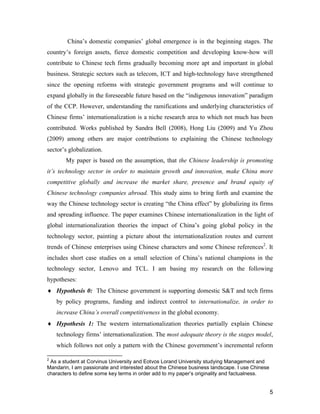
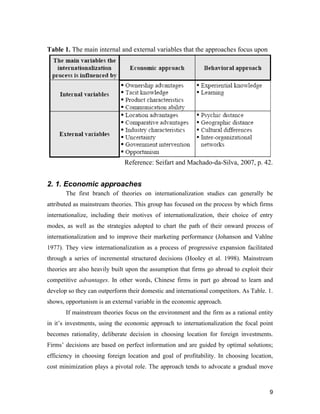
into the framework. Table 1. shows the main characteristics of the two approaches.
9
Table 1. The main internal and external variables that the approaches focus upon
Reference: Seifart and Machado-da-Silva, 2007, p. 42.
2. 1. Economic approaches
The first branch of theories on internationalization studies can generally be
attributed as mainstream theories. This group has focused on the process by which firms
internationalize, including their motives of internationalization, their choice of entry
modes, as well as the strategies adopted to chart the path of their onward process of
internationalization and to improve their marketing performance (Johanson and Vahlne
1977). They view internationalization as a process of progressive expansion facilitated
through a series of incremental structured decisions (Hooley et al. 1998). Mainstream
theories are also heavily built upon the assumption that firms go abroad to exploit their
competitive advantages. In other words, Chinese firms in part go abroad to learn and
develop so they can outperform their domestic and international competitors. As Table. 1.
shows, opportunism is an external variable in the economic approach.
If mainstream theories focus on the environment and the firm as a rational entity
in it’s investments, using the economic approach to internationalization the focal point
becomes rationality, deliberate decision in choosing location for foreign investments.
Firms’ decisions are based on perfect information and are guided by optimal solutions;
efficiency in choosing foreign location and goal of profitability. In choosing location,
cost minimization plays a pivotal role. The approach tends to advocate a gradual move
10
from low cost, low-risk strategies, such as exporting, to higher-cost, higher-risk strategies,
such as wholly owned production subsidiaries (Jones, 1999). According to the economic
approach, when firms internationalize, they scan and assess different markets based on
their efficiency gains and search for minimal entry cost modes. In addition, firms expand
abroad to exploit some inherent advantages, either in terms of location or assets
(Mathews, 2002). Thus, MNEs progress abroad from an asset-rich home base, building
on their existing technology and advantages.
Theories associated with the economic approach are Dunning’s eclectic theory
and the International Product Life Cycle Model Approach among others. In the following,
I will briefly show these two theories, largely basing my ideas on the works of
Hermannsdottir (2008) and Child et al. (2005).
Dunning’s (1988) eclectic theory has an explicit emphasis on location theory and
interaction between market entry motives and international production. He identified
market seeking, efficiency seeking, strategic asset seeking and natural resource seeking
as four major incentives to internationalization. Others, such as Young et al. (1989)
widened this further and added broader incentives, such as coalitions, collaborations,
cooperation co-partnerships…etc (Meng, 2009). The theory which was developed in
1976, draws together elements of previous theories and identifies ownership, location
and internalization (OLI) advantages that also motivate internationalization. Thus a firm
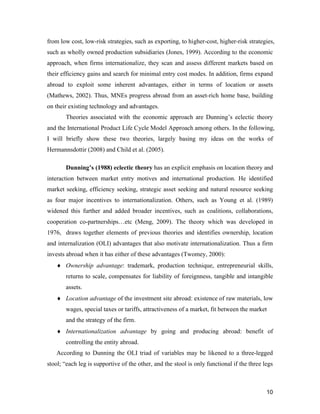
invests abroad when it has either of these advantages (Twomey, 2000):
 Ownership advantage: trademark, production technique, entrepreneurial skills,
returns to scale, compensates for liability of foreignness, tangible and intangible
assets.
 Location advantage of the investment site abroad: existence of raw materials, low
wages, special taxes or tariffs, attractiveness of a market, fit between the market
and the strategy of the firm.
 Internationalization advantage by going and producing abroad: benefit of
controlling the entity abroad.
According to Dunning the OLI triad of variables may be likened to a three-legged
stool; “each leg is supportive of the other, and the stool is only functional if the three legs
11
are evenly balanced.” He also added that the third leg may be the most important, but all
three need to be present for a firm to internationalize.
For Chinese technology companies, being present in the most developed
consumer electronics markets is a crucial goal. To be globally competitive, they must
have products in Europe or USA. The main driver is location advantage, since they do
not possess all the assets abroad that they do at home (technology dependence) and many
times they do not fully control the foreign firms (licensing).
Raymond Vernon’s (1966/2004) International Product Life Cycle Model (IPLC)
model is important in discussing Chinese tech firms, because it builds on incremental,
gradual internationalization approach. According to Hermansdottir, “The
internationalization process is conceived by Vernon (1966/2004) to be a systematic,
incremental, and predictable sequence (Kwon and Hu, 1995) where the form of entry into
foreign markets depends on the life stage of the traded products (Galán et al. 2001).”
According to this theory, “early in a product's life-cycle all the parts and labor associated
with that product come from the area in which it was invented. After the product becomes
adopted and used in the world markets, production gradually moves away from the point
of origin (Hill, 2007).” However, since the model demonstrates that the country that has
the comparative advantage in the production of the product changes from the innovating
(developed) country to the developing countries, using it to explain Chinese tech firms is
not viable. As China still depends a large part on Western technology and know-how,
Chinese tech firms don’t have a comparative advantage overall versus their foreign rivals.
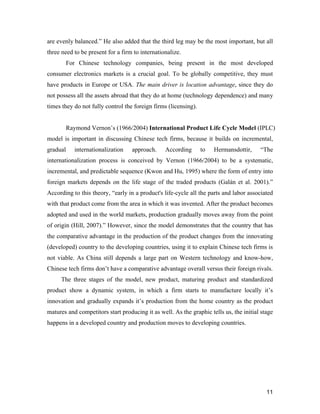
The three stages of the model, new product, maturing product and standardized
product show a dynamic system, in which a firm starts to manufacture locally it’s
innovation and gradually expands it’s production from the home country as the product
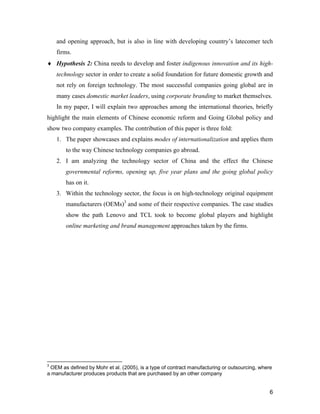
matures and competitors start producing it as well. As the graphic tells us, the initial stage
happens in a developed country and production moves to developing countries.
12
Figure 1: Vernon’s IPLC model
Reference: Provenmodels, 2010
This theory is more suited for technology companies coming from the West (EU,
US) where their more advanced market enables them to be innovative and come out with
new products. After the market becomes saturated with the new product, these firms use
their technological advantage and bring the product to developing countries. The Chinese
market and tech companies are not yet as developed to bring out fresh new products and
patents that the West could not produce.
2. 2. Behavioral approaches
While the first stream of research focuses on the initial stages, the second group’s
primary interest is rooted in the later stages of internationalization, in firm’s decision to
locate operations abroad. Following a behavioral approach (also called process approach)
the focus is on the impact of international experience and on the pace and direction of
subsequent internationalization (Hermansdottir, 2008).
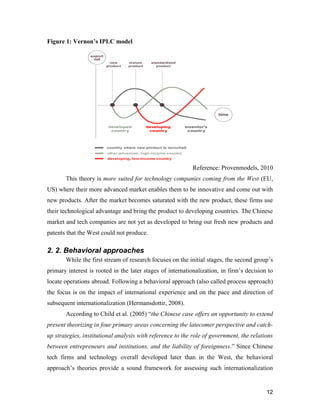
According to Child et al. (2005) “the Chinese case offers an opportunity to extend
present theorizing in four primary areas concerning the latecomer perspective and catch-
up strategies, institutional analysis with reference to the role of government, the relations
between entrepreneurs and institutions, and the liability of foreignness.” Since Chinese
tech firms and technology overall developed later than in the West, the behavioral
approach’s theories provide a sound framework for assessing such internationalization
13
motives. Similarly to Japan and the East Asian Tigers’ tech firms (LG, Samsung, Acer)
these countries had to catch up with the industrialized west in terms of technology and
know-how. These ‘late-comer’ firms started behind and in many cases were supported
vehemently by their respective governments. Their initial positions were not of strength,
but rather “from the resource-meager position of an isolated firm seeking some
connection with the technological and business mainstream” (Matthews, 2002).
A difference between the behavioral and economic approach is that the latter
treats individual learning and organizational knowledge as an important part of the firm’s
international behavior. Also called the process approach, firms learn by doing by a
sequence of steps to gain experience in the foreign market. In contrast to the economic
approach, which is built on advantage seeking, optimization and rationality the
behavioral approach views internationalization as a learning experience. In the following,
I will highlight the importance and relevance of behavioral theories in China’s
internationalization. Theories such as Ahroni’s decision model and the Uppsala scholars’
stages approach provide the best framework for Chinese tech companies.
Yair Aharoni (1966) examined the management decision processes in
international expansion and came to a conclusion that in many cases such decisions are
made out of coincidence, hazard or chance encounters (Mathews, 2002). In his view, the
most crucial decision is the initial venture abroad, which may be triggered by investment
opportunities or solving problems at home. The socio-economic background is important
in initiating the first move abroad. Social relationships within and outside the firm cause
the firm’s going abroad decision. As the enterprise moves ahead with subsequent foreign
investment decision processes, it benefits from its experience in previous investments
(Hermandsdottir, 2008). Thus, internationalization becomes a learning curve for the firm.
As Aharoni states: “There is a strong feeling that one should begin an investment
program on a very small scale, learn from one’s experience, and only after much more
experience and expertise is gained increase the size of the operations. If possible, the firm
would prefer to “test the market” by exporting to it before any investment program
begins. The investment itself often starts with assembly or packaging operations, or in
product lines in which the size of the capital is low” (1966, pp. 150-151).
14
Applying the model to Chinese internationalization, starting small and gradually
venturing abroad has been followed by many enterprises, especially in the tech sector.
Lenovo, a major Chinese tech company branched out from a research institute and started
with very small venture capital. In addition, socio-economic networks are prevalent in
China; the so called ‘guanxi’ or business relationships are a common norm of dealing
with contracts and negotiations. Technology research is embedded in national institutions.
Thus, private firms in China has a lot of connection with the government. In addition,
state owned enterprises (SOEs) - which many Chinese tech companies started out as – are
controlled by the central authorities to a large extent.
The “stages” theory developed by Sweden’s Uppsala schools’ scholars has
largely built on the decision model of Aharoni. The scholars focused on Swedish
manufacturing firms expansion and noted that the firms began to enter new markets that
were fairly close to them. Closer markets attributed less “psychic distance” (cultural
distance between spatially separated units of the firm) and the firms could progress
further if the initial stages were successful. In the theory, the sequential matter of
spreading operations abroad from closer, more similar cultures to farther are followed by
a deeper commitment to each market the firm enters. Johanson and Vahlne (1975)
compared the progressive learning and commitment stage to a ring on the water,
successively spreading out into new but more peripheral rings. In addition, Johanson and
Wiedersheim-Paul explained the different degrees of international involvement and
market commitment as follows (Hollensen, 2007):
 Stage 1: No regular export activities (sporadic export)
 Stage 2: Export via independent representatives (export modes)
 Stage 3: Establishment of foreign sales subsidiary
 Stage 4: Foreign production/manufacturing units
As the stages show, the relevance of this model towards Chinese tech firms is
undisputed on the realms of the learning process experience and incremental involvement
stages. Economic theories attest, firms from developed countries traditionally
internationalize using their competitive advantages based on their higher development
status. On the flip side, firms from developing countries such as China internationalize in
15
order to address existing competitive disadvantages through the acquisition of technology
and resources (Kang, 2008). It is important to note that certain unique factors in the
Chinese economy influence Chinese tech firms ability to go global. The role of the
government and national support, the latecomer stance of Chinese tech firms and unique
motivations are part of this picture. As we will see, many Chinese companies opt to
venture to close countries, such as Japan, Vietnam where ‘psychic distance’ is small.
The previous models and theories give us a frame of reference in the empirical studies
of internationalization. Proving hypothesis 0, The stages model is one of the best
reference theories to address the way Chinese technology and other firms move abroad. It
is in line with the developing country view (late-comer firms, learning by doing) and in
line with Chinese government policies (gradual, incremental reforms).
In the following, the paper will address the development of Chinese reform process,
internationalization path and assess the technology sector.
3. Economic transition and international marketing
3.1. International marketing
International marketing is defined by the American Marketing Association (AMA)
as “the multinational process of planning and executing the conception, pricing,
promotion and distribution of ideas, goods and services to create exchanges that satisfy
individual and organizational objectives” (Onkvisit et. al, 2007, p. 3). According to
Gilligan et. al (2009, p. 12) at “it’s simplest level, international marketing involves the
firm in making one or more marketing mix decisions across national boundaries. At its
most complex level, it involves the firm in establishing manufacturing facilities overseas
and coordinating marketing strategies across the globe.”
In many cases, B2B activities take place as firms sell to governments, NGOs…etc
abroad. When Chinese companies are opting to go global, they need to keep in mind that
their marketing strategy and activities will be tailored to foreign cultures. There is an
important shift companies need to make; instead of looking for consumers who
appreciate the firms’ products (similarly as in China – low cost, brand heritage) the new
focus is on creating a supply of products that foreign buyers desire. In addition, as
16
influence of culture on consumer preference is over-exaggerated, provided that a
company produces reliable, high-quality material at affordable and attractive prices,
than costumers around the world will purchase them in a standardized form (Levitt, 1983).
As an industry is made up of companies that produce products that are substitute for each
other, the tech sector needs to focus on creating value and differentiating the products for
consumers. The two core strategies in marketing, standardization and differentiation are
thus both present when companies goes global.
The platform of marketing strategy
First of all, companies can only create and plan their marketing strategies if they
have information about their environment. The microenvironment is made up of suppliers,
consumers and competitors, having numerous intertwined vertical (with distributors,
consumers – distribution channels) and horizontal connections (usually rival firms).
Companies are in contact with their microenvironment; it can influence the behavior of
their connections. The macro environment is different, in that it is made up of economic,
technological, social, political and legal environments, which companies cannot always
influence (except large MNEs). When dealing with international marketing, both the
micro and macro environment expands, as the firm is dealing with many regions and
markets (Tóth, 1995). Chinese tech companies are in their beginning stages of becoming
international and their ability to manage both the micro and macro-environments are not
yet at the same level as their Western counterparts.
Secondly, an important factor going overseas is the country image in consumers
mind of the brands the enterprise sells. David Ogilvy identifies a brand to be “a complex
symbol, an intangible sum of a product's attributes, its name, packaging, and price, its
history, reputation and the way it is advertised. A brand is also defined by consumers'
impressions of the people who use it, as well as their own experience” (Ogilvy website).
In contrast with Western emphasis on product branding, Chinese have been preferring
corporate branding, in which they spend big money and use their brand resources for
building their company names (Haier, Lenovo, Wahaha). Until now, Chinese corporate
culture has grown out of a larger marketing environment in which the priority was
corporate-management, culture and identity over brand-management, culture and identity.
17
Branding the corporation – building equity in a corporation’s identity and name – at the
expense of brand culture is an Asian phenomenon, not inclusive to China4
. Consumers
emphasize safe consumption drawing them to colossal, highly visible brands (Wang,
2008). Localizing in the target market is a new lesson for such companies with a strong
background in their home markets. In addition, communicating across cultures puts some
Chinese companies outside of their comfort zone. As Chinese perceive brands by the
Chinese meaning of the characters, colors, name, logo, typeface, writing direction, these
symbols need to be translated and localized to the target areas. For Chinese companies
doing business abroad, getting used to different wages, legal environments, labor unions
is a challenging task, in which they do not yet possess complete coherence. Creating
brand equity, value and consumer connections abroad is a new challenge for the Chinese.
Overcoming the low perception of ‘Made in China’ also adds to the test.
In the following I will shed light upon the economic environment of China, which
will provide the necessary theoretical foundation to understand the current
internationalization and case studies.
3. 1. China’s reform process
China’s economic transition from a planned economy towards a market based one
began in December of 1978, under the leadership of Deng Xiaoping. The Chinese
Economic reform, literally Reform and Opening (gaige kaifang - 改革开放) refers to
programs that opened up China to the outside world with intentions such as generating
enough surplus value to finance modernization of the mainland, raising the standard of
living for Chinese people and closing the gap between China and the industrialized West.
From the foundation of the PRC in 1949, the Chinese Communist Party (CCP)
has been following and relying on the Soviet Union by adopting a centrally planned
economy. During the Mao era, the Chinese tried to shift away from Soviet influence and
create own methods of economic growth. One such method was the Great Leap Forward
(GLF), during which China pursued a transition from an agrarian society to an
industrialized one.
4
Good examples are the Japanese keiretsu conglomerates and Korean chaebols
18
The 1958-1961 period of the GLF called for the new system of "Two Decentralizations,
Three Centralizations and One Responsibility". By this was meant the decentralized use
of labor and local investment; central control over political decisions, planning and
administration of natural investment capital; one responsibility meant every basic unit to
account for itself to its supervising unit (Liu, 2004).
The plan was to accelerate economic growth by ‘walking on two legs’ with heavy
industry situated in the cities and state-run communities combining agriculture and small-
scale production in the rural areas. The government produced two plans, of which the
first’s targets were mandatory to meet, while the second was to be achieved by extra
efforts (Fenby, 2009). Based on the Theory of Productive forces, China tried to fulfill the
Communist ideology by advancing in technology, using its resources to increase the
gross national product. Backyard furnaces were set up and People’s Communes were
created. The GLF resulted in a large scale famine and had devastating economic
consequences.
Overall, it can be said that the pre-reform period has been characterized by a
planned economy in which the economic production factors were governed by the state,
the absence of private enterprises with limited foreign trade and low living standards.
3. 1.1. Chinese gradual reform
The Chinese economic reform can be contrasted with two other propositions that
have taken place in Eastern Europe. One was the rationalizing reform, which took place
in the European Command Economies in the 1960s, its purpose to make the command
economy work more smoothly instead of eliminating it. European radical reforms
attacked the ‘hard core’ of the economy, often restructuring important sectors. While
Chinese reform started with the economy, Europeans executed political reform before
economic reform due to the status quo that pro-reform activist wanted to change. In order
for them to succeed in economic terms, they first needed to change the power base, and
create a pro-reform political structure. In contrast with Europe, China was able to
incrementally introduce market elements because there was no political issues without
suffering much social chaos and economic disorder (as many Eastern-European and
Soviet Block countries did).
19
After the class struggle of the Cultural Revolution (1966-1976) the CCP set a new
development model that was different from past experiences. The Third Plenum of the
11th
Chinese Communist Party Central Committee (CCPCC) decided on a system called
“commodity economy with a plan” (Guo, 2009). Leaving the market mechanisms play an
increasing role in pricing and resource allocation, the ‘invisible hand’ started to affect the
economy. The Chinese had no clear idea (reform without a blueprint) about how they
would restructure their economy. They only knew that the centrally planned system did
not work sufficiently and changes were needed to promote economic growth. They
realized the need to introduce some ‘market elements’ into the business environment. The
economy, which was ranked the world’s thirty second largest exporting country at the
time, gradually achieved the top spot in January 2010 (New York Times, 2010a).
The CCP set targets to follow in the ‘four modernization plan’ (1963) that were
officially established once the reform processes took off. Focusing on the four main
sectors industry, agriculture, science and technology and national defense, the plan was to
propel China to become an economic powerhouse by the 21st
century. With these key
industries in mind, the government opened China to foreign investments, bought
machinery and began to modernize. According to Guo (2009, p.100) the six phases China
took towards the path of modernization: centrally planned economy (before 1978),
economy regulated mainly by planning and supplementing by market (1978-84),
commodity economy with a plan (1985-87), combination of planned and market
economy (1988-91), socialist market economy with state ownership as the main form
(1992-97), socialist market economy with public ownership as the main form (from 1998
onwards).
What characterize the reform process at best are its gradual and evolutionary aspects.
In 1978, the government did not have a clearly defined idea about which certain steps are
necessary to go forward. Reforming without a blueprint happened as events unfolded.
“Groping for stones across the river” is the expression used in China for events that
unfold as time goes by and when each step depends on the previous one. Reforms
developed gradually, through a series of phased reforms which were stimulated by
pressing problems. Under Deng, China was “riding the tiger”, growing it’s economy
while being unable to stop without risks. It is important to note that even though the
20
Chinese economy has adapted capitalist market systems, it stays largely state regulated to
the present day.
As we can see, the gradualness of the Chinese reforms indicates a lot of similarities
with the stages model of internationalization. Some define the Chinese system as a
special kind of federalism called market-preserving federalism, in which political
durability plays a key role. Local governments have a control over the economy and are
creating a system of patronage and loyalty (Guo, 2009).
3. 2. Governmental programs in science and technology
In today’s world, governments and the state play an active role in developing a
nation state’s direction of development and advancement in technology. Especially in the
high-tech industries (telecommunications, computing equipments, pharmaceuticals,
aerospace and military equipment, energy…etc.) the state role in providing financing and
supporting research is vehement. Globally, the high-tech sector is often seen as having
the most potential future growth. In China, high-technology is a strategic industry that is
closely aligned with CCP principles such as ‘scientific development’.
Developing and transition economies are typically characterized by an active
governmental involvement in business, both through ownership and through regulation
(Peng, 2000). China’s economic development’s path testifies the case, which has been
attributed to three key factors (Guthrie, 2009, p. 110):
 Policy engagement – the central government has driven through important reform
policies since 1978. In terms of China’s export oriented focus, the main policy has
been the export oriented coastal development strategy (Eastern cities as shipping
hubs5
).
 The government’s internal focus has been to attract FDI and open domestic
markets, greater than Japan and India’s example attest in their similar
development patterns. Goals to attract foreign investment into China have been to
transfer technology and management know-how to domestic firms.
 Government has decentralized decision making and allowed a private economy to
emerge from below.
5
Shanghai’s Yangshan port, based on offshore islands is the largest cargo port in the world
21
The government has seen science and technology (S&T) competence as an indicator
for China’s competitiveness and as a base for sustaining its development. Since China did
not develop a scientific revolution as Europe did, it had a lot to do to catch up with the
Western world. During Mao’s era (1949-1976) Chinese S&T was largely influenced by
Russian technologies and later during the Cultural Revolution (1966-76) saw strong
demise. Thus, special government programs have been launched since the opening of the
reforms in 1978. According to Liu (2009, p. 55) “China’s technological capabilities have
evolved from a very low base to a point where it is emerging as a serious international
competitor.” He indicated the following stages for S&T development:
 Stage 1 (1949-1955)
After the founding of the People’s Republic of China on October 1st
1949, there were few
research institutions. Technology was obsolete and outdated. In November 1949, the
Chinese Academy of Science was established, followed by other research institutions
such as the China Association of Science and Technology, Ministry of Geology and the
China Meteorological Bureau.
 Stage 2 (1956-1967)
In 1956 a policy called the “March toward Science” became a systematic approach to
S&T development. The newly founded Planning Commission for Science and
Technology laid out the Long-term Plan for S&T Development 1956-1967, defining 57
major projects, ranging from nuclear physics, electronics, semiconductors, automation,
computers, aviation and rocketry. An administration system was formed for S&T in
China, with the establishment of the State Commission of Science and Technology, the
Commission of Science and Technology for National Defense and the Chinese Academy
of Sciences (CAS) in 1958. These institutions were the forerunners of a system in which
universities, military and regional research institutions and later firms collaborated
together.
 Stage 3 (1966-1976)
The decade of 1966-76 was the time of the Cultural Revolution, which was devastating
for S&T and other social, economic developments in China. An entire generation of
college students – Mao’s “Red Guards” – were sent down to the countryside for
“reeducation” (Guthrie, 2009). This meant that this “lost generation” could not contribute
22
much to science as universities and research institutions were closed for years or their
works came to a standstill. During this time, the technology gap widened between China
and the developed world.
 Stage 4 (1977-1994)
1978 was the beginning of New China, under which Deng Xiaoping initiated China’s
reforms that brought openness and economic growth which skyrocketed in coming years.
The official launch of the Four Modernizations in December 1978 at the Third Plenum of
the Central Committee shifted emphasis from “putting politics in command” to “putting
economics in command” and designated S&T as a main driver of growth (Wang, 1998).
Deng’s idea of S&T being the ‘chief productive force’ was emphasized by national
programs aiming to increase China’s competitiveness. In addition, 1984 saw an important
change in SOE policies, as the government forced state-owned laboratories to obtain
funding by commercialization of their technologies (Zeng et. al, 2003). This proved to be
an important incentive to indigenous innovation. Important programs promoting S&T
development included:
 Spark program: aimed to revitalize rural economy
 863 Plan: started in March 1986, the National Hi-Tech Research and Development
Program set 20 research themes in biology, spaceflight, information, laser,
automation, energy, new materials and oceanography.6
 Torch Program: launched in 1988, the program is China’s most important guideline
in promoting the commercialization and internationalization of high-tech research
outcomes. It seeks to develop new high-tech industries by establishing high-tech
development zones (HTDZs), market high-tech products, promote international
cooperation with China’s high-tech industries and train and attract talented workforce
(Pecht, 2006). One of the results of the program was the establishment of a US-China
Science and Technology Innovation Park in 2002 at the University of Maryland
Campus.
 Climbing Plan: focused on the development of basic research areas in basic fields
such as mathematics, chemistry and mechanics among others.
 Stage 5 (1995-present)
6
See http://www.863.org.cn
23
In 1995, a national strategy was formed based on “science and education for a
prosperous China”. The tenth Five Year Plan (FYP) from 2001-2005 set information
technology as the foundation of industrialization. The plan advanced the Information
Technology (IT) industry and it’s applicability in enterprises and governments. In 2006,
the National Medium and Long-term Plan for Science and Technology Development
(2006-2020) was announced by the State Council. The plan’s focus on innovation and
building China into an innovative country set certain goals to reach by 2020, which
include (Yoshida, 2007): achieving major breakthroughs in targeted strategic areas of
technological development and basic research, promoting an enterprise-centered
technology innovation system and enhancing the innovation capabilities of Chinese firms,
building an innovation-based economy by fostering indigenous innovation capability,
investing 2.5% of its increasing gross domestic product in R&D, raising the contributions
to economic growth from technological advance to more than 60%, limiting dependence
on imported technology to no more than 30% of value added and becoming one of the top
five countries in the world in the number of invention patents granted to Chinese citizens
and in the number of citations to Chinese-authored scientific papers.
These points prove the second hypothesis, showing that China wants to raise
technological advance and decrease reliance on foreign technology. The emphasis to
reach the goals set for 2020 is on innovation capability. According to Liu (2009) R&D
budgets will increase from 1.34% of GDP in 2005 to 2.5% in 2020, with S&T
development contributing 60% to national growth. Simultaneously China plans to reduce
reliance on foreign technology to less than 30%, provide incentives to more domestic
patent applications and international academic publications. Enterprises, the main drivers
of innovations are encouraged to set up R&D centers. According to the National Bureau
of Statistics of China (NBS), research and R&D refers to systematic and creative
activities in the field of science and technology, aimed at increasing the knowledge and
using knowledge for new applications. It is made up of 3 categories of activities: basic
research, applied research and experimentation for development. The scale and intensity
of R&D are widely used internationally to reflect the strength of S&T and the core
competitiveness of a country. In terms of industrial sectors within technology that have
24
input intensity exceeding 1% in R&D funding in 2008: special equipment manufacturing
with 1.93%, 1.74% for pharmaceutical manufacturing, 1.59% for general equipment
manufacturing, 1.44% for transportation equipment manufacturing, 1.27% for rubber
manufacturing and communications equipment, computer and other electronic equipment
manufacturing respectively, 1.22 % for instrumentation, and cultural, office machinery
manufacturing, and 1.06& for chemical fiber manufacturing industry (NBS).7
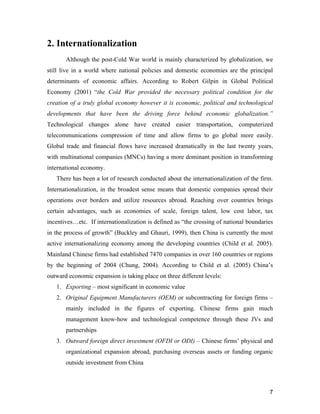
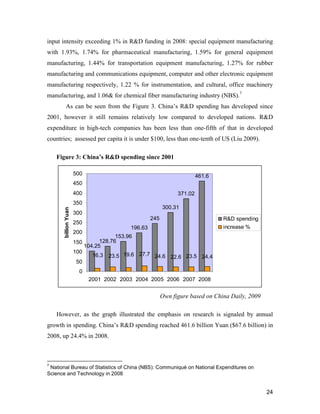
As can be seen from the Figure 3. China’s R&D spending has developed since
2001, however it still remains relatively low compared to developed nations. R&D
expenditure in high-tech companies has been less than one-fifth of that in developed
countries; assessed per capita it is under $100, less than one-tenth of US (Liu 2009).
Figure 3: China’s R&D spending since 2001
104.25
128.76
153.96
196.63
245
300.31
371.02
461.6
16.3 23.5 19.6 24.423.522.6
27.7 24.6
0
50
100
150
200
250
300
350
400
450
500
2001 2002 2003 2004 2005 2006 2007 2008
billionYuan
R&D spending
increase %
Own figure based on China Daily, 2009
However, as the graph illustrated the emphasis on research is signaled by annual
growth in spending. China’s R&D spending reached 461.6 billion Yuan ($67.6 billion) in
2008, up 24.4% in 2008.
7
National Bureau of Statistics of China (NBS): Communiqué on National Expenditures on
Science and Technology in 2008
25
As can be seen from the plan, technology is a key factor for growth. The
government wants to shift reliance on foreign technology towards indigenous innovation.
This means promoting domestic tech firms to internationalize and expand their operations
as a key priority; they not only strengthen global brand awareness for Chinese products
abroad but also revitalize the economy as well. They create jobs, hire top talent from the
immense labor pool, constitute to the advancement of society with their know-how and
make other businesses more efficient (telecommunications). This proves my second
hypothesis that China’s government needs to develop and foster indigenous innovation
and technology in order to create a solid foundation for future growth
The last FYP also maintains the tenth plan’s mission and adds more criterion to
the technological growth path.
3. 2.1. The 11th
FYP (2006-2010)
The plan is composed of two principles of development, a “Scientific
Development Concept” (kexue fazhan guan - 科 学 发 展 观 ) and constructing a
“harmonious socialist society” (hexie shehui - 和谐社会). According to Lam (2005)
“scientific development is, in essence, a euphemism used by the Chinese leaders for
economic growth that takes into consideration the welfare of disadvantaged people and
regions as well as environmental concerns.” In this socio-economic ideology, the eastern
regions of China, along the coast are designated by the government as “upgraded
development” areas, in which growth is based on high-technology, advanced and
knowledge industries and services so as to shift away from industries that consume land
and are wasteful. In addition, the concept of scientific development, created in 2007 is
credited to the paramount Leader Hu Jintao. The idea now constitutes the newest element
of “Socialism with Chinese Characteristics” (juyou zhongguo tese de shehuizhuyi- 具有中
国特色的社会主义), which is the official term used for China’s current economy.
One of the issues the leaders of China realized during the plan is that Intellectual
Property (IP) is a core element of China’s competitive capacity that needs to be advanced.
It is “an important means of upgrading productivity and increasing the added value of
products, the competence advantages of individual enterprises and a route to widening
market share” (China.org, 2009). One of the 11th
FYP’s goals is to enhance IP protection
standards in China and support enterprises to develop their own IP, brands and
26
international competence. This FYP aims to fuel economic growth (7, 5% GDP increase
annually) by “serving the people to improve life quality”. To follow this path, science and
education are key factors influencing people’s lives. Training professionals in high-
technology is an important element in advancing indigenous innovation. According to a
World Bank report “hi-tech products such as integrated circuits, software, bio-
pharmaceuticals, sub-line airplanes and satellite navigation services have registered
significant output growth and technological progress appears remarkable in a number of
important areas such as high power computing, next generation internet, and non-grain
based bio-energy (World Bank).
During the 10th Five-Year Plan period (2001-2005) the domestic capital
formation rate increased from 36% to 44.8%, while the consumption rate decreased from
61.5% to 50.7%, and foreign trade dependency rose from 39.6% to 63.9% (NDRC,
2006a). In the FYP the government aims to foster more consumption and less reliance on
foreign trade.
3. 2.2. The High-tech Industry Development Program of the 11th Five-Year
Plan
The High-Tech industry plan (hereafter Plan) is part of the 11th
FYP, proposed by the
National Development and Reform Commission (NDRC). The Department of High-Tech
Industry’s role is to help realize the goals of the FYP’s technology related plans (NDRC,
2008a). Chapter 7 is called “Implementing the Strategy of Developing China Through
Science and Education and the Strategy of Strengthening China Through Tapping Human
Resources”, in which the government addresses priority programs in S&T, which for
example include: New Generation Broadband Wireless Mobile Communication, Core
Electronic Device, High-End General Chip and Infrastructure Software, Manned Space
Flight and Lunar Exploration Program, High-Resolution Earth Observing System,
Manufacturing Technology and Process of Ultra-Large Scale Integrated Circuit, Key
Infrastructure for Science and Technology…etc. (NDRC, 2006b).
Overall as my first hypothesis states, China is supporting domestic technology firms
to internationalize in order to increase China’s overall competitiveness in the global
economic sphere. The Plan signifies the important role China’s leadership attributes to
technology, proving the first hypothesis. We can see a major shift in the thinking of the
27
government and the policy implications. From a tech processing and assembling
emphasis, the leadership plans to advance China’s ability for independent research, for
developing and manufacturing high-tech products. In 2007, the scale of China's high-
tech manufacturing industry ranked second in the world, with its high-tech and new
technology products making up around 20% of the international market (People, 2008).
In 2005, the high-tech industry’s ratio to total export value was 29%, signaling a growing
importance in the economy. In terms of worldwide high-tech exports, the US was the
leader until 2003. In addition the government provides annually growing percentage of
financing to S&T development. According to the NBS’s 2008 findings S&T funds
allocated by national finance amounted to 258.18 billion Yuan, a year-on-year increase of
46.83 billion Yuan, and rose 22.2 percent, sharing 4.12 percent to national financial
expenditure. These numbers testify the role S&T plays in China’s current strategic
framework (Liu, 2009).
3. 2.3. Challenges in S&T development
As Chinese leadership moved from a plan perspective to a program perspective
with the 11th
FYP, they put more emphasis on researching World Bank databases and
other reports on certain key industries such as technology trends. The aim is to tackle the
problems and challenges facing China’s S&T development.
First of all, these problems according to Liu (2009) are:
 Lack of domestic ownership of IPR
 Limited ability of Chinese enterprises to absorb advanced technology
 Weak industrial innovation
 Government-led model of tech innovation
Secondly, Chinese companies focus too much on their domestic market. Chinese
companies are known for their low-cost strategies, which is not efficient in the long run
in technology abroad. If companies’ goal is to produce products as cheap as possible,
there is no room for R&D led innovation. Chinese consumer’s taste also adds to this
tendency as the market is not as sophisticated yet to value innovative products over
cheaper ones. If the Chinese market matures – the mobile phone segment being a good
example – Chinese companies will be able to blaze the trail of indigenous innovation.
28
Thirdly, the government’s hand is everywhere. In terms of global standards and fair
business, “the Chinese government publicly stated its policy to limit royalties for
patented technologies paid to foreign companies and to promote the domestic
development of essential intellectual property (IP)” (AmCham, 2009). The government
put Chinese firms in advantage by limiting the 3G royalties given to foreign firms,
limiting FDI in telecommunications to 49% and procuring domestic firms in favor of
foreign ones.
3. 2.4. Chinese S&T advantages
 Combining the strengths of enterprises, research institutions and government
procurement: as a ‘footloose industry’, the high tech industry does not have to
locate next to raw materials. In China, the mix of government-led approach,
private enterprise R&D and research institutions create a unique environment
where the ‘footloose industry’ can locate next to universities. Zhongguancun
(ZGC) in Beijing provides an excellent example, as the ZGC Science Park is
walking distance from China’s two leading universities, Beijing University and
Tsinghua University.
 China’s domestic market size and economic growth pattern: China’s economy is
growing rapidly, amid the financial turmoil and export decreases in recent times.
The large amounts of financial reserves are used to fuel the domestic market, with
infrastructure, technology and other investments. These in turn provide jobs and
provide consumers money to buy goods.
 Innovation as tradition: Chinese have been apt in inventions throughout history.
3. 3. The Going Global policy
China’s Go Global policy (zouchuqu - 走出去) has been initiated since 1999 by
the CPC Central Committee. The literal translation of the policy means going or stepping
out (zou – walk, chu – out, qu-go), which implies the direction Chinese enterprises are
advised to follow towards the international business arena. In contrast with foreign direct
investment (FDI), which comes inward by foreign companies setting up businesses in
China, Chinese companies have in recent times began to spread their wings and invest
overseas. The policy can supplement resources needed to stimulate the export of goods
29
and services, while nurturing China’s MNCs and famous brands. The State Council’s
reasons for Chinese enterprises to expand abroad include:
 Deepen the reform of foreign investment-related institutions.
 Further encourage and support superior domestic enterprises to go abroad.
 Improve foreign investment promotion and service systems in China.
In addition Behrman’s (1972) taxonomy about the motivations of Chinese firms to go
global classifies them whether they are seeking resources, markets, technology, or
strategic assets and capability. Inotai et. al (2009) points out three main drivers that
define the Going Global strategy, which include economic, political and strategic goals.
By political, they assert the market economy status and following the “one China” policy,
while the strategic goals help China’s more active international engagement and the
creation of a multipolar world order. In terms of economic drivers, they define the
following groups: foreign trade related, institutional, easing China’s inner problems and
competition among capital attractors.
In the 2006 World Investment Report, UNCTAD identifies market-, efficiency and
natural resource-seeking as the most relevant motives for FDI from emerging countries to
less developed destinations, and market- and strategic asset-seeking as the main attractors
in developed countries (UNCTAD, 2006). Chinese firms also aspire to gain access to
markets in developed countries. This is especially true for technology and consumer
electronics as Europe and the US constitute the majority of consumers and market sizes.
As we can see the goals and motivations are manifold. The focal points of the policy
can best be summed up by Jiang Zemin’s speech, in which he called the Going Global
strategy a “principal battle”: “Only by bravely and actively “going global” shall we be
able, firstly, to compensate our shortages in natural resources and market limitations;
secondly, to increase export of machinery, equipment and other capital goods, to import
more modern equipment and to develop new industries; thirdly, to gradually form our
own transnational corporations in order to improve our position in global competition;
fourthly, to promote economic development of third world countries, to upgrade the
power of forces fighting hegemonism and to defend international peace.”(Chufrin, 2006,
pp. 33.) As Jiang attests, the main driver of outward direct investment (ODI) in China is
aimed at resource allocation, getting hands on precious raw materials. Since China is a
30
major exporter and manufacturer, the factories need to be supplied energy and natural
resources ranging from coal to oil. To feed the “world’s factory” China’s most ODI is
focused around the process of obtaining the needed supplies. The going global paradigm
has also been given a push after China’s 2001 WTO accession. In the technology sector,
however, pursuing raw materials is not always the case. China’s ODI in services and
equipment manufacturing has risen, proving that not all investments abroad are for
resource obtainment.
In the following, I will shed some light upon the annual changes of Chinese ODI.
3. 4. Chinese outward direct investment
Similarly to technology, China is a latecomer as a global investor as well: the
stock of its FDI accounts for less than 1 per cent of world FDI stock, and lags behind the
world average in terms of ratio to GDP (UNCTAD, 2009). While China is known to be
second in drawing inward FDI after the US, relatively little is attributed to her outward
FDI or ODI. The Chinese ODI boom is a result of China's rapid economic growth and its
"going-global" strategy. The ODI amount rose from US$ 5.5 billion in 2004 to nearly
US$ 42 billion in 2008 (MOFCOM, 2009). If the trend continues, Chinese ODI is set to
increase in the years to come. As Figure 5. shows, in 2006 China has been the world’s
largest high/tech exporter.
Before the ‘Stepping out’ strategy, there was no centrally managed and planned ODI
strategy it was discouraged by the central authorities. The evolution of Chinese ODI
policy can be divided in the following stages (Zhang, 2005):
1. (1979-1983) Case-by case approval: The State Council determined case by case
the only entities that could invest abroad. These were SOEs, trading corporations
and regional international economic and technology cooperation enterprises.
2. (1984-1992) Standardization of Approval procedures: Prior approval was still
needed from centrail authorities, but the ODI structure became more transparent
and more corporations had opportunities.
3. (1993-1998) As debacles arose with the surge in ODI during the last period, the
government insisted to screen and monitor outward investments and make sure
they were for “genuinely productive purposes”.
31
4. (1992-2002) The WTO annexation has been a turning point in Beijing’s ODI
policy, as Chinese companies have been recognized as increasingly important in
global trade. Activities that helped China’s export drive were encouraged, with
the light industrial sector (machinery and electrical equipment) to establish
overseas production bases.
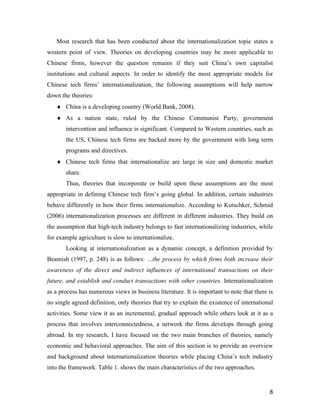
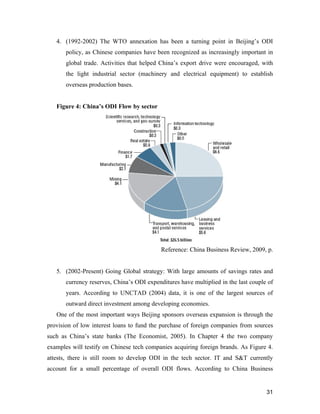
Figure 4: China’s ODI Flow by sector
Reference: China Business Review, 2009, p.
5. (2002-Present) Going Global strategy: With large amounts of savings rates and
currency reserves, China’s ODI expenditures have multiplied in the last couple of
years. According to UNCTAD (2004) data, it is one of the largest sources of
outward direct investment among developing economies.
One of the most important ways Beijing sponsors overseas expansion is through the
provision of low interest loans to fund the purchase of foreign companies from sources
such as China’s state banks (The Economist, 2005). In Chapter 4 the two company
examples will testify on Chinese tech companies acquiring foreign brands. As Figure 4.
attests, there is still room to develop ODI in the tech sector. IT and S&T currently
account for a small percentage of overall ODI flows. According to China Business
32
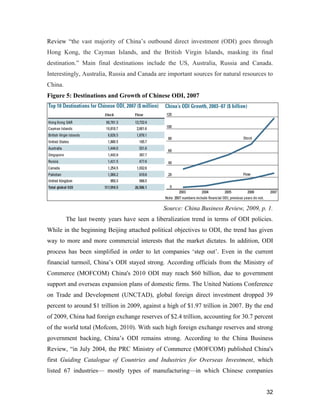
Review “the vast majority of China’s outbound direct investment (ODI) goes through
Hong Kong, the Cayman Islands, and the British Virgin Islands, masking its final
destination.” Main final destinations include the US, Australia, Russia and Canada.
Interestingly, Australia, Russia and Canada are important sources for natural resources to
China.
Figure 5: Destinations and Growth of Chinese ODI, 2007
Source: China Business Review, 2009, p. 1.
The last twenty years have seen a liberalization trend in terms of ODI policies.
While in the beginning Beijing attached political objectives to ODI, the trend has given
way to more and more commercial interests that the market dictates. In addition, ODI
process has been simplified in order to let companies ‘step out’. Even in the current
financial turmoil, China’s ODI stayed strong. According officials from the Ministry of
Commerce (MOFCOM) China's 2010 ODI may reach $60 billion, due to government
support and overseas expansion plans of domestic firms. The United Nations Conference
on Trade and Development (UNCTAD), global foreign direct investment dropped 39
percent to around $1 trillion in 2009, against a high of $1.97 trillion in 2007. By the end
of 2009, China had foreign exchange reserves of $2.4 trillion, accounting for 30.7 percent
of the world total (Mofcom, 2010). With such high foreign exchange reserves and strong
government backing, China’s ODI remains strong. According to the China Business
Review, “in July 2004, the PRC Ministry of Commerce (MOFCOM) published China's
first Guiding Catalogue of Countries and Industries for Overseas Investment, which
listed 67 industries— mostly types of manufacturing—in which Chinese companies
33
would receive preferential treatment when they invested abroad (China Business Review,
2010).” In 2009 this guide was updated with an online version.
In the technology realm, Chinese ODI is contrary to the “resource diplomacy”
theory, where China is seen as having main investment goals to acquire raw materials and
stabilize energy security for its growth (Zweig, 2006). China is still mainly a capital
importer, however its medium term significance as a capital exporter is undisputed. The
current stage of Chinese capital exporting strategies is best described as being in a
learning process stage development.
From the above theoretical models, the governmental reforms and programs it can
be summed up that Chinese technology firms have the following internationalization
characteristics:
 Chinese internationalization follows a step-by-step, slow, gradual approach.
 Chinese firms go abroad to learn and often for resources and know-how.
 The latecomer perspective of Chinese tech firms is an important factor for the
government to advance and promote indigenous innovation and develop strong
research institutions. After the 2001 WTO accession, this trend evolved.
 Chinese tech firms have a unique position, with massive stimulus backing ready
and the fusion of private and state-run research centers at their disposal.
 In 2002, being the largest drawer of FDI, China relies heavily on foreign tech and
know-how. Special Economic Zones with tax incentives prove this point.
34
4. Chinese tech enterprises
The PRC has accumulated large amount of financial reserves, which can be used
to promote select companies going abroad. These companies are in many cases SOEs or
market leader private firms that have the institutional and financial capacity to expand
overseas. In the initial stages, only SOEs and joint companies with foreign capital
participation were allowed to ‘step across the border’, later individual producers, private
firms and so-called “people’s enterprises” (minying) were granted the rights to
internationalize (Chufrin, 2006, p. 34). However the largest corporations investing abroad
still have some affiliation with the state (China Mobile, Bank of China) and many well
known Chinese brands abroad that are privately held and publicly traded also retain some
form of government control. For example Lenovo’s public shareholder ratio as of
September 2009 was 53%.8
Legend Holdings Limited - over which the Chinese Academy
of Sciences has a majority ownership - held 41.5% of the firm. This means that
effectively the largest stakeholder in Lenovo is a governmental agency.
Table 2. identifies four groups of Chinese corporations that have potential to
internationalize and become a global force. Such Chinese enterprises are brands. A
Chinese brand (a brand that is manufactured and known at home) is an important
criterion to internationalize. In terms of the technology sector, national champions such
as Lenovo and TCL are important. The classification of High-tech startups as one of the
groups also shows the significance Chinese tech companies play in shaping China’s
global investments. The emphasis is on the national research institutes, such as China’s
Institute of Biochemistry and Cell Biology, China’s Institute of Computing Technology,
Telecommunications Research Institute among others. China’s high-tech startups are
backed and supported by these research centers, their technologies are made to increase
domestic firms competitiveness. Technology competitiveness is a priority for the State
and these companies are the harbingers of China’s international growth.
8
See Lenovo company website
35
Table 2: Types of Chinese companies that have global potential
Groups of Chinese
companies
Definition Examples
National Champions first become strong at their home
base with strong brands, later opted
to go abroad
Haier, Huawei, Lenovo,
Wanxiang Group
Dedicated Exporters Focus is on economies of scale, low
production cost, exporting to mass
markets globally from the start.
Pearl River Piano, Galanz,
BYD Battery, Midea
Competitive
Networks
Companies operating in close
proximity, clusters leveraging
competitive advantages (high
flexibility, low cost) by specializing
on a certain product (watches, toys,
shoes, pens..etc.)
Wenzhou networks
(lighters) Shengzhou
networks (neckties)
Shenzhen networks
(Christmas decorations)
High-Tech Start-ups Able to obtain technologies cheap,
with the backing of China’s state
owned research institutions.
Lenovo, Tsinghua solar,
Datang Microelectronics,
Innova Superconductor
Own illustration based on Zeng and Williamson (2003)
On the SOE side, globalization of the largest players is due to the SOE
reorganization strategy, initiated by the 15th
Party Congress in 1997.The incentive
“keeping the large and letting go of the small” was meant to concentrate on maintaining
state ownership and control over the largest enterprises in certain core industries. The
idea was to improve all the public sector by promoting about 1,000 big enterprises,
modeling on the corporate success in Japan and Korea, while leaving thousands of
medium and small SOEs in the hands of local governments to invigorate. The
government kept the big firms by maintaining state ownership in dominant “pillar”
industries and backbone enterprises such as the high-tech sector.
4. 1. Centers for technology
One of the results of the high-tech industry’s strategic nature and the going global
policy is the establishments of export bases. Areas such as the Pearl River Delta, Yangtze
River Delta and Beijing-Tianjin region have now have many science parks and export
bases of new- and high-tech products, their exports share making up over 80 percent of
the nation's total new- and high-tech exports. According NBS’s 2008 statistics, six
provinces and municipalities had R&D expenditures over 30 billion Yuan; Jiangsu,
36
Beijing, Guangdong, Shandong, Shanghai, and Zhejiang. Since the Torch plan, China has
established many High-Tech Development Zones (HTDZs) that play a strategic role in
drawing FDI and nurturing domestic firms’ competence. Since the first HTDZ, Beijing’s
Zhongguancuan Science and Technology Park in 1988, China’s HTDZs have matured.
The park designed in 2001 modeled upon Silicon Valley, to create clusters for innovation
and export-oriented manufacturing. In 2007 as part of the 11th
FYP, “China's Hi-Tech
Development Zones eleventh five-year plan outline” marked the a new development
stage of HTDZs, with clearer targets. There are currently 53 HTDZs (Segal, 2003). The
first high-technology park was established in 2001 in the ZGC.
In addition to HTDZs, where mainly larger enterprises flourish, the government
has established areas where SMEs, which other wise would not be able to create their
own tech centers are able to take part in the technology innovation. These productivity
centers are established by large enterprises and business groups to provide SMEs
technology and information services. China also has many incubator centers overseen by
the Ministry of Science and Technology, which advance international S&T cooperation,
introduce and promote innovative technologies, cultivate entrepreneurship and bring
global resources to the certain regions among others. These centers and zones play an
important role in shaping Chinese domestic firms and increase their abilities to compete
globally. As we can see from the going global policy and the technology sector focus of
the CCP, China is preparing to become a major force in global S&T.
4. 2. China’s technology sector
The IT and Hi-Tech sector is crucial to all operations in the world; in China
following “indigenous innovation” it is even more so. The government focuses on
supporting research projects that either enhance China’s international reputation in
certain fields (nanotechnology, defense, biotechnology) or increase China’s global share
of manufactured consumer goods9
(Christoff, 2008). As can be seen from a study
conducted by Georgia Tech using the Georgia Tech High Tech Indicators (HTI)10
, China
has emerged the most in terms of technological standing. Certain domains in China’s
9
For my research purpose, consumer goods in electronics form the basis of international
expansion, market share increase and Chinese high-technology.
10
The HTI indicators are made up of four input factors, projecting long term technological
competitiveness. For more information, visit www.tpac.gatech.edu
37
high-tech such as nanotech and biotech enjoy additional increase. According to the
research “some analyses of nanotechnology research publication in international journals
now show China challenging, or even edging ahead of, the USA as of 2007.” In terms of
(HTI)11
Technological Standing, China is now ranked 2nd
in the world after the US. The
technological development that has taken place in the last few decades indicate that
China is heading to rival the US as the main driver of growth. The research concludes
with the following remarks about Chinese technology:
 As China becomes more proficient at innovation processes, it is linking it’s
burgeoning R&D to commercial enterprises.
 China is increasing attention to management of technology and educating more
and more scientists and engineers with increasing salaries for technological
careers.
 China has transformed itself into a high tech exporting powerhouse. As Figure 6
shows, China is gaining momentum in terms of high-tech exports.
Figure 6: World market shares of high-tech exports, EU-27, United States, Japan
and China – 2006
Source: Eurostat’s high-tech statistics, 2009 (CN: excluding Hong Kong, EU-27:
excluding intra-EU trade)
While the US has been the tip of the iceberg in terms of high-tech, Chinese
technology is also becoming quite cutting edge. Applied Materials, one of Silicon
11
See Appendix (HTI)
38
Valley’s most prominent firms, the world’s biggest supplier of the equipment used to
make semiconductors, solar panels and flat-panel displays has moved it’s research labs to
Xian in China (New York Times, 2010). The company also set up a solar research lab,
estimating that China would be producing two-thirds of the world’s solar panels by the
end of 2010. Many follow this path, moving their research centers close to where
production and consumers are.
A research by Management Science and Engineering (PingQing et al., 2007) shows
some approaches in which China is moving away from the factory of the world to
develop more competitiveness in technology:
 Clustering: “China’s electronic manufacturing industry ecosystem concluded that
leading EMS companies from abroad, international OEM/OBMs, Taiwanese
ODMs, and China’s domestic top 100 electronic enterprises are clustered mainly
in China’s nine major eastern coastal cities/provinces”
 Standardizing: “The overall objective of the strategy for China's technical
standards should be capable of supporting Chinese enterprises and products in
entering the international market and ensuring the superiority of China's key
industries in international competition.”
 Innovating: real core technologies need to come from China through research
and innovation. The government and firms need to enlarge the R&D investment
in the tech sector.
 Educating: “China high-level workforces are in short supply, especially in
technical, management and marketing personnel.”
4. 2.1. Intellectual property
The idea that once domestic firms gain enough experience on the home turf, they
will likely expand overseas can be argued against, however as we have seen in China’s
technology sector, it is true to say. Since 1984’s Patent Law, Chinese intellectual
property rights (IPR) and technology transfer has come a long way. On the first day of
the Patent Law in April, 1985 as many as 3455 new patents were filed, setting a world
record (Thomson et al. 2008). With new regulations brought about with the WTO
annexation, Chinese tech companies are more inclined to self innovate. WTO general
agreements such as Agreement of Trade Related Investment Measure (TRIMs) and Trade
39
Related Intellectual Property Rights (TRIPs) require equal treatment to all WTO
countries operating in China. This puts an end to “forced technology transfer” and relying
on know-how from foreign companies, while breeding and fostering more indigenous
innovation (Thomson et al. 2008). In addition the after-WTO landscape enhanced
Chinese tech companies’ competitiveness, because they faced more domestic competition
and had the playfield leveled: they could obtain similar resources as their foreign
counterparts while also rely on the governments support.
4. 2.2. High technology and original equipment manufacturers (OEMs)
According to Eurostat research “in 2006, as in previous years, “Electronics-
Telecommunication” accounted for the largest share of high-tech imports and exports,
closely followed by “Computers-Office Machines” in China (Eurostat, 2009). For
companies in soft manufacturing, such as cell phones and computers, this landscape
proved advantageous. Ningbo Bird, TCL enjoy the world’s largest mobile phone user
base, while Chinese netizens fuel computer demand from Lenovo and other equipment
manufacturers. While China has been mainly known for it’s exports in electronics until
now, it is on a fast track to developing a strong domestic base for consumer electronics.
As the table on China Mainland Strengths and Weaknesses shows (Appendix), the
number of computers in use ranks second in the world. This will rise, as the internet users
are also growing. Table 3. shows the competitiveness evolution, having more internet
users with technology skills. ODI flows are also in an increasing tendency.
Table 3: Competitiveness related to technology
China Mainland - Competitiveness Evolution
IMPROVEMENTS WCY 2008 WCY 2009
Internet users 128.9 176.77
per 1000 people
Information technology skills 5.05 6.31
are readily available
Direct investment flows abroad 22.47 26.51
US$ billions
Own data using World Competitiveness Yearbook (2009)
4. 3. Chinese internet and advertising
When talking about information technology, digitalism and internet usage in
China, one must not forget that the government has tight controls over certain aspects of
40
the web. The globalization of computer networks has raised new questions on whether
the internet will boost the centralization of cultural, economic, political and social forces
(Harasim, 1993) that impute a massive influx of “culturally and politically offensive
materials”. China has implemented a tight regulation on digital online communication,
that it deems to be “spiritual pollution” entering the country (Cortese, Cary, and
Woodruff, 1996). Sites such as Youtube, Facebook and “yellow” (porn) sites are not
allowed for everyone to visit. By looking at the development of Chinese internet usage,
we can assess tech companies marketing strategies in the online sphere.
In China, the digital civil society development’s first stage was from the mid-
1990s until 2002. During this period, the internet user number increased from around
700,000 to 59 million in 2002. This initial stage helped form new institutions, civil
society organizations and citizen activism, such as rights defense (weiquan -维权).
According to Zhang et. al (2009) in discussing the online emergence of China, three
stages can be shown:
1. The proliferation of the BBS (bulletin board system) forums
2. Civic associations and online communities formed on the web
3. Emergence of online activism (cyber nationalism)
These phases show an example of expanding online growth in the most populous
internet user country with more people becoming digital citizens12
by the day. Looking at
Asia more broadly, it is interesting to not that Japan, the world’s second largest economy
is the first in terms of mobile society. According to a presentation at the Open Web Asia,
Korea is the most penetrated digital society and China has the largest mobile and internet
user base in the world (Plus8star, 2010). While the US may be the most important online
market in terms of online advertising and consumer spending, the digitalization and
connection, broadband speed in Asia is striking. According to an online article by Rein
(2009) “China's online population surpassed the United States' in February 2008, making
it the world's largest with approximately 300 million. The fact that around 20% of China's
total population is online, versus 71.4% of the US's, suggests the remarkable growth
opportunities still present at home.” The presentation also shows an interesting example
12
The notion of digital citizen is most accurately described by a person with technological access
to get connected, capitalize on their connections and use the Internet daily.
41
in the social network domain, where Facebook (founded 2004) is the undisputed leader in
terms of user numbers, however both Korea’s CyWorld (founded 1999) and China’s
QQ.com (founded 1999), had more revenues and profit in 2007 than the American firm.
The average revenue from users was highest at QQ.com in China.
In terms of advertising in the PRC, the role of government is relevant. “The Law
of Advertising of the People’s Republic of China,” approved in 1995, shows that political
stability, status quo are clear requirements. The law requires advertising to be “true and
legitimate” and to conform to the framework of “socialist culture and ideological
progress.” The ad contents should “benefit the physical and metal health of the people”
while “facilitating the improvement of qualities of goods and services.” Infomercials,
disparaging other products, news report ads, infomercials are not allowed in advertising
(Luo, 2001). Chinese companies’ brand identity is closely aligned with Chinese feeling,
thinking and acting, influenced by the long history and deep tradition. Some of the
problems Western brands face in China’s online world may be due to such stringent
government control and growing nationalism, however the reasons are more complex.
Market shares for search, instant messenger and online auctions experienced high
volatility in recent years with domestic firms prevailing. The key players are now local
players such as Tencent, Baidu and Alibaba. Paid search and display advertising play an
important role in China, accounting for 97% of the $2,7 billion ad marketed estimated by
2010. (Harden et. al, 2000, 62) Chinese consumers could not associate themselves with
Google (guge - ) as well as Baidu.
4. 3.1. Digital globalization
As the world is busy watching the developments of Google parting with Mainland
China, Chinese online companies have been quick to quietly spread their operations
abroad. According to a Neteffect article13
Alibaba.com, China’s biggest business-to-
business website is rapidly increasing it’s presence in Brazil, and has recently partnered
with Ludatrade, a Hong Kong company, expecting a growth rate of 30 to 50 percent.
Alibaba already has 156,000 users in the country. “In January 2010, Shanda Games,
China's largest operator of online games, paid $60 million in cash and $20 million in
equity for MochiMedia, a San Francisco-based Flash game advertising network and
13
See Foreign Policy (2010)
42
payments platform” (Foreign Policy, 2010). In a question posted on TechCrunch, an
interesting examination has been formed about the emerging Chinese acquisition
landscape; “Chinese Web companies are building huge cash hoards and valuable stock
currencies and it’s still a comparatively young Web market. Increasingly, these
companies could be likely buyers of US startups—not the other way around” (Lacy,
2010). As Chinese companies face problems expanding in the energy sector14
they are
finding viable opportunities in the online sphere. A research by Walraven (2009) shows a
research based on the internationalization of the Chinese internet sector, also supports
this expansion. Important highlights from the research (Table.4) can be summed up as
follows:
Table 4: Major Chinese internet companies’ internationalization activities
Company and headquarter International activities
Shanda – Shanghai 07/2007 – Vietnam – VTC Intecom
gaming industry 07/2007 – Hong Kong – CSOFT
07/2007 – Macau – CSOFT
04/2008 – India – Zapak
Alibaba – Hangzhou 1999 – U.S. – Functional office
business to business 1999 – Hong Kong – F. office
102007 – Switzerland/Europe – Functional office
03/2008 – Japan – Softbank
04/2008 – India – Infomedia
07/2008 – Taiwan – F. office
Tencent QQ – Shenzhen 2003 – Hong Kong – QQ
instant messaging, search engine, gaming 2003 – Macau – QQ
11/2003 – Taiwan – YamQQ
07/2004 – Thailand – Sanook
2004 – South Africa – QQ.co.za
10/2007 – U.S. – AOL
06/2008 – India – MIH
07/2008 – Qqgames
Baidu – Beijing 01/2008 – Japan – Baidu.jp
search engine
Sina – Beijing 1995 – U.S. – Sina.com
news and entertainment 1998 – Taiwan – Sina.com.tw
1999 – Hong Kong – Sina.com.hk
Own data using Walraven’s (2009) map
14
By problems I am referring to such examples as the Australian mining giant’s Rio Tinto’s 2009
debacles and the failed merger - due to national security issues - of China Offshore Oils Co.
(CNOOC) and US owned Unocal
43
 Chinese internet companies internationalize in gradual steps, starting with
culturally and geographically closer markets. In many cases, Hong Kong or
Macau serves as a gateway to the world. This step-by-step approach enables a
strategic learning process of different markets, by partnerships and licensing
agreements firms are able to localize their services.
 The Chinese internet gaming industry (Shanda, Perfect World, Giant Interactive)
is taking the lead in promoting its products and establishing overseas partnerships.
 Going global is an approach taken mainly after the companies reach a critical
market share and scale in the domestic market. All the above mentioned
companies are market leaders, and opt to go abroad for more growth.
In the following, I will show two leading technology companies, Lenovo and TCL
in the consumer electronics industry. They are relevant in supporting my hypotheses and
showing real world scenarios of Chinese internationalization and online marketing. In
addition, these two companies are increasingly present in global technology circles,
fusing together marketing approaches from the West and the East.
4. 4. Case studies of Chinese high-tech companies
4. 4.1. Lenovo Group
Short history
Lenovo began it’s operation in 1984’s and by 2010 it has become the world’s
fastest growing major PC manufacturer. "Lenovo" is a portmanteau of "Le-" (from
Legend) and "novo", Latin for "new". The Chinese name (lianxiang - 联想) means
"association" or "connected thinking" as well as creativity. The name change from
Legend was necessary because of trademarks problems in the West.
The firm was established by 11 researchers from the Institute of Computing
Technology with small initial capital. In 1987, the Legend Chinese-character card was
successfully rolled out, which strengthened the brand domestically and was a
breakthrough technology at the time. During the 1990’s, Lenovo switched from an agent
of imported products to become a seller and producer, aligning it’s operations with the
Torch program mentioned in Chapter 3.2. In 1994 it was listed on the Hong Kong stock
44
exchange and by 1996 it created it’s first Legend brand laptop and two years later it’s
first shop debuted. In 2003, the initial Legend brand name changed to Lenovo in
preparation for the company’s global expansion plans. Soon after, Lenovo became the
first Chinese company to be a worldwide partner of the International Olympics
Committee. In 2005 Lenovo acquired IBM’s Personal Computing Division and global PC
business, making them the 3rd
largest PC firm. By 2006, the first product lines were sold
abroad and the Torino Winter Olympics were flawlessly supported by the company. In
2008 Lenovo supported the Beijing Olympics and by 2010 it has become a global brand
with a growing market share. The company is an NBA sponsor, uses the most recycled
materials in the PC business and has research centers in Japan, Beijing, Shenzhen,
Shanghai, Xiamen, Raleigh and Chengdu with manufacturing centers in China, India,
Mexico and Poland. The Lenovo of today is a true global player.
It’s main business areas include computers, systems integration, network
infrastructure and software design. It features a product line from servers and storage
devices to printers, printer supplies, projectors, digital products, computing accessories,
computing services and mobile handsets, with PC business remaining the primary focus.
Other domestic PC manufacturers in China include the Founder Group, the Great Wall
Group, the Tontru Group, the Resource Technologies Group, Hasee Computer Company,
the Langchao group among others.
Internationalization
In the early stages of the company’s history, Legend started from a language card
and eventually diversified its products into computers, printers, TVs and services. The
2003 creation of the Lenovo brand name was a milestone for the company towards
international recognition. Since Lenovo is the top computer vendor in China – the
world’s second largest market for computers – going global was not simply a choice but
a necessity for future growth. Important stages of the company’s internationalization
stages can be seen in Table 10. The main highlights happened since 2003’s name change.
The Beijing Olympics, Winter Games and Shanghai Expo sponsorships, the Vodafone
McLaren Mercedes racing team partnership, the acquisition of IBM’s PC division are all
hallmark stages in the company’s global brand evolution.
45
To become the top computer company, the management opted to diversify the
products and initially focus on the Chinese market. After carving out a large market
share at home, problems appeared: increasing competition from foreign companies (Dell,
HP), saturation of the PC market in China’s bigger cities. Lenovo was forced to seek
additional business opportunities in smaller and medium cities, in non-PC segments, and
eventually in international markets (Bell, 2008). The current domestic strength and
outperforming of foreign computer firms in China is due to Lenovo’s initial focus on the
Chinese market and the strong distribution networks the company created in smaller
cities.
Lenovo’s first abroad ventures were in Hong Kong, as a listed company to set up
distribution centers to serve the Chinese market. Real global expansion started after the
acquisition of IBM’s PC division in 2005. With the merger, the company gained IBM’s
customers and businesses in more than 160 countries becoming the 3rd
largest global
computer firm after Dell and HP. Yang Yuanqing, then chairman of the new Lenovo,
stated “[…] the transaction […] constitutes a new era of the international PC industry”
(Lenovo Group 2005). Lenovo’s founders’ aim was to make the company into a Fortune
500 firm and have a global brand name. Motivators, such as exploiting new markets,
escaping home market saturation and computer firms’ internationalization tendency
pushed Lenovo to globalize. In addition, Lenovo hired foreign trained managers who
could help bridge the cultural and managerial gap of international markets15
.
Since the global downturn, Lenovo has turned back to it’s roots and is again
China-centric. China accounted for 48% of the company's revenue for the first half of
2009. In the most recent quarter, China accounted for 47% of sales, the company said. At
the time of the IBM acquisition, the China business was 37% of sales (Businessweek,
2010).
Table 4: Internationalization of Lenovo
Important steps along the road to an international brand name creation:
2001 - Legend successfully spins off Digital China Co. Ltd., which is separately listed on the
Hong Kong Stock Exchange.
2002 - Legend launches its first technological innovation convention, “Legend World 2002,”
which opens up Legend’s “Technology Era”.
15
This is a new move, as many other Chinese companies used home grown managers in their
international expansion. Lenovo’s success is in some part due to hiring foreign managers.
46
2003 - Legend announces the birth of its new "Lenovo" logo to prepare for its expansion into
the overseas market.
2004 - Lenovo becomes an Olympic worldwide partner. It is the first Chinese company to
become a computer technology equipment partner of the IOC.
2005 - Lenovo completes the acquisition of IBM's Personal Computing Division, making it a
new international IT competitor and the third-largest personal computer company in the world.
Lenovo establishes a new Innovation Center in Research Triangle Park, N.C.
2006 - Lenovo technology flawlessly supports the 2006 Olympic Winter Games in Torino,
Italy, supplying 5,000 desktop PCs, 350 servers and 1,000 notebook computers.
The first Lenovo-branded products outside of China debut worldwide.
2007 – The Beijing Organizing Committee for the Olympic Games selects a Lenovo-designed
Olympic Torch as the winning design from among 300 entries.
Lenovo delivers a supercomputer for a Formula One racing team that will provide eight
teraflops of computing power.
2008 - Lenovo enters the worldwide consumer PC market with new Idea brand.
Lenovo provides a smooth, error-free performance at the Beijing Olympic Games.
2009 – Lenovo becomes senior sponsor for Shanghai World Expo 2010.
Reference: Lenovo company website
International significance
In terms of brand value, Lenovo appears to own the most promising brands
compared to TCL, because of it’s high degree of international brand standardization and
it’s distinct brand value proposition (Bell, 2008). In terms of technological innovation,
the company has some key innovations and strengths:
 ThinkPad X300 is called “the best laptop ever” by BusinessWeek (2008) magazine.
 Lenovo owns the industry's thinnest, lightest and most secure Tablet PC, the
ThinkPad X41 Tablet.
 In addition Lenovo is the world's largest provider of biometric-enabled PCs
 Lenovo has a supercomputer for a Formula One racing team providing eight teraflops
of computing power
 It is the first PC manufacturer to announce a client virtualization platform (Lenovo
website) .
47
Figure 10. Worldwide PC market share: 4Q 2008 vs. 4Q 2009
19.4
11.9
13.5
7.5 5
42.8
20.3
13.4
12
8.9 5.5
39.8
24.1
34.6
5.4
42 30.6
10.4
0%
20%
40%
60%
80%
100%
HP Acer Dell Lenovo Toshiba Other
unit growth
4Q 09
4Q 08
Own data based on data from Gartner
As a global company, Lenovo is now part of international supply chain programs
like the Electronic Industry Citizenship Coalition (EICC) since June 2006. The company
puts a lot of emphasis on environmental friendly standards; it was one of the first global
companies to receive OHSAS 18001 certification in 2008 (Lenovo website). In addition,
the company is set to develop further, with Beijing offering subsidies to Chinese
consumers to buy computers and other electronics. Lenovo's market share grew in China
to 33.5% in March 2010 (Businessweek, 2010). According to Figure 10. its global share
also grew, making it the fourth largest PC vendor internationally. In April 2010, Lenovo
emerged as the leading contender for American smartphone pioneer Palm (Suh, 2010).
48
4. 4.2. TCL Group
Short history
According to the company profile, TCL Corporation (Telephone Communications
Limited, jituan - 集团or TCL wangpai –王牌16
King Brand) is a publicly traded, Chinese
digital electronics manufacturer headquartered in Huizhou. It was established in 1981 and
became a global leader in technology, involved in four basic industries; home appliances,
telecommunication equipment, information technology and electronics. (Wang et al. 2003)
TCL employs more than 50,000 people in over 80 operations, including 18 R&D centers,
20 manufacturing bases, and more than 40 sales offices around the world” (TCL
company website). TCL is one of the largest electronic manufacturers, with products
ranging multimedia equipment, mobile phones, personal computers to domestic
appliances, lighting and digital hardware. The company has achieved a record of 42.7 per
cent average annual growth for the last 12 years, becoming one of China’s fastest
growing companies (Fan, 2006) Since 1999, the three listed companies of TCL groups
are on stock exchanges in Shenzhen and Hong Kong: TCL Corporation
(SZ.000100),TCL Multimedia Technology Holdings Limited (HK.1070) and TCL
Communication Technology Holdings Ltd. (HK.2618)17
According to the company’s history, TCL has been a leader in many fields in the
domestic market before going abroad:
 1989 - TCL telephones ranked first among telephone producers in terms of sales
volume in China (continued until the present day).
 1994 - Launch of the first cordless telephone product in China.
 2002 - TCL ranked No. 6 among the most valuable brands in China. The brand
was valued at RMB18.8 billion
 2007 - The brand value of TCL passes the RMB 40 billion mark for the first time
to reach RMB 40.136 billion, an increase of nearly RMB 4 billion, making the
firm the "number one brand in the domestic TV production industry".
16
In rural areas of China, TCL 王牌 (TCL King Brand) is easier remembered by locals than just
the three latin letters. 王牌 is a simple way of stating that the brand is of high quality.
17
(TCL, 2010) official website – Investor Relations
49
Internationalization
TCL showcases a significant example in Chinese enterprises going international,
as it was one of the first ones to do so back in 1999. It first entered Vietnam, which
shows that the initial step toward internationalization was not generated by resource or
market seeking. Production factors (low labor cost, geographical proximity) were the
starting reasons for going abroad. In the same year, TCL went IPO in Hong Kong to
further support expansion plans. TCL’s internationalization follows the stages theory (see
Chapter 2.3), gradually increasing the international involvement from a small psychic
distance. TCL began it’s international operations in Hong Kong and Vietnam, both which
are physically close to China. In the later stages, TCL began to move to developed
markets. These steps were to gain market access to the developed countries, such as the
EU and US. One of the major pushes to internationalize – similarly to many other
Chinese tech companies – came from the domestic market’s increasing competition and
price wars. Furthermore, for TCL to grow it needed to expand overseas and tap into new
markets. TCL not only moved into developed markets, but as the initial Vietnam step
shows, it is present in South-America and other parts of Asia as well. TCL distributes
lower end consumer electrics in these areas. The competitive advantage of the company
lies in production efficiency, the speed and cost of making products. As Figure 8. shows,
the company uses the TCL brand in developing countries, while adjusting it’s image to
the licensed brands in developed markets
As the company progressed internationally, its business structure changed as well.
From a virtual organization structure it went into an investment holding management
model. After the brand value reached the RMB 40 million mark and became the top
brand in Chinese domestic TV production, TCL announced a restructuring program for
its businesses and launched a new branding strategy with the slogan, "The Creative Life".
As the Table 9. attests, TCL used the Chinese market and state’s help to expand. Bell
(2008, p. 188) sums up the main stages of TCL’s internationalization: “TCL Corporation
has also expanded largely into overseas markets. They ranked among the top three brands
in emerging markets such as Vietnam, the Philippines, Chile and Argentina with double-
digit market share in 2004 (TMC 2005b: 15). After joint ventures with French Thomson
for TV sets (TCL-Thomson-Electronics ‘TTE’) and French Alcatel for mobile phones
50
(TCL-Alcatel Mobile Phones ‘TAMP’) in 2004, TCL Corporation is since present with
sales facilities in more than 50 countries. They also run 14 TV plants (e.g., in Poland,
Vietnam, Mexico) and six R&D centres (e.g., in the USA, Germany, France), employing
about 40,000 people worldwide.
Table 5: Internationalization of TCL
Important steps along the road to an international brand name creation:
1993 - TCL extended its presence into the electrical components field and then set up TCL
International Electrical Appliance (Huizhou) Co., Ltd.
1998 - The Package Agreement on Authorized Export Seller’s Credit Line of RMB 2 Billion
was signed between the Import and Export Bank of China and TCL, which provided TCL with
financial support to explore the overseas market and enhance its competitiveness.
2002 - TCL’s Germany subsidiary Schneider Electric began full operation in Munich.
2003 - TCL and Thomson Company of France joined forces to restructure their color TV and
DVD businesses, forming a color TV enterprise with an annual production volume of 18
million.
Merged with US based GO-Video Corporation through capital operation.
2004 - TCL Communication Technological Holdings Limited Company was listed on the main
market of the Stock Exchange of Hong Kong.
TCL Alcatel Mobile Phone Limited Company (TAMP) went into operation.
2005 - TCL Group and Toshiba Corporation ("TCM") signed the Memorandum of
Understanding to establish two companies; a manufacturing company specializing in the
manufacturing of refrigerators and washing machines, and a sales company mainly in sales.
2007 - The brand value of TCL passes the RMB 40 billion mark for the first time to reach RMB
40.136 billion making the firm the "number one brand in the domestic TV production industry".
TCL launched its new brand strategy, giving the TCL brand the new meaning of "The
Creative Life".
2008 - On November 12th, TCL Corporation signed an agreement with the 16th Asian Games
Organizing Committee, becoming the Official Partner of the 2010 Guangzhou Asian Games.
On December 9th, TCL and Intel signed a strategic cooperation agreement in Beijing,
announcing to develop the next-generation Internet television.
Reference: TCL company website
Moreover, the joint venture ‘TTE’ made TCL Corporation to the world’s largest
manufacturer of TV sets, competing globally with Sony, Panasonic, Samsung, Philips
and LG.” It can be seen, that TCL’s internationalization is largely due to mergers and
acquisitions with foreign brands (Thomson, Schneider, Alcatel) and partnerships (Intel)
through which the company gains key technology and competitiveness. Not long ago,
TCL and Intel jointly developed a breakthrough product - MiTV STB UB10 which was
showcased at the 2010 Consumer Electronics Show (CES). In addition, TCL chooses the
right logistics partners as well for it’s distribution channels. When entering the large and
51
saturated European TV market in 2006, TCL signed a sales partnership with Carrefour,
enabling it to use the experience and networks the company had, saving time and energy
for TCL.
However, the strategy of brand licensing will not be a permanent way going
forward, as the company fully only owns the TCL brand. At present, the company
markets the TCL brand name globally and is trying to instill lean brand architecture to
enhance consumers’ brand recognition. It also saves a lot of energy to concentrate on the
main brand.
International significance
TCL is dominant at home, being the #1 TV brand in China. At the end of 2009,
the brand value of TCL had exceeded RMB 41.738 billion (USD 6.11billion). From its
humble beginnings, the company has enjoyed wide ranging support from the Chinese
government. According to Bell (2008, p. 197) TCL was listed as one of the 300 key state-
owned enterprises ratified by the state Economy and Trade Commission and the People’s
Bank of China.
TCL follows a dual brand strategy with a brand for the mid-to high end in Europe
(Thomson, Schneider) and USA (RCA) and in China (ROWA) with a second tier brand
name for TVs. TCL’s brands in mobile phones include TCL, Alcatel and in TVs
Thomson, RCA and ROWA. It does not own the promising brands itself, but is licensing
them. As one of the most global Chinese brands, TCL has operations all across the globe.
According to the company website, TCL “has 18 R&D centers, 20 manufacturing bases,
60,000 and more than 40 sales agencies/offices and a centralized management of supply
chains (product design and manufacturing, logistics supply, quality assurance, and
product innovation and support).” Having different brands in different regions, the
company is able to diversify it’s products and use different price level segments.
Following the slogan “The Creative Life” the company has debut its products
under the TCL brand name at the 2010 Las Vegas CES. In an interview on TCL’s
company news website, Mr. Gary Yu, Senior Vice President of TCL Corporation and
CEO of TCL Multimedia said that “the time is now for TCL to start marketing and its
products under its own brand, around the world to completely transit from ‘Made in
52
China’ to ‘Created in China’ and promote Chinese brands on global basis. After 10
years’ globalization, TCL has formed an extensive global business network. We have
integrated our industrial chain, strengthened innovation and increased our
competitiveness in the global marketplace. The TCL brand and other brands that TCL
owns will benefit from the economic recovery in Europe, North America and emerging
markets which are expected to improve in 2010.”
Figure 8: TCL’s global operations
Source: TCL company website
To prove the significance of TCL, the company is aiming to become a globally
known brand for TVs and mobile phones. The company is aiming to innovate and come
out with more own intellectual property. Investing in R&D and acquiring Western
companies (Alcatel, Thomson) has given TCL a lot of know-how, R&D professionals
and western technology.
53
4. 5. Overview of firms
The two companies show a solid example of ways Chinese tech companies
internationalize. As Table 10. shows, there is a lot of similarities and differences between
the aims, goals and modes of market entry. A big difference is government intervention.
As I stated in the main hypothesis in the introduction, the Chinese government is
supporting technology firms by programs and indirect control. Both Lenovo and TCL
started out as governmental companies, but Lenovo is now relatively independent of the
government since the IBM purchase, US headquarters and New York stock exchange
listing. TCL is not as internationalized and is more focused on the Chinese market.
Table 10: Overview of the two firms
Own illustration based on data from Bell (2008)
In terms of corporate aims, Lenovo, the more internationalized company of the two, want
to become a global famous brand. TCL’s aspirations are not so high, it’s focus is solely
on TVs and mobile phones.
Lenovo TCL
Corporate
aims
Fortune Global 500, Global
famous brand
Internationally known brand for
TVs and mobile phones
Motives of
global brand
building
Exploiting new sales pools and
escaping home market
commoditization
Exploiting new sales pools and
escaping home market
commoditization, increasing profit
and competences
Following a precondition of the
PC industry due to increasing
competition in China
Leveraging governmental
ambitions and CEO ambitions
Mode of
market entry
Pure M&A strategy with an initial
JV in Hong Kong: motherboards,
Hong Kong (1988) - IBM PCs,
worldwide (160 countries) (2005)
Initially OEM in USA; later brand
acquisitions and licensing in USA
and Europe; since March 2006
launch of own TCL brand into
Europe
Hong Kong for backward
integration from distribution to
manufacturing, mainly to serve the
Chinese PC markets
Focus on majority JVs and
acquisitions of money loosing
businesses including
manufacturing plants, sales and
R&D facilities, IP, brand rights
and employees
‘Real’ going-international through
IBM PC deal, including Think-
family brands, IP, R&D, sales and
manufacturing facilities
Hong Kong (1993) - emerging
markets (1998) - USA (2001) -
Europe (2002) - world (2004)
Brand role
models
HP, Dell Sony, Samsung
54
The internationalization process of the firms is similar, in that they both had
strong market leadership in China across both urban and rural areas and did not perceive
enough room for future growth (Bell, 2008). However, Lenovo, a kind of Chinese version
of ‘born global’18
firm had the goal and potential from the start to be a truly international
enterprise. Both firms followed a gradual approach to internationalization, TCL even
more so than Lenovo. TCL went into the developing world first and tested the waters
before going into brand licensing agreements to tap into the larger and more saturated
Western markets. In addition, TCL’s internationalization is due to more national and
political reasons (government control larger) than purely economic ones. The degree to
which TCL is organizing it’s brands is more regional-centric, while Lenovo follows a
geocentric, global approach. Lenovo’s IBM acquisition gave the company an
international boost in sales, networks, management and technology know-how that
quickly skyrocketed it to the 3rd
largest PC manufacturer. Similarly, their research efforts
were focused on personalized product innovation in the Chinese market first, and gaining
experience, they established R&D facilities abroad. Over time, they begin to acquire,
absorb, and develop technology and expertise to compete against their OEM customers
and by ”leapfrogging” they were able to move beyond OEM production to original
design and product development through transnational operations in other markets
(Buckley et al., 1999).
In terms of market entry, Lenovo used a pure merger and acquisitions (M&A)
method and backward integration to sell PCs in China while TCL bought and licensed
brands to enter developed markets. Both companies bought struggling Western
companies that had profitability issues and used them to gain access to market and tech
resources. However, Lenovo only acquired the Think label and focused more towards the
PC segment. TCL and Lenovo are both dominant players, but Lenovo is among the most
well established Chinese companies abroad and closest to entering the Global 500.
18
According to Rennie (1993) born global firms seek superior international business performance,
begin with a global view of their markets and develop such capabilities from their founding.
55
4. 6. Branding Strategies
According to Chinabrand (2010), a German management consulting firm various kinds of
brand strategies are used in China. Companies increasingly concentrate on abstract forms
of branding, which favors their intention of expansion and diversification:
 Strong product brands can be found everywhere in China, mostly in foodstuff, drinks
and pharmaceuticals.
 Most Chinese large-scale enterprises apply a strategy of an umbrella brand by using
the company name as the umbrella brand.” TCL is using this strategy by having TCL
group be the parent company of it’s overseas ventures.
 “Placebo brands that simulate a not existing effect and therefore an illusory world are
found in pharmaceuticals, drinks, foodstuff and even articles of daily use.
 Fashion labels or cosmetics are often brands functioning as symbols. They stand for
specific social groups or a particular lifestyle.
 Only big and traditional Chinese brands can act as an authority. These brands
outshine all competitors due to their historically grown substance which already has
an authoritarian character”. Lenovo is currently among this category, based on it’s
position at home.
 “Brand strategies targeting on the alter ego of consumers are seldom in collectivist
China and most likely found in youth brands.
 Even fantasy brands can be found in China. These brands exclusively exist because of
imagination while the function of the product is only of secondary importance”
(Chinabrand, 2010).
56
Figure 9: Brand strategies of Chinese Companies
Source: China Brand Management Consulting
4. 7. Digital communications and online marketing:
Important key points in digital branding that both companies need to take into
consideration are as follows (Cocoran, 2007):
 The type of functionality organizations place on their website needs to be
reflective of their core processes and create value to the customer.
 Site maps and search engines should be mandatory components of all websites, as
they expedite a user’s search for relevant material.
 An organization’s history and background is an invaluable component of a
brand’s genetic makeup and online presence.
The current stage of development is web 2.0 and many people are talking about the
internet’s evolution towards web 3.0. In terms of online marketing and advertising, the
internet is becoming more multi-sensory, catering to a wider group of people, (ageing
population, disabled, multi cultural) incorporating new technologies (touch screen, hand-
held controllers) and facilitating more online activities. (emotional connection, dynamic
content, live video) Figure 9. shows the main aspects of the internet’s evolution, showing
a trend toward a more customizable and user oriented future.
57
Figure 10: Evolution of the Internet
Own data based on Cocoran (2007)
Lenovo is currently using a lot of Web 2.0 techniques to build its brand equity
online. It has websites tailored to create an online community (lenovosocial.com,
lenovoblogs.com) that helps in “linking your world and ours.” A part of Lenovo’s
globalized and integrated marketing approach19
including websites, are standardized and
address several regional markets at the same time, generating positive spillover effects
across countries. From a market leader in China, Lenovo has transformed it’s brand into a
global force. Through online offers, strong distribution networks and product promotions
such as a PC including a one-year free internet access, the brand has been well managed.
The company was regularly present at the world’s largest computer fairs since 1990, and
was engaged in several national sports sponsorships (Bell, 2008). In 2010, Lenovo (led
by David Churbuck, VP digital marketing) engaged with it’s consumers via it’s blog
website and other web 2.0 tools such as Twitter and Flickr to report about the Consumer
Electronics Show and “to publish interviews, insights, and announcements related to the
new wave of ThinkPad and IdeaPad PCs, as well as some new categories” (Lenovoblogs,
19
Integrated marketing (IM) is a management strategy and meta-discipline focused on the
organisation-wide optimisation of unique value for stakeholders (Jenkinson et. al, 2007)
58
2010). The newest online marketing campaign of Lenovo is their current contest targeting
the US market, which the site calls “the ultimate college basketball elimination game.20
”
This campaign shows the global reach of the company and the digital marketing
techniques involving user engagement (via Twitter, Facebook, blogs) and user generated
content. Lenovo’s main goal is to create points-of-difference (POD) from it’s main
competitors HP and Dell. By being a major supporter of sports events and basketball
(which is the #1 sport in China) the PC manufacturer is able to influence consumers on
the judgments and feelings portion of the Consumer-Based Equity Model(CBBE). The
strategy arouses excitement and creates loyalty among sport enthusiasts. In addition, the
online marketing techniques also help consumers associate better with the brand.
TCL’s online marketing is different. Since TCL Group is a holding company, it
runs global websites that are interlinked to the websites of the product brands, showing
that f.e. Schneider is part of the TCL Group. As the company is running a multi-product
brand strategy, it’s main brand TCL is only known in the domestic and undeveloped
markets. However, the current aims of the company is to make strengthen the TCL name.
TCL and Lenovo share a point-of-parity in terms of supporting sports. TCL is a
partner of the 2010 Guangzhou Asian Games and aims to be marketing it’s brand with
cultural events, programs and nationwide performance tours. These activities show that
the focus is largely domestic. Online activities such as online ‘Happy Asian Games, New
Visual Frontier’ marketing and online Asian Games torch relay accompany the programs,
by which the corporation aims to promote the official principle and spirit of fitness of the
games (TCL Company website). TCL used similar online marketing approaches as
Lenovo with web 2.0 tools engaging consumers about it’s LCD televisions. The
campaign, called TCL 100 Families, aimed at Chinese consumers to better get to know
TCL as a global brand and demystify negative perceptions (lack of differentiation, low
quality). “Finalists were selected through online voting by consumers, creating a
powerful incentive for families to garner popularity by actively blogging about their
experience with the TV and sharing stories and photos on the dedicated website. This
created a potent viral marketing and word-of-mouth campaign as the families directed
everyone in their social networks to the website to vote, creating an extremely personal
20
See www.lastfanstanding2010.com
59
and compelling connection to the brand and product for all involved” (Burston-Marstellar
Case Study, 2007).
Overall, it can be seen that both tech companies are actively using online
marketing and utilizing consumer engagement via web 2.0 sources to enhance their brand
equity and create consumer resonance. Globally, TCL is more diversified and thus it’s
branding efforts are more strenuous in terms of creating a clear brand imagery for
consumers, while Lenovo’s Olympic sponsorship and active sports support give it a
cleaner definition in consumer’s minds. Lenovo’s brand equity is stronger and is better
known company worldwide.
4. 8. Presence and significance in Hungary:
The importance for Hungary to join and take advantage of the growing capital exports
from China will be increasingly significant in the future. Some conclusions can be given
for Hungarian economic policy (Inotai et. al, 2009):
 Hungary is in fierce competition with other EU countries to become the logistical
base for Chinese ODI firms.
 Hungary should focus on areas where the Hungarian economy’s long term goals
are similar with Chinese priorities:
o the creation of regional service networks, infusion of advanced Chinese
technologies (biotech, agriculture, environmental protection, water
management)
o engaging in the “learning process” of Chinese firms, by which the
Hungarian examples in liberalization, economic opening and market
transition can be useful.
 Chinese capital’s increasing infusion into Hungarian industrial parks.
 Starting common R&D projects, helping Chinese experts take part in EU related
technological research centers’ work.
Lenovo’s Hungarian presence and global strategy is highlighted by it’s Marketing
Content Warehouse21
, by which the company helps foreign business partners use it’s logo,
download online content and create creative ads following specific instructions.
21
See www.lenovo.com/partner/mcwarehouse/uk
60
5. Overview
In my paper, I was examining the way Chinese technology firms internationalize,
the theories and government programs associated with encouraging going global
initiatives. Since the turn of the century, the rapid rise of China’s economy is manifested
in many areas, technology being a paramount example. I tried to find answers to the
following questions throughout my paper. What is the role of government in supporting
Chinese firms? What theories explain internationalization as a whole? Why is the
technology sector a strategic area in the Chinese economy and how is it developing?
Based on these question, I formulated three hypothesis. In the base hypothesis I
stated that the Chinese government is actively engaged in technology firms and supports
their international goals. As we have seen through Chapter 3. the reform process’s latest
stages (11th
FYP and Going Global policy) are indeed constructing a path to modernize
the Chinese economy and equip it with technology developed at home. We have seen the
types of companies that have global potential (Table 2.) and how in many cases these are
government selected companies or handpicked by the zhuadafangxiao strategy. In
addition, the examples of Lenovo and TCL provided us with insight into the framework
of how technology companies move beyond China’s borders. Such companies are only
part of the bigger picture, which the policies and government programs explained in
Chapter 3. China is strategically building up it’s science and technology sector, through
program such as the Torch and Spark programs, and enhancing education facilities with
technological equipments, training future scientists. The “Scientific Development
Concept” envisions the future China to be more innovative, produce world class
technology and patents, supported by strong educational institutions, top scholars and
global firms. The goals set forth to be achieved by 2020 in Chapter 3.2. such as raising
contributions to economic growth from technological advance, increasing domestic R&D,
decreasing reliance on foreign technology are all manifestations of the active and
strategic role the government plays in spurring economic growth based on technology. In
terms of patents, China is still falling short, but is on the right track to invigorate and
enhance creative capabilities.
61
Chapter 1. detailed the international theories and explained the two main
theoretical branches. As the first hypothesis stated, the most adequate theory was the
stages model, which follows not only a pattern with the Chinese government’s
incremental reform and opening approach, but is also in line with developing country’s
latecomer tech firms. As China has only began to open it’s economy since 1978 and use
market elements to instill growth, it’s technological capabilities and history lags behind
the Western world. Thus, as the theories showed, the product life cycle theory did not fit
the developing country point of view, while behavioral approaches such as moving
abroad in stages were quite adequate for China. In addition, the Uppsala model is a good
indicator towards Chinese governmental approaches, as the gradual reform took shape by
small steps. Learning by doing, having a dual track system and slowly privatizing
companies have shown that Chinese leaders keep pace with market reforms. However, it
can be concluded that no theory can fully explain the uniqueness of Chinese
internationalization, as the country’s policies and strategies change and evolve through
time and the firms have more and more experience.
In Chapter 4. I explained the Chinese technology sector more in detail and proved
the second hypothesis, that China needs to develop and foster indigenous innovation and
its high-technology sector to not rely on foreign technology. By showing the steps
(clustering, standardizing, innovating, educating) taken to enhance domestic tech
capabilities, I concluded that it is a crucial point for China to enhance key industries such
as high-tech.
The research into the field of Chinese internationalization within the tech sector
has a lot of future potential. More investigation is needed in trailing the next wave of
technology companies (Ningbo bird) that are ready to go global and the impact they will
have on the global economy.
62
6. Bibliography:
Aharoni, Y. (2004) The foreign investment decision process. In Buckley, P. J. and Ghauri,
P. N. (Eds.). The internationalization of the firm. A reader (3-13). London: Thomson
Learning.
AmCham, (2009) American Chamber of Commerce People’s Republic of China: White
Paper. Industry Issues, Beijing, p. 206.
Andersen, O. (1993) On the internationalization process of firms: A critical analysis.
Journal of International Business Studies, 24, pp. 209- 231.
Beamish P. and Lane, H. (1997) Cooperative Strategies: Asian Pacific Perspectives.
United States: New Lexington Pr, p. 248.
Behrman, J.N. (1972) The Role of International Companies in Latin American
Integration. Lexington, Mass.: Lexington.
Bell, S. (2001) Internationalization brand management of Chinese companies.
Universitat Duisburg-Essen, Springer, p. 75.
Buckley, J. and Ghauri P.N. (1999) The internationalization of the firm. 2nd
ed. Oxford:
Thomson Learning. p. ix.
Buckley, P. J. and Ghauri P. N. (1966) The internationalization of the firm: A reader (14-
26), London: Thomson Learning, 22, pp. 1-17.
Cateora, P., Gilly, M. and Graham, J. (2009) International Marketing. 4th
edition, New
York: McGraw-Hill/Irwin, p. vii.
63
Child, J. and Rodrigues, S.B. (2005) The internationalization of Chinese firms: a case for
theoretical extension? Management and Organization Review, Vol. 1 No.3, pp. 381-410.
Christoff, P.S. (2008) China’s Technology Sector. Library of Congress, p. 52 .
Chufrin, G. (2006) East Asia: between regionalism and globalism. ISEAS Publications,
Singapore, p. 33.
Chung, S. (2004) Proceedings of the 11th International Symposium on the Physical &
Failure, IEEE Electron Devices Society.
Cindy, F. (2006) China’s Eleventh Five-Year Plan (2006–2010): From “Getting Rich
First” to “Common Prosperity.” Eurasian Geography and Economics, No.6, 708-723.
Cocoran, I. (2007) The Art of Digital Branding. New York: Allworth Press.
Cortese, A., Cary J., and Woodruff D. (1996) Alt. sex. Bondage is Closed. Should We Be
Scared? Business Week, 15 January, p. 39.
Dunning, J. H. (2001) Global Capitalism at Bay. London: Routledge, p. 116.
Fan, C. (2005) China’s Eleventh Five-Year Plan (2006–2010): From “Getting Rich
First” to “Common Prosperity. Eurasian Geography and Economics, No.6., pp. 708-723.
Fan, Y. (2006) The Globalisation of Chinese Brands. London: Emerald Insight, p. 9.
Fenby, J. (2009) The Penguin History of Modern China: the Fall and Rise of a Great
Power, 1850-2008. London: Penguin.
Forsgren, M., and Johanson, J. (1992) Managing Networks in International Business.
Philadelphia: Gordon and Breach.
64
Galán, J. I. and González-Benito, J. (2001) Determinant factors of foreign direct
investment: Some empirical evidence. European Business Review, 13, pp. 269-278.
Gilpin, R. (2001) Global political economy: understanding the international economic
order. Princeton University Press, p. 135.
Gilligan C. and Hird, M. (1986) International marketing: strategy and management. Kent:
Croom Helm, p. 12.
Guo, R. (2009) How the Chinese economy works. New York, Palgrave Macmillen, 3rd
edition, pp. 81-94, 100-233.
Guthrie, D. (2009) China and Globalization: the Social, Economic and Political
Transformation of Chinese Society. New York: Routledge, p. 110.
Harasim, L.M. (1993) Global Networks: An Introduction. In Global Networks: Computer
and International Communication. Cambridge: MIT Press.
Harden, L. and Heyman, B. (2009) Digital Engagement: Internet Marketing That
Captures Customers and Builds Brand Loyalty. New York: Library of Congress in
Publication Data, p. 62.
Hermannsdottir, A. (2008) Theoretical Underpinnings of the Internationalization Process.
Institute of Business Research Working Paper, Reykjavik: University of Iceland, p. 16.
Hill, C. (2007) International Business Competing in the Global Marketplace. 6th
edition,
McGraw-Hill, p. 168.
Hollensen S. (2007) Global Marketing: a decision-oriented approach. Essex: Prentice
Hall, p. 63.
65
Inotai, A. and Juhász, O. (2009) A változó Kina (The changing China). Budapest:
Akadémiai Kiadó, pp. 293-301.
Jenkinson, A. and Mathews, B. (2007) Integrated Marketing and its implications for
personalised customer marketing strategies. J Direct, Data and Digital Marketing
Practice. Vol 8 No. 3. Basingstoke: Palgrave Macmillan, p. 93.
Johannson and Vahlne, (1977) The internationalisation process of the firm: a model of
knowledge development and increasing foreign market. Journal of International Business
Studies, pp. 23-33.
Kang, Y. (2008) Challenges for internationalization of Chinese firms. Auckland, Massey
University.
Kutschker, M. and Schmid, S. (2006) Internationales Management. München,
Oldenbourg.
Kwon, Y.-C. and Hu, M. Y. (1995) Comparative analysis of export-oriented and foreign
production-oriented firms' foreign market entry decisions. Management International
Review, 35, 4, pp. 325-336.
Lam, W. (2005) China’s 11th Five-Year Plan: A Roadmap for China’s ‘Harmonious
Society? Association for Asian Research, November 23.
Lan, Z. (1999) The 1998 Administrative Reform in China. Asian Journal of Public
Administration vol. 21, no 1, pp. 29-54.
Levitt, T. (1983) The globalization of markets. Harvard Business Review.
Luo, Y. (2001) China’s Service Sector – A New Battlefield For International
Corporations, Copenhagen: Copenhagen Business School Press, pp. 177-178.
66
Mathews, A. (2002) Dragon multinational: a new model for growth. Oxford University
Press, pp. 187-471.
Meng, C. (2009) Multinational Banking in China: Theory and practice. Northampton,
Edward Elgard Publishing, p. 15.
Mohr, J., Sengupta S., and Slater S. (2009) Marketing of High-technology Products and
Innovations. Upper Saddle River, Pearson/Prentice Hall, p. 183.
Naughton, B. (1996) Growing Out of Plan: Chinese Economic Reform 1978-1993.
Cambridge University Press, p. 8
Onkvisit S. and Shaw J. (2007) International marketing: analysis and strategy. New
York: Routledge, p. 3.
Pecht, M. (2006) China’s electronics industry: the definite guide for companies and
policy. Norwich: William Andrew, p. 62.
Pietrobelli, C., Rabelotti R., Sanfilippo M. (2010) The ‘Marco Polo’ Effect: Chinese FDI
in Italy. Florence, European University Institute.
Rennie, M. (1993) Born Global. McKinsey Quarterly, 4, pp. 45-52.
Seifert, R. E. and Machado-da-Silva, C. L. (2007) Environment, resources and
interpretation: Influences in the international strategies of the food industry in Brazil.
Brazilian Administration Review, 4(2), pp. 40-63.
Sikorski, D. and Menkhoff, T. (2000) Internationalisation of Asian business. Singapore
Management Review, 22, pp. 1-17.
67
The Economist. (2005) The dragon tucks in. July 2, p. 70.
Thomson E., Sigurdson J. (2008) China's science and technology sector and the forces of
globalization. World Scientific Publishing, p. 49.
Tóth T. (1995) Nemzetközi Marketing. Budapest, Közgazdasági és Jogi Könyvkiadó.
Twomey, M. J. (2000) A Century of Foreign Investment in the Third World. Routledge, p.
8.
Vernon, R. (1966) International investment and international trade in the product cycle.
Quarterly Journal of Economics, 80, pp. 190-207.
Wang, K. (1998) Modern China: an encyclopedia of history, culture and nationalism.
Library of Congress, p. 119.
Wang, J. (2008) Brand new China: advertising, media, and commercial culture. Harvard
University Press, p. 145.
Wang, S. and Schuster, E. (2003) Chinese Home Appliance Manufacturing: A Case.
Washington: Quebecor World, p. 133.
Yoshida, P.G. (2007) Rising China faces challenges to national innovation goals.
Research Technology Management.
Zeng, M. and Williamson, P.J. (2003) The Hidden Dragons. Harvard Business Review,
pp. 92-99.
Zhang, X. and Zheng. Y. (2009) China’s information and communications technology
revolution: social changes and state responses. Abingdon: Routledge, p. 22.
68
Zhang, K. (2005) Going Global: The Why, When, Where and How of Chinese
Companies’ Outward Investment Intentions. Canada in Asia Series. Vancouver: Asia
Pacific Foundation of Canada.
Zweig, D. (2006) Resource Diplomacy’ under Hegemony: The Roots of Sino-American
Conflict in the 21st Century. Paper prepared for the Conference on “The Rise of China
and Its Implications for Asia-Pacific,” Academia Sinica, Taipei, 23 (25-26 August 2006)
Internet resources:
Burston-Marstellar Case Study, (2007) TCL 100 Families Campaign, http://www.burson-
marsteller.com/Innovation_and_insights/Case_Studies/Lists/CaseStudies/DispForm.aspx
?ID=70&nodeName=Case%20Studies,2&subTitle=TCL%20100%20Families%20Campa
ign
China Brand Management Consulting, (2010) http://www.chinabrand.de/English/07.html
China Business Review, (2010) China Invests Abroad
http://www.chinabusinessreview.com/public/0909/intro.html (Downloaded: 03/24/2010)
China Daily, (2009) China sees year-on-year increase in R&D spending
http://www.chinadaily.com.cn/bizchina/2009-12/16/content_9188184.htm (Downloaded:
03/13/2010)
China.org, (2009) New Situation of IP During 11th Five-Year Plan
http://www.china.org.cn/english/China/208356.htm (Downloaded: 03/12/2010)
Cong Cao and R. P. Suttmeier, (2007) China’s New Science & Technology
Strategy: Implications for Foreign Firms, Vol. 6, No. 2, China currents
69
http://www.chinacurrents.com/spring_2007/cc_simon.htm (Downloaded: 03/12/2010)
Eurostat, (2009)
http://epp.eurostat.ec.europa.eu/cache/ITY_OFFPUB/KS-SF-09-025/EN/KS-SF-09-025-
EN.PDF (Downloaded: 03/12/2010)
Fonow, R. C. (2003) Beyond the Mainland: Chinese Telecommunications Expansion.
Defense Horizons, no. 29, July: 1–8. http://www.ndu.edu/ctnsp/defense_horizons.htm
(Downloaded: 03/10/2010)
Foreign Policy, (2010) China's tech companies go global while no one is watching. 22
March.
<http://neteffect.foreignpolicy.com/posts/2010/03/22/chinas_tech_companies_go_global
_while_no_one_is_watching >
Gartner Statistic for PC shares
http://static.arstechnica.com/hardware/pc_market_share_4Q09.004.png (Downloaded:
03/12/2010)
Ping, Q., Yonghui, G. and Qiang Gu. (2007) Study on the upgrading of China Integrated
circuit industry up to the global value chain.
http://cscanada.net/index.php/mse/article/viewFile/982/1041 (Downloaded: 03/12/2010)
China Business Review, (2009)
http://www.chinabusinessreview.com/public/0909/ChinaData.pdf (Downloaded:
03/25/2010)
Lenovo Company website
Http://www.lenovo.com/news/de/de/2005/05/050105annc.html (Downloaded:
02/28/2010)
70
Lenovoblogs, (2010) Lenovo Live @ CES.
http://lenovoblogs.com/connections/?cat=99 (Downloaded: 04/15/2010)
Lin, Y. (2009) 经济增长方式转变和十一五规划 (Changing the Pattern of Economic
Growth and the 11th Five-Year Plan.
http://www.cenet.org.cn/cn/ReadNews.asp?NewsID=21974 (Downloaded: 03/11/2010)
Ministry of Science and Technology, 科学研究与试验发展经费 (R&D Expenditure).
http://www.most.gov.cn/eng/statistics/2006/200703/t20070309_42000.htm (Downloaded:
02/23/2010)
New York Times, (2010) China Becomes World’s No. 1 Exporter, Passing Germany.
http://www.nytimes.com/2010/01/11/business/global/11chinatrade.html (Downloaded:
2/28/10)
National Bureau of Statistics China (NBS), Communiqué on National Expenditures on
Science and Technology in 2008.
http://www.stats.gov.cn/english/newsandcomingevents/t20091217_402608133.htm
http://www.stats.gov.cn/english/newsandcomingevents/t20091225_402610168.htm
(Downloaded: 03/11/2010)
NDRC, (2006a) National Development and Reform Commission (NDRC), The 11th
Five-Year Plan: targets, paths and policy orientation.
http://en.ndrc.gov.cn/newsrelease/t20060323_63813.htm (Downloaded: 03/15/2010)
NDRC (2006b)
http://en.ndrc.gov.cn/hot/t20060529_71334.htm (Downloaded: 03/15/2010)
NDRC (2008) Department of High-Tech Industry.
http://en.ndrc.gov.cn/mfod/t20081218_252196.htm (Downloaded: 03/15/2010)
71
Lacy, S. (2010) Google’s China Stance: More about Business than Thwarting Evil.
TechCrunch, 12 January.
http://techcrunch.com/2010/01/12/google%E2%80%99s-china-stance-more-about-
business-than-thwarting-evil/
Lenovo company website, (2010) Company history
http://www.lenovo.com/lenovo/us/en/history.html (Downloaded:03/25/2010)
http://www.lenovo.com (Downloaded: 03/26, 2010)
Lenovo Investor factsheet
http://www.lenovo.com/ww/lenovo/investor_factsheet.html (Downloaded: 03/14/2010)
Liu, H. (2004) The Great Leap forward not all bad.
http://www.atimes.com/atimes/China/FD01Ad04.html (Downloaded: 03/14/2010.)
Ministry of Commerce (MOFCOM, 2010) Overseas direct investment may soar.
http://id2.mofcom.gov.cn/column/print.shtml?/chinanews/201002/20100206795672
(Downloaded: 03/14/2010.)
New York Times, (2010a) China Drawing High-Tech Research From U.S.
http://www.nytimes.com/2010/03/18/business/global/18research.html (Downloaded:
02/02/2010)
Ogilvy website, (2010) About Ogilvy China.
http://www.ogilvy.com.cn/about_ogilvy_china/home.html (Downloaded 04/25/2010)
People, (2008) High-tech industry becomes new highlight in China's economy
http://english.people.com.cn/90001/90780/91344/6546684.html (Downloaded:
02/26/2010)
72
Plus8star, (2010) The Digital Silk Road – Interview and Presentation, Open Web Asia,
October, 2008.
http://www.plus8star.com/2010/04/17/interview-the-digital-silk-road/
Porter. A.L, Nils C. Newman, J. David Roessner, David M. Johnson, and Xiao-Yin, J.
(2009) International high tech competitiveness: Does China rank #1? Technology Policy
and Assessment Center, Georgia Tech, Atlanta GA, USA, vol. 21, no.2.
http://www.tpac.gatech.edu/papers/HTI_China1_2008_jun10.pdf
(Downloaded: 02/22/2010)
Provenmodels
http://www.provenmodels.com/583 (Downloaded: 2009.03.10)
Rein, S., (2009) Chinese Companies Go Abroad: (Part 4: The Internet and Software
Sector),
http://seekingalpha.com/article/113826-chinese-companies-go-abroad-part-4-the-internet-
and-software-sector
Suh, K. (2010) Lenovo emerges as leading candidate for Palm. Reuters.
http://www.reuters.com/article/idUSTRE63M1UA20100423
TCL company website
http://www.tcl.com/main_en/About%20TCL/Company%20Profile/index.shtml?catalogId
=13046 (Downloaded: 03/26/2010)
UNCTAD (2006) Trade and Environment Review 2006.
http://www.unctad.org/Templates/webflyer.asp?docid=6768&intItemID=3725&lang=1&
mode=downloads (Downloaded: 02/27/2010)
73
Walraven, P. (2009) Mobinode map, International activities, March 2009.
http://www.mobinode.com/wp-
content/uploads/2009/03/p128_map_international_activities.pdf
World Bank
http://siteresources.worldbank.org/CHINAEXTN/Resources/318949-
1121421890573/China_11th_Five_Year_Plan_main_report_en.pdf
http://siteresources.worldbank.org/CHINAEXTN/Resources/318949-
1121421890573/China_11th_Five_Year_Plan_main_report_en.pdf
(Downloaded: 03/16/2010)
World Competitiveness Online (WCY, 2010)
https://www.worldcompetitiveness.com/OnLine/App/Index.htm (Downloaded:
03/10/2010)
Zhang, K. Woo, P.Y. (2006) China Goes Global, Source:
http://economics.ca/2006/papers/0892.pdf (Downloaded: 3/15/2010)
74
7. Appendix
Change in Technological Standing and INPUT: 1993-2007
Source: http://www.informaworld.com/index/907740422.pdf p. 8
Lenovo:
Lenovo’s path to a global brand (Bell, 2008, p. 263 )
75
Overview of the two companies’ internationalization process
Source: (Bell, 2009) p. 275
76
TCL:
Company logo
Source: TCL company website
TCL’s international expansion and market entry modes from 1993-2006 (Bell, 2008. p.
200)
77
Corporate structure:
Source: http://www.tcl.com/main_en/images/2010/01/08/528717037747.jpg
High Tech Indicators (HTI) Source:
http://www.tpac.gatech.edu/papers/HTI_China1_2008_jun10.pdf
“The HTI were developed as empirical manifestations of a conceptual model with four
“input” factors (c.f.,Roessner et al., 1992, for discussion of the conceptualization of these
leading indicators). Our website offers a number of papers and reports from over the
years, expounding on the indicators [//tpac.gatech.edu]. The HTI model posits that
technology-based competitiveness depends long term (i.e.,on the order of 15 years in the
future) on the conjunction of:
1) National Orientation to so compete (NO)
2) Socio-Economic infrastructure (SE)
78
3) Technological Infrastructure (TI), and
4) Productive Capacity (PC)
Those four are sometimes averaged together as a composite “INPUT” indicator. Current
Technological Standing (“TS”) is tracked with a single “output” factor addressing current
high technology export activity.”
Chinese competitiveness
China Mainland - Strengths and Weaknesses
WCY 2009 WCY 2009
Value Rank Value Rank
ECONOMIC PERFORMANCE INFRASTRUCTURE
STRENGTHS STRENGTHS
Real GDP Growth per capita 8.4 1 Computers in use 8.5 2
Percentage change, based on
national currency in constant
prices
Worldwide share / Source:
Computer Industry Almanac
Direct investment flows inward 92.4 5 High-tech exports 29.7 6
US$ billions
Percentage of manufactured
exports
WEAKNESSES Scientific research 6.1 21
Direct investment stocks abroad 2.9 48
is supported by legislation.
(Survey)
Percentage of GDP Science in schools 6.1 8
Direct investment flows abroad 0.6 45
is sufficiently emphasized.
(Survey)
Percentage of GDP WEAKNESSES
GOVERNMENT EFFICIENCY
Total R&D personnel
nationwide per capita
1.3 42
STRENGTHS
Full-time work equivalent (FTE)
per 1000 people
Foreign currency reserves 1946 1 Computers per capita 76.7 52
US$ billions
Number of computers per 1000 people /
Source: Computer Industry Almanac
Adaptability of government policy
to changes in the economy is high
5.7 7 Internet users 176.8 53
WEAKNESSES per 1000 people
Foreign investors 4.7 51 Mobile telephone subscribers 411.9 55
are free to acquire control in
domestic companies. (Survey)
subscribers per 1000
inhabitants
Own data, showing important competitiveness indicators of the Chinese economy
Source: World Competitiveness Online (WCY)

Chinese Tech Companies Going Global - 2010

  • 1.
    CORVINUS UNIVERSITY OFBUDAPEST Faculty of Business Administration Department of Marketing The China Effect: Chinese Technology Firms Going Global Andras Bodrog Business Management Business Communication Specialization 2010 Consultant: Tamas D. Szabo
  • 2.
    2 Abstract From personal andprofessional passion towards the economy of China, I based my paper on the technology sector, on one of the most strategically important segments of the nation’s economy. Trailing the technology sector in the Middle Kingdom, my research aims to find supportive arguments for the way Chinese tech firms internationalize and the role the government’s reforms play in creating the environment for ‘going global’. Using mainly secondary sources while drawing upon the resources of three disciplines (marketing, international business and political science) I examined three hypothesis. I defined the China effect as the way Chinese companies are shaping the future global technology landscape and concluded that China is developing in a unique fashion. According to the internationalization theories, Chinese tech firms’ global expansion is best described by behavioral approaches, more closely the Uppsala/stages model. Using marketing related concepts, I explained the branding strategies and digital communication techniques involved in Chinese internationalization. To show real world examples and apply the case method, I showcased two of the leading Chinese electronics companies (Lenovo and TCL) and concluded that China’s rise in technology is substantial and shows an increasing trend. However, it can also be said that although these companies are well known and are globally present, they are not yet as dominant as their Western competitors. The importance of the paper and findings can be contributed to better understand the implications China’s rise in technology means for the rest of the world. I would like to thank my consultants, Tamas D. Szabo and Adam Meszaros for their help and ideas in writing my thesis, Katalin Nadasi for her marketing related materials and my friend and China source Jiayou Xi for his input. “I …………………. hereby testify to my full responsibility, that all text, figures and tables contained in this thesis work – not including the referenced works that follow the given guidelines – are solely the product of my own work and do not rely upon other contributors or materials.”
  • 3.
    3 TABLE OF CONTENTS 1.Introduction.................................................................................................................... 4 2. Internationalization ....................................................................................................... 7 2. 1. Economic approaches ........................................................................................... 9 2. 2. Behavioral approaches........................................................................................ 12 3. Economic transition and international marketing ..................................................... 15 3. 1. China’s reform process....................................................................................... 17 3. 1.1. Chinese gradual reform........................................................................... 18 3. 2. Governmental programs in science and technology ........................................ 20 3. 2.1. The 11th FYP (2006-2010)....................................................................... 25 3. 2.2. The High-tech Industry Development Program of the 11th Five-Year Plan..................................................................................................................... 26 3. 2.3. Challenges in S&T development ............................................................ 27 3. 2.4. Chinese S&T advantages ........................................................................ 28 3. 3. The Going Global policy..................................................................................... 28 3. 4. Chinese outward direct investment ................................................................... 30 4. Chinese tech enterprises .............................................................................................. 34 4. 1. Centers for technology........................................................................................ 35 4. 2. China’s technology sector................................................................................... 36 4. 2.1. Intellectual property........................................................................................ 38 4. 2.2. High technology and original equipment manufacturers (OEMs) ................. 39 4. 3. Chinese internet and advertising ....................................................................... 39 4. 3.1. Digital globalization ....................................................................................... 41 4. 4. Case studies of Chinese high-tech companies................................................... 43 4. 4.1. Lenovo Group................................................................................................. 43 4. 4.2. TCL Group ..................................................................................................... 48 4. 5. Overview of firms.............................................................................................. 53 4. 6. Branding Strategies............................................................................................ 55 4. 7. Digital communications and online marketing:................................................. 56 4. 8. Presence and significance in Hungary:.............................................................. 59 5. Overview ....................................................................................................................... 60 6. Bibliography:................................................................................................................ 62 7. Appendix....................................................................................................................... 74
  • 4.
    4 1. Introduction “Let Chinasleep for when she awakes, she will shake the world" /Napoleon Bonaparte The China effect1 is taking over the world. Since the opening of China’s economy and reform began in 1978, the world has witnessed an unparalleled magnitude of growth. The Middle Kingdom, which in the early middle ages been the main contributor to world trade is under way to resemble some if its past. For centuries, this ancient country has stood as the leading civilization, outpacing the rest of the world in the field of arts and sciences. At the start of the last millennium, China was among the preeminent international traders, having a primitive global trading system, the Chinese silk road that connected the East with Rome and Europe (Cateora et al., 2009). Through setbacks caused by the western imperial powers and 20th century internal problems, China has missed out on industrialization, until now when it is becoming a dominant force in technological aspects. Technological advances are transforming almost all aspect of economic, political and social affairs. The new industrial revolution after the Cold War is based on the computer, the rise of information technology (IT) and the internet economy. This is why consumer electronic manufacturers play an important role in shaping the economy of China. The role of science and technology plays a pivotal role in each countries’ development. Throughout history, China has been a hotbed of inventions, such as gunpowder, compass, tea and kites just to name a few. Today’s China, which has been called the “factory of the world” is growing its economy at an unprecedented speed. China is the country with the most mobile phone and internet users. A country that is fueled by growth and has abundant financial resources at its disposal to develop it’s key industries. The technology sector is one of the most important areas politically and economically in China, which will play an increasingly important role domestically and internationally in the future. However, the technology that fuels this robust growth is in large part foreign. In my research, I am showing the aspiration of China to lose the ‘factory of the world’ tag and become a high-technology innovator. 1 I use the term as the global impact of China’s economic rise and that of it’s companies.
  • 5.
    5 China’s domestic companies’global emergence is in the beginning stages. The country’s foreign assets, fierce domestic competition and developing know-how will contribute to Chinese tech firms gradually becoming more apt and important in global business. Strategic sectors such as telecom, ICT and high-technology have strengthened since the opening reforms with strategic government programs and will continue to expand globally in the foreseeable future based on the “indigenous innovation” paradigm of the CCP. However, understanding the ramifications and underlying characteristics of Chinese firms’ internationalization is a niche research area to which not much has been contributed. Works published by Sandra Bell (2008), Hong Liu (2009) and Yu Zhou (2009) among others are major contributions to explaining the Chinese technology sector’s globalization. My paper is based on the assumption, that the Chinese leadership is promoting it’s technology sector in order to maintain growth and innovation, make China more competitive globally and increase the market share, presence and brand equity of Chinese technology companies abroad. This study aims to bring forth and examine the way the Chinese technology sector is creating “the China effect” by globalizing its firms and spreading influence. The paper examines Chinese internationalization in the light of global internationalization theories the impact of China’s going global policy in the technology sector, painting a picture about the internationalization routes and current trends of Chinese enterprises using Chinese characters and some Chinese references2 . It includes short case studies on a small selection of China’s national champions in the technology sector, Lenovo and TCL. I am basing my research on the following hypotheses:  Hypothesis 0: The Chinese government is supporting domestic S&T and tech firms by policy programs, funding and indirect control to internationalize, in order to increase China’s overall competitiveness in the global economy.  Hypothesis 1: The western internationalization theories partially explain Chinese technology firms’ internationalization. The most adequate theory is the stages model, which follows not only a pattern with the Chinese government’s incremental reform 2 As a student at Corvinus University and Eotvos Lorand University studying Management and Mandarin, I am passionate and interested about the Chinese business landscape. I use Chinese characters to define some key terms in order add to my paper’s originality and factualness.
  • 6.
    6 and opening approach,but is also in line with developing country’s latecomer tech firms.  Hypothesis 2: China needs to develop and foster indigenous innovation and its high- technology sector in order to create a solid foundation for future domestic growth and not rely on foreign technology. The most successful companies going global are in many cases domestic market leaders, using corporate branding to market themselves. In my paper, I will explain two approaches among the international theories, briefly highlight the main elements of Chinese economic reform and Going Global policy and show two company examples. The contribution of this paper is three fold: 1. The paper showcases and explains modes of internationalization and applies them to the way Chinese technology companies go abroad. 2. I am analyzing the technology sector of China and the effect the Chinese governmental reforms, opening up, five year plans and the going global policy has on it. 3. Within the technology sector, the focus is on high-technology original equipment manufacturers (OEMs)3 and some of their respective companies. The case studies show the path Lenovo and TCL took to become global players and highlight online marketing and brand management approaches taken by the firms. 3 OEM as defined by Mohr et al. (2005), is a type of contract manufacturing or outsourcing, where a manufacturer produces products that are purchased by an other company
  • 7.
    7 2. Internationalization Although thepost-Cold War world is mainly characterized by globalization, we still live in a world where national policies and domestic economies are the principal determinants of economic affairs. According to Robert Gilpin in Global Political Economy (2001) “the Cold War provided the necessary political condition for the creation of a truly global economy however it is economic, political and technological developments that have been the driving force behind economic globalization.” Technological changes alone have created easier transportation, computerized telecommunications compression of time and allow firms to go global more easily. Global trade and financial flows have increased dramatically in the last twenty years, with multinational companies (MNCs) having a more dominant position in transforming international economy. There has been a lot of research conducted about the internationalization of the firm. Internationalization, in the broadest sense means that domestic companies spread their operations over borders and utilize resources abroad. Reaching over countries brings certain advantages, such as economies of scale, foreign talent, low cost labor, tax incentives…etc. If internationalization is defined as “the crossing of national boundaries in the process of growth” (Buckley and Ghauri, 1999), then China is currently the most active internationalizing economy among the developing countries (Child et al. 2005). Mainland Chinese firms had established 7470 companies in over 160 countries or regions by the beginning of 2004 (Chung, 2004). According to Child et al. (2005) China’s outward economic expansion is taking place on three different levels: 1. Exporting – most significant in economic value 2. Original Equipment Manufacturers (OEM) or subcontracting for foreign firms – mainly included in the figures of exporting. Chinese firms gain much management know-how and technological competence through these JVs and partnerships 3. Outward foreign direct investment (OFDI or ODI) – Chinese firms’ physical and organizational expansion abroad, purchasing overseas assets or funding organic outside investment from China
  • 8.
    8 Most research thathas been conducted about the internationalization topic states a western point of view. Theories on developing countries may be more applicable to Chinese firms, however the question remains if they suit China’s own capitalist institutions and cultural aspects. In order to identify the most appropriate models for Chinese tech firms’ internationalization, the following assumptions will help narrow down the theories:  China is a developing country (World Bank, 2008).  As a nation state, ruled by the Chinese Communist Party, government intervention and influence is significant. Compared to Western countries, such as the US, Chinese tech firms are backed more by the government with long term programs and directives.  Chinese tech firms that internationalize are large in size and domestic market share. Thus, theories that incorporate or build upon these assumptions are the most appropriate in defining Chinese tech firm’s going global. In addition, certain industries behave differently in how their firms internationalize. According to Kutschker, Schmid (2006) internationalization processes are different in different industries. They build on the assumption that high-tech industry belongs to fast internationalizing industries, while for example agriculture is slow to internationalize. Looking at internationalization as a dynamic concept, a definition provided by Beamish (1997, p. 248) is as follows: …the process by which firms both increase their awareness of the direct and indirect influences of international transactions on their future, and establish and conduct transactions with other countries. Internationalization as a process has numerous views in business literature. It is important to note that there is no single agreed definition, only theories that try to explain the existence of international activities. Some view it as an incremental, gradual approach while others look at it as a process that involves interconnectedness, a network the firms develops through going abroad. In my research, I have focused on the two main branches of theories, namely economic and behavioral approaches. The aim of this section is to provide an overview and background about internationalization theories while placing China’s tech industry into the framework. Table 1. shows the main characteristics of the two approaches.
  • 9.
    9 Table 1. Themain internal and external variables that the approaches focus upon Reference: Seifart and Machado-da-Silva, 2007, p. 42. 2. 1. Economic approaches The first branch of theories on internationalization studies can generally be attributed as mainstream theories. This group has focused on the process by which firms internationalize, including their motives of internationalization, their choice of entry modes, as well as the strategies adopted to chart the path of their onward process of internationalization and to improve their marketing performance (Johanson and Vahlne 1977). They view internationalization as a process of progressive expansion facilitated through a series of incremental structured decisions (Hooley et al. 1998). Mainstream theories are also heavily built upon the assumption that firms go abroad to exploit their competitive advantages. In other words, Chinese firms in part go abroad to learn and develop so they can outperform their domestic and international competitors. As Table. 1. shows, opportunism is an external variable in the economic approach. If mainstream theories focus on the environment and the firm as a rational entity in it’s investments, using the economic approach to internationalization the focal point becomes rationality, deliberate decision in choosing location for foreign investments. Firms’ decisions are based on perfect information and are guided by optimal solutions; efficiency in choosing foreign location and goal of profitability. In choosing location, cost minimization plays a pivotal role. The approach tends to advocate a gradual move
  • 10.
    10 from low cost,low-risk strategies, such as exporting, to higher-cost, higher-risk strategies, such as wholly owned production subsidiaries (Jones, 1999). According to the economic approach, when firms internationalize, they scan and assess different markets based on their efficiency gains and search for minimal entry cost modes. In addition, firms expand abroad to exploit some inherent advantages, either in terms of location or assets (Mathews, 2002). Thus, MNEs progress abroad from an asset-rich home base, building on their existing technology and advantages. Theories associated with the economic approach are Dunning’s eclectic theory and the International Product Life Cycle Model Approach among others. In the following, I will briefly show these two theories, largely basing my ideas on the works of Hermannsdottir (2008) and Child et al. (2005). Dunning’s (1988) eclectic theory has an explicit emphasis on location theory and interaction between market entry motives and international production. He identified market seeking, efficiency seeking, strategic asset seeking and natural resource seeking as four major incentives to internationalization. Others, such as Young et al. (1989) widened this further and added broader incentives, such as coalitions, collaborations, cooperation co-partnerships…etc (Meng, 2009). The theory which was developed in 1976, draws together elements of previous theories and identifies ownership, location and internalization (OLI) advantages that also motivate internationalization. Thus a firm invests abroad when it has either of these advantages (Twomey, 2000):  Ownership advantage: trademark, production technique, entrepreneurial skills, returns to scale, compensates for liability of foreignness, tangible and intangible assets.  Location advantage of the investment site abroad: existence of raw materials, low wages, special taxes or tariffs, attractiveness of a market, fit between the market and the strategy of the firm.  Internationalization advantage by going and producing abroad: benefit of controlling the entity abroad. According to Dunning the OLI triad of variables may be likened to a three-legged stool; “each leg is supportive of the other, and the stool is only functional if the three legs
  • 11.
    11 are evenly balanced.”He also added that the third leg may be the most important, but all three need to be present for a firm to internationalize. For Chinese technology companies, being present in the most developed consumer electronics markets is a crucial goal. To be globally competitive, they must have products in Europe or USA. The main driver is location advantage, since they do not possess all the assets abroad that they do at home (technology dependence) and many times they do not fully control the foreign firms (licensing). Raymond Vernon’s (1966/2004) International Product Life Cycle Model (IPLC) model is important in discussing Chinese tech firms, because it builds on incremental, gradual internationalization approach. According to Hermansdottir, “The internationalization process is conceived by Vernon (1966/2004) to be a systematic, incremental, and predictable sequence (Kwon and Hu, 1995) where the form of entry into foreign markets depends on the life stage of the traded products (Galán et al. 2001).” According to this theory, “early in a product's life-cycle all the parts and labor associated with that product come from the area in which it was invented. After the product becomes adopted and used in the world markets, production gradually moves away from the point of origin (Hill, 2007).” However, since the model demonstrates that the country that has the comparative advantage in the production of the product changes from the innovating (developed) country to the developing countries, using it to explain Chinese tech firms is not viable. As China still depends a large part on Western technology and know-how, Chinese tech firms don’t have a comparative advantage overall versus their foreign rivals. The three stages of the model, new product, maturing product and standardized product show a dynamic system, in which a firm starts to manufacture locally it’s innovation and gradually expands it’s production from the home country as the product matures and competitors start producing it as well. As the graphic tells us, the initial stage happens in a developed country and production moves to developing countries.
  • 12.
    12 Figure 1: Vernon’sIPLC model Reference: Provenmodels, 2010 This theory is more suited for technology companies coming from the West (EU, US) where their more advanced market enables them to be innovative and come out with new products. After the market becomes saturated with the new product, these firms use their technological advantage and bring the product to developing countries. The Chinese market and tech companies are not yet as developed to bring out fresh new products and patents that the West could not produce. 2. 2. Behavioral approaches While the first stream of research focuses on the initial stages, the second group’s primary interest is rooted in the later stages of internationalization, in firm’s decision to locate operations abroad. Following a behavioral approach (also called process approach) the focus is on the impact of international experience and on the pace and direction of subsequent internationalization (Hermansdottir, 2008). According to Child et al. (2005) “the Chinese case offers an opportunity to extend present theorizing in four primary areas concerning the latecomer perspective and catch- up strategies, institutional analysis with reference to the role of government, the relations between entrepreneurs and institutions, and the liability of foreignness.” Since Chinese tech firms and technology overall developed later than in the West, the behavioral approach’s theories provide a sound framework for assessing such internationalization
  • 13.
    13 motives. Similarly toJapan and the East Asian Tigers’ tech firms (LG, Samsung, Acer) these countries had to catch up with the industrialized west in terms of technology and know-how. These ‘late-comer’ firms started behind and in many cases were supported vehemently by their respective governments. Their initial positions were not of strength, but rather “from the resource-meager position of an isolated firm seeking some connection with the technological and business mainstream” (Matthews, 2002). A difference between the behavioral and economic approach is that the latter treats individual learning and organizational knowledge as an important part of the firm’s international behavior. Also called the process approach, firms learn by doing by a sequence of steps to gain experience in the foreign market. In contrast to the economic approach, which is built on advantage seeking, optimization and rationality the behavioral approach views internationalization as a learning experience. In the following, I will highlight the importance and relevance of behavioral theories in China’s internationalization. Theories such as Ahroni’s decision model and the Uppsala scholars’ stages approach provide the best framework for Chinese tech companies. Yair Aharoni (1966) examined the management decision processes in international expansion and came to a conclusion that in many cases such decisions are made out of coincidence, hazard or chance encounters (Mathews, 2002). In his view, the most crucial decision is the initial venture abroad, which may be triggered by investment opportunities or solving problems at home. The socio-economic background is important in initiating the first move abroad. Social relationships within and outside the firm cause the firm’s going abroad decision. As the enterprise moves ahead with subsequent foreign investment decision processes, it benefits from its experience in previous investments (Hermandsdottir, 2008). Thus, internationalization becomes a learning curve for the firm. As Aharoni states: “There is a strong feeling that one should begin an investment program on a very small scale, learn from one’s experience, and only after much more experience and expertise is gained increase the size of the operations. If possible, the firm would prefer to “test the market” by exporting to it before any investment program begins. The investment itself often starts with assembly or packaging operations, or in product lines in which the size of the capital is low” (1966, pp. 150-151).
  • 14.
    14 Applying the modelto Chinese internationalization, starting small and gradually venturing abroad has been followed by many enterprises, especially in the tech sector. Lenovo, a major Chinese tech company branched out from a research institute and started with very small venture capital. In addition, socio-economic networks are prevalent in China; the so called ‘guanxi’ or business relationships are a common norm of dealing with contracts and negotiations. Technology research is embedded in national institutions. Thus, private firms in China has a lot of connection with the government. In addition, state owned enterprises (SOEs) - which many Chinese tech companies started out as – are controlled by the central authorities to a large extent. The “stages” theory developed by Sweden’s Uppsala schools’ scholars has largely built on the decision model of Aharoni. The scholars focused on Swedish manufacturing firms expansion and noted that the firms began to enter new markets that were fairly close to them. Closer markets attributed less “psychic distance” (cultural distance between spatially separated units of the firm) and the firms could progress further if the initial stages were successful. In the theory, the sequential matter of spreading operations abroad from closer, more similar cultures to farther are followed by a deeper commitment to each market the firm enters. Johanson and Vahlne (1975) compared the progressive learning and commitment stage to a ring on the water, successively spreading out into new but more peripheral rings. In addition, Johanson and Wiedersheim-Paul explained the different degrees of international involvement and market commitment as follows (Hollensen, 2007):  Stage 1: No regular export activities (sporadic export)  Stage 2: Export via independent representatives (export modes)  Stage 3: Establishment of foreign sales subsidiary  Stage 4: Foreign production/manufacturing units As the stages show, the relevance of this model towards Chinese tech firms is undisputed on the realms of the learning process experience and incremental involvement stages. Economic theories attest, firms from developed countries traditionally internationalize using their competitive advantages based on their higher development status. On the flip side, firms from developing countries such as China internationalize in
  • 15.
    15 order to addressexisting competitive disadvantages through the acquisition of technology and resources (Kang, 2008). It is important to note that certain unique factors in the Chinese economy influence Chinese tech firms ability to go global. The role of the government and national support, the latecomer stance of Chinese tech firms and unique motivations are part of this picture. As we will see, many Chinese companies opt to venture to close countries, such as Japan, Vietnam where ‘psychic distance’ is small. The previous models and theories give us a frame of reference in the empirical studies of internationalization. Proving hypothesis 0, The stages model is one of the best reference theories to address the way Chinese technology and other firms move abroad. It is in line with the developing country view (late-comer firms, learning by doing) and in line with Chinese government policies (gradual, incremental reforms). In the following, the paper will address the development of Chinese reform process, internationalization path and assess the technology sector. 3. Economic transition and international marketing 3.1. International marketing International marketing is defined by the American Marketing Association (AMA) as “the multinational process of planning and executing the conception, pricing, promotion and distribution of ideas, goods and services to create exchanges that satisfy individual and organizational objectives” (Onkvisit et. al, 2007, p. 3). According to Gilligan et. al (2009, p. 12) at “it’s simplest level, international marketing involves the firm in making one or more marketing mix decisions across national boundaries. At its most complex level, it involves the firm in establishing manufacturing facilities overseas and coordinating marketing strategies across the globe.” In many cases, B2B activities take place as firms sell to governments, NGOs…etc abroad. When Chinese companies are opting to go global, they need to keep in mind that their marketing strategy and activities will be tailored to foreign cultures. There is an important shift companies need to make; instead of looking for consumers who appreciate the firms’ products (similarly as in China – low cost, brand heritage) the new focus is on creating a supply of products that foreign buyers desire. In addition, as
  • 16.
    16 influence of cultureon consumer preference is over-exaggerated, provided that a company produces reliable, high-quality material at affordable and attractive prices, than costumers around the world will purchase them in a standardized form (Levitt, 1983). As an industry is made up of companies that produce products that are substitute for each other, the tech sector needs to focus on creating value and differentiating the products for consumers. The two core strategies in marketing, standardization and differentiation are thus both present when companies goes global. The platform of marketing strategy First of all, companies can only create and plan their marketing strategies if they have information about their environment. The microenvironment is made up of suppliers, consumers and competitors, having numerous intertwined vertical (with distributors, consumers – distribution channels) and horizontal connections (usually rival firms). Companies are in contact with their microenvironment; it can influence the behavior of their connections. The macro environment is different, in that it is made up of economic, technological, social, political and legal environments, which companies cannot always influence (except large MNEs). When dealing with international marketing, both the micro and macro environment expands, as the firm is dealing with many regions and markets (Tóth, 1995). Chinese tech companies are in their beginning stages of becoming international and their ability to manage both the micro and macro-environments are not yet at the same level as their Western counterparts. Secondly, an important factor going overseas is the country image in consumers mind of the brands the enterprise sells. David Ogilvy identifies a brand to be “a complex symbol, an intangible sum of a product's attributes, its name, packaging, and price, its history, reputation and the way it is advertised. A brand is also defined by consumers' impressions of the people who use it, as well as their own experience” (Ogilvy website). In contrast with Western emphasis on product branding, Chinese have been preferring corporate branding, in which they spend big money and use their brand resources for building their company names (Haier, Lenovo, Wahaha). Until now, Chinese corporate culture has grown out of a larger marketing environment in which the priority was corporate-management, culture and identity over brand-management, culture and identity.
  • 17.
    17 Branding the corporation– building equity in a corporation’s identity and name – at the expense of brand culture is an Asian phenomenon, not inclusive to China4 . Consumers emphasize safe consumption drawing them to colossal, highly visible brands (Wang, 2008). Localizing in the target market is a new lesson for such companies with a strong background in their home markets. In addition, communicating across cultures puts some Chinese companies outside of their comfort zone. As Chinese perceive brands by the Chinese meaning of the characters, colors, name, logo, typeface, writing direction, these symbols need to be translated and localized to the target areas. For Chinese companies doing business abroad, getting used to different wages, legal environments, labor unions is a challenging task, in which they do not yet possess complete coherence. Creating brand equity, value and consumer connections abroad is a new challenge for the Chinese. Overcoming the low perception of ‘Made in China’ also adds to the test. In the following I will shed light upon the economic environment of China, which will provide the necessary theoretical foundation to understand the current internationalization and case studies. 3. 1. China’s reform process China’s economic transition from a planned economy towards a market based one began in December of 1978, under the leadership of Deng Xiaoping. The Chinese Economic reform, literally Reform and Opening (gaige kaifang - 改革开放) refers to programs that opened up China to the outside world with intentions such as generating enough surplus value to finance modernization of the mainland, raising the standard of living for Chinese people and closing the gap between China and the industrialized West. From the foundation of the PRC in 1949, the Chinese Communist Party (CCP) has been following and relying on the Soviet Union by adopting a centrally planned economy. During the Mao era, the Chinese tried to shift away from Soviet influence and create own methods of economic growth. One such method was the Great Leap Forward (GLF), during which China pursued a transition from an agrarian society to an industrialized one. 4 Good examples are the Japanese keiretsu conglomerates and Korean chaebols
  • 18.
    18 The 1958-1961 periodof the GLF called for the new system of "Two Decentralizations, Three Centralizations and One Responsibility". By this was meant the decentralized use of labor and local investment; central control over political decisions, planning and administration of natural investment capital; one responsibility meant every basic unit to account for itself to its supervising unit (Liu, 2004). The plan was to accelerate economic growth by ‘walking on two legs’ with heavy industry situated in the cities and state-run communities combining agriculture and small- scale production in the rural areas. The government produced two plans, of which the first’s targets were mandatory to meet, while the second was to be achieved by extra efforts (Fenby, 2009). Based on the Theory of Productive forces, China tried to fulfill the Communist ideology by advancing in technology, using its resources to increase the gross national product. Backyard furnaces were set up and People’s Communes were created. The GLF resulted in a large scale famine and had devastating economic consequences. Overall, it can be said that the pre-reform period has been characterized by a planned economy in which the economic production factors were governed by the state, the absence of private enterprises with limited foreign trade and low living standards. 3. 1.1. Chinese gradual reform The Chinese economic reform can be contrasted with two other propositions that have taken place in Eastern Europe. One was the rationalizing reform, which took place in the European Command Economies in the 1960s, its purpose to make the command economy work more smoothly instead of eliminating it. European radical reforms attacked the ‘hard core’ of the economy, often restructuring important sectors. While Chinese reform started with the economy, Europeans executed political reform before economic reform due to the status quo that pro-reform activist wanted to change. In order for them to succeed in economic terms, they first needed to change the power base, and create a pro-reform political structure. In contrast with Europe, China was able to incrementally introduce market elements because there was no political issues without suffering much social chaos and economic disorder (as many Eastern-European and Soviet Block countries did).
  • 19.
    19 After the classstruggle of the Cultural Revolution (1966-1976) the CCP set a new development model that was different from past experiences. The Third Plenum of the 11th Chinese Communist Party Central Committee (CCPCC) decided on a system called “commodity economy with a plan” (Guo, 2009). Leaving the market mechanisms play an increasing role in pricing and resource allocation, the ‘invisible hand’ started to affect the economy. The Chinese had no clear idea (reform without a blueprint) about how they would restructure their economy. They only knew that the centrally planned system did not work sufficiently and changes were needed to promote economic growth. They realized the need to introduce some ‘market elements’ into the business environment. The economy, which was ranked the world’s thirty second largest exporting country at the time, gradually achieved the top spot in January 2010 (New York Times, 2010a). The CCP set targets to follow in the ‘four modernization plan’ (1963) that were officially established once the reform processes took off. Focusing on the four main sectors industry, agriculture, science and technology and national defense, the plan was to propel China to become an economic powerhouse by the 21st century. With these key industries in mind, the government opened China to foreign investments, bought machinery and began to modernize. According to Guo (2009, p.100) the six phases China took towards the path of modernization: centrally planned economy (before 1978), economy regulated mainly by planning and supplementing by market (1978-84), commodity economy with a plan (1985-87), combination of planned and market economy (1988-91), socialist market economy with state ownership as the main form (1992-97), socialist market economy with public ownership as the main form (from 1998 onwards). What characterize the reform process at best are its gradual and evolutionary aspects. In 1978, the government did not have a clearly defined idea about which certain steps are necessary to go forward. Reforming without a blueprint happened as events unfolded. “Groping for stones across the river” is the expression used in China for events that unfold as time goes by and when each step depends on the previous one. Reforms developed gradually, through a series of phased reforms which were stimulated by pressing problems. Under Deng, China was “riding the tiger”, growing it’s economy while being unable to stop without risks. It is important to note that even though the
  • 20.
    20 Chinese economy hasadapted capitalist market systems, it stays largely state regulated to the present day. As we can see, the gradualness of the Chinese reforms indicates a lot of similarities with the stages model of internationalization. Some define the Chinese system as a special kind of federalism called market-preserving federalism, in which political durability plays a key role. Local governments have a control over the economy and are creating a system of patronage and loyalty (Guo, 2009). 3. 2. Governmental programs in science and technology In today’s world, governments and the state play an active role in developing a nation state’s direction of development and advancement in technology. Especially in the high-tech industries (telecommunications, computing equipments, pharmaceuticals, aerospace and military equipment, energy…etc.) the state role in providing financing and supporting research is vehement. Globally, the high-tech sector is often seen as having the most potential future growth. In China, high-technology is a strategic industry that is closely aligned with CCP principles such as ‘scientific development’. Developing and transition economies are typically characterized by an active governmental involvement in business, both through ownership and through regulation (Peng, 2000). China’s economic development’s path testifies the case, which has been attributed to three key factors (Guthrie, 2009, p. 110):  Policy engagement – the central government has driven through important reform policies since 1978. In terms of China’s export oriented focus, the main policy has been the export oriented coastal development strategy (Eastern cities as shipping hubs5 ).  The government’s internal focus has been to attract FDI and open domestic markets, greater than Japan and India’s example attest in their similar development patterns. Goals to attract foreign investment into China have been to transfer technology and management know-how to domestic firms.  Government has decentralized decision making and allowed a private economy to emerge from below. 5 Shanghai’s Yangshan port, based on offshore islands is the largest cargo port in the world
  • 21.
    21 The government hasseen science and technology (S&T) competence as an indicator for China’s competitiveness and as a base for sustaining its development. Since China did not develop a scientific revolution as Europe did, it had a lot to do to catch up with the Western world. During Mao’s era (1949-1976) Chinese S&T was largely influenced by Russian technologies and later during the Cultural Revolution (1966-76) saw strong demise. Thus, special government programs have been launched since the opening of the reforms in 1978. According to Liu (2009, p. 55) “China’s technological capabilities have evolved from a very low base to a point where it is emerging as a serious international competitor.” He indicated the following stages for S&T development:  Stage 1 (1949-1955) After the founding of the People’s Republic of China on October 1st 1949, there were few research institutions. Technology was obsolete and outdated. In November 1949, the Chinese Academy of Science was established, followed by other research institutions such as the China Association of Science and Technology, Ministry of Geology and the China Meteorological Bureau.  Stage 2 (1956-1967) In 1956 a policy called the “March toward Science” became a systematic approach to S&T development. The newly founded Planning Commission for Science and Technology laid out the Long-term Plan for S&T Development 1956-1967, defining 57 major projects, ranging from nuclear physics, electronics, semiconductors, automation, computers, aviation and rocketry. An administration system was formed for S&T in China, with the establishment of the State Commission of Science and Technology, the Commission of Science and Technology for National Defense and the Chinese Academy of Sciences (CAS) in 1958. These institutions were the forerunners of a system in which universities, military and regional research institutions and later firms collaborated together.  Stage 3 (1966-1976) The decade of 1966-76 was the time of the Cultural Revolution, which was devastating for S&T and other social, economic developments in China. An entire generation of college students – Mao’s “Red Guards” – were sent down to the countryside for “reeducation” (Guthrie, 2009). This meant that this “lost generation” could not contribute
  • 22.
    22 much to scienceas universities and research institutions were closed for years or their works came to a standstill. During this time, the technology gap widened between China and the developed world.  Stage 4 (1977-1994) 1978 was the beginning of New China, under which Deng Xiaoping initiated China’s reforms that brought openness and economic growth which skyrocketed in coming years. The official launch of the Four Modernizations in December 1978 at the Third Plenum of the Central Committee shifted emphasis from “putting politics in command” to “putting economics in command” and designated S&T as a main driver of growth (Wang, 1998). Deng’s idea of S&T being the ‘chief productive force’ was emphasized by national programs aiming to increase China’s competitiveness. In addition, 1984 saw an important change in SOE policies, as the government forced state-owned laboratories to obtain funding by commercialization of their technologies (Zeng et. al, 2003). This proved to be an important incentive to indigenous innovation. Important programs promoting S&T development included:  Spark program: aimed to revitalize rural economy  863 Plan: started in March 1986, the National Hi-Tech Research and Development Program set 20 research themes in biology, spaceflight, information, laser, automation, energy, new materials and oceanography.6  Torch Program: launched in 1988, the program is China’s most important guideline in promoting the commercialization and internationalization of high-tech research outcomes. It seeks to develop new high-tech industries by establishing high-tech development zones (HTDZs), market high-tech products, promote international cooperation with China’s high-tech industries and train and attract talented workforce (Pecht, 2006). One of the results of the program was the establishment of a US-China Science and Technology Innovation Park in 2002 at the University of Maryland Campus.  Climbing Plan: focused on the development of basic research areas in basic fields such as mathematics, chemistry and mechanics among others.  Stage 5 (1995-present) 6 See http://www.863.org.cn
  • 23.
    23 In 1995, anational strategy was formed based on “science and education for a prosperous China”. The tenth Five Year Plan (FYP) from 2001-2005 set information technology as the foundation of industrialization. The plan advanced the Information Technology (IT) industry and it’s applicability in enterprises and governments. In 2006, the National Medium and Long-term Plan for Science and Technology Development (2006-2020) was announced by the State Council. The plan’s focus on innovation and building China into an innovative country set certain goals to reach by 2020, which include (Yoshida, 2007): achieving major breakthroughs in targeted strategic areas of technological development and basic research, promoting an enterprise-centered technology innovation system and enhancing the innovation capabilities of Chinese firms, building an innovation-based economy by fostering indigenous innovation capability, investing 2.5% of its increasing gross domestic product in R&D, raising the contributions to economic growth from technological advance to more than 60%, limiting dependence on imported technology to no more than 30% of value added and becoming one of the top five countries in the world in the number of invention patents granted to Chinese citizens and in the number of citations to Chinese-authored scientific papers. These points prove the second hypothesis, showing that China wants to raise technological advance and decrease reliance on foreign technology. The emphasis to reach the goals set for 2020 is on innovation capability. According to Liu (2009) R&D budgets will increase from 1.34% of GDP in 2005 to 2.5% in 2020, with S&T development contributing 60% to national growth. Simultaneously China plans to reduce reliance on foreign technology to less than 30%, provide incentives to more domestic patent applications and international academic publications. Enterprises, the main drivers of innovations are encouraged to set up R&D centers. According to the National Bureau of Statistics of China (NBS), research and R&D refers to systematic and creative activities in the field of science and technology, aimed at increasing the knowledge and using knowledge for new applications. It is made up of 3 categories of activities: basic research, applied research and experimentation for development. The scale and intensity of R&D are widely used internationally to reflect the strength of S&T and the core competitiveness of a country. In terms of industrial sectors within technology that have
  • 24.
    24 input intensity exceeding1% in R&D funding in 2008: special equipment manufacturing with 1.93%, 1.74% for pharmaceutical manufacturing, 1.59% for general equipment manufacturing, 1.44% for transportation equipment manufacturing, 1.27% for rubber manufacturing and communications equipment, computer and other electronic equipment manufacturing respectively, 1.22 % for instrumentation, and cultural, office machinery manufacturing, and 1.06& for chemical fiber manufacturing industry (NBS).7 As can be seen from the Figure 3. China’s R&D spending has developed since 2001, however it still remains relatively low compared to developed nations. R&D expenditure in high-tech companies has been less than one-fifth of that in developed countries; assessed per capita it is under $100, less than one-tenth of US (Liu 2009). Figure 3: China’s R&D spending since 2001 104.25 128.76 153.96 196.63 245 300.31 371.02 461.6 16.3 23.5 19.6 24.423.522.6 27.7 24.6 0 50 100 150 200 250 300 350 400 450 500 2001 2002 2003 2004 2005 2006 2007 2008 billionYuan R&D spending increase % Own figure based on China Daily, 2009 However, as the graph illustrated the emphasis on research is signaled by annual growth in spending. China’s R&D spending reached 461.6 billion Yuan ($67.6 billion) in 2008, up 24.4% in 2008. 7 National Bureau of Statistics of China (NBS): Communiqué on National Expenditures on Science and Technology in 2008
  • 25.
    25 As can beseen from the plan, technology is a key factor for growth. The government wants to shift reliance on foreign technology towards indigenous innovation. This means promoting domestic tech firms to internationalize and expand their operations as a key priority; they not only strengthen global brand awareness for Chinese products abroad but also revitalize the economy as well. They create jobs, hire top talent from the immense labor pool, constitute to the advancement of society with their know-how and make other businesses more efficient (telecommunications). This proves my second hypothesis that China’s government needs to develop and foster indigenous innovation and technology in order to create a solid foundation for future growth The last FYP also maintains the tenth plan’s mission and adds more criterion to the technological growth path. 3. 2.1. The 11th FYP (2006-2010) The plan is composed of two principles of development, a “Scientific Development Concept” (kexue fazhan guan - 科 学 发 展 观 ) and constructing a “harmonious socialist society” (hexie shehui - 和谐社会). According to Lam (2005) “scientific development is, in essence, a euphemism used by the Chinese leaders for economic growth that takes into consideration the welfare of disadvantaged people and regions as well as environmental concerns.” In this socio-economic ideology, the eastern regions of China, along the coast are designated by the government as “upgraded development” areas, in which growth is based on high-technology, advanced and knowledge industries and services so as to shift away from industries that consume land and are wasteful. In addition, the concept of scientific development, created in 2007 is credited to the paramount Leader Hu Jintao. The idea now constitutes the newest element of “Socialism with Chinese Characteristics” (juyou zhongguo tese de shehuizhuyi- 具有中 国特色的社会主义), which is the official term used for China’s current economy. One of the issues the leaders of China realized during the plan is that Intellectual Property (IP) is a core element of China’s competitive capacity that needs to be advanced. It is “an important means of upgrading productivity and increasing the added value of products, the competence advantages of individual enterprises and a route to widening market share” (China.org, 2009). One of the 11th FYP’s goals is to enhance IP protection standards in China and support enterprises to develop their own IP, brands and
  • 26.
    26 international competence. ThisFYP aims to fuel economic growth (7, 5% GDP increase annually) by “serving the people to improve life quality”. To follow this path, science and education are key factors influencing people’s lives. Training professionals in high- technology is an important element in advancing indigenous innovation. According to a World Bank report “hi-tech products such as integrated circuits, software, bio- pharmaceuticals, sub-line airplanes and satellite navigation services have registered significant output growth and technological progress appears remarkable in a number of important areas such as high power computing, next generation internet, and non-grain based bio-energy (World Bank). During the 10th Five-Year Plan period (2001-2005) the domestic capital formation rate increased from 36% to 44.8%, while the consumption rate decreased from 61.5% to 50.7%, and foreign trade dependency rose from 39.6% to 63.9% (NDRC, 2006a). In the FYP the government aims to foster more consumption and less reliance on foreign trade. 3. 2.2. The High-tech Industry Development Program of the 11th Five-Year Plan The High-Tech industry plan (hereafter Plan) is part of the 11th FYP, proposed by the National Development and Reform Commission (NDRC). The Department of High-Tech Industry’s role is to help realize the goals of the FYP’s technology related plans (NDRC, 2008a). Chapter 7 is called “Implementing the Strategy of Developing China Through Science and Education and the Strategy of Strengthening China Through Tapping Human Resources”, in which the government addresses priority programs in S&T, which for example include: New Generation Broadband Wireless Mobile Communication, Core Electronic Device, High-End General Chip and Infrastructure Software, Manned Space Flight and Lunar Exploration Program, High-Resolution Earth Observing System, Manufacturing Technology and Process of Ultra-Large Scale Integrated Circuit, Key Infrastructure for Science and Technology…etc. (NDRC, 2006b). Overall as my first hypothesis states, China is supporting domestic technology firms to internationalize in order to increase China’s overall competitiveness in the global economic sphere. The Plan signifies the important role China’s leadership attributes to technology, proving the first hypothesis. We can see a major shift in the thinking of the
  • 27.
    27 government and thepolicy implications. From a tech processing and assembling emphasis, the leadership plans to advance China’s ability for independent research, for developing and manufacturing high-tech products. In 2007, the scale of China's high- tech manufacturing industry ranked second in the world, with its high-tech and new technology products making up around 20% of the international market (People, 2008). In 2005, the high-tech industry’s ratio to total export value was 29%, signaling a growing importance in the economy. In terms of worldwide high-tech exports, the US was the leader until 2003. In addition the government provides annually growing percentage of financing to S&T development. According to the NBS’s 2008 findings S&T funds allocated by national finance amounted to 258.18 billion Yuan, a year-on-year increase of 46.83 billion Yuan, and rose 22.2 percent, sharing 4.12 percent to national financial expenditure. These numbers testify the role S&T plays in China’s current strategic framework (Liu, 2009). 3. 2.3. Challenges in S&T development As Chinese leadership moved from a plan perspective to a program perspective with the 11th FYP, they put more emphasis on researching World Bank databases and other reports on certain key industries such as technology trends. The aim is to tackle the problems and challenges facing China’s S&T development. First of all, these problems according to Liu (2009) are:  Lack of domestic ownership of IPR  Limited ability of Chinese enterprises to absorb advanced technology  Weak industrial innovation  Government-led model of tech innovation Secondly, Chinese companies focus too much on their domestic market. Chinese companies are known for their low-cost strategies, which is not efficient in the long run in technology abroad. If companies’ goal is to produce products as cheap as possible, there is no room for R&D led innovation. Chinese consumer’s taste also adds to this tendency as the market is not as sophisticated yet to value innovative products over cheaper ones. If the Chinese market matures – the mobile phone segment being a good example – Chinese companies will be able to blaze the trail of indigenous innovation.
  • 28.
    28 Thirdly, the government’shand is everywhere. In terms of global standards and fair business, “the Chinese government publicly stated its policy to limit royalties for patented technologies paid to foreign companies and to promote the domestic development of essential intellectual property (IP)” (AmCham, 2009). The government put Chinese firms in advantage by limiting the 3G royalties given to foreign firms, limiting FDI in telecommunications to 49% and procuring domestic firms in favor of foreign ones. 3. 2.4. Chinese S&T advantages  Combining the strengths of enterprises, research institutions and government procurement: as a ‘footloose industry’, the high tech industry does not have to locate next to raw materials. In China, the mix of government-led approach, private enterprise R&D and research institutions create a unique environment where the ‘footloose industry’ can locate next to universities. Zhongguancun (ZGC) in Beijing provides an excellent example, as the ZGC Science Park is walking distance from China’s two leading universities, Beijing University and Tsinghua University.  China’s domestic market size and economic growth pattern: China’s economy is growing rapidly, amid the financial turmoil and export decreases in recent times. The large amounts of financial reserves are used to fuel the domestic market, with infrastructure, technology and other investments. These in turn provide jobs and provide consumers money to buy goods.  Innovation as tradition: Chinese have been apt in inventions throughout history. 3. 3. The Going Global policy China’s Go Global policy (zouchuqu - 走出去) has been initiated since 1999 by the CPC Central Committee. The literal translation of the policy means going or stepping out (zou – walk, chu – out, qu-go), which implies the direction Chinese enterprises are advised to follow towards the international business arena. In contrast with foreign direct investment (FDI), which comes inward by foreign companies setting up businesses in China, Chinese companies have in recent times began to spread their wings and invest overseas. The policy can supplement resources needed to stimulate the export of goods
  • 29.
    29 and services, whilenurturing China’s MNCs and famous brands. The State Council’s reasons for Chinese enterprises to expand abroad include:  Deepen the reform of foreign investment-related institutions.  Further encourage and support superior domestic enterprises to go abroad.  Improve foreign investment promotion and service systems in China. In addition Behrman’s (1972) taxonomy about the motivations of Chinese firms to go global classifies them whether they are seeking resources, markets, technology, or strategic assets and capability. Inotai et. al (2009) points out three main drivers that define the Going Global strategy, which include economic, political and strategic goals. By political, they assert the market economy status and following the “one China” policy, while the strategic goals help China’s more active international engagement and the creation of a multipolar world order. In terms of economic drivers, they define the following groups: foreign trade related, institutional, easing China’s inner problems and competition among capital attractors. In the 2006 World Investment Report, UNCTAD identifies market-, efficiency and natural resource-seeking as the most relevant motives for FDI from emerging countries to less developed destinations, and market- and strategic asset-seeking as the main attractors in developed countries (UNCTAD, 2006). Chinese firms also aspire to gain access to markets in developed countries. This is especially true for technology and consumer electronics as Europe and the US constitute the majority of consumers and market sizes. As we can see the goals and motivations are manifold. The focal points of the policy can best be summed up by Jiang Zemin’s speech, in which he called the Going Global strategy a “principal battle”: “Only by bravely and actively “going global” shall we be able, firstly, to compensate our shortages in natural resources and market limitations; secondly, to increase export of machinery, equipment and other capital goods, to import more modern equipment and to develop new industries; thirdly, to gradually form our own transnational corporations in order to improve our position in global competition; fourthly, to promote economic development of third world countries, to upgrade the power of forces fighting hegemonism and to defend international peace.”(Chufrin, 2006, pp. 33.) As Jiang attests, the main driver of outward direct investment (ODI) in China is aimed at resource allocation, getting hands on precious raw materials. Since China is a
  • 30.
    30 major exporter andmanufacturer, the factories need to be supplied energy and natural resources ranging from coal to oil. To feed the “world’s factory” China’s most ODI is focused around the process of obtaining the needed supplies. The going global paradigm has also been given a push after China’s 2001 WTO accession. In the technology sector, however, pursuing raw materials is not always the case. China’s ODI in services and equipment manufacturing has risen, proving that not all investments abroad are for resource obtainment. In the following, I will shed some light upon the annual changes of Chinese ODI. 3. 4. Chinese outward direct investment Similarly to technology, China is a latecomer as a global investor as well: the stock of its FDI accounts for less than 1 per cent of world FDI stock, and lags behind the world average in terms of ratio to GDP (UNCTAD, 2009). While China is known to be second in drawing inward FDI after the US, relatively little is attributed to her outward FDI or ODI. The Chinese ODI boom is a result of China's rapid economic growth and its "going-global" strategy. The ODI amount rose from US$ 5.5 billion in 2004 to nearly US$ 42 billion in 2008 (MOFCOM, 2009). If the trend continues, Chinese ODI is set to increase in the years to come. As Figure 5. shows, in 2006 China has been the world’s largest high/tech exporter. Before the ‘Stepping out’ strategy, there was no centrally managed and planned ODI strategy it was discouraged by the central authorities. The evolution of Chinese ODI policy can be divided in the following stages (Zhang, 2005): 1. (1979-1983) Case-by case approval: The State Council determined case by case the only entities that could invest abroad. These were SOEs, trading corporations and regional international economic and technology cooperation enterprises. 2. (1984-1992) Standardization of Approval procedures: Prior approval was still needed from centrail authorities, but the ODI structure became more transparent and more corporations had opportunities. 3. (1993-1998) As debacles arose with the surge in ODI during the last period, the government insisted to screen and monitor outward investments and make sure they were for “genuinely productive purposes”.
  • 31.
    31 4. (1992-2002) TheWTO annexation has been a turning point in Beijing’s ODI policy, as Chinese companies have been recognized as increasingly important in global trade. Activities that helped China’s export drive were encouraged, with the light industrial sector (machinery and electrical equipment) to establish overseas production bases. Figure 4: China’s ODI Flow by sector Reference: China Business Review, 2009, p. 5. (2002-Present) Going Global strategy: With large amounts of savings rates and currency reserves, China’s ODI expenditures have multiplied in the last couple of years. According to UNCTAD (2004) data, it is one of the largest sources of outward direct investment among developing economies. One of the most important ways Beijing sponsors overseas expansion is through the provision of low interest loans to fund the purchase of foreign companies from sources such as China’s state banks (The Economist, 2005). In Chapter 4 the two company examples will testify on Chinese tech companies acquiring foreign brands. As Figure 4. attests, there is still room to develop ODI in the tech sector. IT and S&T currently account for a small percentage of overall ODI flows. According to China Business
  • 32.
    32 Review “the vastmajority of China’s outbound direct investment (ODI) goes through Hong Kong, the Cayman Islands, and the British Virgin Islands, masking its final destination.” Main final destinations include the US, Australia, Russia and Canada. Interestingly, Australia, Russia and Canada are important sources for natural resources to China. Figure 5: Destinations and Growth of Chinese ODI, 2007 Source: China Business Review, 2009, p. 1. The last twenty years have seen a liberalization trend in terms of ODI policies. While in the beginning Beijing attached political objectives to ODI, the trend has given way to more and more commercial interests that the market dictates. In addition, ODI process has been simplified in order to let companies ‘step out’. Even in the current financial turmoil, China’s ODI stayed strong. According officials from the Ministry of Commerce (MOFCOM) China's 2010 ODI may reach $60 billion, due to government support and overseas expansion plans of domestic firms. The United Nations Conference on Trade and Development (UNCTAD), global foreign direct investment dropped 39 percent to around $1 trillion in 2009, against a high of $1.97 trillion in 2007. By the end of 2009, China had foreign exchange reserves of $2.4 trillion, accounting for 30.7 percent of the world total (Mofcom, 2010). With such high foreign exchange reserves and strong government backing, China’s ODI remains strong. According to the China Business Review, “in July 2004, the PRC Ministry of Commerce (MOFCOM) published China's first Guiding Catalogue of Countries and Industries for Overseas Investment, which listed 67 industries— mostly types of manufacturing—in which Chinese companies
  • 33.
    33 would receive preferentialtreatment when they invested abroad (China Business Review, 2010).” In 2009 this guide was updated with an online version. In the technology realm, Chinese ODI is contrary to the “resource diplomacy” theory, where China is seen as having main investment goals to acquire raw materials and stabilize energy security for its growth (Zweig, 2006). China is still mainly a capital importer, however its medium term significance as a capital exporter is undisputed. The current stage of Chinese capital exporting strategies is best described as being in a learning process stage development. From the above theoretical models, the governmental reforms and programs it can be summed up that Chinese technology firms have the following internationalization characteristics:  Chinese internationalization follows a step-by-step, slow, gradual approach.  Chinese firms go abroad to learn and often for resources and know-how.  The latecomer perspective of Chinese tech firms is an important factor for the government to advance and promote indigenous innovation and develop strong research institutions. After the 2001 WTO accession, this trend evolved.  Chinese tech firms have a unique position, with massive stimulus backing ready and the fusion of private and state-run research centers at their disposal.  In 2002, being the largest drawer of FDI, China relies heavily on foreign tech and know-how. Special Economic Zones with tax incentives prove this point.
  • 34.
    34 4. Chinese techenterprises The PRC has accumulated large amount of financial reserves, which can be used to promote select companies going abroad. These companies are in many cases SOEs or market leader private firms that have the institutional and financial capacity to expand overseas. In the initial stages, only SOEs and joint companies with foreign capital participation were allowed to ‘step across the border’, later individual producers, private firms and so-called “people’s enterprises” (minying) were granted the rights to internationalize (Chufrin, 2006, p. 34). However the largest corporations investing abroad still have some affiliation with the state (China Mobile, Bank of China) and many well known Chinese brands abroad that are privately held and publicly traded also retain some form of government control. For example Lenovo’s public shareholder ratio as of September 2009 was 53%.8 Legend Holdings Limited - over which the Chinese Academy of Sciences has a majority ownership - held 41.5% of the firm. This means that effectively the largest stakeholder in Lenovo is a governmental agency. Table 2. identifies four groups of Chinese corporations that have potential to internationalize and become a global force. Such Chinese enterprises are brands. A Chinese brand (a brand that is manufactured and known at home) is an important criterion to internationalize. In terms of the technology sector, national champions such as Lenovo and TCL are important. The classification of High-tech startups as one of the groups also shows the significance Chinese tech companies play in shaping China’s global investments. The emphasis is on the national research institutes, such as China’s Institute of Biochemistry and Cell Biology, China’s Institute of Computing Technology, Telecommunications Research Institute among others. China’s high-tech startups are backed and supported by these research centers, their technologies are made to increase domestic firms competitiveness. Technology competitiveness is a priority for the State and these companies are the harbingers of China’s international growth. 8 See Lenovo company website
  • 35.
    35 Table 2: Typesof Chinese companies that have global potential Groups of Chinese companies Definition Examples National Champions first become strong at their home base with strong brands, later opted to go abroad Haier, Huawei, Lenovo, Wanxiang Group Dedicated Exporters Focus is on economies of scale, low production cost, exporting to mass markets globally from the start. Pearl River Piano, Galanz, BYD Battery, Midea Competitive Networks Companies operating in close proximity, clusters leveraging competitive advantages (high flexibility, low cost) by specializing on a certain product (watches, toys, shoes, pens..etc.) Wenzhou networks (lighters) Shengzhou networks (neckties) Shenzhen networks (Christmas decorations) High-Tech Start-ups Able to obtain technologies cheap, with the backing of China’s state owned research institutions. Lenovo, Tsinghua solar, Datang Microelectronics, Innova Superconductor Own illustration based on Zeng and Williamson (2003) On the SOE side, globalization of the largest players is due to the SOE reorganization strategy, initiated by the 15th Party Congress in 1997.The incentive “keeping the large and letting go of the small” was meant to concentrate on maintaining state ownership and control over the largest enterprises in certain core industries. The idea was to improve all the public sector by promoting about 1,000 big enterprises, modeling on the corporate success in Japan and Korea, while leaving thousands of medium and small SOEs in the hands of local governments to invigorate. The government kept the big firms by maintaining state ownership in dominant “pillar” industries and backbone enterprises such as the high-tech sector. 4. 1. Centers for technology One of the results of the high-tech industry’s strategic nature and the going global policy is the establishments of export bases. Areas such as the Pearl River Delta, Yangtze River Delta and Beijing-Tianjin region have now have many science parks and export bases of new- and high-tech products, their exports share making up over 80 percent of the nation's total new- and high-tech exports. According NBS’s 2008 statistics, six provinces and municipalities had R&D expenditures over 30 billion Yuan; Jiangsu,
  • 36.
    36 Beijing, Guangdong, Shandong,Shanghai, and Zhejiang. Since the Torch plan, China has established many High-Tech Development Zones (HTDZs) that play a strategic role in drawing FDI and nurturing domestic firms’ competence. Since the first HTDZ, Beijing’s Zhongguancuan Science and Technology Park in 1988, China’s HTDZs have matured. The park designed in 2001 modeled upon Silicon Valley, to create clusters for innovation and export-oriented manufacturing. In 2007 as part of the 11th FYP, “China's Hi-Tech Development Zones eleventh five-year plan outline” marked the a new development stage of HTDZs, with clearer targets. There are currently 53 HTDZs (Segal, 2003). The first high-technology park was established in 2001 in the ZGC. In addition to HTDZs, where mainly larger enterprises flourish, the government has established areas where SMEs, which other wise would not be able to create their own tech centers are able to take part in the technology innovation. These productivity centers are established by large enterprises and business groups to provide SMEs technology and information services. China also has many incubator centers overseen by the Ministry of Science and Technology, which advance international S&T cooperation, introduce and promote innovative technologies, cultivate entrepreneurship and bring global resources to the certain regions among others. These centers and zones play an important role in shaping Chinese domestic firms and increase their abilities to compete globally. As we can see from the going global policy and the technology sector focus of the CCP, China is preparing to become a major force in global S&T. 4. 2. China’s technology sector The IT and Hi-Tech sector is crucial to all operations in the world; in China following “indigenous innovation” it is even more so. The government focuses on supporting research projects that either enhance China’s international reputation in certain fields (nanotechnology, defense, biotechnology) or increase China’s global share of manufactured consumer goods9 (Christoff, 2008). As can be seen from a study conducted by Georgia Tech using the Georgia Tech High Tech Indicators (HTI)10 , China has emerged the most in terms of technological standing. Certain domains in China’s 9 For my research purpose, consumer goods in electronics form the basis of international expansion, market share increase and Chinese high-technology. 10 The HTI indicators are made up of four input factors, projecting long term technological competitiveness. For more information, visit www.tpac.gatech.edu
  • 37.
    37 high-tech such asnanotech and biotech enjoy additional increase. According to the research “some analyses of nanotechnology research publication in international journals now show China challenging, or even edging ahead of, the USA as of 2007.” In terms of (HTI)11 Technological Standing, China is now ranked 2nd in the world after the US. The technological development that has taken place in the last few decades indicate that China is heading to rival the US as the main driver of growth. The research concludes with the following remarks about Chinese technology:  As China becomes more proficient at innovation processes, it is linking it’s burgeoning R&D to commercial enterprises.  China is increasing attention to management of technology and educating more and more scientists and engineers with increasing salaries for technological careers.  China has transformed itself into a high tech exporting powerhouse. As Figure 6 shows, China is gaining momentum in terms of high-tech exports. Figure 6: World market shares of high-tech exports, EU-27, United States, Japan and China – 2006 Source: Eurostat’s high-tech statistics, 2009 (CN: excluding Hong Kong, EU-27: excluding intra-EU trade) While the US has been the tip of the iceberg in terms of high-tech, Chinese technology is also becoming quite cutting edge. Applied Materials, one of Silicon 11 See Appendix (HTI)
  • 38.
    38 Valley’s most prominentfirms, the world’s biggest supplier of the equipment used to make semiconductors, solar panels and flat-panel displays has moved it’s research labs to Xian in China (New York Times, 2010). The company also set up a solar research lab, estimating that China would be producing two-thirds of the world’s solar panels by the end of 2010. Many follow this path, moving their research centers close to where production and consumers are. A research by Management Science and Engineering (PingQing et al., 2007) shows some approaches in which China is moving away from the factory of the world to develop more competitiveness in technology:  Clustering: “China’s electronic manufacturing industry ecosystem concluded that leading EMS companies from abroad, international OEM/OBMs, Taiwanese ODMs, and China’s domestic top 100 electronic enterprises are clustered mainly in China’s nine major eastern coastal cities/provinces”  Standardizing: “The overall objective of the strategy for China's technical standards should be capable of supporting Chinese enterprises and products in entering the international market and ensuring the superiority of China's key industries in international competition.”  Innovating: real core technologies need to come from China through research and innovation. The government and firms need to enlarge the R&D investment in the tech sector.  Educating: “China high-level workforces are in short supply, especially in technical, management and marketing personnel.” 4. 2.1. Intellectual property The idea that once domestic firms gain enough experience on the home turf, they will likely expand overseas can be argued against, however as we have seen in China’s technology sector, it is true to say. Since 1984’s Patent Law, Chinese intellectual property rights (IPR) and technology transfer has come a long way. On the first day of the Patent Law in April, 1985 as many as 3455 new patents were filed, setting a world record (Thomson et al. 2008). With new regulations brought about with the WTO annexation, Chinese tech companies are more inclined to self innovate. WTO general agreements such as Agreement of Trade Related Investment Measure (TRIMs) and Trade
  • 39.
    39 Related Intellectual PropertyRights (TRIPs) require equal treatment to all WTO countries operating in China. This puts an end to “forced technology transfer” and relying on know-how from foreign companies, while breeding and fostering more indigenous innovation (Thomson et al. 2008). In addition the after-WTO landscape enhanced Chinese tech companies’ competitiveness, because they faced more domestic competition and had the playfield leveled: they could obtain similar resources as their foreign counterparts while also rely on the governments support. 4. 2.2. High technology and original equipment manufacturers (OEMs) According to Eurostat research “in 2006, as in previous years, “Electronics- Telecommunication” accounted for the largest share of high-tech imports and exports, closely followed by “Computers-Office Machines” in China (Eurostat, 2009). For companies in soft manufacturing, such as cell phones and computers, this landscape proved advantageous. Ningbo Bird, TCL enjoy the world’s largest mobile phone user base, while Chinese netizens fuel computer demand from Lenovo and other equipment manufacturers. While China has been mainly known for it’s exports in electronics until now, it is on a fast track to developing a strong domestic base for consumer electronics. As the table on China Mainland Strengths and Weaknesses shows (Appendix), the number of computers in use ranks second in the world. This will rise, as the internet users are also growing. Table 3. shows the competitiveness evolution, having more internet users with technology skills. ODI flows are also in an increasing tendency. Table 3: Competitiveness related to technology China Mainland - Competitiveness Evolution IMPROVEMENTS WCY 2008 WCY 2009 Internet users 128.9 176.77 per 1000 people Information technology skills 5.05 6.31 are readily available Direct investment flows abroad 22.47 26.51 US$ billions Own data using World Competitiveness Yearbook (2009) 4. 3. Chinese internet and advertising When talking about information technology, digitalism and internet usage in China, one must not forget that the government has tight controls over certain aspects of
  • 40.
    40 the web. Theglobalization of computer networks has raised new questions on whether the internet will boost the centralization of cultural, economic, political and social forces (Harasim, 1993) that impute a massive influx of “culturally and politically offensive materials”. China has implemented a tight regulation on digital online communication, that it deems to be “spiritual pollution” entering the country (Cortese, Cary, and Woodruff, 1996). Sites such as Youtube, Facebook and “yellow” (porn) sites are not allowed for everyone to visit. By looking at the development of Chinese internet usage, we can assess tech companies marketing strategies in the online sphere. In China, the digital civil society development’s first stage was from the mid- 1990s until 2002. During this period, the internet user number increased from around 700,000 to 59 million in 2002. This initial stage helped form new institutions, civil society organizations and citizen activism, such as rights defense (weiquan -维权). According to Zhang et. al (2009) in discussing the online emergence of China, three stages can be shown: 1. The proliferation of the BBS (bulletin board system) forums 2. Civic associations and online communities formed on the web 3. Emergence of online activism (cyber nationalism) These phases show an example of expanding online growth in the most populous internet user country with more people becoming digital citizens12 by the day. Looking at Asia more broadly, it is interesting to not that Japan, the world’s second largest economy is the first in terms of mobile society. According to a presentation at the Open Web Asia, Korea is the most penetrated digital society and China has the largest mobile and internet user base in the world (Plus8star, 2010). While the US may be the most important online market in terms of online advertising and consumer spending, the digitalization and connection, broadband speed in Asia is striking. According to an online article by Rein (2009) “China's online population surpassed the United States' in February 2008, making it the world's largest with approximately 300 million. The fact that around 20% of China's total population is online, versus 71.4% of the US's, suggests the remarkable growth opportunities still present at home.” The presentation also shows an interesting example 12 The notion of digital citizen is most accurately described by a person with technological access to get connected, capitalize on their connections and use the Internet daily.
  • 41.
    41 in the socialnetwork domain, where Facebook (founded 2004) is the undisputed leader in terms of user numbers, however both Korea’s CyWorld (founded 1999) and China’s QQ.com (founded 1999), had more revenues and profit in 2007 than the American firm. The average revenue from users was highest at QQ.com in China. In terms of advertising in the PRC, the role of government is relevant. “The Law of Advertising of the People’s Republic of China,” approved in 1995, shows that political stability, status quo are clear requirements. The law requires advertising to be “true and legitimate” and to conform to the framework of “socialist culture and ideological progress.” The ad contents should “benefit the physical and metal health of the people” while “facilitating the improvement of qualities of goods and services.” Infomercials, disparaging other products, news report ads, infomercials are not allowed in advertising (Luo, 2001). Chinese companies’ brand identity is closely aligned with Chinese feeling, thinking and acting, influenced by the long history and deep tradition. Some of the problems Western brands face in China’s online world may be due to such stringent government control and growing nationalism, however the reasons are more complex. Market shares for search, instant messenger and online auctions experienced high volatility in recent years with domestic firms prevailing. The key players are now local players such as Tencent, Baidu and Alibaba. Paid search and display advertising play an important role in China, accounting for 97% of the $2,7 billion ad marketed estimated by 2010. (Harden et. al, 2000, 62) Chinese consumers could not associate themselves with Google (guge - ) as well as Baidu. 4. 3.1. Digital globalization As the world is busy watching the developments of Google parting with Mainland China, Chinese online companies have been quick to quietly spread their operations abroad. According to a Neteffect article13 Alibaba.com, China’s biggest business-to- business website is rapidly increasing it’s presence in Brazil, and has recently partnered with Ludatrade, a Hong Kong company, expecting a growth rate of 30 to 50 percent. Alibaba already has 156,000 users in the country. “In January 2010, Shanda Games, China's largest operator of online games, paid $60 million in cash and $20 million in equity for MochiMedia, a San Francisco-based Flash game advertising network and 13 See Foreign Policy (2010)
  • 42.
    42 payments platform” (ForeignPolicy, 2010). In a question posted on TechCrunch, an interesting examination has been formed about the emerging Chinese acquisition landscape; “Chinese Web companies are building huge cash hoards and valuable stock currencies and it’s still a comparatively young Web market. Increasingly, these companies could be likely buyers of US startups—not the other way around” (Lacy, 2010). As Chinese companies face problems expanding in the energy sector14 they are finding viable opportunities in the online sphere. A research by Walraven (2009) shows a research based on the internationalization of the Chinese internet sector, also supports this expansion. Important highlights from the research (Table.4) can be summed up as follows: Table 4: Major Chinese internet companies’ internationalization activities Company and headquarter International activities Shanda – Shanghai 07/2007 – Vietnam – VTC Intecom gaming industry 07/2007 – Hong Kong – CSOFT 07/2007 – Macau – CSOFT 04/2008 – India – Zapak Alibaba – Hangzhou 1999 – U.S. – Functional office business to business 1999 – Hong Kong – F. office 102007 – Switzerland/Europe – Functional office 03/2008 – Japan – Softbank 04/2008 – India – Infomedia 07/2008 – Taiwan – F. office Tencent QQ – Shenzhen 2003 – Hong Kong – QQ instant messaging, search engine, gaming 2003 – Macau – QQ 11/2003 – Taiwan – YamQQ 07/2004 – Thailand – Sanook 2004 – South Africa – QQ.co.za 10/2007 – U.S. – AOL 06/2008 – India – MIH 07/2008 – Qqgames Baidu – Beijing 01/2008 – Japan – Baidu.jp search engine Sina – Beijing 1995 – U.S. – Sina.com news and entertainment 1998 – Taiwan – Sina.com.tw 1999 – Hong Kong – Sina.com.hk Own data using Walraven’s (2009) map 14 By problems I am referring to such examples as the Australian mining giant’s Rio Tinto’s 2009 debacles and the failed merger - due to national security issues - of China Offshore Oils Co. (CNOOC) and US owned Unocal
  • 43.
    43  Chinese internetcompanies internationalize in gradual steps, starting with culturally and geographically closer markets. In many cases, Hong Kong or Macau serves as a gateway to the world. This step-by-step approach enables a strategic learning process of different markets, by partnerships and licensing agreements firms are able to localize their services.  The Chinese internet gaming industry (Shanda, Perfect World, Giant Interactive) is taking the lead in promoting its products and establishing overseas partnerships.  Going global is an approach taken mainly after the companies reach a critical market share and scale in the domestic market. All the above mentioned companies are market leaders, and opt to go abroad for more growth. In the following, I will show two leading technology companies, Lenovo and TCL in the consumer electronics industry. They are relevant in supporting my hypotheses and showing real world scenarios of Chinese internationalization and online marketing. In addition, these two companies are increasingly present in global technology circles, fusing together marketing approaches from the West and the East. 4. 4. Case studies of Chinese high-tech companies 4. 4.1. Lenovo Group Short history Lenovo began it’s operation in 1984’s and by 2010 it has become the world’s fastest growing major PC manufacturer. "Lenovo" is a portmanteau of "Le-" (from Legend) and "novo", Latin for "new". The Chinese name (lianxiang - 联想) means "association" or "connected thinking" as well as creativity. The name change from Legend was necessary because of trademarks problems in the West. The firm was established by 11 researchers from the Institute of Computing Technology with small initial capital. In 1987, the Legend Chinese-character card was successfully rolled out, which strengthened the brand domestically and was a breakthrough technology at the time. During the 1990’s, Lenovo switched from an agent of imported products to become a seller and producer, aligning it’s operations with the Torch program mentioned in Chapter 3.2. In 1994 it was listed on the Hong Kong stock
  • 44.
    44 exchange and by1996 it created it’s first Legend brand laptop and two years later it’s first shop debuted. In 2003, the initial Legend brand name changed to Lenovo in preparation for the company’s global expansion plans. Soon after, Lenovo became the first Chinese company to be a worldwide partner of the International Olympics Committee. In 2005 Lenovo acquired IBM’s Personal Computing Division and global PC business, making them the 3rd largest PC firm. By 2006, the first product lines were sold abroad and the Torino Winter Olympics were flawlessly supported by the company. In 2008 Lenovo supported the Beijing Olympics and by 2010 it has become a global brand with a growing market share. The company is an NBA sponsor, uses the most recycled materials in the PC business and has research centers in Japan, Beijing, Shenzhen, Shanghai, Xiamen, Raleigh and Chengdu with manufacturing centers in China, India, Mexico and Poland. The Lenovo of today is a true global player. It’s main business areas include computers, systems integration, network infrastructure and software design. It features a product line from servers and storage devices to printers, printer supplies, projectors, digital products, computing accessories, computing services and mobile handsets, with PC business remaining the primary focus. Other domestic PC manufacturers in China include the Founder Group, the Great Wall Group, the Tontru Group, the Resource Technologies Group, Hasee Computer Company, the Langchao group among others. Internationalization In the early stages of the company’s history, Legend started from a language card and eventually diversified its products into computers, printers, TVs and services. The 2003 creation of the Lenovo brand name was a milestone for the company towards international recognition. Since Lenovo is the top computer vendor in China – the world’s second largest market for computers – going global was not simply a choice but a necessity for future growth. Important stages of the company’s internationalization stages can be seen in Table 10. The main highlights happened since 2003’s name change. The Beijing Olympics, Winter Games and Shanghai Expo sponsorships, the Vodafone McLaren Mercedes racing team partnership, the acquisition of IBM’s PC division are all hallmark stages in the company’s global brand evolution.
  • 45.
    45 To become thetop computer company, the management opted to diversify the products and initially focus on the Chinese market. After carving out a large market share at home, problems appeared: increasing competition from foreign companies (Dell, HP), saturation of the PC market in China’s bigger cities. Lenovo was forced to seek additional business opportunities in smaller and medium cities, in non-PC segments, and eventually in international markets (Bell, 2008). The current domestic strength and outperforming of foreign computer firms in China is due to Lenovo’s initial focus on the Chinese market and the strong distribution networks the company created in smaller cities. Lenovo’s first abroad ventures were in Hong Kong, as a listed company to set up distribution centers to serve the Chinese market. Real global expansion started after the acquisition of IBM’s PC division in 2005. With the merger, the company gained IBM’s customers and businesses in more than 160 countries becoming the 3rd largest global computer firm after Dell and HP. Yang Yuanqing, then chairman of the new Lenovo, stated “[…] the transaction […] constitutes a new era of the international PC industry” (Lenovo Group 2005). Lenovo’s founders’ aim was to make the company into a Fortune 500 firm and have a global brand name. Motivators, such as exploiting new markets, escaping home market saturation and computer firms’ internationalization tendency pushed Lenovo to globalize. In addition, Lenovo hired foreign trained managers who could help bridge the cultural and managerial gap of international markets15 . Since the global downturn, Lenovo has turned back to it’s roots and is again China-centric. China accounted for 48% of the company's revenue for the first half of 2009. In the most recent quarter, China accounted for 47% of sales, the company said. At the time of the IBM acquisition, the China business was 37% of sales (Businessweek, 2010). Table 4: Internationalization of Lenovo Important steps along the road to an international brand name creation: 2001 - Legend successfully spins off Digital China Co. Ltd., which is separately listed on the Hong Kong Stock Exchange. 2002 - Legend launches its first technological innovation convention, “Legend World 2002,” which opens up Legend’s “Technology Era”. 15 This is a new move, as many other Chinese companies used home grown managers in their international expansion. Lenovo’s success is in some part due to hiring foreign managers.
  • 46.
    46 2003 - Legendannounces the birth of its new "Lenovo" logo to prepare for its expansion into the overseas market. 2004 - Lenovo becomes an Olympic worldwide partner. It is the first Chinese company to become a computer technology equipment partner of the IOC. 2005 - Lenovo completes the acquisition of IBM's Personal Computing Division, making it a new international IT competitor and the third-largest personal computer company in the world. Lenovo establishes a new Innovation Center in Research Triangle Park, N.C. 2006 - Lenovo technology flawlessly supports the 2006 Olympic Winter Games in Torino, Italy, supplying 5,000 desktop PCs, 350 servers and 1,000 notebook computers. The first Lenovo-branded products outside of China debut worldwide. 2007 – The Beijing Organizing Committee for the Olympic Games selects a Lenovo-designed Olympic Torch as the winning design from among 300 entries. Lenovo delivers a supercomputer for a Formula One racing team that will provide eight teraflops of computing power. 2008 - Lenovo enters the worldwide consumer PC market with new Idea brand. Lenovo provides a smooth, error-free performance at the Beijing Olympic Games. 2009 – Lenovo becomes senior sponsor for Shanghai World Expo 2010. Reference: Lenovo company website International significance In terms of brand value, Lenovo appears to own the most promising brands compared to TCL, because of it’s high degree of international brand standardization and it’s distinct brand value proposition (Bell, 2008). In terms of technological innovation, the company has some key innovations and strengths:  ThinkPad X300 is called “the best laptop ever” by BusinessWeek (2008) magazine.  Lenovo owns the industry's thinnest, lightest and most secure Tablet PC, the ThinkPad X41 Tablet.  In addition Lenovo is the world's largest provider of biometric-enabled PCs  Lenovo has a supercomputer for a Formula One racing team providing eight teraflops of computing power  It is the first PC manufacturer to announce a client virtualization platform (Lenovo website) .
  • 47.
    47 Figure 10. WorldwidePC market share: 4Q 2008 vs. 4Q 2009 19.4 11.9 13.5 7.5 5 42.8 20.3 13.4 12 8.9 5.5 39.8 24.1 34.6 5.4 42 30.6 10.4 0% 20% 40% 60% 80% 100% HP Acer Dell Lenovo Toshiba Other unit growth 4Q 09 4Q 08 Own data based on data from Gartner As a global company, Lenovo is now part of international supply chain programs like the Electronic Industry Citizenship Coalition (EICC) since June 2006. The company puts a lot of emphasis on environmental friendly standards; it was one of the first global companies to receive OHSAS 18001 certification in 2008 (Lenovo website). In addition, the company is set to develop further, with Beijing offering subsidies to Chinese consumers to buy computers and other electronics. Lenovo's market share grew in China to 33.5% in March 2010 (Businessweek, 2010). According to Figure 10. its global share also grew, making it the fourth largest PC vendor internationally. In April 2010, Lenovo emerged as the leading contender for American smartphone pioneer Palm (Suh, 2010).
  • 48.
    48 4. 4.2. TCLGroup Short history According to the company profile, TCL Corporation (Telephone Communications Limited, jituan - 集团or TCL wangpai –王牌16 King Brand) is a publicly traded, Chinese digital electronics manufacturer headquartered in Huizhou. It was established in 1981 and became a global leader in technology, involved in four basic industries; home appliances, telecommunication equipment, information technology and electronics. (Wang et al. 2003) TCL employs more than 50,000 people in over 80 operations, including 18 R&D centers, 20 manufacturing bases, and more than 40 sales offices around the world” (TCL company website). TCL is one of the largest electronic manufacturers, with products ranging multimedia equipment, mobile phones, personal computers to domestic appliances, lighting and digital hardware. The company has achieved a record of 42.7 per cent average annual growth for the last 12 years, becoming one of China’s fastest growing companies (Fan, 2006) Since 1999, the three listed companies of TCL groups are on stock exchanges in Shenzhen and Hong Kong: TCL Corporation (SZ.000100),TCL Multimedia Technology Holdings Limited (HK.1070) and TCL Communication Technology Holdings Ltd. (HK.2618)17 According to the company’s history, TCL has been a leader in many fields in the domestic market before going abroad:  1989 - TCL telephones ranked first among telephone producers in terms of sales volume in China (continued until the present day).  1994 - Launch of the first cordless telephone product in China.  2002 - TCL ranked No. 6 among the most valuable brands in China. The brand was valued at RMB18.8 billion  2007 - The brand value of TCL passes the RMB 40 billion mark for the first time to reach RMB 40.136 billion, an increase of nearly RMB 4 billion, making the firm the "number one brand in the domestic TV production industry". 16 In rural areas of China, TCL 王牌 (TCL King Brand) is easier remembered by locals than just the three latin letters. 王牌 is a simple way of stating that the brand is of high quality. 17 (TCL, 2010) official website – Investor Relations
  • 49.
    49 Internationalization TCL showcases asignificant example in Chinese enterprises going international, as it was one of the first ones to do so back in 1999. It first entered Vietnam, which shows that the initial step toward internationalization was not generated by resource or market seeking. Production factors (low labor cost, geographical proximity) were the starting reasons for going abroad. In the same year, TCL went IPO in Hong Kong to further support expansion plans. TCL’s internationalization follows the stages theory (see Chapter 2.3), gradually increasing the international involvement from a small psychic distance. TCL began it’s international operations in Hong Kong and Vietnam, both which are physically close to China. In the later stages, TCL began to move to developed markets. These steps were to gain market access to the developed countries, such as the EU and US. One of the major pushes to internationalize – similarly to many other Chinese tech companies – came from the domestic market’s increasing competition and price wars. Furthermore, for TCL to grow it needed to expand overseas and tap into new markets. TCL not only moved into developed markets, but as the initial Vietnam step shows, it is present in South-America and other parts of Asia as well. TCL distributes lower end consumer electrics in these areas. The competitive advantage of the company lies in production efficiency, the speed and cost of making products. As Figure 8. shows, the company uses the TCL brand in developing countries, while adjusting it’s image to the licensed brands in developed markets As the company progressed internationally, its business structure changed as well. From a virtual organization structure it went into an investment holding management model. After the brand value reached the RMB 40 million mark and became the top brand in Chinese domestic TV production, TCL announced a restructuring program for its businesses and launched a new branding strategy with the slogan, "The Creative Life". As the Table 9. attests, TCL used the Chinese market and state’s help to expand. Bell (2008, p. 188) sums up the main stages of TCL’s internationalization: “TCL Corporation has also expanded largely into overseas markets. They ranked among the top three brands in emerging markets such as Vietnam, the Philippines, Chile and Argentina with double- digit market share in 2004 (TMC 2005b: 15). After joint ventures with French Thomson for TV sets (TCL-Thomson-Electronics ‘TTE’) and French Alcatel for mobile phones
  • 50.
    50 (TCL-Alcatel Mobile Phones‘TAMP’) in 2004, TCL Corporation is since present with sales facilities in more than 50 countries. They also run 14 TV plants (e.g., in Poland, Vietnam, Mexico) and six R&D centres (e.g., in the USA, Germany, France), employing about 40,000 people worldwide. Table 5: Internationalization of TCL Important steps along the road to an international brand name creation: 1993 - TCL extended its presence into the electrical components field and then set up TCL International Electrical Appliance (Huizhou) Co., Ltd. 1998 - The Package Agreement on Authorized Export Seller’s Credit Line of RMB 2 Billion was signed between the Import and Export Bank of China and TCL, which provided TCL with financial support to explore the overseas market and enhance its competitiveness. 2002 - TCL’s Germany subsidiary Schneider Electric began full operation in Munich. 2003 - TCL and Thomson Company of France joined forces to restructure their color TV and DVD businesses, forming a color TV enterprise with an annual production volume of 18 million. Merged with US based GO-Video Corporation through capital operation. 2004 - TCL Communication Technological Holdings Limited Company was listed on the main market of the Stock Exchange of Hong Kong. TCL Alcatel Mobile Phone Limited Company (TAMP) went into operation. 2005 - TCL Group and Toshiba Corporation ("TCM") signed the Memorandum of Understanding to establish two companies; a manufacturing company specializing in the manufacturing of refrigerators and washing machines, and a sales company mainly in sales. 2007 - The brand value of TCL passes the RMB 40 billion mark for the first time to reach RMB 40.136 billion making the firm the "number one brand in the domestic TV production industry". TCL launched its new brand strategy, giving the TCL brand the new meaning of "The Creative Life". 2008 - On November 12th, TCL Corporation signed an agreement with the 16th Asian Games Organizing Committee, becoming the Official Partner of the 2010 Guangzhou Asian Games. On December 9th, TCL and Intel signed a strategic cooperation agreement in Beijing, announcing to develop the next-generation Internet television. Reference: TCL company website Moreover, the joint venture ‘TTE’ made TCL Corporation to the world’s largest manufacturer of TV sets, competing globally with Sony, Panasonic, Samsung, Philips and LG.” It can be seen, that TCL’s internationalization is largely due to mergers and acquisitions with foreign brands (Thomson, Schneider, Alcatel) and partnerships (Intel) through which the company gains key technology and competitiveness. Not long ago, TCL and Intel jointly developed a breakthrough product - MiTV STB UB10 which was showcased at the 2010 Consumer Electronics Show (CES). In addition, TCL chooses the right logistics partners as well for it’s distribution channels. When entering the large and
  • 51.
    51 saturated European TVmarket in 2006, TCL signed a sales partnership with Carrefour, enabling it to use the experience and networks the company had, saving time and energy for TCL. However, the strategy of brand licensing will not be a permanent way going forward, as the company fully only owns the TCL brand. At present, the company markets the TCL brand name globally and is trying to instill lean brand architecture to enhance consumers’ brand recognition. It also saves a lot of energy to concentrate on the main brand. International significance TCL is dominant at home, being the #1 TV brand in China. At the end of 2009, the brand value of TCL had exceeded RMB 41.738 billion (USD 6.11billion). From its humble beginnings, the company has enjoyed wide ranging support from the Chinese government. According to Bell (2008, p. 197) TCL was listed as one of the 300 key state- owned enterprises ratified by the state Economy and Trade Commission and the People’s Bank of China. TCL follows a dual brand strategy with a brand for the mid-to high end in Europe (Thomson, Schneider) and USA (RCA) and in China (ROWA) with a second tier brand name for TVs. TCL’s brands in mobile phones include TCL, Alcatel and in TVs Thomson, RCA and ROWA. It does not own the promising brands itself, but is licensing them. As one of the most global Chinese brands, TCL has operations all across the globe. According to the company website, TCL “has 18 R&D centers, 20 manufacturing bases, 60,000 and more than 40 sales agencies/offices and a centralized management of supply chains (product design and manufacturing, logistics supply, quality assurance, and product innovation and support).” Having different brands in different regions, the company is able to diversify it’s products and use different price level segments. Following the slogan “The Creative Life” the company has debut its products under the TCL brand name at the 2010 Las Vegas CES. In an interview on TCL’s company news website, Mr. Gary Yu, Senior Vice President of TCL Corporation and CEO of TCL Multimedia said that “the time is now for TCL to start marketing and its products under its own brand, around the world to completely transit from ‘Made in
  • 52.
    52 China’ to ‘Createdin China’ and promote Chinese brands on global basis. After 10 years’ globalization, TCL has formed an extensive global business network. We have integrated our industrial chain, strengthened innovation and increased our competitiveness in the global marketplace. The TCL brand and other brands that TCL owns will benefit from the economic recovery in Europe, North America and emerging markets which are expected to improve in 2010.” Figure 8: TCL’s global operations Source: TCL company website To prove the significance of TCL, the company is aiming to become a globally known brand for TVs and mobile phones. The company is aiming to innovate and come out with more own intellectual property. Investing in R&D and acquiring Western companies (Alcatel, Thomson) has given TCL a lot of know-how, R&D professionals and western technology.
  • 53.
    53 4. 5. Overviewof firms The two companies show a solid example of ways Chinese tech companies internationalize. As Table 10. shows, there is a lot of similarities and differences between the aims, goals and modes of market entry. A big difference is government intervention. As I stated in the main hypothesis in the introduction, the Chinese government is supporting technology firms by programs and indirect control. Both Lenovo and TCL started out as governmental companies, but Lenovo is now relatively independent of the government since the IBM purchase, US headquarters and New York stock exchange listing. TCL is not as internationalized and is more focused on the Chinese market. Table 10: Overview of the two firms Own illustration based on data from Bell (2008) In terms of corporate aims, Lenovo, the more internationalized company of the two, want to become a global famous brand. TCL’s aspirations are not so high, it’s focus is solely on TVs and mobile phones. Lenovo TCL Corporate aims Fortune Global 500, Global famous brand Internationally known brand for TVs and mobile phones Motives of global brand building Exploiting new sales pools and escaping home market commoditization Exploiting new sales pools and escaping home market commoditization, increasing profit and competences Following a precondition of the PC industry due to increasing competition in China Leveraging governmental ambitions and CEO ambitions Mode of market entry Pure M&A strategy with an initial JV in Hong Kong: motherboards, Hong Kong (1988) - IBM PCs, worldwide (160 countries) (2005) Initially OEM in USA; later brand acquisitions and licensing in USA and Europe; since March 2006 launch of own TCL brand into Europe Hong Kong for backward integration from distribution to manufacturing, mainly to serve the Chinese PC markets Focus on majority JVs and acquisitions of money loosing businesses including manufacturing plants, sales and R&D facilities, IP, brand rights and employees ‘Real’ going-international through IBM PC deal, including Think- family brands, IP, R&D, sales and manufacturing facilities Hong Kong (1993) - emerging markets (1998) - USA (2001) - Europe (2002) - world (2004) Brand role models HP, Dell Sony, Samsung
  • 54.
    54 The internationalization processof the firms is similar, in that they both had strong market leadership in China across both urban and rural areas and did not perceive enough room for future growth (Bell, 2008). However, Lenovo, a kind of Chinese version of ‘born global’18 firm had the goal and potential from the start to be a truly international enterprise. Both firms followed a gradual approach to internationalization, TCL even more so than Lenovo. TCL went into the developing world first and tested the waters before going into brand licensing agreements to tap into the larger and more saturated Western markets. In addition, TCL’s internationalization is due to more national and political reasons (government control larger) than purely economic ones. The degree to which TCL is organizing it’s brands is more regional-centric, while Lenovo follows a geocentric, global approach. Lenovo’s IBM acquisition gave the company an international boost in sales, networks, management and technology know-how that quickly skyrocketed it to the 3rd largest PC manufacturer. Similarly, their research efforts were focused on personalized product innovation in the Chinese market first, and gaining experience, they established R&D facilities abroad. Over time, they begin to acquire, absorb, and develop technology and expertise to compete against their OEM customers and by ”leapfrogging” they were able to move beyond OEM production to original design and product development through transnational operations in other markets (Buckley et al., 1999). In terms of market entry, Lenovo used a pure merger and acquisitions (M&A) method and backward integration to sell PCs in China while TCL bought and licensed brands to enter developed markets. Both companies bought struggling Western companies that had profitability issues and used them to gain access to market and tech resources. However, Lenovo only acquired the Think label and focused more towards the PC segment. TCL and Lenovo are both dominant players, but Lenovo is among the most well established Chinese companies abroad and closest to entering the Global 500. 18 According to Rennie (1993) born global firms seek superior international business performance, begin with a global view of their markets and develop such capabilities from their founding.
  • 55.
    55 4. 6. BrandingStrategies According to Chinabrand (2010), a German management consulting firm various kinds of brand strategies are used in China. Companies increasingly concentrate on abstract forms of branding, which favors their intention of expansion and diversification:  Strong product brands can be found everywhere in China, mostly in foodstuff, drinks and pharmaceuticals.  Most Chinese large-scale enterprises apply a strategy of an umbrella brand by using the company name as the umbrella brand.” TCL is using this strategy by having TCL group be the parent company of it’s overseas ventures.  “Placebo brands that simulate a not existing effect and therefore an illusory world are found in pharmaceuticals, drinks, foodstuff and even articles of daily use.  Fashion labels or cosmetics are often brands functioning as symbols. They stand for specific social groups or a particular lifestyle.  Only big and traditional Chinese brands can act as an authority. These brands outshine all competitors due to their historically grown substance which already has an authoritarian character”. Lenovo is currently among this category, based on it’s position at home.  “Brand strategies targeting on the alter ego of consumers are seldom in collectivist China and most likely found in youth brands.  Even fantasy brands can be found in China. These brands exclusively exist because of imagination while the function of the product is only of secondary importance” (Chinabrand, 2010).
  • 56.
    56 Figure 9: Brandstrategies of Chinese Companies Source: China Brand Management Consulting 4. 7. Digital communications and online marketing: Important key points in digital branding that both companies need to take into consideration are as follows (Cocoran, 2007):  The type of functionality organizations place on their website needs to be reflective of their core processes and create value to the customer.  Site maps and search engines should be mandatory components of all websites, as they expedite a user’s search for relevant material.  An organization’s history and background is an invaluable component of a brand’s genetic makeup and online presence. The current stage of development is web 2.0 and many people are talking about the internet’s evolution towards web 3.0. In terms of online marketing and advertising, the internet is becoming more multi-sensory, catering to a wider group of people, (ageing population, disabled, multi cultural) incorporating new technologies (touch screen, hand- held controllers) and facilitating more online activities. (emotional connection, dynamic content, live video) Figure 9. shows the main aspects of the internet’s evolution, showing a trend toward a more customizable and user oriented future.
  • 57.
    57 Figure 10: Evolutionof the Internet Own data based on Cocoran (2007) Lenovo is currently using a lot of Web 2.0 techniques to build its brand equity online. It has websites tailored to create an online community (lenovosocial.com, lenovoblogs.com) that helps in “linking your world and ours.” A part of Lenovo’s globalized and integrated marketing approach19 including websites, are standardized and address several regional markets at the same time, generating positive spillover effects across countries. From a market leader in China, Lenovo has transformed it’s brand into a global force. Through online offers, strong distribution networks and product promotions such as a PC including a one-year free internet access, the brand has been well managed. The company was regularly present at the world’s largest computer fairs since 1990, and was engaged in several national sports sponsorships (Bell, 2008). In 2010, Lenovo (led by David Churbuck, VP digital marketing) engaged with it’s consumers via it’s blog website and other web 2.0 tools such as Twitter and Flickr to report about the Consumer Electronics Show and “to publish interviews, insights, and announcements related to the new wave of ThinkPad and IdeaPad PCs, as well as some new categories” (Lenovoblogs, 19 Integrated marketing (IM) is a management strategy and meta-discipline focused on the organisation-wide optimisation of unique value for stakeholders (Jenkinson et. al, 2007)
  • 58.
    58 2010). The newestonline marketing campaign of Lenovo is their current contest targeting the US market, which the site calls “the ultimate college basketball elimination game.20 ” This campaign shows the global reach of the company and the digital marketing techniques involving user engagement (via Twitter, Facebook, blogs) and user generated content. Lenovo’s main goal is to create points-of-difference (POD) from it’s main competitors HP and Dell. By being a major supporter of sports events and basketball (which is the #1 sport in China) the PC manufacturer is able to influence consumers on the judgments and feelings portion of the Consumer-Based Equity Model(CBBE). The strategy arouses excitement and creates loyalty among sport enthusiasts. In addition, the online marketing techniques also help consumers associate better with the brand. TCL’s online marketing is different. Since TCL Group is a holding company, it runs global websites that are interlinked to the websites of the product brands, showing that f.e. Schneider is part of the TCL Group. As the company is running a multi-product brand strategy, it’s main brand TCL is only known in the domestic and undeveloped markets. However, the current aims of the company is to make strengthen the TCL name. TCL and Lenovo share a point-of-parity in terms of supporting sports. TCL is a partner of the 2010 Guangzhou Asian Games and aims to be marketing it’s brand with cultural events, programs and nationwide performance tours. These activities show that the focus is largely domestic. Online activities such as online ‘Happy Asian Games, New Visual Frontier’ marketing and online Asian Games torch relay accompany the programs, by which the corporation aims to promote the official principle and spirit of fitness of the games (TCL Company website). TCL used similar online marketing approaches as Lenovo with web 2.0 tools engaging consumers about it’s LCD televisions. The campaign, called TCL 100 Families, aimed at Chinese consumers to better get to know TCL as a global brand and demystify negative perceptions (lack of differentiation, low quality). “Finalists were selected through online voting by consumers, creating a powerful incentive for families to garner popularity by actively blogging about their experience with the TV and sharing stories and photos on the dedicated website. This created a potent viral marketing and word-of-mouth campaign as the families directed everyone in their social networks to the website to vote, creating an extremely personal 20 See www.lastfanstanding2010.com
  • 59.
    59 and compelling connectionto the brand and product for all involved” (Burston-Marstellar Case Study, 2007). Overall, it can be seen that both tech companies are actively using online marketing and utilizing consumer engagement via web 2.0 sources to enhance their brand equity and create consumer resonance. Globally, TCL is more diversified and thus it’s branding efforts are more strenuous in terms of creating a clear brand imagery for consumers, while Lenovo’s Olympic sponsorship and active sports support give it a cleaner definition in consumer’s minds. Lenovo’s brand equity is stronger and is better known company worldwide. 4. 8. Presence and significance in Hungary: The importance for Hungary to join and take advantage of the growing capital exports from China will be increasingly significant in the future. Some conclusions can be given for Hungarian economic policy (Inotai et. al, 2009):  Hungary is in fierce competition with other EU countries to become the logistical base for Chinese ODI firms.  Hungary should focus on areas where the Hungarian economy’s long term goals are similar with Chinese priorities: o the creation of regional service networks, infusion of advanced Chinese technologies (biotech, agriculture, environmental protection, water management) o engaging in the “learning process” of Chinese firms, by which the Hungarian examples in liberalization, economic opening and market transition can be useful.  Chinese capital’s increasing infusion into Hungarian industrial parks.  Starting common R&D projects, helping Chinese experts take part in EU related technological research centers’ work. Lenovo’s Hungarian presence and global strategy is highlighted by it’s Marketing Content Warehouse21 , by which the company helps foreign business partners use it’s logo, download online content and create creative ads following specific instructions. 21 See www.lenovo.com/partner/mcwarehouse/uk
  • 60.
    60 5. Overview In mypaper, I was examining the way Chinese technology firms internationalize, the theories and government programs associated with encouraging going global initiatives. Since the turn of the century, the rapid rise of China’s economy is manifested in many areas, technology being a paramount example. I tried to find answers to the following questions throughout my paper. What is the role of government in supporting Chinese firms? What theories explain internationalization as a whole? Why is the technology sector a strategic area in the Chinese economy and how is it developing? Based on these question, I formulated three hypothesis. In the base hypothesis I stated that the Chinese government is actively engaged in technology firms and supports their international goals. As we have seen through Chapter 3. the reform process’s latest stages (11th FYP and Going Global policy) are indeed constructing a path to modernize the Chinese economy and equip it with technology developed at home. We have seen the types of companies that have global potential (Table 2.) and how in many cases these are government selected companies or handpicked by the zhuadafangxiao strategy. In addition, the examples of Lenovo and TCL provided us with insight into the framework of how technology companies move beyond China’s borders. Such companies are only part of the bigger picture, which the policies and government programs explained in Chapter 3. China is strategically building up it’s science and technology sector, through program such as the Torch and Spark programs, and enhancing education facilities with technological equipments, training future scientists. The “Scientific Development Concept” envisions the future China to be more innovative, produce world class technology and patents, supported by strong educational institutions, top scholars and global firms. The goals set forth to be achieved by 2020 in Chapter 3.2. such as raising contributions to economic growth from technological advance, increasing domestic R&D, decreasing reliance on foreign technology are all manifestations of the active and strategic role the government plays in spurring economic growth based on technology. In terms of patents, China is still falling short, but is on the right track to invigorate and enhance creative capabilities.
  • 61.
    61 Chapter 1. detailedthe international theories and explained the two main theoretical branches. As the first hypothesis stated, the most adequate theory was the stages model, which follows not only a pattern with the Chinese government’s incremental reform and opening approach, but is also in line with developing country’s latecomer tech firms. As China has only began to open it’s economy since 1978 and use market elements to instill growth, it’s technological capabilities and history lags behind the Western world. Thus, as the theories showed, the product life cycle theory did not fit the developing country point of view, while behavioral approaches such as moving abroad in stages were quite adequate for China. In addition, the Uppsala model is a good indicator towards Chinese governmental approaches, as the gradual reform took shape by small steps. Learning by doing, having a dual track system and slowly privatizing companies have shown that Chinese leaders keep pace with market reforms. However, it can be concluded that no theory can fully explain the uniqueness of Chinese internationalization, as the country’s policies and strategies change and evolve through time and the firms have more and more experience. In Chapter 4. I explained the Chinese technology sector more in detail and proved the second hypothesis, that China needs to develop and foster indigenous innovation and its high-technology sector to not rely on foreign technology. By showing the steps (clustering, standardizing, innovating, educating) taken to enhance domestic tech capabilities, I concluded that it is a crucial point for China to enhance key industries such as high-tech. The research into the field of Chinese internationalization within the tech sector has a lot of future potential. More investigation is needed in trailing the next wave of technology companies (Ningbo bird) that are ready to go global and the impact they will have on the global economy.
  • 62.
    62 6. Bibliography: Aharoni, Y.(2004) The foreign investment decision process. In Buckley, P. J. and Ghauri, P. N. (Eds.). The internationalization of the firm. A reader (3-13). London: Thomson Learning. AmCham, (2009) American Chamber of Commerce People’s Republic of China: White Paper. Industry Issues, Beijing, p. 206. Andersen, O. (1993) On the internationalization process of firms: A critical analysis. Journal of International Business Studies, 24, pp. 209- 231. Beamish P. and Lane, H. (1997) Cooperative Strategies: Asian Pacific Perspectives. United States: New Lexington Pr, p. 248. Behrman, J.N. (1972) The Role of International Companies in Latin American Integration. Lexington, Mass.: Lexington. Bell, S. (2001) Internationalization brand management of Chinese companies. Universitat Duisburg-Essen, Springer, p. 75. Buckley, J. and Ghauri P.N. (1999) The internationalization of the firm. 2nd ed. Oxford: Thomson Learning. p. ix. Buckley, P. J. and Ghauri P. N. (1966) The internationalization of the firm: A reader (14- 26), London: Thomson Learning, 22, pp. 1-17. Cateora, P., Gilly, M. and Graham, J. (2009) International Marketing. 4th edition, New York: McGraw-Hill/Irwin, p. vii.
  • 63.
    63 Child, J. andRodrigues, S.B. (2005) The internationalization of Chinese firms: a case for theoretical extension? Management and Organization Review, Vol. 1 No.3, pp. 381-410. Christoff, P.S. (2008) China’s Technology Sector. Library of Congress, p. 52 . Chufrin, G. (2006) East Asia: between regionalism and globalism. ISEAS Publications, Singapore, p. 33. Chung, S. (2004) Proceedings of the 11th International Symposium on the Physical & Failure, IEEE Electron Devices Society. Cindy, F. (2006) China’s Eleventh Five-Year Plan (2006–2010): From “Getting Rich First” to “Common Prosperity.” Eurasian Geography and Economics, No.6, 708-723. Cocoran, I. (2007) The Art of Digital Branding. New York: Allworth Press. Cortese, A., Cary J., and Woodruff D. (1996) Alt. sex. Bondage is Closed. Should We Be Scared? Business Week, 15 January, p. 39. Dunning, J. H. (2001) Global Capitalism at Bay. London: Routledge, p. 116. Fan, C. (2005) China’s Eleventh Five-Year Plan (2006–2010): From “Getting Rich First” to “Common Prosperity. Eurasian Geography and Economics, No.6., pp. 708-723. Fan, Y. (2006) The Globalisation of Chinese Brands. London: Emerald Insight, p. 9. Fenby, J. (2009) The Penguin History of Modern China: the Fall and Rise of a Great Power, 1850-2008. London: Penguin. Forsgren, M., and Johanson, J. (1992) Managing Networks in International Business. Philadelphia: Gordon and Breach.
  • 64.
    64 Galán, J. I.and González-Benito, J. (2001) Determinant factors of foreign direct investment: Some empirical evidence. European Business Review, 13, pp. 269-278. Gilpin, R. (2001) Global political economy: understanding the international economic order. Princeton University Press, p. 135. Gilligan C. and Hird, M. (1986) International marketing: strategy and management. Kent: Croom Helm, p. 12. Guo, R. (2009) How the Chinese economy works. New York, Palgrave Macmillen, 3rd edition, pp. 81-94, 100-233. Guthrie, D. (2009) China and Globalization: the Social, Economic and Political Transformation of Chinese Society. New York: Routledge, p. 110. Harasim, L.M. (1993) Global Networks: An Introduction. In Global Networks: Computer and International Communication. Cambridge: MIT Press. Harden, L. and Heyman, B. (2009) Digital Engagement: Internet Marketing That Captures Customers and Builds Brand Loyalty. New York: Library of Congress in Publication Data, p. 62. Hermannsdottir, A. (2008) Theoretical Underpinnings of the Internationalization Process. Institute of Business Research Working Paper, Reykjavik: University of Iceland, p. 16. Hill, C. (2007) International Business Competing in the Global Marketplace. 6th edition, McGraw-Hill, p. 168. Hollensen S. (2007) Global Marketing: a decision-oriented approach. Essex: Prentice Hall, p. 63.
  • 65.
    65 Inotai, A. andJuhász, O. (2009) A változó Kina (The changing China). Budapest: Akadémiai Kiadó, pp. 293-301. Jenkinson, A. and Mathews, B. (2007) Integrated Marketing and its implications for personalised customer marketing strategies. J Direct, Data and Digital Marketing Practice. Vol 8 No. 3. Basingstoke: Palgrave Macmillan, p. 93. Johannson and Vahlne, (1977) The internationalisation process of the firm: a model of knowledge development and increasing foreign market. Journal of International Business Studies, pp. 23-33. Kang, Y. (2008) Challenges for internationalization of Chinese firms. Auckland, Massey University. Kutschker, M. and Schmid, S. (2006) Internationales Management. München, Oldenbourg. Kwon, Y.-C. and Hu, M. Y. (1995) Comparative analysis of export-oriented and foreign production-oriented firms' foreign market entry decisions. Management International Review, 35, 4, pp. 325-336. Lam, W. (2005) China’s 11th Five-Year Plan: A Roadmap for China’s ‘Harmonious Society? Association for Asian Research, November 23. Lan, Z. (1999) The 1998 Administrative Reform in China. Asian Journal of Public Administration vol. 21, no 1, pp. 29-54. Levitt, T. (1983) The globalization of markets. Harvard Business Review. Luo, Y. (2001) China’s Service Sector – A New Battlefield For International Corporations, Copenhagen: Copenhagen Business School Press, pp. 177-178.
  • 66.
    66 Mathews, A. (2002)Dragon multinational: a new model for growth. Oxford University Press, pp. 187-471. Meng, C. (2009) Multinational Banking in China: Theory and practice. Northampton, Edward Elgard Publishing, p. 15. Mohr, J., Sengupta S., and Slater S. (2009) Marketing of High-technology Products and Innovations. Upper Saddle River, Pearson/Prentice Hall, p. 183. Naughton, B. (1996) Growing Out of Plan: Chinese Economic Reform 1978-1993. Cambridge University Press, p. 8 Onkvisit S. and Shaw J. (2007) International marketing: analysis and strategy. New York: Routledge, p. 3. Pecht, M. (2006) China’s electronics industry: the definite guide for companies and policy. Norwich: William Andrew, p. 62. Pietrobelli, C., Rabelotti R., Sanfilippo M. (2010) The ‘Marco Polo’ Effect: Chinese FDI in Italy. Florence, European University Institute. Rennie, M. (1993) Born Global. McKinsey Quarterly, 4, pp. 45-52. Seifert, R. E. and Machado-da-Silva, C. L. (2007) Environment, resources and interpretation: Influences in the international strategies of the food industry in Brazil. Brazilian Administration Review, 4(2), pp. 40-63. Sikorski, D. and Menkhoff, T. (2000) Internationalisation of Asian business. Singapore Management Review, 22, pp. 1-17.
  • 67.
    67 The Economist. (2005)The dragon tucks in. July 2, p. 70. Thomson E., Sigurdson J. (2008) China's science and technology sector and the forces of globalization. World Scientific Publishing, p. 49. Tóth T. (1995) Nemzetközi Marketing. Budapest, Közgazdasági és Jogi Könyvkiadó. Twomey, M. J. (2000) A Century of Foreign Investment in the Third World. Routledge, p. 8. Vernon, R. (1966) International investment and international trade in the product cycle. Quarterly Journal of Economics, 80, pp. 190-207. Wang, K. (1998) Modern China: an encyclopedia of history, culture and nationalism. Library of Congress, p. 119. Wang, J. (2008) Brand new China: advertising, media, and commercial culture. Harvard University Press, p. 145. Wang, S. and Schuster, E. (2003) Chinese Home Appliance Manufacturing: A Case. Washington: Quebecor World, p. 133. Yoshida, P.G. (2007) Rising China faces challenges to national innovation goals. Research Technology Management. Zeng, M. and Williamson, P.J. (2003) The Hidden Dragons. Harvard Business Review, pp. 92-99. Zhang, X. and Zheng. Y. (2009) China’s information and communications technology revolution: social changes and state responses. Abingdon: Routledge, p. 22.
  • 68.
    68 Zhang, K. (2005)Going Global: The Why, When, Where and How of Chinese Companies’ Outward Investment Intentions. Canada in Asia Series. Vancouver: Asia Pacific Foundation of Canada. Zweig, D. (2006) Resource Diplomacy’ under Hegemony: The Roots of Sino-American Conflict in the 21st Century. Paper prepared for the Conference on “The Rise of China and Its Implications for Asia-Pacific,” Academia Sinica, Taipei, 23 (25-26 August 2006) Internet resources: Burston-Marstellar Case Study, (2007) TCL 100 Families Campaign, http://www.burson- marsteller.com/Innovation_and_insights/Case_Studies/Lists/CaseStudies/DispForm.aspx ?ID=70&nodeName=Case%20Studies,2&subTitle=TCL%20100%20Families%20Campa ign China Brand Management Consulting, (2010) http://www.chinabrand.de/English/07.html China Business Review, (2010) China Invests Abroad http://www.chinabusinessreview.com/public/0909/intro.html (Downloaded: 03/24/2010) China Daily, (2009) China sees year-on-year increase in R&D spending http://www.chinadaily.com.cn/bizchina/2009-12/16/content_9188184.htm (Downloaded: 03/13/2010) China.org, (2009) New Situation of IP During 11th Five-Year Plan http://www.china.org.cn/english/China/208356.htm (Downloaded: 03/12/2010) Cong Cao and R. P. Suttmeier, (2007) China’s New Science & Technology Strategy: Implications for Foreign Firms, Vol. 6, No. 2, China currents
  • 69.
    69 http://www.chinacurrents.com/spring_2007/cc_simon.htm (Downloaded: 03/12/2010) Eurostat,(2009) http://epp.eurostat.ec.europa.eu/cache/ITY_OFFPUB/KS-SF-09-025/EN/KS-SF-09-025- EN.PDF (Downloaded: 03/12/2010) Fonow, R. C. (2003) Beyond the Mainland: Chinese Telecommunications Expansion. Defense Horizons, no. 29, July: 1–8. http://www.ndu.edu/ctnsp/defense_horizons.htm (Downloaded: 03/10/2010) Foreign Policy, (2010) China's tech companies go global while no one is watching. 22 March. <http://neteffect.foreignpolicy.com/posts/2010/03/22/chinas_tech_companies_go_global _while_no_one_is_watching > Gartner Statistic for PC shares http://static.arstechnica.com/hardware/pc_market_share_4Q09.004.png (Downloaded: 03/12/2010) Ping, Q., Yonghui, G. and Qiang Gu. (2007) Study on the upgrading of China Integrated circuit industry up to the global value chain. http://cscanada.net/index.php/mse/article/viewFile/982/1041 (Downloaded: 03/12/2010) China Business Review, (2009) http://www.chinabusinessreview.com/public/0909/ChinaData.pdf (Downloaded: 03/25/2010) Lenovo Company website Http://www.lenovo.com/news/de/de/2005/05/050105annc.html (Downloaded: 02/28/2010)
  • 70.
    70 Lenovoblogs, (2010) LenovoLive @ CES. http://lenovoblogs.com/connections/?cat=99 (Downloaded: 04/15/2010) Lin, Y. (2009) 经济增长方式转变和十一五规划 (Changing the Pattern of Economic Growth and the 11th Five-Year Plan. http://www.cenet.org.cn/cn/ReadNews.asp?NewsID=21974 (Downloaded: 03/11/2010) Ministry of Science and Technology, 科学研究与试验发展经费 (R&D Expenditure). http://www.most.gov.cn/eng/statistics/2006/200703/t20070309_42000.htm (Downloaded: 02/23/2010) New York Times, (2010) China Becomes World’s No. 1 Exporter, Passing Germany. http://www.nytimes.com/2010/01/11/business/global/11chinatrade.html (Downloaded: 2/28/10) National Bureau of Statistics China (NBS), Communiqué on National Expenditures on Science and Technology in 2008. http://www.stats.gov.cn/english/newsandcomingevents/t20091217_402608133.htm http://www.stats.gov.cn/english/newsandcomingevents/t20091225_402610168.htm (Downloaded: 03/11/2010) NDRC, (2006a) National Development and Reform Commission (NDRC), The 11th Five-Year Plan: targets, paths and policy orientation. http://en.ndrc.gov.cn/newsrelease/t20060323_63813.htm (Downloaded: 03/15/2010) NDRC (2006b) http://en.ndrc.gov.cn/hot/t20060529_71334.htm (Downloaded: 03/15/2010) NDRC (2008) Department of High-Tech Industry. http://en.ndrc.gov.cn/mfod/t20081218_252196.htm (Downloaded: 03/15/2010)
  • 71.
    71 Lacy, S. (2010)Google’s China Stance: More about Business than Thwarting Evil. TechCrunch, 12 January. http://techcrunch.com/2010/01/12/google%E2%80%99s-china-stance-more-about- business-than-thwarting-evil/ Lenovo company website, (2010) Company history http://www.lenovo.com/lenovo/us/en/history.html (Downloaded:03/25/2010) http://www.lenovo.com (Downloaded: 03/26, 2010) Lenovo Investor factsheet http://www.lenovo.com/ww/lenovo/investor_factsheet.html (Downloaded: 03/14/2010) Liu, H. (2004) The Great Leap forward not all bad. http://www.atimes.com/atimes/China/FD01Ad04.html (Downloaded: 03/14/2010.) Ministry of Commerce (MOFCOM, 2010) Overseas direct investment may soar. http://id2.mofcom.gov.cn/column/print.shtml?/chinanews/201002/20100206795672 (Downloaded: 03/14/2010.) New York Times, (2010a) China Drawing High-Tech Research From U.S. http://www.nytimes.com/2010/03/18/business/global/18research.html (Downloaded: 02/02/2010) Ogilvy website, (2010) About Ogilvy China. http://www.ogilvy.com.cn/about_ogilvy_china/home.html (Downloaded 04/25/2010) People, (2008) High-tech industry becomes new highlight in China's economy http://english.people.com.cn/90001/90780/91344/6546684.html (Downloaded: 02/26/2010)
  • 72.
    72 Plus8star, (2010) TheDigital Silk Road – Interview and Presentation, Open Web Asia, October, 2008. http://www.plus8star.com/2010/04/17/interview-the-digital-silk-road/ Porter. A.L, Nils C. Newman, J. David Roessner, David M. Johnson, and Xiao-Yin, J. (2009) International high tech competitiveness: Does China rank #1? Technology Policy and Assessment Center, Georgia Tech, Atlanta GA, USA, vol. 21, no.2. http://www.tpac.gatech.edu/papers/HTI_China1_2008_jun10.pdf (Downloaded: 02/22/2010) Provenmodels http://www.provenmodels.com/583 (Downloaded: 2009.03.10) Rein, S., (2009) Chinese Companies Go Abroad: (Part 4: The Internet and Software Sector), http://seekingalpha.com/article/113826-chinese-companies-go-abroad-part-4-the-internet- and-software-sector Suh, K. (2010) Lenovo emerges as leading candidate for Palm. Reuters. http://www.reuters.com/article/idUSTRE63M1UA20100423 TCL company website http://www.tcl.com/main_en/About%20TCL/Company%20Profile/index.shtml?catalogId =13046 (Downloaded: 03/26/2010) UNCTAD (2006) Trade and Environment Review 2006. http://www.unctad.org/Templates/webflyer.asp?docid=6768&intItemID=3725&lang=1& mode=downloads (Downloaded: 02/27/2010)
  • 73.
    73 Walraven, P. (2009)Mobinode map, International activities, March 2009. http://www.mobinode.com/wp- content/uploads/2009/03/p128_map_international_activities.pdf World Bank http://siteresources.worldbank.org/CHINAEXTN/Resources/318949- 1121421890573/China_11th_Five_Year_Plan_main_report_en.pdf http://siteresources.worldbank.org/CHINAEXTN/Resources/318949- 1121421890573/China_11th_Five_Year_Plan_main_report_en.pdf (Downloaded: 03/16/2010) World Competitiveness Online (WCY, 2010) https://www.worldcompetitiveness.com/OnLine/App/Index.htm (Downloaded: 03/10/2010) Zhang, K. Woo, P.Y. (2006) China Goes Global, Source: http://economics.ca/2006/papers/0892.pdf (Downloaded: 3/15/2010)
  • 74.
    74 7. Appendix Change inTechnological Standing and INPUT: 1993-2007 Source: http://www.informaworld.com/index/907740422.pdf p. 8 Lenovo: Lenovo’s path to a global brand (Bell, 2008, p. 263 )
  • 75.
    75 Overview of thetwo companies’ internationalization process Source: (Bell, 2009) p. 275
  • 76.
    76 TCL: Company logo Source: TCLcompany website TCL’s international expansion and market entry modes from 1993-2006 (Bell, 2008. p. 200)
  • 77.
    77 Corporate structure: Source: http://www.tcl.com/main_en/images/2010/01/08/528717037747.jpg HighTech Indicators (HTI) Source: http://www.tpac.gatech.edu/papers/HTI_China1_2008_jun10.pdf “The HTI were developed as empirical manifestations of a conceptual model with four “input” factors (c.f.,Roessner et al., 1992, for discussion of the conceptualization of these leading indicators). Our website offers a number of papers and reports from over the years, expounding on the indicators [//tpac.gatech.edu]. The HTI model posits that technology-based competitiveness depends long term (i.e.,on the order of 15 years in the future) on the conjunction of: 1) National Orientation to so compete (NO) 2) Socio-Economic infrastructure (SE)
  • 78.
    78 3) Technological Infrastructure(TI), and 4) Productive Capacity (PC) Those four are sometimes averaged together as a composite “INPUT” indicator. Current Technological Standing (“TS”) is tracked with a single “output” factor addressing current high technology export activity.” Chinese competitiveness China Mainland - Strengths and Weaknesses WCY 2009 WCY 2009 Value Rank Value Rank ECONOMIC PERFORMANCE INFRASTRUCTURE STRENGTHS STRENGTHS Real GDP Growth per capita 8.4 1 Computers in use 8.5 2 Percentage change, based on national currency in constant prices Worldwide share / Source: Computer Industry Almanac Direct investment flows inward 92.4 5 High-tech exports 29.7 6 US$ billions Percentage of manufactured exports WEAKNESSES Scientific research 6.1 21 Direct investment stocks abroad 2.9 48 is supported by legislation. (Survey) Percentage of GDP Science in schools 6.1 8 Direct investment flows abroad 0.6 45 is sufficiently emphasized. (Survey) Percentage of GDP WEAKNESSES GOVERNMENT EFFICIENCY Total R&D personnel nationwide per capita 1.3 42 STRENGTHS Full-time work equivalent (FTE) per 1000 people Foreign currency reserves 1946 1 Computers per capita 76.7 52 US$ billions Number of computers per 1000 people / Source: Computer Industry Almanac Adaptability of government policy to changes in the economy is high 5.7 7 Internet users 176.8 53 WEAKNESSES per 1000 people Foreign investors 4.7 51 Mobile telephone subscribers 411.9 55 are free to acquire control in domestic companies. (Survey) subscribers per 1000 inhabitants Own data, showing important competitiveness indicators of the Chinese economy Source: World Competitiveness Online (WCY)