Maarten Goos University of Utrecht and University of Leuven,
Jozef Konings University of Leuven (VIVES) and CEPR
& Emilie Rademakers University of Leuven
We thank Jeroen Van den bosch for excellent research assistance
evidence from OECD countries
future of work
in the digital age:
flexibility@work 2016
yearly report on flexible labor and employment
3
flexibility@work
part I
Table of Contents
CEO introduction												4
I. Introduction												8
	II. The Role of Technology										12
	 II.1. ICT Intensity and Between-Sector Job Polarization since 1980						 12
	 II.2. STEM (High-Tech) Employment Growth since 1980							 16
	II.3. Within-Sector Analysis										20
III. High-Tech Employment and Recessions									24
	 III.1. STEM employment and Recessions in Europe, the US and Japan: A General Discussion			 25
	III.2. Regression Analysis											27
IV. Productivity and High-Tech Employment									28
	 IV.1. Productivity and STEM jobs: A General Discussion							 28
	 IV.2 Productivity and STEM jobs: Firm Level Analysis							 29
	 IV.2.1. Employment, Productivity and the great recession							 29
	IV.2.2. Local firm spillovers										31
V. Policy Implications											32
	 V.1. Complementarity between STEM and non-STEM employment						 32
	V.2. STEM employment and Human Capital								35
VI. Conclusions and Recommendations									38
References												39
A 1. Data Appendix											41
A.2. Robustness												46
A 3: Country Profiles											51
A3.1. Job Polarization: Aggregate trends and within Broad Sector Classifications: 2008-2014			 51
A3.2 STEM versus Non-STEM sectors, by country: Labor Productivity and Total Factor Productivity
(EU KLEMSS Data, STEM share > 13.5%)									54
A 3.3 STEM versus Non-STEM sectors, by country: Labor Productivity and Employment (Amadeus firm level data base)	 56
2 yearly report on flexible labor and employment
Acknowlegdement
KU LEUVEN
Situated in Belgium, in the heart of Western Europe, KU Leuven has been a centre of
learning for nearly six centuries. Today, it is Belgium’s largest university and, founded
in 1425, one of the oldest and most renowned universities in Europe. As a leading
European research university and co-founder of the League of European Research
Universities (LERU), KU Leuven offers a wide variety of international master’s
programmes, all supported by high-quality, innovative, interdisciplinary research.
Since its founding, KU Leuven has been based in the city that shares its name. Leuven
is a pleasant, safe and bustling student town, where centuries-rich history meets
cutting-edge science. The university also offers degree programmes at campuses in
11 Belgian cities, including Brussels, Ghent and Antwerp.
KU Leuven fulfills its mission by providing high-quality interdisciplinary research and
education with a Catholic signature.
UTRECHT UNIVERSITY
Utrecht University is an international research university of the highest quality and
the alma mater of many leading names, academics and scientists who have made an
important contribution to the quality of society.
Utrecht University invests in educating the leaders of the future, offering high-
quality, innovative education, with a high student pass rate. In the Netherlands,
Utrecht University is a pioneer in innovative educational concepts, such as that of
the University College. The Utrecht model of education stands for personal and
interactive education, flexibility and freedom of choice for students, and permanent
professional development for lecturers.
The University conducts fundamental and applied research in a wide range of
disciplines. Multidisciplinary research in Utrecht focuses on four strategic themes:
Dynamics of Youth, Institutions, Life Sciences and Sustainability.
4 5yearly report on flexible labor and employment
flexibility@work
part I
Preface
Randstad is pleased to present the 2016 edition of
Flexibility@work: an annual study on flexible labor and
employment. The Flexibility@work report provides a
comprehensive overview of international employment trends
in the flexible labor market. Additionally, we zoom in on a
specific development in the world of work. The 2016 edition
focuses on the changes and transitions in the digital era.
The research, ‘Future of Work in the Digital Age’ by KU
Leuven and Utrecht University reveals the labor market is in
the midst of drastic changes. To understand the transition
currently taking place in the labor market, the researchers
assessed two related phenomena: deindustrialization and
job polarization in OECD countries. These phenomena
capture the shifting composition of the labor market, a clear
sign of a labor market in transition. Next to the decrease
in manufacturing in the developed countries, the growth
in services can be decomposed into low-tech, low-paying
and high-tech, high-paying employment, which reveals the
current trend of the job polarization.
Job polarization captures the increasing importance of the
least and most paid occupations in the economy at the
expense of mid-level jobs. In response to the digital economy
many new markets and jobs are created, but many existing
jobs are and will be eliminated, or will have to be significantly
re-tooled in the process. Medium-paid jobs such as machine
operators and assemblers; office clerks and customer
service clerks are disappearing as a result of robotization,
automatization and outsourcing. The research shows this
phenomenon is taking place in all developed countries and
across all sectors, with a an emphasis on manufacturing.
There is a second kind of job polarization occurring; both the
least and most innovative tech-intense sectors are increasing
their employment share. The tech intensive sectors create
high-tech STEM (science, technology, engineering and
mathematics) jobs which are typically more productive and
therefore generate additional demand. These companies
tend to concentrate in high-tech hubs where high-paid
workers employed in STEM occupations are likely to spend
their income on local non-routine services. This research
shows that with the creation of one high-tech job, between
2.5 and 4.4 additional jobs are created outside tech intensive
sectors in these high-tech regions. An important fact because,
and contrary to what is sometimes considered, the boosting
of high-tech employment helps rather than hurts growth of
employment at the lower end of the labor market.
To understand the impact of job polarization in the digital
era, we need to move away from the traditional classification
of the economy into manufacturing and non-manufacturing
sectors. The main differentiator in the digital era is routine
tasks versus non-routine tasks. Routine tasks which are
easily robotized and outsourced versus the growing share
of non-routine tasks which need to be innovative by nature,
either on the high end by new products and processes or, at
the low end, by new forms and ways of in-person services to
provide for an increasing demand for these services.
As the researchers state: ‘the technology change is clearly
skill- -or better said- routine biased’. The paradox lies in the
fact that there still remain many tasks of which we have
little understanding of how we perform them or require
the human touch and soft skills. These are often tasks which
require little human effort to accomplish but still pose great
difficulty for computer programmers to put into computer
language.
The changes in the digital era raise profound issues how to
adapt labor market policy and institutions, as well as decent
flexible work arrangements and social security, in order to
provide adequate security for workers while exploiting
the potential of the new ways of working to enhance
opportunities. We need to become as innovative in creating
good jobs as we are in developing innovative products and
services. What skills are needed for these non-routine tasks?
What would it take for business, policy, and education leaders
to work together to make it happen? If our approach does
not change, people are denied the opportunities they need
to develop the skills they require in the digital era.
Jacques van den Broek
CEO Randstad
6 7yearly report on flexible labor and employment
flexibility@work
	
List of Figures and Tables
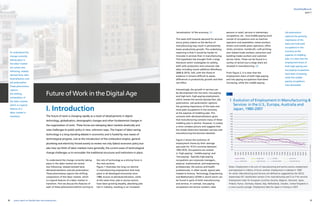
Figure 1: Evolution of Employment in Manufacturing in the U.S., Europa, Australia and Japan, 1980-2007		 9
Figure 2a: Change in Occupational Employment Shares in Low, Middle, and High-Wage Occupations in 16
EU countries, 1993-2010.											10
Figure 3: Polarization of Occupations in the United States 1990-2010						 11
Figure 4: Between-Sector Job Polarization in the U.S., EU, Australia and Japan					 14
Figure 5: Between-Sector Job Polarization in the Netherlands, Belgium, Germany, Spain and Italy			 15
Figure 6: STEM vs. non-STEM Employment in the U.S., Europe, Australia and Japan				 17
Figure 7: STEM vs. non-STEM Employment in the Netherlands, Belgium, Germany, Spain and Italy			 18
Figure 8: Employment shares across STEM intensity in the U.S., Europa, Australia and Japan			 19
Figure 9: Employment shares across STEM intensity in the Netherlands, Belgium, Germany, Spain, Italy		 20
Figure 10: Employment Share changes, Within-Sectors ranked by ICT intensity: 2008-2014				 23
Figure 11: Evolution of Employment in Europe during recessions						 25
Figure 12: Evolution of Employment in the United States during recessions					 26
Figure 13: Evolution of Employment in Japan during recessions							 26
Figure 14: Private fixed investment in information processing equipment and software as a percentage of GDP	 27
Figure 15: Regional distribution high-tech jobs								24
Figure 16: High-tech employment share in 2011								26
Figure 17: High-tech employment share in 2011								26
Table 1: STEM occupations for 2 digit ISCO 88 classification							 16
Table 2: Job Polarization within Broad Sectoral Classifications: 2008-2014					 21
Table 3: Job Polarization within Narrowly Defined Sectors: 2008-2014						 22
Table 4: Evolution of employment growth rates during recessions						 27
Table 5: Yearly growth in labor productivity (STEM 13.5%)							 29
Table 6: Yearly growth in TFP (STEM 13.5%)									29
Table 7: European Firms in STEM versus Non-STEM sectors							 30
Table 8: Can STEM jobs weather the Crisis?									30
Table 9: Complementarities between STEM and non-STEM jobs							 31
The future of work is changing rapidly as a result of
developments in digital technology, globalization,
demographic changes and other fundamental changes in
the organization of work. These forces are reshaping labor
markets drastically and raise challenges to public policy in
new, unknown ways. To understand the change currently
taking place in the labor market we review two related
stylized facts: deindustrialization and job polarization.
Job polarization refers to the growing importance of the
least and most paid occupations in the economy at the
expense of middle-paid ones. These phenomena capture
the shifting composition of the labor market, which is a
typical feature of a labor market in transition. Just as the
introduction of the combustion engine, general plumbing
and electricity forced society to review not only (labor)
economic policy but also how we think of labor markets
more generally, the current wave of technological change
challenges us to reconsider the traditional structures and
institutions in place.
THE MAIN FINDINGS IN THIS PAPER CAN BE SUMMARIZED
AS FOLLOWS:
•	Deindustrialization and Job Polarization are two related
phenomenathatcapturerapidchangesthatarecurrently
taking place in the labor market. Specifically, job
polarization captures how changes in the employment
share of high-paid, low-paid and middle-paid jobs can
be linked to technological change which are masked by
the traditional distinction between manufacturing and
non-manufacturing employment.
•	The role of technology can be understood by looking
at the ICT capital intensity of a sector and the share
of STEM employment. Both of these provide evidence
that technological change drives between-sector job
polarization. Moreover, we find that job polarization
also takes place within narrowly defined sectors, which
is consistent with technology being the underlying
driving factor.
•	STEM employment is more resilient to economic shocks.
During recessions they tend to be associated with
higher levels of productivity, productivity growth and
employment growth. This confirms the Schumpeterian
view of creative destruction: Recessions are times that
new technology and innovation is being implemented
which impacts on the type of jobs and amplifies
polarization.
•	The evidence demonstrates that in order to understand
the current changes in the labor market, both
researchers and policy makers should move away from
the traditional distinction between manufacturing and
non-manufacturing employment. Rather the focus
should be on key enabling technologies, how they
interact with employment and which type of occupations
play a key facilitating role. Moreover, evidence is given
that there are positive spillover effects from high-tech
employment to low-tech employment, especially in
the form of in-person services. This provides evidence
that policy boosting STEM employment may generate a
positive impact reverberating across many occupations,
including non-STEM.
•	Suggestive evidence is given for the positive relationship
between more and better investment in (higher)
education and the share in STEM employment. This
provides potential avenues for policy makers to focus
on.
Summary
part I
1. Evolution of Employment in Manufacturing 
Services in the U.S., Europa, Australia and
Japan, 1980-2007
Source:EUKLEMS2011Release
Notes: Employment is the sum of manufacturing and service sectors employment
and expressed in millions of hours worked. Employment is indexed in 1980
for clarity. Manufacturing and services are defined as suggested by the OECD,
respectively ISIC classification section D for manufacturing and G to P for services.
Employment index for European countries (Austria, Belgium, Denmark, Spain,
Finland, France, Germany, Ireland, Italy, Netherlands, Sweden, United Kingdom) is
a cross-country average. Employment data for Japan is missing in 2007.
8 9yearly report on flexible labor and employment
flexibility@work
‘servatization’ of the economy. (1)
This taste shift towards demand for services
worry policy makers as the decline of
manufacturing may result in permanently
lower productivity growth. The underlying
reasoning is that it would be harder to
innovate in services than in manufacturing.
This hypothesis has brought forth a large
literature which investigates its validity,
both with production and consumer side
data, including recent additions (Nordhaus,
2008  2015). Still, with this flood of
evidence it remains difficult to assess
differences in productivity growth and their
net effect.
Interestingly, the growth in services can
be decomposed into low-tech, low-paying
and high-tech, high-paying employment,
which reveals the second stylized fact: job
polarization. Job polarization captures
the growing importance of the least and
most paid occupations in the economy
at the expense of middling jobs. This
connects with deindustrialization given
that manufacturing contains many of these
middling jobs in decline. However, it creates
a more complex picture and suggests that
the simple distinction between services and
manufacturing has become obsolete.
Figure 2 shows the evolution of
employment shares by their average
pay-scale for 16 EU countries between
1993-2010. Occupations are ranked
in ‘high-paying’, ‘middle-paying’ and
‘low-paying’. Typically high-paying
occupations are corporate managers,
physical, mathematical, and engineering
professionals, life science and health
professionals, in other words, typical jobs
related to Science, Technology, Engineering
and Mathematics (STEM in short) which can
be found in parts of both manufacturing
and services. In contrast, low-paying
occupations are service workers, sales
To understand the change currently taking
place in the labor market we review
two following, related stylized facts:
deindustrialization and job polarization.
These phenomena capture the shifting
composition of the labor market, which
is a typical feature of a labor market in
transition. First we discuss the features of
each of these phenomena before turning to
the role of technology as a driving force in
the next sections.
Figure 1 illustrates the long run decline
in manufacturing employment that took
place in all developed economies since
1980, known as deindustrialization, while
at the same time, jobs in service sectors
have been growing steadily, absorbing jobs
lost in industry, resulting in an increased
Future of Work in the Digital Age
The future of work is changing rapidly as a result of developments in digital
technology, globalization, demographic changes and other fundamental changes in
the organization of work. These forces are reshaping labor markets drastically and
raise challenges to public policy in new, unknown ways. The impact of labor-saving
technology is a long-standing debate in economics and is fueled by new waves of
technological progress. Just as the introduction of the combustion engine, general
plumbing and electricity forced society to review not only (labor) economic policy but
also how we think of labor markets more generally, the current wave of technological
change challenges us to reconsider the traditional structures and institutions in place.
To understand the
change currently
taking place in
the labor market
we review two
following, related
stylized facts: dein-
dustrialization and
job polarization.
These phenomena
capture
the shifting
composition of
the labor market,
which is a typical
feature of a
labor market in
transition.
part I
Job polarization
captures the growing
importance of the
least and most paid
occupations in the
economy at the
expense of middling
jobs. It is clear that the
employment share of
both high-paying and
low-paying occupations
have been increasing,
while the middle-
paying occupations
have decreased.
persons in retail, services in elementary
occupations, etc.. And middle-paying work
consist of occupations such as machine
operators and assemblers; metal workers;
drivers and mobile plant operators; office
clerks; precision, handicraft, craft printing,
and related trade workers; extraction and
building trades workers and customer
service clerks. These can be found in a
variety of sectors but a large share are
situated in manufacturing. (2)
From Figure 2, it is clear that the
employment share of both high-paying
and low-paying occupations have been
increasing, while the middle-paying
200
190
180
170
160
150
140
130
120
110
90
80
70
60
50
1980
1981
1982
1983
1984
1985
1986
1987
1988
1989
1990
1991
1992
1993
1994
1995
1996
1997
1998
1999
2000
2001
2002
2003
2004
2005
2006
2007
US Man	 	 US Services 	 EU Man 	 	 EU Service
Japan Man	 Japan Services 	 Australia Man 	 Australia Servies
I. Introduction
2. Change in Occupational Employment
Shares in Low, Middle, and High-Wage
Occupations in 16 EU countries, 1993-2010
3. Polarization of Occupations in the United
States 1990-2010
Source:Goos,ManningandSalamons[2014,Table2]
Notes: Starting from 2 digit ISCO classified occupations, ‘Low’ is defined as the
employment in the four lowest paying occupations, ‘Middle’ as the nine middling
occupations and ‘High’ and the eight highest-paying occupations.
10 11yearly report on flexible labor and employment
flexibility@work
non-routine tasks are harder to substitute
with robots (e.g. Autor, 2015)4
. These
questions and observations concerning the
role of technology will be the main subject
of Section II.
In the subsequent sections two more
observations are discussed arising from
the macroeconomic literature that
looks broader than the labor market,
considering the economy as a whole. The
first observation relates to the timing of
job polarization. While the evidence on
job polarization and deindustrialization
shows the long term trends in employment,
it is also important to understand how
these changes take place within a shorter
time span. For example, are these changes
gradual over time or do they take place in
short bursts over the short to medium run?
There is some evidence that the cyclical
nature of the economy also has a role to
play. It is namely observed that the largest
decline in middling jobs takes place during
recessions. In other words, job polarization
seems to be amplified during downturns
in the economy. This relationship and
timing of events is discussed in Section
III. Secondly, deindustrialization relates
to the growing literature on differences
in productivity growth, captured by
differences in total factor productivity (TFP).
Here, it becomes increasingly important to
allow for heterogeneity between sectors
and even between firms. These differences
in productivity and the potential looming
of a secular stagnation in the economy are
discussed in Section IV.
These long term trends in employment have
inspired many countries to develop policies
to support manufacturing and especially in
the aftermath of the great recession many
initiatives have been launched under the
realm of New Industrial Policy. For instance,
the European Union set out its policy
occupations have decreased. Especially the
high-paying occupations have gained in
relative importance. This is what typically is
referred to as polarization of occupations.
Figure 3 shows a similar trend for the
United States, where typical operational
and blue collar routine occupations have
lost ground over the same period. So, this
seems to have been a pervasive trend in
most advanced countries, which suggests
there must be some systematic mechanism
underlying this evolution, albeit the
part I
Typically, produc-
tivity growth is
related to the
introduction of
new technology
and innovation.
While the
first industrial
revolution was
triggered by the
introduction of the
combustion engine
and electricity as
a key enabling
technology,
arguably, the
economy today is
increasingly shaped
by the introduction
of computers,
robots and more
in general the
adaption and use
of Information and
Communication
Technology (ICT)
as a key enabling
technology.
extent of polarization seems to differ from
country to country. For instance, in Figure
2 we see that the increase in the share of
high-paying occupations varies from around
4% in Portugal and Austria to over 12% in
Luxembourg and Finland. (3)
This paper wants to take a closer look at the
long-run process of deindustrialization and
job polarization. To this end, we use various
data sets to document and analyze how
deindustrialization and job polarization
are affecting various types of occupations,
which type of jobs tend to grow and
which do not, and how these trends affect
productivity growth. Typically, productivity
growth is related to the introduction of
new technology and innovation. In this
context, we will focus in particular on the
role of key enabling technologies. While
the first industrial revolution was triggered
by the introduction of the combustion
engine and electricity as a key enabling
technology, arguably, the economy today
is increasingly shaped by the introduction
of computers, robots and more in general
the adaption and use of Information and
Communication Technology (ICT) as a key
enabling technology. ICT has triggered
a process of job polarization due to an
increased automation of encodable tasks in
search of cost cutting (e.g. Goos, Manning
and Salamons, 2014). In addition, there
is evidence that the presence of STEM
occupations marks the strong impact of
technology as many of these occupations
play a key facilitating role in the adoption
of digital technology. As we will illustrate
extensively in this work, this polarization
and automation process forces us to move
away from the traditional classification
of the economy into manufacturing and
non-manufacturing sectors. Rather we
should think in terms non-routine tasks
embedded in jobs versus routine tasks. With
automation the latter are easily replaced
or offshored to low-wage countries, while
Source:BasedonKatzandMargo[2014],Table1.6,panelAandowncalculations.
4 Routine tasks are structured and can therefore be increasingly codified in software and embodied in capital, whereas non-routine tasks are harder to automate. As a result, capital accumulation leads to an
accumulation of routine tasks in the economy -- hence the term Routine-Biased Technological Change -- while decreasing the demand for routine relative to non-routine labor tasks. Because routine labor tasks are
concentrated in middling jobs, RBTC leads to a hollowing out of labor demand or job polarization.
-2,0%
-1,5%
-1,0%
-0,5%
-0,0%
0,5%
1,0%
1,5%
2,0%
2,5%
Agricultural O
ccupation
Averagechangein%-points
Service
O
ccupations
O
perative/Laborer
Skilled
Blue
Collar (Craft)
Clerical/Sales
M
anager
Professional Technical
Occupations ranked from lowest paying to highest paying
15%
10%
5%
0%
-5%
-10%
-15%
Ireland
Belgium
Spain
UnitedKingdom
Luxembourg
Greece
Finland
Italy
Austria
Denmark
Sweden
France
Norway
Netherlands
Germany
Portugal
Low paying occupations	 Middle paying occupations	 High paying occupations
Changein%-points
12 13yearly report on flexible labor and employment
flexibility@work
in the context of the Innovation Union
initiative. In particular, it aims to create an
innovation-friendly environment to bring
economic growth and jobs to its regions.
For example, it strives for a 50% (or 150
billion Euro) increase in RD investments
by 2020, claiming this could increase annual
European GDP by 5% (or by 715 billion
Euro) and increase employment by 1.7%
(or by 3.7 million jobs) by 2025. Moreover,
the Innovation Union plan contains over
thirty action points to guarantee that this
growth is inclusive with more and better
jobs for all, and to remove obstacles to
innovation. Most of these initiatives are
targeted towards industry. However, in
recent years the growth of jobs seem to
have been concentrated in STEM jobs (e.g.
Goos et al, 2015). In Section V, we discuss
the importance of such policies and touch
on potential avenues for the future. We
conclude in Section VI.
In this section we show that
deindustrialization and job polarization
are (mainly) driven by technology by
reviewing these stylized facts in three
different ways.
First we illustrate a different way of
looking at the polarization from the labor
market based on sector employment. As
mentioned, ICT is considered as a key
enabling technology in the current wave
of digitization. Therefore we distinguish
sectors based on their ICT capital
intensity as a proxy for this difference in
susceptibility to technological employment.
Second, we rank sectors by their share
in STEM occupations as an alternative
and perhaps even more accurate way
of capturing the essential difference in
susceptibility to technological change
between sectors. However, the growth of
digital capital performing certain tasks is
a phenomenon that changes not only the
size but also the composition of sectors.
That is, if technology really is an importance
driver, we expect there to be evidence both
between and within sectors. This aspect will
be the focus of the final subsection.
2.1. ICT INTENSITY AND BETWEEN-
SECTOR JOB POLARIZATION SINCE
1980
The literature has explored two key
hypotheses that potentially account for
labor market polarization, one is offshoring
of ‘routine’ occupations to low-wage
countries, the other is skill-biased, or
rather routine-biased technological change
(Acemoglu and Autor, 2011).
It is the latter that has received more
attention as technological progress is
changing the relative demand for skills
and hence the relative wages, ‘offshoring’
of routine jobs then becomes a natural
consequence of routine biased technological
change. Arguably, a major technological
shock that overlaps the same period as the
emergence of labor market polarization is
the increased adaption of computers in the
production process and more generally the
spread of ICT5
.
The intuition is that high-tech occupations
are capable of attracting a larger share
of (high skilled) employment through the
complementarity with the accumulation
of ICT capital. They will do so more than
occupations at the middle of the distribution
given the larger importance of ICT capital
intensity and resulting larger decrease in
relative prices as predicted by Baumol’s cost
disease6
. At the same time, middling sectors
are discarding more (less-skilled) workers
previously employed in routine labor tasks
which are now increasingly performed by
digital capital. These are drawn in by the
least capital intensive sectors at the bottom
of the distribution which are growing due
to the complementarity in consumption
and the growing taste for services in the
economy. These sectors, containing most
of the in-person services, are, as of yet, still
little affected by changes in ICT technology.
The lack of automation can be summarized
by a constraint referred to by Autor [2015]
as Polayni’s Paradox7
.
The scope for automation of certain tasks
is bounded since it requires an explicit
knowledge of the rules that govern them.
The paradox lies in the fact that, for now,
there still remain many tasks of which we
have only a tacit understanding of how we
perform them. This implies that they require
little effort for humans to accomplish but
still pose great difficulty for computer
programmers to put into computer
language. Still, in-person services are
inherently connected due to the increased
demand for these services over time; a
relation we will explore further in Section
V. Taken together, routine-biased technical
change predicts that both the least and most
innovative or ICT intense sectors will increase
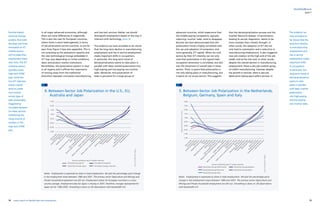
their employment share over time. Figure
4 shows the change in the employment
share of sectors between 1980 and 2007
that are ranked by their ICT capital intensity
for the US, EU, Australia and Japan based
on data from the EU KLEMS database 8,9
.
While there are cross-country differences, a
clear pattern of job polarization emerges,
this time not in terms of occupations,
but in terms of total employment in the
sectors. While in the previous section and
in most other papers, this phenomenon is
discussed in terms of employment change in
occupations ranked by the wage, this shows
that there are other dimensions through
which job polarization can be understood.
(see text box next page)
Figure 4 also shows the direct connection
between job polarization across sectors
and the decline in manufacturing sectors.
Given that sectors with a large share of
routine labor tasks are often part of the
manufacturing industry, we can expect these
to lose employment share over time. On
the other hand, sectors with a large share
of non-routine labor tasks are more often
services with varying levels of technology
present in production. E.g. both child day
care as well as financial consulting. That
is, we find services with rising shares of
employment at both ends of the distribution
of sectors according ICT capital intensity. This
is also suggestive of how these sectors differ
and how they are gaining employment
share for different reasons. The ICT intensive
sectors typically create high-tech STEM jobs,
while the low ICT intensive sectors would
tend to create non-routine service type of
jobs, presumably triggered by increased
demand for these services initiated by the
rising income of workers in the high-tech
STEM jobs. It is striking to note that this
polarization trend has been taking place
part I
The growth of digital
capital performing
certain tasks is a
phenomenon that
changes not only
the size but also
the composition of
sectors.
The scope for
automation of certain
tasks is bounded since
it requires an explicit
knowledge of the
rules that govern
them. The paradox
lies in the fact that,
for now, there still
remain many tasks of
which we have only
a tacit understanding
of how we perform
them. This implies
that they require little
effort for humans to
accomplish but still
pose great difficulty
for computer
programmers to
put into computer
language.
Job polarization
and automation
process forces us to
move away from
the traditional
classification of
the economy into
manufacturing and
non-manufacturing
sectors. Rather we
should think in
terms non-routine
tasks embedded
in jobs versus
routine tasks.
With automation
the latter are
easily replaced
or offshored
to low-wage
countries, while
non-routine tasks
are harder to
substitute with
robots.
II. The Role of
Technology
5 Unfortunately, empirical measures on the ‘routiness’ and ‘offshorability’ of jobs most often overlap, even though they are distinct concept. Given the necessary measurement error inherent to each of these measures, one
must be careful in how much one can claim to disentangle these two forces. 6 Baumol’s [1967] original thesis stated that, if productivity growth is unbalanced across sectors, sectors with lower productivity growth will see
their relative output price as well as their share in total employment increase. Moreover, he argued that unbalanced productivity growth would lead to an increasing share in GDP for less innovative sectors, and thus to a
slowdown in sector-weighted aggregate growth. 7 Polanyi was an economist, philosopher and chemist who in 1966 observed that, “We know more that we can tell”. [Polanyi 1966; Autor 2015] .
8 The latest update of the EU KLEMS data project covers data until 2007. While we do miss information on the last ten years, including the great recession, this data allows us to spot long run trends in job growth and
polarization. To analyze more recent trends, we will therefore be using alternative data sources, including the European Labor Force Survey amongst others. 9 ICT capital intensity is defined as ICT capital compensation
relative to the total income from production measured in value added and is taken from the EU KLEMS data (see data appendix for more details). ICT capital compensation is the product of the ICT capital stock (consisting
of office and computing equipment, communication equipment and software) and its user cost [Timmer et al., 2007]. We define this in the year 2005, but if we take a different year, the ranking remains the same. In the
appendix, table A1, we provide an overview of sectors ranked by their ICT intensity. We can note that sectors like ‘financial intermediation’, ‘post  telecom’ are typically among the highest users of ICT, as expected.
4. Between-Sector Job Polarization in the U.S., EU,
Australia and Japan
Notes: Employment is expressed as share in total employment. We plot the percentage point change
in the employment share between 1980 and 2007. The primary sector (Agriculture and Mining) and
Private household employment are left out. Employment shares for European countries is a cross-
country average. Employment data for Japan is missing in 2007, therefore, changes represented for
Japan are for 1980-2005. Smoothing is done on 28 observations with bandwidth 0.8.
Notes: Employment is expressed as share in total employment. We plot the percentage point
change in the employment share between 1980 and 2007. The primary sector (Agriculture and
Mining) and Private household employment are left out. Smoothing is done on 28 observations
with bandwidth 0.8.
Source:EUKLEMS2011Release
Changeemploymentsharesin%-points
Realestate
Realestate
Construction
Construction
H
otels
restaurants
H
otels
restaurants
Education
Education
H
ealth

socialw
ork
H
ealth

socialw
ork
W
ood
W
ood
Textiles
Textiles
M
anufacturing
nec;recycling
M
anufacturing
nec;recycling
ubber
plastic
ubber
plastic
Basicm
etals
Basicm
etals
N
on-m
etallicm
ineral,nec
N
on-m
etallicm
ineral,nec
Retailtrade;household
goodsrepair
Retailtrade;household
goodsrepair
Food
Food
Publicadm
in

defence
Publicadm
in

defence
M
otorvehicle
sale,m
aintenance

repair
M
otorvehicle
sale,m
aintenance

repair
Transporteq
Transporteq
M
achinery,nec
M
achinery,nec
O
thercom
m
,social
personalservices
O
thercom
m
,social
personalservices
Sectors ranked by log ICT capital intensity
Chem
icals
Chem
icals
Electricity,gas

w
ater
Electricity,gas

w
ater
Refined
petroleum
Refined
petroleum
Transport
storage
Transport
storage
W
holesale
trade
W
holesale
trade
Paper
Paper
Electricaleq
Electricaleq
Businessactivities
Businessactivities
Financialinterm
ediation
Financialinterm
ediation
Post
telecom
m
Post
telecom
m
2.5%
2.0%
1.5%
1.0%
0.5%
0.0%
-0.5%
-1.0%
3.0%
2.5%
2.0%
1.5%
1.0%
0.5%
0.0%
-0.5%
-1.0%
-1.5%
Smoothed change US Smoothed change EU
Smoothed change Japan Smoothed change Australia
Smoothed change Netherlands
Smoothed change Italy
Smoothed change Belgium
Smoothed change Germany Smoothed change Spain
5. Between-Sector Job Polarization in the Netherlands,
Belgium, Germany, Spain and Italy
14 15yearly report on flexible labor and employment
flexibility@work
in all major advanced economies, although
there are some differences in magnitude.
This is also the case for European countries,
where there is some heterogeneity in terms
of job polarization across countries, as can be
seen from Figure 5 (see also appendix). This is
not surprising as the absorption capacity and
the rate technological change embedded in
ICT may vary depending on initial conditions,
labor and product market institutions.
Nonetheless, the polarization pattern is clear
in all regions and it affirms the importance
of moving away from the traditional
distinction between innovative manufacturing
and low-tech services. Rather, we should
distinguish employment based on the way it
interacts with technology. (4 en 5)
The evidence we have provided so far shows
that the long term decline in manufacturing
employment and rise in service employment
masks important shifts in occupations.
In particular, this long-term trend of
deindustrialization seems to take place in
parallel with labor market polarization into
high-paying and low-paying non-routine
tasks. Moreover, this polarization of
tasks is pervasive for a large group of
advanced countries, which experience that
the middle-paying occupations, typically
capturing ‘routine’ tasks, tend to disappear.
Second, we have demonstrated that this
polarization trend is highly correlated with
the use and adoption of computers, and
more generally, ICT capital. When we rank
sectors by their ICT intensity we not only
note that polarization in the typical task/
occupation dimension is correlated, but also
into the dimension of overall jobs in these
sectors. Third, it seems that polarization is
not only taking place in manufacturing, but
it seems to cut across sectors. This suggests
that the deindustrialization process and the
implied ‘Baumol’s disease’ of servitization,
leading to secular stagnation, seems to be
more complex than initially thought. In
other words, the adaption of ICT did not
only lead to automation and a reduction in
manufacturing employment, it also triggered
new job creation at the high-end of the job
ladder and at the low-end. In other words,
despite the overall decline in manufacturing
employment, there is also job creation going
on within manufacturing. Likewise, despite
the growth in services, there is also job
destruction taking place within services. In
part I
The evidence we
have provided so
far shows that the
long term decline
in manufacturing
employment and
rise in service
employment masks
important shifts
in occupations.
In particular, this
long-term trend of
deindustrialization
seems to take
place in parallel
with labor market
polarization
into high-paying
and low-paying
non-routine tasks.
Routine-biased
technical change
predicts that both
the least and most
innovative or ICT
intense sectors
will increase their
employment share
over time. The ICT
intensive sectors
typically create
high-tech STEM
jobs, while the
low ICT intensive
sectors would
tend to create
non-routine
service type of
jobs, presumably
triggered by
increased demand
for these services
initiated by the
rising income of
workers in the
high-tech STEM
jobs
16 17yearly report on flexible labor and employment
flexibility@work
particular, these growing, high-paying jobs
are typically related to sciences, technicians,
health and managing occupations, in
short occupations highly correlated with
STEM content. Typically, such jobs are
believed to generate high value added and
innovation. Given the strong increase in
these high-wage occupations, we will focus
next on the importance of STEM jobs in
order to understand the broad picture of
deindustrialization and servitization of the
economy.
2.2. STEM (HIGH-TECH) EMPLOYMENT
GROWTH SINCE 1980
We use the European Labor Force Survey
(ELFS) to compute for each sector the
fraction of STEM occupations (see data
appendix). By deploying the variation in
occupations of respondents in the ELFS across
sectors, it is possible to characterize sectors
by their intensity in STEM occupations. These
occupations are important for the adoption
and implementation of new (digital)
technologies at the workplace and therefore
provide a good proxy for the importance of
technology in the economic activity. Table
1 lists the occupations at the 2 digit level
which are classified by Eurostat as STEM
occupations and which are commonly used
in studies analyzing STEM occupations (e.g.
Goos et al, 2013).
part I
Growth in the
employment
share of sectors
that are STEM
intensive is not
just restricted to
high-tech manu-
facturing, such as
‘Chemicals’, but
also sectors such as
‘Post  Telecom’,
‘Business Activities,
‘Health and Social
Work’ tend to
have experienced
high changes in
employment and
are highly STEM
intensive.
It is striking to note
the relatively fast
growth of STEM
jobs compared to
non-STEM jobs in
all countries.
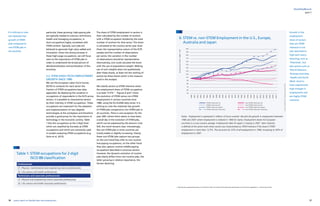
6. STEM vs. non-STEM Employment in the U.S., Europe,
Australia and Japan
The share of STEM employment in sectors is
then calculated by the number of workers
with a STEM occupation divided by the total
number of workers for that sector. This share
is calculated at the country-sector-year level.
Given the representative nature of the ELFS
sample and the number of observations
per sector, the variation in the number
of observations should be representative.
Alternatively, one could calculate the share
with the use of populations weight. Making
use of such weights does not qualitatively
alter these shares, at least not the ranking of
sectors by these shares which is the measure
used in the analysis.
We classify sectors as STEM intensive when
the employment share of STEM occupations
is at least 13.5%10
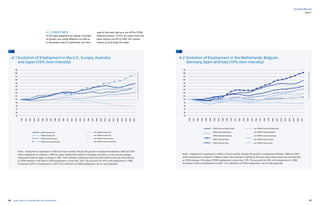
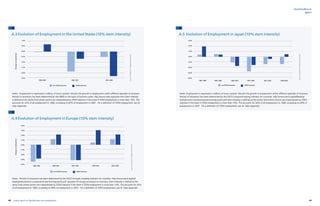
. Figures 6 and 7 show
the evolution of STEM versus non-STEM
employment in various countries since
1980, using the EU KLEMS data series. It is
striking to note the relatively fast growth
of STEM jobs compared to non-STEM jobs in
all countries. There is one exception for the
year 2001 where there seems to have been
a small dip in the evolution of STEM jobs,
which can be explained by the dotcom crisis.
Still, the trend remains clear. Interestingly,
the non-STEM jobs in most countries are
mostly stable or slightly increasing. Clearly,
these non-STEM jobs capture two groups,
on the one hand they refer to non-routine
low-paying occupations, on the other hand
they also capture routine middle-paying
occupations described in previous section.
However, the dynamic evolution of routine
jobs clearly differs from non-routine jobs, the
latter growing in relative importance, the
former declining.
Notes: Employment is expressed in millions of hours worked. We plot the growth in employment between
1980 and 2007 where employment is indexed in 1980 for clarity. Employment shares for European
countries is a cross-country average. Employment data for Japan is missing in 2007. Stem intensity
is defined at the sector level where sectors are characterized as STEM intensive if the share if STEM
employment is more than 13,5%. This accounts for 22% of all employment in 1980, increasing to 30% of
employment in 2007.
Source:EUKLEMS2011ReleaseandEULFS2005
10 We have also experimented with a cut-off level of 10%. The results of this alternative specification can be found in Appendix A. 1 and are very similar.
Table 1: STEM occupations for 2 digit
ISCO 88 classification
Professionals
21. Physical, mathematical and engineering science professionals
22. Life science and health professionals
Technicians and associate professionals
31. Physical and engineering science associate professionals
32. Life science and health associate professionals
200
190
180
170
160
150
140
130
120
110
90
80
70
60
50
Employmentindex:1980=100
1980
1981
1982
1983
1984
1985
1986
1987
1988
1989
1990
1991
1992
1993
1994
1995
1996
1997
1998
1999
2000
2001
2002
2003
2004
2005
2006
2007
STEM intensive US
STEM intensive EU
STEM intensive Japan
STEM intensive Australia
non STEM intensive US
non STEM intensive EU
non STEM intensive Japan
non STEM intensive Australia
18 19yearly report on flexible labor and employment
flexibility@work
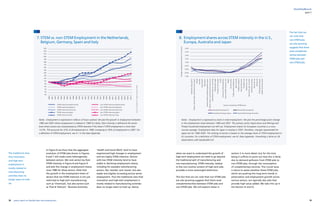
In Figure 8 we show that the aggregate
evolution of STEM jobs shown in Figures
6 and 7 still masks some heterogeneity
between sectors. We rank sectors by their
STEM intensity in Figure 8 and Figure 9
and plot the change in employment shares
since 1980 for these sectors. Note that
the growth in the employment share of
sectors that are STEM intensive is not just
restricted to high-tech manufacturing,
such as ‘Chemicals’, but also sectors such
as ‘Post  Telecom’, ‘Business Activities,
‘Health and Social Work’ tend to have
experienced high changes in employment
and are highly STEM intensive. Sectors
with low STEM intensity tend to have
stable or declining employment shares,
including for example manufacturing
sectors, like ‘textiles’ and ‘wood’, but also
stable and slightly increasing service sector
employment. Thus the traditional view that
innovation and high-tech employment is
mostly related to manufacturing activities
does no longer seem to hold up. Hence,
when we want to understand the growth of
high-tech employment we need to go beyond
the traditional split of manufacturing and
non-manufacturing. STEM intensity, related
to the non-routine content of high-tech jobs
provides a more meaningful distinction.
The fact that we can note that non-STEM jobs
are also growing suggests that there exist
complementarities between STEM jobs and
non-STEM jobs. We will explore these in
section V in more detail, but for the time
being it suffices to point out that this is likely
due to demand spillovers from STEM jobs to
non-STEM jobs, through the consumption
of complementary services. The crucial issue
is hence to assess whether these STEM jobs,
which are pushing the long term trends in
polarization and employment growth across
various sectors, are typically also jobs that
provide high value added. We take this up in
the Section III and IV.
part I
The fact that we
can note that
non-STEM jobs
are also growing
suggests that there
exist complemen-
tarities between
STEM jobs and
non-STEM jobs.
The traditional view
that innovation
and high-tech
employment is
mostly related to
manufacturing
activities does no
longer seem to hold
up.
7. STEM vs. non-STEM Employment in the Netherlands,
Belgium, Germany, Spain and Italy
8. Employment shares across STEM intensity in the U.S.,
Europa, Australia and Japan
Notes: Employment is expressed in millions of hours worked. We plot the growth in employment between
1980 and 2007 where employment is indexed in 1980 for clarity. Stem intensity is defined at the sector
level where sectors are characterized as STEM intensive if the share if STEM employment is more than
13,5%. This accounts for 22% of all employment in 1980, increasing to 30% of employment in 2007. For
a definition of STEM employment, see A 1 in the Data Appendix.
Notes: Employment is expressed as share in total employment. We plot the percentage point change
in the employment share between 1980 and 2007. The primary sector (Agriculture and Mining) and
Private household employment are left out. Employment shares for European countries is a cross-
country average. Employment data for Japan is missing in 2007, therefore, changes represented for
Japan are for 1980-2005. The ranking of sectors is based on the average share of STEM employment in
EU countries. For a definition of STEM employment, see AI. Data Appendix. Smoothing is done on 28
observations with bandwidth 0.8.
Source:EUKLEMS2011ReleaseandEULFS2005
230
220
210
200
190
180
170
160
150
140
130
120
110
90
80
70
60
50
3.0%
2.5%
2.0%
1.5%
1.0%
0.5%
0.0%
-0.5%
-1.0%
1980
1981
1982
1983
1984
1985
1986
1987
1988
1989
1990
1991
1992
1993
1994
1995
1996
1997
1998
1999
2000
2001
2002
2003
2004
2005
2006
2007
Hotelsrestaurants
Motorvehiclesale,maintenancerepair
Wood
Textiles
Realestate
Education
Retailtrade;householdgoodsrepair
Othercomm,socialpersonalservices
Manufacturingnec;recycling
Wholesaletrade
Transportstorage
Food
Financialintermediation
Non-metallicmineral,nec
Paper
Construction
Publicadmindefence
Basicmetals
Rubberplastic
Posttelecomm
Transporteq
Machinery,nec
Electricity,gaswater
Businessactivities
Electricaleq
Chemicals
Refinedpetroleum
Healthsocialwork
Changeemploymentsharesin%-points
Sectors ranked by STEM share
Smoothed change US Smoothed change EU
Smoothed change Japen Smoothed change Australia
STEM intensive Netherlands
STEM intensive Belgium
STEM intensive Germany
STEM intensive Spain
STEM intensive Italy
non STEM intensive Netherlands
non STEM intensive Belgium
non STEM intensive Germany
non STEM intensive Spain
non STEM intensive Italy
20 21yearly report on flexible labor and employment
flexibility@work
2.3. WITHIN-SECTOR ANALYSIS
So far, the evidence shows that the surge
in digital technology enabled by the
implementation of key technologies and
the presence of STEM workers had an
important role in explaining the recent
changes in the composition of the labor
market. In the previous subsection, this has
been shown for changes in the sector level
employment shares. Arguably, the influence
of technology should also be visible in
similar changes in employment away from
routine tasks taking place within sectors.
Therefore, we explore how polarization
takes place within sectors and how this
relates to the ICT intensity of a sector,
returning to employment at the level of
occupations. To this end, we use data from
EUROSTAT on employment in 10 broad
occupational categories in various sectors
for the years 2008-201411
. This data covers
not only the EU 28, but also countries
like Norway, Switzerland and Turkey, 34
countries in total. Following Goos et al
(2014) we group these 10 occupational
categories in three, ‘low-paying’, ‘middle-
paying’ and ‘high-paying’ occupations12
.
In Table 2 and Table 3 we show, by sector,
the average change in employment
shares for each of these three broad
occupational groups, averaged over all
countries in our sample. The appendix
provides a break-down by country.
While we cover only 7 years of data and
include the ‘great recession’, we find that
even in this relatively short time period
polarization continues to increase. In Table
2, we can note that for the major sectors,
Construction, Manufacturing and Services,
the share of middle-paying jobs, associated
with routine tasks, has been declining
between 2008-2014, with 4%, 3.1%
and 3.1% respectively. The share of the
high-paying jobs has been increasing with
5% in construction, 3% in Manufacturing
and 1.5% in Services. Only in Agriculture
we can note a different pattern, but
Agriculture represents only a tiny fraction of
total employment. The share of low-paying
occupations has also gone up, except in
Construction. It is also important to note
that the pattern of job polarization cannot
be pinned down to particular sectors. Job
polarization takes place within most sectors
(see Table 3). Routine jobs (middle-paying)
are on average declining in all sectors, while
most sectors see especially a strong relative
increase in high-paying occupations. For
low-paying occupations we see a mixed
picture, with most of them being either
stable or slightly increasing.
The fact that job polarization is taking place
within sectors indicates that substantial
part I
The fact that
we see such a
strong effect
with high-paying
occupations and
middle-paying
occupations
suggests that it
is technological
change that is
the main trigger,
affecting all sectors
in a similar way.
9. Employment shares across STEM intensity in
the Netherlands, Belgium, Germany, Spain, Italy
Notes: Employment is expressed as share in total employment. We plot the percentage point change
in the employment share between 1980 and 2007. The primary sector (Agriculture and Mining) and
Private household employment are left out. Employment shares for European countries is a cross-country
average. The ranking of sectors is based on the average share of STEM employment in EU countries. For
a definition of STEM employment, see AI. Data Appendix. Smoothing is done on 28 observations with
bandwidth 0.8.
Source:EUKLEMS2011ReleaseandEULFS2005
11 Eurostat does not publish data at the level of sector-occupations before 2008. 12 In particular, low-paying: ‘Elementary Occupations’, ‘Service and Sales Workers’, ‘Agricultural, forestry and fishery workers’; middle-
paying: ‘Armed Forced Occupations’, ‘Clerical Support Workers’, ‘Craft and Related Trades.
Workers’, ‘Plant and Machine operators’; high-paying: ‘Technicians and Associate Professionals’, ‘Professionals’, ‘Managers’
heterogeneity exists between firms and
type of occupations within sectors. The
fact that we see such a strong effect with
high-paying occupations and middle-paying
occupations suggests that it is technological
change that is the main trigger, affecting all
sectors in a similar way. We explore the role
of technology for within-sector employment
changes more directly in Figure 10.
Table 2: Job Polarization within Broad Sectoral
Classifications: 2008-2014
Notes : Occupation employment is grouped within a sector by the wage levels
according to the distinction made in Table 1, p4 of Goos, Manning and Salomons
[2014]. The changes across the period 2008-2014 are averaged across EU 28 plus
Norway, Switzerland and Turkey.
Source:EurostatELFS,authors’calculations
Sector High Middle Low
Agriculture -1.6% 0.8% 0.7%
Construction 5.3% -4.0% -1.2%
Manufacturing 3.0% -3.1% 0.0%
Services 1.4% -3.1% 1.7%
2.5%
2.0%
1.5%
1.0%
0.5%
0.0%
-0.5%
-1.0%
-1.5%
Hotelsrestaurants
Motorvehiclesale,maintenancerepair
Wood
Textiles
Realestate
Education
Retailtrade;householdgoodsrepair
Othercomm,socialpersonalservices
Manufacturingnec;recycling
Wholesaletrade
Transportstorage
Food
Financialintermediation
Non-metallicmineral,nec
Paper
Construction
Publicadmindefence
Basicmetals
Rubberplastic
Posttelecomm
Transporteq
Machinery,nec
Electricity,gaswater
Businessactivities
Electricaleq
Chemicals
Refinedpetroleum
Healthsocialwork
Changeemploymentsharesin%-points
Sectors ranked by STEM share
Smoothed change Netherlands Smoothed change Belgium
Smoothed change Germany
Smoothed change Italy
Smoothed change Spain
22 23yearly report on flexible labor and employment
flexibility@work
In Figure 10, we document for the years
2008-2014 the extent of job polarization in
various sectors, averaged over all countries in
our sample. On the vertical axis we measure
an index of job polarization, which we
construct by taking the sum of the change
in the employment share of the high-paid
and low-paid occupational groups. Recall
that we observe polarization within each
sector. Therefore, within each sector we
would expect to see a relative increase in
the high-paid as well as in the low-paid
occupations and hence the middle-paid
ones would decline relatively. We therefore
construct a job polarization index by simply
adding the shares of the low and high-paid
occupations and computing their growth
rate over time. Next, we want to explore
whether this relative increase in high-paid
and low-paid occupations within each
sector is correlated with the use of ICT. We
therefore measure on the horizontal axis ICT
intensity by sector. Hence, we rank sectors by
their ICT capital intensity, from low to high.
Each dot in Figure 10 represents the
average change between 2008 and 2014 in
the employment share of high- paid and
low-paid occupations in a particular sector.
Since both types should become relatively
important, we would expect positive
growth rates of their employment shares.
In Figure 10, all points, except for the sector
Agricultural are located above zero, which
indicates that in all sectors polarization, as
measured by our index, has increased. We
obtain three additional important insights
from the pattern shown in Figure 10: First,
there is heterogeneity in polarization across
sectors. For instance, we can note that
polarization is higher in ‘Finance’ then in
‘Retail and Wholesale Trade’. Second this
polarization tends to be correlated with ICT
intensity. We can note a positive correlation
between ICT intensity and our polarization
index. Third, this is not just restricted to
manufacturing sectors, but equally so in
services. In particular, in Figure 10, ‘Financial
Services’ and ‘Telecom, publishing and IT
services’ are among the most intensive
ICT adopters, clearly they seem to also be
experiencing substantial polarization. (10)
So far, we have looked at job polarization
reflected in differential growth rates of
various occupations, where the employment
in the high-tech, typically, high-skilled
and abstract occupations as well as low
paid service jobs tends to have grown
disproportionately at the expense of middle
type, routine occupations. The growth of
both low- and high-tech employment can
be explained by complementarities between
high-skilled and low-skilled non-routine
occupations. This affirms the role of
technology as a main driver for the changes
that are found both within and between
sectors. Taken together, the three types of
measurements reviewed in this section, all
point in the direction of digital technology
driving the aggregate evolution captured
by deindustrialization and job polarization.
This can be explained by the hypothesis
of routine biased technical change where
digital technology substitutes for the routine
task content of employment. Given that
this innovation and presence of routine
tasks cannot be restricted to the traditional
distinction between manufacturing and
services, this evidence calls for a new view
of the labor market where we cut through
the data by looking at task content and
susceptibility to technological change.
part I
10. Employment Share changes, Within-Sectors ranked
by ICT intensity: 2008-2014
Source: Eurostat, EU KLEMS and Authors’ calculations
Notes:ThisfigureplotsthedatainTable3afterrankingsectorsbased
ontheirICTcapitalintensitytakenfromtheEUKLEMSdatabase.
Table 3: Job Polarization within Narrowly
Defined Sectors: 2008-2014
Source:EurostatELFS,authors’calculations
Notes : Occupation employment is grouped within a sectpr by the wage
levels according to the distinction made in Table 1, p4 of Goos, Manning and
Salomons [2014]. The changes across the period 2008-2014 are averaged
across EU 28 plus Norway, Switzerland and Turkey.
Sector High Middle Low
Administrative support -1.3% -1.0% 2.3%
Agriculture -2.5% 1.4% 1.1%
Arts 2.9% -2.9% 0.0%
Construction 4.1% -2.6% -1.4%
Education -0.9% -0.3% 1.3%
Electricity, Gas 12.3% -11.9% -0.4%
Financial 5.6% -6.1% 0.5%
Health 3.2% -1.3% -1.9%
Hotels  Restaurants -0.5% -0.4% -0.9%
Household services 1.2% -1.7% 0.5%
Manufacturing 3.0% -3.1% 0.1%
Mining 2.9% -1.9% -1.0%
Other services 3.4% -2.1% -1.3%
Public services 3.2% -3.7% 0.5%
Publishing, Telecom, IT 3.5% -4.6% 1.1%
RD, business services 2.6% -2.2% -0.3%
Real Estate 2.2% -2.8% 0.6%
Transport 1.0% -1.2% 0.1%
Water supply 9.2% -2.7% -6.5%
Wholesale  Retail -4.3% -4.1% 8.4%
Extra-territorial organizations 1.0% -7.7% 6.6%
12%
10%
8%
6%
4%
2%
0%
-2%
ICT capital intensity
0% 5% 10% 15%
AGRICULTURE
MINING
MANUFACTURING
ELECTRICITY, GAS
WATER SUPPLYCONSTRUCTION
WHOLESALE  RETAIL
TRANSPORT
HOTELS  RESTAURANTS
PUBLISHING, TELECOM, IT
FINANCIAL
REAL ESTATE
RD, BUSINESS SERVICES
ADMINISTRATIVE SUPPORT
PUBLIC SERVICES
EDUCATION
HEALTH
ARTS
OTHER SERVICES
HOUSEHOLD
SERVICES
24 25yearly report on flexible labor and employment
flexibility@work
III. High-Tech
Employment
and Recessions
In order to understand the timing of
the events discussed in the previous
section, it is important to think about
what the impact of technology is in
the short to medium run. Firstly, if
digital technology is implemented with
the aim of reducing (labor) costs, it
is important to understand whether
if affects firms by increasing output
because firms are capable of producing
at a lower cost; or by reducing
employment because it has become
more productive; or by a combination
of these two.
This depends highly on whether firms pass on
cost-saving technology into lower prices and
on whether product markets respond rapidly
to these prices. On the one hand, economists
such as Keynes (1933) have argued that
innovation improves labor productivity
faster than product demand and as such, is
bound to reduce employment at least in the
short to medium run. This effect has a direct
negative impact on employment known
as “Technological Unemployment”. Others
have claimed that firms do pass on the cost
reducing impact of innovation into lower
prices and that product markets respond
rapidly to such changes. The increased
product demand would imply an increase in
production and overall demand for inputs,
including employment. Even if economists
cannot agree on the timing in the short
run, it is plausible that both of these effects
become important after some time. Still, from
the hypothesis of routine-biased technical
change, we know that the negative and
positive effects of labor-saving technology
does not affect all workers equally. In
addition, it is important to understand when
firms find it optimal to invest in labor-saving
technology, i.e. when opportunity costs
are low. There is evidence that firms use
recessions to implement innovation because
opportunity costs of restructuring are low.
The “cleansing effect” of recessions is often
associated with both job destruction and
job creation since it usually involves the
introduction of new production processes,
replacing the least productive by more
productive (e.g. Foster, Grim and Haltiwanger,
2014; De Loecker and Konings, 2006).
This is particularly relevant in the context
of automation and digitalization, where
routine type jobs may suffer more from
such a creative destruction process. In
contrast, high-tech STEM jobs are less
likely to be displaced as they typically are
complementary to ICT technology that is
being implemented faster in recessions.
Therefore, the performance of STEM
intensity employment is the focus of this
section. To analyze whether high-tech
employment is doing better in recessions, we
take not only the recent great recession of
2008-2009 into account, but we consider all
recessions that took place since 1980 in the
various countries that we have in our data
set. We use two main sources to define the
existence of recession and expansion periods,
the NBER for the US and the OECD for the
EU13
, Japan and Australia. The OECD labels
recession periods through its Composite
Leading Indicator (CLI).14
3.1. STEM EMPLOYMENT AND
RECESSIONS IN EUROPE, THE US AND
JAPAN: A GENERAL DISCUSSION
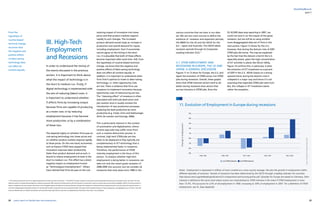
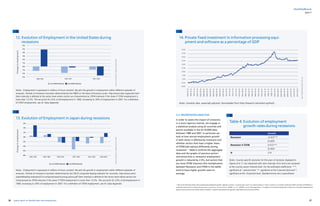
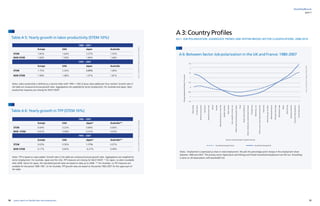
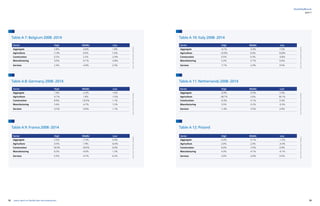
Figures 11 to 13 show for Europe, the U.S. and
Japan the evolution of STEM versus non-STEM
jobs during recessions. Overall, these graphs
show that STEM intensive sectors tend to do
better during recessions than sectors that
are less intensive in STEM jobs. Since the
EU KLEMS data stop reporting in 2007, we
could not tune in on the impact of the great
recession, but we will do so using another
more disaggregated data set of firms in the
next section. Figure 12 shows for the U.S.,
however, that during the dotcom crisis of 2001
STEM jobs did worse. This may be explained
by the fact that the dotcom crisis hit the U.S.
especially severe, given the high concentration
of ICT activities in places like Silicon Valley.
Figure 14 confirms this, in particular, it plots
the evolution of ICT investment as a percent
of GDP in the U.S.. While clearly on a strong
upward trend, during the dotcom crisis it
collapsed in a major way and hence it is not
surprising that especially STEM jobs were hurt.
But, this collapse in ICT investment seems
rather the exception.
part I
From the
hypothesis of
routine-biased
technical change,
we know that
the negative and
positive effects
of labor-saving
technology does
not affect all
workers equally.
11. Evolution of Employment in Europe during recessions
13 The recession periods for the EU are approximated by the recession periods in Germany. 14 The OECD CLI system is based on the growth cycle and identifies business cycles as deviations from the trend. The main
reference series to calculate these deviations is industrial production (IIP) covering all industry sectors with the exclusion of construction, given its cyclical nature and monthly availability. GDP for the total economy is
used to complement the more specific information of IIP. The NBER explores the behavior of several indicators, placing more emphasis on indicators that encompass the entire economy rather than specific sectors. It
uses three independently developed indicators of monthly GDP and GDI, real personal income excluding transfers, the payroll and household measures of total employment, and aggregate hours of work in the total
economy. Monthly data on industrial production and manufacturing-trade sales are used only as complementary information when there is any ambiguity.
Notes: Employment is expressed in millions of hours worked as a cross-country average. We plot the growth in employment within
different episodes of recession. Periods of recessions has been determined by the OECD through a leading indicator for countries.
http://www.oecd.org/std/leadingindicators/CLI-components-and-turning-points.pdf. Episodes for Europe are based on Germany. Stem
intensity is defined at the sector level where sectors are characterized as STEM intensive if the share if STEM employment is more
than 13,5%. This accounts for 22% of all employment in 1980, increasing to 30% of employment in 2007. For a definition of STEM
employment, see AI. Data Appendix.
Source:EUKLEMS2011ReleaseandEULFS2005
Changeinemployment
5%
4%
3%
2%
1%
0%
-1%
-2%
-3%
1980-1982 1985-1987 1991-1993 1995-1997 2001-2005
non STEM intensive non STEM intensive
26 27yearly report on flexible labor and employment
flexibility@work
3.2. REGRESSION ANALYSIS
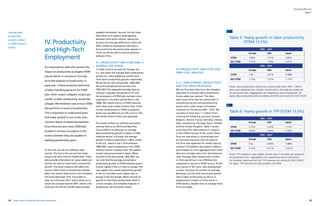
In order to assess the impact of recessions
in a more rigorous manner, we engage in
a statistical analysis using all countries and
sectors available in the EU KLEMS data
between 1980 and 2007. In particular we
look at how annual employment growth
in each sector is affected by recessions and
whether sectors that have a higher share
of STEM jobs behave differently during
recessions15
. Table 4 confirms the aggregate
data and the graphs of previous section
and shows that in recessions employment
growth is reduced by 2.3%, but sectors that
are more STEM intensive (the multiplication
between Recession and STEM in the table)
tend to have higher growth rates on
average.
part I
14. Private fixed investment in information processing equi-
pment and software as a percentage of GDP
Notes: Quarterly data, seasonally adjusted. Downloaded from https://research.stlouisfed.org/fred2.
Source:FederalReserveBankofSt,Louis
15 We run the following model, with g representing employment growth, subscript s is sector, c is country and t is year. R is a dummy equal to 1 when a country is in a recession and 0 else, STEM is the share of STEM jobs in
a particular sector and ε is a white noise error term.: g_sct=α_0+α_1 R_ct+α_2 R_ct×〖STEM〗_sc+ α_3 〖STEM〗_sc+ε_sct. We expect that α_1 is negative as in recessions job growth is lower, but α_2 would be expected to be
positive if sector that are more STEM intensive to better in recessions. We estimate this equation using fixed country and sector effects.
12. Evolution of Employment in the United States during
recessions
Notes: Employment is expressed in millions of hours worked. We plot the growth in employment within different episodes of
recession. Periods of recessions has been determined by the NBER on the basis of business cycles. http://www.nber.org/cycles.html
Stem intensity is defined at the sector level where sectors are characterized as STEM intensive if the share if STEM employment is
more than 13,5%. This accounts for 22% of all employment in 1980, increasing to 30% of employment in 2007. For a definition
of STEM employment, see AI. Data Appendix.
Notes: Employment is expressed in millions of hours worked. We plot the growth in employment within different episodes of
recession. Periods of recessions has been determined by the OECD composite leasing indicator for countries. http://www.oecd.
org/std/leading-indicators/CLI-componentsand-turning-points.pdf Stem intensity is defined at the sector level where sectors are
characterized as STEM intensive if the share if STEM employment is more than 13,5%. This accounts for 22% of all employment in
1980, increasing to 30% of employment in 2007. For a definition of STEM employment, see AI. Data Appendix.
Source:EUKLEMS2011ReleaseandEULFS2005Source:EUKLEMS2011ReleaseandEULFS2005
13. Evolution of Employment in Japan during recessions
ChangeinemploymentChangeinemployment
6%
5%
4%
3%
2%
1%
0%
-1%
-2%
-3%
6%
4%
2%
0%
-2%
-4%
-6%
-8%
1980-1983
1982-1983 1985-1986 1990-1993 1997-1999 2001-2002 2004-2005
1990-1991 2001-2002
non STEM intensive non STEM intensive
Table 4: Evolution of employment
growth rates during recessions
Notes: Country-specific dummies for the years of recession displayed in
Figures 8 to 11 are interacted with stem intensity. Error terms are clustered
at the country-sector intensity level. For the estimated coefficients: ***,
significant at 1 percent level. **, significant at the 5 percent level and *,
significant at the 10 percent level. Standard errors are in parentheses.
Growth
Recession -0.023***
(0.005)
Recession X STEM 0.012***
(0.003)
N 214
1949-01-01
1950-12-01
1952-11-01
1954-10-01
1956-09-01
1968-08-01
1960-07-01
1962-06-01
1964-05-01
1966-04-01
1968-03-01
1970-02-01
1972-01-01
1973-12-01
1975-11-01
1977-10-01
1979-09-01
1981-08-01
1983-07-01
1985-06-01
1987-05-01
1989-04-01
1991-03-01
1993-02-01
1995-01-01
1996-12-01
1998-11-01
2000-10-01
2002-09-01
2004-08-01
2006-07-01
2008-06-01
2010-05-01
2012-04-01
2014-03-01
5.0%
4.5%
4.0%
3.5%
3.0%
2.5%
2.0%
1.5%
1.0%
0.5%
0.0%
28 29yearly report on flexible labor and employment
flexibility@work
IV. Productivity
and High-Tech
Employment
It is important to take into account the
impact on productivity as despite STEM
jobs do better in recessions, this may
be at the expense of productivity. In
particular, if there would be some kind
of labor hoarding going on for STEM
jobs: when output collapses, output per
worker or labor productivity would also
collapse. We therefore look at how STEM
jobs perform in terms of productivity.
This is important to understand given
that lower growth is one of the main
concerns about increased servitization.
Since there are also many STEM jobs
located in services we explore in this
section whether they are capable of
realizing productivity gains.
To this end, we use two different data
sources. The first is the one we have been
using so far and is the EU KLEMS data. These
data provide information on value added per
worker, but also on total factor productivity
growth. The latter measure also takes into
account other factor of production, besides
labor. Our second data source is the Amadeus
firm level data base. First, it provides us
data up to the year 2012, which allows us to
extent the analysis beyond 2007, which is the
final year that the EU KLEMS data provides
useable information. Second, the firm level
data allow us to explore heterogeneity
between firms within sectors, taking into
account size and age differences, which are
often related to employment demand in
firms and hence the sectors they operate in.
Third, we will be able to look at spillovers
between firms.
4.1. PRODUCTIVITY AND STEM JOBS: A
GENERAL DISCUSSION
In Table 5 and 6 we show for Europe, the
U.S. and Japan the average labor productivity
growth (i.e. value added per worker) and
total factor productivity growth respectively.
We do this for two sub-periods, 1980-2007,
the entire sample period we have and
1995-2007 (the appendix provides data by
country). Arguably, the spread of ICT and
the emergence of STEM jobs has been more
important in the latter period than in the
1980s. We classify sectors in STEM intensive
when they have a share of more than 13.5%
of their employment in STEM occupations
(when we use different cut-offs, such as 10%,
the results remain similar, see appendix).
The results confirm our intuition and earlier
work by Goos et al. (2015) and Bay Area
Council (2012). In particular, on average
labor productivity growth is higher in STEM
intensive sectors. In Europe, the average
growth in labor productivity is 1.88%, similar
to the U.S., where it was 1.91% between
1980-2007. Labor productivity in non-STEM
intensive sectors is clearly lower. This pattern
is even more pronounced in Japan. When
we look at the later period, 1995-2007, we
can note that the average annual labor
productivity growth in STEM intensive sectors
is much higher in the U.S. than in Europe. This
may explain why overall productivity growth
in the U.S. has been much higher than in
Europe in the last decade. When we look at
growth in total factor productivity, which is
a more complex, but complete measure of
productivity, we find similar results.
4.2 PRODUCTIVITY AND STEM JOBS:
FIRM LEVEL ANALYSIS
4.2.1. EMPLOYMENT, PRODUCTIVITY
AND THE GREAT RECESSION
We use firm level data from the Amadeus
data base to compute labor productivity
(value added per worker). This data
base covers firms that are active both in
manufacturing and nonmanufacturing
sectors and a wide range of European
countries for the period 2002 – 2012. We
use data of more than 1.1 million firms
covering the following countries, Austria,
Belgium, Finland, France, Germany, Ireland,
Italy, Luxembourg, Portugal, Spain, Sweden
and the United Kingdom. Table 7 shows
some basic firm level patterns in relation
to the STEM intensity of the sectors these
firms are operating in, summarized over
all countries and years that we observe
the firms (see appendix for similar data by
country). The pattern described in Tables 5
and 6 based on more aggregate sector level
data also emerges when firm level data are
used. Average labor productivity is lower
in firms operating in non-STEM sectors
compared to sectors in STEM sectors, 50 361
euro versus 57 831 euro. Also employment
is lower, 18 versus 42 workers on average.
Moreover, we find that the annual growth
rate in labor productivity as well as in
employment is higher in firms active in
STEM sectors, despite that on average these
firms are larger.
part I
Average labor
productivity
growth is higher
in STEM intensive
sectors.
Table 5: Yearly growth in labor productivity
(STEM 13.5%)
Table 6: Yearly growth in TFP (STEM 13.5%)
Source:EUKLEMS2011ReleaseandAuthors’calculationsSource:EUKLEMS2011ReleaseandAuthors’calculations
Notes: Labor productivity is defined as a volume index (with 1995 = 100) of
gross value added per hour worked. Growth rates in the table are compound
annual growth rates. Aggregations are weighted by sector employment. For
Japan, labor productivity data is available until 2006 and missing for NACE 95t97.
Notes: TFP is based on value added. Growth rates in the table are compound
annual growth rates. Aggregations are weighted by sector employment.
For Australia, Japan and the USA, TFP measures are missing for NACE 95t97.
For Japan, TFP measures are only available until 2006.
1980 – 2007
Europe USA Japan
STEM 1.88% 1.91% 3.80%
NO STEM 1.62% 1.48% 1.87%
1995 – 2007
Europe USA Japan
STEM 1.84 2.81% 3.19%
NO STEM 1.15% 1.55% 1.17%
1980 – 2007
Europe USA Japan
STEM 0.72% 0.42% 1.17%
NO STEM 0.60% 0.44% 0.30%
1995 – 2007
Europe USA Japan
STEM 0.62 0.88% 1.46%
NO STEM 0.25% 0.51% -0.22%
30 31yearly report on flexible labor and employment
flexibility@work
In Table 8 we show on the basis of a
standard firm level regression analysis that
these differences are statistically significant
and persist even when we control for the
size and age of the firm and the capital
intensity of the firm. Furthermore, Table
8 also shows that the great recession has
triggered a process in which firms active in
high intensive STEM sectors increase their
productivity as well as their employment.
The idea here is that during the recession
typically STEM occupations benefit from
restructuring, implementing new and more
modern ICT production techniques. This is
confirmed in column (2) and (4) of Table 8.
In column (2) the coefficient that belongs
to Crisis X STEM is 0.068 which indicates
that on average job growth has been 6.8%
higher during the crisis in firms that operate
in STEM intensive sectors, compared to
firms that operate in non-intensive STEM
sectors. Similarly, the last column, column
(4) indicates that the average measured
labor productivity in firms active in STEM
intensive sectors is 63% higher than in
firms that operate in non-intensive STEM
sectors. Moreover, during the crisis the
labor productivity in firms in STEM intensive
sectors increases even more. This suggests
that firms in STEM-intensive sectors use
recessions as periods to restructure and
engage in more technology adoption,
consistent with the idea of Schumpeterian
creative destruction described earlier.
4.2.2. LOCAL FIRM SPILLOVERS
While we have demonstrated that STEM jobs
seem to be more cushioned against shocks,
like the financial crisis, there is another
important dimension related to STEM jobs.
In particular, as shown above, STEM jobs
are typically more productive, and this cuts
across sectors. In other words, we can note
that STEM jobs within manufacturing are
more productive, but also STEM jobs within
Service sectors are. The fact that they are
more productive suggests that they may
generate additional demand. In particular,
workers employed in STEM occupations
would typically have higher pay (as these
jobs are also more productive) and hence
they are likely to spend part of this locally,
which may increase local demand for services
often related to non-STEM occupations (e.g.
restaurants, coffee bars, hairdressers, child
care, etc.). This channel, which emphasizes
the complementarity between STEM and
non-STEM jobs, has been documented
before in the context of what is known as
local multipliers (e.g. Moretti, 2012).
In Table 9 we therefore analyze to what
extent STEM jobs are complementary for
non-STEM jobs. We therefore analyze
employment growth in European firms,
taking into account that typically small firms
and young firms tend to grow faster than
large firms and old firms. We look for an
additional effect on employment growth of
non-STEM-jobs. In particular, if the fraction
of STEM jobs in total in a particular region
is high, we would expect that this generates
additional demand for non-STEM jobs. We
therefore look at the correlation between
the fraction of regional STEM jobs and
average firm level growth of non-STEM
jobs16
of firms in the same region. In Table
9 we report a positive and statistically
significant coefficient of 0.05. This means
that as the fraction of STEM jobs in total in a
particular region increases, this has positive
effects on non-STEM employment, indicating
spillovers between STEM jobs and non-STEM
ones in the same region. We explore this
further in the next section.
part I
The great recession
has triggered a
process in which
firms active in high
intensive STEM
sectors increase
their productivity
as well as their
employment.
The idea here is
that during the
recession typically
STEM occupations
benefit from
restructuring,
implementing new
and more modern
ICT production
techniques.
As the fraction
of STEM jobs
in total in a
particular region
increases, this has
positive effects
on non-STEM
employment,
indicating
spillovers between
STEM jobs and
non-STEM ones in
the same region.
Table 9: Complementarities between STEM and
non-STEM jobs
Source: Amadeus and Authors’ calculations
16 Recall that we classify firms in sectors which are typically low intensive in terms of STEM versus sectors which are typically high-intensive in terms of STEM jobs.
Table 7: European Firms in STEM versus Non-STEM sectors
Table 8: Can STEM jobs weather the Crisis?
Source: Amadeus and Authors’ calculations
Notes: For the estimated coefficients: ***, significant at 1 percent level. **, significant at the 5 percent level and *,
significant at the 10 percent level. Standard errors are in parentheses.
Labor productivity Employment Growth labor productivity Growth employment
NON-STEM € 50 361 18 1.0% 1.0%
STEM € 57 831 42 2.4% 2.7%
Job growth Job growth Productivity Productivity
STEM 0.055* (0.038 0.035 (0.037) 0.661*** (0.003) 0.636*** (0.004)
CRISIS X STEM 0.068** (0.022) 0.098*** (0.008)
CAPITAL/LABOR 0.004*** (0.000) 0.004*** (0.000)
#OBSERVATIONS 12472171 12472171 7444205 7444205
Employment growth
non STEM
Employment growth non
STEM
LOG (EMPLOYMENT LAST
YEAR)
-0.036*** (0.001)
LOG (AGE OF THE FIRM) -0.0267*** (0.001)
REGIONAL FRACTION OF STEM
JOBS IN TOTAL
0.03*** (0.006) 0.05*** (0.009)
# OBSERVATIONS 9,670,799 9,588,719
32 33yearly report on flexible labor and employment
flexibility@work
V. Policy
Implications
This section discusses some of the
avenues that policy makers can explore
in order to mitigate the negative
transition effects of technological
progress while trying to maximize the
positive effects. Firstly, we consider an
important positive spillover effect that
exists between STEM and non-STEM
employment. The evidence above
shows that both low-paid, low-tech and
high-paid, high-tech employment is
growing in importance in the economy.
This implies that our policy should not
only be geared towards training more
STEM workers, but also to support
this low-tech service employment to
respond to the increased demand.
Still, the evidence of complementarity
between the two suggests that it
could be enough for policy makers to
create policies that stimulates STEM
employment in order to boost both
target groups. This is contrary to
the consideration in public debates
that investing in STEM only creates
employment at the top while destroying
employment at the bottom. Second,
we consider how such policy boosting
is in line with the arguments presented by
Autor and Dorn (2013) for the US and Goos,
Manning and Salomons (2014) for countries
in the European Union underlying the
phenomenon of job polarization.
Innovation increases demand for high-tech
jobs because of existing complementarity
of these jobs in the production of high-tech
goods. In additional, the decrease in the
relative price of these high-tech goods
(in accordance with the idea of Baumol’s
cost disease) may increase the demand
for employment in high-tech production.
Secondly, innovation leads to an increase
in demand for local services following an
increase in the average income in the region.
This demand-side effect may be sizeable
given the evidence that demand for services
is relatively income elastic but also price
demand inelastic. Consider, for example, the
increase in demand for household services,
childcare, restaurant, schools, etc., as the
average income in developed countries
increased. In addition, we can expect this
increased demand to remain even in the case
of increasing relative prices. For example, the
demand for education is likely to increase
even if consumers are facing increasing
prices. We can expect this increased demand
for services to be translated in increased
employment demand given that these
services cannot be readily automated due
to their non-routine content or outsourced.
The non-tradable aspect of services can be
related to the fact that these local services
also tend to be in-person, such as waiting
on someone in a restaurant or cutting
someone’s hair in a barbershop.
This mechanism may explain why there
is growth in both high- and low-tech
employment and more specifically, why a
local high-tech job multiplier may exist given
that the increased demand for non-tradable,
in-person services can be expected to have
local effect. A local high-tech job multiplier
part I
Innovation leads to an increase in demand for local services following an increase
in the average income in the region. We can expect this increased demand for
services to be translated in increased employment demand given that these
services cannot be readily automated due to their non-routine content or
outsourced. The non-tradable aspect of services can be related to the fact that
these local services also tend to be in-person, such as waiting on someone in a
restaurant or cutting someone’s hair in a barbershop.
Some comple-
mentarity exists
between STEM
and non-STEM
intensive
employment which
is necessary to
explore in order
to understand
the full impact of
innovation and
targeted policies
on the economy-
wide employment.
would capture that for every additional job
in high-tech employment, more than one
additional job is created within the region.
Evidence for such a local high-tech job
multiplier has been presented by Moretti
(2010) for US cities. Moretti estimates
that for every created tradable job, 1.5
non-tradable jobs are created within the
same city. This estimate increases to 2.5
in non-tradable local goods and services
when considering only the creation in
skilled jobs. The estimated local multiplier
increases further to 5 when considering
urban high-tech employment in two
specific sectors: “machinery and computing
equipment”; and “electrical machinery
and professional equipment”. Moretti and
Wilson (2014) provide further specificity by
exploring the impact of local RD subsidies
in multiple states. They present even larger
local job multipliers which have particular
impact on the growth of employment in
construction, for job creation in bio-tech
companies. This evidence has been extended
to Sweden using information on 72 local
labor markets in Sweden. The multiplier
following an additional job in skilled
tradable employment is 2.8 for non-tradable
employment in that region. This number
decreases to 1.1 when considering and
additional job in high-tech manufacturing.
The fact that local spillovers between
high-tech jobs and low-tech jobs, or
alternatively, ‘abstract STEM type of jobs’
STEM employment might be developed
and what it should focus on. Specifically,
we look at the potential impact of
investment in (higher)
5.1. COMPLEMENTARITY BETWEEN
STEM AND NON-STEM EMPLOYMENT
The evidence above shows that both
employment and productivity growth
can be associated in particular with STEM
employment. Moreover, STEM employment
provides a better buffer against employment
loss during recessions than non-STEM
employment. However, as mentioned in
section II.1 and II.2., employment growth is
not restricted to STEM employment, which
can be found both in manufacturing and
service sectors. The drop of employment
in low-tech manufacturing sectors is also
absorbed by an increased employment share
in low-paying, low-ICT intensive service
employment which tends to be the least
STEM intensive sectors in the economy. This
suggests that some complementarity exists
between STEM and non-STEM intensive
employment which is necessary to explore
in order to understand the full impact of
innovation and targeted policies on the
economy-wide employment.
There are several interacting factors which
may contribute to this complementarity. We
have already given evidence on one aspect
of this by showing that there is a positive
association between STEM and non-STEM
employment at the firm level. In this section
we have a closer look at how this plays out
at the local level and also provide empirical
evidence present in the current literature.
First, we provide a theoretical framework
which links innovation to the growth of
both high-tech employment as well as
employment in local services through a
combination of interacting demand and
supply effects. The mechanism described
34 35yearly report on flexible labor and employment
flexibility@work
is a STEM occupation. On the other hand,
a manager, which may not be regarded
as high-tech per se, is considered as such
if he or she is working in a high-tech
sector. This generates four components of
high-tech employment: STEM occupations
in high-tech sectors, STEM occupations
outside high-tech sectors, and non-STEM
employment in high-tech sectors.
To take into account that the interpretation
of the empirical results may not be causal
if, for example, there are shocks at the
regional level which affect both high-tech
and other employment, the authors
suggest a correction in constructing
Instrumental Variables. The instruments
are based on taking the average growth
in high-tech employment in the country,
excluding the growth of the region for
which the instrument is calculated. In
addition, this instrument is expanded to
the four different components of high-tech
employment based on their definition. See
Goos et al. (2015, p6-7) for further details.
The authors report the results for the
OLS and IV specification using either or
both of the instruments described for
5-year growth periods. The OLS estimates
suggest that the creation of one high-tech
job leads to the creation of 2.57 jobs in
other employment within that region.
The IV specification provides substantially
larger estimates. Regardless of the
specified instruments, the estimated local
multipliers suggest that for every high-tech
job, 4.75 other jobs are created in the
region. This is robust to restricting the
growth in high-tech employment to STEM
occupations. That is, if we consider growth
in high-tech employment only as the
growth in STEM occupations and exclude
non-STEM employment in high-tech
sectors, the estimated local multiplier
still equals 2.8 when applying OLS and
4.45 when making use of the introduced
instruments17
. The definition of high-tech
employment, which is more specified
towards the presence of innovation may
explain the difference in magnitude of the
estimated job multiplier with respect to the
previous evidence.
In sum, regional growth in high-tech
employment can be connected to an even
stronger growth in other employment,
which may be explained by the presence
of complementarity in consumption
and spillover effects in demand. This
can explain why there is growth also
beyond STEM occupations as a second
order effect of innovation taking place.
The estimates suggest that, on average,
with the introduction of one high-tech
workers between 2.5 and 4.4 jobs are
created outside high-tech employment.
This also implies that policies geared
towards high-tech employment can
boost both employment groups which
we know are under increased demand
due to technological progress and their
non-routine nature. Contrary to what
is sometimes considered, the boosting
of high-tech employment helps rather
than hurts growth of employment at the
bottom.
5.2. STEM EMPLOYMENT AND
HUMAN CAPITAL
Given the evidence of positive spillover
effects of STEM employment and its
robustness to economic shocks, it becomes
increasingly important to understand how
we can gear policy towards supporting the
growth in these occupations. This section
tries to shed some light on the potential
policy implications of the importance of
STEM employment at the country level in
creating higher levels of economy-wide
employment growth which may also prove
to be more resilient to negative shocks in
the economy.
part I
The estimates
suggest that, on
average, with
the introduction
of one high-tech
workers between
2.5 and 4.4 jobs
are created
outside high-tech
employment. This
also implies that
policies geared
towards high-tech
employment
can boost both
employment
groups which
we know are
under increased
demand due to
technological
progress and
their non-routine
nature. Contrary to
what is sometimes
considered,
the boosting
of high-tech
employment
helps rather than
hurts growth of
employment at the
bottom.
and ‘service non-routine jobs’ becomes
clear from Figure 15, which shows that
high-tech employment is often regionally
concentrated. Typically these tech hubs
are in major urban areas throughout the
continent and in regions with highly skilled
workforces.
Goos et al. (2015) consider therefore
the existence of a local high-tech job
multiplier with regional data at the NUTS
2 level of 27 countries of the European
Union. Moreover, the authors expand
the definition of high-tech employment.
Starting with the high-tech employment
at the sector level, it includes all
workers employed in manufacturing
sectors defined by a high ratio of
RD expenditure over value-added
and in knowledge-intensive services
characterized by a high share of tertiary
educated workforce. In addition,
high-tech employment is determined by
employment in STEM occupations which
are located across both high-tech and
other sectors. This implies that high-tech
employment is captured both through the
specificity of the occupation itself or the
innovation character of sector activity. For
example, we consider an engineer to be
high-tech employment regardless of the
sector he or she is working in because it
17 These results can be found in greater detail in Table 3 of Goos et al. [2015].
15. Regional distribution high-tech jobs
Source:Goos,Hattaway,Konings,Vandeweyer(2013)
High-Tech Jobs Share
13,5% to 20,4%
11% to 13,5%
9% to 11%
6,5% to 9%
3% to 6,5%
36 37yearly report on flexible labor and employment
flexibility@work
Policies on how to boost STEM employment
may remain important as Figure 6 and
7 show that country level differences
in the share of STEM employment are
not decreasing. Goos et al. (2015) also
present the existence and persistence of
regional dispersion both at the country
and regional NUTS-2 level. While they also
argue that convergence between regions
is taking place, it is very slow. At the rate
that the authors estimate it would take
Europe’s lagging regions at least 60 years
to close half of the gap with Europe’s more
high-tech intensive regions.
There exist many possible explanations for
such regional differences, which are very
difficult to detangle and to causally relate.
This section provides some suggestive
evidence taken on the importance of
Human Capital growth for the share of
high-tech employment. Figure 15 plots on
the horizontal axis, a country’s expenditure
on RD in higher education as a share of
GDP in 2011.
 
A clear positive relationship can be
discerned between the expenditure in
RD in higher education and the share of
high-tech employment across countries.
However, the figure also suggests that
some countries make better use of their
investments than others. While countries
like Lithuania and Portugal spend more or
less equal amounts of investment in RD
as a share of their GDP as countries such
as Belgium and Germany, their high-tech
employment share is only half, which
suggests a potential doubling of their
high-tech employment share by spending
their investments in RD in higher
education more effectively.
The authors provide a second indicator
at the country level for the importance
of high education to boost STEM
employment: the share of tertiary educated
aged 24-64 in a country. These results are
reproduced in Figure 17.
Again, the relationship is positive,
suggesting that a higher share of tertiary
educated can be associated with a high
share in high-tech employment. The
correlation is relatively weak though
indicating that increasing the share
of tertiary educated is less effective in
fostering the growth of STEM occupations
in a country. One reason for this may be
that the quality of the education rather
than the quantity matters for the growth
of high-tech employment. In other words,
the 33% share of tertiary educated in
Spain may have a different content that
the 33% share in the Netherlands or
in Denmark18
.
In sum, low public investment in (higher)
education both in terms of quantity and
quality may be holding back growth in
high-tech employment and is one of the
reasons why there is such persistence
in the differential growth of high-tech
employment between regions. This
suggests that regions should consider
increasing their investment in tertiary
education and in RD in higher education
in particular as means to boost their
high-tech employment growth. Still, the
presence of wide cross-country variation
suggests that some caution is necessary.
Not all expenditure in (higher) education is
equal and countries should consider policy
measures careful, also when adopting them
from other, seemingly successful contexts.
part I
In sum, low public
investment in
(higher) education
both in terms
of quantity and
quality may
be holding
back growth
in high-tech
employment and is
one of the reasons
why there is such
persistence in the
differential growth
of high-tech
employment
between regions.
This suggests that
regions should
consider increasing
their investment in
tertiary education
and in RD in
higher education
in particular as
means to boost
their high-tech
employment
growth.
18 The authors show that the correlation increases when restricting the share of tertiary educated to those with high literacy proficiency levels or when examining the regional differences in tertiary attainment within countries.
16. High-tech employment share in 2011
17. High-tech employment share in 2011
Source:Goosetal[2015,p31]
Source:Goosetal[2015,p32]
16%
14%
12%
10%
8%
6%
4%
2%
0%
16%
14%
12%
10%
8%
6%
4%
2%
0%
AUSTRIA
HUNGARY
DENMARK
MALTA
CYPRUS
LITHUANIA
SPAIN
PORTUGAL
SLOVENIA
BELGIUM
IRELAND
ESTONIA
NETHERLANDS
CZECH REPUBLIC
LUXEMBOURG
FINLAND
ROMANIA
SLOVAKIA
BULGARIA
ITALY
GREECE
POLAND
GERMANY
LATVIA
FRANCE
SWEDEN
UNITED KINGDOM
AUSTRIA
IRELAND
SPAIN
ROMANIA
CYPRUS
LUXEMBOURG
HUNGARY
UNITED KINGDOM
DENMARK
NETHERLANDS
BELGIUM
ITALY
FINLAND
SWEDEN
CZECH REPUBLIC
LATVIA
ESTONIA
POLAND
BULGARIA
LITHUANIA
FRANCE
SLOVENIA
GERMANY
MALTA
GREECEPORTUGAL
Share of population aged 25-64 with tertiary education in 2011
Expenditure on RD in higher education as share of GDP in 2011
HighTechemploymentsharein2011
HighTechemploymentsharein2011HighTechemploymentsharein2011
10%
0.0%
15%
0.1%
20%
0.2%
25%
0.3% 0.4% 0.5% 0.6% 0.7% 0.8% 0.9% 1.0%
30% 45%35% 40%
38 39yearly report on flexible labor and employment
flexibility@work
part I
In order to understand the rapid changes that the labor
market is currently experiencing, this paper takes a closer
look at the long-run process of deindustrialization and
job polarization. We use various data sets to document
that these two are related phenomena. In particular, job
polarization provides a more accurate decomposition of
the growth in services in the economy associated with
the phenomenon of deindustrialization. Job polarization
also connects to the task approach of the labor market
which provides the meaningful distinction in employment
between routine and non-routine tasks. This allows us to
bridge the observed changes with the driving force of
technological change and reveals that the servitization of
the economy and the associated stagnation is much more
complex. By focusing on key enabling technologies, we
have shown that the implementation of ICT has triggered
a process of job polarization due to an increased
automation of encodable tasks in search of cost cutting.
Moreover, we have also shown that the presence of STEM
workers provides an even more accurate approximation
of the exposure to new technologies. That is, high
intensity of STEM workers is associated with higher
growth in employment share. In favor of technology
underlying the changes in employment shares resulting
in job polarization, the evidence also shows that job
polarization can be found within narrowly defined
sectors in addition to between sectors. Moreover, this
within-sector job polarization increases with the ICT
intensity of that sector.
This exercise has demonstrated that the current wave
of technological change forces us to move away from
the traditional classification of the economy into
manufacturing and nonmanufacturing sectors. Rather
we should think in terms non-routine tasks embedded in
jobs versus routine tasks. With automation the latter are
easily replaced or offshored to low-wage countries, while
non-routine tasks are harder to substitute with robots.
By focusing on employment with high STEM intensity, the
evidence reveals that these employment shares are not
only associated with higher growth, but also with better
performance during recessions than other employment
and with higher levels of productivity, measured as labor
productivity or TFP more broadly.
While there are interesting cross-country differences,
these results are strikingly similar between the different
OECD countries that we study in this paper. This reinforces
the idea of a global force such as technological change or
globalization being behind these changes.
This evidence also reinforces the possibilities for policy
makers to target and tailor future policies. While the
cross-country variation in labor market institutions provide
interaction effects which should be taken into careful
consideration by policy makers, it is possible to make some
general recommendation for policy makers. First of all,
policy should not be blindsided by the traditional structures
of manufacturing versus non-manufacturing as engines
for growth. This paper has shown that innovation occurs
in both camps. Therefore, the servitization of the economy
need not be associated with long term declines in economic
growth. It is more meaningful to distinguish between
employment in the way it interacts with technology. Two
dimensions have been introduced: ICT capital intensity and
STEM share in employment. By focusing on employment
which is STEM intensive, you can boost employment which
benefits highly from the current technological change,
it is more resilient during recessions and can generate
higher levels of productivity. Moreover, we have provided
evidence of a structural link between STEM and non-STEM
employment, especially in in-person services. This takes
place because of positive spillover effects from STEM
employment through demand in consumption for local
services. Therefore, by supporting STEM employment,
the other, expanding share of the market may also be
supported. We have given one suggestion of possible
avenue for economic policy by providing evidence of a
positive association between better and higher investment
in (higher) education and STEM employment.
Conclusions and Recommendations
Autor, D. (2015). “Why are there still so many jobs?” The
Journal of Economic Perspectives, Vol. 29, No. 3., 3-30.
Acemoglu, D. and D. Autor (2011), “Skills, tasks and
technologies: Implications for employment and earnings,”
Handbook of labor economics, 4, 1043–1171
Autor, D. (2010),The polarization of job opportunities in the
US labor market: Implications for employment and earnings.
Center for American Progress and The Hamilton Project.
Autor, D. and D. Dorn (2013), “The Growth of Low Skill
Service Jobs and the Polarization of the U.S. Labor Market,”
American Economic Review, 103, 1553–1597.
Autor, D., L. Katz, and M. Kearney (2006), “The Polarization
of the US Labor Market”, The
American Economic Review 96.2, 189-194.
Baumol, W. J. (1967). “Macroeconomics of Unbalanced
Growth: Anatomy of an Urban Crisis”, American Economic
Review; 57: 415-426.
Bay Area Council (2012). “Technology Works: High-Tech
Employment and Wages in the United States”, www.
bayareaeconomy.org
De Loecker, J., Konings, J. (2006) “Job reallocation and
productivity growth in a post-socialist
economy: Evidence from Slovenian manufacturing”,
European Journal of Political Economy, 22.2, 388-408, June
2006.
Foster, l., Grim, C., Haltiwanger, J. (2014) “Reallocation in
the Great Recession: Cleansing or Not?”, NBER Working
Paper, No. 20427, August 2014.
Goos, M., Hathaway, I., Konings, J. and Vandeweyer, M.
(2013). “High Technology Employment in the European
Union”, VIVES Discussion Paper 41, KU Leuven.
Goos, M., Konings, J. and Vandeweyer, M. (2015).
“Employment Growth in Europe: The roles of innovation,
local job multipliers and institutions”, VIVES discussion Paper
50, KU Leuven.
Goos, M. and A. Manning (2007), “Lousy and lovely jobs: The
rising polarization of work in
Britain”,The Review of Economics and Statistics 89.1, 118-133
Goos, M., Manning, A., and A. Salomons (2009), Job
polarization in Europe. The American Economic Review,
58-63.
Goos, Maarten, Alan Manning and Anna Salomons. 2014.
“Explaining Job Polarization: Routine-Biased Technological
Change and Offshoring” American Economic Review, Vol.
104, No 8, August 2014, 2509-2526.
Katz L., Margo R.” Technical Change and the Relative
Demand for Skilled Labor: The United States in Historical
Perspective.” In: L. Boustan, C. Frydman, and R.A. Margo,
eds., Human Capital in History,. University of Chicago Press
and NBER; 2014. 15-57.
Keynes, M., (1933) “Essays in persuasion” Economic
Possibilities for our Grandchildren. MacMillan
Moretti, Enrico. 2010. “Local Multipliers.” American
Economic Review, 100(2): 373-77.
Moretti, Enrico. 2012. The New Geography of Jobs.
Houghton Mifflin Harcourt.
Moretti, Enrico  Wilson, Daniel J., 2014. “State incentives
for innovation, star scientists and jobs: Evidence from
biotech,” Journal of Urban Economics, 79(C), 20-38.
Nordhaus, W., 2008. “Baumol’s Cost Diseas: A Macroeconomic
Perspective”, The B.E. Journal of Macroeconomics, 7.8, 1-39,
February 2008.
Nordhaus, W., “Are We Approaching an Economic
Singularity? Information Technology and the Future
of Economic Growth” NBER Working Paper, No 21547,
September 2015.
O’Mahony, M. and Timmer, M. (2007), “Output, input and
productivity measures at the industry
level: The eu klems database” The Economic Journal,
538.119, 374-403, 2009.
Polanyi, M., “The Tacit Dimension”, The University of
Chicago Press, 1966.
References
40 41yearly report on flexible labor and employment
flexibility@work
part I
APPENDIX A 1. Data Appendix
LIST OF FIGURES AND TABLES
Figure A 1: Evolution of Employment in the U.S., Europa, Australia and Japan					 46
Figure A 2: Evolution of Employment in the Netherlands, Belgium, Germany, Spain and Italy (10% stem intensity)	 47
Figure A 3: Evolution of Employment in the United States (10% stem intensity)					 48
Figure A 4: Evolution of Employment in Europe (10% stem intensity)						 48
Figure A 5: Evolution of Employment in Japan (10% stem intensity)						 49
Figure A 6: Between-Sector Job polarization in the UK and France: 1980-2007					 51
Figure A 7: STEM vs. non-STEM employment in the UK and France: 1980-2007					 56
Figure A 8: STEM vs. non-STEM employment in the UK and France: 1980-2007					 57
Table A 1: Average Ranking of Sectors according to ICT Capital Intensity						 42
Table A 2: Number of observations in EULFS dataset per country in 2005						 43
Table A 3: Number of observations across countries in EULFS dataset						 44
Table A 4: Average Ranking of Sectors according to STEM share						 45
Table A 5: Yearly growth in labor productivity (STEM 10%)							 50
Table A 6: Yearly growth in TFP (STEM 10%)									 51
Table A 7: Belgium 2008 -2014										52
Table A 8:Germany 2008 -2014										53
Table A 9: France 2008 -2014										54
Table A 10: Italy 2008 -2014										53
Table A 11: Netherlands 2008 -2014										53
Table A 12: Poland											53
Table A 13: United Kingdom 2008 -2014									54
Table A 14: Yearly growth in labour productivity (STEM 13.5%)							 54
Table A 15: Yearly growth in Total Factor Productivity (STEM 13.5%)						 56
Table A 16: STEM versus Non-STEM sectors – Belgium								 58
Table A 17: STEM versus Non-STEM sectors – Germany								 58
Table A 18: STEM versus Non-STEM sectors – France								 58
Table A 19: STEM versus Non-STEM sectors – Italy								 58
Table A 20: STEM versus Non-STEM sectors – Netherlands							 59
Table A 21: STEM versus Non-STEM sectors – United Kingdom							 59
A. EU KLEMS
Based on harmonized data from the National
Statistics of several OECD countries the authors
Timmer et al. [2007] have compiled a country-
sector level dataset over a long period of time,
1970-2007. This dataset contains information
on sectors (ISIC rev 3. which overlaps with NACE
rev. 1) concerning: Value added, output volume,
labor and capital input and output prices (a.o.).
Interesting is that the employed capital can
be split into ICT and non-ICT. This allows us to
compute an indicator on a sector’s susceptibility to
advances in digital technology.
In order to have consistent information between
1980 and 2005/2007, we confine the analysis to
the following 15 countries: Austria, Belgium,
Denmark, Finland, France, Germany, Italy, Ireland,
the Netherlands, Spain, Sweden, UK, United
States, Japan and Australia. Information on the
United States starts in 1980 which is why we take
this as a starting point.
For the majority of summary statistics, a cross-
country average of European countries will be
used. This leaves us with 4 country indicators, EU=
average of European countries, US= United States,
JPN= Japan, AUS=Australia.
In order to deploy the largest variation possible at
the sectors level, we chose the most disaggregated
sector level at which we could still find consistent
information on ICT capital compensation. This
leaves with a total of observations for 31 sectors,
as presented in Table 1. These 31 sectors are
ranked according to their ICT capital intensity,
which is the ICT capital compensation relative
to the total income from production measured
in Value Added. EU KLEMS defines ICT capital
compensation as the product of the ICT capital
stock (consisting of office and computing
equipment, communication equipment and
software) and its user cost. See Timmer et al.
[2007] for details. This measure is an indication
of the importance of ICT in the production
process and therefore also of the potential for
implementation of digital technology. ICT capital
intensity is therefore a number between zero and
one where zero would indicate that ICT capital
does not have any role to play in production
in which case there is also no susceptibility for
advances in digital technology, see Table A1.
Given that the ranking of sectors according to this
measure is consistent over time, we make us of ICT
capital intensity as measures in 2005. Note that to
investigate employment polarization along this
dimension we leave out the primary sector. Also,
we leave out the sector ‘P: Private households with
employed persons’, due to data limitations.
Alternatively we group sectors under.
Manufacturing and Services. Manufacturing
contains the sum of employment that falls under
the sector section ‘D’ while Services encompasses
everything from ‘G’ to ‘P’ as suggested by the
OECD.19
This leaves out the primary sectors Agriculture,
Forestry and Fishing; Mining and Quarrying; Gas,
Water and Electricity Supply; and Construction.
Note that Gas, Water and Electricity Supply and
Construction are included in the statistics on job
polarization where we only make use of the ICT
capital intensity to rank sectors.
19 https://stats.oecd.org/glossary/detail.asp?ID=2432
42 43yearly report on flexible labor and employment
flexibility@work
part I
Table A 1: Average Ranking of Sectors according to ICT Capital Intensity
B. EU LABOUR FORCE SURVEY
The European Union Labor Force Survey is a large sample survey among private households in
European countries providing EUROSTAT with data from national labor force surveys. It covers both
the active and inactive population over 15 years of age. The used sample for this paper covers the same
countries as explored by the EU KLEMS: Austria, Belgium, Denmark, Finland, France, Germany, Italy,
Ireland, the Netherlands, Spain, Sweden, UK, for the time period 1995-2007.
Active participants in the labor market were asked both for their principal activity and for their
profession. The first is captured by the NACE Rev1.1 (Statistical classification of economic activities in
the European Community) code for the establishment where the work is performed. These code have
been aggregated to reflect the code level used in the EU KLEMS dataset. The respondent profession is
captured by a 2 digit ISCO (International Standard Classification of Occupations) code. This allows us
to explore the distribution of certain occupations across industries. Table A2 and A3 list the number of
observations in the EULFS sample across countries and sectors for the year 2005. And table A4 shows
the share of STEM jobs by sector, computed on the basis of the observed STEM occupations in the LFS
in each sector as a fraction of the total number of jobs.20
20 For more information, see http://ec.europa.eu/eurostat/statistics-explained/index.php/EU_labour_force_survey
ICT capital intensity 2005 in %
P Private households with employed persons 0.03
AtB Agriculture, hunting, forestry, fish 0.72
70 Real estate activities 0.83
F Construction 1.57
H Hotels and restaurants 1.61
M Education 1.81
N Health and social work 1.70
C Mining and quarrying 1.75
20 Wood and wood products 1.86
17t19 Textiles, textile, leather and footwear 2.15
36t37 Manufacturing nec; recycling 2.35
25 Rubber and plastics 2.32
27t28 Basic metals and fabricated metals 2.48
26 Other non-metallic minerals 2.91
52 Retail trade, except of motor vehicles; repair of
household goods
2.98
15t16 Food, beverages and tobacco 3.15
L Public admin and defense; compulsary soc sec 3.35
50 Sale, maintenance and repair of motor vehicles 3.45
34t35 Transport equipment 3.63
29 Machinery nec 3.65
O Other community, social and personal services 3.83
24 Chemicals and chemical products 3.92
E Electricity, gas and water supply 4.18
23 Coke, refined petroleum and nuclear fuel 6.65
60t63 Transport and storage 5.07
51 Wholesale trade and commission trade, except of motor
vehicles
5.50
21t22 Pulp, paper, printing and publishing 5.74
30t33 Electrical and optical equipment 5.94
71t74 Renting of meq and other business activities 7.28
J Financial intermediation 14.41
64 Post and telecommunications 19.33
Countrey Frequ ency Percent
Austria 19,532 5.43
Belgium 10,172 2.83
Denmark 6,551 1.82
Spain 36,063 10.02
Finland 15,665 4.35
France 27,124 7.54
Germany 54,646 15.19
Ireland 29,338 8.15
Italy 46,145 12.82
Netherlands 44,029 12.24
Sweden 22,574 6.27
United Kingdom 48,021 13.34
Total 359,860 100
Notes: Sectors are ranked by their log ICT capital intensity in 2005. The table presents the cross-country average ICT
capital intensity in 2005 for the following countries: Austria, Belgium, Denmark, Spain, Finland, France, Germany,
Ireland, Italy, Netherlands, Sweden, United Kingdom, United States, Japan and Australia. The ICT capital intensity is
defined at the income share accruing to ICT capital. That is, ICT capital compensation over Value added at the sector
level. Sectors that are underlined are defined by EUROSTAT as high-tech or knowledge intensive.
Table A 2: Number of observations in
EULFS dataset per country in 2005
44 45yearly report on flexible labor and employment
Table A 3: Number of observations across countries in
eulfs dataset per sector in 2005
Table A 4: Average Ranking of Sectors according to STEM share
Sector Code Freq. Percent
Health  social work N 36062 10.02
Business activities 71t74 35562 9.88
Retail trade; household goods repair 52 31620 8.79
Construction F 23930 6.65
Education M 21248 5.9
Other comm, social  personal services O 21241 5.9
Public admin  defence L 20654 5.74
Hotels  restaurants H 16970 4.72
Transport  storage 60t63 16624 4.62
Wholesale trade 51 13874 3.86
Financial intermediation J 12384 3.44
Agriculture, forestry  fishing AtB 11825 3.29
Basic metals 27t28 9776 2.72
Food 15t16 8812 2.45
Motor vehicle sale, maintenance  repair 50 8400 2.33
Electrical eq 30t33 7624 2.12
Paper 21t22 6571 1.83
Machinery, nec 29 6412 1.78
Post  telecomm 64 6340 1.76
Transport eq 34t35 5839 1.62
Manufacturing nec; recycling 36t37 5591 1.55
Chemicals 24 4692 1.3
Real estate 70 4269 1.19
Textiles 17t19 4149 1.15
Non-metallic mineral, nec 26 3056 0.85
Electricity, gas  water E 3000 0.83
Rubber  plastic 25 2992 0.83
Private households P 2743 0.76
Wood 20 2607 0.72
Mining C 1233 0.34
Refined petroleum 23 460 0.13
Missing sector 0.92
Total 359,860 100
average share of STEM occupation employment in 2005
H Hotels  restaurants 0.70%
P Private households with employed persons 2.51%
50 Motor vehicle sale, maintenance  repair 2.52%
AtB Agriculture, fishing forestry 3.90%
20 Wood 3.98%
17t19 Textiles 5.14%
70 Real estate 5.32%
M Education 5.61%
52 Retail trade; household goods repair 5.89%
O Other comm, social  personal services 5.96%
36t37 Manufacturing nec; recycling 6.38%
51 Wholesale trade 6.40%
60t63 Transport  storage 6.51%
15t16 Food 6.54%
J Financial intermediation 6.56%
26 Non-metallic mineral, nec 9.22%
21t22 Paper 9.46%
F Construction 9.93%
L Public admin  defence 10.15%
27t28 Basic metals 10.61%
25 Rubber  plastic 11.26%
C Mining 13.41%
64 Post  telecomm 13.61%
34t35 Transport eq 15.60%
29 Machinery, nec 18.76%
E Electricity, gas  water 22.22%
71t74 Business activities 24.88%
30t33 Electrical eq 26.59%
24 Chemicals 27.08%
23 Refined petroleum 29.96%
N Health  social work 31.82%
Notes: Employment is expressed as share in total employment by sector. These shares are a cross-country average for European
countries: Austria, Belgium, Denmark, Spain, Finland, France, Germany, Ireland, Italy, Netherlands, Sweden, United Kingdom. The
definition of STEM employment can be found in AI. Data Appendix. See Table A3. About 1% of the data in the EULFS contained
no sector code identification.
Source:EULabourForceSurvey2005
flexibility@work
part I
46 47yearly report on flexible labor and employment
flexibility@work
part I
A.2. ROBUSTNESS
In this data appendix we repeat a number
of graphs, but using different cut-offs as
a robustness check. In particular, we have
used in the main text as a cut off for STEM
intensive sectors, 13.5%; we report here the
same using a cut-off of 10%. Our results
remain by and large the same.
A.1 Evolution of Employment in the U.S., Europa, Australia
and Japan (10% stem intensity)
A.2 Evolution of Employment in the Netherlands, Belgium,
Germany, Spain and Italy (10% stem intensity)
Notes: Employment is expressed in millions of hours worked. We plot the growth in employment between 1980 and 2007
where employment is indexed in 1980 for clarity. Employment shares for European countries is a cross-country average.
Employment data for Japan is missing in 2007. Stem intensity is defined at the sector level where sectors are characterized
as STEM intensive if the share if STEM employment is more than 10%. This accounts for 34% of all employment in 1980,
increasing to 40% of employment in 2007. For a definition of STEM employment, see AI. Data Appendix.
Notes: Employment is expressed in millions of hours worked. We plot the growth in employment between 1980 and 2007
where employment is indexed in 1980 for clarity. Stem intensity is defined at the sector level where sectors are characterized
as STEM intensive if the share if STEM employment is more than 10%. This accounts for 34% of all employment in 1980,
increasing to 40% of employment in 2007. For a definition of STEM employment, see AI. Data Appendix.
Source:EUKLEMS2011ReleaseandEULFS2005
1980
1981
1982
1983
1984
1985
1986
1987
1988
1989
1990
1991
1992
1993
1994
1995
1996
1997
1998
1999
2000
2001
2002
2003
2004
2005
2006
2007
1980
1981
1982
1983
1984
1985
1986
1987
1988
1989
1990
1991
1992
1993
1994
1995
1996
1997
1998
1999
2000
2001
2002
2003
2004
2005
2006
2007
190
180
170
160
150
140
130
120
110
100
90
80
70
60
50
190
180
170
160
150
140
130
120
110
100
90
80
70
60
50
STEM intensive US
STEM intensive EU
STEM intensive Japan
STEM intensive Australia
non STEM intensive US
non STEM intensive EU
non STEM intensive Japan
non STEM intensive Australia
non STEM intensive Netherlands
non STEM intensive Belgium
non STEM intensive Germany
non STEM intensive Spain
non STEM intensive Italy
STEM intensive Netherlands
STEM intensive Belgium
STEM intensive Germany
STEM intensive Spain
STEM intensive Italy
48 49yearly report on flexible labor and employment
flexibility@work
part I
A.3 Evolution of Employment in the United States (10% stem intensity) A.5 Evolution of Employment in Japan (10% stem intensity)
A.4 Evolution of Employment in Europe (10% stem intensity)
Notes: Employment is expressed in millions of hours worked. We plot the growth in employment within different episodes of recession.
Periods of recessions has been determined by the NBER on the basis of business cycles. http://www.nber.org/cycles.html Stem intensity
is defined at the sector level where sectors are characterized as STEM intensive if the share if STEM employment is more than 10%. This
accounts for 34% of all employment in 1980, increasing to 40% of employment in 2007. For a definition of STEM employment, see AI.
Data Appendix.
Notes: Employment is expressed in millions of hours worked. We plot the growth in employment within different episodes of recession.
Periods of recessions has been determined by the OECD composite leasing indicator for countries. http://www.oecd.org/std/leading-
indicators/CLI-componentsand-turning-points.pdf Stem intensity is defined at the sector level where sectors are characterized as STEM
intensive if the share if STEM employment is more than 10%. This accounts for 34% of all employment in 1980, increasing to 40% of
employment in 2007. For a definition of STEM employment, see AI. Data Appendix.
Notes: Periods of recessions has been determined by the OECD through a leading indicator for countries. http://www.oecd.org/std/
leadingindicators/CLI-components-and-turning-points.pdf. Episodes for Europe are based on Germany. Stem intensity is defined at the
sector level where sectors are characterized as STEM intensive if the share if STEM employment is more than 10%. This accounts for 34%
of all employment in 1980, increasing to 40% of employment in 2007. For a definition of STEM employment, see AI. Data Appendix.
Source:EUKLEMS2011ReleaseandEULFS2005
6.0%
4.0%
2.0%
0.0%
-2.0%
-4.0%
-6.0%
-8.0%
1.0%
0.5%
0.0%
-0.5%
-1.0%
-1.5%
-2.0%
-2.5%
4.0%
3.5%
2.0%
1.0%
0.0%
-1.0%
-2.0%
-3.0%
-4.0%
1982-19831980-1983 1990-1991 2001-2002
ChangeinemploymentChangeinemployment
1980-1982 1985-1987 1991-1993 1995-1997 2001-2005
1985-1986 1990-1993 1997-1999
STEM intensiveSTEM intensive
STEM intensive
non STEM intensivenon STEM intensive
non STEM intensive
2001-2002 2004-2005
50 51yearly report on flexible labor and employment
flexibility@work
part I
Table A 5: Yearly growth in labor productivity (STEM 10%)
A 6: Between-Sector Job polarization in the UK and France: 1980-2007
Table A 6: Yearly growth in TFP (STEM 10%)
Notes: Labor productivity is defined as a volume index (with 1995 = 100) of gross value added per hour worked. Growth rates in
the table are compound annual growth rates. Aggregations are weighted by sector employment. For Australia and Japan, labor
productivity measures are missing for NACE 95t97.
Notes: Employment is expressed as share in total employment. We plot the percentage point change in the employment share
between 1980 and 2007. The primary sector (Agriculture and Mining) and Private household employment are left out. Smoothing
is done on 28 observations with bandwidth 0.8.Notes: TFP is based on value added. Growth rates in the table are compound annual growth rates. Aggregations are weighted by
sector employment. For Australia, Japan and the USA, TFP measures are missing for NACE 95t97. * For Japan, no data is available
after 2006. Hence for Japan, the calculated growth rates are based on data up to 2006. ** For Australia, no TFP measures are
available for the period 1980-1981. So for Australia, TFP growth rates are based on the period 1982-2007 for the upper part of
the table.
Source:EUKLEMS2011ReleaseandAuthors’calculations
Source:EUKLEMS2011ReleaseandEULFS2005
Source:EUKLEMS2011ReleaseandAuthors’calculations
A 3: Country Profiles
A3.1. JOB POLARIZATION: AGGREGATE TRENDS AND WITHIN BROAD SECTOR CLASSIFICATIONS: 2008-2014
2.5
2
1.5
1
0.5
0
-0.5
-1
-1.5
Changeemploymentsharein%-points
Sectors ranked by log ICT capital intensity
Smoothed changes France Smoothed Changed UK
Realestate
Construction
Hotelsrestaurants
Education
Healthsocialwork
Wood
Textiles
Manufacturingnec;recycling
Rubberplastic
Basicmetals
Non-metallicmineral,nec
Retailtrade;householdgoodsrepair
Food
Publicadmindefence
Motorvehiclesale,maintenancerepair
Transporteq
Machinery,nec
Othercomm,socialpersonalservices
Chemicals
Electricity,gaswater
Refinedpetroleum
Transportstorage
Wholesaletrade
Paper
Electricaleq
Businessactivities
Financialintermediation
Posttelecomm
1980 – 2007
Europe USA Japan Australia
STEM 1.82% 1.64% 3.37% 1.35%
NON STEM 1.60% 1.56% 1.84% 1.46%
1995 – 2007
Europe USA Japan Australia
STEM 1.75% 2.26% 2.93% 1.46%
NON STEM 1.08% 1.68% 1.07% 1.81%
1980 – 2007
Europe USA Japan* Australia**
STEM 0.64% 0.22% 0.89% 0.06%
NON STEM 0.61% 0.58% 0.31% 0.52%
1995 – 2007
Europe USA Japan* Australia**
STEM 0.63% 0.56% 1.17% 0.07%
NON STEM 0.17% 0.65% -0.27% 0.49%
52 53yearly report on flexible labor and employment
flexibility@work
part I
Table A 7: Belgium 2008 -2014 Table A 10: Italy 2008 -2014
Table A 8: Germany 2008 -2014 Table A 11: Netherlands 2008 -2014
Table A 9: France 2008 -2014 Table A 12: Poland
Source:EULFSandAuthors’calculations
Sector High Middle Low
Aggregate 2.8% -4.6% 1.8%
Agriculture -7.4% 0.0% 7.4%
Construction 0.2% 2.2% -2.4%
Manufacturing 3.0% -0.1% -2.8%
Services 2.4% -4.9% 2.5%
Sector High Middle Low
Aggregate -4.1% -3.4% 7.5%
Agriculture -10.9% 0.0% 10.8%
Construction 0.5% 0.3% -0.8%
Manufacturing 2.2% -2.7% 0.4%
Services -7.1% -2.4% 9.5%
Sector High Middle Low
Aggregate 1.4% -2.5% 1.0%
Agriculture -0.7% 1.8% -1.0%
Construction 8.9% -10.0% 1.1%
Manufacturing 3.4% -4.7% 1.2%
Services -0.5% -0.6% 1.1%
Sector High Middle Low
Aggregate -0.9% -4.3% 5.3%
Agriculture -38.7% 2.6% 36.1%
Construction -0.3% -2.1% 2.4%
Manufacturing 5.5% -5.2% -0.3%
Services -1.4% -3.5% 4.9%
Sector High Middle Low
Aggregate 3.3% -7.2% 3.9%
Agriculture 4.5% 1.9% -6.4%
Construction 18.0% -18.0% 0.0%
Manufacturing 8.2% -9.6% 1.3%
Services 0.5% -4.7% 4.2%
Sector High Middle Low
Aggregate 4.3% -3.1% -1.2%
Agriculture 2.0% 2.3% -4.3%
Construction 6.0% -7.0% 0.9%
Manufacturing 4.3% -4.1% -0.1%
Services 2.0% -2.6% 0.5%
54 55yearly report on flexible labor and employment
flexibility@work
part I
Table A 13: United Kingdom 2008 -2014 Table A 15: Yearly growth in Total Factor Productivity (STEM 13.5%)
Table A 14: Yearly growth in labor productivity (STEM 13.5%)
Source:EULFSandAuthors’calculationsSource:EUKLEMS2011ReleaseandAuthors’calculations
Source:EUKLEMS2011ReleaseandAuthors’calculations
Notes: Labor productivity is defined as a volume index (with 1995 = 100) of gross value added per hour worked. Growth
rates are compound annual growth rates. Aggregations are weighted by sector employment.
Notes: Total Factor Productivity (TFP) is defined as a growth rate (with 1995 = 100). TFP is based on value added. Growth
rates are compound annual growth rates. Aggregations are weighted by sector employment. For Australia, TFP measures
are reported from 1982 onwards, for Germany from 1991 onwards and for Belgium TFP measures are available until 2006.
For Australia, Belgium, The Netherlands, Spain and the United Kingdom TFP there is no data on TFP for NACE 95t97.
Sector High Middle Low
Aggregate 5.0% -5.2% 0.2%
Agriculture -4.2% -3.3% 7.5%
Construction 6.6% -5.7% -0.8%
Manufacturing 2.4% -3.6% 1.2%
Services 4.9% -4.1% -0.7%
1980 – 2007 1995 – 2007
STEM NON STEM STEM NON STEM
Australia 1.23% 1.49% 1.54% 1.75%
Belgium 1.37% 1.60% 1.08% 0.89%
France 1.82% 1.99% 1.32% 1.39%
Germany 2.02% 1.63% 1.66% 1.17%
Italy 0.12% 1.15% 0.05% 0.44%
Netherlands 0.95% 1.50% 1.18% 1.71%
Spain 0.98% 1.47% 0.69% 0.38%
United Kingdom 3.10% 1.99% 3.37% 1.58%
1980 – 2007 1995 – 2007
STEM NON STEM STEM NON STEM
Australia -0.05% 0.51% 0.12% 0.43%
Belgium 0.06% 0.18% -0.19% -0.20%
France 0.75% 0.99% 0.34% 0.46%
Germany 0.95% 0.81% 0.53% 0.73%
Italy 0.07% 0.42% -0.22% -0.43%
Netherlands -0.05% 0.67% -0.01% 0.74%
Spain -0.68% 0.09% -0.81% -0.73%
United Kingdom 1.22% 0.78% 1.49% 0.27%
A3.2 STEM VERSUS NON-STEM SECTORS, BY COUNTRY: LABOR PRODUCTIVITY AND TOTAL FACTOR
PRODUCTIVITY (EU KLEMSS DATA, STEM SHARE  13.5%)
56 57yearly report on flexible labor and employment
flexibility@work
part I
Figure A 8: STEM vs. non-STEM employment in the UK and France: 1980-2007
Notes: Employment is expressed as share in total employment. We plot the percentage point change in the employment share
between 1980 and 2007. The primary sector (Agriculture and Mining) and Private household employment are left out. The
ranking of sectors is based on the average share of STEM employment in EU countries. For a definition of STEM employment, see
AI. Data Appendix. Smoothing is done on 28 observations with bandwidth 0.8. 0
Source:EUKLEMS2011ReleaseandEULFS2005
Hotelsrestaurants
Motorvehiclesale,maintenancerepair
Wood
Textiles
Realestate
Education
Retailtrade;householdgoodsrepair
Othercomm,socialpersonalservices
Manufacturingnec;recycling
Wholesaletrade
Transportstorage
Food
Financialintermediation
Non-metallicmineral,nec
Paper
Construction
Publicadmindefence
Basicmetals
Rubberplastic
Posttelecomm
Transporteq
Machinery,nec
Electricity,gaswater
Businessactivities
Electricaleq
Chemicals
Refinedpetroleum
Healthsocialwork
Sectors ranked by stem share
Smooted Changes France Smooted Changes UK
Changeemploymentsharein%-points
-1
-0,5
0,5
1
1,5
2
0
A 7: STEM vs. non-STEM employment in the UK and France: 1980-2007
Notes: Employment is expressed in millions of hours worked. We plot the growth in employment between 1980 and 2007 where
employment is indexed in 1980 for clarity. Stem intensity is defined at the sector level where sectors are characterized as STEM
intensive if the share if STEM employment is more than 13,5%. This accounts for 22% of all employment in 1980, increasing to
30% of employment in 2007. For a definition of STEM employment, see AI. Data Appendix.
Source:EUKLEMS2011ReleaseandEULFS2005
A 3.3 STEM VERSUS NON-STEM SECTORS, BY COUNTRY: LABOR PRODUCTIVITY AND EMPLOYMENT
(AMADEUS FIRM LEVEL DATA BASE)
150
140
130
120
110
100
90
80
70
60
50
1980
STEM intensitive France non STEM intensitive France
STEM intensitive UK non STEM intensitive UK
1981
1982
1983
1984
1985
1986
1987
1988
1989
1990
1991
1992
1993
1994
1995
1996
1997
1998
1999
2000
2001
2002
2003
2004
2005
2006
2007
58 59yearly report on flexible labor and employment
flexibility@work
Table A 16: STEM versus Non-STEM sectors – Belgium Table A 20: STEM versus Non-STEM sectors – Netherlands
Table A 17: STEM versus Non-STEM sectors – Germany Table A 21: STEM versus Non-STEM sectors – United Kingdom
Table A 18: STEM versus Non-STEM sectors – France
Table A 19: STEM versus Non-STEM sectors – Italy
Source:AmadeusandAuthors’calculations
Source:AmadeusandAuthors’calculationsSource:AmadeusandAuthors’calculations
Labor productivity Employment Growth labor
productivity
Growth employment
Non-STEM € 103 411 12 0.1% 3.4%
STEM € 106 614 33 0.7% 4.5%
Labor productivity Employment Growth labor
productivity
Growth employment
Non-STEM € 108 367 6 4.9% 0.9%
STEM € 105 470 12 8.7% 3.6%
Labor productivity Employment Growth labor
productivity
Growth employment
Non-STEM € 76 290 39 0.8% 3.8%
STEM € 78 316 133 1.3% 5.5%
Labor productivity Employment Growth labor
productivity
Growth employment
Non-STEM € 66 640 133 -2.3% 0.5%
STEM € 78 052 134 0.0% 1.0%
Labor productivity Employment Growth labor
productivity
Growth employment
Non-STEM € 61 488 16 3.3% 1.3%
STEM € 72 548 43 4.2% 2.7%
Labor productivity Employment Growth labor
productivity
Growth employment
Non-STEM € 54 283 21 -1.3% 2.0%
STEM € 58 575 48 0.9% 2.9%
part I
60 61yearly report on flexible labor and employment
flexibility@work
part II
part II
Future of work, drivers of change
Source:WEF,Futureofjobs(2016)
62 63yearly report on flexible labor and employment
flexibility@work
The balance among employment sectors
– and the kinds of skills required by those
sectors – has been shifting for five decades.
Occupations, both traditional and new,
require more highly skilled workers now
than before. The Information Age is
affecting the workforce in several ways.
Especially the medium-skilled workers are
being replaced by computers that can do
the job more effectively and faster. This has
created a situation in which workers who
perform tasks which are easily automated
being forced to find work which involves
tasks that are not easily automated and
workers are being forced to compete in a
global job market.
SKILLS ARE NEEDED MORE THAN EVER
Being skilled has always been an advantage
– if not a necessity – for individual workers.
Today, having a skilled workforce is just as
much a necessity for countries competing in
an advanced economy. Promoting education
and training is an important facet of
developing a skilled workforce.
Skilled people generate knowledge that
can be used to create and implement
innovations and educated workers have a
better start for acquisition of further skills.
On the other hand, a concern is that in
the future of work, only the highly skilled
will have access to rewarding professional
careers, and that this trend will increase
Labor market 2015
The world of work is being reshaped by tremendous forces. Economic shifts are
redistributing power, wealth, competition and opportunity around the globe.
Disruptive innovations, radical thinking, new business models and resource scarcity
are impacting every sector. Technology is changing industries at a rapid pace and the
labor market is therefore entering a period of uncertainty. Managing this transition is
an important challenge, as is preparing for the future for the workforce of tomorrow.
DEMOGRAPHIC AND SOCIO-ECONOMIC
Changing nature of work, flexible work
Middle class in emerging markets
Climate change, natural resources
Geopolitical volatility
Consumer ethics, privacy issues
Longevity, ageing societies
Young demographics in emerging markets
Women’s economic power, aspirations
Rapid urbanization
TECHNOLOGICAL
Mobile internet, cloud technology
Processing power, Big Data
New energy supplies and technologies
Internet of Things
Sharing economy, crowdsourcing
Robotics, autonomous transport
Artificial intelligence
Adv. manufacturing, 3D printing
Adv. materials, biotechnology
44%
23%
23%
21%
16%
14%
13%
12%
8%
34%
26%
22%
14%
12%
9%
7%
6%
6%
part II
The squeezed
middle
Jobs traditionally
associated with
the middle class
(assembly line
workers, data
processors,
foremen and
supervisors) are
beginning to
disappear, either
through relocation
or automation.
Workers must
either move up,
joining the group
of “mind workers”
which will continue
to grow in demand
(engineers,
doctors, attorneys,
teachers, scientists,
professors,
executives,
consultants), or
settle for low-skill,
low-wage service
jobs thereby
pushing the low-
educated out of
the labor market.
Climatechange
Sharing economy
ageing societies
autonomoustransport
Longevity
64 65yearly report on flexible labor and employment
flexibility@work
inequality on the labor market. Countries
can, through the education system, develop
the skills needed for participation in the
labor market. This requires a broad range
of skills that raise employability in the short
term (and ease their transition to the labor
market) as well as in the long term, by
giving people the capacity to learn, develop
further and adapt their knowledge to labor
market needs.
Education and labor policy need to be
re-examined to make them more reactive
and relevant to the ever-changing market
realities. On average, developed countries
spend about 6 percent of their GDP on
Even at the height of the crisis employers reported having difficulties in
finding workers with the appropriate skills. Employers say they cannot
fill vacancies because even highly-qualified candidates have the wrong
skills. The education systems ‘educate graduates of tomorrow in the skills
needed in the industry yesterday’ as they claim. Many employers are
concerned that applicants lack ‘soft skills’, such as interpersonal, commu-
nication and analytical problem-solving abilities. This clearly indicates
that jobs in growing sectors such as health, education and other services
require a different set of skills than those acquired by unemployed people
who worked in declining sectors, such as agriculture and manufacturing.
Youth often lack certain social and emotional skills such as those involved
in working in teams, which can undermine the use of their cognitive skills.
Educate for the 21st century
The future of work requires a systemic change in education and training.
The types of skills that employers need are changing all the time. Employees
need to continually learn and adapt to changing and new industries. Business
needs are reshaped continuously by technology, creating ongoing skill gaps
both individuals and countries will have to address.
Education systems are often badly equipped to develop these dynamic skills in
students, most schools and universities are teaching a 20th-century education
to young people who will need cutting-edge 21st-century skills. Employers
need to collaborate with schools and universities on the development of
curricula and a shared practical knowledge of the market. The education
system also needs to change to allow a focus on lifelong learning.
educational institutions. Most countries
have worked to increase the proportion
of students who complete secondary
education and move on to post-secondary
and higher education.
The importance of science education is
recognized on both sides of the Atlantic
but the debate gets particularly heated
when it intersects with immigration.
Europe is in a similar position to the
United States, but has much more rigid
immigration policies making that Europe
attracts fewer high-skilled workers than
not only the United States, but also
Canada and Australia. Only 3 percent of
scientists in the European Union come
from non-EU countries, whereas in the
United States 16 percent of scientists come
from abroad.
THE FUTURE OF WORK IS GLOBAL
Some 230 million people – are living
(and in large part working) in a country
other than that of their birth. Sometimes
described as the unfinished business of
globalization, labor migration issues raise
complex and sensitive political, human
rights, economic and social concerns, as
well as an array of legal and regulatory
challenges. Migration accordingly occupies
a prominent place on both national and
multilateral policy agendas, and in public
discourse and debate.
Significant talent challenges are looming
in the Northern and Southern hemispheres
by 2020 and beyond. In the Northern
hemisphere, the expected talent gaps
will be caused mainly by demographic
shifts – notably, the retirement of baby
boomers. For example in the United
States, Germany, Canada and the United
Kingdom, immigration and expected
birth rates will not balance the workforce
losses caused by aging populations. Over
the next decade, Western Europe’s talent
Top10softskillsin2020
Source:WorldEconomicForum:‘Futureofjobsreport’(2015)
1. Complex
problem solving
2. Critical thinking 3. Creativity
4. People
management
5. Coordinating
with others
6. Emotional
intelligence
7. Judgment and
decision making
8. Service orientation 9. Negotiation
10. Cognitive flexibility
Percentage of students in tertiary
education enrolled in STEM
Netherlands
Belgium
United States
Australia
Brazil
Poland
France
Italy
Spain
United Kingdom
India
Germany
0% 10% 20% 30% 40% 50%
�����������������������������
����������������������������������
����������������������������
�����������������������������������
����������������������������������
���������������������������������������
�������������������������������������
������������������������������
����������������������������������������
����������������������������������
�������������
����������������������������������������
16%
17%
20%
20%
24%
24%
25%
26%
27%
33%
37%
���������������
������������������������
���������������������������
������������������������������
����������������������������������������
���������������������������������������
���������������������������������������������
����������������������������������������
��������������������������������������������������
��������������������������������������������������������������������������������
���������������������������������������������������������
Women Total Men������� �������
��������������� 14%
part II
Investing in STEM
Investment in STEM disciplines
(science, technology, engineering
and mathematics) is increasingly
seen in the US and Europe as a
means to boost innovation and
economic growth. The importance
of science education is recognized
on both sides of the Atlantic
but the debate gets particularly
heated when it intersects with
immigration. Europe is in a similar
position to the United States, but
has much more rigid immigration
policies making that Europe
attracts fewer high-skilled workers
than not only the United States,
but also Canada and Australia.
Only 3 percent of scientists in
the European Union come from
non-EU countries, whereas in
the United States 16 percent of
scientists come from abroad.
Source:UNESCO(2014)
66 67yearly report on flexible labor and employment
flexibility@work
A global labor market is already here
A global labor market is already here, but we lack the institutions to make it work effectively. Global shortage
of STEM skills is not the real problem for the world economy, but the location mismatch between employers and
employees. Talented people cannot move to where the jobs are. Several US and European firms have moved their
RD operations offshore over the last two decades, which diminishes the number of STEM jobs in both the United
States and Europe. Demand has not dropped, but has relocated to countries such as China and India. Commissioned
by Randstad, IZA Institute for the Study of Labor in Bonn is currently researching the drivers of the global ‘jobs to
people, people to jobs’ mobility. This report will be published fall 2016.
Global talent gap
Dawn of super-aged societies
Notes: colour codes based on compound annual growth rates of talent supply and demand by 2020 and 2030.
Based on: WEF Global Talent Risk report
Talent gap trend
none or low
medium
Strong
Source:WEFGlobaltalentriskreport(2012)
Source:OECD.stats(2015)
More than 20% of
population over 65 by
2015
2030
2050
part II
2013 2020  2030 
supply will continuously decrease, leading to
almost empty talent pipelines beyond 2020.
Economic growth expectations coinciding
with projected waves of retirements will
force employers to find, attract and retain
scarce talent.
DEMOGRAPHIC SHIFTS ARE UPON US
Demographic shifts are upon us and will
significantly lower economic growth. The
number of “super-aged” countries – where
more than one in five of the population
is 65 or older – will reach 27 in 2030.
Only Germany, Italy and Japan meet that
definition today. Thanks to the aging of
today’s middle-aged demographic swell and
ongoing improvements in life expectancy, the
population of seniors is projected to surge
to 1.5 billion in 2050. The result will be a
much older world, a future in which roughly
one-in-six people is expected to be 65 and
older by 2050, double the proportion today.
In the coming decades, aging and slower
rates of growth are expected to characterize
the populations of all major regions in the
world. Ranked by median age, Europe is
currently the oldest region in the world and
should will remain so in 2050. Even relatively
young countries such as Brazil and Turkey
are aging. Moreover, the pace of aging in
some of these countries is more rapid than
in developed economies. Some societies in
Eastern Asia are forecast to age particularly
fast.
The population of children, meanwhile, will
be at a virtual standstill due to long-term
declines in birth rates around the world.
The number of children younger than 15 is
expected to increase with only 0.2 billion to 2
billion in 2050. Consequently, more countries
will find that they have more adults over 65
than they have children younger than 15.
Aging of the population will be challenging
for public budgets and pension systems. The
falling share of the population at traditionally
68 69yearly report on flexible labor and employment
flexibility@work
Public concern
A survey by PEW research in
2013 on attitudes towards aging
showed concern peaks in East
Asia, wherePro nearly nine-in-ten
Japanese, eight-in-ten South
Koreans and seven-in-ten Chinese
describe aging as a major problem
for their country. Europeans also
display a relatively high level of
concern with aging, with more
than half of the public in Germany
and Spain saying that it is a major
problem. Americans are among
the least concerned, with only
one-in-four expressing this opinion.
Is aging a problem in your country?
39%
Japan
China
Germany
Spain
France
United Kingdom
Italy
South Africa
Brazil
United States
87%
67%
55%
52%
45%
43%
41%
31%
26%
part II
Ageing will slow economic
growth
Most of the countries set to join the
“super-aged” club by 2020 are in Europe
and include the Netherlands, France,
Sweden, Portugal, Slovenia and Croatia.
But by 2030 they will be joined by a more
diverse group including Hong Kong,
Korea, the US, the UK and New Zealand.
According to Moody’s the unprecedented
pace of population aging will slow
annual global economic growth by 0.4
percent over the next five years and by
0.9 percent between 2020 and 2025.
The OECD warned about the issue
when it predicted population aging
would contribute to slow global annual
economic growth from an average 3.6
percent in this decade to about 2.4
percent between 2050 and 2060.
Unemployment rates 2015
Source:Eurostat(2015q2),OECD.stats(2015q2),ILOEstimates(2015)
Spain
Italy
France
European Union
Belgium
Poland
Brazil
Netherlands
Canada
Australia
United Kingdom
United States
Germany
China
Mexico
India
Japan 3.3%
3.5%
4.4%
4.6%
4.7%
5.3%
5.5%
6.0%
6.9%
6.9%
7.2%
7.4%
8.4%
9.5%
10.1%
12.1%
22.4%
Development unemployment rates
11%
10%
9%
8%
7%
6%
5%
4%
3%
2%
1%
0%
2002
2003
2004
2005
2006
2007
2008
2009
2010
2011
2012
2013
2014
2015
United States
Japan
European Union
Canada
Australia
Source:Eurostat(2015q2),OECD.stats(2015q2),ILOEstimates(2015)
Source:PEWresearch(2013)
productive ages means relatively fewer
people will pay taxes and social contributions
at a time when the rising share of older
persons implies that more people will receive
pensions and costly health services. In
response, many countries have implemented
reforms, such as a rise in the retirement
age, designed to delay the rate of increase.
Nonetheless, public pension expenditures are
expected to consume about 15 percent of
GDP in several European countries by 2050.
Pension expenditures in the United States are
projected to increase to 8.5 percent in the
same period.
Larger concerns revolve around public health
care expenditures, which are rising faster
than pension expenditures in most countries.
Health care expenditures are pushed up not
just by aging but by cost inflation as well.
In the U.S., public health expenditures are
projected to more than double to 15 percent
in 2050. Similarly, large increases are expected
in Japan and several countries in Europe.
70 71yearly report on flexible labor and employment
flexibility@work
Change in global unemployment rate, 2015–17
Source:ILO,WESOtrends2016
down over 0.3
down 0 to 0.3 pp
up 0 to 0.2 pp
up over 0.2 pp
No data
part II
I. Recovering
Labor Markets
After a long period of high
unemployment and underemployment
labor market conditions are finally
improving even in those countries
hit hardest by the global financial
and economic crisis. In many
countries there has been a drop in
unemployment numbers since the
global financial crisis, but there is
some evidence that this is not only
due to jobs growth but also because
Unemployment trend
Based on the most recent economic growth projections by the ILO, the number of unemployed globally is forecast to rise by
about 2.3 million in 2016, with an additional 1.1 million unemployed in 2017. Emerging economies predicted to contribute
the greatest number to this total are Brazil (0.7 million) and China (0.8 million). Developing economies will see an increase
in unemployment levels of 1 million over the two-year period. Globally some of that increase will be offset by continued
improvements in developed economies, where unemployment levels are anticipated to fall by 1.4 million over the course of
2016 and 2017, driven by reductions within the EU-28 and the United States.
Change in %-points
Youth unemployment rates 2015
Source:Eurostat(2015q2),OECD.stats(2015q2),ILOEstimates(2015)
49.2%
41.1%
23.1%
20.4%
20.4%
19.8%
16.8%
15.0%
13.4%
13.2%
12.1%
11.6%
11.0%
9.7%
9.1%
7.0%
5.4%
Spain
Italy
France
Belgium
European Union
Poland
Brazil
United Kingdom
Australia
Canada
China
United States
Netherlands
India
Mexico
Germany
Japan
long-term unemployed are giving up
on trying to find a job.
In Europe labor market conditions are
slowly improving and may continue to do
so in the short term. The unemployment
rate in the European Union has reached
9.5 percent in 2015, down from 10.8 in
2013 and 10.1 in 2014 – the lowest rate
since 2011. Improvements have been most
notable in Southern Europe. In Greece,
Portugal and Spain, the unemployment
rates have fallen from their very high
peaks, declining on average by almost 2
percentage points in the past year alone
(although in the case of Greece and Spain
they remain above 20 per cent). In the
United States the unemployment rate has
been falling since 2010 from 9.6 percent
to 5.3 percent in 2015. Also in Japan and
Shift of economic power
The coming changes in world demography could alter the distribution of global economic power over the coming decades.
The graying of the world’s population in the aggregate conceals some important variations. Japan, China, South Korea and
many countries in Europe are expected to have greater numbers of people dependent on shrinking workforces, a potentially
significant demographic challenge for economic growth.
For the United States and Australia population trends may lead to greater opportunities in the global economy of the future.
Although the United States population is anticipated to turn older and grow at a slower rate in the future, it is projected
to increase at a faster pace and age less than the populations of most of the rest of the developed world. Thus, to the
extent that demography is destiny, the United States may be in a position to experience a more robust economic future in
comparison to other developed nations.
Elsewhere, aging of the society mostly means less children but a growing workforce. A favorable demographic trend for
economic growth. In countries like India, Pakistan, Egypt, Nigeria, Kenya and South Africa the dependency ratios will
decrease, a boon for economic growth.
72 73yearly report on flexible labor and employment
flexibility@work
Development youth unemployment rates
Source:Eurostat(2015q2),OECD.stats(2015q2),ILOEstimates(2015)
24%
22%
20%
18%
16%
14%
12%
10%
8%
6%
4%
2%
0%
2002
2003
2004
2005
2006
2007
2008
2009
2010
2011
2012
2013
2014
2015
United States
Japan
European Union
Canada
Australia
part II
Canada unemployment has been falling for
over 5 years. In Australia on the other hand
unemployment has been slowly increasing
since 2011.
The EU unemployment rate is projected
to continue to fall steadily over the next
couple of years. Nonetheless, virtually all
the countries in Europe, with the exception
of Germany and the United Kingdom,
will continue to post unemployment rates
higher than the pre-crisis level. In addition,
the long-term unemployed continue to
comprise a large share of the total number
of unemployed. In 2015, around half of
all unemployed persons in Europe had
been without work for one year or longer.
Workers unemployed for long periods risk
losing their skills, face reduced employability
and are at greater risk of poverty.
YOUTH, SCARS OF THE RECESSION
It is not easy to be young in the labor
market today. Young people have suffered a
disproportionate share of job losses during
the global economic crisis. In 2015 there were
over 4.5 million young people unemployed
in the European Union, 0.5 million more than
before the crisis. In the United States, with 2.5
million young people unemployed it is back
to pre-crisis levels.
Coping with unemployment is difficult for
everyone. But for low-skilled youth, and
especially those who have left school without
qualifications, failure to find a first job or
How to give youth a boost on the labor market
Tackle the current youth unemployment crisis
➜ Tackle weak aggregate demand and boost job creation
➜ Maintain, and where possible expand cost-effective labor
market measures
➜ Tackle demand-side barriers to the employment of low-
skilled youth
➜ Encourage employers to continue or expand quality
apprenticeship and internship programmes
➜ Provide adequate income support to unemployed youth
until labor market improve, but subject to strict mutual
obligations
Strengthen the long-term employment prospects
➜ Strengthen the education system and prepare all young
people for the world of work
➜ Strengthen the role and effectiveness of vocational
education and training
➜ Assist the transition to the world of work
➜ Reshape labor market policy and institutions to facilitate
access to employment and tackle social exclusion
74 75yearly report on flexible labor and employment
flexibility@work
Activity rates 2015
Source:Eurostat(2015q2),OECD.stats(2015q2),ILOEstimates(2015)
Netherlands
Canada
China
Germany
Australia
United Kingdom
Japan
Spain
United States
Brazil
European Union
France
Poland
Belgium
Italy
Mexico
India
79.7%
78.0%
77.4%
77.3%
76.8%
76.6%
75.8%
74.6%
72.6%
72.5%
72.4%
71.2%
67.6%
67.0%
64.2%
63.4%
56.1%
part II
keep it for long can have negative long-term
consequences on career prospects – a
phenomenon often referred to as “scarring”.
The risks posed by a “scarred” generation
have motivated many governments to take
vigorous action, notably by scaling up funds
for youth labor market programs.
In the context of today’s fragile recovery and
mounting fiscal pressures, there is a strong
need to keep momentum, by maintaining
adequate resources for cost-effective
measures for youth. But governments cannot
do everything alone, and well-coordinated
supports and incentives must come from all
key stakeholders, including employers, trade
unions, NGOs, and naturally from youth
themselves.
NEED TO INCREASE ACTIVITY RATES
Globally, there are over 2 billion
working-age people who are not
participating in the labor market. Some
26 million joined these ranks in 2015. The
share of the population over the age of
15 that is active in the labor market varies
tremendously. Variation in participation
rates are due to both cyclical and structural
factors. When jobs are scarce due to
recession or slow recovery in the economic
cycle, some jobseekers become discouraged
and drop out of the labor market. In terms
of structural factors, population ageing
and increasing years spent in education in
many countries result in shrinking or slower
growth in the working-age population.
These two effects need to be differentiated
Long term unemployment
Source:OECD.stats(2015q2)
Canada
Australia
United States
United Kingdom
Poland
Japan
Netherlands
France
Germany
Belgium
Spain
Italy
More than 1 year Less than 1 year
87%
78%
77%
64%
64%
62%
60%
57%
56%
50%
47%
39%
13%
22%
23%
36%
36%
38%
40%
43%
44%
50%
53%
61%
Persistent long-term unemployment
Long-term unemployment has likely peaked but remains a major concern. In countries hardest
hit, notably in Southern Europe, this has led to a rise in structural unemployment which will not
be automatically reversed by a pick-up in economic growth. Long-term unemployment reveals
an important problem of labor market. Because the longer one stays unemployed, the smaller
becomes the chance of getting back into employment. This means that high unemployment on
itself is not necessarily the problem, but the persistence of unemployment is. As long as mobility is
high, people won’t stay unemployed for too long.
In the US long-term unemployment has been limited until the latest crisis, but increased sharply
since then. While in the EU the average has always been much higher (around 40 percent of all
unemployed persons) but decreased in 2009 because so many new people became unemployed.
As not all of these newly unemployed could find jobs immediately, the share of long-term unem-
ployment rose again in the last years. These figures point at a serious problem because this kind of
unemployment is persistent. Chances that these people will return into employment have become
quite low during the unemployment period, and it will take a lot of extra effort to make labor
market policy work for this group.
76 77yearly report on flexible labor and employment
flexibility@work
US Proportion of the inactive labor force by reason
Source:BLSUSA
Labor participation in the United States is
falling
A study by the U.S. Bureau of Labor Statistics provide
insight into why people who were not in the labor
force did not work. From 2004 to 2014, there was
an increase in the proportion of the population 16
years and older that was not in the labor force and
that cited school attendance, illness or disability, or
retirement as the main reason for not working. The
percentage of people who were not in the labor force
and the reasons they gave for not working varied by
age and gender.
Among younger people, the percentage not in the
labor force rose sharply and the most often cited
reason for not working was school attendance. The
percentage not in the labor force also rose for both
men and women 25 to 54 years, and nearly all reasons
cited recorded an increase. Women in this age group
were more likely than men to cite home responsi-
bilities as the main reason for not working.
The increase of men and women not in the labor
force were larger for those with less education. Men
and women 25 to 54 years with less education were
more likely to be labor force nonparticipants than
their counterparts with more education. People with
less education were more likely than those with
more education to cite illness or disability as the main
reason for not working.
The proportion of older adults who were not in
the labor force declined from 2004 to 2014. Older
adults were most likely to cite retirement as the main
reason for not working, although the percentage
who cited this reason fell. The older adult population
saw an increase in the proportion who cited illness or
disability as the main reason for not working.
Illness or disability
5.5%
13.9%
6.0%
5.0%
0.9%
6.5%
15.4%
5.4%
6.4%
1.2%
Retired Going to schoolHome responsibilities Other reasons
2004 2014
Development activity rates
Source:Eurostat(2015q2),OECD.stats(2015q2),ILOEstimates(2015)
(See text box below)
80%
79%
78%
77%
76%
75%
74%
73%
72%
71%
70%
69%
68%
67%
66%
65%
2002
2003
2004
2005
2006
2007
2008
2009
2010
2011
2012
2013
2014
2015
United States
Japan
European Union
Canada
Australia
part II
to provide a clearer understanding of the
future path of labor force participation
and to design and implement an effective
set of policy interventions.
In the case of developed economies,
the decline in participation rates in the
aftermath of the crisis stemmed from
weak labor market prospects, particularly
for young people who often chose to
extend their education. Indeed, some
developed countries that experienced
sharp declines in employment also saw
a significant drop in participation rates.
This is especially so in the United States.
As labor markets improve, some of the
downward trend is likely to be reversed
– this is evident from the stabilization
in participation rates in many of the
developed economies.
Participation rates have also been
declining in emerging economies and
some developing economies. Some of
this decline is due to more young people
moving into or staying longer in education
rather than entering the world of work,
while in some cases fewer women are
joining the labor market due to income
and wealth effects.
THE GENDER GAP IN LABOR
PARTICIPATION
As for women, their participation has been
rising in all countries for several decades.
Each new generation of women has had a
stronger attachment to the labor market
than the previous one. There are probably
important cultural reasons for this, but
the increase has also been enabled by
technical progress, allowing housework
78 79yearly report on flexible labor and employment
flexibility@work
Age gap in activity rates
Source:Eurostat(2015q2),OECD.stats(2015q2),ILOEstimates(2015)
Spain
Germany
France
Netherlands
Canada
UK
EU
Japan
Poland
Belgium
Australia
Brazil
United States
Italy
Age 55 to 64 Age 25 to 54
57% 85%
85%69%
83%53%
83%67%
82%65%
82%64%
82%57%
82%72%
80%45%
79%47%
78%65%
75%56%
74%64%
74%51%
72%56%
Gender gap in activity rates
Source:Eurostat(2015q2),OECD.stats(2015q2),ILOEstimates(2015)
Japan
Netherlands
Brazil
Australia
Mexico
Canada
United Kingdom
Germany
Spain
United States
European Union
France
Poland
Italy
Belgium
67% 85%
85%75%
83%62%
83%71%
82%47%
82%74%
82%72%
82%73%
80%70%
79%67%
78%67%
75%67%
74%61%
74%54%
72%62%
Female Male
part II
to be done more easily, while higher
educational attainment has also played a
role in luring women into the job market.
Policies have also affected this trend
and appear to play an important role
in explaining cross-country differences
in female participation. Taxation is one
such policy. Married women are widely
considered as the second earner in a
couple and when their income is taxed
jointly with that of their husband, the
marginal tax rate can be very high. This is
unfortunate since women’s participation
reacts more to tax changes than that of
men. Most countries have moved towards
taxing each earner in the couple separately,
but joint taxation still exists in a number of
countries, including France and Germany.
Better participation can also be achieved
by subsidising childcare, either directly
or through the tax system. Most Nordic
countries have gone pretty far in this
respect and also have high female labor
force participation. Childcare support
may be seen more as a subsidy to female
full-time work than to part-time work,
and indeed, the share of part-time work
in Nordic countries has declined. But
the money to pay for childcare subsidies
obviously has to come from taxes, and
higher taxes in general reduce people’s
desire to work, so there are limits to how
far this policy can go. Other countries, such
as the United States, manage however to
achieve high female participation without
large-scale subsidisation of childcare. In this
case, because of a wide dispersion of wages,
many households can afford to meet the
costs of childcare by themselves.
THE AGE GAP IN LABOR
PARTICIPATION
In contrast to women, older men have
reduced their labor force participation
in all countries over the past three decades
– in some cases sharply. It may seem ironic
that effective retirement ages have fallen
at the same time as people are living longer
and healthier lives. This fall may reflect a
stronger appetite for leisure as real incomes
have gone up. But it also owes a lot to
policies.
Early retirement, invalidity and
unemployment benefit schemes in many
countries provide people in their 50s with
strong incentives to retire. These often
misguided policies led to a sharp drop in
participation in the 1970s and 1980s.
There has been some moderate roll-back
since then, but most of these policies
remain in place in many continental
European countries, with detrimental
consequences for employment.
Old-age pension schemes also stack the
cards in favor of people retiring early.
If people postpone their retirement
by a year, this is rarely reflected in
correspondingly higher pensions later on,
despite their extra contributions. This is
already problematic at ages between 60
and 65, but after 65 the disincentives to
work become almost prohibitive in some
countries. In our society where people are
fitter for a lot longer, we should be free to
engage in “active ageing”.
80 81yearly report on flexible labor and employment
flexibility@work
Ways to increase labor participation
There is a strong presumption that those countries which achieved high labor force
participation also had the best policy framework. The time has come to implement a
new set of policies conducive to stronger growth, higher employment and sounder
pension systems. To cope with mounting financial pressures due to the ageing of society,
governments have to make hard choices. In particular, to avoid increasing the tax burden
or impoverishing pensioners, they are now looking at ways of inducing more people to
enter or stay in work.
These policies will have to be tailored to meet the specific needs of the various groups
that make up the active population. One group in the labor market almost fully
employed is that of prime-age males (25-54), whose labor-force participation rate
generally exceeds 90 percent. By contrast, there is wide variation in the extent to which
women, as well as young and older persons, participate in the labor market. Those
groups are most likely to be influenced by government policies, for better or worse.
In the short term measures could well be needed to ensure the full employment
of more people coming onto the job market. But it is reassuring to note that those
countries which have promoted active labor force participation also benefit from high
employment. Given time, employers have been able to create the jobs needed to match
a more abundant supply of labor.
Share of part-time employment
Source:Eurostat(2015q2),OECD.stats(2015q2),ILOEstimates(2015)
Poland
France
Spain
European Union
Belgium
Mexico
Italy
Canada
Germany
Japan
United Kingdom
Australia
Netherlands
70%60%50%40%30%20%10%0%
Total Female Youth
eliminate early retirement schemes and raise standard retirement ages;
increase childcare subsidies;
eliminate tax discrimination against female participation;
enhance the role of part-time work;
make the school-to-work transition more effective.
A policy package to increase labor participation would
include the following steps:
part II
PART-TIME EMPLOYMENT
Regarding the increase of participation, one
might state that the rise in participation
owes to a large extent to the possibility
of part-time jobs, which stimulated many
households to participate with both
members. In the last decades some countries
faced a transition from the standard
‘breadwinner household’ to the more
modern ‘1.5 jobs per family’ households,
gaining popularity among young families
with children. Part-time work is still a
female and young phenomenon. Most of
the increased female participation during
the nineties, was through women entering
the labor market in part-time jobs. When
looking at the incidence of part-time work
we see that the Netherlands take a special
position. Nearly 40 percent of all employed
Dutch persons are working in a part-time
job of less than 30 hours/week (mostly
women).
82 83yearly report on flexible labor and employment
flexibility@work
Flexible labor relations 2015
Although the traditional open-ended
labor contract is still the standard labor
relation, many other forms of more flexible
labor relations have developed over the
last decades. These other forms of labor
relations vary in the type of flexibility:
flexibility in the duration of the contract
(fixed-term contracts), flexibility in the
company people work for (e.g. triangular
labor relations such as agency work),
and flexibility in the labor relation (e.g.
self-employed workers). For that reason,
all these other types of contracts can be
interpreted as flexible labor contracts as
opposed to the traditional open-ended labor
contract with a direct employer.
Flexible labor relations enable companies to quickly adjust the size and composition
of their workforce when innovations change their product lines and production
methods. These flexible labor relations also enable companies to screen workers
with respect to their productivity and creativity before adding them to their more
permanent workforce. Through this way of matching, long-term labor relations
become more efficient to the employer. If flexible labor relations are used to
support innovation processes and optimize the quality of the workforce, it enables
further economic growth.
part II
84 85yearly report on flexible labor and employment
flexibility@work
Share of flexible labor relations in total employment Share of self-employment in total employment
Source:Eurostat(2015q2),OECD.stats(2014),ILOEstimates(2015)
Source:Eurostat2015q2.*ILO2013
In Canada, Japan and most European
countries, all forms of flexible labor
together account for 15 to 30 percent
of total employment. Particular high
shares of flexible labor are found in the
Mediterranean countries (more than 30
percent), but also in Poland (40 percent)
and in the Netherlands (33 percent). The
Mediterranean countries have a long
tradition in flexible labor, particularly
through self-employed workers. Poland
and the Netherlands have experienced the
largest growth in flexible labor relations
during the last decade for different
reasons.
The lowest share of flexible labor is
found in the United States. Only around
10 percent of employment comes in the
form of some type of flexible labor. Also
Australia, the United Kingdom and Canada
are countries with a traditionally low
demand for flexible labor and a relatively
low employment protection of workers, in
particular those with a fixed-term contract
against (individual) dismissal.
SELF-EMPLOYMENT
Self-employment includes both owners
of businesses, who can be considered
employers rather than employees, and
own-account workers. Many self-employed
workers can be found in the agricultural
sector and small retail. Therefor, countries
with a large share of employment in
these sectors have a high rate of self-
employment. This is especially so in the
developing and emerging regions of the
world like Southern and Southeastern
Asia and Latin-America where by far the
highest rates of self-employment can be
found. Self-employment rates here easily
exceed 25 percent and reach up to over 80
percent in India. Often distinction between
self-employment and informal work is
difficult to make in these regions.
In the western world however self-
employment rates are more moderate.
About half of all flexible labor relations
consist of self-employment. In the
European Union nearly 14.5 percent of
all employment is self-employment. The
highest shares of self-employment can be
found in Southern- and Eastern-European
countries where – again - agricultural
businesses and small retail still hold a large
part of total employment. The United
States, Canada and Scandinavian countries
have the lowest share of self-employment,
all below 10 percent.
Poland
Spain
Netherlands
Italy
European Union
France
Belgium
Germany
Canada
Japan
United Kingdom
Australia
United States
18% 22% 40%
16% 21% 37%
15% 18% 33%
22% 11% 33%
14% 12% 26%
11% 15% 26%
14% 8% 22%
10% 12% 22%
9% 12% 21%
12% 8% 20%
14% 5% 19%
10% 5% 15%
7% 4% 10%
Self-employment Temporary employment
Italy
Poland
Spain
Netherlands
European Union
Belgium
United Kingdom
Japan*
France
Australia*
Germany
Canada*
United States*
22.0%
17.9%
16.4%
15.4%
14.2%
13.7%
13.6%
11.5%
10.7%
10.4%
9.6%
8.8%
6.6%
part II
86 87yearly report on flexible labor and employment
flexibility@work
In general self-employment rates drop in
countries when employment in agriculture
and small retail drop. In the western world
self-employment rates have stabilized and
remained fairly equal in the last decade.
There has been no clear effect on self-
employment levels by the recent crisis.
In times of economic recession, when
jobs are scarce, employees who lose their
job may decide to offer their services to
companies. These flexible labor services
may be attractive to companies as they
offer comparable labor productivity in the
short run and at lower risks. In the long
run however, self-employment may not
always provide the right substitution for
traditional employees, who have more
opportunities to invest in company-specific
knowledge and skills (firm-specific human
capital) which would eventually lead to
a decline in the share of self-employed
workers.
However, these stable self-employment
rates hide a strong variety. Variety
between countries, sectors and educational
attainment. When we look closer at the
figures for Europe it is clear there has
been a decline of self-employment in
Southern- and Eastern Europe. On the
other hand, self-employment in France,
the UK and especially the Netherlands self-
employment has been rising in the past
decade.
Development self-employment in Europe
Source:Eurostat(2015q2
0%
5%
10%
15%
2002
2003
2004
2005
2006
2007
2008
2010
2011
2012
2013
2014
2015
2016
20%
25%
Belgium
European Union
France
Germany
Italy
Netherlands
Poland
Spain
United Kingdom
-686
-764
Sectoral shift in self-employment: EU 2008-2015 (in 1,000’s)
			 	 Top 5 sectors down
Professional, scientific,
and technical
Human health and social work
Education
Administrative and support servive
Information and communication
Transportation and storage
Manufacturing
Construction
Wholesale and reatail trade
Agriculture, forestry
and fishing
100
300
500
200
400
600
556
340
171 163
137
-100
-300
-500
-600
-700
-200
-400
-454
-435
-150.7
Sectoral shift of
self-employment
The variety in growth
of self-employment
between the countries
partly be explained
by a shift of self-
employment between
the sectors. Since 2008
in the European Union
self-employment in
agriculture and retail
continuous decreased
with in total 1.5 million
jobs. Furthermore,
self-employment
dropped with nearly
0.5 million jobs each
in manufacturing and
construction explaining
the drop in most Medi-
terranean and Eastern
European countries.
However, recently
self-employment is
increasing in service
sectors. Especially in
the professional, science
and technical sector (up
nearly 0.6 million) and
health care (up over
0.3 million) which can
explain the increase
in several Western
European countries.
part II
Top 5 sectors up
88 89yearly report on flexible labor and employment
flexibility@work
This sectoral shift of self-employment
is reflected in the level of education
of self-employed workers. The total
amount of self-employed workers went
up only marginally from 28.7 to 30.4
million since 2002 in the European
Union but the average level education
changed drastically. In 2002, 10 million
self-employed only had a basic level of
educational attainment opposed to 6
million self-employed with an advanced
level of education. By 2015 this picture
has reversed completely, in a near perfect
mirror image 10.2 million self-employed
had an advanced level of education and 6.5
million a basic level.
In nearly all countries the probability
of being self-employed is higher for
men than for women. In North-America
this gender gap in self-employment is
quite moderate with 44 percent of self-
employed being women in Canada and 40
percent in the United States, but it Europe
less than a third of all employed is a
woman. Countries in Southern and South-
eastern Asia are the only exception to this
rule but very often self-employment in
this region involve informal low-quality
jobs.
Self-employment by age group
Source:Eurostat2015q2.
The likelihood of being self-employed does
increase with age. In Europe of all young
workers, age between 15 to 24, only 4.3
percent are self-employed. The probability
triples to nearly 14.1 percent for the core
working age-group of 25 to 54 year olds,
and of all workers over 55 year olds one in
five is self-employed. Elderly workers have
better access to capital, can take advantage
of their aggregated skills and network
and are more likely to want the freedom
and independence associated with self-
employment.
Self-employment by level of education (EU)
Source:Eurostat2015q2
2002
0
2,000
4,000
6,000
8,000
x1,000persons
10,000
12,000
14,000
2003 2004 2005 2006 2007 2008 2009 2010 2011 2012 2013
Advanced educationIntermediate educationBasic education
2014 2015
Belgium
European Union
France
Germany
Italy
Netherlands
Poland
Spain
United Kingdom
25%20%15%10%5%0%
Age 15 to 24 Age 25 to 54 Age 55 to 64
part II
90 91yearly report on flexible labor and employment
flexibility@work
TEMPORARY EMPLOYMENT
In many countries temporary work has been
an important component of employment
growth in the last one or two decades.
Temporary contracts may facilitate job
matching, by providing an initial work
experience especially for youths (either
during their educational period, for starters
or for drop-outs) while also allowing
employers to screen suitable candidates.
For employers temporary jobs also offer
the opportunity to adapt the size of their
workforce to the economic conditions.
Currently, about half of all flexible labor
consists of fixed-term contracts (the other
half being self-employment). Most western
countries between 5 and 20 percent of
all workers have fixed-term contracts.
The United States, Australia and the
Share of temporary employment in total employment
Source:Eurostat2015q2.*OECD2014**OECD2013.***OECD2005
United Kingdom show traditionally the
lowest figures due to the less stringent
employment protection. The type of
temporary contracts differs between
countries in average duration. The average
duration of a temporary contract in the EU
is 17 months. However, 60 percent of the
contracts agree on a duration of less than
12 months. In Scandinavia and the German-
speaking countries temporary workers have
longer contracts than in other countries,
especially France, Belgium and Spain.
When the recent economic crisis kicked in,
the share of fixed-term contracts declined
in most European countries. The crisis was
assimilated by businesses through not
renewing fixed-term contracts. As a result,
the share of fixed-term contracts in total
employment fell seriously in the financial
crisis, particularly in Spain. Since the early
nineties close to 30 percent of all Spanish
workers had a temporary contract. The
share of temporary contracts dropped as
a consequence of the recession, which
struck the Spanish labor market more than
in most other countries (and temporary
workers even more).
In Poland temporary work increased in a
seven-year period in the beginning of the
century from less than 6 percent to over
20 percent and remained on the same
level ever since reaching 22.4 percent in
2015. Strong growth of the temporary
employment rate in the Netherlands,
from 12 percent at the beginning of the
century to 18.7 percent in 2015 was driven
by institutional factors, which made it
easier for employers to offer fixed-term
contracts. France and Italy have seen a
more moderate, yet continuous growth
of the temporary employment rate. In
Germany there was a directly increase of
the temporary employment rate after the
Hartz reforms in 2004, peaking at 13.1
percent in 2008, but it has fallen since to
11.6 percent close to the level before the
Hartz reforms.
Incidence of temporary work differs by
age but not by gender. In most countries
women are only slightly overrepresented,
However, as expected, temporary work
is more common among youth. Part of
this effect is caused by the fact that many
young people are still in education, and
therefore not available for a fulltime job.
The relations in temporary employment
rates between the age-groups has been
Poland
Spain
Netherlands
France
European Union
Canada*
Germany
Italy
Belgium
Japan
United Kingdom
Australia*
United States*
22.4%
20.9%
18.3%
15.2%
12.1%
11.8%
11.6%
10.9%
7.6%
7.5%
5.2%
4.9%
3.8%
part II
Push or pull to self-employment
In Flexibility@work2015 Blanchflower argues the self-employed are either pushed or pulled to work for themselves. Push
factors are those that push individuals into self-employment due to lack of alternatives while pull factors are those that
provide incentives for individuals to become self-employed. It is likely that a considerable proportion of those who have
recently become self-employed in the recession have done so because of ‘push’ factors, driven out of wage work because
of a lack of jobs. Push self-employment is more likely to occur when unemployment is high.
In good times ‘pull’ factors tend to become more important; demand is booming and a currently employed person
thinks ‘I can do that’ and sets up his or her own business. The reason for being able to do this is demand is booming and
there are opportunities for all. Those who are ‘pulled’ to self-employment, who make a positive decision to go it alone,
frequently after a long planning period, perhaps during which they are able to raise enough capital to go it alone, are
generally much closer to our idea of an entrepreneur, the job creator who made a job for him or herself and potentially
down the road, will create jobs for others. Pull self-employed frequently are job-makers. Pull self-employment is more
likely to take place when unemployment is low.
There is no one way to approach the different faces of self-employment. Tailor-made policies to increase the job quality
(social protection and employee benefits) of self-employed are needed yet they should not impede the entrepeneurship
and freedom self-employed aspire to maintain innovation and job creation they bring.
92 93yearly report on flexible labor and employment
flexibility@work
Development temporary employment in Europe
Temporary employment by age group Temporary employment by educational attainment
Source:Eurostat2015q2.Source:Eurostat2015q2.
Source:Eurostat2015q2.
very constant over the years which
indicates most youth who are in temporary
employment do step into open-ended
employment by the time they reach their
thirties or before.
Temporary work is not only characterized
by relatively young workers, it is also
characterized by overrepresentation of
low-skilled workers. The most dramatic
example of this being Germany where
the likelihood of being in temporary
work is three times higher for low-skilled
workers. Two possible explanations
can be thought of. Firstly, if people are
still in education, their skill level is not
measured correctly by ‘highest successfully
completed education’ because they have
not completed their educational track yet.
Secondly, early school leavers (‘drop-outs’)
do not get a permanent job easily because
they lack certain minimum qualifications.
Starting with temporary jobs is often
their only option. However, in Spain and
Italy temporary work is not distinguished
as ‘typically low-skilled’: high-skilled
temporary work is also very common in
these countries.
Temporary workers can be found in different
economic sectors like manufacturing, retail,
health care, education, construction and
business services. There is no clear pattern
but it varies by country. Manufacturing is
the most important sector for temporary
workers in the Germany, France, Italy and
Portugal. Construction is more dominant in
Spain, Portugal and Greece. Furthermore,
in the Netherlands, Germany, France,
Sweden and the UK the health sector plays
Belgium
European Union
France
Germany
Italy
Netherlands
Poland
Spain
United Kingdom
0% 10% 20% 30% 40% 50% 60%
Age 15 to 24 Age 25 to 54 Age 55 to 64
0%
Belgium
European
Union
France
Germ
any
Italy
Netherlands
Poland
Spain
United
Kingdom
5%
10%
15%
20%
25%
30%
Basic education Intermediate education Advanced education
30%
25%
20%
15%
10%
5%
0%
2002
2003
2004
2005
2006
2007
2009
2010
2011
2012
2013
2014
2015
Belgium
European Union
France
Germany
Italy
Netherlands
Poland
Spain
United Kingdom
part II
94 95yearly report on flexible labor and employment
flexibility@work
Agency work penetration rates and fte (in 1,000’s)
UK
AU
NL
LU
US
DE[1] FR
BE
JP CH AT
SE PL FI NO SG[1]
CZ MK[1]
IT DK EE MA ES HR
AR
NZ
BG[2]
MX[1]
RO[1]
LT
GR
BR
0,1%
0,2%
0,2%
0,2%
0,3%
0,3%
0,4%
0,4%
0,4%
0,5%
0,7%
0,7%
0,7%
0,9%
0,9%
0,9%
1,0%
1,1%
1,2%
1,3%
1,4%
1,4%
1,6%
1,7%
2,0%
2,0%
2,0%
2,1%
2,2%
2,6%
2,7%
3,7%
3,9%
IE[2]
US
MX
3,192
95
29
65
3,006
21,900
20
1,262
115
EUR
IN
JP
SG
AU
225
MA
BR
AR
Source:CiettEconomicreport2016,data2014
NO
SE
FI
EE
LV
LT
PL
DK
NL
BE
UK
FR
ES
LU
CH
IT
AT
CZ
HU
HR
RO
BG
MK
GR
1,185
90
430
90
208
10
64
29 2O
4
2
0
198
46
6
66
5
47
139
6
75
79
2O
part II
Agency work give employers the opportunity to
adapt the size of their workforce to economic
conditions and at the same time facilitate job
matching by providing initial work experience. This
is particularly true for younger people, either during
their educational period or when starting on the
labor market, but also for the unemployed to find
their way back to the labor market. People who start
doing agency work out of unemployment will often
not return to unemployment after their assignment.
Although there are significant differences between
the countries, each show that agency work is a
stepping stone out of unemployment into work.
Clearly, people use the experience and skills they
obtain while working as an agency worker to make a
next move on the labor market.
People who start working as an agency worker can
do so either from employment or unemployment,
but also from education or inactivity. Through agency
work, they do not only have a good point of entry
to the labor market, but they are also able to stay
in employment after their agency work assignment
ended. In many countries agency workers receive
formal training, either directly through the agency,
or through bipartite funds set up by the agencies
and the trade unions. This makes sure that agency
workers get opportunities to keep developing
themselves in order to take another step on the labor
market. Being close to the labor market, employment
and recruitment agencies are excellently suited to
advice workers on the type of training to follow in
order to enhance their employability.
96 97yearly report on flexible labor and employment
flexibility@work
an important role in the labor market for
temporary workers. At least 15 percent of the
temporary workforce in these countries works
in the health sector. In the UK many temporary
workers are also found in the education sector
(although the overall share of temporary
workers in total employment is considerably
low in the UK).
The reasons for working in a temporary
job differ substantially between countries.
Roughly speaking: in the German-speaking
countries, Scandinavia and the Netherlands
temporary work is a voluntary choice for the
majority of temporary workers. In contrast,
in Belgium and the Mediterranean countries
the majority of temporary workers opt for
temporary work only as a second choice. A
correlation does exist between employment
participation and whether temporary
work is voluntary: countries with higher
participation have less people working
involuntary in a fixed term contract. In other
words, higher participation levels come hand
in hand with more voluntary temporary
workers. Apparently some part of the higher
participation countries might be connected to
their labor markets providing ‘good quality’
temporary jobs.
AGENCY WORK
With agency work, the employer does not hire
an employee directly on a fixed-term contract,
but through a private employment agency.
Typically, the employee is hired directly by the
employment agency, mostly on a fixed-term
basis but occasionally on an open-ended
contract. During the contract period, the
employee can be assigned to different user
companies. After the contract expires, a
renewed contract with the employment
agency is one of the possibilities, but also a
contract with one of the user companies.
In 2014 the 39 million individuals who worked
as an agency worker at some point during the
year, together filled about 8.3 million full time
equivalent jobs. That means it takes about
4.7 agency workers to fill one full time job,
or an average job takes about 11 weeks. Of
course, these figures differ significantly from
one country to another. After one agency work
assignment, many people transition into other
working roles.
Agency work accounts for a relatively small
but important part of total employment. It
has a long tradition in the United States, with
a long-term share in total employment of
around 2 percent. In Europe, agency work has
the highest employment share in the United
This U.S. Department of Commerce
states in their July 2015 ‘Temporary
Help Workers in the U.S. Labor
Market’ report jobs in the
temporary help services industry
have hit an all-time high as the
labor market recovery continues in
the United States. Temporary help
has been and continues to be a way
for workers and firms to enter into
flexible employment relationships.
Variations in the concentration of
temporary help across states are
likely a result of the industries and
occupations that tend to rely on
temporary workers. Almost one
quarter of temporary workers
are employed in production
occupations; among workers
directly-hired into production
occupations, the vast majority
work in the manufacturing sector.
Thus, perhaps not surprisingly, the
states where temporary workers
constitute a larger share of the
employed, are in the Midwest and
South, areas known for manufac-
turing.
Although it is difficult to estimate
using official statistics how much
manufacturers are using temporary
workers to fill their labor needs,
there has been anecdotal evidence
that manufacturers’ use of
temporary workers is growing.
After experiencing uncertainty
over the past decade or more,
manufacturers may be making use
of the flexibility of temporary work
arrangements in some cases, rather
than entering into longer term
labor contracts.
Agency work in the United States has hit an all-time high
Agency work penetration rates in US States
Source:U.S.DepartmentofCommerce
Note: Preliminary data were used in these calcualtions.
 0.8%
0.8% - 1.5%
1.6% - 2.3%
2.4% - 3.0%
3.0%
Development agency work
Source:Source:CiettEconomicreport2016
5%
4%
3%
2%
1%
0%
2002
2003
2004
2005
2006
2007
2009
2010
2011
2012
2013
2014
Australia
Belgium
France
Germany
Italy
Japan
Netherlands
Poland
Spain
United Kingdom
USA
part II
98 99yearly report on flexible labor and employment
flexibility@work
Kingdom, followed traditionally by the
Benelux countries and France, where agency
work has been well-established for four to
five decades now. In Germany agency work
has become much more popular over the
last decade after the changed regulation
on labor in the Hartz reforms. In Japan,
agency work has become more popular
since 2000, with the current share at around
1.5 to 2 percent. After the financial crisis
agency work penetration rates went down in
many countries but have recovered since to
pre-crisis rates. In Australia, the United States
and Poland even reached an all-time high in
2014.
JOB QUALITY IN THE
FUTURE OF WORK
Most people spend a substantial amount
of time at work, and work for a significant
part of their life. The jobs people hold
are therefore one of the most important
determinants of their well-being. But what
are the features of job quality that affect
well-being? Good pay, labor market security
and a decent working environment can
go hand in hand with high employment,
according to OECD findings on the quality of
jobs in 45 countries.
Job quality is the highest in Australia,
German-speaking countries and the Nordics.
These countries are performing relatively well
along at least two of the three dimensions of
job quality. Relatively low job quality on the
other hand is found in countries in Eastern
and Southern Europe.
The OECD data also reveal big differences
across groups of workers. Youths and the
unskilled tend to have the worst performance
in terms of employment as well as lower
earnings and considerably higher labor
market insecurity and higher job strain
(especially the low skilled). Women suffer
from substantially lower employment rates
than men and face a large pay gap. At the
OECD introduces the
Job Quality Index
The OECD focuses the
job quality index on the
outcomes for workers in
three broad areas that are
most important for their
well-being:
• Earnings quality. How
does employment
contribute to material
living conditions? How
are earnings distributed
across the workforce?
• Labor market security.
What is the level of risk
of becoming and staying
unemployed? What are
the economic conse-
quences for workers of
being laid off?
• Job strain, the quality
of the working
environment. What is
the nature and content
of the work? How much
pressure does it involve?
same time, they are less likely than men to
experience job strain.
A study by the London Metropolitan University
on precarious work compared different types
of employment contracts on job quality.
The research showed fulltime open-ended
contracts, part-time open-ended contracts,
direct fixed term contracts and agency work
are all comparable in terms of overall job
quality. Informal work and bogus or false self-
employment are the forms of work that offer
the worst job quality. Agency work, being a
well-regulated form of work in most countries,
offers high job quality, especially in terms of
access to welfare and pension, working time
limits, discrimination protection and also on
job security.
OECD Job quality index
SourceOECD,Jobqualityindex
Comparing job quality of different
employment relations
Source:LondonMetropolitanUniversity.Studyonprecariousworkandsocialrights(2012)
(0 = lowest, 5 = highest)
Full-timeindefinitework
Part-timeindefinitework
Netherlands
Belgium
Germany
Australia
France
Canada
Italy
United States
United Kingdom
Spain
Japan
Poland
Mexico
Japan
Germany
Netherlands
Belgium
Canada
Australia
France
United States
Mexico
United Kingdom
Poland
Italy
Spain
Australia
Canada
United States
United Kingdom
Belgium
Mexico
Netherlands
Germany
France
Italy
Poland
Japan
Spain
0
0
0
5
5
5
10
10
10
15
15
15
Earnings quality
Labor market insecurity
Job strain
20
20
20
25
25
25
30
30
30
Fixedtermcontracts
Casualwork
AgencyWork
Zero-hourscontract
Seasonalwork
(Bogus)self-employment
Informal/undeclaredwork
3.90
3.80 3.80 3.70
3.30
2.70
2.50
1.70
1.20
part II
100 101yearly report on flexible labor and employment
flexibility@work
HOW TO TACKLE UNDECLARED
WORK
It is widely recognized that the undeclared
economy is prevalent in many global
regions. In fact, out of a global working
population of some 3 billion, almost
two-thirds (some 1.8 billion) work in the
undeclared economy. It is also generally
acknowledged that the undeclared
economy lowers the quality of work and
working conditions, undermines the
business environment through unfair
competition, and puts at risk the financial
sustainability of social protection systems.
Clearly, therefore, undeclared activities
should not merely be discouraged, but
should rather be transformed into regular
work.
As to what causes undeclared work, there
are two perspectives. On the one hand, the
liberal, open-market perspective argues
that the undeclared economy is a direct
result of high taxes, state corruption and
burdensome regulations and controls. On
the other hand, there is the ‘structuralist’
perspective, which argues that undeclared
work is the by-product of inefficient
regulation, combined with a lack of labor
market intervention and social protection.
The study for Flexibility@work2013 -
conducted by the University of Sheffield
and Regioplan Policy Research - showed
that countries with a smaller undeclared
economy are those in which it is easier
for companies to resort to temporary
employment opportunities to meet labor
demands and in which, at the same time,
there is greater intervention (in the form
of labor market policies that protect and
support vulnerable groups of workers).
By creating the right environment these
relatively successful economies reduce the
supply and demand of undeclared work by
Source:Randstad/Regioplan/UniversityofSheffield:Flexibility@work2014
Size of the undeclared
economy in % of GDP (2013)
BE
16,4%
ES
18,6%
PT
19%
IE
12,2%
UK
9,7%
SE
13,9%
FI
13%
DK
13%
EE
27,6%
LV
25,5%LT
28%
PL
23,8%
RO
28,4%
BG
31,2%
EL
23,6%
CY
25,2%MT
24,3%
IT
21,1%
HR
28,4%
AT
7,5% SI
23,1%
HU
22,1%
DE
13%
CZ
15,5% SK
15%LU
8%
FR
9,9%
NL
9,1%
CA
10,8%
US
6,6%
JP
8,1%
NZ
8,0%
AU
9,4%
part II
providing both workers and employers with
better alternatives.
This report reveals no correlation between
higher tax rates and larger undeclared
economies. Instead, it reveals that nations:
• in which larger intervention in the
form of labor market policies to protect
vulnerable groups occurs;
• in which higher levels of social protection
occur;
• in which it is easier for firms to resort to
temporary employment and temporary
work agencies to meet labor demands;
• have smaller undeclared economies.
These economies reduce the supply of
undeclared labor by providing workers
with alternatives for undeclared work
such as social protection and labor market
policy interventions to help them enter
the formal labor market. On the other
hand, by making it easier for businesses
to turn to temporary employment
and TWAs to meet their flexible labor
demands, the demand for undeclared
labor also diminishes.
The study therefore encourages a greater
recognition of the need to take an active
approach to labor markets by:
• stepping up labor market policy
interventions as for instance training,
employment incentives, start up
incentives, job rotation and job sharing;
• creating a mature system of social
protection and labor market policy
supports like out-of-work income
maintenance and support;
• putting in place the measures necessary
to reduce the demand for and supply
of undeclared labor, like he creation of
accessible, well regulated market for
temporary employment and temporary
work agencies.
102 103yearly report on flexible labor and employment
flexibility@work
country tables
part II
104 105yearly report on flexible labor and employment
flexibility@work
Activity Employment Unemployment Self-employment Own-account
employment
Agency
work
Total 68.9% 56.9% 6.7% 24.7% 19.8% 0.4%
Men 81.7% 70.3% 5.6% 28.8% 23.0%
Women 56.3% 44.4% 8.2% 18.9% 15.3%
Age 15 to 24 41.7% 33.8% 19.1%
Age 25 to 54 81.5%
63.2%
Age 55 to 64 62.2%
Activity Employment Unemployment Parttime
employment
Self-
employment
Own-account
employment
Temporary
employment
Agency
work
Total 76.8% 72.0% 6.0% 25.2% 10.4% 3.7% 4.9% 3.7%
Men 82.6% 77.5% 6.1% 14.0% 12.2% 12.0% 4.3%
Women 71.0% 66.6% 6.0% 38.3% 8.1% 7.9% 5.6%
Age 15 to 24 67.2% 58.3% 13.4% 46.6% 5.3%
Age 25 to 54 83.3% 79.4% 4.8% 18.9% 4.8%
Age 55 to 64 64.7% 62.0% 4.2% 24.9% 3.8%
0 .4%
Agency
work
19.8%
Own-account
employment
24.7%
Self-
employ-
ment
6.7%
Unemployment
56.9%
Employment
68.9%
Activity
3.7%
Agency
work
4.9%
Temporary
employ-
ment
3.7%
Own-account
employment
10.4%
Self-
employ-
ment
43.3%
Parttime em-
ployment
6.0%
Unemployment
72%
Employment
76.8%
Activity
Argentina
Australia
country tables
Activity Employment Unemployment Parttime
employment
Self-
employment
Own-account
employment
Temporary
employment
Agency
work
Total 75.3% 70.8% 5.8% 20.9% 11.0% 6.6% 7.8% 1.6%
Men 80.0% 75.0% 6.2% 8.5% 13.4% 7.0% 7.7%
Women 70.5% 66.7% 5.4% 34.9% 8.4% 6.0% 7.9%
Age 15 to 24 55.8% 50.2% 10.2% 19.9% 1.8% 1.5% 33.0%
Age 25 to 54 88.2% 83.4% 5.4% 19.6% 11.3% 6.8% 4.6%
Age 55 to 64 48.2% 46.1% 4.4% 23.2% 18.2% 10.4% 2.7%
Education: basic 52.6% 46.4% 11.5% 7.3% 5.3% 22.0%
Education: intermediate 77.8% 73.6% 5.4% 9.4% 5.7% 4.6%
Education: advanced 86.7% 83.1% 4.1% 15.0% 8.4% 7.4%
Austria
1.6%
Agency
work
7.8%
Temporary
employ-
ment
6.6%
Own-account
employment
11.0%
Self-
employ-
ment
20.9%
Parttime em-
ployment
5.8%
Unemployment
70.8%
Employment
75.3%
Activity
Activity Employment Unemployment Parttime
employment
Self-
employment
Own-account
employment
Temporary
employment
Agency
work
Total 67.0% 61.4% 8.4% 18.1% 13.7% 9.8% 7.6% 2.0%
Men 71.9% 65.1% 9.3% 7.2% 17.7% 12.2% 6.5%
Women 62.1% 57.6% 7.2% 30.5% 9.1% 7.0% 8.8%
Age 15 to 24 28.6% 22.8% 20.4% 22.0% 6.0% 5.3% 34.1%
Age 25 to 54 84.6% 78.1% 7.6% 16.3% 13.7% 9.7% 6.2%
Age 55 to 64 46.6% 43.8% 6.1% 24.5% 17.5% 12.4% 3.1%
Education: basic 42.4% 35.0% 17.2% 11.8% 7.9% 9.7%
Education: intermediate 70.1% 64.3% 8.1% 13.5% 9.2% 7.9%
Education: advanced 86.0% 82.0% 4.5% 14.6% 11.0% 6.5%
2.0%
Agency
work
7.6%
Temporary
employ-
ment
00%
Own-account
employment
13.7%
Self-
employ-
ment
16.7%
Parttime em-
ployment
8.4%
Unemployment
61.4%
Employment
67.0%
Activity
Belgium
Definitionsandsourcesseepage127
106 107yearly report on flexible labor and employment
flexibility@work
country tablescountry tables
Activity Employment Unemployment Parttime
employment
Self-employment Own-account
employment
Agency
work
Total 72.5% 62.3% 7.2% 16.4% 26.8% 20.6% 0.1%
Men 83.3% 74.1% 5.6% 10.2% 30.9% 24.5%
Women 62.0% 51.1% 9.2% 24.7% 21.4% 15.3%
Age 15 to 24 57.4% 47.8% 16.8% 18.9%
Age 25 to 54 81.5%
66.2%
13.7%
Age 55 to 64 55.8% 21.6%
Activity Employment Unemployment Parttime
employment
Self-
employment
Own-account
employment
Temporary
employment
Total 78.0% 72.5% 6.9% 19.3% 8.8% 8.6% 11.8%
Men 81.8% 75.6% 7.5% 12.3% 9.4% 9.3% 11.0%
Women 74.2% 69.4% 6.3% 27.0% 8.0% 7.9% 12.6%
Age 15 to 24 64.2% 55.8% 13.2% 48.9% 29.9%
Age 25 to 54 86.4% 81.4% 5.8% 12.0% 8.4%
Age 55 to 64 64.8% 60.9% 6.1% 18.3% 7.4%
0.1%
Agency
work
20.6%
Own-account
employment
26.8%
Self-
employ-
ment
7.2%
Unemployment
62.3%
Employment
72.5%
Activity
11.8%
Temporary
employ-
ment
8.6%
Own-account
employment
8.8%
Self-
employ-
ment
19.3%
Parttime em-
ployment
6.9%
Unemployment
72.5%
Employment
78%
Activity
Brazil
Canada
12.1%
Own-account
employment
4.6%
Unemployment
67.6%
Employment
77.4%
Activity
Activity Employment Unemployment Parttime
employment
Temporary employment
Total 66.7% 62.4% 6.3% 17.0% 21.8%
Men 77.7% 73.1% 5.6% 11.5% 23.7%
Women 55.7% 51.6% 7.2% 25.0% 19.1%
Age 15 to 24 36.0% 30.1% 16.2% 25.2% 40.2%
Age 25 to 54 79.3% 74.9% 5.6% 13.7% 20.3%
Age 55 to 64 66.2% 64.2% 3.0% 17.6% 12.0%
Activity Employment Unemployment Own-account employment
Total 77.4% 67.6% 4.6% 12.1%
Men 84.0% 74.0% 5.1%
Women 70.3% 61.0% 4.0%
Age 15 to 24 54.3% 47.7% 12.1%
Age 25 to 54 88.1%
71.5%
Age 55 to 64 59.1%
Chile
China
21.8%
Temporary
employ-
ment6.3%
Unemployment
62.4%
Employment
66.7%
Activity
Definitionsandsourcesseepage127
108 109yearly report on flexible labor and employment
flexibility@work
country tables
Activity Employment Unemployment Parttime
employment
Self-
employment
Own-account
employment
Temporary
employment
Agency
work
Total 78.3% 73.5% 6.0% 19.7% 7.8% 4.6% 8.4% 0.7%
Men 81.5% 76.6% 5.8% 14.6% 10.2% 5.7% 7.3%
Women 75.1% 70.3% 6.3% 25.4% 5.0% 3.3% 9.7%
Age 15 to 24 61.9% 55.9% 9.7% 63.9% 1.0% 23.4%
Age 25 to 54 86.9% 81.8% 5.9% 10.8% 8.4% 5.1% 6.5%
Age 55 to 64 68.0% 65.3% 3.9% 12.8% 11.1% 6.6% 2.9%
Education: basic 59.3% 53.9% 8.9% 7.4% 4.3% 14.3%
Education: intermediate 83.4% 78.6% 5.6% 8.5% 4.8% 6.8%
Education: advanced 89.9% 85.7% 4.5% 7.1% 4.4% 7.0%
Activity Employment Unemployment Parttime
employment
Self-
employment
Own-account
employment
Temporary
employment
Total 72.4% 65.5% 9.5% 17.5% 14.2% 10.1% 12.1%
Men 78.1% 70.6% 9.5% 8.5% 17.9% 12.3% 11.3%
Women 66.8% 60.4% 9.5% 28.0% 9.9% 7.6% 13.1%
Age 15 to 24 40.9% 32.5% 20.4% 28.6% 4.3% 3.9% 40.4%
Age 25 to 54 85.5% 78.0% 8.8% 14.7% 14.1% 10.0% 10.5%
Age 55 to 64 57.1% 53.1% 7.0% 19.6% 19.7% 13.8% 5.1%
Education: basic 52.9% 43.3% 17.7% 16.9% 12.9% 17.2%
Education: intermediate 75.8% 69.2% 8.7% 13.2% 9.5% 11.5%
Education: advanced 87.7% 82.8% 5.5% 14.2% 9.6% 10.3%
0.7%
Agency
work
8.4%
Temporary
employ-
ment
4.6%
Own-account
employment
7.8%
Self-
employ-
ment
19.7%
Parttime em-
ployment
6.0%
Unemployment
73.5%
Employment
78.3%
Activity
12.1%
Temporary
employ-
ment
10.1%
Own-account
employment
14.2%
Self-
employ-
ment
9.5%
Unemployment
65.5%
Employment
72.5%
Activity
Denmark
European Union (28)
0.9%
Agency
work
8.5%
Temporary
employ-
ment
12.9%
Own-account
employment
16.5%
Self-
employ-
ment
4.8%
Parttime em-
ployment
4.9%
Unemployment
70.2%
Employment
73.9%
Activity
Activity Employment Unemployment Parttime
employment
Self-employment Own-account
employment
Total 72.6% 61.7% 10.0% 16.5% 52.5% 42.8%
Men 83.0% 73.8% 7.6% 9.2% 52.9% 43.6%
Women 62.4% 50.4% 13.0% 26.6% 51.9% 41.6%
Age 15 to 24 44.5% 35.3% 20.5% 24.0%
Age 25 to 54 85.0%
69.5% 15.0%
Age 55 to 64 66.3%
Colombia
Activity Employment Unemployment Parttime
employment
Self-
employment
Own-account
employment
Temporary
employment
Agency
work
Total 73.9% 70.2% 4.9% 4.8% 16.5% 12.9% 8.5% 0.9%
Men 81.2% 77.8% 4.2% 2.5% 20.3% 15.5% 7.0%
Women 66.3% 62.3% 5.9% 7.7% 11.5% 9.6% 10.5%
Age 15 to 24 31.9% 28.1% 12.0% 9.3% 4.6% 4.5% 29.6%
Age 25 to 54 88.5% 84.5% 4.5% 3.1% 16.5% 13.0% 7.4%
Age 55 to 64 58.1% 55.6% 4.3% 6.4% 21.0% 16.0% 5.8%
Education: basic 28.7% 22.3% 21.9% 9.7% 8.7% 20.0%
Education: intermediate 79.1% 75.4% 4.7% 16.9% 13.6% 8.1%
Education: advanced 84.8% 82.9% 2.2% 16.2% 11.4% 7.8%
Czech Republic
42.8%
Own-account
employment
52.5%
Self-
employ-
ment
16.5%
Parttime em-
ployment
10.0%
Unemployment
61.7%
Employment
72.6%
Activity
Definitionsandsourcesseepage127
110 111yearly report on flexible labor and employment
flexibility@work
country tables
2.0%
Agency
work
15.2%
Temporary
employ-
ment
6.7%
Own-account
employment
10.7%
Self-
employ-
ment
18.9%
Parttime em-
ployment
10.1%
Unemployment
63.9%
Employment
71.2%
Activity
Finland
France
1.2%
Agency
work
14.5%
Temporary
employ-
ment
8.6%
Own-account
employment
12.6%
Self-
employ-
ment
13.1%
Parttime em-
ployment
10.7%
Unemployment
69.3%
Employment
77.8%
Activity
Activity Employment Unemployment Parttime
employment
Self-
employment
Own-account
employment
Temporary
employment
Agency
work
Total 67.7% 51.0% 24.6% 11.2% 30.1% 23.4% 8.1% 0.2%
Men 75.7% 59.3% 21.6% 7.5% 35.6% 27.0% 7.0%
Women 59.9% 42.8% 28.3% 16.2% 22.6% 18.4% 9.6%
Age 15 to 24 26.0% 13.1% 49.5% 19.3% 8.9% 7.1% 25.7%
Age 25 to 54 85.4% 64.9% 24.1% 10.8% 27.6% 21.1% 7.8%
Age 55 to 64 40.9% 34.0% 17.0% 9.5% 53.1% 43.3% 3.9%
Education: basic 54.4% 40.0% 26.1% 44.0% 37.8% 8.7%
Education: intermediate 67.7% 49.0% 27.6% 27.3% 20.0% 8.8%
Education: advanced 84.7% 68.2% 19.3% 23.2% 16.7% 6.6%
Activity Employment Unemployment Parttime
employment
Self-
employment
Own-account
employment
Temporary
employment
Agency
work
Total 77.3% 73.6% 4.7% 22.3% 9.6% 5.2% 11.6% 2.1%
Men 81.5% 77.3% 5.1% 9.1% 12.2% 5.9% 11.1%
Women 73.0% 69.9% 4.2% 37.5% 6.7% 4.4% 12.2%
Age 15 to 24 47.1% 43.8% 7.0% 20.7% 1.4% 1.1% 50.8%
Age 25 to 54 87.6% 83.7% 4.5% 20.5% 9.8% 5.4% 8.7%
Age 55 to 64 68.9% 65.7% 4.7% 24.3% 13.1% 6.7% 2.9%
Education: basic 51.0% 45.3% 11.1% 5.3% 3.1% 29.2%
Education: intermediate 81.4% 77.8% 4.3% 7.6% 4.3% 9.4%
Education: advanced 89.7% 87.6% 2.3% 15.9% 8.1% 8.8%
Activity Employment Unemployment Parttime
employment
Self-
employment
Own-account
employment
Temporary
employment
Agency
work
Total 71.2% 63.9% 10.1% 14.2% 10.7% 6.7% 15.2% 2.0%
Men 75.3% 67.2% 10.6% 6.6% 13.9% 8.1% 13.8%
Women 67.2% 60.8% 9.5% 22.3% 7.4% 5.1% 16.6%
Age 15 to 24 36.2% 27.9% 23.1% 19.7% 2.0% 1.4% 58.8%
Age 25 to 54 87.4% 79.5% 9.0% 12.3% 10.6% 6.6% 12.2%
Age 55 to 64 53.0% 49.0% 7.6% 19.1% 16.2% 9.6% 7.3%
Education: basic 47.7% 39.4% 17.2% 8.7% 5.8% 18.0%
Education: intermediate 74.5% 66.7% 10.5% 10.4% 6.3% 16.2%
Education: advanced 87.1% 81.8% 6.0% 12.0% 7.4% 12.6%
Activity Employment Unemployment Parttime
employment
Self-
employment
Own-account
employment
Temporary
employment
Agency
work
Total 77.8% 69.3% 10.7% 13.3% 12.6% 8.6% 14.5% 1.2%
Men 79.2% 70.1% 11.2% 10.0% 16.4% 10.5% 11.8%
Women 76.4% 68.5% 10.2% 16.8% 8.6% 6.5% 17.3%
Age 15 to 24 62.9% 44.6% 29.0% 36.8% 2.9% 2.5% 44.6%
Age 25 to 54 86.8% 80.2% 7.7% 7.4% 13.1% 8.7% 11.7%
Age 55 to 64 64.9% 59.5% 8.2% 15.4% 16.9% 12.0% 5.8%
Education: basic 52.6% 39.6% 23.4% 17.2% 10.4% 20.9%
Education: intermediate 80.0% 71.0% 11.0% 13.9% 9.9% 15.3%
Education: advanced 88.5% 83.1% 6.0% 9.9% 6.6% 11.8%
2.1%
Agency
work
11.6%
Temporary
employ-
ment
5.2%
Own-account
employment
9.6%
Self-
employ-
ment
22.3%
Parttime em-
ployment
4.7%
Unemployment
73.6%
Employment
77.3%
Activity
0.2%
Agency
work
8.1%
Temporary
employ-
ment
23.4%
Own-account
employment
30.1%
Self-
employ-
ment
11.1%
Parttime em-
ployment
24.6%
Unemployment
51.0%
Employment
67.7%
Activity
Germany
Greece
Definitionsandsourcesseepage127
112 113yearly report on flexible labor and employment
flexibility@work
country tables
Activity Employment Unemployment Self-
employment
Own-account employment
Total 71.0% 58.3% 3.3% 10.1% 6.5%
Men 79.8% 66.0% 3.6% 14.4% 9.3%
Women 63.5% 51.7% 3.0% 5.6% 3.6%
Age 15 to 24 39.7% 35.9% 9.5%
Age 25 to 54 83.8%
61.6%
Age 55 to 64 54.5%
Activity Employment Unemployment Parttime
employment
Self-
employment
Own-account
employment
Temporary
employment
Total 68.5% 63.8% 6.9% 4.5% 10.2% 5.2% 10.1%
Men 75.2% 70.1% 6.7% 3.2% 12.6% 5.9% 10.2%
Women 62.0% 57.6% 7.1% 6.0% 7.4% 4.4% 10.0%
Age 15 to 24 30.7% 25.2% 17.8% 5.2% 2.4% 1.9% 23.5%
Age 25 to 54 85.8% 80.6% 6.1% 3.5% 9.6% 4.8% 9.2%
Age 55 to 64 47.9% 45.1% 5.8% 7.4% 17.0% 8.9% 9.2%
Education: basic 40.7% 33.4% 17.9% 3.4% 2.1% 31.4%
Education: intermediate 73.5% 68.8% 6.4% 10.5% 5.8% 8.9%
Education: advanced 84.0% 82.0% 2.4% 12.5% 5.3% 3.7%
6.5%
Own-account
employment
10.1%
Self-
employ-
ment
3.3%
Unemployment
53.3%
Employment
71.0%
Activity
10.1%
Temporary
employ-
ment
5.2%
Own-account
employment
10.2%
Self-
employ-
ment
4.2%
Parttime em-
ployment
6.9%
Unemployment
63.8%
Employment
68.5%
Activity
Hong Kong. China
Hungary
Activity Employment Unemployment
Total 56.1% 51.9% 3.5%
Men 81.9% 76.4% 3.4%
Women 28.3% 25.8% 3.8%
Age 15 to 24 34.2% 30.9% 9.7%
Age 25 to 54 66.5%
59.2%
Age 55 to 64 54.4%
Activity Employment Unemployment Self- employment Own-account employment
Total 69.5% 63.4% 53.5% 17.0%
Men 85.9% 79.3% 49.5% 17.3%
Women 52.8% 47.5% 60.3% 16.6%
Age 15 to 24 49.3% 39.7% 19.3%
Age 25 to 54 77.8%
70.8%
Age 55 to 64 67.8%
India
Indonesia
3.5%
Unemployment
51.9%
Employment
56.1%
Activity
17.0%
Own-account
employment
53.5%
Self-
employ-
ment
63.4%
Employment
69.5%
Activity
Definitionsandsourcesseepage127
114 115yearly report on flexible labor and employment
flexibility@work
country tables
Activity Employment Unemployment Parttime
employment
Self-
employment
Own-account
employment
Temporary
employment
Total 70.1% 63.1% 9.8% 23.4% 15.2% 10.6% 7.4%
Men 77.6% 68.7% 11.1% 12.5% 6.9% 4.7% 6.7%
Women 62.8% 57.6% 8.2% 35.4% 8.2%
Age 15 to 24 36.1% 28.0% 22.4% 40.0% 14.3% 9.8% 32.4%
Age 25 to 54 81.4% 74.1% 9.0% 20.3% 28.1% 20.6% 5.6%
Age 55 to 64 60.1% 55.4% 7.8% 29.2% 23.7% 18.7% 4.0%
Education: basic 42.7% 34.5% 17.6% 16.2% 11.3% 9.7%
Education: intermediate 72.5% 63.9% 11.6% 12.4% 8.0% 8.5%
Education: advanced 85.8% 81.1% 5.5% 22.3% 15.8% 5.8%
Activity Employment Unemployment Parttime
employment
Self-
employment
Own-account
employment
Total 72.0% 68.2% 5.1% 16.0% 12.6% 12.5%
Men 76.2% 72.3% 5.1% 9.4% 15.8% 15.7%
Women 67.8% 64.2% 5.1% 23.5% 9.0% 8.8%
Age 15 to 24 48.6% 44.0% 8.6% 20.7%
Age 25 to 54 82.5% 78.9% 4.4% 12.9%
Age 55 to 64 68.7% 66.2% 3.7% 18.0%
7.4%
Temporary
employ-
ment
10.6%
Own-account
employment
15.2%
Self-
employ-
ment
23.4%
Parttime em-
ployment
9.8%
Unemployment
63.1%
Employment
70.1%
Activity
12.5%
Own-account
employment
12.6%
Self-
employ-
ment
25.5%
Parttime em-
ployment
5.1%
Unemployment
68.2%
Employment
72.0%
Activity
Ireland
Israel
Activity Employment Unemployment Parttime
employment
Self-
employment
Own-account
employment
Temporary
employment
Agency
work
Total 64.2% 56.3% 12.1% 18.8% 22.0% 15.6% 10.9% 0.9%
Men 74.1% 65.3% 11.7% 8.6% 26.2% 18.2% 10.0%
Women 54.4% 47.4% 12.8% 32.9% 16.1% 12.1% 12.1%
Age 15 to 24 25.6% 15.1% 41.1% 26.1% 12.5% 11.2% 49.7%
Age 25 to 54 77.1% 68.2% 11.5% 18.0% 21.7% 15.5% 10.2%
Age 55 to 64 51.4% 48.6% 5.5% 19.1% 25.5% 17.1% 4.5%
Education: basic 50.3% 42.0% 16.1% 23.1% 15.9% 11.0%
Education: intermediate 71.7% 63.3% 11.5% 19.4% 13.2% 10.8%
Education: advanced 82.5% 76.6% 7.0% 26.1% 20.5% 10.7%
Activity Employment Unemployment Parttime
employment
Self-
employment
Own-account
employment
Temporary
employment
Agency
work
Total 75.8% 73.2% 3.3% 22.7% 11.5% 8.8% 7.5% 2.0%
Men 84.9% 81.8% 3.5% 12.0% 12.4% 11.5% 5.2%
Women 66.7% 64.5% 3.1% 37.2% 10.4% 5.1% 10.4%
Age 15 to 24 42.9% 40.6% 5.4% 32.5% 14.0%
Age 25 to 54 85.2% 85.2% 3.4% 17.2% 5.0%
Age 55 to 64 71.8% 69.5% 3.2% 25.4% 7.6%
0.9%
Agency
work
10.9%
Temporary
employ-
ment
15.6%
Own-account
employment
22.0%
Self-
employ-
ment
18.3%
Parttime em-
ployment
12.1%
Unemployment
56.3%
Employment
64.2%
Activity
2.0%
Agency
work
7.5%
Temporary
employ-
ment
8.8%
Own-account
employment
11.5%
Self-
employ-
ment
22.0%
Parttime em-
ployment
3.3%
Unemployment
73.2%
Employment
75.8%
Activity
Italy
Japan
Definitionsandsourcesseepage127
116 117yearly report on flexible labor and employment
flexibility@work
country tables
Activity Employment Unemployment Parttime
employment
Self-
employment
Own-account
employment
Temporary
employment
Total 68.2% 65.5% 3.8% 10.5% 27.4% 22.5% 17.2%
Men 78.6% 75.6% 3.8% 6.8% 29.0% 27.8% 15.5%
Women 57.6% 55.4% 3.8% 15.6% 25.3% 15.2% 19.6%
Age 15 to 24 30.3% 27.0% 11.1% 23.9% 25.9%
Age 25 to 54 78.3% 75.6% 3.4% 6.4% 12.7%
Age 55 to 64 67.3% 65.5% 2.8% 11.8% 19.4%
Activity Employment Unemployment Parttime
employment
Self-
employment
Own-account
employment
Temporary
employment
Total 70.9% 67.1% 5.4% 15.5% 8.7% 5.3% 8.9%
Men 75.9% 72.2% 4.8% 5.6% 9.8% 5.1% 8.8%
Women 65.9% 61.8% 6.1% 27.7% 7.4% 5.6% 9.1%
Age 15 to 24 33.0% 28.9% 12.3% 27.0% 33.5%
Age 25 to 54 87.9% 83.7% 4.9% 14.0% 8.6% 5.4% 7.8%
Age 55 to 64 42.0% 40.1% 18.5% 16.0% 9.0%
Education: basic 53.1% 48.9% 7.9% 6.0% 12.7%
Education: intermediate 71.0% 67.3% 5.2% 9.2% 5.3% 6.5%
Education: advanced 86.7% 83.1% 4.1% 9.7% 6.5% 9.0%
17.2%
Temporary
employ-
ment
22.5%
Own-account
employment
27.4%
Self-
employ-
ment
10.3%
Parttime em-
ployment
3.8%
Unemployment
65.5%
Employment
68.2%
Activity
8.9%
Temporary
employ-
ment
5.3%
Own-account
employment
8.7%
Self-
employ-
ment
14.9%
Parttime em-
ployment
5.4%
Unemployment
67.1%
Employment
70.9%
Activity
Republic
of Korea
Luxembourg
27.3%
Own-account
employment
33.0%
Self-
employ-
ment
18.5%
Parttime em-
ployment
60.5%
Unemployment
60.5%
Employment
63.4%
Activity
Activity Employment Unemployment Parttime
employment
Self- employment Own-account
employment
Total 63.4% 60.5% 60.5% 18.7% 33.0% 27.3%
Men 81.9% 78.2% 78.2% 13.0% 32.5% 28.2%
Women 46.5% 44.3% 44.3% 27.9% 33.8% 25.8%
Age 15 to 24 44.5% 40.5% 40.5% 23.2%
Age 25 to 54 73.4% 70.7% 70.7% 15.9%
Age 55 to 64 55.7% 54.4% 54.4% 22.0%
Mexico
Activity Employment Unemployment Self- employment Own-account
employment
Total 66.6% 61.5% 24.9% 16.5%
Men 80.9% 75.5% 2.8% 24.7% 17.3%
Women 52.6% 47.7% 3.2% 25.1% 15.3%
Age 15 to 24 40.3% 36.1% 10.4%
Age 25 to 54 80.9%
69.8%
Age 55 to 64 50.6%
Malaysia
16.5%
Own-account
employment
24.9%
Self-
employ-
ment
61.5%
Employment
66.6%
Activity
Definitionsandsourcesseepage127
118 119yearly report on flexible labor and employment
flexibility@work
yearly report on flexible labor and employment
country tables
Activity Employment Unemployment Parttime
employment
Self-
employment
Own-account
employment
Temporary
employment
Agency
work
Total 79.7% 74.2% 6.9% 38.5% 15.4% 11.6% 18.3% 2.7%
Men 84.6% 84.6% 6.6% 19.6% 18.2% 12.9% 16.9%
Women 74.8% 74.8% 7.2% 60.6% 12.1% 10.0% 20.0%
Age 15 to 24 68.9% 61.3% 11.0% 70.2% 5.3% 5.1% 50.7%
Age 25 to 54 87.0% 82.1% 5.6% 30.3% 16.2% 12.0% 14.2%
Age 55 to 64 67.3% 74.2% 8.4% 36.4% 21.0% 15.6% 4.9%
Education: basic 64.7% 61.3% 11.5% 12.4% 9.8% 25.6%
Education: intermediate 82.3% 82.1% 7.0% 14.4% 10.5% 18.3%
Education: advanced 91.0% 91.0% 3.7% 18.2% 13.8% 13.9%
Activity Employment Unemployment Parttime
employment
Self-
employment
Own-account
employment
Agency
work
Total 79.3% 74.4% 5.9% 21.5% 15.2% 14.0% 0.4%
Men 84.5% 79.9% 5.2% 11.4% 18.4% 17.5%
Women 74.3% 69.2% 6.7% 32.7% 11.4% 10.0%
Age 15 to 24 62.5% 53.5% 14.4% 40.4%
Age 25 to 54 85.6% 81.6% 4.7% 15.9%
Age 55 to 64 78.2% 75.6% 3.4% 19.6%
2.7%
Agency
work
18.3%
Temporary
employ-
ment
11.6%
Own-account
employment
15.4%
Self-
employ-
ment
50.5%
Parttime em-
ployment
6.9%
Unemployment
74.2%
Employment
79.7%
Activity
0.4%
Agency
work
14.0%
Own-account
employment
15.2%
Self-
employ-
ment
20.8%
Parttime em-
ployment
5.9%
Unemployment
74.4%
Employment
79.3%
Activity
Netherlands
New Zealand
1.1%
Agency
work
7.6%
Temporary
employ-
ment
4.5%
Own-account
employment
6.2%
Self-
employ-
ment
18.6%
Parttime em-
ployment
4.3%
Unemployment
75.2%
Employment
78.7%
Activity
1.3%
Agency
work
22.4%
Temporary
employ-
ment
14.3%
Own-account
employment
17.9%
Self-
employ-
ment
7.1%
Parttime em-
ployment
7.4%
Unemployment
62.6%
Employment
67.6%
Activity
Activity Employment Unemployment Parttime
employment
Self-
employment
Own-account
employment
Temporary
employment
Agency
work
Total 78.7% 75.2% 4.3% 18.8% 6.2% 4.5% 7.6% 1.1%
Men 80.8% 76.8% 4.8% 10.8% 7.9% 5.4% 5.9%
Women 76.5% 73.5% 3.8% 27.7% 4.3% 3.5% 9.4%
Age 15 to 24 58.0% 51.4% 11.4% 47.7% 1.7% 1.4% 23.7%
Age 25 to 54 86.6% 83.3% 3.8% 12.1% 6.2% 4.6% 6.0%
Age 55 to 64 73.4% 72.4% 1.4% 18.3% 9.3% 6.8% 1.5%
Education: basic 56.4% 50.6% 10.2% 6.8% 4.5% 10.4%
Education: intermediate 81.7% 78.5% 3.8% 6.9% 4.9% 6.9%
Education: advanced 90.4% 88.1% 2.5% 5.3% 4.3% 7.1%
Activity Employment Unemployment Parttime
employment
Self-
employment
Own-account
employment
Temporary
employment
Agency
work
Total 67.6% 62.6% 7.4% 7.1% 17.9% 14.3% 22.4% 1.3%
Men 74.2% 68.7% 7.4% 4.2% 22.0% 17.2% 21.4%
Women 61.1% 56.4% 7.5% 10.7% 12.9% 10.7% 23.6%
Age 15 to 24 32.5% 26.1% 19.8% 12.1% 5.6% 5.0% 64.1%
Age 25 to 54 85.0% 79.3% 6.7% 5.4% 17.6% 14.0% 20.9%
Age 55 to 64 45.4% 43.0% 5.3% 9.4% 25.3% 20.1% 10.7%
Education: basic 27.5% 22.5% 17.8% 25.0% 23.8% 33.2%
Education: intermediate 69.5% 63.6% 8.4% 19.8% 16.3% 24.1%
Education: advanced 88.5% 85.3% 3.6% 13.2% 9.0% 17.3%
Norway
Poland
Definitionsandsourcesseepage127
120 121yearly report on flexible labor and employment
flexibility@work
country tables
Activity Employment Unemployment Parttime
employment
Self-
employment
Own-account
employment
Temporary
employment
Total 73.6% 59.8% 5.8% 4.0% 7.3% 5.6% 8.2%
Men 79.2% 67.3% 6.2% 2.7% 8.1% 6.0% 10.1%
Women 68.5% 53.6% 5.4% 5.3% 6.4% 5.1% 6.2%
Age 15 to 24 39.0% 33.2% 15.0% 5.7% 17.6%
Age 25 to 54 89.5%
63.7%
3.1%
Age 55 to 64 49.0% 6.8%
Activity Employment Unemployment Parttime
employment
Self-
employment
Own-account
employment
Temporary
employment
Total 73.3% 64.2% 12.1% 11.0% 14.7% 9.9% 18.8%
Men 9.1%
Women 12.9%
Age 15 to 24 31.8% 22.3% 29.8% 18.8% 3.9% 3.6% 63.4%
Age 25 to 54 88.9% 79.3% 10.9% 6.3% 13.1% 8.3% 17.8%
Age 55 to 64 57.3% 50.4% 12.0% 15.7% 27.1% 20.6% 8.0%
Education: basic 65.2% 56.1% 13.3% 18.8% 13.2% 16.1%
Education: intermediate 78.3% 67.9% 13.3% 10.6% 6.6% 22.1%
Education: advanced 89.1% 81.7% 8.3% 11.2% 7.2% 20.7%
18.8%
Temporary
employ-
ment
9.9%
Own-account
employment
14.7%
Self-
employ-
ment
10.3%
Parttime em-
ployment
12.1%
Unemployment
64.2%
Employment
73.3%
Activity
8.2%
Temporary
employ-
ment
5.6%
Own-account
employment
7.3%
Self-
employ-
ment
4.0%
Parttime em-
ployment
5.8%
Unemployment
59.8%
Employment
73.6%
Activity
Portugal
Russian Federation 9.3%
Temporary
employ-
ment
11.9%
Own-account
employment
14.9%
Self-
employ-
ment
4.9%
Parttime em-
ployment
11.2%
Unemployment
62.5%
Employment
70.5%
Activity
Activity Employment Unemployment Parttime
employment
Self-
employment
Own-account
employment
Temporary
employment
Total 70.5% 62.5% 11.2% 4.9% 14.9% 11.9% 9.3%
Men 77.2% 69.4% 10.0% 3.7% 18.8% 14.9% 8.3%
Women 63.7% 55.6% 12.7% 6.4% 10.1% 8.2% 10.4%
Age 15 to 24 30.5% 22.8% 25.3% 10.5% 8.3% 7.2% 28.8%
Age 25 to 54 87.2% 78.1% 10.5% 4.0% 15.3% 12.3% 8.3%
Age 55 to 64 51.1% 46.7% 8.5% 5.8% 15.7% 11.8% 6.2%
Education: basic 28.8% 17.7% 38.5% 5.8% 5.2% 41.3%
Education: intermediate 76.8% 68.6% 10.7% 15.3% 12.9% 8.9%
Education: advanced 81.5% 77.0% 5.4% 15.4% 10.0% 4.6%
Activity Employment Unemployment Self-employment Own-account employment
Total 74.0% 65.0% 3.3% 14.9% 8.1%
Men 82.4% 74.1% 3.1% 18.5% 10.3%
Women 65.8% 56.2% 3.5% 10.5% 5.4%
Age 15 to 24 37.7% 34.9% 7.3%
Age 25 to 54 86.3%
Age 25 to 64 70.5%
Age 55 to 64 67.9%
Singapore
Slovakia
8.1%
Own-account
employment
14.9%
Self-
employ-
ment
3.3%
Unemployment
65.0%
Employment
74.0%
Activity
Definitionsandsourcesseepage127
122 123yearly report on flexible labor and employment
flexibility@work
country tables
Activity Employment Unemployment Parttime
employment
Self-employment Own-account
employment
Total 56.7% 39.7% 25.1% 8.0% 13.6% 8.3%
Men 62.8% 46.2% 25.1% 5.0% 15.6% 8.1%
Women 50.7% 33.5% 50.0% 11.9% 11.0% 8.5%
Age 15 to 24 26.1% 13.1% 50.0% 7.8%
Age 25 to 54 73.8%
49.7%
7.5%
Age 55 to 64 41.9% 11.5%
8.3%
Own-account
employment
13.6%
Self-
employ-
ment
8.0%
Parttime em-
ployment
25.1%
Unemployment
39.7%
Employment
56.7%
Activity
0.5%
Agency
work
20.9%
Temporary
employ-
ment
11.6%
Own-account
employment
16.4%
Self-
employ-
ment
14.0%
Parttime em-
ployment
22.4%
Unemployment
57.8%
Employment
74.6%
Activity
South Africa
Spain
1.4%
Agency
work
15.2%
Temporary
employ-
ment
5.4%
Own-account
employment
8.8%
Self-
employ-
ment
14.2%
Parttime em-
ployment
8.3%
Unemployment
75.6%
Employment
82.6%
Activity
1.7%
Agency
work
3.1%
Temporary
employ-
ment
5.7%
Own-account
employment
10.9%
Self-
employ-
ment
26.9%
Parttime em-
ployment
4.2%
Unemployment
80.1%
Employment
83.7%
Activity
Sweden
Switzerland
Activity Employment Unemployment Parttime
employment
Self-
employment
Own-account
employment
Temporary
employment
Agency
work
Total 83.7% 80.1% 4.2% 26.9% 10.9% 5.7% 3.1% 1.7%
Men 88.1% 84.5% 4.1% 10.8% 12.4% 5.1% 11.6%
Women 79.2% 75.6% 4.3% 45.6% 9.3% 6.4% 11.9%
Age 15 to 24 64.5% 60.4% 6.4% 20.1% 1.0% 0.7% 36.9%
Age 25 to 54 91.0% 87.3% 4.0% 25.1% 10.6% 5.4% 7.3%
Age 25 to 64 8.4%
Age 55 to 64 75.4% 72.6% 3.7% 37.9% 20.1% 10.7% 11.6%
Education: basic 65.3% 59.2% 9.1% 5.1% 2.9% 11.9%
Education: intermediate 84.5% 81.3% 3.7% 10.9% 6.2% 7.3%
Activity Employment Unemployment Parttime
employment
Self-
employment
Own-account
employment
Temporary
employment
Agency
work
Total 74.6% 57.8% 22.4% 14.7% 16.4% 11.6% 20.9% 0.5%
Men 79.7% 62.9% 21.0% 7.1% 20.2% 14.0% 19.9%
Women 69.5% 52.7% 24.0% 23.6% 11.9% 8.6% 22.0%
Age 15 to 24 34.8% 17.7% 49.2% 37.1% 5.7% 5.0% 62.8%
Age 25 to 54 87.8% 69.5% 20.9% 13.9% 15.5% 11.0% 20.9%
Age 55 to 64 57.4% 46.7% 18.6% 11.8% 24.5% 17.1% 7.8%
Education: basic 67.4% 46.1% 31.4% 19.5% 14.1% 24.5%
Education: intermediate 73.8% 57.6% 21.8% 16.3% 11.1% 20.5%
Education: advanced 88.8% 76.9% 13.3% 13.9% 9.7% 18.1%
Activity Employment Unemployment Parttime
employment
Self-
employment
Own-account
employment
Temporary
employment
Agency
work
Total 82.6% 75.6% 8.3% 14.2% 8.8% 5.4% 15.2% 1.4%
Men 84.4% 77.1% 8.3% 10.5% 11.9% 6.9% 13.3%
Women 80.8% 74.0% 8.3% 18.3% 5.4% 3.7% 17.3%
Age 15 to 24 58.9% 44.0% 25.2% 37.2% 2.1% 1.6% 54.9%
Age 25 to 54 91.2% 85.8% 6.0% 8.7% 8.8% 5.2% 11.2%
Age 55 to 64 78.6% 74.4% 5.3% 12.0% 13.0% 8.3% 6.1%
Education: basic 59.3% 45.6% 22.1% 10.9% 6.4% 26.1%
Education: intermediate 87.2% 81.3% 6.6% 9.7% 5.6% 15.0%
Education: advanced 92.2% 88.0% 4.5% 7.0% 4.8% 11.8%
Definitionsandsourcesseepage127
124 125yearly report on flexible labor and employment
flexibility@work
country tables
Activity Employment Unemployment
Total 80.9% 77.1% 3.7%
Men 92.4% 88.9% 2.9%
Women 42.5% 38.1% 9.1%
Age 15 to 24 48.0% 42.7% 11.1%
Age 25 to 54 87.6%
83.1%
Age 55 to 64 70.6%
1.4%
Agency
work
9.5%
Temporary
employ-
ment
15.7%
Own-account
employment
20.1%
Self-
employ-
ment
10.6%
Parttime
employment
9.3%
Unemployment
51.1%
Employment
56.5%
Activity
3.7%
Unemployment
77.1%
Employment
80.9%
Activity
Turkey
United Arab Emirates
Activity Employment Unemployment Self-
employment
Own-account
employment
Temporary
employment
Agency
work
Total 72.6% 68.7% 5.3% 6.6% 6.5% 3.8% 2.2%
Men 78.5% 74.2% 5.4% 7.5% 7.4% 3.7%
Women 66.9% 63.4% 5.2% 5.6% 5.5% 3.9%
Age 15 to 24 55.0% 48.6% 11.6% 7.4%
Age 25 to 54 80.9% 77.2% 4.5% 3.1%
Age 55 to 64 63.9% 61.5% 3.8% 2.7%
Activity Employment Unemployment Parttime
employment
Self-
employment
Own-account
employment
Temporary
employment
Agency
work
Total 76.6% 72.3% 5.5% 24.1% 13.6% 11.3% 5.2% 3.9%
Men 81.7% 77.0% 5.6% 11.7% 17.5% 14.2% 4.5%
Women 71.5% 67.7% 5.2% 38.1% 9.2% 8.0% 5.9%
Age 15 to 24 57.4% 48.8% 15.0% 35.4% 5.0% 4.8% 13.5%
Age 25 to 54 85.8% 82.2% 4.2% 19.5% 13.8% 11.4% 4.0%
Age 55 to 64 64.0% 61.8% 3.5% 28.4% 19.7% 16.1% 3.8%
Education: basic 61.0% 54.5% 10.2% 14.1% 11.6% 4.3%
Education: intermediate 78.1% 73.2% 6.1% 13.6% 11.6% 5.1%
Education: advanced 87.4% 84.8% 2.9% 13.4% 10.9% 5.6%
Activity Employment Unemployment Parttime
employment
Self-
employment
Own-account
employment
Temporary
employment
Agency
work
Total 56.5% 51.1% 9.3% 10.6% 20.1% 15.7% 9.5% 1.4%
Men 77.2% 70.7% 8.4% 6.4% 24.6% 18.8% 10.3%
Women 35.6% 31.5% 11.5% 20.6% 9.9% 8.7% 7.5%
Age 15 to 24 41.3% 34.4% 33.3% 12.9% 4.5% 3.7% 17.8%
Age 25 to 54 66.0% 60.6% 8.2% 8.5% 20.2% 15.3% 8.1%
Age 55 to 64 35.4% 33.2% 6.1% 19.7% 48.1% 41.5% 6.8%
Education: basic 49.6% 45.1% 8.7% 24.8% 21.2% 12.9%
Education: intermediate 61.3% 54.9% 10.5% 17.3% 11.4% 5.9%
Education: advanced 82.2% 74.0% 10.0% 9.5% 4.2% 3.1%
United Kingdom
United States
2.2%
Agency
work
3.8%
Temporary
employ-
ment
6.5%
Own-account
employment
6.6%
Self-
employ-
ment
5.3%
Unemployment
68.7%
Employment
72.6%
Activity
3.9%
Agency
work
5.4%
Temporary
employ-
ment
11.3%
Own-account
employment
13.6%
Self-
employ-
ment
23.4%
Parttime em-
ployment
5.5%
Unemployment
72.3%
Employment
76.6%
Activity
Definitionsandsourcesseepage127
126 yearly report on flexible labor and employment
Activity Employment Unemployment Self-employment Own-account employment
Total 83.2% 76.7% 2.1% 65.1% 45.5%
Men 86.7% 81.5% 2.0% 60.0% 44.6%
Women 79.7% 72.2% 2.1% 70.5% 46.4%
Age 15 to 24 60.4% 57.2% 5.3%
Age 25 to 54 93.5% 82.2%
Age 55 to 64 74.2%
45.5%
Own-account
employment
65.1%
Self-
employ-
ment
2.1%
Unemployment
76.7%
Employment
83.2%
Activity
Viet Nam
Definitionsandsourcesseepage127
flexibility@work
127
country tables
PART II. FLEXIBLE LABOR AND
EMPLOYMENT
Sources:
• Employment Outlook 2015 (OECD)
• Skills Outlook 2015 (OECD)
• The future of work centenary initiative (ILO
2015)
• World Employment and Social Outlook –
Trends 2016 (ILO)
• The changing nature of jobs - World
Employment and Social Outlook 2015 (ILO)
• The Future of Jobs (WEF 2016)
• Global talent risk report (WEF 2012)
• World Economic report 2016 (Ciett)
• World population prospect 2015 (United
Nations)
• Flexibility@work 2013 (Randstad. SEO)
• Flexibility@work 2014 (Randstad. Regioplan.
Sheffield University)
• Flexibility@work 2015 (Randstad. Dartmouth
college)
Data: Eurostat. OECD. ILOSTAT. BLS. Pew. UN
COUNTRY TABLES:
Definitions and sources
Activity: The activity rate is calculated as the
active population (employed plus unemployed)
divided by the working age population.
Sources: Eurostat (2015q2): Austria. Belgium.
Czech Republic. Denmark. European Union.
Finland. France. Germany. Greece. Hungary.
Ireland. Italy. Luxembourg. Netherlands.
Norway. Poland. Portugal. Slovakia. Spain.
Sweden. Switzerland. Turkey. United Kingdom
OECD (2015q2): Australia. Chile. Canada. Israel.
Korea. Mexico. New Zealand. United States
ILO (2014): Argentina. Brazil. China. Colombia.
Hong Kong. India. Indonesia. Malaysia. Russian
Federation. Singapore. South Africa. United
Arab Emirates. Viet Nam
Employment: The employment rate is measured
as the number of employed people divided by
the working age population.
Sources: Eurostat (2015q2): Austria. Belgium.
Czech Republic. Denmark. European Union.
Finland. France. Germany. Greece. Hungary.
Ireland. Italy. Luxembourg. Netherlands.
Norway. Poland. Portugal. Slovakia. Spain.
Sweden. Switzerland. Turkey. United Kingdom
OECD (2015q2): Australia. Chile. Canada. Israel.
Korea. Mexico. New Zealand. United States
ILO (2014): Argentina. Brazil. China. Colombia.
Hong Kong. India. Indonesia. Malaysia. Russian
Federation. Singapore. South Africa. United
Arab Emirates. Viet Nam
Unemployment: The unemployment rate is the
ratio of number of persons unemployed and
the number of persons in the labor force. The
labor force is the sum of the numbers of persons
employed and unemployed.
Sources: Eurostat (2015q2): Austria. Belgium.
Czech Republic. Denmark. European Union.
Finland. France. Germany. Greece. Hungary.
Ireland. Italy. Luxembourg. Netherlands.
Norway. Poland. Portugal. Slovakia. Spain.
Sweden. Switzerland. Turkey. United Kingdom
OECD (2015q2): Australia. Chile. Canada. Israel.
Korea. Mexico. New Zealand. United States
ILO (2015q2):. Brazil. China. Colombia. Hong
Kong. India. Indonesia. Malaysia. Russian
Federation. Singapore. South Africa. United
Arab Emirates. Viet Nam
Parttime: The part time rate is the ratio of
number of persons employed part time (OECD
definition is less than 30 hours a week) and the
number of persons in employment.
Source: OECD (2014)
Self-employment: The self-employment rate
is the ratio of number of persons in self-
employment and the total number of persons in
employment.
Sources: Eurostat (2015q2): Austria. Belgium.
Czech Republic. Denmark. European Union.
Finland. France. Germany. Greece. Hungary.
Ireland. Italy. Luxembourg. Netherlands.
Norway. Poland. Portugal. Slovakia. Spain.
Sweden. Switzerland. Turkey. United Kingdom
ILO (2014): Argentina (2013). Australia (2013).
Brazil. Canada. Colombia (2013). Hong Kong
(2013). Indonesia. Israel (2013). Japan. Korea
(2013). Malaysia. Mexico (2013). New Zealand
(2013). Russian Federation (2013). Singapore
(2013). South Africa. United Arab Emirates.
United States (2013). Viet Nam (2013)
Own-account employment: The own-account
employment rate is the ratio of number of
persons in own-account employment and the
total number of persons in employment.
Eurostat (2015q2): Austria. Belgium. Czech
Republic. Denmark. European Union. Finland.
France. Germany. Greece. Hungary. Ireland. Italy.
Luxembourg. Netherlands. Norway. Poland.
Portugal. Slovakia. Spain. Sweden. Switzerland.
Turkey. United Kingdom
ILO (2014): Argentina (2013). Australia (2013).
Brazil. Canada. China (2013). Colombia (2013).
Hong Kong (2013). Indonesia. Israel (2013).
Japan. Korea (2013). Malaysia. Mexico (2013).
New Zealand (2013). Russian Federation (2013).
Singapore (2013). South Africa. United Arab
Emirates. United States (2013). Viet Nam (2013)
Temporary employment: The temporary
employment rate is the ratio of number of
persons in temporary employment and the total
number of persons in employment.
Eurostat (2015q2): Austria. Belgium. Czech
Republic. Denmark. European Union. Finland.
France. Germany. Greece. Hungary. Ireland. Italy.
Luxembourg. Netherlands. Norway. Poland.
Portugal. Slovakia. Spain. Sweden. Switzerland.
Turkey. United Kingdom
OECD (2014): Australia (2013). Chile. Canada.
Israel. Korea. Mexico. New Zealand. United
States (2005)
Agency work: The Agency work rate is the ratio
of number of persons employed in Agency
work and the total number of persons in
employment.
Source: Ciett (2014)
Flexibility@work-2016

Flexibility@work-2016

  • 1.
    Maarten Goos Universityof Utrecht and University of Leuven, Jozef Konings University of Leuven (VIVES) and CEPR & Emilie Rademakers University of Leuven We thank Jeroen Van den bosch for excellent research assistance evidence from OECD countries future of work in the digital age: flexibility@work 2016 yearly report on flexible labor and employment
  • 2.
    3 flexibility@work part I Table ofContents CEO introduction 4 I. Introduction 8 II. The Role of Technology 12 II.1. ICT Intensity and Between-Sector Job Polarization since 1980 12 II.2. STEM (High-Tech) Employment Growth since 1980 16 II.3. Within-Sector Analysis 20 III. High-Tech Employment and Recessions 24 III.1. STEM employment and Recessions in Europe, the US and Japan: A General Discussion 25 III.2. Regression Analysis 27 IV. Productivity and High-Tech Employment 28 IV.1. Productivity and STEM jobs: A General Discussion 28 IV.2 Productivity and STEM jobs: Firm Level Analysis 29 IV.2.1. Employment, Productivity and the great recession 29 IV.2.2. Local firm spillovers 31 V. Policy Implications 32 V.1. Complementarity between STEM and non-STEM employment 32 V.2. STEM employment and Human Capital 35 VI. Conclusions and Recommendations 38 References 39 A 1. Data Appendix 41 A.2. Robustness 46 A 3: Country Profiles 51 A3.1. Job Polarization: Aggregate trends and within Broad Sector Classifications: 2008-2014 51 A3.2 STEM versus Non-STEM sectors, by country: Labor Productivity and Total Factor Productivity (EU KLEMSS Data, STEM share > 13.5%) 54 A 3.3 STEM versus Non-STEM sectors, by country: Labor Productivity and Employment (Amadeus firm level data base) 56 2 yearly report on flexible labor and employment Acknowlegdement KU LEUVEN Situated in Belgium, in the heart of Western Europe, KU Leuven has been a centre of learning for nearly six centuries. Today, it is Belgium’s largest university and, founded in 1425, one of the oldest and most renowned universities in Europe. As a leading European research university and co-founder of the League of European Research Universities (LERU), KU Leuven offers a wide variety of international master’s programmes, all supported by high-quality, innovative, interdisciplinary research. Since its founding, KU Leuven has been based in the city that shares its name. Leuven is a pleasant, safe and bustling student town, where centuries-rich history meets cutting-edge science. The university also offers degree programmes at campuses in 11 Belgian cities, including Brussels, Ghent and Antwerp. KU Leuven fulfills its mission by providing high-quality interdisciplinary research and education with a Catholic signature. UTRECHT UNIVERSITY Utrecht University is an international research university of the highest quality and the alma mater of many leading names, academics and scientists who have made an important contribution to the quality of society. Utrecht University invests in educating the leaders of the future, offering high- quality, innovative education, with a high student pass rate. In the Netherlands, Utrecht University is a pioneer in innovative educational concepts, such as that of the University College. The Utrecht model of education stands for personal and interactive education, flexibility and freedom of choice for students, and permanent professional development for lecturers. The University conducts fundamental and applied research in a wide range of disciplines. Multidisciplinary research in Utrecht focuses on four strategic themes: Dynamics of Youth, Institutions, Life Sciences and Sustainability.
  • 3.
    4 5yearly reporton flexible labor and employment flexibility@work part I Preface Randstad is pleased to present the 2016 edition of Flexibility@work: an annual study on flexible labor and employment. The Flexibility@work report provides a comprehensive overview of international employment trends in the flexible labor market. Additionally, we zoom in on a specific development in the world of work. The 2016 edition focuses on the changes and transitions in the digital era. The research, ‘Future of Work in the Digital Age’ by KU Leuven and Utrecht University reveals the labor market is in the midst of drastic changes. To understand the transition currently taking place in the labor market, the researchers assessed two related phenomena: deindustrialization and job polarization in OECD countries. These phenomena capture the shifting composition of the labor market, a clear sign of a labor market in transition. Next to the decrease in manufacturing in the developed countries, the growth in services can be decomposed into low-tech, low-paying and high-tech, high-paying employment, which reveals the current trend of the job polarization. Job polarization captures the increasing importance of the least and most paid occupations in the economy at the expense of mid-level jobs. In response to the digital economy many new markets and jobs are created, but many existing jobs are and will be eliminated, or will have to be significantly re-tooled in the process. Medium-paid jobs such as machine operators and assemblers; office clerks and customer service clerks are disappearing as a result of robotization, automatization and outsourcing. The research shows this phenomenon is taking place in all developed countries and across all sectors, with a an emphasis on manufacturing. There is a second kind of job polarization occurring; both the least and most innovative tech-intense sectors are increasing their employment share. The tech intensive sectors create high-tech STEM (science, technology, engineering and mathematics) jobs which are typically more productive and therefore generate additional demand. These companies tend to concentrate in high-tech hubs where high-paid workers employed in STEM occupations are likely to spend their income on local non-routine services. This research shows that with the creation of one high-tech job, between 2.5 and 4.4 additional jobs are created outside tech intensive sectors in these high-tech regions. An important fact because, and contrary to what is sometimes considered, the boosting of high-tech employment helps rather than hurts growth of employment at the lower end of the labor market. To understand the impact of job polarization in the digital era, we need to move away from the traditional classification of the economy into manufacturing and non-manufacturing sectors. The main differentiator in the digital era is routine tasks versus non-routine tasks. Routine tasks which are easily robotized and outsourced versus the growing share of non-routine tasks which need to be innovative by nature, either on the high end by new products and processes or, at the low end, by new forms and ways of in-person services to provide for an increasing demand for these services. As the researchers state: ‘the technology change is clearly skill- -or better said- routine biased’. The paradox lies in the fact that there still remain many tasks of which we have little understanding of how we perform them or require the human touch and soft skills. These are often tasks which require little human effort to accomplish but still pose great difficulty for computer programmers to put into computer language. The changes in the digital era raise profound issues how to adapt labor market policy and institutions, as well as decent flexible work arrangements and social security, in order to provide adequate security for workers while exploiting the potential of the new ways of working to enhance opportunities. We need to become as innovative in creating good jobs as we are in developing innovative products and services. What skills are needed for these non-routine tasks? What would it take for business, policy, and education leaders to work together to make it happen? If our approach does not change, people are denied the opportunities they need to develop the skills they require in the digital era. Jacques van den Broek CEO Randstad
  • 4.
    6 7yearly reporton flexible labor and employment flexibility@work List of Figures and Tables Figure 1: Evolution of Employment in Manufacturing in the U.S., Europa, Australia and Japan, 1980-2007 9 Figure 2a: Change in Occupational Employment Shares in Low, Middle, and High-Wage Occupations in 16 EU countries, 1993-2010. 10 Figure 3: Polarization of Occupations in the United States 1990-2010 11 Figure 4: Between-Sector Job Polarization in the U.S., EU, Australia and Japan 14 Figure 5: Between-Sector Job Polarization in the Netherlands, Belgium, Germany, Spain and Italy 15 Figure 6: STEM vs. non-STEM Employment in the U.S., Europe, Australia and Japan 17 Figure 7: STEM vs. non-STEM Employment in the Netherlands, Belgium, Germany, Spain and Italy 18 Figure 8: Employment shares across STEM intensity in the U.S., Europa, Australia and Japan 19 Figure 9: Employment shares across STEM intensity in the Netherlands, Belgium, Germany, Spain, Italy 20 Figure 10: Employment Share changes, Within-Sectors ranked by ICT intensity: 2008-2014 23 Figure 11: Evolution of Employment in Europe during recessions 25 Figure 12: Evolution of Employment in the United States during recessions 26 Figure 13: Evolution of Employment in Japan during recessions 26 Figure 14: Private fixed investment in information processing equipment and software as a percentage of GDP 27 Figure 15: Regional distribution high-tech jobs 24 Figure 16: High-tech employment share in 2011 26 Figure 17: High-tech employment share in 2011 26 Table 1: STEM occupations for 2 digit ISCO 88 classification 16 Table 2: Job Polarization within Broad Sectoral Classifications: 2008-2014 21 Table 3: Job Polarization within Narrowly Defined Sectors: 2008-2014 22 Table 4: Evolution of employment growth rates during recessions 27 Table 5: Yearly growth in labor productivity (STEM 13.5%) 29 Table 6: Yearly growth in TFP (STEM 13.5%) 29 Table 7: European Firms in STEM versus Non-STEM sectors 30 Table 8: Can STEM jobs weather the Crisis? 30 Table 9: Complementarities between STEM and non-STEM jobs 31 The future of work is changing rapidly as a result of developments in digital technology, globalization, demographic changes and other fundamental changes in the organization of work. These forces are reshaping labor markets drastically and raise challenges to public policy in new, unknown ways. To understand the change currently taking place in the labor market we review two related stylized facts: deindustrialization and job polarization. Job polarization refers to the growing importance of the least and most paid occupations in the economy at the expense of middle-paid ones. These phenomena capture the shifting composition of the labor market, which is a typical feature of a labor market in transition. Just as the introduction of the combustion engine, general plumbing and electricity forced society to review not only (labor) economic policy but also how we think of labor markets more generally, the current wave of technological change challenges us to reconsider the traditional structures and institutions in place. THE MAIN FINDINGS IN THIS PAPER CAN BE SUMMARIZED AS FOLLOWS: • Deindustrialization and Job Polarization are two related phenomenathatcapturerapidchangesthatarecurrently taking place in the labor market. Specifically, job polarization captures how changes in the employment share of high-paid, low-paid and middle-paid jobs can be linked to technological change which are masked by the traditional distinction between manufacturing and non-manufacturing employment. • The role of technology can be understood by looking at the ICT capital intensity of a sector and the share of STEM employment. Both of these provide evidence that technological change drives between-sector job polarization. Moreover, we find that job polarization also takes place within narrowly defined sectors, which is consistent with technology being the underlying driving factor. • STEM employment is more resilient to economic shocks. During recessions they tend to be associated with higher levels of productivity, productivity growth and employment growth. This confirms the Schumpeterian view of creative destruction: Recessions are times that new technology and innovation is being implemented which impacts on the type of jobs and amplifies polarization. • The evidence demonstrates that in order to understand the current changes in the labor market, both researchers and policy makers should move away from the traditional distinction between manufacturing and non-manufacturing employment. Rather the focus should be on key enabling technologies, how they interact with employment and which type of occupations play a key facilitating role. Moreover, evidence is given that there are positive spillover effects from high-tech employment to low-tech employment, especially in the form of in-person services. This provides evidence that policy boosting STEM employment may generate a positive impact reverberating across many occupations, including non-STEM. • Suggestive evidence is given for the positive relationship between more and better investment in (higher) education and the share in STEM employment. This provides potential avenues for policy makers to focus on. Summary part I
  • 5.
    1. Evolution ofEmployment in Manufacturing Services in the U.S., Europa, Australia and Japan, 1980-2007 Source:EUKLEMS2011Release Notes: Employment is the sum of manufacturing and service sectors employment and expressed in millions of hours worked. Employment is indexed in 1980 for clarity. Manufacturing and services are defined as suggested by the OECD, respectively ISIC classification section D for manufacturing and G to P for services. Employment index for European countries (Austria, Belgium, Denmark, Spain, Finland, France, Germany, Ireland, Italy, Netherlands, Sweden, United Kingdom) is a cross-country average. Employment data for Japan is missing in 2007. 8 9yearly report on flexible labor and employment flexibility@work ‘servatization’ of the economy. (1) This taste shift towards demand for services worry policy makers as the decline of manufacturing may result in permanently lower productivity growth. The underlying reasoning is that it would be harder to innovate in services than in manufacturing. This hypothesis has brought forth a large literature which investigates its validity, both with production and consumer side data, including recent additions (Nordhaus, 2008 2015). Still, with this flood of evidence it remains difficult to assess differences in productivity growth and their net effect. Interestingly, the growth in services can be decomposed into low-tech, low-paying and high-tech, high-paying employment, which reveals the second stylized fact: job polarization. Job polarization captures the growing importance of the least and most paid occupations in the economy at the expense of middling jobs. This connects with deindustrialization given that manufacturing contains many of these middling jobs in decline. However, it creates a more complex picture and suggests that the simple distinction between services and manufacturing has become obsolete. Figure 2 shows the evolution of employment shares by their average pay-scale for 16 EU countries between 1993-2010. Occupations are ranked in ‘high-paying’, ‘middle-paying’ and ‘low-paying’. Typically high-paying occupations are corporate managers, physical, mathematical, and engineering professionals, life science and health professionals, in other words, typical jobs related to Science, Technology, Engineering and Mathematics (STEM in short) which can be found in parts of both manufacturing and services. In contrast, low-paying occupations are service workers, sales To understand the change currently taking place in the labor market we review two following, related stylized facts: deindustrialization and job polarization. These phenomena capture the shifting composition of the labor market, which is a typical feature of a labor market in transition. First we discuss the features of each of these phenomena before turning to the role of technology as a driving force in the next sections. Figure 1 illustrates the long run decline in manufacturing employment that took place in all developed economies since 1980, known as deindustrialization, while at the same time, jobs in service sectors have been growing steadily, absorbing jobs lost in industry, resulting in an increased Future of Work in the Digital Age The future of work is changing rapidly as a result of developments in digital technology, globalization, demographic changes and other fundamental changes in the organization of work. These forces are reshaping labor markets drastically and raise challenges to public policy in new, unknown ways. The impact of labor-saving technology is a long-standing debate in economics and is fueled by new waves of technological progress. Just as the introduction of the combustion engine, general plumbing and electricity forced society to review not only (labor) economic policy but also how we think of labor markets more generally, the current wave of technological change challenges us to reconsider the traditional structures and institutions in place. To understand the change currently taking place in the labor market we review two following, related stylized facts: dein- dustrialization and job polarization. These phenomena capture the shifting composition of the labor market, which is a typical feature of a labor market in transition. part I Job polarization captures the growing importance of the least and most paid occupations in the economy at the expense of middling jobs. It is clear that the employment share of both high-paying and low-paying occupations have been increasing, while the middle- paying occupations have decreased. persons in retail, services in elementary occupations, etc.. And middle-paying work consist of occupations such as machine operators and assemblers; metal workers; drivers and mobile plant operators; office clerks; precision, handicraft, craft printing, and related trade workers; extraction and building trades workers and customer service clerks. These can be found in a variety of sectors but a large share are situated in manufacturing. (2) From Figure 2, it is clear that the employment share of both high-paying and low-paying occupations have been increasing, while the middle-paying 200 190 180 170 160 150 140 130 120 110 90 80 70 60 50 1980 1981 1982 1983 1984 1985 1986 1987 1988 1989 1990 1991 1992 1993 1994 1995 1996 1997 1998 1999 2000 2001 2002 2003 2004 2005 2006 2007 US Man US Services EU Man EU Service Japan Man Japan Services Australia Man Australia Servies I. Introduction
  • 6.
    2. Change inOccupational Employment Shares in Low, Middle, and High-Wage Occupations in 16 EU countries, 1993-2010 3. Polarization of Occupations in the United States 1990-2010 Source:Goos,ManningandSalamons[2014,Table2] Notes: Starting from 2 digit ISCO classified occupations, ‘Low’ is defined as the employment in the four lowest paying occupations, ‘Middle’ as the nine middling occupations and ‘High’ and the eight highest-paying occupations. 10 11yearly report on flexible labor and employment flexibility@work non-routine tasks are harder to substitute with robots (e.g. Autor, 2015)4 . These questions and observations concerning the role of technology will be the main subject of Section II. In the subsequent sections two more observations are discussed arising from the macroeconomic literature that looks broader than the labor market, considering the economy as a whole. The first observation relates to the timing of job polarization. While the evidence on job polarization and deindustrialization shows the long term trends in employment, it is also important to understand how these changes take place within a shorter time span. For example, are these changes gradual over time or do they take place in short bursts over the short to medium run? There is some evidence that the cyclical nature of the economy also has a role to play. It is namely observed that the largest decline in middling jobs takes place during recessions. In other words, job polarization seems to be amplified during downturns in the economy. This relationship and timing of events is discussed in Section III. Secondly, deindustrialization relates to the growing literature on differences in productivity growth, captured by differences in total factor productivity (TFP). Here, it becomes increasingly important to allow for heterogeneity between sectors and even between firms. These differences in productivity and the potential looming of a secular stagnation in the economy are discussed in Section IV. These long term trends in employment have inspired many countries to develop policies to support manufacturing and especially in the aftermath of the great recession many initiatives have been launched under the realm of New Industrial Policy. For instance, the European Union set out its policy occupations have decreased. Especially the high-paying occupations have gained in relative importance. This is what typically is referred to as polarization of occupations. Figure 3 shows a similar trend for the United States, where typical operational and blue collar routine occupations have lost ground over the same period. So, this seems to have been a pervasive trend in most advanced countries, which suggests there must be some systematic mechanism underlying this evolution, albeit the part I Typically, produc- tivity growth is related to the introduction of new technology and innovation. While the first industrial revolution was triggered by the introduction of the combustion engine and electricity as a key enabling technology, arguably, the economy today is increasingly shaped by the introduction of computers, robots and more in general the adaption and use of Information and Communication Technology (ICT) as a key enabling technology. extent of polarization seems to differ from country to country. For instance, in Figure 2 we see that the increase in the share of high-paying occupations varies from around 4% in Portugal and Austria to over 12% in Luxembourg and Finland. (3) This paper wants to take a closer look at the long-run process of deindustrialization and job polarization. To this end, we use various data sets to document and analyze how deindustrialization and job polarization are affecting various types of occupations, which type of jobs tend to grow and which do not, and how these trends affect productivity growth. Typically, productivity growth is related to the introduction of new technology and innovation. In this context, we will focus in particular on the role of key enabling technologies. While the first industrial revolution was triggered by the introduction of the combustion engine and electricity as a key enabling technology, arguably, the economy today is increasingly shaped by the introduction of computers, robots and more in general the adaption and use of Information and Communication Technology (ICT) as a key enabling technology. ICT has triggered a process of job polarization due to an increased automation of encodable tasks in search of cost cutting (e.g. Goos, Manning and Salamons, 2014). In addition, there is evidence that the presence of STEM occupations marks the strong impact of technology as many of these occupations play a key facilitating role in the adoption of digital technology. As we will illustrate extensively in this work, this polarization and automation process forces us to move away from the traditional classification of the economy into manufacturing and non-manufacturing sectors. Rather we should think in terms non-routine tasks embedded in jobs versus routine tasks. With automation the latter are easily replaced or offshored to low-wage countries, while Source:BasedonKatzandMargo[2014],Table1.6,panelAandowncalculations. 4 Routine tasks are structured and can therefore be increasingly codified in software and embodied in capital, whereas non-routine tasks are harder to automate. As a result, capital accumulation leads to an accumulation of routine tasks in the economy -- hence the term Routine-Biased Technological Change -- while decreasing the demand for routine relative to non-routine labor tasks. Because routine labor tasks are concentrated in middling jobs, RBTC leads to a hollowing out of labor demand or job polarization. -2,0% -1,5% -1,0% -0,5% -0,0% 0,5% 1,0% 1,5% 2,0% 2,5% Agricultural O ccupation Averagechangein%-points Service O ccupations O perative/Laborer Skilled Blue Collar (Craft) Clerical/Sales M anager Professional Technical Occupations ranked from lowest paying to highest paying 15% 10% 5% 0% -5% -10% -15% Ireland Belgium Spain UnitedKingdom Luxembourg Greece Finland Italy Austria Denmark Sweden France Norway Netherlands Germany Portugal Low paying occupations Middle paying occupations High paying occupations Changein%-points
  • 7.
    12 13yearly reporton flexible labor and employment flexibility@work in the context of the Innovation Union initiative. In particular, it aims to create an innovation-friendly environment to bring economic growth and jobs to its regions. For example, it strives for a 50% (or 150 billion Euro) increase in RD investments by 2020, claiming this could increase annual European GDP by 5% (or by 715 billion Euro) and increase employment by 1.7% (or by 3.7 million jobs) by 2025. Moreover, the Innovation Union plan contains over thirty action points to guarantee that this growth is inclusive with more and better jobs for all, and to remove obstacles to innovation. Most of these initiatives are targeted towards industry. However, in recent years the growth of jobs seem to have been concentrated in STEM jobs (e.g. Goos et al, 2015). In Section V, we discuss the importance of such policies and touch on potential avenues for the future. We conclude in Section VI. In this section we show that deindustrialization and job polarization are (mainly) driven by technology by reviewing these stylized facts in three different ways. First we illustrate a different way of looking at the polarization from the labor market based on sector employment. As mentioned, ICT is considered as a key enabling technology in the current wave of digitization. Therefore we distinguish sectors based on their ICT capital intensity as a proxy for this difference in susceptibility to technological employment. Second, we rank sectors by their share in STEM occupations as an alternative and perhaps even more accurate way of capturing the essential difference in susceptibility to technological change between sectors. However, the growth of digital capital performing certain tasks is a phenomenon that changes not only the size but also the composition of sectors. That is, if technology really is an importance driver, we expect there to be evidence both between and within sectors. This aspect will be the focus of the final subsection. 2.1. ICT INTENSITY AND BETWEEN- SECTOR JOB POLARIZATION SINCE 1980 The literature has explored two key hypotheses that potentially account for labor market polarization, one is offshoring of ‘routine’ occupations to low-wage countries, the other is skill-biased, or rather routine-biased technological change (Acemoglu and Autor, 2011). It is the latter that has received more attention as technological progress is changing the relative demand for skills and hence the relative wages, ‘offshoring’ of routine jobs then becomes a natural consequence of routine biased technological change. Arguably, a major technological shock that overlaps the same period as the emergence of labor market polarization is the increased adaption of computers in the production process and more generally the spread of ICT5 . The intuition is that high-tech occupations are capable of attracting a larger share of (high skilled) employment through the complementarity with the accumulation of ICT capital. They will do so more than occupations at the middle of the distribution given the larger importance of ICT capital intensity and resulting larger decrease in relative prices as predicted by Baumol’s cost disease6 . At the same time, middling sectors are discarding more (less-skilled) workers previously employed in routine labor tasks which are now increasingly performed by digital capital. These are drawn in by the least capital intensive sectors at the bottom of the distribution which are growing due to the complementarity in consumption and the growing taste for services in the economy. These sectors, containing most of the in-person services, are, as of yet, still little affected by changes in ICT technology. The lack of automation can be summarized by a constraint referred to by Autor [2015] as Polayni’s Paradox7 . The scope for automation of certain tasks is bounded since it requires an explicit knowledge of the rules that govern them. The paradox lies in the fact that, for now, there still remain many tasks of which we have only a tacit understanding of how we perform them. This implies that they require little effort for humans to accomplish but still pose great difficulty for computer programmers to put into computer language. Still, in-person services are inherently connected due to the increased demand for these services over time; a relation we will explore further in Section V. Taken together, routine-biased technical change predicts that both the least and most innovative or ICT intense sectors will increase their employment share over time. Figure 4 shows the change in the employment share of sectors between 1980 and 2007 that are ranked by their ICT capital intensity for the US, EU, Australia and Japan based on data from the EU KLEMS database 8,9 . While there are cross-country differences, a clear pattern of job polarization emerges, this time not in terms of occupations, but in terms of total employment in the sectors. While in the previous section and in most other papers, this phenomenon is discussed in terms of employment change in occupations ranked by the wage, this shows that there are other dimensions through which job polarization can be understood. (see text box next page) Figure 4 also shows the direct connection between job polarization across sectors and the decline in manufacturing sectors. Given that sectors with a large share of routine labor tasks are often part of the manufacturing industry, we can expect these to lose employment share over time. On the other hand, sectors with a large share of non-routine labor tasks are more often services with varying levels of technology present in production. E.g. both child day care as well as financial consulting. That is, we find services with rising shares of employment at both ends of the distribution of sectors according ICT capital intensity. This is also suggestive of how these sectors differ and how they are gaining employment share for different reasons. The ICT intensive sectors typically create high-tech STEM jobs, while the low ICT intensive sectors would tend to create non-routine service type of jobs, presumably triggered by increased demand for these services initiated by the rising income of workers in the high-tech STEM jobs. It is striking to note that this polarization trend has been taking place part I The growth of digital capital performing certain tasks is a phenomenon that changes not only the size but also the composition of sectors. The scope for automation of certain tasks is bounded since it requires an explicit knowledge of the rules that govern them. The paradox lies in the fact that, for now, there still remain many tasks of which we have only a tacit understanding of how we perform them. This implies that they require little effort for humans to accomplish but still pose great difficulty for computer programmers to put into computer language. Job polarization and automation process forces us to move away from the traditional classification of the economy into manufacturing and non-manufacturing sectors. Rather we should think in terms non-routine tasks embedded in jobs versus routine tasks. With automation the latter are easily replaced or offshored to low-wage countries, while non-routine tasks are harder to substitute with robots. II. The Role of Technology 5 Unfortunately, empirical measures on the ‘routiness’ and ‘offshorability’ of jobs most often overlap, even though they are distinct concept. Given the necessary measurement error inherent to each of these measures, one must be careful in how much one can claim to disentangle these two forces. 6 Baumol’s [1967] original thesis stated that, if productivity growth is unbalanced across sectors, sectors with lower productivity growth will see their relative output price as well as their share in total employment increase. Moreover, he argued that unbalanced productivity growth would lead to an increasing share in GDP for less innovative sectors, and thus to a slowdown in sector-weighted aggregate growth. 7 Polanyi was an economist, philosopher and chemist who in 1966 observed that, “We know more that we can tell”. [Polanyi 1966; Autor 2015] . 8 The latest update of the EU KLEMS data project covers data until 2007. While we do miss information on the last ten years, including the great recession, this data allows us to spot long run trends in job growth and polarization. To analyze more recent trends, we will therefore be using alternative data sources, including the European Labor Force Survey amongst others. 9 ICT capital intensity is defined as ICT capital compensation relative to the total income from production measured in value added and is taken from the EU KLEMS data (see data appendix for more details). ICT capital compensation is the product of the ICT capital stock (consisting of office and computing equipment, communication equipment and software) and its user cost [Timmer et al., 2007]. We define this in the year 2005, but if we take a different year, the ranking remains the same. In the appendix, table A1, we provide an overview of sectors ranked by their ICT intensity. We can note that sectors like ‘financial intermediation’, ‘post telecom’ are typically among the highest users of ICT, as expected.
  • 8.
    4. Between-Sector JobPolarization in the U.S., EU, Australia and Japan Notes: Employment is expressed as share in total employment. We plot the percentage point change in the employment share between 1980 and 2007. The primary sector (Agriculture and Mining) and Private household employment are left out. Employment shares for European countries is a cross- country average. Employment data for Japan is missing in 2007, therefore, changes represented for Japan are for 1980-2005. Smoothing is done on 28 observations with bandwidth 0.8. Notes: Employment is expressed as share in total employment. We plot the percentage point change in the employment share between 1980 and 2007. The primary sector (Agriculture and Mining) and Private household employment are left out. Smoothing is done on 28 observations with bandwidth 0.8. Source:EUKLEMS2011Release Source:EUKLEMS2011Release Changeemploymentsharesin%-points Changeemploymentsharesin%-points Realestate Realestate Construction Construction H otels restaurants H otels restaurants Education Education H ealth socialw ork H ealth socialw ork W ood W ood Textiles Textiles M anufacturing nec;recycling M anufacturing nec;recycling ubber plastic ubber plastic Basicm etals Basicm etals N on-m etallicm ineral,nec N on-m etallicm ineral,nec Retailtrade;household goodsrepair Retailtrade;household goodsrepair Food Food Publicadm in defence Publicadm in defence M otorvehicle sale,m aintenance repair M otorvehicle sale,m aintenance repair Transporteq Transporteq M achinery,nec M achinery,nec O thercom m ,social personalservices O thercom m ,social personalservices Sectors ranked by log ICT capital intensity Sectors ranked by log ICT capital intensity Chem icals Chem icals Electricity,gas w ater Electricity,gas w ater Refined petroleum Refined petroleum Transport storage Transport storage W holesale trade W holesale trade Paper Paper Electricaleq Electricaleq Businessactivities Businessactivities Financialinterm ediation Financialinterm ediation Post telecom m Post telecom m 2.5% 2.0% 1.5% 1.0% 0.5% 0.0% -0.5% -1.0% 3.0% 2.5% 2.0% 1.5% 1.0% 0.5% 0.0% -0.5% -1.0% -1.5% Smoothed change US Smoothed change EU Smoothed change Japan Smoothed change Australia Smoothed change Netherlands Smoothed change Italy Smoothed change Belgium Smoothed change Germany Smoothed change Spain 5. Between-Sector Job Polarization in the Netherlands, Belgium, Germany, Spain and Italy 14 15yearly report on flexible labor and employment flexibility@work in all major advanced economies, although there are some differences in magnitude. This is also the case for European countries, where there is some heterogeneity in terms of job polarization across countries, as can be seen from Figure 5 (see also appendix). This is not surprising as the absorption capacity and the rate technological change embedded in ICT may vary depending on initial conditions, labor and product market institutions. Nonetheless, the polarization pattern is clear in all regions and it affirms the importance of moving away from the traditional distinction between innovative manufacturing and low-tech services. Rather, we should distinguish employment based on the way it interacts with technology. (4 en 5) The evidence we have provided so far shows that the long term decline in manufacturing employment and rise in service employment masks important shifts in occupations. In particular, this long-term trend of deindustrialization seems to take place in parallel with labor market polarization into high-paying and low-paying non-routine tasks. Moreover, this polarization of tasks is pervasive for a large group of advanced countries, which experience that the middle-paying occupations, typically capturing ‘routine’ tasks, tend to disappear. Second, we have demonstrated that this polarization trend is highly correlated with the use and adoption of computers, and more generally, ICT capital. When we rank sectors by their ICT intensity we not only note that polarization in the typical task/ occupation dimension is correlated, but also into the dimension of overall jobs in these sectors. Third, it seems that polarization is not only taking place in manufacturing, but it seems to cut across sectors. This suggests that the deindustrialization process and the implied ‘Baumol’s disease’ of servitization, leading to secular stagnation, seems to be more complex than initially thought. In other words, the adaption of ICT did not only lead to automation and a reduction in manufacturing employment, it also triggered new job creation at the high-end of the job ladder and at the low-end. In other words, despite the overall decline in manufacturing employment, there is also job creation going on within manufacturing. Likewise, despite the growth in services, there is also job destruction taking place within services. In part I The evidence we have provided so far shows that the long term decline in manufacturing employment and rise in service employment masks important shifts in occupations. In particular, this long-term trend of deindustrialization seems to take place in parallel with labor market polarization into high-paying and low-paying non-routine tasks. Routine-biased technical change predicts that both the least and most innovative or ICT intense sectors will increase their employment share over time. The ICT intensive sectors typically create high-tech STEM jobs, while the low ICT intensive sectors would tend to create non-routine service type of jobs, presumably triggered by increased demand for these services initiated by the rising income of workers in the high-tech STEM jobs
  • 9.
    16 17yearly reporton flexible labor and employment flexibility@work particular, these growing, high-paying jobs are typically related to sciences, technicians, health and managing occupations, in short occupations highly correlated with STEM content. Typically, such jobs are believed to generate high value added and innovation. Given the strong increase in these high-wage occupations, we will focus next on the importance of STEM jobs in order to understand the broad picture of deindustrialization and servitization of the economy. 2.2. STEM (HIGH-TECH) EMPLOYMENT GROWTH SINCE 1980 We use the European Labor Force Survey (ELFS) to compute for each sector the fraction of STEM occupations (see data appendix). By deploying the variation in occupations of respondents in the ELFS across sectors, it is possible to characterize sectors by their intensity in STEM occupations. These occupations are important for the adoption and implementation of new (digital) technologies at the workplace and therefore provide a good proxy for the importance of technology in the economic activity. Table 1 lists the occupations at the 2 digit level which are classified by Eurostat as STEM occupations and which are commonly used in studies analyzing STEM occupations (e.g. Goos et al, 2013). part I Growth in the employment share of sectors that are STEM intensive is not just restricted to high-tech manu- facturing, such as ‘Chemicals’, but also sectors such as ‘Post Telecom’, ‘Business Activities, ‘Health and Social Work’ tend to have experienced high changes in employment and are highly STEM intensive. It is striking to note the relatively fast growth of STEM jobs compared to non-STEM jobs in all countries. 6. STEM vs. non-STEM Employment in the U.S., Europe, Australia and Japan The share of STEM employment in sectors is then calculated by the number of workers with a STEM occupation divided by the total number of workers for that sector. This share is calculated at the country-sector-year level. Given the representative nature of the ELFS sample and the number of observations per sector, the variation in the number of observations should be representative. Alternatively, one could calculate the share with the use of populations weight. Making use of such weights does not qualitatively alter these shares, at least not the ranking of sectors by these shares which is the measure used in the analysis. We classify sectors as STEM intensive when the employment share of STEM occupations is at least 13.5%10 . Figures 6 and 7 show the evolution of STEM versus non-STEM employment in various countries since 1980, using the EU KLEMS data series. It is striking to note the relatively fast growth of STEM jobs compared to non-STEM jobs in all countries. There is one exception for the year 2001 where there seems to have been a small dip in the evolution of STEM jobs, which can be explained by the dotcom crisis. Still, the trend remains clear. Interestingly, the non-STEM jobs in most countries are mostly stable or slightly increasing. Clearly, these non-STEM jobs capture two groups, on the one hand they refer to non-routine low-paying occupations, on the other hand they also capture routine middle-paying occupations described in previous section. However, the dynamic evolution of routine jobs clearly differs from non-routine jobs, the latter growing in relative importance, the former declining. Notes: Employment is expressed in millions of hours worked. We plot the growth in employment between 1980 and 2007 where employment is indexed in 1980 for clarity. Employment shares for European countries is a cross-country average. Employment data for Japan is missing in 2007. Stem intensity is defined at the sector level where sectors are characterized as STEM intensive if the share if STEM employment is more than 13,5%. This accounts for 22% of all employment in 1980, increasing to 30% of employment in 2007. Source:EUKLEMS2011ReleaseandEULFS2005 10 We have also experimented with a cut-off level of 10%. The results of this alternative specification can be found in Appendix A. 1 and are very similar. Table 1: STEM occupations for 2 digit ISCO 88 classification Professionals 21. Physical, mathematical and engineering science professionals 22. Life science and health professionals Technicians and associate professionals 31. Physical and engineering science associate professionals 32. Life science and health associate professionals 200 190 180 170 160 150 140 130 120 110 90 80 70 60 50 Employmentindex:1980=100 1980 1981 1982 1983 1984 1985 1986 1987 1988 1989 1990 1991 1992 1993 1994 1995 1996 1997 1998 1999 2000 2001 2002 2003 2004 2005 2006 2007 STEM intensive US STEM intensive EU STEM intensive Japan STEM intensive Australia non STEM intensive US non STEM intensive EU non STEM intensive Japan non STEM intensive Australia
  • 10.
    18 19yearly reporton flexible labor and employment flexibility@work In Figure 8 we show that the aggregate evolution of STEM jobs shown in Figures 6 and 7 still masks some heterogeneity between sectors. We rank sectors by their STEM intensity in Figure 8 and Figure 9 and plot the change in employment shares since 1980 for these sectors. Note that the growth in the employment share of sectors that are STEM intensive is not just restricted to high-tech manufacturing, such as ‘Chemicals’, but also sectors such as ‘Post Telecom’, ‘Business Activities, ‘Health and Social Work’ tend to have experienced high changes in employment and are highly STEM intensive. Sectors with low STEM intensity tend to have stable or declining employment shares, including for example manufacturing sectors, like ‘textiles’ and ‘wood’, but also stable and slightly increasing service sector employment. Thus the traditional view that innovation and high-tech employment is mostly related to manufacturing activities does no longer seem to hold up. Hence, when we want to understand the growth of high-tech employment we need to go beyond the traditional split of manufacturing and non-manufacturing. STEM intensity, related to the non-routine content of high-tech jobs provides a more meaningful distinction. The fact that we can note that non-STEM jobs are also growing suggests that there exist complementarities between STEM jobs and non-STEM jobs. We will explore these in section V in more detail, but for the time being it suffices to point out that this is likely due to demand spillovers from STEM jobs to non-STEM jobs, through the consumption of complementary services. The crucial issue is hence to assess whether these STEM jobs, which are pushing the long term trends in polarization and employment growth across various sectors, are typically also jobs that provide high value added. We take this up in the Section III and IV. part I The fact that we can note that non-STEM jobs are also growing suggests that there exist complemen- tarities between STEM jobs and non-STEM jobs. The traditional view that innovation and high-tech employment is mostly related to manufacturing activities does no longer seem to hold up. 7. STEM vs. non-STEM Employment in the Netherlands, Belgium, Germany, Spain and Italy 8. Employment shares across STEM intensity in the U.S., Europa, Australia and Japan Notes: Employment is expressed in millions of hours worked. We plot the growth in employment between 1980 and 2007 where employment is indexed in 1980 for clarity. Stem intensity is defined at the sector level where sectors are characterized as STEM intensive if the share if STEM employment is more than 13,5%. This accounts for 22% of all employment in 1980, increasing to 30% of employment in 2007. For a definition of STEM employment, see A 1 in the Data Appendix. Notes: Employment is expressed as share in total employment. We plot the percentage point change in the employment share between 1980 and 2007. The primary sector (Agriculture and Mining) and Private household employment are left out. Employment shares for European countries is a cross- country average. Employment data for Japan is missing in 2007, therefore, changes represented for Japan are for 1980-2005. The ranking of sectors is based on the average share of STEM employment in EU countries. For a definition of STEM employment, see AI. Data Appendix. Smoothing is done on 28 observations with bandwidth 0.8. Source:EUKLEMS2011ReleaseandEULFS2005 230 220 210 200 190 180 170 160 150 140 130 120 110 90 80 70 60 50 3.0% 2.5% 2.0% 1.5% 1.0% 0.5% 0.0% -0.5% -1.0% 1980 1981 1982 1983 1984 1985 1986 1987 1988 1989 1990 1991 1992 1993 1994 1995 1996 1997 1998 1999 2000 2001 2002 2003 2004 2005 2006 2007 Hotelsrestaurants Motorvehiclesale,maintenancerepair Wood Textiles Realestate Education Retailtrade;householdgoodsrepair Othercomm,socialpersonalservices Manufacturingnec;recycling Wholesaletrade Transportstorage Food Financialintermediation Non-metallicmineral,nec Paper Construction Publicadmindefence Basicmetals Rubberplastic Posttelecomm Transporteq Machinery,nec Electricity,gaswater Businessactivities Electricaleq Chemicals Refinedpetroleum Healthsocialwork Changeemploymentsharesin%-points Sectors ranked by STEM share Smoothed change US Smoothed change EU Smoothed change Japen Smoothed change Australia STEM intensive Netherlands STEM intensive Belgium STEM intensive Germany STEM intensive Spain STEM intensive Italy non STEM intensive Netherlands non STEM intensive Belgium non STEM intensive Germany non STEM intensive Spain non STEM intensive Italy
  • 11.
    20 21yearly reporton flexible labor and employment flexibility@work 2.3. WITHIN-SECTOR ANALYSIS So far, the evidence shows that the surge in digital technology enabled by the implementation of key technologies and the presence of STEM workers had an important role in explaining the recent changes in the composition of the labor market. In the previous subsection, this has been shown for changes in the sector level employment shares. Arguably, the influence of technology should also be visible in similar changes in employment away from routine tasks taking place within sectors. Therefore, we explore how polarization takes place within sectors and how this relates to the ICT intensity of a sector, returning to employment at the level of occupations. To this end, we use data from EUROSTAT on employment in 10 broad occupational categories in various sectors for the years 2008-201411 . This data covers not only the EU 28, but also countries like Norway, Switzerland and Turkey, 34 countries in total. Following Goos et al (2014) we group these 10 occupational categories in three, ‘low-paying’, ‘middle- paying’ and ‘high-paying’ occupations12 . In Table 2 and Table 3 we show, by sector, the average change in employment shares for each of these three broad occupational groups, averaged over all countries in our sample. The appendix provides a break-down by country. While we cover only 7 years of data and include the ‘great recession’, we find that even in this relatively short time period polarization continues to increase. In Table 2, we can note that for the major sectors, Construction, Manufacturing and Services, the share of middle-paying jobs, associated with routine tasks, has been declining between 2008-2014, with 4%, 3.1% and 3.1% respectively. The share of the high-paying jobs has been increasing with 5% in construction, 3% in Manufacturing and 1.5% in Services. Only in Agriculture we can note a different pattern, but Agriculture represents only a tiny fraction of total employment. The share of low-paying occupations has also gone up, except in Construction. It is also important to note that the pattern of job polarization cannot be pinned down to particular sectors. Job polarization takes place within most sectors (see Table 3). Routine jobs (middle-paying) are on average declining in all sectors, while most sectors see especially a strong relative increase in high-paying occupations. For low-paying occupations we see a mixed picture, with most of them being either stable or slightly increasing. The fact that job polarization is taking place within sectors indicates that substantial part I The fact that we see such a strong effect with high-paying occupations and middle-paying occupations suggests that it is technological change that is the main trigger, affecting all sectors in a similar way. 9. Employment shares across STEM intensity in the Netherlands, Belgium, Germany, Spain, Italy Notes: Employment is expressed as share in total employment. We plot the percentage point change in the employment share between 1980 and 2007. The primary sector (Agriculture and Mining) and Private household employment are left out. Employment shares for European countries is a cross-country average. The ranking of sectors is based on the average share of STEM employment in EU countries. For a definition of STEM employment, see AI. Data Appendix. Smoothing is done on 28 observations with bandwidth 0.8. Source:EUKLEMS2011ReleaseandEULFS2005 11 Eurostat does not publish data at the level of sector-occupations before 2008. 12 In particular, low-paying: ‘Elementary Occupations’, ‘Service and Sales Workers’, ‘Agricultural, forestry and fishery workers’; middle- paying: ‘Armed Forced Occupations’, ‘Clerical Support Workers’, ‘Craft and Related Trades. Workers’, ‘Plant and Machine operators’; high-paying: ‘Technicians and Associate Professionals’, ‘Professionals’, ‘Managers’ heterogeneity exists between firms and type of occupations within sectors. The fact that we see such a strong effect with high-paying occupations and middle-paying occupations suggests that it is technological change that is the main trigger, affecting all sectors in a similar way. We explore the role of technology for within-sector employment changes more directly in Figure 10. Table 2: Job Polarization within Broad Sectoral Classifications: 2008-2014 Notes : Occupation employment is grouped within a sector by the wage levels according to the distinction made in Table 1, p4 of Goos, Manning and Salomons [2014]. The changes across the period 2008-2014 are averaged across EU 28 plus Norway, Switzerland and Turkey. Source:EurostatELFS,authors’calculations Sector High Middle Low Agriculture -1.6% 0.8% 0.7% Construction 5.3% -4.0% -1.2% Manufacturing 3.0% -3.1% 0.0% Services 1.4% -3.1% 1.7% 2.5% 2.0% 1.5% 1.0% 0.5% 0.0% -0.5% -1.0% -1.5% Hotelsrestaurants Motorvehiclesale,maintenancerepair Wood Textiles Realestate Education Retailtrade;householdgoodsrepair Othercomm,socialpersonalservices Manufacturingnec;recycling Wholesaletrade Transportstorage Food Financialintermediation Non-metallicmineral,nec Paper Construction Publicadmindefence Basicmetals Rubberplastic Posttelecomm Transporteq Machinery,nec Electricity,gaswater Businessactivities Electricaleq Chemicals Refinedpetroleum Healthsocialwork Changeemploymentsharesin%-points Sectors ranked by STEM share Smoothed change Netherlands Smoothed change Belgium Smoothed change Germany Smoothed change Italy Smoothed change Spain
  • 12.
    22 23yearly reporton flexible labor and employment flexibility@work In Figure 10, we document for the years 2008-2014 the extent of job polarization in various sectors, averaged over all countries in our sample. On the vertical axis we measure an index of job polarization, which we construct by taking the sum of the change in the employment share of the high-paid and low-paid occupational groups. Recall that we observe polarization within each sector. Therefore, within each sector we would expect to see a relative increase in the high-paid as well as in the low-paid occupations and hence the middle-paid ones would decline relatively. We therefore construct a job polarization index by simply adding the shares of the low and high-paid occupations and computing their growth rate over time. Next, we want to explore whether this relative increase in high-paid and low-paid occupations within each sector is correlated with the use of ICT. We therefore measure on the horizontal axis ICT intensity by sector. Hence, we rank sectors by their ICT capital intensity, from low to high. Each dot in Figure 10 represents the average change between 2008 and 2014 in the employment share of high- paid and low-paid occupations in a particular sector. Since both types should become relatively important, we would expect positive growth rates of their employment shares. In Figure 10, all points, except for the sector Agricultural are located above zero, which indicates that in all sectors polarization, as measured by our index, has increased. We obtain three additional important insights from the pattern shown in Figure 10: First, there is heterogeneity in polarization across sectors. For instance, we can note that polarization is higher in ‘Finance’ then in ‘Retail and Wholesale Trade’. Second this polarization tends to be correlated with ICT intensity. We can note a positive correlation between ICT intensity and our polarization index. Third, this is not just restricted to manufacturing sectors, but equally so in services. In particular, in Figure 10, ‘Financial Services’ and ‘Telecom, publishing and IT services’ are among the most intensive ICT adopters, clearly they seem to also be experiencing substantial polarization. (10) So far, we have looked at job polarization reflected in differential growth rates of various occupations, where the employment in the high-tech, typically, high-skilled and abstract occupations as well as low paid service jobs tends to have grown disproportionately at the expense of middle type, routine occupations. The growth of both low- and high-tech employment can be explained by complementarities between high-skilled and low-skilled non-routine occupations. This affirms the role of technology as a main driver for the changes that are found both within and between sectors. Taken together, the three types of measurements reviewed in this section, all point in the direction of digital technology driving the aggregate evolution captured by deindustrialization and job polarization. This can be explained by the hypothesis of routine biased technical change where digital technology substitutes for the routine task content of employment. Given that this innovation and presence of routine tasks cannot be restricted to the traditional distinction between manufacturing and services, this evidence calls for a new view of the labor market where we cut through the data by looking at task content and susceptibility to technological change. part I 10. Employment Share changes, Within-Sectors ranked by ICT intensity: 2008-2014 Source: Eurostat, EU KLEMS and Authors’ calculations Notes:ThisfigureplotsthedatainTable3afterrankingsectorsbased ontheirICTcapitalintensitytakenfromtheEUKLEMSdatabase. Table 3: Job Polarization within Narrowly Defined Sectors: 2008-2014 Source:EurostatELFS,authors’calculations Notes : Occupation employment is grouped within a sectpr by the wage levels according to the distinction made in Table 1, p4 of Goos, Manning and Salomons [2014]. The changes across the period 2008-2014 are averaged across EU 28 plus Norway, Switzerland and Turkey. Sector High Middle Low Administrative support -1.3% -1.0% 2.3% Agriculture -2.5% 1.4% 1.1% Arts 2.9% -2.9% 0.0% Construction 4.1% -2.6% -1.4% Education -0.9% -0.3% 1.3% Electricity, Gas 12.3% -11.9% -0.4% Financial 5.6% -6.1% 0.5% Health 3.2% -1.3% -1.9% Hotels Restaurants -0.5% -0.4% -0.9% Household services 1.2% -1.7% 0.5% Manufacturing 3.0% -3.1% 0.1% Mining 2.9% -1.9% -1.0% Other services 3.4% -2.1% -1.3% Public services 3.2% -3.7% 0.5% Publishing, Telecom, IT 3.5% -4.6% 1.1% RD, business services 2.6% -2.2% -0.3% Real Estate 2.2% -2.8% 0.6% Transport 1.0% -1.2% 0.1% Water supply 9.2% -2.7% -6.5% Wholesale Retail -4.3% -4.1% 8.4% Extra-territorial organizations 1.0% -7.7% 6.6% 12% 10% 8% 6% 4% 2% 0% -2% ICT capital intensity 0% 5% 10% 15% AGRICULTURE MINING MANUFACTURING ELECTRICITY, GAS WATER SUPPLYCONSTRUCTION WHOLESALE RETAIL TRANSPORT HOTELS RESTAURANTS PUBLISHING, TELECOM, IT FINANCIAL REAL ESTATE RD, BUSINESS SERVICES ADMINISTRATIVE SUPPORT PUBLIC SERVICES EDUCATION HEALTH ARTS OTHER SERVICES HOUSEHOLD SERVICES
  • 13.
    24 25yearly reporton flexible labor and employment flexibility@work III. High-Tech Employment and Recessions In order to understand the timing of the events discussed in the previous section, it is important to think about what the impact of technology is in the short to medium run. Firstly, if digital technology is implemented with the aim of reducing (labor) costs, it is important to understand whether if affects firms by increasing output because firms are capable of producing at a lower cost; or by reducing employment because it has become more productive; or by a combination of these two. This depends highly on whether firms pass on cost-saving technology into lower prices and on whether product markets respond rapidly to these prices. On the one hand, economists such as Keynes (1933) have argued that innovation improves labor productivity faster than product demand and as such, is bound to reduce employment at least in the short to medium run. This effect has a direct negative impact on employment known as “Technological Unemployment”. Others have claimed that firms do pass on the cost reducing impact of innovation into lower prices and that product markets respond rapidly to such changes. The increased product demand would imply an increase in production and overall demand for inputs, including employment. Even if economists cannot agree on the timing in the short run, it is plausible that both of these effects become important after some time. Still, from the hypothesis of routine-biased technical change, we know that the negative and positive effects of labor-saving technology does not affect all workers equally. In addition, it is important to understand when firms find it optimal to invest in labor-saving technology, i.e. when opportunity costs are low. There is evidence that firms use recessions to implement innovation because opportunity costs of restructuring are low. The “cleansing effect” of recessions is often associated with both job destruction and job creation since it usually involves the introduction of new production processes, replacing the least productive by more productive (e.g. Foster, Grim and Haltiwanger, 2014; De Loecker and Konings, 2006). This is particularly relevant in the context of automation and digitalization, where routine type jobs may suffer more from such a creative destruction process. In contrast, high-tech STEM jobs are less likely to be displaced as they typically are complementary to ICT technology that is being implemented faster in recessions. Therefore, the performance of STEM intensity employment is the focus of this section. To analyze whether high-tech employment is doing better in recessions, we take not only the recent great recession of 2008-2009 into account, but we consider all recessions that took place since 1980 in the various countries that we have in our data set. We use two main sources to define the existence of recession and expansion periods, the NBER for the US and the OECD for the EU13 , Japan and Australia. The OECD labels recession periods through its Composite Leading Indicator (CLI).14 3.1. STEM EMPLOYMENT AND RECESSIONS IN EUROPE, THE US AND JAPAN: A GENERAL DISCUSSION Figures 11 to 13 show for Europe, the U.S. and Japan the evolution of STEM versus non-STEM jobs during recessions. Overall, these graphs show that STEM intensive sectors tend to do better during recessions than sectors that are less intensive in STEM jobs. Since the EU KLEMS data stop reporting in 2007, we could not tune in on the impact of the great recession, but we will do so using another more disaggregated data set of firms in the next section. Figure 12 shows for the U.S., however, that during the dotcom crisis of 2001 STEM jobs did worse. This may be explained by the fact that the dotcom crisis hit the U.S. especially severe, given the high concentration of ICT activities in places like Silicon Valley. Figure 14 confirms this, in particular, it plots the evolution of ICT investment as a percent of GDP in the U.S.. While clearly on a strong upward trend, during the dotcom crisis it collapsed in a major way and hence it is not surprising that especially STEM jobs were hurt. But, this collapse in ICT investment seems rather the exception. part I From the hypothesis of routine-biased technical change, we know that the negative and positive effects of labor-saving technology does not affect all workers equally. 11. Evolution of Employment in Europe during recessions 13 The recession periods for the EU are approximated by the recession periods in Germany. 14 The OECD CLI system is based on the growth cycle and identifies business cycles as deviations from the trend. The main reference series to calculate these deviations is industrial production (IIP) covering all industry sectors with the exclusion of construction, given its cyclical nature and monthly availability. GDP for the total economy is used to complement the more specific information of IIP. The NBER explores the behavior of several indicators, placing more emphasis on indicators that encompass the entire economy rather than specific sectors. It uses three independently developed indicators of monthly GDP and GDI, real personal income excluding transfers, the payroll and household measures of total employment, and aggregate hours of work in the total economy. Monthly data on industrial production and manufacturing-trade sales are used only as complementary information when there is any ambiguity. Notes: Employment is expressed in millions of hours worked as a cross-country average. We plot the growth in employment within different episodes of recession. Periods of recessions has been determined by the OECD through a leading indicator for countries. http://www.oecd.org/std/leadingindicators/CLI-components-and-turning-points.pdf. Episodes for Europe are based on Germany. Stem intensity is defined at the sector level where sectors are characterized as STEM intensive if the share if STEM employment is more than 13,5%. This accounts for 22% of all employment in 1980, increasing to 30% of employment in 2007. For a definition of STEM employment, see AI. Data Appendix. Source:EUKLEMS2011ReleaseandEULFS2005 Changeinemployment 5% 4% 3% 2% 1% 0% -1% -2% -3% 1980-1982 1985-1987 1991-1993 1995-1997 2001-2005 non STEM intensive non STEM intensive
  • 14.
    26 27yearly reporton flexible labor and employment flexibility@work 3.2. REGRESSION ANALYSIS In order to assess the impact of recessions in a more rigorous manner, we engage in a statistical analysis using all countries and sectors available in the EU KLEMS data between 1980 and 2007. In particular we look at how annual employment growth in each sector is affected by recessions and whether sectors that have a higher share of STEM jobs behave differently during recessions15 . Table 4 confirms the aggregate data and the graphs of previous section and shows that in recessions employment growth is reduced by 2.3%, but sectors that are more STEM intensive (the multiplication between Recession and STEM in the table) tend to have higher growth rates on average. part I 14. Private fixed investment in information processing equi- pment and software as a percentage of GDP Notes: Quarterly data, seasonally adjusted. Downloaded from https://research.stlouisfed.org/fred2. Source:FederalReserveBankofSt,Louis 15 We run the following model, with g representing employment growth, subscript s is sector, c is country and t is year. R is a dummy equal to 1 when a country is in a recession and 0 else, STEM is the share of STEM jobs in a particular sector and ε is a white noise error term.: g_sct=α_0+α_1 R_ct+α_2 R_ct×〖STEM〗_sc+ α_3 〖STEM〗_sc+ε_sct. We expect that α_1 is negative as in recessions job growth is lower, but α_2 would be expected to be positive if sector that are more STEM intensive to better in recessions. We estimate this equation using fixed country and sector effects. 12. Evolution of Employment in the United States during recessions Notes: Employment is expressed in millions of hours worked. We plot the growth in employment within different episodes of recession. Periods of recessions has been determined by the NBER on the basis of business cycles. http://www.nber.org/cycles.html Stem intensity is defined at the sector level where sectors are characterized as STEM intensive if the share if STEM employment is more than 13,5%. This accounts for 22% of all employment in 1980, increasing to 30% of employment in 2007. For a definition of STEM employment, see AI. Data Appendix. Notes: Employment is expressed in millions of hours worked. We plot the growth in employment within different episodes of recession. Periods of recessions has been determined by the OECD composite leasing indicator for countries. http://www.oecd. org/std/leading-indicators/CLI-componentsand-turning-points.pdf Stem intensity is defined at the sector level where sectors are characterized as STEM intensive if the share if STEM employment is more than 13,5%. This accounts for 22% of all employment in 1980, increasing to 30% of employment in 2007. For a definition of STEM employment, see AI. Data Appendix. Source:EUKLEMS2011ReleaseandEULFS2005Source:EUKLEMS2011ReleaseandEULFS2005 13. Evolution of Employment in Japan during recessions ChangeinemploymentChangeinemployment 6% 5% 4% 3% 2% 1% 0% -1% -2% -3% 6% 4% 2% 0% -2% -4% -6% -8% 1980-1983 1982-1983 1985-1986 1990-1993 1997-1999 2001-2002 2004-2005 1990-1991 2001-2002 non STEM intensive non STEM intensive non STEM intensive non STEM intensive Table 4: Evolution of employment growth rates during recessions Notes: Country-specific dummies for the years of recession displayed in Figures 8 to 11 are interacted with stem intensity. Error terms are clustered at the country-sector intensity level. For the estimated coefficients: ***, significant at 1 percent level. **, significant at the 5 percent level and *, significant at the 10 percent level. Standard errors are in parentheses. Growth Recession -0.023*** (0.005) Recession X STEM 0.012*** (0.003) N 214 1949-01-01 1950-12-01 1952-11-01 1954-10-01 1956-09-01 1968-08-01 1960-07-01 1962-06-01 1964-05-01 1966-04-01 1968-03-01 1970-02-01 1972-01-01 1973-12-01 1975-11-01 1977-10-01 1979-09-01 1981-08-01 1983-07-01 1985-06-01 1987-05-01 1989-04-01 1991-03-01 1993-02-01 1995-01-01 1996-12-01 1998-11-01 2000-10-01 2002-09-01 2004-08-01 2006-07-01 2008-06-01 2010-05-01 2012-04-01 2014-03-01 5.0% 4.5% 4.0% 3.5% 3.0% 2.5% 2.0% 1.5% 1.0% 0.5% 0.0%
  • 15.
    28 29yearly reporton flexible labor and employment flexibility@work IV. Productivity and High-Tech Employment It is important to take into account the impact on productivity as despite STEM jobs do better in recessions, this may be at the expense of productivity. In particular, if there would be some kind of labor hoarding going on for STEM jobs: when output collapses, output per worker or labor productivity would also collapse. We therefore look at how STEM jobs perform in terms of productivity. This is important to understand given that lower growth is one of the main concerns about increased servitization. Since there are also many STEM jobs located in services we explore in this section whether they are capable of realizing productivity gains. To this end, we use two different data sources. The first is the one we have been using so far and is the EU KLEMS data. These data provide information on value added per worker, but also on total factor productivity growth. The latter measure also takes into account other factor of production, besides labor. Our second data source is the Amadeus firm level data base. First, it provides us data up to the year 2012, which allows us to extent the analysis beyond 2007, which is the final year that the EU KLEMS data provides useable information. Second, the firm level data allow us to explore heterogeneity between firms within sectors, taking into account size and age differences, which are often related to employment demand in firms and hence the sectors they operate in. Third, we will be able to look at spillovers between firms. 4.1. PRODUCTIVITY AND STEM JOBS: A GENERAL DISCUSSION In Table 5 and 6 we show for Europe, the U.S. and Japan the average labor productivity growth (i.e. value added per worker) and total factor productivity growth respectively. We do this for two sub-periods, 1980-2007, the entire sample period we have and 1995-2007 (the appendix provides data by country). Arguably, the spread of ICT and the emergence of STEM jobs has been more important in the latter period than in the 1980s. We classify sectors in STEM intensive when they have a share of more than 13.5% of their employment in STEM occupations (when we use different cut-offs, such as 10%, the results remain similar, see appendix). The results confirm our intuition and earlier work by Goos et al. (2015) and Bay Area Council (2012). In particular, on average labor productivity growth is higher in STEM intensive sectors. In Europe, the average growth in labor productivity is 1.88%, similar to the U.S., where it was 1.91% between 1980-2007. Labor productivity in non-STEM intensive sectors is clearly lower. This pattern is even more pronounced in Japan. When we look at the later period, 1995-2007, we can note that the average annual labor productivity growth in STEM intensive sectors is much higher in the U.S. than in Europe. This may explain why overall productivity growth in the U.S. has been much higher than in Europe in the last decade. When we look at growth in total factor productivity, which is a more complex, but complete measure of productivity, we find similar results. 4.2 PRODUCTIVITY AND STEM JOBS: FIRM LEVEL ANALYSIS 4.2.1. EMPLOYMENT, PRODUCTIVITY AND THE GREAT RECESSION We use firm level data from the Amadeus data base to compute labor productivity (value added per worker). This data base covers firms that are active both in manufacturing and nonmanufacturing sectors and a wide range of European countries for the period 2002 – 2012. We use data of more than 1.1 million firms covering the following countries, Austria, Belgium, Finland, France, Germany, Ireland, Italy, Luxembourg, Portugal, Spain, Sweden and the United Kingdom. Table 7 shows some basic firm level patterns in relation to the STEM intensity of the sectors these firms are operating in, summarized over all countries and years that we observe the firms (see appendix for similar data by country). The pattern described in Tables 5 and 6 based on more aggregate sector level data also emerges when firm level data are used. Average labor productivity is lower in firms operating in non-STEM sectors compared to sectors in STEM sectors, 50 361 euro versus 57 831 euro. Also employment is lower, 18 versus 42 workers on average. Moreover, we find that the annual growth rate in labor productivity as well as in employment is higher in firms active in STEM sectors, despite that on average these firms are larger. part I Average labor productivity growth is higher in STEM intensive sectors. Table 5: Yearly growth in labor productivity (STEM 13.5%) Table 6: Yearly growth in TFP (STEM 13.5%) Source:EUKLEMS2011ReleaseandAuthors’calculationsSource:EUKLEMS2011ReleaseandAuthors’calculations Notes: Labor productivity is defined as a volume index (with 1995 = 100) of gross value added per hour worked. Growth rates in the table are compound annual growth rates. Aggregations are weighted by sector employment. For Japan, labor productivity data is available until 2006 and missing for NACE 95t97. Notes: TFP is based on value added. Growth rates in the table are compound annual growth rates. Aggregations are weighted by sector employment. For Australia, Japan and the USA, TFP measures are missing for NACE 95t97. For Japan, TFP measures are only available until 2006. 1980 – 2007 Europe USA Japan STEM 1.88% 1.91% 3.80% NO STEM 1.62% 1.48% 1.87% 1995 – 2007 Europe USA Japan STEM 1.84 2.81% 3.19% NO STEM 1.15% 1.55% 1.17% 1980 – 2007 Europe USA Japan STEM 0.72% 0.42% 1.17% NO STEM 0.60% 0.44% 0.30% 1995 – 2007 Europe USA Japan STEM 0.62 0.88% 1.46% NO STEM 0.25% 0.51% -0.22%
  • 16.
    30 31yearly reporton flexible labor and employment flexibility@work In Table 8 we show on the basis of a standard firm level regression analysis that these differences are statistically significant and persist even when we control for the size and age of the firm and the capital intensity of the firm. Furthermore, Table 8 also shows that the great recession has triggered a process in which firms active in high intensive STEM sectors increase their productivity as well as their employment. The idea here is that during the recession typically STEM occupations benefit from restructuring, implementing new and more modern ICT production techniques. This is confirmed in column (2) and (4) of Table 8. In column (2) the coefficient that belongs to Crisis X STEM is 0.068 which indicates that on average job growth has been 6.8% higher during the crisis in firms that operate in STEM intensive sectors, compared to firms that operate in non-intensive STEM sectors. Similarly, the last column, column (4) indicates that the average measured labor productivity in firms active in STEM intensive sectors is 63% higher than in firms that operate in non-intensive STEM sectors. Moreover, during the crisis the labor productivity in firms in STEM intensive sectors increases even more. This suggests that firms in STEM-intensive sectors use recessions as periods to restructure and engage in more technology adoption, consistent with the idea of Schumpeterian creative destruction described earlier. 4.2.2. LOCAL FIRM SPILLOVERS While we have demonstrated that STEM jobs seem to be more cushioned against shocks, like the financial crisis, there is another important dimension related to STEM jobs. In particular, as shown above, STEM jobs are typically more productive, and this cuts across sectors. In other words, we can note that STEM jobs within manufacturing are more productive, but also STEM jobs within Service sectors are. The fact that they are more productive suggests that they may generate additional demand. In particular, workers employed in STEM occupations would typically have higher pay (as these jobs are also more productive) and hence they are likely to spend part of this locally, which may increase local demand for services often related to non-STEM occupations (e.g. restaurants, coffee bars, hairdressers, child care, etc.). This channel, which emphasizes the complementarity between STEM and non-STEM jobs, has been documented before in the context of what is known as local multipliers (e.g. Moretti, 2012). In Table 9 we therefore analyze to what extent STEM jobs are complementary for non-STEM jobs. We therefore analyze employment growth in European firms, taking into account that typically small firms and young firms tend to grow faster than large firms and old firms. We look for an additional effect on employment growth of non-STEM-jobs. In particular, if the fraction of STEM jobs in total in a particular region is high, we would expect that this generates additional demand for non-STEM jobs. We therefore look at the correlation between the fraction of regional STEM jobs and average firm level growth of non-STEM jobs16 of firms in the same region. In Table 9 we report a positive and statistically significant coefficient of 0.05. This means that as the fraction of STEM jobs in total in a particular region increases, this has positive effects on non-STEM employment, indicating spillovers between STEM jobs and non-STEM ones in the same region. We explore this further in the next section. part I The great recession has triggered a process in which firms active in high intensive STEM sectors increase their productivity as well as their employment. The idea here is that during the recession typically STEM occupations benefit from restructuring, implementing new and more modern ICT production techniques. As the fraction of STEM jobs in total in a particular region increases, this has positive effects on non-STEM employment, indicating spillovers between STEM jobs and non-STEM ones in the same region. Table 9: Complementarities between STEM and non-STEM jobs Source: Amadeus and Authors’ calculations 16 Recall that we classify firms in sectors which are typically low intensive in terms of STEM versus sectors which are typically high-intensive in terms of STEM jobs. Table 7: European Firms in STEM versus Non-STEM sectors Table 8: Can STEM jobs weather the Crisis? Source: Amadeus and Authors’ calculations Source: Amadeus and Authors’ calculations Notes: For the estimated coefficients: ***, significant at 1 percent level. **, significant at the 5 percent level and *, significant at the 10 percent level. Standard errors are in parentheses. Labor productivity Employment Growth labor productivity Growth employment NON-STEM € 50 361 18 1.0% 1.0% STEM € 57 831 42 2.4% 2.7% Job growth Job growth Productivity Productivity STEM 0.055* (0.038 0.035 (0.037) 0.661*** (0.003) 0.636*** (0.004) CRISIS X STEM 0.068** (0.022) 0.098*** (0.008) CAPITAL/LABOR 0.004*** (0.000) 0.004*** (0.000) #OBSERVATIONS 12472171 12472171 7444205 7444205 Employment growth non STEM Employment growth non STEM LOG (EMPLOYMENT LAST YEAR) -0.036*** (0.001) LOG (AGE OF THE FIRM) -0.0267*** (0.001) REGIONAL FRACTION OF STEM JOBS IN TOTAL 0.03*** (0.006) 0.05*** (0.009) # OBSERVATIONS 9,670,799 9,588,719
  • 17.
    32 33yearly reporton flexible labor and employment flexibility@work V. Policy Implications This section discusses some of the avenues that policy makers can explore in order to mitigate the negative transition effects of technological progress while trying to maximize the positive effects. Firstly, we consider an important positive spillover effect that exists between STEM and non-STEM employment. The evidence above shows that both low-paid, low-tech and high-paid, high-tech employment is growing in importance in the economy. This implies that our policy should not only be geared towards training more STEM workers, but also to support this low-tech service employment to respond to the increased demand. Still, the evidence of complementarity between the two suggests that it could be enough for policy makers to create policies that stimulates STEM employment in order to boost both target groups. This is contrary to the consideration in public debates that investing in STEM only creates employment at the top while destroying employment at the bottom. Second, we consider how such policy boosting is in line with the arguments presented by Autor and Dorn (2013) for the US and Goos, Manning and Salomons (2014) for countries in the European Union underlying the phenomenon of job polarization. Innovation increases demand for high-tech jobs because of existing complementarity of these jobs in the production of high-tech goods. In additional, the decrease in the relative price of these high-tech goods (in accordance with the idea of Baumol’s cost disease) may increase the demand for employment in high-tech production. Secondly, innovation leads to an increase in demand for local services following an increase in the average income in the region. This demand-side effect may be sizeable given the evidence that demand for services is relatively income elastic but also price demand inelastic. Consider, for example, the increase in demand for household services, childcare, restaurant, schools, etc., as the average income in developed countries increased. In addition, we can expect this increased demand to remain even in the case of increasing relative prices. For example, the demand for education is likely to increase even if consumers are facing increasing prices. We can expect this increased demand for services to be translated in increased employment demand given that these services cannot be readily automated due to their non-routine content or outsourced. The non-tradable aspect of services can be related to the fact that these local services also tend to be in-person, such as waiting on someone in a restaurant or cutting someone’s hair in a barbershop. This mechanism may explain why there is growth in both high- and low-tech employment and more specifically, why a local high-tech job multiplier may exist given that the increased demand for non-tradable, in-person services can be expected to have local effect. A local high-tech job multiplier part I Innovation leads to an increase in demand for local services following an increase in the average income in the region. We can expect this increased demand for services to be translated in increased employment demand given that these services cannot be readily automated due to their non-routine content or outsourced. The non-tradable aspect of services can be related to the fact that these local services also tend to be in-person, such as waiting on someone in a restaurant or cutting someone’s hair in a barbershop. Some comple- mentarity exists between STEM and non-STEM intensive employment which is necessary to explore in order to understand the full impact of innovation and targeted policies on the economy- wide employment. would capture that for every additional job in high-tech employment, more than one additional job is created within the region. Evidence for such a local high-tech job multiplier has been presented by Moretti (2010) for US cities. Moretti estimates that for every created tradable job, 1.5 non-tradable jobs are created within the same city. This estimate increases to 2.5 in non-tradable local goods and services when considering only the creation in skilled jobs. The estimated local multiplier increases further to 5 when considering urban high-tech employment in two specific sectors: “machinery and computing equipment”; and “electrical machinery and professional equipment”. Moretti and Wilson (2014) provide further specificity by exploring the impact of local RD subsidies in multiple states. They present even larger local job multipliers which have particular impact on the growth of employment in construction, for job creation in bio-tech companies. This evidence has been extended to Sweden using information on 72 local labor markets in Sweden. The multiplier following an additional job in skilled tradable employment is 2.8 for non-tradable employment in that region. This number decreases to 1.1 when considering and additional job in high-tech manufacturing. The fact that local spillovers between high-tech jobs and low-tech jobs, or alternatively, ‘abstract STEM type of jobs’ STEM employment might be developed and what it should focus on. Specifically, we look at the potential impact of investment in (higher) 5.1. COMPLEMENTARITY BETWEEN STEM AND NON-STEM EMPLOYMENT The evidence above shows that both employment and productivity growth can be associated in particular with STEM employment. Moreover, STEM employment provides a better buffer against employment loss during recessions than non-STEM employment. However, as mentioned in section II.1 and II.2., employment growth is not restricted to STEM employment, which can be found both in manufacturing and service sectors. The drop of employment in low-tech manufacturing sectors is also absorbed by an increased employment share in low-paying, low-ICT intensive service employment which tends to be the least STEM intensive sectors in the economy. This suggests that some complementarity exists between STEM and non-STEM intensive employment which is necessary to explore in order to understand the full impact of innovation and targeted policies on the economy-wide employment. There are several interacting factors which may contribute to this complementarity. We have already given evidence on one aspect of this by showing that there is a positive association between STEM and non-STEM employment at the firm level. In this section we have a closer look at how this plays out at the local level and also provide empirical evidence present in the current literature. First, we provide a theoretical framework which links innovation to the growth of both high-tech employment as well as employment in local services through a combination of interacting demand and supply effects. The mechanism described
  • 18.
    34 35yearly reporton flexible labor and employment flexibility@work is a STEM occupation. On the other hand, a manager, which may not be regarded as high-tech per se, is considered as such if he or she is working in a high-tech sector. This generates four components of high-tech employment: STEM occupations in high-tech sectors, STEM occupations outside high-tech sectors, and non-STEM employment in high-tech sectors. To take into account that the interpretation of the empirical results may not be causal if, for example, there are shocks at the regional level which affect both high-tech and other employment, the authors suggest a correction in constructing Instrumental Variables. The instruments are based on taking the average growth in high-tech employment in the country, excluding the growth of the region for which the instrument is calculated. In addition, this instrument is expanded to the four different components of high-tech employment based on their definition. See Goos et al. (2015, p6-7) for further details. The authors report the results for the OLS and IV specification using either or both of the instruments described for 5-year growth periods. The OLS estimates suggest that the creation of one high-tech job leads to the creation of 2.57 jobs in other employment within that region. The IV specification provides substantially larger estimates. Regardless of the specified instruments, the estimated local multipliers suggest that for every high-tech job, 4.75 other jobs are created in the region. This is robust to restricting the growth in high-tech employment to STEM occupations. That is, if we consider growth in high-tech employment only as the growth in STEM occupations and exclude non-STEM employment in high-tech sectors, the estimated local multiplier still equals 2.8 when applying OLS and 4.45 when making use of the introduced instruments17 . The definition of high-tech employment, which is more specified towards the presence of innovation may explain the difference in magnitude of the estimated job multiplier with respect to the previous evidence. In sum, regional growth in high-tech employment can be connected to an even stronger growth in other employment, which may be explained by the presence of complementarity in consumption and spillover effects in demand. This can explain why there is growth also beyond STEM occupations as a second order effect of innovation taking place. The estimates suggest that, on average, with the introduction of one high-tech workers between 2.5 and 4.4 jobs are created outside high-tech employment. This also implies that policies geared towards high-tech employment can boost both employment groups which we know are under increased demand due to technological progress and their non-routine nature. Contrary to what is sometimes considered, the boosting of high-tech employment helps rather than hurts growth of employment at the bottom. 5.2. STEM EMPLOYMENT AND HUMAN CAPITAL Given the evidence of positive spillover effects of STEM employment and its robustness to economic shocks, it becomes increasingly important to understand how we can gear policy towards supporting the growth in these occupations. This section tries to shed some light on the potential policy implications of the importance of STEM employment at the country level in creating higher levels of economy-wide employment growth which may also prove to be more resilient to negative shocks in the economy. part I The estimates suggest that, on average, with the introduction of one high-tech workers between 2.5 and 4.4 jobs are created outside high-tech employment. This also implies that policies geared towards high-tech employment can boost both employment groups which we know are under increased demand due to technological progress and their non-routine nature. Contrary to what is sometimes considered, the boosting of high-tech employment helps rather than hurts growth of employment at the bottom. and ‘service non-routine jobs’ becomes clear from Figure 15, which shows that high-tech employment is often regionally concentrated. Typically these tech hubs are in major urban areas throughout the continent and in regions with highly skilled workforces. Goos et al. (2015) consider therefore the existence of a local high-tech job multiplier with regional data at the NUTS 2 level of 27 countries of the European Union. Moreover, the authors expand the definition of high-tech employment. Starting with the high-tech employment at the sector level, it includes all workers employed in manufacturing sectors defined by a high ratio of RD expenditure over value-added and in knowledge-intensive services characterized by a high share of tertiary educated workforce. In addition, high-tech employment is determined by employment in STEM occupations which are located across both high-tech and other sectors. This implies that high-tech employment is captured both through the specificity of the occupation itself or the innovation character of sector activity. For example, we consider an engineer to be high-tech employment regardless of the sector he or she is working in because it 17 These results can be found in greater detail in Table 3 of Goos et al. [2015]. 15. Regional distribution high-tech jobs Source:Goos,Hattaway,Konings,Vandeweyer(2013) High-Tech Jobs Share 13,5% to 20,4% 11% to 13,5% 9% to 11% 6,5% to 9% 3% to 6,5%
  • 19.
    36 37yearly reporton flexible labor and employment flexibility@work Policies on how to boost STEM employment may remain important as Figure 6 and 7 show that country level differences in the share of STEM employment are not decreasing. Goos et al. (2015) also present the existence and persistence of regional dispersion both at the country and regional NUTS-2 level. While they also argue that convergence between regions is taking place, it is very slow. At the rate that the authors estimate it would take Europe’s lagging regions at least 60 years to close half of the gap with Europe’s more high-tech intensive regions. There exist many possible explanations for such regional differences, which are very difficult to detangle and to causally relate. This section provides some suggestive evidence taken on the importance of Human Capital growth for the share of high-tech employment. Figure 15 plots on the horizontal axis, a country’s expenditure on RD in higher education as a share of GDP in 2011.   A clear positive relationship can be discerned between the expenditure in RD in higher education and the share of high-tech employment across countries. However, the figure also suggests that some countries make better use of their investments than others. While countries like Lithuania and Portugal spend more or less equal amounts of investment in RD as a share of their GDP as countries such as Belgium and Germany, their high-tech employment share is only half, which suggests a potential doubling of their high-tech employment share by spending their investments in RD in higher education more effectively. The authors provide a second indicator at the country level for the importance of high education to boost STEM employment: the share of tertiary educated aged 24-64 in a country. These results are reproduced in Figure 17. Again, the relationship is positive, suggesting that a higher share of tertiary educated can be associated with a high share in high-tech employment. The correlation is relatively weak though indicating that increasing the share of tertiary educated is less effective in fostering the growth of STEM occupations in a country. One reason for this may be that the quality of the education rather than the quantity matters for the growth of high-tech employment. In other words, the 33% share of tertiary educated in Spain may have a different content that the 33% share in the Netherlands or in Denmark18 . In sum, low public investment in (higher) education both in terms of quantity and quality may be holding back growth in high-tech employment and is one of the reasons why there is such persistence in the differential growth of high-tech employment between regions. This suggests that regions should consider increasing their investment in tertiary education and in RD in higher education in particular as means to boost their high-tech employment growth. Still, the presence of wide cross-country variation suggests that some caution is necessary. Not all expenditure in (higher) education is equal and countries should consider policy measures careful, also when adopting them from other, seemingly successful contexts. part I In sum, low public investment in (higher) education both in terms of quantity and quality may be holding back growth in high-tech employment and is one of the reasons why there is such persistence in the differential growth of high-tech employment between regions. This suggests that regions should consider increasing their investment in tertiary education and in RD in higher education in particular as means to boost their high-tech employment growth. 18 The authors show that the correlation increases when restricting the share of tertiary educated to those with high literacy proficiency levels or when examining the regional differences in tertiary attainment within countries. 16. High-tech employment share in 2011 17. High-tech employment share in 2011 Source:Goosetal[2015,p31] Source:Goosetal[2015,p32] 16% 14% 12% 10% 8% 6% 4% 2% 0% 16% 14% 12% 10% 8% 6% 4% 2% 0% AUSTRIA HUNGARY DENMARK MALTA CYPRUS LITHUANIA SPAIN PORTUGAL SLOVENIA BELGIUM IRELAND ESTONIA NETHERLANDS CZECH REPUBLIC LUXEMBOURG FINLAND ROMANIA SLOVAKIA BULGARIA ITALY GREECE POLAND GERMANY LATVIA FRANCE SWEDEN UNITED KINGDOM AUSTRIA IRELAND SPAIN ROMANIA CYPRUS LUXEMBOURG HUNGARY UNITED KINGDOM DENMARK NETHERLANDS BELGIUM ITALY FINLAND SWEDEN CZECH REPUBLIC LATVIA ESTONIA POLAND BULGARIA LITHUANIA FRANCE SLOVENIA GERMANY MALTA GREECEPORTUGAL Share of population aged 25-64 with tertiary education in 2011 Expenditure on RD in higher education as share of GDP in 2011 HighTechemploymentsharein2011 HighTechemploymentsharein2011HighTechemploymentsharein2011 10% 0.0% 15% 0.1% 20% 0.2% 25% 0.3% 0.4% 0.5% 0.6% 0.7% 0.8% 0.9% 1.0% 30% 45%35% 40%
  • 20.
    38 39yearly reporton flexible labor and employment flexibility@work part I In order to understand the rapid changes that the labor market is currently experiencing, this paper takes a closer look at the long-run process of deindustrialization and job polarization. We use various data sets to document that these two are related phenomena. In particular, job polarization provides a more accurate decomposition of the growth in services in the economy associated with the phenomenon of deindustrialization. Job polarization also connects to the task approach of the labor market which provides the meaningful distinction in employment between routine and non-routine tasks. This allows us to bridge the observed changes with the driving force of technological change and reveals that the servitization of the economy and the associated stagnation is much more complex. By focusing on key enabling technologies, we have shown that the implementation of ICT has triggered a process of job polarization due to an increased automation of encodable tasks in search of cost cutting. Moreover, we have also shown that the presence of STEM workers provides an even more accurate approximation of the exposure to new technologies. That is, high intensity of STEM workers is associated with higher growth in employment share. In favor of technology underlying the changes in employment shares resulting in job polarization, the evidence also shows that job polarization can be found within narrowly defined sectors in addition to between sectors. Moreover, this within-sector job polarization increases with the ICT intensity of that sector. This exercise has demonstrated that the current wave of technological change forces us to move away from the traditional classification of the economy into manufacturing and nonmanufacturing sectors. Rather we should think in terms non-routine tasks embedded in jobs versus routine tasks. With automation the latter are easily replaced or offshored to low-wage countries, while non-routine tasks are harder to substitute with robots. By focusing on employment with high STEM intensity, the evidence reveals that these employment shares are not only associated with higher growth, but also with better performance during recessions than other employment and with higher levels of productivity, measured as labor productivity or TFP more broadly. While there are interesting cross-country differences, these results are strikingly similar between the different OECD countries that we study in this paper. This reinforces the idea of a global force such as technological change or globalization being behind these changes. This evidence also reinforces the possibilities for policy makers to target and tailor future policies. While the cross-country variation in labor market institutions provide interaction effects which should be taken into careful consideration by policy makers, it is possible to make some general recommendation for policy makers. First of all, policy should not be blindsided by the traditional structures of manufacturing versus non-manufacturing as engines for growth. This paper has shown that innovation occurs in both camps. Therefore, the servitization of the economy need not be associated with long term declines in economic growth. It is more meaningful to distinguish between employment in the way it interacts with technology. Two dimensions have been introduced: ICT capital intensity and STEM share in employment. By focusing on employment which is STEM intensive, you can boost employment which benefits highly from the current technological change, it is more resilient during recessions and can generate higher levels of productivity. Moreover, we have provided evidence of a structural link between STEM and non-STEM employment, especially in in-person services. This takes place because of positive spillover effects from STEM employment through demand in consumption for local services. Therefore, by supporting STEM employment, the other, expanding share of the market may also be supported. We have given one suggestion of possible avenue for economic policy by providing evidence of a positive association between better and higher investment in (higher) education and STEM employment. Conclusions and Recommendations Autor, D. (2015). “Why are there still so many jobs?” The Journal of Economic Perspectives, Vol. 29, No. 3., 3-30. Acemoglu, D. and D. Autor (2011), “Skills, tasks and technologies: Implications for employment and earnings,” Handbook of labor economics, 4, 1043–1171 Autor, D. (2010),The polarization of job opportunities in the US labor market: Implications for employment and earnings. Center for American Progress and The Hamilton Project. Autor, D. and D. Dorn (2013), “The Growth of Low Skill Service Jobs and the Polarization of the U.S. Labor Market,” American Economic Review, 103, 1553–1597. Autor, D., L. Katz, and M. Kearney (2006), “The Polarization of the US Labor Market”, The American Economic Review 96.2, 189-194. Baumol, W. J. (1967). “Macroeconomics of Unbalanced Growth: Anatomy of an Urban Crisis”, American Economic Review; 57: 415-426. Bay Area Council (2012). “Technology Works: High-Tech Employment and Wages in the United States”, www. bayareaeconomy.org De Loecker, J., Konings, J. (2006) “Job reallocation and productivity growth in a post-socialist economy: Evidence from Slovenian manufacturing”, European Journal of Political Economy, 22.2, 388-408, June 2006. Foster, l., Grim, C., Haltiwanger, J. (2014) “Reallocation in the Great Recession: Cleansing or Not?”, NBER Working Paper, No. 20427, August 2014. Goos, M., Hathaway, I., Konings, J. and Vandeweyer, M. (2013). “High Technology Employment in the European Union”, VIVES Discussion Paper 41, KU Leuven. Goos, M., Konings, J. and Vandeweyer, M. (2015). “Employment Growth in Europe: The roles of innovation, local job multipliers and institutions”, VIVES discussion Paper 50, KU Leuven. Goos, M. and A. Manning (2007), “Lousy and lovely jobs: The rising polarization of work in Britain”,The Review of Economics and Statistics 89.1, 118-133 Goos, M., Manning, A., and A. Salomons (2009), Job polarization in Europe. The American Economic Review, 58-63. Goos, Maarten, Alan Manning and Anna Salomons. 2014. “Explaining Job Polarization: Routine-Biased Technological Change and Offshoring” American Economic Review, Vol. 104, No 8, August 2014, 2509-2526. Katz L., Margo R.” Technical Change and the Relative Demand for Skilled Labor: The United States in Historical Perspective.” In: L. Boustan, C. Frydman, and R.A. Margo, eds., Human Capital in History,. University of Chicago Press and NBER; 2014. 15-57. Keynes, M., (1933) “Essays in persuasion” Economic Possibilities for our Grandchildren. MacMillan Moretti, Enrico. 2010. “Local Multipliers.” American Economic Review, 100(2): 373-77. Moretti, Enrico. 2012. The New Geography of Jobs. Houghton Mifflin Harcourt. Moretti, Enrico Wilson, Daniel J., 2014. “State incentives for innovation, star scientists and jobs: Evidence from biotech,” Journal of Urban Economics, 79(C), 20-38. Nordhaus, W., 2008. “Baumol’s Cost Diseas: A Macroeconomic Perspective”, The B.E. Journal of Macroeconomics, 7.8, 1-39, February 2008. Nordhaus, W., “Are We Approaching an Economic Singularity? Information Technology and the Future of Economic Growth” NBER Working Paper, No 21547, September 2015. O’Mahony, M. and Timmer, M. (2007), “Output, input and productivity measures at the industry level: The eu klems database” The Economic Journal, 538.119, 374-403, 2009. Polanyi, M., “The Tacit Dimension”, The University of Chicago Press, 1966. References
  • 21.
    40 41yearly reporton flexible labor and employment flexibility@work part I APPENDIX A 1. Data Appendix LIST OF FIGURES AND TABLES Figure A 1: Evolution of Employment in the U.S., Europa, Australia and Japan 46 Figure A 2: Evolution of Employment in the Netherlands, Belgium, Germany, Spain and Italy (10% stem intensity) 47 Figure A 3: Evolution of Employment in the United States (10% stem intensity) 48 Figure A 4: Evolution of Employment in Europe (10% stem intensity) 48 Figure A 5: Evolution of Employment in Japan (10% stem intensity) 49 Figure A 6: Between-Sector Job polarization in the UK and France: 1980-2007 51 Figure A 7: STEM vs. non-STEM employment in the UK and France: 1980-2007 56 Figure A 8: STEM vs. non-STEM employment in the UK and France: 1980-2007 57 Table A 1: Average Ranking of Sectors according to ICT Capital Intensity 42 Table A 2: Number of observations in EULFS dataset per country in 2005 43 Table A 3: Number of observations across countries in EULFS dataset 44 Table A 4: Average Ranking of Sectors according to STEM share 45 Table A 5: Yearly growth in labor productivity (STEM 10%) 50 Table A 6: Yearly growth in TFP (STEM 10%) 51 Table A 7: Belgium 2008 -2014 52 Table A 8:Germany 2008 -2014 53 Table A 9: France 2008 -2014 54 Table A 10: Italy 2008 -2014 53 Table A 11: Netherlands 2008 -2014 53 Table A 12: Poland 53 Table A 13: United Kingdom 2008 -2014 54 Table A 14: Yearly growth in labour productivity (STEM 13.5%) 54 Table A 15: Yearly growth in Total Factor Productivity (STEM 13.5%) 56 Table A 16: STEM versus Non-STEM sectors – Belgium 58 Table A 17: STEM versus Non-STEM sectors – Germany 58 Table A 18: STEM versus Non-STEM sectors – France 58 Table A 19: STEM versus Non-STEM sectors – Italy 58 Table A 20: STEM versus Non-STEM sectors – Netherlands 59 Table A 21: STEM versus Non-STEM sectors – United Kingdom 59 A. EU KLEMS Based on harmonized data from the National Statistics of several OECD countries the authors Timmer et al. [2007] have compiled a country- sector level dataset over a long period of time, 1970-2007. This dataset contains information on sectors (ISIC rev 3. which overlaps with NACE rev. 1) concerning: Value added, output volume, labor and capital input and output prices (a.o.). Interesting is that the employed capital can be split into ICT and non-ICT. This allows us to compute an indicator on a sector’s susceptibility to advances in digital technology. In order to have consistent information between 1980 and 2005/2007, we confine the analysis to the following 15 countries: Austria, Belgium, Denmark, Finland, France, Germany, Italy, Ireland, the Netherlands, Spain, Sweden, UK, United States, Japan and Australia. Information on the United States starts in 1980 which is why we take this as a starting point. For the majority of summary statistics, a cross- country average of European countries will be used. This leaves us with 4 country indicators, EU= average of European countries, US= United States, JPN= Japan, AUS=Australia. In order to deploy the largest variation possible at the sectors level, we chose the most disaggregated sector level at which we could still find consistent information on ICT capital compensation. This leaves with a total of observations for 31 sectors, as presented in Table 1. These 31 sectors are ranked according to their ICT capital intensity, which is the ICT capital compensation relative to the total income from production measured in Value Added. EU KLEMS defines ICT capital compensation as the product of the ICT capital stock (consisting of office and computing equipment, communication equipment and software) and its user cost. See Timmer et al. [2007] for details. This measure is an indication of the importance of ICT in the production process and therefore also of the potential for implementation of digital technology. ICT capital intensity is therefore a number between zero and one where zero would indicate that ICT capital does not have any role to play in production in which case there is also no susceptibility for advances in digital technology, see Table A1. Given that the ranking of sectors according to this measure is consistent over time, we make us of ICT capital intensity as measures in 2005. Note that to investigate employment polarization along this dimension we leave out the primary sector. Also, we leave out the sector ‘P: Private households with employed persons’, due to data limitations. Alternatively we group sectors under. Manufacturing and Services. Manufacturing contains the sum of employment that falls under the sector section ‘D’ while Services encompasses everything from ‘G’ to ‘P’ as suggested by the OECD.19 This leaves out the primary sectors Agriculture, Forestry and Fishing; Mining and Quarrying; Gas, Water and Electricity Supply; and Construction. Note that Gas, Water and Electricity Supply and Construction are included in the statistics on job polarization where we only make use of the ICT capital intensity to rank sectors. 19 https://stats.oecd.org/glossary/detail.asp?ID=2432
  • 22.
    42 43yearly reporton flexible labor and employment flexibility@work part I Table A 1: Average Ranking of Sectors according to ICT Capital Intensity B. EU LABOUR FORCE SURVEY The European Union Labor Force Survey is a large sample survey among private households in European countries providing EUROSTAT with data from national labor force surveys. It covers both the active and inactive population over 15 years of age. The used sample for this paper covers the same countries as explored by the EU KLEMS: Austria, Belgium, Denmark, Finland, France, Germany, Italy, Ireland, the Netherlands, Spain, Sweden, UK, for the time period 1995-2007. Active participants in the labor market were asked both for their principal activity and for their profession. The first is captured by the NACE Rev1.1 (Statistical classification of economic activities in the European Community) code for the establishment where the work is performed. These code have been aggregated to reflect the code level used in the EU KLEMS dataset. The respondent profession is captured by a 2 digit ISCO (International Standard Classification of Occupations) code. This allows us to explore the distribution of certain occupations across industries. Table A2 and A3 list the number of observations in the EULFS sample across countries and sectors for the year 2005. And table A4 shows the share of STEM jobs by sector, computed on the basis of the observed STEM occupations in the LFS in each sector as a fraction of the total number of jobs.20 20 For more information, see http://ec.europa.eu/eurostat/statistics-explained/index.php/EU_labour_force_survey ICT capital intensity 2005 in % P Private households with employed persons 0.03 AtB Agriculture, hunting, forestry, fish 0.72 70 Real estate activities 0.83 F Construction 1.57 H Hotels and restaurants 1.61 M Education 1.81 N Health and social work 1.70 C Mining and quarrying 1.75 20 Wood and wood products 1.86 17t19 Textiles, textile, leather and footwear 2.15 36t37 Manufacturing nec; recycling 2.35 25 Rubber and plastics 2.32 27t28 Basic metals and fabricated metals 2.48 26 Other non-metallic minerals 2.91 52 Retail trade, except of motor vehicles; repair of household goods 2.98 15t16 Food, beverages and tobacco 3.15 L Public admin and defense; compulsary soc sec 3.35 50 Sale, maintenance and repair of motor vehicles 3.45 34t35 Transport equipment 3.63 29 Machinery nec 3.65 O Other community, social and personal services 3.83 24 Chemicals and chemical products 3.92 E Electricity, gas and water supply 4.18 23 Coke, refined petroleum and nuclear fuel 6.65 60t63 Transport and storage 5.07 51 Wholesale trade and commission trade, except of motor vehicles 5.50 21t22 Pulp, paper, printing and publishing 5.74 30t33 Electrical and optical equipment 5.94 71t74 Renting of meq and other business activities 7.28 J Financial intermediation 14.41 64 Post and telecommunications 19.33 Countrey Frequ ency Percent Austria 19,532 5.43 Belgium 10,172 2.83 Denmark 6,551 1.82 Spain 36,063 10.02 Finland 15,665 4.35 France 27,124 7.54 Germany 54,646 15.19 Ireland 29,338 8.15 Italy 46,145 12.82 Netherlands 44,029 12.24 Sweden 22,574 6.27 United Kingdom 48,021 13.34 Total 359,860 100 Notes: Sectors are ranked by their log ICT capital intensity in 2005. The table presents the cross-country average ICT capital intensity in 2005 for the following countries: Austria, Belgium, Denmark, Spain, Finland, France, Germany, Ireland, Italy, Netherlands, Sweden, United Kingdom, United States, Japan and Australia. The ICT capital intensity is defined at the income share accruing to ICT capital. That is, ICT capital compensation over Value added at the sector level. Sectors that are underlined are defined by EUROSTAT as high-tech or knowledge intensive. Table A 2: Number of observations in EULFS dataset per country in 2005
  • 23.
    44 45yearly reporton flexible labor and employment Table A 3: Number of observations across countries in eulfs dataset per sector in 2005 Table A 4: Average Ranking of Sectors according to STEM share Sector Code Freq. Percent Health social work N 36062 10.02 Business activities 71t74 35562 9.88 Retail trade; household goods repair 52 31620 8.79 Construction F 23930 6.65 Education M 21248 5.9 Other comm, social personal services O 21241 5.9 Public admin defence L 20654 5.74 Hotels restaurants H 16970 4.72 Transport storage 60t63 16624 4.62 Wholesale trade 51 13874 3.86 Financial intermediation J 12384 3.44 Agriculture, forestry fishing AtB 11825 3.29 Basic metals 27t28 9776 2.72 Food 15t16 8812 2.45 Motor vehicle sale, maintenance repair 50 8400 2.33 Electrical eq 30t33 7624 2.12 Paper 21t22 6571 1.83 Machinery, nec 29 6412 1.78 Post telecomm 64 6340 1.76 Transport eq 34t35 5839 1.62 Manufacturing nec; recycling 36t37 5591 1.55 Chemicals 24 4692 1.3 Real estate 70 4269 1.19 Textiles 17t19 4149 1.15 Non-metallic mineral, nec 26 3056 0.85 Electricity, gas water E 3000 0.83 Rubber plastic 25 2992 0.83 Private households P 2743 0.76 Wood 20 2607 0.72 Mining C 1233 0.34 Refined petroleum 23 460 0.13 Missing sector 0.92 Total 359,860 100 average share of STEM occupation employment in 2005 H Hotels restaurants 0.70% P Private households with employed persons 2.51% 50 Motor vehicle sale, maintenance repair 2.52% AtB Agriculture, fishing forestry 3.90% 20 Wood 3.98% 17t19 Textiles 5.14% 70 Real estate 5.32% M Education 5.61% 52 Retail trade; household goods repair 5.89% O Other comm, social personal services 5.96% 36t37 Manufacturing nec; recycling 6.38% 51 Wholesale trade 6.40% 60t63 Transport storage 6.51% 15t16 Food 6.54% J Financial intermediation 6.56% 26 Non-metallic mineral, nec 9.22% 21t22 Paper 9.46% F Construction 9.93% L Public admin defence 10.15% 27t28 Basic metals 10.61% 25 Rubber plastic 11.26% C Mining 13.41% 64 Post telecomm 13.61% 34t35 Transport eq 15.60% 29 Machinery, nec 18.76% E Electricity, gas water 22.22% 71t74 Business activities 24.88% 30t33 Electrical eq 26.59% 24 Chemicals 27.08% 23 Refined petroleum 29.96% N Health social work 31.82% Notes: Employment is expressed as share in total employment by sector. These shares are a cross-country average for European countries: Austria, Belgium, Denmark, Spain, Finland, France, Germany, Ireland, Italy, Netherlands, Sweden, United Kingdom. The definition of STEM employment can be found in AI. Data Appendix. See Table A3. About 1% of the data in the EULFS contained no sector code identification. Source:EULabourForceSurvey2005 flexibility@work part I
  • 24.
    46 47yearly reporton flexible labor and employment flexibility@work part I A.2. ROBUSTNESS In this data appendix we repeat a number of graphs, but using different cut-offs as a robustness check. In particular, we have used in the main text as a cut off for STEM intensive sectors, 13.5%; we report here the same using a cut-off of 10%. Our results remain by and large the same. A.1 Evolution of Employment in the U.S., Europa, Australia and Japan (10% stem intensity) A.2 Evolution of Employment in the Netherlands, Belgium, Germany, Spain and Italy (10% stem intensity) Notes: Employment is expressed in millions of hours worked. We plot the growth in employment between 1980 and 2007 where employment is indexed in 1980 for clarity. Employment shares for European countries is a cross-country average. Employment data for Japan is missing in 2007. Stem intensity is defined at the sector level where sectors are characterized as STEM intensive if the share if STEM employment is more than 10%. This accounts for 34% of all employment in 1980, increasing to 40% of employment in 2007. For a definition of STEM employment, see AI. Data Appendix. Notes: Employment is expressed in millions of hours worked. We plot the growth in employment between 1980 and 2007 where employment is indexed in 1980 for clarity. Stem intensity is defined at the sector level where sectors are characterized as STEM intensive if the share if STEM employment is more than 10%. This accounts for 34% of all employment in 1980, increasing to 40% of employment in 2007. For a definition of STEM employment, see AI. Data Appendix. Source:EUKLEMS2011ReleaseandEULFS2005 Source:EUKLEMS2011ReleaseandEULFS2005 1980 1981 1982 1983 1984 1985 1986 1987 1988 1989 1990 1991 1992 1993 1994 1995 1996 1997 1998 1999 2000 2001 2002 2003 2004 2005 2006 2007 1980 1981 1982 1983 1984 1985 1986 1987 1988 1989 1990 1991 1992 1993 1994 1995 1996 1997 1998 1999 2000 2001 2002 2003 2004 2005 2006 2007 190 180 170 160 150 140 130 120 110 100 90 80 70 60 50 190 180 170 160 150 140 130 120 110 100 90 80 70 60 50 STEM intensive US STEM intensive EU STEM intensive Japan STEM intensive Australia non STEM intensive US non STEM intensive EU non STEM intensive Japan non STEM intensive Australia non STEM intensive Netherlands non STEM intensive Belgium non STEM intensive Germany non STEM intensive Spain non STEM intensive Italy STEM intensive Netherlands STEM intensive Belgium STEM intensive Germany STEM intensive Spain STEM intensive Italy
  • 25.
    48 49yearly reporton flexible labor and employment flexibility@work part I A.3 Evolution of Employment in the United States (10% stem intensity) A.5 Evolution of Employment in Japan (10% stem intensity) A.4 Evolution of Employment in Europe (10% stem intensity) Notes: Employment is expressed in millions of hours worked. We plot the growth in employment within different episodes of recession. Periods of recessions has been determined by the NBER on the basis of business cycles. http://www.nber.org/cycles.html Stem intensity is defined at the sector level where sectors are characterized as STEM intensive if the share if STEM employment is more than 10%. This accounts for 34% of all employment in 1980, increasing to 40% of employment in 2007. For a definition of STEM employment, see AI. Data Appendix. Notes: Employment is expressed in millions of hours worked. We plot the growth in employment within different episodes of recession. Periods of recessions has been determined by the OECD composite leasing indicator for countries. http://www.oecd.org/std/leading- indicators/CLI-componentsand-turning-points.pdf Stem intensity is defined at the sector level where sectors are characterized as STEM intensive if the share if STEM employment is more than 10%. This accounts for 34% of all employment in 1980, increasing to 40% of employment in 2007. For a definition of STEM employment, see AI. Data Appendix. Notes: Periods of recessions has been determined by the OECD through a leading indicator for countries. http://www.oecd.org/std/ leadingindicators/CLI-components-and-turning-points.pdf. Episodes for Europe are based on Germany. Stem intensity is defined at the sector level where sectors are characterized as STEM intensive if the share if STEM employment is more than 10%. This accounts for 34% of all employment in 1980, increasing to 40% of employment in 2007. For a definition of STEM employment, see AI. Data Appendix. Source:EUKLEMS2011ReleaseandEULFS2005 Source:EUKLEMS2011ReleaseandEULFS2005 Source:EUKLEMS2011ReleaseandEULFS2005 6.0% 4.0% 2.0% 0.0% -2.0% -4.0% -6.0% -8.0% 1.0% 0.5% 0.0% -0.5% -1.0% -1.5% -2.0% -2.5% 4.0% 3.5% 2.0% 1.0% 0.0% -1.0% -2.0% -3.0% -4.0% 1982-19831980-1983 1990-1991 2001-2002 ChangeinemploymentChangeinemployment 1980-1982 1985-1987 1991-1993 1995-1997 2001-2005 1985-1986 1990-1993 1997-1999 STEM intensiveSTEM intensive STEM intensive non STEM intensivenon STEM intensive non STEM intensive 2001-2002 2004-2005
  • 26.
    50 51yearly reporton flexible labor and employment flexibility@work part I Table A 5: Yearly growth in labor productivity (STEM 10%) A 6: Between-Sector Job polarization in the UK and France: 1980-2007 Table A 6: Yearly growth in TFP (STEM 10%) Notes: Labor productivity is defined as a volume index (with 1995 = 100) of gross value added per hour worked. Growth rates in the table are compound annual growth rates. Aggregations are weighted by sector employment. For Australia and Japan, labor productivity measures are missing for NACE 95t97. Notes: Employment is expressed as share in total employment. We plot the percentage point change in the employment share between 1980 and 2007. The primary sector (Agriculture and Mining) and Private household employment are left out. Smoothing is done on 28 observations with bandwidth 0.8.Notes: TFP is based on value added. Growth rates in the table are compound annual growth rates. Aggregations are weighted by sector employment. For Australia, Japan and the USA, TFP measures are missing for NACE 95t97. * For Japan, no data is available after 2006. Hence for Japan, the calculated growth rates are based on data up to 2006. ** For Australia, no TFP measures are available for the period 1980-1981. So for Australia, TFP growth rates are based on the period 1982-2007 for the upper part of the table. Source:EUKLEMS2011ReleaseandAuthors’calculations Source:EUKLEMS2011ReleaseandEULFS2005 Source:EUKLEMS2011ReleaseandAuthors’calculations A 3: Country Profiles A3.1. JOB POLARIZATION: AGGREGATE TRENDS AND WITHIN BROAD SECTOR CLASSIFICATIONS: 2008-2014 2.5 2 1.5 1 0.5 0 -0.5 -1 -1.5 Changeemploymentsharein%-points Sectors ranked by log ICT capital intensity Smoothed changes France Smoothed Changed UK Realestate Construction Hotelsrestaurants Education Healthsocialwork Wood Textiles Manufacturingnec;recycling Rubberplastic Basicmetals Non-metallicmineral,nec Retailtrade;householdgoodsrepair Food Publicadmindefence Motorvehiclesale,maintenancerepair Transporteq Machinery,nec Othercomm,socialpersonalservices Chemicals Electricity,gaswater Refinedpetroleum Transportstorage Wholesaletrade Paper Electricaleq Businessactivities Financialintermediation Posttelecomm 1980 – 2007 Europe USA Japan Australia STEM 1.82% 1.64% 3.37% 1.35% NON STEM 1.60% 1.56% 1.84% 1.46% 1995 – 2007 Europe USA Japan Australia STEM 1.75% 2.26% 2.93% 1.46% NON STEM 1.08% 1.68% 1.07% 1.81% 1980 – 2007 Europe USA Japan* Australia** STEM 0.64% 0.22% 0.89% 0.06% NON STEM 0.61% 0.58% 0.31% 0.52% 1995 – 2007 Europe USA Japan* Australia** STEM 0.63% 0.56% 1.17% 0.07% NON STEM 0.17% 0.65% -0.27% 0.49%
  • 27.
    52 53yearly reporton flexible labor and employment flexibility@work part I Table A 7: Belgium 2008 -2014 Table A 10: Italy 2008 -2014 Table A 8: Germany 2008 -2014 Table A 11: Netherlands 2008 -2014 Table A 9: France 2008 -2014 Table A 12: Poland Source:EULFSandAuthors’calculations Source:EULFSandAuthors’calculations Source:EULFSandAuthors’calculations Source:EULFSandAuthors’calculations Source:EULFSandAuthors’calculations Source:EULFSandAuthors’calculations Sector High Middle Low Aggregate 2.8% -4.6% 1.8% Agriculture -7.4% 0.0% 7.4% Construction 0.2% 2.2% -2.4% Manufacturing 3.0% -0.1% -2.8% Services 2.4% -4.9% 2.5% Sector High Middle Low Aggregate -4.1% -3.4% 7.5% Agriculture -10.9% 0.0% 10.8% Construction 0.5% 0.3% -0.8% Manufacturing 2.2% -2.7% 0.4% Services -7.1% -2.4% 9.5% Sector High Middle Low Aggregate 1.4% -2.5% 1.0% Agriculture -0.7% 1.8% -1.0% Construction 8.9% -10.0% 1.1% Manufacturing 3.4% -4.7% 1.2% Services -0.5% -0.6% 1.1% Sector High Middle Low Aggregate -0.9% -4.3% 5.3% Agriculture -38.7% 2.6% 36.1% Construction -0.3% -2.1% 2.4% Manufacturing 5.5% -5.2% -0.3% Services -1.4% -3.5% 4.9% Sector High Middle Low Aggregate 3.3% -7.2% 3.9% Agriculture 4.5% 1.9% -6.4% Construction 18.0% -18.0% 0.0% Manufacturing 8.2% -9.6% 1.3% Services 0.5% -4.7% 4.2% Sector High Middle Low Aggregate 4.3% -3.1% -1.2% Agriculture 2.0% 2.3% -4.3% Construction 6.0% -7.0% 0.9% Manufacturing 4.3% -4.1% -0.1% Services 2.0% -2.6% 0.5%
  • 28.
    54 55yearly reporton flexible labor and employment flexibility@work part I Table A 13: United Kingdom 2008 -2014 Table A 15: Yearly growth in Total Factor Productivity (STEM 13.5%) Table A 14: Yearly growth in labor productivity (STEM 13.5%) Source:EULFSandAuthors’calculationsSource:EUKLEMS2011ReleaseandAuthors’calculations Source:EUKLEMS2011ReleaseandAuthors’calculations Notes: Labor productivity is defined as a volume index (with 1995 = 100) of gross value added per hour worked. Growth rates are compound annual growth rates. Aggregations are weighted by sector employment. Notes: Total Factor Productivity (TFP) is defined as a growth rate (with 1995 = 100). TFP is based on value added. Growth rates are compound annual growth rates. Aggregations are weighted by sector employment. For Australia, TFP measures are reported from 1982 onwards, for Germany from 1991 onwards and for Belgium TFP measures are available until 2006. For Australia, Belgium, The Netherlands, Spain and the United Kingdom TFP there is no data on TFP for NACE 95t97. Sector High Middle Low Aggregate 5.0% -5.2% 0.2% Agriculture -4.2% -3.3% 7.5% Construction 6.6% -5.7% -0.8% Manufacturing 2.4% -3.6% 1.2% Services 4.9% -4.1% -0.7% 1980 – 2007 1995 – 2007 STEM NON STEM STEM NON STEM Australia 1.23% 1.49% 1.54% 1.75% Belgium 1.37% 1.60% 1.08% 0.89% France 1.82% 1.99% 1.32% 1.39% Germany 2.02% 1.63% 1.66% 1.17% Italy 0.12% 1.15% 0.05% 0.44% Netherlands 0.95% 1.50% 1.18% 1.71% Spain 0.98% 1.47% 0.69% 0.38% United Kingdom 3.10% 1.99% 3.37% 1.58% 1980 – 2007 1995 – 2007 STEM NON STEM STEM NON STEM Australia -0.05% 0.51% 0.12% 0.43% Belgium 0.06% 0.18% -0.19% -0.20% France 0.75% 0.99% 0.34% 0.46% Germany 0.95% 0.81% 0.53% 0.73% Italy 0.07% 0.42% -0.22% -0.43% Netherlands -0.05% 0.67% -0.01% 0.74% Spain -0.68% 0.09% -0.81% -0.73% United Kingdom 1.22% 0.78% 1.49% 0.27% A3.2 STEM VERSUS NON-STEM SECTORS, BY COUNTRY: LABOR PRODUCTIVITY AND TOTAL FACTOR PRODUCTIVITY (EU KLEMSS DATA, STEM SHARE 13.5%)
  • 29.
    56 57yearly reporton flexible labor and employment flexibility@work part I Figure A 8: STEM vs. non-STEM employment in the UK and France: 1980-2007 Notes: Employment is expressed as share in total employment. We plot the percentage point change in the employment share between 1980 and 2007. The primary sector (Agriculture and Mining) and Private household employment are left out. The ranking of sectors is based on the average share of STEM employment in EU countries. For a definition of STEM employment, see AI. Data Appendix. Smoothing is done on 28 observations with bandwidth 0.8. 0 Source:EUKLEMS2011ReleaseandEULFS2005 Hotelsrestaurants Motorvehiclesale,maintenancerepair Wood Textiles Realestate Education Retailtrade;householdgoodsrepair Othercomm,socialpersonalservices Manufacturingnec;recycling Wholesaletrade Transportstorage Food Financialintermediation Non-metallicmineral,nec Paper Construction Publicadmindefence Basicmetals Rubberplastic Posttelecomm Transporteq Machinery,nec Electricity,gaswater Businessactivities Electricaleq Chemicals Refinedpetroleum Healthsocialwork Sectors ranked by stem share Smooted Changes France Smooted Changes UK Changeemploymentsharein%-points -1 -0,5 0,5 1 1,5 2 0 A 7: STEM vs. non-STEM employment in the UK and France: 1980-2007 Notes: Employment is expressed in millions of hours worked. We plot the growth in employment between 1980 and 2007 where employment is indexed in 1980 for clarity. Stem intensity is defined at the sector level where sectors are characterized as STEM intensive if the share if STEM employment is more than 13,5%. This accounts for 22% of all employment in 1980, increasing to 30% of employment in 2007. For a definition of STEM employment, see AI. Data Appendix. Source:EUKLEMS2011ReleaseandEULFS2005 A 3.3 STEM VERSUS NON-STEM SECTORS, BY COUNTRY: LABOR PRODUCTIVITY AND EMPLOYMENT (AMADEUS FIRM LEVEL DATA BASE) 150 140 130 120 110 100 90 80 70 60 50 1980 STEM intensitive France non STEM intensitive France STEM intensitive UK non STEM intensitive UK 1981 1982 1983 1984 1985 1986 1987 1988 1989 1990 1991 1992 1993 1994 1995 1996 1997 1998 1999 2000 2001 2002 2003 2004 2005 2006 2007
  • 30.
    58 59yearly reporton flexible labor and employment flexibility@work Table A 16: STEM versus Non-STEM sectors – Belgium Table A 20: STEM versus Non-STEM sectors – Netherlands Table A 17: STEM versus Non-STEM sectors – Germany Table A 21: STEM versus Non-STEM sectors – United Kingdom Table A 18: STEM versus Non-STEM sectors – France Table A 19: STEM versus Non-STEM sectors – Italy Source:AmadeusandAuthors’calculations Source:AmadeusandAuthors’calculations Source:AmadeusandAuthors’calculations Source:AmadeusandAuthors’calculations Source:AmadeusandAuthors’calculationsSource:AmadeusandAuthors’calculations Labor productivity Employment Growth labor productivity Growth employment Non-STEM € 103 411 12 0.1% 3.4% STEM € 106 614 33 0.7% 4.5% Labor productivity Employment Growth labor productivity Growth employment Non-STEM € 108 367 6 4.9% 0.9% STEM € 105 470 12 8.7% 3.6% Labor productivity Employment Growth labor productivity Growth employment Non-STEM € 76 290 39 0.8% 3.8% STEM € 78 316 133 1.3% 5.5% Labor productivity Employment Growth labor productivity Growth employment Non-STEM € 66 640 133 -2.3% 0.5% STEM € 78 052 134 0.0% 1.0% Labor productivity Employment Growth labor productivity Growth employment Non-STEM € 61 488 16 3.3% 1.3% STEM € 72 548 43 4.2% 2.7% Labor productivity Employment Growth labor productivity Growth employment Non-STEM € 54 283 21 -1.3% 2.0% STEM € 58 575 48 0.9% 2.9% part I
  • 31.
    60 61yearly reporton flexible labor and employment flexibility@work part II part II
  • 32.
    Future of work,drivers of change Source:WEF,Futureofjobs(2016) 62 63yearly report on flexible labor and employment flexibility@work The balance among employment sectors – and the kinds of skills required by those sectors – has been shifting for five decades. Occupations, both traditional and new, require more highly skilled workers now than before. The Information Age is affecting the workforce in several ways. Especially the medium-skilled workers are being replaced by computers that can do the job more effectively and faster. This has created a situation in which workers who perform tasks which are easily automated being forced to find work which involves tasks that are not easily automated and workers are being forced to compete in a global job market. SKILLS ARE NEEDED MORE THAN EVER Being skilled has always been an advantage – if not a necessity – for individual workers. Today, having a skilled workforce is just as much a necessity for countries competing in an advanced economy. Promoting education and training is an important facet of developing a skilled workforce. Skilled people generate knowledge that can be used to create and implement innovations and educated workers have a better start for acquisition of further skills. On the other hand, a concern is that in the future of work, only the highly skilled will have access to rewarding professional careers, and that this trend will increase Labor market 2015 The world of work is being reshaped by tremendous forces. Economic shifts are redistributing power, wealth, competition and opportunity around the globe. Disruptive innovations, radical thinking, new business models and resource scarcity are impacting every sector. Technology is changing industries at a rapid pace and the labor market is therefore entering a period of uncertainty. Managing this transition is an important challenge, as is preparing for the future for the workforce of tomorrow. DEMOGRAPHIC AND SOCIO-ECONOMIC Changing nature of work, flexible work Middle class in emerging markets Climate change, natural resources Geopolitical volatility Consumer ethics, privacy issues Longevity, ageing societies Young demographics in emerging markets Women’s economic power, aspirations Rapid urbanization TECHNOLOGICAL Mobile internet, cloud technology Processing power, Big Data New energy supplies and technologies Internet of Things Sharing economy, crowdsourcing Robotics, autonomous transport Artificial intelligence Adv. manufacturing, 3D printing Adv. materials, biotechnology 44% 23% 23% 21% 16% 14% 13% 12% 8% 34% 26% 22% 14% 12% 9% 7% 6% 6% part II The squeezed middle Jobs traditionally associated with the middle class (assembly line workers, data processors, foremen and supervisors) are beginning to disappear, either through relocation or automation. Workers must either move up, joining the group of “mind workers” which will continue to grow in demand (engineers, doctors, attorneys, teachers, scientists, professors, executives, consultants), or settle for low-skill, low-wage service jobs thereby pushing the low- educated out of the labor market. Climatechange Sharing economy ageing societies autonomoustransport Longevity
  • 33.
    64 65yearly reporton flexible labor and employment flexibility@work inequality on the labor market. Countries can, through the education system, develop the skills needed for participation in the labor market. This requires a broad range of skills that raise employability in the short term (and ease their transition to the labor market) as well as in the long term, by giving people the capacity to learn, develop further and adapt their knowledge to labor market needs. Education and labor policy need to be re-examined to make them more reactive and relevant to the ever-changing market realities. On average, developed countries spend about 6 percent of their GDP on Even at the height of the crisis employers reported having difficulties in finding workers with the appropriate skills. Employers say they cannot fill vacancies because even highly-qualified candidates have the wrong skills. The education systems ‘educate graduates of tomorrow in the skills needed in the industry yesterday’ as they claim. Many employers are concerned that applicants lack ‘soft skills’, such as interpersonal, commu- nication and analytical problem-solving abilities. This clearly indicates that jobs in growing sectors such as health, education and other services require a different set of skills than those acquired by unemployed people who worked in declining sectors, such as agriculture and manufacturing. Youth often lack certain social and emotional skills such as those involved in working in teams, which can undermine the use of their cognitive skills. Educate for the 21st century The future of work requires a systemic change in education and training. The types of skills that employers need are changing all the time. Employees need to continually learn and adapt to changing and new industries. Business needs are reshaped continuously by technology, creating ongoing skill gaps both individuals and countries will have to address. Education systems are often badly equipped to develop these dynamic skills in students, most schools and universities are teaching a 20th-century education to young people who will need cutting-edge 21st-century skills. Employers need to collaborate with schools and universities on the development of curricula and a shared practical knowledge of the market. The education system also needs to change to allow a focus on lifelong learning. educational institutions. Most countries have worked to increase the proportion of students who complete secondary education and move on to post-secondary and higher education. The importance of science education is recognized on both sides of the Atlantic but the debate gets particularly heated when it intersects with immigration. Europe is in a similar position to the United States, but has much more rigid immigration policies making that Europe attracts fewer high-skilled workers than not only the United States, but also Canada and Australia. Only 3 percent of scientists in the European Union come from non-EU countries, whereas in the United States 16 percent of scientists come from abroad. THE FUTURE OF WORK IS GLOBAL Some 230 million people – are living (and in large part working) in a country other than that of their birth. Sometimes described as the unfinished business of globalization, labor migration issues raise complex and sensitive political, human rights, economic and social concerns, as well as an array of legal and regulatory challenges. Migration accordingly occupies a prominent place on both national and multilateral policy agendas, and in public discourse and debate. Significant talent challenges are looming in the Northern and Southern hemispheres by 2020 and beyond. In the Northern hemisphere, the expected talent gaps will be caused mainly by demographic shifts – notably, the retirement of baby boomers. For example in the United States, Germany, Canada and the United Kingdom, immigration and expected birth rates will not balance the workforce losses caused by aging populations. Over the next decade, Western Europe’s talent Top10softskillsin2020 Source:WorldEconomicForum:‘Futureofjobsreport’(2015) 1. Complex problem solving 2. Critical thinking 3. Creativity 4. People management 5. Coordinating with others 6. Emotional intelligence 7. Judgment and decision making 8. Service orientation 9. Negotiation 10. Cognitive flexibility Percentage of students in tertiary education enrolled in STEM Netherlands Belgium United States Australia Brazil Poland France Italy Spain United Kingdom India Germany 0% 10% 20% 30% 40% 50% ����������������������������� ���������������������������������� ���������������������������� ����������������������������������� ���������������������������������� ��������������������������������������� ������������������������������������� ������������������������������ ���������������������������������������� ���������������������������������� ������������� ���������������������������������������� 16% 17% 20% 20% 24% 24% 25% 26% 27% 33% 37% ��������������� ������������������������ ��������������������������� ������������������������������ ���������������������������������������� ��������������������������������������� ��������������������������������������������� ���������������������������������������� �������������������������������������������������� �������������������������������������������������������������������������������� ��������������������������������������������������������� Women Total Men������� ������� ��������������� 14% part II Investing in STEM Investment in STEM disciplines (science, technology, engineering and mathematics) is increasingly seen in the US and Europe as a means to boost innovation and economic growth. The importance of science education is recognized on both sides of the Atlantic but the debate gets particularly heated when it intersects with immigration. Europe is in a similar position to the United States, but has much more rigid immigration policies making that Europe attracts fewer high-skilled workers than not only the United States, but also Canada and Australia. Only 3 percent of scientists in the European Union come from non-EU countries, whereas in the United States 16 percent of scientists come from abroad. Source:UNESCO(2014)
  • 34.
    66 67yearly reporton flexible labor and employment flexibility@work A global labor market is already here A global labor market is already here, but we lack the institutions to make it work effectively. Global shortage of STEM skills is not the real problem for the world economy, but the location mismatch between employers and employees. Talented people cannot move to where the jobs are. Several US and European firms have moved their RD operations offshore over the last two decades, which diminishes the number of STEM jobs in both the United States and Europe. Demand has not dropped, but has relocated to countries such as China and India. Commissioned by Randstad, IZA Institute for the Study of Labor in Bonn is currently researching the drivers of the global ‘jobs to people, people to jobs’ mobility. This report will be published fall 2016. Global talent gap Dawn of super-aged societies Notes: colour codes based on compound annual growth rates of talent supply and demand by 2020 and 2030. Based on: WEF Global Talent Risk report Talent gap trend none or low medium Strong Source:WEFGlobaltalentriskreport(2012) Source:OECD.stats(2015) More than 20% of population over 65 by 2015 2030 2050 part II 2013 2020 2030 supply will continuously decrease, leading to almost empty talent pipelines beyond 2020. Economic growth expectations coinciding with projected waves of retirements will force employers to find, attract and retain scarce talent. DEMOGRAPHIC SHIFTS ARE UPON US Demographic shifts are upon us and will significantly lower economic growth. The number of “super-aged” countries – where more than one in five of the population is 65 or older – will reach 27 in 2030. Only Germany, Italy and Japan meet that definition today. Thanks to the aging of today’s middle-aged demographic swell and ongoing improvements in life expectancy, the population of seniors is projected to surge to 1.5 billion in 2050. The result will be a much older world, a future in which roughly one-in-six people is expected to be 65 and older by 2050, double the proportion today. In the coming decades, aging and slower rates of growth are expected to characterize the populations of all major regions in the world. Ranked by median age, Europe is currently the oldest region in the world and should will remain so in 2050. Even relatively young countries such as Brazil and Turkey are aging. Moreover, the pace of aging in some of these countries is more rapid than in developed economies. Some societies in Eastern Asia are forecast to age particularly fast. The population of children, meanwhile, will be at a virtual standstill due to long-term declines in birth rates around the world. The number of children younger than 15 is expected to increase with only 0.2 billion to 2 billion in 2050. Consequently, more countries will find that they have more adults over 65 than they have children younger than 15. Aging of the population will be challenging for public budgets and pension systems. The falling share of the population at traditionally
  • 35.
    68 69yearly reporton flexible labor and employment flexibility@work Public concern A survey by PEW research in 2013 on attitudes towards aging showed concern peaks in East Asia, wherePro nearly nine-in-ten Japanese, eight-in-ten South Koreans and seven-in-ten Chinese describe aging as a major problem for their country. Europeans also display a relatively high level of concern with aging, with more than half of the public in Germany and Spain saying that it is a major problem. Americans are among the least concerned, with only one-in-four expressing this opinion. Is aging a problem in your country? 39% Japan China Germany Spain France United Kingdom Italy South Africa Brazil United States 87% 67% 55% 52% 45% 43% 41% 31% 26% part II Ageing will slow economic growth Most of the countries set to join the “super-aged” club by 2020 are in Europe and include the Netherlands, France, Sweden, Portugal, Slovenia and Croatia. But by 2030 they will be joined by a more diverse group including Hong Kong, Korea, the US, the UK and New Zealand. According to Moody’s the unprecedented pace of population aging will slow annual global economic growth by 0.4 percent over the next five years and by 0.9 percent between 2020 and 2025. The OECD warned about the issue when it predicted population aging would contribute to slow global annual economic growth from an average 3.6 percent in this decade to about 2.4 percent between 2050 and 2060. Unemployment rates 2015 Source:Eurostat(2015q2),OECD.stats(2015q2),ILOEstimates(2015) Spain Italy France European Union Belgium Poland Brazil Netherlands Canada Australia United Kingdom United States Germany China Mexico India Japan 3.3% 3.5% 4.4% 4.6% 4.7% 5.3% 5.5% 6.0% 6.9% 6.9% 7.2% 7.4% 8.4% 9.5% 10.1% 12.1% 22.4% Development unemployment rates 11% 10% 9% 8% 7% 6% 5% 4% 3% 2% 1% 0% 2002 2003 2004 2005 2006 2007 2008 2009 2010 2011 2012 2013 2014 2015 United States Japan European Union Canada Australia Source:Eurostat(2015q2),OECD.stats(2015q2),ILOEstimates(2015) Source:PEWresearch(2013) productive ages means relatively fewer people will pay taxes and social contributions at a time when the rising share of older persons implies that more people will receive pensions and costly health services. In response, many countries have implemented reforms, such as a rise in the retirement age, designed to delay the rate of increase. Nonetheless, public pension expenditures are expected to consume about 15 percent of GDP in several European countries by 2050. Pension expenditures in the United States are projected to increase to 8.5 percent in the same period. Larger concerns revolve around public health care expenditures, which are rising faster than pension expenditures in most countries. Health care expenditures are pushed up not just by aging but by cost inflation as well. In the U.S., public health expenditures are projected to more than double to 15 percent in 2050. Similarly, large increases are expected in Japan and several countries in Europe.
  • 36.
    70 71yearly reporton flexible labor and employment flexibility@work Change in global unemployment rate, 2015–17 Source:ILO,WESOtrends2016 down over 0.3 down 0 to 0.3 pp up 0 to 0.2 pp up over 0.2 pp No data part II I. Recovering Labor Markets After a long period of high unemployment and underemployment labor market conditions are finally improving even in those countries hit hardest by the global financial and economic crisis. In many countries there has been a drop in unemployment numbers since the global financial crisis, but there is some evidence that this is not only due to jobs growth but also because Unemployment trend Based on the most recent economic growth projections by the ILO, the number of unemployed globally is forecast to rise by about 2.3 million in 2016, with an additional 1.1 million unemployed in 2017. Emerging economies predicted to contribute the greatest number to this total are Brazil (0.7 million) and China (0.8 million). Developing economies will see an increase in unemployment levels of 1 million over the two-year period. Globally some of that increase will be offset by continued improvements in developed economies, where unemployment levels are anticipated to fall by 1.4 million over the course of 2016 and 2017, driven by reductions within the EU-28 and the United States. Change in %-points Youth unemployment rates 2015 Source:Eurostat(2015q2),OECD.stats(2015q2),ILOEstimates(2015) 49.2% 41.1% 23.1% 20.4% 20.4% 19.8% 16.8% 15.0% 13.4% 13.2% 12.1% 11.6% 11.0% 9.7% 9.1% 7.0% 5.4% Spain Italy France Belgium European Union Poland Brazil United Kingdom Australia Canada China United States Netherlands India Mexico Germany Japan long-term unemployed are giving up on trying to find a job. In Europe labor market conditions are slowly improving and may continue to do so in the short term. The unemployment rate in the European Union has reached 9.5 percent in 2015, down from 10.8 in 2013 and 10.1 in 2014 – the lowest rate since 2011. Improvements have been most notable in Southern Europe. In Greece, Portugal and Spain, the unemployment rates have fallen from their very high peaks, declining on average by almost 2 percentage points in the past year alone (although in the case of Greece and Spain they remain above 20 per cent). In the United States the unemployment rate has been falling since 2010 from 9.6 percent to 5.3 percent in 2015. Also in Japan and Shift of economic power The coming changes in world demography could alter the distribution of global economic power over the coming decades. The graying of the world’s population in the aggregate conceals some important variations. Japan, China, South Korea and many countries in Europe are expected to have greater numbers of people dependent on shrinking workforces, a potentially significant demographic challenge for economic growth. For the United States and Australia population trends may lead to greater opportunities in the global economy of the future. Although the United States population is anticipated to turn older and grow at a slower rate in the future, it is projected to increase at a faster pace and age less than the populations of most of the rest of the developed world. Thus, to the extent that demography is destiny, the United States may be in a position to experience a more robust economic future in comparison to other developed nations. Elsewhere, aging of the society mostly means less children but a growing workforce. A favorable demographic trend for economic growth. In countries like India, Pakistan, Egypt, Nigeria, Kenya and South Africa the dependency ratios will decrease, a boon for economic growth.
  • 37.
    72 73yearly reporton flexible labor and employment flexibility@work Development youth unemployment rates Source:Eurostat(2015q2),OECD.stats(2015q2),ILOEstimates(2015) 24% 22% 20% 18% 16% 14% 12% 10% 8% 6% 4% 2% 0% 2002 2003 2004 2005 2006 2007 2008 2009 2010 2011 2012 2013 2014 2015 United States Japan European Union Canada Australia part II Canada unemployment has been falling for over 5 years. In Australia on the other hand unemployment has been slowly increasing since 2011. The EU unemployment rate is projected to continue to fall steadily over the next couple of years. Nonetheless, virtually all the countries in Europe, with the exception of Germany and the United Kingdom, will continue to post unemployment rates higher than the pre-crisis level. In addition, the long-term unemployed continue to comprise a large share of the total number of unemployed. In 2015, around half of all unemployed persons in Europe had been without work for one year or longer. Workers unemployed for long periods risk losing their skills, face reduced employability and are at greater risk of poverty. YOUTH, SCARS OF THE RECESSION It is not easy to be young in the labor market today. Young people have suffered a disproportionate share of job losses during the global economic crisis. In 2015 there were over 4.5 million young people unemployed in the European Union, 0.5 million more than before the crisis. In the United States, with 2.5 million young people unemployed it is back to pre-crisis levels. Coping with unemployment is difficult for everyone. But for low-skilled youth, and especially those who have left school without qualifications, failure to find a first job or How to give youth a boost on the labor market Tackle the current youth unemployment crisis ➜ Tackle weak aggregate demand and boost job creation ➜ Maintain, and where possible expand cost-effective labor market measures ➜ Tackle demand-side barriers to the employment of low- skilled youth ➜ Encourage employers to continue or expand quality apprenticeship and internship programmes ➜ Provide adequate income support to unemployed youth until labor market improve, but subject to strict mutual obligations Strengthen the long-term employment prospects ➜ Strengthen the education system and prepare all young people for the world of work ➜ Strengthen the role and effectiveness of vocational education and training ➜ Assist the transition to the world of work ➜ Reshape labor market policy and institutions to facilitate access to employment and tackle social exclusion
  • 38.
    74 75yearly reporton flexible labor and employment flexibility@work Activity rates 2015 Source:Eurostat(2015q2),OECD.stats(2015q2),ILOEstimates(2015) Netherlands Canada China Germany Australia United Kingdom Japan Spain United States Brazil European Union France Poland Belgium Italy Mexico India 79.7% 78.0% 77.4% 77.3% 76.8% 76.6% 75.8% 74.6% 72.6% 72.5% 72.4% 71.2% 67.6% 67.0% 64.2% 63.4% 56.1% part II keep it for long can have negative long-term consequences on career prospects – a phenomenon often referred to as “scarring”. The risks posed by a “scarred” generation have motivated many governments to take vigorous action, notably by scaling up funds for youth labor market programs. In the context of today’s fragile recovery and mounting fiscal pressures, there is a strong need to keep momentum, by maintaining adequate resources for cost-effective measures for youth. But governments cannot do everything alone, and well-coordinated supports and incentives must come from all key stakeholders, including employers, trade unions, NGOs, and naturally from youth themselves. NEED TO INCREASE ACTIVITY RATES Globally, there are over 2 billion working-age people who are not participating in the labor market. Some 26 million joined these ranks in 2015. The share of the population over the age of 15 that is active in the labor market varies tremendously. Variation in participation rates are due to both cyclical and structural factors. When jobs are scarce due to recession or slow recovery in the economic cycle, some jobseekers become discouraged and drop out of the labor market. In terms of structural factors, population ageing and increasing years spent in education in many countries result in shrinking or slower growth in the working-age population. These two effects need to be differentiated Long term unemployment Source:OECD.stats(2015q2) Canada Australia United States United Kingdom Poland Japan Netherlands France Germany Belgium Spain Italy More than 1 year Less than 1 year 87% 78% 77% 64% 64% 62% 60% 57% 56% 50% 47% 39% 13% 22% 23% 36% 36% 38% 40% 43% 44% 50% 53% 61% Persistent long-term unemployment Long-term unemployment has likely peaked but remains a major concern. In countries hardest hit, notably in Southern Europe, this has led to a rise in structural unemployment which will not be automatically reversed by a pick-up in economic growth. Long-term unemployment reveals an important problem of labor market. Because the longer one stays unemployed, the smaller becomes the chance of getting back into employment. This means that high unemployment on itself is not necessarily the problem, but the persistence of unemployment is. As long as mobility is high, people won’t stay unemployed for too long. In the US long-term unemployment has been limited until the latest crisis, but increased sharply since then. While in the EU the average has always been much higher (around 40 percent of all unemployed persons) but decreased in 2009 because so many new people became unemployed. As not all of these newly unemployed could find jobs immediately, the share of long-term unem- ployment rose again in the last years. These figures point at a serious problem because this kind of unemployment is persistent. Chances that these people will return into employment have become quite low during the unemployment period, and it will take a lot of extra effort to make labor market policy work for this group.
  • 39.
    76 77yearly reporton flexible labor and employment flexibility@work US Proportion of the inactive labor force by reason Source:BLSUSA Labor participation in the United States is falling A study by the U.S. Bureau of Labor Statistics provide insight into why people who were not in the labor force did not work. From 2004 to 2014, there was an increase in the proportion of the population 16 years and older that was not in the labor force and that cited school attendance, illness or disability, or retirement as the main reason for not working. The percentage of people who were not in the labor force and the reasons they gave for not working varied by age and gender. Among younger people, the percentage not in the labor force rose sharply and the most often cited reason for not working was school attendance. The percentage not in the labor force also rose for both men and women 25 to 54 years, and nearly all reasons cited recorded an increase. Women in this age group were more likely than men to cite home responsi- bilities as the main reason for not working. The increase of men and women not in the labor force were larger for those with less education. Men and women 25 to 54 years with less education were more likely to be labor force nonparticipants than their counterparts with more education. People with less education were more likely than those with more education to cite illness or disability as the main reason for not working. The proportion of older adults who were not in the labor force declined from 2004 to 2014. Older adults were most likely to cite retirement as the main reason for not working, although the percentage who cited this reason fell. The older adult population saw an increase in the proportion who cited illness or disability as the main reason for not working. Illness or disability 5.5% 13.9% 6.0% 5.0% 0.9% 6.5% 15.4% 5.4% 6.4% 1.2% Retired Going to schoolHome responsibilities Other reasons 2004 2014 Development activity rates Source:Eurostat(2015q2),OECD.stats(2015q2),ILOEstimates(2015) (See text box below) 80% 79% 78% 77% 76% 75% 74% 73% 72% 71% 70% 69% 68% 67% 66% 65% 2002 2003 2004 2005 2006 2007 2008 2009 2010 2011 2012 2013 2014 2015 United States Japan European Union Canada Australia part II to provide a clearer understanding of the future path of labor force participation and to design and implement an effective set of policy interventions. In the case of developed economies, the decline in participation rates in the aftermath of the crisis stemmed from weak labor market prospects, particularly for young people who often chose to extend their education. Indeed, some developed countries that experienced sharp declines in employment also saw a significant drop in participation rates. This is especially so in the United States. As labor markets improve, some of the downward trend is likely to be reversed – this is evident from the stabilization in participation rates in many of the developed economies. Participation rates have also been declining in emerging economies and some developing economies. Some of this decline is due to more young people moving into or staying longer in education rather than entering the world of work, while in some cases fewer women are joining the labor market due to income and wealth effects. THE GENDER GAP IN LABOR PARTICIPATION As for women, their participation has been rising in all countries for several decades. Each new generation of women has had a stronger attachment to the labor market than the previous one. There are probably important cultural reasons for this, but the increase has also been enabled by technical progress, allowing housework
  • 40.
    78 79yearly reporton flexible labor and employment flexibility@work Age gap in activity rates Source:Eurostat(2015q2),OECD.stats(2015q2),ILOEstimates(2015) Spain Germany France Netherlands Canada UK EU Japan Poland Belgium Australia Brazil United States Italy Age 55 to 64 Age 25 to 54 57% 85% 85%69% 83%53% 83%67% 82%65% 82%64% 82%57% 82%72% 80%45% 79%47% 78%65% 75%56% 74%64% 74%51% 72%56% Gender gap in activity rates Source:Eurostat(2015q2),OECD.stats(2015q2),ILOEstimates(2015) Japan Netherlands Brazil Australia Mexico Canada United Kingdom Germany Spain United States European Union France Poland Italy Belgium 67% 85% 85%75% 83%62% 83%71% 82%47% 82%74% 82%72% 82%73% 80%70% 79%67% 78%67% 75%67% 74%61% 74%54% 72%62% Female Male part II to be done more easily, while higher educational attainment has also played a role in luring women into the job market. Policies have also affected this trend and appear to play an important role in explaining cross-country differences in female participation. Taxation is one such policy. Married women are widely considered as the second earner in a couple and when their income is taxed jointly with that of their husband, the marginal tax rate can be very high. This is unfortunate since women’s participation reacts more to tax changes than that of men. Most countries have moved towards taxing each earner in the couple separately, but joint taxation still exists in a number of countries, including France and Germany. Better participation can also be achieved by subsidising childcare, either directly or through the tax system. Most Nordic countries have gone pretty far in this respect and also have high female labor force participation. Childcare support may be seen more as a subsidy to female full-time work than to part-time work, and indeed, the share of part-time work in Nordic countries has declined. But the money to pay for childcare subsidies obviously has to come from taxes, and higher taxes in general reduce people’s desire to work, so there are limits to how far this policy can go. Other countries, such as the United States, manage however to achieve high female participation without large-scale subsidisation of childcare. In this case, because of a wide dispersion of wages, many households can afford to meet the costs of childcare by themselves. THE AGE GAP IN LABOR PARTICIPATION In contrast to women, older men have reduced their labor force participation in all countries over the past three decades – in some cases sharply. It may seem ironic that effective retirement ages have fallen at the same time as people are living longer and healthier lives. This fall may reflect a stronger appetite for leisure as real incomes have gone up. But it also owes a lot to policies. Early retirement, invalidity and unemployment benefit schemes in many countries provide people in their 50s with strong incentives to retire. These often misguided policies led to a sharp drop in participation in the 1970s and 1980s. There has been some moderate roll-back since then, but most of these policies remain in place in many continental European countries, with detrimental consequences for employment. Old-age pension schemes also stack the cards in favor of people retiring early. If people postpone their retirement by a year, this is rarely reflected in correspondingly higher pensions later on, despite their extra contributions. This is already problematic at ages between 60 and 65, but after 65 the disincentives to work become almost prohibitive in some countries. In our society where people are fitter for a lot longer, we should be free to engage in “active ageing”.
  • 41.
    80 81yearly reporton flexible labor and employment flexibility@work Ways to increase labor participation There is a strong presumption that those countries which achieved high labor force participation also had the best policy framework. The time has come to implement a new set of policies conducive to stronger growth, higher employment and sounder pension systems. To cope with mounting financial pressures due to the ageing of society, governments have to make hard choices. In particular, to avoid increasing the tax burden or impoverishing pensioners, they are now looking at ways of inducing more people to enter or stay in work. These policies will have to be tailored to meet the specific needs of the various groups that make up the active population. One group in the labor market almost fully employed is that of prime-age males (25-54), whose labor-force participation rate generally exceeds 90 percent. By contrast, there is wide variation in the extent to which women, as well as young and older persons, participate in the labor market. Those groups are most likely to be influenced by government policies, for better or worse. In the short term measures could well be needed to ensure the full employment of more people coming onto the job market. But it is reassuring to note that those countries which have promoted active labor force participation also benefit from high employment. Given time, employers have been able to create the jobs needed to match a more abundant supply of labor. Share of part-time employment Source:Eurostat(2015q2),OECD.stats(2015q2),ILOEstimates(2015) Poland France Spain European Union Belgium Mexico Italy Canada Germany Japan United Kingdom Australia Netherlands 70%60%50%40%30%20%10%0% Total Female Youth eliminate early retirement schemes and raise standard retirement ages; increase childcare subsidies; eliminate tax discrimination against female participation; enhance the role of part-time work; make the school-to-work transition more effective. A policy package to increase labor participation would include the following steps: part II PART-TIME EMPLOYMENT Regarding the increase of participation, one might state that the rise in participation owes to a large extent to the possibility of part-time jobs, which stimulated many households to participate with both members. In the last decades some countries faced a transition from the standard ‘breadwinner household’ to the more modern ‘1.5 jobs per family’ households, gaining popularity among young families with children. Part-time work is still a female and young phenomenon. Most of the increased female participation during the nineties, was through women entering the labor market in part-time jobs. When looking at the incidence of part-time work we see that the Netherlands take a special position. Nearly 40 percent of all employed Dutch persons are working in a part-time job of less than 30 hours/week (mostly women).
  • 42.
    82 83yearly reporton flexible labor and employment flexibility@work Flexible labor relations 2015 Although the traditional open-ended labor contract is still the standard labor relation, many other forms of more flexible labor relations have developed over the last decades. These other forms of labor relations vary in the type of flexibility: flexibility in the duration of the contract (fixed-term contracts), flexibility in the company people work for (e.g. triangular labor relations such as agency work), and flexibility in the labor relation (e.g. self-employed workers). For that reason, all these other types of contracts can be interpreted as flexible labor contracts as opposed to the traditional open-ended labor contract with a direct employer. Flexible labor relations enable companies to quickly adjust the size and composition of their workforce when innovations change their product lines and production methods. These flexible labor relations also enable companies to screen workers with respect to their productivity and creativity before adding them to their more permanent workforce. Through this way of matching, long-term labor relations become more efficient to the employer. If flexible labor relations are used to support innovation processes and optimize the quality of the workforce, it enables further economic growth. part II
  • 43.
    84 85yearly reporton flexible labor and employment flexibility@work Share of flexible labor relations in total employment Share of self-employment in total employment Source:Eurostat(2015q2),OECD.stats(2014),ILOEstimates(2015) Source:Eurostat2015q2.*ILO2013 In Canada, Japan and most European countries, all forms of flexible labor together account for 15 to 30 percent of total employment. Particular high shares of flexible labor are found in the Mediterranean countries (more than 30 percent), but also in Poland (40 percent) and in the Netherlands (33 percent). The Mediterranean countries have a long tradition in flexible labor, particularly through self-employed workers. Poland and the Netherlands have experienced the largest growth in flexible labor relations during the last decade for different reasons. The lowest share of flexible labor is found in the United States. Only around 10 percent of employment comes in the form of some type of flexible labor. Also Australia, the United Kingdom and Canada are countries with a traditionally low demand for flexible labor and a relatively low employment protection of workers, in particular those with a fixed-term contract against (individual) dismissal. SELF-EMPLOYMENT Self-employment includes both owners of businesses, who can be considered employers rather than employees, and own-account workers. Many self-employed workers can be found in the agricultural sector and small retail. Therefor, countries with a large share of employment in these sectors have a high rate of self- employment. This is especially so in the developing and emerging regions of the world like Southern and Southeastern Asia and Latin-America where by far the highest rates of self-employment can be found. Self-employment rates here easily exceed 25 percent and reach up to over 80 percent in India. Often distinction between self-employment and informal work is difficult to make in these regions. In the western world however self- employment rates are more moderate. About half of all flexible labor relations consist of self-employment. In the European Union nearly 14.5 percent of all employment is self-employment. The highest shares of self-employment can be found in Southern- and Eastern-European countries where – again - agricultural businesses and small retail still hold a large part of total employment. The United States, Canada and Scandinavian countries have the lowest share of self-employment, all below 10 percent. Poland Spain Netherlands Italy European Union France Belgium Germany Canada Japan United Kingdom Australia United States 18% 22% 40% 16% 21% 37% 15% 18% 33% 22% 11% 33% 14% 12% 26% 11% 15% 26% 14% 8% 22% 10% 12% 22% 9% 12% 21% 12% 8% 20% 14% 5% 19% 10% 5% 15% 7% 4% 10% Self-employment Temporary employment Italy Poland Spain Netherlands European Union Belgium United Kingdom Japan* France Australia* Germany Canada* United States* 22.0% 17.9% 16.4% 15.4% 14.2% 13.7% 13.6% 11.5% 10.7% 10.4% 9.6% 8.8% 6.6% part II
  • 44.
    86 87yearly reporton flexible labor and employment flexibility@work In general self-employment rates drop in countries when employment in agriculture and small retail drop. In the western world self-employment rates have stabilized and remained fairly equal in the last decade. There has been no clear effect on self- employment levels by the recent crisis. In times of economic recession, when jobs are scarce, employees who lose their job may decide to offer their services to companies. These flexible labor services may be attractive to companies as they offer comparable labor productivity in the short run and at lower risks. In the long run however, self-employment may not always provide the right substitution for traditional employees, who have more opportunities to invest in company-specific knowledge and skills (firm-specific human capital) which would eventually lead to a decline in the share of self-employed workers. However, these stable self-employment rates hide a strong variety. Variety between countries, sectors and educational attainment. When we look closer at the figures for Europe it is clear there has been a decline of self-employment in Southern- and Eastern Europe. On the other hand, self-employment in France, the UK and especially the Netherlands self- employment has been rising in the past decade. Development self-employment in Europe Source:Eurostat(2015q2 0% 5% 10% 15% 2002 2003 2004 2005 2006 2007 2008 2010 2011 2012 2013 2014 2015 2016 20% 25% Belgium European Union France Germany Italy Netherlands Poland Spain United Kingdom -686 -764 Sectoral shift in self-employment: EU 2008-2015 (in 1,000’s) Top 5 sectors down Professional, scientific, and technical Human health and social work Education Administrative and support servive Information and communication Transportation and storage Manufacturing Construction Wholesale and reatail trade Agriculture, forestry and fishing 100 300 500 200 400 600 556 340 171 163 137 -100 -300 -500 -600 -700 -200 -400 -454 -435 -150.7 Sectoral shift of self-employment The variety in growth of self-employment between the countries partly be explained by a shift of self- employment between the sectors. Since 2008 in the European Union self-employment in agriculture and retail continuous decreased with in total 1.5 million jobs. Furthermore, self-employment dropped with nearly 0.5 million jobs each in manufacturing and construction explaining the drop in most Medi- terranean and Eastern European countries. However, recently self-employment is increasing in service sectors. Especially in the professional, science and technical sector (up nearly 0.6 million) and health care (up over 0.3 million) which can explain the increase in several Western European countries. part II Top 5 sectors up
  • 45.
    88 89yearly reporton flexible labor and employment flexibility@work This sectoral shift of self-employment is reflected in the level of education of self-employed workers. The total amount of self-employed workers went up only marginally from 28.7 to 30.4 million since 2002 in the European Union but the average level education changed drastically. In 2002, 10 million self-employed only had a basic level of educational attainment opposed to 6 million self-employed with an advanced level of education. By 2015 this picture has reversed completely, in a near perfect mirror image 10.2 million self-employed had an advanced level of education and 6.5 million a basic level. In nearly all countries the probability of being self-employed is higher for men than for women. In North-America this gender gap in self-employment is quite moderate with 44 percent of self- employed being women in Canada and 40 percent in the United States, but it Europe less than a third of all employed is a woman. Countries in Southern and South- eastern Asia are the only exception to this rule but very often self-employment in this region involve informal low-quality jobs. Self-employment by age group Source:Eurostat2015q2. The likelihood of being self-employed does increase with age. In Europe of all young workers, age between 15 to 24, only 4.3 percent are self-employed. The probability triples to nearly 14.1 percent for the core working age-group of 25 to 54 year olds, and of all workers over 55 year olds one in five is self-employed. Elderly workers have better access to capital, can take advantage of their aggregated skills and network and are more likely to want the freedom and independence associated with self- employment. Self-employment by level of education (EU) Source:Eurostat2015q2 2002 0 2,000 4,000 6,000 8,000 x1,000persons 10,000 12,000 14,000 2003 2004 2005 2006 2007 2008 2009 2010 2011 2012 2013 Advanced educationIntermediate educationBasic education 2014 2015 Belgium European Union France Germany Italy Netherlands Poland Spain United Kingdom 25%20%15%10%5%0% Age 15 to 24 Age 25 to 54 Age 55 to 64 part II
  • 46.
    90 91yearly reporton flexible labor and employment flexibility@work TEMPORARY EMPLOYMENT In many countries temporary work has been an important component of employment growth in the last one or two decades. Temporary contracts may facilitate job matching, by providing an initial work experience especially for youths (either during their educational period, for starters or for drop-outs) while also allowing employers to screen suitable candidates. For employers temporary jobs also offer the opportunity to adapt the size of their workforce to the economic conditions. Currently, about half of all flexible labor consists of fixed-term contracts (the other half being self-employment). Most western countries between 5 and 20 percent of all workers have fixed-term contracts. The United States, Australia and the Share of temporary employment in total employment Source:Eurostat2015q2.*OECD2014**OECD2013.***OECD2005 United Kingdom show traditionally the lowest figures due to the less stringent employment protection. The type of temporary contracts differs between countries in average duration. The average duration of a temporary contract in the EU is 17 months. However, 60 percent of the contracts agree on a duration of less than 12 months. In Scandinavia and the German- speaking countries temporary workers have longer contracts than in other countries, especially France, Belgium and Spain. When the recent economic crisis kicked in, the share of fixed-term contracts declined in most European countries. The crisis was assimilated by businesses through not renewing fixed-term contracts. As a result, the share of fixed-term contracts in total employment fell seriously in the financial crisis, particularly in Spain. Since the early nineties close to 30 percent of all Spanish workers had a temporary contract. The share of temporary contracts dropped as a consequence of the recession, which struck the Spanish labor market more than in most other countries (and temporary workers even more). In Poland temporary work increased in a seven-year period in the beginning of the century from less than 6 percent to over 20 percent and remained on the same level ever since reaching 22.4 percent in 2015. Strong growth of the temporary employment rate in the Netherlands, from 12 percent at the beginning of the century to 18.7 percent in 2015 was driven by institutional factors, which made it easier for employers to offer fixed-term contracts. France and Italy have seen a more moderate, yet continuous growth of the temporary employment rate. In Germany there was a directly increase of the temporary employment rate after the Hartz reforms in 2004, peaking at 13.1 percent in 2008, but it has fallen since to 11.6 percent close to the level before the Hartz reforms. Incidence of temporary work differs by age but not by gender. In most countries women are only slightly overrepresented, However, as expected, temporary work is more common among youth. Part of this effect is caused by the fact that many young people are still in education, and therefore not available for a fulltime job. The relations in temporary employment rates between the age-groups has been Poland Spain Netherlands France European Union Canada* Germany Italy Belgium Japan United Kingdom Australia* United States* 22.4% 20.9% 18.3% 15.2% 12.1% 11.8% 11.6% 10.9% 7.6% 7.5% 5.2% 4.9% 3.8% part II Push or pull to self-employment In Flexibility@work2015 Blanchflower argues the self-employed are either pushed or pulled to work for themselves. Push factors are those that push individuals into self-employment due to lack of alternatives while pull factors are those that provide incentives for individuals to become self-employed. It is likely that a considerable proportion of those who have recently become self-employed in the recession have done so because of ‘push’ factors, driven out of wage work because of a lack of jobs. Push self-employment is more likely to occur when unemployment is high. In good times ‘pull’ factors tend to become more important; demand is booming and a currently employed person thinks ‘I can do that’ and sets up his or her own business. The reason for being able to do this is demand is booming and there are opportunities for all. Those who are ‘pulled’ to self-employment, who make a positive decision to go it alone, frequently after a long planning period, perhaps during which they are able to raise enough capital to go it alone, are generally much closer to our idea of an entrepreneur, the job creator who made a job for him or herself and potentially down the road, will create jobs for others. Pull self-employed frequently are job-makers. Pull self-employment is more likely to take place when unemployment is low. There is no one way to approach the different faces of self-employment. Tailor-made policies to increase the job quality (social protection and employee benefits) of self-employed are needed yet they should not impede the entrepeneurship and freedom self-employed aspire to maintain innovation and job creation they bring.
  • 47.
    92 93yearly reporton flexible labor and employment flexibility@work Development temporary employment in Europe Temporary employment by age group Temporary employment by educational attainment Source:Eurostat2015q2.Source:Eurostat2015q2. Source:Eurostat2015q2. very constant over the years which indicates most youth who are in temporary employment do step into open-ended employment by the time they reach their thirties or before. Temporary work is not only characterized by relatively young workers, it is also characterized by overrepresentation of low-skilled workers. The most dramatic example of this being Germany where the likelihood of being in temporary work is three times higher for low-skilled workers. Two possible explanations can be thought of. Firstly, if people are still in education, their skill level is not measured correctly by ‘highest successfully completed education’ because they have not completed their educational track yet. Secondly, early school leavers (‘drop-outs’) do not get a permanent job easily because they lack certain minimum qualifications. Starting with temporary jobs is often their only option. However, in Spain and Italy temporary work is not distinguished as ‘typically low-skilled’: high-skilled temporary work is also very common in these countries. Temporary workers can be found in different economic sectors like manufacturing, retail, health care, education, construction and business services. There is no clear pattern but it varies by country. Manufacturing is the most important sector for temporary workers in the Germany, France, Italy and Portugal. Construction is more dominant in Spain, Portugal and Greece. Furthermore, in the Netherlands, Germany, France, Sweden and the UK the health sector plays Belgium European Union France Germany Italy Netherlands Poland Spain United Kingdom 0% 10% 20% 30% 40% 50% 60% Age 15 to 24 Age 25 to 54 Age 55 to 64 0% Belgium European Union France Germ any Italy Netherlands Poland Spain United Kingdom 5% 10% 15% 20% 25% 30% Basic education Intermediate education Advanced education 30% 25% 20% 15% 10% 5% 0% 2002 2003 2004 2005 2006 2007 2009 2010 2011 2012 2013 2014 2015 Belgium European Union France Germany Italy Netherlands Poland Spain United Kingdom part II
  • 48.
    94 95yearly reporton flexible labor and employment flexibility@work Agency work penetration rates and fte (in 1,000’s) UK AU NL LU US DE[1] FR BE JP CH AT SE PL FI NO SG[1] CZ MK[1] IT DK EE MA ES HR AR NZ BG[2] MX[1] RO[1] LT GR BR 0,1% 0,2% 0,2% 0,2% 0,3% 0,3% 0,4% 0,4% 0,4% 0,5% 0,7% 0,7% 0,7% 0,9% 0,9% 0,9% 1,0% 1,1% 1,2% 1,3% 1,4% 1,4% 1,6% 1,7% 2,0% 2,0% 2,0% 2,1% 2,2% 2,6% 2,7% 3,7% 3,9% IE[2] US MX 3,192 95 29 65 3,006 21,900 20 1,262 115 EUR IN JP SG AU 225 MA BR AR Source:CiettEconomicreport2016,data2014 NO SE FI EE LV LT PL DK NL BE UK FR ES LU CH IT AT CZ HU HR RO BG MK GR 1,185 90 430 90 208 10 64 29 2O 4 2 0 198 46 6 66 5 47 139 6 75 79 2O part II Agency work give employers the opportunity to adapt the size of their workforce to economic conditions and at the same time facilitate job matching by providing initial work experience. This is particularly true for younger people, either during their educational period or when starting on the labor market, but also for the unemployed to find their way back to the labor market. People who start doing agency work out of unemployment will often not return to unemployment after their assignment. Although there are significant differences between the countries, each show that agency work is a stepping stone out of unemployment into work. Clearly, people use the experience and skills they obtain while working as an agency worker to make a next move on the labor market. People who start working as an agency worker can do so either from employment or unemployment, but also from education or inactivity. Through agency work, they do not only have a good point of entry to the labor market, but they are also able to stay in employment after their agency work assignment ended. In many countries agency workers receive formal training, either directly through the agency, or through bipartite funds set up by the agencies and the trade unions. This makes sure that agency workers get opportunities to keep developing themselves in order to take another step on the labor market. Being close to the labor market, employment and recruitment agencies are excellently suited to advice workers on the type of training to follow in order to enhance their employability.
  • 49.
    96 97yearly reporton flexible labor and employment flexibility@work an important role in the labor market for temporary workers. At least 15 percent of the temporary workforce in these countries works in the health sector. In the UK many temporary workers are also found in the education sector (although the overall share of temporary workers in total employment is considerably low in the UK). The reasons for working in a temporary job differ substantially between countries. Roughly speaking: in the German-speaking countries, Scandinavia and the Netherlands temporary work is a voluntary choice for the majority of temporary workers. In contrast, in Belgium and the Mediterranean countries the majority of temporary workers opt for temporary work only as a second choice. A correlation does exist between employment participation and whether temporary work is voluntary: countries with higher participation have less people working involuntary in a fixed term contract. In other words, higher participation levels come hand in hand with more voluntary temporary workers. Apparently some part of the higher participation countries might be connected to their labor markets providing ‘good quality’ temporary jobs. AGENCY WORK With agency work, the employer does not hire an employee directly on a fixed-term contract, but through a private employment agency. Typically, the employee is hired directly by the employment agency, mostly on a fixed-term basis but occasionally on an open-ended contract. During the contract period, the employee can be assigned to different user companies. After the contract expires, a renewed contract with the employment agency is one of the possibilities, but also a contract with one of the user companies. In 2014 the 39 million individuals who worked as an agency worker at some point during the year, together filled about 8.3 million full time equivalent jobs. That means it takes about 4.7 agency workers to fill one full time job, or an average job takes about 11 weeks. Of course, these figures differ significantly from one country to another. After one agency work assignment, many people transition into other working roles. Agency work accounts for a relatively small but important part of total employment. It has a long tradition in the United States, with a long-term share in total employment of around 2 percent. In Europe, agency work has the highest employment share in the United This U.S. Department of Commerce states in their July 2015 ‘Temporary Help Workers in the U.S. Labor Market’ report jobs in the temporary help services industry have hit an all-time high as the labor market recovery continues in the United States. Temporary help has been and continues to be a way for workers and firms to enter into flexible employment relationships. Variations in the concentration of temporary help across states are likely a result of the industries and occupations that tend to rely on temporary workers. Almost one quarter of temporary workers are employed in production occupations; among workers directly-hired into production occupations, the vast majority work in the manufacturing sector. Thus, perhaps not surprisingly, the states where temporary workers constitute a larger share of the employed, are in the Midwest and South, areas known for manufac- turing. Although it is difficult to estimate using official statistics how much manufacturers are using temporary workers to fill their labor needs, there has been anecdotal evidence that manufacturers’ use of temporary workers is growing. After experiencing uncertainty over the past decade or more, manufacturers may be making use of the flexibility of temporary work arrangements in some cases, rather than entering into longer term labor contracts. Agency work in the United States has hit an all-time high Agency work penetration rates in US States Source:U.S.DepartmentofCommerce Note: Preliminary data were used in these calcualtions. 0.8% 0.8% - 1.5% 1.6% - 2.3% 2.4% - 3.0% 3.0% Development agency work Source:Source:CiettEconomicreport2016 5% 4% 3% 2% 1% 0% 2002 2003 2004 2005 2006 2007 2009 2010 2011 2012 2013 2014 Australia Belgium France Germany Italy Japan Netherlands Poland Spain United Kingdom USA part II
  • 50.
    98 99yearly reporton flexible labor and employment flexibility@work Kingdom, followed traditionally by the Benelux countries and France, where agency work has been well-established for four to five decades now. In Germany agency work has become much more popular over the last decade after the changed regulation on labor in the Hartz reforms. In Japan, agency work has become more popular since 2000, with the current share at around 1.5 to 2 percent. After the financial crisis agency work penetration rates went down in many countries but have recovered since to pre-crisis rates. In Australia, the United States and Poland even reached an all-time high in 2014. JOB QUALITY IN THE FUTURE OF WORK Most people spend a substantial amount of time at work, and work for a significant part of their life. The jobs people hold are therefore one of the most important determinants of their well-being. But what are the features of job quality that affect well-being? Good pay, labor market security and a decent working environment can go hand in hand with high employment, according to OECD findings on the quality of jobs in 45 countries. Job quality is the highest in Australia, German-speaking countries and the Nordics. These countries are performing relatively well along at least two of the three dimensions of job quality. Relatively low job quality on the other hand is found in countries in Eastern and Southern Europe. The OECD data also reveal big differences across groups of workers. Youths and the unskilled tend to have the worst performance in terms of employment as well as lower earnings and considerably higher labor market insecurity and higher job strain (especially the low skilled). Women suffer from substantially lower employment rates than men and face a large pay gap. At the OECD introduces the Job Quality Index The OECD focuses the job quality index on the outcomes for workers in three broad areas that are most important for their well-being: • Earnings quality. How does employment contribute to material living conditions? How are earnings distributed across the workforce? • Labor market security. What is the level of risk of becoming and staying unemployed? What are the economic conse- quences for workers of being laid off? • Job strain, the quality of the working environment. What is the nature and content of the work? How much pressure does it involve? same time, they are less likely than men to experience job strain. A study by the London Metropolitan University on precarious work compared different types of employment contracts on job quality. The research showed fulltime open-ended contracts, part-time open-ended contracts, direct fixed term contracts and agency work are all comparable in terms of overall job quality. Informal work and bogus or false self- employment are the forms of work that offer the worst job quality. Agency work, being a well-regulated form of work in most countries, offers high job quality, especially in terms of access to welfare and pension, working time limits, discrimination protection and also on job security. OECD Job quality index SourceOECD,Jobqualityindex Comparing job quality of different employment relations Source:LondonMetropolitanUniversity.Studyonprecariousworkandsocialrights(2012) (0 = lowest, 5 = highest) Full-timeindefinitework Part-timeindefinitework Netherlands Belgium Germany Australia France Canada Italy United States United Kingdom Spain Japan Poland Mexico Japan Germany Netherlands Belgium Canada Australia France United States Mexico United Kingdom Poland Italy Spain Australia Canada United States United Kingdom Belgium Mexico Netherlands Germany France Italy Poland Japan Spain 0 0 0 5 5 5 10 10 10 15 15 15 Earnings quality Labor market insecurity Job strain 20 20 20 25 25 25 30 30 30 Fixedtermcontracts Casualwork AgencyWork Zero-hourscontract Seasonalwork (Bogus)self-employment Informal/undeclaredwork 3.90 3.80 3.80 3.70 3.30 2.70 2.50 1.70 1.20 part II
  • 51.
    100 101yearly reporton flexible labor and employment flexibility@work HOW TO TACKLE UNDECLARED WORK It is widely recognized that the undeclared economy is prevalent in many global regions. In fact, out of a global working population of some 3 billion, almost two-thirds (some 1.8 billion) work in the undeclared economy. It is also generally acknowledged that the undeclared economy lowers the quality of work and working conditions, undermines the business environment through unfair competition, and puts at risk the financial sustainability of social protection systems. Clearly, therefore, undeclared activities should not merely be discouraged, but should rather be transformed into regular work. As to what causes undeclared work, there are two perspectives. On the one hand, the liberal, open-market perspective argues that the undeclared economy is a direct result of high taxes, state corruption and burdensome regulations and controls. On the other hand, there is the ‘structuralist’ perspective, which argues that undeclared work is the by-product of inefficient regulation, combined with a lack of labor market intervention and social protection. The study for Flexibility@work2013 - conducted by the University of Sheffield and Regioplan Policy Research - showed that countries with a smaller undeclared economy are those in which it is easier for companies to resort to temporary employment opportunities to meet labor demands and in which, at the same time, there is greater intervention (in the form of labor market policies that protect and support vulnerable groups of workers). By creating the right environment these relatively successful economies reduce the supply and demand of undeclared work by Source:Randstad/Regioplan/UniversityofSheffield:Flexibility@work2014 Size of the undeclared economy in % of GDP (2013) BE 16,4% ES 18,6% PT 19% IE 12,2% UK 9,7% SE 13,9% FI 13% DK 13% EE 27,6% LV 25,5%LT 28% PL 23,8% RO 28,4% BG 31,2% EL 23,6% CY 25,2%MT 24,3% IT 21,1% HR 28,4% AT 7,5% SI 23,1% HU 22,1% DE 13% CZ 15,5% SK 15%LU 8% FR 9,9% NL 9,1% CA 10,8% US 6,6% JP 8,1% NZ 8,0% AU 9,4% part II providing both workers and employers with better alternatives. This report reveals no correlation between higher tax rates and larger undeclared economies. Instead, it reveals that nations: • in which larger intervention in the form of labor market policies to protect vulnerable groups occurs; • in which higher levels of social protection occur; • in which it is easier for firms to resort to temporary employment and temporary work agencies to meet labor demands; • have smaller undeclared economies. These economies reduce the supply of undeclared labor by providing workers with alternatives for undeclared work such as social protection and labor market policy interventions to help them enter the formal labor market. On the other hand, by making it easier for businesses to turn to temporary employment and TWAs to meet their flexible labor demands, the demand for undeclared labor also diminishes. The study therefore encourages a greater recognition of the need to take an active approach to labor markets by: • stepping up labor market policy interventions as for instance training, employment incentives, start up incentives, job rotation and job sharing; • creating a mature system of social protection and labor market policy supports like out-of-work income maintenance and support; • putting in place the measures necessary to reduce the demand for and supply of undeclared labor, like he creation of accessible, well regulated market for temporary employment and temporary work agencies.
  • 52.
    102 103yearly reporton flexible labor and employment flexibility@work country tables part II
  • 53.
    104 105yearly reporton flexible labor and employment flexibility@work Activity Employment Unemployment Self-employment Own-account employment Agency work Total 68.9% 56.9% 6.7% 24.7% 19.8% 0.4% Men 81.7% 70.3% 5.6% 28.8% 23.0% Women 56.3% 44.4% 8.2% 18.9% 15.3% Age 15 to 24 41.7% 33.8% 19.1% Age 25 to 54 81.5% 63.2% Age 55 to 64 62.2% Activity Employment Unemployment Parttime employment Self- employment Own-account employment Temporary employment Agency work Total 76.8% 72.0% 6.0% 25.2% 10.4% 3.7% 4.9% 3.7% Men 82.6% 77.5% 6.1% 14.0% 12.2% 12.0% 4.3% Women 71.0% 66.6% 6.0% 38.3% 8.1% 7.9% 5.6% Age 15 to 24 67.2% 58.3% 13.4% 46.6% 5.3% Age 25 to 54 83.3% 79.4% 4.8% 18.9% 4.8% Age 55 to 64 64.7% 62.0% 4.2% 24.9% 3.8% 0 .4% Agency work 19.8% Own-account employment 24.7% Self- employ- ment 6.7% Unemployment 56.9% Employment 68.9% Activity 3.7% Agency work 4.9% Temporary employ- ment 3.7% Own-account employment 10.4% Self- employ- ment 43.3% Parttime em- ployment 6.0% Unemployment 72% Employment 76.8% Activity Argentina Australia country tables Activity Employment Unemployment Parttime employment Self- employment Own-account employment Temporary employment Agency work Total 75.3% 70.8% 5.8% 20.9% 11.0% 6.6% 7.8% 1.6% Men 80.0% 75.0% 6.2% 8.5% 13.4% 7.0% 7.7% Women 70.5% 66.7% 5.4% 34.9% 8.4% 6.0% 7.9% Age 15 to 24 55.8% 50.2% 10.2% 19.9% 1.8% 1.5% 33.0% Age 25 to 54 88.2% 83.4% 5.4% 19.6% 11.3% 6.8% 4.6% Age 55 to 64 48.2% 46.1% 4.4% 23.2% 18.2% 10.4% 2.7% Education: basic 52.6% 46.4% 11.5% 7.3% 5.3% 22.0% Education: intermediate 77.8% 73.6% 5.4% 9.4% 5.7% 4.6% Education: advanced 86.7% 83.1% 4.1% 15.0% 8.4% 7.4% Austria 1.6% Agency work 7.8% Temporary employ- ment 6.6% Own-account employment 11.0% Self- employ- ment 20.9% Parttime em- ployment 5.8% Unemployment 70.8% Employment 75.3% Activity Activity Employment Unemployment Parttime employment Self- employment Own-account employment Temporary employment Agency work Total 67.0% 61.4% 8.4% 18.1% 13.7% 9.8% 7.6% 2.0% Men 71.9% 65.1% 9.3% 7.2% 17.7% 12.2% 6.5% Women 62.1% 57.6% 7.2% 30.5% 9.1% 7.0% 8.8% Age 15 to 24 28.6% 22.8% 20.4% 22.0% 6.0% 5.3% 34.1% Age 25 to 54 84.6% 78.1% 7.6% 16.3% 13.7% 9.7% 6.2% Age 55 to 64 46.6% 43.8% 6.1% 24.5% 17.5% 12.4% 3.1% Education: basic 42.4% 35.0% 17.2% 11.8% 7.9% 9.7% Education: intermediate 70.1% 64.3% 8.1% 13.5% 9.2% 7.9% Education: advanced 86.0% 82.0% 4.5% 14.6% 11.0% 6.5% 2.0% Agency work 7.6% Temporary employ- ment 00% Own-account employment 13.7% Self- employ- ment 16.7% Parttime em- ployment 8.4% Unemployment 61.4% Employment 67.0% Activity Belgium Definitionsandsourcesseepage127
  • 54.
    106 107yearly reporton flexible labor and employment flexibility@work country tablescountry tables Activity Employment Unemployment Parttime employment Self-employment Own-account employment Agency work Total 72.5% 62.3% 7.2% 16.4% 26.8% 20.6% 0.1% Men 83.3% 74.1% 5.6% 10.2% 30.9% 24.5% Women 62.0% 51.1% 9.2% 24.7% 21.4% 15.3% Age 15 to 24 57.4% 47.8% 16.8% 18.9% Age 25 to 54 81.5% 66.2% 13.7% Age 55 to 64 55.8% 21.6% Activity Employment Unemployment Parttime employment Self- employment Own-account employment Temporary employment Total 78.0% 72.5% 6.9% 19.3% 8.8% 8.6% 11.8% Men 81.8% 75.6% 7.5% 12.3% 9.4% 9.3% 11.0% Women 74.2% 69.4% 6.3% 27.0% 8.0% 7.9% 12.6% Age 15 to 24 64.2% 55.8% 13.2% 48.9% 29.9% Age 25 to 54 86.4% 81.4% 5.8% 12.0% 8.4% Age 55 to 64 64.8% 60.9% 6.1% 18.3% 7.4% 0.1% Agency work 20.6% Own-account employment 26.8% Self- employ- ment 7.2% Unemployment 62.3% Employment 72.5% Activity 11.8% Temporary employ- ment 8.6% Own-account employment 8.8% Self- employ- ment 19.3% Parttime em- ployment 6.9% Unemployment 72.5% Employment 78% Activity Brazil Canada 12.1% Own-account employment 4.6% Unemployment 67.6% Employment 77.4% Activity Activity Employment Unemployment Parttime employment Temporary employment Total 66.7% 62.4% 6.3% 17.0% 21.8% Men 77.7% 73.1% 5.6% 11.5% 23.7% Women 55.7% 51.6% 7.2% 25.0% 19.1% Age 15 to 24 36.0% 30.1% 16.2% 25.2% 40.2% Age 25 to 54 79.3% 74.9% 5.6% 13.7% 20.3% Age 55 to 64 66.2% 64.2% 3.0% 17.6% 12.0% Activity Employment Unemployment Own-account employment Total 77.4% 67.6% 4.6% 12.1% Men 84.0% 74.0% 5.1% Women 70.3% 61.0% 4.0% Age 15 to 24 54.3% 47.7% 12.1% Age 25 to 54 88.1% 71.5% Age 55 to 64 59.1% Chile China 21.8% Temporary employ- ment6.3% Unemployment 62.4% Employment 66.7% Activity Definitionsandsourcesseepage127
  • 55.
    108 109yearly reporton flexible labor and employment flexibility@work country tables Activity Employment Unemployment Parttime employment Self- employment Own-account employment Temporary employment Agency work Total 78.3% 73.5% 6.0% 19.7% 7.8% 4.6% 8.4% 0.7% Men 81.5% 76.6% 5.8% 14.6% 10.2% 5.7% 7.3% Women 75.1% 70.3% 6.3% 25.4% 5.0% 3.3% 9.7% Age 15 to 24 61.9% 55.9% 9.7% 63.9% 1.0% 23.4% Age 25 to 54 86.9% 81.8% 5.9% 10.8% 8.4% 5.1% 6.5% Age 55 to 64 68.0% 65.3% 3.9% 12.8% 11.1% 6.6% 2.9% Education: basic 59.3% 53.9% 8.9% 7.4% 4.3% 14.3% Education: intermediate 83.4% 78.6% 5.6% 8.5% 4.8% 6.8% Education: advanced 89.9% 85.7% 4.5% 7.1% 4.4% 7.0% Activity Employment Unemployment Parttime employment Self- employment Own-account employment Temporary employment Total 72.4% 65.5% 9.5% 17.5% 14.2% 10.1% 12.1% Men 78.1% 70.6% 9.5% 8.5% 17.9% 12.3% 11.3% Women 66.8% 60.4% 9.5% 28.0% 9.9% 7.6% 13.1% Age 15 to 24 40.9% 32.5% 20.4% 28.6% 4.3% 3.9% 40.4% Age 25 to 54 85.5% 78.0% 8.8% 14.7% 14.1% 10.0% 10.5% Age 55 to 64 57.1% 53.1% 7.0% 19.6% 19.7% 13.8% 5.1% Education: basic 52.9% 43.3% 17.7% 16.9% 12.9% 17.2% Education: intermediate 75.8% 69.2% 8.7% 13.2% 9.5% 11.5% Education: advanced 87.7% 82.8% 5.5% 14.2% 9.6% 10.3% 0.7% Agency work 8.4% Temporary employ- ment 4.6% Own-account employment 7.8% Self- employ- ment 19.7% Parttime em- ployment 6.0% Unemployment 73.5% Employment 78.3% Activity 12.1% Temporary employ- ment 10.1% Own-account employment 14.2% Self- employ- ment 9.5% Unemployment 65.5% Employment 72.5% Activity Denmark European Union (28) 0.9% Agency work 8.5% Temporary employ- ment 12.9% Own-account employment 16.5% Self- employ- ment 4.8% Parttime em- ployment 4.9% Unemployment 70.2% Employment 73.9% Activity Activity Employment Unemployment Parttime employment Self-employment Own-account employment Total 72.6% 61.7% 10.0% 16.5% 52.5% 42.8% Men 83.0% 73.8% 7.6% 9.2% 52.9% 43.6% Women 62.4% 50.4% 13.0% 26.6% 51.9% 41.6% Age 15 to 24 44.5% 35.3% 20.5% 24.0% Age 25 to 54 85.0% 69.5% 15.0% Age 55 to 64 66.3% Colombia Activity Employment Unemployment Parttime employment Self- employment Own-account employment Temporary employment Agency work Total 73.9% 70.2% 4.9% 4.8% 16.5% 12.9% 8.5% 0.9% Men 81.2% 77.8% 4.2% 2.5% 20.3% 15.5% 7.0% Women 66.3% 62.3% 5.9% 7.7% 11.5% 9.6% 10.5% Age 15 to 24 31.9% 28.1% 12.0% 9.3% 4.6% 4.5% 29.6% Age 25 to 54 88.5% 84.5% 4.5% 3.1% 16.5% 13.0% 7.4% Age 55 to 64 58.1% 55.6% 4.3% 6.4% 21.0% 16.0% 5.8% Education: basic 28.7% 22.3% 21.9% 9.7% 8.7% 20.0% Education: intermediate 79.1% 75.4% 4.7% 16.9% 13.6% 8.1% Education: advanced 84.8% 82.9% 2.2% 16.2% 11.4% 7.8% Czech Republic 42.8% Own-account employment 52.5% Self- employ- ment 16.5% Parttime em- ployment 10.0% Unemployment 61.7% Employment 72.6% Activity Definitionsandsourcesseepage127
  • 56.
    110 111yearly reporton flexible labor and employment flexibility@work country tables 2.0% Agency work 15.2% Temporary employ- ment 6.7% Own-account employment 10.7% Self- employ- ment 18.9% Parttime em- ployment 10.1% Unemployment 63.9% Employment 71.2% Activity Finland France 1.2% Agency work 14.5% Temporary employ- ment 8.6% Own-account employment 12.6% Self- employ- ment 13.1% Parttime em- ployment 10.7% Unemployment 69.3% Employment 77.8% Activity Activity Employment Unemployment Parttime employment Self- employment Own-account employment Temporary employment Agency work Total 67.7% 51.0% 24.6% 11.2% 30.1% 23.4% 8.1% 0.2% Men 75.7% 59.3% 21.6% 7.5% 35.6% 27.0% 7.0% Women 59.9% 42.8% 28.3% 16.2% 22.6% 18.4% 9.6% Age 15 to 24 26.0% 13.1% 49.5% 19.3% 8.9% 7.1% 25.7% Age 25 to 54 85.4% 64.9% 24.1% 10.8% 27.6% 21.1% 7.8% Age 55 to 64 40.9% 34.0% 17.0% 9.5% 53.1% 43.3% 3.9% Education: basic 54.4% 40.0% 26.1% 44.0% 37.8% 8.7% Education: intermediate 67.7% 49.0% 27.6% 27.3% 20.0% 8.8% Education: advanced 84.7% 68.2% 19.3% 23.2% 16.7% 6.6% Activity Employment Unemployment Parttime employment Self- employment Own-account employment Temporary employment Agency work Total 77.3% 73.6% 4.7% 22.3% 9.6% 5.2% 11.6% 2.1% Men 81.5% 77.3% 5.1% 9.1% 12.2% 5.9% 11.1% Women 73.0% 69.9% 4.2% 37.5% 6.7% 4.4% 12.2% Age 15 to 24 47.1% 43.8% 7.0% 20.7% 1.4% 1.1% 50.8% Age 25 to 54 87.6% 83.7% 4.5% 20.5% 9.8% 5.4% 8.7% Age 55 to 64 68.9% 65.7% 4.7% 24.3% 13.1% 6.7% 2.9% Education: basic 51.0% 45.3% 11.1% 5.3% 3.1% 29.2% Education: intermediate 81.4% 77.8% 4.3% 7.6% 4.3% 9.4% Education: advanced 89.7% 87.6% 2.3% 15.9% 8.1% 8.8% Activity Employment Unemployment Parttime employment Self- employment Own-account employment Temporary employment Agency work Total 71.2% 63.9% 10.1% 14.2% 10.7% 6.7% 15.2% 2.0% Men 75.3% 67.2% 10.6% 6.6% 13.9% 8.1% 13.8% Women 67.2% 60.8% 9.5% 22.3% 7.4% 5.1% 16.6% Age 15 to 24 36.2% 27.9% 23.1% 19.7% 2.0% 1.4% 58.8% Age 25 to 54 87.4% 79.5% 9.0% 12.3% 10.6% 6.6% 12.2% Age 55 to 64 53.0% 49.0% 7.6% 19.1% 16.2% 9.6% 7.3% Education: basic 47.7% 39.4% 17.2% 8.7% 5.8% 18.0% Education: intermediate 74.5% 66.7% 10.5% 10.4% 6.3% 16.2% Education: advanced 87.1% 81.8% 6.0% 12.0% 7.4% 12.6% Activity Employment Unemployment Parttime employment Self- employment Own-account employment Temporary employment Agency work Total 77.8% 69.3% 10.7% 13.3% 12.6% 8.6% 14.5% 1.2% Men 79.2% 70.1% 11.2% 10.0% 16.4% 10.5% 11.8% Women 76.4% 68.5% 10.2% 16.8% 8.6% 6.5% 17.3% Age 15 to 24 62.9% 44.6% 29.0% 36.8% 2.9% 2.5% 44.6% Age 25 to 54 86.8% 80.2% 7.7% 7.4% 13.1% 8.7% 11.7% Age 55 to 64 64.9% 59.5% 8.2% 15.4% 16.9% 12.0% 5.8% Education: basic 52.6% 39.6% 23.4% 17.2% 10.4% 20.9% Education: intermediate 80.0% 71.0% 11.0% 13.9% 9.9% 15.3% Education: advanced 88.5% 83.1% 6.0% 9.9% 6.6% 11.8% 2.1% Agency work 11.6% Temporary employ- ment 5.2% Own-account employment 9.6% Self- employ- ment 22.3% Parttime em- ployment 4.7% Unemployment 73.6% Employment 77.3% Activity 0.2% Agency work 8.1% Temporary employ- ment 23.4% Own-account employment 30.1% Self- employ- ment 11.1% Parttime em- ployment 24.6% Unemployment 51.0% Employment 67.7% Activity Germany Greece Definitionsandsourcesseepage127
  • 57.
    112 113yearly reporton flexible labor and employment flexibility@work country tables Activity Employment Unemployment Self- employment Own-account employment Total 71.0% 58.3% 3.3% 10.1% 6.5% Men 79.8% 66.0% 3.6% 14.4% 9.3% Women 63.5% 51.7% 3.0% 5.6% 3.6% Age 15 to 24 39.7% 35.9% 9.5% Age 25 to 54 83.8% 61.6% Age 55 to 64 54.5% Activity Employment Unemployment Parttime employment Self- employment Own-account employment Temporary employment Total 68.5% 63.8% 6.9% 4.5% 10.2% 5.2% 10.1% Men 75.2% 70.1% 6.7% 3.2% 12.6% 5.9% 10.2% Women 62.0% 57.6% 7.1% 6.0% 7.4% 4.4% 10.0% Age 15 to 24 30.7% 25.2% 17.8% 5.2% 2.4% 1.9% 23.5% Age 25 to 54 85.8% 80.6% 6.1% 3.5% 9.6% 4.8% 9.2% Age 55 to 64 47.9% 45.1% 5.8% 7.4% 17.0% 8.9% 9.2% Education: basic 40.7% 33.4% 17.9% 3.4% 2.1% 31.4% Education: intermediate 73.5% 68.8% 6.4% 10.5% 5.8% 8.9% Education: advanced 84.0% 82.0% 2.4% 12.5% 5.3% 3.7% 6.5% Own-account employment 10.1% Self- employ- ment 3.3% Unemployment 53.3% Employment 71.0% Activity 10.1% Temporary employ- ment 5.2% Own-account employment 10.2% Self- employ- ment 4.2% Parttime em- ployment 6.9% Unemployment 63.8% Employment 68.5% Activity Hong Kong. China Hungary Activity Employment Unemployment Total 56.1% 51.9% 3.5% Men 81.9% 76.4% 3.4% Women 28.3% 25.8% 3.8% Age 15 to 24 34.2% 30.9% 9.7% Age 25 to 54 66.5% 59.2% Age 55 to 64 54.4% Activity Employment Unemployment Self- employment Own-account employment Total 69.5% 63.4% 53.5% 17.0% Men 85.9% 79.3% 49.5% 17.3% Women 52.8% 47.5% 60.3% 16.6% Age 15 to 24 49.3% 39.7% 19.3% Age 25 to 54 77.8% 70.8% Age 55 to 64 67.8% India Indonesia 3.5% Unemployment 51.9% Employment 56.1% Activity 17.0% Own-account employment 53.5% Self- employ- ment 63.4% Employment 69.5% Activity Definitionsandsourcesseepage127
  • 58.
    114 115yearly reporton flexible labor and employment flexibility@work country tables Activity Employment Unemployment Parttime employment Self- employment Own-account employment Temporary employment Total 70.1% 63.1% 9.8% 23.4% 15.2% 10.6% 7.4% Men 77.6% 68.7% 11.1% 12.5% 6.9% 4.7% 6.7% Women 62.8% 57.6% 8.2% 35.4% 8.2% Age 15 to 24 36.1% 28.0% 22.4% 40.0% 14.3% 9.8% 32.4% Age 25 to 54 81.4% 74.1% 9.0% 20.3% 28.1% 20.6% 5.6% Age 55 to 64 60.1% 55.4% 7.8% 29.2% 23.7% 18.7% 4.0% Education: basic 42.7% 34.5% 17.6% 16.2% 11.3% 9.7% Education: intermediate 72.5% 63.9% 11.6% 12.4% 8.0% 8.5% Education: advanced 85.8% 81.1% 5.5% 22.3% 15.8% 5.8% Activity Employment Unemployment Parttime employment Self- employment Own-account employment Total 72.0% 68.2% 5.1% 16.0% 12.6% 12.5% Men 76.2% 72.3% 5.1% 9.4% 15.8% 15.7% Women 67.8% 64.2% 5.1% 23.5% 9.0% 8.8% Age 15 to 24 48.6% 44.0% 8.6% 20.7% Age 25 to 54 82.5% 78.9% 4.4% 12.9% Age 55 to 64 68.7% 66.2% 3.7% 18.0% 7.4% Temporary employ- ment 10.6% Own-account employment 15.2% Self- employ- ment 23.4% Parttime em- ployment 9.8% Unemployment 63.1% Employment 70.1% Activity 12.5% Own-account employment 12.6% Self- employ- ment 25.5% Parttime em- ployment 5.1% Unemployment 68.2% Employment 72.0% Activity Ireland Israel Activity Employment Unemployment Parttime employment Self- employment Own-account employment Temporary employment Agency work Total 64.2% 56.3% 12.1% 18.8% 22.0% 15.6% 10.9% 0.9% Men 74.1% 65.3% 11.7% 8.6% 26.2% 18.2% 10.0% Women 54.4% 47.4% 12.8% 32.9% 16.1% 12.1% 12.1% Age 15 to 24 25.6% 15.1% 41.1% 26.1% 12.5% 11.2% 49.7% Age 25 to 54 77.1% 68.2% 11.5% 18.0% 21.7% 15.5% 10.2% Age 55 to 64 51.4% 48.6% 5.5% 19.1% 25.5% 17.1% 4.5% Education: basic 50.3% 42.0% 16.1% 23.1% 15.9% 11.0% Education: intermediate 71.7% 63.3% 11.5% 19.4% 13.2% 10.8% Education: advanced 82.5% 76.6% 7.0% 26.1% 20.5% 10.7% Activity Employment Unemployment Parttime employment Self- employment Own-account employment Temporary employment Agency work Total 75.8% 73.2% 3.3% 22.7% 11.5% 8.8% 7.5% 2.0% Men 84.9% 81.8% 3.5% 12.0% 12.4% 11.5% 5.2% Women 66.7% 64.5% 3.1% 37.2% 10.4% 5.1% 10.4% Age 15 to 24 42.9% 40.6% 5.4% 32.5% 14.0% Age 25 to 54 85.2% 85.2% 3.4% 17.2% 5.0% Age 55 to 64 71.8% 69.5% 3.2% 25.4% 7.6% 0.9% Agency work 10.9% Temporary employ- ment 15.6% Own-account employment 22.0% Self- employ- ment 18.3% Parttime em- ployment 12.1% Unemployment 56.3% Employment 64.2% Activity 2.0% Agency work 7.5% Temporary employ- ment 8.8% Own-account employment 11.5% Self- employ- ment 22.0% Parttime em- ployment 3.3% Unemployment 73.2% Employment 75.8% Activity Italy Japan Definitionsandsourcesseepage127
  • 59.
    116 117yearly reporton flexible labor and employment flexibility@work country tables Activity Employment Unemployment Parttime employment Self- employment Own-account employment Temporary employment Total 68.2% 65.5% 3.8% 10.5% 27.4% 22.5% 17.2% Men 78.6% 75.6% 3.8% 6.8% 29.0% 27.8% 15.5% Women 57.6% 55.4% 3.8% 15.6% 25.3% 15.2% 19.6% Age 15 to 24 30.3% 27.0% 11.1% 23.9% 25.9% Age 25 to 54 78.3% 75.6% 3.4% 6.4% 12.7% Age 55 to 64 67.3% 65.5% 2.8% 11.8% 19.4% Activity Employment Unemployment Parttime employment Self- employment Own-account employment Temporary employment Total 70.9% 67.1% 5.4% 15.5% 8.7% 5.3% 8.9% Men 75.9% 72.2% 4.8% 5.6% 9.8% 5.1% 8.8% Women 65.9% 61.8% 6.1% 27.7% 7.4% 5.6% 9.1% Age 15 to 24 33.0% 28.9% 12.3% 27.0% 33.5% Age 25 to 54 87.9% 83.7% 4.9% 14.0% 8.6% 5.4% 7.8% Age 55 to 64 42.0% 40.1% 18.5% 16.0% 9.0% Education: basic 53.1% 48.9% 7.9% 6.0% 12.7% Education: intermediate 71.0% 67.3% 5.2% 9.2% 5.3% 6.5% Education: advanced 86.7% 83.1% 4.1% 9.7% 6.5% 9.0% 17.2% Temporary employ- ment 22.5% Own-account employment 27.4% Self- employ- ment 10.3% Parttime em- ployment 3.8% Unemployment 65.5% Employment 68.2% Activity 8.9% Temporary employ- ment 5.3% Own-account employment 8.7% Self- employ- ment 14.9% Parttime em- ployment 5.4% Unemployment 67.1% Employment 70.9% Activity Republic of Korea Luxembourg 27.3% Own-account employment 33.0% Self- employ- ment 18.5% Parttime em- ployment 60.5% Unemployment 60.5% Employment 63.4% Activity Activity Employment Unemployment Parttime employment Self- employment Own-account employment Total 63.4% 60.5% 60.5% 18.7% 33.0% 27.3% Men 81.9% 78.2% 78.2% 13.0% 32.5% 28.2% Women 46.5% 44.3% 44.3% 27.9% 33.8% 25.8% Age 15 to 24 44.5% 40.5% 40.5% 23.2% Age 25 to 54 73.4% 70.7% 70.7% 15.9% Age 55 to 64 55.7% 54.4% 54.4% 22.0% Mexico Activity Employment Unemployment Self- employment Own-account employment Total 66.6% 61.5% 24.9% 16.5% Men 80.9% 75.5% 2.8% 24.7% 17.3% Women 52.6% 47.7% 3.2% 25.1% 15.3% Age 15 to 24 40.3% 36.1% 10.4% Age 25 to 54 80.9% 69.8% Age 55 to 64 50.6% Malaysia 16.5% Own-account employment 24.9% Self- employ- ment 61.5% Employment 66.6% Activity Definitionsandsourcesseepage127
  • 60.
    118 119yearly reporton flexible labor and employment flexibility@work yearly report on flexible labor and employment country tables Activity Employment Unemployment Parttime employment Self- employment Own-account employment Temporary employment Agency work Total 79.7% 74.2% 6.9% 38.5% 15.4% 11.6% 18.3% 2.7% Men 84.6% 84.6% 6.6% 19.6% 18.2% 12.9% 16.9% Women 74.8% 74.8% 7.2% 60.6% 12.1% 10.0% 20.0% Age 15 to 24 68.9% 61.3% 11.0% 70.2% 5.3% 5.1% 50.7% Age 25 to 54 87.0% 82.1% 5.6% 30.3% 16.2% 12.0% 14.2% Age 55 to 64 67.3% 74.2% 8.4% 36.4% 21.0% 15.6% 4.9% Education: basic 64.7% 61.3% 11.5% 12.4% 9.8% 25.6% Education: intermediate 82.3% 82.1% 7.0% 14.4% 10.5% 18.3% Education: advanced 91.0% 91.0% 3.7% 18.2% 13.8% 13.9% Activity Employment Unemployment Parttime employment Self- employment Own-account employment Agency work Total 79.3% 74.4% 5.9% 21.5% 15.2% 14.0% 0.4% Men 84.5% 79.9% 5.2% 11.4% 18.4% 17.5% Women 74.3% 69.2% 6.7% 32.7% 11.4% 10.0% Age 15 to 24 62.5% 53.5% 14.4% 40.4% Age 25 to 54 85.6% 81.6% 4.7% 15.9% Age 55 to 64 78.2% 75.6% 3.4% 19.6% 2.7% Agency work 18.3% Temporary employ- ment 11.6% Own-account employment 15.4% Self- employ- ment 50.5% Parttime em- ployment 6.9% Unemployment 74.2% Employment 79.7% Activity 0.4% Agency work 14.0% Own-account employment 15.2% Self- employ- ment 20.8% Parttime em- ployment 5.9% Unemployment 74.4% Employment 79.3% Activity Netherlands New Zealand 1.1% Agency work 7.6% Temporary employ- ment 4.5% Own-account employment 6.2% Self- employ- ment 18.6% Parttime em- ployment 4.3% Unemployment 75.2% Employment 78.7% Activity 1.3% Agency work 22.4% Temporary employ- ment 14.3% Own-account employment 17.9% Self- employ- ment 7.1% Parttime em- ployment 7.4% Unemployment 62.6% Employment 67.6% Activity Activity Employment Unemployment Parttime employment Self- employment Own-account employment Temporary employment Agency work Total 78.7% 75.2% 4.3% 18.8% 6.2% 4.5% 7.6% 1.1% Men 80.8% 76.8% 4.8% 10.8% 7.9% 5.4% 5.9% Women 76.5% 73.5% 3.8% 27.7% 4.3% 3.5% 9.4% Age 15 to 24 58.0% 51.4% 11.4% 47.7% 1.7% 1.4% 23.7% Age 25 to 54 86.6% 83.3% 3.8% 12.1% 6.2% 4.6% 6.0% Age 55 to 64 73.4% 72.4% 1.4% 18.3% 9.3% 6.8% 1.5% Education: basic 56.4% 50.6% 10.2% 6.8% 4.5% 10.4% Education: intermediate 81.7% 78.5% 3.8% 6.9% 4.9% 6.9% Education: advanced 90.4% 88.1% 2.5% 5.3% 4.3% 7.1% Activity Employment Unemployment Parttime employment Self- employment Own-account employment Temporary employment Agency work Total 67.6% 62.6% 7.4% 7.1% 17.9% 14.3% 22.4% 1.3% Men 74.2% 68.7% 7.4% 4.2% 22.0% 17.2% 21.4% Women 61.1% 56.4% 7.5% 10.7% 12.9% 10.7% 23.6% Age 15 to 24 32.5% 26.1% 19.8% 12.1% 5.6% 5.0% 64.1% Age 25 to 54 85.0% 79.3% 6.7% 5.4% 17.6% 14.0% 20.9% Age 55 to 64 45.4% 43.0% 5.3% 9.4% 25.3% 20.1% 10.7% Education: basic 27.5% 22.5% 17.8% 25.0% 23.8% 33.2% Education: intermediate 69.5% 63.6% 8.4% 19.8% 16.3% 24.1% Education: advanced 88.5% 85.3% 3.6% 13.2% 9.0% 17.3% Norway Poland Definitionsandsourcesseepage127
  • 61.
    120 121yearly reporton flexible labor and employment flexibility@work country tables Activity Employment Unemployment Parttime employment Self- employment Own-account employment Temporary employment Total 73.6% 59.8% 5.8% 4.0% 7.3% 5.6% 8.2% Men 79.2% 67.3% 6.2% 2.7% 8.1% 6.0% 10.1% Women 68.5% 53.6% 5.4% 5.3% 6.4% 5.1% 6.2% Age 15 to 24 39.0% 33.2% 15.0% 5.7% 17.6% Age 25 to 54 89.5% 63.7% 3.1% Age 55 to 64 49.0% 6.8% Activity Employment Unemployment Parttime employment Self- employment Own-account employment Temporary employment Total 73.3% 64.2% 12.1% 11.0% 14.7% 9.9% 18.8% Men 9.1% Women 12.9% Age 15 to 24 31.8% 22.3% 29.8% 18.8% 3.9% 3.6% 63.4% Age 25 to 54 88.9% 79.3% 10.9% 6.3% 13.1% 8.3% 17.8% Age 55 to 64 57.3% 50.4% 12.0% 15.7% 27.1% 20.6% 8.0% Education: basic 65.2% 56.1% 13.3% 18.8% 13.2% 16.1% Education: intermediate 78.3% 67.9% 13.3% 10.6% 6.6% 22.1% Education: advanced 89.1% 81.7% 8.3% 11.2% 7.2% 20.7% 18.8% Temporary employ- ment 9.9% Own-account employment 14.7% Self- employ- ment 10.3% Parttime em- ployment 12.1% Unemployment 64.2% Employment 73.3% Activity 8.2% Temporary employ- ment 5.6% Own-account employment 7.3% Self- employ- ment 4.0% Parttime em- ployment 5.8% Unemployment 59.8% Employment 73.6% Activity Portugal Russian Federation 9.3% Temporary employ- ment 11.9% Own-account employment 14.9% Self- employ- ment 4.9% Parttime em- ployment 11.2% Unemployment 62.5% Employment 70.5% Activity Activity Employment Unemployment Parttime employment Self- employment Own-account employment Temporary employment Total 70.5% 62.5% 11.2% 4.9% 14.9% 11.9% 9.3% Men 77.2% 69.4% 10.0% 3.7% 18.8% 14.9% 8.3% Women 63.7% 55.6% 12.7% 6.4% 10.1% 8.2% 10.4% Age 15 to 24 30.5% 22.8% 25.3% 10.5% 8.3% 7.2% 28.8% Age 25 to 54 87.2% 78.1% 10.5% 4.0% 15.3% 12.3% 8.3% Age 55 to 64 51.1% 46.7% 8.5% 5.8% 15.7% 11.8% 6.2% Education: basic 28.8% 17.7% 38.5% 5.8% 5.2% 41.3% Education: intermediate 76.8% 68.6% 10.7% 15.3% 12.9% 8.9% Education: advanced 81.5% 77.0% 5.4% 15.4% 10.0% 4.6% Activity Employment Unemployment Self-employment Own-account employment Total 74.0% 65.0% 3.3% 14.9% 8.1% Men 82.4% 74.1% 3.1% 18.5% 10.3% Women 65.8% 56.2% 3.5% 10.5% 5.4% Age 15 to 24 37.7% 34.9% 7.3% Age 25 to 54 86.3% Age 25 to 64 70.5% Age 55 to 64 67.9% Singapore Slovakia 8.1% Own-account employment 14.9% Self- employ- ment 3.3% Unemployment 65.0% Employment 74.0% Activity Definitionsandsourcesseepage127
  • 62.
    122 123yearly reporton flexible labor and employment flexibility@work country tables Activity Employment Unemployment Parttime employment Self-employment Own-account employment Total 56.7% 39.7% 25.1% 8.0% 13.6% 8.3% Men 62.8% 46.2% 25.1% 5.0% 15.6% 8.1% Women 50.7% 33.5% 50.0% 11.9% 11.0% 8.5% Age 15 to 24 26.1% 13.1% 50.0% 7.8% Age 25 to 54 73.8% 49.7% 7.5% Age 55 to 64 41.9% 11.5% 8.3% Own-account employment 13.6% Self- employ- ment 8.0% Parttime em- ployment 25.1% Unemployment 39.7% Employment 56.7% Activity 0.5% Agency work 20.9% Temporary employ- ment 11.6% Own-account employment 16.4% Self- employ- ment 14.0% Parttime em- ployment 22.4% Unemployment 57.8% Employment 74.6% Activity South Africa Spain 1.4% Agency work 15.2% Temporary employ- ment 5.4% Own-account employment 8.8% Self- employ- ment 14.2% Parttime em- ployment 8.3% Unemployment 75.6% Employment 82.6% Activity 1.7% Agency work 3.1% Temporary employ- ment 5.7% Own-account employment 10.9% Self- employ- ment 26.9% Parttime em- ployment 4.2% Unemployment 80.1% Employment 83.7% Activity Sweden Switzerland Activity Employment Unemployment Parttime employment Self- employment Own-account employment Temporary employment Agency work Total 83.7% 80.1% 4.2% 26.9% 10.9% 5.7% 3.1% 1.7% Men 88.1% 84.5% 4.1% 10.8% 12.4% 5.1% 11.6% Women 79.2% 75.6% 4.3% 45.6% 9.3% 6.4% 11.9% Age 15 to 24 64.5% 60.4% 6.4% 20.1% 1.0% 0.7% 36.9% Age 25 to 54 91.0% 87.3% 4.0% 25.1% 10.6% 5.4% 7.3% Age 25 to 64 8.4% Age 55 to 64 75.4% 72.6% 3.7% 37.9% 20.1% 10.7% 11.6% Education: basic 65.3% 59.2% 9.1% 5.1% 2.9% 11.9% Education: intermediate 84.5% 81.3% 3.7% 10.9% 6.2% 7.3% Activity Employment Unemployment Parttime employment Self- employment Own-account employment Temporary employment Agency work Total 74.6% 57.8% 22.4% 14.7% 16.4% 11.6% 20.9% 0.5% Men 79.7% 62.9% 21.0% 7.1% 20.2% 14.0% 19.9% Women 69.5% 52.7% 24.0% 23.6% 11.9% 8.6% 22.0% Age 15 to 24 34.8% 17.7% 49.2% 37.1% 5.7% 5.0% 62.8% Age 25 to 54 87.8% 69.5% 20.9% 13.9% 15.5% 11.0% 20.9% Age 55 to 64 57.4% 46.7% 18.6% 11.8% 24.5% 17.1% 7.8% Education: basic 67.4% 46.1% 31.4% 19.5% 14.1% 24.5% Education: intermediate 73.8% 57.6% 21.8% 16.3% 11.1% 20.5% Education: advanced 88.8% 76.9% 13.3% 13.9% 9.7% 18.1% Activity Employment Unemployment Parttime employment Self- employment Own-account employment Temporary employment Agency work Total 82.6% 75.6% 8.3% 14.2% 8.8% 5.4% 15.2% 1.4% Men 84.4% 77.1% 8.3% 10.5% 11.9% 6.9% 13.3% Women 80.8% 74.0% 8.3% 18.3% 5.4% 3.7% 17.3% Age 15 to 24 58.9% 44.0% 25.2% 37.2% 2.1% 1.6% 54.9% Age 25 to 54 91.2% 85.8% 6.0% 8.7% 8.8% 5.2% 11.2% Age 55 to 64 78.6% 74.4% 5.3% 12.0% 13.0% 8.3% 6.1% Education: basic 59.3% 45.6% 22.1% 10.9% 6.4% 26.1% Education: intermediate 87.2% 81.3% 6.6% 9.7% 5.6% 15.0% Education: advanced 92.2% 88.0% 4.5% 7.0% 4.8% 11.8% Definitionsandsourcesseepage127
  • 63.
    124 125yearly reporton flexible labor and employment flexibility@work country tables Activity Employment Unemployment Total 80.9% 77.1% 3.7% Men 92.4% 88.9% 2.9% Women 42.5% 38.1% 9.1% Age 15 to 24 48.0% 42.7% 11.1% Age 25 to 54 87.6% 83.1% Age 55 to 64 70.6% 1.4% Agency work 9.5% Temporary employ- ment 15.7% Own-account employment 20.1% Self- employ- ment 10.6% Parttime employment 9.3% Unemployment 51.1% Employment 56.5% Activity 3.7% Unemployment 77.1% Employment 80.9% Activity Turkey United Arab Emirates Activity Employment Unemployment Self- employment Own-account employment Temporary employment Agency work Total 72.6% 68.7% 5.3% 6.6% 6.5% 3.8% 2.2% Men 78.5% 74.2% 5.4% 7.5% 7.4% 3.7% Women 66.9% 63.4% 5.2% 5.6% 5.5% 3.9% Age 15 to 24 55.0% 48.6% 11.6% 7.4% Age 25 to 54 80.9% 77.2% 4.5% 3.1% Age 55 to 64 63.9% 61.5% 3.8% 2.7% Activity Employment Unemployment Parttime employment Self- employment Own-account employment Temporary employment Agency work Total 76.6% 72.3% 5.5% 24.1% 13.6% 11.3% 5.2% 3.9% Men 81.7% 77.0% 5.6% 11.7% 17.5% 14.2% 4.5% Women 71.5% 67.7% 5.2% 38.1% 9.2% 8.0% 5.9% Age 15 to 24 57.4% 48.8% 15.0% 35.4% 5.0% 4.8% 13.5% Age 25 to 54 85.8% 82.2% 4.2% 19.5% 13.8% 11.4% 4.0% Age 55 to 64 64.0% 61.8% 3.5% 28.4% 19.7% 16.1% 3.8% Education: basic 61.0% 54.5% 10.2% 14.1% 11.6% 4.3% Education: intermediate 78.1% 73.2% 6.1% 13.6% 11.6% 5.1% Education: advanced 87.4% 84.8% 2.9% 13.4% 10.9% 5.6% Activity Employment Unemployment Parttime employment Self- employment Own-account employment Temporary employment Agency work Total 56.5% 51.1% 9.3% 10.6% 20.1% 15.7% 9.5% 1.4% Men 77.2% 70.7% 8.4% 6.4% 24.6% 18.8% 10.3% Women 35.6% 31.5% 11.5% 20.6% 9.9% 8.7% 7.5% Age 15 to 24 41.3% 34.4% 33.3% 12.9% 4.5% 3.7% 17.8% Age 25 to 54 66.0% 60.6% 8.2% 8.5% 20.2% 15.3% 8.1% Age 55 to 64 35.4% 33.2% 6.1% 19.7% 48.1% 41.5% 6.8% Education: basic 49.6% 45.1% 8.7% 24.8% 21.2% 12.9% Education: intermediate 61.3% 54.9% 10.5% 17.3% 11.4% 5.9% Education: advanced 82.2% 74.0% 10.0% 9.5% 4.2% 3.1% United Kingdom United States 2.2% Agency work 3.8% Temporary employ- ment 6.5% Own-account employment 6.6% Self- employ- ment 5.3% Unemployment 68.7% Employment 72.6% Activity 3.9% Agency work 5.4% Temporary employ- ment 11.3% Own-account employment 13.6% Self- employ- ment 23.4% Parttime em- ployment 5.5% Unemployment 72.3% Employment 76.6% Activity Definitionsandsourcesseepage127
  • 64.
    126 yearly reporton flexible labor and employment Activity Employment Unemployment Self-employment Own-account employment Total 83.2% 76.7% 2.1% 65.1% 45.5% Men 86.7% 81.5% 2.0% 60.0% 44.6% Women 79.7% 72.2% 2.1% 70.5% 46.4% Age 15 to 24 60.4% 57.2% 5.3% Age 25 to 54 93.5% 82.2% Age 55 to 64 74.2% 45.5% Own-account employment 65.1% Self- employ- ment 2.1% Unemployment 76.7% Employment 83.2% Activity Viet Nam Definitionsandsourcesseepage127 flexibility@work 127 country tables PART II. FLEXIBLE LABOR AND EMPLOYMENT Sources: • Employment Outlook 2015 (OECD) • Skills Outlook 2015 (OECD) • The future of work centenary initiative (ILO 2015) • World Employment and Social Outlook – Trends 2016 (ILO) • The changing nature of jobs - World Employment and Social Outlook 2015 (ILO) • The Future of Jobs (WEF 2016) • Global talent risk report (WEF 2012) • World Economic report 2016 (Ciett) • World population prospect 2015 (United Nations) • Flexibility@work 2013 (Randstad. SEO) • Flexibility@work 2014 (Randstad. Regioplan. Sheffield University) • Flexibility@work 2015 (Randstad. Dartmouth college) Data: Eurostat. OECD. ILOSTAT. BLS. Pew. UN COUNTRY TABLES: Definitions and sources Activity: The activity rate is calculated as the active population (employed plus unemployed) divided by the working age population. Sources: Eurostat (2015q2): Austria. Belgium. Czech Republic. Denmark. European Union. Finland. France. Germany. Greece. Hungary. Ireland. Italy. Luxembourg. Netherlands. Norway. Poland. Portugal. Slovakia. Spain. Sweden. Switzerland. Turkey. United Kingdom OECD (2015q2): Australia. Chile. Canada. Israel. Korea. Mexico. New Zealand. United States ILO (2014): Argentina. Brazil. China. Colombia. Hong Kong. India. Indonesia. Malaysia. Russian Federation. Singapore. South Africa. United Arab Emirates. Viet Nam Employment: The employment rate is measured as the number of employed people divided by the working age population. Sources: Eurostat (2015q2): Austria. Belgium. Czech Republic. Denmark. European Union. Finland. France. Germany. Greece. Hungary. Ireland. Italy. Luxembourg. Netherlands. Norway. Poland. Portugal. Slovakia. Spain. Sweden. Switzerland. Turkey. United Kingdom OECD (2015q2): Australia. Chile. Canada. Israel. Korea. Mexico. New Zealand. United States ILO (2014): Argentina. Brazil. China. Colombia. Hong Kong. India. Indonesia. Malaysia. Russian Federation. Singapore. South Africa. United Arab Emirates. Viet Nam Unemployment: The unemployment rate is the ratio of number of persons unemployed and the number of persons in the labor force. The labor force is the sum of the numbers of persons employed and unemployed. Sources: Eurostat (2015q2): Austria. Belgium. Czech Republic. Denmark. European Union. Finland. France. Germany. Greece. Hungary. Ireland. Italy. Luxembourg. Netherlands. Norway. Poland. Portugal. Slovakia. Spain. Sweden. Switzerland. Turkey. United Kingdom OECD (2015q2): Australia. Chile. Canada. Israel. Korea. Mexico. New Zealand. United States ILO (2015q2):. Brazil. China. Colombia. Hong Kong. India. Indonesia. Malaysia. Russian Federation. Singapore. South Africa. United Arab Emirates. Viet Nam Parttime: The part time rate is the ratio of number of persons employed part time (OECD definition is less than 30 hours a week) and the number of persons in employment. Source: OECD (2014) Self-employment: The self-employment rate is the ratio of number of persons in self- employment and the total number of persons in employment. Sources: Eurostat (2015q2): Austria. Belgium. Czech Republic. Denmark. European Union. Finland. France. Germany. Greece. Hungary. Ireland. Italy. Luxembourg. Netherlands. Norway. Poland. Portugal. Slovakia. Spain. Sweden. Switzerland. Turkey. United Kingdom ILO (2014): Argentina (2013). Australia (2013). Brazil. Canada. Colombia (2013). Hong Kong (2013). Indonesia. Israel (2013). Japan. Korea (2013). Malaysia. Mexico (2013). New Zealand (2013). Russian Federation (2013). Singapore (2013). South Africa. United Arab Emirates. United States (2013). Viet Nam (2013) Own-account employment: The own-account employment rate is the ratio of number of persons in own-account employment and the total number of persons in employment. Eurostat (2015q2): Austria. Belgium. Czech Republic. Denmark. European Union. Finland. France. Germany. Greece. Hungary. Ireland. Italy. Luxembourg. Netherlands. Norway. Poland. Portugal. Slovakia. Spain. Sweden. Switzerland. Turkey. United Kingdom ILO (2014): Argentina (2013). Australia (2013). Brazil. Canada. China (2013). Colombia (2013). Hong Kong (2013). Indonesia. Israel (2013). Japan. Korea (2013). Malaysia. Mexico (2013). New Zealand (2013). Russian Federation (2013). Singapore (2013). South Africa. United Arab Emirates. United States (2013). Viet Nam (2013) Temporary employment: The temporary employment rate is the ratio of number of persons in temporary employment and the total number of persons in employment. Eurostat (2015q2): Austria. Belgium. Czech Republic. Denmark. European Union. Finland. France. Germany. Greece. Hungary. Ireland. Italy. Luxembourg. Netherlands. Norway. Poland. Portugal. Slovakia. Spain. Sweden. Switzerland. Turkey. United Kingdom OECD (2014): Australia (2013). Chile. Canada. Israel. Korea. Mexico. New Zealand. United States (2005) Agency work: The Agency work rate is the ratio of number of persons employed in Agency work and the total number of persons in employment. Source: Ciett (2014)