WHY YOU
SHOULD
GIVE BLOOD
TOLD
IN 10 NUMBERSBy Kimberly Chin
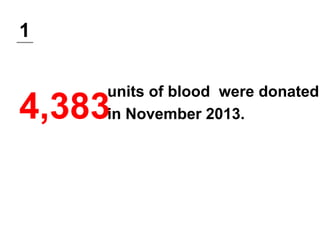
1
units of blood were donated
in November 2013.4,383
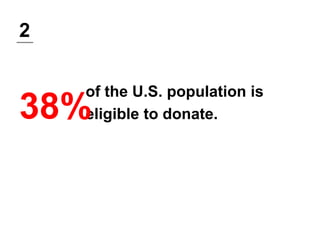
2
of the U.S. population is
eligible to donate.38%
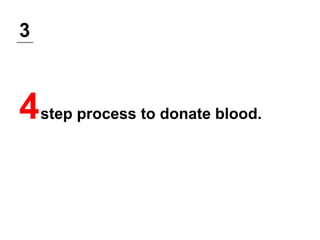
3
4step process to donate blood.
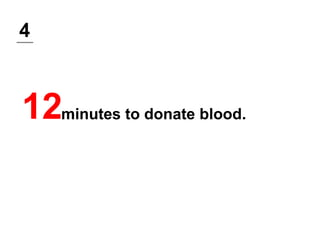
4
12minutes to donate blood.
5
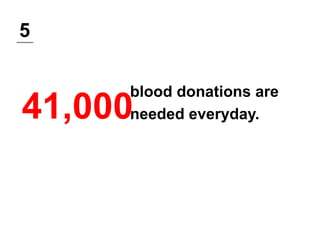
41,000
blood donations are
needed everyday.
6
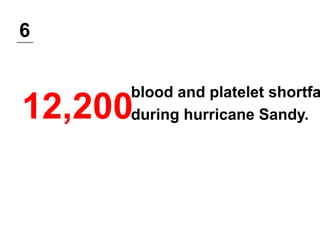
12,200
blood and platelet shortfa
during hurricane Sandy.
7
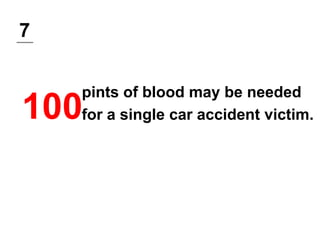
100
pints of blood may be needed
for a single car accident victim.
8
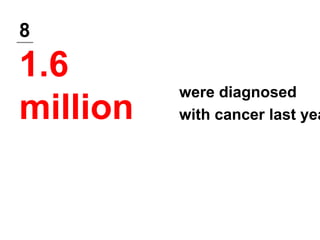
1.6
million
were diagnosed
with cancer last yea
9
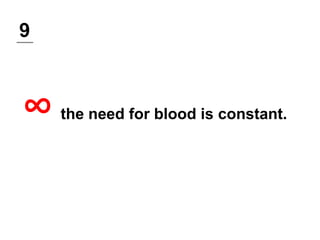
∞ the need for blood is constant.
10
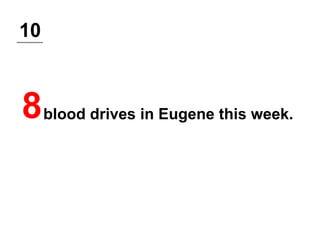
8blood drives in Eugene this week.

Chin Blood Drive

Editor's Notes

  • #2 Slide 1: There are many reasons why every one of you in this room should give blood and in my presentation, I’ll give you 10 numbers that illustrate reasons why. Just curious…how many of you have donated before? How many of you haven’t? 
  • #3 Slide 2: Last November, 4,383 units of blood were donated in the Civil War Blood Drive in campaign in the state of Oregon. This campaign was a four-way collaboration between the American Red Cross, Lane Blood Center, Oregon State Alumni Association, and Oregon Alumni Associations. Thiscampaign is a shared effort every year to increase blood donations as the holiday season approaches because there’s a decline of donations during the winter when families are preoccupied with whatever it may be ranging from family trips to severe weather that forces families to stay off the roads. Whether you’re a Duck or Beaver fan, there’s no score or more gratification than helping the real winners, the hospital patients.
  • #4 Slide 3: This is one of my favorite statistics just because it really puts into perspective how many people actually donate. An estimated 38% of the United States is eligible to donate blood, yet only 10% actually do so each year. Giving blood is the right thing to do. The most cited reason why donors give blood is because they “want to help others.” The top reasons cited by people who are reluctant to give blood are “I never thought about it” and “I don’t like needles.” Along with “I’m too busy” and “others are donating enough.” 
  • #5 Slide 4: If you find yourself using one of the excuses. Rest assured, the blood donation is a quick 4-step process: registration, mini-physical (blood pressure, pulse, temperature, and very small sample of blood), the actual donation, and refreshments at the end.Before you donate, it’s recommended that maintain a healthy iron level by eating red meat, poultry, fish, or spinach. Just to name a few. Get a good nights rest. Drink an extra 16 oz. of waterEat a healthy meal.Wear something comfortable. Preferably a short-sleeved shirt or something that can be rolled up. And of course, a form of ID. 
  • #6 Slide 5: The actual donation process takes about 10 minutes, 12 minutes maximum. The entire process, from the time you arrive to the time you leave, take about an hour and 15 minutes. It’s convenient, easy, and it’s a safe process. Needles may just be a fear in general; sterile needles are used once for each donor then thrown away. All donated blood is tested for HIV, hepatitis B/C, and other diseases before it’s released to hospitals.
  • #7 Slide 6: More than 41,000 blood donations are needed everyday on a nationwide scale.The average adult has about 10 pints of blood in their body and roughly 1 pint is given in one donation. Sometimes blood donation is a one-time thing but a healthy donor can donate red blood cells every 56 days, or double red cells every 112 days.
  • #8 Slide 7: Someone in the U.S. needs blood every two seconds, and as I said before, more than 41,000 blood donations are needed everyday. Patients and others rely on blood and its products during a variety of treatment and this need doesn’t go away when a disaster strikes. Even more is needed. There was a 12,200 blood and platelet shortfall across 14 states during Hurricane Sandy in 2012. On an average day, the American Red Cross will hold around 600 blood drives. Hurricane Sandy caused a cancellation of 300 of them.
  • #9 Slide 8: The need of blood also extends further. In a nationwide study, it was recorded that 100 pints of blood may be needed for a single car accident victim. In a time of need, blood donations give children, a mom or dad, a brother or a sister an additional chance at life. So realistically, you have a chance to become a hero.
  • #10 Slide 9: Extending a bit further, 1.6 million people were diagnosed with cancer last year. Many cancer patients will need blood, and sometimes daily, as they go through chemotherapy treatment. Because blood cannot be manufactured, patients in need rely on donors to help ensure that it’s available.
  • #11 Slide 10: A blood donation is a gift of life and can help save the lives of up to three people per donation, and it’s never too late to donate, as the need for blood is constant. Blood cannot be manufactured – it can only come from generous donors.No matter what type of blood you have, it’s always needed. Only 7% of people in the U.S. have O-negative blood type. O-negative blood type donors are universal donors as their blood can be given to people of all blood types. This is especially important when it’s needed in emergencies before the patient's blood type is known and with newborns who need blood.
  • #12 Slide 11: It’s essential that blood drive efforts are maximized for the American Red Cross and Lane Blood Center to continue to help save lives. 80% of the blood donations given to the Red Cross are collected at mobile blood drives so of which are on our very own campus. In Eugene alone, Lane Blood Center services three area hospitals to collect 80 units of blood every day to meet their needs. There are eight blood drives in Eugene this week and you can find more information at lanebloodcenter.org. Thank you and I hope you are all motivated to give blood!