An Assessment
on
CHILDREN FILMS IN INDIA
1
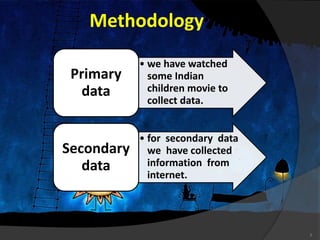
Methodology
2
• we have watched
some Indian
children movie to
collect data.
Primary
data
• for secondary data
we have collected
information from
internet.
Secondary
data
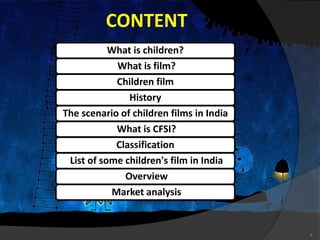
CONTENT
3
What is children?
What is film?
Children film
History
The scenario of children films in India
What is CFSI?
Classification
List of some children's film in India
Overview
Market analysis
WHAT IS CHILDREN ?
 A child (plural: children) is generally a human between the stages
of birth and puberty.
 An immature or irresponsible person.
 A person between birth and full growth;
A young boy or girl.
 A person who has little or no experience in a particular area.
4
Psychological Aspects Of Children
Children are born with certain innate biological dispositions as a
product of long evolutionary history.
This provides an underlying biological framework for what may
fascinate a child and also impose limitations on the same.
These can be seen in certain universal features shared in children's
films.
5
WHAT IS FILM ?
A story or event recorded by a camera as a set of moving images and
shown in a cinema or on television
Films are cultural artifacts created by specific cultures. They reflect
those cultures, and, in turn, affect them. Film is considered to be
an important art form, a source of popular entertainment, and a
powerful medium for educating or indoctrinating citizens
Film is the art of simulating experiences, that communicate ideas,
stories, perceptions, feelings, beauty or atmosphere by the
means of recorded or programmed moving images along with
other sensory stimulations
6
CHILDREN’S FILM
 A children's film or family film is a film genre that contains
children or relates to them in the context of home and family
 Children's films refer to films that are made specifically for
children and not necessarily for the general audience, while
family films are made for a wider appeal with a general audience
in mind.
 Children's films come in several major forms like realism, fantasy,
animation, war, musicals, and literary adaptations
7
HISTORY
The concept of an exclusive cinema for India's children was mooted
by its first Prime Minister Jawaharlal Nehru, and Children's Film
Society, India (CFSI) was founded on 11 May 1955 under the
Ministry of Information and Broadcasting with Hriday Nath
Kunzru as its first president.
The first film produced by CFSI was Jaldeep (1956), an adventure
film directed by Kidar Sharma also starring Mala Sinha.
8
THE SCENARIO OF CHILDREN
FILMS IN INDIA
 For a country rich in both grannies tales and celluloid ventures ,it is a
surprise that India has never had a consistent record when it comes to
films for children. mainstream cinema stretch itself in simultaneously
appealing to every taste bud with the result that niche market, like
those for children, were never on the agenda of most production
houses. the result was that most children films became relegated to a
sidelines or were dependent on state patronage
 However, thanks in part to some visionary directors and CFSI (a
government agency) , Indian film making centered around kids have
produced a few memorable film that would make it to any must –watch
list of Indian cinema
9
WHAT IS CFSI
 Children's Film Society India (CFSI) was founded soon after India's
independence by Pandit Jawahar Lal Nehru, India's first Prime Minister,
whose affection for children is well known. Pandit Nehru established
CFSI with the hope that indigenous and exclusive cinema for children
would stimulate their creativity, compassion and critical thinking.
 CFSI produce, exhibit and distribute quality content for children: from
feature films, shorts, animations to television episodes and
documentaries
 CFSI promotes films that provide healthy and wholesome entertainment
for children to broaden their perspective and encourage them to reflect
on the world aroundCFSI is committed to strengthening the children's
film movement within India and promoting Indian produced children's
films across the globe.
10
CLASSIFICATION
U - Universal UA - Parental Guidance
 Unrestricted Public Exhibition
throughout India, suitable for all
age groups. Films under this
category should not upset
children over 4. Such films may
contain educational, social,
comical or family-oriented
themes. Films under this
category may also contain
fantasy violence, very mild sex
scenes and/or mild bad
language.
 All ages admitted, but it is advised
that children below 12 be
accompanied by a parent as the
theme or content may be
considered intense or inappropriate
for children's. Films under this
category may contain mature
themes, sexual references, mild sex
scenes, violence with brief gory
images and/or infrequent use of
crude language.
11
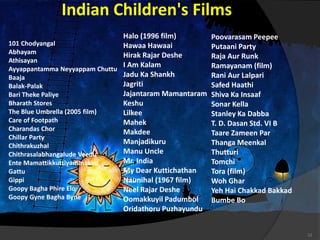
Indian Children's Films
12
101 Chodyangal
Abhayam
Athisayan
Ayyappantamma Neyyappam Chuttu
Baaja
Balak-Palak
Bari Theke Paliye
Bharath Stores
The Blue Umbrella (2005 film)
Care of Footpath
Charandas Chor
Chillar Party
Chithrakuzhal
Chithrasalabhangalude Veedu
Ente Mamattikkuttiyammakku
Gattu
Gippi
Goopy Bagha Phire Elo
Goopy Gyne Bagha Byne
Halo (1996 film)
Hawaa Hawaai
Hirak Rajar Deshe
I Am Kalam
Jadu Ka Shankh
Jagriti
Jajantaram Mamantaram
Keshu
Lilkee
Mahek
Makdee
Manjadikuru
Manu Uncle
Mr. India
My Dear Kuttichathan
Naunihal (1967 film)
Neel Rajar Deshe
Oomakkuyil Padumbol
Oridathoru Puzhayundu
Poovarasam Peepee
Putaani Party
Raja Aur Runk
Ramayanam (film)
Rani Aur Lalpari
Safed Haathi
Shiva Ka Insaaf
Sonar Kella
Stanley Ka Dabba
T. D. Dasan Std. VI B
Taare Zameen Par
Thanga Meenkal
Thutturi
Tomchi
Tora (film)
Woh Ghar
Yeh Hai Chakkad Bakkad
Bumbe Bo
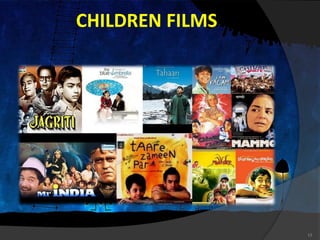
CHILDREN FILMS
13
OVERVIEW
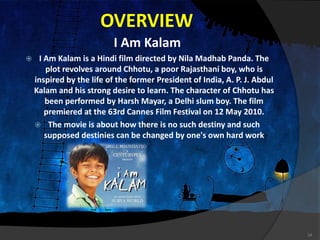
I Am Kalam
 I Am Kalam is a Hindi film directed by Nila Madhab Panda. The
plot revolves around Chhotu, a poor Rajasthani boy, who is
inspired by the life of the former President of India, A. P. J. Abdul
Kalam and his strong desire to learn. The character of Chhotu has
been performed by Harsh Mayar, a Delhi slum boy. The film
premiered at the 63rd Cannes Film Festival on 12 May 2010.
 The movie is about how there is no such destiny and such
supposed destinies can be changed by one's own hard work
14
OVERVIEW
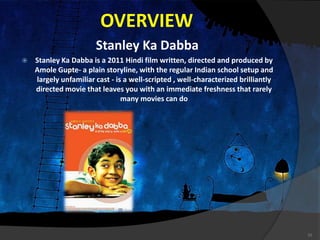
Stanley Ka Dabba
 Stanley Ka Dabba is a 2011 Hindi film written, directed and produced by
Amole Gupte- a plain storyline, with the regular Indian school setup and
largely unfamiliar cast - is a well-scripted , well-characterized brilliantly
directed movie that leaves you with an immediate freshness that rarely
many movies can do
15
OVERVIEW
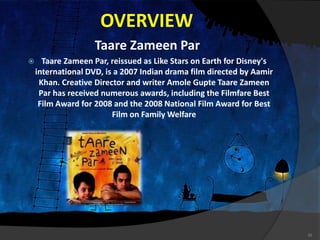
Taare Zameen Par
 Taare Zameen Par, reissued as Like Stars on Earth for Disney's
international DVD, is a 2007 Indian drama film directed by Aamir
Khan. Creative Director and writer Amole Gupte Taare Zameen
Par has received numerous awards, including the Filmfare Best
Film Award for 2008 and the 2008 National Film Award for Best
Film on Family Welfare
16
OVERVIEW
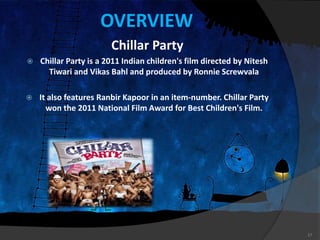
Chillar Party
 Chillar Party is a 2011 Indian children's film directed by Nitesh
Tiwari and Vikas Bahl and produced by Ronnie Screwvala
 It also features Ranbir Kapoor in an item-number. Chillar Party
won the 2011 National Film Award for Best Children's Film.
17
OVERVIEW
Konikar Ramdhenu
Konikar Ramdhenu (Assamese: কণিকাৰ ৰামধেনু) is an Assamese
language film directed by Jahnu Barua. It was released in 2003.
The film was shown in Indian Panorama section of IFFI during
October 2002 in Delhi and Mumbai International Festival in
2003.
It is the last instalment of his trilogy, the other two being Xagoroloi
Bohu Door (1995) and Pokhi (1998). Konikar Ramdhenu depicts
the horrors that happen in a juvenile home
18
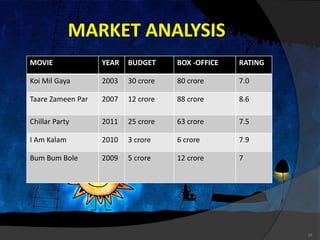
MARKET ANALYSIS
MOVIE YEAR BUDGET BOX -OFFICE RATING
Koi Mil Gaya 2003 30 crore 80 crore 7.0
Taare Zameen Par 2007 12 crore 88 crore 8.6
Chillar Party 2011 25 crore 63 crore 7.5
I Am Kalam 2010 3 crore 6 crore 7.9
Bum Bum Bole 2009 5 crore 12 crore 7
19
CONCLUSION
 We have observed that in India there is a large scope for children
movie. But still we do not have so many children film maker and
directors. Young new comer directors should come forward to
make films in this genre. Not only Children but also adults love to
watch entertaining children movies. Children's can learn so many
good things in an entertaining way and they can increase their
imagination power. In commercial perspective too these kinds of
films are very beneficial . So we should motivate film makers to
make such films by which children's can be influenced in positive
way.
20
BIBLIOGRAPHY
 www.wikipedia.com
 www.imdb.com
 http://cfsindia.org/
 http://timesofindia.indiatimes.com/entertainment/top-
lists/top-10-children%27s-movies-in
 bollywood/videols/26101886.cms
 http://www.conflictfreesourcing.org/
21
22

Children films in india

  • 1.
  • 2.
    Methodology 2 • we havewatched some Indian children movie to collect data. Primary data • for secondary data we have collected information from internet. Secondary data
  • 3.
    CONTENT 3 What is children? Whatis film? Children film History The scenario of children films in India What is CFSI? Classification List of some children's film in India Overview Market analysis
  • 4.
    WHAT IS CHILDREN?  A child (plural: children) is generally a human between the stages of birth and puberty.  An immature or irresponsible person.  A person between birth and full growth; A young boy or girl.  A person who has little or no experience in a particular area. 4
  • 5.
    Psychological Aspects OfChildren Children are born with certain innate biological dispositions as a product of long evolutionary history. This provides an underlying biological framework for what may fascinate a child and also impose limitations on the same. These can be seen in certain universal features shared in children's films. 5
  • 6.
    WHAT IS FILM? A story or event recorded by a camera as a set of moving images and shown in a cinema or on television Films are cultural artifacts created by specific cultures. They reflect those cultures, and, in turn, affect them. Film is considered to be an important art form, a source of popular entertainment, and a powerful medium for educating or indoctrinating citizens Film is the art of simulating experiences, that communicate ideas, stories, perceptions, feelings, beauty or atmosphere by the means of recorded or programmed moving images along with other sensory stimulations 6
  • 7.
    CHILDREN’S FILM  Achildren's film or family film is a film genre that contains children or relates to them in the context of home and family  Children's films refer to films that are made specifically for children and not necessarily for the general audience, while family films are made for a wider appeal with a general audience in mind.  Children's films come in several major forms like realism, fantasy, animation, war, musicals, and literary adaptations 7
  • 8.
    HISTORY The concept ofan exclusive cinema for India's children was mooted by its first Prime Minister Jawaharlal Nehru, and Children's Film Society, India (CFSI) was founded on 11 May 1955 under the Ministry of Information and Broadcasting with Hriday Nath Kunzru as its first president. The first film produced by CFSI was Jaldeep (1956), an adventure film directed by Kidar Sharma also starring Mala Sinha. 8
  • 9.
    THE SCENARIO OFCHILDREN FILMS IN INDIA  For a country rich in both grannies tales and celluloid ventures ,it is a surprise that India has never had a consistent record when it comes to films for children. mainstream cinema stretch itself in simultaneously appealing to every taste bud with the result that niche market, like those for children, were never on the agenda of most production houses. the result was that most children films became relegated to a sidelines or were dependent on state patronage  However, thanks in part to some visionary directors and CFSI (a government agency) , Indian film making centered around kids have produced a few memorable film that would make it to any must –watch list of Indian cinema 9
  • 10.
    WHAT IS CFSI Children's Film Society India (CFSI) was founded soon after India's independence by Pandit Jawahar Lal Nehru, India's first Prime Minister, whose affection for children is well known. Pandit Nehru established CFSI with the hope that indigenous and exclusive cinema for children would stimulate their creativity, compassion and critical thinking.  CFSI produce, exhibit and distribute quality content for children: from feature films, shorts, animations to television episodes and documentaries  CFSI promotes films that provide healthy and wholesome entertainment for children to broaden their perspective and encourage them to reflect on the world aroundCFSI is committed to strengthening the children's film movement within India and promoting Indian produced children's films across the globe. 10
  • 11.
    CLASSIFICATION U - UniversalUA - Parental Guidance  Unrestricted Public Exhibition throughout India, suitable for all age groups. Films under this category should not upset children over 4. Such films may contain educational, social, comical or family-oriented themes. Films under this category may also contain fantasy violence, very mild sex scenes and/or mild bad language.  All ages admitted, but it is advised that children below 12 be accompanied by a parent as the theme or content may be considered intense or inappropriate for children's. Films under this category may contain mature themes, sexual references, mild sex scenes, violence with brief gory images and/or infrequent use of crude language. 11
  • 12.
    Indian Children's Films 12 101Chodyangal Abhayam Athisayan Ayyappantamma Neyyappam Chuttu Baaja Balak-Palak Bari Theke Paliye Bharath Stores The Blue Umbrella (2005 film) Care of Footpath Charandas Chor Chillar Party Chithrakuzhal Chithrasalabhangalude Veedu Ente Mamattikkuttiyammakku Gattu Gippi Goopy Bagha Phire Elo Goopy Gyne Bagha Byne Halo (1996 film) Hawaa Hawaai Hirak Rajar Deshe I Am Kalam Jadu Ka Shankh Jagriti Jajantaram Mamantaram Keshu Lilkee Mahek Makdee Manjadikuru Manu Uncle Mr. India My Dear Kuttichathan Naunihal (1967 film) Neel Rajar Deshe Oomakkuyil Padumbol Oridathoru Puzhayundu Poovarasam Peepee Putaani Party Raja Aur Runk Ramayanam (film) Rani Aur Lalpari Safed Haathi Shiva Ka Insaaf Sonar Kella Stanley Ka Dabba T. D. Dasan Std. VI B Taare Zameen Par Thanga Meenkal Thutturi Tomchi Tora (film) Woh Ghar Yeh Hai Chakkad Bakkad Bumbe Bo
  • 13.
  • 14.
    OVERVIEW I Am Kalam I Am Kalam is a Hindi film directed by Nila Madhab Panda. The plot revolves around Chhotu, a poor Rajasthani boy, who is inspired by the life of the former President of India, A. P. J. Abdul Kalam and his strong desire to learn. The character of Chhotu has been performed by Harsh Mayar, a Delhi slum boy. The film premiered at the 63rd Cannes Film Festival on 12 May 2010.  The movie is about how there is no such destiny and such supposed destinies can be changed by one's own hard work 14
  • 15.
    OVERVIEW Stanley Ka Dabba Stanley Ka Dabba is a 2011 Hindi film written, directed and produced by Amole Gupte- a plain storyline, with the regular Indian school setup and largely unfamiliar cast - is a well-scripted , well-characterized brilliantly directed movie that leaves you with an immediate freshness that rarely many movies can do 15
  • 16.
    OVERVIEW Taare Zameen Par Taare Zameen Par, reissued as Like Stars on Earth for Disney's international DVD, is a 2007 Indian drama film directed by Aamir Khan. Creative Director and writer Amole Gupte Taare Zameen Par has received numerous awards, including the Filmfare Best Film Award for 2008 and the 2008 National Film Award for Best Film on Family Welfare 16
  • 17.
    OVERVIEW Chillar Party  ChillarParty is a 2011 Indian children's film directed by Nitesh Tiwari and Vikas Bahl and produced by Ronnie Screwvala  It also features Ranbir Kapoor in an item-number. Chillar Party won the 2011 National Film Award for Best Children's Film. 17
  • 18.
    OVERVIEW Konikar Ramdhenu Konikar Ramdhenu(Assamese: কণিকাৰ ৰামধেনু) is an Assamese language film directed by Jahnu Barua. It was released in 2003. The film was shown in Indian Panorama section of IFFI during October 2002 in Delhi and Mumbai International Festival in 2003. It is the last instalment of his trilogy, the other two being Xagoroloi Bohu Door (1995) and Pokhi (1998). Konikar Ramdhenu depicts the horrors that happen in a juvenile home 18
  • 19.
    MARKET ANALYSIS MOVIE YEARBUDGET BOX -OFFICE RATING Koi Mil Gaya 2003 30 crore 80 crore 7.0 Taare Zameen Par 2007 12 crore 88 crore 8.6 Chillar Party 2011 25 crore 63 crore 7.5 I Am Kalam 2010 3 crore 6 crore 7.9 Bum Bum Bole 2009 5 crore 12 crore 7 19
  • 20.
    CONCLUSION  We haveobserved that in India there is a large scope for children movie. But still we do not have so many children film maker and directors. Young new comer directors should come forward to make films in this genre. Not only Children but also adults love to watch entertaining children movies. Children's can learn so many good things in an entertaining way and they can increase their imagination power. In commercial perspective too these kinds of films are very beneficial . So we should motivate film makers to make such films by which children's can be influenced in positive way. 20
  • 21.
    BIBLIOGRAPHY  www.wikipedia.com  www.imdb.com http://cfsindia.org/  http://timesofindia.indiatimes.com/entertainment/top- lists/top-10-children%27s-movies-in  bollywood/videols/26101886.cms  http://www.conflictfreesourcing.org/ 21
  • 22.