Child Support Assessments
PARENTS’ INCOME
The child support assessment can be based on
the formula set out in the legislation, or an agreement reached
between the parents.
Formula Assessment
The current formula was introduced on 1 July 2008. It
takes into account many variables including the incomes of each
parent, the number and ages of children, the costs of children,
the level of care each parent provides for the children, and
whether either parent has a legal duty to support any other
children.
The formula consists of three main elements:
1. Parents’ Incomes
2. Costs of Children Table
3. Level of Care
The starting point is each parent’s taxable income for the previous
year, plus other amounts which are automatically included such as:
- Net financial investment losses (eg rental property, shares, managed
investments)
- Reportable fringe benefits
- Foreign income
- Reportable superannuation contributions
- Some tax-free pensions or benefits
- Some payments from the Department of Veteran’s Affairs
PARENTS’ INCOME
The Costs of Children Tables are based on Australian research which
looked at the amount of money spent on raising children in households
with differing levels of income. The Costs of Children Tables are adjusted
each year in accordance with changes in average incomes.
LEVEL OF CARE
The amount of care provided by each parent can be counted as a
contribution to the costs of the children. The level of care is generally
counted in nights. However, a request can be made to determine the level
of care based on hours rather than nights.
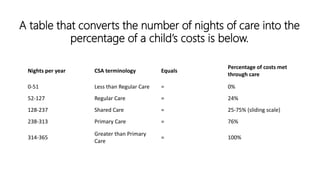
A table that converts the number of nights of care into the
percentage of a child’s costs is below.
Nights per year CSA terminology Equals
Percentage of costs met
through care
0-51 Less than Regular Care = 0%
52-127 Regular Care = 24%
128-237 Shared Care = 25-75% (sliding scale)
238-313 Primary Care = 76%
314-365
Greater than Primary
Care
= 100%
http://www.childsupportconsulting.com.au/our-blog/12-child-
support-assessments
Child
Support
Consulting
http://www.childsupportconsulting.com.au/

Child support assessments

  • 1.
  • 2.
    Child Support Assessments PARENTS’INCOME The child support assessment can be based on the formula set out in the legislation, or an agreement reached between the parents. Formula Assessment The current formula was introduced on 1 July 2008. It takes into account many variables including the incomes of each parent, the number and ages of children, the costs of children, the level of care each parent provides for the children, and whether either parent has a legal duty to support any other children.
  • 3.
    The formula consistsof three main elements: 1. Parents’ Incomes 2. Costs of Children Table 3. Level of Care The starting point is each parent’s taxable income for the previous year, plus other amounts which are automatically included such as: - Net financial investment losses (eg rental property, shares, managed investments) - Reportable fringe benefits - Foreign income - Reportable superannuation contributions - Some tax-free pensions or benefits - Some payments from the Department of Veteran’s Affairs
  • 4.
    PARENTS’ INCOME The Costsof Children Tables are based on Australian research which looked at the amount of money spent on raising children in households with differing levels of income. The Costs of Children Tables are adjusted each year in accordance with changes in average incomes. LEVEL OF CARE The amount of care provided by each parent can be counted as a contribution to the costs of the children. The level of care is generally counted in nights. However, a request can be made to determine the level of care based on hours rather than nights.
  • 5.
    A table thatconverts the number of nights of care into the percentage of a child’s costs is below. Nights per year CSA terminology Equals Percentage of costs met through care 0-51 Less than Regular Care = 0% 52-127 Regular Care = 24% 128-237 Shared Care = 25-75% (sliding scale) 238-313 Primary Care = 76% 314-365 Greater than Primary Care = 100%
  • 6.