1
EMPLOYMENT OF CHILD LABOUR IN
BANGLADESH AND ITS IMPACT
ON EPZs AND NGOs
2
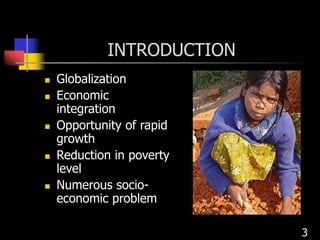
INTRODUCTION
 Globalization
 Economic
integration
 Opportunity of rapid
growth
 Reduction in poverty
level
 Numerous socio-
economic problem
3
HYPOTHESIS
 What is child labour?
 What are the causes of child labour in
Bangladesh?
 What is the key statistics of recent child labour
survey in Bangladesh?
 Is there any national legislation and policies
against child labour?
 What is policy of international labour
organization (ilo) against child labour?
4
HYPOTHESIS
 What are the Rules for child labour in
EPZ?
 What is the Present condition of child
labour in EPZ?
 Do EPZs have Social responsibility against
child labour?
 What are theNGOs movement against
child labour?
 Time bound program to eliminate child
labour
5
RESEARCH METHODOLOGY
 Primary sources
 Secondary sources
6
AIM
TO STUDY THE EMPLOYMENT OF CHILD
LABOUR PROBLEM IN BANGLADESH AND ITS
IMPACT ON EPZs AND NGOs
7
SEQUENCE
 DEFINITION OF CHILD LABOUR
 CAUSES OF CHILD LABOUR
 NTL LEGISLATIONS AND POLICIES AGAINST
CHILD LABOUR
 KEY STATISTICS OF CHILD LABOUR SURVEY
 ANALYSIS IN LIGHT OF STATISTICS
 POLICIES OF DIFFERENT ORG
8
SEQUENCE
 Rules of child labour in EPZ
 Present condition at EPZ
 Social responsibility of EPZ
 Ngos movement against child labour
 A time bound prog to eliminate prob
 Research result
9
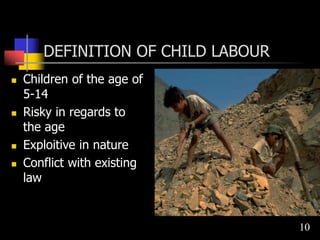
DEFINITION OF CHILD LABOUR
 Children of the age of
5-14
 Risky in regards to
the age
 Exploitive in nature
 Conflict with existing
law
10
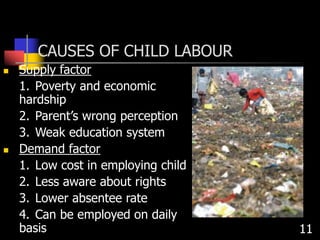
CAUSES OF CHILD LABOUR
 Supply factor
1. Poverty and economic
hardship
2. Parent’s wrong perception
3. Weak education system
 Demand factor
1. Low cost in employing child
2. Less aware about rights
3. Lower absentee rate
4. Can be employed on daily
basis 11
NTL LEGISLATIONS AND POLICIES
 Children’s act 1974
 Children’s rules 1976
 Act discourages occupation of children up
below 14 years of age age at certain works
 Doesn’t purely restricts involvement of child
in all kind of job
12
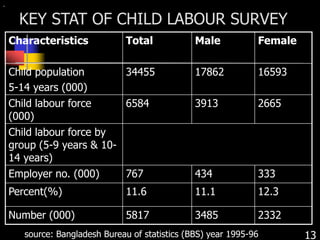
KEY STAT OF CHILD LABOUR SURVEY
Characteristics Total Male Female
Child population
5-14 years (000)
34455 17862 16593
Child labour force
(000)
6584 3913 2665
Child labour force by
group (5-9 years & 10-
14 years)
Employer no. (000) 767 434 333
Percent(%) 11.6 11.1 12.3
Number (000) 5817 3485 2332
source: Bangladesh Bureau of statistics (BBS) year 1995-96 13
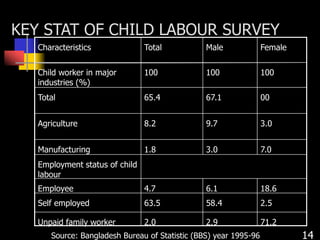
KEY STAT OF CHILD LABOUR SURVEY
Characteristics Total Male Female
Child worker in major
industries (%)
100 100 100
Total 65.4 67.1 00
Agriculture 8.2 9.7 3.0
Manufacturing 1.8 3.0 7.0
Employment status of child
labour
Employee 4.7 6.1 18.6
Self employed 63.5 58.4 2.5
Unpaid family worker 2.0 2.9 71.2
Source: Bangladesh Bureau of Statistic (BBS) year 1995-96 14
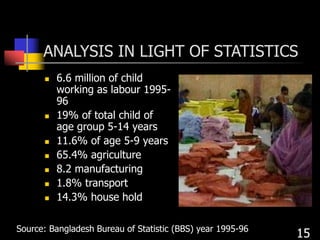
ANALYSIS IN LIGHT OF STATISTICS
 6.6 million of child
working as labour 1995-
96
 19% of total child of
age group 5-14 years
 11.6% of age 5-9 years
 65.4% agriculture
 8.2 manufacturing
 1.8% transport
 14.3% house hold
15
Source: Bangladesh Bureau of Statistic (BBS) year 1995-96
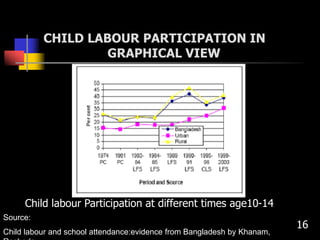
CHILD LABOUR PARTICIPATION IN
GRAPHICAL VIEW
Child labour Participation at different times age10-14
16
Source:
Child labour and school attendance:evidence from Bangladesh by Khanam,
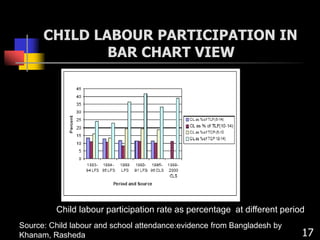
CHILD LABOUR PARTICIPATION IN
BAR CHART VIEW
Child labour participation rate as percentage at different period
17
Source: Child labour and school attendance:evidence from Bangladesh by
Khanam, Rasheda
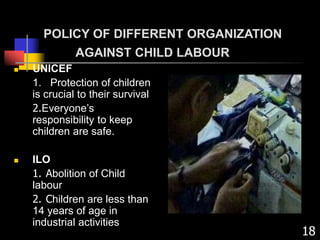
POLICY OF DIFFERENT ORGANIZATION
AGAINST CHILD LABOUR
 UNICEF
1. Protection of children
is crucial to their survival
2.Everyone’s
responsibility to keep
children are safe.
 ILO
1. Abolition of Child
labour
2. Children are less than
14 years of age in
industrial activities
18
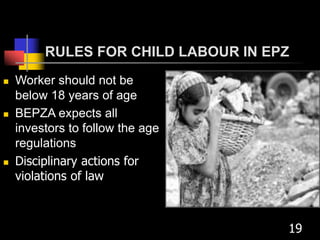
RULES FOR CHILD LABOUR IN EPZ
 Worker should not be
below 18 years of age
 BEPZA expects all
investors to follow the age
regulations
 Disciplinary actions for
violations of law
19
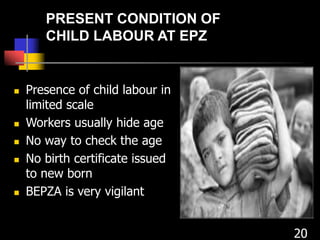
 Presence of child labour in
limited scale
 Workers usually hide age
 No way to check the age
 No birth certificate issued
to new born
 BEPZA is very vigilant
20
PRESENT CONDITION OF
CHILD LABOUR AT EPZ
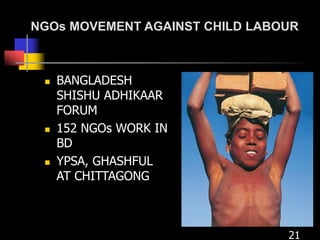
NGOs MOVEMENT AGAINST CHILD LABOUR
 BANGLADESH
SHISHU ADHIKAAR
FORUM
 152 NGOs WORK IN
BD
 YPSA, GHASHFUL
AT CHITTAGONG
21
A TIME BOUND PROGRAM
 Difficult to set time
 General awareness of people
 Govt has to continue with the
incentives for children
22
RESEARCH RESULT
 Existence of child labour in EPZ
 Not in that Extend to be worried
 NGOs are conducting various
Seminars, symposium to create
the general awareness
23
CONCLUSIONS
 Child Labour Is Undoubtedly Due to Poverty
 Parents can’t afford children’s need
 Exploitation of workers
 Low living standard
 Low quality of education
 Lack of legal provisions and its enforcement
24
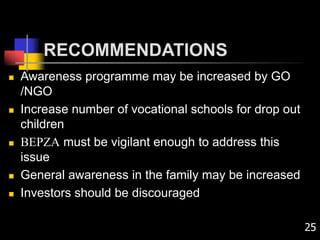
RECOMMENDATIONS
 Awareness programme may be increased by GO
/NGO
 Increase number of vocational schools for drop out
children
 BEPZA must be vigilant enough to address this
issue
 General awareness in the family may be increased
 Investors should be discouraged
25
27

Child Labor and its devastating effects on society

  • 2.
  • 3.
    EMPLOYMENT OF CHILDLABOUR IN BANGLADESH AND ITS IMPACT ON EPZs AND NGOs 2
  • 4.
    INTRODUCTION  Globalization  Economic integration Opportunity of rapid growth  Reduction in poverty level  Numerous socio- economic problem 3
  • 5.
    HYPOTHESIS  What ischild labour?  What are the causes of child labour in Bangladesh?  What is the key statistics of recent child labour survey in Bangladesh?  Is there any national legislation and policies against child labour?  What is policy of international labour organization (ilo) against child labour? 4
  • 6.
    HYPOTHESIS  What arethe Rules for child labour in EPZ?  What is the Present condition of child labour in EPZ?  Do EPZs have Social responsibility against child labour?  What are theNGOs movement against child labour?  Time bound program to eliminate child labour 5
  • 7.
    RESEARCH METHODOLOGY  Primarysources  Secondary sources 6
  • 8.
    AIM TO STUDY THEEMPLOYMENT OF CHILD LABOUR PROBLEM IN BANGLADESH AND ITS IMPACT ON EPZs AND NGOs 7
  • 9.
    SEQUENCE  DEFINITION OFCHILD LABOUR  CAUSES OF CHILD LABOUR  NTL LEGISLATIONS AND POLICIES AGAINST CHILD LABOUR  KEY STATISTICS OF CHILD LABOUR SURVEY  ANALYSIS IN LIGHT OF STATISTICS  POLICIES OF DIFFERENT ORG 8
  • 10.
    SEQUENCE  Rules ofchild labour in EPZ  Present condition at EPZ  Social responsibility of EPZ  Ngos movement against child labour  A time bound prog to eliminate prob  Research result 9
  • 11.
    DEFINITION OF CHILDLABOUR  Children of the age of 5-14  Risky in regards to the age  Exploitive in nature  Conflict with existing law 10
  • 12.
    CAUSES OF CHILDLABOUR  Supply factor 1. Poverty and economic hardship 2. Parent’s wrong perception 3. Weak education system  Demand factor 1. Low cost in employing child 2. Less aware about rights 3. Lower absentee rate 4. Can be employed on daily basis 11
  • 13.
    NTL LEGISLATIONS ANDPOLICIES  Children’s act 1974  Children’s rules 1976  Act discourages occupation of children up below 14 years of age age at certain works  Doesn’t purely restricts involvement of child in all kind of job 12
  • 14.
    KEY STAT OFCHILD LABOUR SURVEY Characteristics Total Male Female Child population 5-14 years (000) 34455 17862 16593 Child labour force (000) 6584 3913 2665 Child labour force by group (5-9 years & 10- 14 years) Employer no. (000) 767 434 333 Percent(%) 11.6 11.1 12.3 Number (000) 5817 3485 2332 source: Bangladesh Bureau of statistics (BBS) year 1995-96 13
  • 15.
    KEY STAT OFCHILD LABOUR SURVEY Characteristics Total Male Female Child worker in major industries (%) 100 100 100 Total 65.4 67.1 00 Agriculture 8.2 9.7 3.0 Manufacturing 1.8 3.0 7.0 Employment status of child labour Employee 4.7 6.1 18.6 Self employed 63.5 58.4 2.5 Unpaid family worker 2.0 2.9 71.2 Source: Bangladesh Bureau of Statistic (BBS) year 1995-96 14
  • 16.
    ANALYSIS IN LIGHTOF STATISTICS  6.6 million of child working as labour 1995- 96  19% of total child of age group 5-14 years  11.6% of age 5-9 years  65.4% agriculture  8.2 manufacturing  1.8% transport  14.3% house hold 15 Source: Bangladesh Bureau of Statistic (BBS) year 1995-96
  • 17.
    CHILD LABOUR PARTICIPATIONIN GRAPHICAL VIEW Child labour Participation at different times age10-14 16 Source: Child labour and school attendance:evidence from Bangladesh by Khanam,
  • 18.
    CHILD LABOUR PARTICIPATIONIN BAR CHART VIEW Child labour participation rate as percentage at different period 17 Source: Child labour and school attendance:evidence from Bangladesh by Khanam, Rasheda
  • 19.
    POLICY OF DIFFERENTORGANIZATION AGAINST CHILD LABOUR  UNICEF 1. Protection of children is crucial to their survival 2.Everyone’s responsibility to keep children are safe.  ILO 1. Abolition of Child labour 2. Children are less than 14 years of age in industrial activities 18
  • 20.
    RULES FOR CHILDLABOUR IN EPZ  Worker should not be below 18 years of age  BEPZA expects all investors to follow the age regulations  Disciplinary actions for violations of law 19
  • 21.
     Presence ofchild labour in limited scale  Workers usually hide age  No way to check the age  No birth certificate issued to new born  BEPZA is very vigilant 20 PRESENT CONDITION OF CHILD LABOUR AT EPZ
  • 22.
    NGOs MOVEMENT AGAINSTCHILD LABOUR  BANGLADESH SHISHU ADHIKAAR FORUM  152 NGOs WORK IN BD  YPSA, GHASHFUL AT CHITTAGONG 21
  • 23.
    A TIME BOUNDPROGRAM  Difficult to set time  General awareness of people  Govt has to continue with the incentives for children 22
  • 24.
    RESEARCH RESULT  Existenceof child labour in EPZ  Not in that Extend to be worried  NGOs are conducting various Seminars, symposium to create the general awareness 23
  • 25.
    CONCLUSIONS  Child LabourIs Undoubtedly Due to Poverty  Parents can’t afford children’s need  Exploitation of workers  Low living standard  Low quality of education  Lack of legal provisions and its enforcement 24
  • 26.
    RECOMMENDATIONS  Awareness programmemay be increased by GO /NGO  Increase number of vocational schools for drop out children  BEPZA must be vigilant enough to address this issue  General awareness in the family may be increased  Investors should be discouraged 25
  • 27.