Introduction
Have you noticedthat today, everyone speaks
about climate change? Learn from this
presentation and be the one who knows best!
Before explaining what climate change is, do
you know the difference between weather
and climate?
3.
The Weather
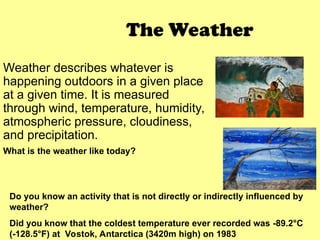
Weather describeswhatever is
happening outdoors in a given place
at a given time. It is measured
through wind, temperature, humidity,
atmospheric pressure, cloudiness,
and precipitation.
What is the weather like today?
Do you know an activity that is not directly or indirectly influenced by
weather?
Did you know that the coldest temperature ever recorded was -89.2°C
(-128.5°F) at Vostok, Antarctica (3420m high) on 1983
4.
The Climate
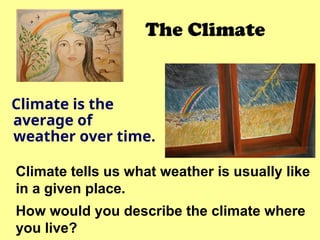
Climate isthe
average of
weather over time.
Climate tells us what weather is usually like
in a given place.
How would you describe the climate where
you live?
5.
What is climate
variability?
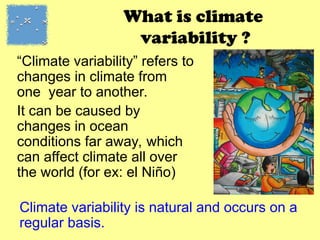
“Climate variability” refers to
changes in climate from
one year to another.
It can be caused by
changes in ocean
conditions far away, which
can affect climate all over
the world (for ex: el Niño)
Climate variability is natural and occurs on a
regular basis.
6.
What is climatechange ?
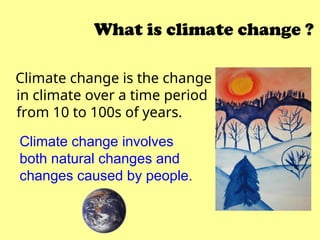
Climate change is the change
in climate over a time period
from 10 to 100s of years.
Climate change involves
both natural changes and
changes caused by people.
7.
Why does ourclimate
change?
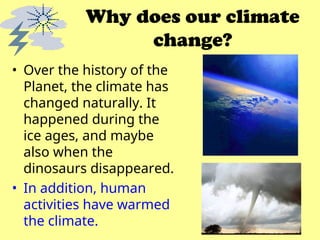
• Over the history of the
Planet, the climate has
changed naturally. It
happened during the
ice ages, and maybe
also when the
dinosaurs disappeared.
• In addition, human
activities have warmed
the climate.
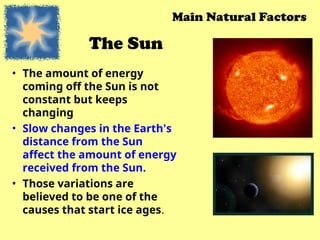
The Sun
• Theamount of energy
coming off the Sun is not
constant but keeps
changing
• Slow changes in the Earth's
distance from the Sun
affect the amount of energy
received from the Sun.
• Those variations are
believed to be one of the
causes that start ice ages.
Main Natural Factors
10.
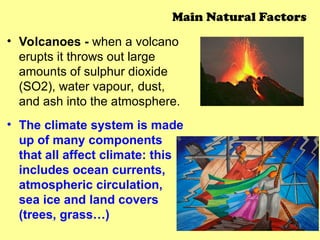
• Volcanoes -when a volcano
erupts it throws out large
amounts of sulphur dioxide
(SO2), water vapour, dust,
and ash into the atmosphere.
• The climate system is made
up of many components
that all affect climate: this
includes ocean currents,
atmospheric circulation,
sea ice and land covers
(trees, grass…)
Main Natural Factors
11.
The Greenhouse Effect
controlsour climate
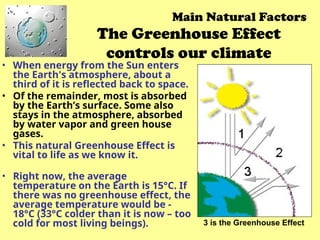
• When energy from the Sun enters
the Earth's atmosphere, about a
third of it is reflected back to space.
• Of the remainder, most is absorbed
by the Earth’s surface. Some also
stays in the atmosphere, absorbed
by water vapor and green house
gases.
• This natural Greenhouse Effect is
vital to life as we know it.
• Right now, the average
temperature on the Earth is 15°C. If
there was no greenhouse effect, the
average temperature would be -
18°C (33°C colder than it is now – too
cold for most living beings).
Main Natural Factors
3 is the Greenhouse Effect
Greenhouse Gases
• Humanactivities send gases (for example
methane, carbon dioxine CO2) into the
athmosphere that enhance the greenhouse effect.
• Many of the gases come from fossil fuels such as
oil, coal and natural gas to run vehicles, and
generate electricity for industries or households.
• When the atmosphere contains too much of those
gases, the whole atmosphere and the Earth
becomes hotter, like it does in a greenhouse. The
atmosphere holds on to too much heat, instead of
letting it escape into space.
Main Human Factors
This causes global warming !
14.
The example ofCO2
• Today there is about 25% more Carbon dioxide (CO2) in
the atmosphere than in 1860. CO2 is the greenhouse gas
that people make the most of. The more CO2 we put into
the air, the more the temperature could rise.
• Two of the biggest sources of CO2 are burning fossil fuels
and cutting down and burning trees.
• Forests are called « carbon sinks » because they take
CO2 from the air and store it. When trees are cut down
and burned, the CO2 that is stored in them is released
back into the air. Scientists believe that every year, 2 to 5
billion tonnes of CO2 are released into the air from forests
being cut down and burned.
Main Human Factors
15.
Aerosols
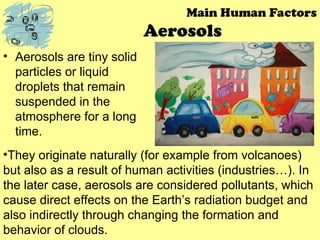
• Aerosols aretiny solid
particles or liquid
droplets that remain
suspended in the
atmosphere for a long
time.
Main Human Factors
•They originate naturally (for example from volcanoes)
but also as a result of human activities (industries…). In
the later case, aerosols are considered pollutants, which
cause direct effects on the Earth’s radiation budget and
also indirectly through changing the formation and
behavior of clouds.
16.
Land Use Change
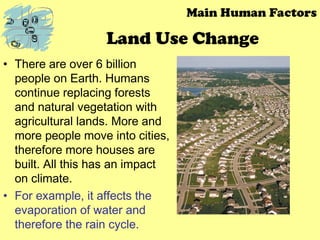
•There are over 6 billion
people on Earth. Humans
continue replacing forests
and natural vegetation with
agricultural lands. More and
more people move into cities,
therefore more houses are
built. All this has an impact
on climate.
• For example, it affects the
evaporation of water and
therefore the rain cycle.
Main Human Factors
17.
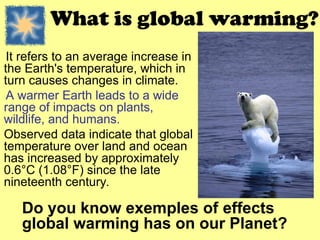
What is globalwarming?
It refers to an average increase in
the Earth's temperature, which in
turn causes changes in climate.
A warmer Earth leads to a wide
range of impacts on plants,
wildlife, and humans.
Observed data indicate that global
temperature over land and ocean
has increased by approximately
0.6°C (1.08°F) since the late
nineteenth century.
Do you know exemples of effects
global warming has on our Planet?
18.
Our future climateaccording to scientists
According to meteorologists and
climatologists (they are the scientists who
study weather and climate), the changing
climate very likely entail more:
•Heat waves
•Heavy rain and snow
•Droughts
•Tropical cyclones
19.
Our future climateaccording to scientists
Rising sea level
Scientists also predict that global warming
will cause the level of water in the oceans
to rise between 15 and 95 cm in the next
100 years, because warmer temperature
will cause sea ice and glaciers to melt,
adding more water to oceans, and because
as water gets warmer, it takes up more
space
20.
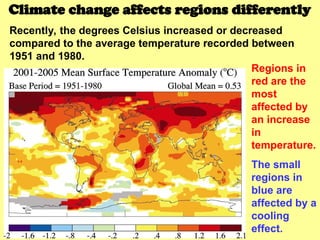
Climate change affectsregions differently
Recently, the degrees Celsius increased or decreased
compared to the average temperature recorded between
1951 and 1980.
Regions in
red are the
most
affected by
an increase
in
temperature.
The small
regions in
blue are
affected by a
cooling
effect.
21.
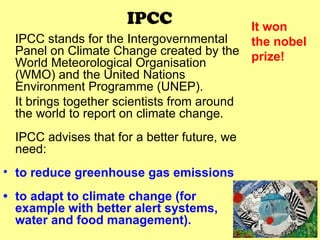
IPCC
IPCC stands forthe Intergovernmental
Panel on Climate Change created by the
World Meteorological Organisation
(WMO) and the United Nations
Environment Programme (UNEP).
It brings together scientists from around
the world to report on climate change.
IPCC advises that for a better future, we
need:
• to reduce greenhouse gas emissions
• to adapt to climate change (for
example with better alert systems,
water and food management).
It won
the nobel
prize!
22.
Through WMO, 188Member countries worldwide produce,
share and improve information on weather, water and
climate, including forecasts and warnings.
WMO organizes training for weather and climate
professionals to bring you reliable and clear information.
The Meteorological and Hydrological Services work
together within WMO to improve the quality and safety of
your life.
23.
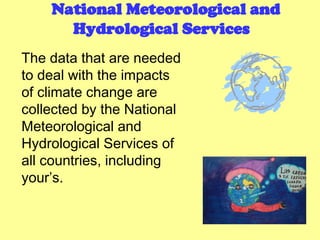
National Meteorological and
HydrologicalServices
The data that are needed
to deal with the impacts
of climate change are
collected by the National
Meteorological and
Hydrological Services of
all countries, including
your’s.
24.
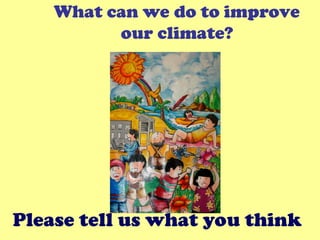
What can wedo to improve
our climate?
Please tell us what you think
25.
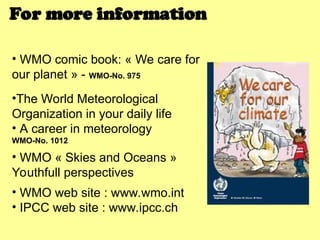
• WMO comicbook: « We care for
our planet » - WMO-No. 975
•The World Meteorological
Organization in your daily life
• A career in meteorology
WMO-No. 1012
• WMO « Skies and Oceans »
Youthfull perspectives
• WMO web site : www.wmo.int
• IPCC web site : www.ipcc.ch
For more information
Editor's Notes
#1 Note:
The arguments presented are interpretations of, or inferences from, some of the findings of the fourth Assessment Report of the WMO/UNEP Intergovernmental Panel on Climate Change, or are based on reports prepared by nations around the world. A comic book, called “We care for our climate” was also prepared by WMO to teach children about climate change.
The designations employed and the presentation of material in this presentation do not imply the expression of any
opinion whatsoever on the part of the Secretariat of the World Meteorological Organization concerning the legal
status of any country, territory, city or area, or of its authorities, or concerning the delimitations of its frontiers or
boundaries.
Target audience: 10 - 14 years old
For more information, contact:
WMO Headquarters, Geneva, Switzerland
Communications and Public Affairs
World Meteorological Organization
7,bis Avenue de la Paix
CH 1211 Genève 2
+41 22730 8314/8317
cpa@wmo.int
#24 www.wwf.fi
Creative Director: Marcelo Coutinho
Art Director: Luiz Risi
Copywriter: Leena Yliportimo
#25 Sources:
WMO comic book: « We care for our planet »
WMO publication : The World Meteorological Organization in your daily life
WMO « Skies and Oceans » Youthful perspectives
WMO web sites (www.wmo.org) and publications
IPCC web site: http://www.ipcc.ch/index.htm
Gaëlle Sévenier, WMO Press Officer, 2009
Young artists from Skies and Oceans:
Wong Yun Qiu
age: 10 years, Country: MALAYSIA
Spela Sebenik
age: 8 years, Country: SLOVENIA
Aisyah Syahirah Mazlan
age: 10 years, Country: MALAYSIA
Vugar Agaev
age: 15 years, Country: AZERBAIJAN
Evgenia Shmeleva
Country: KAZAKHSTAN
Roisin Manning
age: 10 years, Country: UNITED KINGDOM
Miral Ahmed Said
age: 14 years Country: EGYPT



![Climate_Change_&_Its_Impact_PPT[2][2][1][2].pptx](https://cdn.slidesharecdn.com/ss_thumbnails/climatechangeitsimpactppt2212-251010054513-21112abb-thumbnail.jpg?width=640&height=640&fit=bounds)


