Child Development 9th Edition Berk Solutions Manual
Child Development 9th Edition Berk Solutions Manual
Child Development 9th Edition Berk Solutions Manual
Child Development 9th Edition Berk Solutions Manual
Child Development 9th Edition Berk Solutions Manual
1.
Child Development 9thEdition Berk Solutions
Manual download
http://testbankbell.com/product/child-development-9th-edition-
berk-solutions-manual/
Download more testbank from https://testbankbell.com
2.
We believe theseproducts will be a great fit for you. Click
the link to download now, or visit testbankbell.com
to discover even more!
Test Bank for Child Development, 9th Edition : Berk
https://testbankbell.com/product/test-bank-for-child-
development-9th-edition-berk/
Solution Manual for Child Development 9th Edition Laura
E. Berk
https://testbankbell.com/product/solution-manual-for-child-
development-9th-edition-laura-e-berk/
Test Bank for Child Development 9th Edition Laura E.
Berk
https://testbankbell.com/product/test-bank-for-child-
development-9th-edition-laura-e-berk/
Development Through the Lifespan 7th Edition Berk
Solutions Manual
https://testbankbell.com/product/development-through-the-
lifespan-7th-edition-berk-solutions-manual/
3.
Child Development: AnIntroduction, 14th Edition
https://testbankbell.com/product/child-development-an-
introduction-14th-edition/
Corporate Finance Berk 3rd Edition Solutions Manual
https://testbankbell.com/product/corporate-finance-berk-3rd-
edition-solutions-manual/
Development Through the Lifespan 7th Edition Berk Test
Bank
https://testbankbell.com/product/development-through-the-
lifespan-7th-edition-berk-test-bank/
Test Bank for Exploring Lifespan Development, 2nd
Edition: Berk
https://testbankbell.com/product/test-bank-for-exploring-
lifespan-development-2nd-edition-berk/
Development Through the Lifespan Berk 6th Edition Test
Bank
https://testbankbell.com/product/development-through-the-
lifespan-berk-6th-edition-test-bank/
moves are thesame; and as the substance of what is thought is
thought, what is thought is the absolute cause which, itself
unmoved, is identical with the thought which is moved by it; the
separation and the relation are one and the same. The chief moment
in Aristotle’s philosophy is accordingly this, that the energy of
thinking and the object of thought are the same; “for thought is that
which is receptive of objects of perception and the existent. When in
possession of these it is in a condition of activity (ἐνεργεῖ δὲ ἔχων);
and thus all this” operation by which it thinks itself, “is more divine
than the divine possession which thinking reason supposes itself to
have,”—the content of thought. It is not the object of thought that is
the more excellent, but the very energy of thinking; the activity of
apprehension brings that to pass which appears as something that is
being apprehended. “Speculation (ἡ θεωρία) is thus the most
pleasing and the best. If then God has eternally subsisted in such
surpassing excellence as for a limited time pertains to us” (in whom
this eternal Thought, which is God Himself, occurs only as a
particular condition), “He is worthy of admiration; if He possesses it
in a more eminent degree, His nature is still more admirable. But this
is His mode of subsistence. Life is also inherent in Him, for the
activity of thought is life. But He constitutes this efficient power;
essential energy belongs to God as His most excellent and eternal
life. We therefore say that with God there is life perfect and
everlasting.” From this substance Aristotle moreover excludes
magnitude.
We in our way of speaking designate the Absolute, the True, as
the unity of subjectivity and objectivity, which is therefore neither
the one nor the other, and yet just as much the one as the other;
and Aristotle busied himself with these same speculations, the
deepest forms of speculation even of the present day, and he has
expressed them with the greatest definiteness. With Aristotle it is
thus no dry identity of the abstract understanding that is indicated,
for he distinguishes subjective and objective precisely and decisively.
Not dead identity such as this, but energy, is for him what is most to
be reverenced, God. Unity is thus a poor, unphilosophic expression,
32.
and true Philosophyis not the system of identity; its principle is a
unity which is activity, movement, repulsion, and thus, in being
different, is at the same time identical with itself. If Aristotle had
made the jejune identity of understanding, or experience, his
principle, he would never have risen to a speculative Idea like this,
wherein individuality and activity are placed higher than universal
potentiality. Thought, as the object of thought, is nothing else than
the absolute Idea regarded as in itself, the Father; yet this First and
unmoved, as distinguished from activity, is, as absolute, simply
activity, and is first through this activity set forth as true. In what he
teaches respecting the soul we shall find Aristotle recurring to this
speculative thought; but to Aristotle it is again an object, like other
objects, a kind of condition which he separates from the other
conditions of the soul which he understands empirically, such as
sleep, or weariness. He does not say that it alone is truth, that all is
summed up in Thought, but he says it is the first, the strongest, the
most honourable. We, on the other hand, say that Thought, as that
which relates to itself, has existence, or is the truth; that Thought
comprehends the whole of Truth, even, though we ordinarily
represent to ourselves sensation and so on, besides thought, as
having reality. Thus, although Aristotle does not express himself in
modern philosophic language, he has yet throughout the same
fundamental theory; he speaks not of a special kind of reason, but
of the universal Reason. The speculative philosophy of Aristotle
simply means the direction of thought on all kinds of objects, thus
transforming these into thoughts; hence, in being thoughts, they
exist in truth. The meaning of this is not, however, that natural
objects have thus themselves the power of thinking, but as they are
subjectively thought by me, my thought is thus also the Notion of
the thing, which therefore constitutes its absolute substance. But in
Nature the Notion does not exist explicitly as thought in this
freedom, but has flesh and blood, and is oppressed by externalities;
yet this flesh and blood has a soul, and this is its Notion. The
ordinary definition of truth, according to which it is “the harmony of
the conception with the object,” is certainly not borne out by the
conception; for when I represent to myself a house, a beam, and so
33.
on, I amby no means this content, but something entirely different,
and therefore very far from being in harmony with the object of my
conception. It is only in thought that there is present a true harmony
between objective and subjective; that constitutes me. Aristotle
therefore finds himself at the highest standpoint; nothing deeper can
we desire to know, although he has always the appearance of
making ordinary conceptions his starting-point.
Aristotle (Metaph. XII. 9) now solves many other doubtful
questions, for instance, whether thought is compound, and whether
science is the object of science itself. “Some further doubts arise as
to thought (νοῦς), which seems to be of all things the most divine;
but it is only with difficulty that we can conceive under what
conditions (πῶς δ̓ ἔχων) it is a thing of this sort. When it thinks of
nothing, but is in a state like that of a sleeper, what constitutes its
superiority? And when it thinks, but something else is dominant all
the time (ἄλλο κύριον), that which is its substance is not thought
(νόησις), but a potentiality;” it would not be in eternal activity. “In
this way it would not be the highest substance; for it is” (active)
“thought (τὸ νοεῖν) that gives it its high rank. If now, further,
thought or thinking is its substance, what does it think? Itself or
another? And if another, is it always the same, or something
different? Does it also not make a difference, whether it thinks of
what is beautiful or what is casual? In the first place, if thought is
not thinking, but only the power to think, continuous thinking would
be laborious for it,” for every power wears itself out. “In the next
place, something else would be more excellent than thought, namely
that which is thought (νοούμενον); and thinking and thought (τὸ
νοεῖν καὶ ἡ νόησις) will be present to the mind in understanding
what is most inferior. As this is to be avoided (in the same way that
it is better not to see some things than to see them), thinking would
not constitute the best. Thought is therefore this, to think itself,
because it is the most excellent; and it is the thinking, which is the
thinking of thinking. For understanding and sensation and opinion
and deliberation seem always to have an object other than
themselves, and to be their own objects only in a secondary sense.
34.
Further, if thinkingand being thought of are different, in relation to
which of the two is the Good inherent in thought? For the Notion[92]
of thinking and that of the object of thought are not the same. Or, in
the case of some things, does the science itself constitute that which
is the object of science? In what is practical the thing is the
immaterial substance and the determination of the end (ἡ οὐσία καὶ
τὸ τί ἦν εἶναι), and in what is theoretical it is the reason and the
thinking. As therefore thought and the object of thought are not
different, these opposites, so far as they involve no connection with
matter, are the same thing, and there is only a thought of the thing
thought of.” Reason which thinks itself, is the absolute end or the
Good, for it only exists for its own sake. “There still remains a doubt
whether that which thinks is of composite nature or not; for it might
undergo change in the parts of the whole. But the Good is not in this
or that part, for it is the best in the universe, as distinguished from
it. In this way the Thought which is its own object subsists to all
eternity.”
As this speculative Idea, which is the best and most free, is also
to be seen in nature, and not only in thinking reason, Aristotle
(Metaph. XII. 8) in this connection passes on to the visible God,
which is the heavens. God, as living God, is the universe; and thus in
the universe God, as living God, shows Himself forth. He comes forth
as manifesting Himself or as causing motion, and it is in
manifestation alone that the difference between the cause of motion
and that which is moved comes to pass. “The principle and the first
cause of that which is, is itself unmoved, but brings to pass the
original and eternal and single motion,” that is, the heaven of the
fixed stars. “We see that besides the simple revolution of the
universe, which is brought about by the first unmoved substance,
there are other eternal motions, those of the planets.” We must not,
however, enter into further details on this subject.
Regarding the organization of the universe in general, Aristotle
says (Metaph. XII. 10), “We must investigate in what manner the
nature of the whole has within it the Good and the Best; whether as
something set apart and absolute, or as an order, or in both ways, as
35.
in the caseof an army. For the good condition of an army depends
upon the order enforced, as much as on the general, and the
general is the cause of the army’s good condition in all the greater
degree from the fact of the order being through him, and not from
his being through the order. All things are co-ordinated in a certain
way, but not all in the same way: take, for example, animals which
swim, and those which fly, and plants; they are not so constituted
that one of them is not related to another, but they stand in mutual
relations. For all are co-ordinated into one system just as in a house
it is by no means permitted to the free inmates to do freely
whatever they like, but all that they do, or the most of it, is done
according to orderly arrangement. By slaves and animals, on the
contrary, little is done for the general good, but they do much that is
casual. For the principle of each is his own nature. In the same way
it is necessary that all should attain to a position where distinction is
drawn” (the seat of judgment) “but there are some things so
constituted that all participate in them for the formation of a whole.”
Aristotle then goes on to refute some other notions; showing, for
instance, the embarrassments into which they fall who make all
things proceed from oppositions, and he corroborates, on the other
hand, the unity of the principle by quoting Homer’s line (Iliad II.
204):
“It is not good that many govern; let one alone bear rule.”
2. Philosophy of Nature.
Amongst the special sciences treated by Aristotle, the Physics is
contained in a whole series of physical treatises, which form a
tolerably complete system of what constitutes the Philosophy of
Nature in its whole extent. We shall try to give their general plan.
Aristotle’s first work is his Treatise, in eight books, on Physics, or on
the Principles (φυσικὴ ἀκρόασις ἢ περὶ ἀρχῶν). In this he deals, as is
fitting, with the doctrine of the Notion of nature generally, with
movement, and with space and time. The first manifestation of
absolute substance is movement, and its moments are space and
36.
time; this conceptionof its manifestation is the universal, which
realizes itself first in the corporeal world, passing into the principle of
separation. Aristotle’s Physics is what for present physicists would,
properly speaking, be the Metaphysics of Nature; for our physicists
only say what they have seen, what delicate and excellent
instruments they have made, and not what they have thought. This
first work by Aristotle is followed by his treatises concerning the
Heavens, which deal with the nature of body and the first real
bodies, the earth and heavenly bodies in general, as also with the
general abstract relation of bodies to one another through
mechanical weight and lightness, or what we should call attraction;
and finally, with the determination of abstract real bodies or
elements. Then follow the treatises on Production and Destruction,
the physical process of change, while formerly the ideal process of
movement was considered. Besides the physical elements, moments
which are only posited in process, as such, now enter in: for
instance, warmth, cold, &c. Those elements are the real existent
facts, while these determinations are the moments of becoming or
of passing away, which exist only in movement. Then comes the
Meteorology; it represents the universal physical process in its most
real forms. Here particular determinations appear, such as rain, the
saltness of the sea, clouds, dew, hail, snow, hoar-frost, winds,
rainbows, boiling, cooking, roasting, colours, &c. On certain matters,
such as the colours, Aristotle wrote particular treatises. Nothing is
forgotten, and yet the presentation is, on the whole, empiric. The
book On the Universe, which forms the conclusion, is said not to be
genuine; it is a separate dissertation, addressed to Alexander, which
contains in part the doctrine of the universality of things, a doctrine
found already in the other treatises; hence this book does not
belong to this series.
From this point Aristotle proceeds to organic nature, and here his
works not only contain a natural history, but also a physiology and
anatomy. To the anatomy pertain his works on the Locomotion of
Animals, and on the Parts of Animals. He deals with physiology in
the works on the Generation of Animals, on the common Movement
37.
of Animals; andthen he comes to the distinction between Youth and
Age, Sleeping and Waking, and treats of Breathing, Dreaming, the
Shortness and Length of Life, &c., all of which he deals with partly in
an empiric, and partly in a more speculative manner. Finally, there
comes the History of Animals, not merely as a history of Nature, but
also as the history of the animal in its entirety—what we may call a
kind of physiologico-anatomical anatomy. There is likewise a
botanical work On Plants (περὶ φυτῶν) which is ascribed to him.
Thus we here find natural philosophy in the whole extent of its
outward content.
As regards this plan, there is no question that this is not the
necessary order in which natural philosophy or physics must be
treated. It is long since physics adopted in its conception the form
and tendency derived from Aristotle, of deducing the parts of the
science from the whole; and thus even what is not speculative still
retains this connection as far as outward order goes. This is plainly
to be preferred to the arrangement in our modern text-books, which
is a wholly irrational succession of doctrines accidentally put
together, and is undoubtedly more suitable to that method of
contemplating nature, which grasps the sensuous manifestation of
nature quite irrespective of sense or reason. Physics before this
contained some metaphysics, but the experience which was met
with in endeavouring unsuccessfully to work it out, determined the
physicists, so far as possible, to keep it at a distance, and to devote
their attention to what they call experience, for they think that here
they come across genuine truth, unspoiled by thought, fresh from
the hand of nature; it is in their hands and before their faces. They
can certainly not dispense with the Notion, but through a kind of
tacit agreement they allow certain conceptions, such as forces,
subsistence in parts, &c., to be valid, and make use of these without
in the least knowing whether they have truth and how they have
truth. But in regard to the content they express no better the truth
of things, but only the sensuous manifestation. Aristotle and the
ancients understand by physics, on the other hand, the
comprehension of nature—the universal; and for this reason Aristotle
38.
also calls itthe doctrine of principles. For in the manifestation of
nature this distinction between the principle and what follows it,
manifestation, really commences, and it is abrogated only in genuine
speculation. Yet if, on the one hand, what is physical in Aristotle is
mainly philosophic and not experimental, he yet proceeded in his
Physics in what may be called an empiric way. Thus, as it has been
already remarked of the Aristotelian philosophy in general that the
different parts fall into a series of independently determined
conceptions, so we find that this is the case here also; hence an
account can only be given of a part of them. One part is not
universal enough to embrace the other part, for each is
independent. But that which follows, and which has in great
measure reference to what is individual, no longer comes under the
dominion of the Notion, but becomes a superficial suggestion of
reasons, and an explanation from the proximate causes, such as we
find in our physics.
In regard to the general conception of nature, we must say that
Aristotle represents it in the highest and truest manner. For in the
Idea of nature Aristotle (Phys. II. 8) really relies on two
determinations: the conception of end and the conception of
necessity. Aristotle at once grasps the whole matter in its principles,
and this constitutes the old contradiction and divergence of view
existing between necessity (causæ efficientes) and end (causæ
finales), which we have inherited. The first mode of consideration is
that in accordance with external necessity, which is the same as
chance—the conception that all that pertains to nature is determined
from without by means of natural causes. The other mode of
consideration is the teleological, but conformity to end is either
inward or outward, and in the more recent culture the latter has long
retained the supremacy. Thus men vibrate in their opinion between
these two points of view, seek external causes, and war against the
form of an external teleology which places the end outside of nature.
These determinations were known to Aristotle, and he thoroughly
investigates them and considers what they are and mean. Aristotle’s
conception of nature is, however, nobler than that of to-day, for with
39.
him the principalpoint is the determination of end as the inward
determinateness of natural things. Thus he comprehended nature as
life, i.e. as that which has its end within itself, is unity with itself,
which does not pass into another, but, through this principle of
activity, determines changes in conformity with its own content, and
in this way maintains itself therein. In this doctrine Aristotle has
before his eyes the inward immanent end, to which he considers
necessity an external condition. Thus, on the one hand, Aristotle
determines nature as the final cause, which is to be distinguished
from what is luck or chance; it is thus opposed by him to what is
necessary, which it also contains within itself; and then he considers
how necessity is present in natural things. In nature we usually think
of necessity first, and understand as the essentially natural that
which is not determined through end. For long men thought that
they determined nature both philosophically and truly in limiting it to
necessity. But the aspect of nature has had a stigma removed from
it, because, by means of its conformity to the end in view, it is
elevated above the commonplace. The two moments which we have
considered in substance, the active form and matter, correspond
with these two determinations.
We must first consider the conception of adaptation to end as the
ideal moment in substance. Aristotle begins (Phys. II. 8) with the
fact that the natural is the self-maintaining, all that is difficult is its
comprehension. “The first cause of perplexity is, what hinders nature
from not operating for the sake of an end, and because it is better
so to operate, but” being, for example, “like Jupiter, who rains, not
that the corn may grow, but from necessity. The vapour driven
upwards cools, and the water resulting from this cooling falls as rain,
and it happens that the corn is thereby made to grow. In like
manner, if the corn of any one is destroyed, it does not rain for the
sake of this destruction, but this is an accidental circumstance.” That
is to say, there is a necessary connection which, however, is an
external relation, and this is the contingency of the cause as well as
of the effect. “But if this be so,” Aristotle asks, “what hinders us from
assuming that what appears as parts” (the parts of an animal, for
40.
instance) “may thussubsist in nature, too, as contingent? That, for
example, the front teeth are sharp and adapted for dividing, and
that the back teeth, on the contrary, are broad and adapted for
grinding the food in pieces, may be an accidental circumstance, not
necessarily brought about for these particular ends. And the same is
true with respect to the other parts of the body which appear to be
adapted for some end; therefore those living things in which all was
accidentally constituted as if for some end, are now, having once
been so existent, preserved, although originally they had arisen by
chance, in accordance with external necessity.” Aristotle adds that
Empedocles especially had these reflections, and represented the
first beginnings of things as a world composed of all sorts of
monstrosities, such as bulls with human heads; such, however, could
not continue to subsist, but disappeared because they were not
originally constituted so that they should endure; and this went on
until what was in conformity with purpose came together. Without
going back to the fabulous monstrosities of the ancients, we likewise
know of a number of animal tribes which have died out, just
because they could not preserve the race. Thus we also require to
use the expression development (an unthinking evolution), in our
present-day natural philosophy. The conception that the first
productions were, so to speak, attempts, of which those which did
not show themselves to be suitable could not endure, is easily
arrived at by natural philosophy. But nature, as entelecheia or
realization, is what brings forth itself. Aristotle hence replies: “It is
impossible to believe this. For what is produced in accordance with
nature is always, or at least for the most part, produced” (external
universality as the constant recurrence of what has passed away),
“but this is not so with what happens through fortune or through
chance. That in which there is an end (τέλος), equally in its
character as something which precedes and as something which
follows, is made into end; as therefore a thing is made, so is its
nature, and as is its nature, so is it made; it exists therefore for the
sake of this.” The meaning of nature is that as something is, it was
in the beginning; it means this inward universality and adaptation to
end that realizes itself; and thus cause and effect are identical, since
41.
all individual partsare related to this unity of end. “He who assumes
contingent and accidental forms, subverts, on the other hand, both
nature itself and that which subsists from nature, for that subsists
from nature which has a principle within itself, by whose means, and
being continually moved, it attains its end.” In this expression of
Aristotle’s we now find the whole of the true profound Notion of life,
which must be considered as an end in itself—a self-identity that
independently impels itself on, and in its manifestation remains
identical with its Notion: thus it is the self-effectuating Idea. Leaves,
blossoms, roots thus bring the plant into evidence and go back into
it; and that which they bring to pass is already present in the seed
from which they took their origin. The chemical product, on the
contrary, does not appear to have itself similarly present, for from
acid and base a third appears to come forth; but here, likewise, the
essence of both these sides, their relationship, is already present,
though it is there mere potentiality, as it is in the product merely a
thing. But the self-maintaining activity of life really brings forth this
unity in all relationships. What has here been said is already
contained in that which was asserted by those who do not represent
nature in this way, but say, “that which is constituted as though it
were constituted for an end, will endure.” For this is the self-
productive action of nature. In the modern way of looking at life this
conception becomes lost in two different ways; either through a
mechanical philosophy, in which we always find as principle
pressure, impulse, chemical relationships and forces, or external
relations generally—which certainly seem to be inherent in nature,
but not to proceed from the nature of the body, seeing that they are
an added, foreign appendage, such as colour in a fluid; or else
theological physics maintain the thoughts of an understanding
outside of the world to be the causes. In the Kantian philosophy we
for the first time have that conception once more awakened in us,
for organic nature at least; life has there been made an end to itself.
In Kant this indeed had only the subjective form which constitutes
the essence of the Kantian philosophy, in which it seems as though
life were only so determined by reason of our subjective reasoning;
but still the whole truth is there contained that the organic creation
42.
is the self-maintaining.The fact that most recent times have brought
back the rational view of the matter into our remembrance, is thus
none else than a justification of the Aristotelian Idea.
Aristotle also speaks of the end which is represented by organic
nature in itself, in relation to the means, of which he says (Phys. II.
8): “If the swallow builds her nest, and the spider spreads her web,
and trees root themselves in the earth, for the sake of nutriment,
there is present in them a self-maintaining cause of this kind, or an
end.” For this instinctive action exhibits an operation of self-
preservation, as a means whereby natural existence becomes shut
up and reflected into itself. Aristotle then brings what is here said
into relation with general conceptions which he had earlier
maintained (p. 138): “Since nature is twofold as matter and form,
but since the latter is end, and the rest are on account of the end,
this is final cause.” For the active form has a content, which, as
content of potentiality, contains the means which make their
appearance as adapted for an end, i.e. as moments established
through the determinate Notion. However much we may, in the
modern way of regarding things, struggle against the idea of an
immanent end, from reluctance to accept it, we must, in the case of
animals and plants, acknowledge such a conception, always re-
establishing itself in another. For example, because the animal lives
in water or in air, it is so constructed that it can maintain its
existence in air or water; thus it requires water to explain the gills of
fishes; and, on the other hand, because the animal is so
constructed, it lives in water. This activity in transformation thus
does not depend in a contingent way on life; it is aroused through
the outward powers, but only in as far as conformity with the soul of
the animal permits.
In passing, Aristotle here (Phys. II. 8) makes a comparison
between nature and art, which also connects what results with what
goes before, in accordance with ends. “Nature may commit an error
as well as art; for as a grammarian sometimes makes a mistake in
writing, and a physician in mixing a medicinal draught, nature, too,
sometimes does not attain its ends. Its errors are monstrosities and
43.
deformities, which, however,are only the errors of that which
operates for an end. In the production of animals and plants, an
animal is not at first produced, but the seed, and even in it
corruption is possible.” For the seed is the mean, as being the not as
yet established, independent, indifferent, free actuality. In this
comparison of nature with art we ordinarily have before us the
external adaptation to end, the teleological point of view, the making
for definite ends. And Aristotle declaims against this, while he
remarks that if nature is activity for a certain end, or if it is the
implicitly universal, “it is absurd to deny that action is in conformity
with end, because that which moves cannot be seen to have
deliberated and considered.” The understanding comes forward with
the determination of this end, and with its instruments and tools, to
operate on matter, and we carry this conception of an external
teleology over into nature. “But art also,” says Aristotle, “does not
deliberate. If the form of a ship were the particular inward principle
of the timber, it would act as nature prompted. The action of nature
is very similar to the exercise of the art whereby anyone heals
himself.” Through an inward instinct the animal avoids what is evil,
and does what is good for him; health is thus essentially present to
him, not as a conscious end, but as an understanding which
accomplishes its ends without conscious thought.
As Aristotle has hitherto combated an external teleology, he
directs another equally applicable remark (Phys. II. 9) against
merely external necessity, and thus we come to the other side, or to
how necessity exists in nature. He says in this regard: “Men fancy
that necessity exists in this way in generation, just as if it were
thought that a house existed from necessity, because heavy things
were naturally carried downwards, and light things upwards, and
that, therefore, the stones and foundation, on account of their
weight, were under the earth, and the earth, because it was lighter,
was further up, and the wood in the highest place because it is the
lightest.” But Aristotle thus explains the facts of the case. “The house
is certainly not made without these materials, but not on account of,
or through them (unless the material so demands), but it is made for
44.
the sake ofconcealing and preserving certain things. The same
takes place in everything which has an end in itself; for it is not
without that which is necessary to its nature, and yet it is not on
account of this, unless the matter so demands, but on account of an
end. Hence the necessary is from hypothesis only, and not as end,
for necessity is in matter, but end is in reason (λόγῳ). Thus it is clear
that matter and its movement are necessity in natural things; both
have to be set forth as principle, but end is the higher principle.” It
undoubtedly requires necessity, but it retains it in its own power,
does not allow it to give vent to itself, but controls external
necessity. The principle of matter is thus turned into the truly active
ground of end, which means the overthrow of necessity, so that that
which is natural shall maintain itself in the end. Necessity is the
objective manifestation of the action of its moments as separated,
just as in chemistry the essential reality of both the extremes—the
base and the acid—is the necessity of their relation.
This is the main conception of Aristotelian Physics. Its further
development concerns the conceptions of the different objects of
nature, a material for speculative philosophy which we have spoken
of above (pp. 153-155), and regarding which Aristotle puts before us
reflections both difficult and profound. Thus he at first (Phys. III. 1-
3) proceeds from this point to movement (κίνησις), and says that it
is essential that a philosophy of nature should speak of it, but that it
is difficult to grasp; in fact, it is one of the most difficult conceptions.
Aristotle thus sets to work to understand movement in general, not
merely in space and time, but also in its reality; and in this sense he
calls it “the activity of an existent thing which is in capacity, so far as
it is in capacity.” He explains this thus: “Brass is in capacity a statue;
yet the motion to become a statue is not a motion of the brass so far
as it is brass, but a motion of itself, as the capacity to become a
statue. Hence this activity is an imperfect one (ἀτελής),” i.e. it has
not its end within itself, “for mere capacity, whose activity is
movement, is imperfect.” The absolute substance, the moving
immovable, the existent ground of heaven which we saw as end, is,
on the contrary, both activity itself and the content and object of
45.
activity. But Aristotledistinguishes from this what falls under the
form of this opposition, “That moving is also moved which has
movement as a capacity, and whose immobility is rest. That in which
movement is present has immobility as rest; for activity in rest, as
such, is movement.” That is to say, rest is capacity for motion.
“Hence movement is the activity of that which is movable (κινητοῦ),
[93] so far as it is movable; but this happens from the contact of that
which is motive (κινητικοῦ), so that at the same time it is posited as
passive likewise. But that which moves always introduces a certain
form or end (εἶδος), either this particular thing (τόδε), or a quality or
a quantity, which is the principle and cause of the motion when it
moves; thus man, as he is in energy, makes man from man as he is
in capacity. Thus, too, it is evident that movement is in the movable
thing: for it is the activity of this, and is derived from that which is
motive. The activity of that which is motive is likewise not different,
for both are necessarily activity. It is motive because it has the
capacity for being so; but it causes motion because it energizes. But
it is the energetic of the moveable (ἔστιν ἐνεργητικὸν τοῦ κινετοῦ),
so that there is one energy of both; just as the relation between one
and two is the same as that between two and one, and there also is
the same relation between acclivity and declivity, so the way from
Thebes to Athens is the same as from Athens to Thebes. Activity and
passivity are not originally (κυρίως) the same, but in what they are
inherent, in motion, they are the same. In Being (τῷ εἶναι) they are
identical, but activity, in so far as it is activity of this in this” (what is
moved), “and the activity of this from this” (what moves), “is
different as regards its conception (τῷ λόγῳ).” Aristotle subsequently
deals with the infinite (Phys. III. 4-8).
“In like manner it is necessary,” says Aristotle (Phys. IV. 1-5),
“that the natural philosopher should consider the subject of place
(τόπος).” Here come various definitions and determinations under
which space generally and particular space or place appear. “Is place
a body? It cannot be a body, for then there would be in one and the
same, two bodies. Again, if it is the place and receptacle (χώρα) of
this body, it is evident that it is so also of the superficies and the
46.
remaining boundaries; butthe same reasoning applies to these, for
where the superficies of water were before, there will now be the
superficies of air,” and thus the places of both superficies would be in
one. “But in truth there is no difference between the point and the
place of the point, so that if place is not different from the other
forms of limitation, neither is it something outside of them. It is not
an element, and neither consists of corporeal nor of incorporeal
elements, for it possesses magnitude, but not body. The elements of
bodies are, however, themselves bodies, and no magnitude is
produced from intelligible elements. Place is not the material of
things, for nothing consists of it—neither the form, nor the Notion,
nor the end, nor the moving cause; and yet it is something.”
Aristotle now determines place as the first unmoved limit of that
which is the comprehending: it comprehends the body whose place
it is, and has nothing of the thing in itself; yet it co-exists with the
thing, because the limits and the limited co-exist. The uttermost
ends of what comprehends and of what is comprehended are
identical, for both are bounds; but they are not bounds of the same,
for form is the boundary of the thing, place is that of the embracing
body. Place, as the comprehending, remains unchangeably passive
while the thing which is moved is moved away; from which we see
that place must be separable from the thing. Or place, according to
Aristotle, is the boundary, the negation of a body, the assertion of
difference, of discretion; but it likewise does not merely belong to
this body, but also to that which comprehends. There is thus no
difference at all, but unchangeable continuity. “Place is neither the
universal (κοινός) in which all bodies are” (heaven), “nor the
particular (ἴδιος), in which they are as the first (πρώτῳ).” Aristotle
also speaks of above and below in space, in relation to heaven as
that which contains, and earth as what is beneath. “That body,
outside of which is a comprehending body, is in space. But the whole
heavens are not anywhere, since no body comprehends them.
Outside the universe nothing is, and hence everything is in the
heavens, for the heavens are the whole. Place, however, is not the
heavens, but its external quiescent boundary which touches the
47.
body moved. Hencethe earth is in water, water in air, air in ether,
but ether in the heavens.”
From this point Aristotle goes on (Phys. IV. 6, 7) to empty space,
in which an old question is involved which physicists even now
cannot explain: they could do so if they studied Aristotle, but as far
as they are concerned there might have been no thought nor
Aristotle in the world. “Vacuum, according to ordinary ideas, is a
space in which there is no body, and, fancying that all Being is body,
they say that vacuum is that in which there is nothing at all. The
conception of a vacuum has its justification for one thing in the fact
that a vacuum,” the negative to an existent form, “is essential to
motion; for a body could not move in a plenum,” and in the place to
which it does move there must be nothing. “The other argument in
favour of a vacuum is found in the compression of bodies, in which
the parts press into the empty spaces.” This is the conception of
varying density and the alteration of the same, in accordance with
which an equal weight might consist of an equal number of parts,
but these, as being separated by vacuum, might present a greater
volume. Aristotle confutes these reasonings most adroitly, and first
of all in this way; “The plenum could be changed, and bodies could
yield to one another even if no interval of vacuum separated them.
Liquids as well as solids are not condensed into a vacuum;
something that they contained is expelled, just as air is expelled if
water is compressed.”
Aristotle deals more thoroughly, in the first place (Phys. IV. 8),
with the erroneous conception that the vacuum is the cause of
movement. For, on the one hand, he shows that the vacuum really
abolishes motion, and consequently in vacuum a universal rest
would reign. He calls it perfect indifference as to the greater or less
distance to which a thing is moved; in vacuum there are no
distinctions. It is pure negation without object or difference; there is
no reason for standing still or going on. But body is in movement,
and that, indeed, as distinguished; it has a positive relation, and not
one merely to nothing. On the other hand, Aristotle refutes the idea
that movement is in vacuum because compression is possible. But
48.
this does nothappen in a vacuum; there would be established in it
not one movement, but a movement towards all sides, a general
annihilation, an absolute yielding, where no cohesion would remain
in the body. “Again, a weight or a body is borne along more swiftly
or more slowly from two causes; either because there is a difference
in that through which it is borne along, as when it moves through air
or water or earth, or because that which is borne along differs
through excess of weight or lightness.” As regards difference of
movement on account of the first difference—that in the density of
the medium—Aristotle says: “The medium through which the body is
borne along is the cause of the resistance encountered, which is
greater if the medium is moving in a contrary direction (and less if it
is at rest); resistance is increased also if the medium is not easily
divided. The difference in velocity is in inverse ratio to the specific
gravity of the medium, air and water, so that if the medium has only
half the density, the rate of progress will be double as quick. But
vacuum has to body no such relation of differences of specific
gravity. Body can no more contain a vacuum within its dimensions
than a line can contain a point, unless the line were composed of
points. The vacuum has no ratio to the plenum.” But as to the other
case, the difference in weight and lightness, which has to be
considered as being in bodies themselves, whereby one moves more
quickly than another through the same space: “this distinction exists
only in the plenum, for the heavy body, by reason of its power,
divides the plenum more quickly.” This point of view is quite correct,
and it is mainly directed against a number of conceptions that
prevail in our physics. The conception of equal movement of the
heavy and the light, as that of pure weight, pure matter, is an
abstraction, being taken as though they were inherently like, only
differing through the accidental resistance of the air.
Aristotle (Phys. IV. 9) now comes to the second point, to the
proof of the vacuum because of the difference in specific gravity.
“Many believe that the vacuum exists because of the rare and the
dense;” the former is said to be a rare body, and the latter a perfect
continuity; or they at least differ quantitatively from one another
49.
through greater orless density. “For if air should be generated from
a quantity of water, a given quantity of water must produce a
quantity of air the same in bulk, or there must necessarily be a
vacuum; for it is only on the hypothesis of a vacuum that
compression and rarefaction are explicable. Now if, as they say, the
less dense were that which has many separate void spaces, it is
evident that since a vacuum cannot be separated any more than a
space can have intervals, neither can the rare subsist in this manner.
But if it is not separable, and yet a vacuum is said to exist in the
body, in the first place movement could thus only be upwards; for
the rare is the light, and hence they say that fire is rare,” because it
always moves upwards. “In the next place the vacuum cannot be the
cause of motion as that in which something moves, but must
resemble bladders that carry up that which adheres to them. But
how is it possible that a vacuum can move, or that there can be a
place where there is a vacuum? For that into which it is carried
would be the vacuum of a vacuum. In short, as there can be no
movement in vacuum, so also a vacuum cannot move.” Aristotle set
against these ideas the true state of matters, and states generally
the ideal conception of nature: “that the opposites, hot and cold,
and the other physical contraries, have one and the same matter,
and that from what is in capacity that which is in energy is
produced; that matter is not separable though it is different in
essence[94] (τῷ εἶναι), and that it remains one and the same in
number (ἀριθμῷ) even if it possesses colour, or is hot and cold. And
again, the matter of a small body and a large is the same, because
at one time a greater proceeds from a smaller, and at another time a
smaller from a greater. If air is generated from water it is expanded,
but the matter remains the same and without taking to itself
anything else; for that which it was in capacity it becomes in
actuality. In a similar way if air is compressed from a greater into a
less volume, the process will be reversed, and air will similarly pass
into water, because the matter which is in capacity both air and
water, also becomes both.” Aristotle likewise asserts that increase
and decrease of warmth, and its transition into cold, is no addition or
50.
otherwise of warmmatter, and also one and the same is both dense
and rare. This is very different from the physical conceptions which
assert more or less matter to correspond with more or less density,
thus comprehending the difference in specific weight as the external
addition of matter. Aristotle, on the contrary, takes this dynamically,
though certainly not in the sense in which dynamics are to-day
understood, viz. as an increase of intensity or as a degree, for he
accepts intensity in its truth as universal capacity. Undoubtedly the
difference must also be taken as a difference in amount, but not as
an increase and decrease, or as an alteration in the absolute
quantity of the matter. For here intensity means force, but again not
as being a thing of thought separated from matter, but as indicating
that if anything has become more intensive, it has had its actuality
diminished, having, however, according to Aristotle, attained to a
greater capacity. If the intensity is again directed outwards, and
compared with other things, it undoubtedly becomes degree, and
therefore magnitude immediately enters in. It then is indifferent
whether greater intension or greater extension is posited; more air is
capable of being warmed to the same degree as less, through the
greater intensity of the warmth; or the same air can thereby become
intensively warmer.
As regards the investigation of time, Aristotle remarks (Phys. IV.
10, 11, 13) that if time is externally (exoterically, ἐξωτερικῶς)
regarded, we are inevitably led to doubt (διαπορῆσαι) whether it has
any being whatever, or whether it has bare existence, as feeble
(μόλις καὶ ἀμυδρῶς) as if it were only a potentiality. “For one part of
it was and is not: another part will be and is not as yet; but of these
parts infinite and everlasting (ἀεὶ λαμβανόμενος), time is composed.
But it now appears that time, if composed of things that are not,
may be incapable of existence. And also as regards everything
divisible, if it exists, either some or all of its parts must be. Time is
certainly divisible; but some of the parts are past, others are future,
and no part is present. For the now is no part, since a part has a
measure, and the whole must consist of the parts; but time does not
appear to consist of the Now.” That is to say, because the Now is
51.
indivisible, it hasno quantitative determination which could be
measured. “Besides it is not easy to decide whether the Now
remains, or always becomes another and another. Again, time is not
a movement and change, for movement and change occur in that
which is moved and changed, or accompany time in its course; but
time is everywhere alike. Besides change is swifter and slower, but
time is not. But it is not without change and motion” (which is just
the moment of pure negativity in the same) “for when we perceive
no change, it appears as if no time had elapsed, as in sleep. Time is
hence in motion but not motion itself.” Aristotle defines it thus: “We
say that time is, when we perceive the before and after in
movement; but these are so distinguished that we apprehend them
to be another and another, and conceive that there is something
between, as a middle. Now when we understand that the extremes
of the conclusion are different from the middle, and the soul says
that the Now has two instants, the one prior and the other posterior,
then we say that this is time. What is determined through the Now,
we call time, and this is the fundamental principle. But when we are
sensible of the Now as one, and not as a prior and posterior in
motion, nor as the identity of an earlier or later, then there does not
appear to us to have been any time, because neither was there any
motion.” Tedium is thus ever the same. “Time is hence the number
of motion, according to priority and posteriority; it is not motion
itself, unless so far as motion has number. We judge of the more or
less through number, but of a greater or less motion by time. But we
call number that which can be numbered, as well as that with which
we number; but time is not the number with which we number, but
that which is numbered, and, like motion, always is changing. The
Now is, which is the unity of number, and it measures time. The
whole of time is the same, for the Now which was is the same”
(universality as the Now destroyed) “but in Being it is another. Time
thus is through the Now both continuous (συνεχής) and discrete
(διῇρηται). It thereby resembles the point, for that also is the
continuity of the line and its division, its principle and limit; but the
Now is not an enduring point. As continuity of time the Now
connects the past and the future, but it likewise divides time in

![Copyright © 2013 Pearson Education, Inc. All Rights Reserved. 35
35 Copyright © 2013 Pearson Education, Inc. All Rights Reserved.
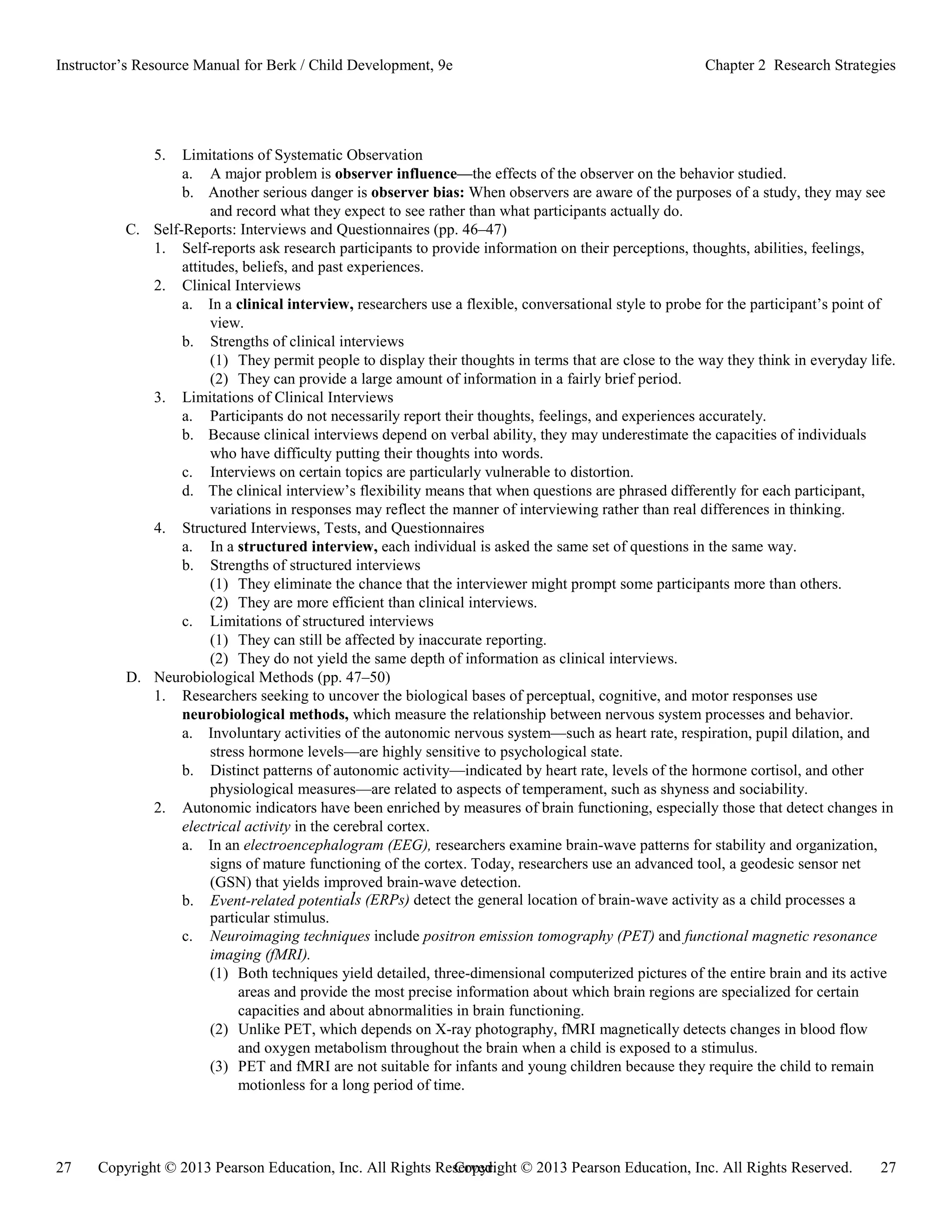
Instructor’s Resource Manual for Berk / Child Development, 9e Chapter 2 Research Strategies
past two months (so children were likely to recall them), such as a trip to a museum or an amusement park. Mothers were asked
to talk about one event that was emotionally positive for the child, and one was that emotionally negative. At the end of the
home visit, a researcher conducted a short interview with each child to assess various aspects of self-concept (personal
qualities, attributes, and beliefs). The purpose of the interview was to determine whether maternal reminiscing style also
predicted self-concept in young children.
Following the mother–child conversation, the researcher again played with the child, telling him or her, “Your mom just
told me that . . . (for example, you went to the museum last weekend). I’ve never been there before. Tell me what you did.” To
elicit details, the researcher used prompts like, “What else happened?” “Can you tell me more about it?” To assess various
aspects of self-concept, the researcher conducted a short self-description interview with each child. She explained to the child,
“I would like to write a story about you. What’s the first thing I should put in the story?” She then used prompts as needed, such
as “What else should I write about you?” Finally, mothers completed questionnaires about their child’s self-concept and
language development.
Home visits were video recorded for later coding. Mothers’ utterances during the mother–child conversation were coded as
elaborations or evaluations. Elaborations included introducing a topic for discussion or adding information. Evaluations
included confirming, negating, questioning, or emphasizing any part of the child’s previous statement. Children’s utterances
were coded as shared memory reports whenever they requested more information or provided new information about the event.
When recounting past events to the researcher, children’s utterances were coded as independent memory reports whenever they
provided new information that was not discussed in the mother–child conversation.
Results indicated that European-American mothers used more elaborations and evaluations with their children than
Chinese and Chinese-immigrant mothers. European-American children, in turn, demonstrated greater recall when sharing
memories with their mothers and with the researcher than Chinese and Chinese-immigrant children. Regardless of cultural
background, children whose mothers were more elaborative and evaluative recalled more information than children whose
mothers were less elaborative and evaluative. European-American children also provided more specific information about
themselves in their personal narratives—that is, included more personal qualities, attributes, and beliefs—than either group of
Chinese children. Although there were no cultural differences in proportion of favorable attributes or beliefs children included
in their self-concepts, once again European-American children (who were more likely to have elaborative-style mothers)
provided more details about themselves compared with their Chinese counterparts.
Have students review the text discussion on individualistic and collectivist societies (Chapter 1, p. 35). How might
these cultural orientations explain differences in mother–child conversations?
Wang, Q. (2008). Relations of maternal style and child self-concept to autobiographical memories in Chinese, Chinese
Immigrant, and European American 3-year-olds. Child Development, 77, 1749–1809.
LECTURE ENHANCEMENT 2.2
Demonstrating the Correlational Design: Parents’ Management of Their Teenagers’ Romantic Relationships
(pp. 55–56)
Time: 10–15 minutes
Objective: To illustrate the correlational design using a study of parents’ management of their teenagers’ romantic
relationships.
To extend existing research on dating in late adolescence, Madsen (2008) recruited 104 adolescents between the ages of 17 and
19 (29 boys, 75 girls) and at least one of their parents. The majority of the participants were from middle-SES families. The
researchers collected the following information:
(1) Parents completed the Parents of Adolescents Separation Anxiety Scale (PASAC). The PASAC assesses adults’
comfort with their parenting role. For example, on a scale of 1 to 5 (1 = strongly disagree; 5 = strongly agree), “I
like knowing that my teenager will come to me when he/she feels upset.”
(2) Participants reported on their parents’ use of psychological control. For example, on a scale of 1 to 3 (1 = not like
him/her; 3 = a lot like him/her), “My mother [father] is a person who is always trying to change how I feel or
think about things.”
(3) Participants completed the Network of Relationship Inventory (NRI), which measures various aspects of romantic
relationships—satisfaction, intimacy, affection, admiration, conflict, and antagonism. Sample questions include:
On a scale of 1 to 5 (1 = little or none; 5 = the most),](https://image.slidesharecdn.com/7159-250420131251-82909281/75/Child-Development-9th-Edition-Berk-Solutions-Manual-16-2048.jpg)





![Further, if thinking and being thought of are different, in relation to
which of the two is the Good inherent in thought? For the Notion[92]
of thinking and that of the object of thought are not the same. Or, in
the case of some things, does the science itself constitute that which
is the object of science? In what is practical the thing is the
immaterial substance and the determination of the end (ἡ οὐσία καὶ
τὸ τί ἦν εἶναι), and in what is theoretical it is the reason and the
thinking. As therefore thought and the object of thought are not
different, these opposites, so far as they involve no connection with
matter, are the same thing, and there is only a thought of the thing
thought of.” Reason which thinks itself, is the absolute end or the
Good, for it only exists for its own sake. “There still remains a doubt
whether that which thinks is of composite nature or not; for it might
undergo change in the parts of the whole. But the Good is not in this
or that part, for it is the best in the universe, as distinguished from
it. In this way the Thought which is its own object subsists to all
eternity.”
As this speculative Idea, which is the best and most free, is also
to be seen in nature, and not only in thinking reason, Aristotle
(Metaph. XII. 8) in this connection passes on to the visible God,
which is the heavens. God, as living God, is the universe; and thus in
the universe God, as living God, shows Himself forth. He comes forth
as manifesting Himself or as causing motion, and it is in
manifestation alone that the difference between the cause of motion
and that which is moved comes to pass. “The principle and the first
cause of that which is, is itself unmoved, but brings to pass the
original and eternal and single motion,” that is, the heaven of the
fixed stars. “We see that besides the simple revolution of the
universe, which is brought about by the first unmoved substance,
there are other eternal motions, those of the planets.” We must not,
however, enter into further details on this subject.
Regarding the organization of the universe in general, Aristotle
says (Metaph. XII. 10), “We must investigate in what manner the
nature of the whole has within it the Good and the Best; whether as
something set apart and absolute, or as an order, or in both ways, as](https://image.slidesharecdn.com/7159-250420131251-82909281/75/Child-Development-9th-Edition-Berk-Solutions-Manual-34-2048.jpg)




![activity. But Aristotle distinguishes from this what falls under the
form of this opposition, “That moving is also moved which has
movement as a capacity, and whose immobility is rest. That in which
movement is present has immobility as rest; for activity in rest, as
such, is movement.” That is to say, rest is capacity for motion.
“Hence movement is the activity of that which is movable (κινητοῦ),
[93] so far as it is movable; but this happens from the contact of that
which is motive (κινητικοῦ), so that at the same time it is posited as
passive likewise. But that which moves always introduces a certain
form or end (εἶδος), either this particular thing (τόδε), or a quality or
a quantity, which is the principle and cause of the motion when it
moves; thus man, as he is in energy, makes man from man as he is
in capacity. Thus, too, it is evident that movement is in the movable
thing: for it is the activity of this, and is derived from that which is
motive. The activity of that which is motive is likewise not different,
for both are necessarily activity. It is motive because it has the
capacity for being so; but it causes motion because it energizes. But
it is the energetic of the moveable (ἔστιν ἐνεργητικὸν τοῦ κινετοῦ),
so that there is one energy of both; just as the relation between one
and two is the same as that between two and one, and there also is
the same relation between acclivity and declivity, so the way from
Thebes to Athens is the same as from Athens to Thebes. Activity and
passivity are not originally (κυρίως) the same, but in what they are
inherent, in motion, they are the same. In Being (τῷ εἶναι) they are
identical, but activity, in so far as it is activity of this in this” (what is
moved), “and the activity of this from this” (what moves), “is
different as regards its conception (τῷ λόγῳ).” Aristotle subsequently
deals with the infinite (Phys. III. 4-8).
“In like manner it is necessary,” says Aristotle (Phys. IV. 1-5),
“that the natural philosopher should consider the subject of place
(τόπος).” Here come various definitions and determinations under
which space generally and particular space or place appear. “Is place
a body? It cannot be a body, for then there would be in one and the
same, two bodies. Again, if it is the place and receptacle (χώρα) of
this body, it is evident that it is so also of the superficies and the](https://image.slidesharecdn.com/7159-250420131251-82909281/75/Child-Development-9th-Edition-Berk-Solutions-Manual-45-2048.jpg)


![through greater or less density. “For if air should be generated from
a quantity of water, a given quantity of water must produce a
quantity of air the same in bulk, or there must necessarily be a
vacuum; for it is only on the hypothesis of a vacuum that
compression and rarefaction are explicable. Now if, as they say, the
less dense were that which has many separate void spaces, it is
evident that since a vacuum cannot be separated any more than a
space can have intervals, neither can the rare subsist in this manner.
But if it is not separable, and yet a vacuum is said to exist in the
body, in the first place movement could thus only be upwards; for
the rare is the light, and hence they say that fire is rare,” because it
always moves upwards. “In the next place the vacuum cannot be the
cause of motion as that in which something moves, but must
resemble bladders that carry up that which adheres to them. But
how is it possible that a vacuum can move, or that there can be a
place where there is a vacuum? For that into which it is carried
would be the vacuum of a vacuum. In short, as there can be no
movement in vacuum, so also a vacuum cannot move.” Aristotle set
against these ideas the true state of matters, and states generally
the ideal conception of nature: “that the opposites, hot and cold,
and the other physical contraries, have one and the same matter,
and that from what is in capacity that which is in energy is
produced; that matter is not separable though it is different in
essence[94] (τῷ εἶναι), and that it remains one and the same in
number (ἀριθμῷ) even if it possesses colour, or is hot and cold. And
again, the matter of a small body and a large is the same, because
at one time a greater proceeds from a smaller, and at another time a
smaller from a greater. If air is generated from water it is expanded,
but the matter remains the same and without taking to itself
anything else; for that which it was in capacity it becomes in
actuality. In a similar way if air is compressed from a greater into a
less volume, the process will be reversed, and air will similarly pass
into water, because the matter which is in capacity both air and
water, also becomes both.” Aristotle likewise asserts that increase
and decrease of warmth, and its transition into cold, is no addition or](https://image.slidesharecdn.com/7159-250420131251-82909281/75/Child-Development-9th-Edition-Berk-Solutions-Manual-49-2048.jpg)