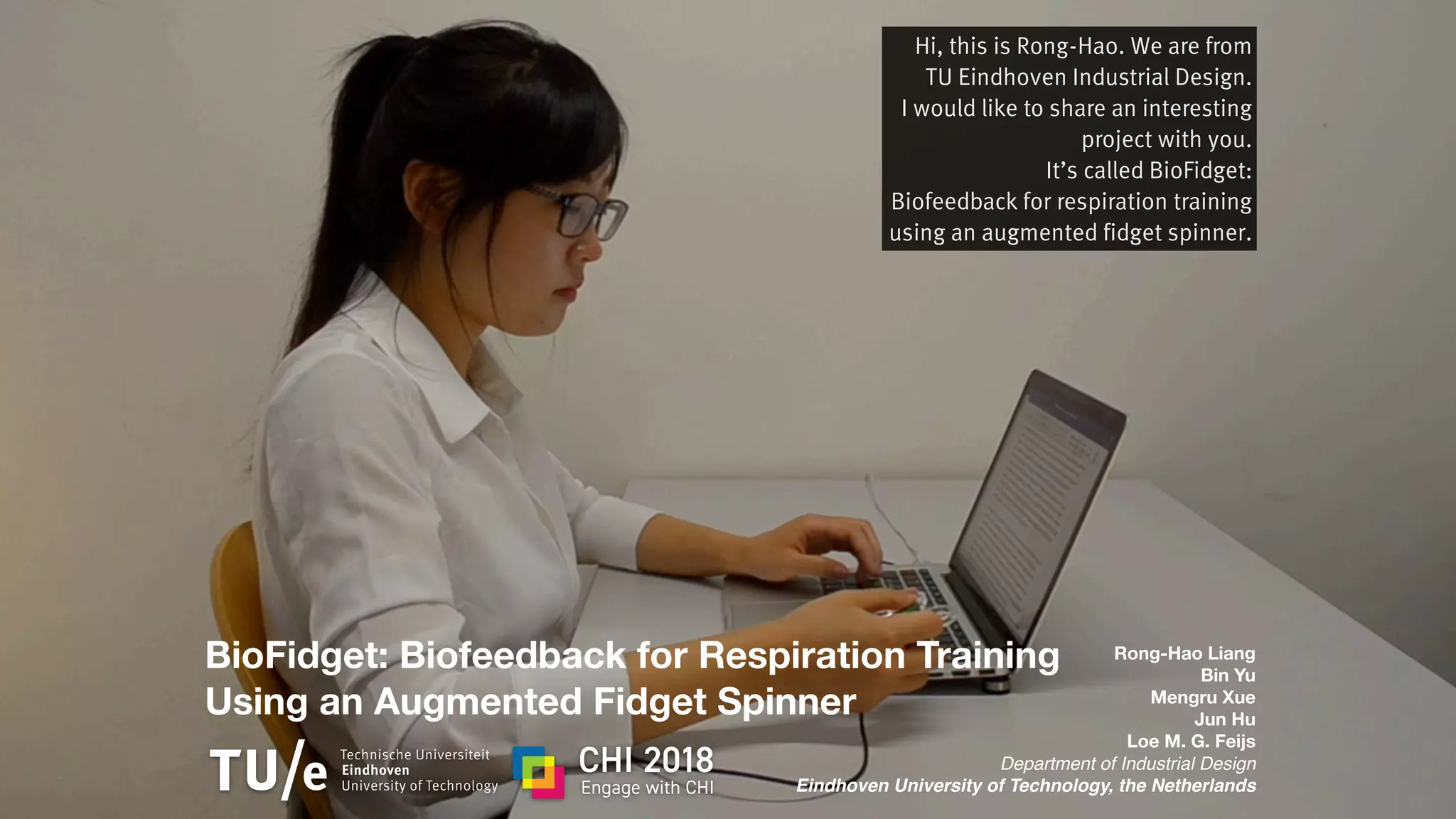
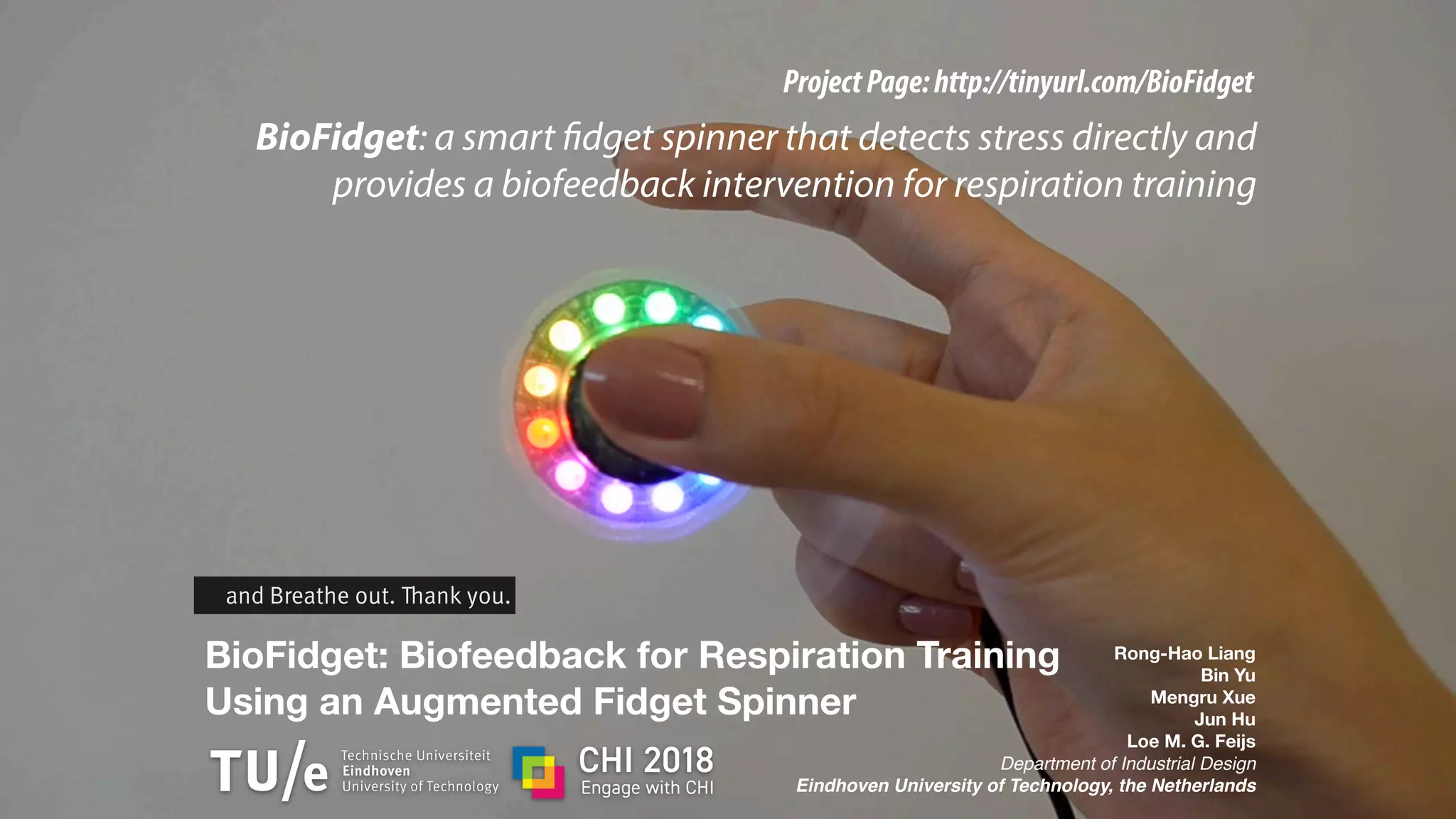
BioFidget: Biofeedback for Respiration Training
Using an Augmented Fidget Spinner
Rong-Hao Liang
Bin Yu
Mengru Xue
Jun Hu
Loe M. G. Feijs
Department of Industrial Design
Eindhoven University of Technology, the Netherlands
Hi, this is Rong-Hao. We are from
TU Eindhoven Industrial Design.
I would like to share an interesting
project with you.
It’s called BioFidget:
Biofeedback for respiration training
using an augmented fidget spinner.
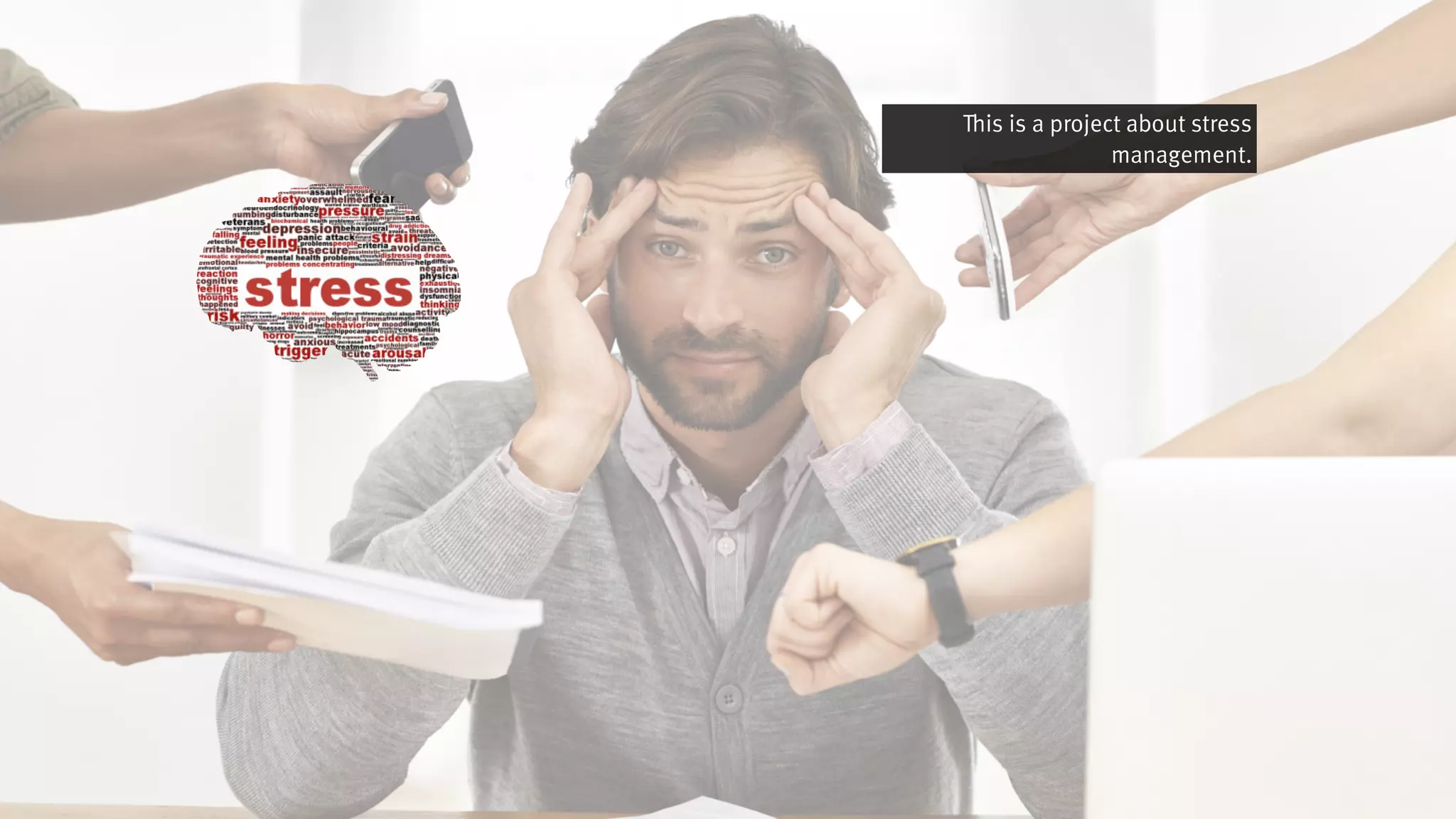
This is a project about stress
management.
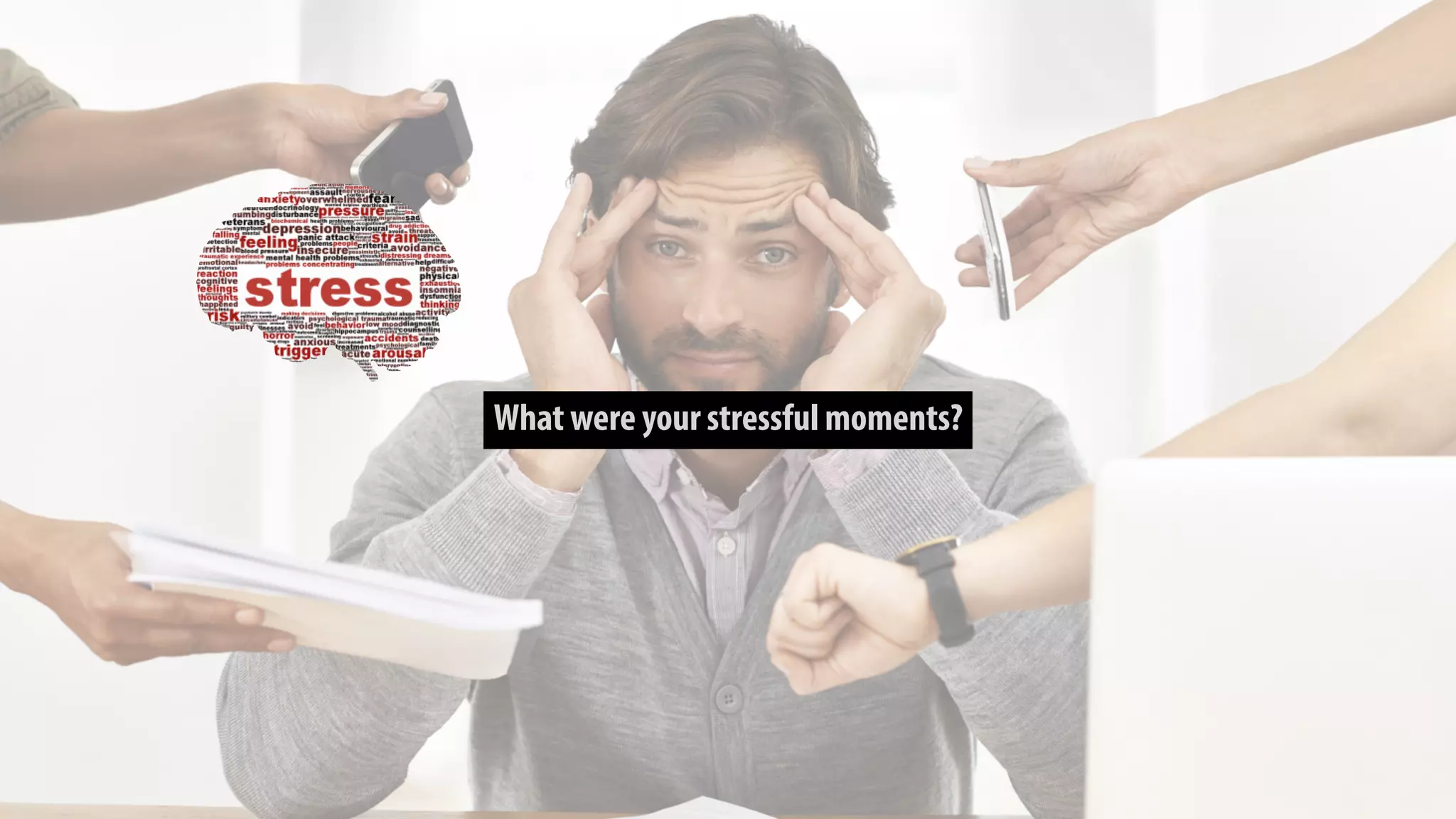
What were your stressful moments?
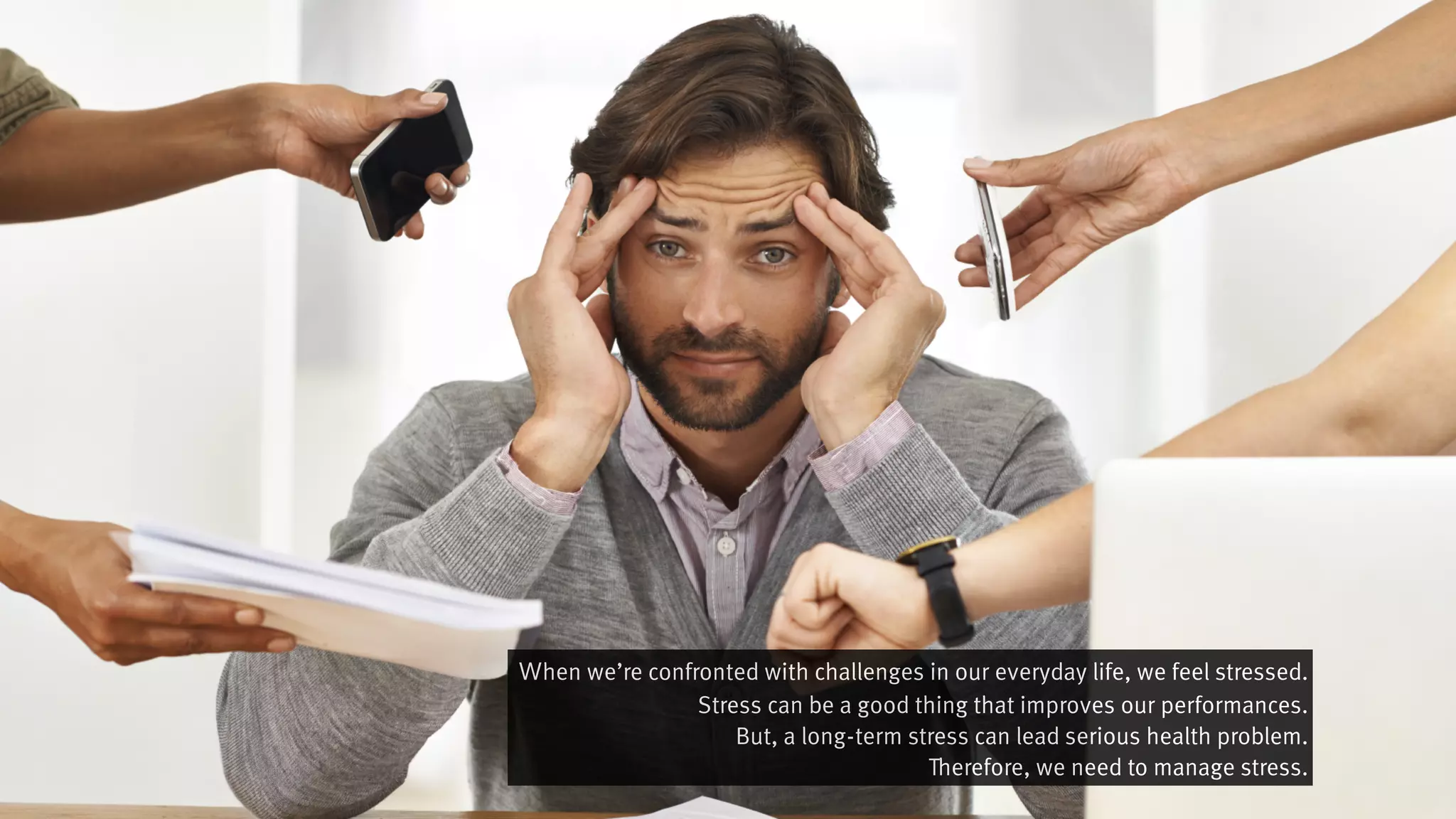
When we’re confronted with challenges in our everyday life, we feel stressed.
Stress can be a good thing that improves our performances.
But, a long-term stress can lead serious health problem.
Therefore, we need to manage stress.
]
Lehrer, P. M., Vaschillo, E., and Vaschillo,
B. Resonant frequency biofeedback training to increase cardiac variability: Rationale and manual for training. Applied
psychophysiology and biofeedback 25, 3 (2000), 177–191.
RespirationTraining
is Clinical-Proven in Stress Reduction,
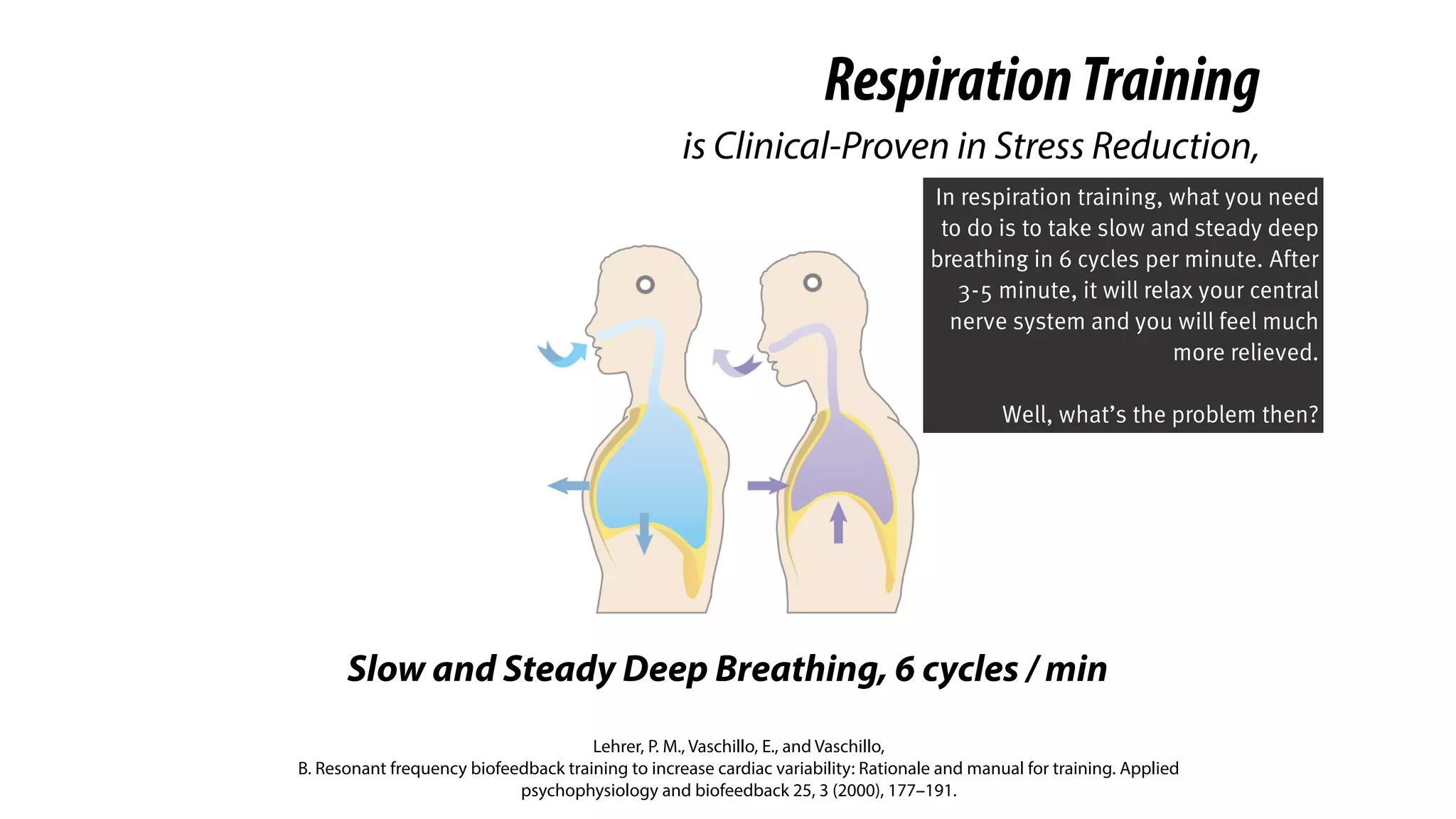
Here we introduce a clinical-
proven method in stress
management.
And you probably knew it. It’s
respiration training.
Slow and Steady Deep Breathing, 6 cycles / min
Lehrer, P. M., Vaschillo, E., and Vaschillo,
B. Resonant frequency biofeedback training to increase cardiac variability: Rationale and manual for training. Applied
psychophysiology and biofeedback 25, 3 (2000), 177–191.
RespirationTraining
is Clinical-Proven in Stress Reduction,
In respiration training, what you need
to do is to take slow and steady deep
breathing in 6 cycles per minute. After
3-5 minute, it will relax your central
nerve system and you will feel much
more relieved.
Well, what’s the problem then?
Slow and Steady Deep Breathing, 6 cycles / min
Lehrer, P. M., Vaschillo, E., and Vaschillo,
B. Resonant frequency biofeedback training to increase cardiac variability: Rationale and manual for training. Applied
psychophysiology and biofeedback 25, 3 (2000), 177–191.
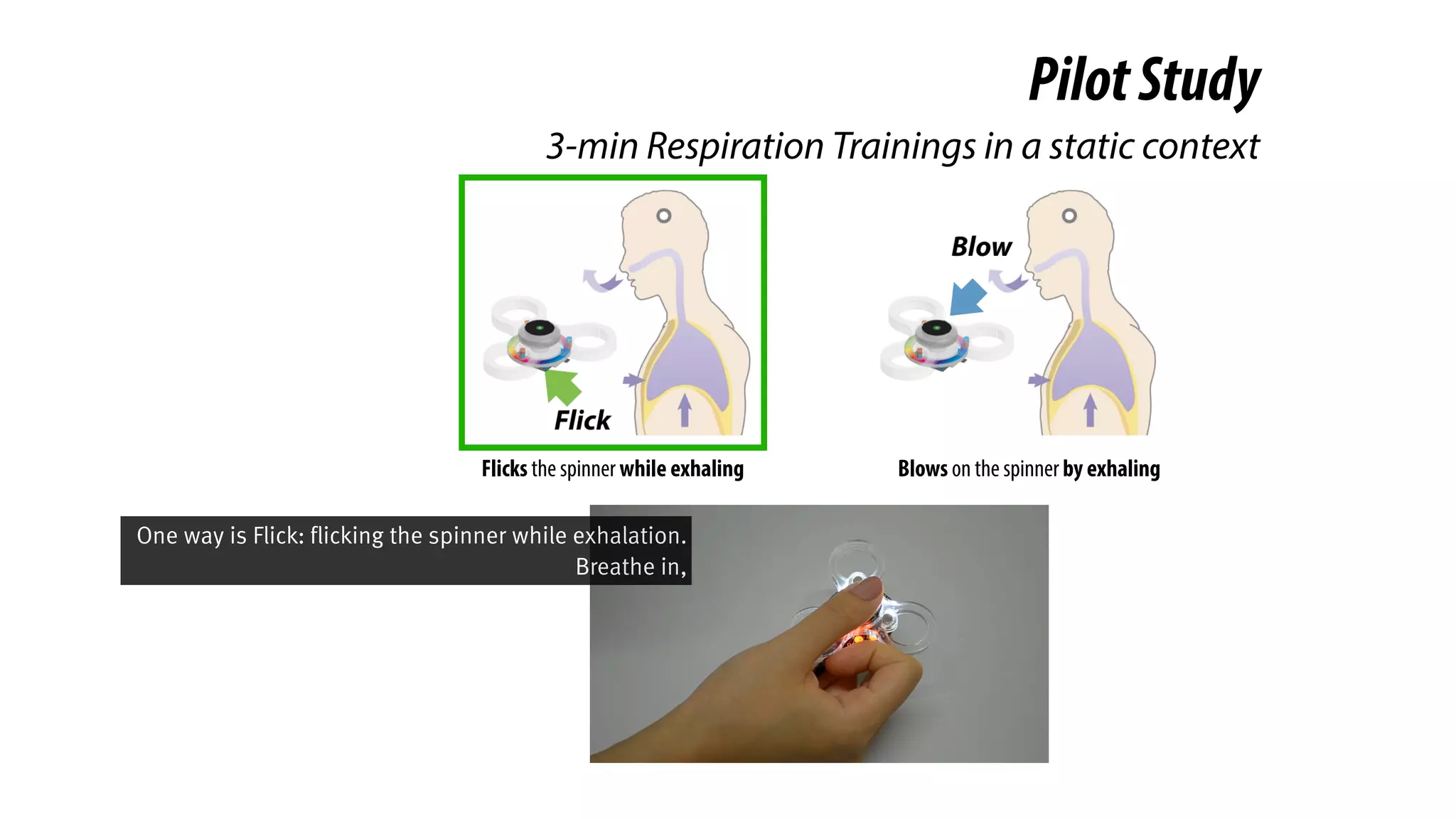
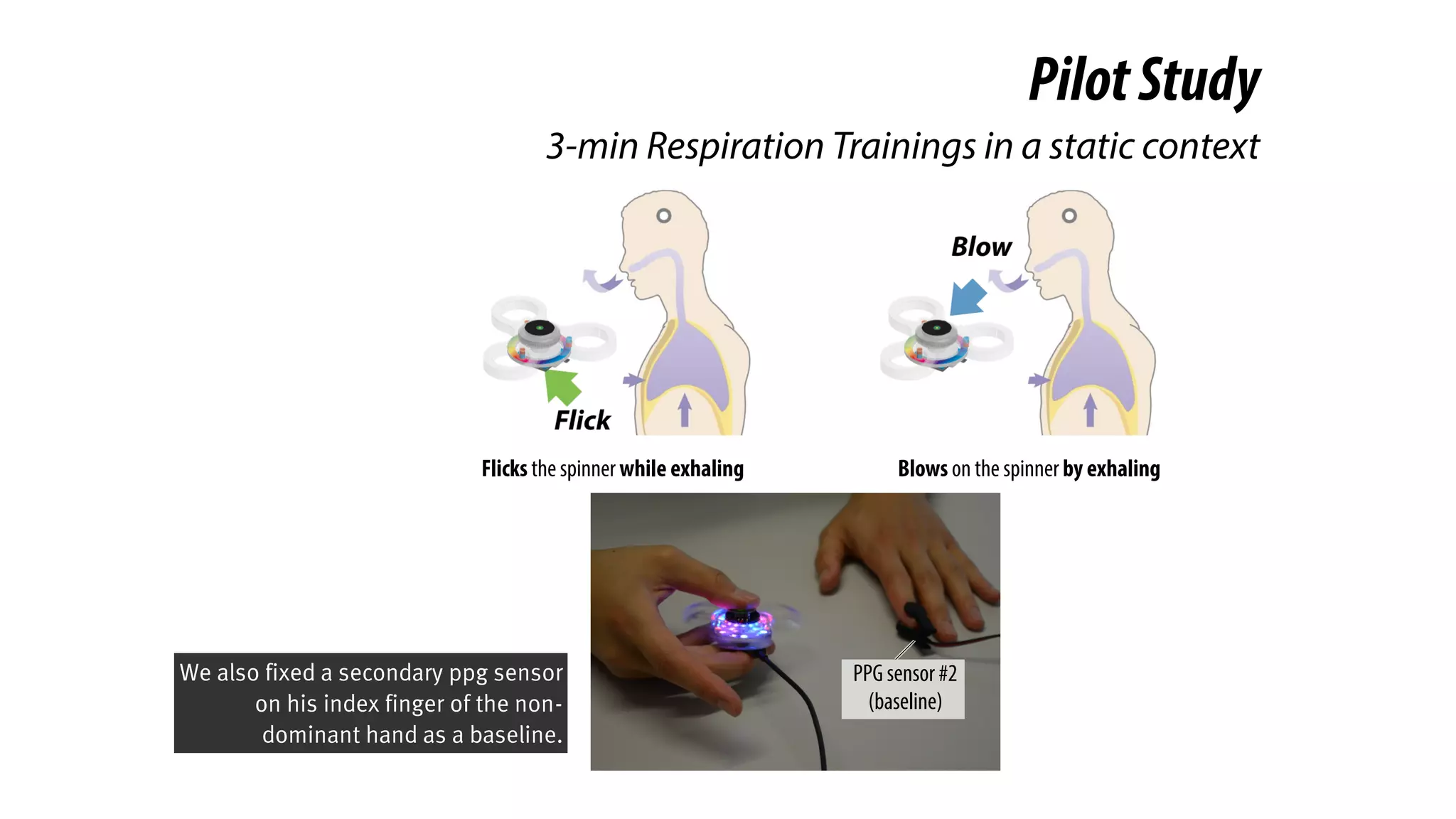
RespirationTraining
is Clinical-Proven in Stress Reduction,
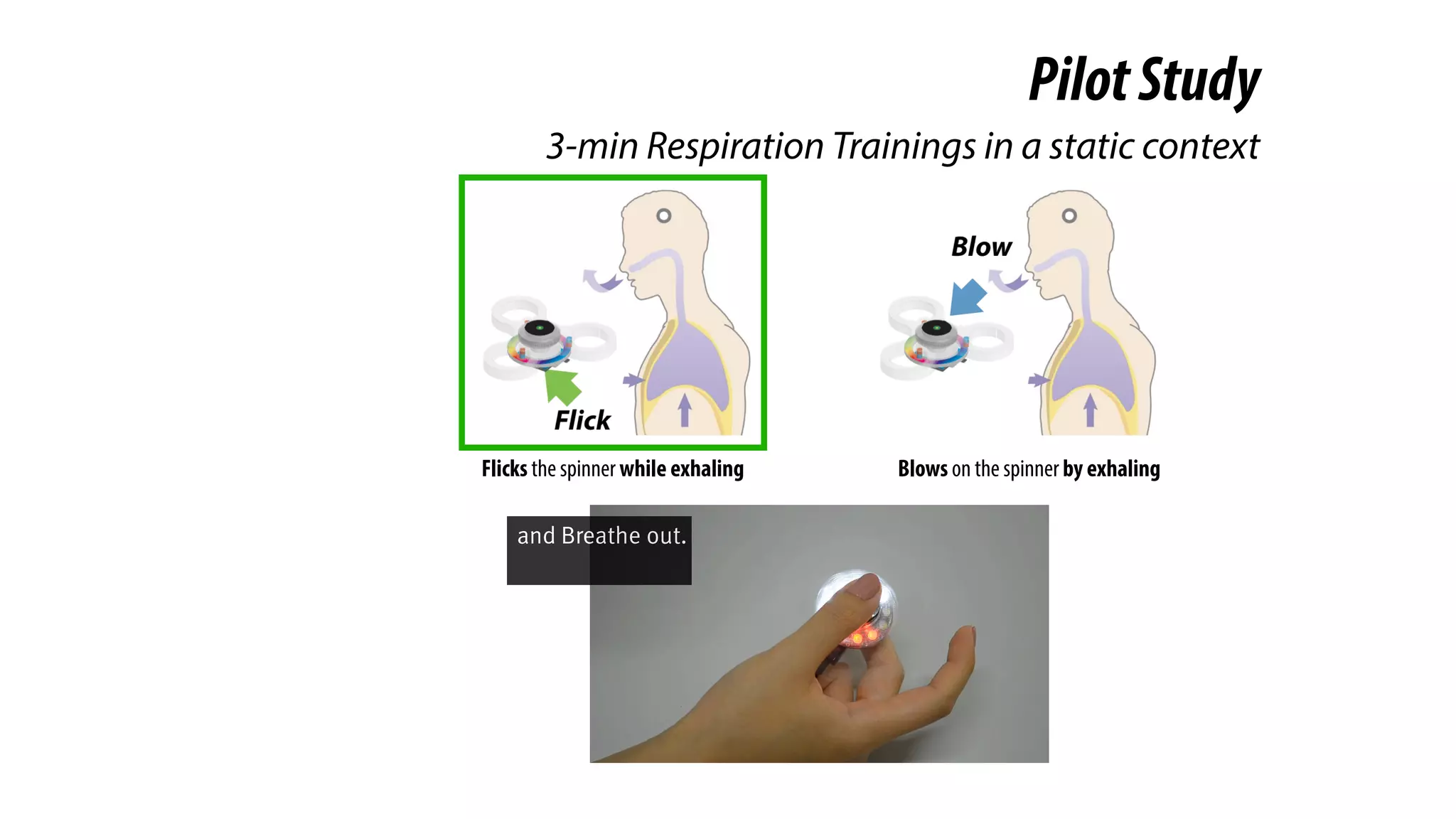
but People Usually Drops Out.
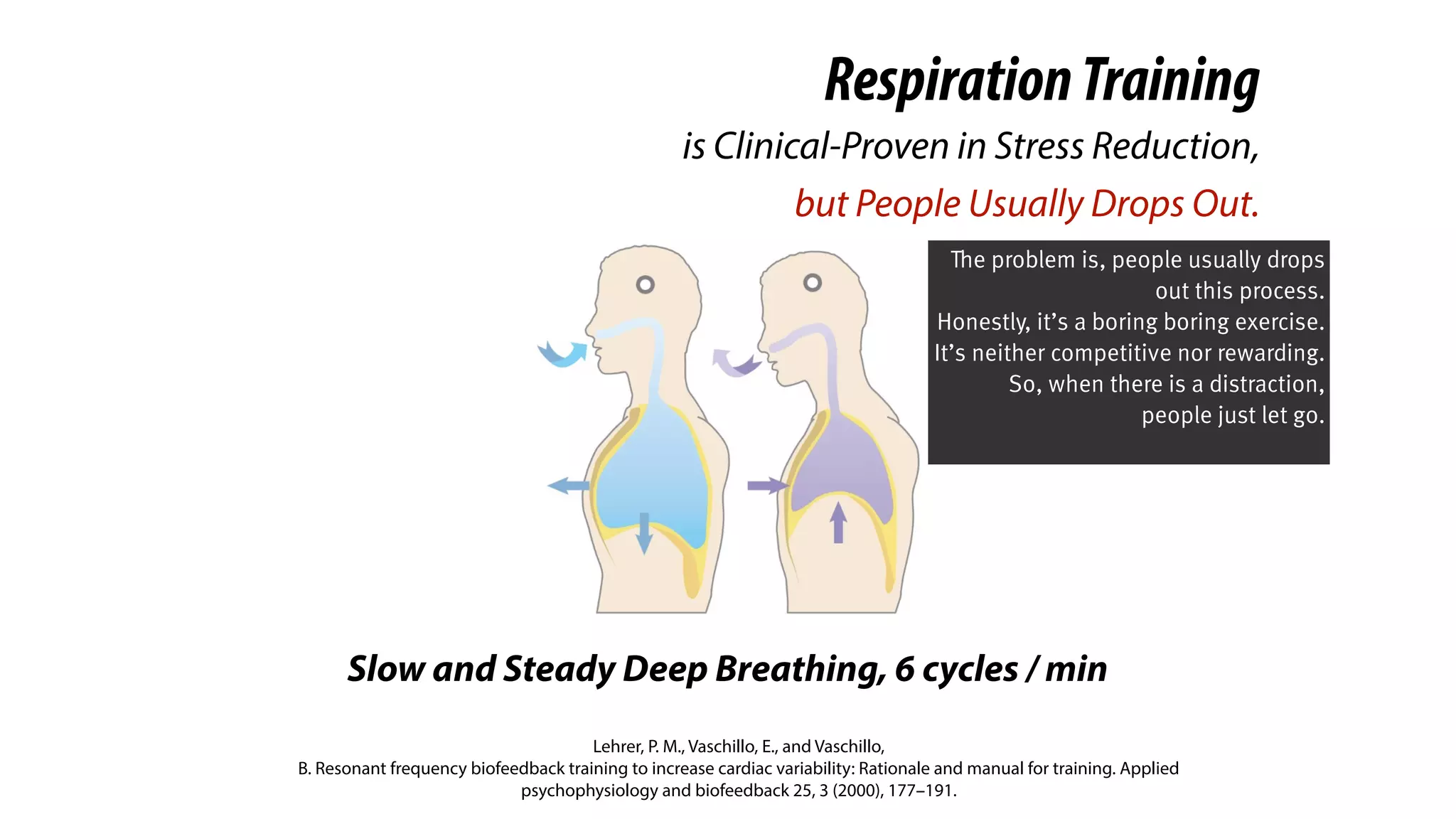
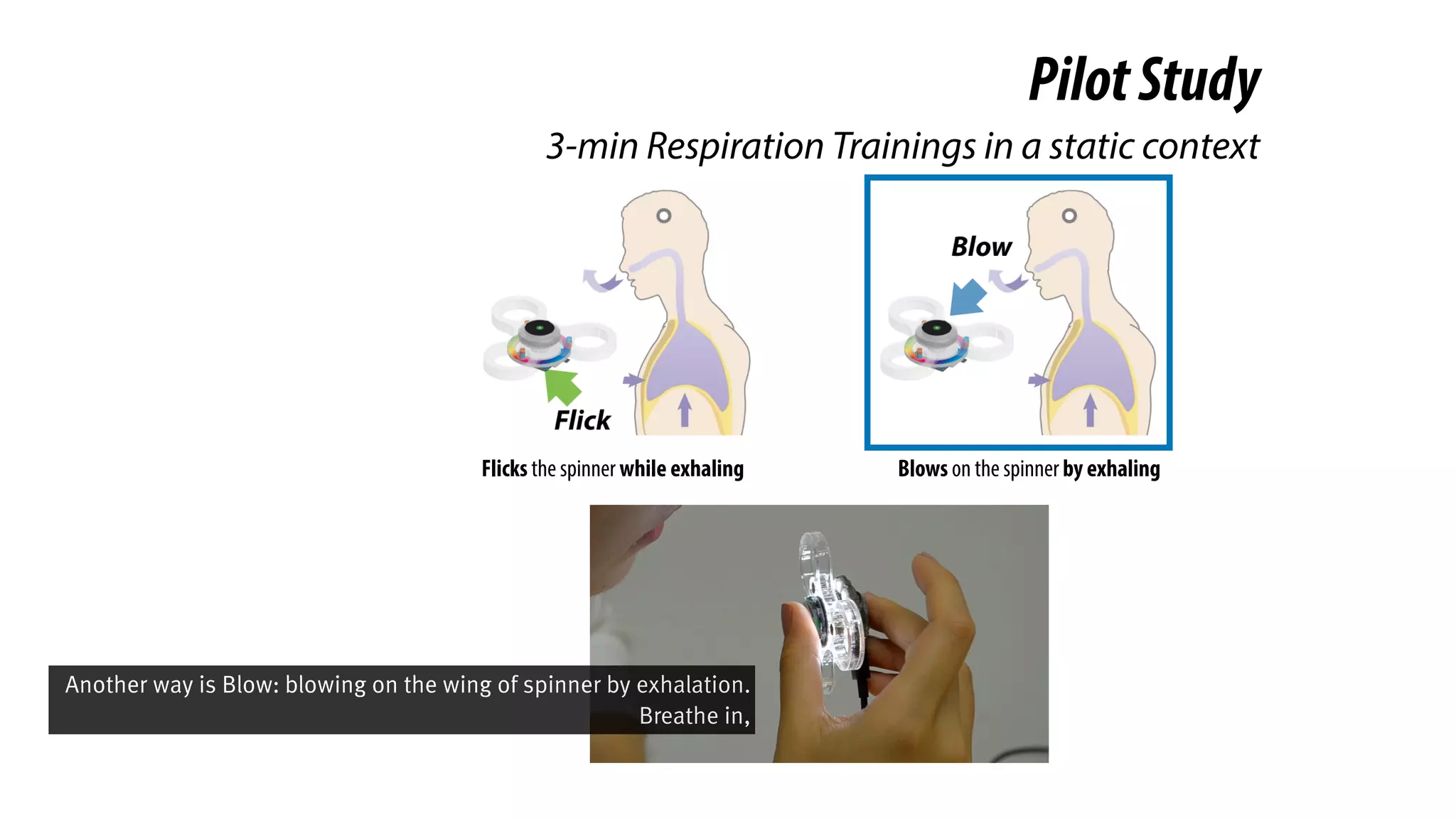
The problem is, people usually drops
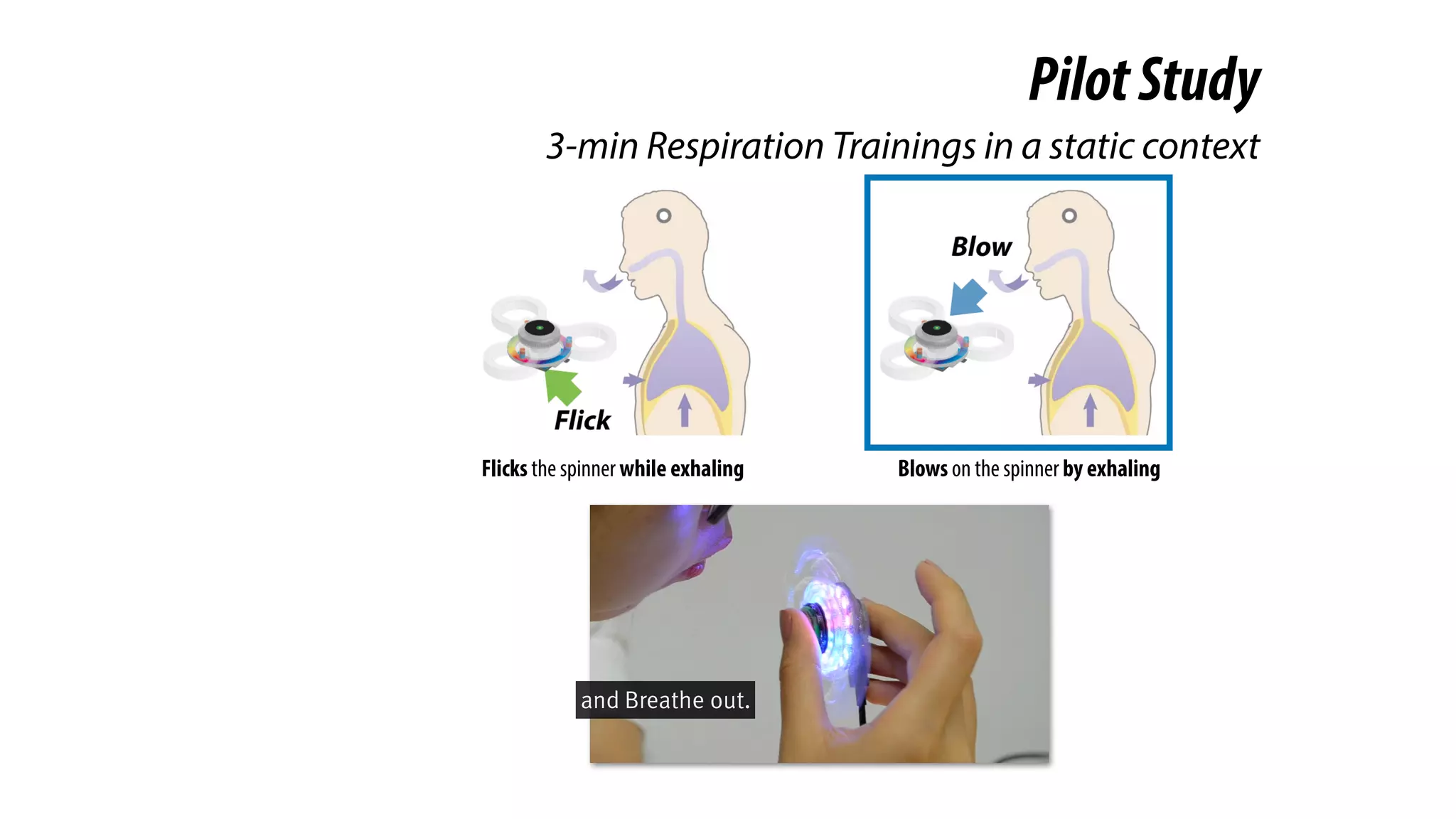
out this process.
Honestly, it’s a boring boring exercise.
It’s neither competitive nor rewarding.
So, when there is a distraction,
people just let go.
Stretch Sensor for Breath Sensing
ImprovingEngagement
Respiration Training with Biofeedback
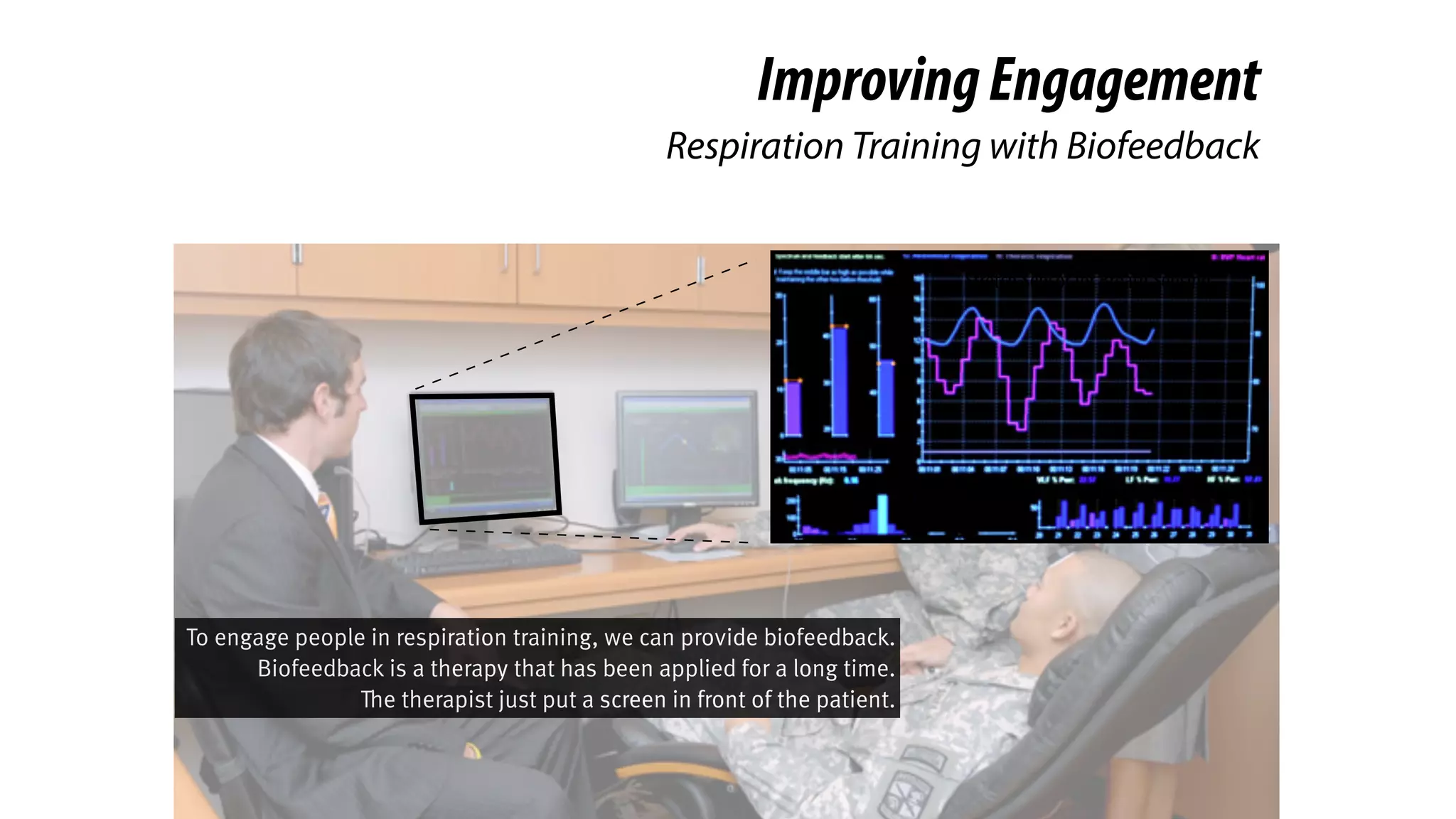
To engage people in respiration training, we can provide biofeedback.
Biofeedback is a therapy that has been applied for a long time.
The therapist just put a screen in front of the patient.
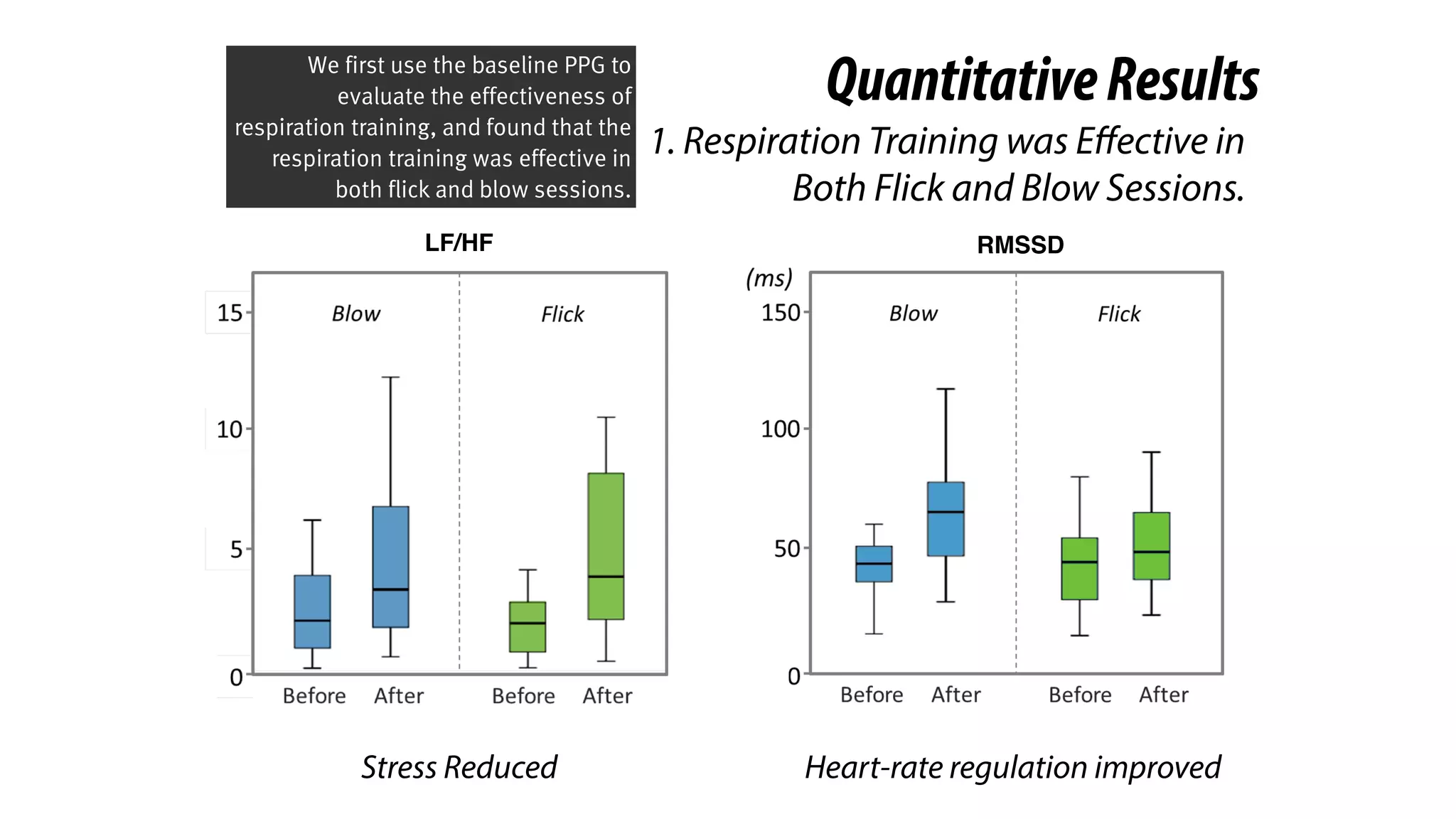
Stretch Sensor for Breath Sensing
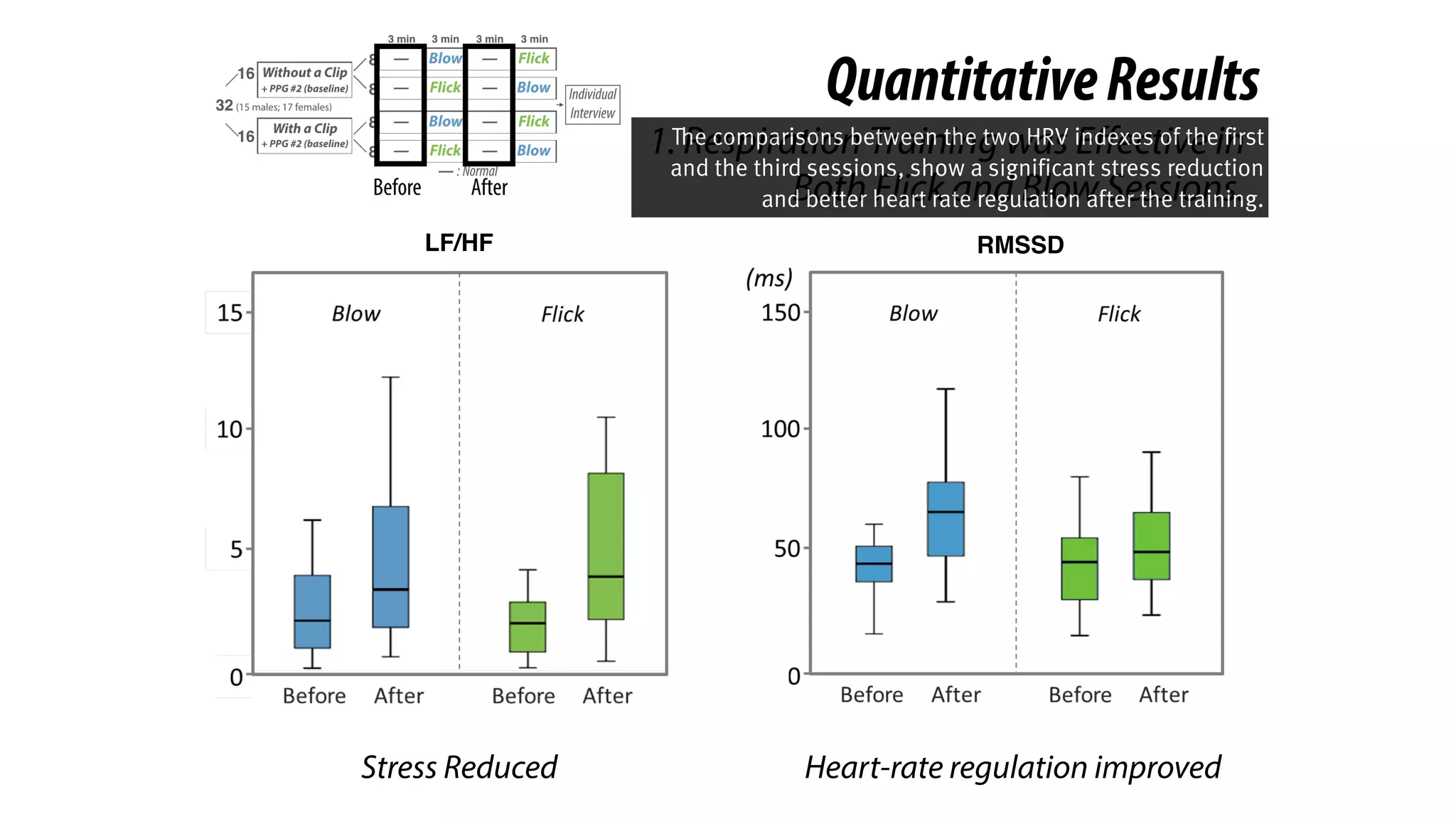
Respiration
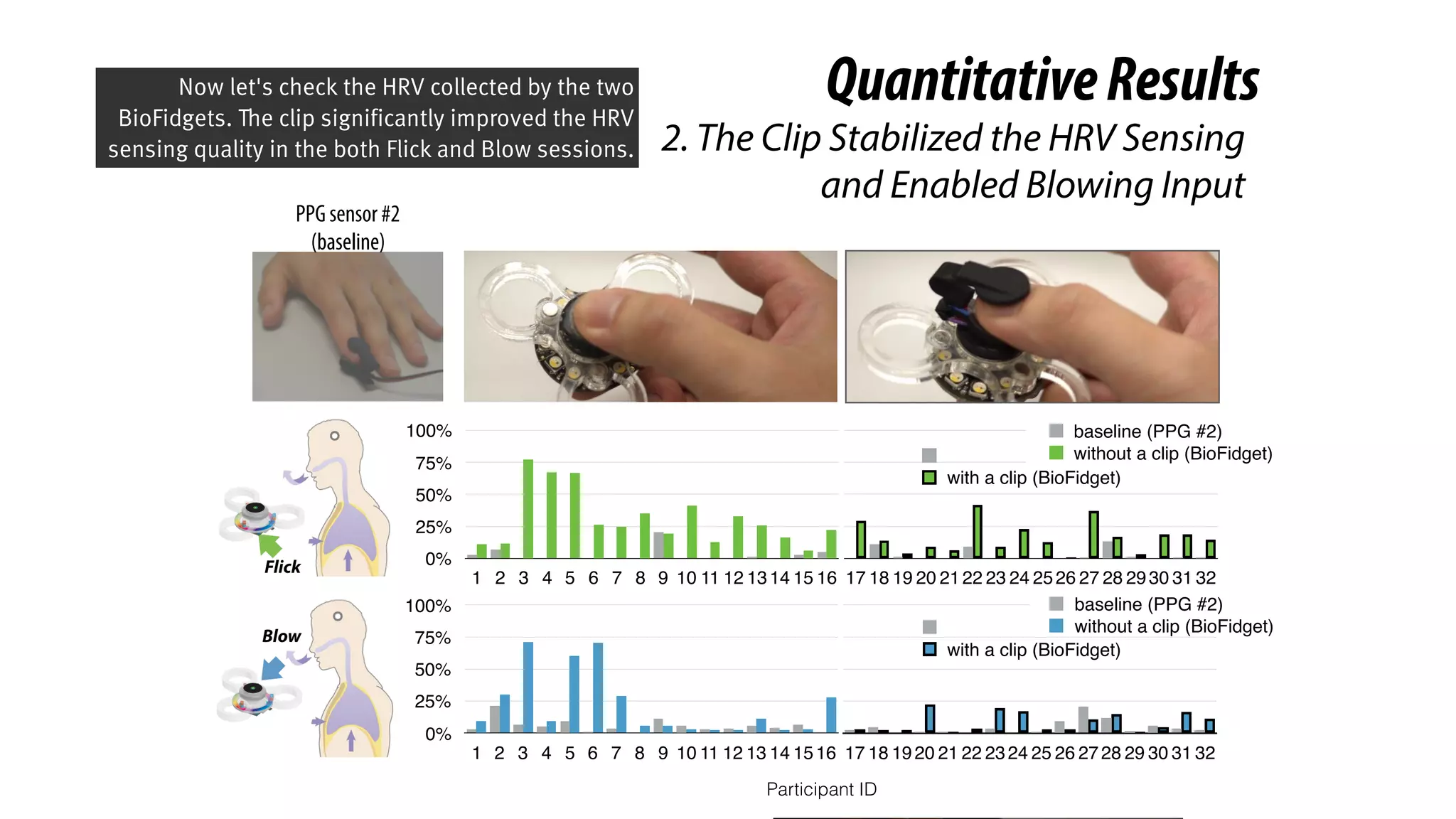
Heart Rate Variability (HRV)
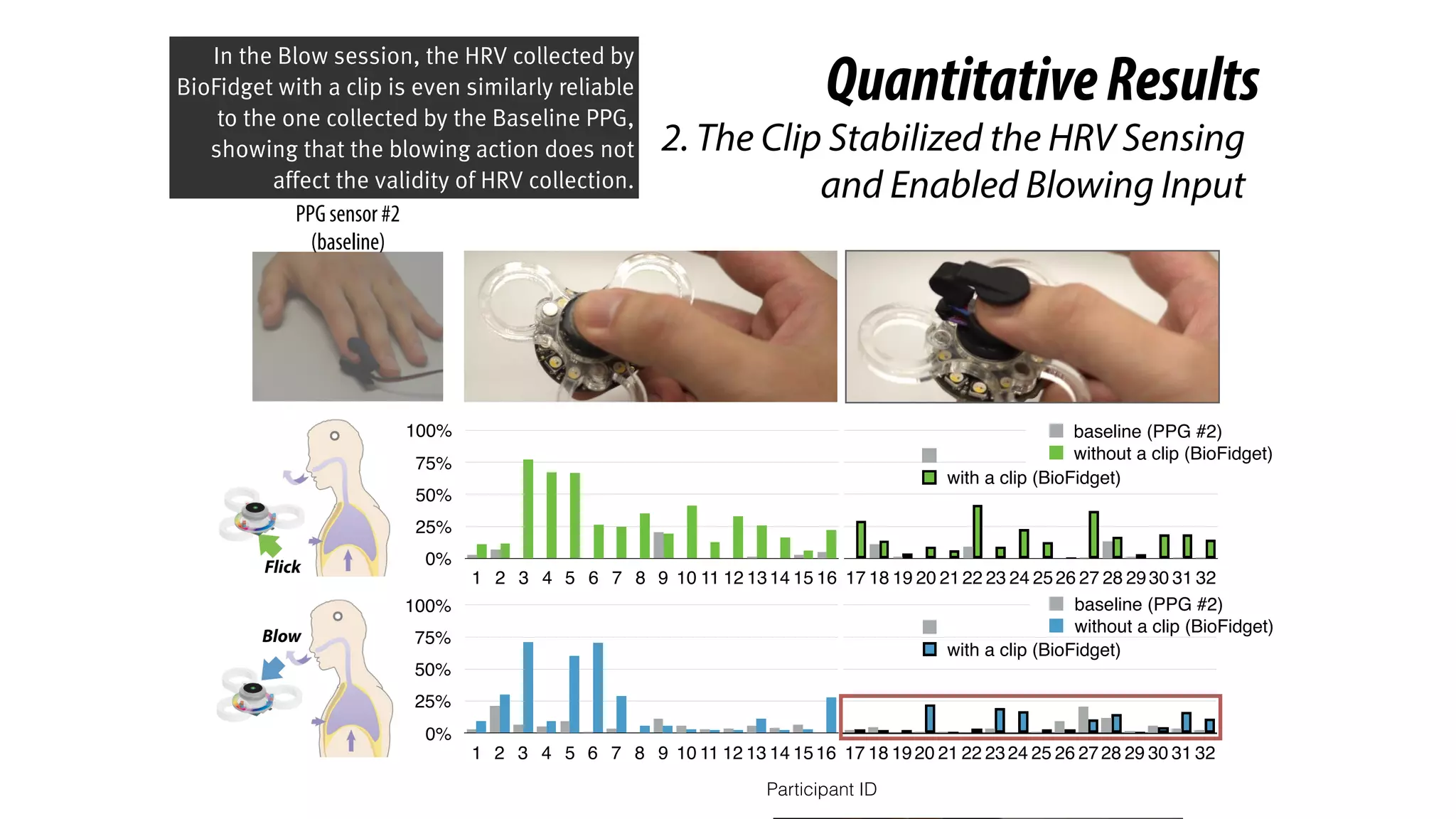
(The variation in the Inter-beat Interval)
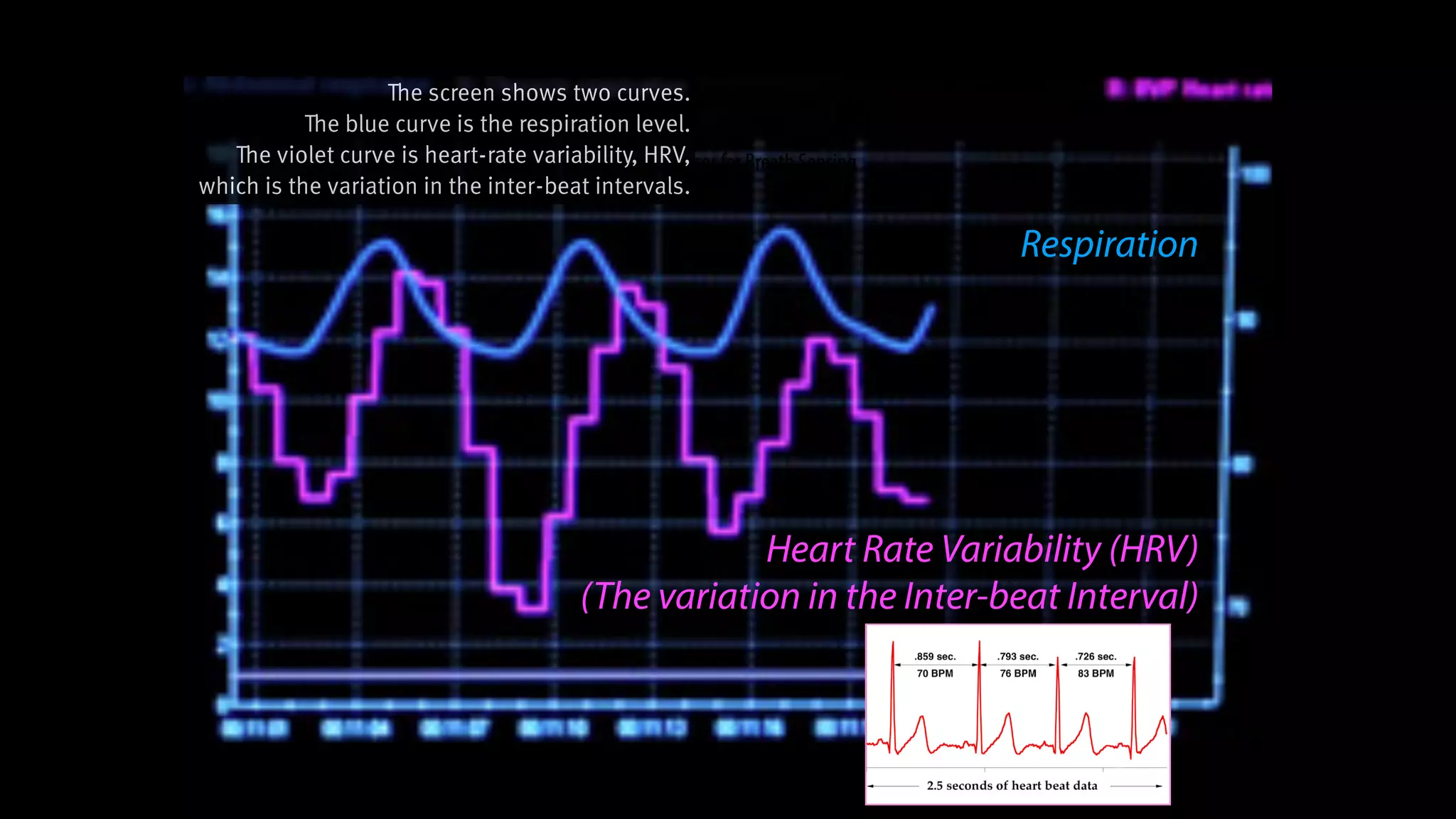
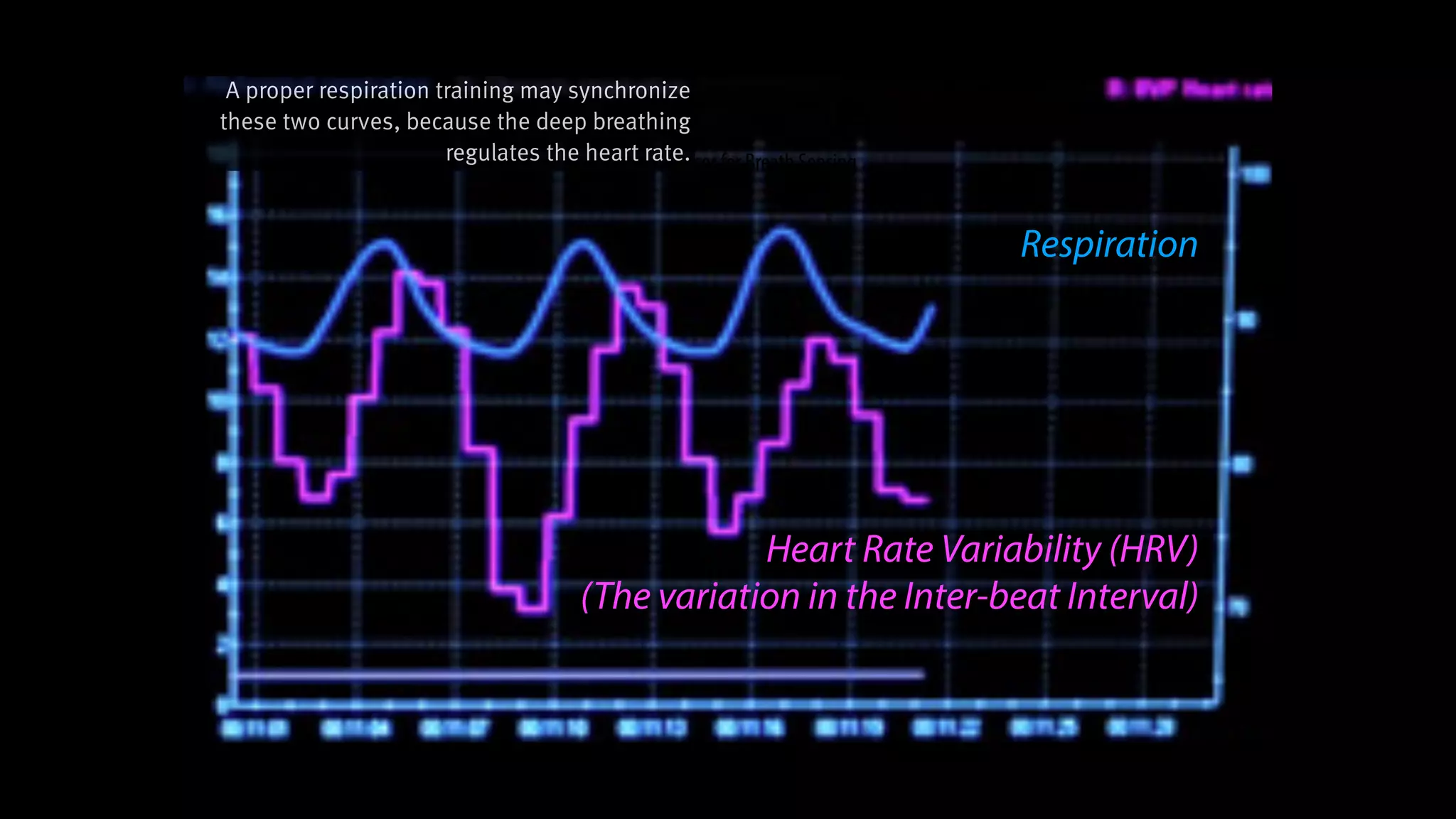
The screen shows two curves.
The blue curve is the respiration level.
The violet curve is heart-rate variability, HRV,
which is the variation in the inter-beat intervals.
Stretch Sensor for Breath Sensing
Respiration
Heart Rate Variability (HRV)
(The variation in the Inter-beat Interval)
A proper respiration training may synchronize
these two curves, because the deep breathing
regulates the heart rate.
Stretch Sensor for Breath Sensing
ImprovingEngagement
Respiration Training with Biofeedback
of Respiration and Heart Rate Variability (HRV) Information
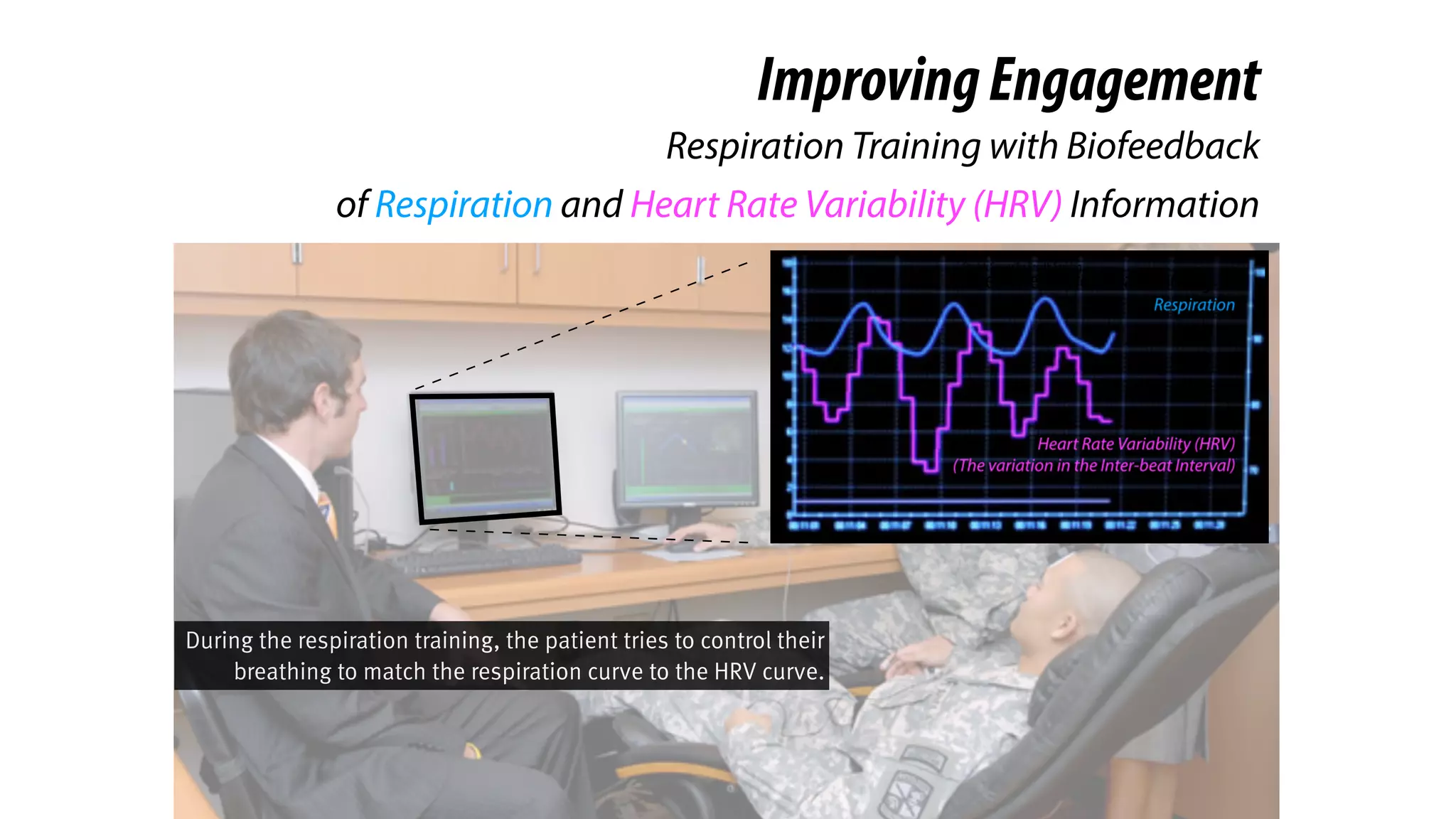
During the respiration training, the patient tries to control their
breathing to match the respiration curve to the HRV curve.
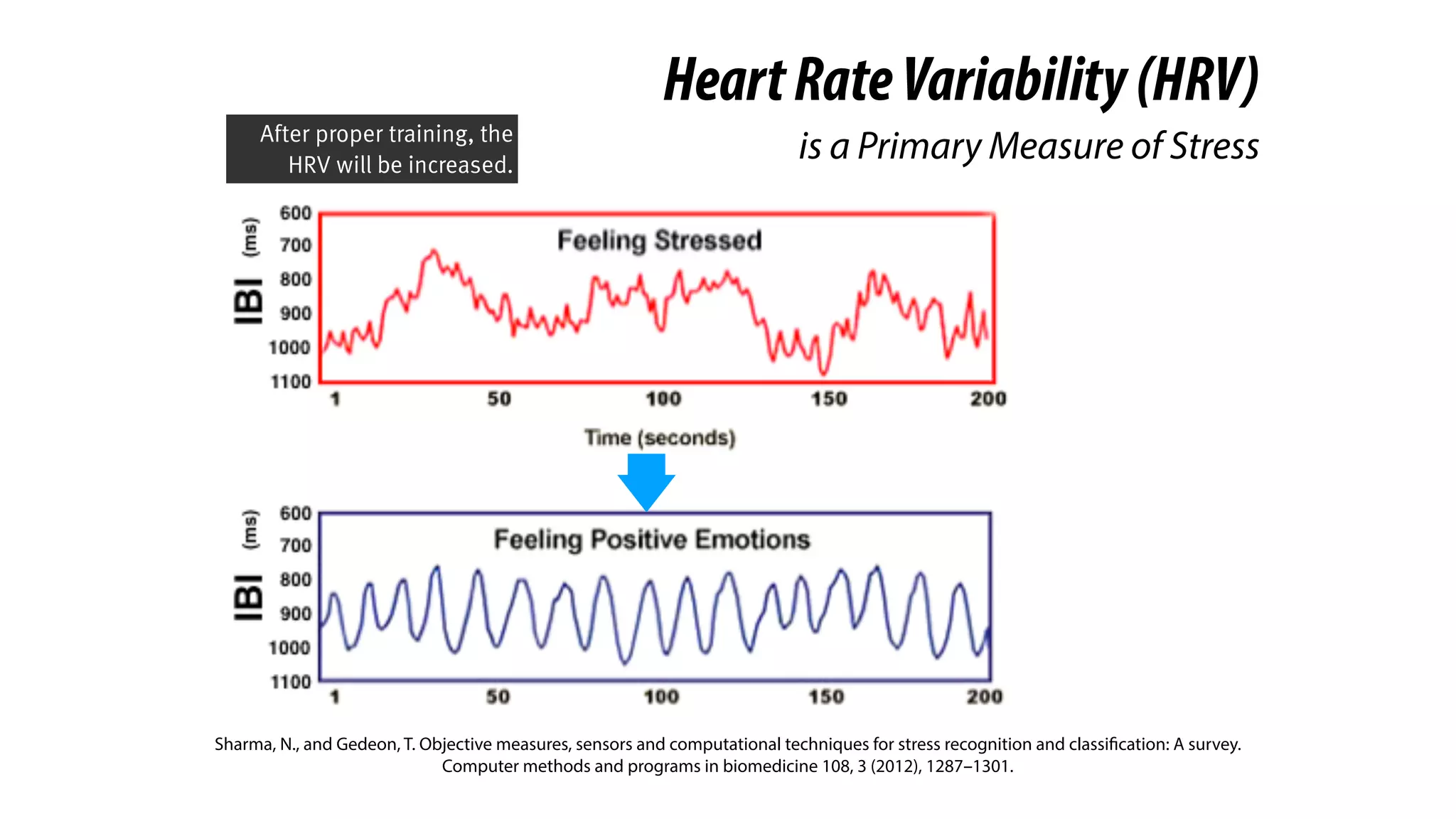
Sharma, N., and Gedeon, T. Objective measures, sensors and computational techniques for stress recognition and classification: A survey.
Computer methods and programs in biomedicine 108, 3 (2012), 1287–1301.
HeartRateVariability(HRV)
is a Primary Measure of StressAfter proper training, the
HRV will be increased.
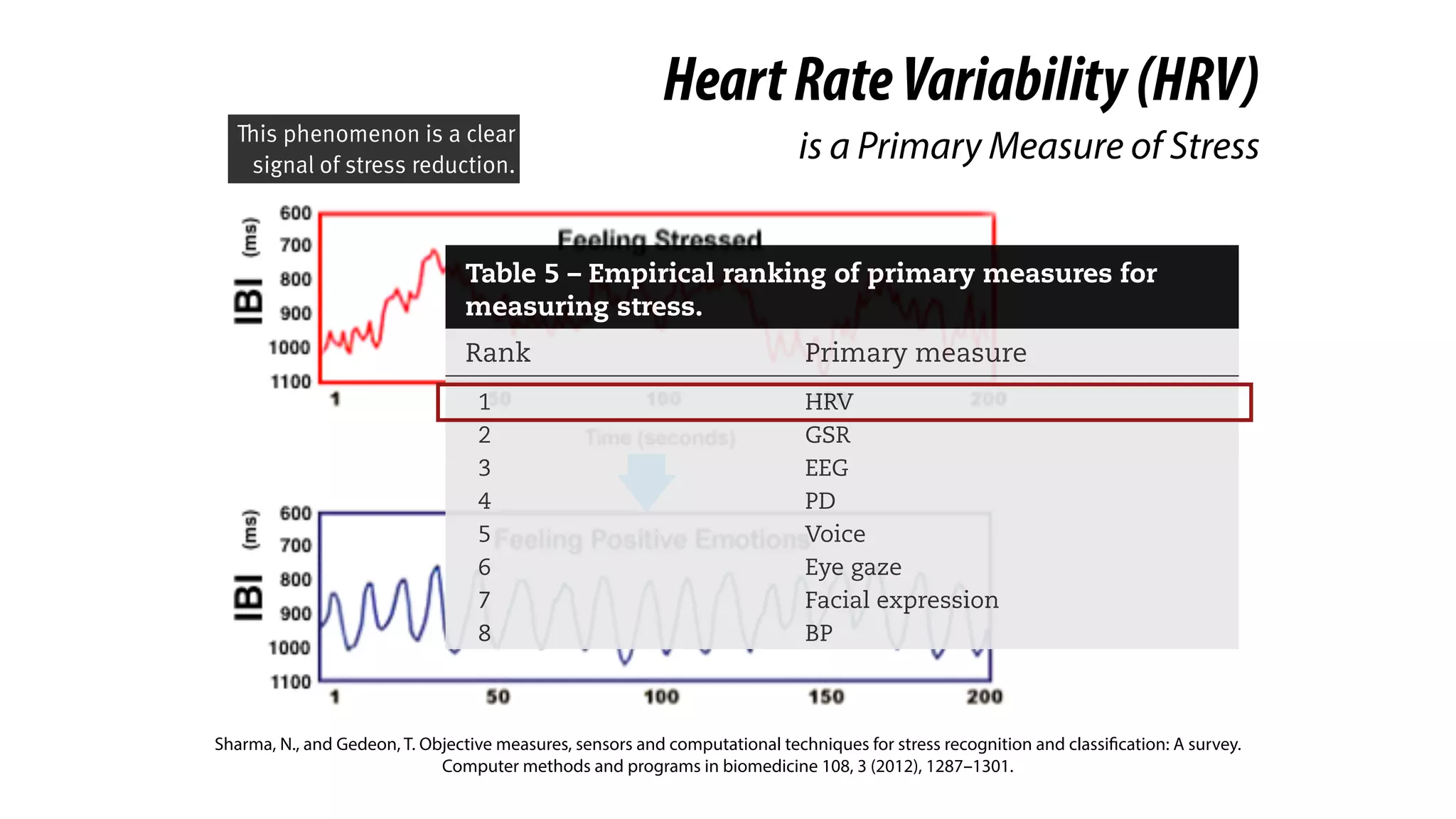
Table 5 – Empirical ranking of primary measures for
measuring stress.
Rank Primary measure
1 HRV
2 GSR
3 EEG
4 PD
5 Voice
6 Eye gaze
7 Facial expression
8 BP
Sharma, N., and Gedeon, T. Objective measures, sensors and computational techniques for stress recognition and classification: A survey.
Computer methods and programs in biomedicine 108, 3 (2012), 1287–1301.
HeartRateVariability(HRV)
is a Primary Measure of StressThis phenomenon is a clear
signal of stress reduction.
HR via Music [Yokoyama 2002]SQUID [Farjadian et al. 2013]BreathTray [Moraveji et al. 2012]
ImprovingEngagement
Providing User-Friendly Biofeedback,
Previous work tried to improve
the experiences by providing
user-friendly biofeedback in
visual, haptic, and audio
channels.
HR via Music [Yokoyama 2002]SQUID [Farjadian et al. 2013]
Living Surface [Yu et al. 2016]
BreathTray [Moraveji et al. 2012]
InnerGarden [Roo et al. 2017]
ImprovingEngagement
Providing User-Friendly Biofeedback,
Some further use shape
changing interfaces and virtual
reality to increase the
immersion.
SQUID [Farjadian et al. 2013]
Living Surface [Yu et al. 2016]
BreathTray [Moraveji et al. 2012]
InnerGarden [Roo et al. 2017]
ImprovingEngagement
Providing User-Friendly Biofeedback,
but Requires Bio-sensors to be Worn.
HR via Music [Yokoyama 2002]
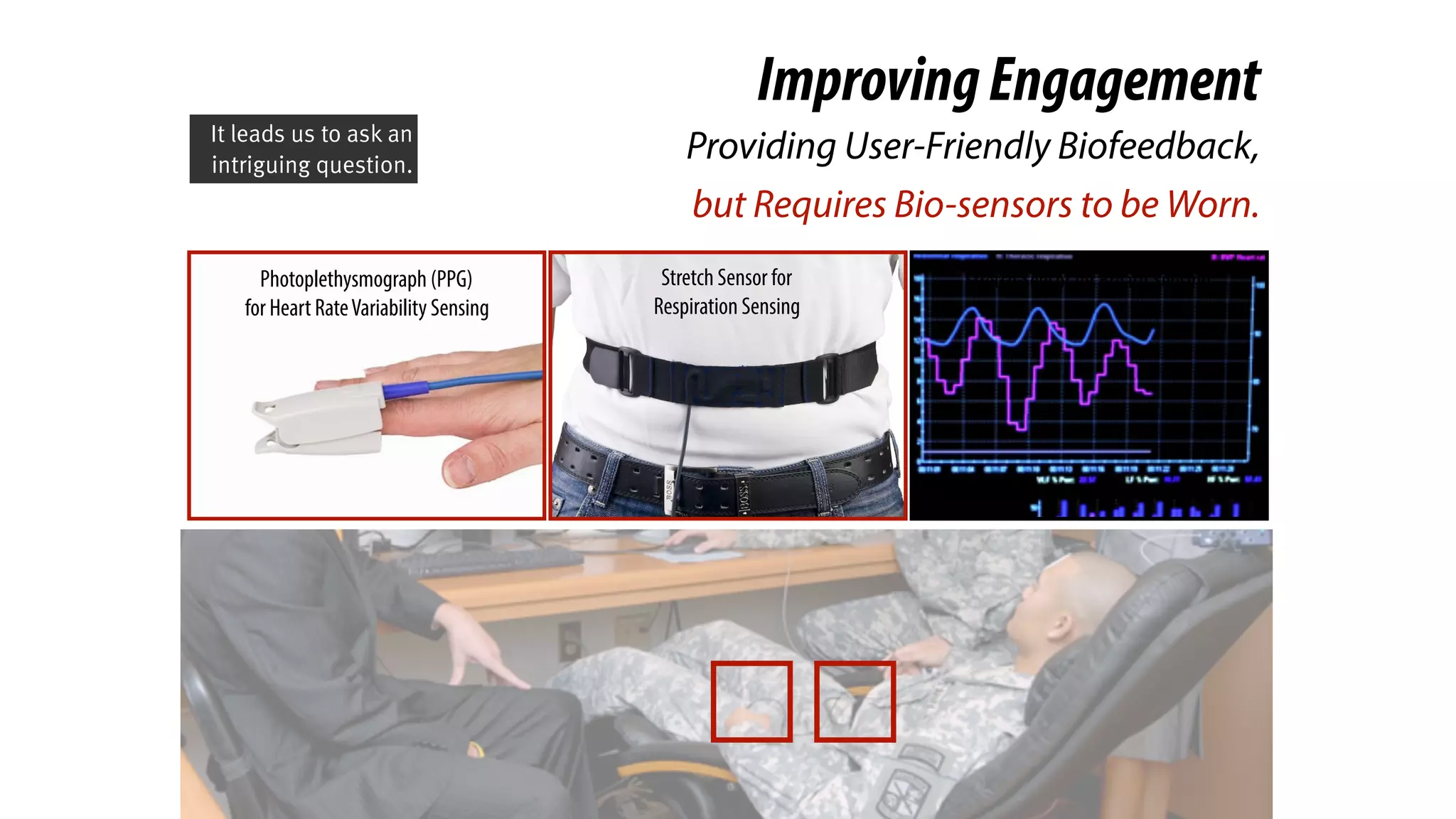
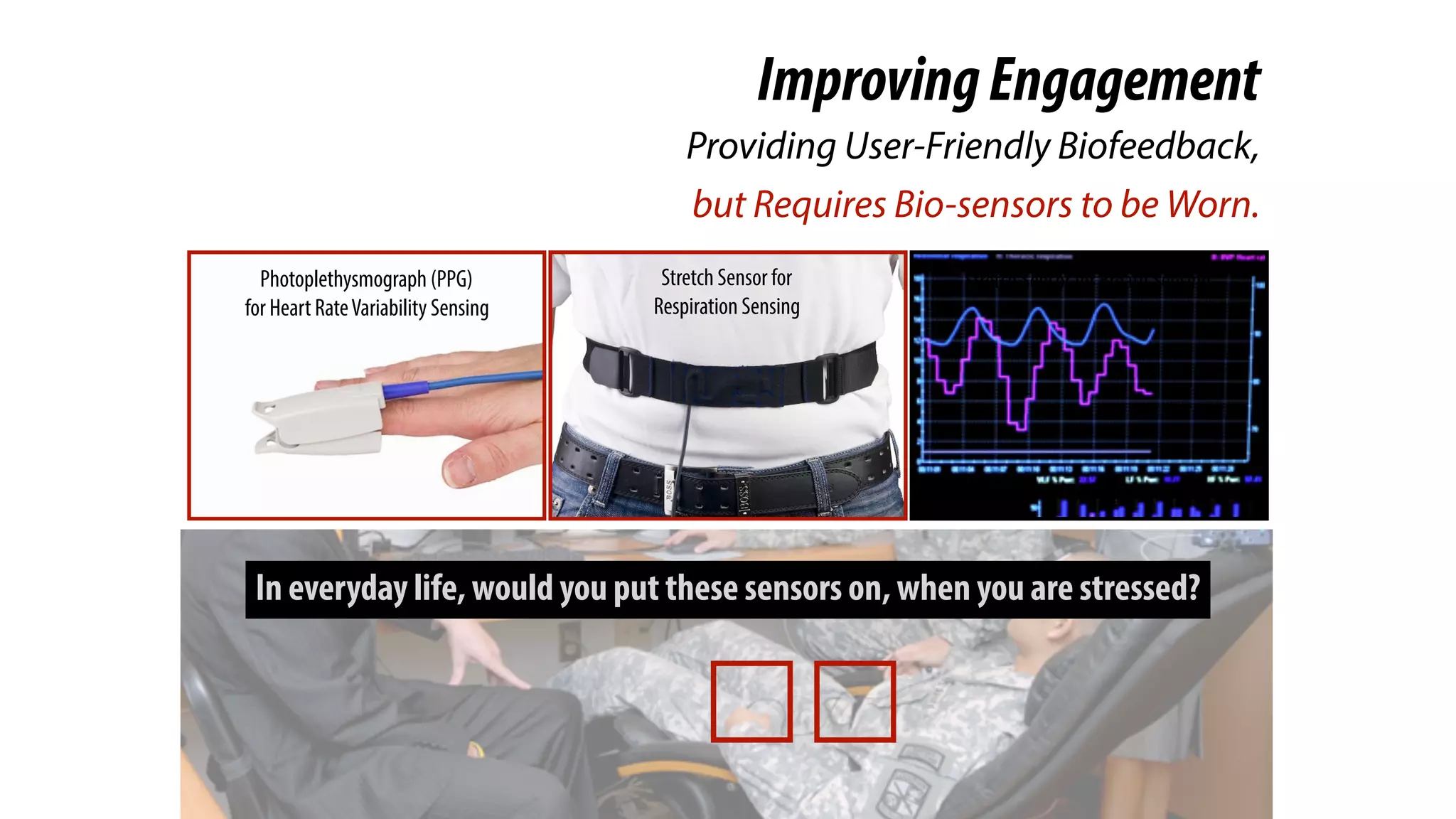
However, these systems all
require the users to wear both
heart rate and respiration sensors,
before they start the training.
ImprovingEngagement
Photoplethysmograph (PPG)
for Heart RateVariability Sensing
Stretch Sensor for
Respiration Sensing
Stretch Sensor for Breath Sensing
Providing User-Friendly Biofeedback,
but Requires Bio-sensors to be Worn.
It leads us to ask an
intriguing question.
ImprovingEngagement
Photoplethysmograph (PPG)
for Heart RateVariability Sensing
Stretch Sensor for
Respiration Sensing
Stretch Sensor for Breath Sensing
Providing User-Friendly Biofeedback,
but Requires Bio-sensors to be Worn.
In everyday life, would you put these sensors on, when you are stressed?
FidgetSpinner
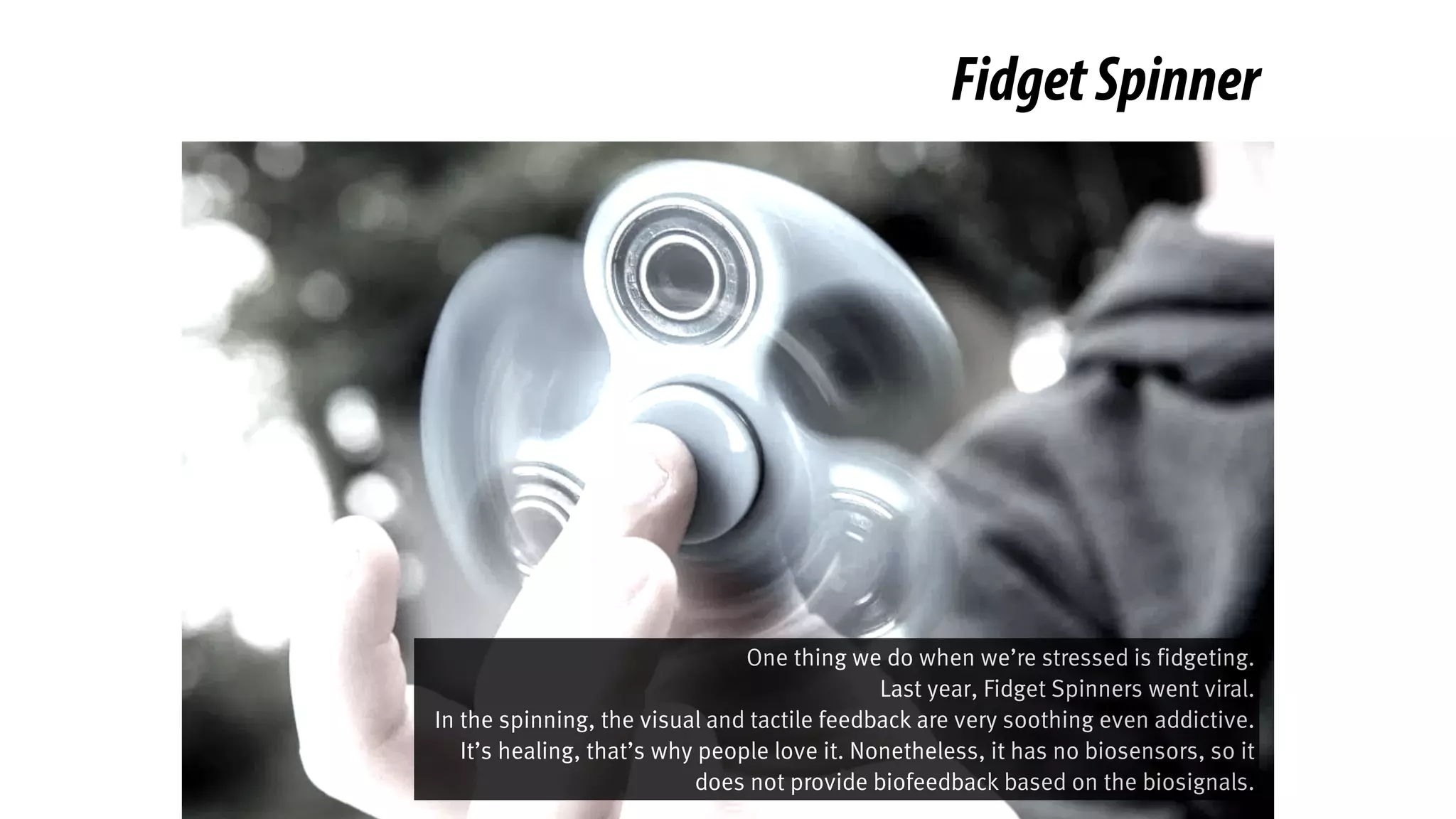
One thing we do when we’re stressed is fidgeting.
Last year, Fidget Spinners went viral.
In the spinning, the visual and tactile feedback are very soothing even addictive.
It’s healing, that’s why people love it. Nonetheless, it has no biosensors, so it
does not provide biofeedback based on the biosignals.
FidgetSpinner
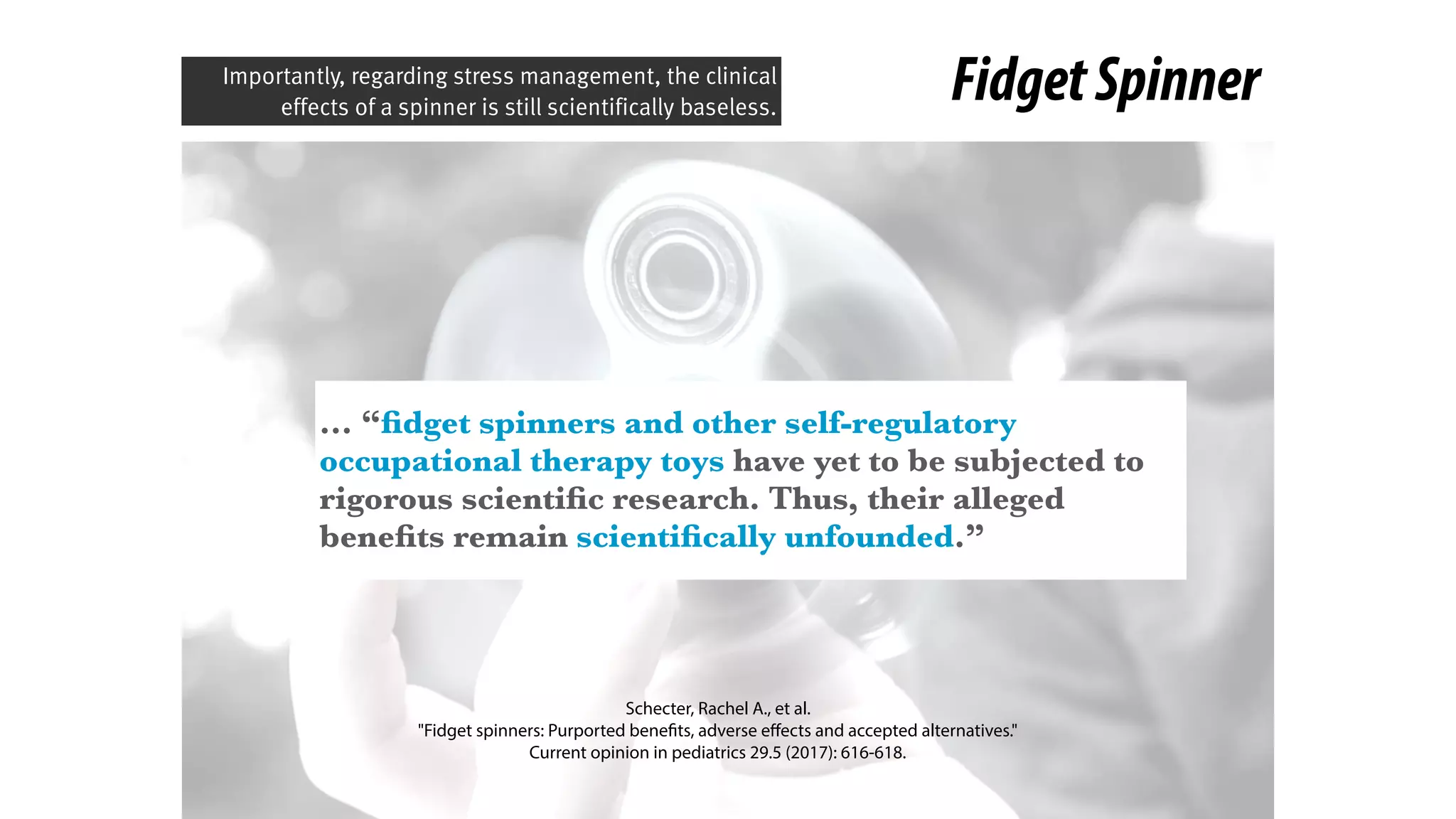
… “fidget spinners and other self-regulatory
occupational therapy toys have yet to be subjected to
rigorous scientific research. Thus, their alleged
benefits remain scientifically unfounded.”
Schecter, Rachel A., et al.
"Fidget spinners: Purported benefits, adverse effects and accepted alternatives." 
Current opinion in pediatrics 29.5 (2017): 616-618.
Importantly, regarding stress management, the clinical
effects of a spinner is still scientifically baseless.
do not sense the user’s physiological data
[Wensveen et al. 2012] Mind Sphere, PhilipsFidgetWidget [Karlesky et al. 2014] Relax! Pen [Bruns 2010]
FidgetDevicesforSelf-Regulation
Same as fidget spinners, previous work uses tangible
user interfaces as fidgets to help the users in doing
self-regulation. They also did not provide
biofeedback based on stress-related biosignal.
FidgetDevicesforSelf-Regulation
[Wensveen et al. 2012] Mind Sphere, PhilipsFidgetWidget [Karlesky et al. 2014] Relax! Pen [Bruns 2010]
HandheldDevicesforBio-Sensing
do not support rich, engaging interaction
StressEraserHandheld Spirometer Finger-based ECG
do not sense the user’s physiological data
Some handheld physiological sensors, we call it
biosensors in short, do not require users to wear,
but they try to avoid user interactions that may
affect their technical validity of bio-sensing.
FidgetDevicesforSelf-Regulation
[Wensveen et al. 2012] Mind Sphere, PhilipsFidgetWidget [Karlesky et al. 2014] Relax! Pen [Bruns 2010]
HandheldDevicesforBio-Sensing
do not support rich, engaging interaction
StressEraserHandheld Spirometer Finger-based ECG
do not sense the user’s physiological data
We see a gap between
these two research
domains, and that's what
we are gonna bridge.  
BioFidget:AugmentedFidgetSpinner
without Requiring Additional Sensors to be Worn
That Senses HRV and Respiration and Provides Biofeedback
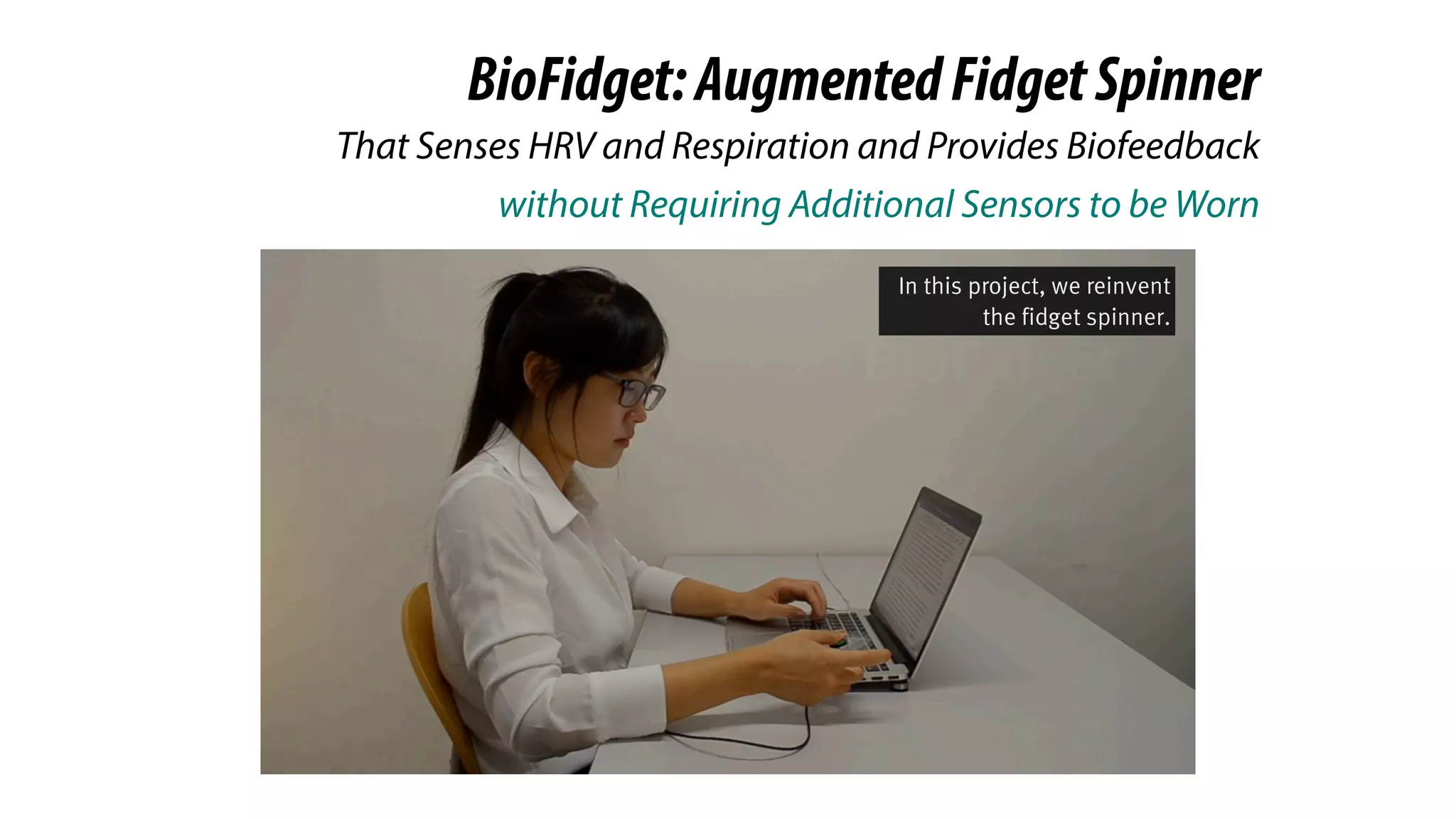
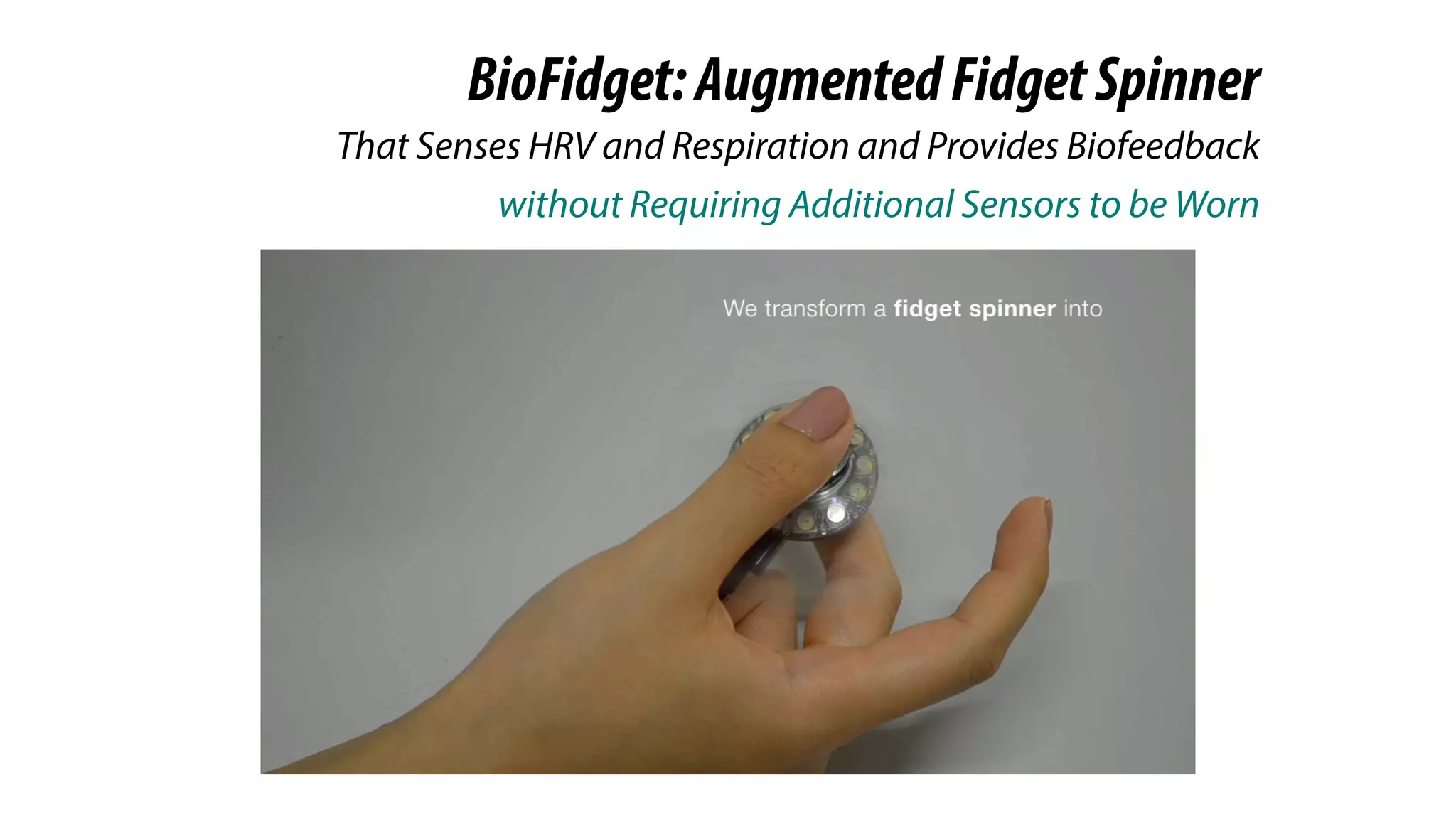
In this project, we reinvent
the fidget spinner.
BioFidget:AugmentedFidgetSpinner
without Requiring Additional Sensors to be Worn
That Senses HRV and Respiration and Provides Biofeedback
BioFidget:AugmentedFidgetSpinner
without Requiring Additional Sensors to be Worn
That Senses HRV and Respiration and Provides Biofeedback
BioFidget:AugmentedFidgetSpinner
without Requiring Additional Sensors to be Worn
That Senses HRV and Respiration and Provides Biofeedback
BioFidget:AugmentedFidgetSpinner
without Requiring Additional Sensors to be Worn
That Senses HRV and Respiration and Provides Biofeedback
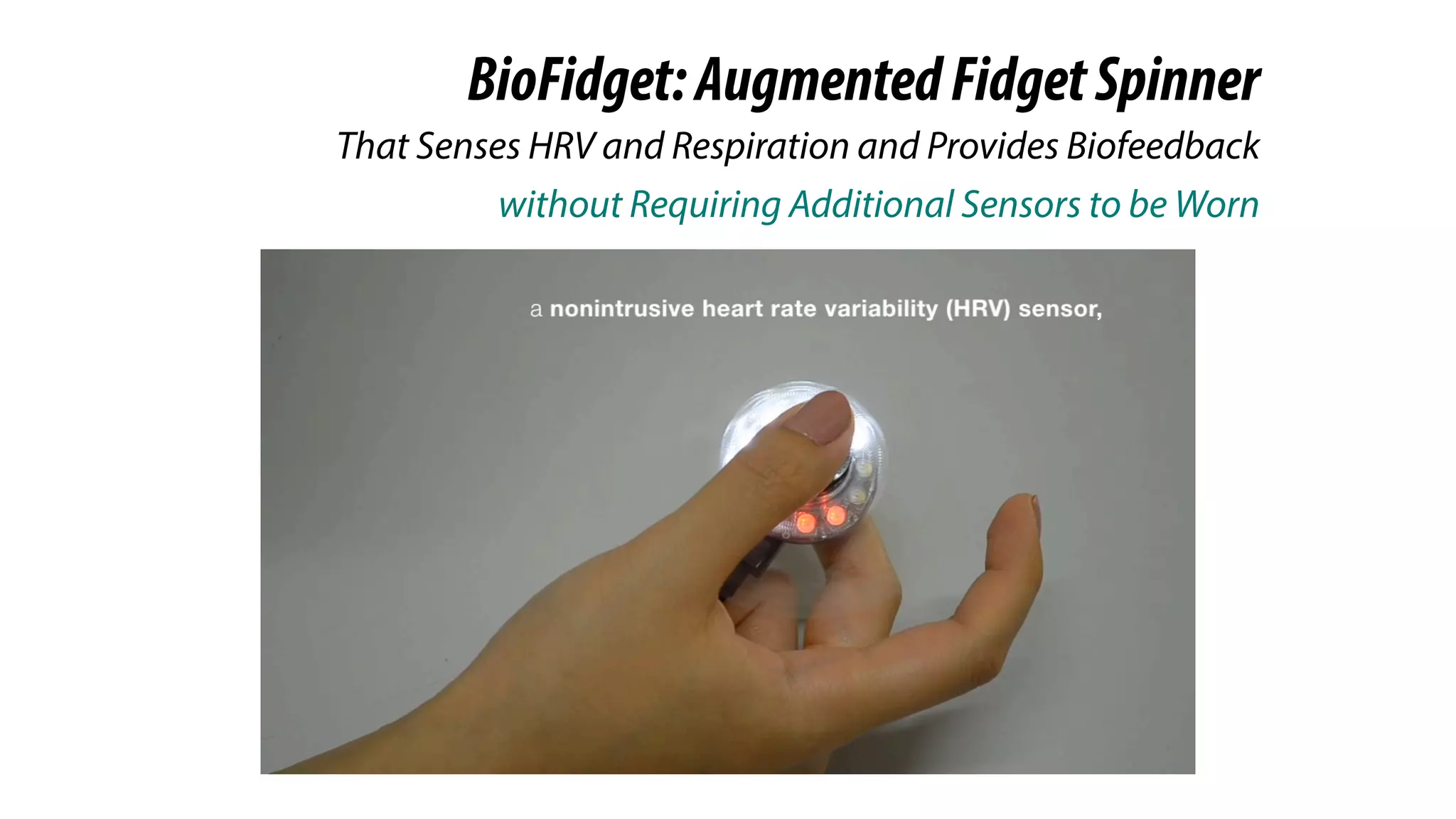
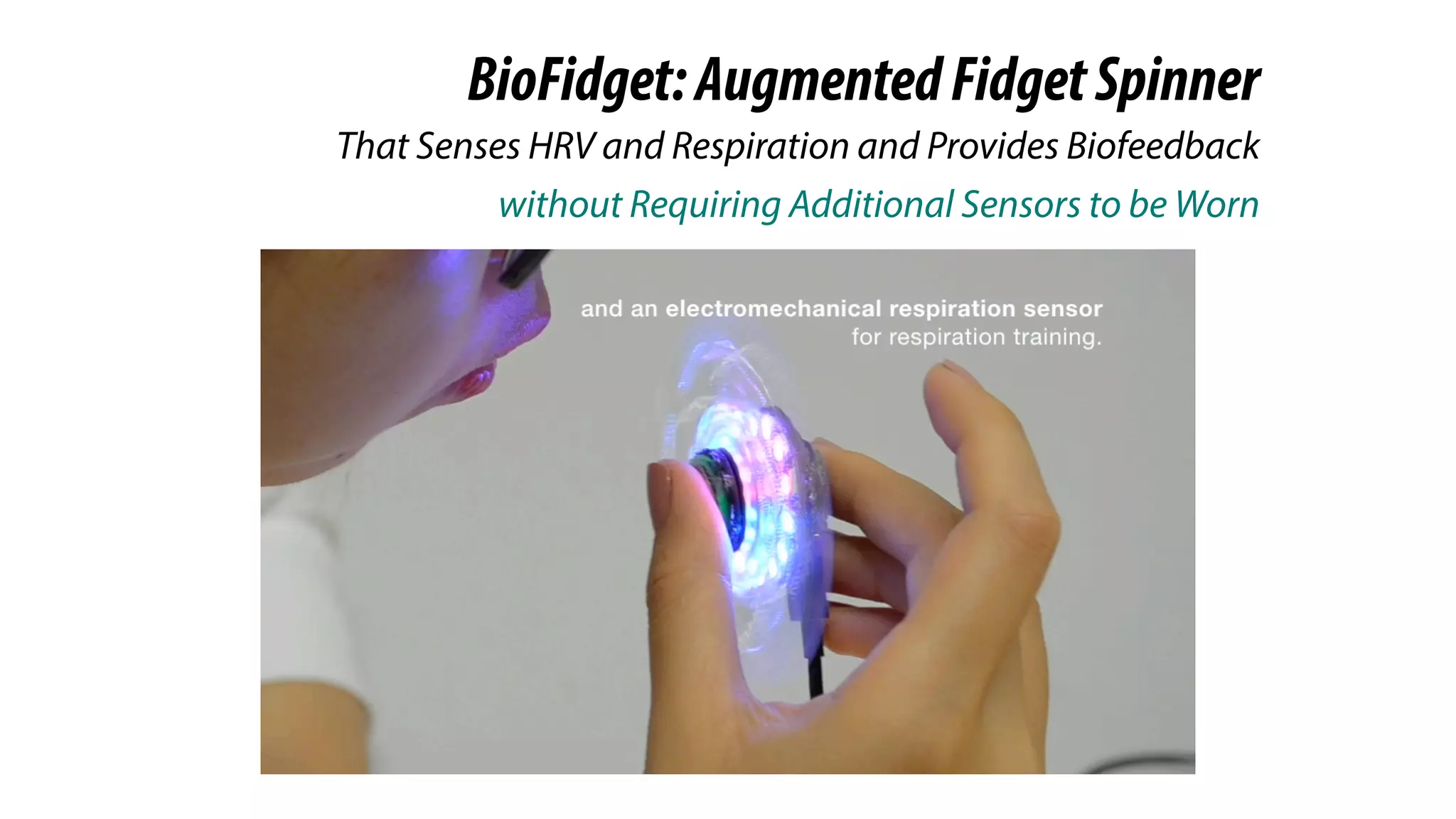
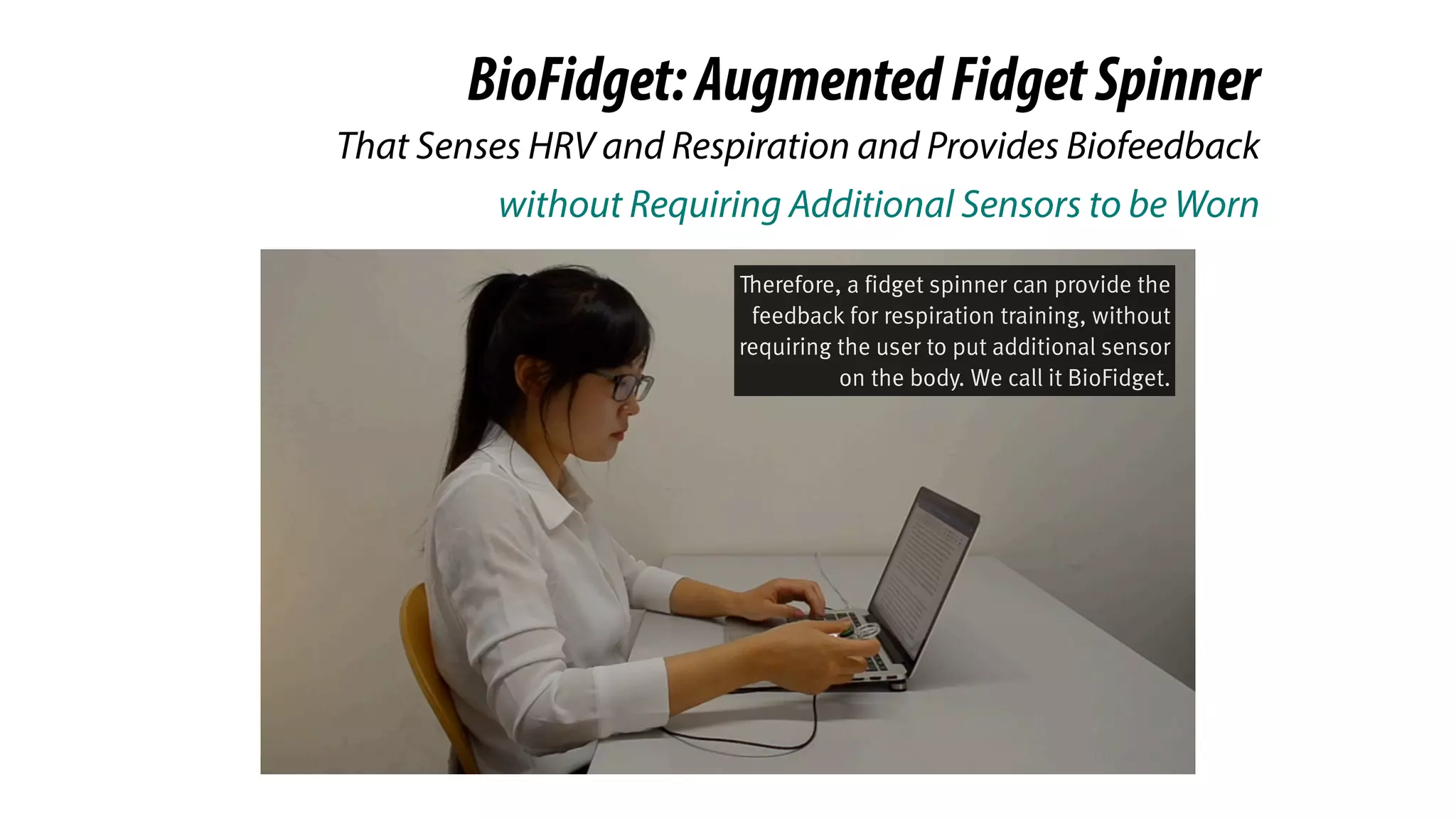
Therefore, a fidget spinner can provide the
feedback for respiration training, without
requiring the user to put additional sensor
on the body. We call it BioFidget.
RedesigningFidgetSpinner
To Meet Both Technical Validity and Playfulness
Playfulness
Technical
Validity&
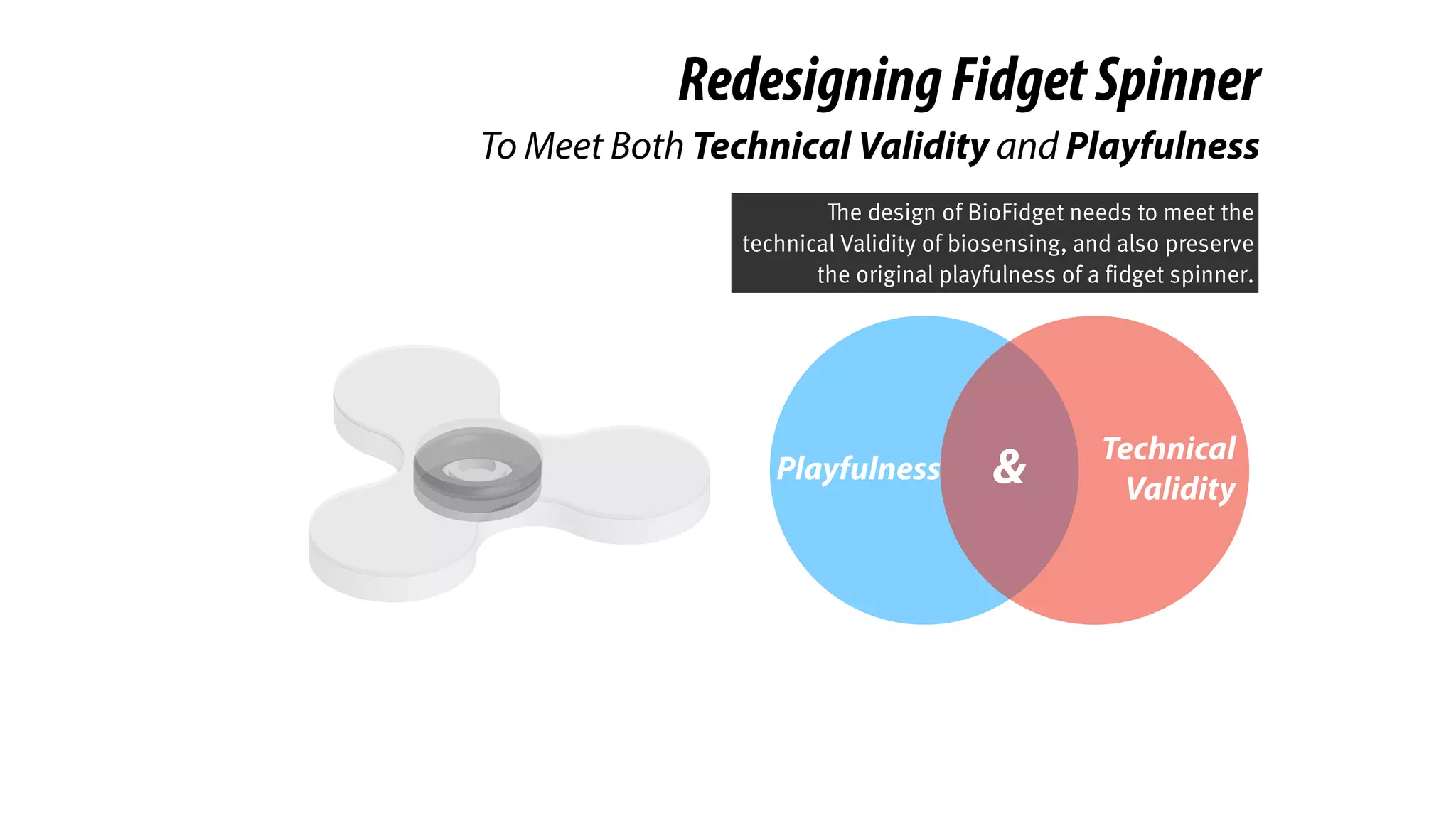
The design of BioFidget needs to meet the
technical Validity of biosensing, and also preserve
the original playfulness of a fidget spinner.
RedesigningFidgetSpinner
To Meet Both Technical Validity and Playfulness
Pad
Pad
Wing
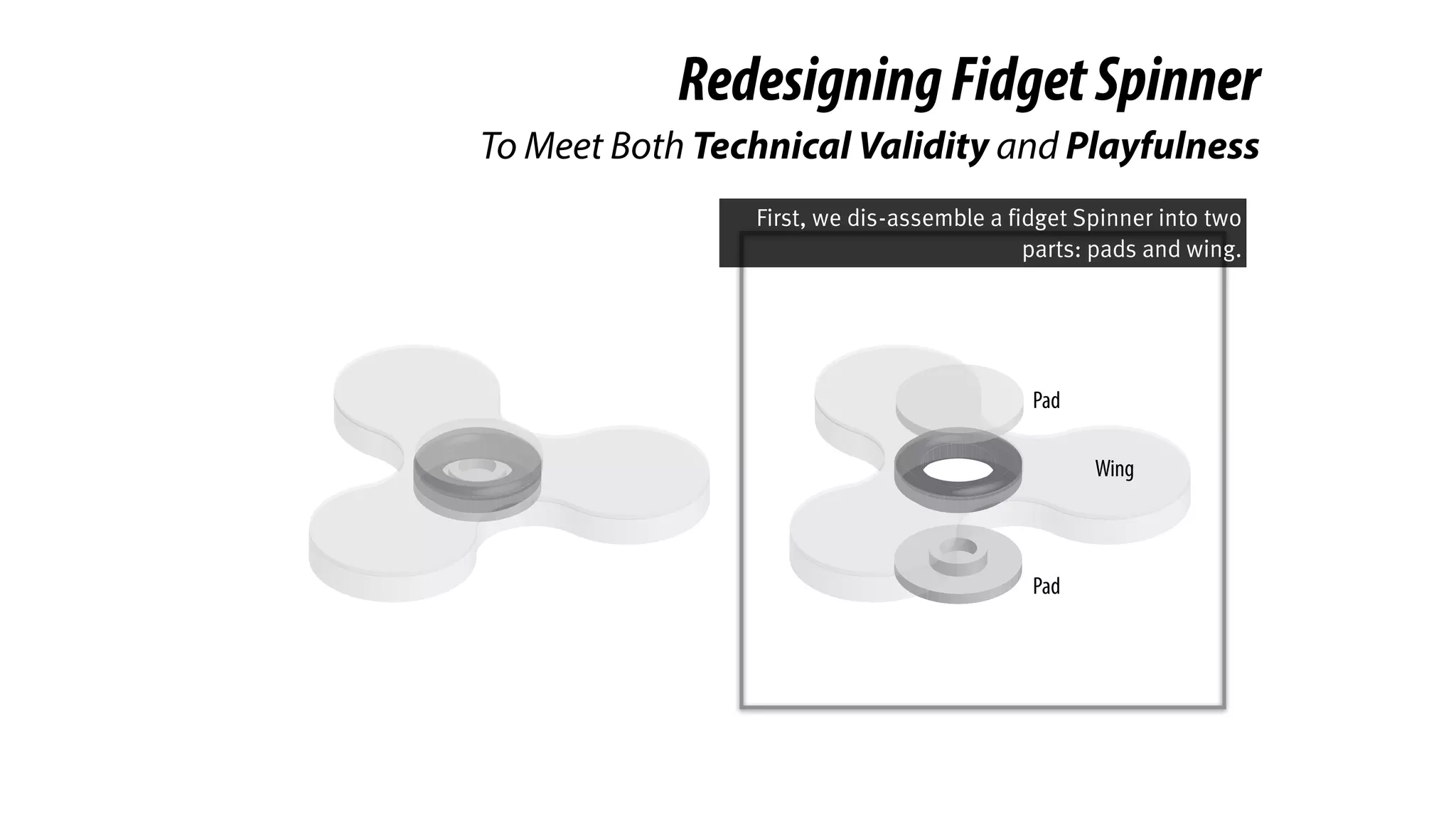
First, we dis-assemble a fidget Spinner into two
parts: pads and wing.
RedesigningFidgetSpinner
To Meet Both Technical Validity and Playfulness
Pad
Pad
Wing
PPG Sensor
Micro-controller
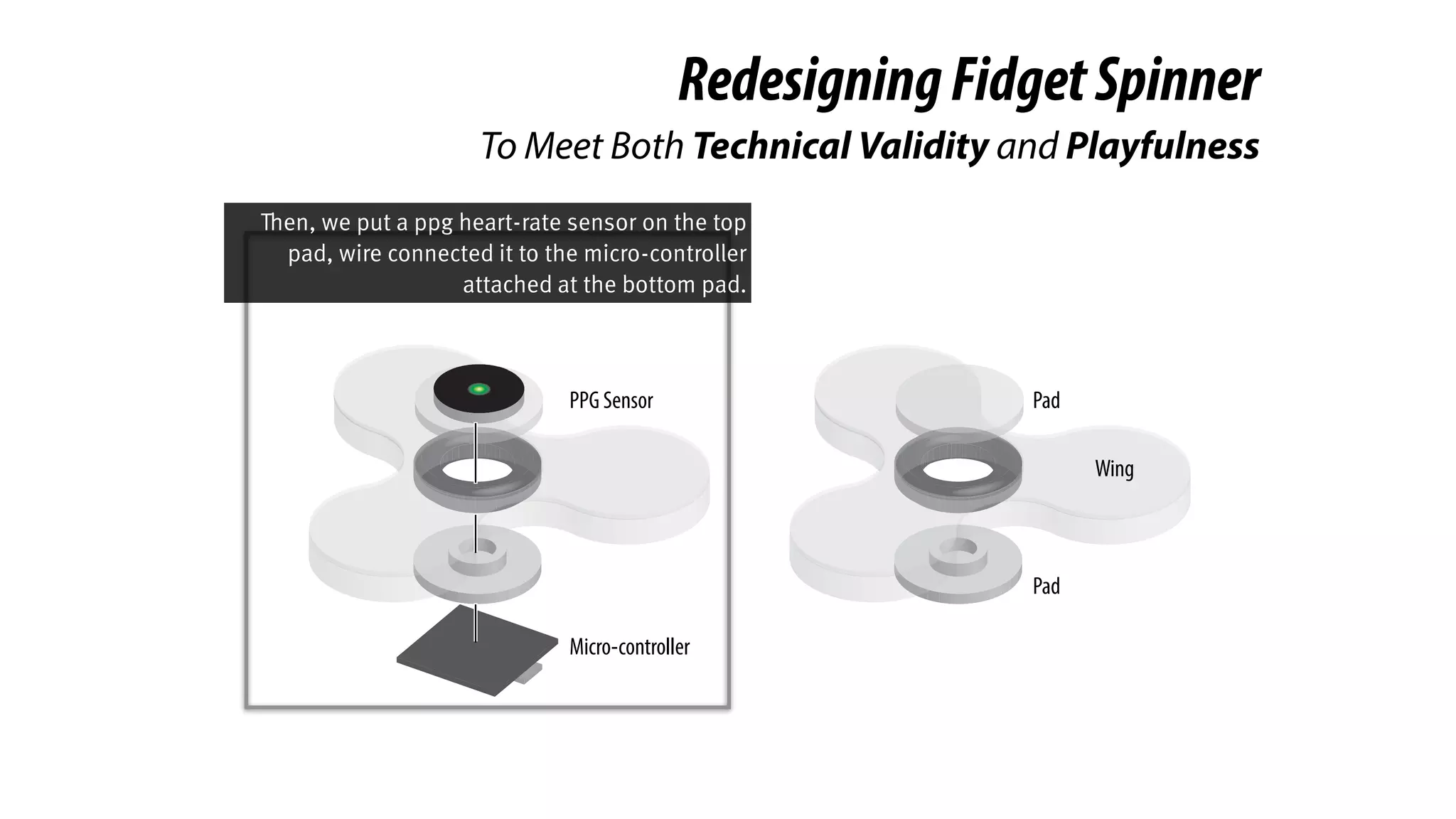
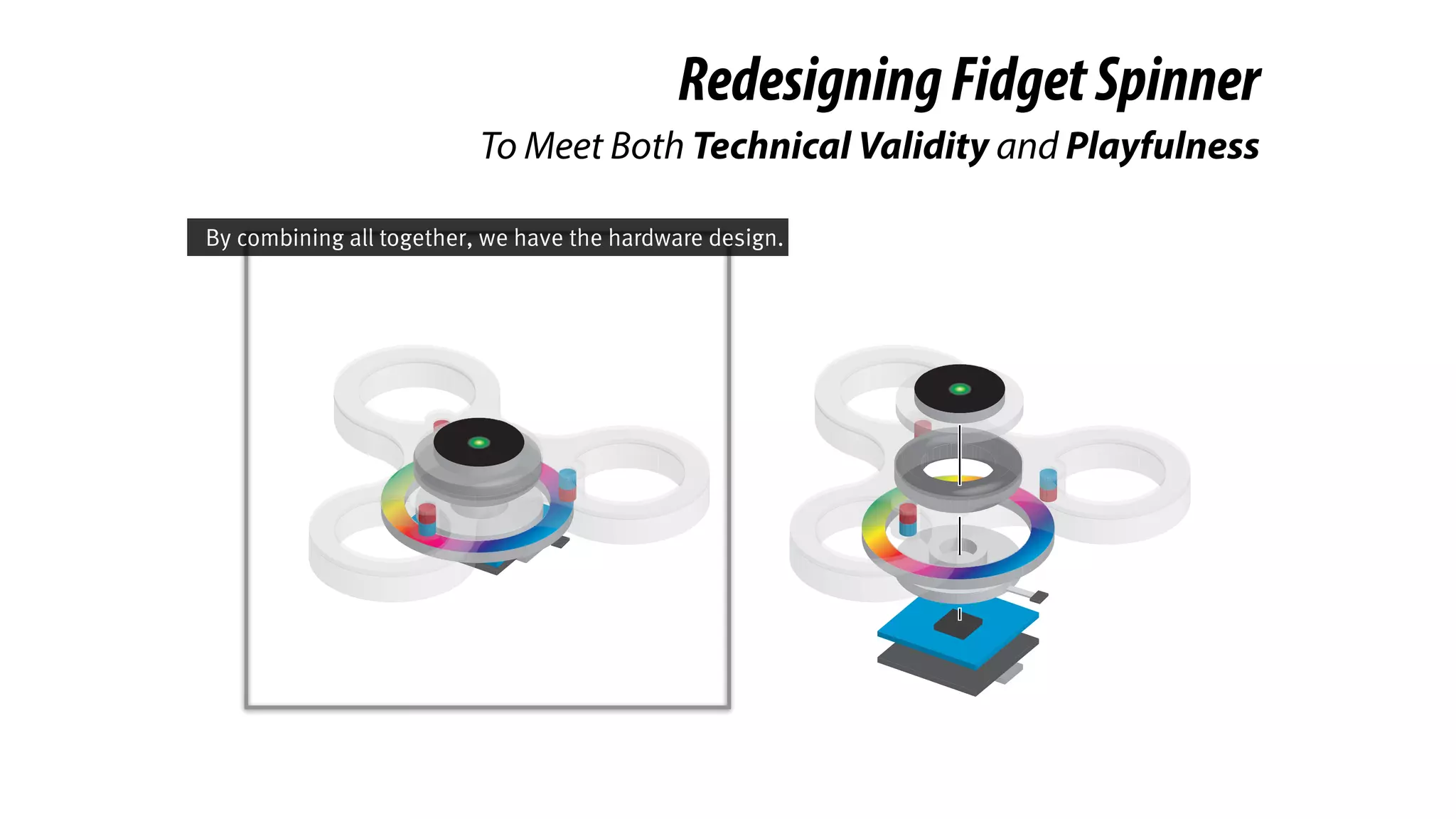
Then, we put a ppg heart-rate sensor on the top
pad, wire connected it to the micro-controller
attached at the bottom pad.
RedesigningFidgetSpinner
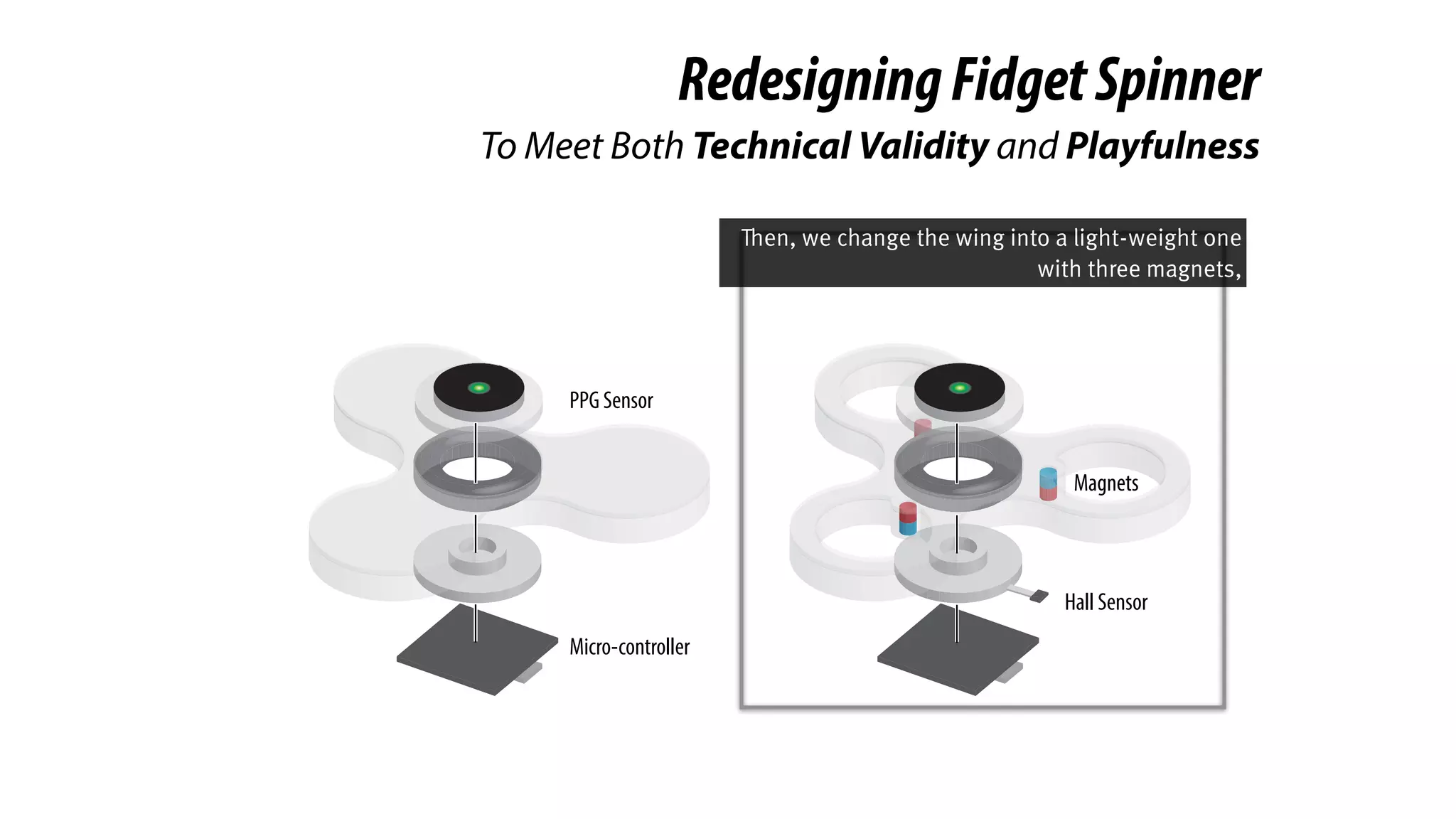
To Meet Both Technical Validity and Playfulness
PPG Sensor
Micro-controller
Hall Sensor
Magnets
Then, we change the wing into a light-weight one
with three magnets,
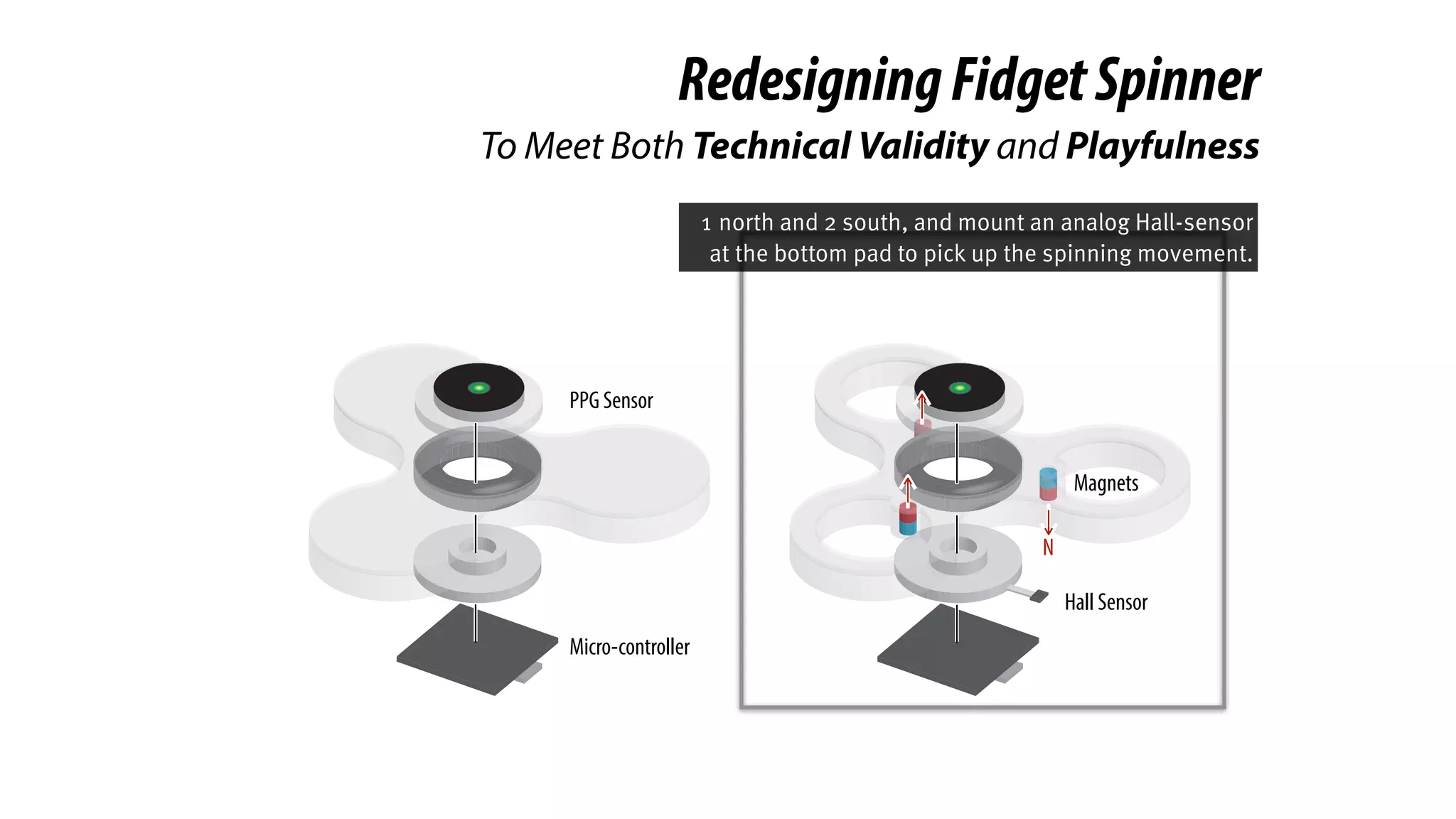
RedesigningFidgetSpinner
To Meet Both Technical Validity and Playfulness
PPG Sensor
Micro-controller
Hall Sensor
Magnets
N
1 north and 2 south, and mount an analog Hall-sensor
at the bottom pad to pick up the spinning movement.
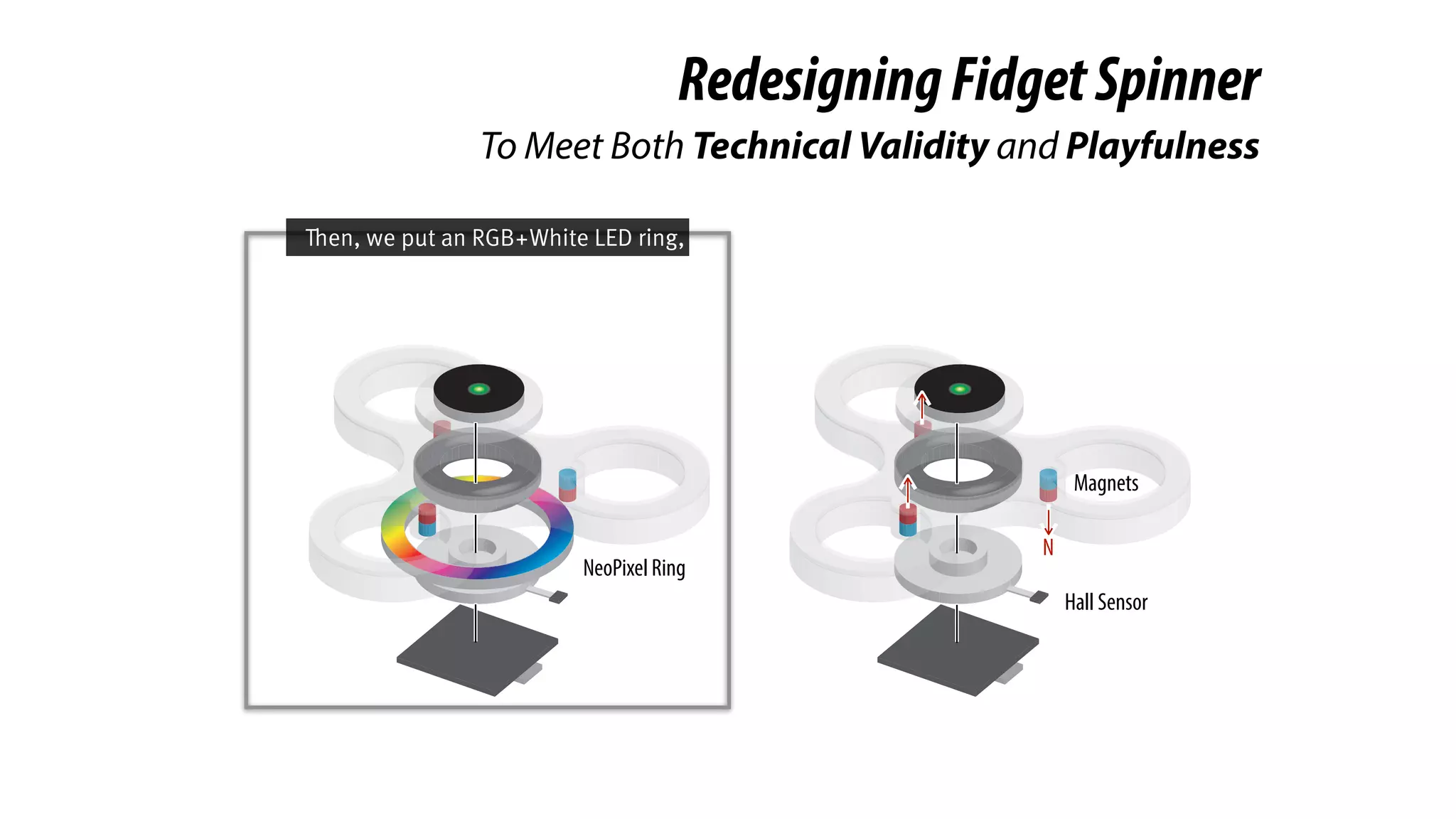
RedesigningFidgetSpinner
To Meet Both Technical Validity and Playfulness
Hall Sensor
Magnets
N
NeoPixel Ring
Then, we put an RGB+White LED ring,
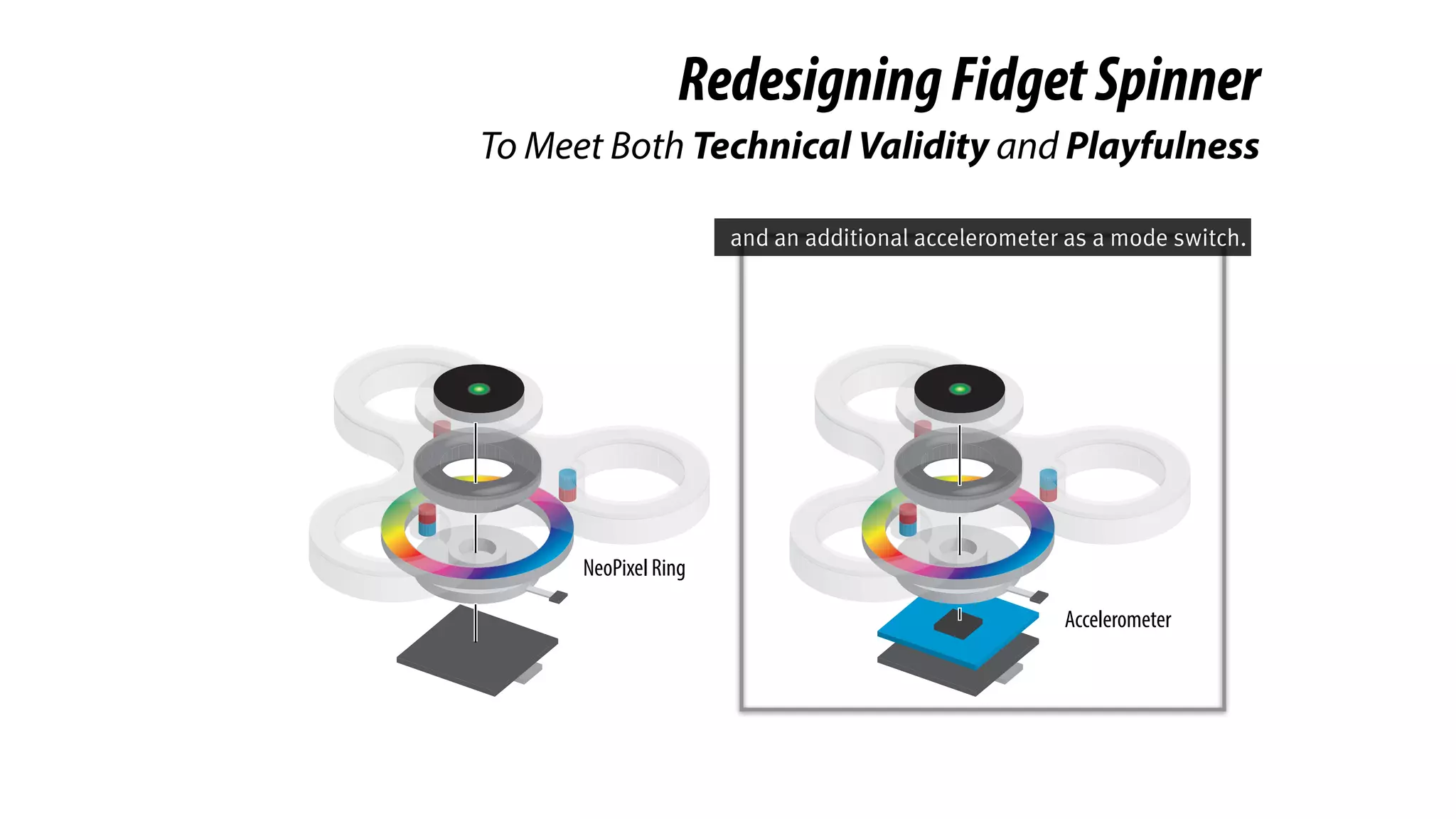
RedesigningFidgetSpinner
To Meet Both Technical Validity and Playfulness
NeoPixel Ring
Accelerometer
and an additional accelerometer as a mode switch.
RedesigningFidgetSpinner
To Meet Both Technical Validity and Playfulness
By combining all together, we have the hardware design.
RedesigningFidgetSpinner
To Meet Both Technical Validity and Playfulness
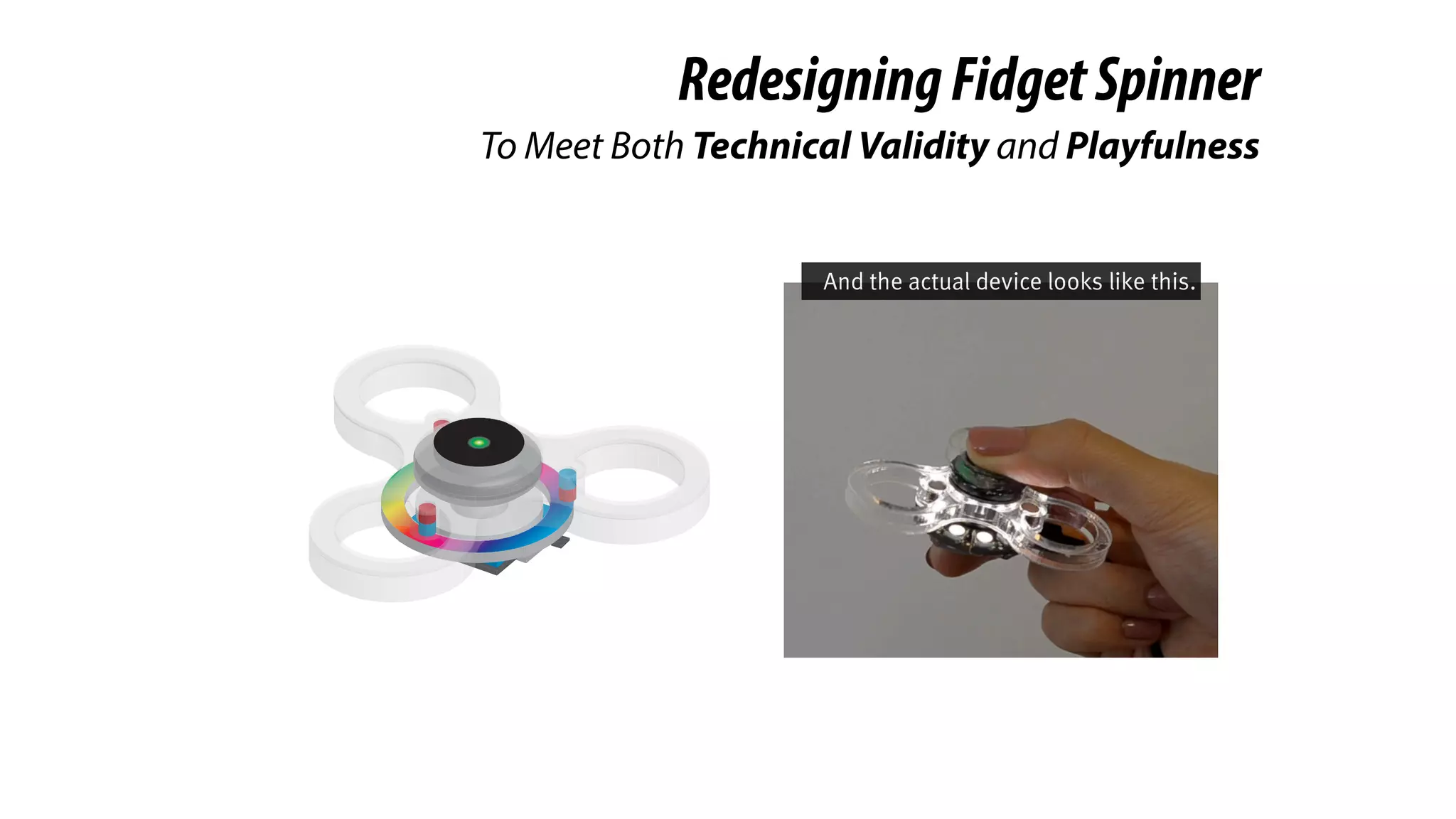
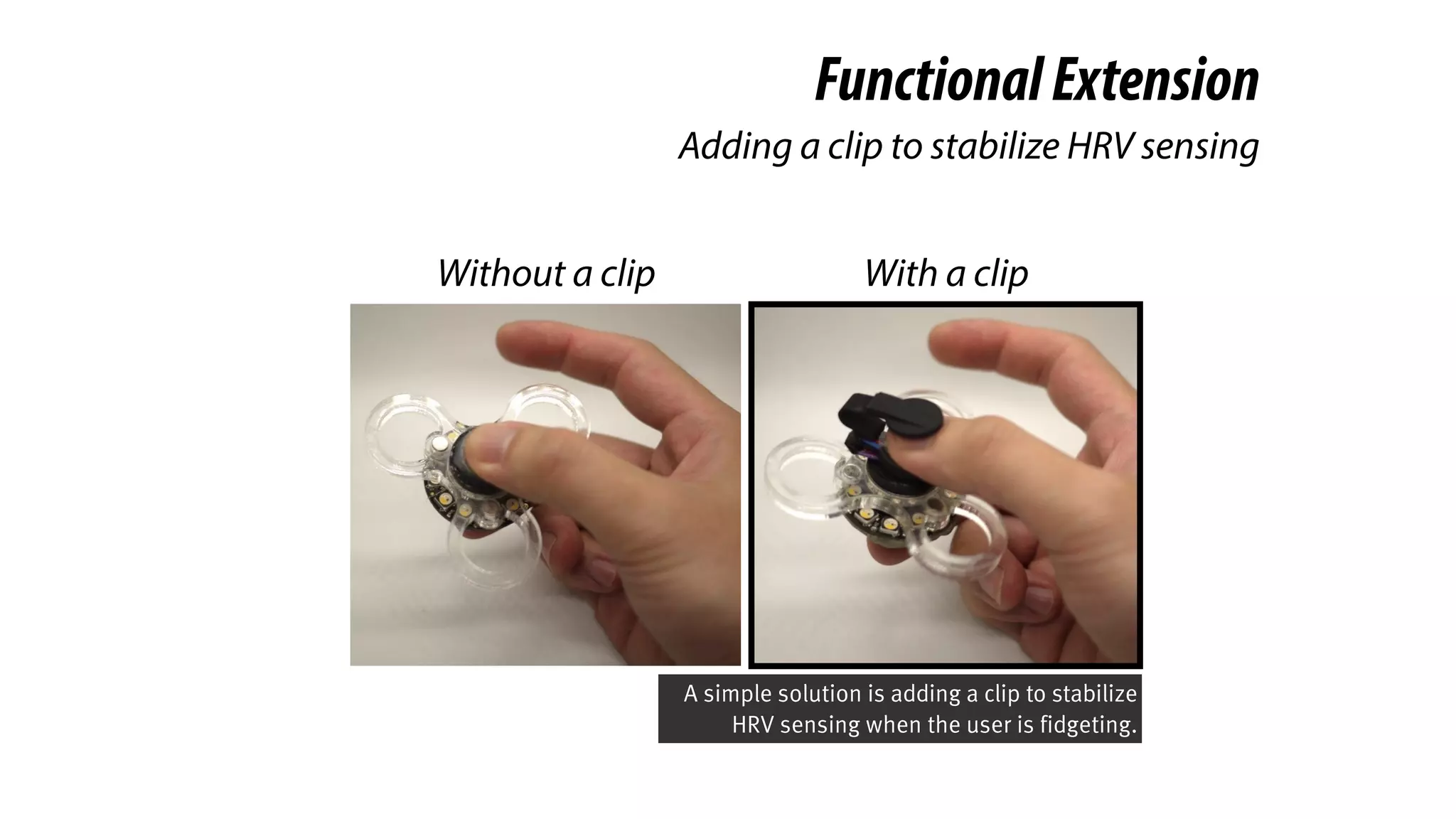
And the actual device looks like this.
SignalProcessing
Signal Pipeline
PPG Sensor
Hall Sensor
DisplayMicro-controller
(500Hz Sampling)
Heart RateVariability
Respiration
Action
PPG Sensor Signals
Hall Sensor Signals
PC
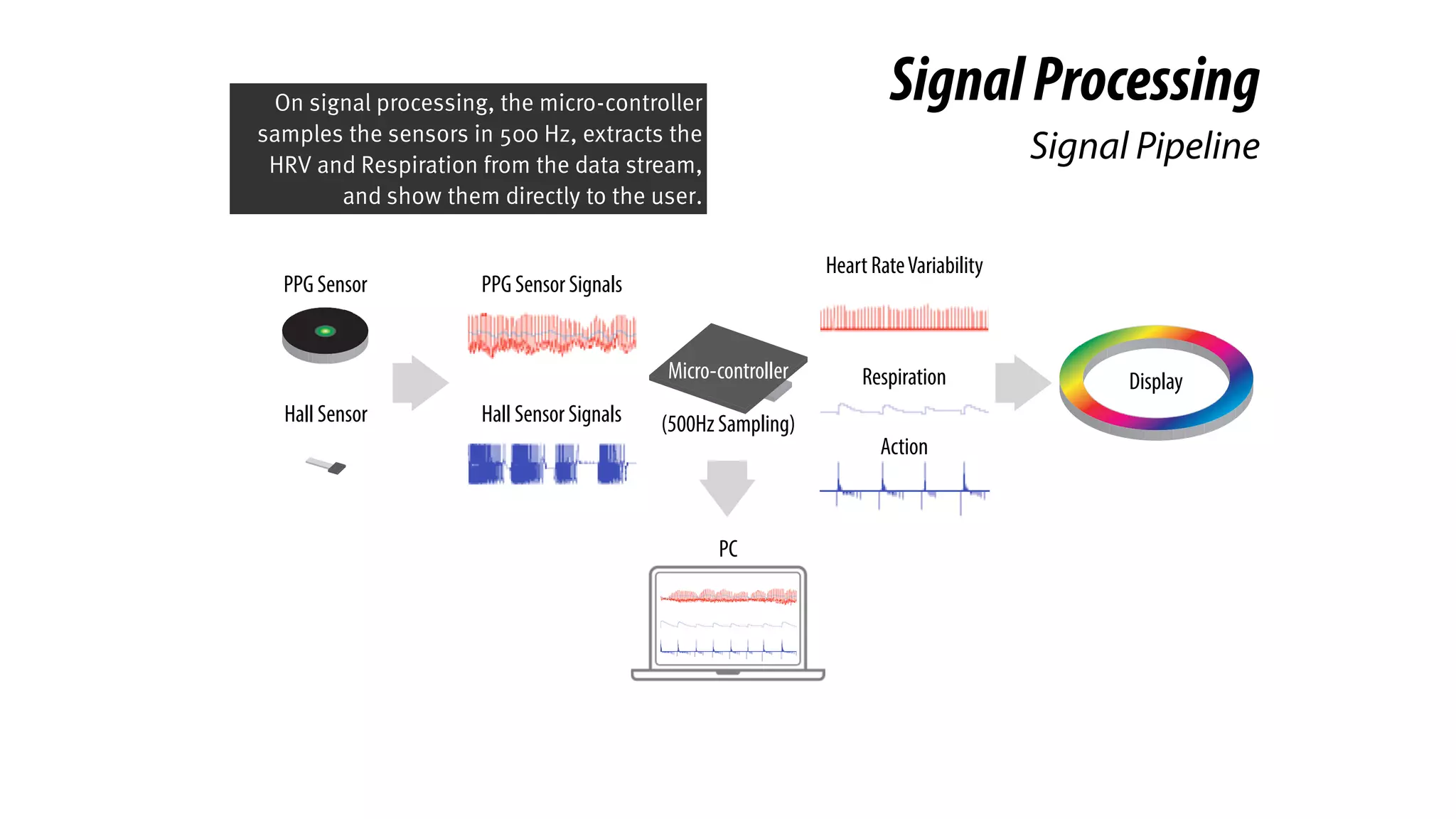
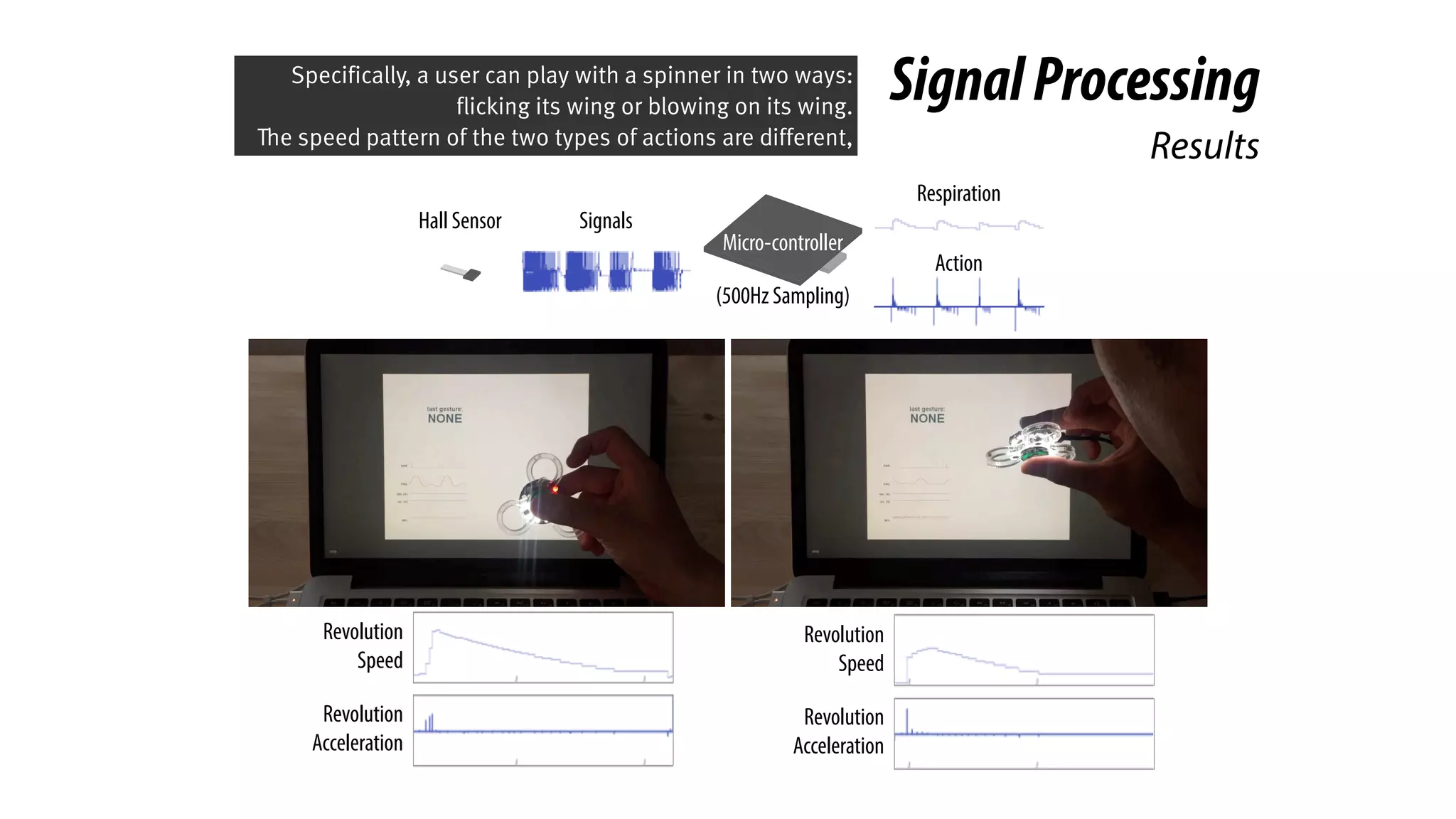
On signal processing, the micro-controller
samples the sensors in 500 Hz, extracts the
HRV and Respiration from the data stream,
and show them directly to the user.
HRVSensing
Algorithm
PPG Sensor
Micro-controller
(500Hz Sampling)
Heart RateVariabilitySignals
time
(diastolic point)
Dn-1
Sn
Dn
dn
TnTn-1
(systolic point)
(dicrotic notch)
Sn-1 Sn+1
Dn+1
dn+1
Tn+1
voltage
dn-1
t(Bn-1) t(Bn) t(Bn+1)
IBInIBIn-1
Robin P Smith, Jerome Argod, Jean-Louis Pepin, and Patrick A Levy. 1999.
Pulse transit time: an appraisal of potential clinical applications. Thorax 54, 5 (1999), 452–457.
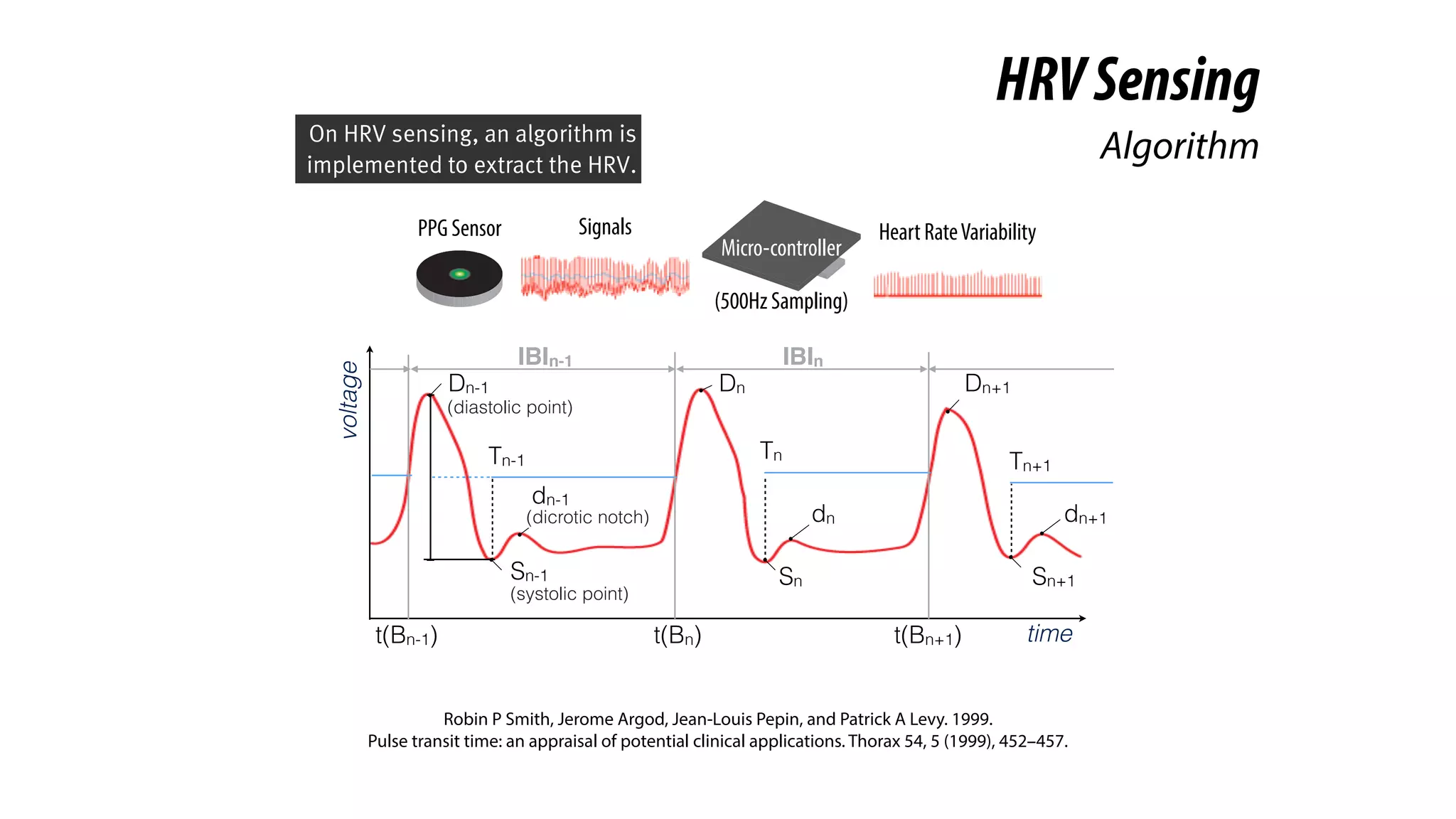
On HRV sensing, an algorithm is
implemented to extract the HRV.
PPG Sensor
Micro-controller
(500Hz Sampling)
Heart RateVariability
Signals
PPG Sensor
Micro-controller
(500Hz Sampling)
Heart RateVariabilitySignals
HRVSensing
Results
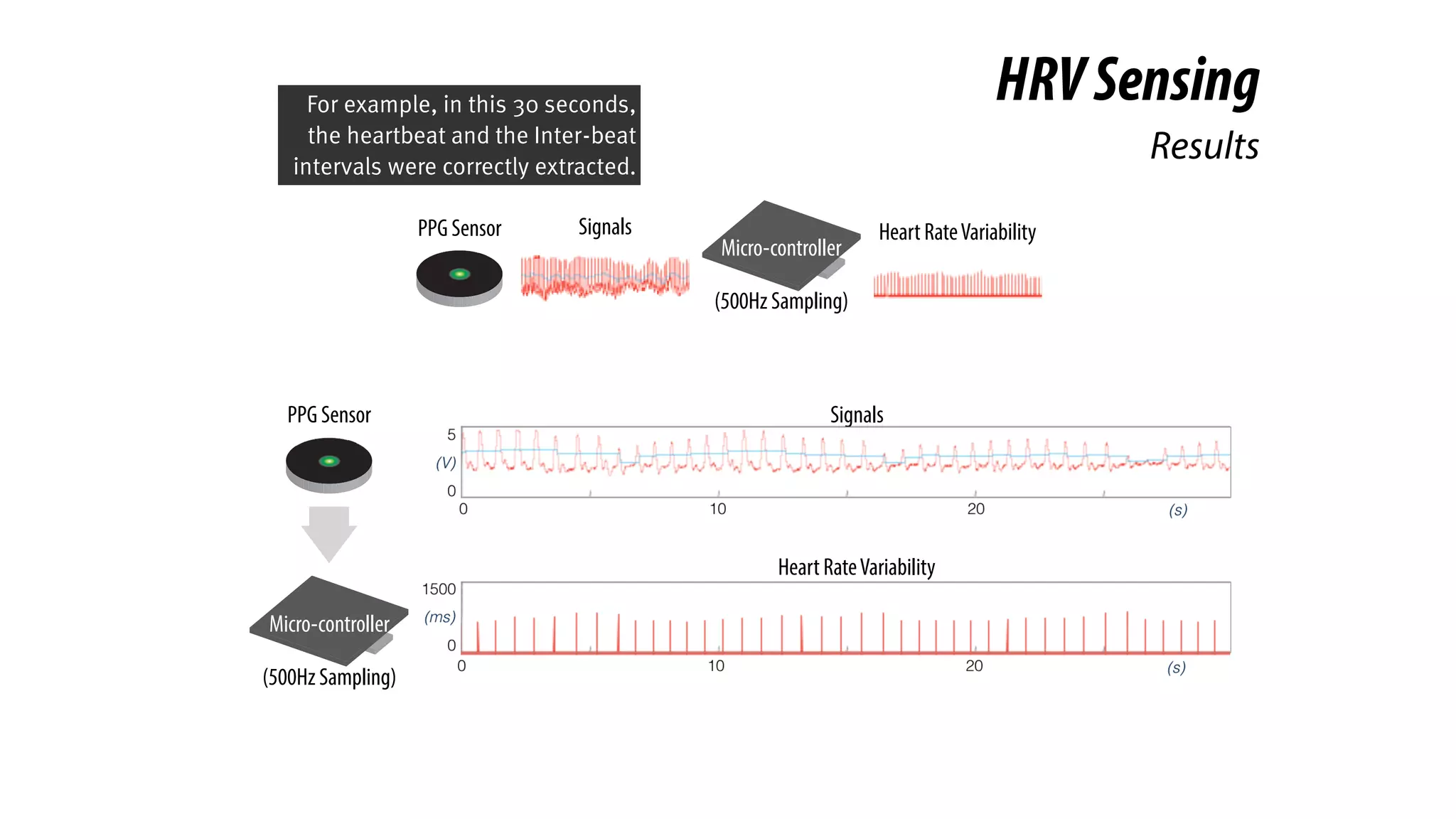
For example, in this 30 seconds,
the heartbeat and the Inter-beat
intervals were correctly extracted.
SignalProcessing
Algorithm (1/2)
Hall Sensor
Micro-controller
(500Hz Sampling)
Respiration
Action
Signals
voltage
time
rectified
north
south
Hall Sensor
Magnets
N raw
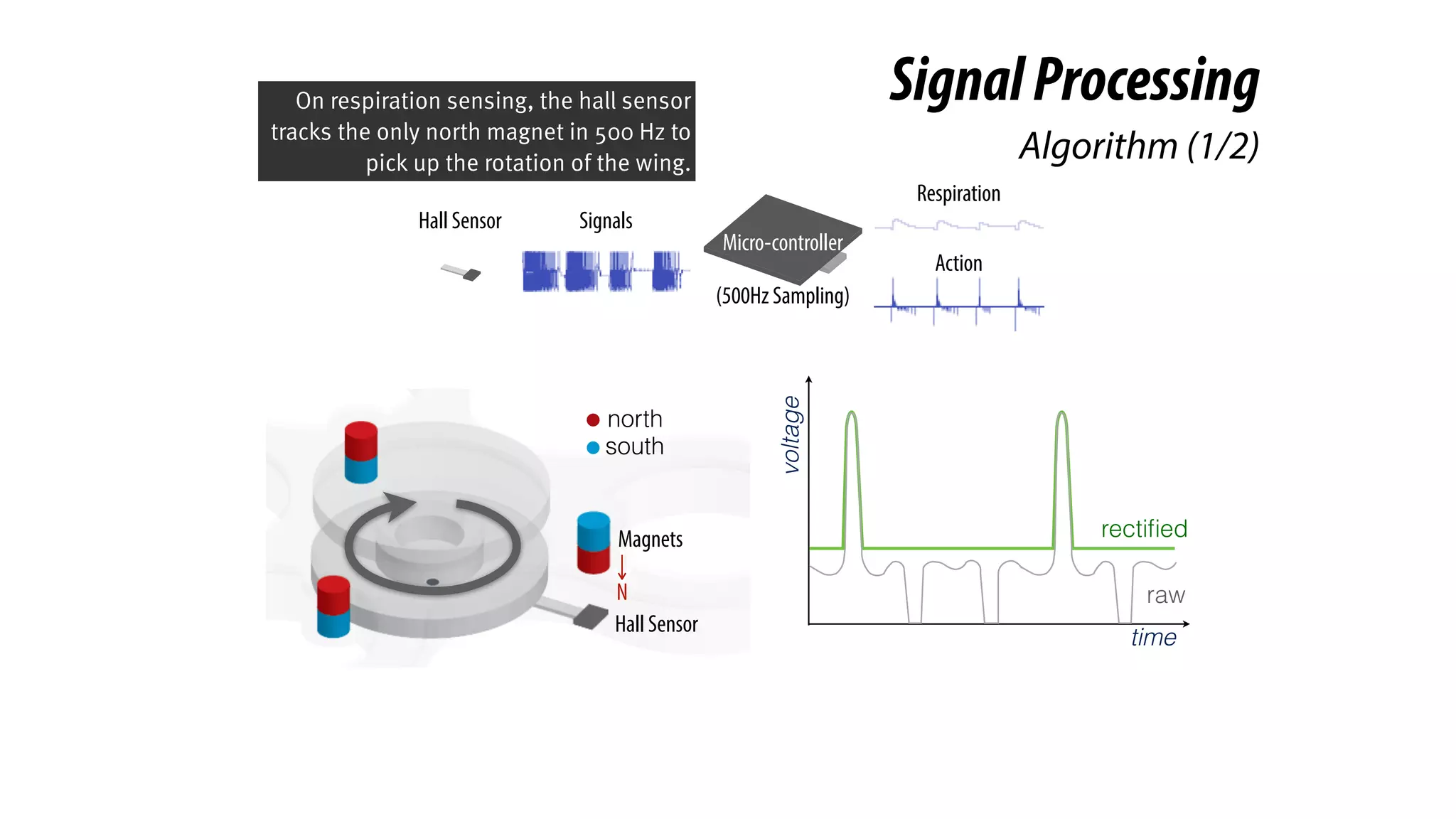
On respiration sensing, the hall sensor
tracks the only north magnet in 500 Hz to
pick up the rotation of the wing.
SignalProcessing
Algorithm (2/2)
Hall Sensor
Micro-controller
(500Hz Sampling)
Respiration
Action
Signals
Hall Sensor
Micro-controller
(500Hz Sampling)
Revolution Speed
Signals
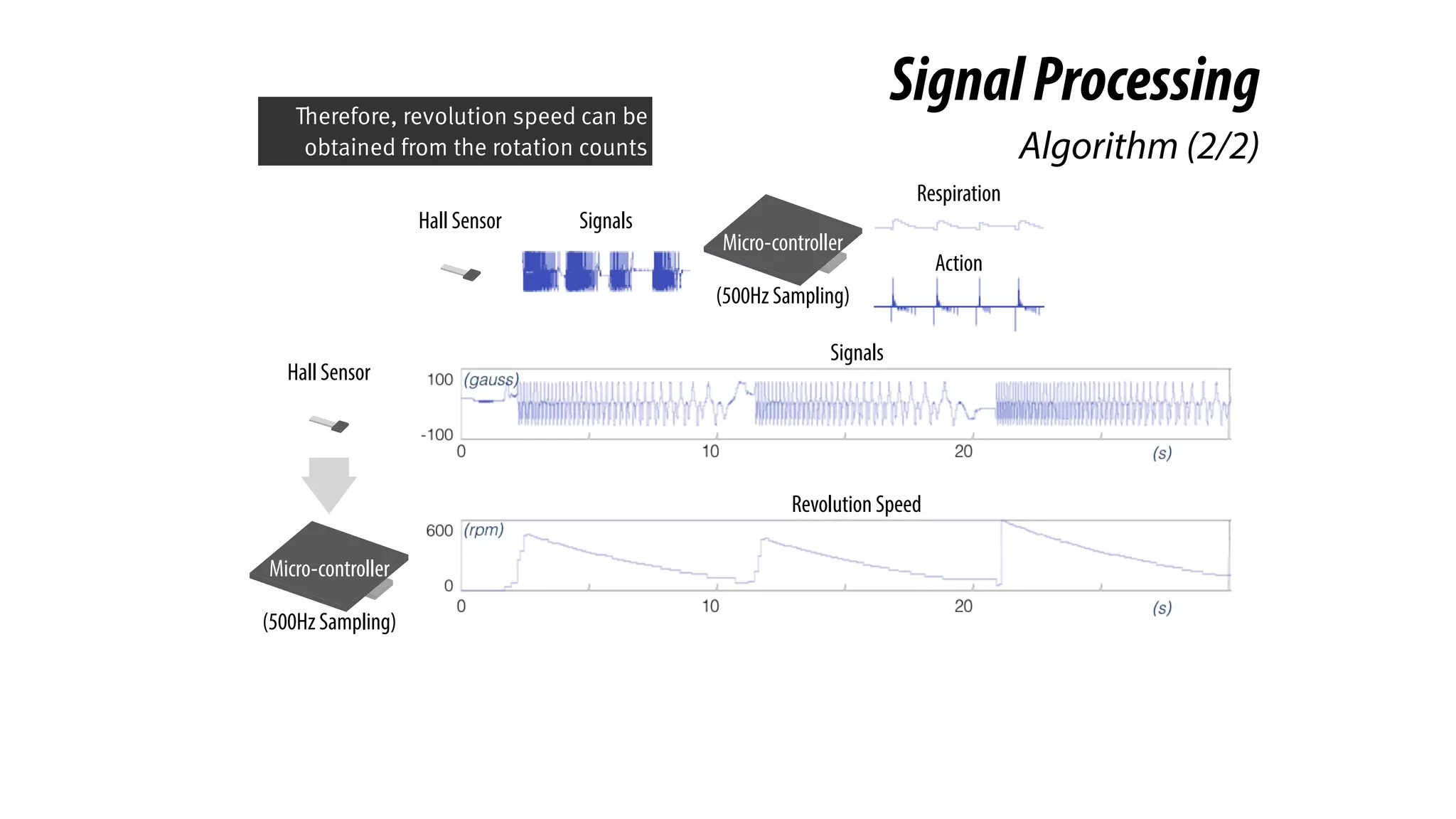
Therefore, revolution speed can be
obtained from the rotation counts
SignalProcessing
Algorithm (2/2)
Hall Sensor
Micro-controller
(500Hz Sampling)
Respiration
Action
Signals
Hall Sensor
Micro-controller
(500Hz Sampling)
Revolution Speed
Signals
Revolution Acceleration
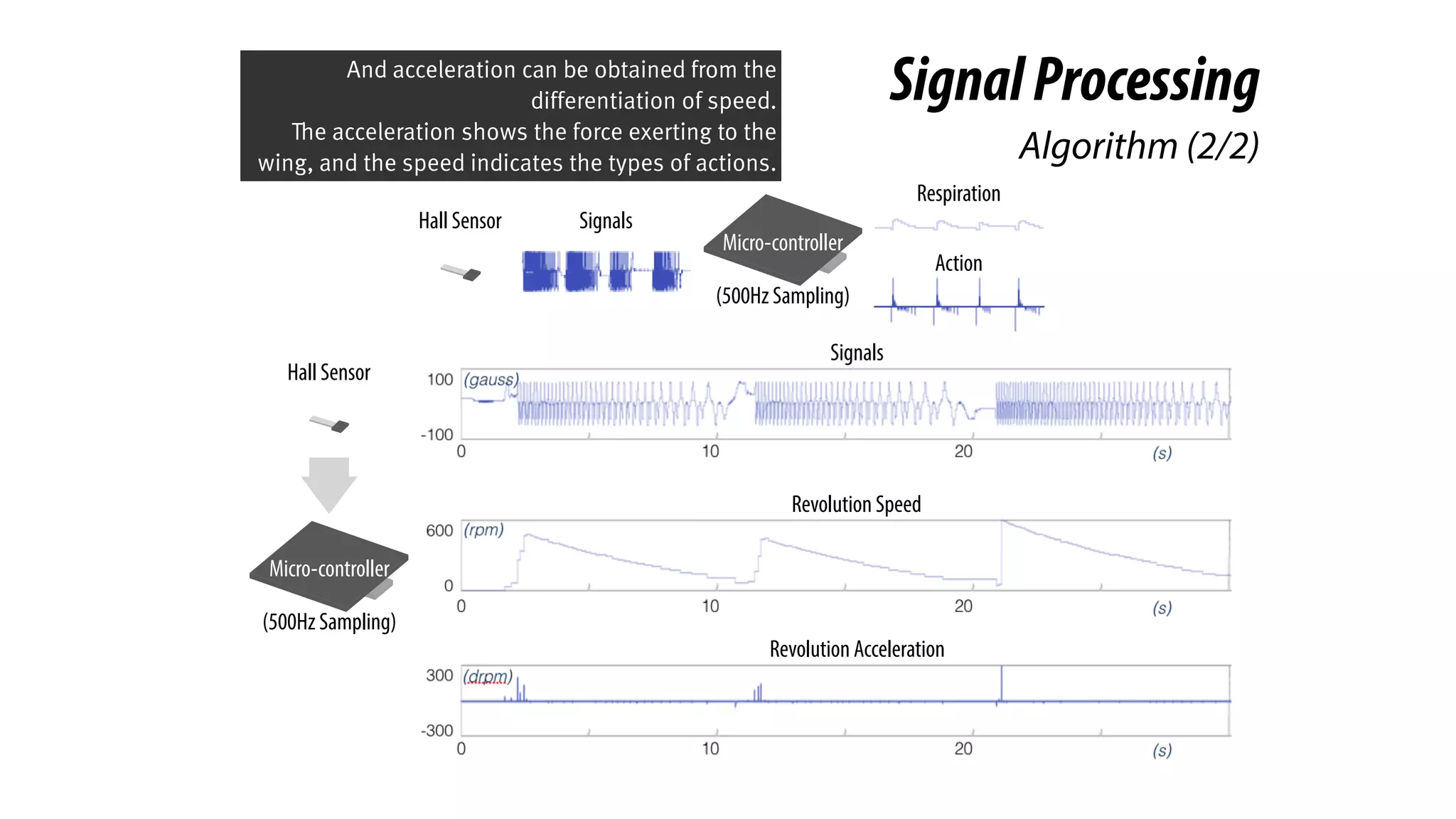
And acceleration can be obtained from the
differentiation of speed.
The acceleration shows the force exerting to the
wing, and the speed indicates the types of actions.
Results
Hall Sensor
Micro-controller
(500Hz Sampling)
Respiration
Action
Signals
Revolution
Speed
Revolution
Acceleration
Revolution
Speed
Revolution
Acceleration
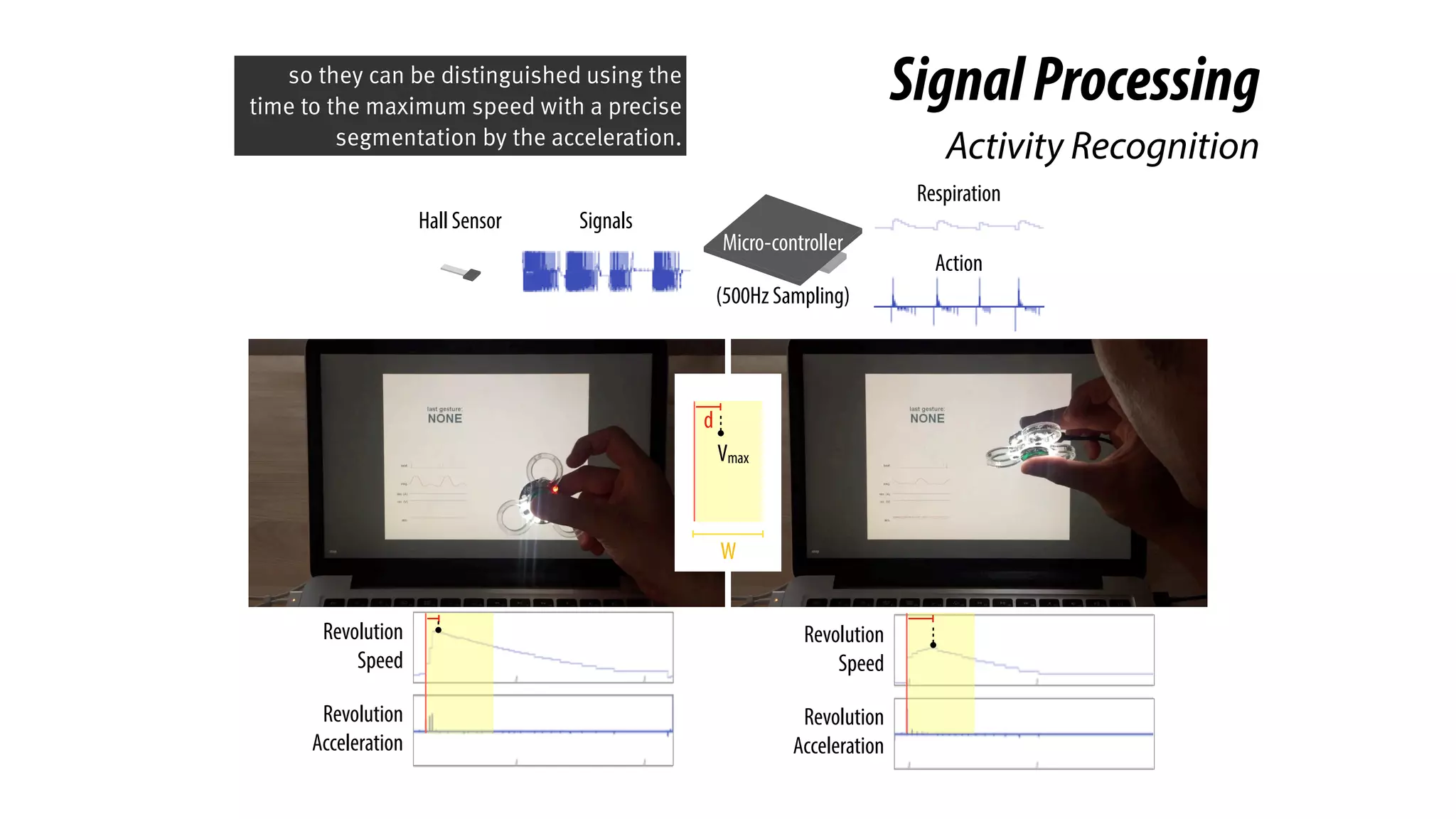
SignalProcessingSpecifically, a user can play with a spinner in two ways:
flicking its wing or blowing on its wing.
The speed pattern of the two types of actions are different,
Activity Recognition
Hall Sensor
Micro-controller
(500Hz Sampling)
Respiration
Action
Signals
Revolution
Speed
Revolution
Acceleration
Revolution
Speed
Revolution
Acceleration
SignalProcessing
W
d
Vmax
so they can be distinguished using the
time to the maximum speed with a precise
segmentation by the acceleration.
For respiration training
BioFeedback
Signals
Guidance and Feedback
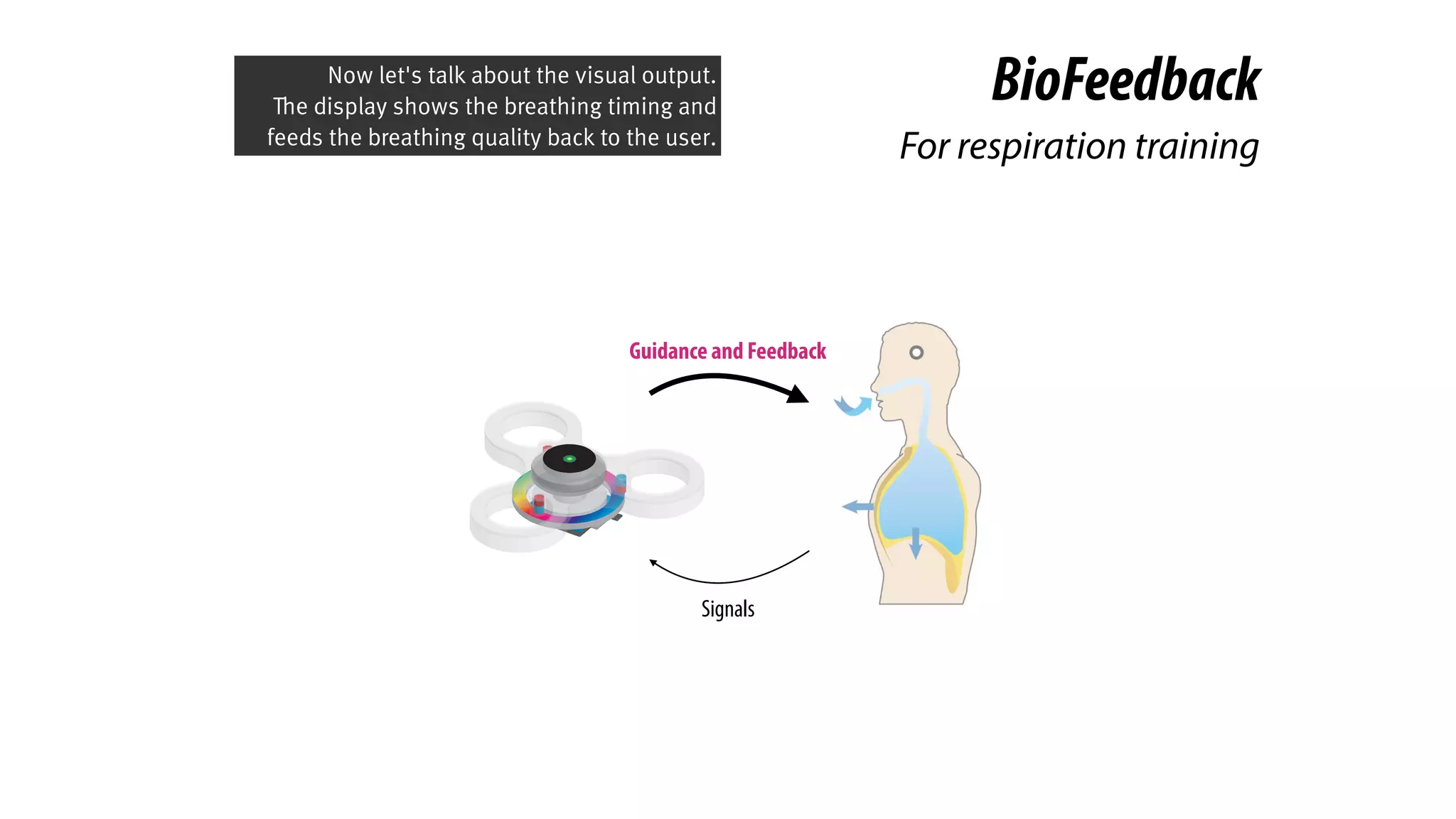
Now let's talk about the visual output.
The display shows the breathing timing and
feeds the breathing quality back to the user.
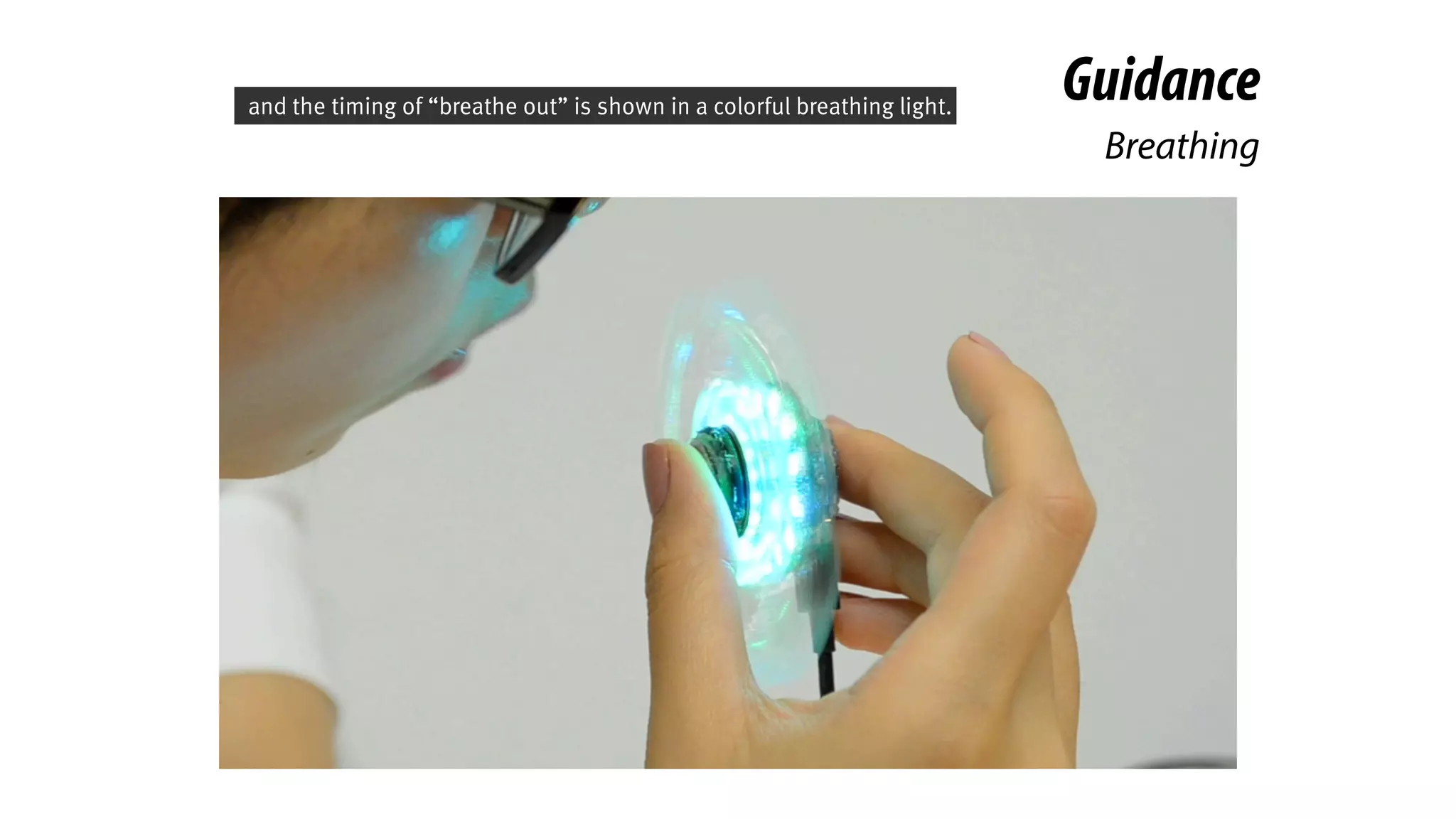
Breathing
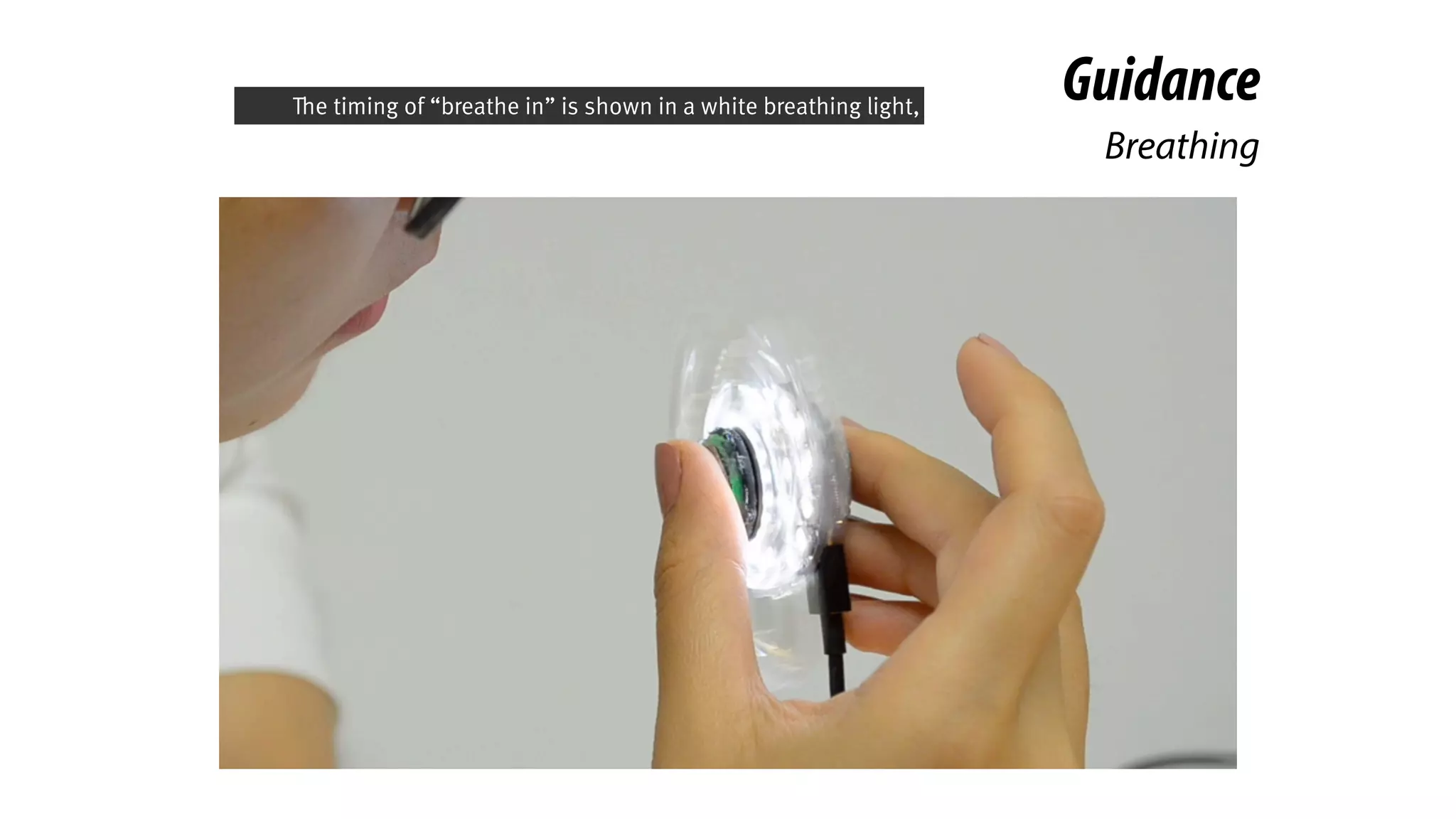
GuidanceThe timing of “breathe in” is shown in a white breathing light,
Breathing
Guidanceand the timing of “breathe out” is shown in a colorful breathing light.
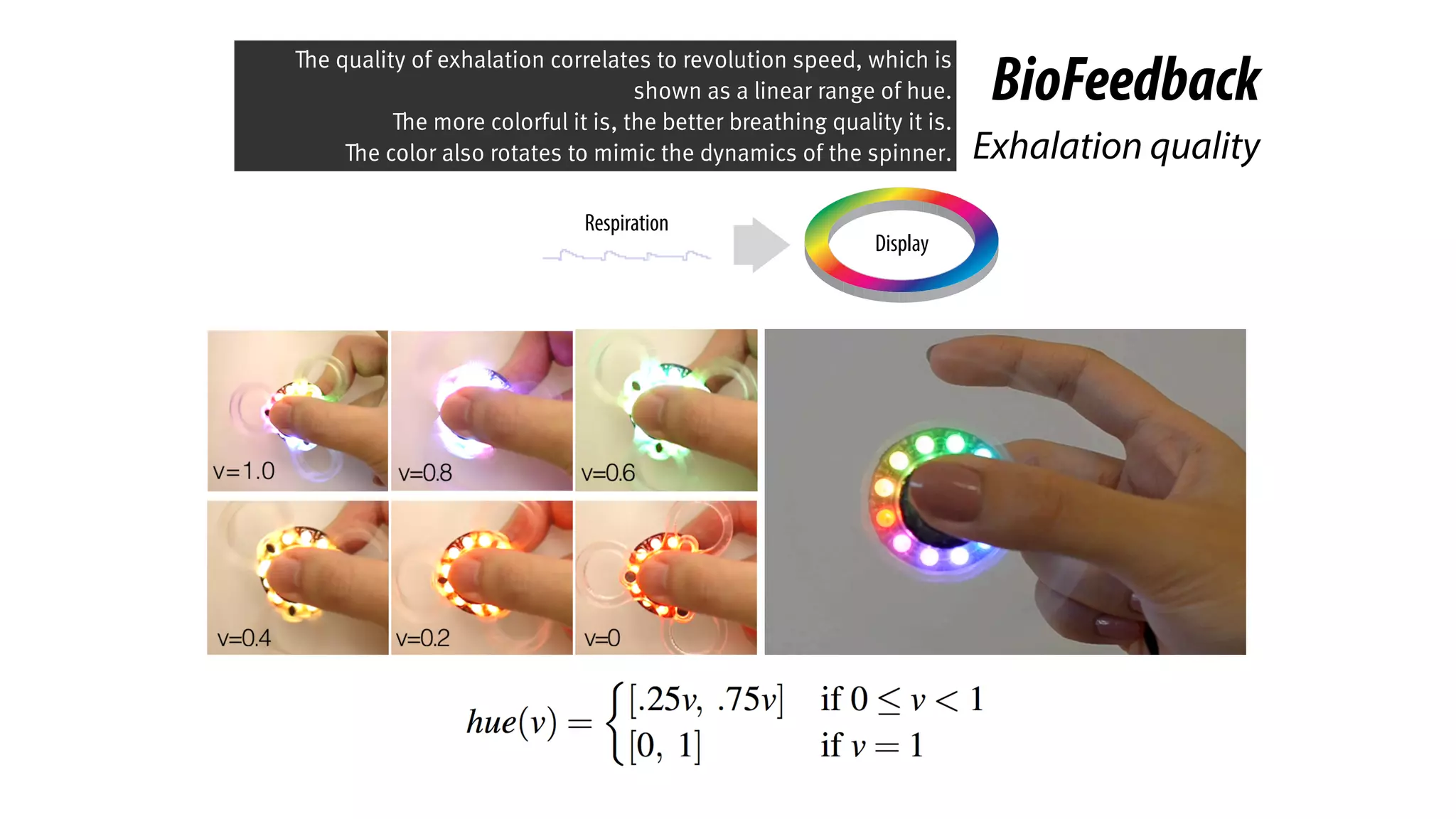
Exhalation quality
BioFeedback
Respiration
Display
The quality of exhalation correlates to revolution speed, which is
shown as a linear range of hue.
The more colorful it is, the better breathing quality it is.
The color also rotates to mimic the dynamics of the spinner.
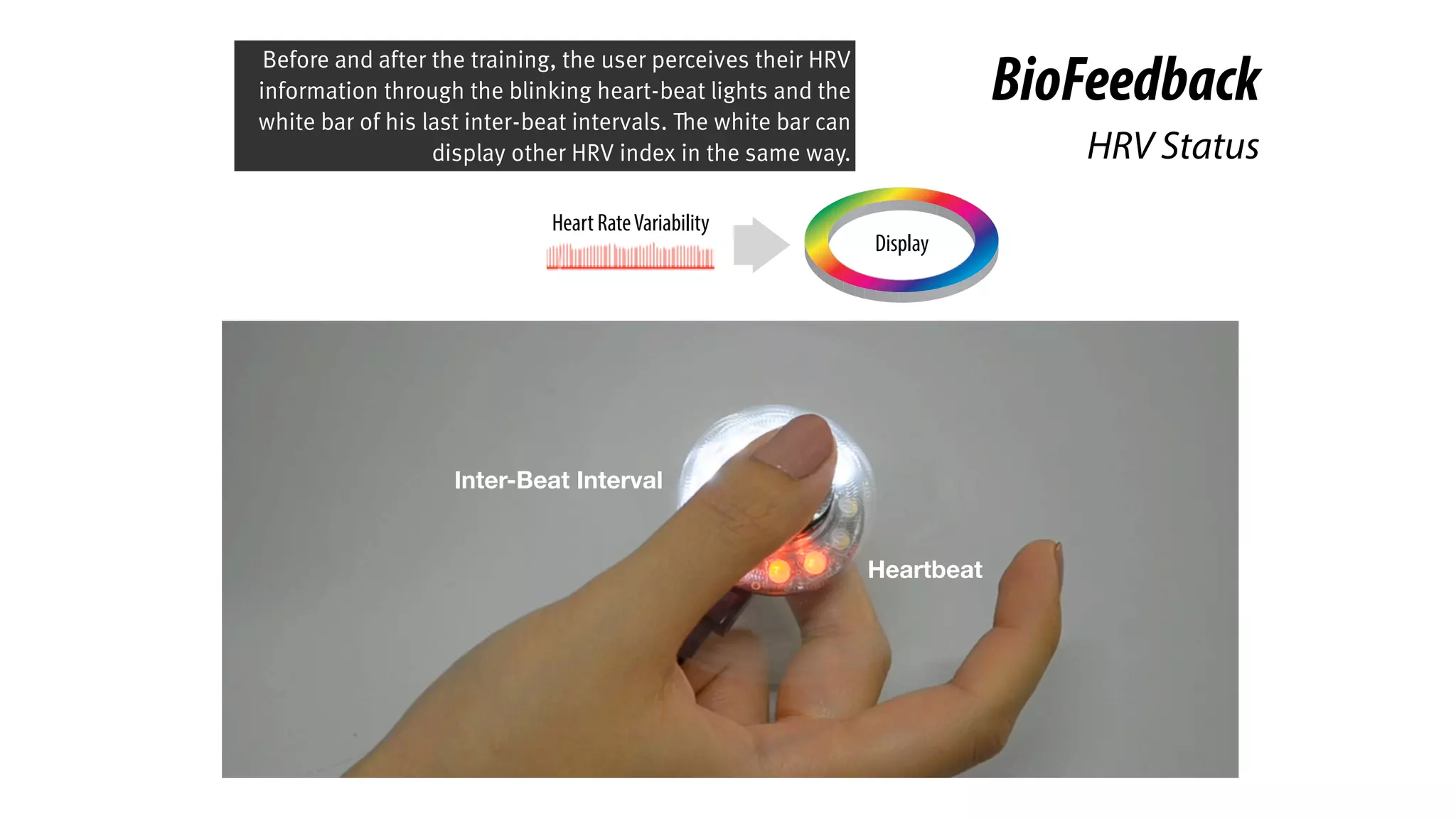
HRV Status
BioFeedback
Display
Heart RateVariability
Inter-Beat Interval
Heartbeat
Before and after the training, the user perceives their HRV
information through the blinking heart-beat lights and the
white bar of his last inter-beat intervals. The white bar can
display other HRV index in the same way.
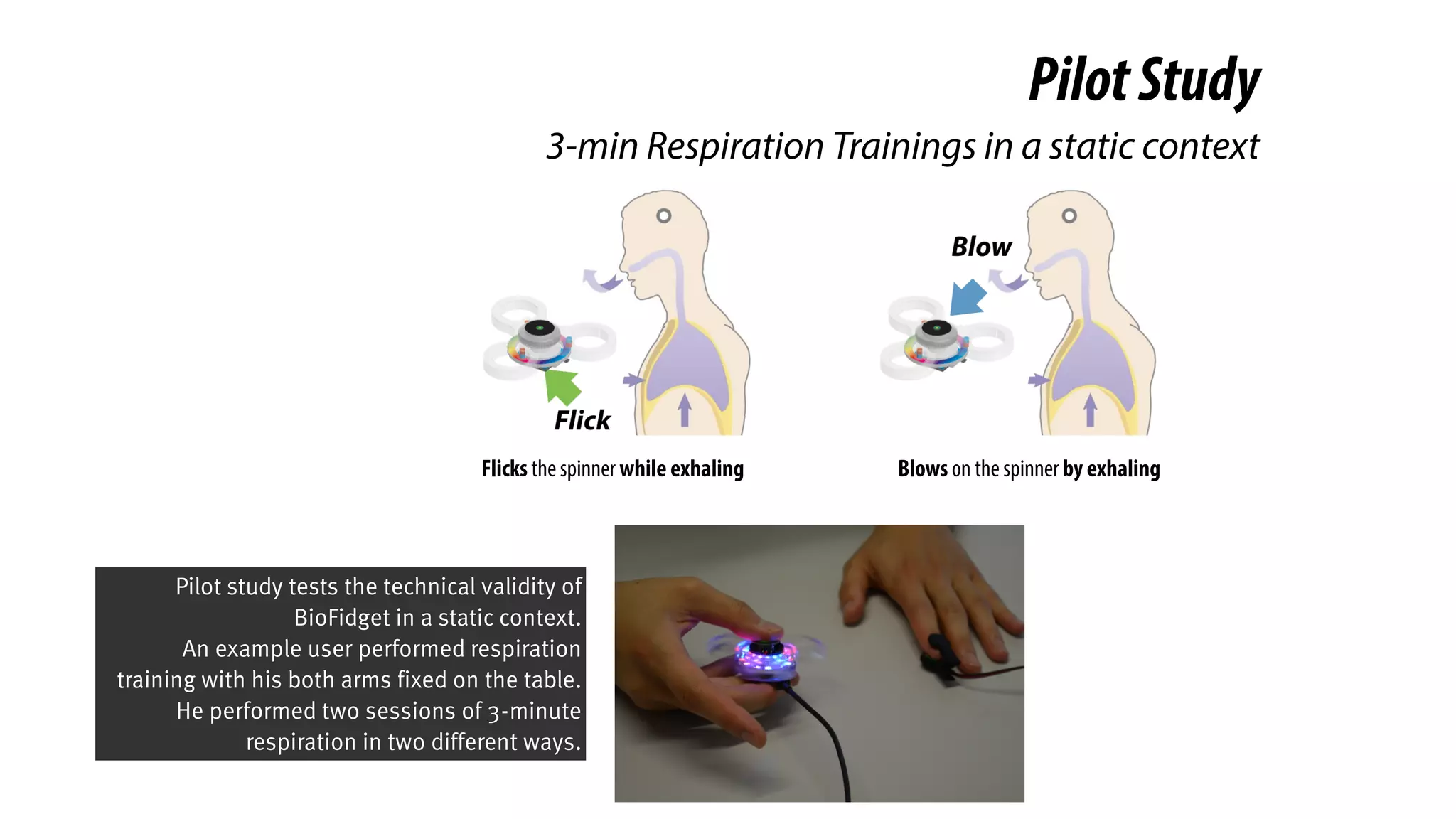
PilotStudy
3-min Respiration Trainings in a static context
Flicks the spinner while exhaling Blows on the spinner by exhaling
Pilot study tests the technical validity of
BioFidget in a static context.
An example user performed respiration
training with his both arms fixed on the table.
He performed two sessions of 3-minute
respiration in two different ways.
Flicks the spinner while exhaling Blows on the spinner by exhaling
PilotStudy
3-min Respiration Trainings in a static context
One way is Flick: flicking the spinner while exhalation.
Breathe in,
Flicks the spinner while exhaling Blows on the spinner by exhaling
PilotStudy
3-min Respiration Trainings in a static context
and Breathe out.
Flicks the spinner while exhaling Blows on the spinner by exhaling
PilotStudy
3-min Respiration Trainings in a static context
Another way is Blow: blowing on the wing of spinner by exhalation.
Breathe in,
Flicks the spinner while exhaling Blows on the spinner by exhaling
PilotStudy
3-min Respiration Trainings in a static context
and Breathe out.
PPG sensor #2
(baseline)
Flicks the spinner while exhaling Blows on the spinner by exhaling
PilotStudy
3-min Respiration Trainings in a static context
We also fixed a secondary ppg sensor
on his index finger of the non-
dominant hand as a baseline.
PPG sensor #2
(baseline)
Accelerometer
Flicks the spinner while exhaling Blows on the spinner by exhaling
PilotStudy
3-min Respiration Trainings in a static context
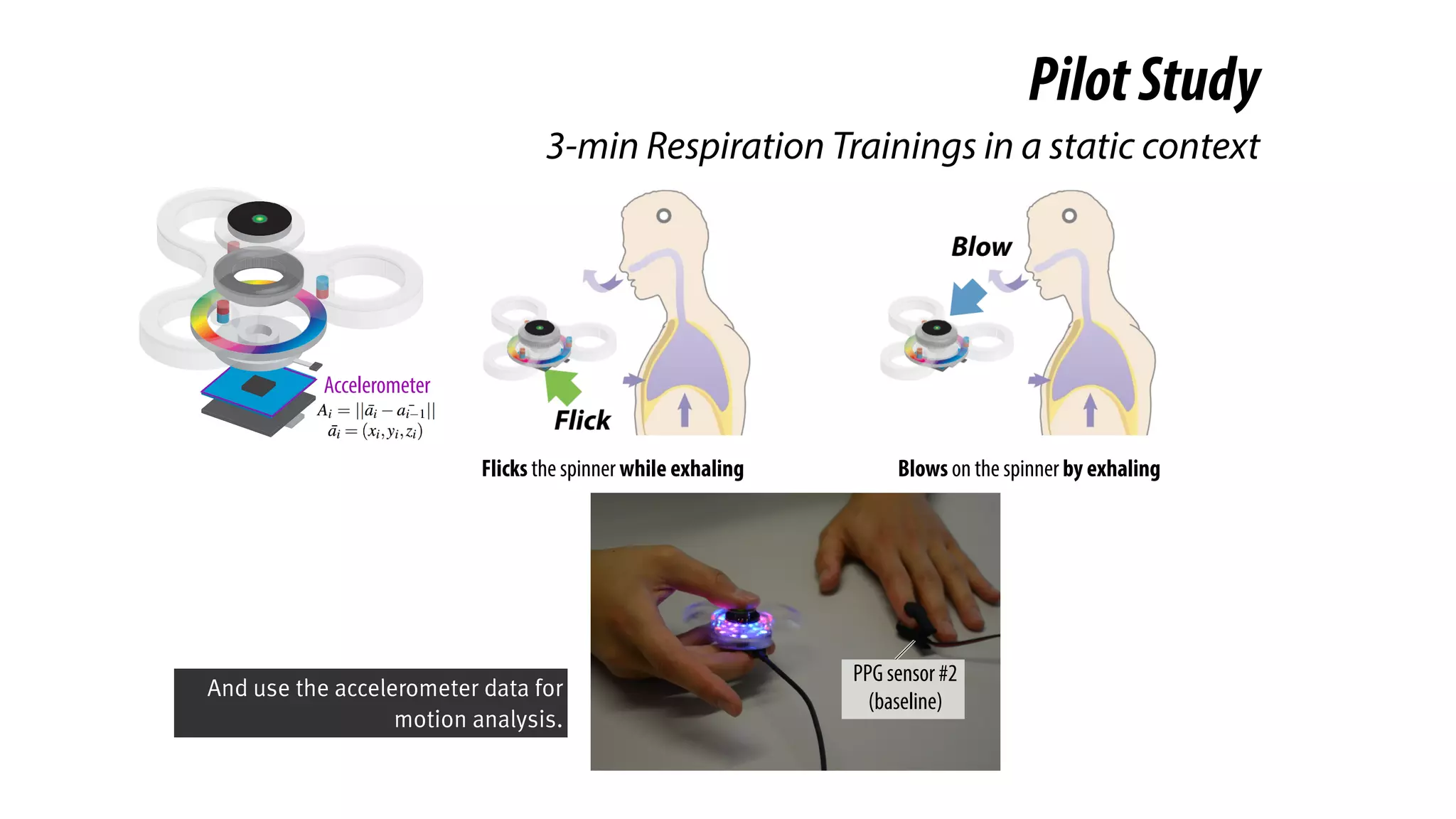
And use the accelerometer data for
motion analysis.
Results
0 60 120 0 60 120 (s)
revolution speed
revolution acceleration
acceleration
interbeat interval
blood volume pulse
interbeat interval
blood volume pulse
sensorsonfidgetspinnerbaseline
HallAPPGPPG
Accelerometer
0 60 120 0 60 120 (s)
revolution speed
revolution acceleration
acceleration
interbeat interval
blood volume pulse
interbeat interval
blood volume pulse
sensorsonfidgetspinnerbaseline
HallAPPGPPG
(s)
Flicks the spinner while exhaling Blows on the spinner by exhaling
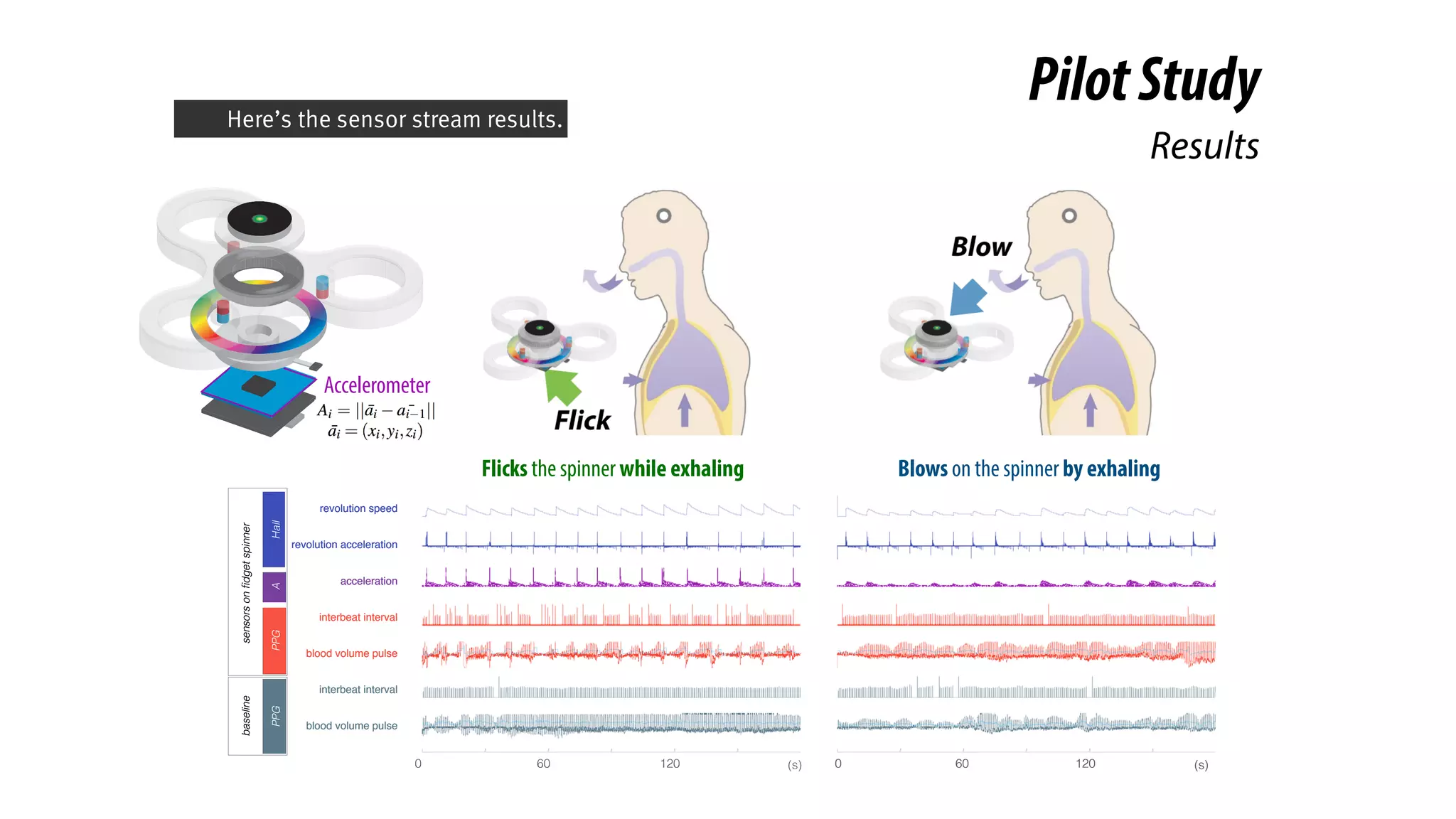
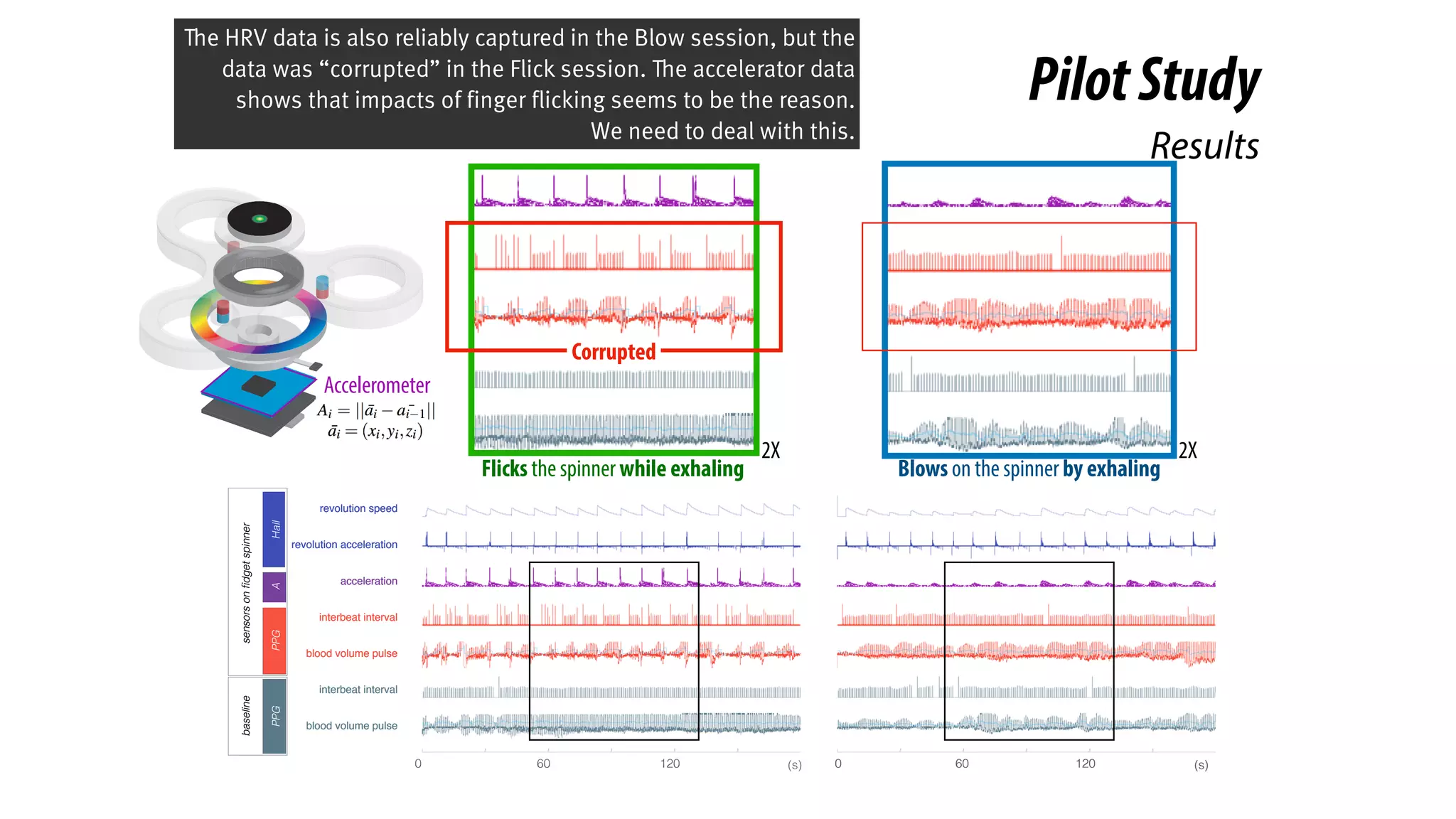
PilotStudyHere’s the sensor stream results.
Accelerometer
0 60 120 0 60 120 (s)
revolution speed
revolution acceleration
acceleration
interbeat interval
blood volume pulse
interbeat interval
blood volume pulse
sensorsonfidgetspinnerbaseline
HallAPPGPPG
0 60 120 0 60 120 (s)
revolution speed
revolution acceleration
acceleration
interbeat interval
blood volume pulse
interbeat interval
blood volume pulse
sensorsonfidgetspinnerbaseline
HallAPPGPPG
(s)
2X 2X
Results
Flicks the spinner while exhaling Blows on the spinner by exhaling
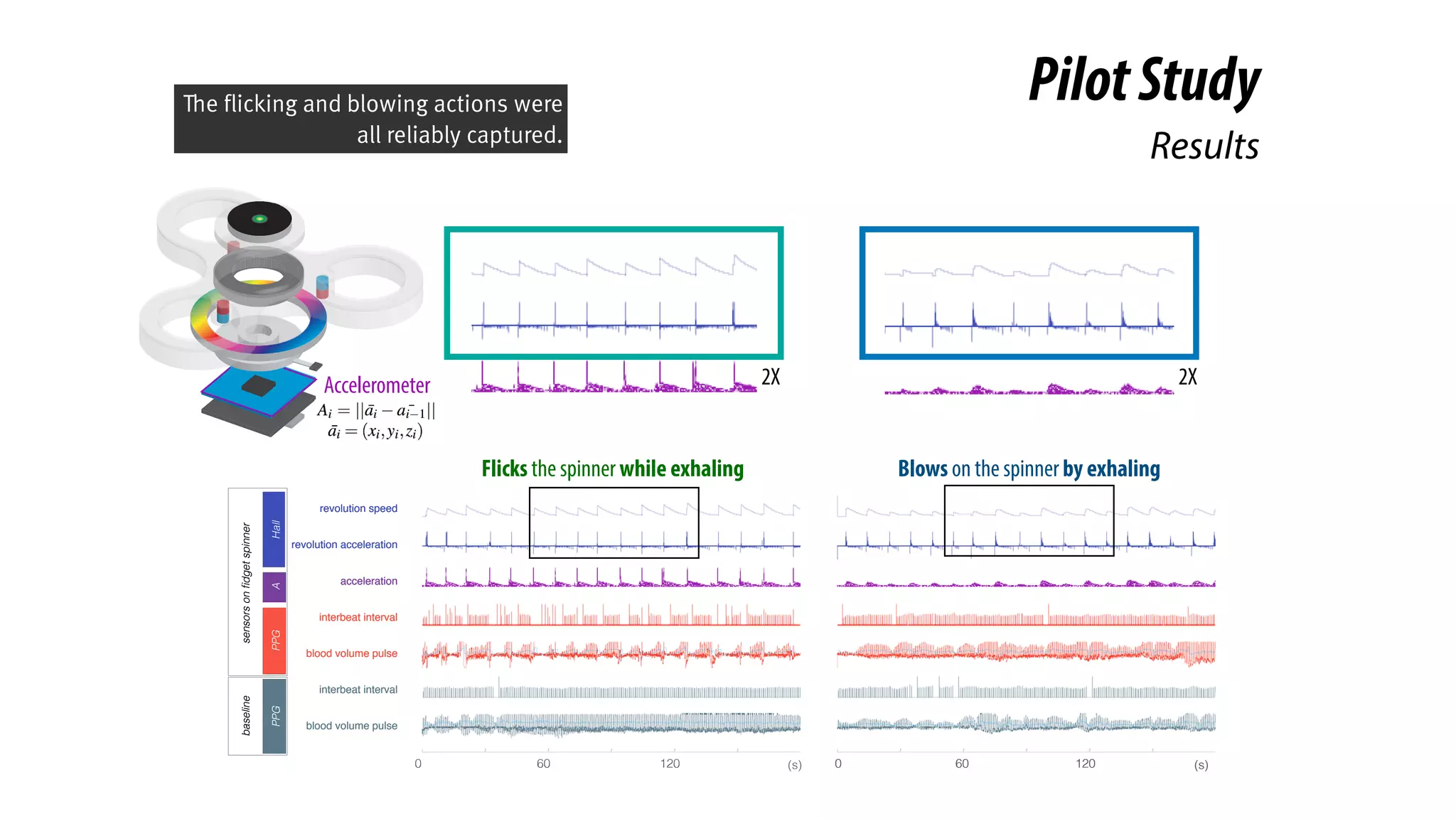
PilotStudyThe flicking and blowing actions were
all reliably captured.
Accelerometer
0 60 120 0 60 120 (s)
revolution speed
revolution acceleration
acceleration
interbeat interval
blood volume pulse
interbeat interval
blood volume pulse
sensorsonfidgetspinnerbaseline
HallAPPGPPG
0 60 120 0 60 120 (s)
revolution speed
revolution acceleration
acceleration
interbeat interval
blood volume pulse
interbeat interval
blood volume pulse
sensorsonfidgetspinnerbaseline
HallAPPGPPG
(s)
2X 2X
Results
Corrupted
Flicks the spinner while exhaling Blows on the spinner by exhaling
PilotStudy
The HRV data is also reliably captured in the Blow session, but the
data was “corrupted” in the Flick session. The accelerator data
shows that impacts of finger flicking seems to be the reason.
We need to deal with this.
FunctionalExtension
Adding a clip to stabilize HRV sensing
Without a clip With a clip
A simple solution is adding a clip to stabilize
HRV sensing when the user is fidgeting.
UserStudy
PPG sensor #2
(baseline)
respiration training in a personally comfortable way
Without a clip
With a clip
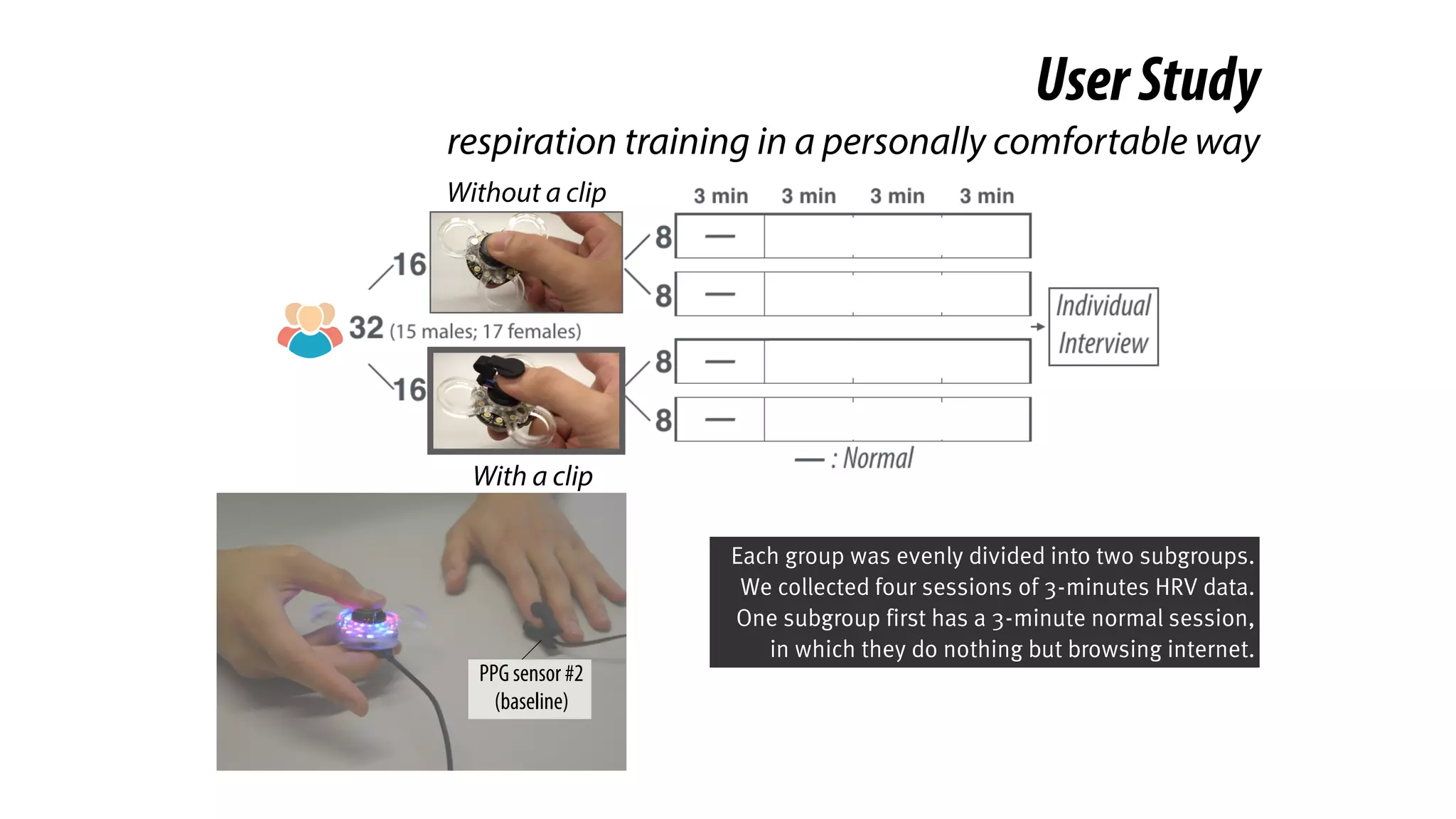
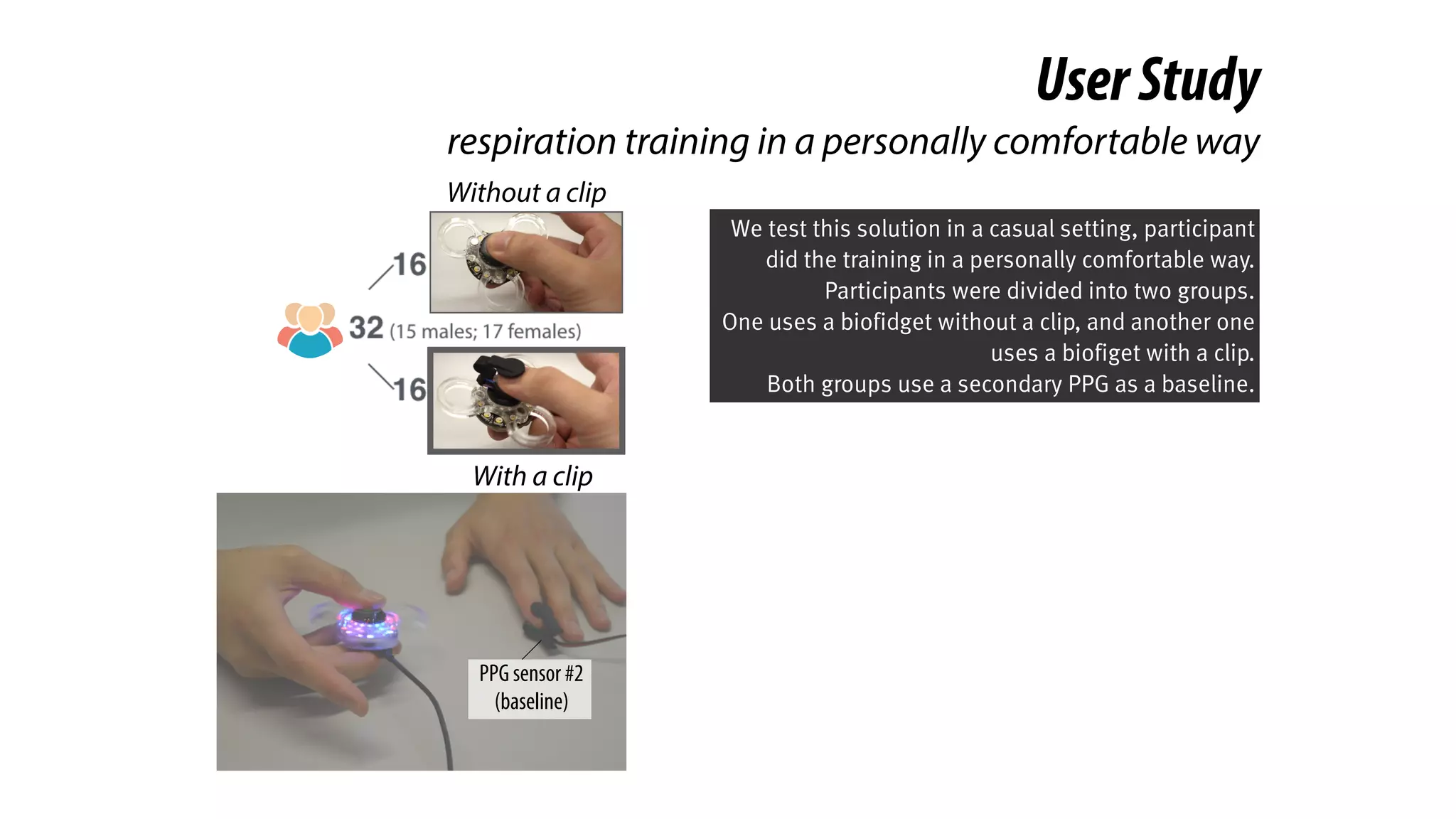
We test this solution in a casual setting, participant
did the training in a personally comfortable way.
Participants were divided into two groups.  
One uses a biofidget without a clip, and another one
uses a biofiget with a clip.
Both groups use a secondary PPG as a baseline.
Without a clip
With a clip
PPG sensor #2
(baseline)
UserStudy
respiration training in a personally comfortable way
Each group was evenly divided into two subgroups.
We collected four sessions of 3-minutes HRV data.
One subgroup first has a 3-minute normal session,
in which they do nothing but browsing internet.
Without a clip
With a clip
PPG sensor #2
(baseline)
UserStudy
respiration training in a personally comfortable way
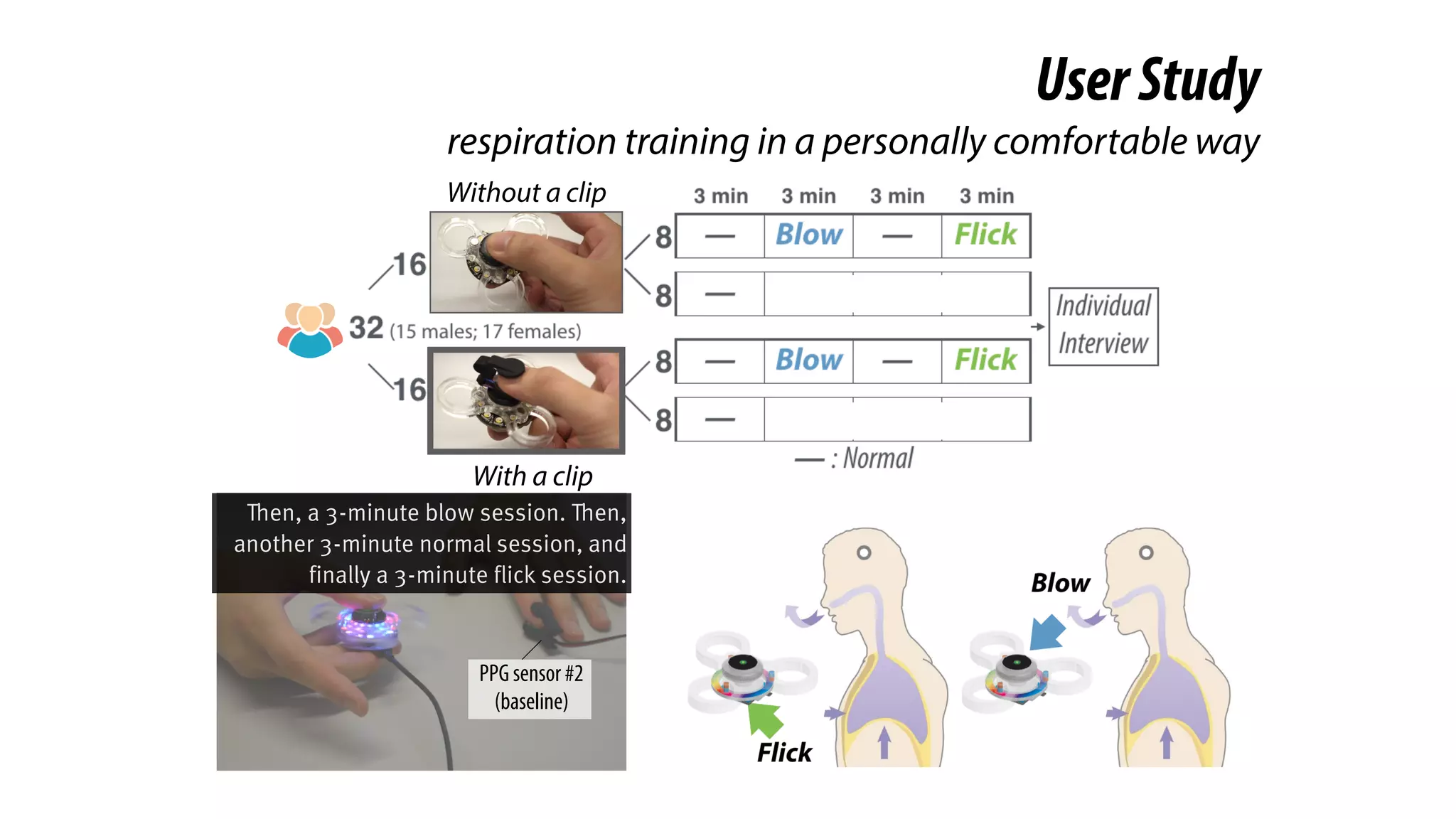
Then, a 3-minute blow session. Then,
another 3-minute normal session, and
finally a 3-minute flick session.
Without a clip
With a clip
PPG sensor #2
(baseline)
UserStudy
respiration training in a personally comfortable way
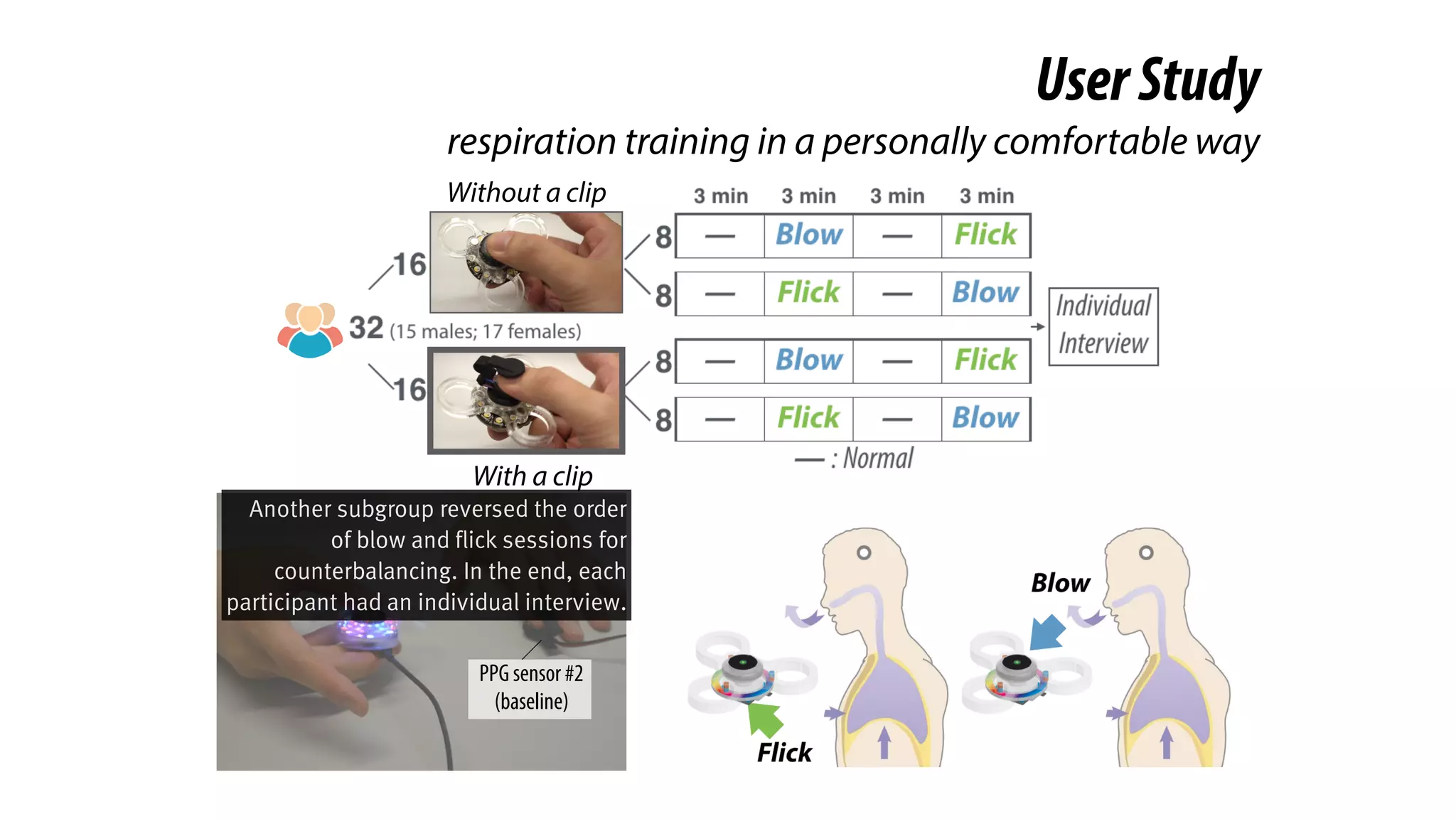
Another subgroup reversed the order
of blow and flick sessions for
counterbalancing. In the end, each
participant had an individual interview.
RMSSDLF/HF
1. Respiration Training was Effective in
Both Flick and Blow Sessions.
Stress Reduced Heart-rate regulation improved
QuantitativeResultsWe first use the baseline PPG to
evaluate the effectiveness of
respiration training, and found that the
respiration training was effective in
both flick and blow sessions.
RMSSDLF/HF
1. Respiration Training was Effective in
Both Flick and Blow Sessions.
Stress Reduced Heart-rate regulation improved
QuantitativeResults
Before After
The comparisons between the two HRV indexes of the first
and the third sessions, show a significant stress reduction
and better heart rate regulation after the training.
17 18 19 20 2122 23 24 2526 27 28 2930 31 32
with a clip (BioFidget)
17 18 1920 21 22 2324 25 26 2728 29 30 31 32
with a clip (BioFidget)
0%
25%
50%
75%
100%
1 2 3 4 5 6 7 8 9 10 11 12 13 14 1516
baseline (PPG #2)
without a clip (BioFidget)
0%
25%
50%
75%
100%
1 2 3 4 5 6 7 8 9 10 11 12 1314 15 16
baseline (PPG #2)
without a clip (BioFidget)
Participant ID
QuantitativeResults
2. The Clip Stabilized the HRV Sensing
and Enabled Blowing Input
PPG sensor #2
(baseline)
Now let's check the HRV collected by the two
BioFidgets. The clip significantly improved the HRV
sensing quality in the both Flick and Blow sessions.
17 18 19 20 2122 23 24 2526 27 28 2930 31 32
with a clip (BioFidget)
17 18 1920 21 22 2324 25 26 2728 29 30 31 32
with a clip (BioFidget)
0%
25%
50%
75%
100%
1 2 3 4 5 6 7 8 9 10 11 12 13 14 1516
baseline (PPG #2)
without a clip (BioFidget)
0%
25%
50%
75%
100%
1 2 3 4 5 6 7 8 9 10 11 12 1314 15 16
baseline (PPG #2)
without a clip (BioFidget)
Participant ID
QuantitativeResults
2. The Clip Stabilized the HRV Sensing
and Enabled Blowing Input
PPG sensor #2
(baseline)
In the Blow session, the HRV collected by
BioFidget with a clip is even similarly reliable
to the one collected by the Baseline PPG,
showing that the blowing action does not
affect the validity of HRV collection.
Flicking
Detected
QuantitativeResults
Strategy of HRV data collection
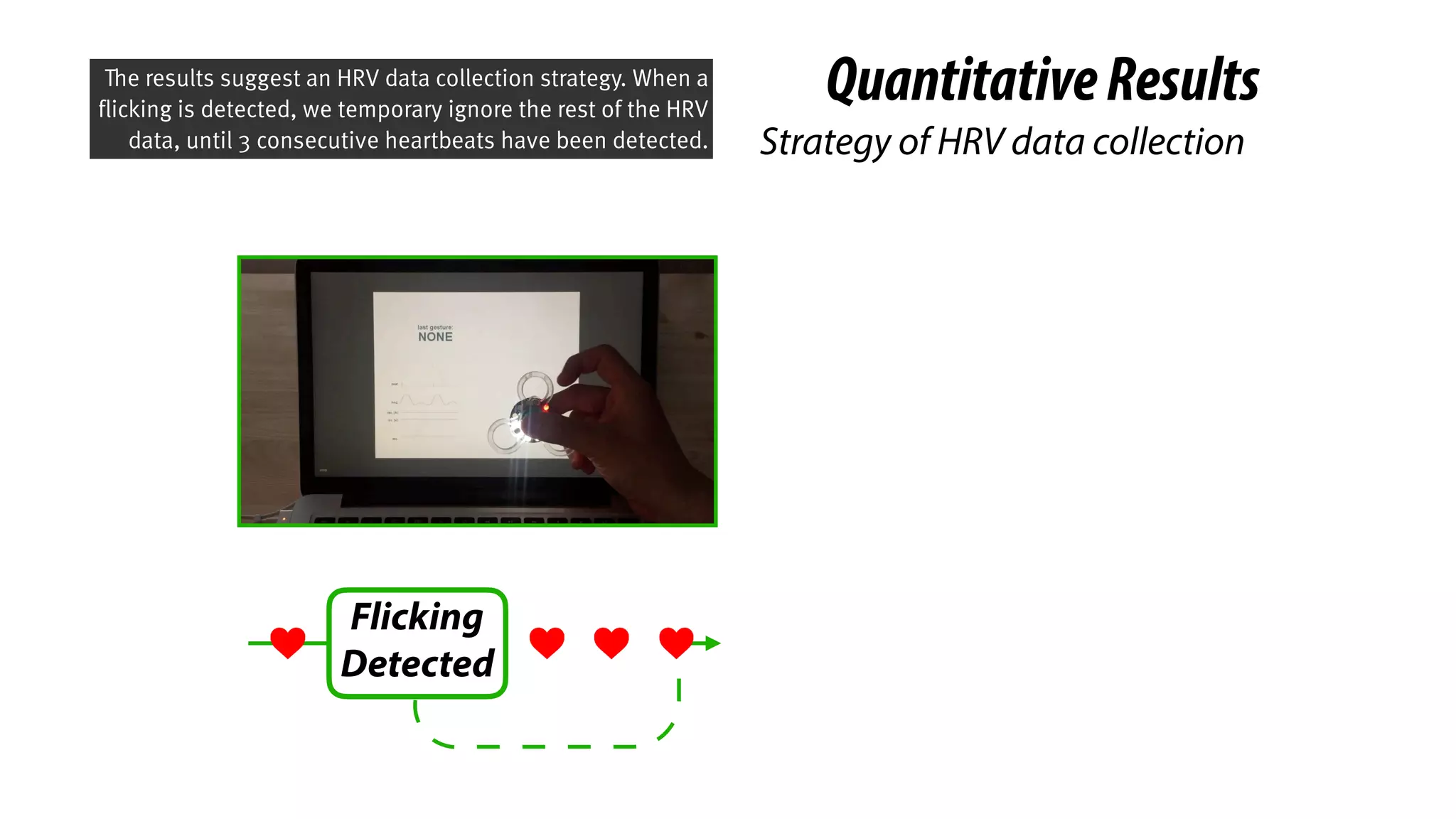
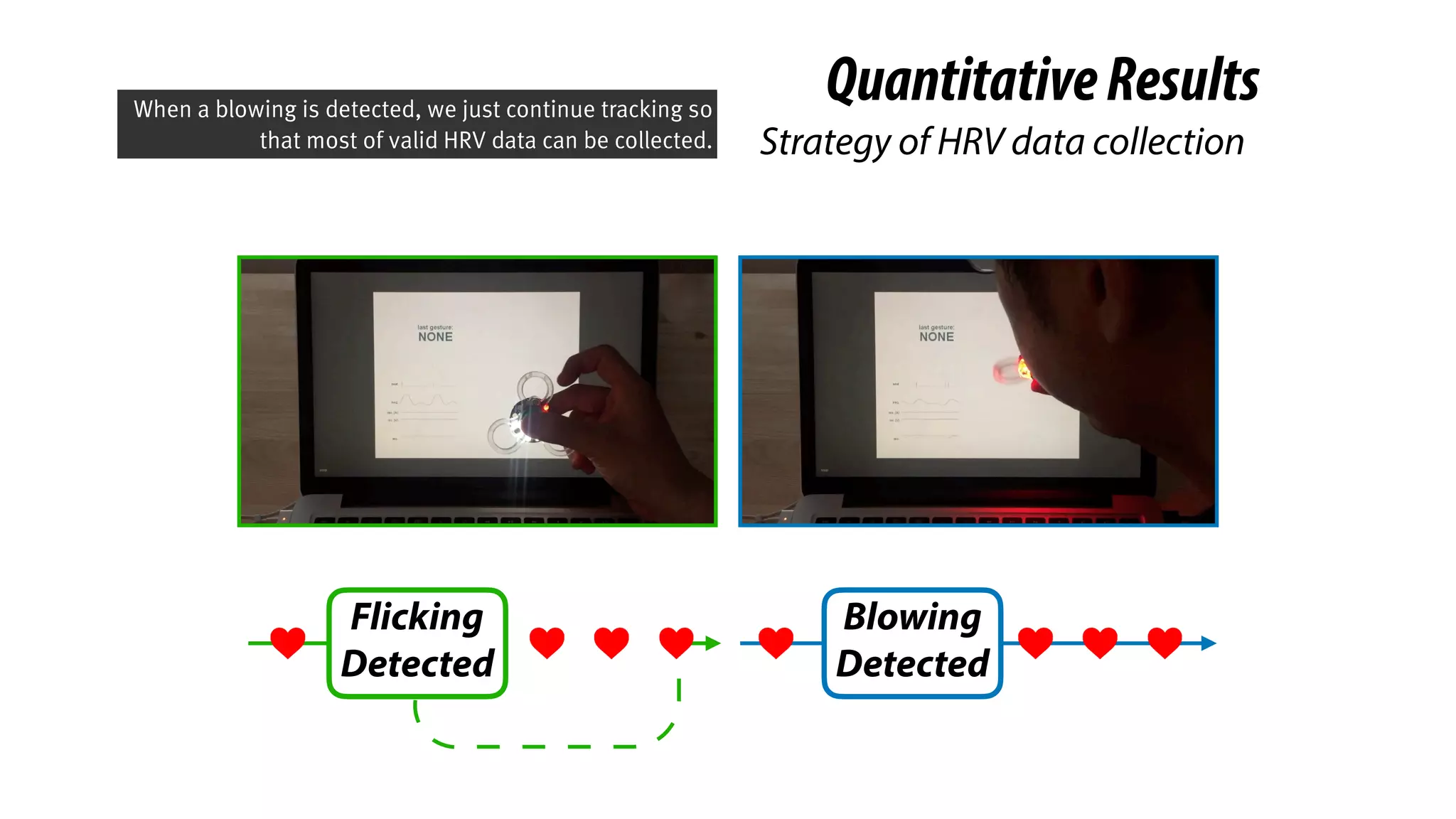
The results suggest an HRV data collection strategy. When a
flicking is detected, we temporary ignore the rest of the HRV
data, until 3 consecutive heartbeats have been detected.
Flicking
Detected
Blowing
Detected
QuantitativeResults
Strategy of HRV data collection
When a blowing is detected, we just continue tracking so
that most of valid HRV data can be collected.
0%
25%
50%
75%
100%
500 400 300 200
0%
25%
50%
75%
100%
500 400 300 200
window size (ms)
accuracy
detectionrate
0%
25%
50%
75%
100%
500 400 300 200
300
270
240
210
180
150
120
90
60
window size (ms)
0%
25%
50%
75%
100%
500 400 300 200
recall
window size (ms) window size (ms)
Recall: FlickingRecall: BlowingAction Detection RateAccuracy: Overall
recall
minimal
velocity
(rpm)
QuantitativeResults
3. Actions were Reliably Recognized
(with High Recall of Blowing Recognition)
W
d
Vmax
Vmax
Resultsofactivityrecognitionusingdasfeature
W = 500ms;Vmax ≥ 60rpm: 87.9% accuracy; 96.2% detection rate.
W W W W
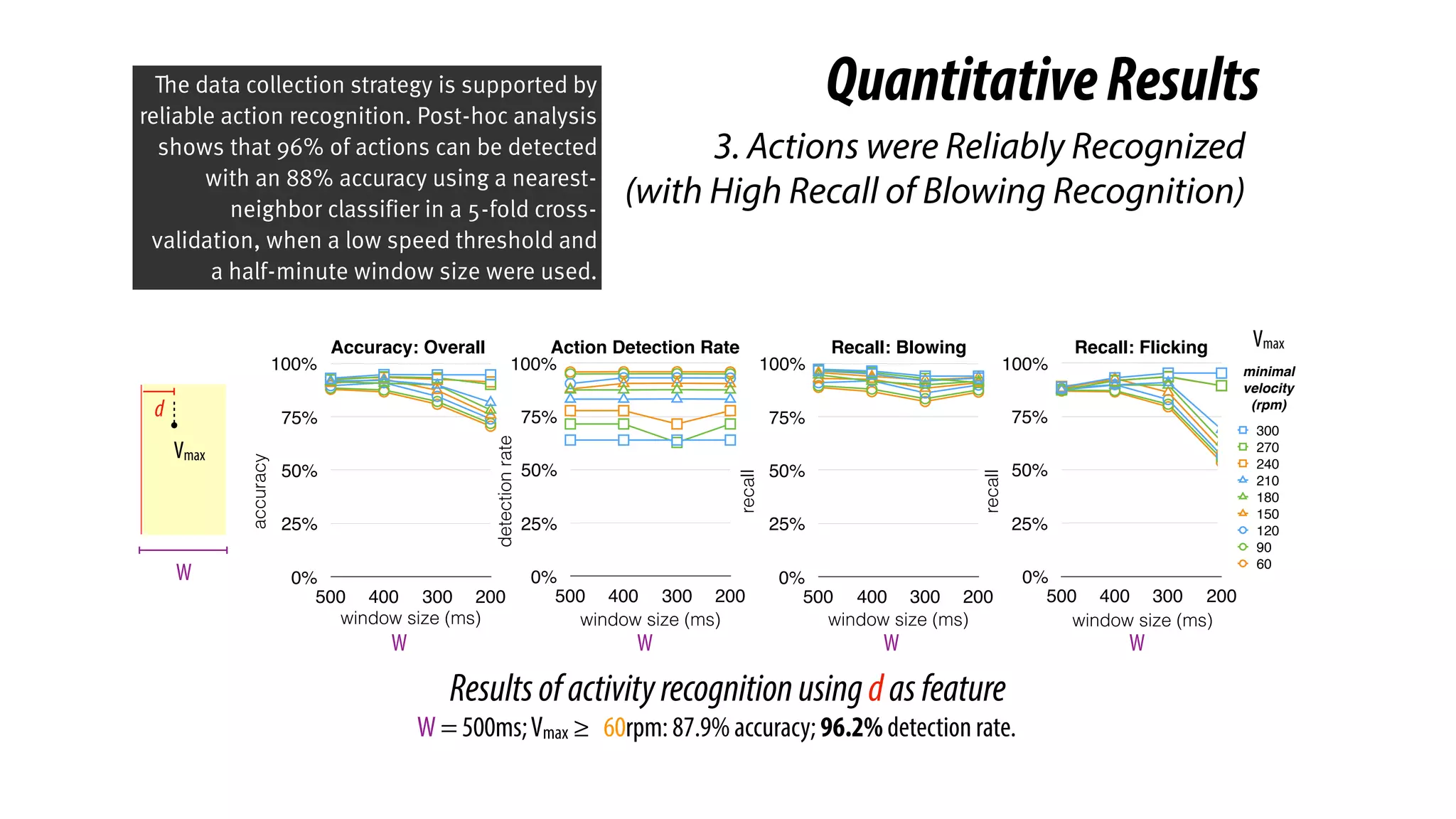
The data collection strategy is supported by
reliable action recognition. Post-hoc analysis
shows that 96% of actions can be detected
with an 88% accuracy using a nearest-
neighbor classifier in a 5-fold cross-
validation, when a low speed threshold and
a half-minute window size were used.
31(outof32)participants:
ThebreathingguidancethroughthelightonBioFidgetwasclearandeasytoperceive.
20participants:
Spinningthefidgetmadethemfeelrelaxedandmoreabletofocusonthebreathingguidance.
26participants:
Thefeedbackengagedandmotivatedthemtoperformbetterinbreathingtraining.
UserFeedback
General responses
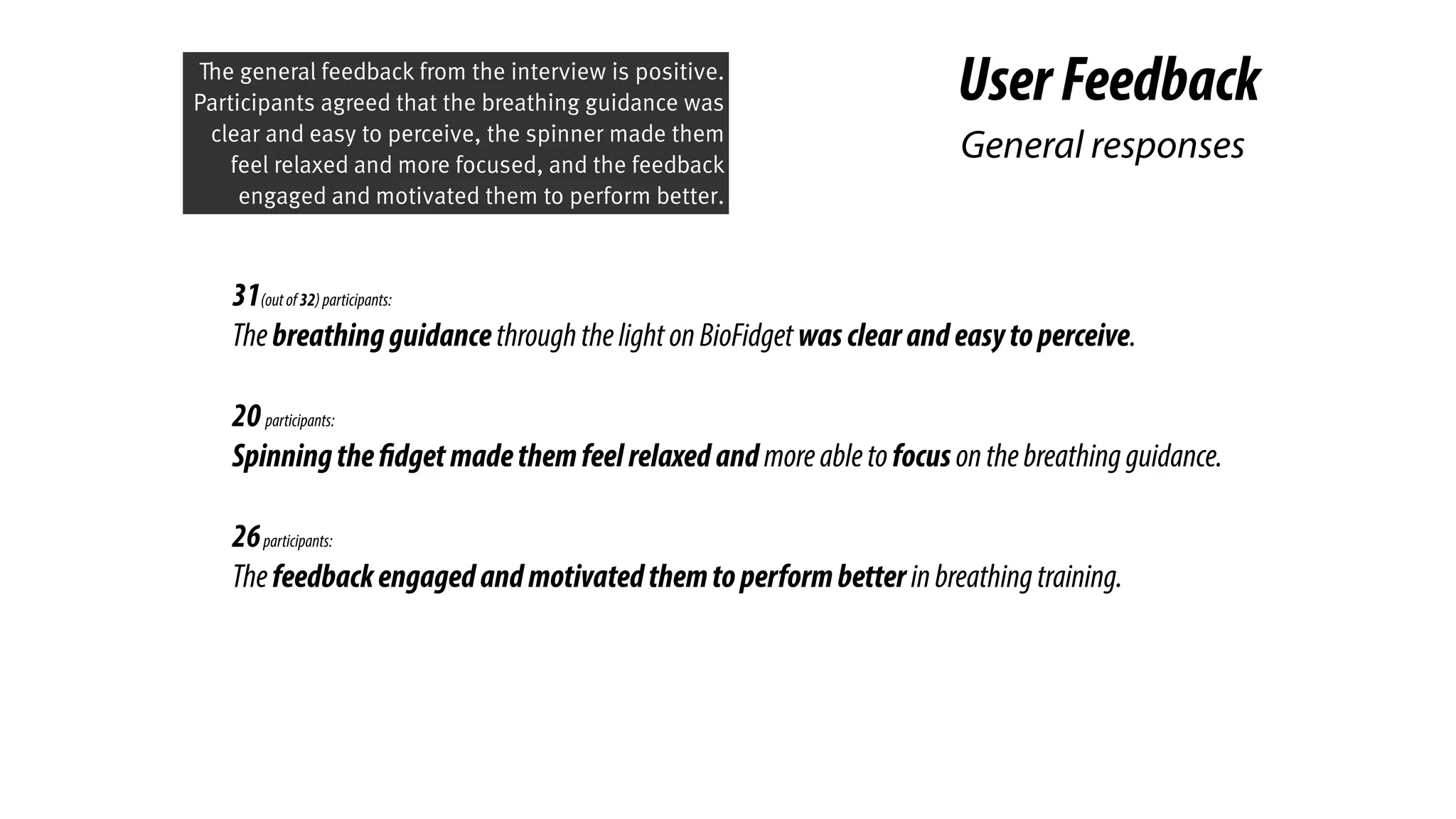
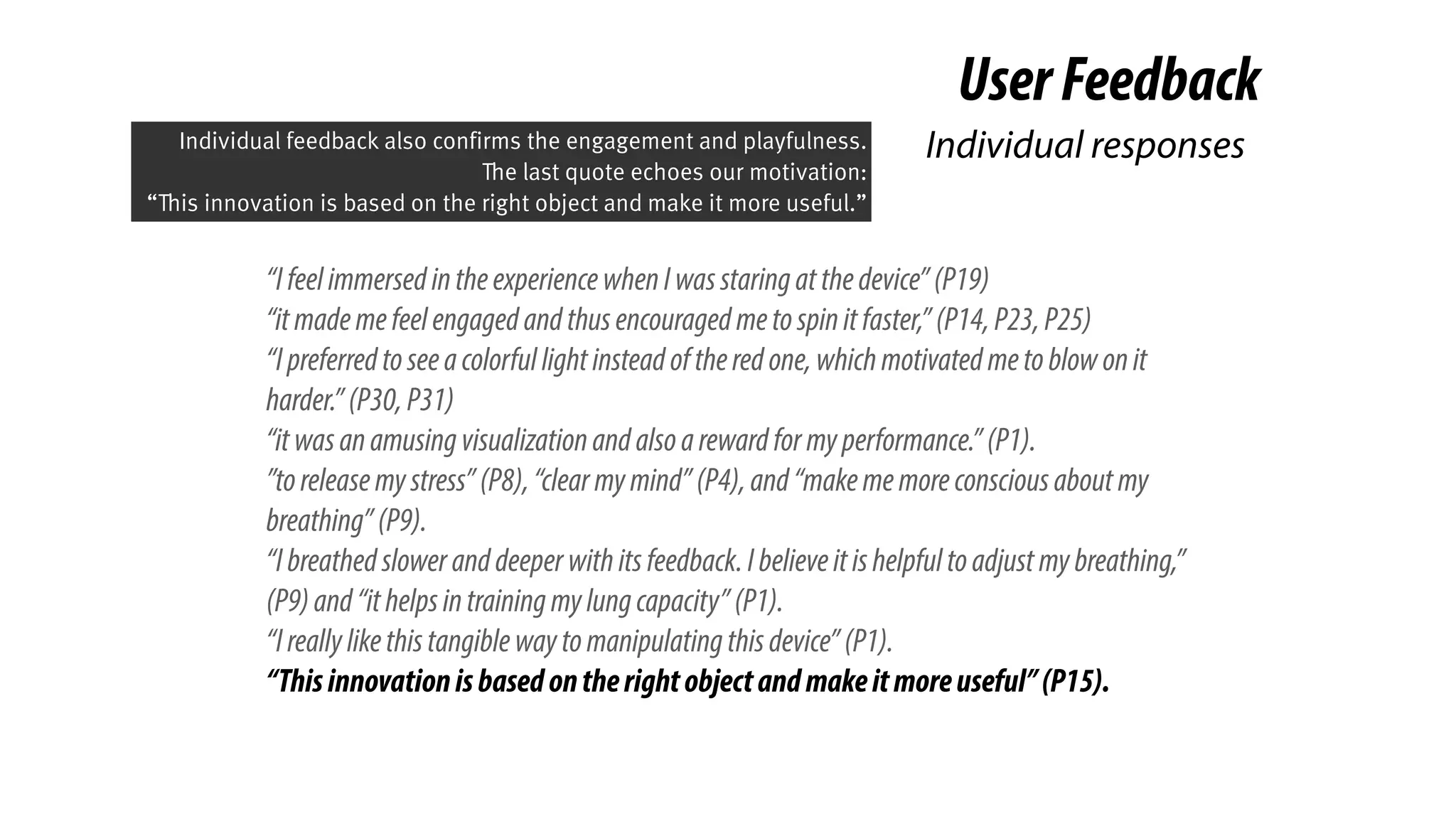
The general feedback from the interview is positive.
Participants agreed that the breathing guidance was
clear and easy to perceive, the spinner made them
feel relaxed and more focused, and the feedback
engaged and motivated them to perform better.
“IfeelimmersedintheexperiencewhenIwasstaringatthedevice”(P19)
“itmademefeelengagedandthusencouragedmetospinitfaster,”(P14,P23,P25)
“Ipreferredtoseeacolorfullightinsteadoftheredone,whichmotivatedmetoblowonit
harder.”(P30,P31)
“itwasanamusingvisualizationandalsoarewardformyperformance.”(P1).
”toreleasemystress”(P8),“clearmymind”(P4),and“makememoreconsciousaboutmy
breathing”(P9).
“Ibreathedsloweranddeeperwithitsfeedback.Ibelieveitishelpfultoadjustmybreathing,”
(P9)and“ithelpsintrainingmylungcapacity”(P1).
“Ireallylikethistangiblewaytomanipulatingthisdevice”(P1).
“Thisinnovationisbasedontherightobjectandmakeitmoreuseful”(P15).
UserFeedback
Individual responsesIndividual feedback also confirms the engagement and playfulness.
The last quote echoes our motivation:
“This innovation is based on the right object and make it more useful.”
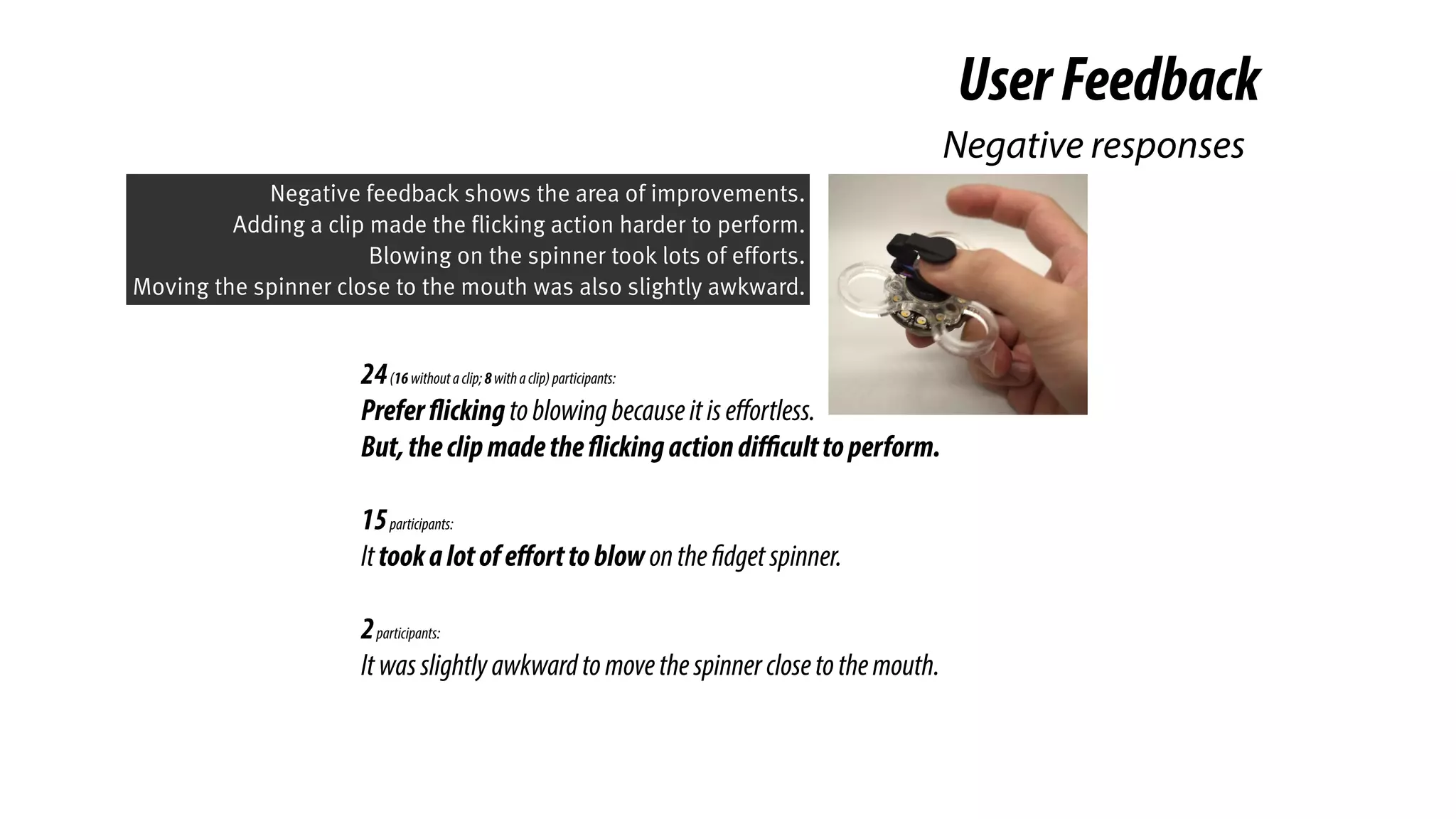
24(16withoutaclip;8withaclip)participants:
Preferflickingtoblowingbecauseitiseffortless.
But,theclipmadetheflickingactiondifficulttoperform.
15participants:
Ittookalotofefforttoblowonthefidgetspinner.
2participants:
Itwasslightlyawkwardtomovethespinnerclosetothemouth.
UserFeedback
Negative responses
Negative feedback shows the area of improvements.
Adding a clip made the flicking action harder to perform.
Blowing on the spinner took lots of efforts.
Moving the spinner close to the mouth was also slightly awkward.
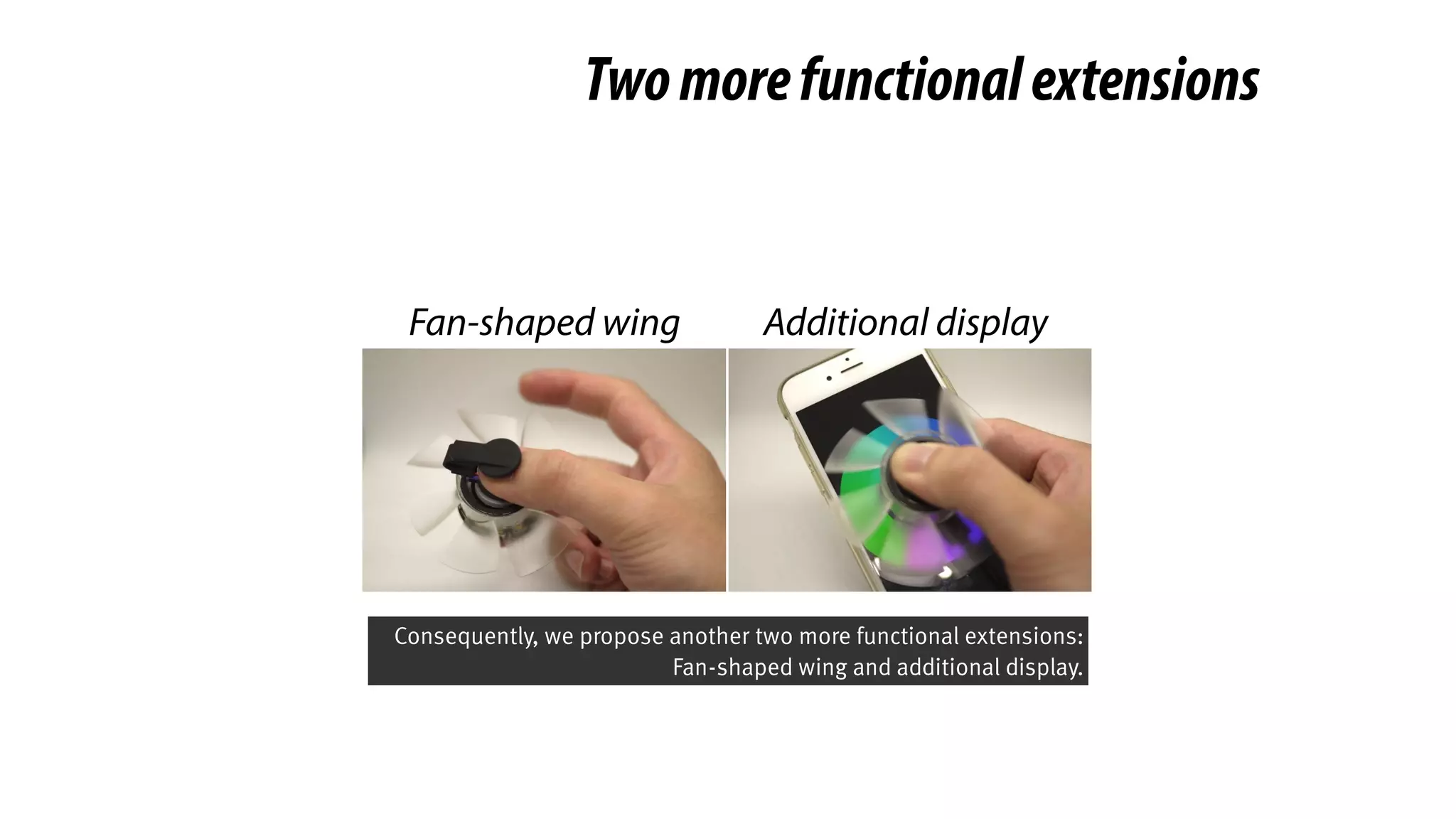
Twomorefunctionalextensions
Fan-shaped wing Additional display
Consequently, we propose another two more functional extensions:
Fan-shaped wing and additional display.
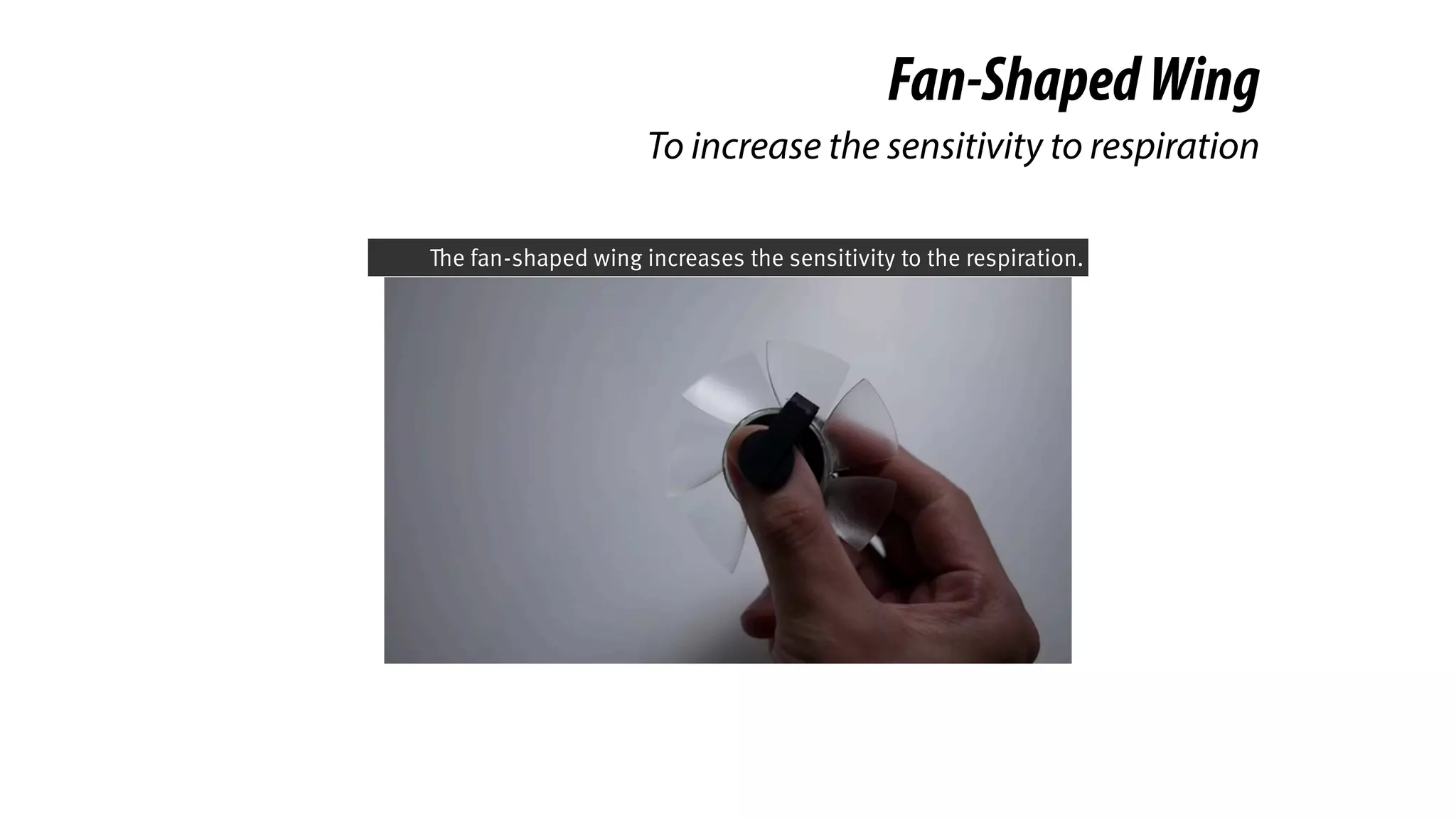
Fan-ShapedWing
To increase the sensitivity to respiration
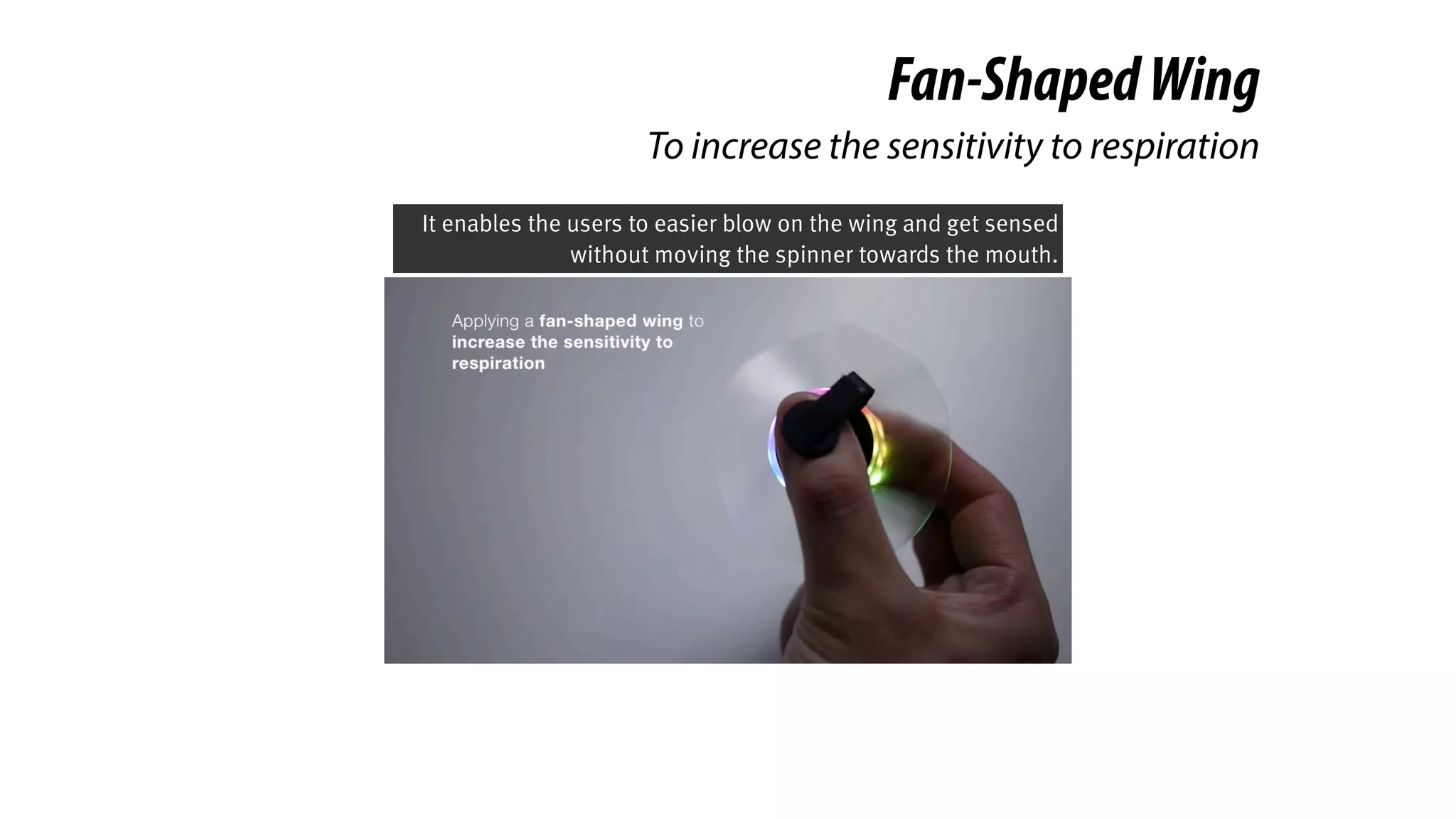
The fan-shaped wing increases the sensitivity to the respiration.
Fan-ShapedWing
To increase the sensitivity to respiration
It enables the users to easier blow on the wing and get sensed
without moving the spinner towards the mouth.
Fan-ShapedWing
Allows for static use
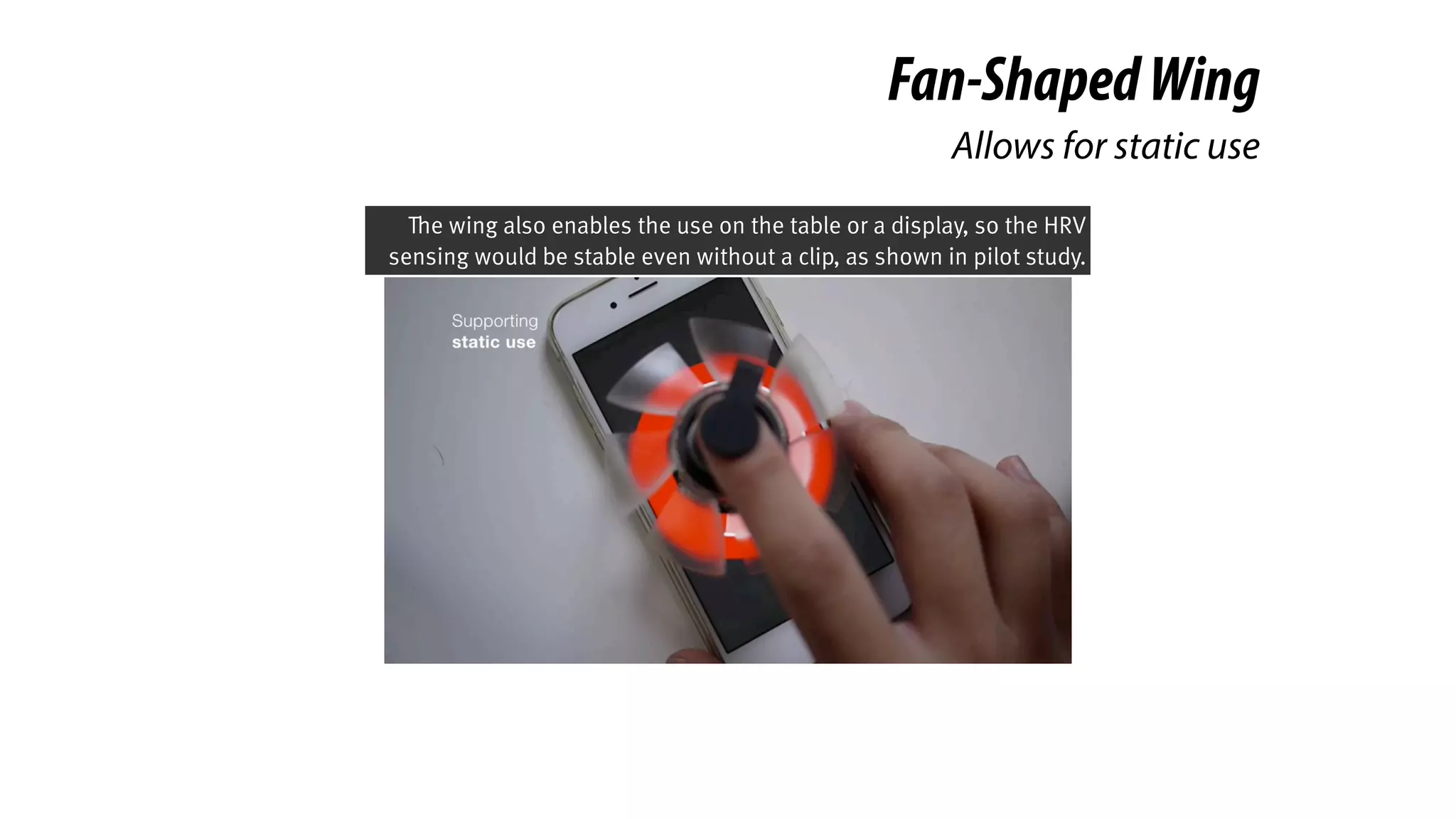
The wing also enables the use on the table or a display, so the HRV
sensing would be stable even without a clip, as shown in pilot study.
AdditionalDisplay
Provide historical HRV information
adequate
respiration
training
inadequate
respiration
training
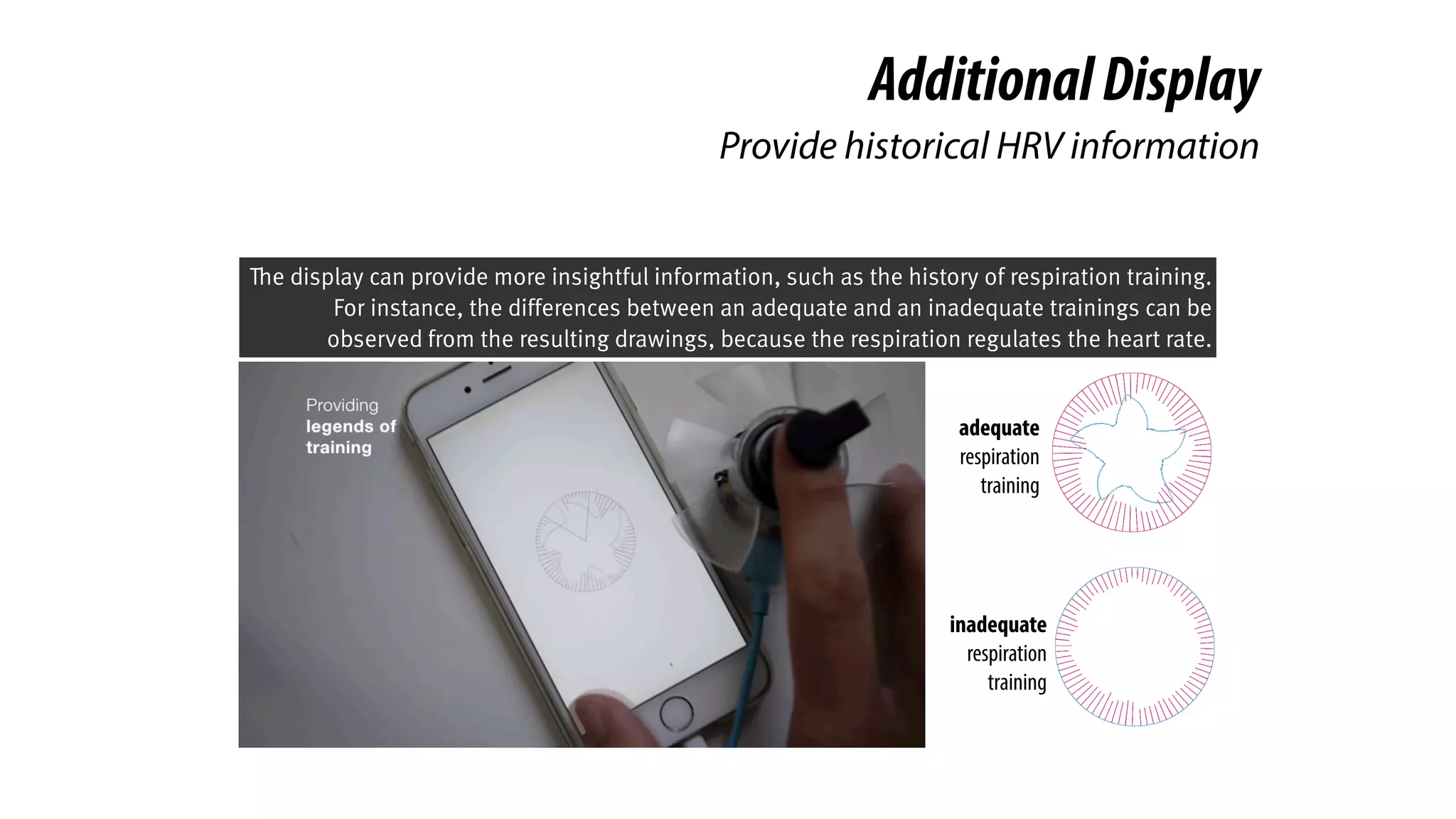
The display can provide more insightful information, such as the history of respiration training.
For instance, the differences between an adequate and an inadequate trainings can be
observed from the resulting drawings, because the respiration regulates the heart rate.
Follow-UpStudy
20
11 females
9 males
1-min
Functional extensions
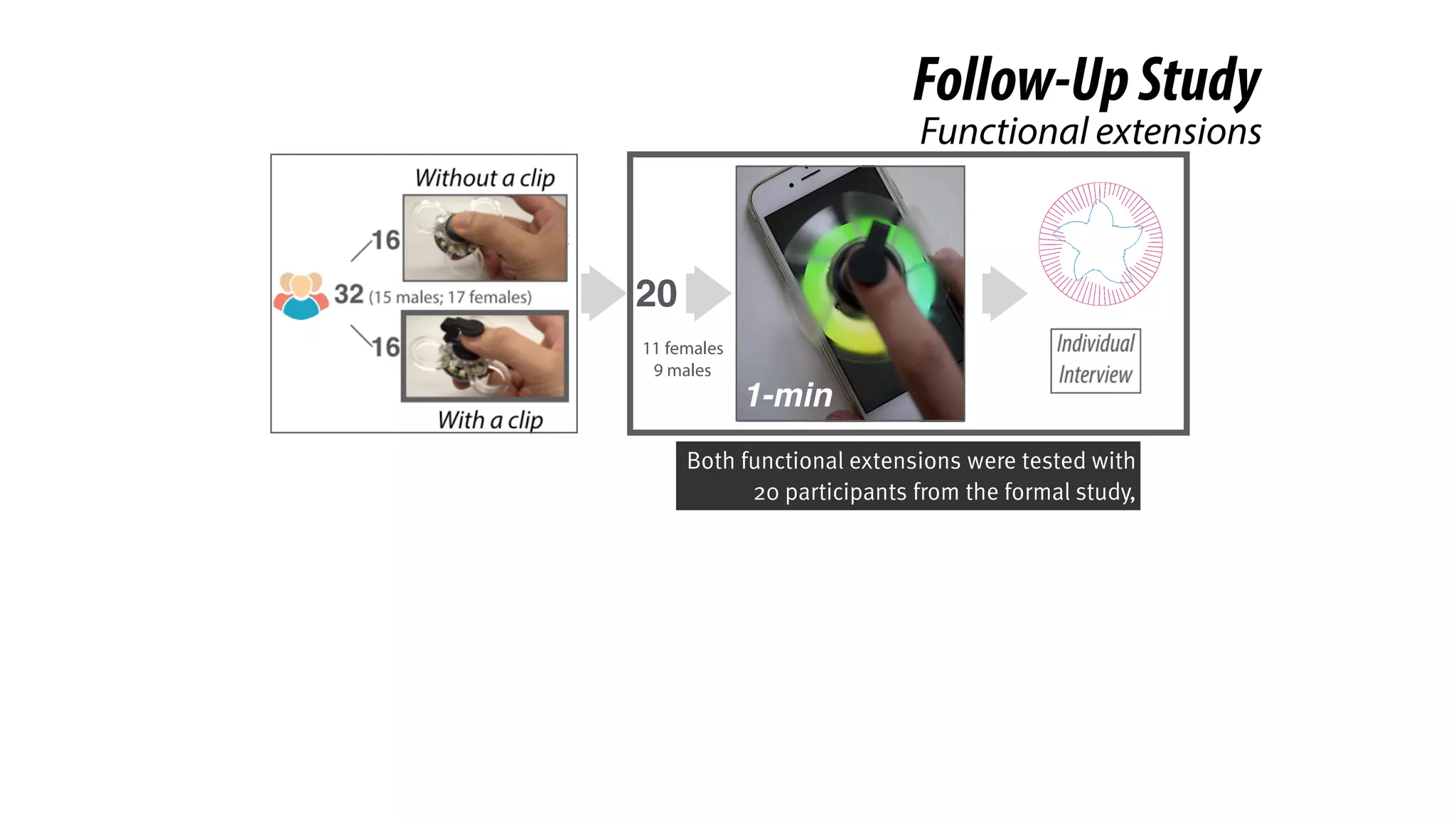
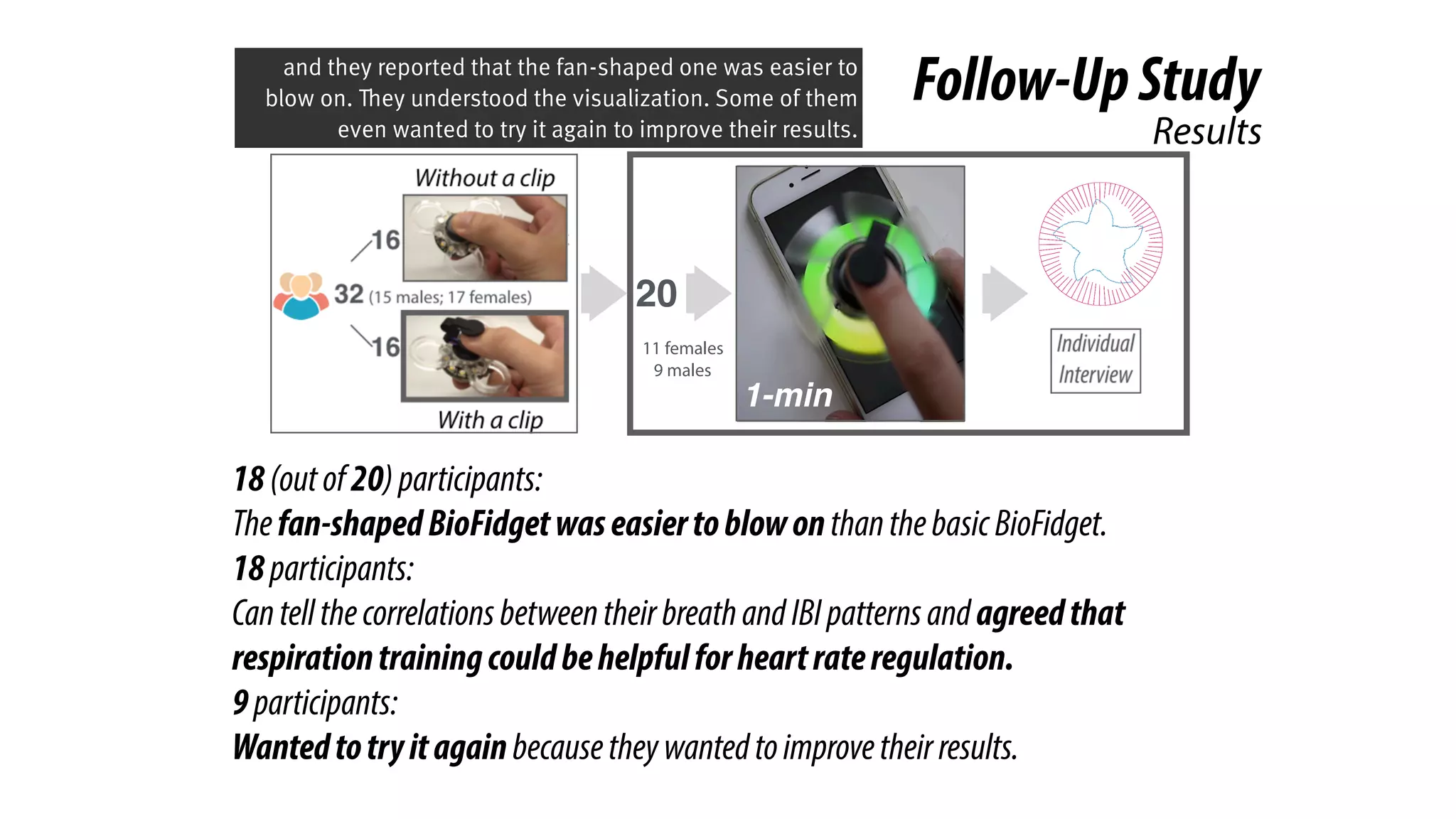
Both functional extensions were tested with
20 participants from the formal study,
18(outof20)participants:
Thefan-shapedBioFidgetwaseasiertoblowonthanthebasicBioFidget.
18participants:
CantellthecorrelationsbetweentheirbreathandIBIpatternsandagreedthat
respirationtrainingcouldbehelpfulforheartrateregulation.
9participants:
Wantedtotryitagainbecausetheywantedtoimprovetheirresults.
20
11 females
9 males
1-min
Follow-UpStudy
Results
and they reported that the fan-shaped one was easier to
blow on. They understood the visualization. Some of them
even wanted to try it again to improve their results.
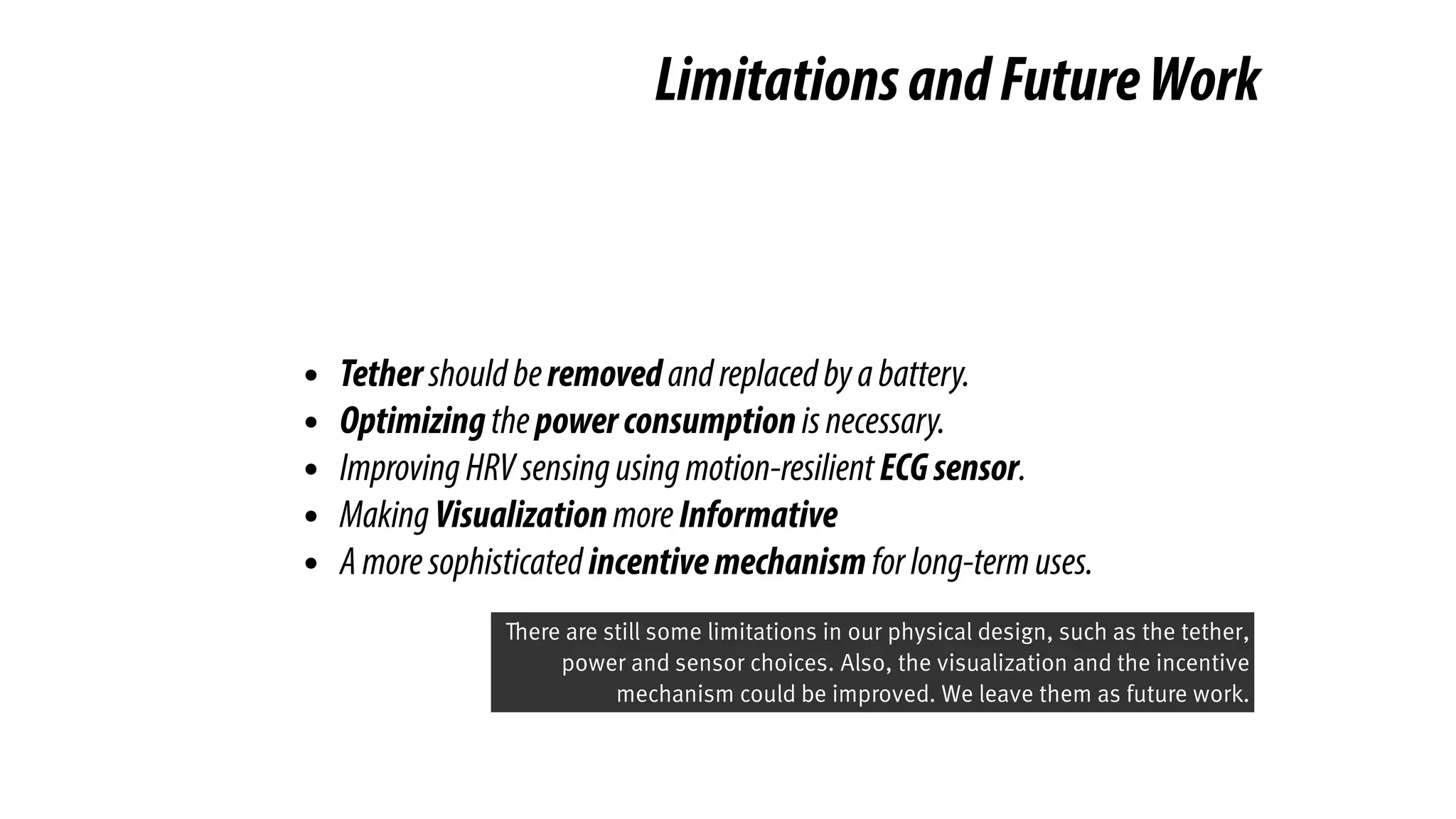
LimitationsandFutureWork
• Tethershouldberemovedandreplacedbyabattery.
• Optimizingthepowerconsumptionisnecessary.
• ImprovingHRVsensingusingmotion-resilientECGsensor.
• MakingVisualizationmoreInformative
• Amoresophisticatedincentivemechanismforlong-termuses.
There are still some limitations in our physical design, such as the tether,
power and sensor choices. Also, the visualization and the incentive
mechanism could be improved. We leave them as future work.
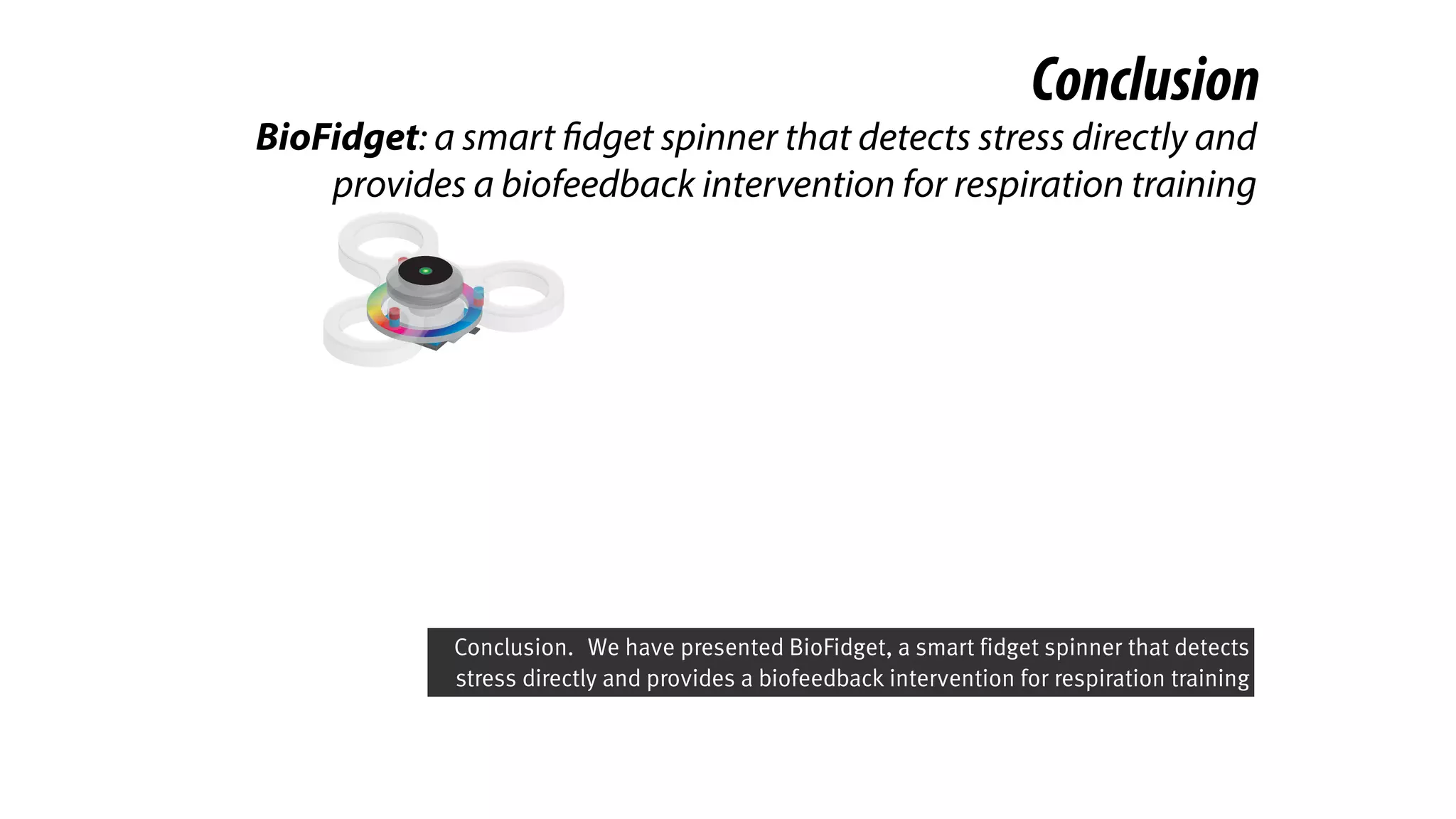
Conclusion
BioFidget: a smart fidget spinner that detects stress directly and
provides a biofeedback intervention for respiration training
Conclusion.  We have presented BioFidget, a smart fidget spinner that detects
stress directly and provides a biofeedback intervention for respiration training
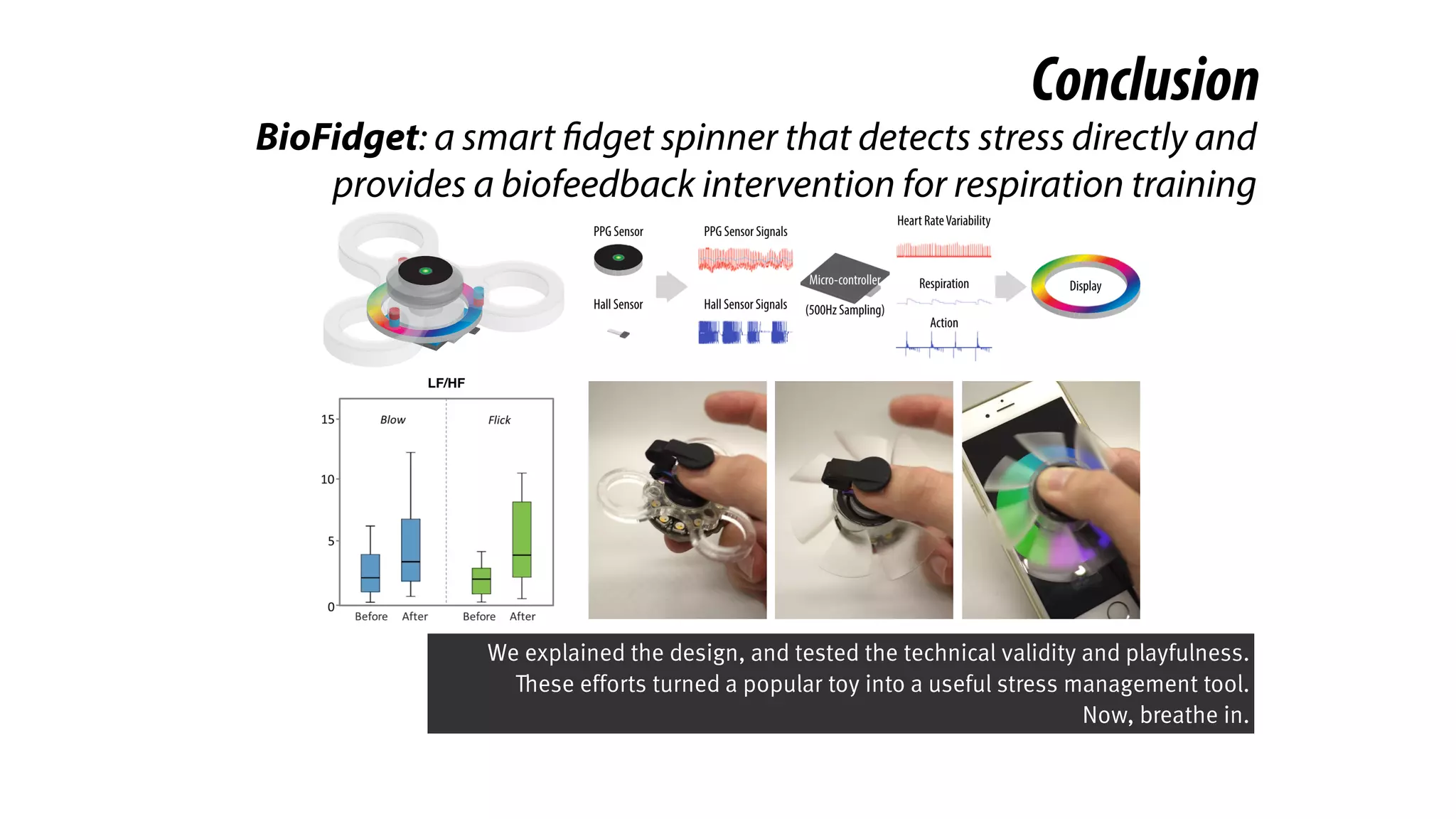
Conclusion
BioFidget: a smart fidget spinner that detects stress directly and
provides a biofeedback intervention for respiration training
We explained the design, and tested the technical validity and playfulness.
These efforts turned a popular toy into a useful stress management tool.
Now, breathe in.
BioFidget: Biofeedback for Respiration Training
Using an Augmented Fidget Spinner
Rong-Hao Liang
Bin Yu
Mengru Xue
Jun Hu
Loe M. G. Feijs
Department of Industrial Design
Eindhoven University of Technology, the Netherlands
ProjectPage:http://tinyurl.com/BioFidget
BioFidget: a smart fidget spinner that detects stress directly and
provides a biofeedback intervention for respiration training
and Breathe out. Thank you.

[CHI '18 Paper] BioFidget: Biofeedback for Respiration Training Using an Augmented Fidget Spinner (with script)

  • 1.
    BioFidget: Biofeedback forRespiration Training Using an Augmented Fidget Spinner Rong-Hao Liang Bin Yu Mengru Xue Jun Hu Loe M. G. Feijs Department of Industrial Design Eindhoven University of Technology, the Netherlands Hi, this is Rong-Hao. We are from TU Eindhoven Industrial Design. I would like to share an interesting project with you. It’s called BioFidget: Biofeedback for respiration training using an augmented fidget spinner.
  • 2.
    This is aproject about stress management.
  • 3.
    What were yourstressful moments?
  • 4.
    When we’re confrontedwith challenges in our everyday life, we feel stressed. Stress can be a good thing that improves our performances. But, a long-term stress can lead serious health problem. Therefore, we need to manage stress.
  • 5.
    ] Lehrer, P. M.,Vaschillo, E., and Vaschillo, B. Resonant frequency biofeedback training to increase cardiac variability: Rationale and manual for training. Applied psychophysiology and biofeedback 25, 3 (2000), 177–191. RespirationTraining is Clinical-Proven in Stress Reduction, Here we introduce a clinical- proven method in stress management. And you probably knew it. It’s respiration training.
  • 6.
    Slow and SteadyDeep Breathing, 6 cycles / min Lehrer, P. M., Vaschillo, E., and Vaschillo, B. Resonant frequency biofeedback training to increase cardiac variability: Rationale and manual for training. Applied psychophysiology and biofeedback 25, 3 (2000), 177–191. RespirationTraining is Clinical-Proven in Stress Reduction, In respiration training, what you need to do is to take slow and steady deep breathing in 6 cycles per minute. After 3-5 minute, it will relax your central nerve system and you will feel much more relieved. Well, what’s the problem then?
  • 7.
    Slow and SteadyDeep Breathing, 6 cycles / min Lehrer, P. M., Vaschillo, E., and Vaschillo, B. Resonant frequency biofeedback training to increase cardiac variability: Rationale and manual for training. Applied psychophysiology and biofeedback 25, 3 (2000), 177–191. RespirationTraining is Clinical-Proven in Stress Reduction, but People Usually Drops Out. The problem is, people usually drops out this process. Honestly, it’s a boring boring exercise. It’s neither competitive nor rewarding. So, when there is a distraction, people just let go.
  • 8.
    Stretch Sensor forBreath Sensing ImprovingEngagement Respiration Training with Biofeedback To engage people in respiration training, we can provide biofeedback. Biofeedback is a therapy that has been applied for a long time. The therapist just put a screen in front of the patient.
  • 9.
    Stretch Sensor forBreath Sensing Respiration Heart Rate Variability (HRV) (The variation in the Inter-beat Interval) The screen shows two curves. The blue curve is the respiration level. The violet curve is heart-rate variability, HRV, which is the variation in the inter-beat intervals.
  • 10.
    Stretch Sensor forBreath Sensing Respiration Heart Rate Variability (HRV) (The variation in the Inter-beat Interval) A proper respiration training may synchronize these two curves, because the deep breathing regulates the heart rate.
  • 11.
    Stretch Sensor forBreath Sensing ImprovingEngagement Respiration Training with Biofeedback of Respiration and Heart Rate Variability (HRV) Information During the respiration training, the patient tries to control their breathing to match the respiration curve to the HRV curve.
  • 12.
    Sharma, N., andGedeon, T. Objective measures, sensors and computational techniques for stress recognition and classification: A survey. Computer methods and programs in biomedicine 108, 3 (2012), 1287–1301. HeartRateVariability(HRV) is a Primary Measure of StressAfter proper training, the HRV will be increased.
  • 13.
    Table 5 –Empirical ranking of primary measures for measuring stress. Rank Primary measure 1 HRV 2 GSR 3 EEG 4 PD 5 Voice 6 Eye gaze 7 Facial expression 8 BP Sharma, N., and Gedeon, T. Objective measures, sensors and computational techniques for stress recognition and classification: A survey. Computer methods and programs in biomedicine 108, 3 (2012), 1287–1301. HeartRateVariability(HRV) is a Primary Measure of StressThis phenomenon is a clear signal of stress reduction.
  • 14.
    HR via Music[Yokoyama 2002]SQUID [Farjadian et al. 2013]BreathTray [Moraveji et al. 2012] ImprovingEngagement Providing User-Friendly Biofeedback, Previous work tried to improve the experiences by providing user-friendly biofeedback in visual, haptic, and audio channels.
  • 15.
    HR via Music[Yokoyama 2002]SQUID [Farjadian et al. 2013] Living Surface [Yu et al. 2016] BreathTray [Moraveji et al. 2012] InnerGarden [Roo et al. 2017] ImprovingEngagement Providing User-Friendly Biofeedback, Some further use shape changing interfaces and virtual reality to increase the immersion.
  • 16.
    SQUID [Farjadian etal. 2013] Living Surface [Yu et al. 2016] BreathTray [Moraveji et al. 2012] InnerGarden [Roo et al. 2017] ImprovingEngagement Providing User-Friendly Biofeedback, but Requires Bio-sensors to be Worn. HR via Music [Yokoyama 2002] However, these systems all require the users to wear both heart rate and respiration sensors, before they start the training.
  • 17.
    ImprovingEngagement Photoplethysmograph (PPG) for HeartRateVariability Sensing Stretch Sensor for Respiration Sensing Stretch Sensor for Breath Sensing Providing User-Friendly Biofeedback, but Requires Bio-sensors to be Worn. It leads us to ask an intriguing question.
  • 18.
    ImprovingEngagement Photoplethysmograph (PPG) for HeartRateVariability Sensing Stretch Sensor for Respiration Sensing Stretch Sensor for Breath Sensing Providing User-Friendly Biofeedback, but Requires Bio-sensors to be Worn. In everyday life, would you put these sensors on, when you are stressed?
  • 19.
    FidgetSpinner One thing wedo when we’re stressed is fidgeting. Last year, Fidget Spinners went viral. In the spinning, the visual and tactile feedback are very soothing even addictive. It’s healing, that’s why people love it. Nonetheless, it has no biosensors, so it does not provide biofeedback based on the biosignals.
  • 20.
    FidgetSpinner … “fidget spinnersand other self-regulatory occupational therapy toys have yet to be subjected to rigorous scientific research. Thus, their alleged benefits remain scientifically unfounded.” Schecter, Rachel A., et al. "Fidget spinners: Purported benefits, adverse effects and accepted alternatives."  Current opinion in pediatrics 29.5 (2017): 616-618. Importantly, regarding stress management, the clinical effects of a spinner is still scientifically baseless.
  • 21.
    do not sensethe user’s physiological data [Wensveen et al. 2012] Mind Sphere, PhilipsFidgetWidget [Karlesky et al. 2014] Relax! Pen [Bruns 2010] FidgetDevicesforSelf-Regulation Same as fidget spinners, previous work uses tangible user interfaces as fidgets to help the users in doing self-regulation. They also did not provide biofeedback based on stress-related biosignal.
  • 22.
    FidgetDevicesforSelf-Regulation [Wensveen et al.2012] Mind Sphere, PhilipsFidgetWidget [Karlesky et al. 2014] Relax! Pen [Bruns 2010] HandheldDevicesforBio-Sensing do not support rich, engaging interaction StressEraserHandheld Spirometer Finger-based ECG do not sense the user’s physiological data Some handheld physiological sensors, we call it biosensors in short, do not require users to wear, but they try to avoid user interactions that may affect their technical validity of bio-sensing.
  • 23.
    FidgetDevicesforSelf-Regulation [Wensveen et al.2012] Mind Sphere, PhilipsFidgetWidget [Karlesky et al. 2014] Relax! Pen [Bruns 2010] HandheldDevicesforBio-Sensing do not support rich, engaging interaction StressEraserHandheld Spirometer Finger-based ECG do not sense the user’s physiological data We see a gap between these two research domains, and that's what we are gonna bridge.  
  • 24.
    BioFidget:AugmentedFidgetSpinner without Requiring AdditionalSensors to be Worn That Senses HRV and Respiration and Provides Biofeedback In this project, we reinvent the fidget spinner.
  • 25.
    BioFidget:AugmentedFidgetSpinner without Requiring AdditionalSensors to be Worn That Senses HRV and Respiration and Provides Biofeedback
  • 26.
    BioFidget:AugmentedFidgetSpinner without Requiring AdditionalSensors to be Worn That Senses HRV and Respiration and Provides Biofeedback
  • 27.
    BioFidget:AugmentedFidgetSpinner without Requiring AdditionalSensors to be Worn That Senses HRV and Respiration and Provides Biofeedback
  • 28.
    BioFidget:AugmentedFidgetSpinner without Requiring AdditionalSensors to be Worn That Senses HRV and Respiration and Provides Biofeedback Therefore, a fidget spinner can provide the feedback for respiration training, without requiring the user to put additional sensor on the body. We call it BioFidget.
  • 29.
    RedesigningFidgetSpinner To Meet BothTechnical Validity and Playfulness Playfulness Technical Validity& The design of BioFidget needs to meet the technical Validity of biosensing, and also preserve the original playfulness of a fidget spinner.
  • 30.
    RedesigningFidgetSpinner To Meet BothTechnical Validity and Playfulness Pad Pad Wing First, we dis-assemble a fidget Spinner into two parts: pads and wing.
  • 31.
    RedesigningFidgetSpinner To Meet BothTechnical Validity and Playfulness Pad Pad Wing PPG Sensor Micro-controller Then, we put a ppg heart-rate sensor on the top pad, wire connected it to the micro-controller attached at the bottom pad.
  • 32.
    RedesigningFidgetSpinner To Meet BothTechnical Validity and Playfulness PPG Sensor Micro-controller Hall Sensor Magnets Then, we change the wing into a light-weight one with three magnets,
  • 33.
    RedesigningFidgetSpinner To Meet BothTechnical Validity and Playfulness PPG Sensor Micro-controller Hall Sensor Magnets N 1 north and 2 south, and mount an analog Hall-sensor at the bottom pad to pick up the spinning movement.
  • 34.
    RedesigningFidgetSpinner To Meet BothTechnical Validity and Playfulness Hall Sensor Magnets N NeoPixel Ring Then, we put an RGB+White LED ring,
  • 35.
    RedesigningFidgetSpinner To Meet BothTechnical Validity and Playfulness NeoPixel Ring Accelerometer and an additional accelerometer as a mode switch.
  • 36.
    RedesigningFidgetSpinner To Meet BothTechnical Validity and Playfulness By combining all together, we have the hardware design.
  • 37.
    RedesigningFidgetSpinner To Meet BothTechnical Validity and Playfulness And the actual device looks like this.
  • 38.
    SignalProcessing Signal Pipeline PPG Sensor HallSensor DisplayMicro-controller (500Hz Sampling) Heart RateVariability Respiration Action PPG Sensor Signals Hall Sensor Signals PC On signal processing, the micro-controller samples the sensors in 500 Hz, extracts the HRV and Respiration from the data stream, and show them directly to the user.
  • 39.
    HRVSensing Algorithm PPG Sensor Micro-controller (500Hz Sampling) HeartRateVariabilitySignals time (diastolic point) Dn-1 Sn Dn dn TnTn-1 (systolic point) (dicrotic notch) Sn-1 Sn+1 Dn+1 dn+1 Tn+1 voltage dn-1 t(Bn-1) t(Bn) t(Bn+1) IBInIBIn-1 Robin P Smith, Jerome Argod, Jean-Louis Pepin, and Patrick A Levy. 1999. Pulse transit time: an appraisal of potential clinical applications. Thorax 54, 5 (1999), 452–457. On HRV sensing, an algorithm is implemented to extract the HRV.
  • 40.
    PPG Sensor Micro-controller (500Hz Sampling) HeartRateVariability Signals PPG Sensor Micro-controller (500Hz Sampling) Heart RateVariabilitySignals HRVSensing Results For example, in this 30 seconds, the heartbeat and the Inter-beat intervals were correctly extracted.
  • 41.
    SignalProcessing Algorithm (1/2) Hall Sensor Micro-controller (500HzSampling) Respiration Action Signals voltage time rectified north south Hall Sensor Magnets N raw On respiration sensing, the hall sensor tracks the only north magnet in 500 Hz to pick up the rotation of the wing.
  • 42.
    SignalProcessing Algorithm (2/2) Hall Sensor Micro-controller (500HzSampling) Respiration Action Signals Hall Sensor Micro-controller (500Hz Sampling) Revolution Speed Signals Therefore, revolution speed can be obtained from the rotation counts
  • 43.
    SignalProcessing Algorithm (2/2) Hall Sensor Micro-controller (500HzSampling) Respiration Action Signals Hall Sensor Micro-controller (500Hz Sampling) Revolution Speed Signals Revolution Acceleration And acceleration can be obtained from the differentiation of speed. The acceleration shows the force exerting to the wing, and the speed indicates the types of actions.
  • 44.
    Results Hall Sensor Micro-controller (500Hz Sampling) Respiration Action Signals Revolution Speed Revolution Acceleration Revolution Speed Revolution Acceleration SignalProcessingSpecifically,a user can play with a spinner in two ways: flicking its wing or blowing on its wing. The speed pattern of the two types of actions are different,
  • 45.
    Activity Recognition Hall Sensor Micro-controller (500HzSampling) Respiration Action Signals Revolution Speed Revolution Acceleration Revolution Speed Revolution Acceleration SignalProcessing W d Vmax so they can be distinguished using the time to the maximum speed with a precise segmentation by the acceleration.
  • 46.
    For respiration training BioFeedback Signals Guidanceand Feedback Now let's talk about the visual output. The display shows the breathing timing and feeds the breathing quality back to the user.
  • 47.
    Breathing GuidanceThe timing of“breathe in” is shown in a white breathing light,
  • 48.
    Breathing Guidanceand the timingof “breathe out” is shown in a colorful breathing light.
  • 49.
    Exhalation quality BioFeedback Respiration Display The qualityof exhalation correlates to revolution speed, which is shown as a linear range of hue. The more colorful it is, the better breathing quality it is. The color also rotates to mimic the dynamics of the spinner.
  • 50.
    HRV Status BioFeedback Display Heart RateVariability Inter-BeatInterval Heartbeat Before and after the training, the user perceives their HRV information through the blinking heart-beat lights and the white bar of his last inter-beat intervals. The white bar can display other HRV index in the same way.
  • 51.
    PilotStudy 3-min Respiration Trainingsin a static context Flicks the spinner while exhaling Blows on the spinner by exhaling Pilot study tests the technical validity of BioFidget in a static context. An example user performed respiration training with his both arms fixed on the table. He performed two sessions of 3-minute respiration in two different ways.
  • 52.
    Flicks the spinnerwhile exhaling Blows on the spinner by exhaling PilotStudy 3-min Respiration Trainings in a static context One way is Flick: flicking the spinner while exhalation. Breathe in,
  • 53.
    Flicks the spinnerwhile exhaling Blows on the spinner by exhaling PilotStudy 3-min Respiration Trainings in a static context and Breathe out.
  • 54.
    Flicks the spinnerwhile exhaling Blows on the spinner by exhaling PilotStudy 3-min Respiration Trainings in a static context Another way is Blow: blowing on the wing of spinner by exhalation. Breathe in,
  • 55.
    Flicks the spinnerwhile exhaling Blows on the spinner by exhaling PilotStudy 3-min Respiration Trainings in a static context and Breathe out.
  • 56.
    PPG sensor #2 (baseline) Flicksthe spinner while exhaling Blows on the spinner by exhaling PilotStudy 3-min Respiration Trainings in a static context We also fixed a secondary ppg sensor on his index finger of the non- dominant hand as a baseline.
  • 57.
    PPG sensor #2 (baseline) Accelerometer Flicksthe spinner while exhaling Blows on the spinner by exhaling PilotStudy 3-min Respiration Trainings in a static context And use the accelerometer data for motion analysis.
  • 58.
    Results 0 60 1200 60 120 (s) revolution speed revolution acceleration acceleration interbeat interval blood volume pulse interbeat interval blood volume pulse sensorsonfidgetspinnerbaseline HallAPPGPPG Accelerometer 0 60 120 0 60 120 (s) revolution speed revolution acceleration acceleration interbeat interval blood volume pulse interbeat interval blood volume pulse sensorsonfidgetspinnerbaseline HallAPPGPPG (s) Flicks the spinner while exhaling Blows on the spinner by exhaling PilotStudyHere’s the sensor stream results.
  • 59.
    Accelerometer 0 60 1200 60 120 (s) revolution speed revolution acceleration acceleration interbeat interval blood volume pulse interbeat interval blood volume pulse sensorsonfidgetspinnerbaseline HallAPPGPPG 0 60 120 0 60 120 (s) revolution speed revolution acceleration acceleration interbeat interval blood volume pulse interbeat interval blood volume pulse sensorsonfidgetspinnerbaseline HallAPPGPPG (s) 2X 2X Results Flicks the spinner while exhaling Blows on the spinner by exhaling PilotStudyThe flicking and blowing actions were all reliably captured.
  • 60.
    Accelerometer 0 60 1200 60 120 (s) revolution speed revolution acceleration acceleration interbeat interval blood volume pulse interbeat interval blood volume pulse sensorsonfidgetspinnerbaseline HallAPPGPPG 0 60 120 0 60 120 (s) revolution speed revolution acceleration acceleration interbeat interval blood volume pulse interbeat interval blood volume pulse sensorsonfidgetspinnerbaseline HallAPPGPPG (s) 2X 2X Results Corrupted Flicks the spinner while exhaling Blows on the spinner by exhaling PilotStudy The HRV data is also reliably captured in the Blow session, but the data was “corrupted” in the Flick session. The accelerator data shows that impacts of finger flicking seems to be the reason. We need to deal with this.
  • 61.
    FunctionalExtension Adding a clipto stabilize HRV sensing Without a clip With a clip A simple solution is adding a clip to stabilize HRV sensing when the user is fidgeting.
  • 62.
    UserStudy PPG sensor #2 (baseline) respirationtraining in a personally comfortable way Without a clip With a clip We test this solution in a casual setting, participant did the training in a personally comfortable way. Participants were divided into two groups.   One uses a biofidget without a clip, and another one uses a biofiget with a clip. Both groups use a secondary PPG as a baseline.
  • 63.
    Without a clip Witha clip PPG sensor #2 (baseline) UserStudy respiration training in a personally comfortable way Each group was evenly divided into two subgroups. We collected four sessions of 3-minutes HRV data. One subgroup first has a 3-minute normal session, in which they do nothing but browsing internet.
  • 64.
    Without a clip Witha clip PPG sensor #2 (baseline) UserStudy respiration training in a personally comfortable way Then, a 3-minute blow session. Then, another 3-minute normal session, and finally a 3-minute flick session.
  • 65.
    Without a clip Witha clip PPG sensor #2 (baseline) UserStudy respiration training in a personally comfortable way Another subgroup reversed the order of blow and flick sessions for counterbalancing. In the end, each participant had an individual interview.
  • 66.
    RMSSDLF/HF 1. Respiration Trainingwas Effective in Both Flick and Blow Sessions. Stress Reduced Heart-rate regulation improved QuantitativeResultsWe first use the baseline PPG to evaluate the effectiveness of respiration training, and found that the respiration training was effective in both flick and blow sessions.
  • 67.
    RMSSDLF/HF 1. Respiration Trainingwas Effective in Both Flick and Blow Sessions. Stress Reduced Heart-rate regulation improved QuantitativeResults Before After The comparisons between the two HRV indexes of the first and the third sessions, show a significant stress reduction and better heart rate regulation after the training.
  • 68.
    17 18 1920 2122 23 24 2526 27 28 2930 31 32 with a clip (BioFidget) 17 18 1920 21 22 2324 25 26 2728 29 30 31 32 with a clip (BioFidget) 0% 25% 50% 75% 100% 1 2 3 4 5 6 7 8 9 10 11 12 13 14 1516 baseline (PPG #2) without a clip (BioFidget) 0% 25% 50% 75% 100% 1 2 3 4 5 6 7 8 9 10 11 12 1314 15 16 baseline (PPG #2) without a clip (BioFidget) Participant ID QuantitativeResults 2. The Clip Stabilized the HRV Sensing and Enabled Blowing Input PPG sensor #2 (baseline) Now let's check the HRV collected by the two BioFidgets. The clip significantly improved the HRV sensing quality in the both Flick and Blow sessions.
  • 69.
    17 18 1920 2122 23 24 2526 27 28 2930 31 32 with a clip (BioFidget) 17 18 1920 21 22 2324 25 26 2728 29 30 31 32 with a clip (BioFidget) 0% 25% 50% 75% 100% 1 2 3 4 5 6 7 8 9 10 11 12 13 14 1516 baseline (PPG #2) without a clip (BioFidget) 0% 25% 50% 75% 100% 1 2 3 4 5 6 7 8 9 10 11 12 1314 15 16 baseline (PPG #2) without a clip (BioFidget) Participant ID QuantitativeResults 2. The Clip Stabilized the HRV Sensing and Enabled Blowing Input PPG sensor #2 (baseline) In the Blow session, the HRV collected by BioFidget with a clip is even similarly reliable to the one collected by the Baseline PPG, showing that the blowing action does not affect the validity of HRV collection.
  • 70.
    Flicking Detected QuantitativeResults Strategy of HRVdata collection The results suggest an HRV data collection strategy. When a flicking is detected, we temporary ignore the rest of the HRV data, until 3 consecutive heartbeats have been detected.
  • 71.
    Flicking Detected Blowing Detected QuantitativeResults Strategy of HRVdata collection When a blowing is detected, we just continue tracking so that most of valid HRV data can be collected.
  • 72.
    0% 25% 50% 75% 100% 500 400 300200 0% 25% 50% 75% 100% 500 400 300 200 window size (ms) accuracy detectionrate 0% 25% 50% 75% 100% 500 400 300 200 300 270 240 210 180 150 120 90 60 window size (ms) 0% 25% 50% 75% 100% 500 400 300 200 recall window size (ms) window size (ms) Recall: FlickingRecall: BlowingAction Detection RateAccuracy: Overall recall minimal velocity (rpm) QuantitativeResults 3. Actions were Reliably Recognized (with High Recall of Blowing Recognition) W d Vmax Vmax Resultsofactivityrecognitionusingdasfeature W = 500ms;Vmax ≥ 60rpm: 87.9% accuracy; 96.2% detection rate. W W W W The data collection strategy is supported by reliable action recognition. Post-hoc analysis shows that 96% of actions can be detected with an 88% accuracy using a nearest- neighbor classifier in a 5-fold cross- validation, when a low speed threshold and a half-minute window size were used.
  • 73.
    31(outof32)participants: ThebreathingguidancethroughthelightonBioFidgetwasclearandeasytoperceive. 20participants: Spinningthefidgetmadethemfeelrelaxedandmoreabletofocusonthebreathingguidance. 26participants: Thefeedbackengagedandmotivatedthemtoperformbetterinbreathingtraining. UserFeedback General responses The generalfeedback from the interview is positive. Participants agreed that the breathing guidance was clear and easy to perceive, the spinner made them feel relaxed and more focused, and the feedback engaged and motivated them to perform better.
  • 74.
    “IfeelimmersedintheexperiencewhenIwasstaringatthedevice”(P19) “itmademefeelengagedandthusencouragedmetospinitfaster,”(P14,P23,P25) “Ipreferredtoseeacolorfullightinsteadoftheredone,whichmotivatedmetoblowonit harder.”(P30,P31) “itwasanamusingvisualizationandalsoarewardformyperformance.”(P1). ”toreleasemystress”(P8),“clearmymind”(P4),and“makememoreconsciousaboutmy breathing”(P9). “Ibreathedsloweranddeeperwithitsfeedback.Ibelieveitishelpfultoadjustmybreathing,” (P9)and“ithelpsintrainingmylungcapacity”(P1). “Ireallylikethistangiblewaytomanipulatingthisdevice”(P1). “Thisinnovationisbasedontherightobjectandmakeitmoreuseful”(P15). UserFeedback Individual responsesIndividual feedbackalso confirms the engagement and playfulness. The last quote echoes our motivation: “This innovation is based on the right object and make it more useful.”
  • 75.
  • 76.
    Twomorefunctionalextensions Fan-shaped wing Additionaldisplay Consequently, we propose another two more functional extensions: Fan-shaped wing and additional display.
  • 77.
    Fan-ShapedWing To increase thesensitivity to respiration The fan-shaped wing increases the sensitivity to the respiration.
  • 78.
    Fan-ShapedWing To increase thesensitivity to respiration It enables the users to easier blow on the wing and get sensed without moving the spinner towards the mouth.
  • 79.
    Fan-ShapedWing Allows for staticuse The wing also enables the use on the table or a display, so the HRV sensing would be stable even without a clip, as shown in pilot study.
  • 80.
    AdditionalDisplay Provide historical HRVinformation adequate respiration training inadequate respiration training The display can provide more insightful information, such as the history of respiration training. For instance, the differences between an adequate and an inadequate trainings can be observed from the resulting drawings, because the respiration regulates the heart rate.
  • 81.
    Follow-UpStudy 20 11 females 9 males 1-min Functionalextensions Both functional extensions were tested with 20 participants from the formal study,
  • 82.
  • 83.
    LimitationsandFutureWork • Tethershouldberemovedandreplacedbyabattery. • Optimizingthepowerconsumptionisnecessary. •ImprovingHRVsensingusingmotion-resilientECGsensor. • MakingVisualizationmoreInformative • Amoresophisticatedincentivemechanismforlong-termuses. There are still some limitations in our physical design, such as the tether, power and sensor choices. Also, the visualization and the incentive mechanism could be improved. We leave them as future work.
  • 84.
    Conclusion BioFidget: a smartfidget spinner that detects stress directly and provides a biofeedback intervention for respiration training Conclusion.  We have presented BioFidget, a smart fidget spinner that detects stress directly and provides a biofeedback intervention for respiration training
  • 85.
    Conclusion BioFidget: a smartfidget spinner that detects stress directly and provides a biofeedback intervention for respiration training We explained the design, and tested the technical validity and playfulness. These efforts turned a popular toy into a useful stress management tool. Now, breathe in.
  • 86.
    BioFidget: Biofeedback forRespiration Training Using an Augmented Fidget Spinner Rong-Hao Liang Bin Yu Mengru Xue Jun Hu Loe M. G. Feijs Department of Industrial Design Eindhoven University of Technology, the Netherlands ProjectPage:http://tinyurl.com/BioFidget BioFidget: a smart fidget spinner that detects stress directly and provides a biofeedback intervention for respiration training and Breathe out. Thank you.