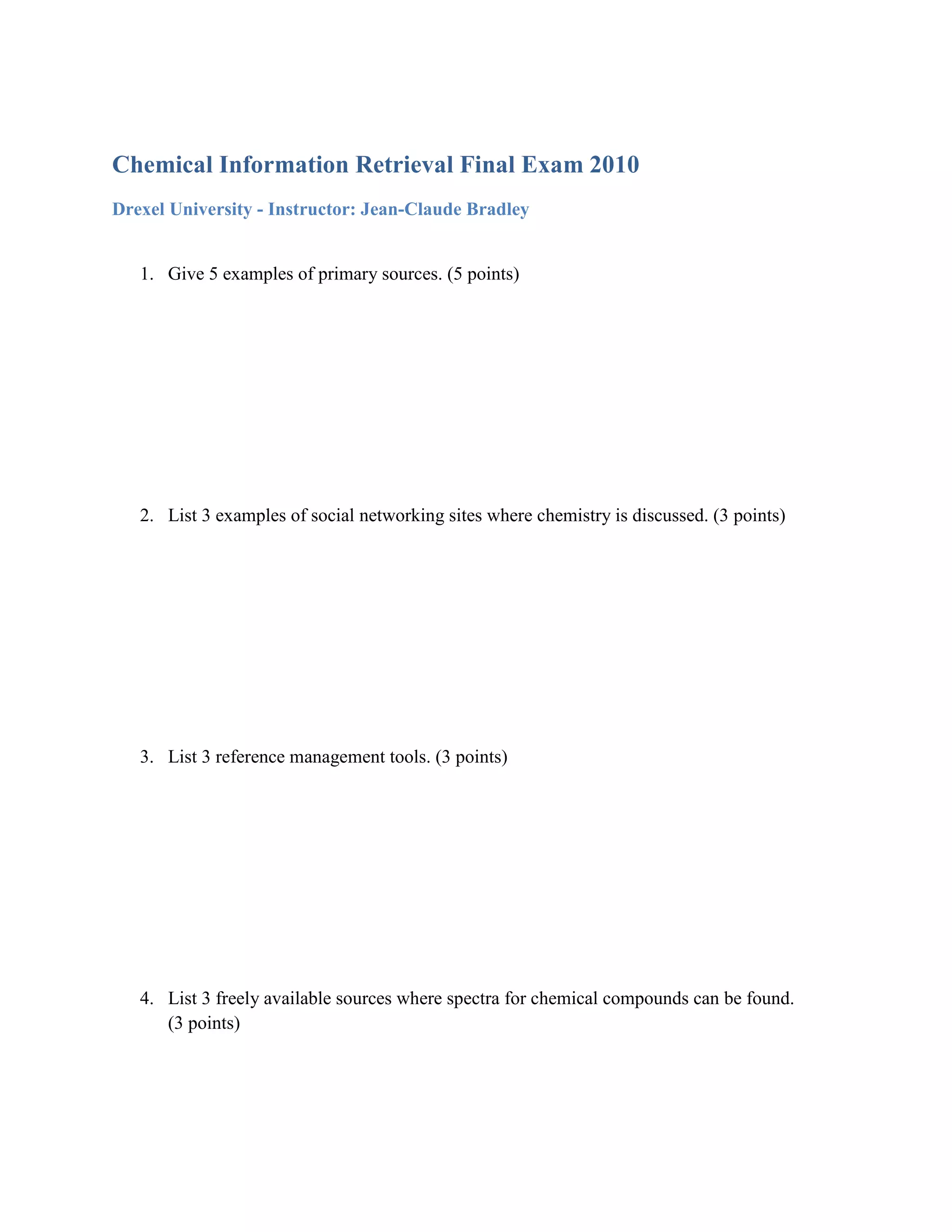
Chemical Information Retrieval Final Exam 2010
Drexel University - Instructor: Jean-Claude Bradley


   1. Give 5 examples of primary sources. (5 points)


   2. List 3 examples of social networking sites where chemistry is discussed. (3 points)


   3. List 3 reference management tools. (3 points)


   4. List 3 freely available sources where spectra for chemical compounds can be found.
      (3 points)
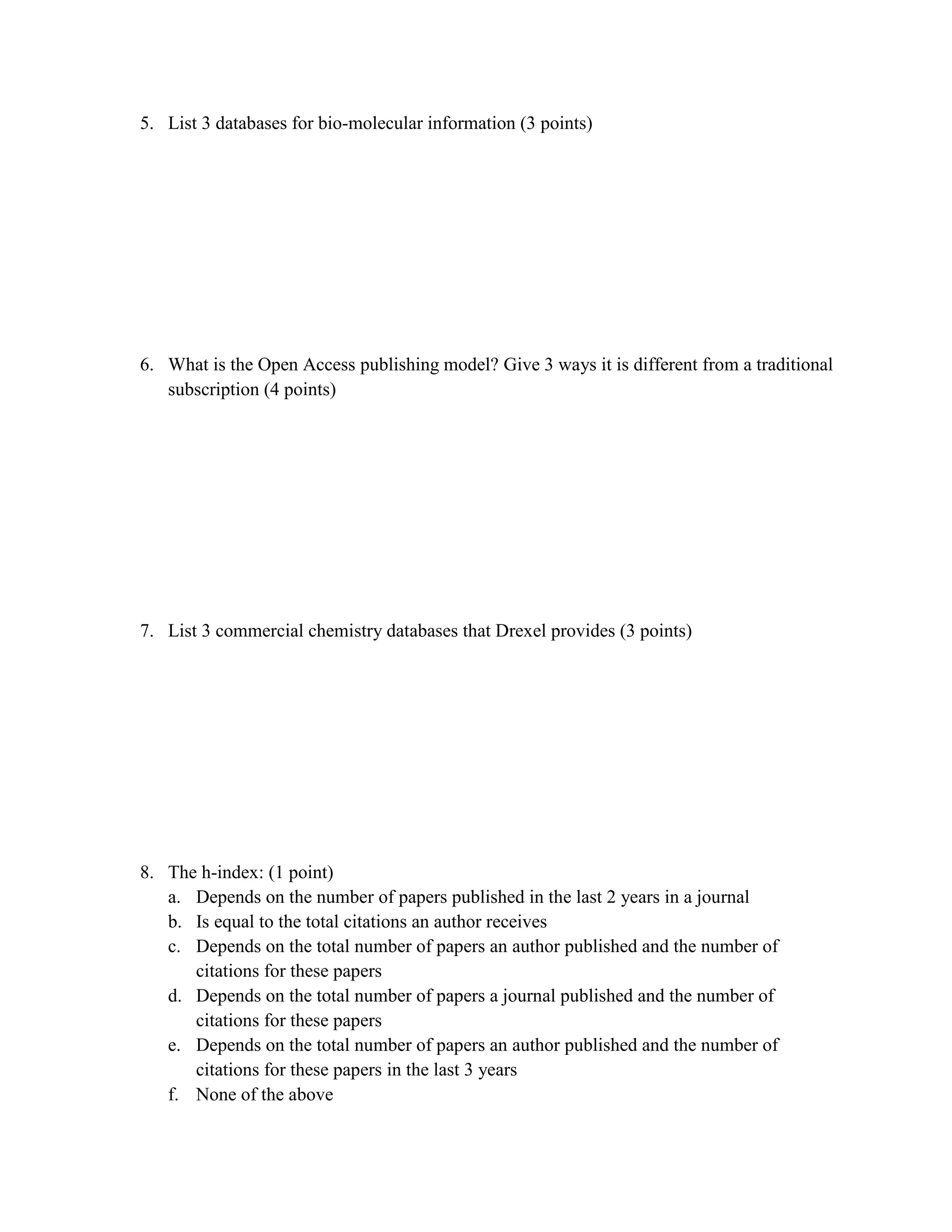
5. List 3 databases for bio-molecular information (3 points)


6. What is the Open Access publishing model? Give 3 ways it is different from a traditional
   subscription (4 points)


7. List 3 commercial chemistry databases that Drexel provides (3 points)


8. The h-index: (1 point)
   a. Depends on the number of papers published in the last 2 years in a journal
   b. Is equal to the total citations an author receives
   c. Depends on the total number of papers an author published and the number of
      citations for these papers
   d. Depends on the total number of papers a journal published and the number of
      citations for these papers
   e. Depends on the total number of papers an author published and the number of
      citations for these papers in the last 3 years
   f. None of the above
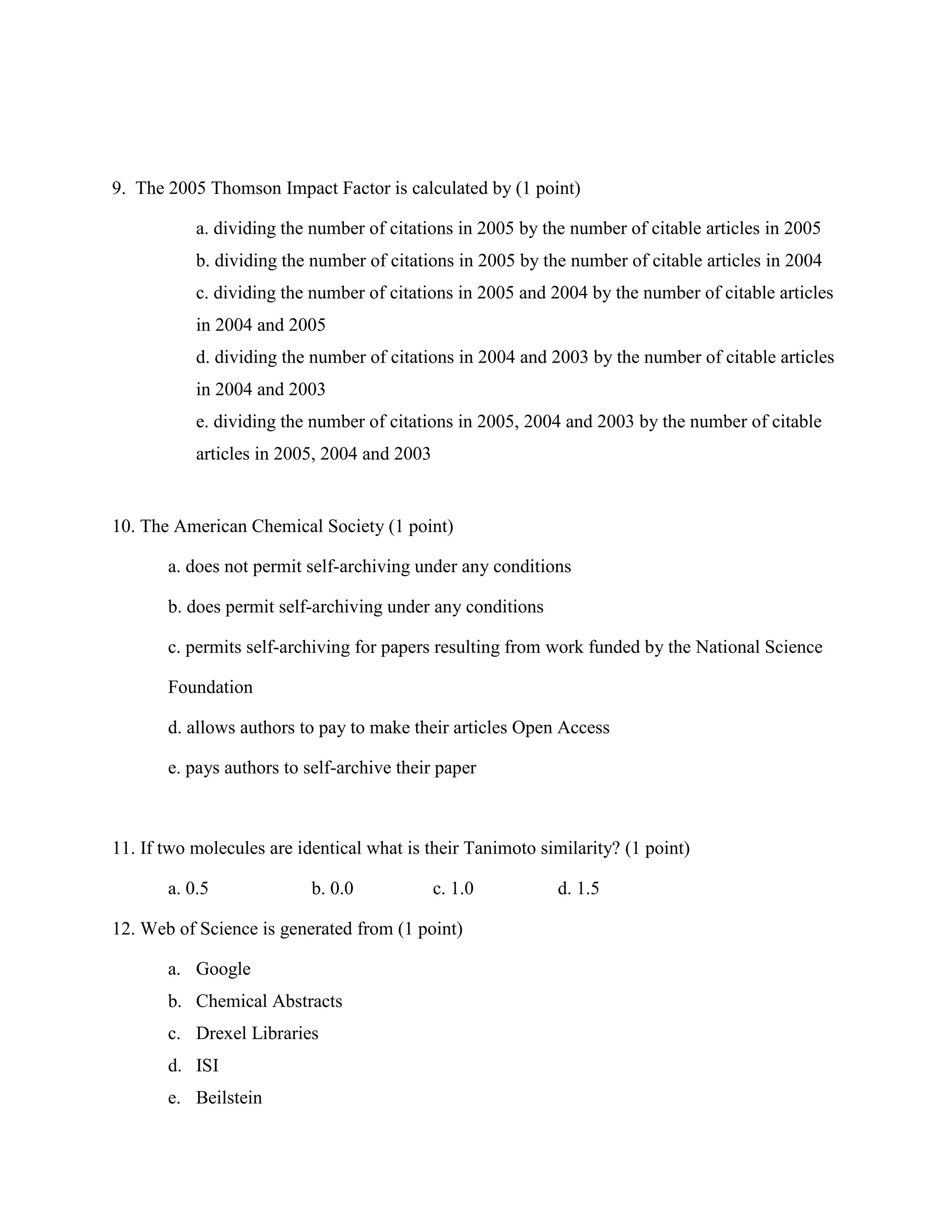
9. The 2005 Thomson Impact Factor is calculated by (1 point)

           a. dividing the number of citations in 2005 by the number of citable articles in 2005
           b. dividing the number of citations in 2005 by the number of citable articles in 2004
           c. dividing the number of citations in 2005 and 2004 by the number of citable articles
           in 2004 and 2005
           d. dividing the number of citations in 2004 and 2003 by the number of citable articles
           in 2004 and 2003
           e. dividing the number of citations in 2005, 2004 and 2003 by the number of citable
           articles in 2005, 2004 and 2003


10. The American Chemical Society (1 point)

       a. does not permit self-archiving under any conditions

       b. does permit self-archiving under any conditions

       c. permits self-archiving for papers resulting from work funded by the National Science

       Foundation

       d. allows authors to pay to make their articles Open Access

       e. pays authors to self-archive their paper


11. If two molecules are identical what is their Tanimoto similarity? (1 point)

       a. 0.5              b. 0.0            c. 1.0         d. 1.5

12. Web of Science is generated from (1 point)

       a. Google
       b. Chemical Abstracts
       c. Drexel Libraries
       d. ISI
       e. Beilstein
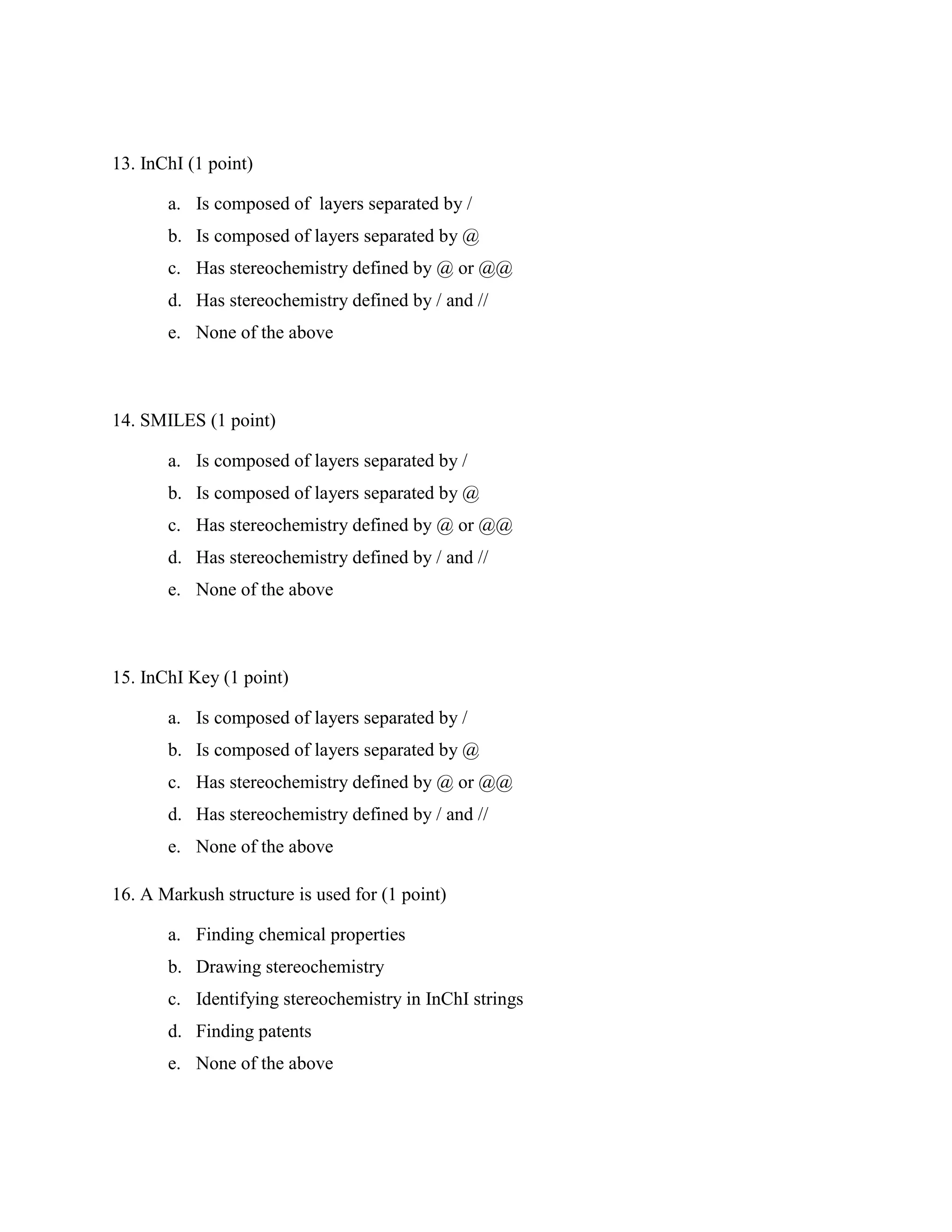
13. InChI (1 point)

       a. Is composed of layers separated by /
       b. Is composed of layers separated by @
       c. Has stereochemistry defined by @ or @@
       d. Has stereochemistry defined by / and //
       e. None of the above


14. SMILES (1 point)

       a. Is composed of layers separated by /
       b. Is composed of layers separated by @
       c. Has stereochemistry defined by @ or @@
       d. Has stereochemistry defined by / and //
       e. None of the above


15. InChI Key (1 point)

       a. Is composed of layers separated by /
       b. Is composed of layers separated by @
       c. Has stereochemistry defined by @ or @@
       d. Has stereochemistry defined by / and //
       e. None of the above

16. A Markush structure is used for (1 point)

       a. Finding chemical properties
       b. Drawing stereochemistry
       c. Identifying stereochemistry in InChI strings
       d. Finding patents
       e. None of the above
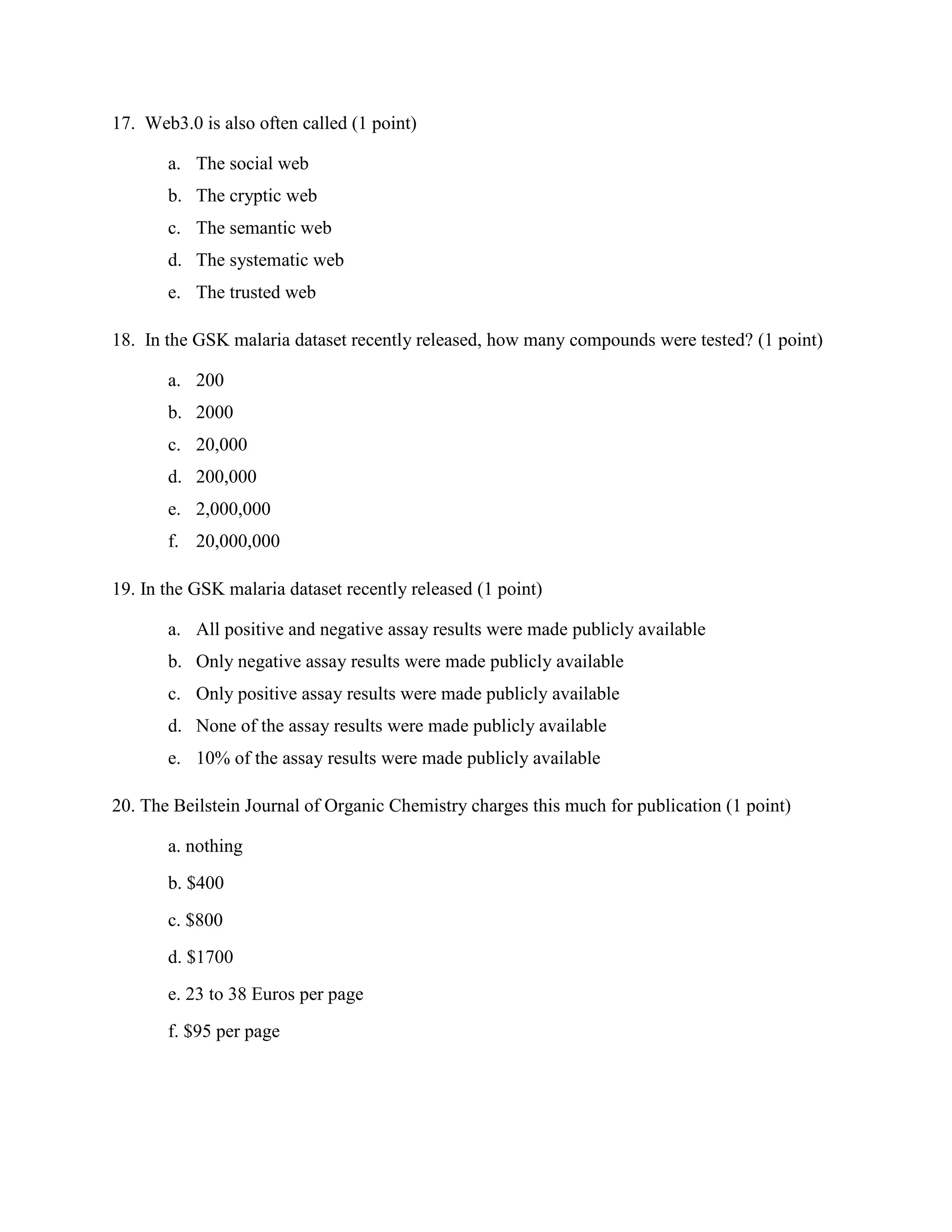
17. Web3.0 is also often called (1 point)

       a. The social web
       b. The cryptic web
       c. The semantic web
       d. The systematic web
       e. The trusted web

18. In the GSK malaria dataset recently released, how many compounds were tested? (1 point)

       a. 200
       b. 2000
       c. 20,000
       d. 200,000
       e. 2,000,000
       f. 20,000,000

19. In the GSK malaria dataset recently released (1 point)

       a. All positive and negative assay results were made publicly available
       b. Only negative assay results were made publicly available
       c. Only positive assay results were made publicly available
       d. None of the assay results were made publicly available
       e. 10% of the assay results were made publicly available

20. The Beilstein Journal of Organic Chemistry charges this much for publication (1 point)

       a. nothing
       b. $400
       c. $800
       d. $1700
       e. 23 to 38 Euros per page
       f. $95 per page

ChemInfo Retrieval Exam 2010

  • 1.
    Chemical Information RetrievalFinal Exam 2010 Drexel University - Instructor: Jean-Claude Bradley 1. Give 5 examples of primary sources. (5 points) 2. List 3 examples of social networking sites where chemistry is discussed. (3 points) 3. List 3 reference management tools. (3 points) 4. List 3 freely available sources where spectra for chemical compounds can be found. (3 points)
  • 2.
    5. List 3databases for bio-molecular information (3 points) 6. What is the Open Access publishing model? Give 3 ways it is different from a traditional subscription (4 points) 7. List 3 commercial chemistry databases that Drexel provides (3 points) 8. The h-index: (1 point) a. Depends on the number of papers published in the last 2 years in a journal b. Is equal to the total citations an author receives c. Depends on the total number of papers an author published and the number of citations for these papers d. Depends on the total number of papers a journal published and the number of citations for these papers e. Depends on the total number of papers an author published and the number of citations for these papers in the last 3 years f. None of the above
  • 3.
    9. The 2005Thomson Impact Factor is calculated by (1 point) a. dividing the number of citations in 2005 by the number of citable articles in 2005 b. dividing the number of citations in 2005 by the number of citable articles in 2004 c. dividing the number of citations in 2005 and 2004 by the number of citable articles in 2004 and 2005 d. dividing the number of citations in 2004 and 2003 by the number of citable articles in 2004 and 2003 e. dividing the number of citations in 2005, 2004 and 2003 by the number of citable articles in 2005, 2004 and 2003 10. The American Chemical Society (1 point) a. does not permit self-archiving under any conditions b. does permit self-archiving under any conditions c. permits self-archiving for papers resulting from work funded by the National Science Foundation d. allows authors to pay to make their articles Open Access e. pays authors to self-archive their paper 11. If two molecules are identical what is their Tanimoto similarity? (1 point) a. 0.5 b. 0.0 c. 1.0 d. 1.5 12. Web of Science is generated from (1 point) a. Google b. Chemical Abstracts c. Drexel Libraries d. ISI e. Beilstein
  • 4.
    13. InChI (1point) a. Is composed of layers separated by / b. Is composed of layers separated by @ c. Has stereochemistry defined by @ or @@ d. Has stereochemistry defined by / and // e. None of the above 14. SMILES (1 point) a. Is composed of layers separated by / b. Is composed of layers separated by @ c. Has stereochemistry defined by @ or @@ d. Has stereochemistry defined by / and // e. None of the above 15. InChI Key (1 point) a. Is composed of layers separated by / b. Is composed of layers separated by @ c. Has stereochemistry defined by @ or @@ d. Has stereochemistry defined by / and // e. None of the above 16. A Markush structure is used for (1 point) a. Finding chemical properties b. Drawing stereochemistry c. Identifying stereochemistry in InChI strings d. Finding patents e. None of the above
  • 5.
    17. Web3.0 isalso often called (1 point) a. The social web b. The cryptic web c. The semantic web d. The systematic web e. The trusted web 18. In the GSK malaria dataset recently released, how many compounds were tested? (1 point) a. 200 b. 2000 c. 20,000 d. 200,000 e. 2,000,000 f. 20,000,000 19. In the GSK malaria dataset recently released (1 point) a. All positive and negative assay results were made publicly available b. Only negative assay results were made publicly available c. Only positive assay results were made publicly available d. None of the assay results were made publicly available e. 10% of the assay results were made publicly available 20. The Beilstein Journal of Organic Chemistry charges this much for publication (1 point) a. nothing b. $400 c. $800 d. $1700 e. 23 to 38 Euros per page f. $95 per page