DISCOVER . LEARN . EMPOWER
ChatBots
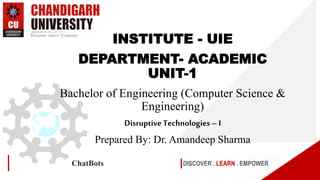
INSTITUTE - UIE
DEPARTMENT- ACADEMIC
UNIT-1
Bachelor of Engineering (Computer Science &
Engineering)
Disruptive Technologies– I
Prepared By: Dr. Amandeep Sharma
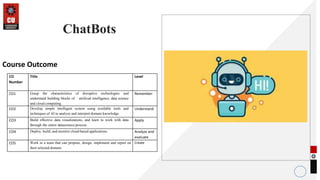
ChatBots
CO
Number
Title Level
CO1 Grasp the characteristics of disruptive technologies and
understand building blocks of artificial intelligence, data science
and cloud computing.
Remember
CO2 Develop simple intelligent system using available tools and
techniques of AI to analyze and interpret domain knowledge.
Understand
CO3 Build effective data visualizations, and learn to work with data
through the entire datascience process.
Apply
CO4 Deploy, build, and monitor cloud-based applications. Analyze and
evaluate
CO5 Work in a team that can propose, design, implement and report on
their selected domain.
Create
Course Outcome
Introduction
• Chat Bot: A computer program that can talk to humans in natural
language!
• Uses Artificial Intelligence Markup Language (AIML) to represent
knowledge.
• Can replace a human for monotonous jobs of answering queries, e.g.
E-help desk.
How It All Started
• Eliza – the first chat bot made by Joseph Weizenbaum.
• Eliza Effect
• tendency of humans to attach associations to terms from prior experience.
• Working of Eliza is based on
• Knowledge Representation
• Pattern Recognition
• Substitution of key words into known phrases.
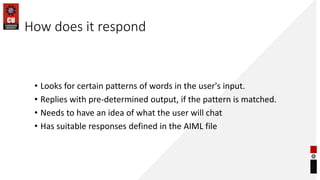
How does it respond
• Looks for certain patterns of words in the user's input.
• Replies with pre-determined output, if the pattern is matched.
• Needs to have an idea of what the user will chat
• Has suitable responses defined in the AIML file
Architecture of a Chat Bot
Responder
AIML Interpreter
AIML Objects
A Chat Bot
Knowledge Representation
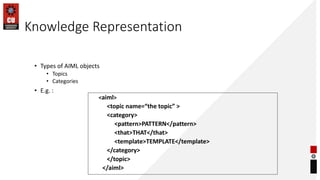
• Types of AIML objects
• Topics
• Categories
• E.g. :
<aiml>
<topic name=“the topic” >
<category>
<pattern>PATTERN</pattern>
<that>THAT</that>
<template>TEMPLATE</template>
</category>
</topic>
</aiml>
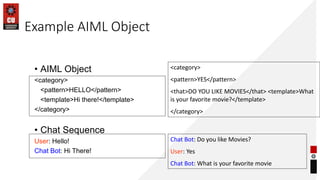
Example AIML Object
• AIML Object
<category>
<pattern>HELLO</pattern>
<template>Hi there!</template>
</category>
• Chat Sequence
User: Hello!
Chat Bot: Hi There!
<category>
<pattern>YES</pattern>
<that>DO YOU LIKE MOVIES</that> <template>What
is your favorite movie?</template>
</category>
Chat Bot: Do you like Movies?
User: Yes
Chat Bot: What is your favorite movie
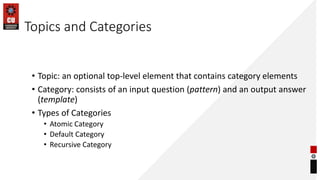
Topics and Categories
• Topic: an optional top-level element that contains category elements
• Category: consists of an input question (pattern) and an output answer
(template)
• Types of Categories
• Atomic Category
• Default Category
• Recursive Category
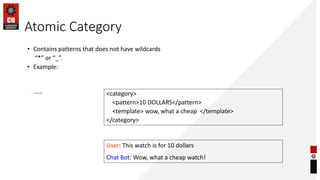
Atomic Category
<category>
<pattern>10 DOLLARS</pattern>
<template> wow, what a cheap </template>
</category>
User: This watch is for 10 dollars
Chat Bot: Wow, what a cheap watch!
• Contains patterns that does not have wildcards
“*” or “_”.
• Example:
• Conversation:
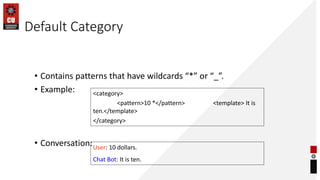
Default Category
• Contains patterns that have wildcards “*” or “_”.
• Example:
• Conversation:
<category>
<pattern>10 *</pattern> <template> It is
ten.</template>
</category>
User: 10 dollars.
Chat Bot: It is ten.
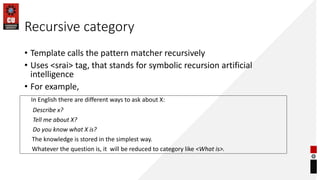
Recursive category
• Template calls the pattern matcher recursively
• Uses <srai> tag, that stands for symbolic recursion artificial
intelligence
• For example,
In English there are different ways to ask about X:
Describe x?
Tell me about X?
Do you know what X is?
The knowledge is stored in the simplest way.
Whatever the question is, it will be reduced to category like <What is>.
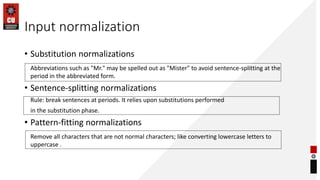
Input normalization
• Substitution normalizations
Abbreviations such as "Mr." may be spelled out as "Mister" to avoid sentence-splitting at the
period in the abbreviated form.
• Sentence-splitting normalizations
Rule: break sentences at periods. It relies upon substitutions performed
in the substitution phase.
• Pattern-fitting normalizations
Remove all characters that are not normal characters; like converting lowercase letters to
uppercase .
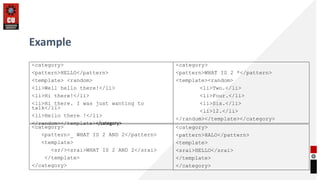
<category>
<pattern>_ WHAT IS 2 AND 2</pattern>
<template>
<sr/><srai>WHAT IS 2 AND 2</srai>
</template>
</category>
<category>
<pattern>WHAT IS 2 *</pattern>
<template><random>
<li>Two.</li>
<li>Four.</li>
<li>Six.</li>
<li>12.</li>
</random></template></category>
<category>
<pattern>HALO</pattern>
<template>
<srai>HELLO</srai>
</template>
</category>
<category>
<pattern>HELLO</pattern>
<template> <random>
<li>Well hello there!</li>
<li>Hi there!</li>
<li>Hi there. I was just wanting to
talk</li>
<li>Hello there !</li>
</random></template></category>
Example
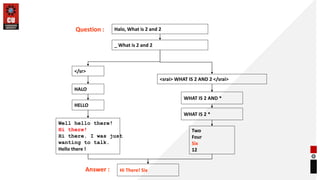
Halo, What is 2 and 2
_ What is 2 and 2
</sr>
<srai> WHAT IS 2 AND 2 </srai>
Well hello there!
Hi there!
Hi there. I was just
wanting to talk.
Hello there !
WHAT IS 2 AND *
WHAT IS 2 *
Two
Four
Six
12
Hi There! Six
Question :
Answer :
HALO
HELLO
Graph-master – an example interpreter
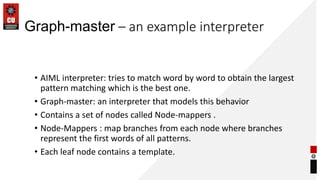
• AIML interpreter: tries to match word by word to obtain the largest
pattern matching which is the best one.
• Graph-master: an interpreter that models this behavior
• Contains a set of nodes called Node-mappers .
• Node-Mappers : map branches from each node where branches
represent the first words of all patterns.
• Each leaf node contains a template.
Flowchart for Pattern Matching
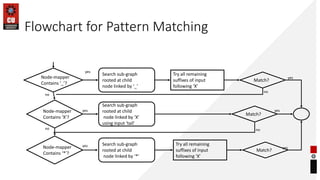
Search sub-graph
rooted at child
node linked by ‘_’
Node-mapper
Contains ‘X’?
Match?
Search sub-graph
rooted at child
node linked by ‘X’
using input ‘tail’
Search sub-graph
rooted at child
node linked by ‘*’
Try all remaining
suffixes of input
following ‘X’
Node-mapper
Contains ‘_’?
Node-mapper
Contains ‘*’?
Try all remaining
suffixes of input
following ‘X’
Match?
Match?
yes
yes
yes
yes
yes
yes
no
no no
no
Some Observations
• Priority order at every node:
• ‘_’ wildcard, followed by
• an atomic word, followed by
• ‘*’ wildcard .
• Patterns need not be ordered alphabetically
• The matching is word-by-word, not category-by-category
• Highly restricted form of depth-first search
Turing Test
• Alan Turing proposed the Turing Test as a replacement for the question
“Can machines think?”
• Turing's aim is to provide a method to assess whether or not a machine
can think.
• The test
• A man (A), a woman (B) and an interrogator (C) chat.
• The objective of the interrogator is to determine which of the other two is the
woman
• If a machine (bot) chats instead of A or B and fools the interrogator, it has
passed the Turing test.
Can It Answer All My Questions?
• A Chat Bot has a limited number of patterns and responses.
• The AIML structure supports regular expressions
• In AIML, you can define recursive categories.
• The bot may sometimes give funny replies, but that depends on the
AIML spec, i.e. Its brain!
How to build a bot of your own
• Components – An AIML Object Spec, AIML interpreter, and a
responder!
• A Chat Bot represents and models a character.
• The brain is the AIML file, that defines patterns and corresponding
replies
• A bot can be trained to be an Expert System about a special theme –
large data!
• Training data – Yahoo Chat!
What is a Chat Bot useful for?
• Commercial chatter bots to help customers
• At web-shops and e-commerce sites.
• Bots to receive complaints from users, online
• An interactive (talking) encyclopedia.
• Chatter bots administrating IRC-channels and Hotline server.
• The Psychiatrist – the famous pronoun reversal trick
• Starship Titanic, a game created by the famous writer Douglas
Adams along with Terry Jones
Questions We Answered
• What is it? Who wants it? Why?
• Since when is it around?
• How does it work?
• How do you test it?
• Can it answer all my questions?
• Can I make one of my own?
• Where can I put it to work?
A Chat Bot…
Clarifications
• How powerful is JavaCC-built parser?
• As long as one can use JavaCC's look-ahead specification to guide the parsing where the LL(1) rules
are not sufficient, JavaCC can handle any grammar that is not left-recursive.
• Powerful than a yacc generated parser?
• AIML is connected to a system that allows for learning new patterns and putting them into a context
• Context sensitive
• Learning ?
• Dialogue Corpora can be used to train a Chatbot! (See References)
• Intelligent?
• Even Turing tests have different levels and yet cannot finally decide whether the system is intelligent
or not. Nowadays a system is considered to be intelligent if it is able to mimic intelligent behaviour
(e.g. within a specified domain).
References
• The Anatomy of A.L.I.C.E.: Dr. Richard S. Wallace, http://www.alicebot.org/anatomy.html
• Artificial Intelligence Markup Language (AIML), A.L.I.C.E. AI Foundation,
http://alicebot.org/TR/2001/WD-aiml/
• AIML Interpreter Overview 2004, http://www.aimlbots.com/en/aiml-interpreters.html
• Computing machinery and intelligence, Alan Turing [1950],
http://www.abelard.org/turpap/turpap.htm
• Using Dialogue Corpora to Train a Chatbot (Bayan Abu Shawar, Eric Atwell)
http://www.comp.leeds.ac.uk/andyr/research/papers/techreport2003_02.pdf
Project Proposal
• Extension to Chat Bot, that will reply emails
• Will maintain a chat session in terms of email-session-id
• Can be useful for auto replying to emails that have a common reply,
related to the question in the email
THANK YOU
For queries
Email: amandeep.ece@cumail.in

Chatbots.pptx

  • 1.
    DISCOVER . LEARN. EMPOWER ChatBots INSTITUTE - UIE DEPARTMENT- ACADEMIC UNIT-1 Bachelor of Engineering (Computer Science & Engineering) Disruptive Technologies– I Prepared By: Dr. Amandeep Sharma
  • 2.
    ChatBots CO Number Title Level CO1 Graspthe characteristics of disruptive technologies and understand building blocks of artificial intelligence, data science and cloud computing. Remember CO2 Develop simple intelligent system using available tools and techniques of AI to analyze and interpret domain knowledge. Understand CO3 Build effective data visualizations, and learn to work with data through the entire datascience process. Apply CO4 Deploy, build, and monitor cloud-based applications. Analyze and evaluate CO5 Work in a team that can propose, design, implement and report on their selected domain. Create Course Outcome
  • 3.
    Introduction • Chat Bot:A computer program that can talk to humans in natural language! • Uses Artificial Intelligence Markup Language (AIML) to represent knowledge. • Can replace a human for monotonous jobs of answering queries, e.g. E-help desk.
  • 4.
    How It AllStarted • Eliza – the first chat bot made by Joseph Weizenbaum. • Eliza Effect • tendency of humans to attach associations to terms from prior experience. • Working of Eliza is based on • Knowledge Representation • Pattern Recognition • Substitution of key words into known phrases.
  • 5.
    How does itrespond • Looks for certain patterns of words in the user's input. • Replies with pre-determined output, if the pattern is matched. • Needs to have an idea of what the user will chat • Has suitable responses defined in the AIML file
  • 6.
    Architecture of aChat Bot Responder AIML Interpreter AIML Objects A Chat Bot
  • 7.
    Knowledge Representation • Typesof AIML objects • Topics • Categories • E.g. : <aiml> <topic name=“the topic” > <category> <pattern>PATTERN</pattern> <that>THAT</that> <template>TEMPLATE</template> </category> </topic> </aiml>
  • 8.
    Example AIML Object •AIML Object <category> <pattern>HELLO</pattern> <template>Hi there!</template> </category> • Chat Sequence User: Hello! Chat Bot: Hi There! <category> <pattern>YES</pattern> <that>DO YOU LIKE MOVIES</that> <template>What is your favorite movie?</template> </category> Chat Bot: Do you like Movies? User: Yes Chat Bot: What is your favorite movie
  • 9.
    Topics and Categories •Topic: an optional top-level element that contains category elements • Category: consists of an input question (pattern) and an output answer (template) • Types of Categories • Atomic Category • Default Category • Recursive Category
  • 10.
    Atomic Category <category> <pattern>10 DOLLARS</pattern> <template>wow, what a cheap </template> </category> User: This watch is for 10 dollars Chat Bot: Wow, what a cheap watch! • Contains patterns that does not have wildcards “*” or “_”. • Example: • Conversation:
  • 11.
    Default Category • Containspatterns that have wildcards “*” or “_”. • Example: • Conversation: <category> <pattern>10 *</pattern> <template> It is ten.</template> </category> User: 10 dollars. Chat Bot: It is ten.
  • 12.
    Recursive category • Templatecalls the pattern matcher recursively • Uses <srai> tag, that stands for symbolic recursion artificial intelligence • For example, In English there are different ways to ask about X: Describe x? Tell me about X? Do you know what X is? The knowledge is stored in the simplest way. Whatever the question is, it will be reduced to category like <What is>.
  • 13.
    Input normalization • Substitutionnormalizations Abbreviations such as "Mr." may be spelled out as "Mister" to avoid sentence-splitting at the period in the abbreviated form. • Sentence-splitting normalizations Rule: break sentences at periods. It relies upon substitutions performed in the substitution phase. • Pattern-fitting normalizations Remove all characters that are not normal characters; like converting lowercase letters to uppercase .
  • 14.
    <category> <pattern>_ WHAT IS2 AND 2</pattern> <template> <sr/><srai>WHAT IS 2 AND 2</srai> </template> </category> <category> <pattern>WHAT IS 2 *</pattern> <template><random> <li>Two.</li> <li>Four.</li> <li>Six.</li> <li>12.</li> </random></template></category> <category> <pattern>HALO</pattern> <template> <srai>HELLO</srai> </template> </category> <category> <pattern>HELLO</pattern> <template> <random> <li>Well hello there!</li> <li>Hi there!</li> <li>Hi there. I was just wanting to talk</li> <li>Hello there !</li> </random></template></category> Example
  • 15.
    Halo, What is2 and 2 _ What is 2 and 2 </sr> <srai> WHAT IS 2 AND 2 </srai> Well hello there! Hi there! Hi there. I was just wanting to talk. Hello there ! WHAT IS 2 AND * WHAT IS 2 * Two Four Six 12 Hi There! Six Question : Answer : HALO HELLO
  • 16.
    Graph-master – anexample interpreter • AIML interpreter: tries to match word by word to obtain the largest pattern matching which is the best one. • Graph-master: an interpreter that models this behavior • Contains a set of nodes called Node-mappers . • Node-Mappers : map branches from each node where branches represent the first words of all patterns. • Each leaf node contains a template.
  • 17.
    Flowchart for PatternMatching Search sub-graph rooted at child node linked by ‘_’ Node-mapper Contains ‘X’? Match? Search sub-graph rooted at child node linked by ‘X’ using input ‘tail’ Search sub-graph rooted at child node linked by ‘*’ Try all remaining suffixes of input following ‘X’ Node-mapper Contains ‘_’? Node-mapper Contains ‘*’? Try all remaining suffixes of input following ‘X’ Match? Match? yes yes yes yes yes yes no no no no
  • 18.
    Some Observations • Priorityorder at every node: • ‘_’ wildcard, followed by • an atomic word, followed by • ‘*’ wildcard . • Patterns need not be ordered alphabetically • The matching is word-by-word, not category-by-category • Highly restricted form of depth-first search
  • 19.
    Turing Test • AlanTuring proposed the Turing Test as a replacement for the question “Can machines think?” • Turing's aim is to provide a method to assess whether or not a machine can think. • The test • A man (A), a woman (B) and an interrogator (C) chat. • The objective of the interrogator is to determine which of the other two is the woman • If a machine (bot) chats instead of A or B and fools the interrogator, it has passed the Turing test.
  • 20.
    Can It AnswerAll My Questions? • A Chat Bot has a limited number of patterns and responses. • The AIML structure supports regular expressions • In AIML, you can define recursive categories. • The bot may sometimes give funny replies, but that depends on the AIML spec, i.e. Its brain!
  • 21.
    How to builda bot of your own • Components – An AIML Object Spec, AIML interpreter, and a responder! • A Chat Bot represents and models a character. • The brain is the AIML file, that defines patterns and corresponding replies • A bot can be trained to be an Expert System about a special theme – large data! • Training data – Yahoo Chat!
  • 22.
    What is aChat Bot useful for? • Commercial chatter bots to help customers • At web-shops and e-commerce sites. • Bots to receive complaints from users, online • An interactive (talking) encyclopedia. • Chatter bots administrating IRC-channels and Hotline server. • The Psychiatrist – the famous pronoun reversal trick • Starship Titanic, a game created by the famous writer Douglas Adams along with Terry Jones
  • 23.
    Questions We Answered •What is it? Who wants it? Why? • Since when is it around? • How does it work? • How do you test it? • Can it answer all my questions? • Can I make one of my own? • Where can I put it to work? A Chat Bot…
  • 24.
    Clarifications • How powerfulis JavaCC-built parser? • As long as one can use JavaCC's look-ahead specification to guide the parsing where the LL(1) rules are not sufficient, JavaCC can handle any grammar that is not left-recursive. • Powerful than a yacc generated parser? • AIML is connected to a system that allows for learning new patterns and putting them into a context • Context sensitive • Learning ? • Dialogue Corpora can be used to train a Chatbot! (See References) • Intelligent? • Even Turing tests have different levels and yet cannot finally decide whether the system is intelligent or not. Nowadays a system is considered to be intelligent if it is able to mimic intelligent behaviour (e.g. within a specified domain).
  • 25.
    References • The Anatomyof A.L.I.C.E.: Dr. Richard S. Wallace, http://www.alicebot.org/anatomy.html • Artificial Intelligence Markup Language (AIML), A.L.I.C.E. AI Foundation, http://alicebot.org/TR/2001/WD-aiml/ • AIML Interpreter Overview 2004, http://www.aimlbots.com/en/aiml-interpreters.html • Computing machinery and intelligence, Alan Turing [1950], http://www.abelard.org/turpap/turpap.htm • Using Dialogue Corpora to Train a Chatbot (Bayan Abu Shawar, Eric Atwell) http://www.comp.leeds.ac.uk/andyr/research/papers/techreport2003_02.pdf
  • 26.
    Project Proposal • Extensionto Chat Bot, that will reply emails • Will maintain a chat session in terms of email-session-id • Can be useful for auto replying to emails that have a common reply, related to the question in the email
  • 27.
    THANK YOU For queries Email:amandeep.ece@cumail.in