Chat Bots
Sachin Sharma
C.S.E. 4th
year
1428010010
Introduction
 Chat Bot: A computer program that can talk to humans in
natural language!
 Uses Artificial Intelligence Markup Language (AIML) to
represent knowledge.
 Can replace a human for monotonous jobs of answering
queries, e.g. E-help desk.
How It All Started
 Eliza – the first chat bot made by Joseph Weizenbaum.
 Working of Eliza is based on
– Knowledge Representation
– Pattern Recognition
– Substitution of key words into known phrases.
How does it respond
 Looks for certain patterns of words in the user's input.
 Replies with pre-determined output, if the pattern is
matched.
 Needs to have an idea of what the user will chat
 Has suitable responses defined in the AIML file
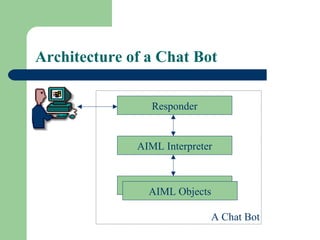
Architecture of a Chat Bot
Responder
AIML Interpreter
AIML Objects
A Chat Bot
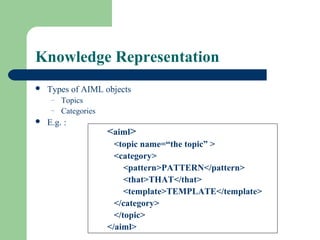
Knowledge Representation
 Types of AIML objects
– Topics
– Categories
 E.g. :
<aiml>
<topic name=“the topic” >
<category>
<pattern>PATTERN</pattern>
<that>THAT</that>
<template>TEMPLATE</template>
</category>
</topic>
</aiml>
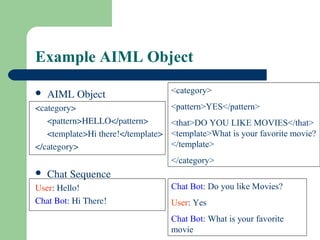
Example AIML Object
 AIML Object
<category>
<pattern>HELLO</pattern> 
<template>Hi there!</template>
</category>
 Chat Sequence
User: Hello!
Chat Bot: Hi There!
<category>
<pattern>YES</pattern>
<that>DO YOU LIKE MOVIES</that>
<template>What is your favorite movie?
</template>
</category>
Chat Bot: Do you like Movies?
User: Yes
Chat Bot: What is your favorite
movie
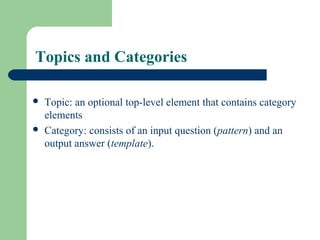
Topics and Categories
 Topic: an optional top-level element that contains category
elements
 Category: consists of an input question (pattern) and an
output answer (template).
Turing Test
 Alan Turing proposed the Turing Test as a replacement for
the question “Can machines think?”
 Turing's aim is to provide a method to assess whether or not a
machine can think.
 The test
– A man (A), a woman (B) and an interrogator (C) chat.
– The objective of the interrogator is to determine which of the other
two is the woman
– If a machine (bot) chats instead of A or B and fools the interrogator,
it has passed the Turing test.
Can It Answer All My Questions?
 A Chat Bot has a limited number of patterns and responses.
 The AIML structure supports regular expressions
 In AIML, you can define recursive categories.
 The bot may sometimes give funny replies, but that depends
on the AIML spec, i.e. Its brain!
How to build a bot of your own
 Components – An AIML Object Spec, AIML interpreter,
and a responder!
 The brain is the AIML file, that defines patterns and
corresponding replies
 A bot can be trained to be an Expert System about a special
theme – large data!
 Training data – Yahoo Chat!
What is a Chat Bot useful for?
 Commercial chatter bots to help customers
– At web-shops and e-commerce sites.
– Bots to receive complaints from users, online
 An interactive (talking) encyclopedia.
Thank You

Chat bots - Trending Technology

  • 1.
    Chat Bots Sachin Sharma C.S.E.4th year 1428010010
  • 2.
    Introduction  Chat Bot:A computer program that can talk to humans in natural language!  Uses Artificial Intelligence Markup Language (AIML) to represent knowledge.  Can replace a human for monotonous jobs of answering queries, e.g. E-help desk.
  • 3.
    How It AllStarted  Eliza – the first chat bot made by Joseph Weizenbaum.  Working of Eliza is based on – Knowledge Representation – Pattern Recognition – Substitution of key words into known phrases.
  • 4.
    How does itrespond  Looks for certain patterns of words in the user's input.  Replies with pre-determined output, if the pattern is matched.  Needs to have an idea of what the user will chat  Has suitable responses defined in the AIML file
  • 5.
    Architecture of aChat Bot Responder AIML Interpreter AIML Objects A Chat Bot
  • 6.
    Knowledge Representation  Typesof AIML objects – Topics – Categories  E.g. : <aiml> <topic name=“the topic” > <category> <pattern>PATTERN</pattern> <that>THAT</that> <template>TEMPLATE</template> </category> </topic> </aiml>
  • 7.
    Example AIML Object AIML Object <category> <pattern>HELLO</pattern>  <template>Hi there!</template> </category>  Chat Sequence User: Hello! Chat Bot: Hi There! <category> <pattern>YES</pattern> <that>DO YOU LIKE MOVIES</that> <template>What is your favorite movie? </template> </category> Chat Bot: Do you like Movies? User: Yes Chat Bot: What is your favorite movie
  • 8.
    Topics and Categories Topic: an optional top-level element that contains category elements  Category: consists of an input question (pattern) and an output answer (template).
  • 9.
    Turing Test  AlanTuring proposed the Turing Test as a replacement for the question “Can machines think?”  Turing's aim is to provide a method to assess whether or not a machine can think.  The test – A man (A), a woman (B) and an interrogator (C) chat. – The objective of the interrogator is to determine which of the other two is the woman – If a machine (bot) chats instead of A or B and fools the interrogator, it has passed the Turing test.
  • 10.
    Can It AnswerAll My Questions?  A Chat Bot has a limited number of patterns and responses.  The AIML structure supports regular expressions  In AIML, you can define recursive categories.  The bot may sometimes give funny replies, but that depends on the AIML spec, i.e. Its brain!
  • 11.
    How to builda bot of your own  Components – An AIML Object Spec, AIML interpreter, and a responder!  The brain is the AIML file, that defines patterns and corresponding replies  A bot can be trained to be an Expert System about a special theme – large data!  Training data – Yahoo Chat!
  • 12.
    What is aChat Bot useful for?  Commercial chatter bots to help customers – At web-shops and e-commerce sites. – Bots to receive complaints from users, online  An interactive (talking) encyclopedia.
  • 13.