CHAT BOTS
BASICS
WHAT IS A
CHATBOT?
A chatbot is a computer
software that at its most basic level
simulates and processes human
speech. This enables users of digital
devices to converse with them as
though they were speaking to a real
person. Chatbots can be as basic as
one-line programmes that respond to
straightforward questions or they can
be as complex as digital assistants
that learn and develop over time to
provide ever more individualised
service as they acquire and process
more data.
TWO MAIN
TYPES OF
CHATBOT?
1. Task-oriented chatbots are specialised
software applications that concentrate on
carrying out a single task. They provide
automated but conversational responses to
user enquiries by using rules, NLP, and
very little ML. Interactions with these
chatbots are highly specific and structured
and are most applicable to support and
service functions think robust, interactive
FAQs. Task-oriented chatbots can manage
frequent inquiries, such as inquiries
regarding business hours or
straightforward transactions without a lot of
variables. Though they do use NLP so end
users can experience them in a
conversational way, their capabilities are
fairly basic. These are currently the most
commonly used chatbots.
TWO MAIN
TYPES OF
CHATBOT?
2. Compared to task-oriented chatbots,
data-driven and predictive chatbots are
significantly more intelligent, interactive,
and personalised. They are also sometimes
referred to as virtual assistants or digital
assistants. These chatbots use natural
language understanding (NLU), natural
language processing (NLP), and machine
learning (ML) to learn as they go. In order to
offer personalization based on user profiles
and previous user behaviour, they utilise
predictive intelligence and analytics. Digital
assistants can gradually learn a user's
preferences, make suggestions, and even
foresee needs. They can start dialogues in
addition to monitoring data and intent. A
couple of examples of consumer-focused,
data-driven, predictive chatbots are Apple's
Siri and Amazon's Alexa.
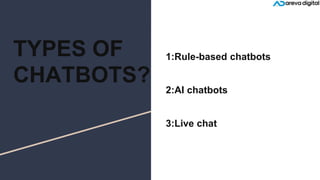
TYPES OF
CHATBOTS?
1:Rule-based chatbots
2:AI chatbots
3:Live chat
1:Rule-based
chatbots
These chatbots use pre-established
rules to map out dialogues. Rules-
based chatbots can direct the
conversation based on the inputs of
website visitors by responding to
particular pre-defined options or
keywords. But remember that a rule-
based chatbot is only as flexible as its
set of rules. Therefore, it can only react
or act in ways that have been
expected.
2:AI
chatbots
AI chatbots, as opposed to rule-based
chatbots, are trained to assess and
comprehend a site visitor's intent
before providing the response they
believe is most appropriate in light of
the available data. Giving website
users the ability to direct the
conversation in their own terms is
possible with a Conversational AI
platform. Additionally, as they gather
an increasing amount of conversational
data, these chatbots continue to learn
and improve their responses.
3:Live chat
Sales and sales development teams
generally employ these chatbots to
engage website visitors in immediate
dialogues. Live chat software is also
used by customer service firms to
provide real-time answers to inquiries.
THANK
YOU
OFFICE:
ADDRESS:
3rd Floor, Rema Plaza, TVM
PHONE NO:
+91-8925680195
WEBSITE:
………………….https://arevadigital.com/location/digital
-marketing-courses-training-in-trivandrum/

CHAT BOTS

  • 1.
  • 2.
    WHAT IS A CHATBOT? Achatbot is a computer software that at its most basic level simulates and processes human speech. This enables users of digital devices to converse with them as though they were speaking to a real person. Chatbots can be as basic as one-line programmes that respond to straightforward questions or they can be as complex as digital assistants that learn and develop over time to provide ever more individualised service as they acquire and process more data.
  • 3.
    TWO MAIN TYPES OF CHATBOT? 1.Task-oriented chatbots are specialised software applications that concentrate on carrying out a single task. They provide automated but conversational responses to user enquiries by using rules, NLP, and very little ML. Interactions with these chatbots are highly specific and structured and are most applicable to support and service functions think robust, interactive FAQs. Task-oriented chatbots can manage frequent inquiries, such as inquiries regarding business hours or straightforward transactions without a lot of variables. Though they do use NLP so end users can experience them in a conversational way, their capabilities are fairly basic. These are currently the most commonly used chatbots.
  • 4.
    TWO MAIN TYPES OF CHATBOT? 2.Compared to task-oriented chatbots, data-driven and predictive chatbots are significantly more intelligent, interactive, and personalised. They are also sometimes referred to as virtual assistants or digital assistants. These chatbots use natural language understanding (NLU), natural language processing (NLP), and machine learning (ML) to learn as they go. In order to offer personalization based on user profiles and previous user behaviour, they utilise predictive intelligence and analytics. Digital assistants can gradually learn a user's preferences, make suggestions, and even foresee needs. They can start dialogues in addition to monitoring data and intent. A couple of examples of consumer-focused, data-driven, predictive chatbots are Apple's Siri and Amazon's Alexa.
  • 5.
  • 6.
    1:Rule-based chatbots These chatbots usepre-established rules to map out dialogues. Rules- based chatbots can direct the conversation based on the inputs of website visitors by responding to particular pre-defined options or keywords. But remember that a rule- based chatbot is only as flexible as its set of rules. Therefore, it can only react or act in ways that have been expected.
  • 7.
    2:AI chatbots AI chatbots, asopposed to rule-based chatbots, are trained to assess and comprehend a site visitor's intent before providing the response they believe is most appropriate in light of the available data. Giving website users the ability to direct the conversation in their own terms is possible with a Conversational AI platform. Additionally, as they gather an increasing amount of conversational data, these chatbots continue to learn and improve their responses.
  • 8.
    3:Live chat Sales andsales development teams generally employ these chatbots to engage website visitors in immediate dialogues. Live chat software is also used by customer service firms to provide real-time answers to inquiries.
  • 9.
    THANK YOU OFFICE: ADDRESS: 3rd Floor, RemaPlaza, TVM PHONE NO: +91-8925680195 WEBSITE: ………………….https://arevadigital.com/location/digital -marketing-courses-training-in-trivandrum/