TU – PE 4063/6463 – Well Completion Fall 2013
Dr. Evren M. Ozbayoglu, Tel: 918-631 2972, e-mail: evren-ozbayoglu@utulsa.edu Chapter-6, 1/36
PE 4063 / 6463 – Well Completion
CHAPTER 6 – Perforation
In the majority of completions, once the reservoir has been drilled, production casing or a liner is
run into the well and cemented in place. To provide the communication path between the
reservoir and the wellbore, it will be necessary to produce holes through the wall of the casing,
the cement sheath and penetrate into the formation. This is accomplished by a technique called
perforating. The basic operation requires that a series of explosive charges are lowered into the
well either on an electric conductor wireline cable, or on tubing or drillstring, and when the
charges are located at the required depth, they are detonated to produce a series of perforations
through the wall of the casing and the cement sheath. Since the perforations will hopefully
provide the only communication between the reservoir and wellbore, it is necessary to carefully
design and execute the perforating operation, to provide the required degree of reservoir
depletion control and maximize well productivity/injectivity. Initially, the type of charges used in
perforating guns were bullets, but with the development of armour penetrating explosives, shaped
charges or jet perforators are now almost exclusively used.
Shaped Charge Characteristics and Performance
A considerable amount of research has been conducted through the years into the mechanics of
the detonation of shaped charges and the subsequent penetration of the target. A large number of
design parameters, as well as operational conditions, can markedly affect the performance of
shaped charged perforators.
Principles of Shaped Charges
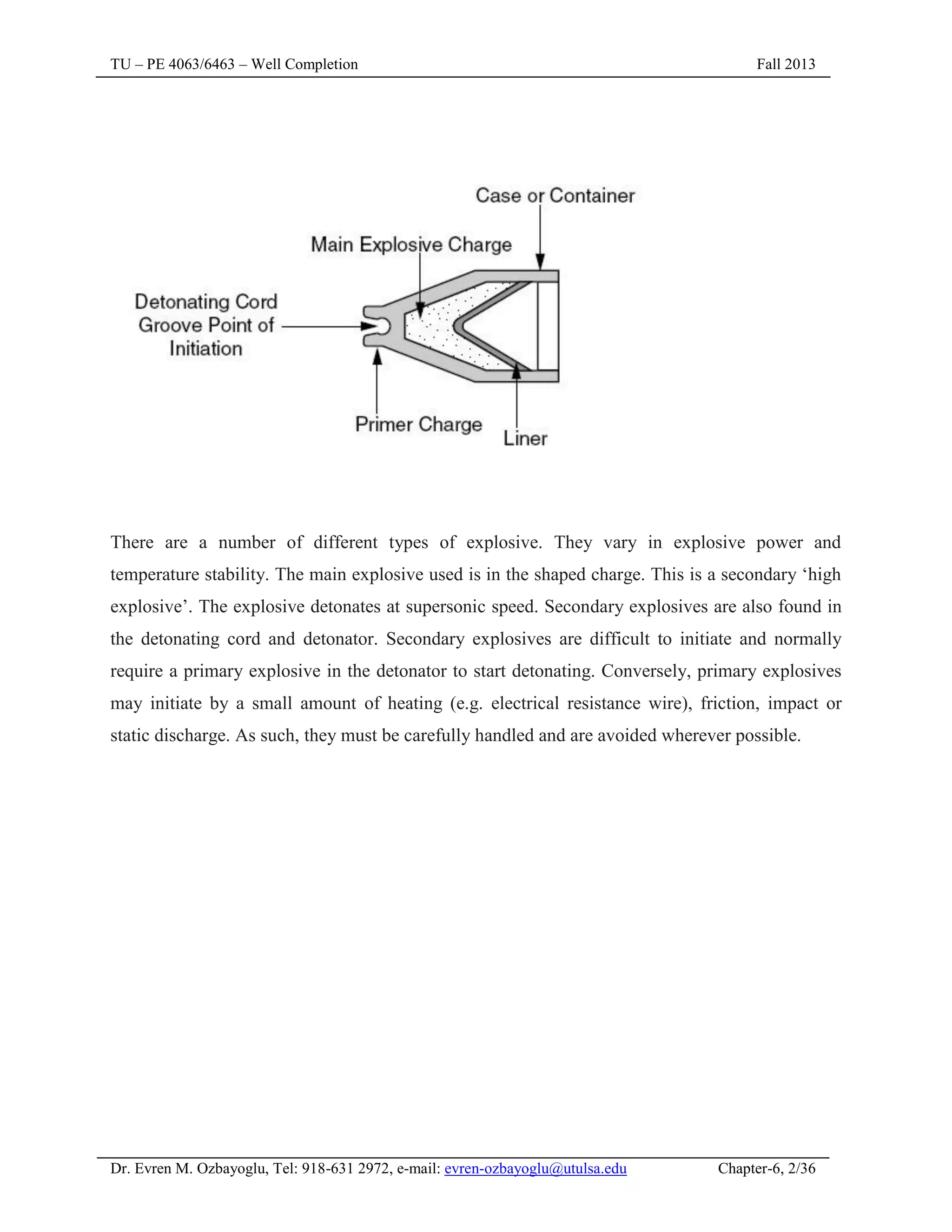
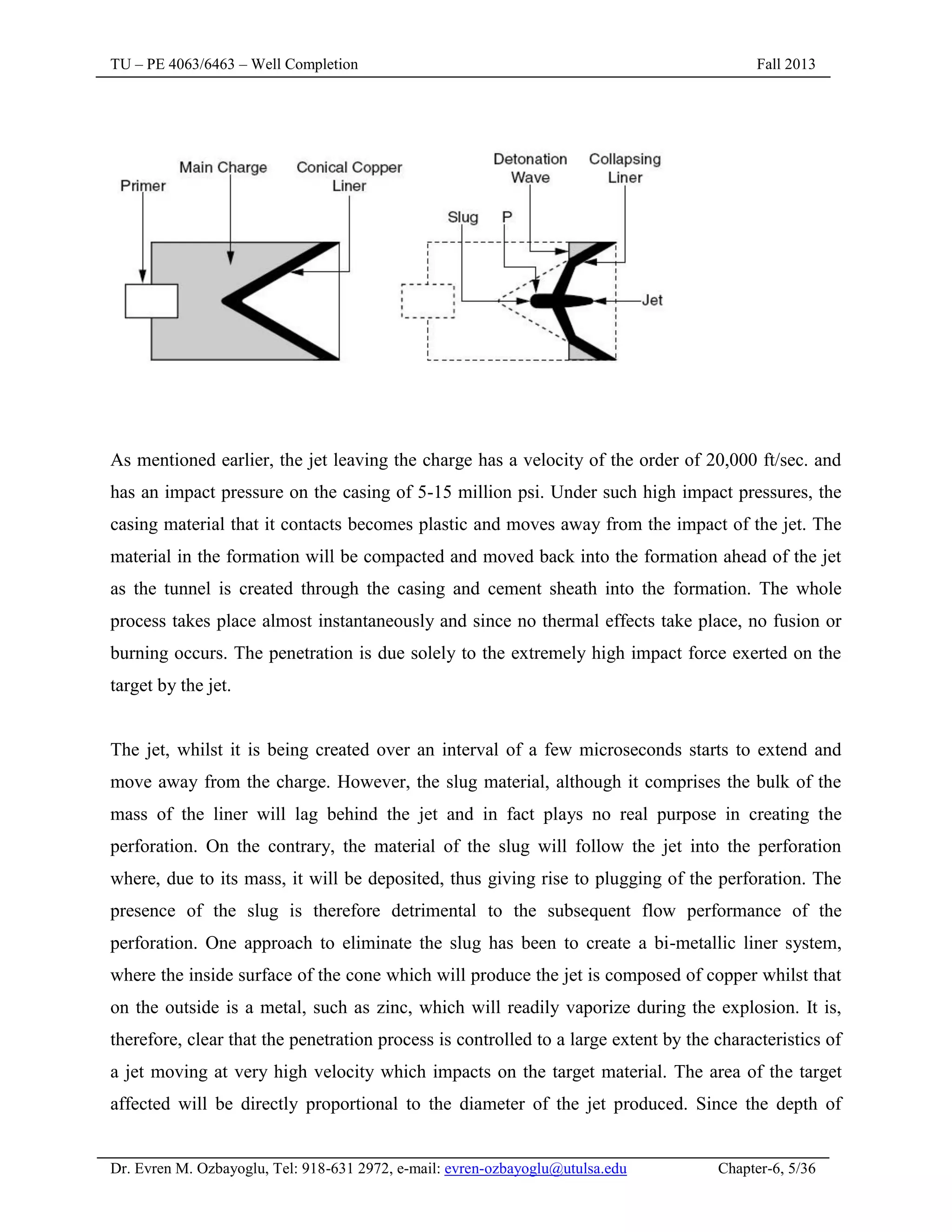
The basic shaped charge consists of:
 A conical metallic liner
 A primer explosive charge
 The main explosive charge
 A charge case or container
TU – PE 4063/6463 – Well Completion Fall 2013
Dr. Evren M. Ozbayoglu, Tel: 918-631 2972, e-mail: evren-ozbayoglu@utulsa.edu Chapter-6, 2/36
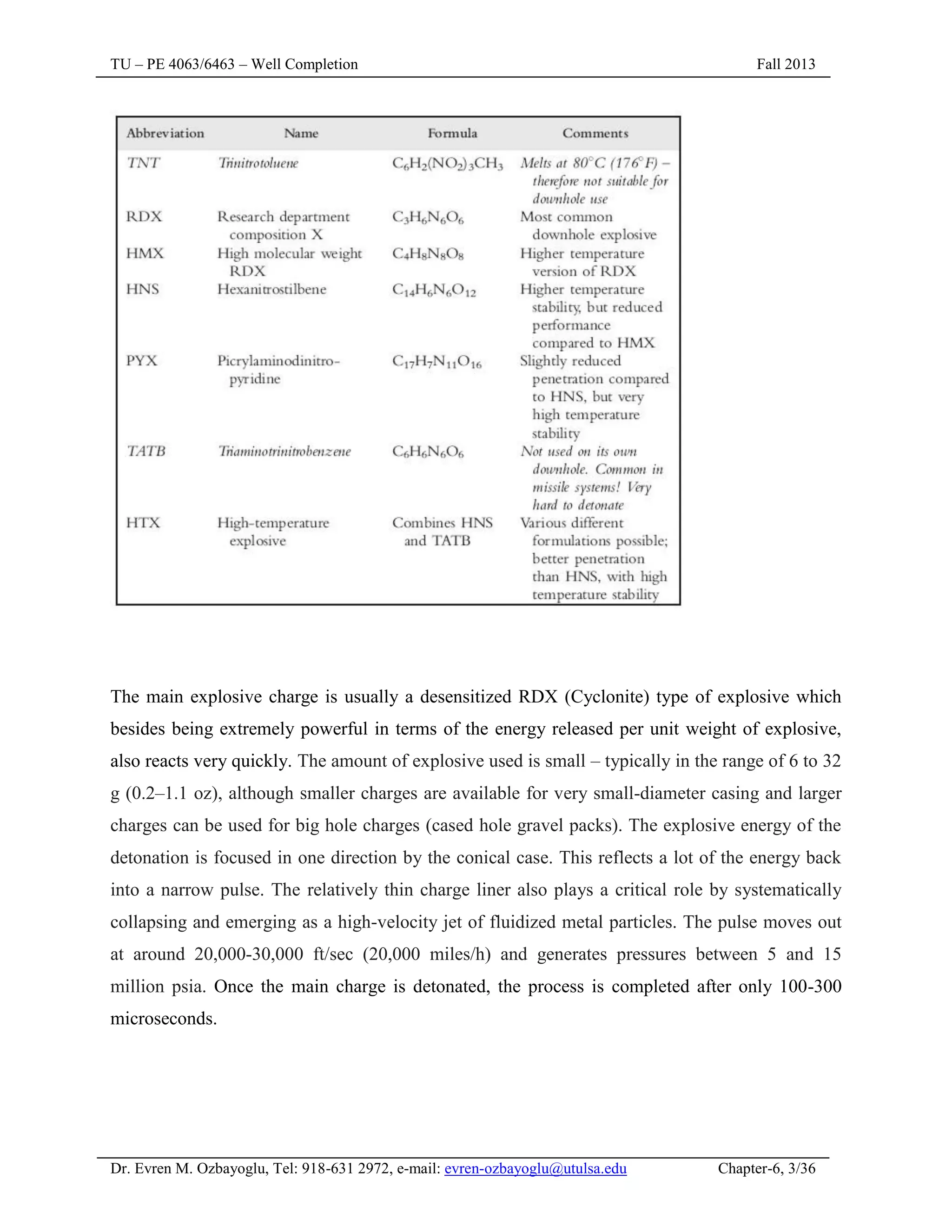
There are a number of different types of explosive. They vary in explosive power and
temperature stability. The main explosive used is in the shaped charge. This is a secondary ‘high
explosive’. The explosive detonates at supersonic speed. Secondary explosives are also found in
the detonating cord and detonator. Secondary explosives are difficult to initiate and normally
require a primary explosive in the detonator to start detonating. Conversely, primary explosives
may initiate by a small amount of heating (e.g. electrical resistance wire), friction, impact or
static discharge. As such, they must be carefully handled and are avoided wherever possible.
TU – PE 4063/6463 – Well Completion Fall 2013
Dr. Evren M. Ozbayoglu, Tel: 918-631 2972, e-mail: evren-ozbayoglu@utulsa.edu Chapter-6, 3/36
The main explosive charge is usually a desensitized RDX (Cyclonite) type of explosive which
besides being extremely powerful in terms of the energy released per unit weight of explosive,
also reacts very quickly. The amount of explosive used is small – typically in the range of 6 to 32
g (0.2–1.1 oz), although smaller charges are available for very small-diameter casing and larger
charges can be used for big hole charges (cased hole gravel packs). The explosive energy of the
detonation is focused in one direction by the conical case. This reflects a lot of the energy back
into a narrow pulse. The relatively thin charge liner also plays a critical role by systematically
collapsing and emerging as a high-velocity jet of fluidized metal particles. The pulse moves out
at around 20,000-30,000 ft/sec (20,000 miles/h) and generates pressures between 5 and 15
million psia. Once the main charge is detonated, the process is completed after only 100-300
microseconds.
TU – PE 4063/6463 – Well Completion Fall 2013
Dr. Evren M. Ozbayoglu, Tel: 918-631 2972, e-mail: evren-ozbayoglu@utulsa.edu Chapter-6, 4/36
The main explosive is contained within a charge container which can be manufactured as either a
metal or a disintegrateable case e.g. ceramic which will be shattered during the explosion. Whilst
a metal case would assist in containing and directing the force of the explosion to a certain target
area, the target area would be diffuse as it would depend upon the diameter of the exit area for the
explosion from the charge case and its distance from the target area. To concentrate the impact of
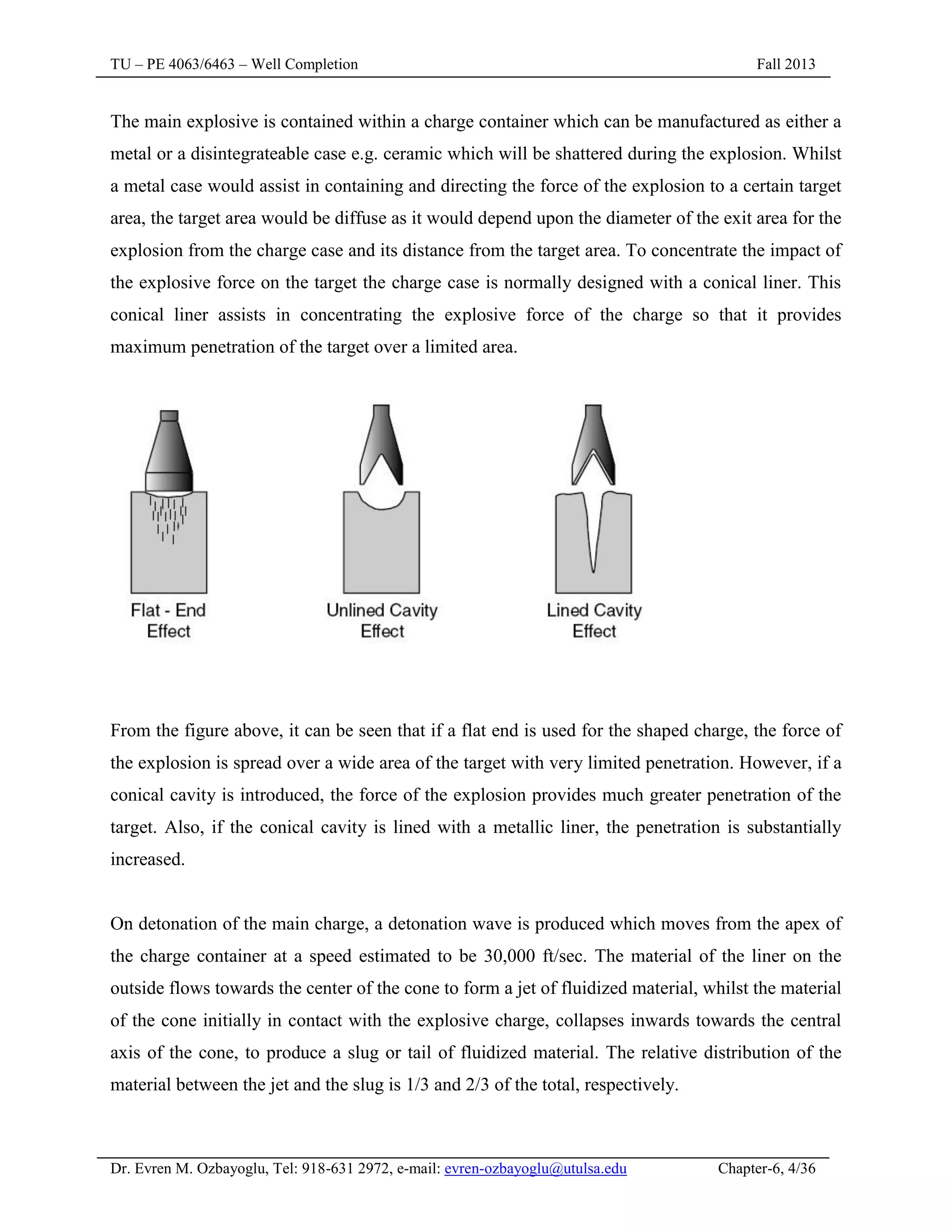
the explosive force on the target the charge case is normally designed with a conical liner. This
conical liner assists in concentrating the explosive force of the charge so that it provides
maximum penetration of the target over a limited area.
From the figure above, it can be seen that if a flat end is used for the shaped charge, the force of
the explosion is spread over a wide area of the target with very limited penetration. However, if a
conical cavity is introduced, the force of the explosion provides much greater penetration of the
target. Also, if the conical cavity is lined with a metallic liner, the penetration is substantially
increased.
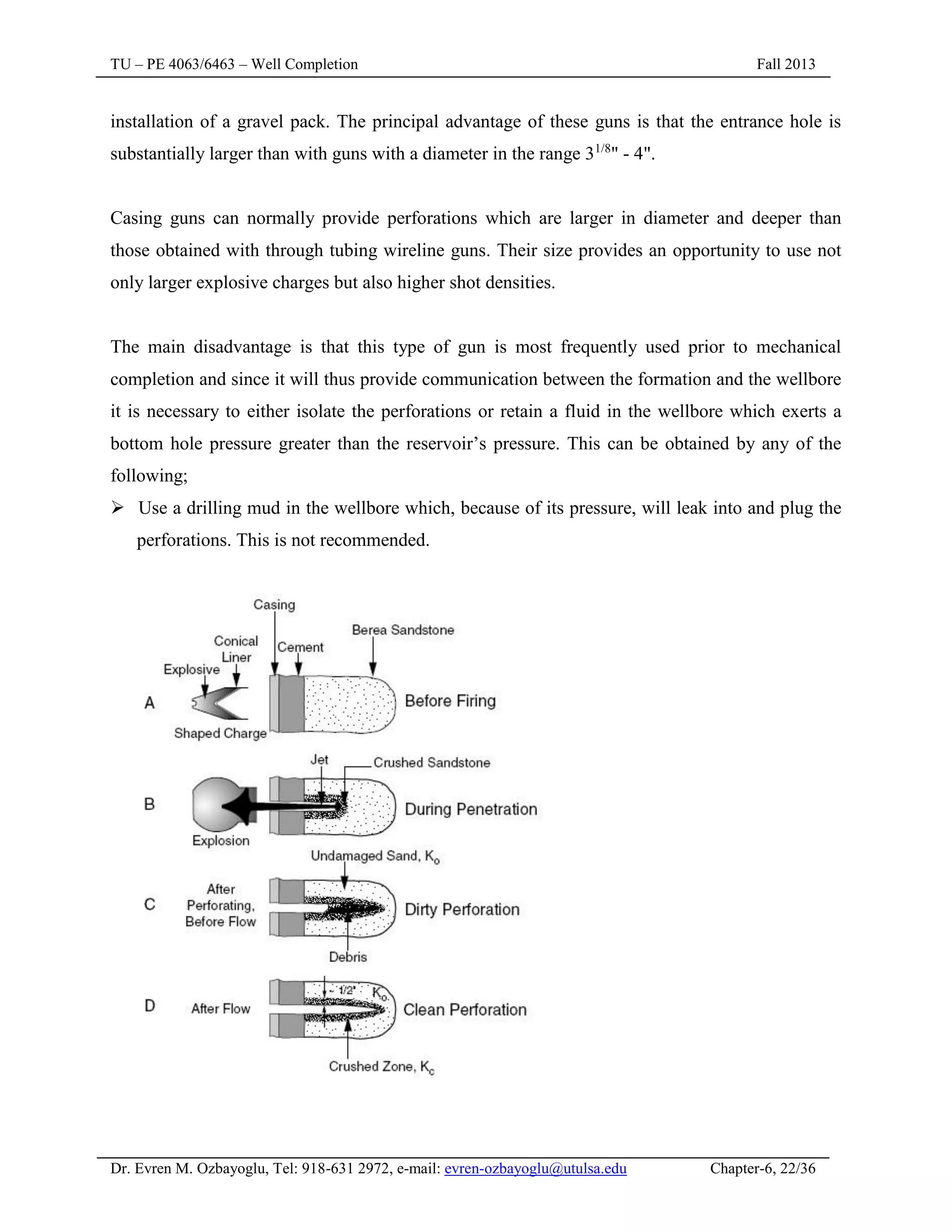
On detonation of the main charge, a detonation wave is produced which moves from the apex of
the charge container at a speed estimated to be 30,000 ft/sec. The material of the liner on the
outside flows towards the center of the cone to form a jet of fluidized material, whilst the material
of the cone initially in contact with the explosive charge, collapses inwards towards the central
axis of the cone, to produce a slug or tail of fluidized material. The relative distribution of the
material between the jet and the slug is 1/3 and 2/3 of the total, respectively.
TU – PE 4063/6463 – Well Completion Fall 2013
Dr. Evren M. Ozbayoglu, Tel: 918-631 2972, e-mail: evren-ozbayoglu@utulsa.edu Chapter-6, 5/36
As mentioned earlier, the jet leaving the charge has a velocity of the order of 20,000 ft/sec. and
has an impact pressure on the casing of 5-15 million psi. Under such high impact pressures, the
casing material that it contacts becomes plastic and moves away from the impact of the jet. The
material in the formation will be compacted and moved back into the formation ahead of the jet
as the tunnel is created through the casing and cement sheath into the formation. The whole
process takes place almost instantaneously and since no thermal effects take place, no fusion or
burning occurs. The penetration is due solely to the extremely high impact force exerted on the
target by the jet.
The jet, whilst it is being created over an interval of a few microseconds starts to extend and
move away from the charge. However, the slug material, although it comprises the bulk of the
mass of the liner will lag behind the jet and in fact plays no real purpose in creating the
perforation. On the contrary, the material of the slug will follow the jet into the perforation
where, due to its mass, it will be deposited, thus giving rise to plugging of the perforation. The
presence of the slug is therefore detrimental to the subsequent flow performance of the
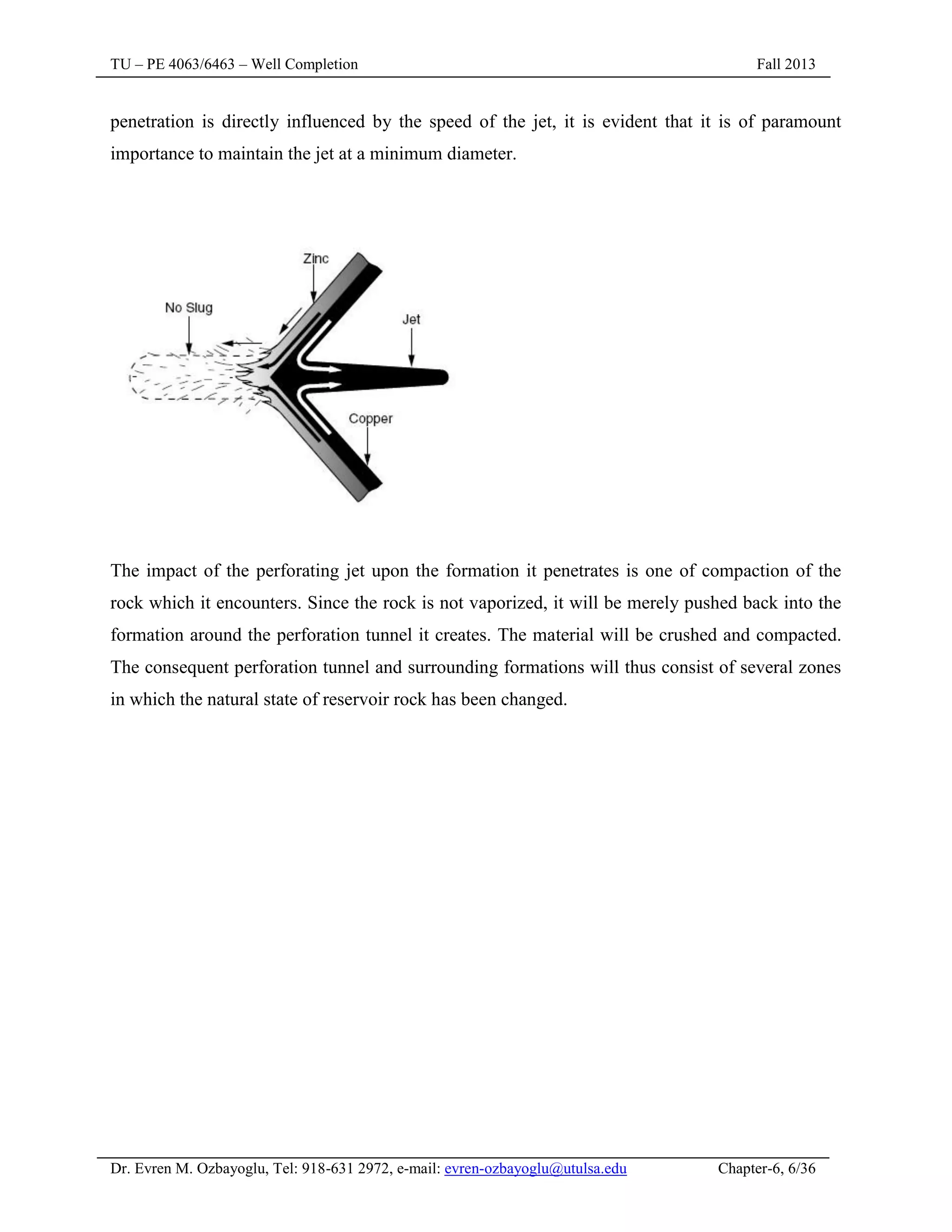
perforation. One approach to eliminate the slug has been to create a bi-metallic liner system,
where the inside surface of the cone which will produce the jet is composed of copper whilst that
on the outside is a metal, such as zinc, which will readily vaporize during the explosion. It is,
therefore, clear that the penetration process is controlled to a large extent by the characteristics of
a jet moving at very high velocity which impacts on the target material. The area of the target
affected will be directly proportional to the diameter of the jet produced. Since the depth of
TU – PE 4063/6463 – Well Completion Fall 2013
Dr. Evren M. Ozbayoglu, Tel: 918-631 2972, e-mail: evren-ozbayoglu@utulsa.edu Chapter-6, 6/36
penetration is directly influenced by the speed of the jet, it is evident that it is of paramount
importance to maintain the jet at a minimum diameter.
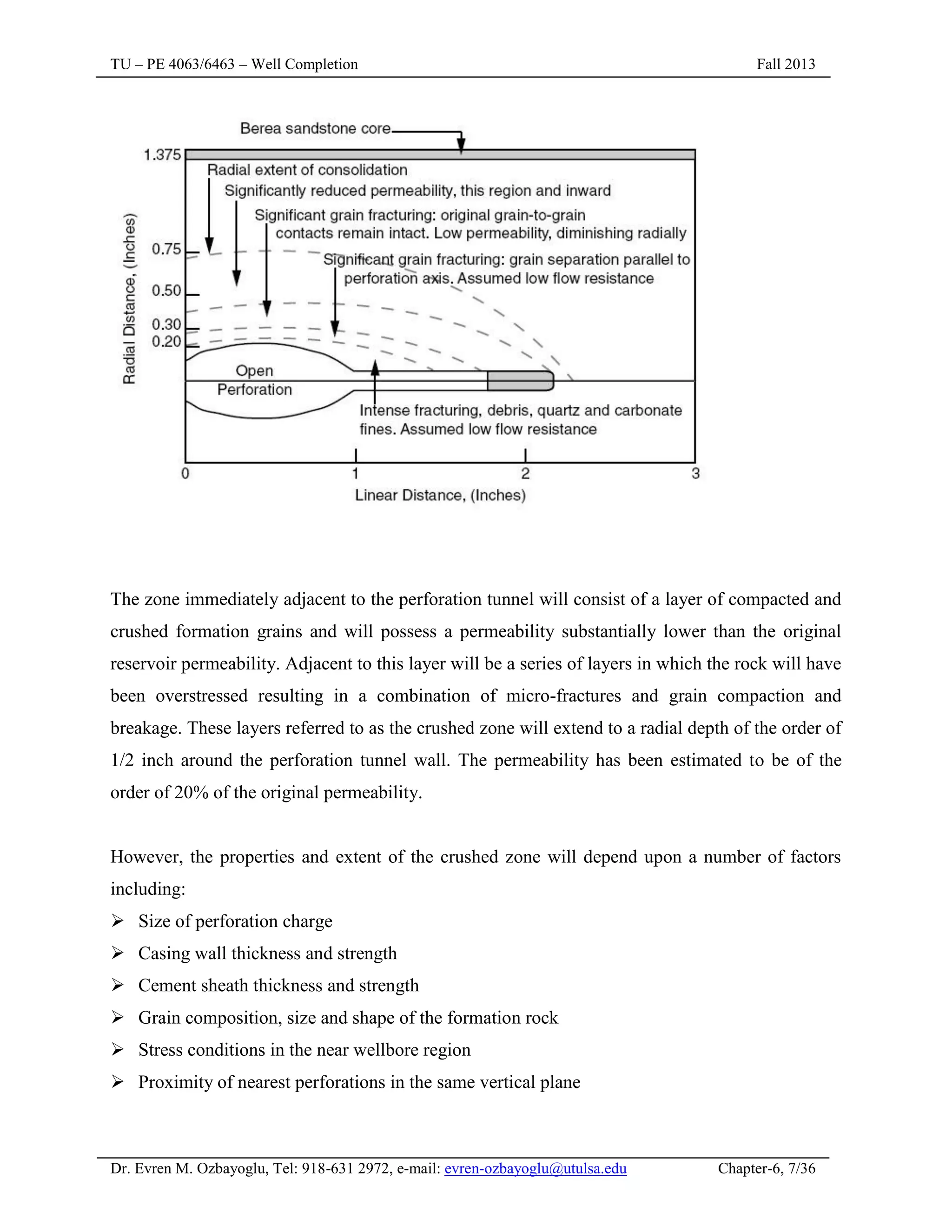
The impact of the perforating jet upon the formation it penetrates is one of compaction of the
rock which it encounters. Since the rock is not vaporized, it will be merely pushed back into the
formation around the perforation tunnel it creates. The material will be crushed and compacted.
The consequent perforation tunnel and surrounding formations will thus consist of several zones
in which the natural state of reservoir rock has been changed.
TU – PE 4063/6463 – Well Completion Fall 2013
Dr. Evren M. Ozbayoglu, Tel: 918-631 2972, e-mail: evren-ozbayoglu@utulsa.edu Chapter-6, 7/36
The zone immediately adjacent to the perforation tunnel will consist of a layer of compacted and
crushed formation grains and will possess a permeability substantially lower than the original
reservoir permeability. Adjacent to this layer will be a series of layers in which the rock will have
been overstressed resulting in a combination of micro-fractures and grain compaction and
breakage. These layers referred to as the crushed zone will extend to a radial depth of the order of
1/2 inch around the perforation tunnel wall. The permeability has been estimated to be of the
order of 20% of the original permeability.
However, the properties and extent of the crushed zone will depend upon a number of factors
including:
 Size of perforation charge
 Casing wall thickness and strength
 Cement sheath thickness and strength
 Grain composition, size and shape of the formation rock
 Stress conditions in the near wellbore region
 Proximity of nearest perforations in the same vertical plane
TU – PE 4063/6463 – Well Completion Fall 2013
Dr. Evren M. Ozbayoglu, Tel: 918-631 2972, e-mail: evren-ozbayoglu@utulsa.edu Chapter-6, 8/36
Factors Influencing Charge Performance
The physical performance of a shaped charge is normally gauged from a number of
characteristics:-
 Penetration length
 Perforation diameter
 Perforation hole volume
 Burr height on the inside of the casing around the perforation entrance hole
However, charge performance will be a complex matter since it will be affected by charge size,
material and configuration, the dimensions and shape of the charge case, and most importantly,
the characteristics of the conical liner, as well as the strength characteristics of the formation and
the wellbore conditions. It would, therefore, be expected that the following parameters may
influence the physical performance of the shaped charge;
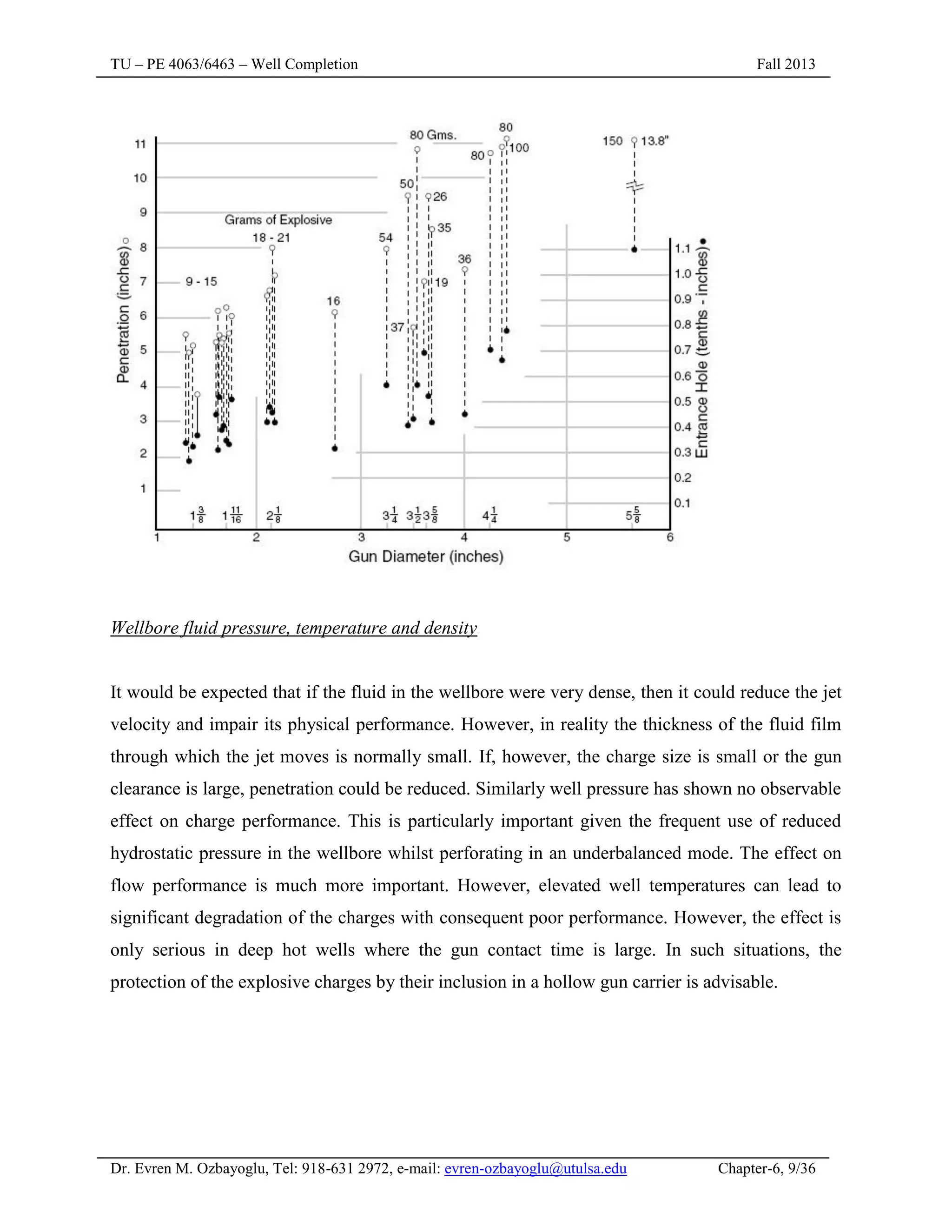
Gun size/explosive charge size
The size of the perforating gun will dictate the maximum explosive load which can be
accommodated in the charges. In general terms, both the penetration and the diameter of the
entrance hole will increase as the gun diameter and hence the size of explosive charge also
increase.
TU – PE 4063/6463 – Well Completion Fall 2013
Dr. Evren M. Ozbayoglu, Tel: 918-631 2972, e-mail: evren-ozbayoglu@utulsa.edu Chapter-6, 9/36
Wellbore fluid pressure, temperature and density
It would be expected that if the fluid in the wellbore were very dense, then it could reduce the jet
velocity and impair its physical performance. However, in reality the thickness of the fluid film
through which the jet moves is normally small. If, however, the charge size is small or the gun
clearance is large, penetration could be reduced. Similarly well pressure has shown no observable
effect on charge performance. This is particularly important given the frequent use of reduced
hydrostatic pressure in the wellbore whilst perforating in an underbalanced mode. The effect on
flow performance is much more important. However, elevated well temperatures can lead to
significant degradation of the charges with consequent poor performance. However, the effect is
only serious in deep hot wells where the gun contact time is large. In such situations, the
protection of the explosive charges by their inclusion in a hollow gun carrier is advisable.
TU – PE 4063/6463 – Well Completion Fall 2013
Dr. Evren M. Ozbayoglu, Tel: 918-631 2972, e-mail: evren-ozbayoglu@utulsa.edu Chapter-6, 10/36
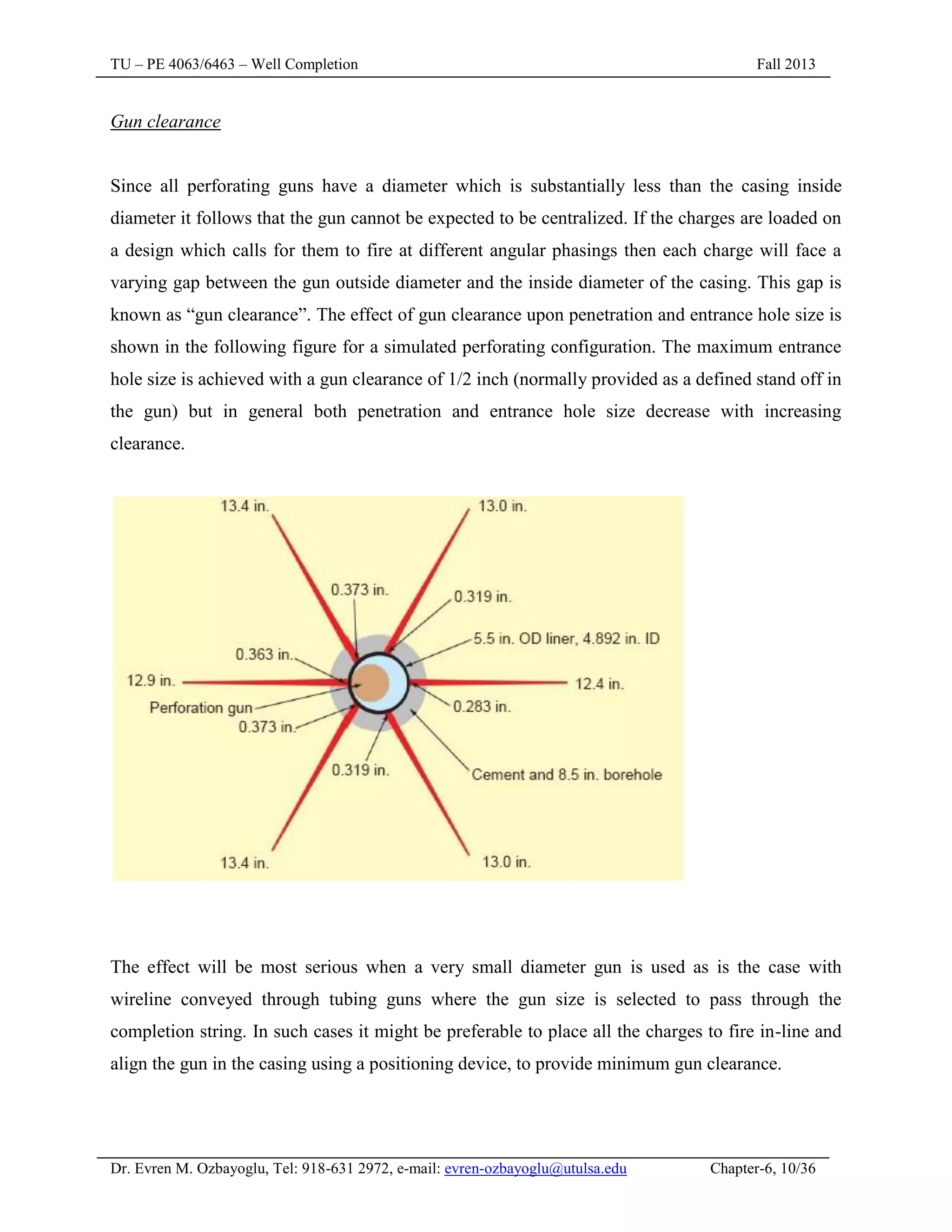
Gun clearance
Since all perforating guns have a diameter which is substantially less than the casing inside
diameter it follows that the gun cannot be expected to be centralized. If the charges are loaded on
a design which calls for them to fire at different angular phasings then each charge will face a
varying gap between the gun outside diameter and the inside diameter of the casing. This gap is
known as “gun clearance”. The effect of gun clearance upon penetration and entrance hole size is
shown in the following figure for a simulated perforating configuration. The maximum entrance
hole size is achieved with a gun clearance of 1/2 inch (normally provided as a defined stand off in
the gun) but in general both penetration and entrance hole size decrease with increasing
clearance.
The effect will be most serious when a very small diameter gun is used as is the case with
wireline conveyed through tubing guns where the gun size is selected to pass through the
completion string. In such cases it might be preferable to place all the charges to fire in-line and
align the gun in the casing using a positioning device, to provide minimum gun clearance.
TU – PE 4063/6463 – Well Completion Fall 2013
Dr. Evren M. Ozbayoglu, Tel: 918-631 2972, e-mail: evren-ozbayoglu@utulsa.edu Chapter-6, 11/36
Compressive strength of formation rock
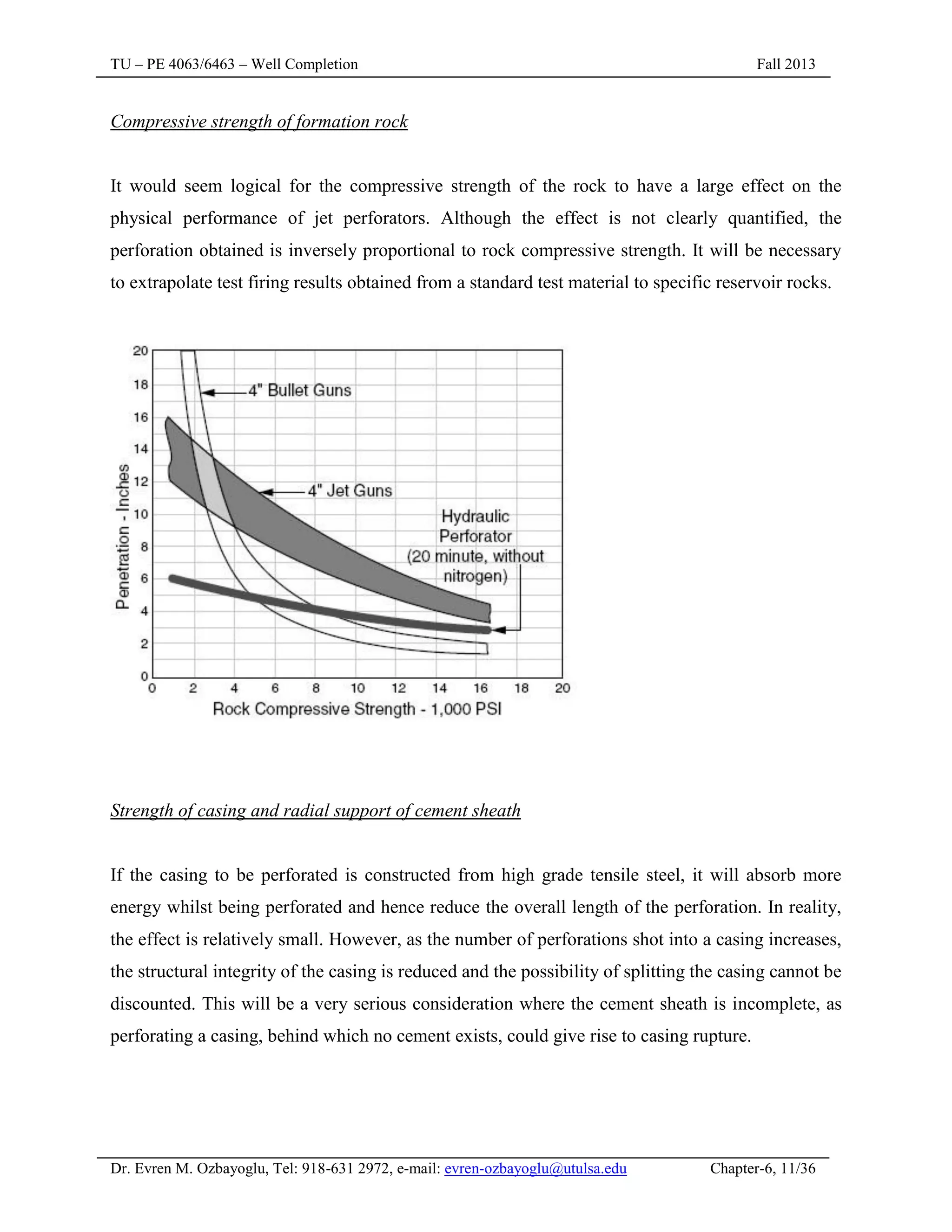
It would seem logical for the compressive strength of the rock to have a large effect on the
physical performance of jet perforators. Although the effect is not clearly quantified, the
perforation obtained is inversely proportional to rock compressive strength. It will be necessary
to extrapolate test firing results obtained from a standard test material to specific reservoir rocks.
Strength of casing and radial support of cement sheath
If the casing to be perforated is constructed from high grade tensile steel, it will absorb more
energy whilst being perforated and hence reduce the overall length of the perforation. In reality,
the effect is relatively small. However, as the number of perforations shot into a casing increases,
the structural integrity of the casing is reduced and the possibility of splitting the casing cannot be
discounted. This will be a very serious consideration where the cement sheath is incomplete, as
perforating a casing, behind which no cement exists, could give rise to casing rupture.
TU – PE 4063/6463 – Well Completion Fall 2013
Dr. Evren M. Ozbayoglu, Tel: 918-631 2972, e-mail: evren-ozbayoglu@utulsa.edu Chapter-6, 12/36
Perforation Charge Arrangement
In the preparation of a perforation gun, a number of charges are assembled on a carrier such that
upon detonation they will yield a series of perforations into the formation. The arrangement
provides for variation in the number of shots to be fired per unit interval, i.e. the shot density and
the direction in which all, or individual, charges will be shot, i.e. the shot phasing. The number of
shots installed in a perforating gun varies from low shot density, e.g. less than 1 shot/ft, to higher
shot densities of up to 16 shots/ft. The lower shot densities are normally adequate for production
in reservoirs of moderate to high productivity or are selected for specific injection operations
where flow control is required. The higher shot densities will provide improved inflow
performance in all reservoirs but may only be significantly beneficial in reservoirs with a low
vertical permeability or where severe local drawdown might give rise to formation sand collapse.
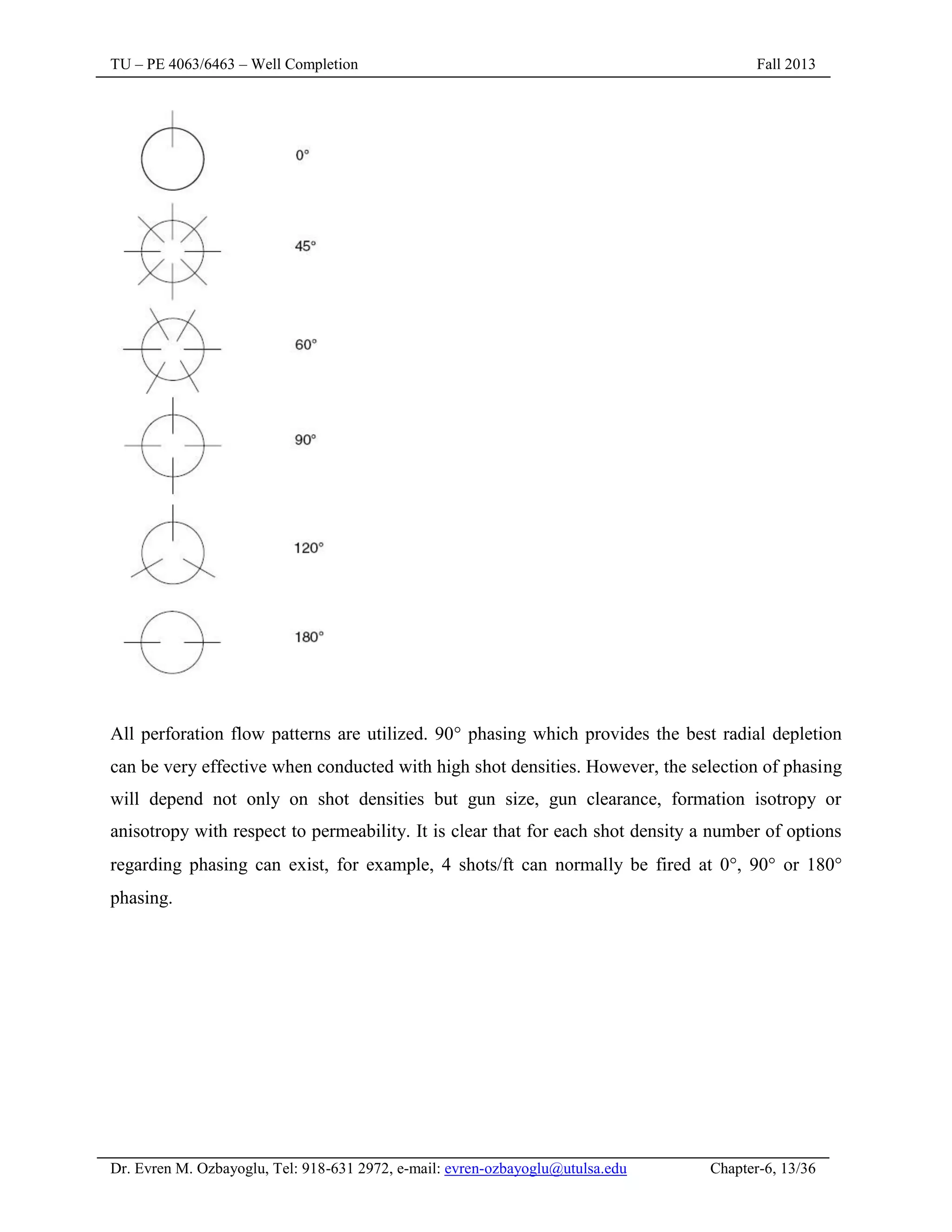
The orientation of perforations defined as the angular phasing can be
 0 or in-line firing which can provide the minimum clearance for all perforations if the gun is
positioned to fire on the low side of the hole
 45 to 90 phasing which provides the nearest approximation to radial flow
 180 phasing in either of the two planar directions
 120 phasing either with all 3 shots firing at 120 to each other or omitting 1 charge such that
the 2 shots fire at +60 and -60 angular phase
TU – PE 4063/6463 – Well Completion Fall 2013
Dr. Evren M. Ozbayoglu, Tel: 918-631 2972, e-mail: evren-ozbayoglu@utulsa.edu Chapter-6, 13/36
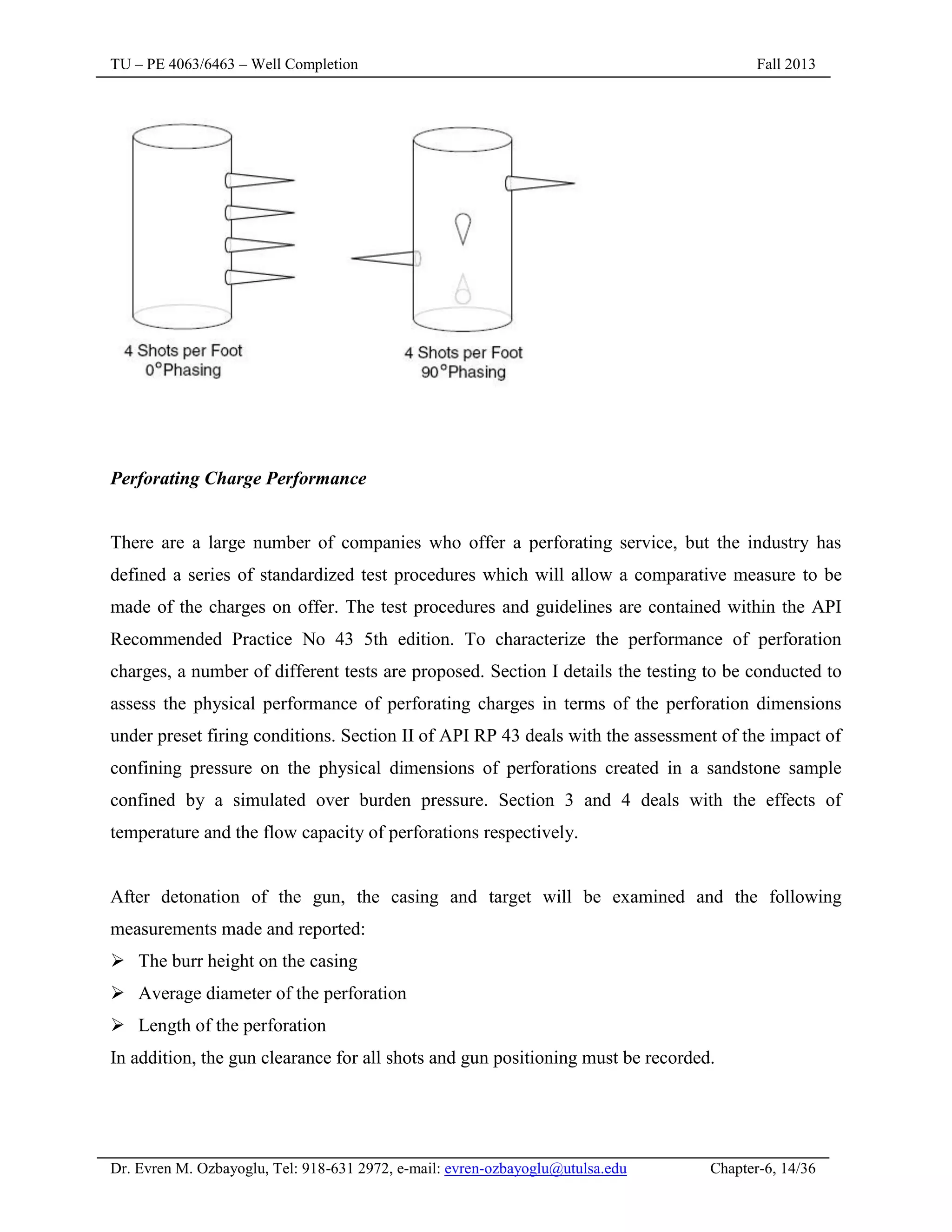
All perforation flow patterns are utilized. 90 phasing which provides the best radial depletion
can be very effective when conducted with high shot densities. However, the selection of phasing
will depend not only on shot densities but gun size, gun clearance, formation isotropy or
anisotropy with respect to permeability. It is clear that for each shot density a number of options
regarding phasing can exist, for example, 4 shots/ft can normally be fired at 0, 90 or 180
phasing.
TU – PE 4063/6463 – Well Completion Fall 2013
Dr. Evren M. Ozbayoglu, Tel: 918-631 2972, e-mail: evren-ozbayoglu@utulsa.edu Chapter-6, 14/36
Perforating Charge Performance
There are a large number of companies who offer a perforating service, but the industry has
defined a series of standardized test procedures which will allow a comparative measure to be
made of the charges on offer. The test procedures and guidelines are contained within the API
Recommended Practice No 43 5th edition. To characterize the performance of perforation
charges, a number of different tests are proposed. Section I details the testing to be conducted to
assess the physical performance of perforating charges in terms of the perforation dimensions
under preset firing conditions. Section II of API RP 43 deals with the assessment of the impact of
confining pressure on the physical dimensions of perforations created in a sandstone sample
confined by a simulated over burden pressure. Section 3 and 4 deals with the effects of
temperature and the flow capacity of perforations respectively.
After detonation of the gun, the casing and target will be examined and the following
measurements made and reported:
 The burr height on the casing
 Average diameter of the perforation
 Length of the perforation
In addition, the gun clearance for all shots and gun positioning must be recorded.
TU – PE 4063/6463 – Well Completion Fall 2013
Dr. Evren M. Ozbayoglu, Tel: 918-631 2972, e-mail: evren-ozbayoglu@utulsa.edu Chapter-6, 15/36
It must be stressed that the API RP 43 tests are principally of comparative value only and provide
little direct indication of downhole performance. The section I test seeks merely to establish a
comparative measure between the physical characteristics of perforation produced under constant
conditions using a range of charges. Since no attempt is made to establish the performance in
specific lithologies and using realistic in situ stresses the results in fact provide little indication of
the real perforation characteristics which will be achieved in the reservoir. Since no method has
yet been published to allow a prediction of performance under different compressive loads and
with different lithologies, it is difficult to use the Section I tests to predict downhole performance.
The section 2 test allows the effect of over burden or confining stress to be evaluated. The data
from this test can be extrapolated to penetration in any reservoir of known compressive strength
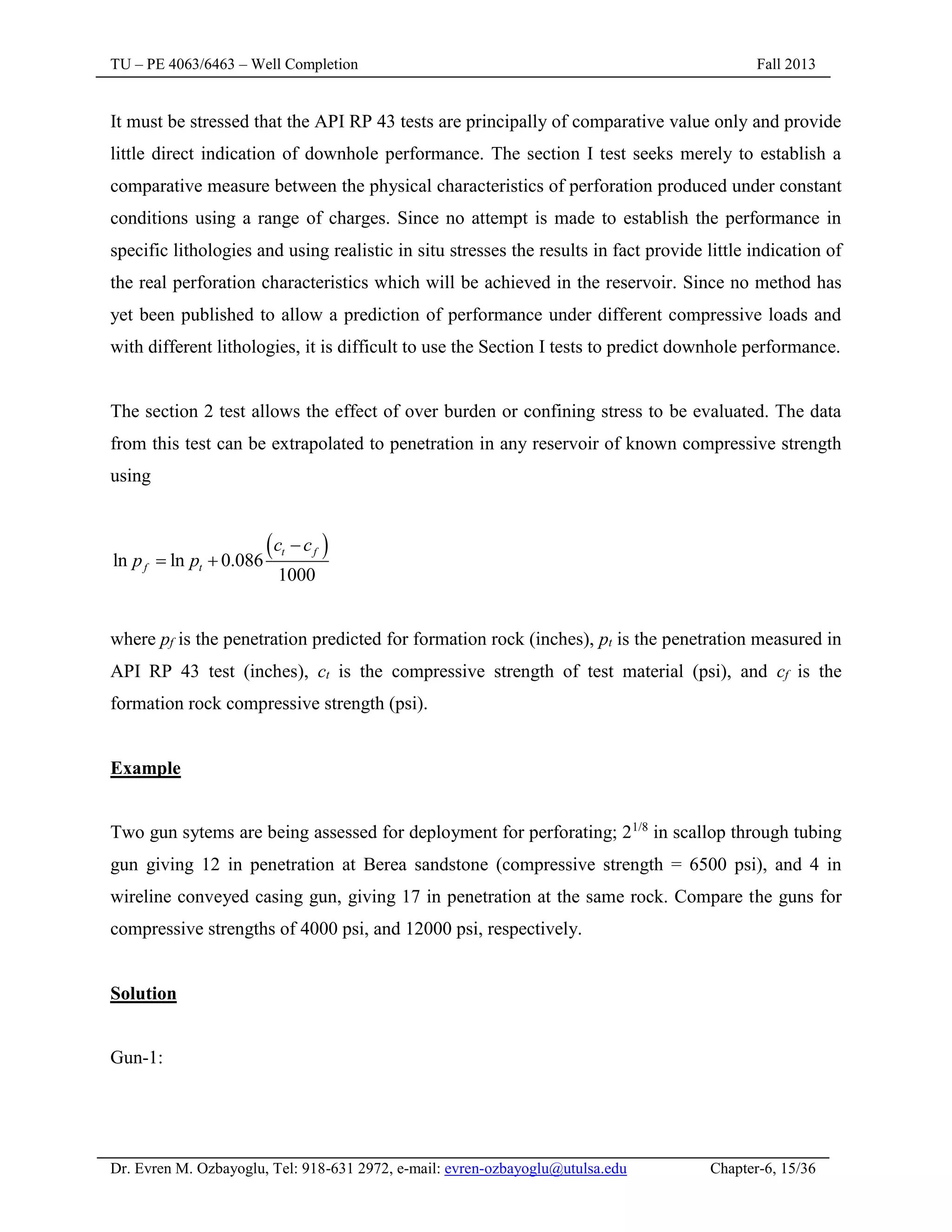
using
 
ln ln 0.086
1000
t f
f t
c c
p p

 
where pf is the penetration predicted for formation rock (inches), pt is the penetration measured in
API RP 43 test (inches), ct is the compressive strength of test material (psi), and cf is the
formation rock compressive strength (psi).
Example
Two gun sytems are being assessed for deployment for perforating; 21/8
in scallop through tubing
gun giving 12 in penetration at Berea sandstone (compressive strength = 6500 psi), and 4 in
wireline conveyed casing gun, giving 17 in penetration at the same rock. Compare the guns for
compressive strengths of 4000 psi, and 12000 psi, respectively.
Solution
Gun-1:
TU – PE 4063/6463 – Well Completion Fall 2013
Dr. Evren M. Ozbayoglu, Tel: 918-631 2972, e-mail: evren-ozbayoglu@utulsa.edu Chapter-6, 16/36
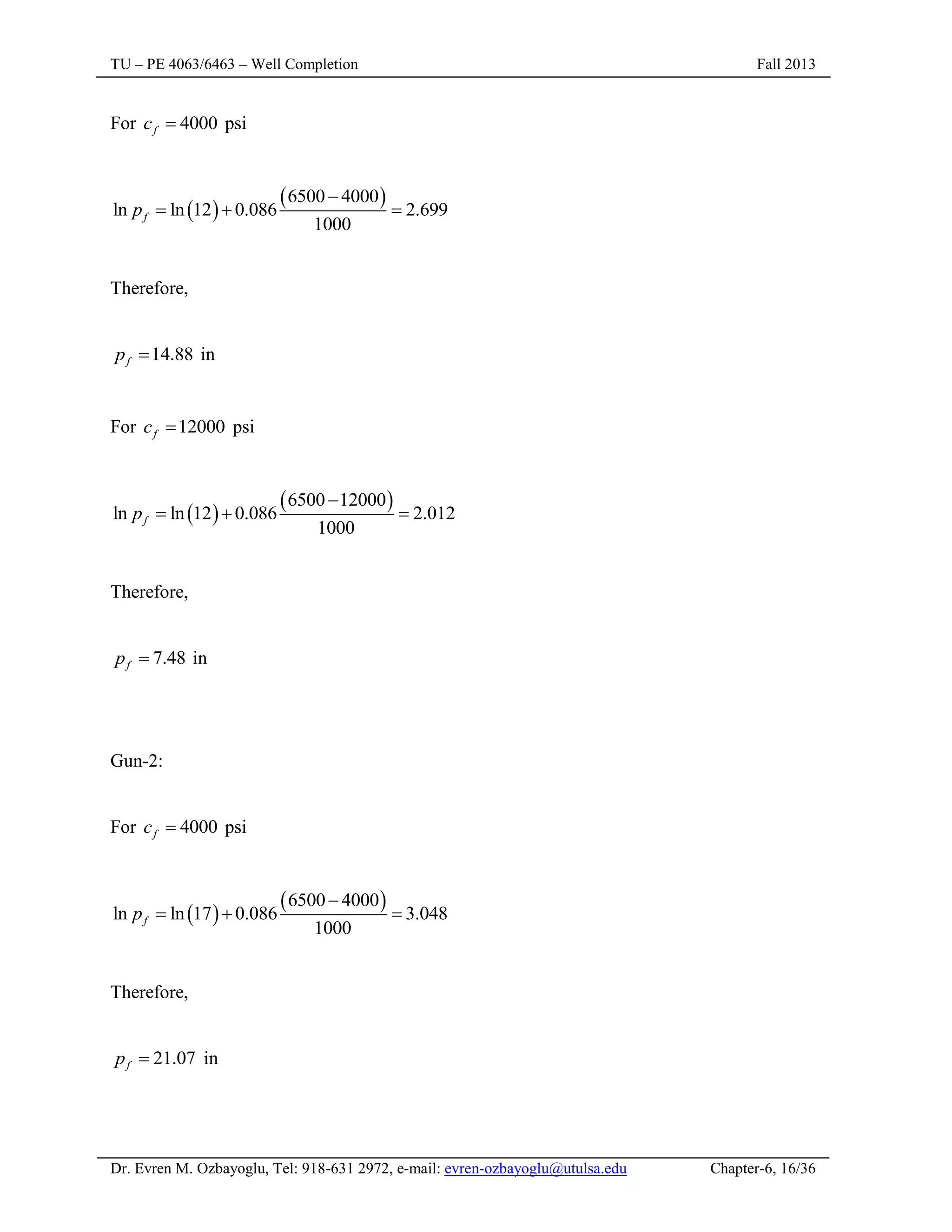
For 4000
f
c  psi
 
 
6500 4000
ln ln 12 0.086 2.699
1000
f
p

  
Therefore,
14.88
f
p  in
For 12000
f
c  psi
 
 
6500 12000
ln ln 12 0.086 2.012
1000
f
p

  
Therefore,
7.48
f
p  in
Gun-2:
For 4000
f
c  psi
 
 
6500 4000
ln ln 17 0.086 3.048
1000
f
p

  
Therefore,
21.07
f
p  in
TU – PE 4063/6463 – Well Completion Fall 2013
Dr. Evren M. Ozbayoglu, Tel: 918-631 2972, e-mail: evren-ozbayoglu@utulsa.edu Chapter-6, 17/36
For 12000
f
c  psi
 
 
6500 12000
ln ln 17 0.086 2.36
1000
f
p

  
Therefore,
10.59
f
p  in
Perforating Gun Systems
Several key features classify perforating operations including
 Whether the gun will be run on wireline or be conveyed on tubing or a drill string.
 Whether the pressure in the wellbore at the time of perforating will be less than reservoir
pressure, i.e. an underbalanced pressure condition, or be greater than reservoir pressure, i.e. an
overbalanced condition.
 The extent to which the gun, the charges or charge carrier will be retrieved from the wellbore
after perforating.
 Whether perforating will be conducted prior to, or after, mechanical completion of the well.
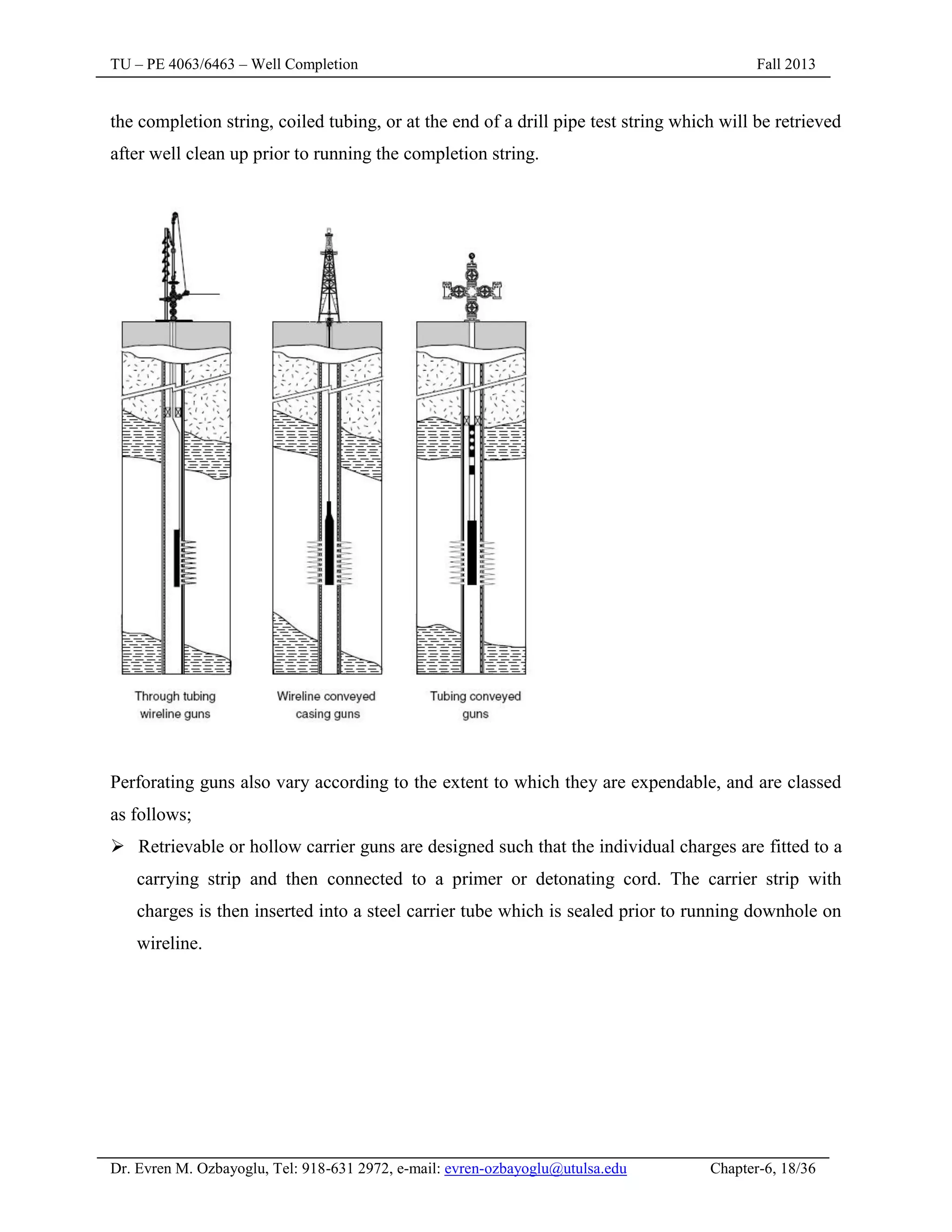
The majority of wells are perforated using wireline conveyed guns. However, there are
alternative approaches. The guns can be lowered into the cased wellbore prior to installation of
the production tubing. In such cases, the guns are referred to as casing guns and both during and
after the operation it is necessary to maintain a wellbore pressure which exceeds the reservoir
pressure unless surface pressure control equipment is being used. Thus the approach utilizes
overbalanced pressure conditions.
Alternatively, after installing the completion tubing, a gun can be selected to be run down the
inside of the tubing, out of the tailpipe and perforate the casing. The guns in this case are referred
to as through tubing guns. Also, the perforating guns can be tubing conveyed either on the end of
TU – PE 4063/6463 – Well Completion Fall 2013
Dr. Evren M. Ozbayoglu, Tel: 918-631 2972, e-mail: evren-ozbayoglu@utulsa.edu Chapter-6, 18/36
the completion string, coiled tubing, or at the end of a drill pipe test string which will be retrieved
after well clean up prior to running the completion string.
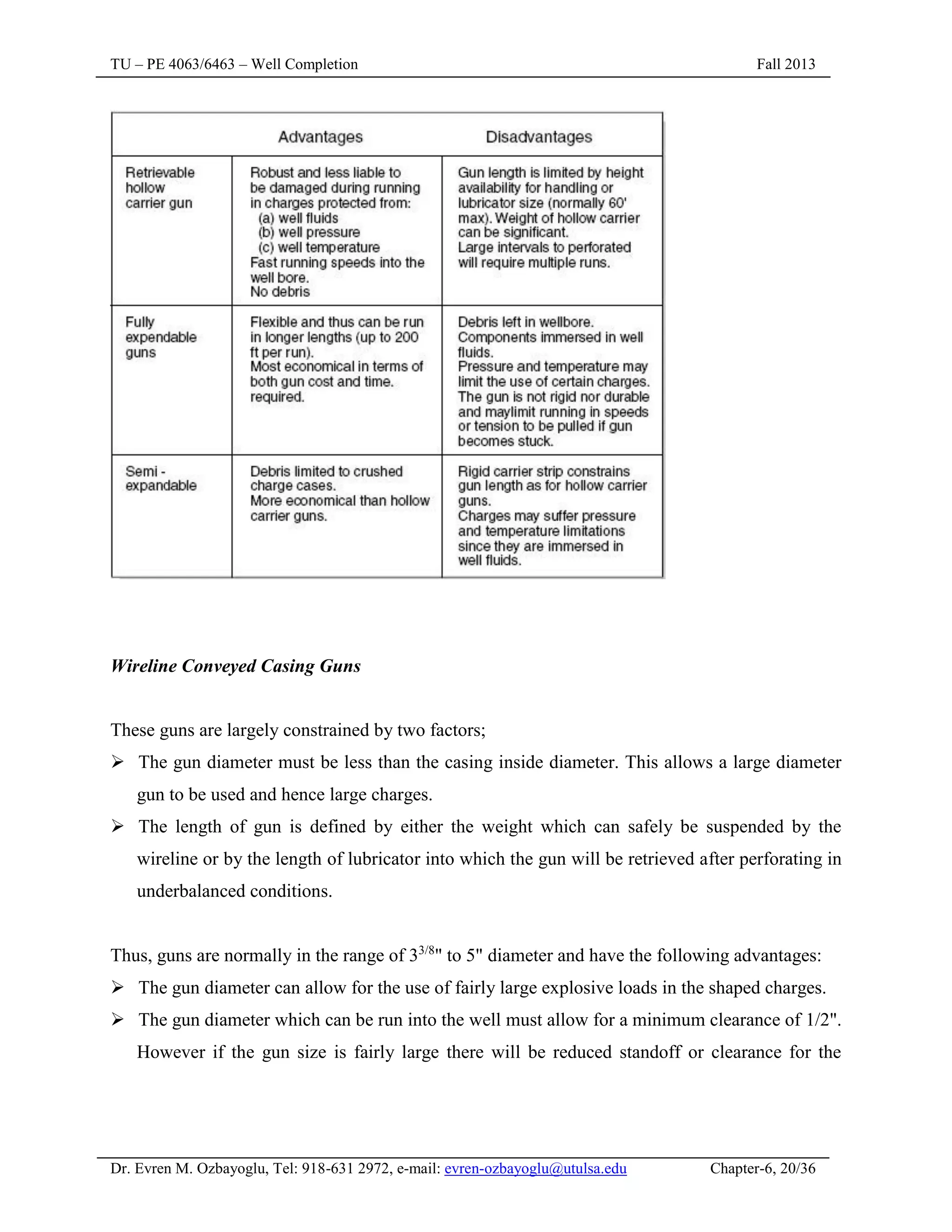
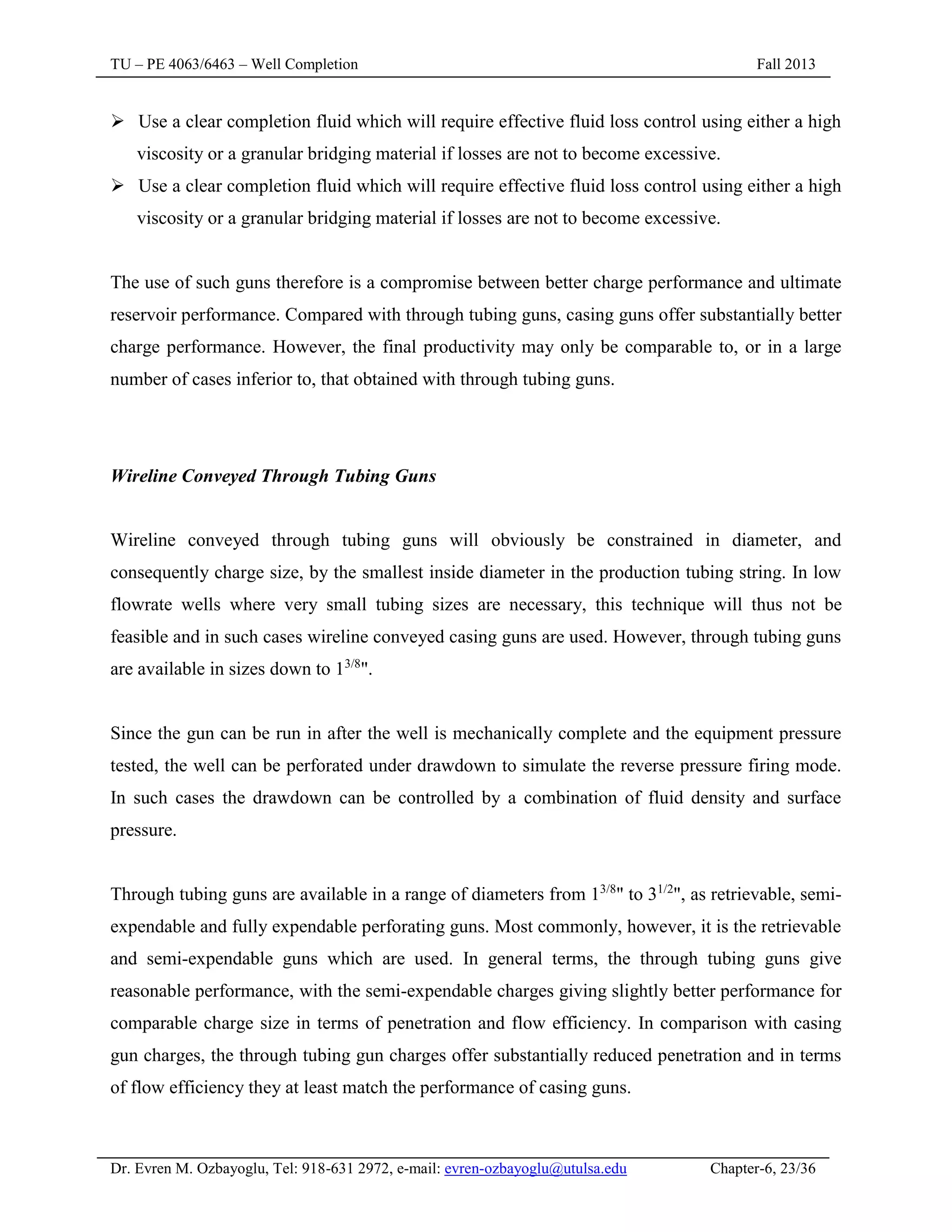
Perforating guns also vary according to the extent to which they are expendable, and are classed
as follows;
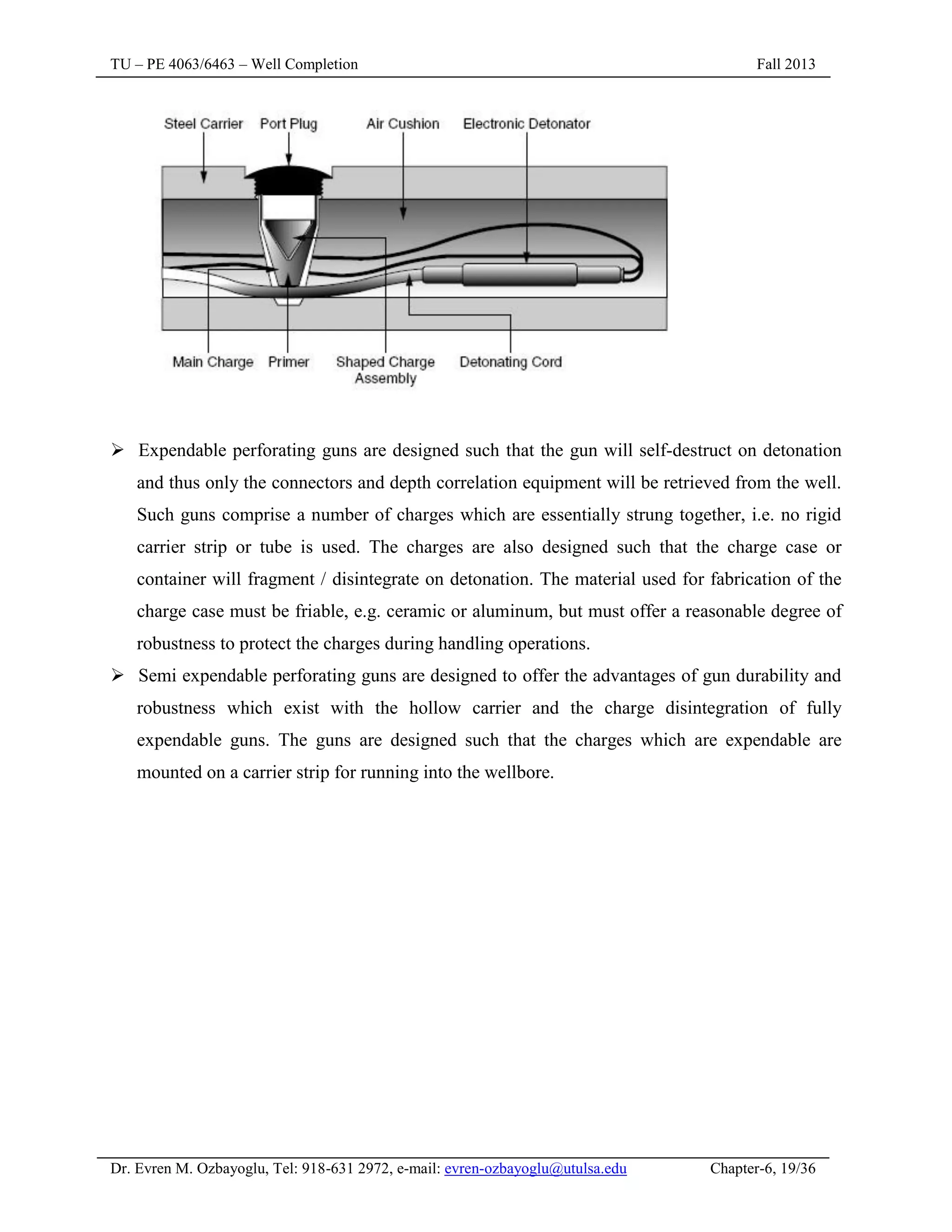
 Retrievable or hollow carrier guns are designed such that the individual charges are fitted to a
carrying strip and then connected to a primer or detonating cord. The carrier strip with
charges is then inserted into a steel carrier tube which is sealed prior to running downhole on
wireline.
TU – PE 4063/6463 – Well Completion Fall 2013
Dr. Evren M. Ozbayoglu, Tel: 918-631 2972, e-mail: evren-ozbayoglu@utulsa.edu Chapter-6, 19/36
 Expendable perforating guns are designed such that the gun will self-destruct on detonation
and thus only the connectors and depth correlation equipment will be retrieved from the well.
Such guns comprise a number of charges which are essentially strung together, i.e. no rigid
carrier strip or tube is used. The charges are also designed such that the charge case or
container will fragment / disintegrate on detonation. The material used for fabrication of the
charge case must be friable, e.g. ceramic or aluminum, but must offer a reasonable degree of
robustness to protect the charges during handling operations.
 Semi expendable perforating guns are designed to offer the advantages of gun durability and
robustness which exist with the hollow carrier and the charge disintegration of fully
expendable guns. The guns are designed such that the charges which are expendable are
mounted on a carrier strip for running into the wellbore.
TU – PE 4063/6463 – Well Completion Fall 2013
Dr. Evren M. Ozbayoglu, Tel: 918-631 2972, e-mail: evren-ozbayoglu@utulsa.edu Chapter-6, 20/36
Wireline Conveyed Casing Guns
These guns are largely constrained by two factors;
 The gun diameter must be less than the casing inside diameter. This allows a large diameter
gun to be used and hence large charges.
 The length of gun is defined by either the weight which can safely be suspended by the
wireline or by the length of lubricator into which the gun will be retrieved after perforating in
underbalanced conditions.
Thus, guns are normally in the range of 33/8
" to 5" diameter and have the following advantages:
 The gun diameter can allow for the use of fairly large explosive loads in the shaped charges.
 The gun diameter which can be run into the well must allow for a minimum clearance of 1/2".
However if the gun size is fairly large there will be reduced standoff or clearance for the
TU – PE 4063/6463 – Well Completion Fall 2013
Dr. Evren M. Ozbayoglu, Tel: 918-631 2972, e-mail: evren-ozbayoglu@utulsa.edu Chapter-6, 21/36
charges, and such guns can take full advantage of 90
flow performance.
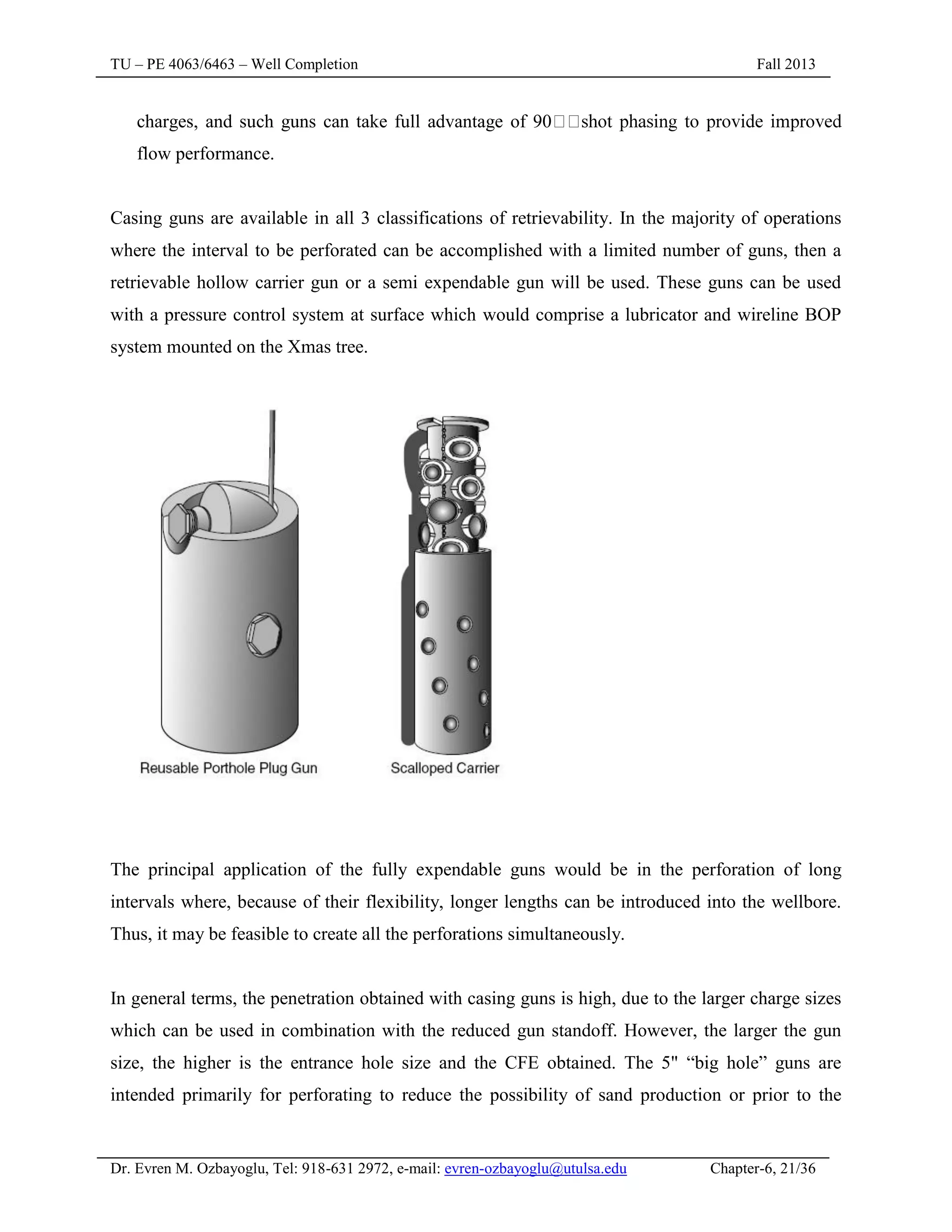
Casing guns are available in all 3 classifications of retrievability. In the majority of operations
where the interval to be perforated can be accomplished with a limited number of guns, then a
retrievable hollow carrier gun or a semi expendable gun will be used. These guns can be used
with a pressure control system at surface which would comprise a lubricator and wireline BOP
system mounted on the Xmas tree.
The principal application of the fully expendable guns would be in the perforation of long
intervals where, because of their flexibility, longer lengths can be introduced into the wellbore.
Thus, it may be feasible to create all the perforations simultaneously.
In general terms, the penetration obtained with casing guns is high, due to the larger charge sizes
which can be used in combination with the reduced gun standoff. However, the larger the gun
size, the higher is the entrance hole size and the CFE obtained. The 5" “big hole” guns are
intended primarily for perforating to reduce the possibility of sand production or prior to the
TU – PE 4063/6463 – Well Completion Fall 2013
Dr. Evren M. Ozbayoglu, Tel: 918-631 2972, e-mail: evren-ozbayoglu@utulsa.edu Chapter-6, 22/36
installation of a gravel pack. The principal advantage of these guns is that the entrance hole is
substantially larger than with guns with a diameter in the range 31/8
" - 4".
Casing guns can normally provide perforations which are larger in diameter and deeper than
those obtained with through tubing wireline guns. Their size provides an opportunity to use not
only larger explosive charges but also higher shot densities.
The main disadvantage is that this type of gun is most frequently used prior to mechanical
completion and since it will thus provide communication between the formation and the wellbore
it is necessary to either isolate the perforations or retain a fluid in the wellbore which exerts a
bottom hole pressure greater than the reservoir’s pressure. This can be obtained by any of the
following;
 Use a drilling mud in the wellbore which, because of its pressure, will leak into and plug the
perforations. This is not recommended.
TU – PE 4063/6463 – Well Completion Fall 2013
Dr. Evren M. Ozbayoglu, Tel: 918-631 2972, e-mail: evren-ozbayoglu@utulsa.edu Chapter-6, 23/36
 Use a clear completion fluid which will require effective fluid loss control using either a high
viscosity or a granular bridging material if losses are not to become excessive.
 Use a clear completion fluid which will require effective fluid loss control using either a high
viscosity or a granular bridging material if losses are not to become excessive.
The use of such guns therefore is a compromise between better charge performance and ultimate
reservoir performance. Compared with through tubing guns, casing guns offer substantially better
charge performance. However, the final productivity may only be comparable to, or in a large
number of cases inferior to, that obtained with through tubing guns.
Wireline Conveyed Through Tubing Guns
Wireline conveyed through tubing guns will obviously be constrained in diameter, and
consequently charge size, by the smallest inside diameter in the production tubing string. In low
flowrate wells where very small tubing sizes are necessary, this technique will thus not be
feasible and in such cases wireline conveyed casing guns are used. However, through tubing guns
are available in sizes down to 13/8
".
Since the gun can be run in after the well is mechanically complete and the equipment pressure
tested, the well can be perforated under drawdown to simulate the reverse pressure firing mode.
In such cases the drawdown can be controlled by a combination of fluid density and surface
pressure.
Through tubing guns are available in a range of diameters from 13/8
" to 31/2
", as retrievable, semi-
expendable and fully expendable perforating guns. Most commonly, however, it is the retrievable
and semi-expendable guns which are used. In general terms, the through tubing guns give
reasonable performance, with the semi-expendable charges giving slightly better performance for
comparable charge size in terms of penetration and flow efficiency. In comparison with casing
gun charges, the through tubing gun charges offer substantially reduced penetration and in terms
of flow efficiency they at least match the performance of casing guns.
TU – PE 4063/6463 – Well Completion Fall 2013
Dr. Evren M. Ozbayoglu, Tel: 918-631 2972, e-mail: evren-ozbayoglu@utulsa.edu Chapter-6, 24/36
The real benefit of through tubing guns is their ability to perforate under drawdown conditions.
The use of a drawdown prevents fluid inflow from the wellbore into the perforation and also
serves to flush out material lodged within the perforation tunnel or surrounding matrix. It must be
stressed however that due to the restriction on gun length caused by gun retrieval only the first
gun is detonated in under balance. In general terms to remove damage from the tunnel itself, the
higher the differential pressure the more effective will be the clean up process. However the use
of excessive drawdowns can lead to:
 Collapse of the formation around the perforation tunnel.
 Mobilization of fine particulates within the formation which can cause destabilization of the
formation or blockage of the pore space.
In most cases the drawdown must be held within reasonable limits although for the lower
permeability rocks higher drawdowns can be used because:
 Higher drawdown will be required to create sufficiently high flowrates.
TU – PE 4063/6463 – Well Completion Fall 2013
Dr. Evren M. Ozbayoglu, Tel: 918-631 2972, e-mail: evren-ozbayoglu@utulsa.edu Chapter-6, 25/36
 If the reduced rock permeability is due to grain size and not just to pore space infill, then the
compressive strength of the rock will be higher.
For oil wells the drawdown should be in the range of 250-1000 psi for productive wells; and for
low permeability wells, say, 1000 psi for wells of a permeability of 100 md, and up to 2000 psi
for lower permeability reservoirs. Gas well drawdowns in excess of 1000 psi are typical and can
be increased up to 5000 psi in reservoirs with a permeability of 1 md or less. However, the exact
drawdown has to be matched to specific well conditions. Through tubing perforating is a most
widely applied method and offers a reasonable compromise between charge performance, well
productivity and safety.
Tubing Conveyed Perforating Guns
As the name implies, tubing conveyed perforating, or TCP, involves the assembly of a
perforating gun on the end of drill pipe string, production tubing or coiled tubing and its lowering
and positioning in the wellbore prior to detonation. The technique has increased rapidly in both
application and development during the 1970s and is now widely employed. After detonation, the
gun can either be pulled from the well or detached to drop into the wellbore sump below the
perforated interval.
Deployment Options
Tubing conveyed perforating can either be employed by:
 Running the guns with a conventional drill stem test assembly. After clean up, the well would
have to be killed prior to retrieving the test string, normally with the spent gun. Subsequently,
the well would be completed if required.
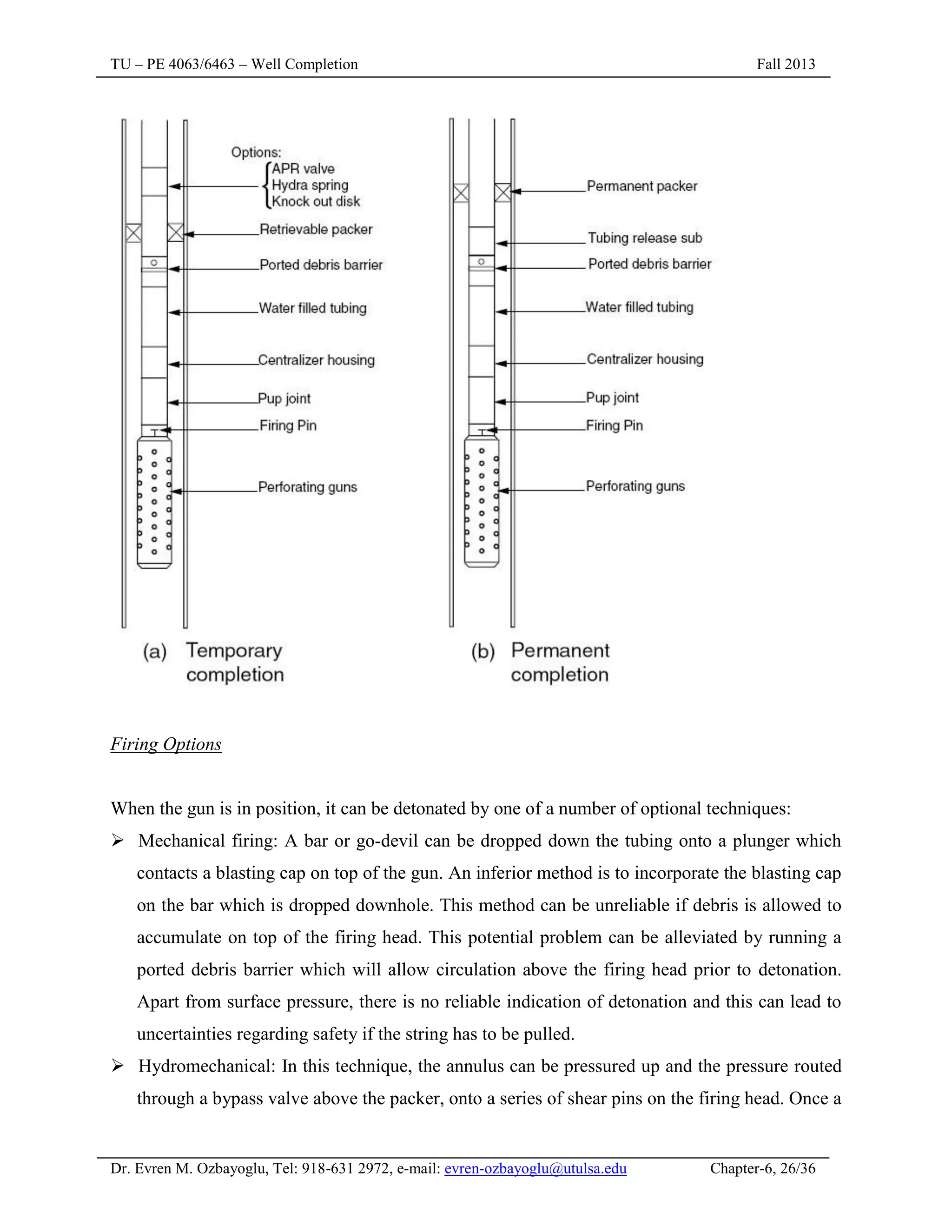
 The gun could be run attached to the base of the completion string tailpipe below the packer.
The string would be run into the hole, landed off, the packer set and the gun detonated under
drawdown. Normally, the guns would be detached and dropped into the sump.
 Running and retrieving the gun on coiled tubing using a CT deployment system.
TU – PE 4063/6463 – Well Completion Fall 2013
Dr. Evren M. Ozbayoglu, Tel: 918-631 2972, e-mail: evren-ozbayoglu@utulsa.edu Chapter-6, 26/36
Firing Options
When the gun is in position, it can be detonated by one of a number of optional techniques:
 Mechanical firing: A bar or go-devil can be dropped down the tubing onto a plunger which
contacts a blasting cap on top of the gun. An inferior method is to incorporate the blasting cap
on the bar which is dropped downhole. This method can be unreliable if debris is allowed to
accumulate on top of the firing head. This potential problem can be alleviated by running a
ported debris barrier which will allow circulation above the firing head prior to detonation.
Apart from surface pressure, there is no reliable indication of detonation and this can lead to
uncertainties regarding safety if the string has to be pulled.
 Hydromechanical: In this technique, the annulus can be pressured up and the pressure routed
through a bypass valve above the packer, onto a series of shear pins on the firing head. Once a
TU – PE 4063/6463 – Well Completion Fall 2013
Dr. Evren M. Ozbayoglu, Tel: 918-631 2972, e-mail: evren-ozbayoglu@utulsa.edu Chapter-6, 27/36
differential pressure is exerted sufficient to shear the pins, the firing pin is driven down
against the detonator. This technique would be more reliable than the mechanical method,
especially in deviated wellbores.
 Wireline firing: In this system, a special wet connect is run on wireline after the guns are
positioned. This wet connect attaches to the firing head which can then be fired by passing an
electrical current down the cable from surface. The main advantage of this technique is that,
besides surface pressure being created on successful firing, there are also electrical indications
at the surface.
TCP Gun Disposal
After detonation the gun can be dropped. However, if it is decided to flow the well either before
detaching the gun, or if it is intended to retrieve the gun, a vent assembly or perforated joint must
be provided below the packer where fluid can enter the flow string.
Advantages / Disadvantages of TCP
A major advantage of TCP is that as with using casing guns, the gun size and, accordingly, that
density and charge size can be quite large. Given the size of the guns, it would be expected that
the charges would offer deep penetration with large entrance hole size and good flow efficiency.
The principal advantages of TCP are that it can offer the ability to use large charges with high
shot density (up to 16 shots/ft) and perforate under substantial drawdown if required. It therefore
combines some of the advantages of casing and through tubing guns.
The advantages of tubing conveyed guns are
 The ability to use high shot densities and to create large entrance hole sizes can lead to
reduced hydraulic erosion in the formation around the perforations. This allows higher
flowrates to be realized without formation breakdown.
 The perforating operation can be completed in one run even for long intervals.
 Intervals in excess of 1000 m have been shot in one run with TCP.
TU – PE 4063/6463 – Well Completion Fall 2013
Dr. Evren M. Ozbayoglu, Tel: 918-631 2972, e-mail: evren-ozbayoglu@utulsa.edu Chapter-6, 28/36
 Unlike wireline operations, even if the interval is fairly large, the ability to shoot the interval
with one gun means that all the perforations are created simultaneously, which benefits well
clean up and productivity.
 As with the through tubing techniques the well is not perforated until the well is completed
and it is safe to allow well fluids to enter the wellbore.
 With wireline conveyed guns, whilst perforating under drawdown, there is a danger that the
guns will be damaged or blown up the wellbore if too high a pressure drawdown is used. With
TCP, the durability of the system allows high differential pressures, e.g. >2500 psi, to be
used.
 If the hydromechanical firing option is used the technique is feasible, even in highly deviated
wells, as there is no dependence on wireline nor on a go devil detonation system.
 If either the mechanical or hydromechanical firing system is used there is no necessity for
radio silence.
The disadvantages of TCP are
 If a misfire occurs, then gun retrieval will require a round trip which is both time consuming
and costly. There is also a safety concern as to why the gun has not detonated. Detonation
whilst the string is being retrieved, although rare, has occurred.
 If the gun is not detached but is to remain opposite the perforated interval, it will prevent
production logging or through tubing wireline below the tailpipe.
 Since the running procedure for the guns is prolonged, the charges may be exposed to well
temperatures for an extended period and this may lead to degradation.
 In general, the costs of TCP are higher than conventional wireline perforating. The cost
differential will decrease as the length of interval to be perforated increases. Further, if the
gun is to be dropped into the sump the cost of drilling the additional sump length must be
considered.
 Surface observation of the degree to which the charges have fired is not possible unless the
gun is retrieved.
TU – PE 4063/6463 – Well Completion Fall 2013
Dr. Evren M. Ozbayoglu, Tel: 918-631 2972, e-mail: evren-ozbayoglu@utulsa.edu Chapter-6, 29/36
Operational Considerations
Surface Pressure Equipment
The majority of perforating operations are conducted under conditions of under balanced
pressure. In the case of through tubing guns particularly, there will be a need to allow retrieval
and removal of the gun from the well. There will be a need to assemble a lubricator and wireline
BOP in much the same manner as for the conventional slick wireline. Normally both a
hydraulically actuated and a manual BOP valve are located at the base of the lubricator. In
addition, since the gun will be lowered on a braided electrical conductor cable, the sealing of
pressure as the cable leaves the lubricator will be a serious problem. In conventional slick line, a
stuffing box can be reasonably effective on a single strand line. However, when perforating,
sealing is provided by grease injection through a port into a flow-tube through which the cable
passes.
Depth Correlation
A reservoir can either be blanket perforated in which most of the reservoir is perforated with little
selectivity, or alternatively selectively perforated over a reduced interval(s). The latter case is
perhaps more prevalent, and it will therefore be necessary to ensure that the perforating guns be
located at the required depth prior to firing. A number of wireline techniques are available for
depth correlation against previous wireline logs;
 Gamma Ray Log: A gamma ray log can measure the shaliness of a formation even behind a
casing. Since the log is widely run, a log will normally be available at the time of perforation
for correlation. Thus a gamma ray log is frequently incorporated above the perforating gun
and used to depth correlate against a previous gamma-ray log.
 Casing Collar Locator: A casing collar locator log monitors the location of casing couplings
in that it responds ultrasonically to the wall thickness of steel. This log is normally run with a
cement bond log CBL or cement evaluation tool after casing cementation. A CCL can be run
above the perforating gun and used to monitor casing collar location for depth correlation
against a previous log. However, since most casing joints are similar in length, confusion as to
TU – PE 4063/6463 – Well Completion Fall 2013
Dr. Evren M. Ozbayoglu, Tel: 918-631 2972, e-mail: evren-ozbayoglu@utulsa.edu Chapter-6, 30/36
the exact depth can occur. This can be prevented by installing a smaller pup joint (10' or 20')
in the original casing string, located in the proximity of the top of the reservoir. This joint will
act as a marker and ease exact depth correlation.
 Nuclear Logs: It is possible to use nuclear logs such as the Compensated Nuclear Log CNL as
these will respond to fluid saturation/porosity behind the casing. However, given that these
logs utilize a nuclear source, they are less frequently used in conjunction with perforating
guns.
In most cases a combination of CCL and GR is used and using these techniques it should be
possible to depth correlate to with a minimum of 1-2 ft. of the required depth. In the case of TCP,
a radioactive source is frequently used for depth correlation.
Gun Length/Perforated Interval
The length of gun which can be used in the case of retrievable or semi expendable guns is limited
by the lubricator length and in the care of larger gun diameters, the tensile strength of the cable.
Normally the gun will be between 15 - 40ft. If the required perforated interval is larger than this,
then multiple trips with perforating guns will be necessary. In such cases The lubricator provides
the necessary well security. Perforating usually starts at the lowest interval in the zone or the
interval with the lowest permeability and moves upwards on successive runs.
Perforating Multiple Zones
If, for example, 3 intervals each 10ft. in length are required to be perforated it is possible to make
up a single gun which comprises 3 sections and can be detonated with a switch system. If the
zones are large, they will normally be perforated separately with individual guns.
Temperature Effects
Explosive charges can spontaneously detonate if exposed to high temperature. The RDX
explosive will detonate at 340
TU – PE 4063/6463 – Well Completion Fall 2013
Dr. Evren M. Ozbayoglu, Tel: 918-631 2972, e-mail: evren-ozbayoglu@utulsa.edu Chapter-6, 31/36
exposure. In most wireline perforating operations, the gun will never warm up to bottom hole
temperature because of the thermal lag and the fact that in a newly completed well, the
completion fluid will perhaps not have had time to warm up. However, such benevolent effects
cannot normally be relied upon and the explosive charge should be selected appropriate to the
anticipated well temperature. However, in the case of TCP, the deviation of exposure of the
charges in increased and the possibility of spontaneous detonation potentially more dangerous.
Casing Damage
The present trend is to use large charges (largest diameter gun) with higher shot densities.
However, the possibility of casing damage is increased in these situations. In general terms,
casing damage will be influenced by
 Casing steel grade and consequent compressive strength.
 The quality of the cement sheath and the extent to which it provides radial support to the
casing.
 The shot density, the number of shots in any plane will influence the stress on the casing
during perforating.
The damage, if it occurs, is likely to be in the form of splits along the casing wall in the axial
direction between perforations. This is clearly undesirable and should be avoided at all costs.
Gun Orientation
There are two particular situations where it is either desirable or essential to orientate the gun to
perforate in a specific direction.
 In deviated wells, where the gun size is substantially smaller than the casing size, the degree
of gun clearance due to the lack of centralization will affect charge performance. In such
cases it is frequently more beneficial to
position the gun to fire in the low side of the hole where the gun is in contact with the casing.
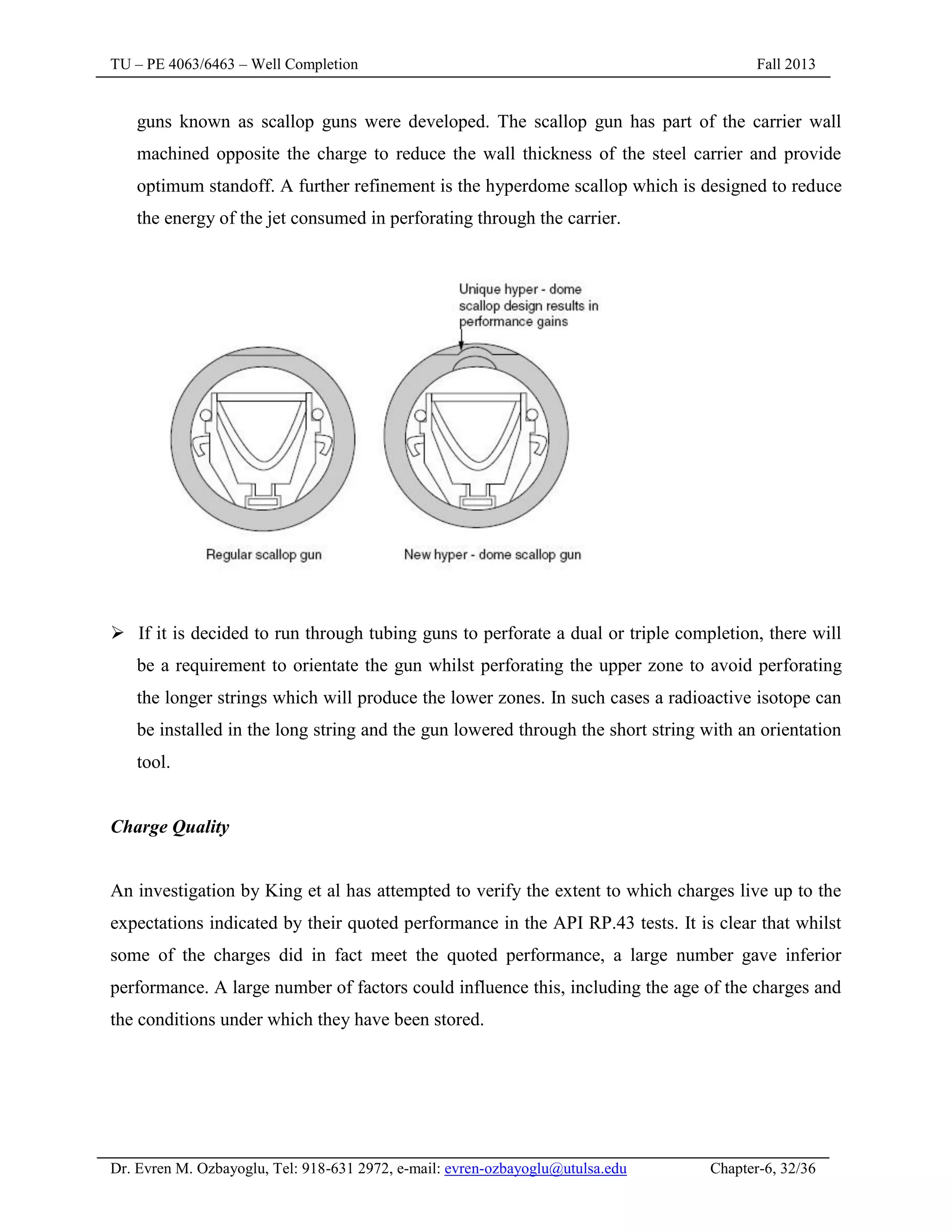
To further improve the effectiveness of this approach, a series of retrievable hollow carrier
TU – PE 4063/6463 – Well Completion Fall 2013
Dr. Evren M. Ozbayoglu, Tel: 918-631 2972, e-mail: evren-ozbayoglu@utulsa.edu Chapter-6, 32/36
guns known as scallop guns were developed. The scallop gun has part of the carrier wall
machined opposite the charge to reduce the wall thickness of the steel carrier and provide
optimum standoff. A further refinement is the hyperdome scallop which is designed to reduce
the energy of the jet consumed in perforating through the carrier.
 If it is decided to run through tubing guns to perforate a dual or triple completion, there will
be a requirement to orientate the gun whilst perforating the upper zone to avoid perforating
the longer strings which will produce the lower zones. In such cases a radioactive isotope can
be installed in the long string and the gun lowered through the short string with an orientation
tool.
Charge Quality
An investigation by King et al has attempted to verify the extent to which charges live up to the
expectations indicated by their quoted performance in the API RP.43 tests. It is clear that whilst
some of the charges did in fact meet the quoted performance, a large number gave inferior
performance. A large number of factors could influence this, including the age of the charges and
the conditions under which they have been stored.
TU – PE 4063/6463 – Well Completion Fall 2013
Dr. Evren M. Ozbayoglu, Tel: 918-631 2972, e-mail: evren-ozbayoglu@utulsa.edu Chapter-6, 33/36
Underbalanced and Overbalanced Perforation Concept
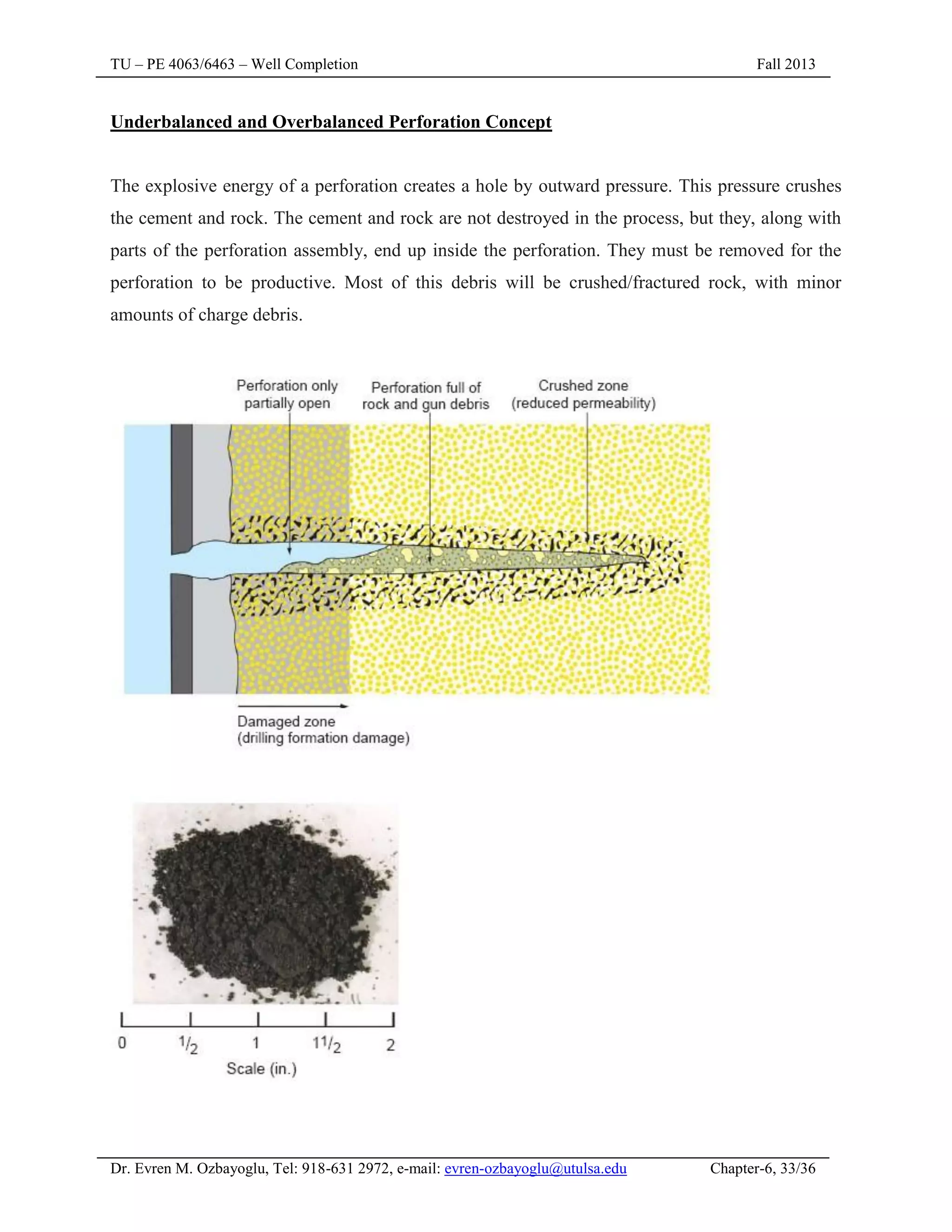
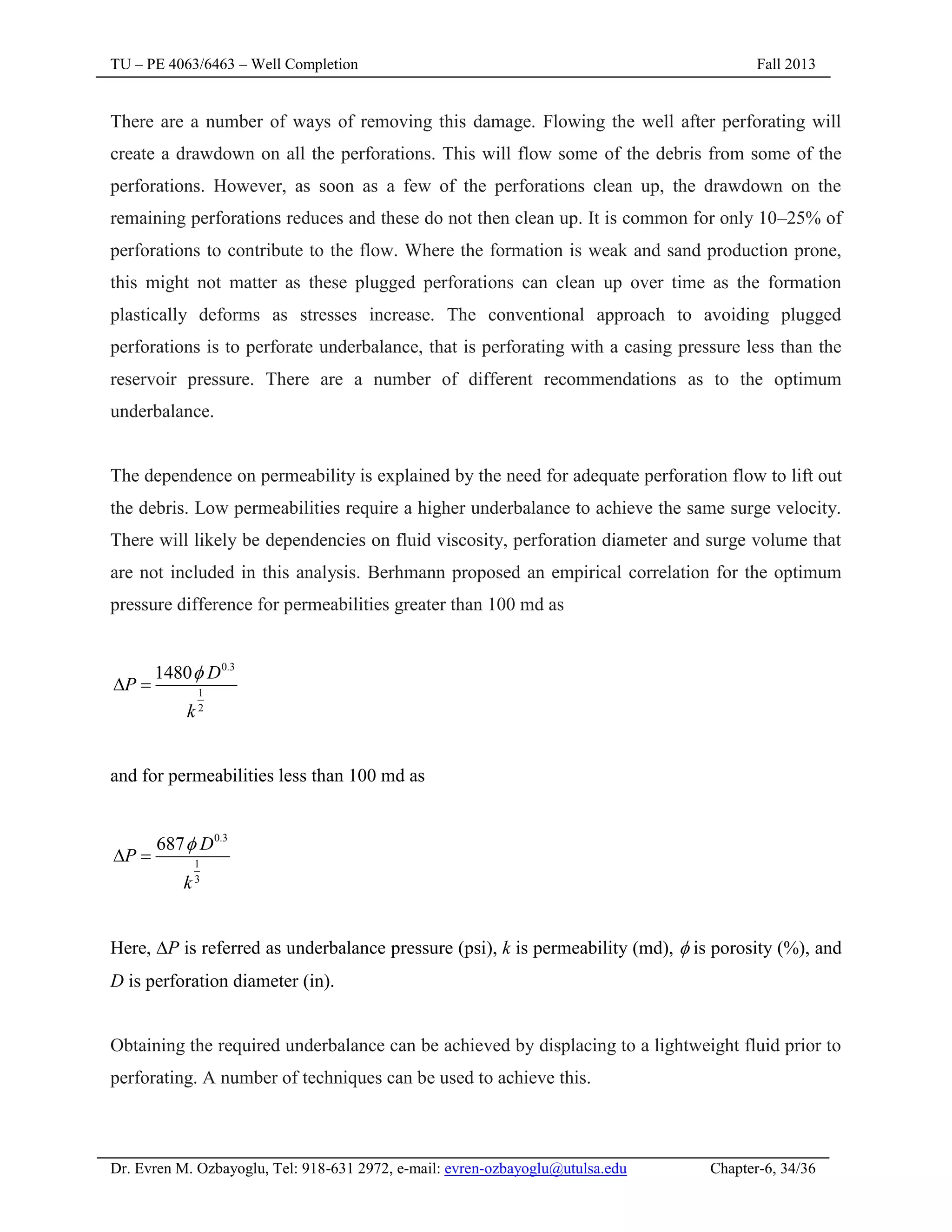
The explosive energy of a perforation creates a hole by outward pressure. This pressure crushes
the cement and rock. The cement and rock are not destroyed in the process, but they, along with
parts of the perforation assembly, end up inside the perforation. They must be removed for the
perforation to be productive. Most of this debris will be crushed/fractured rock, with minor
amounts of charge debris.
TU – PE 4063/6463 – Well Completion Fall 2013
Dr. Evren M. Ozbayoglu, Tel: 918-631 2972, e-mail: evren-ozbayoglu@utulsa.edu Chapter-6, 34/36
There are a number of ways of removing this damage. Flowing the well after perforating will
create a drawdown on all the perforations. This will flow some of the debris from some of the
perforations. However, as soon as a few of the perforations clean up, the drawdown on the
remaining perforations reduces and these do not then clean up. It is common for only 10–25% of
perforations to contribute to the flow. Where the formation is weak and sand production prone,
this might not matter as these plugged perforations can clean up over time as the formation
plastically deforms as stresses increase. The conventional approach to avoiding plugged
perforations is to perforate underbalance, that is perforating with a casing pressure less than the
reservoir pressure. There are a number of different recommendations as to the optimum
underbalance.
The dependence on permeability is explained by the need for adequate perforation flow to lift out
the debris. Low permeabilities require a higher underbalance to achieve the same surge velocity.
There will likely be dependencies on fluid viscosity, perforation diameter and surge volume that
are not included in this analysis. Berhmann proposed an empirical correlation for the optimum
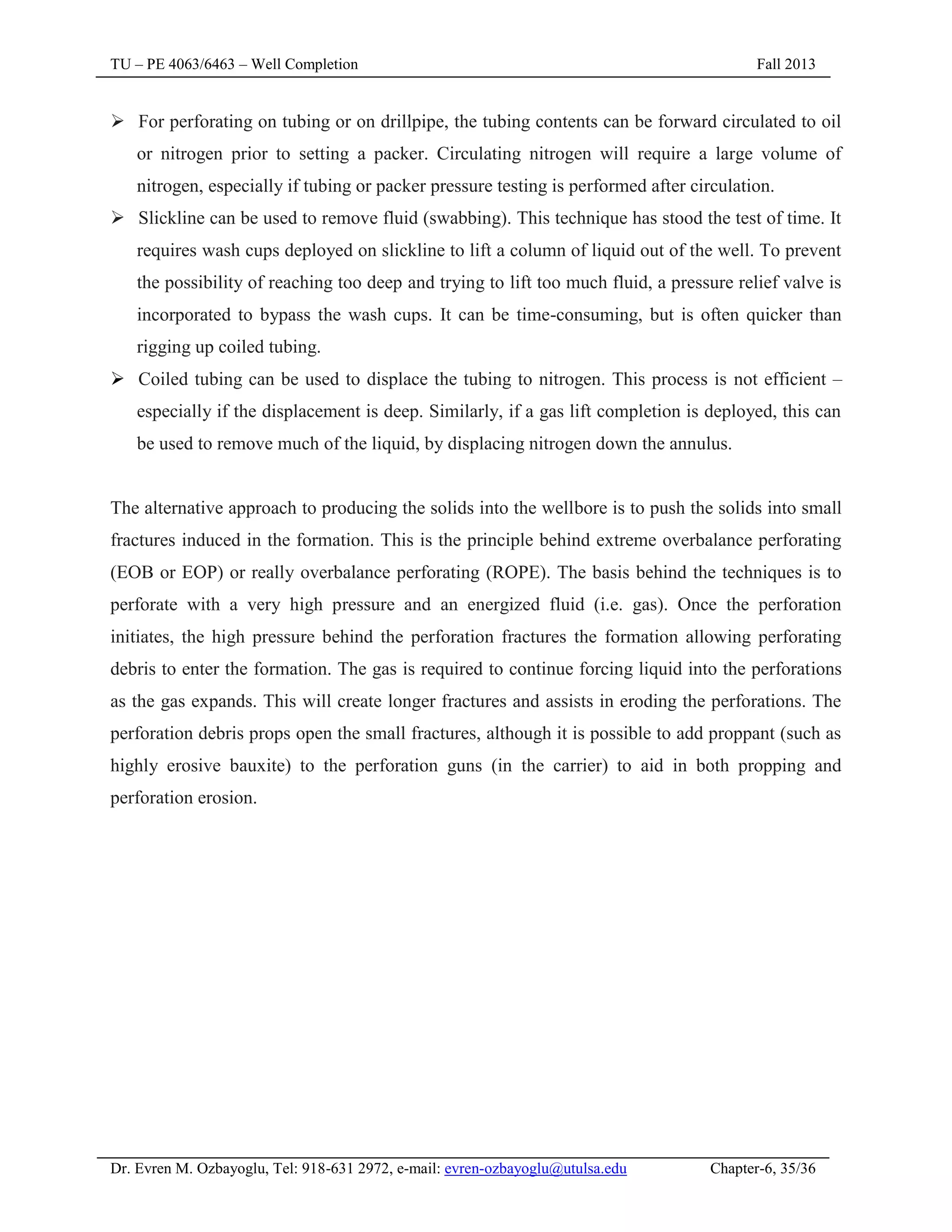
pressure difference for permeabilities greater than 100 md as
0.3
1
2
1480 D
P
k

 
and for permeabilities less than 100 md as
0.3
1
3
687 D
P
k

 
Here, P is referred as underbalance pressure (psi), k is permeability (md),  is porosity (%), and
D is perforation diameter (in).
Obtaining the required underbalance can be achieved by displacing to a lightweight fluid prior to
perforating. A number of techniques can be used to achieve this.
TU – PE 4063/6463 – Well Completion Fall 2013
Dr. Evren M. Ozbayoglu, Tel: 918-631 2972, e-mail: evren-ozbayoglu@utulsa.edu Chapter-6, 35/36
 For perforating on tubing or on drillpipe, the tubing contents can be forward circulated to oil
or nitrogen prior to setting a packer. Circulating nitrogen will require a large volume of
nitrogen, especially if tubing or packer pressure testing is performed after circulation.
 Slickline can be used to remove fluid (swabbing). This technique has stood the test of time. It
requires wash cups deployed on slickline to lift a column of liquid out of the well. To prevent
the possibility of reaching too deep and trying to lift too much fluid, a pressure relief valve is
incorporated to bypass the wash cups. It can be time-consuming, but is often quicker than
rigging up coiled tubing.
 Coiled tubing can be used to displace the tubing to nitrogen. This process is not efficient –
especially if the displacement is deep. Similarly, if a gas lift completion is deployed, this can
be used to remove much of the liquid, by displacing nitrogen down the annulus.
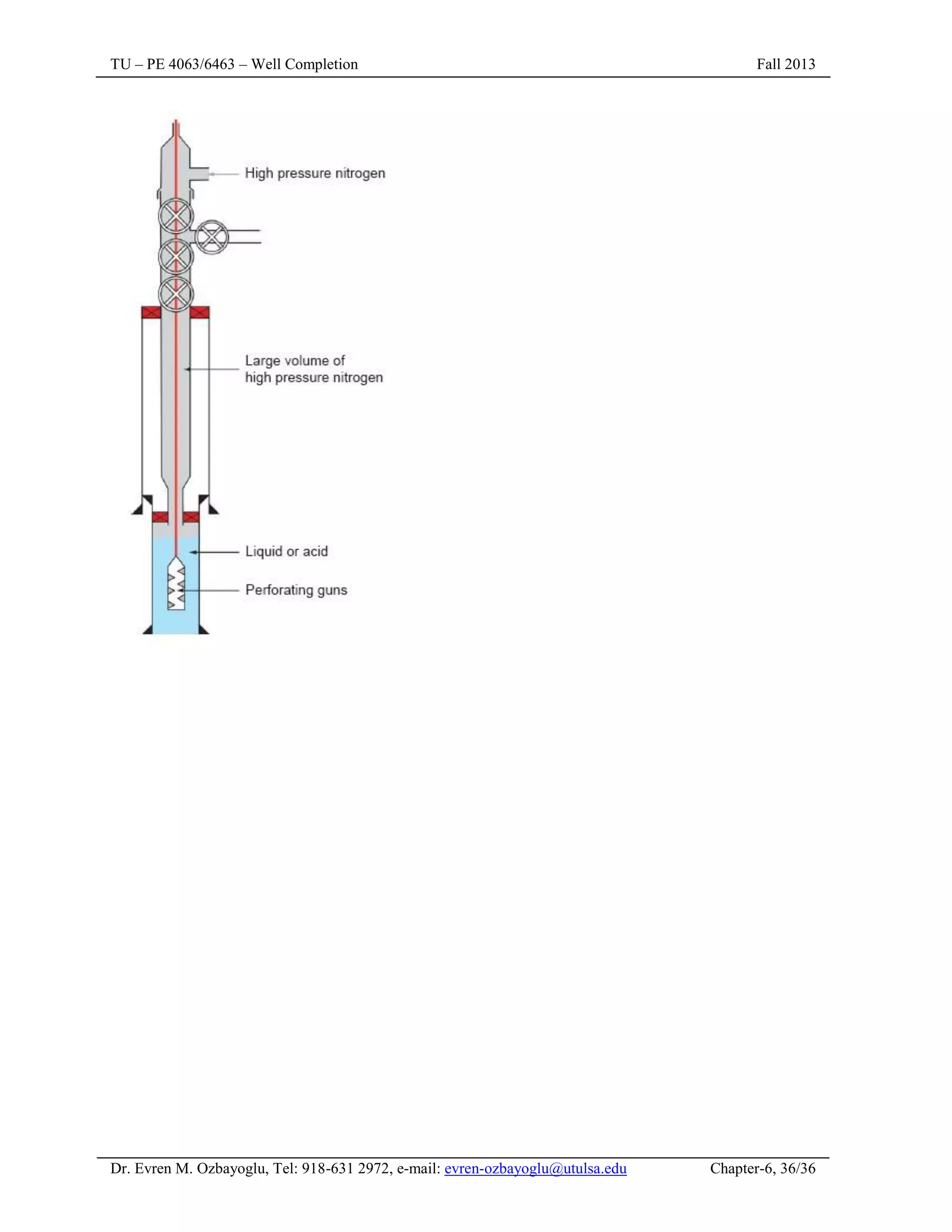
The alternative approach to producing the solids into the wellbore is to push the solids into small
fractures induced in the formation. This is the principle behind extreme overbalance perforating
(EOB or EOP) or really overbalance perforating (ROPE). The basis behind the techniques is to
perforate with a very high pressure and an energized fluid (i.e. gas). Once the perforation
initiates, the high pressure behind the perforation fractures the formation allowing perforating
debris to enter the formation. The gas is required to continue forcing liquid into the perforations
as the gas expands. This will create longer fractures and assists in eroding the perforations. The
perforation debris props open the small fractures, although it is possible to add proppant (such as
highly erosive bauxite) to the perforation guns (in the carrier) to aid in both propping and
perforation erosion.
TU – PE 4063/6463 – Well Completion Fall 2013
Dr. Evren M. Ozbayoglu, Tel: 918-631 2972, e-mail: evren-ozbayoglu@utulsa.edu Chapter-6, 36/36

Chapter_6-Perforation.pdf

  • 1.
    TU – PE4063/6463 – Well Completion Fall 2013 Dr. Evren M. Ozbayoglu, Tel: 918-631 2972, e-mail: evren-ozbayoglu@utulsa.edu Chapter-6, 1/36 PE 4063 / 6463 – Well Completion CHAPTER 6 – Perforation In the majority of completions, once the reservoir has been drilled, production casing or a liner is run into the well and cemented in place. To provide the communication path between the reservoir and the wellbore, it will be necessary to produce holes through the wall of the casing, the cement sheath and penetrate into the formation. This is accomplished by a technique called perforating. The basic operation requires that a series of explosive charges are lowered into the well either on an electric conductor wireline cable, or on tubing or drillstring, and when the charges are located at the required depth, they are detonated to produce a series of perforations through the wall of the casing and the cement sheath. Since the perforations will hopefully provide the only communication between the reservoir and wellbore, it is necessary to carefully design and execute the perforating operation, to provide the required degree of reservoir depletion control and maximize well productivity/injectivity. Initially, the type of charges used in perforating guns were bullets, but with the development of armour penetrating explosives, shaped charges or jet perforators are now almost exclusively used. Shaped Charge Characteristics and Performance A considerable amount of research has been conducted through the years into the mechanics of the detonation of shaped charges and the subsequent penetration of the target. A large number of design parameters, as well as operational conditions, can markedly affect the performance of shaped charged perforators. Principles of Shaped Charges The basic shaped charge consists of:  A conical metallic liner  A primer explosive charge  The main explosive charge  A charge case or container
  • 2.
    TU – PE4063/6463 – Well Completion Fall 2013 Dr. Evren M. Ozbayoglu, Tel: 918-631 2972, e-mail: evren-ozbayoglu@utulsa.edu Chapter-6, 2/36 There are a number of different types of explosive. They vary in explosive power and temperature stability. The main explosive used is in the shaped charge. This is a secondary ‘high explosive’. The explosive detonates at supersonic speed. Secondary explosives are also found in the detonating cord and detonator. Secondary explosives are difficult to initiate and normally require a primary explosive in the detonator to start detonating. Conversely, primary explosives may initiate by a small amount of heating (e.g. electrical resistance wire), friction, impact or static discharge. As such, they must be carefully handled and are avoided wherever possible.
  • 3.
    TU – PE4063/6463 – Well Completion Fall 2013 Dr. Evren M. Ozbayoglu, Tel: 918-631 2972, e-mail: evren-ozbayoglu@utulsa.edu Chapter-6, 3/36 The main explosive charge is usually a desensitized RDX (Cyclonite) type of explosive which besides being extremely powerful in terms of the energy released per unit weight of explosive, also reacts very quickly. The amount of explosive used is small – typically in the range of 6 to 32 g (0.2–1.1 oz), although smaller charges are available for very small-diameter casing and larger charges can be used for big hole charges (cased hole gravel packs). The explosive energy of the detonation is focused in one direction by the conical case. This reflects a lot of the energy back into a narrow pulse. The relatively thin charge liner also plays a critical role by systematically collapsing and emerging as a high-velocity jet of fluidized metal particles. The pulse moves out at around 20,000-30,000 ft/sec (20,000 miles/h) and generates pressures between 5 and 15 million psia. Once the main charge is detonated, the process is completed after only 100-300 microseconds.
  • 4.
    TU – PE4063/6463 – Well Completion Fall 2013 Dr. Evren M. Ozbayoglu, Tel: 918-631 2972, e-mail: evren-ozbayoglu@utulsa.edu Chapter-6, 4/36 The main explosive is contained within a charge container which can be manufactured as either a metal or a disintegrateable case e.g. ceramic which will be shattered during the explosion. Whilst a metal case would assist in containing and directing the force of the explosion to a certain target area, the target area would be diffuse as it would depend upon the diameter of the exit area for the explosion from the charge case and its distance from the target area. To concentrate the impact of the explosive force on the target the charge case is normally designed with a conical liner. This conical liner assists in concentrating the explosive force of the charge so that it provides maximum penetration of the target over a limited area. From the figure above, it can be seen that if a flat end is used for the shaped charge, the force of the explosion is spread over a wide area of the target with very limited penetration. However, if a conical cavity is introduced, the force of the explosion provides much greater penetration of the target. Also, if the conical cavity is lined with a metallic liner, the penetration is substantially increased. On detonation of the main charge, a detonation wave is produced which moves from the apex of the charge container at a speed estimated to be 30,000 ft/sec. The material of the liner on the outside flows towards the center of the cone to form a jet of fluidized material, whilst the material of the cone initially in contact with the explosive charge, collapses inwards towards the central axis of the cone, to produce a slug or tail of fluidized material. The relative distribution of the material between the jet and the slug is 1/3 and 2/3 of the total, respectively.
  • 5.
    TU – PE4063/6463 – Well Completion Fall 2013 Dr. Evren M. Ozbayoglu, Tel: 918-631 2972, e-mail: evren-ozbayoglu@utulsa.edu Chapter-6, 5/36 As mentioned earlier, the jet leaving the charge has a velocity of the order of 20,000 ft/sec. and has an impact pressure on the casing of 5-15 million psi. Under such high impact pressures, the casing material that it contacts becomes plastic and moves away from the impact of the jet. The material in the formation will be compacted and moved back into the formation ahead of the jet as the tunnel is created through the casing and cement sheath into the formation. The whole process takes place almost instantaneously and since no thermal effects take place, no fusion or burning occurs. The penetration is due solely to the extremely high impact force exerted on the target by the jet. The jet, whilst it is being created over an interval of a few microseconds starts to extend and move away from the charge. However, the slug material, although it comprises the bulk of the mass of the liner will lag behind the jet and in fact plays no real purpose in creating the perforation. On the contrary, the material of the slug will follow the jet into the perforation where, due to its mass, it will be deposited, thus giving rise to plugging of the perforation. The presence of the slug is therefore detrimental to the subsequent flow performance of the perforation. One approach to eliminate the slug has been to create a bi-metallic liner system, where the inside surface of the cone which will produce the jet is composed of copper whilst that on the outside is a metal, such as zinc, which will readily vaporize during the explosion. It is, therefore, clear that the penetration process is controlled to a large extent by the characteristics of a jet moving at very high velocity which impacts on the target material. The area of the target affected will be directly proportional to the diameter of the jet produced. Since the depth of
  • 6.
    TU – PE4063/6463 – Well Completion Fall 2013 Dr. Evren M. Ozbayoglu, Tel: 918-631 2972, e-mail: evren-ozbayoglu@utulsa.edu Chapter-6, 6/36 penetration is directly influenced by the speed of the jet, it is evident that it is of paramount importance to maintain the jet at a minimum diameter. The impact of the perforating jet upon the formation it penetrates is one of compaction of the rock which it encounters. Since the rock is not vaporized, it will be merely pushed back into the formation around the perforation tunnel it creates. The material will be crushed and compacted. The consequent perforation tunnel and surrounding formations will thus consist of several zones in which the natural state of reservoir rock has been changed.
  • 7.
    TU – PE4063/6463 – Well Completion Fall 2013 Dr. Evren M. Ozbayoglu, Tel: 918-631 2972, e-mail: evren-ozbayoglu@utulsa.edu Chapter-6, 7/36 The zone immediately adjacent to the perforation tunnel will consist of a layer of compacted and crushed formation grains and will possess a permeability substantially lower than the original reservoir permeability. Adjacent to this layer will be a series of layers in which the rock will have been overstressed resulting in a combination of micro-fractures and grain compaction and breakage. These layers referred to as the crushed zone will extend to a radial depth of the order of 1/2 inch around the perforation tunnel wall. The permeability has been estimated to be of the order of 20% of the original permeability. However, the properties and extent of the crushed zone will depend upon a number of factors including:  Size of perforation charge  Casing wall thickness and strength  Cement sheath thickness and strength  Grain composition, size and shape of the formation rock  Stress conditions in the near wellbore region  Proximity of nearest perforations in the same vertical plane
  • 8.
    TU – PE4063/6463 – Well Completion Fall 2013 Dr. Evren M. Ozbayoglu, Tel: 918-631 2972, e-mail: evren-ozbayoglu@utulsa.edu Chapter-6, 8/36 Factors Influencing Charge Performance The physical performance of a shaped charge is normally gauged from a number of characteristics:-  Penetration length  Perforation diameter  Perforation hole volume  Burr height on the inside of the casing around the perforation entrance hole However, charge performance will be a complex matter since it will be affected by charge size, material and configuration, the dimensions and shape of the charge case, and most importantly, the characteristics of the conical liner, as well as the strength characteristics of the formation and the wellbore conditions. It would, therefore, be expected that the following parameters may influence the physical performance of the shaped charge; Gun size/explosive charge size The size of the perforating gun will dictate the maximum explosive load which can be accommodated in the charges. In general terms, both the penetration and the diameter of the entrance hole will increase as the gun diameter and hence the size of explosive charge also increase.
  • 9.
    TU – PE4063/6463 – Well Completion Fall 2013 Dr. Evren M. Ozbayoglu, Tel: 918-631 2972, e-mail: evren-ozbayoglu@utulsa.edu Chapter-6, 9/36 Wellbore fluid pressure, temperature and density It would be expected that if the fluid in the wellbore were very dense, then it could reduce the jet velocity and impair its physical performance. However, in reality the thickness of the fluid film through which the jet moves is normally small. If, however, the charge size is small or the gun clearance is large, penetration could be reduced. Similarly well pressure has shown no observable effect on charge performance. This is particularly important given the frequent use of reduced hydrostatic pressure in the wellbore whilst perforating in an underbalanced mode. The effect on flow performance is much more important. However, elevated well temperatures can lead to significant degradation of the charges with consequent poor performance. However, the effect is only serious in deep hot wells where the gun contact time is large. In such situations, the protection of the explosive charges by their inclusion in a hollow gun carrier is advisable.
  • 10.
    TU – PE4063/6463 – Well Completion Fall 2013 Dr. Evren M. Ozbayoglu, Tel: 918-631 2972, e-mail: evren-ozbayoglu@utulsa.edu Chapter-6, 10/36 Gun clearance Since all perforating guns have a diameter which is substantially less than the casing inside diameter it follows that the gun cannot be expected to be centralized. If the charges are loaded on a design which calls for them to fire at different angular phasings then each charge will face a varying gap between the gun outside diameter and the inside diameter of the casing. This gap is known as “gun clearance”. The effect of gun clearance upon penetration and entrance hole size is shown in the following figure for a simulated perforating configuration. The maximum entrance hole size is achieved with a gun clearance of 1/2 inch (normally provided as a defined stand off in the gun) but in general both penetration and entrance hole size decrease with increasing clearance. The effect will be most serious when a very small diameter gun is used as is the case with wireline conveyed through tubing guns where the gun size is selected to pass through the completion string. In such cases it might be preferable to place all the charges to fire in-line and align the gun in the casing using a positioning device, to provide minimum gun clearance.
  • 11.
    TU – PE4063/6463 – Well Completion Fall 2013 Dr. Evren M. Ozbayoglu, Tel: 918-631 2972, e-mail: evren-ozbayoglu@utulsa.edu Chapter-6, 11/36 Compressive strength of formation rock It would seem logical for the compressive strength of the rock to have a large effect on the physical performance of jet perforators. Although the effect is not clearly quantified, the perforation obtained is inversely proportional to rock compressive strength. It will be necessary to extrapolate test firing results obtained from a standard test material to specific reservoir rocks. Strength of casing and radial support of cement sheath If the casing to be perforated is constructed from high grade tensile steel, it will absorb more energy whilst being perforated and hence reduce the overall length of the perforation. In reality, the effect is relatively small. However, as the number of perforations shot into a casing increases, the structural integrity of the casing is reduced and the possibility of splitting the casing cannot be discounted. This will be a very serious consideration where the cement sheath is incomplete, as perforating a casing, behind which no cement exists, could give rise to casing rupture.
  • 12.
    TU – PE4063/6463 – Well Completion Fall 2013 Dr. Evren M. Ozbayoglu, Tel: 918-631 2972, e-mail: evren-ozbayoglu@utulsa.edu Chapter-6, 12/36 Perforation Charge Arrangement In the preparation of a perforation gun, a number of charges are assembled on a carrier such that upon detonation they will yield a series of perforations into the formation. The arrangement provides for variation in the number of shots to be fired per unit interval, i.e. the shot density and the direction in which all, or individual, charges will be shot, i.e. the shot phasing. The number of shots installed in a perforating gun varies from low shot density, e.g. less than 1 shot/ft, to higher shot densities of up to 16 shots/ft. The lower shot densities are normally adequate for production in reservoirs of moderate to high productivity or are selected for specific injection operations where flow control is required. The higher shot densities will provide improved inflow performance in all reservoirs but may only be significantly beneficial in reservoirs with a low vertical permeability or where severe local drawdown might give rise to formation sand collapse. The orientation of perforations defined as the angular phasing can be  0 or in-line firing which can provide the minimum clearance for all perforations if the gun is positioned to fire on the low side of the hole  45 to 90 phasing which provides the nearest approximation to radial flow  180 phasing in either of the two planar directions  120 phasing either with all 3 shots firing at 120 to each other or omitting 1 charge such that the 2 shots fire at +60 and -60 angular phase
  • 13.
    TU – PE4063/6463 – Well Completion Fall 2013 Dr. Evren M. Ozbayoglu, Tel: 918-631 2972, e-mail: evren-ozbayoglu@utulsa.edu Chapter-6, 13/36 All perforation flow patterns are utilized. 90 phasing which provides the best radial depletion can be very effective when conducted with high shot densities. However, the selection of phasing will depend not only on shot densities but gun size, gun clearance, formation isotropy or anisotropy with respect to permeability. It is clear that for each shot density a number of options regarding phasing can exist, for example, 4 shots/ft can normally be fired at 0, 90 or 180 phasing.
  • 14.
    TU – PE4063/6463 – Well Completion Fall 2013 Dr. Evren M. Ozbayoglu, Tel: 918-631 2972, e-mail: evren-ozbayoglu@utulsa.edu Chapter-6, 14/36 Perforating Charge Performance There are a large number of companies who offer a perforating service, but the industry has defined a series of standardized test procedures which will allow a comparative measure to be made of the charges on offer. The test procedures and guidelines are contained within the API Recommended Practice No 43 5th edition. To characterize the performance of perforation charges, a number of different tests are proposed. Section I details the testing to be conducted to assess the physical performance of perforating charges in terms of the perforation dimensions under preset firing conditions. Section II of API RP 43 deals with the assessment of the impact of confining pressure on the physical dimensions of perforations created in a sandstone sample confined by a simulated over burden pressure. Section 3 and 4 deals with the effects of temperature and the flow capacity of perforations respectively. After detonation of the gun, the casing and target will be examined and the following measurements made and reported:  The burr height on the casing  Average diameter of the perforation  Length of the perforation In addition, the gun clearance for all shots and gun positioning must be recorded.
  • 15.
    TU – PE4063/6463 – Well Completion Fall 2013 Dr. Evren M. Ozbayoglu, Tel: 918-631 2972, e-mail: evren-ozbayoglu@utulsa.edu Chapter-6, 15/36 It must be stressed that the API RP 43 tests are principally of comparative value only and provide little direct indication of downhole performance. The section I test seeks merely to establish a comparative measure between the physical characteristics of perforation produced under constant conditions using a range of charges. Since no attempt is made to establish the performance in specific lithologies and using realistic in situ stresses the results in fact provide little indication of the real perforation characteristics which will be achieved in the reservoir. Since no method has yet been published to allow a prediction of performance under different compressive loads and with different lithologies, it is difficult to use the Section I tests to predict downhole performance. The section 2 test allows the effect of over burden or confining stress to be evaluated. The data from this test can be extrapolated to penetration in any reservoir of known compressive strength using   ln ln 0.086 1000 t f f t c c p p    where pf is the penetration predicted for formation rock (inches), pt is the penetration measured in API RP 43 test (inches), ct is the compressive strength of test material (psi), and cf is the formation rock compressive strength (psi). Example Two gun sytems are being assessed for deployment for perforating; 21/8 in scallop through tubing gun giving 12 in penetration at Berea sandstone (compressive strength = 6500 psi), and 4 in wireline conveyed casing gun, giving 17 in penetration at the same rock. Compare the guns for compressive strengths of 4000 psi, and 12000 psi, respectively. Solution Gun-1:
  • 16.
    TU – PE4063/6463 – Well Completion Fall 2013 Dr. Evren M. Ozbayoglu, Tel: 918-631 2972, e-mail: evren-ozbayoglu@utulsa.edu Chapter-6, 16/36 For 4000 f c  psi     6500 4000 ln ln 12 0.086 2.699 1000 f p     Therefore, 14.88 f p  in For 12000 f c  psi     6500 12000 ln ln 12 0.086 2.012 1000 f p     Therefore, 7.48 f p  in Gun-2: For 4000 f c  psi     6500 4000 ln ln 17 0.086 3.048 1000 f p     Therefore, 21.07 f p  in
  • 17.
    TU – PE4063/6463 – Well Completion Fall 2013 Dr. Evren M. Ozbayoglu, Tel: 918-631 2972, e-mail: evren-ozbayoglu@utulsa.edu Chapter-6, 17/36 For 12000 f c  psi     6500 12000 ln ln 17 0.086 2.36 1000 f p     Therefore, 10.59 f p  in Perforating Gun Systems Several key features classify perforating operations including  Whether the gun will be run on wireline or be conveyed on tubing or a drill string.  Whether the pressure in the wellbore at the time of perforating will be less than reservoir pressure, i.e. an underbalanced pressure condition, or be greater than reservoir pressure, i.e. an overbalanced condition.  The extent to which the gun, the charges or charge carrier will be retrieved from the wellbore after perforating.  Whether perforating will be conducted prior to, or after, mechanical completion of the well. The majority of wells are perforated using wireline conveyed guns. However, there are alternative approaches. The guns can be lowered into the cased wellbore prior to installation of the production tubing. In such cases, the guns are referred to as casing guns and both during and after the operation it is necessary to maintain a wellbore pressure which exceeds the reservoir pressure unless surface pressure control equipment is being used. Thus the approach utilizes overbalanced pressure conditions. Alternatively, after installing the completion tubing, a gun can be selected to be run down the inside of the tubing, out of the tailpipe and perforate the casing. The guns in this case are referred to as through tubing guns. Also, the perforating guns can be tubing conveyed either on the end of
  • 18.
    TU – PE4063/6463 – Well Completion Fall 2013 Dr. Evren M. Ozbayoglu, Tel: 918-631 2972, e-mail: evren-ozbayoglu@utulsa.edu Chapter-6, 18/36 the completion string, coiled tubing, or at the end of a drill pipe test string which will be retrieved after well clean up prior to running the completion string. Perforating guns also vary according to the extent to which they are expendable, and are classed as follows;  Retrievable or hollow carrier guns are designed such that the individual charges are fitted to a carrying strip and then connected to a primer or detonating cord. The carrier strip with charges is then inserted into a steel carrier tube which is sealed prior to running downhole on wireline.
  • 19.
    TU – PE4063/6463 – Well Completion Fall 2013 Dr. Evren M. Ozbayoglu, Tel: 918-631 2972, e-mail: evren-ozbayoglu@utulsa.edu Chapter-6, 19/36  Expendable perforating guns are designed such that the gun will self-destruct on detonation and thus only the connectors and depth correlation equipment will be retrieved from the well. Such guns comprise a number of charges which are essentially strung together, i.e. no rigid carrier strip or tube is used. The charges are also designed such that the charge case or container will fragment / disintegrate on detonation. The material used for fabrication of the charge case must be friable, e.g. ceramic or aluminum, but must offer a reasonable degree of robustness to protect the charges during handling operations.  Semi expendable perforating guns are designed to offer the advantages of gun durability and robustness which exist with the hollow carrier and the charge disintegration of fully expendable guns. The guns are designed such that the charges which are expendable are mounted on a carrier strip for running into the wellbore.
  • 20.
    TU – PE4063/6463 – Well Completion Fall 2013 Dr. Evren M. Ozbayoglu, Tel: 918-631 2972, e-mail: evren-ozbayoglu@utulsa.edu Chapter-6, 20/36 Wireline Conveyed Casing Guns These guns are largely constrained by two factors;  The gun diameter must be less than the casing inside diameter. This allows a large diameter gun to be used and hence large charges.  The length of gun is defined by either the weight which can safely be suspended by the wireline or by the length of lubricator into which the gun will be retrieved after perforating in underbalanced conditions. Thus, guns are normally in the range of 33/8 " to 5" diameter and have the following advantages:  The gun diameter can allow for the use of fairly large explosive loads in the shaped charges.  The gun diameter which can be run into the well must allow for a minimum clearance of 1/2". However if the gun size is fairly large there will be reduced standoff or clearance for the
  • 21.
    TU – PE4063/6463 – Well Completion Fall 2013 Dr. Evren M. Ozbayoglu, Tel: 918-631 2972, e-mail: evren-ozbayoglu@utulsa.edu Chapter-6, 21/36 charges, and such guns can take full advantage of 90 flow performance. Casing guns are available in all 3 classifications of retrievability. In the majority of operations where the interval to be perforated can be accomplished with a limited number of guns, then a retrievable hollow carrier gun or a semi expendable gun will be used. These guns can be used with a pressure control system at surface which would comprise a lubricator and wireline BOP system mounted on the Xmas tree. The principal application of the fully expendable guns would be in the perforation of long intervals where, because of their flexibility, longer lengths can be introduced into the wellbore. Thus, it may be feasible to create all the perforations simultaneously. In general terms, the penetration obtained with casing guns is high, due to the larger charge sizes which can be used in combination with the reduced gun standoff. However, the larger the gun size, the higher is the entrance hole size and the CFE obtained. The 5" “big hole” guns are intended primarily for perforating to reduce the possibility of sand production or prior to the
  • 22.
    TU – PE4063/6463 – Well Completion Fall 2013 Dr. Evren M. Ozbayoglu, Tel: 918-631 2972, e-mail: evren-ozbayoglu@utulsa.edu Chapter-6, 22/36 installation of a gravel pack. The principal advantage of these guns is that the entrance hole is substantially larger than with guns with a diameter in the range 31/8 " - 4". Casing guns can normally provide perforations which are larger in diameter and deeper than those obtained with through tubing wireline guns. Their size provides an opportunity to use not only larger explosive charges but also higher shot densities. The main disadvantage is that this type of gun is most frequently used prior to mechanical completion and since it will thus provide communication between the formation and the wellbore it is necessary to either isolate the perforations or retain a fluid in the wellbore which exerts a bottom hole pressure greater than the reservoir’s pressure. This can be obtained by any of the following;  Use a drilling mud in the wellbore which, because of its pressure, will leak into and plug the perforations. This is not recommended.
  • 23.
    TU – PE4063/6463 – Well Completion Fall 2013 Dr. Evren M. Ozbayoglu, Tel: 918-631 2972, e-mail: evren-ozbayoglu@utulsa.edu Chapter-6, 23/36  Use a clear completion fluid which will require effective fluid loss control using either a high viscosity or a granular bridging material if losses are not to become excessive.  Use a clear completion fluid which will require effective fluid loss control using either a high viscosity or a granular bridging material if losses are not to become excessive. The use of such guns therefore is a compromise between better charge performance and ultimate reservoir performance. Compared with through tubing guns, casing guns offer substantially better charge performance. However, the final productivity may only be comparable to, or in a large number of cases inferior to, that obtained with through tubing guns. Wireline Conveyed Through Tubing Guns Wireline conveyed through tubing guns will obviously be constrained in diameter, and consequently charge size, by the smallest inside diameter in the production tubing string. In low flowrate wells where very small tubing sizes are necessary, this technique will thus not be feasible and in such cases wireline conveyed casing guns are used. However, through tubing guns are available in sizes down to 13/8 ". Since the gun can be run in after the well is mechanically complete and the equipment pressure tested, the well can be perforated under drawdown to simulate the reverse pressure firing mode. In such cases the drawdown can be controlled by a combination of fluid density and surface pressure. Through tubing guns are available in a range of diameters from 13/8 " to 31/2 ", as retrievable, semi- expendable and fully expendable perforating guns. Most commonly, however, it is the retrievable and semi-expendable guns which are used. In general terms, the through tubing guns give reasonable performance, with the semi-expendable charges giving slightly better performance for comparable charge size in terms of penetration and flow efficiency. In comparison with casing gun charges, the through tubing gun charges offer substantially reduced penetration and in terms of flow efficiency they at least match the performance of casing guns.
  • 24.
    TU – PE4063/6463 – Well Completion Fall 2013 Dr. Evren M. Ozbayoglu, Tel: 918-631 2972, e-mail: evren-ozbayoglu@utulsa.edu Chapter-6, 24/36 The real benefit of through tubing guns is their ability to perforate under drawdown conditions. The use of a drawdown prevents fluid inflow from the wellbore into the perforation and also serves to flush out material lodged within the perforation tunnel or surrounding matrix. It must be stressed however that due to the restriction on gun length caused by gun retrieval only the first gun is detonated in under balance. In general terms to remove damage from the tunnel itself, the higher the differential pressure the more effective will be the clean up process. However the use of excessive drawdowns can lead to:  Collapse of the formation around the perforation tunnel.  Mobilization of fine particulates within the formation which can cause destabilization of the formation or blockage of the pore space. In most cases the drawdown must be held within reasonable limits although for the lower permeability rocks higher drawdowns can be used because:  Higher drawdown will be required to create sufficiently high flowrates.
  • 25.
    TU – PE4063/6463 – Well Completion Fall 2013 Dr. Evren M. Ozbayoglu, Tel: 918-631 2972, e-mail: evren-ozbayoglu@utulsa.edu Chapter-6, 25/36  If the reduced rock permeability is due to grain size and not just to pore space infill, then the compressive strength of the rock will be higher. For oil wells the drawdown should be in the range of 250-1000 psi for productive wells; and for low permeability wells, say, 1000 psi for wells of a permeability of 100 md, and up to 2000 psi for lower permeability reservoirs. Gas well drawdowns in excess of 1000 psi are typical and can be increased up to 5000 psi in reservoirs with a permeability of 1 md or less. However, the exact drawdown has to be matched to specific well conditions. Through tubing perforating is a most widely applied method and offers a reasonable compromise between charge performance, well productivity and safety. Tubing Conveyed Perforating Guns As the name implies, tubing conveyed perforating, or TCP, involves the assembly of a perforating gun on the end of drill pipe string, production tubing or coiled tubing and its lowering and positioning in the wellbore prior to detonation. The technique has increased rapidly in both application and development during the 1970s and is now widely employed. After detonation, the gun can either be pulled from the well or detached to drop into the wellbore sump below the perforated interval. Deployment Options Tubing conveyed perforating can either be employed by:  Running the guns with a conventional drill stem test assembly. After clean up, the well would have to be killed prior to retrieving the test string, normally with the spent gun. Subsequently, the well would be completed if required.  The gun could be run attached to the base of the completion string tailpipe below the packer. The string would be run into the hole, landed off, the packer set and the gun detonated under drawdown. Normally, the guns would be detached and dropped into the sump.  Running and retrieving the gun on coiled tubing using a CT deployment system.
  • 26.
    TU – PE4063/6463 – Well Completion Fall 2013 Dr. Evren M. Ozbayoglu, Tel: 918-631 2972, e-mail: evren-ozbayoglu@utulsa.edu Chapter-6, 26/36 Firing Options When the gun is in position, it can be detonated by one of a number of optional techniques:  Mechanical firing: A bar or go-devil can be dropped down the tubing onto a plunger which contacts a blasting cap on top of the gun. An inferior method is to incorporate the blasting cap on the bar which is dropped downhole. This method can be unreliable if debris is allowed to accumulate on top of the firing head. This potential problem can be alleviated by running a ported debris barrier which will allow circulation above the firing head prior to detonation. Apart from surface pressure, there is no reliable indication of detonation and this can lead to uncertainties regarding safety if the string has to be pulled.  Hydromechanical: In this technique, the annulus can be pressured up and the pressure routed through a bypass valve above the packer, onto a series of shear pins on the firing head. Once a
  • 27.
    TU – PE4063/6463 – Well Completion Fall 2013 Dr. Evren M. Ozbayoglu, Tel: 918-631 2972, e-mail: evren-ozbayoglu@utulsa.edu Chapter-6, 27/36 differential pressure is exerted sufficient to shear the pins, the firing pin is driven down against the detonator. This technique would be more reliable than the mechanical method, especially in deviated wellbores.  Wireline firing: In this system, a special wet connect is run on wireline after the guns are positioned. This wet connect attaches to the firing head which can then be fired by passing an electrical current down the cable from surface. The main advantage of this technique is that, besides surface pressure being created on successful firing, there are also electrical indications at the surface. TCP Gun Disposal After detonation the gun can be dropped. However, if it is decided to flow the well either before detaching the gun, or if it is intended to retrieve the gun, a vent assembly or perforated joint must be provided below the packer where fluid can enter the flow string. Advantages / Disadvantages of TCP A major advantage of TCP is that as with using casing guns, the gun size and, accordingly, that density and charge size can be quite large. Given the size of the guns, it would be expected that the charges would offer deep penetration with large entrance hole size and good flow efficiency. The principal advantages of TCP are that it can offer the ability to use large charges with high shot density (up to 16 shots/ft) and perforate under substantial drawdown if required. It therefore combines some of the advantages of casing and through tubing guns. The advantages of tubing conveyed guns are  The ability to use high shot densities and to create large entrance hole sizes can lead to reduced hydraulic erosion in the formation around the perforations. This allows higher flowrates to be realized without formation breakdown.  The perforating operation can be completed in one run even for long intervals.  Intervals in excess of 1000 m have been shot in one run with TCP.
  • 28.
    TU – PE4063/6463 – Well Completion Fall 2013 Dr. Evren M. Ozbayoglu, Tel: 918-631 2972, e-mail: evren-ozbayoglu@utulsa.edu Chapter-6, 28/36  Unlike wireline operations, even if the interval is fairly large, the ability to shoot the interval with one gun means that all the perforations are created simultaneously, which benefits well clean up and productivity.  As with the through tubing techniques the well is not perforated until the well is completed and it is safe to allow well fluids to enter the wellbore.  With wireline conveyed guns, whilst perforating under drawdown, there is a danger that the guns will be damaged or blown up the wellbore if too high a pressure drawdown is used. With TCP, the durability of the system allows high differential pressures, e.g. >2500 psi, to be used.  If the hydromechanical firing option is used the technique is feasible, even in highly deviated wells, as there is no dependence on wireline nor on a go devil detonation system.  If either the mechanical or hydromechanical firing system is used there is no necessity for radio silence. The disadvantages of TCP are  If a misfire occurs, then gun retrieval will require a round trip which is both time consuming and costly. There is also a safety concern as to why the gun has not detonated. Detonation whilst the string is being retrieved, although rare, has occurred.  If the gun is not detached but is to remain opposite the perforated interval, it will prevent production logging or through tubing wireline below the tailpipe.  Since the running procedure for the guns is prolonged, the charges may be exposed to well temperatures for an extended period and this may lead to degradation.  In general, the costs of TCP are higher than conventional wireline perforating. The cost differential will decrease as the length of interval to be perforated increases. Further, if the gun is to be dropped into the sump the cost of drilling the additional sump length must be considered.  Surface observation of the degree to which the charges have fired is not possible unless the gun is retrieved.
  • 29.
    TU – PE4063/6463 – Well Completion Fall 2013 Dr. Evren M. Ozbayoglu, Tel: 918-631 2972, e-mail: evren-ozbayoglu@utulsa.edu Chapter-6, 29/36 Operational Considerations Surface Pressure Equipment The majority of perforating operations are conducted under conditions of under balanced pressure. In the case of through tubing guns particularly, there will be a need to allow retrieval and removal of the gun from the well. There will be a need to assemble a lubricator and wireline BOP in much the same manner as for the conventional slick wireline. Normally both a hydraulically actuated and a manual BOP valve are located at the base of the lubricator. In addition, since the gun will be lowered on a braided electrical conductor cable, the sealing of pressure as the cable leaves the lubricator will be a serious problem. In conventional slick line, a stuffing box can be reasonably effective on a single strand line. However, when perforating, sealing is provided by grease injection through a port into a flow-tube through which the cable passes. Depth Correlation A reservoir can either be blanket perforated in which most of the reservoir is perforated with little selectivity, or alternatively selectively perforated over a reduced interval(s). The latter case is perhaps more prevalent, and it will therefore be necessary to ensure that the perforating guns be located at the required depth prior to firing. A number of wireline techniques are available for depth correlation against previous wireline logs;  Gamma Ray Log: A gamma ray log can measure the shaliness of a formation even behind a casing. Since the log is widely run, a log will normally be available at the time of perforation for correlation. Thus a gamma ray log is frequently incorporated above the perforating gun and used to depth correlate against a previous gamma-ray log.  Casing Collar Locator: A casing collar locator log monitors the location of casing couplings in that it responds ultrasonically to the wall thickness of steel. This log is normally run with a cement bond log CBL or cement evaluation tool after casing cementation. A CCL can be run above the perforating gun and used to monitor casing collar location for depth correlation against a previous log. However, since most casing joints are similar in length, confusion as to
  • 30.
    TU – PE4063/6463 – Well Completion Fall 2013 Dr. Evren M. Ozbayoglu, Tel: 918-631 2972, e-mail: evren-ozbayoglu@utulsa.edu Chapter-6, 30/36 the exact depth can occur. This can be prevented by installing a smaller pup joint (10' or 20') in the original casing string, located in the proximity of the top of the reservoir. This joint will act as a marker and ease exact depth correlation.  Nuclear Logs: It is possible to use nuclear logs such as the Compensated Nuclear Log CNL as these will respond to fluid saturation/porosity behind the casing. However, given that these logs utilize a nuclear source, they are less frequently used in conjunction with perforating guns. In most cases a combination of CCL and GR is used and using these techniques it should be possible to depth correlate to with a minimum of 1-2 ft. of the required depth. In the case of TCP, a radioactive source is frequently used for depth correlation. Gun Length/Perforated Interval The length of gun which can be used in the case of retrievable or semi expendable guns is limited by the lubricator length and in the care of larger gun diameters, the tensile strength of the cable. Normally the gun will be between 15 - 40ft. If the required perforated interval is larger than this, then multiple trips with perforating guns will be necessary. In such cases The lubricator provides the necessary well security. Perforating usually starts at the lowest interval in the zone or the interval with the lowest permeability and moves upwards on successive runs. Perforating Multiple Zones If, for example, 3 intervals each 10ft. in length are required to be perforated it is possible to make up a single gun which comprises 3 sections and can be detonated with a switch system. If the zones are large, they will normally be perforated separately with individual guns. Temperature Effects Explosive charges can spontaneously detonate if exposed to high temperature. The RDX explosive will detonate at 340
  • 31.
    TU – PE4063/6463 – Well Completion Fall 2013 Dr. Evren M. Ozbayoglu, Tel: 918-631 2972, e-mail: evren-ozbayoglu@utulsa.edu Chapter-6, 31/36 exposure. In most wireline perforating operations, the gun will never warm up to bottom hole temperature because of the thermal lag and the fact that in a newly completed well, the completion fluid will perhaps not have had time to warm up. However, such benevolent effects cannot normally be relied upon and the explosive charge should be selected appropriate to the anticipated well temperature. However, in the case of TCP, the deviation of exposure of the charges in increased and the possibility of spontaneous detonation potentially more dangerous. Casing Damage The present trend is to use large charges (largest diameter gun) with higher shot densities. However, the possibility of casing damage is increased in these situations. In general terms, casing damage will be influenced by  Casing steel grade and consequent compressive strength.  The quality of the cement sheath and the extent to which it provides radial support to the casing.  The shot density, the number of shots in any plane will influence the stress on the casing during perforating. The damage, if it occurs, is likely to be in the form of splits along the casing wall in the axial direction between perforations. This is clearly undesirable and should be avoided at all costs. Gun Orientation There are two particular situations where it is either desirable or essential to orientate the gun to perforate in a specific direction.  In deviated wells, where the gun size is substantially smaller than the casing size, the degree of gun clearance due to the lack of centralization will affect charge performance. In such cases it is frequently more beneficial to position the gun to fire in the low side of the hole where the gun is in contact with the casing. To further improve the effectiveness of this approach, a series of retrievable hollow carrier
  • 32.
    TU – PE4063/6463 – Well Completion Fall 2013 Dr. Evren M. Ozbayoglu, Tel: 918-631 2972, e-mail: evren-ozbayoglu@utulsa.edu Chapter-6, 32/36 guns known as scallop guns were developed. The scallop gun has part of the carrier wall machined opposite the charge to reduce the wall thickness of the steel carrier and provide optimum standoff. A further refinement is the hyperdome scallop which is designed to reduce the energy of the jet consumed in perforating through the carrier.  If it is decided to run through tubing guns to perforate a dual or triple completion, there will be a requirement to orientate the gun whilst perforating the upper zone to avoid perforating the longer strings which will produce the lower zones. In such cases a radioactive isotope can be installed in the long string and the gun lowered through the short string with an orientation tool. Charge Quality An investigation by King et al has attempted to verify the extent to which charges live up to the expectations indicated by their quoted performance in the API RP.43 tests. It is clear that whilst some of the charges did in fact meet the quoted performance, a large number gave inferior performance. A large number of factors could influence this, including the age of the charges and the conditions under which they have been stored.
  • 33.
    TU – PE4063/6463 – Well Completion Fall 2013 Dr. Evren M. Ozbayoglu, Tel: 918-631 2972, e-mail: evren-ozbayoglu@utulsa.edu Chapter-6, 33/36 Underbalanced and Overbalanced Perforation Concept The explosive energy of a perforation creates a hole by outward pressure. This pressure crushes the cement and rock. The cement and rock are not destroyed in the process, but they, along with parts of the perforation assembly, end up inside the perforation. They must be removed for the perforation to be productive. Most of this debris will be crushed/fractured rock, with minor amounts of charge debris.
  • 34.
    TU – PE4063/6463 – Well Completion Fall 2013 Dr. Evren M. Ozbayoglu, Tel: 918-631 2972, e-mail: evren-ozbayoglu@utulsa.edu Chapter-6, 34/36 There are a number of ways of removing this damage. Flowing the well after perforating will create a drawdown on all the perforations. This will flow some of the debris from some of the perforations. However, as soon as a few of the perforations clean up, the drawdown on the remaining perforations reduces and these do not then clean up. It is common for only 10–25% of perforations to contribute to the flow. Where the formation is weak and sand production prone, this might not matter as these plugged perforations can clean up over time as the formation plastically deforms as stresses increase. The conventional approach to avoiding plugged perforations is to perforate underbalance, that is perforating with a casing pressure less than the reservoir pressure. There are a number of different recommendations as to the optimum underbalance. The dependence on permeability is explained by the need for adequate perforation flow to lift out the debris. Low permeabilities require a higher underbalance to achieve the same surge velocity. There will likely be dependencies on fluid viscosity, perforation diameter and surge volume that are not included in this analysis. Berhmann proposed an empirical correlation for the optimum pressure difference for permeabilities greater than 100 md as 0.3 1 2 1480 D P k    and for permeabilities less than 100 md as 0.3 1 3 687 D P k    Here, P is referred as underbalance pressure (psi), k is permeability (md),  is porosity (%), and D is perforation diameter (in). Obtaining the required underbalance can be achieved by displacing to a lightweight fluid prior to perforating. A number of techniques can be used to achieve this.
  • 35.
    TU – PE4063/6463 – Well Completion Fall 2013 Dr. Evren M. Ozbayoglu, Tel: 918-631 2972, e-mail: evren-ozbayoglu@utulsa.edu Chapter-6, 35/36  For perforating on tubing or on drillpipe, the tubing contents can be forward circulated to oil or nitrogen prior to setting a packer. Circulating nitrogen will require a large volume of nitrogen, especially if tubing or packer pressure testing is performed after circulation.  Slickline can be used to remove fluid (swabbing). This technique has stood the test of time. It requires wash cups deployed on slickline to lift a column of liquid out of the well. To prevent the possibility of reaching too deep and trying to lift too much fluid, a pressure relief valve is incorporated to bypass the wash cups. It can be time-consuming, but is often quicker than rigging up coiled tubing.  Coiled tubing can be used to displace the tubing to nitrogen. This process is not efficient – especially if the displacement is deep. Similarly, if a gas lift completion is deployed, this can be used to remove much of the liquid, by displacing nitrogen down the annulus. The alternative approach to producing the solids into the wellbore is to push the solids into small fractures induced in the formation. This is the principle behind extreme overbalance perforating (EOB or EOP) or really overbalance perforating (ROPE). The basis behind the techniques is to perforate with a very high pressure and an energized fluid (i.e. gas). Once the perforation initiates, the high pressure behind the perforation fractures the formation allowing perforating debris to enter the formation. The gas is required to continue forcing liquid into the perforations as the gas expands. This will create longer fractures and assists in eroding the perforations. The perforation debris props open the small fractures, although it is possible to add proppant (such as highly erosive bauxite) to the perforation guns (in the carrier) to aid in both propping and perforation erosion.
  • 36.
    TU – PE4063/6463 – Well Completion Fall 2013 Dr. Evren M. Ozbayoglu, Tel: 918-631 2972, e-mail: evren-ozbayoglu@utulsa.edu Chapter-6, 36/36