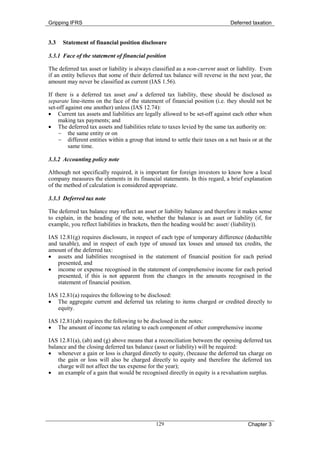
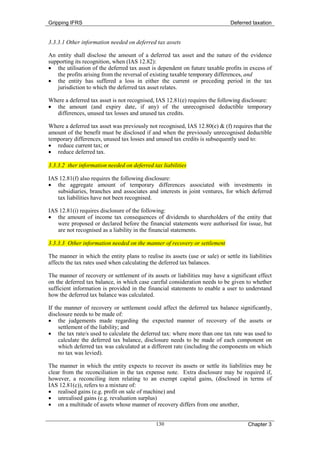
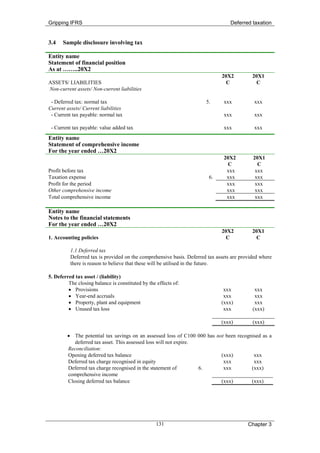
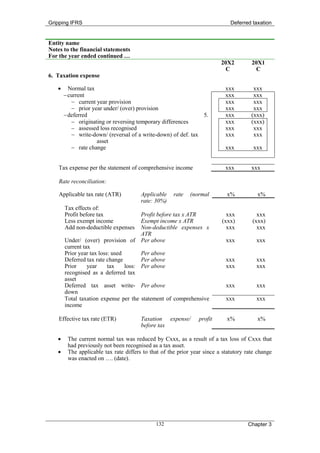
Gripping IFRS                                                        Deferred taxation


                                      Chapter 3
                                 Deferred Taxation

Reference: IAS 12 and SIC 21


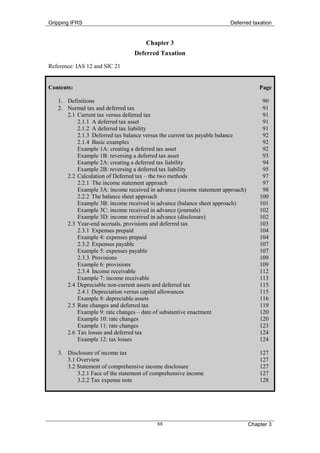
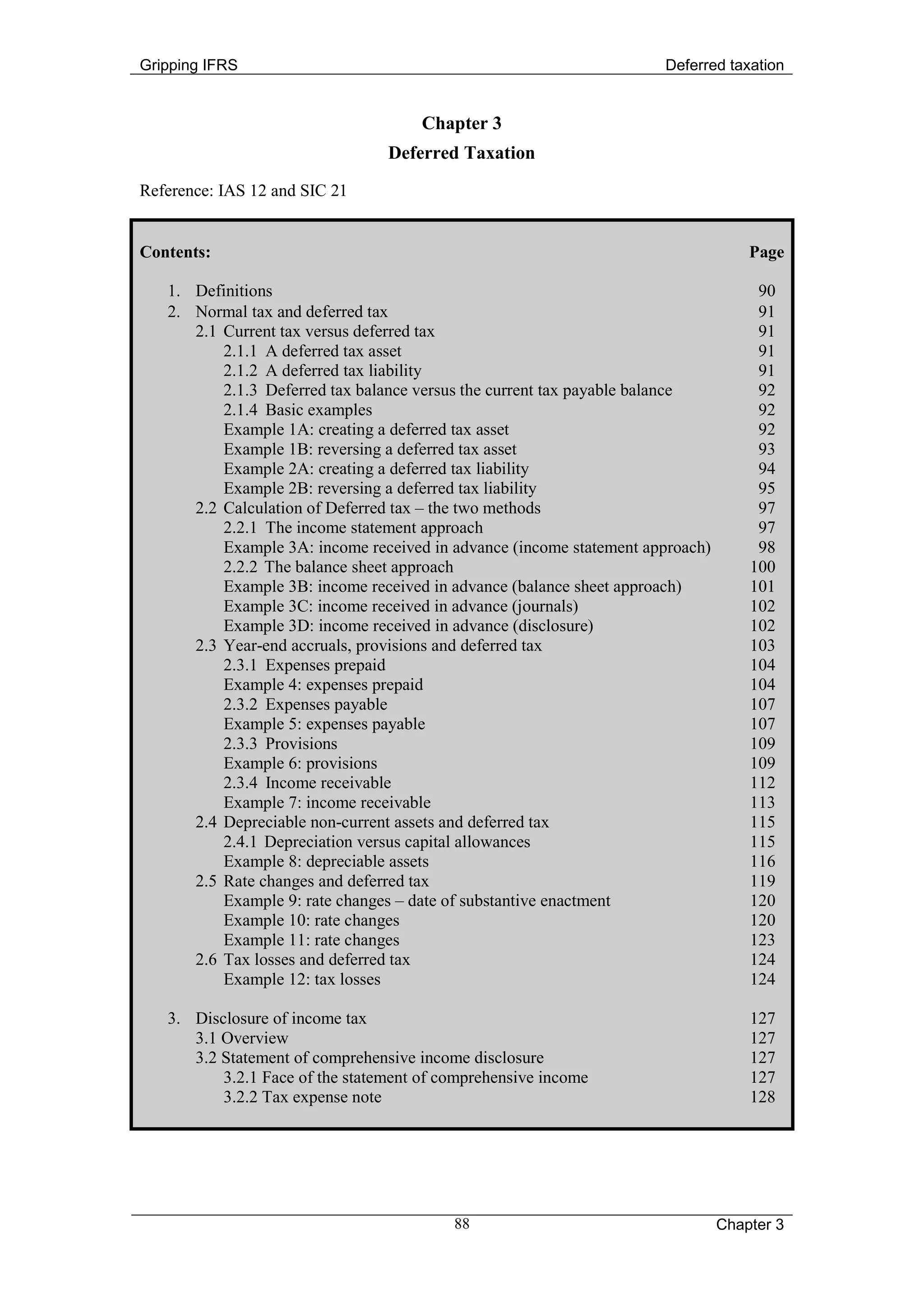
Contents:                                                                          Page

   1. Definitions                                                                   90
   2. Normal tax and deferred tax                                                   91
      2.1 Current tax versus deferred tax                                           91
          2.1.1 A deferred tax asset                                                91
          2.1.2 A deferred tax liability                                            91
          2.1.3 Deferred tax balance versus the current tax payable balance         92
          2.1.4 Basic examples                                                      92
          Example 1A: creating a deferred tax asset                                 92
          Example 1B: reversing a deferred tax asset                                93
          Example 2A: creating a deferred tax liability                             94
          Example 2B: reversing a deferred tax liability                            95
      2.2 Calculation of Deferred tax – the two methods                             97
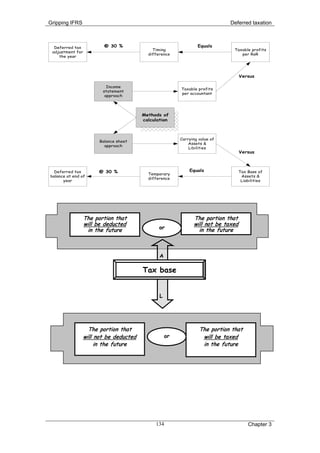
          2.2.1 The income statement approach                                       97
          Example 3A: income received in advance (income statement approach)        98
          2.2.2 The balance sheet approach                                         100
          Example 3B: income received in advance (balance sheet approach)          101
          Example 3C: income received in advance (journals)                        102
          Example 3D: income received in advance (disclosure)                      102
      2.3 Year-end accruals, provisions and deferred tax                           103
          2.3.1 Expenses prepaid                                                   104
          Example 4: expenses prepaid                                              104
          2.3.2 Expenses payable                                                   107
          Example 5: expenses payable                                              107
          2.3.3 Provisions                                                         109
          Example 6: provisions                                                    109
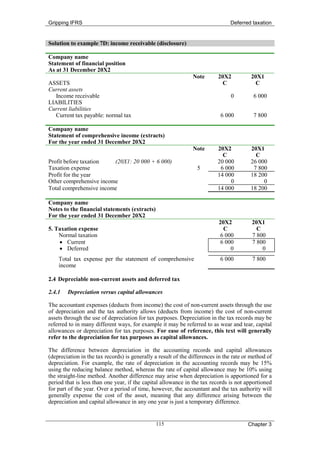
          2.3.4 Income receivable                                                  112
          Example 7: income receivable                                             113
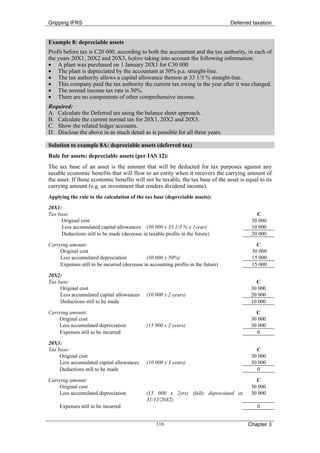
      2.4 Depreciable non-current assets and deferred tax                          115
          2.4.1 Depreciation versus capital allowances                             115
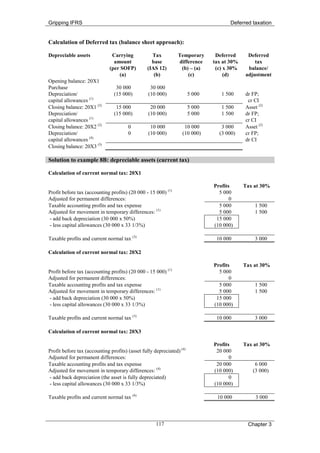
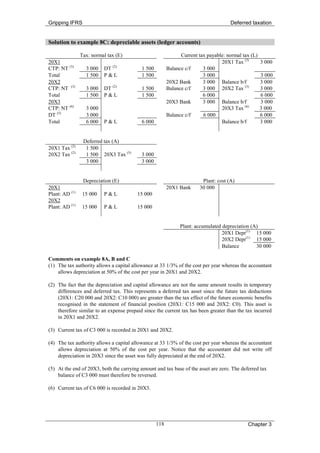
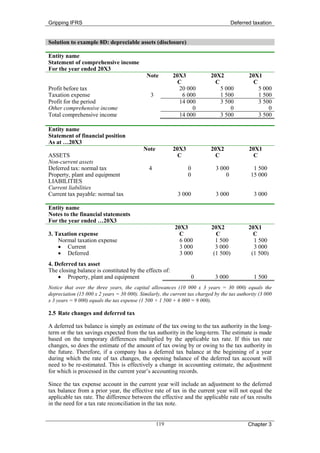
          Example 8: depreciable assets                                            116
      2.5 Rate changes and deferred tax                                            119
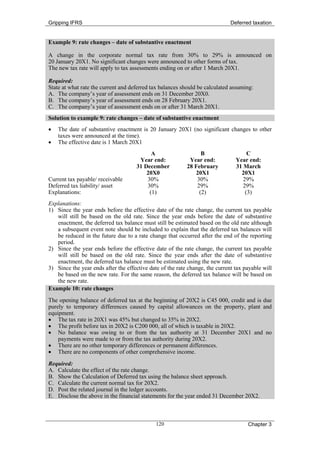
          Example 9: rate changes – date of substantive enactment                  120
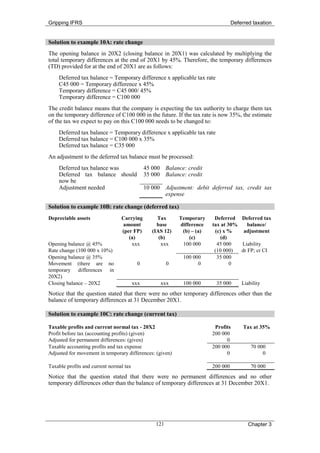
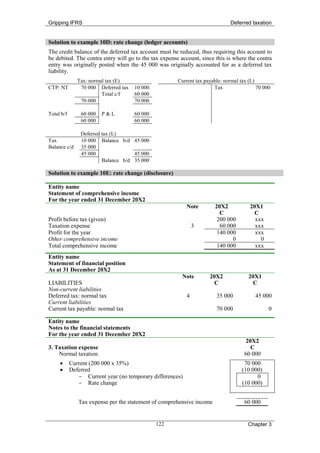
          Example 10: rate changes                                                 120
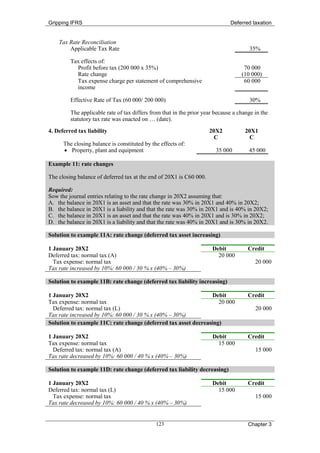
          Example 11: rate changes                                                 123
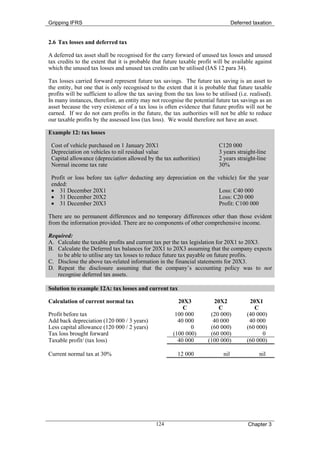
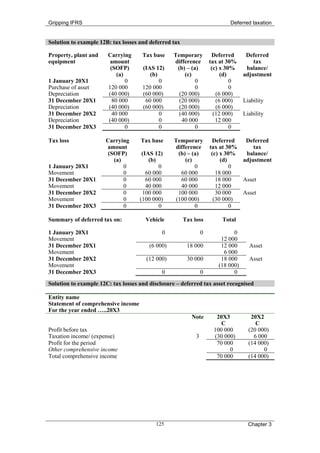
      2.6 Tax losses and deferred tax                                              124
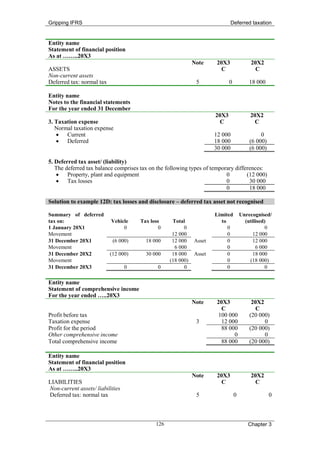
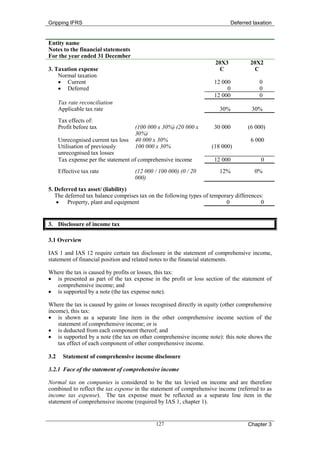
          Example 12: tax losses                                                   124

   3. Disclosure of income tax                                                     127
      3.1 Overview                                                                 127
      3.2 Statement of comprehensive income disclosure                             127
          3.2.1 Face of the statement of comprehensive income                      127
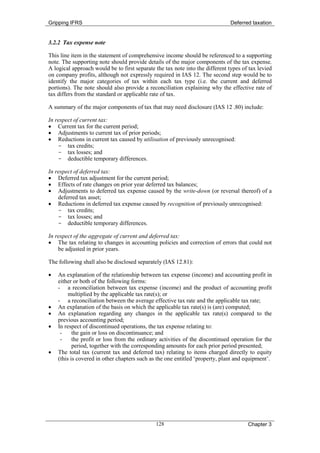
          3.2.2 Tax expense note                                                   128


                                          88                                   Chapter 3
Gripping IFRS                                                        Deferred taxation


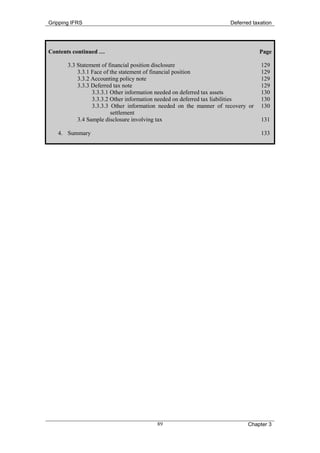
Contents continued …                                                             Page

       3.3 Statement of financial position disclosure                            129
           3.3.1 Face of the statement of financial position                     129
           3.3.2 Accounting policy note                                          129
           3.3.3 Deferred tax note                                               129
                 3.3.3.1 Other information needed on deferred tax assets         130
                 3.3.3.2 Other information needed on deferred tax liabilities    130
                 3.3.3.3 Other information needed on the manner of recovery or   130
                         settlement
           3.4 Sample disclosure involving tax                                   131

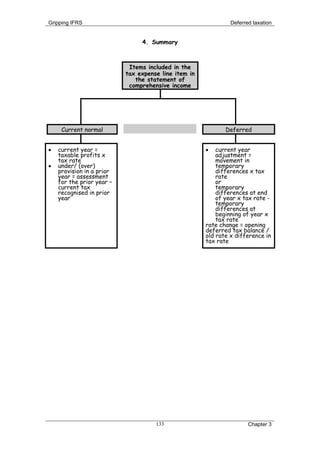
   4. Summary                                                                    133


                                         89                                 Chapter 3
Gripping IFRS                                                                  Deferred taxation


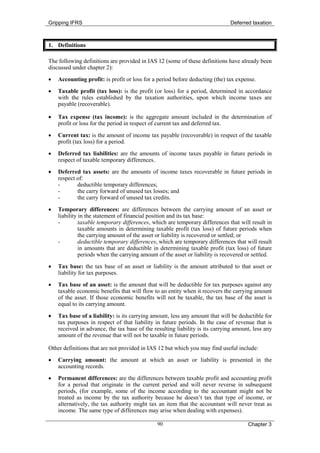
1. Definitions

The following definitions are provided in IAS 12 (some of these definitions have already been
discussed under chapter 2):
•   Accounting profit: is profit or loss for a period before deducting (the) tax expense.
•   Taxable profit (tax loss): is the profit (or loss) for a period, determined in accordance
    with the rules established by the taxation authorities, upon which income taxes are
    payable (recoverable).

•   Tax expense (tax income): is the aggregate amount included in the determination of
    profit or loss for the period in respect of current tax and deferred tax.

•   Current tax: is the amount of income tax payable (recoverable) in respect of the taxable
    profit (tax loss) for a period.
•   Deferred tax liabilities: are the amounts of income taxes payable in future periods in
    respect of taxable temporary differences.
•   Deferred tax assets: are the amounts of income taxes recoverable in future periods in
    respect of:
    -       deductible temporary differences;
    -       the carry forward of unused tax losses; and
    -       the carry forward of unused tax credits.
•   Temporary differences: are differences between the carrying amount of an asset or
    liability in the statement of financial position and its tax base:
    -         taxable temporary differences, which are temporary differences that will result in
              taxable amounts in determining taxable profit (tax loss) of future periods when
              the carrying amount of the asset or liability is recovered or settled; or
    -         deductible temporary differences, which are temporary differences that will result
              in amounts that are deductible in determining taxable profit (tax loss) of future
              periods when the carrying amount of the asset or liability is recovered or settled.
•   Tax base: the tax base of an asset or liability is the amount attributed to that asset or
    liability for tax purposes.
•   Tax base of an asset: is the amount that will be deductible for tax purposes against any
    taxable economic benefits that will flow to an entity when it recovers the carrying amount
    of the asset. If those economic benefits will not be taxable, the tax base of the asset is
    equal to its carrying amount.

•   Tax base of a liability: is its carrying amount, less any amount that will be deductible for
    tax purposes in respect of that liability in future periods. In the case of revenue that is
    received in advance, the tax base of the resulting liability is its carrying amount, less any
    amount of the revenue that will not be taxable in future periods.

Other definitions that are not provided in IAS 12 but which you may find useful include:
•   Carrying amount: the amount at which an asset or liability is presented in the
    accounting records.
•   Permanent differences: are the differences between taxable profit and accounting profit
    for a period that originate in the current period and will never reverse in subsequent
    periods, (for example, some of the income according to the accountant might not be
    treated as income by the tax authority because he doesn’t tax that type of income, or
    alternatively, the tax authority might tax an item that the accountant will never treat as
    income. The same type of differences may arise when dealing with expenses).

                                               90                                     Chapter 3
Gripping IFRS                                                                  Deferred taxation


•   Comprehensive basis: is the term used to describe the method whereby the tax effects of
    all temporary differences are recognised.
•   Applicable or standard tax rate: is the rate of tax, as determined from time to time by
    tax legislation, at which entities pay tax on taxable profits, (a rate of 30% is assumed in
    this text).
•   Effective tax rate: is the taxation expense charge in the statement of comprehensive
    income expressed as a percentage of accounting profits .

2. Normal tax and deferred tax

2.1 Current tax versus deferred tax
As mentioned in the previous chapter, the total normal tax for disclosure purposes is broken
down into two main components:
• current tax; and
• deferred tax.
Current normal tax is the tax charged by the tax authority in the current period on the current
period’s taxable profits. The taxable profits are calculated based on tax legislation (discussed
in the previous chapter). Since this tax legislation is not based strictly on the accrual concept,
differences may arise such as income being included in taxable profits before it is earned!
The total normal tax expense recognised in the statement of comprehensive income is the tax
incurred on the accounting profits. Accounting profits are calculated in accordance with the
international financial reporting standards, which are based on the concept of accrual.
The difference between current normal tax (which is not based on the accrual concept), and
the total normal tax in the statement of comprehensive income (which is based on the accrual
concept), is an adjustment called deferred tax. The deferred tax adjustment is therefore
simply an accrual of tax.
In other words: current normal tax (i.e. the amount charged by the tax authority) is adjusted
upwards or downwards so that the total normal tax in the statement of comprehensive income
is shown at the amount of tax incurred. This results in the creation of a deferred tax asset or
liability.
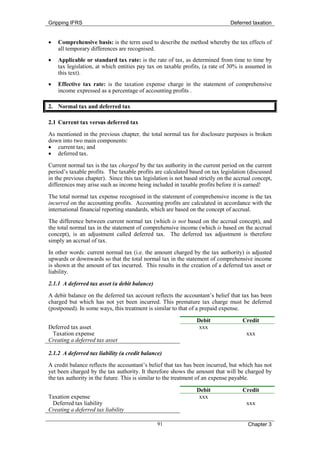
2.1.1 A deferred tax asset (a debit balance)
A debit balance on the deferred tax account reflects the accountant’s belief that tax has been
charged but which has not yet been incurred. This premature tax charge must be deferred
(postponed). In some ways, this treatment is similar to that of a prepaid expense.

                                                                 Debit               Credit
Deferred tax asset                                                xxx
 Taxation expense                                                                     xxx
Creating a deferred tax asset

2.1.2 A deferred tax liability (a credit balance)
A credit balance reflects the accountant’s belief that tax has been incurred, but which has not
yet been charged by the tax authority. It therefore shows the amount that will be charged by
the tax authority in the future. This is similar to the treatment of an expense payable.

                                                                 Debit               Credit
Taxation expense                                                  xxx
 Deferred tax liability                                                               xxx
Creating a deferred tax liability

                                               91                                      Chapter 3
Gripping IFRS                                                                  Deferred taxation


2.1.3 Deferred tax balance versus the current tax payable balance

The balance on the deferred tax account differs from the balance on the current tax payable
account in the following ways:
• the current tax payable account reflects the amount currently owing to or by the tax
    authorities based tax legislation. This account is therefore treated as a current liability or
    asset; whereas
• the deferred tax account reflects the amount that the accountant believes to still be owing
    to or by the tax authorities in the long-term based on the concept of accrual. Since this
    amount is not yet payable according to tax legislation, this account is treated as a non-
    current liability or asset.

2.1.4 Basic examples

Consider the following examples:

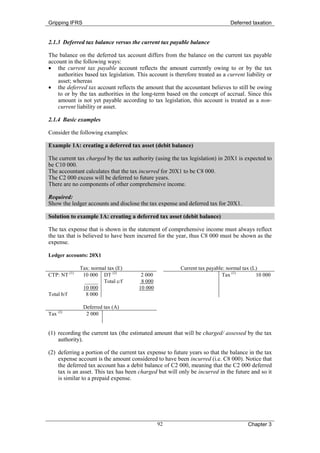
Example 1A: creating a deferred tax asset (debit balance)

The current tax charged by the tax authority (using the tax legislation) in 20X1 is expected to
be C10 000.
The accountant calculates that the tax incurred for 20X1 to be C8 000.
The C2 000 excess will be deferred to future years.
There are no components of other comprehensive income.

Required:
Show the ledger accounts and disclose the tax expense and deferred tax for 20X1.

Solution to example 1A: creating a deferred tax asset (debit balance)

The tax expense that is shown in the statement of comprehensive income must always reflect
the tax that is believed to have been incurred for the year, thus C8 000 must be shown as the
expense.

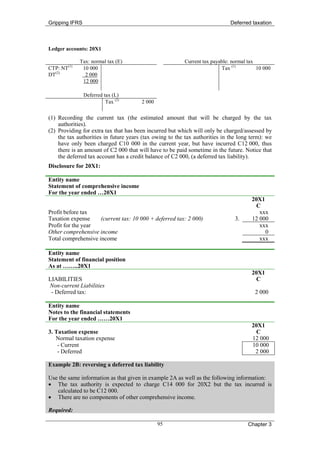
Ledger accounts: 20X1

              Tax: normal tax (E)                        Current tax payable: normal tax (L)
CTP: NT (1)    10 000 DT (2)            2 000                               Tax (1)        10 000
                _____ Total c/f         8 000
               10 000                  10 000
Total b/f       8 000

                Deferred tax (A)
Tax (2)          2 000


(1) recording the current tax (the estimated amount that will be charged/ assessed by the tax
    authority).

(2) deferring a portion of the current tax expense to future years so that the balance in the tax
    expense account is the amount considered to have been incurred (i.e. C8 000). Notice that
    the deferred tax account has a debit balance of C2 000, meaning that the C2 000 deferred
    tax is an asset. This tax has been charged but will only be incurred in the future and so it
    is similar to a prepaid expense.


                                                92                                     Chapter 3
Gripping IFRS                                                                   Deferred taxation


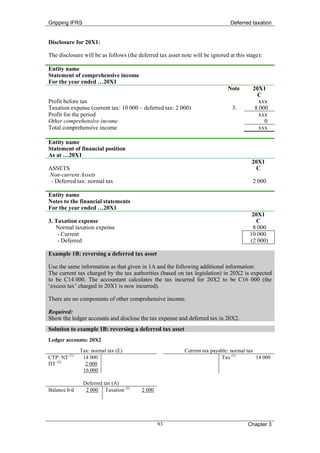
Disclosure for 20X1:

The disclosure will be as follows (the deferred tax asset note will be ignored at this stage):

Entity name
Statement of comprehensive income
For the year ended …20X1
                                                                               Note      20X1
                                                                                           C
Profit before tax                                                                           xxx
Taxation expense (current tax: 10 000 – deferred tax: 2 000)                    3.        8 000
Profit for the period                                                                       xxx
Other comprehensive income                                                                    0
Total comprehensive income                                                                  xxx

Entity name
Statement of financial position
As at …20X1
                                                                                         20X1
ASSETS                                                                                     C
Non-current Assets
 - Deferred tax: normal tax                                                               2 000

Entity name
Notes to the financial statements
For the year ended …20X1
                                                                                         20X1
3. Taxation expense                                                                        C
   Normal taxation expense                                                               8 000
    - Current                                                                           10 000
    - Deferred                                                                          (2 000)

Example 1B: reversing a deferred tax asset

Use the same information as that given in 1A and the following additional information:
The current tax charged by the tax authorities (based on tax legislation) in 20X2 is expected
to be C14 000. The accountant calculates the tax incurred for 20X2 to be C16 000 (the
‘excess tax’ charged in 20X1 is now incurred).

There are no components of other comprehensive income.

Required:
Show the ledger accounts and disclose the tax expense and deferred tax in 20X2.
Solution to example 1B: reversing a deferred tax asset
Ledger accounts: 20X2
              Tax: normal tax (E)                          Current tax payable: normal tax
CTP: NT (1)    14 000                                                      Tax (1)         14 000
DT (2)          2 000
               16 000

                Deferred tax (A)
Balance b/d      2 000 Taxation (2)      2 000


                                                 93                                    Chapter 3
Gripping IFRS                                                                  Deferred taxation


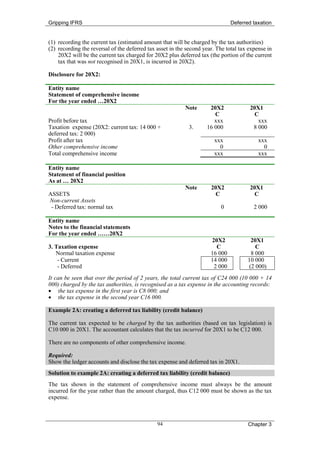
(1) recording the current tax (estimated amount that will be charged by the tax authorities)
(2) recording the reversal of the deferred tax asset in the second year. The total tax expense in
    20X2 will be the current tax charged for 20X2 plus deferred tax (the portion of the current
    tax that was not recognised in 20X1, is incurred in 20X2).

Disclosure for 20X2:

Entity name
Statement of comprehensive income
For the year ended …20X2
                                                           Note      20X2              20X1
                                                                       C                 C
Profit before tax                                                      xxx                xxx
Taxation expense (20X2: current tax: 14 000 +                3.     16 000              8 000
deferred tax: 2 000)
Profit after tax                                                        xxx                xxx
Other comprehensive income                                                0                  0
Total comprehensive income                                              xxx                xxx

Entity name
Statement of financial position
As at … 20X2
                                                           Note       20X2             20X1
ASSETS                                                                  C                C
Non-current Assets
 - Deferred tax: normal tax                                               0              2 000

Entity name
Notes to the financial statements
For the year ended ……20X2
                                                                      20X2             20X1
3. Taxation expense                                                     C                C
   Normal taxation expense                                            16 000           8 000
    - Current                                                         14 000          10 000
    - Deferred                                                         2 000          (2 000)
It can be seen that over the period of 2 years, the total current tax of C24 000 (10 000 + 14
000) charged by the tax authorities, is recognised as a tax expense in the accounting records:
• the tax expense in the first year is C8 000; and
• the tax expense in the second year C16 000.

Example 2A: creating a deferred tax liability (credit balance)

The current tax expected to be charged by the tax authorities (based on tax legislation) is
C10 000 in 20X1. The accountant calculates that the tax incurred for 20X1 to be C12 000.

There are no components of other comprehensive income.

Required:
Show the ledger accounts and disclose the tax expense and deferred tax in 20X1.
Solution to example 2A: creating a deferred tax liability (credit balance)
The tax shown in the statement of comprehensive income must always be the amount
incurred for the year rather than the amount charged, thus C12 000 must be shown as the tax
expense.


                                               94                                     Chapter 3
Gripping IFRS                                                                Deferred taxation


Ledger accounts: 20X1

             Tax: normal tax (E)                         Current tax payable: normal tax
CTP: NT(1)    10 000                                                     Tax (1)         10 000
DT(2)          2 000
              12 000

                Deferred tax (L)
                          Tax (2)      2 000


(1) Recording the current tax (the estimated amount that will be charged by the tax
    authorities).
(2) Providing for extra tax that has been incurred but which will only be charged/assessed by
    the tax authorities in future years (tax owing to the tax authorities in the long term): we
    have only been charged C10 000 in the current year, but have incurred C12 000, thus
    there is an amount of C2 000 that will have to be paid sometime in the future. Notice that
    the deferred tax account has a credit balance of C2 000, (a deferred tax liability).
Disclosure for 20X1:

Entity name
Statement of comprehensive income
For the year ended …20X1
                                                                                      20X1
                                                                                        C
Profit before tax                                                                        xxx
Taxation expense     (current tax: 10 000 + deferred tax: 2 000)               3.     12 000
Profit for the year                                                                      xxx
Other comprehensive income                                                                 0
Total comprehensive income                                                               xxx

Entity name
Statement of financial position
As at ……..20X1
                                                                                      20X1
LIABILITIES                                                                             C
Non-current Liabilities
 - Deferred tax:                                                                        2 000

Entity name
Notes to the financial statements
For the year ended ……20X1
                                                                                      20X1
3. Taxation expense                                                                     C
   Normal taxation expense                                                            12 000
    - Current                                                                         10 000
    - Deferred                                                                         2 000

Example 2B: reversing a deferred tax liability

Use the same information as that given in example 2A as well as the following information:
• The tax authority is expected to charge C14 000 for 20X2 but the tax incurred is
   calculated to be C12 000.
• There are no components of other comprehensive income.

Required:

                                               95                                    Chapter 3
Gripping IFRS                                                                   Deferred taxation


Show the ledger accounts and disclose the tax expense and deferred tax in 20X2.
Solution to example 2B: reversing a deferred tax liability

The deferred tax liability (a non-current liability) will have to be reversed out in 20X2 since
the amount will now form part of the current tax payable liability instead (a current liability).

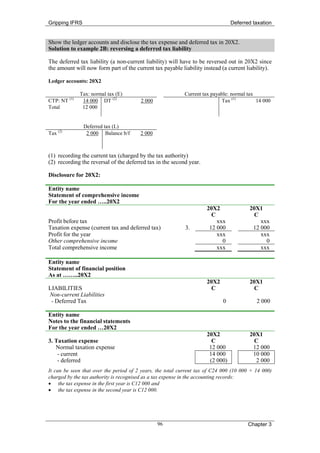
Ledger accounts: 20X2

              Tax: normal tax (E)                          Current tax payable: normal tax
CTP: NT (1)    14 000 DT (2)            2 000                              Tax (1)         14 000
Total          12 000


                Deferred tax (L)
Tax (2)          2 000 Balance b/f      2 000


(1) recording the current tax (charged by the tax authority)
(2) recording the reversal of the deferred tax in the second year.

Disclosure for 20X2:

Entity name
Statement of comprehensive income
For the year ended …..20X2
                                                                     20X2               20X1
                                                                       C                  C
Profit before tax                                                        xxx                xxx
Taxation expense (current tax and deferred tax)             3.        12 000             12 000
Profit for the year                                                      xxx                xxx
Other comprehensive income                                                 0                  0
Total comprehensive income                                               xxx                xxx

Entity name
Statement of financial position
As at ……..20X2
                                                                     20X2               20X1
LIABILITIES                                                            C                  C
Non-current Liabilities
 - Deferred Tax                                                             0              2 000

Entity name
Notes to the financial statements
For the year ended …20X2
                                                                     20X2               20X1
3. Taxation expense                                                    C                  C
   Normal taxation expense                                            12 000             12 000
    - current                                                         14 000             10 000
    - deferred                                                        (2 000)             2 000
It can be seen that over the period of 2 years, the total current tax of C24 000 (10 000 + 14 000)
charged by the tax authority is recognised as a tax expense in the accounting records:
• the tax expense in the first year is C12 000 and
• the tax expense in the second year is C12 000.


                                                96                                     Chapter 3
Gripping IFRS                                                                     Deferred taxation


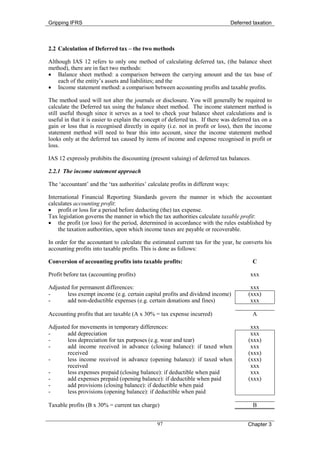
2.2 Calculation of Deferred tax – the two methods

Although IAS 12 refers to only one method of calculating deferred tax, (the balance sheet
method), there are in fact two methods:
• Balance sheet method: a comparison between the carrying amount and the tax base of
    each of the entity’s assets and liabilities; and the
• Income statement method: a comparison between accounting profits and taxable profits.

The method used will not alter the journals or disclosure. You will generally be required to
calculate the Deferred tax using the balance sheet method. The income statement method is
still useful though since it serves as a tool to check your balance sheet calculations and is
useful in that it is easier to explain the concept of deferred tax. If there was deferred tax on a
gain or loss that is recognised directly in equity (i.e. not in profit or loss), then the income
statement method will need to bear this into account, since the income statement method
looks only at the deferred tax caused by items of income and expense recognised in profit or
loss.

IAS 12 expressly prohibits the discounting (present valuing) of deferred tax balances.

2.2.1 The income statement approach

The ‘accountant’ and the ‘tax authorities’ calculate profits in different ways:

International Financial Reporting Standards govern the manner in which the accountant
calculates accounting profit:
• profit or loss for a period before deducting (the) tax expense.
Tax legislation governs the manner in which the tax authorities calculate taxable profit:
• the profit (or loss) for the period, determined in accordance with the rules established by
    the taxation authorities, upon which income taxes are payable or recoverable.

In order for the accountant to calculate the estimated current tax for the year, he converts his
accounting profits into taxable profits. This is done as follows:

Conversion of accounting profits into taxable profits:                                     C

Profit before tax (accounting profits)                                                    xxx

Adjusted for permanent differences:                                                       xxx
-      less exempt income (e.g. certain capital profits and dividend income)             (xxx)
-      add non-deductible expenses (e.g. certain donations and fines)                     xxx

Accounting profits that are taxable (A x 30% = tax expense incurred)                       A

Adjusted for movements in temporary differences:                                          xxx
-      add depreciation                                                                   xxx
-      less depreciation for tax purposes (e.g. wear and tear)                           (xxx)
-      add income received in advance (closing balance): if taxed when                    xxx
       received                                                                          (xxx)
-      less income received in advance (opening balance): if taxed when                  (xxx)
       received                                                                           xxx
-      less expenses prepaid (closing balance): if deductible when paid                   xxx
-      add expenses prepaid (opening balance): if deductible when paid                   (xxx)
-      add provisions (closing balance): if deductible when paid
-      less provisions (opening balance): if deductible when paid

Taxable profits (B x 30% = current tax charge)                                             B


                                               97                                        Chapter 3
Gripping IFRS                                                              Deferred taxation


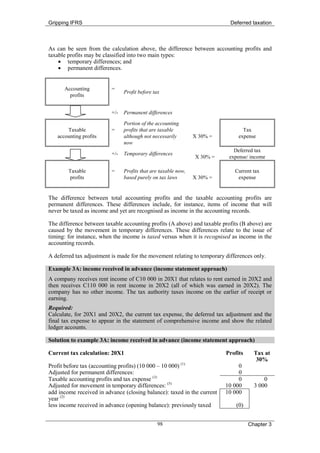
As can be seen from the calculation above, the difference between accounting profits and
taxable profits may be classified into two main types:
    • temporary differences; and
    • permanent differences.


      Accounting          =
                                Profit before tax
        profits


                          +/-   Permanent differences

                                Portion of the accounting
       Taxable            =     profits that are taxable                         Tax
   accounting profits           although not necessarily        X 30% =        expense
                                now
                                                                             Deferred tax
                          +/-   Temporary differences
                                                                X 30% =    expense/ income

        Taxable           =     Profits that are taxable now,                Current tax
        profits                 based purely on tax laws        X 30% =       expense


The difference between total accounting profits and the taxable accounting profits are
permanent differences. These differences include, for instance, items of income that will
never be taxed as income and yet are recognised as income in the accounting records.

The difference between taxable accounting profits (A above) and taxable profits (B above) are
caused by the movement in temporary differences. These differences relate to the issue of
timing: for instance, when the income is taxed versus when it is recognised as income in the
accounting records.

A deferred tax adjustment is made for the movement relating to temporary differences only.

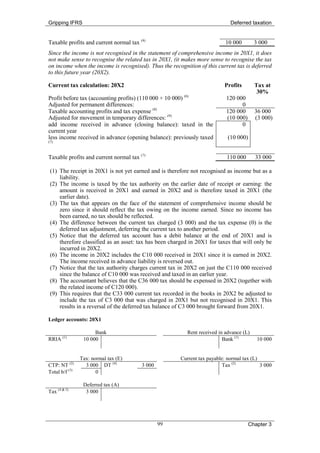
Example 3A: income received in advance (income statement approach)
A company receives rent income of C10 000 in 20X1 that relates to rent earned in 20X2 and
then receives C110 000 in rent income in 20X2 (all of which was earned in 20X2). The
company has no other income. The tax authority taxes income on the earlier of receipt or
earning.
Required:
Calculate, for 20X1 and 20X2, the current tax expense, the deferred tax adjustment and the
final tax expense to appear in the statement of comprehensive income and show the related
ledger accounts.

Solution to example 3A: income received in advance (income statement approach)

Current tax calculation: 20X1                                             Profits     Tax at
                                                                                       30%
Profit before tax (accounting profits) (10 000 – 10 000) (1)                   0
Adjusted for permanent differences:                                            0
Taxable accounting profits and tax expense (3)                                 0          0
Adjusted for movement in temporary differences: (5)                       10 000      3 000
add income received in advance (closing balance): taxed in the current    10 000
year (2)
less income received in advance (opening balance): previously taxed           (0)


                                                98                                  Chapter 3
Gripping IFRS                                                                 Deferred taxation


Taxable profits and current normal tax (4)                                  10 000        3 000
Since the income is not recognised in the statement of comprehensive income in 20X1, it does
not make sense to recognise the related tax in 20X1, (it makes more sense to recognise the tax
on income when the income is recognised). Thus the recognition of this current tax is deferred
to this future year (20X2).

Current tax calculation: 20X2                                              Profits        Tax at
                                                                                           30%
Profit before tax (accounting profits) (110 000 + 10 000) (6)               120 000
Adjusted for permanent differences:                                               0
Taxable accounting profits and tax expense (8)                              120 000       36 000
Adjusted for movement in temporary differences: (9)                         (10 000)      (3 000)
add income received in advance (closing balance): taxed in the                    0
current year
less income received in advance (opening balance): previously taxed          (10 000)
(7)


Taxable profits and current normal tax (7)                                  110 000       33 000

 (1) The receipt in 20X1 is not yet earned and is therefore not recognised as income but as a
     liability.
 (2) The income is taxed by the tax authority on the earlier date of receipt or earning: the
     amount is received in 20X1 and earned in 20X2 and is therefore taxed in 20X1 (the
     earlier date).
 (3) The tax that appears on the face of the statement of comprehensive income should be
     zero since it should reflect the tax owing on the income earned. Since no income has
     been earned, no tax should be reflected.
 (4) The difference between the current tax charged (3 000) and the tax expense (0) is the
     deferred tax adjustment, deferring the current tax to another period.
 (5) Notice that the deferred tax account has a debit balance at the end of 20X1 and is
     therefore classified as an asset: tax has been charged in 20X1 for taxes that will only be
     incurred in 20X2.
 (6) The income in 20X2 includes the C10 000 received in 20X1 since it is earned in 20X2.
     The income received in advance liability is reversed out.
 (7) Notice that the tax authority charges current tax in 20X2 on just the C110 000 received
     since the balance of C10 000 was received and taxed in an earlier year.
 (8) The accountant believes that the C36 000 tax should be expensed in 20X2 (together with
     the related income of C120 000).
 (9) This requires that the C33 000 current tax recorded in the books in 20X2 be adjusted to
     include the tax of C3 000 that was charged in 20X1 but not recognised in 20X1. This
     results in a reversal of the deferred tax balance of C3 000 brought forward from 20X1.

Ledger accounts: 20X1

                      Bank                                 Rent received in advance (L)
RRIA (1)         10 000                                                    Bank (1)        10 000


                Tax: normal tax (E)                     Current tax payable: normal tax (L)
CTP: NT (2)       3 000 DT (4)          3 000                              Tax (2)          3 000
Total b/f (3)          0

                 Deferred tax (A)
Tax (4 & 5)       3 000


                                                99                                      Chapter 3
Gripping IFRS                                                                          Deferred taxation


Ledger accounts: 20X2
                   Bank                                             Rent received in advance (L)
Rent        110 000                                      Rent (6)         10 000 Balance b/f        10 000


              Tax: normal tax (E)                               Current tax payable: normal tax (L)
CTP:NT (7)     33 000                                                              Balance b/f      3 000
DT (9)          3 000                                                              Tax (7)         33 000
Total (8)      36 000


                 Deferred tax                                                 Rent (I)
Balance b/f     3 000 Tax (9)              3 000                                   RRIA (6)         10 000
                                                                                   Bank            110 000
                                                                                                   120 000

2.2.2   The balance sheet approach

When calculating deferred tax using the balance sheet approach, the carrying amount of the
assets and liabilities are compared with the tax bases of these assets and liabilities. Any
difference between the carrying amount and the tax base of an asset or liability is termed a
‘temporary difference’:
• The carrying amounts are the balances of the assets and liabilities as recognised in the
    statement of financial position based on International Financial Reporting Standards.
• The tax bases are the balances of the assets and liabilities, as they would appear in a
    statement of financial position drawn up based on tax law (please read these definitions
    again – you will find them at the beginning of this chapter).

The total temporary differences multiplied by the tax rate will give:
• the deferred tax balance in the statement of financial position.

The difference between the opening and closing deferred tax balance in the statement of
financial position will give you:
• the deferred tax journal adjustment.


Carrying amount:                      Temporary difference                                 Tax base:
                                             X 30% =
Opening balance               Deferred tax balance: beginning of year                  Opening balance
                                                Movement:
                                                Deferred tax
                                                  journal
                                                adjustment


Carrying amount:                         Temporary difference                              Tax base:
                                                X 30% =
 Closing balance                    Deferred tax balance: end of year                   Closing balance


                                                   100                                         Chapter 3
Gripping IFRS                                                                         Deferred taxation


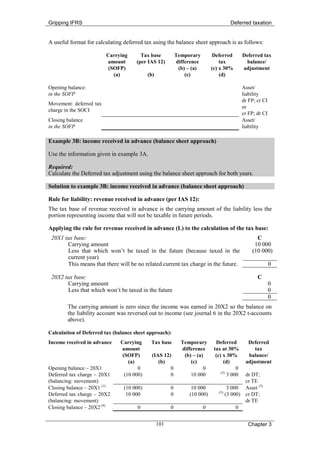
A useful format for calculating deferred tax using the balance sheet approach is as follows:

                         Carrying       Tax base            Temporary        Deferred         Deferred tax
                         amount       (per IAS 12)          difference           tax           balance/
                          (SOFP)                             (b) – (a)       (c) x 30%        adjustment
                            (a)             (b)                 (c)              (d)

Opening balance:                                                                              Asset/
in the SOFP                                                                                   liability
                                                                                              dr FP; cr CI
Movement: deferred tax
                                                                                              or
charge in the SOCI
                                                                                              cr FP; dr CI
Closing balance                                                                               Asset/
in the SOFP                                                                                   liability

Example 3B: income received in advance (balance sheet approach)

Use the information given in example 3A.

Required:
Calculate the Deferred tax adjustment using the balance sheet approach for both years.

Solution to example 3B: income received in advance (balance sheet approach)

Rule for liability: revenue received in advance (per IAS 12):
The tax base of revenue received in advance is the carrying amount of the liability less the
portion representing income that will not be taxable in future periods.

Applying the rule for revenue received in advance (L) to the calculation of the tax base:
 20X1 tax base:                                                                                     C
       Carrying amount                                                                             10 000
       Less that which won’t be taxed in the future (because taxed in the                         (10 000)
       current year)
       This means that there will be no related current tax charge in the future.                            0

 20X2 tax base:                                                                                      C
       Carrying amount                                                                                       0
       Less that which won’t be taxed in the future                                                          0
                                                                                                             0
        The carrying amount is zero since the income was earned in 20X2 so the balance on
        the liability account was reversed out to income (see journal 6 in the 20X2 t-accounts
        above).

Calculation of Deferred tax (balance sheet approach):
Income received in advance     Carrying      Tax base         Temporary        Deferred         Deferred
                               amount                         difference      tax at 30%           tax
                                (SOFP)        (IAS 12)         (b) – (a)       (c) x 30%        balance/
                                   (a)           (b)              (c)               (d)        adjustment
Opening balance – 20X1                 0              0                 0                 0
                                                                                  (3)
Deferred tax charge – 20X1       (10 000)             0           10 000              3 000 dr DT;
(balancing: movement)                                                                       cr TE
Closing balance – 20X1 (1)      (10 000)                0         10 000             3 000 Asset (2)
                                                                                (5)
Deferred tax charge – 20X2       10 000                 0        (10 000)           (3 000) cr DT;
(balancing: movement)                                                                       dr TE
Closing balance – 20X2 (4)            0                 0                0               0


                                                  101                                           Chapter 3
Gripping IFRS                                                                  Deferred taxation


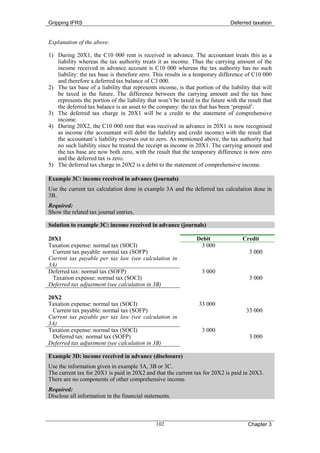
Explanation of the above:

1) During 20X1, the C10 000 rent is received in advance. The accountant treats this as a
   liability whereas the tax authority treats it as income. Thus the carrying amount of the
   income received in advance account is C10 000 whereas the tax authority has no such
   liability: the tax base is therefore zero. This results in a temporary difference of C10 000
   and therefore a deferred tax balance of C3 000.
2) The tax base of a liability that represents income, is that portion of the liability that will
   be taxed in the future. The difference between the carrying amount and the tax base
   represents the portion of the liability that won’t be taxed in the future with the result that
   the deferred tax balance is an asset to the company: the tax that has been ‘prepaid’.
3) The deferred tax charge in 20X1 will be a credit to the statement of comprehensive
   income.
4) During 20X2, the C10 000 rent that was received in advance in 20X1 is now recognised
   as income (the accountant will debit the liability and credit income) with the result that
   the accountant’s liability reverses out to zero. As mentioned above, the tax authority had
   no such liability since he treated the receipt as income in 20X1. The carrying amount and
   the tax base are now both zero, with the result that the temporary difference is now zero
   and the deferred tax is zero.
5) The deferred tax charge in 20X2 is a debit to the statement of comprehensive income.

Example 3C: income received in advance (journals)
Use the current tax calculation done in example 3A and the deferred tax calculation done in
3B.
Required:
Show the related tax journal entries.

Solution to example 3C: income received in advance (journals)

20X1                                                            Debit               Credit
Taxation expense: normal tax (SOCI)                              3 000
  Current tax payable: normal tax (SOFP)                                               3 000
Current tax payable per tax law (see calculation in
3A)
Deferred tax: normal tax (SOFP)                                   3 000
  Taxation expense: normal tax (SOCI)                                                  3 000
Deferred tax adjustment (see calculation in 3B)

20X2
Taxation expense: normal tax (SOCI)                              33 000
  Current tax payable: normal tax (SOFP)                                             33 000
Current tax payable per tax law (see calculation in
3A)
Taxation expense: normal tax (SOCI)                               3 000
  Deferred tax: normal tax (SOFP)                                                      3 000
Deferred tax adjustment (see calculation in 3B)

Example 3D: income received in advance (disclosure)
Use the information given in example 3A, 3B or 3C.
The current tax for 20X1 is paid in 20X2 and that the current tax for 20X2 is paid in 20X3.
There are no components of other comprehensive income.
Required:
Disclose all information in the financial statements.


                                              102                                     Chapter 3
Gripping IFRS                                                                    Deferred taxation


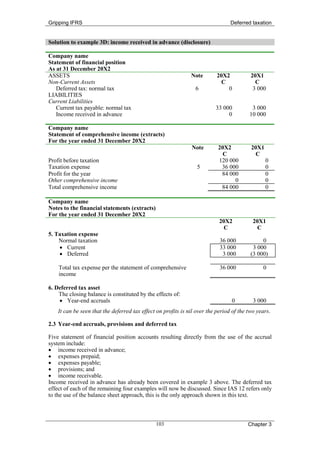
Solution to example 3D: income received in advance (disclosure)

Company name
Statement of financial position
As at 31 December 20X2
ASSETS                                                         Note        20X2           20X1
Non-Current Assets                                                           C              C
   Deferred tax: normal tax                                      6             0           3 000
LIABILITIES
Current Liabilities
   Current tax payable: normal tax                                        33 000          3 000
   Income received in advance                                                  0         10 000

Company name
Statement of comprehensive income (extracts)
For the year ended 31 December 20X2
                                                               Note        20X2           20X1
                                                                             C              C
Profit before taxation                                                     120 000               0
Taxation expense                                                  5         36 000               0
Profit for the year                                                         84 000               0
Other comprehensive income                                                       0               0
Total comprehensive income                                                  84 000               0

Company name
Notes to the financial statements (extracts)
For the year ended 31 December 20X2
                                                                            20X2           20X1
                                                                              C              C
5. Taxation expense
    Normal taxation                                                         36 000             0
    • Current                                                               33 000         3 000
    • Deferred                                                               3 000        (3 000)

    Total tax expense per the statement of comprehensive                    36 000             0
    income

6. Deferred tax asset
    The closing balance is constituted by the effects of:
    • Year-end accruals                                                          0         3 000
    It can be seen that the deferred tax effect on profits is nil over the period of the two years.

2.3 Year-end accruals, provisions and deferred tax

Five statement of financial position accounts resulting directly from the use of the accrual
system include:
• income received in advance;
• expenses prepaid;
• expenses payable;
• provisions; and
• income receivable.
Income received in advance has already been covered in example 3 above. The deferred tax
effect of each of the remaining four examples will now be discussed. Since IAS 12 refers only
to the use of the balance sheet approach, this is the only approach shown in this text.


                                               103                                       Chapter 3
Gripping IFRS                                                                       Deferred taxation


2.3.1   Expenses prepaid

Remember that, although the tax authority normally allows a deduction of expenses when the
expenses are incurred, he may, however, allow a deduction of a prepaid expense depending
on criteria in the tax legislation. If this happens, deferred tax will result.

Example 4: expenses prepaid

Profit before tax is C20 000 in 20X1 and in 20X2, according to the accountant and the tax
authority, before taking into account the following information:
• An amount of C8 000 in respect of electricity for January 20X2 is paid in December 20X1.
• The Receiver allows the payment of C8 000 as a deduction against taxable profits in 20X1.
• The company paid the current tax owing to the tax authorities for 20X1, in 20X2.
• There are no permanent differences, no other temporary differences and no taxes other
   than normal tax at 30%.
• There are no components of other comprehensive income.

Required:
A. Calculate the Deferred tax for 20X1 and 20X2 using the balance sheet approach.
B. Calculate the current normal tax for 20X1 and 20X2.
C. Show the related journal entries in ledger account format.
D. Disclose the tax adjustments for the 20X2 financial year.

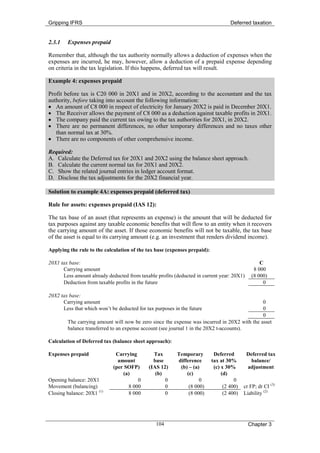
Solution to example 4A: expenses prepaid (deferred tax)

Rule for assets: expenses prepaid (IAS 12):

The tax base of an asset (that represents an expense) is the amount that will be deducted for
tax purposes against any taxable economic benefits that will flow to an entity when it recovers
the carrying amount of the asset. If those economic benefits will not be taxable, the tax base
of the asset is equal to its carrying amount (e.g. an investment that renders dividend income).

Applying the rule to the calculation of the tax base (expenses prepaid):

20X1 tax base:                                                                                    C
      Carrying amount                                                                          8 000
      Less amount already deducted from taxable profits (deducted in current year: 20X1)      (8 000)
      Deduction from taxable profits in the future                                                 0

20X2 tax base:
      Carrying amount                                                                         0
      Less that which won’t be deducted for tax purposes in the future                        0
                                                                                              0
        The carrying amount will now be zero since the expense was incurred in 20X2 with the asset
        balance transferred to an expense account (see journal 1 in the 20X2 t-accounts).

Calculation of Deferred tax (balance sheet approach):

Expenses prepaid              Carrying         Tax        Temporary         Deferred        Deferred tax
                               amount          base       difference       tax at 30%        balance/
                             (per SOFP)      (IAS 12)      (b) – (a)        (c) x 30%       adjustment
                                 (a)            (b)           (c)               (d)
Opening balance: 20X1                  0            0               0                 0
Movement (balancing)               8 000            0          (8 000)           (2 400)   cr FP; dr CI (3)
Closing balance: 20X1 (1)          8 000            0          (8 000)           (2 400)   Liability (2)


                                                 104                                         Chapter 3
Gripping IFRS                                                                          Deferred taxation


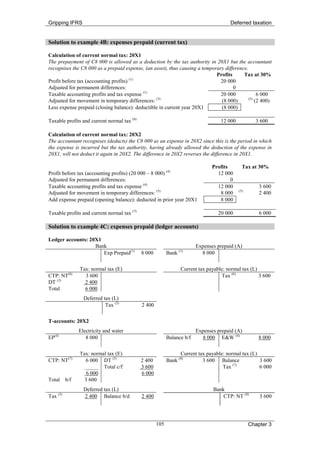
Solution to example 4B: expenses prepaid (current tax)

Calculation of current normal tax: 20X1
The prepayment of C8 000 is allowed as a deduction by the tax authority in 20X1 but the accountant
recognises the C8 000 as a prepaid expense, (an asset), thus causing a temporary difference.
                                                                             Profits      Tax at 30%
Profit before tax (accounting profits) (1)                                     20 000
Adjusted for permanent differences:                                                  0
Taxable accounting profits and tax expense (1)                                 20 000             6 000
Adjusted for movement in temporary differences: (3)                            (8 000)       (3)
                                                                                                 (2 400)
Less expense prepaid (closing balance): deductible in current year 20X1        (8 000)

Taxable profits and current normal tax (6)                                         12 000           3 600

Calculation of current normal tax: 20X2
The accountant recognises (deducts) the C8 000 as an expense in 20X2 since this is the period in which
the expense is incurred but the tax authority, having already allowed the deduction of the expense in
20X1, will not deduct it again in 20X2. The difference in 20X2 reverses the difference in 20X1.

                                                                                Profits       Tax at 30%
Profit before tax (accounting profits) (20 000 – 8 000) (4)                       12 000
Adjusted for permanent differences:                                                     0
Taxable accounting profits and tax expense (4)                                    12 000              3 600
Adjusted for movement in temporary differences: (5)                                8 000    (5)
                                                                                                      2 400
Add expense prepaid (opening balance): deducted in prior year 20X1                 8 000

Taxable profits and current normal tax (7)                                        20 000              6 000

Solution to example 4C: expenses prepaid (ledger accounts)

Ledger accounts: 20X1
                   Bank                                                  Expenses prepaid (A)
                      Exp Prepaid(1)         8 000         Bank (1)        8 000


              Tax: normal tax (E)                                Current tax payable: normal tax (L)
CTP: NT(6)      3 600                                                               Tax (6)          3 600
DT (3)          2 400
Total           6 000
                Deferred tax (L)
                          Tax (3)            2 400


T-accounts: 20X2
              Electricity and water                                      Expenses prepaid (A)
EP(4)            8 000                                     Balance b/f      8 000 E&W (4)             8 000


              Tax: normal tax (E)                                Current tax payable: normal tax (L)
CTP: NT(7)      6 000 DT (5)                 2 400         Bank (8)        3 600 Balance             3 600
                _____ Total c/f              3 600                                  Tax (7)          6 000
                 6 000                       6 000
Total b/f       3 600
                Deferred tax (L)                                                Bank
Tax (5)         2 400 Balance b/d            2 400                                  CTP: NT (8)       3 600


                                                     105                                          Chapter 3
Gripping IFRS                                                                   Deferred taxation


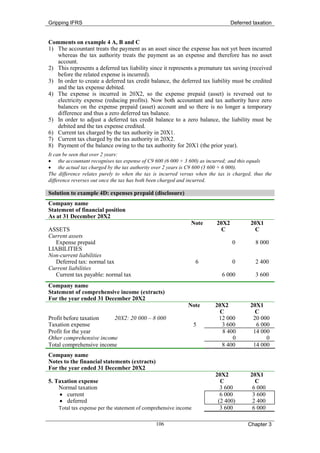
Comments on example 4 A, B and C
1) The accountant treats the payment as an asset since the expense has not yet been incurred
   whereas the tax authority treats the payment as an expense and therefore has no asset
   account.
2) This represents a deferred tax liability since it represents a premature tax saving (received
   before the related expense is incurred).
3) In order to create a deferred tax credit balance, the deferred tax liability must be credited
   and the tax expense debited.
4) The expense is incurred in 20X2, so the expense prepaid (asset) is reversed out to
   electricity expense (reducing profits). Now both accountant and tax authority have zero
   balances on the expense prepaid (asset) account and so there is no longer a temporary
   difference and thus a zero deferred tax balance.
5) In order to adjust a deferred tax credit balance to a zero balance, the liability must be
   debited and the tax expense credited.
6) Current tax charged by the tax authority in 20X1.
7) Current tax charged by the tax authority in 20X2.
8) Payment of the balance owing to the tax authority for 20X1 (the prior year).
It can be seen that over 2 years:
• the accountant recognises tax expense of C9 600 (6 000 + 3 600) as incurred; and this equals
• the actual tax charged by the tax authority over 2 years is C9 600 (3 600 + 6 000).
The difference relates purely to when the tax is incurred versus when the tax is charged, thus the
difference reverses out once the tax has both been charged and incurred.

Solution to example 4D: expenses prepaid (disclosure)
Company name
Statement of financial position
As at 31 December 20X2
                                                              Note       20X2           20X1
ASSETS                                                                     C              C
Current assets
  Expense prepaid                                                               0         8 000
LIABILITIES
Non-current liabilities
  Deferred tax: normal tax                                        6             0         2 400
Current liabilities
  Current tax payable: normal tax                                           6 000         3 600
Company name
Statement of comprehensive income (extracts)
For the year ended 31 December 20X2
                                                             Note        20X2           20X1
                                                                           C              C
Profit before taxation   20X2: 20 000 – 8 000                             12 000         20 000
Taxation expense                                                  5         3 600         6 000
Profit for the year                                                         8 400        14 000
Other comprehensive income                                                      0             0
Total comprehensive income                                                  8 400        14 000
Company name
Notes to the financial statements (extracts)
For the year ended 31 December 20X2
                                                                         20X2           20X1
5. Taxation expense                                                        C              C
    Normal taxation                                                        3 600         6 000
    • current                                                              6 000         3 600
    • deferred                                                            (2 400)        2 400
    Total tax expense per the statement of comprehensive income            3 600         6 000

                                               106                                     Chapter 3
Gripping IFRS                                                                     Deferred taxation


6. Deferred tax asset/ (liability)
    The closing balance is constituted by the effects of:
    • Year-end accruals                                                           0       (2 400)
    It can be seen that the deferred tax effect on profits is nil over the period of the two years.

2.3.2    Expenses payable

The tax authority generally allows expenses to be deducted when they have been incurred
irrespective of whether or not the amount incurred has been paid. This is the accrual system
and therefore there will be no deferred tax on an expense payable balance.

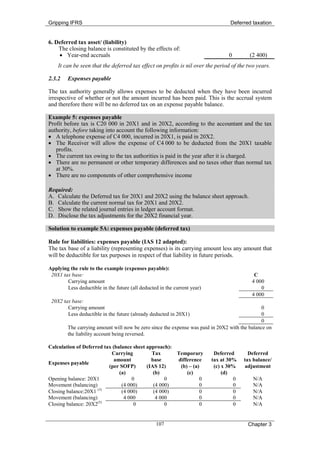
Example 5: expenses payable
Profit before tax is C20 000 in 20X1 and in 20X2, according to the accountant and the tax
authority, before taking into account the following information:
• A telephone expense of C4 000, incurred in 20X1, is paid in 20X2.
• The Receiver will allow the expense of C4 000 to be deducted from the 20X1 taxable
   profits.
• The current tax owing to the tax authorities is paid in the year after it is charged.
• There are no permanent or other temporary differences and no taxes other than normal tax
   at 30%.
• There are no components of other comprehensive income

Required:
A. Calculate the Deferred tax for 20X1 and 20X2 using the balance sheet approach.
B. Calculate the current normal tax for 20X1 and 20X2.
C. Show the related journal entries in ledger account format.
D. Disclose the tax adjustments for the 20X2 financial year.

Solution to example 5A: expenses payable (deferred tax)

Rule for liabilities: expenses payable (IAS 12 adapted):
The tax base of a liability (representing expenses) is its carrying amount less any amount that
will be deductible for tax purposes in respect of that liability in future periods.

Applying the rule to the example (expenses payable):
 20X1 tax base:                                                                             C
        Carrying amount                                                                    4 000
        Less deductible in the future (all deducted in the current year)                       0
                                                                                           4 000
 20X2 tax base:
        Carrying amount                                                                         0
        Less deductible in the future (already deducted in 20X1)                                0
                                                                                                0
         The carrying amount will now be zero since the expense was paid in 20X2 with the balance on
         the liability account being reversed.

Calculation of Deferred tax (balance sheet approach):
                           Carrying          Tax      Temporary             Deferred      Deferred
                             amount          base     difference           tax at 30%   tax balance/
Expenses payable
                          (per SOFP)       (IAS 12)    (b) – (a)            (c) x 30%   adjustment
                               (a)            (b)         (c)                   (d)
Opening balance: 20X1                0             0            0                   0      N/A
Movement (balancing)            (4 000)       (4 000)           0                   0      N/A
Closing balance:20X1 (3)        (4 000)       (4 000)           0                   0      N/A
Movement (balancing)             4 000         4 000            0                   0      N/A
Closing balance: 20X2(5)              0            0            0                   0      N/A


                                                  107                                    Chapter 3
Gripping IFRS                                                                           Deferred taxation


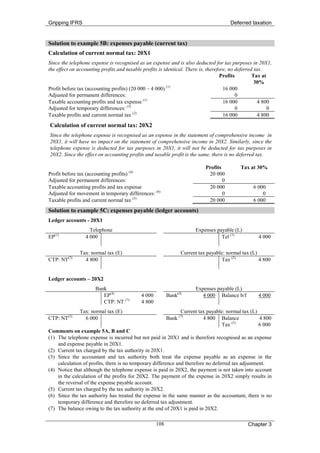
Solution to example 5B: expenses payable (current tax)
Calculation of current normal tax: 20X1
Since the telephone expense is recognised as an expense and is also deducted for tax purposes in 20X1,
the effect on accounting profits and taxable profits is identical. There is, therefore, no deferred tax.
                                                                                    Profits        Tax at
                                                                                                    30%
Profit before tax (accounting profits) (20 000 – 4 000) (1)                          16 000
Adjusted for permanent differences:                                                         0
                                             (1)
Taxable accounting profits and tax expense                                           16 000           4 800
Adjusted for temporary differences: (3)                                                     0             0
Taxable profits and current normal tax (2)                                           16 000           4 800
Calculation of current normal tax: 20X2
Since the telephone expense is recognised as an expense in the statement of comprehensive income in
20X1, it will have no impact on the statement of comprehensive income in 20X2. Similarly, since the
telephone expense is deducted for tax purposes in 20X1, it will not be deducted for tax purposes in
20X2. Since the effect on accounting profits and taxable profit is the same, there is no deferred tax.

                                                                            Profits         Tax at 30%
Profit before tax (accounting profits) (4)                                   20 000
Adjusted for permanent differences:                                                 0
Taxable accounting profits and tax expense                                   20 000               6 000
Adjusted for movement in temporary differences: (6)                                 0                 0
Taxable profits and current normal tax (5)                                   20 000               6 000
Solution to example 5C: expenses payable (ledger accounts)
Ledger accounts - 20X1
                   Telephone                                           Expenses payable (L)
EP(1)            4 000                                                            Tel (1)           4 000


               Tax: normal tax (E)                               Current tax payable: normal tax (L)
CTP: NT(2)       4 800                                                              Tax (2)          4 800


Ledger accounts – 20X2
                      Bank                                             Expenses payable (L)
                         EP(4)              4 000         Bank (4)
                                                                          4 000 Balance b/f         4 000
                         CTP: NT (7)        4 800
               Tax: normal tax (E)                              Current tax payable: normal tax (L)
CTP: NT(5)       6 000                                    Bank (7)        4 800 Balance             4 800
                                                                                   Tax (5)          6 000
Comments on example 5A, B and C
(1) The telephone expense is incurred but not paid in 20X1 and is therefore recognised as an expense
    and expense payable in 20X1.
(2) Current tax charged by the tax authority in 20X1.
(3) Since the accountant and tax authority both treat the expense payable as an expense in the
    calculation of profits, there is no temporary difference and therefore no deferred tax adjustment.
(4) Notice that although the telephone expense is paid in 20X2, the payment is not taken into account
    in the calculation of the profits for 20X2. The payment of the expense in 20X2 simply results in
    the reversal of the expense payable account.
(5) Current tax charged by the tax authority in 20X2.
(6) Since the tax authority has treated the expense in the same manner as the accountant, there is no
    temporary difference and therefore no deferred tax adjustment.
(7) The balance owing to the tax authority at the end of 20X1 is paid in 20X2.

                                                    108                                        Chapter 3
Gripping IFRS                                                                Deferred taxation


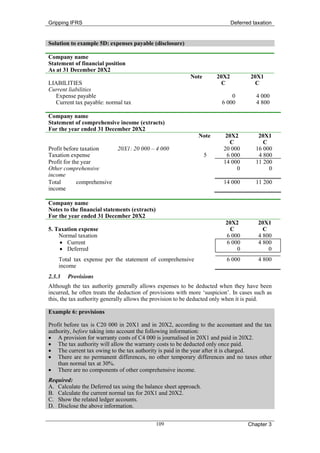
Solution to example 5D: expenses payable (disclosure)

Company name
Statement of financial position
As at 31 December 20X2
                                                           Note       20X2           20X1
LIABILITIES                                                             C              C
Current liabilities
  Expense payable                                                           0          4 000
  Current tax payable: normal tax                                       6 000          4 800

Company name
Statement of comprehensive income (extracts)
For the year ended 31 December 20X2
                                                              Note        20X2          20X1
                                                                            C             C
Profit before taxation     20X1: 20 000 – 4 000                          20 000        16 000
Taxation expense                                                  5       6 000         4 800
Profit for the year                                                      14 000        11 200
Other comprehensive                                                           0             0
income
Total        comprehensive                                               14 000        11 200
income

Company name
Notes to the financial statements (extracts)
For the year ended 31 December 20X2
                                                                         20X2           20X1
5. Taxation expense                                                       C               C
    Normal taxation                                                      6 000          4 800
    • Current                                                            6 000          4 800
    • Deferred                                                               0              0
    Total tax expense per the statement of comprehensive                  6 000         4 800
    income
2.3.3   Provisions
Although the tax authority generally allows expenses to be deducted when they have been
incurred, he often treats the deduction of provisions with more ‘suspicion’. In cases such as
this, the tax authority generally allows the provision to be deducted only when it is paid.

Example 6: provisions

Profit before tax is C20 000 in 20X1 and in 20X2, according to the accountant and the tax
authority, before taking into account the following information:
• A provision for warranty costs of C4 000 is journalised in 20X1 and paid in 20X2.
• The tax authority will allow the warranty costs to be deducted only once paid.
• The current tax owing to the tax authority is paid in the year after it is charged.
• There are no permanent differences, no other temporary differences and no taxes other
    than normal tax at 30%.
• There are no components of other comprehensive income.
Required:
A. Calculate the Deferred tax using the balance sheet approach.
B. Calculate the current normal tax for 20X1 and 20X2.
C. Show the related ledger accounts.
D. Disclose the above information.


                                               109                                  Chapter 3
Gripping IFRS                                                                         Deferred taxation


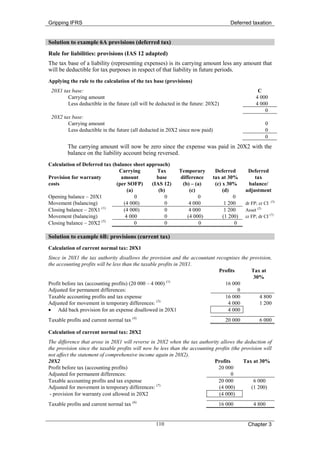
Solution to example 6A provisions (deferred tax)
Rule for liabilities: provisions (IAS 12 adapted)
The tax base of a liability (representing expenses) is its carrying amount less any amount that
will be deductible for tax purposes in respect of that liability in future periods.
Applying the rule to the calculation of the tax base (provisions)
 20X1 tax base:                                                                                    C
        Carrying amount                                                                           4 000
        Less deductible in the future (all will be deducted in the future: 20X2)                  4 000
                                                                                                      0
 20X2 tax base:
        Carrying amount                                                                                0
        Less deductible in the future (all deducted in 20X2 since now paid)                            0
                                                                                                       0
         The carrying amount will now be zero since the expense was paid in 20X2 with the
         balance on the liability account being reversed.
Calculation of Deferred tax (balance sheet approach)
                               Carrying        Tax           Temporary         Deferred       Deferred
Provision for warranty          amount         base          difference       tax at 30%         tax
costs                         (per SOFP)     (IAS 12)         (b) – (a)        (c) x 30%      balance/
                                   (a)          (b)              (c)               (d)       adjustment
Opening balance – 20X1                 0           0                 0                  0
Movement (balancing)             (4 000)           0             4 000              1 200    dr FP; cr CI (3)
Closing balance – 20X1 (1)       (4 000)           0             4 000              1 200    Asset (2)
Movement (balancing)              4 000            0            (4 000)            (1 200)   cr FP; dr CI (7)
Closing balance – 20X2 (5)             0           0                  0                  0

Solution to example 6B: provisions (current tax)
Calculation of current normal tax: 20X1
Since in 20X1 the tax authority disallows the provision and the accountant recognises the provision,
the accounting profits will be less than the taxable profits in 20X1.
                                                                            Profits        Tax at
                                                                                            30%
Profit before tax (accounting profits) (20 000 – 4 000) (1)                    16 000
Adjusted for permanent differences:                                                 0
Taxable accounting profits and tax expense                                     16 000         4 800
Adjusted for movement in temporary differences: (3)                             4 000         1 200
• Add back provision for an expense disallowed in 20X1                          4 000
Taxable profits and current normal tax (4)                                         20 000           6 000

Calculation of current normal tax: 20X2
The difference that arose in 20X1 will reverse in 20X2 when the tax authority allows the deduction of
the provision since the taxable profits will now be less than the accounting profits (the provision will
not affect the statement of comprehensive income again in 20X2).
20X2                                                                         Profits       Tax at 30%
Profit before tax (accounting profits)                                        20 000
Adjusted for permanent differences:                                                  0
Taxable accounting profits and tax expense                                    20 000           6 000
Adjusted for movement in temporary differences: (7)                           (4 000)         (1 200)
 - provision for warranty cost allowed in 20X2                                (4 000)
Taxable profits and current normal tax (6)                                      16 000           4 800


                                                  110                                         Chapter 3
Gripping IFRS                                                                            Deferred taxation


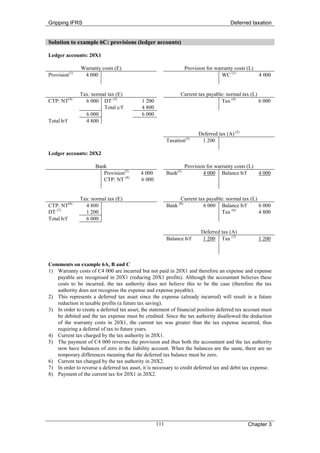
Solution to example 6C: provisions (ledger accounts)

Ledger accounts: 20X1

               Warranty costs (E)                                   Provision for warranty costs (L)
Provision(1)    4 000                                                                WC (1)            4 000


               Tax: normal tax (E)                              Current tax payable: normal tax (L)
CTP: NT(4)       6 000 DT (3)               1 200                                  Tax (4)          6 000
                         Total c/f          4 800
                 6 000                      6 000
Total b/f        4 800

                                                                          Deferred tax (A) (2)
                                                                    (3)
                                                          Taxation         1 200

Ledger accounts: 20X2

                      Bank                                          Provision for warranty costs (L)
                         Provision(5)      4 000          Bank(5)           4 000 Balance b/f        4 000
                         CTP: NT (8)       6 000


               Tax: normal tax (E)                              Current tax payable: normal tax (L)
CTP: NT(6)       4 800                                    Bank (8)        6 000 Balance b/f         6 000
DT (7)           1 200                                                             Tax (6)          4 800
Total b/f        6 000

                                                                           Deferred tax (A)
                                                          Balance b/f       1 200 Tax (7)              1 200


Comments on example 6A, B and C
1) Warranty costs of C4 000 are incurred but not paid in 20X1 and therefore an expense and expense
   payable are recognised in 20X1 (reducing 20X1 profits). Although the accountant believes these
   costs to be incurred, the tax authority does not believe this to be the case (therefore the tax
   authority does not recognise the expense and expense payable).
2) This represents a deferred tax asset since the expense (already incurred) will result in a future
   reduction in taxable profits (a future tax saving).
3) In order to create a deferred tax asset, the statement of financial position deferred tax account must
   be debited and the tax expense must be credited. Since the tax authority disallowed the deduction
   of the warranty costs in 20X1, the current tax was greater than the tax expense incurred, thus
   requiring a deferral of tax to future years.
4) Current tax charged by the tax authority in 20X1.
5) The payment of C4 000 reverses the provision and thus both the accountant and the tax authority
   now have balances of zero in the liability account. When the balances are the same, there are no
   temporary differences meaning that the deferred tax balance must be zero.
6) Current tax charged by the tax authority in 20X2.
7) In order to reverse a deferred tax asset, it is necessary to credit deferred tax and debit tax expense.
8) Payment of the current tax for 20X1 in 20X2.


                                                    111                                          Chapter 3
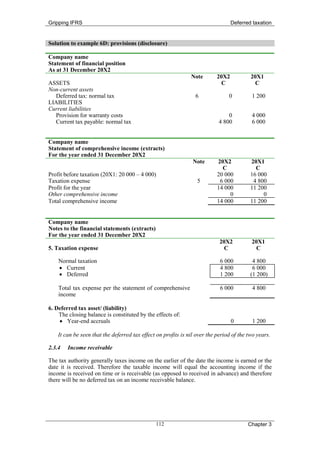
Gripping IFRS                                                                     Deferred taxation


Solution to example 6D: provisions (disclosure)

Company name
Statement of financial position
As at 31 December 20X2
                                                               Note        20X2           20X1
ASSETS                                                                       C              C
Non-current assets
  Deferred tax: normal tax                                       6              0         1 200
LIABILITIES
Current liabilities
  Provision for warranty costs                                                 0          4 000
  Current tax payable: normal tax                                          4 800          6 000


Company name
Statement of comprehensive income (extracts)
For the year ended 31 December 20X2
                                                                Note       20X2           20X1
                                                                             C              C
Profit before taxation (20X1: 20 000 – 4 000)                              20 000         16 000
Taxation expense                                                  5         6 000          4 800
Profit for the year                                                        14 000         11 200
Other comprehensive income                                                      0              0
Total comprehensive income                                                 14 000         11 200


Company name
Notes to the financial statements (extracts)
For the year ended 31 December 20X2
                                                                            20X2          20X1
5. Taxation expense                                                           C             C

    Normal taxation                                                         6 000          4 800
    • Current                                                               4 800          6 000
    • Deferred                                                              1 200         (1 200)

    Total tax expense per the statement of comprehensive                    6 000         4 800
    income

6. Deferred tax asset/ (liability)
    The closing balance is constituted by the effects of:
    • Year-end accruals                                                           0        1 200

    It can be seen that the deferred tax effect on profits is nil over the period of the two years.

2.3.4   Income receivable

The tax authority generally taxes income on the earlier of the date the income is earned or the
date it is received. Therefore the taxable income will equal the accounting income if the
income is received on time or is receivable (as opposed to received in advance) and therefore
there will be no deferred tax on an income receivable balance.


                                               112                                       Chapter 3
Gripping IFRS                                                                         Deferred taxation


Example 7: income receivable

Profit before tax is C20 000 in 20X1 and in 20X2, according to the accountant and the tax
authority, before taking into account the following information:
• Interest income of C6 000 is earned in 20X1 but only received in 20X2.
• The tax authority will tax the interest income when earned.
• The current tax owing to the tax authorities is paid in the year after it is charged.
• There are no permanent or other temporary differences and no taxes other than normal tax
   at 30%.
• There are no components of other comprehensive income.

Required:
A. Calculate the Deferred tax using the balance sheet approach.
B. Calculate the current normal tax for 20X1 and 20X2.
C. Show the related ledger accounts.
D. Disclose the above information.

Solution to example 7A: income receivable (deferred tax)

Rule for assets: income receivable:
The tax base of an asset (that represents an income) is the carrying amount less that portion
that will be taxed in the future.

Applying the rule to the calculation of the tax base (income receivable):

 20X1 tax base:                                                                                 C
        Carrying amount                                                                         6 000
        Less portion that will be taxed in the future (all taxed in current year: 20X1)             0
                                                                                                6 000
 20X2 tax base:
        Carrying amount                                                                        0
        Less portion that will be taxed in the future (all taxed in 20X1)                      0
                                                                                               0
        The carrying amount will now be zero since the income receivable was received in 20X2 (see
        journal 1 in the 20X2 ledger accounts).

Calculation of Deferred tax (balance sheet approach):
                              Carrying         Tax           Temporary         Deferred      Deferred
Income receivable             amount          base           difference       tax at 30%        tax
                            (per SOFP)      (IAS 12)          (b) – (a)        (c) x 30%     balance/
                                 (a)           (b)               (c)               (d)      adjustment
Opening balance – 20X1               0             0                 0                 0       N/A
Movement (balancing)            6 000         6 000                  0                 0       N/A
Closing balance – 20X1 (1)      6 000         6 000                  0                 0       N/A
Movement (balancing)           (6 000)       (6 000)                 0                 0       N/A
Closing balance – 20X2 (3)           0             0                 0                 0       N/A

Solution to example 7B: income receivable (current tax)

Since the tax authority taxes income either on the date it is received or on the date it is earned,
whichever is earlier, the interest income will be taxable in 20X1. The accountant records income when
it is earned and since the interest income is earned in 20X1, the accountant will record the income in
20X1. The accountant and tax authority therefore treat the interest income in the same way with the
result that there are no deferred tax consequences.


                                                  113                                        Chapter 3
Gripping IFRS                                                                       Deferred taxation


Calculation of current normal tax: 20X1

                                                                            Profits       Tax at 30%
Profit before tax (accounting profits) (20 000 + 6 000) (1)                 26 000
Adjusted for permanent differences:                                               0
Taxable accounting profits and tax expense                                  26 000             7 800
Adjusted for movement in temporary differences: (1)                               0                0
Taxable profits and current normal tax (2)                                  26 000             7 800

Calculation of current normal tax: 20X2

                                                                            Profits          Tax at
                                                                                              30%
Profit before tax (accounting profits) (3)                                   20 000
Adjusted for permanent differences:                                               0
Taxable accounting profits and tax expense                                   20 000            6 000
Adjusted for movement in temporary differences: (3)                               0                0
Taxable profits and current normal tax (4)                                   20 000            6 000

Solution to example 7C: income receivable (ledger accounts)

20X1

                Income receivable (A)                                Interest income (I)
Int income(1)      6 000                                                         Inc receivable(1) 6 000


                 Tax: normal tax (E)                         Current tax payable: normal tax (L)
CTP: NT(2)         7 800                                                        Tax (2)          7 800


20X2

                Income receivable (A)                                         Bank
Balance b/d         6 000 Bank (3)       6 000         Int receivable (3) 6 000 CTP (5)           7 800


                 Tax: normal tax (E)                         Current tax payable: normal tax (L)
CTP: NT(4)         6 000                               Bank (5)        7 800 Balance b/d         7 800
                                                                                Tax (4)          6 000

Comments on example 7A, B and C
1) Since the income is treated as income by both the accountant and the tax authority in
   20X1 and yet it hasn’t been received, both the accountant and the tax authority have the
   same income receivable account. There are therefore no temporary differences or deferred
   tax.
2) Current tax for 20X1.
3) Since the income is received, the receipt reverses the income receivable account to zero
   (in both the accountant’s and tax authority’s books). There are therefore still no
   temporary differences or deferred tax.
4) Current tax for 20X2.
5) Payment of current tax for 20X1 in 20X2.


                                                 114                                        Chapter 3
Gripping IFRS                                                                   Deferred taxation


Solution to example 7D: income receivable (disclosure)

Company name
Statement of financial position
As at 31 December 20X2
                                                               Note        20X2          20X1
ASSETS                                                                       C             C
Current assets
  Income receivable                                                             0         6 000
LIABILITIES
Current liabilities
  Current tax payable: normal tax                                           6 000         7 800

Company name
Statement of comprehensive income (extracts)
For the year ended 31 December 20X2
                                                                Note       20X2          20X1
                                                                             C             C
Profit before taxation   (20X1: 20 000 + 6 000)                            20 000        26 000
Taxation expense                                                 5          6 000         7 800
Profit for the year                                                        14 000        18 200
Other comprehensive income                                                      0             0
Total comprehensive income                                                 14 000        18 200

Company name
Notes to the financial statements (extracts)
For the year ended 31 December 20X2
                                                                           20X2           20X1
5. Taxation expense                                                          C              C
    Normal taxation                                                         6 000         7 800
    • Current                                                               6 000         7 800
    • Deferred                                                                  0             0
    Total tax expense per the statement of comprehensive                    6 000         7 800
    income

2.4 Depreciable non-current assets and deferred tax

2.4.1   Depreciation versus capital allowances

The accountant expenses (deducts from income) the cost of non-current assets through the use
of depreciation and the tax authority allows (deducts from income) the cost of non-current
assets through the use of depreciation for tax purposes. Depreciation in the tax records may be
referred to in many different ways, for example it may be referred to as wear and tear, capital
allowances or depreciation for tax purposes. For ease of reference, this text will generally
refer to the depreciation for tax purposes as capital allowances.

The difference between depreciation in the accounting records and capital allowances
(depreciation in the tax records) is generally a result of the differences in the rate or method of
depreciation. For example, the rate of depreciation in the accounting records may be 15%
using the reducing balance method, whereas the rate of capital allowance may be 10% using
the straight-line method. Another difference may arise when depreciation is apportioned for a
period that is less than one year, if the capital allowance in the tax records is not apportioned
for part of the year. Over a period of time, however, the accountant and the tax authority will
generally expense the cost of the asset, meaning that any difference arising between the
depreciation and capital allowance in any one year is just a temporary difference.


                                               115                                      Chapter 3
Gripping IFRS                                                                       Deferred taxation


Example 8: depreciable assets
Profit before tax is C20 000, according to both the accountant and the tax authority, in each of
the years 20X1, 20X2 and 20X3, before taking into account the following information:
• A plant was purchased on 1 January 20X1 for C30 000
• The plant is depreciated by the accountant at 50% p.a. straight-line.
• The tax authority allows a capital allowance thereon at 33 1/3 % straight-line.
• This company paid the tax authority the current tax owing in the year after it was charged.
• The normal income tax rate is 30%.
• There are no components of other comprehensive income.
Required:
A. Calculate the Deferred tax using the balance sheet approach.
B. Calculate the current normal tax for 20X1, 20X2 and 20X3.
C. Show the related ledger accounts.
D. Disclose the above in as much detail as is possible for all three years.

Solution to example 8A: depreciable assets (deferred tax)
Rule for assets: depreciable assets (per IAS 12):
The tax base of an asset is the amount that will be deducted for tax purposes against any
taxable economic benefits that will flow to an entity when it recovers the carrying amount of
the asset. If those economic benefits will not be taxable, the tax base of the asset is equal to its
carrying amount (e.g. an investment that renders dividend income).
Applying the rule to the calculation of the tax base (depreciable assets):

20X1:
Tax base:                                                                                     C
     Original cost                                                                          30 000
     Less accumulated capital allowances (30 000 x 33 1/3 % x 1year)                        10 000
     Deductions still to be made (decrease in taxable profits in the future)                20 000

Carrying amount:                                                                              C
     Original cost                                                                          30 000
     Less accumulated depreciation            (30 000 x 50%)                                15 000
     Expenses still to be incurred (decrease in accounting profits in the future)           15 000

20X2:
Tax base:                                                                                     C
     Original cost                                                                          30 000
     Less accumulated capital allowances      (10 000 x 2 years)                            20 000
     Deductions still to be made                                                            10 000

Carrying amount:                                                                              C
    Original cost                                                                           30 000
    Less accumulated depreciation             (15 000 x 2 years)                            30 000
    Expenses still to be incurred                                                             0

20X3:
Tax base:                                                                                     C
     Original cost                                                                          30 000
     Less accumulated capital allowances      (10 000 x 3 years)                            30 000
     Deductions still to be made                                                              0

Carrying amount:                                                                              C
    Original cost                                                                           30 000
    Less accumulated depreciation             (15 000 x 2yrs) (fully depreciated at         30 000
                                              31/12/20X2)
     Expenses still to be incurred                                                             0


                                                   116                                     Chapter 3
Gripping IFRS                                                                        Deferred taxation


Calculation of Deferred tax (balance sheet approach):

Depreciable assets             Carrying            Tax          Temporary       Deferred     Deferred
                                amount             base         difference     tax at 30%       tax
                              (per SOFP)         (IAS 12)        (b) – (a)      (c) x 30%    balance/
                                  (a)               (b)             (c)             (d)     adjustment
Opening balance: 20X1
Purchase                         30 000           30 000
Depreciation/                   (15 000)         (10 000)              5 000      1 500     dr FP;
capital allowances (1)                                                                       cr CI
Closing balance: 20X1 (2)        15 000           20 000               5 000      1 500     Asset (2)
Depreciation/                   (15 000)         (10 000)              5 000      1 500     dr FP;
capital allowances (1)                                                                      cr CI
Closing balance: 20X2 (2)              0          10 000           10 000         3 000     Asset (2)
Depreciation/                          0         (10 000)         (10 000)       (3 000)    cr FP;
capital allowances (4)                                                                      dr CI
Closing balance: 20X3 (5)

Solution to example 8B: depreciable assets (current tax)

Calculation of current normal tax: 20X1

                                                                               Profits      Tax at 30%
Profit before tax (accounting profits) (20 000 - 15 000) (1)                     5 000
Adjusted for permanent differences:                                                   0
Taxable accounting profits and tax expense                                       5 000          1 500
Adjusted for movement in temporary differences: (1)                              5 000          1 500
- add back depreciation (30 000 x 50%)                                          15 000
- less capital allowances (30 000 x 33 1/3%)                                   (10 000)

Taxable profits and current normal tax (3)                                      10 000          3 000

Calculation of current normal tax: 20X2

                                                                               Profits      Tax at 30%
Profit before tax (accounting profits) (20 000 - 15 000) (1)                     5 000
Adjusted for permanent differences:                                                   0
Taxable accounting profits and tax expense                                       5 000          1 500
Adjusted for movement in temporary differences: (1)                              5 000          1 500
- add back depreciation (30 000 x 50%)                                          15 000
- less capital allowances (30 000 x 33 1/3%)                                   (10 000)

Taxable profits and current normal tax (3)                                      10 000          3 000

Calculation of current normal tax: 20X3

                                                                               Profits      Tax at 30%
Profit before tax (accounting profits) (asset fully depreciated) (4)            20 000
Adjusted for permanent differences:                                                   0
Taxable accounting profits and tax expense                                      20 000          6 000
Adjusted for movement in temporary differences: (4)                            (10 000)        (3 000)
- add back depreciation (the asset is fully depreciated)                              0
- less capital allowances (30 000 x 33 1/3%)                                   (10 000)

Taxable profits and current normal tax (6)                                      10 000           3 000


                                                     117                                     Chapter 3
Gripping IFRS                                                                         Deferred taxation


Solution to example 8C: depreciable assets (ledger accounts)

                Tax: normal tax (E)                            Current tax payable: normal tax (L)
20X1                                                                             20X1 Tax (3)        3 000
CTP: NT (3)       3 000   DT (2)           1 500         Balance c/f     3 000
Total             1 500   P&L              1 500                         3 000                       3 000
20X2                                                     20X2 Bank       3 000 Balance b/f           3 000
CTP: NT (3)       3 000   DT (2)           1 500         Balance c/f     3 000 20X2 Tax (3)          3 000
Total             1 500   P&L              1 500                         6 000                       6 000
20X3                                                     20X3 Bank       3 000 Balance b/f           3 000
CTP: NT (6)       3 000                                                          20X3 Tax (6)        3 000
DT (5)            3 000                                  Balance c/f     6 000                       6 000
Total             6 000   P&L              6 000                                 Balance b/f         3 000


                 Deferred tax (A)
20X1 Tax (2)      1 500
20X2 Tax (2)      1 500 20X3 Tax (5)       3 000
                  3 000                    3 000


                 Depreciation (E)                                        Plant: cost (A)
20X1                                                     20X1 Bank      30 000
Plant: AD (1)    15 000   P&L            15 000
20X2
Plant: AD (1)    15 000   P&L            15 000


                                                               Plant: accumulated depreciation (A)
                                                                                  20X1 Depr(1) 15 000
                                                                                  20X2 Depr(1) 15 000
                                                                                  Balance        30 000

Comments on example 8A, B and C
(1) The tax authority allows a capital allowance at 33 1/3% of the cost per year whereas the accountant
    allows depreciation at 50% of the cost per year in 20X1 and 20X2.

(2) The fact that the depreciation and capital allowance are not the same amount results in temporary
    differences and deferred tax. This represents a deferred tax asset since the future tax deductions
    (20X1: C20 000 and 20X2: C10 000) are greater than the tax effect of the future economic benefits
    recognised in the statement of financial position (20X1: C15 000 and 20X2: C0). This asset is
    therefore similar to an expense prepaid since the current tax has been greater than the tax incurred
    in 20X1 and 20X2.

(3) Current tax of C3 000 is recorded in 20X1 and 20X2.

(4) The tax authority allows a capital allowance at 33 1/3% of the cost per year whereas the accountant
    allows depreciation at 50% of the cost per year. Notice that the accountant did not write off
    depreciation in 20X3 since the asset was fully depreciated at the end of 20X2.

(5) At the end of 20X3, both the carrying amount and tax base of the asset are zero. The deferred tax
    balance of C3 000 must therefore be reversed.

(6) Current tax of C6 000 is recorded in 20X3.


                                                   118                                       Chapter 3
Gripping IFRS                                                                         Deferred taxation


Solution to example 8D: depreciable assets (disclosure)

Entity name
Statement of comprehensive income
For the year ended 20X3
                                             Note        20X3              20X2              20X1
                                                           C                 C                 C
Profit before tax                                          20 000              5 000             5 000
Taxation expense                               3             6 000             1 500             1 500
Profit for the period                                      14 000              3 500             3 500
Other comprehensive income                                       0                 0                 0
Total comprehensive income                                 14 000              3 500             3 500

Entity name
Statement of financial position
As at …20X3
                                            Note         20X3              20X2              20X1
ASSETS                                                     C                 C                 C
Non-current assets
Deferred tax: normal tax                      4                  0           3 000             1 500
Property, plant and equipment                                    0               0            15 000
LIABILITIES
Current liabilities
Current tax payable: normal tax                             3 000            3 000             3 000

Entity name
Notes to the financial statements
For the year ended …20X3
                                                          20X3             20X2              20X1
3. Taxation expense                                         C                C                 C
    Normal taxation expense                                 6 000            1 500             1 500
    • Current                                               3 000            3 000             3 000
    • Deferred                                              3 000           (1 500)           (1 500)
4. Deferred tax asset
The closing balance is constituted by the effects of:
    • Property, plant and equipment                               0          3 000             1 500
Notice that over the three years, the capital allowances (10 000 x 3 years = 30 000) equals the
depreciation (15 000 x 2 years = 30 000). Similarly, the current tax charged by the tax authority (3 000
x 3 years = 9 000) equals the tax expense (1 500 + 1 500 + 6 000 = 9 000).

2.5 Rate changes and deferred tax

A deferred tax balance is simply an estimate of the tax owing to the tax authority in the long-
term or the tax savings expected from the tax authority in the long-term. The estimate is made
based on the temporary differences multiplied by the applicable tax rate. If this tax rate
changes, so does the estimate of the amount of tax owing by or owing to the tax authority in
the future. Therefore, if a company has a deferred tax balance at the beginning of a year
during which the rate of tax changes, the opening balance of the deferred tax account will
need to be re-estimated. This is effectively a change in accounting estimate, the adjustment
for which is processed in the current year’s accounting records.

Since the tax expense account in the current year will include an adjustment to the deferred
tax balance from a prior year, the effective rate of tax in the current year will not equal the
applicable tax rate. The difference between the effective and the applicable rate of tax results
in the need for a tax rate reconciliation in the tax note.


                                                   119                                       Chapter 3
Gripping IFRS                                                                 Deferred taxation


Example 9: rate changes – date of substantive enactment

A change in the corporate normal tax rate from 30% to 29% is announced on
20 January 20X1. No significant changes were announced to other forms of tax.
The new tax rate will apply to tax assessments ending on or after 1 March 20X1.

Required:
State at what rate the current and deferred tax balances should be calculated assuming:
A. The company’s year of assessment ends on 31 December 20X0.
B. The company’s year of assessment ends on 28 February 20X1.
C. The company’s year of assessment ends on or after 31 March 20X1.
Solution to example 9: rate changes – date of substantive enactment
•   The date of substantive enactment is 20 January 20X1 (no significant changes to other
    taxes were announced at the time).
•   The effective date is 1 March 20X1
                                           A                     B                   C
                                      Year end:             Year end:           Year end:
                                     31 December           28 February          31 March
                                         20X0                 20X1                20X1
Current tax payable/ receivable          30%                   30%                 29%
Deferred tax liability/ asset            30%                   29%                 29%
Explanations:                             (1)                   (2)                 (3)
Explanations:
1) Since the year ends before the effective date of the rate change, the current tax payable
   will still be based on the old rate. Since the year ends before the date of substantive
   enactment, the deferred tax balance must still be estimated based on the old rate although
   a subsequent event note should be included to explain that the deferred tax balances will
   be reduced in the future due to a rate change that occurred after the end of the reporting
   period.
2) Since the year ends before the effective date of the rate change, the current tax payable
   will still be based on the old rate. Since the year ends after the date of substantive
   enactment, the deferred tax balance must be estimated using the new rate.
3) Since the year ends after the effective date of the rate change, the current tax payable will
   be based on the new rate. For the same reason, the deferred tax balance will be based on
   the new rate.
Example 10: rate changes
The opening balance of deferred tax at the beginning of 20X2 is C45 000, credit and is due
purely to temporary differences caused by capital allowances on the property, plant and
equipment.
• The tax rate in 20X1 was 45% but changed to 35% in 20X2.
• The profit before tax in 20X2 is C200 000, all of which is taxable in 20X2.
• No balance was owing to or from the tax authority at 31 December 20X1 and no
    payments were made to or from the tax authority during 20X2.
• There are no other temporary differences or permanent differences.
• There are no components of other comprehensive income.
Required:
A. Calculate the effect of the rate change.
B. Show the Calculation of Deferred tax using the balance sheet approach.
C. Calculate the current normal tax for 20X2.
D. Post the related journal in the ledger accounts.
E. Disclose the above in the financial statements for the year ended 31 December 20X2.


                                              120                                    Chapter 3
Gripping IFRS                                                                       Deferred taxation


Solution to example 10A: rate change
The opening balance in 20X2 (closing balance in 20X1) was calculated by multiplying the
total temporary differences at the end of 20X1 by 45%. Therefore, the temporary differences
(TD) provided for at the end of 20X1 are as follows:
    Deferred tax balance = Temporary difference x applicable tax rate
    C45 000 = Temporary difference x 45%
    Temporary difference = C45 000/ 45%
    Temporary difference = C100 000
The credit balance means that the company is expecting the tax authority to charge them tax
on the temporary difference of C100 000 in the future. If the tax rate is now 35%, the estimate
of the tax we expect to pay on this C100 000 needs to be changed to:
    Deferred tax balance = Temporary difference x applicable tax rate
    Deferred tax balance = C100 000 x 35%
    Deferred tax balance = C35 000
An adjustment to the deferred tax balance must be processed:
    Deferred tax balance was                   45 000 Balance: credit
    Deferred tax balance should                35 000 Balance: credit
    now be
    Adjustment needed                          10 000 Adjustment: debit deferred tax, credit tax
                                                      expense

Solution to example 10B: rate change (deferred tax)
Depreciable assets               Carrying           Tax      Temporary     Deferred Deferred tax
                                 amount             base     difference   tax at 30%    balance/
                                 (per FP)         (IAS 12)    (b) – (a)    (c) x %    adjustment
                                    (a)              (b)         (c)          (d)
Opening balance @ 45%                xxx              xxx     100 000       45 000   Liability
Rate change (100 000 x 10%)                                                (10 000)  dr FP; cr CI
Opening balance @ 35%                                         100 000       35 000
Movement (there are no                    0              0          0             0
temporary differences in
20X2)
Closing balance – 20X2                   xxx         xxx      100 000      35 000       Liability
Notice that the question stated that there were no other temporary differences other than the
balance of temporary differences at 31 December 20X1.

Solution to example 10C: rate change (current tax)

Taxable profits and current normal tax - 20X2                              Profits       Tax at 35%
Profit before tax (accounting profits) (given)                            200 000
Adjusted for permanent differences: (given)                                     0
Taxable accounting profits and tax expense                                200 000           70 000
Adjusted for movement in temporary differences: (given)                         0                0

Taxable profits and current normal tax                                    200 000           70 000
Notice that the question stated that there were no permanent differences and no other
temporary differences other than the balance of temporary differences at 31 December 20X1.


                                                   121                                     Chapter 3
Gripping IFRS                                                                 Deferred taxation


Solution to example 10D: rate change (ledger accounts)
The credit balance of the deferred tax account must be reduced, thus requiring this account to
be debited. The contra entry will go to the tax expense account, since this is where the contra
entry was originally posted when the 45 000 was originally accounted for as a deferred tax
liability.
               Tax: normal tax (E)                     Current tax payable: normal tax (L)
CTP: NT         70 000 Deferred tax   10 000                           Tax                 70 000
                         Total c/f    60 000
                70 000                70 000

Total b/f       60 000   P&L          60 000
                60 000                60 000

                Deferred tax (L)
Tax             10 000 Balance b/d 45 000
Balance c/d     35 000
                45 000               45 000
                         Balance b/d 35 000

Solution to example 10E: rate change (disclosure)

Entity name
Statement of comprehensive income
For the year ended 31 December 20X2
                                                           Note        20X2            20X1
                                                                         C               C
Profit before tax (given)                                               200 000          xxx
Taxation expense                                               3         60 000          xxx
Profit for the year                                                     140 000          xxx
Other comprehensive income                                                    0            0
Total comprehensive income                                              140 000          xxx
Entity name
Statement of financial position
As at 31 December 20X2
                                                         Note        20X2              20X1
LIABILITIES                                                            C                 C
Non-current liabilities
Deferred tax: normal tax                                   4            35 000            45 000
Current liabilities
Current tax payable: normal tax                                         70 000                  0

Entity name
Notes to the financial statements
For the year ended 31 December 20X2
                                                                                     20X2
3. Taxation expense                                                                    C
    Normal taxation                                                                  60 000
     •      Current (200 000 x 35%)                                                  70 000
     •      Deferred                                                                (10 000)
               - Current year (no temporary differences)                                  0
               - Rate change                                                        (10 000)


               Tax expense per the statement of comprehensive income                 60 000


                                               122                                    Chapter 3
Gripping IFRS                                                                 Deferred taxation


    Tax Rate Reconciliation
        Applicable Tax Rate                                                            35%

         Tax effects of:
           Profit before tax (200 000 x 35%)                                        70 000
           Rate change                                                             (10 000)
           Tax expense charge per statement of comprehensive                        60 000
           income

         Effective Rate of Tax (60 000/ 200 000)                                       30%

         The applicable rate of tax differs from that in the prior year because a change in the
         statutory tax rate was enacted on … (date).
4. Deferred tax liability                                            20X2            20X1
                                                                       C               C
      The closing balance is constituted by the effects of:
      • Property, plant and equipment                                   35 000        45 000

Example 11: rate changes

The closing balance of deferred tax at the end of 20X1 is C60 000.

Required:
Sow the journal entries relating to the rate change in 20X2 assuming that:
A. the balance in 20X1 is an asset and that the rate was 30% in 20X1 and 40% in 20X2;
B. the balance in 20X1 is a liability and that the rate was 30% in 20X1 and is 40% in 20X2;
C. the balance in 20X1 is an asset and that the rate was 40% in 20X1 and is 30% in 20X2;
D. the balance in 20X1 is a liability and that the rate was 40% in 20X1 and is 30% in 20X2.

Solution to example 11A: rate change (deferred tax asset increasing)

1 January 20X2                                                        Debit           Credit
Deferred tax: normal tax (A)                                            20 000
  Tax expense: normal tax                                                                20 000
Tax rate increased by 10%: 60 000 / 30 % x (40% – 30%)

Solution to example 11B: rate change (deferred tax liability increasing)

1 January 20X2                                                   Debit                Credit
Tax expense: normal tax                                            20 000
  Deferred tax: normal tax (L)                                                           20 000
Tax rate increased by 10%: 60 000 / 30 % x (40% – 30%)
Solution to example 11C: rate change (deferred tax asset decreasing)

1 January 20X2                                                        Debit           Credit
Tax expense: normal tax                                                 15 000
  Deferred tax: normal tax (A)                                                           15 000
Tax rate decreased by 10%: 60 000 / 40 % x (40% – 30%)

Solution to example 11D: rate change (deferred tax liability decreasing)

1 January 20X2                                                        Debit           Credit
Deferred tax: normal tax (L)                                            15 000
  Tax expense: normal tax                                                                15 000
Tax rate decreased by 10%: 60 000 / 40 % x (40% – 30%)


                                              123                                     Chapter 3
Gripping IFRS                                                                       Deferred taxation


2.6 Tax losses and deferred tax

A deferred tax asset shall be recognised for the carry forward of unused tax losses and unused
tax credits to the extent that it is probable that future taxable profit will be available against
which the unused tax losses and unused tax credits can be utilised (IAS 12 para 34).

Tax losses carried forward represent future tax savings. The future tax saving is an asset to
the entity, but one that is only recognised to the extent that it is probable that future taxable
profits will be sufficient to allow the tax saving from the tax loss to be utilised (i.e. realised).
In many instances, therefore, an entity may not recognise the potential future tax savings as an
asset because the very existence of a tax loss is often evidence that future profits will not be
earned. If we do not earn profits in the future, the tax authorities will not be able to reduce
our taxable profits by the assessed loss (tax loss). We would therefore not have an asset.

Example 12: tax losses

 Cost of vehicle purchased on 1 January 20X1                                C120 000
 Depreciation on vehicles to nil residual value                             3 years straight-line
 Capital allowance (depreciation allowed by the tax authorities)            2 years straight-line
 Normal income tax rate                                                     30%

 Profit or loss before tax (after deducting any depreciation on the vehicle) for the year
 ended:
 • 31 December 20X1                                                  Loss: C40 000
 • 31 December 20X2                                                  Loss: C20 000
 • 31 December 20X3                                                  Profit: C100 000

There are no permanent differences and no temporary differences other than those evident
from the information provided. There are no components of other comprehensive income.

Required:
A. Calculate the taxable profits and current tax per the tax legislation for 20X1 to 20X3.
B. Calculate the Deferred tax balances for 20X1 to 20X3 assuming that the company expects
   to be able to utilise any tax losses to reduce future tax payable on future profits.
C. Disclose the above tax-related information in the financial statements for 20X3.
D. Repeat the disclosure assuming that the company’s accounting policy was to not
   recognise deferred tax assets.

Solution to example 12A: tax losses and current tax

Calculation of current normal tax                        20X3             20X2             20X1
                                                           C                C                C
Profit before tax                                       100 000         (20 000)          (40 000)
Add back depreciation (120 000 / 3 years)                40 000          40 000            40 000
Less capital allowance (120 000 / 2 years)                    0         (60 000)          (60 000)
Tax loss brought forward                               (100 000)        (60 000)                0
Taxable profit/ (tax loss)                               40 000        (100 000)          (60 000)

Current normal tax at 30%                                12 000               nil              nil


                                                124                                        Chapter 3
Gripping IFRS                                                              Deferred taxation


Solution to example 12B: tax losses and deferred tax

Property, plant and    Carrying      Tax base     Temporary          Deferred      Deferred
equipment               amount                    difference        tax at 30%        tax
                        (SOFP)       (IAS 12)      (b) – (a)         (c) x 30%     balance/
                           (a)          (b)           (c)                (d)      adjustment
1 January 20X1                 0            0              0                 0
Purchase of asset      120 000       120 000               0                 0
Depreciation           (40 000)      (60 000)       (20 000)           (6 000)
31 December 20X1         80 000       60 000        (20 000)           (6 000)    Liability
Depreciation           (40 000)      (60 000)       (20 000)           (6 000)
31 December 20X2         40 000             0       (40 000)          (12 000)    Liability
Depreciation           (40 000)             0        40 000            12 000
31 December 20X3               0            0              0                 0

Tax loss              Carrying      Tax base      Temporary          Deferred   Deferred
                      amount                      difference        tax at 30%     tax
                       (SOFP)        (IAS 12)      (b) – (a)         (c) x 30%  balance/
                         (a)            (b)           (c)                (d)   adjustment
1 January 20X1               0              0             0                  0
Movement                     0         60 000       60 000             18 000
31 December 20X1             0         60 000       60 000             18 000  Asset
Movement                     0         40 000       40 000             12 000
31 December 20X2             0       100 000       100 000             30 000  Asset
Movement                     0      (100 000)     (100 000)           (30 000)
31 December 20X3             0              0             0                  0

Summary of deferred tax on:           Vehicle          Tax loss         Total

1 January 20X1                               0                  0            0
Movement                                                                12 000
31 December 20X1                        (6 000)         18 000          12 000      Asset
Movement                                                                 6 000
31 December 20X2                       (12 000)         30 000          18 000      Asset
Movement                                                               (18 000)
31 December 20X3                             0                  0            0
Solution to example 12C: tax losses and disclosure – deferred tax asset recognised

Entity name
Statement of comprehensive income
For the year ended …..20X3
                                                          Note        20X3           20X2
                                                                        C              C
Profit before tax                                                    100 000        (20 000)
Taxation income/ (expense)                                  3        (30 000)         6 000
Profit for the period                                                 70 000        (14 000)
Other comprehensive income                                                 0              0
Total comprehensive income                                            70 000        (14 000)


                                          125                                       Chapter 3
Gripping IFRS                                                                Deferred taxation


Entity name
Statement of financial position
As at ……..20X3
                                                             Note     20X3              20X2
ASSETS                                                                  C                 C
Non-current assets
Deferred tax: normal tax                                      5             0           18 000

Entity name
Notes to the financial statements
For the year ended 31 December
                                                                     20X3               20X2
3. Taxation expense                                                    C                  C
   Normal taxation expense
   • Current                                                         12 000                  0
   • Deferred                                                        18 000             (6 000)
                                                                     30 000             (6 000)

5. Deferred tax asset/ (liability)
   The deferred tax balance comprises tax on the following types of temporary differences:
   • Property, plant and equipment                                        0        (12 000)
   • Tax losses                                                           0         30 000
                                                                          0         18 000

Solution to example 12D: tax losses and disclosure – deferred tax asset not recognised

Summary of deferred                                                  Limited        Unrecognised/
tax on:                    Vehicle    Tax loss     Total               to             (utilised)
1 January 20X1                  0             0         0                 0                     0
Movement                                           12 000                 0              12 000
31 December 20X1            (6 000)     18 000     12 000    Asset        0              12 000
Movement                                            6 000                 0                6 000
31 December 20X2           (12 000)     30 000     18 000    Asset        0              18 000
Movement                                          (18 000)                0             (18 000)
31 December 20X3                  0          0          0                 0                     0

Entity name
Statement of comprehensive income
For the year ended …..20X3
                                                             Note     20X3               20X2
                                                                        C                  C
Profit before tax                                                      100 000          (20 000)
Taxation expense                                              3         12 000                0
Profit for the period                                                   88 000          (20 000)
Other comprehensive income                                                   0                0
Total comprehensive income                                              88 000          (20 000)

Entity name
Statement of financial position
As at ……..20X3
                                                             Note     20X3              20X2
LIABILITIES                                                             C                 C
Non-current assets/ liabilities
Deferred tax: normal tax                                      5                 0                 0


                                            126                                        Chapter 3
Gripping IFRS                                                               Deferred taxation


Entity name
Notes to the financial statements
For the year ended 31 December
                                                                     20X3           20X2
3. Taxation expense                                                    C              C
    Normal taxation
    • Current                                                        12 000             0
    • Deferred                                                            0             0
                                                                     12 000             0
      Tax rate reconciliation
      Applicable tax rate                                              30%          30%
      Tax effects of:
      Profit before tax             (100 000 x 30%) (20 000 x        30 000        (6 000)
                                    30%)
      Unrecognised current tax loss 40 000 x 30%                                    6 000
      Utilisation of previously     100 000 x 30%                   (18 000)
      unrecognised tax losses
      Tax expense per the statement of comprehensive income          12 000             0
      Effective tax rate            (12 000 / 100 000) (0 / 20         12%            0%
                                    000)
5. Deferred tax asset/ (liability)
   The deferred tax balance comprises tax on the following types of temporary differences:
   • Property, plant and equipment                                        0              0


3. Disclosure of income tax

3.1 Overview

IAS 1 and IAS 12 require certain tax disclosure in the statement of comprehensive income,
statement of financial position and related notes to the financial statements.

Where the tax is caused by profits or losses, this tax:
• is presented as part of the tax expense in the profit or loss section of the statement of
  comprehensive income; and
• is supported by a note (the tax expense note).

Where the tax is caused by gains or losses recognised directly in equity (other comprehensive
income), this tax:
• is shown as a separate line item in the other comprehensive income section of the
    statement of comprehensive income; or is
• is deducted from each component thereof; and
• is supported by a note (the tax on other comprehensive income note): this note shows the
    tax effect of each component of other comprehensive income.

3.2     Statement of comprehensive income disclosure

3.2.1 Face of the statement of comprehensive income

Normal tax on companies is considered to be the tax levied on income and are therefore
combined to reflect the tax expense in the statement of comprehensive income (referred to as
income tax expense). The tax expense must be reflected as a separate line item in the
statement of comprehensive income (required by IAS 1, chapter 1).


                                            127                                    Chapter 3
Gripping IFRS                                                                  Deferred taxation


3.2.2 Tax expense note

This line item in the statement of comprehensive income should be referenced to a supporting
note. The supporting note should provide details of the major components of the tax expense.
A logical approach would be to first separate the tax note into the different types of tax levied
on company profits, although not expressly required in IAS 12. The second step would be to
identify the major categories of tax within each tax type (i.e. the current and deferred
portions). The note should also provide a reconciliation explaining why the effective rate of
tax differs from the standard or applicable rate of tax.

A summary of the major components of tax that may need disclosure (IAS 12 .80) include:

In respect of current tax:
• Current tax for the current period;
• Adjustments to current tax of prior periods;
• Reductions in current tax caused by utilisation of previously unrecognised:
    - tax credits;
    - tax losses; and
    - deductible temporary differences.

In respect of deferred tax:
• Deferred tax adjustment for the current period;
• Effects of rate changes on prior year deferred tax balances;
• Adjustments to deferred tax expense caused by the write-down (or reversal thereof) of a
    deferred tax asset;
• Reductions in deferred tax expense caused by recognition of previously unrecognised:
    - tax credits;
    - tax losses; and
    - deductible temporary differences.

In respect of the aggregate of current and deferred tax:
• The tax relating to changes in accounting policies and correction of errors that could not
    be adjusted in prior years.

The following shall also be disclosed separately (IAS 12.81):

•   An explanation of the relationship between tax expense (income) and accounting profit in
    either or both of the following forms:
    - a reconciliation between tax expense (income) and the product of accounting profit
         multiplied by the applicable tax rate(s); or
    - a reconciliation between the average effective tax rate and the applicable tax rate;
•   An explanation of the basis on which the applicable tax rate(s) is (are) computed;
•   An explanation regarding any changes in the applicable tax rate(s) compared to the
    previous accounting period;
•   In respect of discontinued operations, the tax expense relating to:
     -     the gain or loss on discontinuance; and
     -     the profit or loss from the ordinary activities of the discontinued operation for the
           period, together with the corresponding amounts for each prior period presented;
•   The total tax (current tax and deferred tax) relating to items charged directly to equity
    (this is covered in other chapters such as the one entitled ‘property, plant and equipment’.


                                              128                                     Chapter 3
Gripping IFRS                                                                  Deferred taxation


3.3   Statement of financial position disclosure

3.3.1 Face of the statement of financial position

The deferred tax asset or liability is always classified as a non-current asset or liability. Even
if an entity believes that some of their deferred tax balance will reverse in the next year, the
amount may never be classified as current (IAS 1.56).

If there is a deferred tax asset and a deferred tax liability, these should be disclosed as
separate line-items on the face of the statement of financial position (i.e. they should not be
set-off against one another) unless (IAS 12.74):
• Current tax assets and liabilities are legally allowed to be set-off against each other when
    making tax payments; and
• The deferred tax assets and liabilities relate to taxes levied by the same tax authority on:
    − the same entity or on
    − different entities within a group that intend to settle their taxes on a net basis or at the
         same time.

3.3.2 Accounting policy note

Although not specifically required, it is important for foreign investors to know how a local
company measures the elements in its financial statements. In this regard, a brief explanation
of the method of calculation is considered appropriate.

3.3.3 Deferred tax note

The deferred tax balance may reflect an asset or liability balance and therefore it makes sense
to explain, in the heading of the note, whether the balance is an asset or liability (if, for
example, you reflect liabilities in brackets, then the heading would be: asset/ (liability)).

IAS 12.81(g) requires disclosure, in respect of each type of temporary difference (deductible
and taxable), and in respect of each type of unused tax losses and unused tax credits, the
amount of the deferred tax:
• assets and liabilities recognised in the statement of financial position for each period
   presented, and
• income or expense recognised in the statement of comprehensive income for each period
   presented, if this is not apparent from the changes in the amounts recognised in the
   statement of financial position.

IAS 12.81(a) requires the following to be disclosed:
• The aggregate current and deferred tax relating to items charged or credited directly to
   equity.

IAS 12.81(ab) requires the following to be disclosed in the notes:
• The amount of income tax relating to each component of other comprehensive income

IAS 12.81(a), (ab) and (g) above means that a reconciliation between the opening deferred tax
balance and the closing deferred tax balance (asset or liability) will be required:
• whenever a gain or loss is charged directly to equity, (because the deferred tax charge on
    the gain or loss will also be charged directly to equity and therefore the deferred tax
    charge will not affect the tax expense for the year);
• an example of a gain that would be recognised directly in equity is a revaluation surplus.


                                               129                                     Chapter 3
Gripping IFRS                                                                  Deferred taxation


3.3.3.1 Other information needed on deferred tax assets

An entity shall disclose the amount of a deferred tax asset and the nature of the evidence
supporting its recognition, when (IAS 12.82):
• the utilisation of the deferred tax asset is dependent on future taxable profits in excess of
   the profits arising from the reversal of existing taxable temporary differences, and
• the entity has suffered a loss in either the current or preceding period in the tax
   jurisdiction to which the deferred tax asset relates.

Where a deferred tax asset is not recognised, IAS 12.81(e) requires the following disclosure:
• the amount (and expiry date, if any) of the unrecognised deductible temporary
  differences, unused tax losses and unused tax credits.

Where a deferred tax asset was previously not recognised, IAS 12.80(e) & (f) requires that the
amount of the benefit must be disclosed if and when the previously unrecognised deductible
temporary differences, unused tax losses and unused tax credits is subsequently used to:
• reduce current tax; or
• reduce deferred tax.

3.3.3.2 ther information needed on deferred tax liabilities

IAS 12.81(f) also requires the following disclosure:
• the aggregate amount of temporary differences associated with investments in
   subsidiaries, branches and associates and interests in joint ventures, for which deferred
   tax liabilities have not been recognised.

IAS 12.81(i) requires disclosure of the following:
• the amount of income tax consequences of dividends to shareholders of the entity that
   were proposed or declared before the financial statements were authorised for issue, but
   are not recognised as a liability in the financial statements.

3.3.3.3 Other information needed on the manner of recovery or settlement

The manner in which the entity plans to realise its assets (use or sale) or settle its liabilities
affects the tax rates used when calculating the deferred tax balances.

The manner of recovery or settlement of its assets or liabilities may have a significant effect
on the deferred tax balance, in which case careful consideration needs to be given to whether
sufficient information is provided in the financial statements to enable a user to understand
how the deferred tax balance was calculated.

If the manner of recovery or settlement could affect the deferred tax balance significantly,
disclosure needs to be made of:
• the judgements made regarding the expected manner of recovery of the assets or
     settlement of the liability; and
• the tax rate/s used to calculate the deferred tax: where more than one tax rate was used to
     calculate the deferred tax balance, disclosure needs to be made of each component on
     which deferred tax was calculated at a different rate (including the components on which
     no tax was levied).

The manner in which the entity expects to recover its assets or settle its liabilities may be
clear from the reconciliation in the tax expense note. Extra disclosure may be required if,
however, a reconciling item relating to an exempt capital gains, (disclosed in terms of
IAS 12.81(c)), refers to a mixture of:
• realised gains (e.g. profit on sale of machine) and
• unrealised gains (e.g. revaluation surplus)
• on a multitude of assets whose manner of recovery differs from one another,


                                               130                                     Chapter 3
Gripping IFRS                                                                     Deferred taxation


3.4   Sample disclosure involving tax

Entity name
Statement of financial position
As at ……..20X2
                                                                              20X2          20X1
ASSETS/ LIABILITIES                                                             C             C
Non-current assets/ Non-current liabilities

 - Deferred tax: normal tax                                            5.      xxx           xxx
Current assets/ Current liabilities
 - Current tax payable: normal tax                                             xxx           xxx

 - Current tax payable: value added tax                                        xxx           xxx
Entity name
Statement of comprehensive income
For the year ended …20X2
                                                                               20X2         20X1
                                                                                C             C
Profit before tax                                                               xxx          xxx
Taxation expense                                                        6.      xxx          xxx
Profit for the period                                                           xxx          xxx
Other comprehensive income                                                      xxx          xxx
Total comprehensive income                                                      xxx          xxx

Entity name
Notes to the financial statements
For the year ended …20X2
                                                                              20X2          20X1
1. Accounting policies                                                          C            C

          1.1 Deferred tax
          Deferred tax is provided on the comprehensive basis. Deferred tax assets are provided where
          there is reason to believe that these will be utilised in the future.

5. Deferred tax asset / (liability)
         The closing balance is constituted by the effects of:
         • Provisions                                                          xxx           xxx
         • Year-end accruals                                                   xxx           xxx
         • Property, plant and equipment                                      (xxx)          xxx
         • Unused tax loss                                                     xxx          (xxx)

                                                                              (xxx)         (xxx)

         • The potential tax savings on an assessed loss of C100 000 has not been recognised as a
            deferred tax asset. This assessed loss will not expire.
         Reconciliation:
         Opening deferred tax balance                                      (xxx)         xxx
         Deferred tax charge recognised in equity                           xxx          xxx
         Deferred tax charge recognised in the statement of         6.      xxx         (xxx)
         comprehensive income
         Closing deferred tax balance                                      (xxx)        (xxx)


                                                   131                                    Chapter 3
Gripping IFRS                                                                Deferred taxation


Entity name
Notes to the financial statements
For the year ended continued …
                                                                         20X2         20X1
                                                                           C            C
6. Taxation expense

   •     Normal tax                                                        xxx         xxx
       − current                                                           xxx         xxx
          − current year provision                                         xxx         xxx
          − prior year under/ (over) provision                             xxx         xxx
       − deferred                                              5.          xxx        (xxx)
          − originating or reversing temporary differences                 xxx        (xxx)
          − assessed loss recognised                                       xxx         xxx
          − write-down/ (reversal of a write-down) of def. tax             xxx         xxx
                    asset
          − rate change                                                    xxx         xxx


    Tax expense per the statement of comprehensive income                  xxx        xxx

    Rate reconciliation:

    Applicable tax rate (ATR)          Applicable    rate   (normal        x%           x%
                                       rate: 30%)
       Tax effects of:
       Profit before tax               Profit before tax x ATR             xxx          xxx
       Less exempt income              Exempt income x ATR               (xxx)        (xxx)
       Add non-deductible expenses     Non-deductible expenses x           xxx          xxx
                                       ATR
       Under/ (over) provision of Per above                                xxx          xxx
       current tax
       Prior year tax loss: used       Per above
       Deferred tax rate change        Per above                           xxx          xxx
       Prior     year     tax    loss: Per above                           xxx          xxx
       recognised as a deferred tax
       asset
       Deferred tax asset write- Per above                                 xxx          xxx
       down
       Total taxation expense per the statement of comprehensive           xxx          xxx
       income

    Effective tax rate (ETR)           Taxation expense/       profit      x%           x%
                                       before tax

   •    The current normal tax was reduced by Cxxx, as a result of a tax loss of Cxxx that
        had previously not been recognised as a tax asset.
   •    The applicable tax rate differs to that of the prior year since a statutory rate change
        was enacted on …. (date).


                                             132                                    Chapter 3
Gripping IFRS                                                  Deferred taxation


                                4. Summary


                            Items included in the
                           tax expense line item in
                              the statement of
                            comprehensive income


     Current normal                                          Deferred


•   current year =                                    •   current year
    taxable profits x                                     adjustment =
    tax rate                                              movement in
•   under/ (over)                                         temporary
    provision in a prior                                  differences x tax
    year = assessment                                     rate
    for the prior year –                                  or
    current tax                                           temporary
    recognised in prior                                   differences at end
    year                                                  of year x tax rate -
                                                          temporary
                                                          differences at
                                                          beginning of year x
                                                          tax rate
                                                      rate change = opening
                                                      deferred tax balance /
                                                      old rate x difference in
                                                      tax rate


                                     133                              Chapter 3
Gripping IFRS                                                                Deferred taxation


  Deferred tax            @ 30 %                                 Equals
                                             Timing                            Taxable profits
 adjustment for
                                           difference                             per RoR
    the year


                                                                                   Versus

                           Income
                                                         Taxable profits
                         statement
                                                         per accountant
                          approach


                                         Methods of
                                         calculation


                                                         Carrying value of
                        Balance sheet
                                                             Assets &
                          approach
                                                             Libilities
                                                                                   Versus


  Deferred tax          @ 30 %                               Equals                Tax Base of
                                           Temporary
balance at end of                                                                   Assets &
                                           difference
      year                                                                          Liabilities


                The portion that                               The portion that
                will be deducted                               will not be taxed
                 in the future                  or               in the future


                                                A

                                         Tax base


                                                L


                    The portion that                              The portion that
                  will not be deducted              or             will be taxed
                       in the future                               in the future


                                              134                                      Chapter 3

Chapter3 deferred tax2008

  • 1.
    Gripping IFRS Deferred taxation Chapter 3 Deferred Taxation Reference: IAS 12 and SIC 21 Contents: Page 1. Definitions 90 2. Normal tax and deferred tax 91 2.1 Current tax versus deferred tax 91 2.1.1 A deferred tax asset 91 2.1.2 A deferred tax liability 91 2.1.3 Deferred tax balance versus the current tax payable balance 92 2.1.4 Basic examples 92 Example 1A: creating a deferred tax asset 92 Example 1B: reversing a deferred tax asset 93 Example 2A: creating a deferred tax liability 94 Example 2B: reversing a deferred tax liability 95 2.2 Calculation of Deferred tax – the two methods 97 2.2.1 The income statement approach 97 Example 3A: income received in advance (income statement approach) 98 2.2.2 The balance sheet approach 100 Example 3B: income received in advance (balance sheet approach) 101 Example 3C: income received in advance (journals) 102 Example 3D: income received in advance (disclosure) 102 2.3 Year-end accruals, provisions and deferred tax 103 2.3.1 Expenses prepaid 104 Example 4: expenses prepaid 104 2.3.2 Expenses payable 107 Example 5: expenses payable 107 2.3.3 Provisions 109 Example 6: provisions 109 2.3.4 Income receivable 112 Example 7: income receivable 113 2.4 Depreciable non-current assets and deferred tax 115 2.4.1 Depreciation versus capital allowances 115 Example 8: depreciable assets 116 2.5 Rate changes and deferred tax 119 Example 9: rate changes – date of substantive enactment 120 Example 10: rate changes 120 Example 11: rate changes 123 2.6 Tax losses and deferred tax 124 Example 12: tax losses 124 3. Disclosure of income tax 127 3.1 Overview 127 3.2 Statement of comprehensive income disclosure 127 3.2.1 Face of the statement of comprehensive income 127 3.2.2 Tax expense note 128 88 Chapter 3
  • 2.
    Gripping IFRS Deferred taxation Contents continued … Page 3.3 Statement of financial position disclosure 129 3.3.1 Face of the statement of financial position 129 3.3.2 Accounting policy note 129 3.3.3 Deferred tax note 129 3.3.3.1 Other information needed on deferred tax assets 130 3.3.3.2 Other information needed on deferred tax liabilities 130 3.3.3.3 Other information needed on the manner of recovery or 130 settlement 3.4 Sample disclosure involving tax 131 4. Summary 133 89 Chapter 3
  • 3.
    Gripping IFRS Deferred taxation 1. Definitions The following definitions are provided in IAS 12 (some of these definitions have already been discussed under chapter 2): • Accounting profit: is profit or loss for a period before deducting (the) tax expense. • Taxable profit (tax loss): is the profit (or loss) for a period, determined in accordance with the rules established by the taxation authorities, upon which income taxes are payable (recoverable). • Tax expense (tax income): is the aggregate amount included in the determination of profit or loss for the period in respect of current tax and deferred tax. • Current tax: is the amount of income tax payable (recoverable) in respect of the taxable profit (tax loss) for a period. • Deferred tax liabilities: are the amounts of income taxes payable in future periods in respect of taxable temporary differences. • Deferred tax assets: are the amounts of income taxes recoverable in future periods in respect of: - deductible temporary differences; - the carry forward of unused tax losses; and - the carry forward of unused tax credits. • Temporary differences: are differences between the carrying amount of an asset or liability in the statement of financial position and its tax base: - taxable temporary differences, which are temporary differences that will result in taxable amounts in determining taxable profit (tax loss) of future periods when the carrying amount of the asset or liability is recovered or settled; or - deductible temporary differences, which are temporary differences that will result in amounts that are deductible in determining taxable profit (tax loss) of future periods when the carrying amount of the asset or liability is recovered or settled. • Tax base: the tax base of an asset or liability is the amount attributed to that asset or liability for tax purposes. • Tax base of an asset: is the amount that will be deductible for tax purposes against any taxable economic benefits that will flow to an entity when it recovers the carrying amount of the asset. If those economic benefits will not be taxable, the tax base of the asset is equal to its carrying amount. • Tax base of a liability: is its carrying amount, less any amount that will be deductible for tax purposes in respect of that liability in future periods. In the case of revenue that is received in advance, the tax base of the resulting liability is its carrying amount, less any amount of the revenue that will not be taxable in future periods. Other definitions that are not provided in IAS 12 but which you may find useful include: • Carrying amount: the amount at which an asset or liability is presented in the accounting records. • Permanent differences: are the differences between taxable profit and accounting profit for a period that originate in the current period and will never reverse in subsequent periods, (for example, some of the income according to the accountant might not be treated as income by the tax authority because he doesn’t tax that type of income, or alternatively, the tax authority might tax an item that the accountant will never treat as income. The same type of differences may arise when dealing with expenses). 90 Chapter 3
  • 4.
    Gripping IFRS Deferred taxation • Comprehensive basis: is the term used to describe the method whereby the tax effects of all temporary differences are recognised. • Applicable or standard tax rate: is the rate of tax, as determined from time to time by tax legislation, at which entities pay tax on taxable profits, (a rate of 30% is assumed in this text). • Effective tax rate: is the taxation expense charge in the statement of comprehensive income expressed as a percentage of accounting profits . 2. Normal tax and deferred tax 2.1 Current tax versus deferred tax As mentioned in the previous chapter, the total normal tax for disclosure purposes is broken down into two main components: • current tax; and • deferred tax. Current normal tax is the tax charged by the tax authority in the current period on the current period’s taxable profits. The taxable profits are calculated based on tax legislation (discussed in the previous chapter). Since this tax legislation is not based strictly on the accrual concept, differences may arise such as income being included in taxable profits before it is earned! The total normal tax expense recognised in the statement of comprehensive income is the tax incurred on the accounting profits. Accounting profits are calculated in accordance with the international financial reporting standards, which are based on the concept of accrual. The difference between current normal tax (which is not based on the accrual concept), and the total normal tax in the statement of comprehensive income (which is based on the accrual concept), is an adjustment called deferred tax. The deferred tax adjustment is therefore simply an accrual of tax. In other words: current normal tax (i.e. the amount charged by the tax authority) is adjusted upwards or downwards so that the total normal tax in the statement of comprehensive income is shown at the amount of tax incurred. This results in the creation of a deferred tax asset or liability. 2.1.1 A deferred tax asset (a debit balance) A debit balance on the deferred tax account reflects the accountant’s belief that tax has been charged but which has not yet been incurred. This premature tax charge must be deferred (postponed). In some ways, this treatment is similar to that of a prepaid expense. Debit Credit Deferred tax asset xxx Taxation expense xxx Creating a deferred tax asset 2.1.2 A deferred tax liability (a credit balance) A credit balance reflects the accountant’s belief that tax has been incurred, but which has not yet been charged by the tax authority. It therefore shows the amount that will be charged by the tax authority in the future. This is similar to the treatment of an expense payable. Debit Credit Taxation expense xxx Deferred tax liability xxx Creating a deferred tax liability 91 Chapter 3
  • 5.
    Gripping IFRS Deferred taxation 2.1.3 Deferred tax balance versus the current tax payable balance The balance on the deferred tax account differs from the balance on the current tax payable account in the following ways: • the current tax payable account reflects the amount currently owing to or by the tax authorities based tax legislation. This account is therefore treated as a current liability or asset; whereas • the deferred tax account reflects the amount that the accountant believes to still be owing to or by the tax authorities in the long-term based on the concept of accrual. Since this amount is not yet payable according to tax legislation, this account is treated as a non- current liability or asset. 2.1.4 Basic examples Consider the following examples: Example 1A: creating a deferred tax asset (debit balance) The current tax charged by the tax authority (using the tax legislation) in 20X1 is expected to be C10 000. The accountant calculates that the tax incurred for 20X1 to be C8 000. The C2 000 excess will be deferred to future years. There are no components of other comprehensive income. Required: Show the ledger accounts and disclose the tax expense and deferred tax for 20X1. Solution to example 1A: creating a deferred tax asset (debit balance) The tax expense that is shown in the statement of comprehensive income must always reflect the tax that is believed to have been incurred for the year, thus C8 000 must be shown as the expense. Ledger accounts: 20X1 Tax: normal tax (E) Current tax payable: normal tax (L) CTP: NT (1) 10 000 DT (2) 2 000 Tax (1) 10 000 _____ Total c/f 8 000 10 000 10 000 Total b/f 8 000 Deferred tax (A) Tax (2) 2 000 (1) recording the current tax (the estimated amount that will be charged/ assessed by the tax authority). (2) deferring a portion of the current tax expense to future years so that the balance in the tax expense account is the amount considered to have been incurred (i.e. C8 000). Notice that the deferred tax account has a debit balance of C2 000, meaning that the C2 000 deferred tax is an asset. This tax has been charged but will only be incurred in the future and so it is similar to a prepaid expense. 92 Chapter 3
  • 6.
    Gripping IFRS Deferred taxation Disclosure for 20X1: The disclosure will be as follows (the deferred tax asset note will be ignored at this stage): Entity name Statement of comprehensive income For the year ended …20X1 Note 20X1 C Profit before tax xxx Taxation expense (current tax: 10 000 – deferred tax: 2 000) 3. 8 000 Profit for the period xxx Other comprehensive income 0 Total comprehensive income xxx Entity name Statement of financial position As at …20X1 20X1 ASSETS C Non-current Assets - Deferred tax: normal tax 2 000 Entity name Notes to the financial statements For the year ended …20X1 20X1 3. Taxation expense C Normal taxation expense 8 000 - Current 10 000 - Deferred (2 000) Example 1B: reversing a deferred tax asset Use the same information as that given in 1A and the following additional information: The current tax charged by the tax authorities (based on tax legislation) in 20X2 is expected to be C14 000. The accountant calculates the tax incurred for 20X2 to be C16 000 (the ‘excess tax’ charged in 20X1 is now incurred). There are no components of other comprehensive income. Required: Show the ledger accounts and disclose the tax expense and deferred tax in 20X2. Solution to example 1B: reversing a deferred tax asset Ledger accounts: 20X2 Tax: normal tax (E) Current tax payable: normal tax CTP: NT (1) 14 000 Tax (1) 14 000 DT (2) 2 000 16 000 Deferred tax (A) Balance b/d 2 000 Taxation (2) 2 000 93 Chapter 3
  • 7.
    Gripping IFRS Deferred taxation (1) recording the current tax (estimated amount that will be charged by the tax authorities) (2) recording the reversal of the deferred tax asset in the second year. The total tax expense in 20X2 will be the current tax charged for 20X2 plus deferred tax (the portion of the current tax that was not recognised in 20X1, is incurred in 20X2). Disclosure for 20X2: Entity name Statement of comprehensive income For the year ended …20X2 Note 20X2 20X1 C C Profit before tax xxx xxx Taxation expense (20X2: current tax: 14 000 + 3. 16 000 8 000 deferred tax: 2 000) Profit after tax xxx xxx Other comprehensive income 0 0 Total comprehensive income xxx xxx Entity name Statement of financial position As at … 20X2 Note 20X2 20X1 ASSETS C C Non-current Assets - Deferred tax: normal tax 0 2 000 Entity name Notes to the financial statements For the year ended ……20X2 20X2 20X1 3. Taxation expense C C Normal taxation expense 16 000 8 000 - Current 14 000 10 000 - Deferred 2 000 (2 000) It can be seen that over the period of 2 years, the total current tax of C24 000 (10 000 + 14 000) charged by the tax authorities, is recognised as a tax expense in the accounting records: • the tax expense in the first year is C8 000; and • the tax expense in the second year C16 000. Example 2A: creating a deferred tax liability (credit balance) The current tax expected to be charged by the tax authorities (based on tax legislation) is C10 000 in 20X1. The accountant calculates that the tax incurred for 20X1 to be C12 000. There are no components of other comprehensive income. Required: Show the ledger accounts and disclose the tax expense and deferred tax in 20X1. Solution to example 2A: creating a deferred tax liability (credit balance) The tax shown in the statement of comprehensive income must always be the amount incurred for the year rather than the amount charged, thus C12 000 must be shown as the tax expense. 94 Chapter 3
  • 8.
    Gripping IFRS Deferred taxation Ledger accounts: 20X1 Tax: normal tax (E) Current tax payable: normal tax CTP: NT(1) 10 000 Tax (1) 10 000 DT(2) 2 000 12 000 Deferred tax (L) Tax (2) 2 000 (1) Recording the current tax (the estimated amount that will be charged by the tax authorities). (2) Providing for extra tax that has been incurred but which will only be charged/assessed by the tax authorities in future years (tax owing to the tax authorities in the long term): we have only been charged C10 000 in the current year, but have incurred C12 000, thus there is an amount of C2 000 that will have to be paid sometime in the future. Notice that the deferred tax account has a credit balance of C2 000, (a deferred tax liability). Disclosure for 20X1: Entity name Statement of comprehensive income For the year ended …20X1 20X1 C Profit before tax xxx Taxation expense (current tax: 10 000 + deferred tax: 2 000) 3. 12 000 Profit for the year xxx Other comprehensive income 0 Total comprehensive income xxx Entity name Statement of financial position As at ……..20X1 20X1 LIABILITIES C Non-current Liabilities - Deferred tax: 2 000 Entity name Notes to the financial statements For the year ended ……20X1 20X1 3. Taxation expense C Normal taxation expense 12 000 - Current 10 000 - Deferred 2 000 Example 2B: reversing a deferred tax liability Use the same information as that given in example 2A as well as the following information: • The tax authority is expected to charge C14 000 for 20X2 but the tax incurred is calculated to be C12 000. • There are no components of other comprehensive income. Required: 95 Chapter 3
  • 9.
    Gripping IFRS Deferred taxation Show the ledger accounts and disclose the tax expense and deferred tax in 20X2. Solution to example 2B: reversing a deferred tax liability The deferred tax liability (a non-current liability) will have to be reversed out in 20X2 since the amount will now form part of the current tax payable liability instead (a current liability). Ledger accounts: 20X2 Tax: normal tax (E) Current tax payable: normal tax CTP: NT (1) 14 000 DT (2) 2 000 Tax (1) 14 000 Total 12 000 Deferred tax (L) Tax (2) 2 000 Balance b/f 2 000 (1) recording the current tax (charged by the tax authority) (2) recording the reversal of the deferred tax in the second year. Disclosure for 20X2: Entity name Statement of comprehensive income For the year ended …..20X2 20X2 20X1 C C Profit before tax xxx xxx Taxation expense (current tax and deferred tax) 3. 12 000 12 000 Profit for the year xxx xxx Other comprehensive income 0 0 Total comprehensive income xxx xxx Entity name Statement of financial position As at ……..20X2 20X2 20X1 LIABILITIES C C Non-current Liabilities - Deferred Tax 0 2 000 Entity name Notes to the financial statements For the year ended …20X2 20X2 20X1 3. Taxation expense C C Normal taxation expense 12 000 12 000 - current 14 000 10 000 - deferred (2 000) 2 000 It can be seen that over the period of 2 years, the total current tax of C24 000 (10 000 + 14 000) charged by the tax authority is recognised as a tax expense in the accounting records: • the tax expense in the first year is C12 000 and • the tax expense in the second year is C12 000. 96 Chapter 3
  • 10.
    Gripping IFRS Deferred taxation 2.2 Calculation of Deferred tax – the two methods Although IAS 12 refers to only one method of calculating deferred tax, (the balance sheet method), there are in fact two methods: • Balance sheet method: a comparison between the carrying amount and the tax base of each of the entity’s assets and liabilities; and the • Income statement method: a comparison between accounting profits and taxable profits. The method used will not alter the journals or disclosure. You will generally be required to calculate the Deferred tax using the balance sheet method. The income statement method is still useful though since it serves as a tool to check your balance sheet calculations and is useful in that it is easier to explain the concept of deferred tax. If there was deferred tax on a gain or loss that is recognised directly in equity (i.e. not in profit or loss), then the income statement method will need to bear this into account, since the income statement method looks only at the deferred tax caused by items of income and expense recognised in profit or loss. IAS 12 expressly prohibits the discounting (present valuing) of deferred tax balances. 2.2.1 The income statement approach The ‘accountant’ and the ‘tax authorities’ calculate profits in different ways: International Financial Reporting Standards govern the manner in which the accountant calculates accounting profit: • profit or loss for a period before deducting (the) tax expense. Tax legislation governs the manner in which the tax authorities calculate taxable profit: • the profit (or loss) for the period, determined in accordance with the rules established by the taxation authorities, upon which income taxes are payable or recoverable. In order for the accountant to calculate the estimated current tax for the year, he converts his accounting profits into taxable profits. This is done as follows: Conversion of accounting profits into taxable profits: C Profit before tax (accounting profits) xxx Adjusted for permanent differences: xxx - less exempt income (e.g. certain capital profits and dividend income) (xxx) - add non-deductible expenses (e.g. certain donations and fines) xxx Accounting profits that are taxable (A x 30% = tax expense incurred) A Adjusted for movements in temporary differences: xxx - add depreciation xxx - less depreciation for tax purposes (e.g. wear and tear) (xxx) - add income received in advance (closing balance): if taxed when xxx received (xxx) - less income received in advance (opening balance): if taxed when (xxx) received xxx - less expenses prepaid (closing balance): if deductible when paid xxx - add expenses prepaid (opening balance): if deductible when paid (xxx) - add provisions (closing balance): if deductible when paid - less provisions (opening balance): if deductible when paid Taxable profits (B x 30% = current tax charge) B 97 Chapter 3
  • 11.
    Gripping IFRS Deferred taxation As can be seen from the calculation above, the difference between accounting profits and taxable profits may be classified into two main types: • temporary differences; and • permanent differences. Accounting = Profit before tax profits +/- Permanent differences Portion of the accounting Taxable = profits that are taxable Tax accounting profits although not necessarily X 30% = expense now Deferred tax +/- Temporary differences X 30% = expense/ income Taxable = Profits that are taxable now, Current tax profits based purely on tax laws X 30% = expense The difference between total accounting profits and the taxable accounting profits are permanent differences. These differences include, for instance, items of income that will never be taxed as income and yet are recognised as income in the accounting records. The difference between taxable accounting profits (A above) and taxable profits (B above) are caused by the movement in temporary differences. These differences relate to the issue of timing: for instance, when the income is taxed versus when it is recognised as income in the accounting records. A deferred tax adjustment is made for the movement relating to temporary differences only. Example 3A: income received in advance (income statement approach) A company receives rent income of C10 000 in 20X1 that relates to rent earned in 20X2 and then receives C110 000 in rent income in 20X2 (all of which was earned in 20X2). The company has no other income. The tax authority taxes income on the earlier of receipt or earning. Required: Calculate, for 20X1 and 20X2, the current tax expense, the deferred tax adjustment and the final tax expense to appear in the statement of comprehensive income and show the related ledger accounts. Solution to example 3A: income received in advance (income statement approach) Current tax calculation: 20X1 Profits Tax at 30% Profit before tax (accounting profits) (10 000 – 10 000) (1) 0 Adjusted for permanent differences: 0 Taxable accounting profits and tax expense (3) 0 0 Adjusted for movement in temporary differences: (5) 10 000 3 000 add income received in advance (closing balance): taxed in the current 10 000 year (2) less income received in advance (opening balance): previously taxed (0) 98 Chapter 3
  • 12.
    Gripping IFRS Deferred taxation Taxable profits and current normal tax (4) 10 000 3 000 Since the income is not recognised in the statement of comprehensive income in 20X1, it does not make sense to recognise the related tax in 20X1, (it makes more sense to recognise the tax on income when the income is recognised). Thus the recognition of this current tax is deferred to this future year (20X2). Current tax calculation: 20X2 Profits Tax at 30% Profit before tax (accounting profits) (110 000 + 10 000) (6) 120 000 Adjusted for permanent differences: 0 Taxable accounting profits and tax expense (8) 120 000 36 000 Adjusted for movement in temporary differences: (9) (10 000) (3 000) add income received in advance (closing balance): taxed in the 0 current year less income received in advance (opening balance): previously taxed (10 000) (7) Taxable profits and current normal tax (7) 110 000 33 000 (1) The receipt in 20X1 is not yet earned and is therefore not recognised as income but as a liability. (2) The income is taxed by the tax authority on the earlier date of receipt or earning: the amount is received in 20X1 and earned in 20X2 and is therefore taxed in 20X1 (the earlier date). (3) The tax that appears on the face of the statement of comprehensive income should be zero since it should reflect the tax owing on the income earned. Since no income has been earned, no tax should be reflected. (4) The difference between the current tax charged (3 000) and the tax expense (0) is the deferred tax adjustment, deferring the current tax to another period. (5) Notice that the deferred tax account has a debit balance at the end of 20X1 and is therefore classified as an asset: tax has been charged in 20X1 for taxes that will only be incurred in 20X2. (6) The income in 20X2 includes the C10 000 received in 20X1 since it is earned in 20X2. The income received in advance liability is reversed out. (7) Notice that the tax authority charges current tax in 20X2 on just the C110 000 received since the balance of C10 000 was received and taxed in an earlier year. (8) The accountant believes that the C36 000 tax should be expensed in 20X2 (together with the related income of C120 000). (9) This requires that the C33 000 current tax recorded in the books in 20X2 be adjusted to include the tax of C3 000 that was charged in 20X1 but not recognised in 20X1. This results in a reversal of the deferred tax balance of C3 000 brought forward from 20X1. Ledger accounts: 20X1 Bank Rent received in advance (L) RRIA (1) 10 000 Bank (1) 10 000 Tax: normal tax (E) Current tax payable: normal tax (L) CTP: NT (2) 3 000 DT (4) 3 000 Tax (2) 3 000 Total b/f (3) 0 Deferred tax (A) Tax (4 & 5) 3 000 99 Chapter 3
  • 13.
    Gripping IFRS Deferred taxation Ledger accounts: 20X2 Bank Rent received in advance (L) Rent 110 000 Rent (6) 10 000 Balance b/f 10 000 Tax: normal tax (E) Current tax payable: normal tax (L) CTP:NT (7) 33 000 Balance b/f 3 000 DT (9) 3 000 Tax (7) 33 000 Total (8) 36 000 Deferred tax Rent (I) Balance b/f 3 000 Tax (9) 3 000 RRIA (6) 10 000 Bank 110 000 120 000 2.2.2 The balance sheet approach When calculating deferred tax using the balance sheet approach, the carrying amount of the assets and liabilities are compared with the tax bases of these assets and liabilities. Any difference between the carrying amount and the tax base of an asset or liability is termed a ‘temporary difference’: • The carrying amounts are the balances of the assets and liabilities as recognised in the statement of financial position based on International Financial Reporting Standards. • The tax bases are the balances of the assets and liabilities, as they would appear in a statement of financial position drawn up based on tax law (please read these definitions again – you will find them at the beginning of this chapter). The total temporary differences multiplied by the tax rate will give: • the deferred tax balance in the statement of financial position. The difference between the opening and closing deferred tax balance in the statement of financial position will give you: • the deferred tax journal adjustment. Carrying amount: Temporary difference Tax base: X 30% = Opening balance Deferred tax balance: beginning of year Opening balance Movement: Deferred tax journal adjustment Carrying amount: Temporary difference Tax base: X 30% = Closing balance Deferred tax balance: end of year Closing balance 100 Chapter 3
  • 14.
    Gripping IFRS Deferred taxation A useful format for calculating deferred tax using the balance sheet approach is as follows: Carrying Tax base Temporary Deferred Deferred tax amount (per IAS 12) difference tax balance/ (SOFP) (b) – (a) (c) x 30% adjustment (a) (b) (c) (d) Opening balance: Asset/ in the SOFP liability dr FP; cr CI Movement: deferred tax or charge in the SOCI cr FP; dr CI Closing balance Asset/ in the SOFP liability Example 3B: income received in advance (balance sheet approach) Use the information given in example 3A. Required: Calculate the Deferred tax adjustment using the balance sheet approach for both years. Solution to example 3B: income received in advance (balance sheet approach) Rule for liability: revenue received in advance (per IAS 12): The tax base of revenue received in advance is the carrying amount of the liability less the portion representing income that will not be taxable in future periods. Applying the rule for revenue received in advance (L) to the calculation of the tax base: 20X1 tax base: C Carrying amount 10 000 Less that which won’t be taxed in the future (because taxed in the (10 000) current year) This means that there will be no related current tax charge in the future. 0 20X2 tax base: C Carrying amount 0 Less that which won’t be taxed in the future 0 0 The carrying amount is zero since the income was earned in 20X2 so the balance on the liability account was reversed out to income (see journal 6 in the 20X2 t-accounts above). Calculation of Deferred tax (balance sheet approach): Income received in advance Carrying Tax base Temporary Deferred Deferred amount difference tax at 30% tax (SOFP) (IAS 12) (b) – (a) (c) x 30% balance/ (a) (b) (c) (d) adjustment Opening balance – 20X1 0 0 0 0 (3) Deferred tax charge – 20X1 (10 000) 0 10 000 3 000 dr DT; (balancing: movement) cr TE Closing balance – 20X1 (1) (10 000) 0 10 000 3 000 Asset (2) (5) Deferred tax charge – 20X2 10 000 0 (10 000) (3 000) cr DT; (balancing: movement) dr TE Closing balance – 20X2 (4) 0 0 0 0 101 Chapter 3
  • 15.
    Gripping IFRS Deferred taxation Explanation of the above: 1) During 20X1, the C10 000 rent is received in advance. The accountant treats this as a liability whereas the tax authority treats it as income. Thus the carrying amount of the income received in advance account is C10 000 whereas the tax authority has no such liability: the tax base is therefore zero. This results in a temporary difference of C10 000 and therefore a deferred tax balance of C3 000. 2) The tax base of a liability that represents income, is that portion of the liability that will be taxed in the future. The difference between the carrying amount and the tax base represents the portion of the liability that won’t be taxed in the future with the result that the deferred tax balance is an asset to the company: the tax that has been ‘prepaid’. 3) The deferred tax charge in 20X1 will be a credit to the statement of comprehensive income. 4) During 20X2, the C10 000 rent that was received in advance in 20X1 is now recognised as income (the accountant will debit the liability and credit income) with the result that the accountant’s liability reverses out to zero. As mentioned above, the tax authority had no such liability since he treated the receipt as income in 20X1. The carrying amount and the tax base are now both zero, with the result that the temporary difference is now zero and the deferred tax is zero. 5) The deferred tax charge in 20X2 is a debit to the statement of comprehensive income. Example 3C: income received in advance (journals) Use the current tax calculation done in example 3A and the deferred tax calculation done in 3B. Required: Show the related tax journal entries. Solution to example 3C: income received in advance (journals) 20X1 Debit Credit Taxation expense: normal tax (SOCI) 3 000 Current tax payable: normal tax (SOFP) 3 000 Current tax payable per tax law (see calculation in 3A) Deferred tax: normal tax (SOFP) 3 000 Taxation expense: normal tax (SOCI) 3 000 Deferred tax adjustment (see calculation in 3B) 20X2 Taxation expense: normal tax (SOCI) 33 000 Current tax payable: normal tax (SOFP) 33 000 Current tax payable per tax law (see calculation in 3A) Taxation expense: normal tax (SOCI) 3 000 Deferred tax: normal tax (SOFP) 3 000 Deferred tax adjustment (see calculation in 3B) Example 3D: income received in advance (disclosure) Use the information given in example 3A, 3B or 3C. The current tax for 20X1 is paid in 20X2 and that the current tax for 20X2 is paid in 20X3. There are no components of other comprehensive income. Required: Disclose all information in the financial statements. 102 Chapter 3
  • 16.
    Gripping IFRS Deferred taxation Solution to example 3D: income received in advance (disclosure) Company name Statement of financial position As at 31 December 20X2 ASSETS Note 20X2 20X1 Non-Current Assets C C Deferred tax: normal tax 6 0 3 000 LIABILITIES Current Liabilities Current tax payable: normal tax 33 000 3 000 Income received in advance 0 10 000 Company name Statement of comprehensive income (extracts) For the year ended 31 December 20X2 Note 20X2 20X1 C C Profit before taxation 120 000 0 Taxation expense 5 36 000 0 Profit for the year 84 000 0 Other comprehensive income 0 0 Total comprehensive income 84 000 0 Company name Notes to the financial statements (extracts) For the year ended 31 December 20X2 20X2 20X1 C C 5. Taxation expense Normal taxation 36 000 0 • Current 33 000 3 000 • Deferred 3 000 (3 000) Total tax expense per the statement of comprehensive 36 000 0 income 6. Deferred tax asset The closing balance is constituted by the effects of: • Year-end accruals 0 3 000 It can be seen that the deferred tax effect on profits is nil over the period of the two years. 2.3 Year-end accruals, provisions and deferred tax Five statement of financial position accounts resulting directly from the use of the accrual system include: • income received in advance; • expenses prepaid; • expenses payable; • provisions; and • income receivable. Income received in advance has already been covered in example 3 above. The deferred tax effect of each of the remaining four examples will now be discussed. Since IAS 12 refers only to the use of the balance sheet approach, this is the only approach shown in this text. 103 Chapter 3
  • 17.
    Gripping IFRS Deferred taxation 2.3.1 Expenses prepaid Remember that, although the tax authority normally allows a deduction of expenses when the expenses are incurred, he may, however, allow a deduction of a prepaid expense depending on criteria in the tax legislation. If this happens, deferred tax will result. Example 4: expenses prepaid Profit before tax is C20 000 in 20X1 and in 20X2, according to the accountant and the tax authority, before taking into account the following information: • An amount of C8 000 in respect of electricity for January 20X2 is paid in December 20X1. • The Receiver allows the payment of C8 000 as a deduction against taxable profits in 20X1. • The company paid the current tax owing to the tax authorities for 20X1, in 20X2. • There are no permanent differences, no other temporary differences and no taxes other than normal tax at 30%. • There are no components of other comprehensive income. Required: A. Calculate the Deferred tax for 20X1 and 20X2 using the balance sheet approach. B. Calculate the current normal tax for 20X1 and 20X2. C. Show the related journal entries in ledger account format. D. Disclose the tax adjustments for the 20X2 financial year. Solution to example 4A: expenses prepaid (deferred tax) Rule for assets: expenses prepaid (IAS 12): The tax base of an asset (that represents an expense) is the amount that will be deducted for tax purposes against any taxable economic benefits that will flow to an entity when it recovers the carrying amount of the asset. If those economic benefits will not be taxable, the tax base of the asset is equal to its carrying amount (e.g. an investment that renders dividend income). Applying the rule to the calculation of the tax base (expenses prepaid): 20X1 tax base: C Carrying amount 8 000 Less amount already deducted from taxable profits (deducted in current year: 20X1) (8 000) Deduction from taxable profits in the future 0 20X2 tax base: Carrying amount 0 Less that which won’t be deducted for tax purposes in the future 0 0 The carrying amount will now be zero since the expense was incurred in 20X2 with the asset balance transferred to an expense account (see journal 1 in the 20X2 t-accounts). Calculation of Deferred tax (balance sheet approach): Expenses prepaid Carrying Tax Temporary Deferred Deferred tax amount base difference tax at 30% balance/ (per SOFP) (IAS 12) (b) – (a) (c) x 30% adjustment (a) (b) (c) (d) Opening balance: 20X1 0 0 0 0 Movement (balancing) 8 000 0 (8 000) (2 400) cr FP; dr CI (3) Closing balance: 20X1 (1) 8 000 0 (8 000) (2 400) Liability (2) 104 Chapter 3
  • 18.
    Gripping IFRS Deferred taxation Solution to example 4B: expenses prepaid (current tax) Calculation of current normal tax: 20X1 The prepayment of C8 000 is allowed as a deduction by the tax authority in 20X1 but the accountant recognises the C8 000 as a prepaid expense, (an asset), thus causing a temporary difference. Profits Tax at 30% Profit before tax (accounting profits) (1) 20 000 Adjusted for permanent differences: 0 Taxable accounting profits and tax expense (1) 20 000 6 000 Adjusted for movement in temporary differences: (3) (8 000) (3) (2 400) Less expense prepaid (closing balance): deductible in current year 20X1 (8 000) Taxable profits and current normal tax (6) 12 000 3 600 Calculation of current normal tax: 20X2 The accountant recognises (deducts) the C8 000 as an expense in 20X2 since this is the period in which the expense is incurred but the tax authority, having already allowed the deduction of the expense in 20X1, will not deduct it again in 20X2. The difference in 20X2 reverses the difference in 20X1. Profits Tax at 30% Profit before tax (accounting profits) (20 000 – 8 000) (4) 12 000 Adjusted for permanent differences: 0 Taxable accounting profits and tax expense (4) 12 000 3 600 Adjusted for movement in temporary differences: (5) 8 000 (5) 2 400 Add expense prepaid (opening balance): deducted in prior year 20X1 8 000 Taxable profits and current normal tax (7) 20 000 6 000 Solution to example 4C: expenses prepaid (ledger accounts) Ledger accounts: 20X1 Bank Expenses prepaid (A) Exp Prepaid(1) 8 000 Bank (1) 8 000 Tax: normal tax (E) Current tax payable: normal tax (L) CTP: NT(6) 3 600 Tax (6) 3 600 DT (3) 2 400 Total 6 000 Deferred tax (L) Tax (3) 2 400 T-accounts: 20X2 Electricity and water Expenses prepaid (A) EP(4) 8 000 Balance b/f 8 000 E&W (4) 8 000 Tax: normal tax (E) Current tax payable: normal tax (L) CTP: NT(7) 6 000 DT (5) 2 400 Bank (8) 3 600 Balance 3 600 _____ Total c/f 3 600 Tax (7) 6 000 6 000 6 000 Total b/f 3 600 Deferred tax (L) Bank Tax (5) 2 400 Balance b/d 2 400 CTP: NT (8) 3 600 105 Chapter 3
  • 19.
    Gripping IFRS Deferred taxation Comments on example 4 A, B and C 1) The accountant treats the payment as an asset since the expense has not yet been incurred whereas the tax authority treats the payment as an expense and therefore has no asset account. 2) This represents a deferred tax liability since it represents a premature tax saving (received before the related expense is incurred). 3) In order to create a deferred tax credit balance, the deferred tax liability must be credited and the tax expense debited. 4) The expense is incurred in 20X2, so the expense prepaid (asset) is reversed out to electricity expense (reducing profits). Now both accountant and tax authority have zero balances on the expense prepaid (asset) account and so there is no longer a temporary difference and thus a zero deferred tax balance. 5) In order to adjust a deferred tax credit balance to a zero balance, the liability must be debited and the tax expense credited. 6) Current tax charged by the tax authority in 20X1. 7) Current tax charged by the tax authority in 20X2. 8) Payment of the balance owing to the tax authority for 20X1 (the prior year). It can be seen that over 2 years: • the accountant recognises tax expense of C9 600 (6 000 + 3 600) as incurred; and this equals • the actual tax charged by the tax authority over 2 years is C9 600 (3 600 + 6 000). The difference relates purely to when the tax is incurred versus when the tax is charged, thus the difference reverses out once the tax has both been charged and incurred. Solution to example 4D: expenses prepaid (disclosure) Company name Statement of financial position As at 31 December 20X2 Note 20X2 20X1 ASSETS C C Current assets Expense prepaid 0 8 000 LIABILITIES Non-current liabilities Deferred tax: normal tax 6 0 2 400 Current liabilities Current tax payable: normal tax 6 000 3 600 Company name Statement of comprehensive income (extracts) For the year ended 31 December 20X2 Note 20X2 20X1 C C Profit before taxation 20X2: 20 000 – 8 000 12 000 20 000 Taxation expense 5 3 600 6 000 Profit for the year 8 400 14 000 Other comprehensive income 0 0 Total comprehensive income 8 400 14 000 Company name Notes to the financial statements (extracts) For the year ended 31 December 20X2 20X2 20X1 5. Taxation expense C C Normal taxation 3 600 6 000 • current 6 000 3 600 • deferred (2 400) 2 400 Total tax expense per the statement of comprehensive income 3 600 6 000 106 Chapter 3
  • 20.
    Gripping IFRS Deferred taxation 6. Deferred tax asset/ (liability) The closing balance is constituted by the effects of: • Year-end accruals 0 (2 400) It can be seen that the deferred tax effect on profits is nil over the period of the two years. 2.3.2 Expenses payable The tax authority generally allows expenses to be deducted when they have been incurred irrespective of whether or not the amount incurred has been paid. This is the accrual system and therefore there will be no deferred tax on an expense payable balance. Example 5: expenses payable Profit before tax is C20 000 in 20X1 and in 20X2, according to the accountant and the tax authority, before taking into account the following information: • A telephone expense of C4 000, incurred in 20X1, is paid in 20X2. • The Receiver will allow the expense of C4 000 to be deducted from the 20X1 taxable profits. • The current tax owing to the tax authorities is paid in the year after it is charged. • There are no permanent or other temporary differences and no taxes other than normal tax at 30%. • There are no components of other comprehensive income Required: A. Calculate the Deferred tax for 20X1 and 20X2 using the balance sheet approach. B. Calculate the current normal tax for 20X1 and 20X2. C. Show the related journal entries in ledger account format. D. Disclose the tax adjustments for the 20X2 financial year. Solution to example 5A: expenses payable (deferred tax) Rule for liabilities: expenses payable (IAS 12 adapted): The tax base of a liability (representing expenses) is its carrying amount less any amount that will be deductible for tax purposes in respect of that liability in future periods. Applying the rule to the example (expenses payable): 20X1 tax base: C Carrying amount 4 000 Less deductible in the future (all deducted in the current year) 0 4 000 20X2 tax base: Carrying amount 0 Less deductible in the future (already deducted in 20X1) 0 0 The carrying amount will now be zero since the expense was paid in 20X2 with the balance on the liability account being reversed. Calculation of Deferred tax (balance sheet approach): Carrying Tax Temporary Deferred Deferred amount base difference tax at 30% tax balance/ Expenses payable (per SOFP) (IAS 12) (b) – (a) (c) x 30% adjustment (a) (b) (c) (d) Opening balance: 20X1 0 0 0 0 N/A Movement (balancing) (4 000) (4 000) 0 0 N/A Closing balance:20X1 (3) (4 000) (4 000) 0 0 N/A Movement (balancing) 4 000 4 000 0 0 N/A Closing balance: 20X2(5) 0 0 0 0 N/A 107 Chapter 3
  • 21.
    Gripping IFRS Deferred taxation Solution to example 5B: expenses payable (current tax) Calculation of current normal tax: 20X1 Since the telephone expense is recognised as an expense and is also deducted for tax purposes in 20X1, the effect on accounting profits and taxable profits is identical. There is, therefore, no deferred tax. Profits Tax at 30% Profit before tax (accounting profits) (20 000 – 4 000) (1) 16 000 Adjusted for permanent differences: 0 (1) Taxable accounting profits and tax expense 16 000 4 800 Adjusted for temporary differences: (3) 0 0 Taxable profits and current normal tax (2) 16 000 4 800 Calculation of current normal tax: 20X2 Since the telephone expense is recognised as an expense in the statement of comprehensive income in 20X1, it will have no impact on the statement of comprehensive income in 20X2. Similarly, since the telephone expense is deducted for tax purposes in 20X1, it will not be deducted for tax purposes in 20X2. Since the effect on accounting profits and taxable profit is the same, there is no deferred tax. Profits Tax at 30% Profit before tax (accounting profits) (4) 20 000 Adjusted for permanent differences: 0 Taxable accounting profits and tax expense 20 000 6 000 Adjusted for movement in temporary differences: (6) 0 0 Taxable profits and current normal tax (5) 20 000 6 000 Solution to example 5C: expenses payable (ledger accounts) Ledger accounts - 20X1 Telephone Expenses payable (L) EP(1) 4 000 Tel (1) 4 000 Tax: normal tax (E) Current tax payable: normal tax (L) CTP: NT(2) 4 800 Tax (2) 4 800 Ledger accounts – 20X2 Bank Expenses payable (L) EP(4) 4 000 Bank (4) 4 000 Balance b/f 4 000 CTP: NT (7) 4 800 Tax: normal tax (E) Current tax payable: normal tax (L) CTP: NT(5) 6 000 Bank (7) 4 800 Balance 4 800 Tax (5) 6 000 Comments on example 5A, B and C (1) The telephone expense is incurred but not paid in 20X1 and is therefore recognised as an expense and expense payable in 20X1. (2) Current tax charged by the tax authority in 20X1. (3) Since the accountant and tax authority both treat the expense payable as an expense in the calculation of profits, there is no temporary difference and therefore no deferred tax adjustment. (4) Notice that although the telephone expense is paid in 20X2, the payment is not taken into account in the calculation of the profits for 20X2. The payment of the expense in 20X2 simply results in the reversal of the expense payable account. (5) Current tax charged by the tax authority in 20X2. (6) Since the tax authority has treated the expense in the same manner as the accountant, there is no temporary difference and therefore no deferred tax adjustment. (7) The balance owing to the tax authority at the end of 20X1 is paid in 20X2. 108 Chapter 3
  • 22.
    Gripping IFRS Deferred taxation Solution to example 5D: expenses payable (disclosure) Company name Statement of financial position As at 31 December 20X2 Note 20X2 20X1 LIABILITIES C C Current liabilities Expense payable 0 4 000 Current tax payable: normal tax 6 000 4 800 Company name Statement of comprehensive income (extracts) For the year ended 31 December 20X2 Note 20X2 20X1 C C Profit before taxation 20X1: 20 000 – 4 000 20 000 16 000 Taxation expense 5 6 000 4 800 Profit for the year 14 000 11 200 Other comprehensive 0 0 income Total comprehensive 14 000 11 200 income Company name Notes to the financial statements (extracts) For the year ended 31 December 20X2 20X2 20X1 5. Taxation expense C C Normal taxation 6 000 4 800 • Current 6 000 4 800 • Deferred 0 0 Total tax expense per the statement of comprehensive 6 000 4 800 income 2.3.3 Provisions Although the tax authority generally allows expenses to be deducted when they have been incurred, he often treats the deduction of provisions with more ‘suspicion’. In cases such as this, the tax authority generally allows the provision to be deducted only when it is paid. Example 6: provisions Profit before tax is C20 000 in 20X1 and in 20X2, according to the accountant and the tax authority, before taking into account the following information: • A provision for warranty costs of C4 000 is journalised in 20X1 and paid in 20X2. • The tax authority will allow the warranty costs to be deducted only once paid. • The current tax owing to the tax authority is paid in the year after it is charged. • There are no permanent differences, no other temporary differences and no taxes other than normal tax at 30%. • There are no components of other comprehensive income. Required: A. Calculate the Deferred tax using the balance sheet approach. B. Calculate the current normal tax for 20X1 and 20X2. C. Show the related ledger accounts. D. Disclose the above information. 109 Chapter 3
  • 23.
    Gripping IFRS Deferred taxation Solution to example 6A provisions (deferred tax) Rule for liabilities: provisions (IAS 12 adapted) The tax base of a liability (representing expenses) is its carrying amount less any amount that will be deductible for tax purposes in respect of that liability in future periods. Applying the rule to the calculation of the tax base (provisions) 20X1 tax base: C Carrying amount 4 000 Less deductible in the future (all will be deducted in the future: 20X2) 4 000 0 20X2 tax base: Carrying amount 0 Less deductible in the future (all deducted in 20X2 since now paid) 0 0 The carrying amount will now be zero since the expense was paid in 20X2 with the balance on the liability account being reversed. Calculation of Deferred tax (balance sheet approach) Carrying Tax Temporary Deferred Deferred Provision for warranty amount base difference tax at 30% tax costs (per SOFP) (IAS 12) (b) – (a) (c) x 30% balance/ (a) (b) (c) (d) adjustment Opening balance – 20X1 0 0 0 0 Movement (balancing) (4 000) 0 4 000 1 200 dr FP; cr CI (3) Closing balance – 20X1 (1) (4 000) 0 4 000 1 200 Asset (2) Movement (balancing) 4 000 0 (4 000) (1 200) cr FP; dr CI (7) Closing balance – 20X2 (5) 0 0 0 0 Solution to example 6B: provisions (current tax) Calculation of current normal tax: 20X1 Since in 20X1 the tax authority disallows the provision and the accountant recognises the provision, the accounting profits will be less than the taxable profits in 20X1. Profits Tax at 30% Profit before tax (accounting profits) (20 000 – 4 000) (1) 16 000 Adjusted for permanent differences: 0 Taxable accounting profits and tax expense 16 000 4 800 Adjusted for movement in temporary differences: (3) 4 000 1 200 • Add back provision for an expense disallowed in 20X1 4 000 Taxable profits and current normal tax (4) 20 000 6 000 Calculation of current normal tax: 20X2 The difference that arose in 20X1 will reverse in 20X2 when the tax authority allows the deduction of the provision since the taxable profits will now be less than the accounting profits (the provision will not affect the statement of comprehensive income again in 20X2). 20X2 Profits Tax at 30% Profit before tax (accounting profits) 20 000 Adjusted for permanent differences: 0 Taxable accounting profits and tax expense 20 000 6 000 Adjusted for movement in temporary differences: (7) (4 000) (1 200) - provision for warranty cost allowed in 20X2 (4 000) Taxable profits and current normal tax (6) 16 000 4 800 110 Chapter 3
  • 24.
    Gripping IFRS Deferred taxation Solution to example 6C: provisions (ledger accounts) Ledger accounts: 20X1 Warranty costs (E) Provision for warranty costs (L) Provision(1) 4 000 WC (1) 4 000 Tax: normal tax (E) Current tax payable: normal tax (L) CTP: NT(4) 6 000 DT (3) 1 200 Tax (4) 6 000 Total c/f 4 800 6 000 6 000 Total b/f 4 800 Deferred tax (A) (2) (3) Taxation 1 200 Ledger accounts: 20X2 Bank Provision for warranty costs (L) Provision(5) 4 000 Bank(5) 4 000 Balance b/f 4 000 CTP: NT (8) 6 000 Tax: normal tax (E) Current tax payable: normal tax (L) CTP: NT(6) 4 800 Bank (8) 6 000 Balance b/f 6 000 DT (7) 1 200 Tax (6) 4 800 Total b/f 6 000 Deferred tax (A) Balance b/f 1 200 Tax (7) 1 200 Comments on example 6A, B and C 1) Warranty costs of C4 000 are incurred but not paid in 20X1 and therefore an expense and expense payable are recognised in 20X1 (reducing 20X1 profits). Although the accountant believes these costs to be incurred, the tax authority does not believe this to be the case (therefore the tax authority does not recognise the expense and expense payable). 2) This represents a deferred tax asset since the expense (already incurred) will result in a future reduction in taxable profits (a future tax saving). 3) In order to create a deferred tax asset, the statement of financial position deferred tax account must be debited and the tax expense must be credited. Since the tax authority disallowed the deduction of the warranty costs in 20X1, the current tax was greater than the tax expense incurred, thus requiring a deferral of tax to future years. 4) Current tax charged by the tax authority in 20X1. 5) The payment of C4 000 reverses the provision and thus both the accountant and the tax authority now have balances of zero in the liability account. When the balances are the same, there are no temporary differences meaning that the deferred tax balance must be zero. 6) Current tax charged by the tax authority in 20X2. 7) In order to reverse a deferred tax asset, it is necessary to credit deferred tax and debit tax expense. 8) Payment of the current tax for 20X1 in 20X2. 111 Chapter 3
  • 25.
    Gripping IFRS Deferred taxation Solution to example 6D: provisions (disclosure) Company name Statement of financial position As at 31 December 20X2 Note 20X2 20X1 ASSETS C C Non-current assets Deferred tax: normal tax 6 0 1 200 LIABILITIES Current liabilities Provision for warranty costs 0 4 000 Current tax payable: normal tax 4 800 6 000 Company name Statement of comprehensive income (extracts) For the year ended 31 December 20X2 Note 20X2 20X1 C C Profit before taxation (20X1: 20 000 – 4 000) 20 000 16 000 Taxation expense 5 6 000 4 800 Profit for the year 14 000 11 200 Other comprehensive income 0 0 Total comprehensive income 14 000 11 200 Company name Notes to the financial statements (extracts) For the year ended 31 December 20X2 20X2 20X1 5. Taxation expense C C Normal taxation 6 000 4 800 • Current 4 800 6 000 • Deferred 1 200 (1 200) Total tax expense per the statement of comprehensive 6 000 4 800 income 6. Deferred tax asset/ (liability) The closing balance is constituted by the effects of: • Year-end accruals 0 1 200 It can be seen that the deferred tax effect on profits is nil over the period of the two years. 2.3.4 Income receivable The tax authority generally taxes income on the earlier of the date the income is earned or the date it is received. Therefore the taxable income will equal the accounting income if the income is received on time or is receivable (as opposed to received in advance) and therefore there will be no deferred tax on an income receivable balance. 112 Chapter 3
  • 26.
    Gripping IFRS Deferred taxation Example 7: income receivable Profit before tax is C20 000 in 20X1 and in 20X2, according to the accountant and the tax authority, before taking into account the following information: • Interest income of C6 000 is earned in 20X1 but only received in 20X2. • The tax authority will tax the interest income when earned. • The current tax owing to the tax authorities is paid in the year after it is charged. • There are no permanent or other temporary differences and no taxes other than normal tax at 30%. • There are no components of other comprehensive income. Required: A. Calculate the Deferred tax using the balance sheet approach. B. Calculate the current normal tax for 20X1 and 20X2. C. Show the related ledger accounts. D. Disclose the above information. Solution to example 7A: income receivable (deferred tax) Rule for assets: income receivable: The tax base of an asset (that represents an income) is the carrying amount less that portion that will be taxed in the future. Applying the rule to the calculation of the tax base (income receivable): 20X1 tax base: C Carrying amount 6 000 Less portion that will be taxed in the future (all taxed in current year: 20X1) 0 6 000 20X2 tax base: Carrying amount 0 Less portion that will be taxed in the future (all taxed in 20X1) 0 0 The carrying amount will now be zero since the income receivable was received in 20X2 (see journal 1 in the 20X2 ledger accounts). Calculation of Deferred tax (balance sheet approach): Carrying Tax Temporary Deferred Deferred Income receivable amount base difference tax at 30% tax (per SOFP) (IAS 12) (b) – (a) (c) x 30% balance/ (a) (b) (c) (d) adjustment Opening balance – 20X1 0 0 0 0 N/A Movement (balancing) 6 000 6 000 0 0 N/A Closing balance – 20X1 (1) 6 000 6 000 0 0 N/A Movement (balancing) (6 000) (6 000) 0 0 N/A Closing balance – 20X2 (3) 0 0 0 0 N/A Solution to example 7B: income receivable (current tax) Since the tax authority taxes income either on the date it is received or on the date it is earned, whichever is earlier, the interest income will be taxable in 20X1. The accountant records income when it is earned and since the interest income is earned in 20X1, the accountant will record the income in 20X1. The accountant and tax authority therefore treat the interest income in the same way with the result that there are no deferred tax consequences. 113 Chapter 3
  • 27.
    Gripping IFRS Deferred taxation Calculation of current normal tax: 20X1 Profits Tax at 30% Profit before tax (accounting profits) (20 000 + 6 000) (1) 26 000 Adjusted for permanent differences: 0 Taxable accounting profits and tax expense 26 000 7 800 Adjusted for movement in temporary differences: (1) 0 0 Taxable profits and current normal tax (2) 26 000 7 800 Calculation of current normal tax: 20X2 Profits Tax at 30% Profit before tax (accounting profits) (3) 20 000 Adjusted for permanent differences: 0 Taxable accounting profits and tax expense 20 000 6 000 Adjusted for movement in temporary differences: (3) 0 0 Taxable profits and current normal tax (4) 20 000 6 000 Solution to example 7C: income receivable (ledger accounts) 20X1 Income receivable (A) Interest income (I) Int income(1) 6 000 Inc receivable(1) 6 000 Tax: normal tax (E) Current tax payable: normal tax (L) CTP: NT(2) 7 800 Tax (2) 7 800 20X2 Income receivable (A) Bank Balance b/d 6 000 Bank (3) 6 000 Int receivable (3) 6 000 CTP (5) 7 800 Tax: normal tax (E) Current tax payable: normal tax (L) CTP: NT(4) 6 000 Bank (5) 7 800 Balance b/d 7 800 Tax (4) 6 000 Comments on example 7A, B and C 1) Since the income is treated as income by both the accountant and the tax authority in 20X1 and yet it hasn’t been received, both the accountant and the tax authority have the same income receivable account. There are therefore no temporary differences or deferred tax. 2) Current tax for 20X1. 3) Since the income is received, the receipt reverses the income receivable account to zero (in both the accountant’s and tax authority’s books). There are therefore still no temporary differences or deferred tax. 4) Current tax for 20X2. 5) Payment of current tax for 20X1 in 20X2. 114 Chapter 3
  • 28.
    Gripping IFRS Deferred taxation Solution to example 7D: income receivable (disclosure) Company name Statement of financial position As at 31 December 20X2 Note 20X2 20X1 ASSETS C C Current assets Income receivable 0 6 000 LIABILITIES Current liabilities Current tax payable: normal tax 6 000 7 800 Company name Statement of comprehensive income (extracts) For the year ended 31 December 20X2 Note 20X2 20X1 C C Profit before taxation (20X1: 20 000 + 6 000) 20 000 26 000 Taxation expense 5 6 000 7 800 Profit for the year 14 000 18 200 Other comprehensive income 0 0 Total comprehensive income 14 000 18 200 Company name Notes to the financial statements (extracts) For the year ended 31 December 20X2 20X2 20X1 5. Taxation expense C C Normal taxation 6 000 7 800 • Current 6 000 7 800 • Deferred 0 0 Total tax expense per the statement of comprehensive 6 000 7 800 income 2.4 Depreciable non-current assets and deferred tax 2.4.1 Depreciation versus capital allowances The accountant expenses (deducts from income) the cost of non-current assets through the use of depreciation and the tax authority allows (deducts from income) the cost of non-current assets through the use of depreciation for tax purposes. Depreciation in the tax records may be referred to in many different ways, for example it may be referred to as wear and tear, capital allowances or depreciation for tax purposes. For ease of reference, this text will generally refer to the depreciation for tax purposes as capital allowances. The difference between depreciation in the accounting records and capital allowances (depreciation in the tax records) is generally a result of the differences in the rate or method of depreciation. For example, the rate of depreciation in the accounting records may be 15% using the reducing balance method, whereas the rate of capital allowance may be 10% using the straight-line method. Another difference may arise when depreciation is apportioned for a period that is less than one year, if the capital allowance in the tax records is not apportioned for part of the year. Over a period of time, however, the accountant and the tax authority will generally expense the cost of the asset, meaning that any difference arising between the depreciation and capital allowance in any one year is just a temporary difference. 115 Chapter 3
  • 29.
    Gripping IFRS Deferred taxation Example 8: depreciable assets Profit before tax is C20 000, according to both the accountant and the tax authority, in each of the years 20X1, 20X2 and 20X3, before taking into account the following information: • A plant was purchased on 1 January 20X1 for C30 000 • The plant is depreciated by the accountant at 50% p.a. straight-line. • The tax authority allows a capital allowance thereon at 33 1/3 % straight-line. • This company paid the tax authority the current tax owing in the year after it was charged. • The normal income tax rate is 30%. • There are no components of other comprehensive income. Required: A. Calculate the Deferred tax using the balance sheet approach. B. Calculate the current normal tax for 20X1, 20X2 and 20X3. C. Show the related ledger accounts. D. Disclose the above in as much detail as is possible for all three years. Solution to example 8A: depreciable assets (deferred tax) Rule for assets: depreciable assets (per IAS 12): The tax base of an asset is the amount that will be deducted for tax purposes against any taxable economic benefits that will flow to an entity when it recovers the carrying amount of the asset. If those economic benefits will not be taxable, the tax base of the asset is equal to its carrying amount (e.g. an investment that renders dividend income). Applying the rule to the calculation of the tax base (depreciable assets): 20X1: Tax base: C Original cost 30 000 Less accumulated capital allowances (30 000 x 33 1/3 % x 1year) 10 000 Deductions still to be made (decrease in taxable profits in the future) 20 000 Carrying amount: C Original cost 30 000 Less accumulated depreciation (30 000 x 50%) 15 000 Expenses still to be incurred (decrease in accounting profits in the future) 15 000 20X2: Tax base: C Original cost 30 000 Less accumulated capital allowances (10 000 x 2 years) 20 000 Deductions still to be made 10 000 Carrying amount: C Original cost 30 000 Less accumulated depreciation (15 000 x 2 years) 30 000 Expenses still to be incurred 0 20X3: Tax base: C Original cost 30 000 Less accumulated capital allowances (10 000 x 3 years) 30 000 Deductions still to be made 0 Carrying amount: C Original cost 30 000 Less accumulated depreciation (15 000 x 2yrs) (fully depreciated at 30 000 31/12/20X2) Expenses still to be incurred 0 116 Chapter 3
  • 30.
    Gripping IFRS Deferred taxation Calculation of Deferred tax (balance sheet approach): Depreciable assets Carrying Tax Temporary Deferred Deferred amount base difference tax at 30% tax (per SOFP) (IAS 12) (b) – (a) (c) x 30% balance/ (a) (b) (c) (d) adjustment Opening balance: 20X1 Purchase 30 000 30 000 Depreciation/ (15 000) (10 000) 5 000 1 500 dr FP; capital allowances (1) cr CI Closing balance: 20X1 (2) 15 000 20 000 5 000 1 500 Asset (2) Depreciation/ (15 000) (10 000) 5 000 1 500 dr FP; capital allowances (1) cr CI Closing balance: 20X2 (2) 0 10 000 10 000 3 000 Asset (2) Depreciation/ 0 (10 000) (10 000) (3 000) cr FP; capital allowances (4) dr CI Closing balance: 20X3 (5) Solution to example 8B: depreciable assets (current tax) Calculation of current normal tax: 20X1 Profits Tax at 30% Profit before tax (accounting profits) (20 000 - 15 000) (1) 5 000 Adjusted for permanent differences: 0 Taxable accounting profits and tax expense 5 000 1 500 Adjusted for movement in temporary differences: (1) 5 000 1 500 - add back depreciation (30 000 x 50%) 15 000 - less capital allowances (30 000 x 33 1/3%) (10 000) Taxable profits and current normal tax (3) 10 000 3 000 Calculation of current normal tax: 20X2 Profits Tax at 30% Profit before tax (accounting profits) (20 000 - 15 000) (1) 5 000 Adjusted for permanent differences: 0 Taxable accounting profits and tax expense 5 000 1 500 Adjusted for movement in temporary differences: (1) 5 000 1 500 - add back depreciation (30 000 x 50%) 15 000 - less capital allowances (30 000 x 33 1/3%) (10 000) Taxable profits and current normal tax (3) 10 000 3 000 Calculation of current normal tax: 20X3 Profits Tax at 30% Profit before tax (accounting profits) (asset fully depreciated) (4) 20 000 Adjusted for permanent differences: 0 Taxable accounting profits and tax expense 20 000 6 000 Adjusted for movement in temporary differences: (4) (10 000) (3 000) - add back depreciation (the asset is fully depreciated) 0 - less capital allowances (30 000 x 33 1/3%) (10 000) Taxable profits and current normal tax (6) 10 000 3 000 117 Chapter 3
  • 31.
    Gripping IFRS Deferred taxation Solution to example 8C: depreciable assets (ledger accounts) Tax: normal tax (E) Current tax payable: normal tax (L) 20X1 20X1 Tax (3) 3 000 CTP: NT (3) 3 000 DT (2) 1 500 Balance c/f 3 000 Total 1 500 P&L 1 500 3 000 3 000 20X2 20X2 Bank 3 000 Balance b/f 3 000 CTP: NT (3) 3 000 DT (2) 1 500 Balance c/f 3 000 20X2 Tax (3) 3 000 Total 1 500 P&L 1 500 6 000 6 000 20X3 20X3 Bank 3 000 Balance b/f 3 000 CTP: NT (6) 3 000 20X3 Tax (6) 3 000 DT (5) 3 000 Balance c/f 6 000 6 000 Total 6 000 P&L 6 000 Balance b/f 3 000 Deferred tax (A) 20X1 Tax (2) 1 500 20X2 Tax (2) 1 500 20X3 Tax (5) 3 000 3 000 3 000 Depreciation (E) Plant: cost (A) 20X1 20X1 Bank 30 000 Plant: AD (1) 15 000 P&L 15 000 20X2 Plant: AD (1) 15 000 P&L 15 000 Plant: accumulated depreciation (A) 20X1 Depr(1) 15 000 20X2 Depr(1) 15 000 Balance 30 000 Comments on example 8A, B and C (1) The tax authority allows a capital allowance at 33 1/3% of the cost per year whereas the accountant allows depreciation at 50% of the cost per year in 20X1 and 20X2. (2) The fact that the depreciation and capital allowance are not the same amount results in temporary differences and deferred tax. This represents a deferred tax asset since the future tax deductions (20X1: C20 000 and 20X2: C10 000) are greater than the tax effect of the future economic benefits recognised in the statement of financial position (20X1: C15 000 and 20X2: C0). This asset is therefore similar to an expense prepaid since the current tax has been greater than the tax incurred in 20X1 and 20X2. (3) Current tax of C3 000 is recorded in 20X1 and 20X2. (4) The tax authority allows a capital allowance at 33 1/3% of the cost per year whereas the accountant allows depreciation at 50% of the cost per year. Notice that the accountant did not write off depreciation in 20X3 since the asset was fully depreciated at the end of 20X2. (5) At the end of 20X3, both the carrying amount and tax base of the asset are zero. The deferred tax balance of C3 000 must therefore be reversed. (6) Current tax of C6 000 is recorded in 20X3. 118 Chapter 3
  • 32.
    Gripping IFRS Deferred taxation Solution to example 8D: depreciable assets (disclosure) Entity name Statement of comprehensive income For the year ended 20X3 Note 20X3 20X2 20X1 C C C Profit before tax 20 000 5 000 5 000 Taxation expense 3 6 000 1 500 1 500 Profit for the period 14 000 3 500 3 500 Other comprehensive income 0 0 0 Total comprehensive income 14 000 3 500 3 500 Entity name Statement of financial position As at …20X3 Note 20X3 20X2 20X1 ASSETS C C C Non-current assets Deferred tax: normal tax 4 0 3 000 1 500 Property, plant and equipment 0 0 15 000 LIABILITIES Current liabilities Current tax payable: normal tax 3 000 3 000 3 000 Entity name Notes to the financial statements For the year ended …20X3 20X3 20X2 20X1 3. Taxation expense C C C Normal taxation expense 6 000 1 500 1 500 • Current 3 000 3 000 3 000 • Deferred 3 000 (1 500) (1 500) 4. Deferred tax asset The closing balance is constituted by the effects of: • Property, plant and equipment 0 3 000 1 500 Notice that over the three years, the capital allowances (10 000 x 3 years = 30 000) equals the depreciation (15 000 x 2 years = 30 000). Similarly, the current tax charged by the tax authority (3 000 x 3 years = 9 000) equals the tax expense (1 500 + 1 500 + 6 000 = 9 000). 2.5 Rate changes and deferred tax A deferred tax balance is simply an estimate of the tax owing to the tax authority in the long- term or the tax savings expected from the tax authority in the long-term. The estimate is made based on the temporary differences multiplied by the applicable tax rate. If this tax rate changes, so does the estimate of the amount of tax owing by or owing to the tax authority in the future. Therefore, if a company has a deferred tax balance at the beginning of a year during which the rate of tax changes, the opening balance of the deferred tax account will need to be re-estimated. This is effectively a change in accounting estimate, the adjustment for which is processed in the current year’s accounting records. Since the tax expense account in the current year will include an adjustment to the deferred tax balance from a prior year, the effective rate of tax in the current year will not equal the applicable tax rate. The difference between the effective and the applicable rate of tax results in the need for a tax rate reconciliation in the tax note. 119 Chapter 3
  • 33.
    Gripping IFRS Deferred taxation Example 9: rate changes – date of substantive enactment A change in the corporate normal tax rate from 30% to 29% is announced on 20 January 20X1. No significant changes were announced to other forms of tax. The new tax rate will apply to tax assessments ending on or after 1 March 20X1. Required: State at what rate the current and deferred tax balances should be calculated assuming: A. The company’s year of assessment ends on 31 December 20X0. B. The company’s year of assessment ends on 28 February 20X1. C. The company’s year of assessment ends on or after 31 March 20X1. Solution to example 9: rate changes – date of substantive enactment • The date of substantive enactment is 20 January 20X1 (no significant changes to other taxes were announced at the time). • The effective date is 1 March 20X1 A B C Year end: Year end: Year end: 31 December 28 February 31 March 20X0 20X1 20X1 Current tax payable/ receivable 30% 30% 29% Deferred tax liability/ asset 30% 29% 29% Explanations: (1) (2) (3) Explanations: 1) Since the year ends before the effective date of the rate change, the current tax payable will still be based on the old rate. Since the year ends before the date of substantive enactment, the deferred tax balance must still be estimated based on the old rate although a subsequent event note should be included to explain that the deferred tax balances will be reduced in the future due to a rate change that occurred after the end of the reporting period. 2) Since the year ends before the effective date of the rate change, the current tax payable will still be based on the old rate. Since the year ends after the date of substantive enactment, the deferred tax balance must be estimated using the new rate. 3) Since the year ends after the effective date of the rate change, the current tax payable will be based on the new rate. For the same reason, the deferred tax balance will be based on the new rate. Example 10: rate changes The opening balance of deferred tax at the beginning of 20X2 is C45 000, credit and is due purely to temporary differences caused by capital allowances on the property, plant and equipment. • The tax rate in 20X1 was 45% but changed to 35% in 20X2. • The profit before tax in 20X2 is C200 000, all of which is taxable in 20X2. • No balance was owing to or from the tax authority at 31 December 20X1 and no payments were made to or from the tax authority during 20X2. • There are no other temporary differences or permanent differences. • There are no components of other comprehensive income. Required: A. Calculate the effect of the rate change. B. Show the Calculation of Deferred tax using the balance sheet approach. C. Calculate the current normal tax for 20X2. D. Post the related journal in the ledger accounts. E. Disclose the above in the financial statements for the year ended 31 December 20X2. 120 Chapter 3
  • 34.
    Gripping IFRS Deferred taxation Solution to example 10A: rate change The opening balance in 20X2 (closing balance in 20X1) was calculated by multiplying the total temporary differences at the end of 20X1 by 45%. Therefore, the temporary differences (TD) provided for at the end of 20X1 are as follows: Deferred tax balance = Temporary difference x applicable tax rate C45 000 = Temporary difference x 45% Temporary difference = C45 000/ 45% Temporary difference = C100 000 The credit balance means that the company is expecting the tax authority to charge them tax on the temporary difference of C100 000 in the future. If the tax rate is now 35%, the estimate of the tax we expect to pay on this C100 000 needs to be changed to: Deferred tax balance = Temporary difference x applicable tax rate Deferred tax balance = C100 000 x 35% Deferred tax balance = C35 000 An adjustment to the deferred tax balance must be processed: Deferred tax balance was 45 000 Balance: credit Deferred tax balance should 35 000 Balance: credit now be Adjustment needed 10 000 Adjustment: debit deferred tax, credit tax expense Solution to example 10B: rate change (deferred tax) Depreciable assets Carrying Tax Temporary Deferred Deferred tax amount base difference tax at 30% balance/ (per FP) (IAS 12) (b) – (a) (c) x % adjustment (a) (b) (c) (d) Opening balance @ 45% xxx xxx 100 000 45 000 Liability Rate change (100 000 x 10%) (10 000) dr FP; cr CI Opening balance @ 35% 100 000 35 000 Movement (there are no 0 0 0 0 temporary differences in 20X2) Closing balance – 20X2 xxx xxx 100 000 35 000 Liability Notice that the question stated that there were no other temporary differences other than the balance of temporary differences at 31 December 20X1. Solution to example 10C: rate change (current tax) Taxable profits and current normal tax - 20X2 Profits Tax at 35% Profit before tax (accounting profits) (given) 200 000 Adjusted for permanent differences: (given) 0 Taxable accounting profits and tax expense 200 000 70 000 Adjusted for movement in temporary differences: (given) 0 0 Taxable profits and current normal tax 200 000 70 000 Notice that the question stated that there were no permanent differences and no other temporary differences other than the balance of temporary differences at 31 December 20X1. 121 Chapter 3
  • 35.
    Gripping IFRS Deferred taxation Solution to example 10D: rate change (ledger accounts) The credit balance of the deferred tax account must be reduced, thus requiring this account to be debited. The contra entry will go to the tax expense account, since this is where the contra entry was originally posted when the 45 000 was originally accounted for as a deferred tax liability. Tax: normal tax (E) Current tax payable: normal tax (L) CTP: NT 70 000 Deferred tax 10 000 Tax 70 000 Total c/f 60 000 70 000 70 000 Total b/f 60 000 P&L 60 000 60 000 60 000 Deferred tax (L) Tax 10 000 Balance b/d 45 000 Balance c/d 35 000 45 000 45 000 Balance b/d 35 000 Solution to example 10E: rate change (disclosure) Entity name Statement of comprehensive income For the year ended 31 December 20X2 Note 20X2 20X1 C C Profit before tax (given) 200 000 xxx Taxation expense 3 60 000 xxx Profit for the year 140 000 xxx Other comprehensive income 0 0 Total comprehensive income 140 000 xxx Entity name Statement of financial position As at 31 December 20X2 Note 20X2 20X1 LIABILITIES C C Non-current liabilities Deferred tax: normal tax 4 35 000 45 000 Current liabilities Current tax payable: normal tax 70 000 0 Entity name Notes to the financial statements For the year ended 31 December 20X2 20X2 3. Taxation expense C Normal taxation 60 000 • Current (200 000 x 35%) 70 000 • Deferred (10 000) - Current year (no temporary differences) 0 - Rate change (10 000) Tax expense per the statement of comprehensive income 60 000 122 Chapter 3
  • 36.
    Gripping IFRS Deferred taxation Tax Rate Reconciliation Applicable Tax Rate 35% Tax effects of: Profit before tax (200 000 x 35%) 70 000 Rate change (10 000) Tax expense charge per statement of comprehensive 60 000 income Effective Rate of Tax (60 000/ 200 000) 30% The applicable rate of tax differs from that in the prior year because a change in the statutory tax rate was enacted on … (date). 4. Deferred tax liability 20X2 20X1 C C The closing balance is constituted by the effects of: • Property, plant and equipment 35 000 45 000 Example 11: rate changes The closing balance of deferred tax at the end of 20X1 is C60 000. Required: Sow the journal entries relating to the rate change in 20X2 assuming that: A. the balance in 20X1 is an asset and that the rate was 30% in 20X1 and 40% in 20X2; B. the balance in 20X1 is a liability and that the rate was 30% in 20X1 and is 40% in 20X2; C. the balance in 20X1 is an asset and that the rate was 40% in 20X1 and is 30% in 20X2; D. the balance in 20X1 is a liability and that the rate was 40% in 20X1 and is 30% in 20X2. Solution to example 11A: rate change (deferred tax asset increasing) 1 January 20X2 Debit Credit Deferred tax: normal tax (A) 20 000 Tax expense: normal tax 20 000 Tax rate increased by 10%: 60 000 / 30 % x (40% – 30%) Solution to example 11B: rate change (deferred tax liability increasing) 1 January 20X2 Debit Credit Tax expense: normal tax 20 000 Deferred tax: normal tax (L) 20 000 Tax rate increased by 10%: 60 000 / 30 % x (40% – 30%) Solution to example 11C: rate change (deferred tax asset decreasing) 1 January 20X2 Debit Credit Tax expense: normal tax 15 000 Deferred tax: normal tax (A) 15 000 Tax rate decreased by 10%: 60 000 / 40 % x (40% – 30%) Solution to example 11D: rate change (deferred tax liability decreasing) 1 January 20X2 Debit Credit Deferred tax: normal tax (L) 15 000 Tax expense: normal tax 15 000 Tax rate decreased by 10%: 60 000 / 40 % x (40% – 30%) 123 Chapter 3
  • 37.
    Gripping IFRS Deferred taxation 2.6 Tax losses and deferred tax A deferred tax asset shall be recognised for the carry forward of unused tax losses and unused tax credits to the extent that it is probable that future taxable profit will be available against which the unused tax losses and unused tax credits can be utilised (IAS 12 para 34). Tax losses carried forward represent future tax savings. The future tax saving is an asset to the entity, but one that is only recognised to the extent that it is probable that future taxable profits will be sufficient to allow the tax saving from the tax loss to be utilised (i.e. realised). In many instances, therefore, an entity may not recognise the potential future tax savings as an asset because the very existence of a tax loss is often evidence that future profits will not be earned. If we do not earn profits in the future, the tax authorities will not be able to reduce our taxable profits by the assessed loss (tax loss). We would therefore not have an asset. Example 12: tax losses Cost of vehicle purchased on 1 January 20X1 C120 000 Depreciation on vehicles to nil residual value 3 years straight-line Capital allowance (depreciation allowed by the tax authorities) 2 years straight-line Normal income tax rate 30% Profit or loss before tax (after deducting any depreciation on the vehicle) for the year ended: • 31 December 20X1 Loss: C40 000 • 31 December 20X2 Loss: C20 000 • 31 December 20X3 Profit: C100 000 There are no permanent differences and no temporary differences other than those evident from the information provided. There are no components of other comprehensive income. Required: A. Calculate the taxable profits and current tax per the tax legislation for 20X1 to 20X3. B. Calculate the Deferred tax balances for 20X1 to 20X3 assuming that the company expects to be able to utilise any tax losses to reduce future tax payable on future profits. C. Disclose the above tax-related information in the financial statements for 20X3. D. Repeat the disclosure assuming that the company’s accounting policy was to not recognise deferred tax assets. Solution to example 12A: tax losses and current tax Calculation of current normal tax 20X3 20X2 20X1 C C C Profit before tax 100 000 (20 000) (40 000) Add back depreciation (120 000 / 3 years) 40 000 40 000 40 000 Less capital allowance (120 000 / 2 years) 0 (60 000) (60 000) Tax loss brought forward (100 000) (60 000) 0 Taxable profit/ (tax loss) 40 000 (100 000) (60 000) Current normal tax at 30% 12 000 nil nil 124 Chapter 3
  • 38.
    Gripping IFRS Deferred taxation Solution to example 12B: tax losses and deferred tax Property, plant and Carrying Tax base Temporary Deferred Deferred equipment amount difference tax at 30% tax (SOFP) (IAS 12) (b) – (a) (c) x 30% balance/ (a) (b) (c) (d) adjustment 1 January 20X1 0 0 0 0 Purchase of asset 120 000 120 000 0 0 Depreciation (40 000) (60 000) (20 000) (6 000) 31 December 20X1 80 000 60 000 (20 000) (6 000) Liability Depreciation (40 000) (60 000) (20 000) (6 000) 31 December 20X2 40 000 0 (40 000) (12 000) Liability Depreciation (40 000) 0 40 000 12 000 31 December 20X3 0 0 0 0 Tax loss Carrying Tax base Temporary Deferred Deferred amount difference tax at 30% tax (SOFP) (IAS 12) (b) – (a) (c) x 30% balance/ (a) (b) (c) (d) adjustment 1 January 20X1 0 0 0 0 Movement 0 60 000 60 000 18 000 31 December 20X1 0 60 000 60 000 18 000 Asset Movement 0 40 000 40 000 12 000 31 December 20X2 0 100 000 100 000 30 000 Asset Movement 0 (100 000) (100 000) (30 000) 31 December 20X3 0 0 0 0 Summary of deferred tax on: Vehicle Tax loss Total 1 January 20X1 0 0 0 Movement 12 000 31 December 20X1 (6 000) 18 000 12 000 Asset Movement 6 000 31 December 20X2 (12 000) 30 000 18 000 Asset Movement (18 000) 31 December 20X3 0 0 0 Solution to example 12C: tax losses and disclosure – deferred tax asset recognised Entity name Statement of comprehensive income For the year ended …..20X3 Note 20X3 20X2 C C Profit before tax 100 000 (20 000) Taxation income/ (expense) 3 (30 000) 6 000 Profit for the period 70 000 (14 000) Other comprehensive income 0 0 Total comprehensive income 70 000 (14 000) 125 Chapter 3
  • 39.
    Gripping IFRS Deferred taxation Entity name Statement of financial position As at ……..20X3 Note 20X3 20X2 ASSETS C C Non-current assets Deferred tax: normal tax 5 0 18 000 Entity name Notes to the financial statements For the year ended 31 December 20X3 20X2 3. Taxation expense C C Normal taxation expense • Current 12 000 0 • Deferred 18 000 (6 000) 30 000 (6 000) 5. Deferred tax asset/ (liability) The deferred tax balance comprises tax on the following types of temporary differences: • Property, plant and equipment 0 (12 000) • Tax losses 0 30 000 0 18 000 Solution to example 12D: tax losses and disclosure – deferred tax asset not recognised Summary of deferred Limited Unrecognised/ tax on: Vehicle Tax loss Total to (utilised) 1 January 20X1 0 0 0 0 0 Movement 12 000 0 12 000 31 December 20X1 (6 000) 18 000 12 000 Asset 0 12 000 Movement 6 000 0 6 000 31 December 20X2 (12 000) 30 000 18 000 Asset 0 18 000 Movement (18 000) 0 (18 000) 31 December 20X3 0 0 0 0 0 Entity name Statement of comprehensive income For the year ended …..20X3 Note 20X3 20X2 C C Profit before tax 100 000 (20 000) Taxation expense 3 12 000 0 Profit for the period 88 000 (20 000) Other comprehensive income 0 0 Total comprehensive income 88 000 (20 000) Entity name Statement of financial position As at ……..20X3 Note 20X3 20X2 LIABILITIES C C Non-current assets/ liabilities Deferred tax: normal tax 5 0 0 126 Chapter 3
  • 40.
    Gripping IFRS Deferred taxation Entity name Notes to the financial statements For the year ended 31 December 20X3 20X2 3. Taxation expense C C Normal taxation • Current 12 000 0 • Deferred 0 0 12 000 0 Tax rate reconciliation Applicable tax rate 30% 30% Tax effects of: Profit before tax (100 000 x 30%) (20 000 x 30 000 (6 000) 30%) Unrecognised current tax loss 40 000 x 30% 6 000 Utilisation of previously 100 000 x 30% (18 000) unrecognised tax losses Tax expense per the statement of comprehensive income 12 000 0 Effective tax rate (12 000 / 100 000) (0 / 20 12% 0% 000) 5. Deferred tax asset/ (liability) The deferred tax balance comprises tax on the following types of temporary differences: • Property, plant and equipment 0 0 3. Disclosure of income tax 3.1 Overview IAS 1 and IAS 12 require certain tax disclosure in the statement of comprehensive income, statement of financial position and related notes to the financial statements. Where the tax is caused by profits or losses, this tax: • is presented as part of the tax expense in the profit or loss section of the statement of comprehensive income; and • is supported by a note (the tax expense note). Where the tax is caused by gains or losses recognised directly in equity (other comprehensive income), this tax: • is shown as a separate line item in the other comprehensive income section of the statement of comprehensive income; or is • is deducted from each component thereof; and • is supported by a note (the tax on other comprehensive income note): this note shows the tax effect of each component of other comprehensive income. 3.2 Statement of comprehensive income disclosure 3.2.1 Face of the statement of comprehensive income Normal tax on companies is considered to be the tax levied on income and are therefore combined to reflect the tax expense in the statement of comprehensive income (referred to as income tax expense). The tax expense must be reflected as a separate line item in the statement of comprehensive income (required by IAS 1, chapter 1). 127 Chapter 3
  • 41.
    Gripping IFRS Deferred taxation 3.2.2 Tax expense note This line item in the statement of comprehensive income should be referenced to a supporting note. The supporting note should provide details of the major components of the tax expense. A logical approach would be to first separate the tax note into the different types of tax levied on company profits, although not expressly required in IAS 12. The second step would be to identify the major categories of tax within each tax type (i.e. the current and deferred portions). The note should also provide a reconciliation explaining why the effective rate of tax differs from the standard or applicable rate of tax. A summary of the major components of tax that may need disclosure (IAS 12 .80) include: In respect of current tax: • Current tax for the current period; • Adjustments to current tax of prior periods; • Reductions in current tax caused by utilisation of previously unrecognised: - tax credits; - tax losses; and - deductible temporary differences. In respect of deferred tax: • Deferred tax adjustment for the current period; • Effects of rate changes on prior year deferred tax balances; • Adjustments to deferred tax expense caused by the write-down (or reversal thereof) of a deferred tax asset; • Reductions in deferred tax expense caused by recognition of previously unrecognised: - tax credits; - tax losses; and - deductible temporary differences. In respect of the aggregate of current and deferred tax: • The tax relating to changes in accounting policies and correction of errors that could not be adjusted in prior years. The following shall also be disclosed separately (IAS 12.81): • An explanation of the relationship between tax expense (income) and accounting profit in either or both of the following forms: - a reconciliation between tax expense (income) and the product of accounting profit multiplied by the applicable tax rate(s); or - a reconciliation between the average effective tax rate and the applicable tax rate; • An explanation of the basis on which the applicable tax rate(s) is (are) computed; • An explanation regarding any changes in the applicable tax rate(s) compared to the previous accounting period; • In respect of discontinued operations, the tax expense relating to: - the gain or loss on discontinuance; and - the profit or loss from the ordinary activities of the discontinued operation for the period, together with the corresponding amounts for each prior period presented; • The total tax (current tax and deferred tax) relating to items charged directly to equity (this is covered in other chapters such as the one entitled ‘property, plant and equipment’. 128 Chapter 3
  • 42.
    Gripping IFRS Deferred taxation 3.3 Statement of financial position disclosure 3.3.1 Face of the statement of financial position The deferred tax asset or liability is always classified as a non-current asset or liability. Even if an entity believes that some of their deferred tax balance will reverse in the next year, the amount may never be classified as current (IAS 1.56). If there is a deferred tax asset and a deferred tax liability, these should be disclosed as separate line-items on the face of the statement of financial position (i.e. they should not be set-off against one another) unless (IAS 12.74): • Current tax assets and liabilities are legally allowed to be set-off against each other when making tax payments; and • The deferred tax assets and liabilities relate to taxes levied by the same tax authority on: − the same entity or on − different entities within a group that intend to settle their taxes on a net basis or at the same time. 3.3.2 Accounting policy note Although not specifically required, it is important for foreign investors to know how a local company measures the elements in its financial statements. In this regard, a brief explanation of the method of calculation is considered appropriate. 3.3.3 Deferred tax note The deferred tax balance may reflect an asset or liability balance and therefore it makes sense to explain, in the heading of the note, whether the balance is an asset or liability (if, for example, you reflect liabilities in brackets, then the heading would be: asset/ (liability)). IAS 12.81(g) requires disclosure, in respect of each type of temporary difference (deductible and taxable), and in respect of each type of unused tax losses and unused tax credits, the amount of the deferred tax: • assets and liabilities recognised in the statement of financial position for each period presented, and • income or expense recognised in the statement of comprehensive income for each period presented, if this is not apparent from the changes in the amounts recognised in the statement of financial position. IAS 12.81(a) requires the following to be disclosed: • The aggregate current and deferred tax relating to items charged or credited directly to equity. IAS 12.81(ab) requires the following to be disclosed in the notes: • The amount of income tax relating to each component of other comprehensive income IAS 12.81(a), (ab) and (g) above means that a reconciliation between the opening deferred tax balance and the closing deferred tax balance (asset or liability) will be required: • whenever a gain or loss is charged directly to equity, (because the deferred tax charge on the gain or loss will also be charged directly to equity and therefore the deferred tax charge will not affect the tax expense for the year); • an example of a gain that would be recognised directly in equity is a revaluation surplus. 129 Chapter 3
  • 43.
    Gripping IFRS Deferred taxation 3.3.3.1 Other information needed on deferred tax assets An entity shall disclose the amount of a deferred tax asset and the nature of the evidence supporting its recognition, when (IAS 12.82): • the utilisation of the deferred tax asset is dependent on future taxable profits in excess of the profits arising from the reversal of existing taxable temporary differences, and • the entity has suffered a loss in either the current or preceding period in the tax jurisdiction to which the deferred tax asset relates. Where a deferred tax asset is not recognised, IAS 12.81(e) requires the following disclosure: • the amount (and expiry date, if any) of the unrecognised deductible temporary differences, unused tax losses and unused tax credits. Where a deferred tax asset was previously not recognised, IAS 12.80(e) & (f) requires that the amount of the benefit must be disclosed if and when the previously unrecognised deductible temporary differences, unused tax losses and unused tax credits is subsequently used to: • reduce current tax; or • reduce deferred tax. 3.3.3.2 ther information needed on deferred tax liabilities IAS 12.81(f) also requires the following disclosure: • the aggregate amount of temporary differences associated with investments in subsidiaries, branches and associates and interests in joint ventures, for which deferred tax liabilities have not been recognised. IAS 12.81(i) requires disclosure of the following: • the amount of income tax consequences of dividends to shareholders of the entity that were proposed or declared before the financial statements were authorised for issue, but are not recognised as a liability in the financial statements. 3.3.3.3 Other information needed on the manner of recovery or settlement The manner in which the entity plans to realise its assets (use or sale) or settle its liabilities affects the tax rates used when calculating the deferred tax balances. The manner of recovery or settlement of its assets or liabilities may have a significant effect on the deferred tax balance, in which case careful consideration needs to be given to whether sufficient information is provided in the financial statements to enable a user to understand how the deferred tax balance was calculated. If the manner of recovery or settlement could affect the deferred tax balance significantly, disclosure needs to be made of: • the judgements made regarding the expected manner of recovery of the assets or settlement of the liability; and • the tax rate/s used to calculate the deferred tax: where more than one tax rate was used to calculate the deferred tax balance, disclosure needs to be made of each component on which deferred tax was calculated at a different rate (including the components on which no tax was levied). The manner in which the entity expects to recover its assets or settle its liabilities may be clear from the reconciliation in the tax expense note. Extra disclosure may be required if, however, a reconciling item relating to an exempt capital gains, (disclosed in terms of IAS 12.81(c)), refers to a mixture of: • realised gains (e.g. profit on sale of machine) and • unrealised gains (e.g. revaluation surplus) • on a multitude of assets whose manner of recovery differs from one another, 130 Chapter 3
  • 44.
    Gripping IFRS Deferred taxation 3.4 Sample disclosure involving tax Entity name Statement of financial position As at ……..20X2 20X2 20X1 ASSETS/ LIABILITIES C C Non-current assets/ Non-current liabilities - Deferred tax: normal tax 5. xxx xxx Current assets/ Current liabilities - Current tax payable: normal tax xxx xxx - Current tax payable: value added tax xxx xxx Entity name Statement of comprehensive income For the year ended …20X2 20X2 20X1 C C Profit before tax xxx xxx Taxation expense 6. xxx xxx Profit for the period xxx xxx Other comprehensive income xxx xxx Total comprehensive income xxx xxx Entity name Notes to the financial statements For the year ended …20X2 20X2 20X1 1. Accounting policies C C 1.1 Deferred tax Deferred tax is provided on the comprehensive basis. Deferred tax assets are provided where there is reason to believe that these will be utilised in the future. 5. Deferred tax asset / (liability) The closing balance is constituted by the effects of: • Provisions xxx xxx • Year-end accruals xxx xxx • Property, plant and equipment (xxx) xxx • Unused tax loss xxx (xxx) (xxx) (xxx) • The potential tax savings on an assessed loss of C100 000 has not been recognised as a deferred tax asset. This assessed loss will not expire. Reconciliation: Opening deferred tax balance (xxx) xxx Deferred tax charge recognised in equity xxx xxx Deferred tax charge recognised in the statement of 6. xxx (xxx) comprehensive income Closing deferred tax balance (xxx) (xxx) 131 Chapter 3
  • 45.
    Gripping IFRS Deferred taxation Entity name Notes to the financial statements For the year ended continued … 20X2 20X1 C C 6. Taxation expense • Normal tax xxx xxx − current xxx xxx − current year provision xxx xxx − prior year under/ (over) provision xxx xxx − deferred 5. xxx (xxx) − originating or reversing temporary differences xxx (xxx) − assessed loss recognised xxx xxx − write-down/ (reversal of a write-down) of def. tax xxx xxx asset − rate change xxx xxx Tax expense per the statement of comprehensive income xxx xxx Rate reconciliation: Applicable tax rate (ATR) Applicable rate (normal x% x% rate: 30%) Tax effects of: Profit before tax Profit before tax x ATR xxx xxx Less exempt income Exempt income x ATR (xxx) (xxx) Add non-deductible expenses Non-deductible expenses x xxx xxx ATR Under/ (over) provision of Per above xxx xxx current tax Prior year tax loss: used Per above Deferred tax rate change Per above xxx xxx Prior year tax loss: Per above xxx xxx recognised as a deferred tax asset Deferred tax asset write- Per above xxx xxx down Total taxation expense per the statement of comprehensive xxx xxx income Effective tax rate (ETR) Taxation expense/ profit x% x% before tax • The current normal tax was reduced by Cxxx, as a result of a tax loss of Cxxx that had previously not been recognised as a tax asset. • The applicable tax rate differs to that of the prior year since a statutory rate change was enacted on …. (date). 132 Chapter 3
  • 46.
    Gripping IFRS Deferred taxation 4. Summary Items included in the tax expense line item in the statement of comprehensive income Current normal Deferred • current year = • current year taxable profits x adjustment = tax rate movement in • under/ (over) temporary provision in a prior differences x tax year = assessment rate for the prior year – or current tax temporary recognised in prior differences at end year of year x tax rate - temporary differences at beginning of year x tax rate rate change = opening deferred tax balance / old rate x difference in tax rate 133 Chapter 3
  • 47.
    Gripping IFRS Deferred taxation Deferred tax @ 30 % Equals Timing Taxable profits adjustment for difference per RoR the year Versus Income Taxable profits statement per accountant approach Methods of calculation Carrying value of Balance sheet Assets & approach Libilities Versus Deferred tax @ 30 % Equals Tax Base of Temporary balance at end of Assets & difference year Liabilities The portion that The portion that will be deducted will not be taxed in the future or in the future A Tax base L The portion that The portion that will not be deducted or will be taxed in the future in the future 134 Chapter 3